

1. Define the acquisition decision
The investment question is whether personalisation produces transferable, compliant and collected economics after the full cost of suitability. A buyer may see attractive engagement, low marginal distribution cost and a large data asset. Those observations do not establish that recommendations are appropriate, that customers receive good outcomes or that the operating model remains profitable when supervision and remediation are fully loaded.
The board should define the product perimeter before it debates a revenue multiple. The target may provide education, generic guidance, targeted support, execution-only journeys, regulated advice, portfolio management or adviser tools. A single application can cross those categories as content becomes more specific, incorporates individual facts or triggers a transaction. Legal character depends on the facts and applicable rules; product labels are insufficient.[1][2][11]
The acquisition thesis should be written as a falsifiable chain. Better customer understanding should improve relevant engagement. Improved engagement should lead to suitable actions, retained assets or efficient adviser capacity. Those outcomes should reconcile to cash after data, product, model, supervision, support, complaint and capital costs. The diligence plan should identify the evidence capable of disproving each link.
Value should be divided into stand-alone evidenced contribution, buyer-specific distribution benefits, unproven expansion options and risk adjustments. This prevents a premium for an attractive interface from concealing weak permissions, stale client data, narrow product selection, conflicted optimisation or unseasoned customer outcomes.
Investment-committee evidence pack
The investment committee should receive one reconciled evidence pack rather than separate commercial, technology and compliance narratives. The pack should define the service perimeter, legal entities, active customer cohorts, assets, revenue, direct cost, complaint exposure, model inventory and critical vendors using consistent dates and populations. Each valuation assumption should link to an evidence owner and a test. Where management cannot supply a historical series, the paper should state the limitation and prevent a short observation window from being annualised without an explicit adjustment.
The buyer should choose a representative transaction sample before management curates files. Sampling can combine random selection with targeted cases: high-value customers, vulnerable circumstances, complex products, overrides, drawdowns, complaints, transfers and recently changed models. The objective is to determine whether a recommendation can be reconstructed from source facts to customer outcome. A sample that excludes failed or abandoned journeys will overstate both conversion and control quality.
The decision paper should distinguish four kinds of value. Existing value is supported by collected contribution from current services. Protected value depends on retaining permissions, customers, advisers and vendors through change of control. Improvement value depends on actions with named owners, cost and timing. Option value depends on future products or markets and should remain outside the central case until evidence gates are met. This classification makes the acquisition decision resilient when attractive technology has not yet produced mature economics.
2. Separate support, recommendation and discretion
Personalisation is a continuum. A platform can order educational content using stated interests, identify a customer segment, suggest an action for a group, make a personal recommendation based on individual circumstances or execute discretionary decisions. Each step changes the information required, the control intensity and the consequences of error.
The United Kingdom targeted-support framework permits suggestions designed for groups with common characteristics and went live in April 2026.[1] It sits alongside regulated advice and guidance under its own conditions. MiFID II requires firms providing investment advice or portfolio management to obtain information on knowledge, experience, financial situation, ability to bear losses, objectives and risk tolerance.[7][9] In the United States, Regulation Best Interest, adviser fiduciary duties and FINRA rules govern recommendations and conflicts according to role and activity.[16][17][18]
The buyer should map every customer journey at decision level. A chatbot can begin with general education and end with a specific product suggestion. A portfolio-health score can become a recommendation when it directs an individual to trade. An adviser-assist tool can affect the client even when the human formally approves the output. The control framework should follow economic substance and customer effect.
Revenue should be segmented by perimeter because conversion, staffing, insurance, recordkeeping and redress differ. A blended average can overstate scalability by applying guidance economics to advice revenue or understate risk by attributing discretionary outcomes to software support.
3. Map the regulatory and accountability perimeter
The firm remains responsible when advice or portfolio management is delivered through an automated or semi-automated system.[2] ESMA expects firms using AI in investment services to comply with MiFID II organisational, conduct and best-interest requirements; identified risks include bias, data quality, opacity, overreliance, privacy and security.[6][8] FINRA likewise states that technology-neutral obligations continue to apply to generative AI and third-party tools.[13]
The transaction team should construct a perimeter matrix by legal entity, permission, product, customer location, booking centre, data controller, model owner and outsourced provider. It should identify who designs the product, collects client facts, creates the recommendation, communicates it, executes the trade, monitors suitability, handles complaints and bears redress.
Accountability should survive organisational handoffs. A model vendor may supply ranking technology, while the regulated firm determines the product universe and client interaction. An adviser may approve recommendations generated by a central engine. A distributor may own the interface while another entity manages the portfolio. Contracts and policies should align with actual control and customer presentation.
| Service layer | Customer effect | Required evidence | Principal valuation exposure |
|---|---|---|---|
| education | general understanding | approved content and audience controls | communication and conduct cost |
| targeted support | group-based suggestion | cohort definition and outcome test | segmentation and foreseeable-harm risk |
| personal recommendation | individual investment action | complete client facts and suitability rationale | advice liability and redress |
| discretionary management | firm decides and trades | mandate, policy, monitoring and execution | fiduciary and portfolio outcome risk |
| adviser enablement | influences human recommendation | workflow, override and supervision records | shared-control and adoption risk |
| product ranking | changes prominence or sequence | ranking objective and conflict control | bias, conflict and conversion quality |
| customer service | explains or supports | knowledge source and escalation | misinformation and complaint cost |
Proposed framework; transaction-specific legal analysis remains required.
4. Reconstruct the suitability evidence chain
A defensible recommendation is an evidence chain rather than a model score. It begins with identity and current client facts. It connects those facts to objectives, capacity for loss, risk tolerance, knowledge, time horizon, liquidity and relevant preferences. It then maps the product universe, costs, risks and target market to a recommendation, communication, customer decision, execution and subsequent outcome.
The chain should preserve both content and time. A recommendation that was suitable in January may become inappropriate after a withdrawal, inheritance, job loss, market move or change in product risk. The buyer should test how triggers are identified, which facts expire, how customers are prompted, when activity is restricted and how stale information affects service.
Evidence must be reproducible after a model or product catalogue changes. The target should retain the client snapshot, model version, product data, optimisation objective, constraints, exclusions, disclosures, human actions and delivered statement used at decision time. Logs without semantic context or versioned inputs cannot explain the result.
Reconstruction protocol
Reconstruction should begin with the customer artefact and work backwards. The diligence team should obtain the exact statement, screen, message or adviser record delivered to the customer. It should identify the recommendation and material disclosures, then locate the decision identifier, model version, product data, client snapshot and policy rules that produced it. Working backwards reduces the risk that a technically complete log is accepted even though it does not correspond to the customer communication.
The team should then replay the historical case in a controlled environment. A successful replay should reproduce the eligible universe, ranking, allocation, warnings and rationale within defined tolerances. Differences should be classified: expected changes from corrected reference data, nondeterministic model behaviour, unavailable components, undocumented human edits or lost evidence. Each class has a different valuation and remediation response.
Time alignment deserves its own test. Client facts, market data, product risk and model versions may update on different schedules. A current database can make a historical recommendation appear defensible even when the facts available at the time were stale. The reconstruction should therefore use effective dates and archived versions. The buyer should calculate the proportion of decisions that can be replayed completely, partially or not at all, and connect those results to complaint defence, integration cost and contingent value.
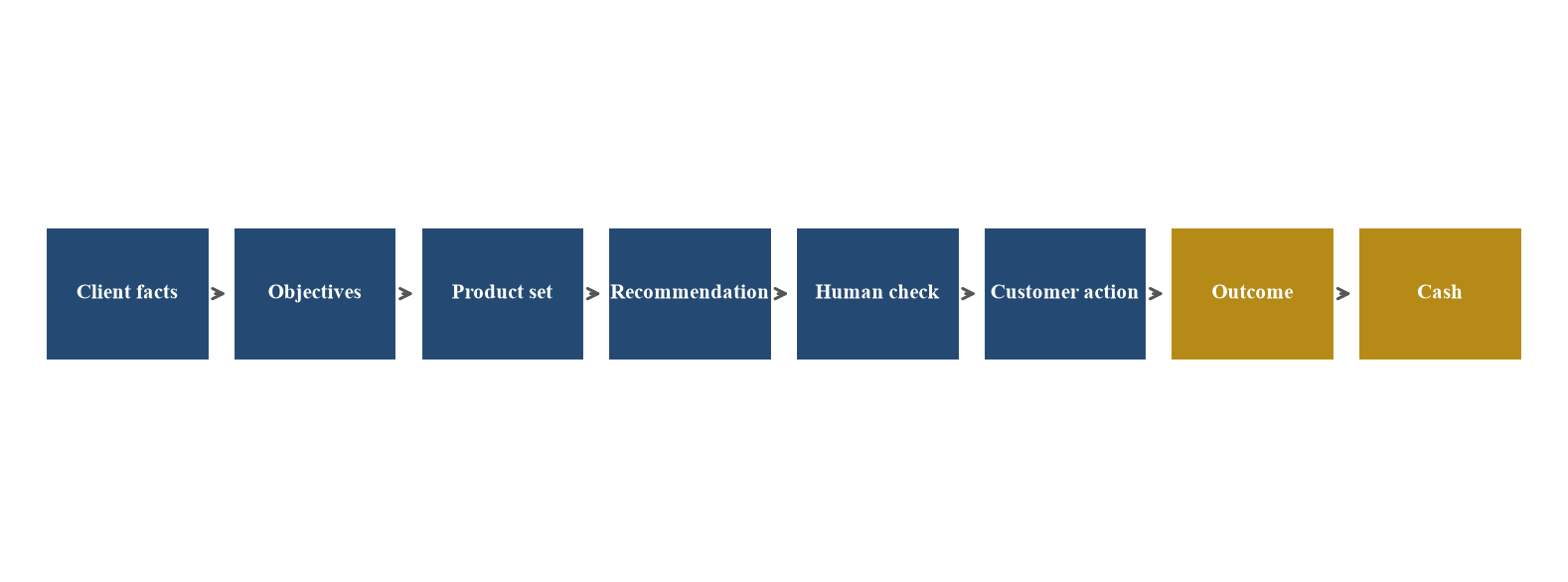
Each transition requires ownership, timestamped evidence and an exception path.
5. Rebuild the client fact base
Client data is an operating asset only when it is lawful, current, complete and decision-relevant. A long profile can still omit the fact that changes suitability. Conversely, collecting more data than the service requires can increase consent, privacy, security and maintenance cost without improving outcomes.
The buyer should sample client records across age, wealth, product, channel, geography, vulnerability, adviser and tenure. It should compare stated answers with behaviour, complaints, withdrawals and adviser notes; inconsistencies should be resolved through controlled processes rather than silently overwritten. Digital questionnaires should test comprehension and contradictory answers, because interface design can steer risk tolerance or create false precision.[10]
Freshness should be measured by field and event. Contact data, employment, dependants, liquidity needs, tax residence, investment experience and capacity for loss age at different rates. The system should identify which recommendations depend on each fact and which events require refresh or suspension.
Data provenance matters in M&A. Aggregated bank data, open-finance feeds, behavioural signals and external enrichment may have separate rights and purposes. The acquirer should verify transferability, customer notice, vendor contracts, retention limits and the consequences of change of control. Value supported by data that cannot lawfully move should be excluded or made contingent.
Data-quality economics
Data quality should be measured at the point of use. A field can be technically populated while economically unreliable. A household-income value may be self-reported years earlier; a liquidity requirement may sit in an adviser note that the engine cannot read; an external account feed may omit pensions or private assets. The buyer should evaluate completeness, freshness, consistency, provenance and decision sensitivity for each material input.
Sensitivity analysis identifies which defects matter. If a small change in capacity for loss moves a customer into a different portfolio, that field needs tighter validation and refresh. If a product remains suitable across a broad range, precision may add little. This approach directs spending toward decision-critical data rather than maximising the number of fields collected.
The operating model should price correction. Customer prompts create abandonment; adviser follow-up consumes time; third-party verification incurs fees; inconsistent records require investigation. These costs should be attributed to the recommendation cohorts that depend on the data. Management should also quantify restrictions caused by missing facts and distinguish responsible stops from avoidable failures. A high completion rate achieved by defaulting unknown values can inflate revenue and future redress together. Transaction value should reward verified, decision-relevant data and a controlled method for managing uncertainty.
6. Measure the depth and cost of personalisation
Personalisation is valuable when it improves a relevant outcome; it is costly when each incremental feature requires new data, model complexity, testing, disclosure and supervision. The transaction team should measure depth by the number of client dimensions used, product choices affected, decisions automated, communication variants created and downstream actions triggered.
A shallow system may personalise language while preserving one standard allocation. A deeper system may change tax wrappers, liquidity buffers, risk exposures, sustainability characteristics, drawdown paths and rebalancing. The second system can create more value, while it requires stronger fact collection, product data, optimisation controls and human review.
Cost should be attributed to the feature that creates it. A new tax-personalisation module may require jurisdiction logic, annual thresholds, customer verification, legal review, testing and support. A vulnerability feature may require careful data handling, accessible communications and specialist escalation. Generic technology overhead hides whether the feature earns its cost.
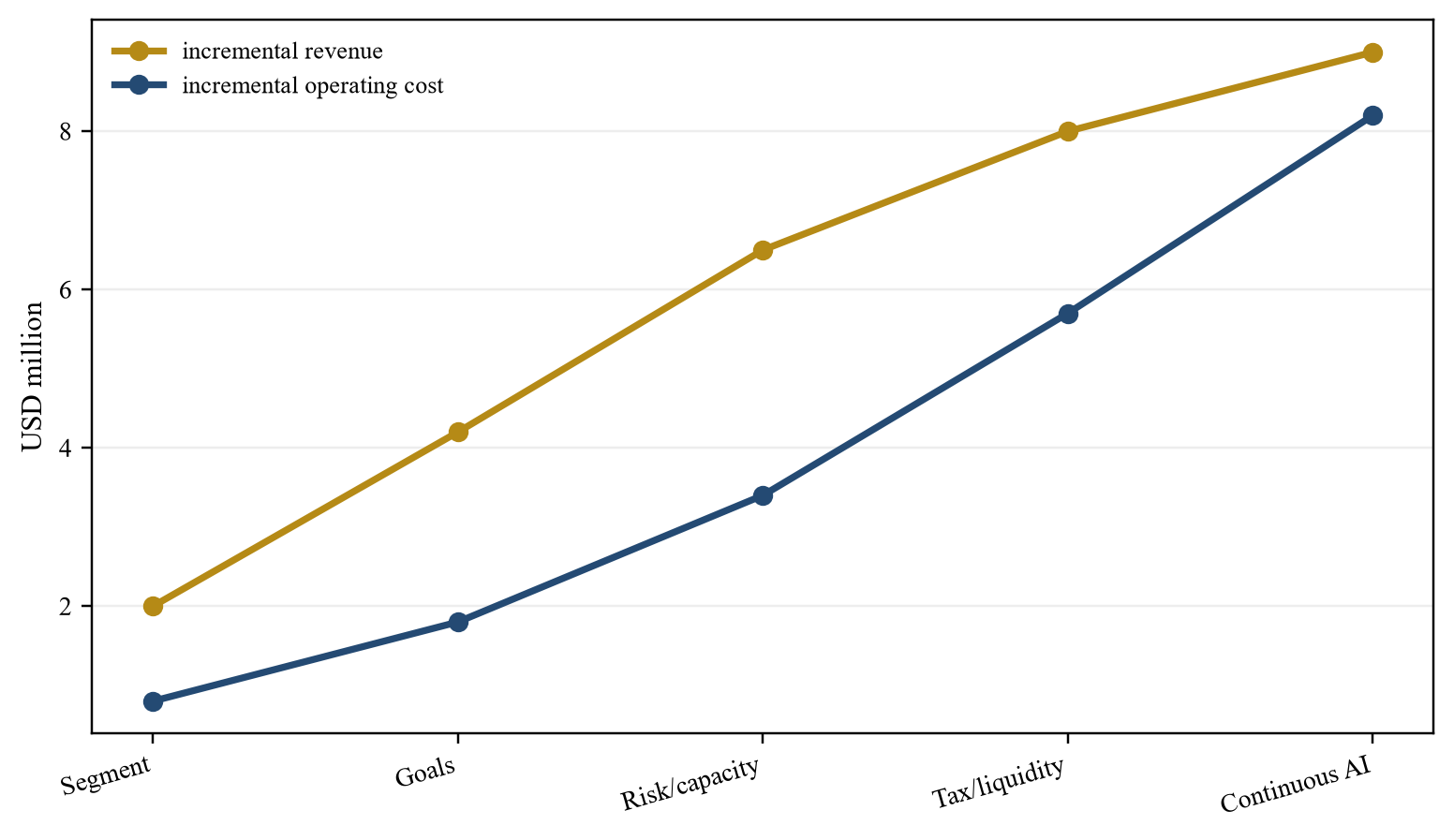
Wholly hypothetical annual USD millions; values demonstrate the method only.
7. Test recommendation logic and constraints
The buyer should test the entire decision system: eligibility rules, risk mapping, product filters, optimisation objective, constraints, tie-breakers, disclosures and post-processing. Model performance alone is insufficient. A statistically strong prediction can generate unsuitable action when the objective rewards engagement, the product set is restricted or a constraint is missing.
Test cases should include ordinary and boundary customers. Scenarios should cover incomplete information, contradictory answers, sudden liquidity need, low capacity for loss, concentrated holdings, complex products, high fees, vulnerable circumstances and market stress. The expected response may be a recommendation, warning, adviser referral, restricted journey or no action.
The system should distinguish deterministic policy from probabilistic inference. Hard legal or product constraints should not depend on a language model following a prompt. Generative components can summarise or explain, while control-critical calculations and exclusions require versioned logic, tested data and reproducible outputs.
Override analysis reveals hidden economics. High override rates can indicate weak model quality or adviser distrust. Very low rates can indicate automation bias or incentives to accept. The buyer should measure who overrides, why, which direction changes, what customers do and whether outcomes improve.
Validation design
Validation should be independent of the team that receives the primary commercial benefit from deployment. Independence can be organisational or procedural; the essential features are authority to challenge, access to data, competent reviewers and documented closure. Validation should cover conceptual soundness, data, implementation, performance, stability, explainability, fairness, security and use within the wider business process.
Back-testing needs meaningful outcomes. Clicks and acceptance reveal behaviour, while they do not establish suitability. Useful tests can include recommendation consistency, constraint breaches, risk realised relative to capacity, fee drag, concentration, liquidity, customer persistence, complaint incidence and adviser correction. Market performance should be interpreted carefully because a suitable portfolio can lose value and an unsuitable position can profit.
Change control should define which modifications require revalidation. A new foundation model, prompt, feature, product feed, optimisation weight, user interface or customer segment can change output. The platform should retain a release record, approval, test result, rollback plan and affected population. Emergency changes need retrospective review. The buyer should inspect production drift between approved design and actual use, including unofficial spreadsheets, adviser workarounds and vendor updates. Valuation should reflect the cost and time needed to bring uncontrolled variants into one governed system.
| Control | Test | Evidence | Valuation relevance |
|---|---|---|---|
| client completeness | missing and contradictory facts | validation and stop decision | addressable served population |
| risk and capacity | boundary and stress cases | input-output trace | redress and attrition risk |
| product filter | prohibited and high-cost products | deterministic exclusion | conduct and product-governance risk |
| optimisation objective | engagement versus customer outcome | objective and constraint record | conflict and revenue quality |
| model version | repeat historical recommendation | reproducible result | auditability and integration |
| human override | accept, reject and amend | reason and outcome | supervision cost and model trust |
| communication | explanation and warning | delivered artefact | complaint defensibility |
Proposed tests; applicable rules and product design determine final acceptance criteria.
8. Govern product data and the recommendation universe
Suitability depends on knowing the product as well as the client. Product data should include structure, target market, liquidity, volatility, loss scenarios, leverage, currency, concentration, fees, exit terms, sustainability characteristics and operational dependencies. Static descriptions are inadequate when risk and terms change.
The recommendation universe can create conflicts. A platform limited to affiliated funds or commercial partners may still produce mathematically personalised outputs within a restricted set. The buyer should identify exclusions, shelf fees, revenue sharing, proprietary products, campaign priorities and ranking effects. Customer disclosures and conflict controls should match actual behaviour.[7][17]
The transaction team should trace product onboarding, approval, monitoring and withdrawal. It should test who can change a risk rating, how rapidly restrictions propagate and whether existing portfolios are reviewed. Product governance should connect the intended target market to observed customers and outcomes.
Data ownership affects integration. Third-party product feeds may restrict reuse, storage, model training or redistribution. A buyer should confirm licence scope, service levels, error correction, historical access and transition support. Rebuilding an apparently simple feed can delay migration and impair recommendation continuity.
Product-governance reconciliation
Product governance should reconcile three views: the manufacturer target market, the distributor assessment and the customer recommendation. Differences can be legitimate, while they require explanation. The target should show how product characteristics enter eligibility and ranking, how negative target-market cases are controlled and how sales outside the expected population are reviewed.
Fees and incentives should be traced through the same logic. A platform may receive custody, platform, fund, transaction, referral or service revenue. The buyer should compare recommendation rates and customer outcomes across economic relationships. Where proprietary or affiliated products receive prominence, evidence should show the customer rationale and the control applied to the conflict.
Product change creates a monitoring obligation. A fund can alter strategy, cost, liquidity, manager or risk; a structured product can approach a barrier; a bond can deteriorate; a tax wrapper can change. The system should identify affected customers and determine whether review, warning or action is required. The transaction team should inspect actual events and elapsed response time. An attractive recommendation engine that lacks ongoing product monitoring may shift cost to advisers and complaints after closing. The valuation model should include the staff, data and operating procedures required to sustain the product universe.
9. Detect bias, differential outcomes and vulnerability
Personalisation can improve inclusion while creating differential outcomes that are difficult to explain. A model may use location, device, behaviour or language as proxies for protected or vulnerable characteristics. Even when a field is excluded, correlated variables can reproduce the effect.
The buyer should compare offer, recommendation, completion, fee, risk, complaint, override and outcome rates across relevant customer groups. The purpose is diagnostic; legal conclusions require jurisdiction-specific analysis. Differences should be connected to legitimate objectives, data quality, product availability and customer need, with remediation where outcomes are inconsistent with obligations.[5][32][33]
Vulnerability cannot be reduced to a permanent label. Health, bereavement, financial shock, low capability, language and digital access can change through time. The platform should support sensitive identification, limited access, appropriate assistance and escalation without using vulnerability primarily as a sales signal.
The acquisition model should include the cost of accessible design, specialist teams, monitoring and remediation. A platform that serves broader populations may create significant value; the value is durable only when service quality and economics survive the additional operating requirements.
10. Price human supervision honestly
Human oversight is a workflow with capacity, competence and incentives. A nominal approval click has limited value when the reviewer cannot see the evidence, understand the model or change the outcome. Effective intervention requires information, authority, time, training and feedback.
The buyer should measure review volume, handling time, queue age, exception complexity, adviser utilisation, escalation, quality assurance and rework. It should separate routine approval from genuine judgement. As volume grows, a fixed human team can become a hidden constraint; service deteriorates through delay, superficial review or unrecorded workarounds.
Supervision should focus on material decisions and abnormal conditions. Low-risk, well-tested journeys may use sampling and automated controls. Novel products, weak data, vulnerable circumstances, large losses or model uncertainty may require mandatory intervention. Thresholds should be documented and tested.
Cost forecasts should include first-line review, specialist escalation, compliance monitoring, model validation, customer support and management governance. Adviser productivity improvements are credible only when the same definition includes the time spent correcting, documenting and explaining AI output.
Capacity and quality model
The supervision model should convert customer activity into work. Each journey produces a probability of automated completion, routine review, specialist review, customer clarification, complaint or remediation. Multiplying those probabilities by handling time and service standards creates a transparent capacity requirement. The model should include peaks caused by market volatility, tax deadlines, product events and integration releases.
Quality assurance should sample decisions by risk as well as volume. Random sampling estimates broad error rates; targeted sampling tests high-loss or unusual cases. Review findings should feed model, policy, training and product changes. Repeat errors indicate a system problem even when individual cases are corrected. The buyer should verify that remediation reaches the affected population rather than only the reviewed sample.
Incentives can undermine supervision. Reviewers paid for throughput may avoid escalation; advisers rewarded for assets or products may accept recommendations that support sales; model teams measured on conversion may resist restrictive controls. Governance should define balanced objectives and independent challenge. The acquisition case should model a sustainable quality level and identify the revenue effect of appropriate restrictions. This makes supervision a designed operating capability rather than an unpriced promise of human oversight.
11. Reconstruct suitability statements and customer communications
The suitability statement should explain why the recommendation fits the client, including objectives and personal circumstances. A generic narrative assembled after the event is not equivalent to a contemporaneous rationale. The buyer should compare statements with the actual client snapshot, product facts and decision path.[9][10]
Generated explanations can improve clarity, consistency and language coverage. They can also hallucinate facts, omit limitations or create a persuasive account for logic that did not drive the recommendation. The controlled architecture should ground text in approved evidence, protect numerical and legal content, validate required elements and escalate uncertainty.
Communications should be tested for fair presentation, comprehension and action. A technically accurate statement can still fail if material risks are buried, costs are fragmented or language is unsuitable for the customer. Firms should monitor whether customers understand, proceed, abandon, complain or seek help.
Recordkeeping should retain the delivered version, not merely a template. Channel changes, adviser edits, translations and post-delivery corrections should be versioned. During M&A, the buyer should test retrieval across legacy systems and retention periods because missing evidence can turn an operational issue into redress uncertainty.
| Evidence object | Primary owner | Recurring cost driver | Failure consequence |
|---|---|---|---|
| client snapshot | customer operations | refresh and exception handling | unsuitable or unsupported decision |
| product profile | product governance | data licence and review | incorrect matching |
| model and constraints | technology and investment | validation and change control | biased or unstable output |
| human decision | advice or supervision | capacity and competence | rubber-stamp approval |
| delivered statement | regulated entity | generation, QA and retention | weak complaint defence |
| outcome record | product and compliance | monitoring and analysis | hidden harm or attrition |
| complaint and redress | operations and legal | investigation and payment | cash loss and reputation damage |
Proposed responsibility map; actual accountability depends on the operating and legal structure.
12. Rebuild unit economics after the suitability bill
Revenue should be reconciled to assets, pricing, customer action, retention and cash. Assets under administration or management can overstate economics when pricing is promotional, balances are inactive, revenue is shared or customers have not remained through a full cycle.
The hypothetical case has 250,000 clients and USD 5.0 billion of assets. Gross revenue is 55 basis points, or USD 27.5 million. Asset servicing and market data cost 12 basis points; acquisition and distribution cost 10; advice and model operations cost 7; human supervision costs 4; compliance, complaints and expected redress cost 3. Contribution before central cost, tax and capital is 19 basis points, or USD 9.5 million.
These figures are management assumptions for method demonstration. They should not be treated as market evidence. Actual analysis should segment by jurisdiction, service type, cohort, channel, adviser, product, wealth band and tenure. The board should reconcile accounting revenue to collected cash and identify costs held elsewhere in the group.
Cohort profitability method
Customer cohorts should start when the economically material relationship begins, not when an account is created. A downloaded application or empty account may contribute little. The buyer should define funded, advised, active and retained customers, then reconcile movement between states. Assets should be separated into market movement, net flows, acquisition, transfer and closure.
Revenue needs the same treatment. Headline basis points can include interest spread, platform fees, advice fees, fund rebates, trading revenue and one-off charges. Each component has different sensitivity and conflict implications. Direct cost should include custody, market data, cloud, model services, communications, adviser time, supervision, support, complaint handling and expected redress. Shared group costs should be allocated where the target relies on capabilities that will need replacement after separation.
The resulting contribution curve should be shown by cohort age. Acquisition spend appears early; advice and support may be concentrated around onboarding; complaint and redress costs can arrive later. Mature cohorts reveal whether pricing covers the full service. Forecasts should preserve the relationship between assets, service intensity and cost. A projection that raises personalised engagement while holding human and compliance cost flat requires operational evidence, such as tested automation, lower exception rates or measured reviewer productivity.
| Item | Basis points on assets | USD million |
|---|---|---|
| client assets | 10,000 | 5,000.0 |
| gross revenue | 55 | 27.5 |
| asset servicing and market data | (12) | (6.0) |
| acquisition and distribution | (10) | (5.0) |
| advice and model operations | (7) | (3.5) |
| human supervision | (4) | (2.0) |
| compliance, complaints and redress | (3) | (1.5) |
| contribution before central cost | 19 | 9.5 |
Wholly hypothetical USD millions and basis points; the table is not a market benchmark.
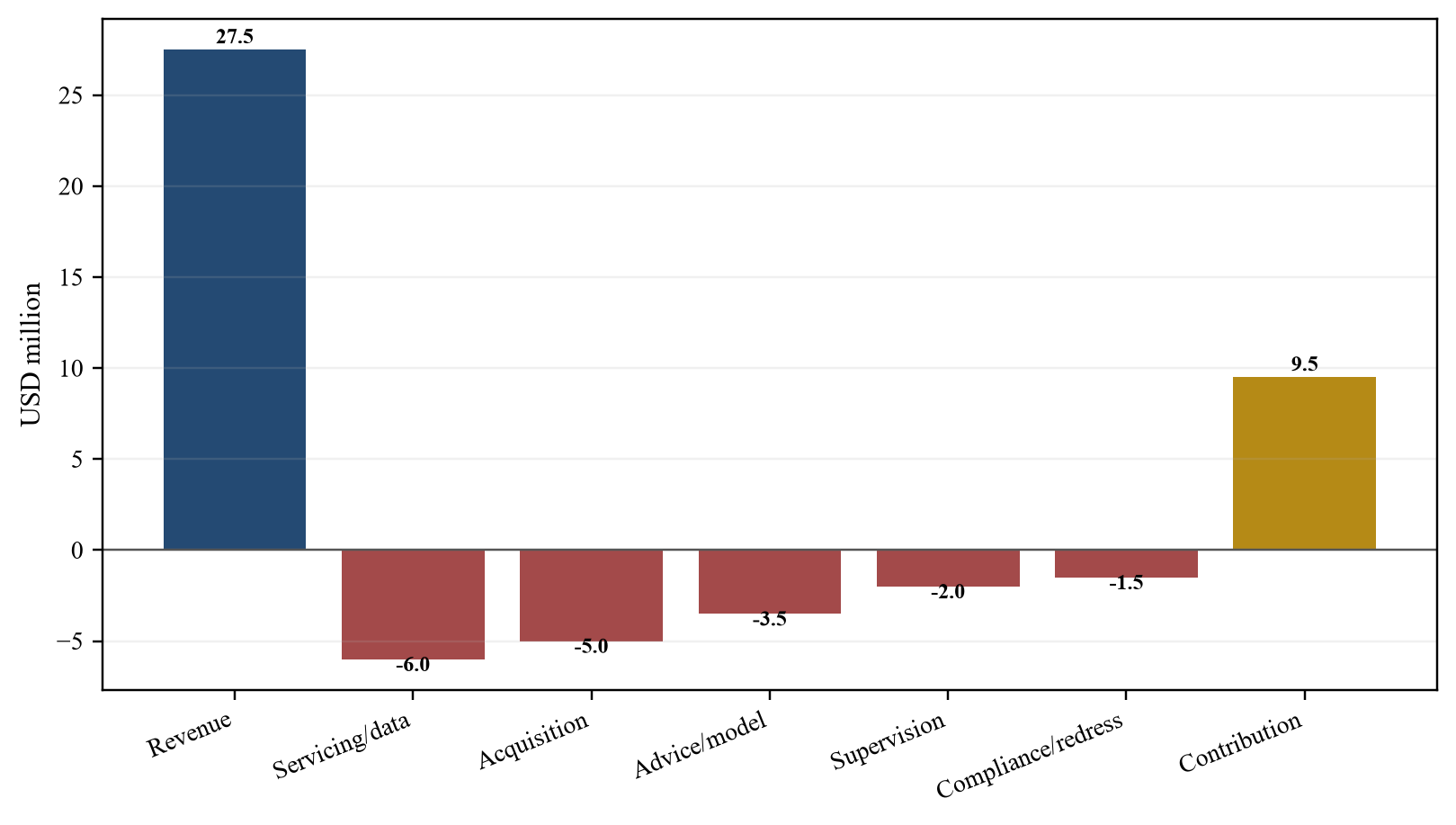
Wholly hypothetical USD millions; central cost, tax and capital remain outside the displayed contribution.
13. Measure engagement, retention and customer outcomes together
Personalisation can raise visits, click-through, deposits and trades. Those metrics become valuable only when they lead to suitable behaviour, durable assets and acceptable customer outcomes. Optimising an intermediate action can create activity without wealth accumulation or collected profit.
The buyer should follow cohorts from first interaction through fact completion, recommendation, acceptance, funding, retention, withdrawal and complaint. Cohorts should be defined by product version, model version, channel and customer characteristics. Aggregate retention can conceal that recent AI-acquired customers leave before acquisition cost is recovered.
Outcome measurement should combine commercial and conduct indicators. Relevant measures can include time invested, diversification, cash drag, fee burden, drawdown behaviour, goal progress, service usage, abandonment, complaint, override and vulnerability support. The metric set should reflect the service; it should not imply that the firm controls market returns.
Causal claims require care. Customers receiving deeper personalisation may already be more engaged or wealthier. The target should use controlled tests where appropriate, document selection effects and separate product changes from communication effects. Management estimates should be identified and prevented from becoming valuation facts through repetition.
The investment case should assign value to mature cohorts. Early engagement uplift can support an option, while consideration or integration spend should be released after assets and contribution persist through a meaningful period.
14. Price complaints, redress and remediation
Complaints are information about the control system. Volume alone is insufficient; the buyer should classify cause, product, model, adviser, customer group, financial effect, resolution time and repeat pattern. A low complaint rate may reflect effective service, weak detection or difficult escalation.
Suitability redress should be reconstructed from files rather than booked labels. The transaction team should examine the original facts, recommendation, communication, customer action, loss methodology, settlement and recovery. It should test whether similar cases remain outside the recognised population and whether limitation or insurance assumptions are enforceable.
Provisioning needs a cohort method. Recently deployed models have immature tails because complaints and market effects emerge later. A platform that has operated only in rising markets may not reveal how customers react to drawdowns, liquidity stress or product failure. Historical outcomes should be segmented by market regime and time since recommendation.
Remediation cost includes customer contact, file review, calculation, payment, regulatory reporting, legal work, model change and operational disruption. The acquisition model should also reflect foregone sales or restricted journeys during repair. These costs can interact; a data weakness can expand the review population and reduce the evidence available to defend cases.
Redress population method
The buyer should build a population waterfall. Start with all decisions made by the relevant product, model or adviser during the period. Remove cases only through documented criteria, such as a verified unaffected model version or product. Divide the remaining population into evidence-complete, evidence-partial and evidence-missing groups. Each group requires a different review method and assumption.
Financial impact should separate customer loss, foregone gain where applicable, fees, interest, tax, administration, professional cost and insurance recovery. Legal and regulatory specialists should determine the methodology. The valuation model should show gross exposure, expected payment, timing, operating cost and tax separately because they affect cash and purchase-price protection differently.
Root-cause analysis should connect complaints to the wider population. If a complaint reveals stale data, an unsuitable product mapping or a misleading explanation, the team should determine which other customers encountered the same condition. A case-by-case closure process can understate systemic exposure. The board should see central, downside and severe populations, the evidence supporting each, and management actions capable of reducing uncertainty. Where files cannot support a reliable estimate, escrow or contingent value may be more defensible than a probability-weighted discount.
15. Model the cost curve at scale
Digital advice is often presented as near-zero marginal cost. Infrastructure can scale cheaply, while suitability cost may rise in steps. New jurisdictions add permissions, product data, tax logic and language. New customer groups add accessibility and support. New products add research, governance and disclosure. Model complexity adds validation and monitoring.
The buyer should separate variable, step-fixed and tail costs. Cloud inference, data calls and statements may vary with interactions. Compliance teams, model validators and specialist advisers grow in capacity bands. Complaints and remediation create skewed costs that appear after deployment. Insurance and regulatory capital may respond to exposure rather than current revenue.
Unit economics should include the cost of saying no. Restricting a journey can reduce conversion while protecting customers and future cash. A model that counts every stopped sale as lost revenue will pressure controls. The board should distinguish avoidable friction from necessary protection and measure both.
Scenario analysis should test growth with constant quality. Adviser queue time, stale-data share, override quality, complaint age, model-monitoring coverage and service uptime can reveal when scale is consuming control capacity. Capital should be released when evidence shows the operating system is scaling, not simply when customer numbers rise.
16. Test third parties, resilience and exit
Wealthtech stacks often depend on cloud, model, market-data, product-data, identity, open-finance, execution, custody, communications and adviser systems. Outsourcing does not transfer regulated responsibility. DORA and supervisory guidance emphasise ICT risk, third-party oversight, continuity and exit planning for relevant firms.[23][24][25]
The buyer should map each dependency to customer service and evidence. A model outage can stop recommendations. A product-data error can affect suitability. A communications failure can prevent warnings. A lost model version can impair complaint reconstruction. Criticality should reflect customer and regulatory effect, not only annual vendor spend.
Contracts should address audit, incident notification, subcontracting, data location, intellectual property, service levels, assistance, change of control, portability, transition and deletion. Technical tests should verify backup, failover, degraded service, manual processing and recovery. A contractual exit right without data, documentation and replacement capacity has little operational value.
| Capability | Strong evidence | Weak evidence | Transaction response |
|---|---|---|---|
| client-data service | versioned source and reconciliation | untraceable aggregated profile | remediation and data discount |
| recommendation engine | reproducible version and tests | opaque vendor response | closing condition or value deduction |
| product data | monitored feed and fallback | one untested source | continuity covenant |
| human review | capacity and trained alternative | informal escalation | funded operating plan |
| customer communication | retained delivered artefact | template-only archive | evidence remediation |
| incident recovery | rehearsed end-to-end test | component backup only | integration holdback |
| vendor exit | tested export and replacement plan | contractual right only | contingent value |
Proposed matrix; materiality determines test depth and transaction response.
17. Apply privacy and automated-decision safeguards
Personalisation depends on profiling. The buyer should establish the lawful basis, purpose, notice, minimisation, retention, access and sharing for each data category. Consent, contract and legitimate-interest analyses are fact-specific. Data collected for service may not automatically be available for marketing, model training or acquisition integration.
GDPR Article 22 addresses solely automated decisions with legal or similarly significant effects and provides safeguards under specified conditions.[21] The EU AI Act adds obligations according to system role and risk classification.[20] The UK Information Commissioner and European Data Protection Board provide guidance on AI, profiling, transparency and rights.[26][27] The transaction team should identify where human involvement is genuine, where an automated output determines customer treatment and how challenges are handled.
Model development should preserve lineage from raw data to features, labels, training sets, validation and production. Special-category, inferred and behavioural data require particular attention. The buyer should inspect whether deletion, correction or consent withdrawal propagates through operational and analytical stores.
Integration can change purpose and access. Combining brokerage, banking, insurance and external data may enable richer advice while creating new regulatory and customer expectations. Synergy value should be contingent on lawful design, customer communication and tested controls rather than assumed from technical availability.
18. Value the platform by evidence layer
The platform should be valued as an operating evidence system. Software, client data, permissions, product relationships, models, adviser workflows and customer trust contribute only when they support transferable and collected economics. The buyer should value components separately and apply evidence weights.
The hypothetical bridge begins with USD 125 million of stand-alone operating value. Evidenced engagement and retention adds USD 18 million. Buyer distribution adds USD 12 million. Recurring suitability and supervision cost reduces value by USD 10 million; remediation by USD 8 million; data and privacy uncertainty by USD 7 million; integration by USD 5 million. The resulting illustrative equity value remains USD 125 million.
The arithmetic is methodological. It prevents gross synergy from being presented without the costs required to earn it. Evidence weights should reflect contractual transferability, cohort maturity, regulatory permissions, technical reproducibility and implementation readiness.
Valuation triangulation
Discounted cash flow should be built from cohort contribution, not a single revenue growth rate. The model should project assets, flows, pricing, service intensity, supervision, complaints, remediation and reinvestment. Terminal economics should reflect the mature suitability cost rather than the temporary benefit of underbuilt controls. Cash conversion should account for regulatory capital, insurance, working capital and delayed redress.
Market multiples can provide a reasonableness check when definitions align. Wealthtech businesses differ in permission, product, asset mix, advice intensity, custody, geography, growth and profitability. The buyer should normalise revenue for pass-through items and identify whether peers bear the same advice and control costs. A high multiple applied to gross revenue can capitalise costs that belong to customers, advisers or another group entity.
An evidence-weighted sum of parts is useful for uncertain synergy. Existing contribution can receive a conventional operating value. Distribution synergy can be weighted by customer access, consent, adviser adoption and integration readiness. Data synergy can be weighted by rights and quality. New-product value can be contingent on permission and tested outcomes. Risk deductions should remain separate so that management can see what action releases value. The three methods should reconcile through common assumptions and produce a range that the purchase agreement can protect.
| Layer | Gross value | Evidence weight | Included value |
|---|---|---|---|
| stand-alone operating value | 125 | 100% | 125 |
| engagement and retention | 18 | 100% | 18 |
| buyer distribution | 24 | 50% | 12 |
| suitability and supervision cost | (10) | 100% | (10) |
| remediation programme | (8) | 100% | (8) |
| data and privacy uncertainty | (7) | 100% | (7) |
| integration and continuity | (5) | 100% | (5) |
| illustrative equity value | 137 gross less 12 risk | 125 |
Wholly hypothetical USD millions and evidence weights; amounts are not a valuation opinion.
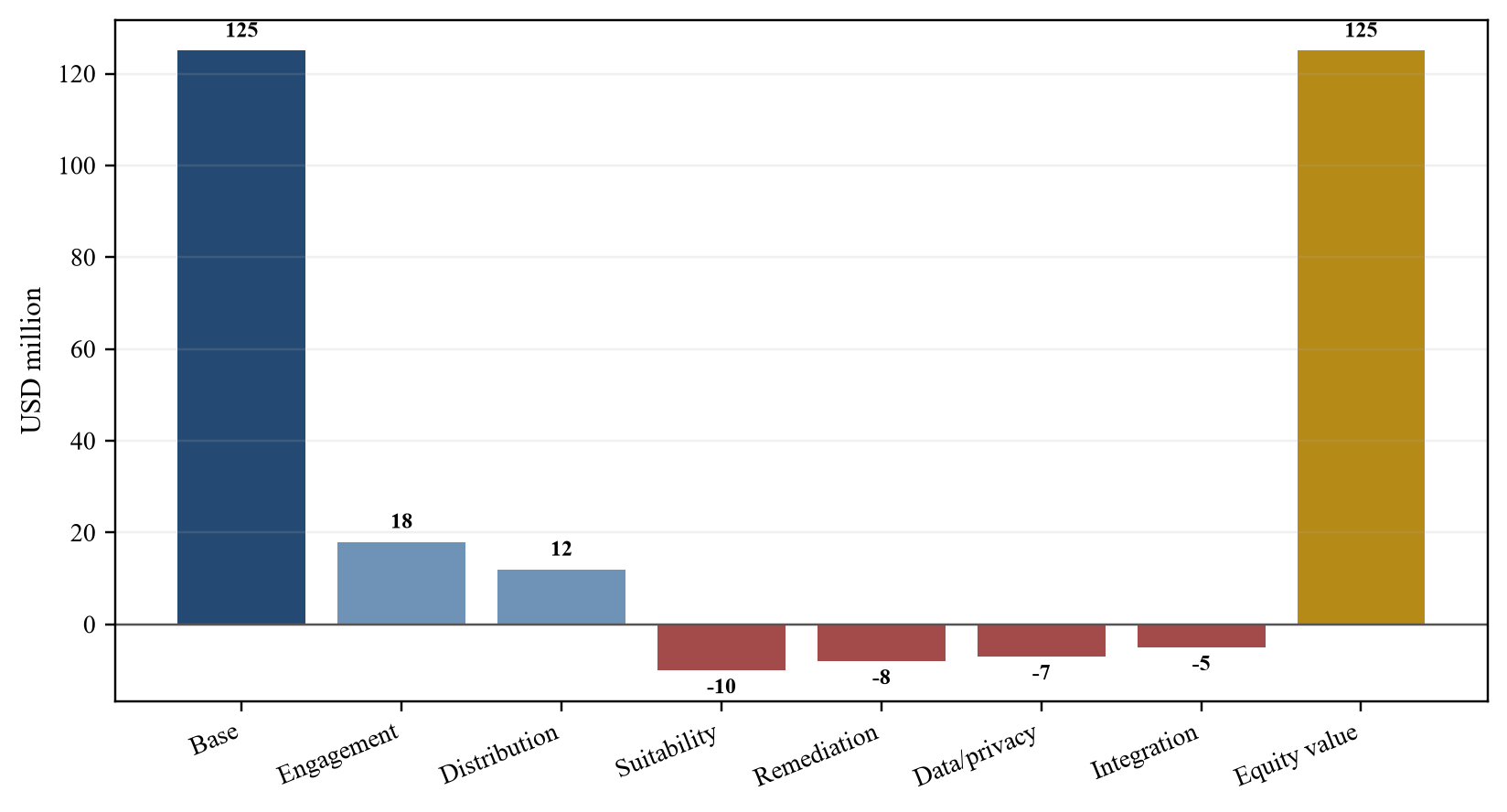
Wholly hypothetical USD millions; the bridge is methodological and is not a valuation opinion.
19. Apply a suitability discount transparently
A suitability discount should quantify the risk that current revenue depends on incomplete facts, weak recommendation evidence, underpriced supervision, unresolved conflicts or immature customer outcomes. It should connect to observable gaps and defined scenarios rather than a generic percentage.
The central case uses the economics in section 12. A downside can assume gross revenue falls from 55 to 50 basis points while supervision and compliance costs rise from 7 to 11 basis points. A severe case can assume lower retained assets, product restrictions, a remediation review and delayed integration. Each case should identify the first point at which contribution, liquidity, service quality or regulatory permission becomes constrained.
The board should avoid false probability. Where evidence is insufficient, the response may be exclusion, contingent consideration, escrow or a closing condition. A weighted average built from unsupported probabilities can create a precise-looking answer without stronger knowledge.
Sensitivity should expose the variables management can control. Revenue pricing, asset retention, review productivity, vendor terms, complaint closure and model quality can improve through action. Market returns are not an operating control and should be separated from service performance.
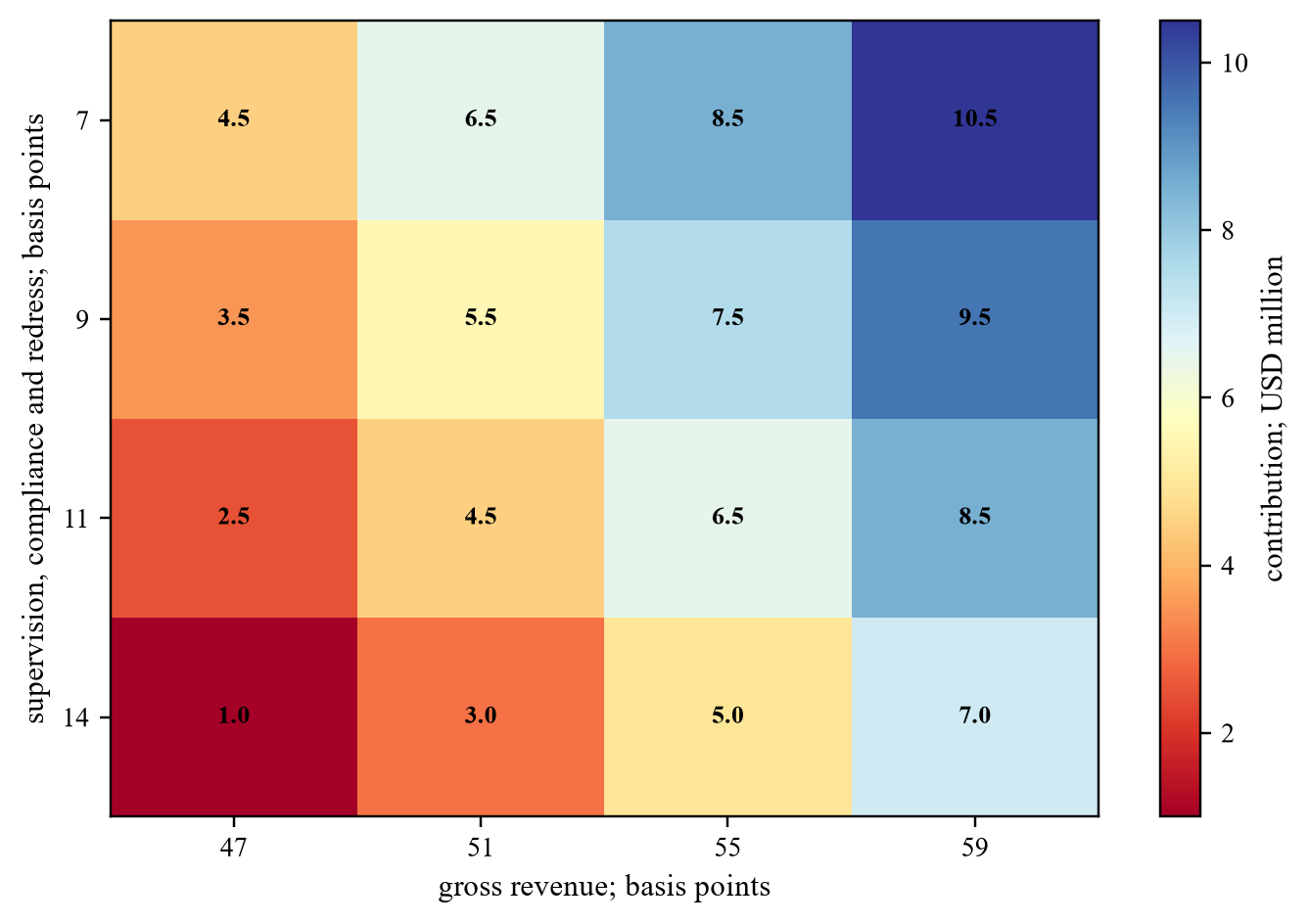
Wholly hypothetical annual USD millions across revenue and suitability-cost cases.
20. Translate evidence into transaction protections
Transaction terms should allocate identified uncertainty. Representations can address licences, permissions, customer data, advice files, product governance, model ownership, conflicts, complaints, redress, vendors, cybersecurity and regulatory correspondence. Definitions should match the diligence data so that protection is enforceable and measurable.
Conditions can require a permission, regulatory non-objection, transfer of critical contracts, delivery of reproducible advice files, closure of a material control gap or funding of a remediation reserve. Covenants should govern model, product, pricing, data and vendor changes between signing and closing.
Escrow, indemnity, retention and insurance should match enforceable exposure. Contingent consideration can be tied to retained suitable assets, mature complaint cohorts, verified contribution, adviser adoption and tested controls. Revenue milestones alone can reward growth that expands future redress.
The buyer should preserve optionality. If one jurisdiction or product lacks evidence, a carve-out, delayed migration or restricted launch may protect the wider transaction. The integration plan and purchase agreement should use the same evidence gates.
| Evidence gap | Price response | Protection | Release evidence |
|---|---|---|---|
| stale client facts | cohort value deferral | remediation condition | refreshed material population |
| unseasoned AI recommendations | exclude forecast premium | retention or earn-out | mature outcomes and contribution |
| weak advice-file reconstruction | funded deduction | escrow and covenant | reproducible historical sample |
| uncertain data transfer | exclude dependent synergy | condition and representation | executed lawful transfer plan |
| underpriced human supervision | operating-plan deduction | completion funding | capacity and quality test |
| complaint tail uncertainty | reserve adjustment | indemnity and escrow | closed cohort and paid outcomes |
| critical vendor dependency | continuity deduction | consent and exit covenant | approved transfer and tested fallback |
Proposed matrix; legal drafting and remedies remain transaction-specific.
21. Design integration around customer continuity
Integration can change the facts that supported suitability. Product shelves, pricing, advisers, models, data sources, custody, communications and legal entities may change. The buyer should identify which recommendations, mandates and ongoing reviews must be reassessed before migration.
Customer continuity comes first. The target should preserve access, trading, withdrawals, statements, complaints and support while systems change. Data reconciliation should be performed at customer and portfolio level. Exceptions should have owners, severity, deadline and customer-impact assessment.
Model migration should be treated as a controlled change. The combined firm should compare old and new outputs on matched cases, investigate differences, validate disclosures and monitor post-migration outcomes. A technically successful migration can still alter recommendations or customer treatment.
People and incentives matter. Advisers need training, confidence and time to use the new system. Sales targets should not pressure acceptance of AI suggestions. Compliance, product, technology and customer operations need shared definitions for override, complaint, suitability, harm and value.
Synergy should be released after operational evidence. Cost removal before replacement controls are proven can create apparent savings and later remediation. The board should track recurring contribution, customer outcome and control capacity together.
22. Execute a 180-day programme
Days one to thirty should preserve service, permissions, data, logs, model versions, product files and complaint evidence. The buyer should establish governance, incident paths and restricted changes. It should reconcile headline assets and revenue to custody, billing and cash.
Days thirty to seventy should reconstruct representative recommendations, test client and product data, measure override and review capacity, and identify material gaps. High-risk journeys should be restricted or routed to specialists. Vendor consents and continuity actions should be completed.
Days seventy to one hundred and twenty should remediate priority controls, validate models, refresh material facts, improve suitability statements and test customer communications. Integration pilots should use matched cohorts and reversible releases.
Days one hundred and twenty to one hundred and eighty should season outcomes, verify asset retention and contribution, test complaint and service performance, and release contingent value only after defined evidence gates. Remaining uncertainty should stay in reserves, escrow or delayed scope.
Ongoing governance should assign one accountable executive for the end-to-end suitability system. Board reporting should connect customer facts, model changes, product restrictions, human review, outcomes, complaints, redress, assets and cash.
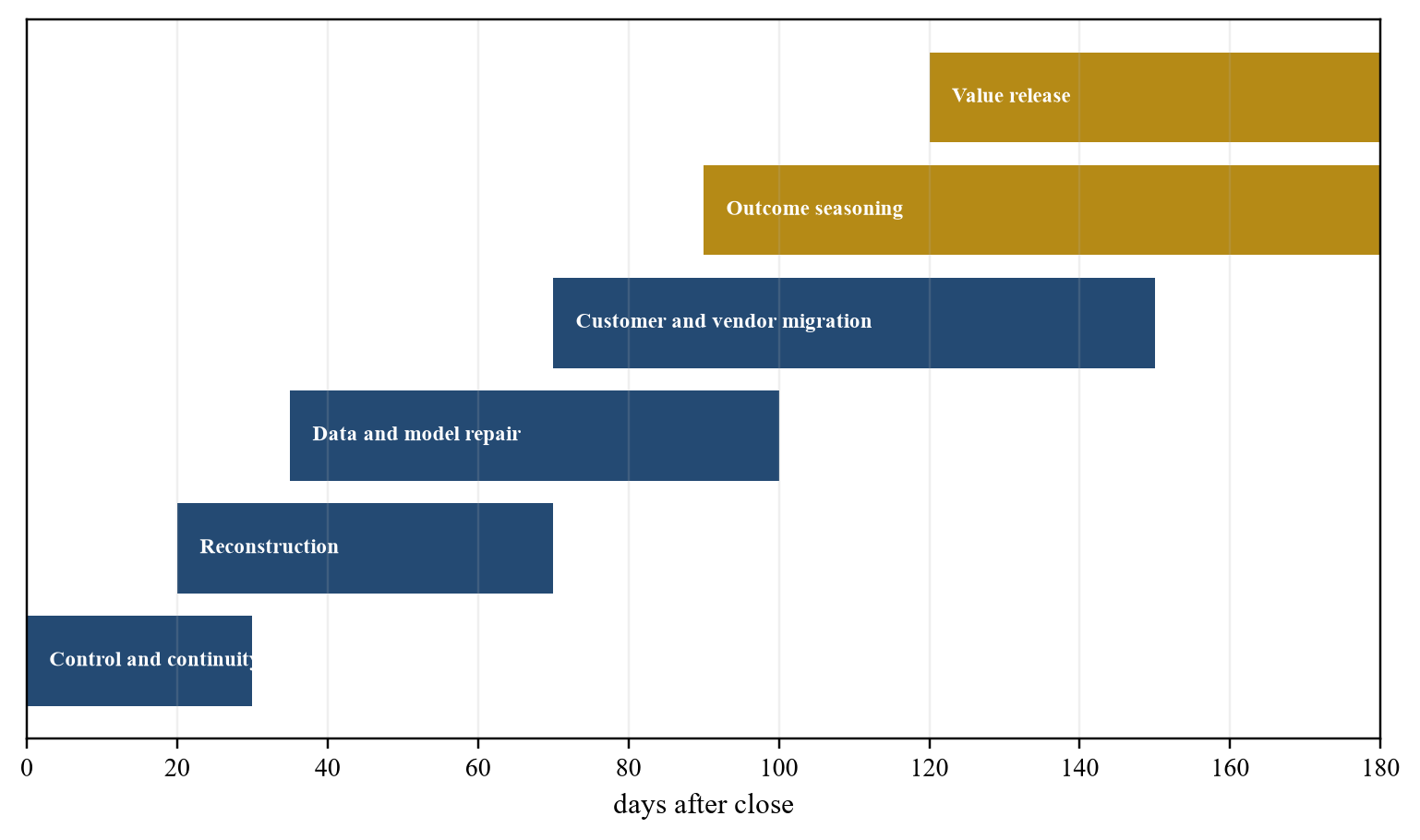
Timing should follow transaction, regulatory, customer and technology constraints.
23. Decision and conclusion
AI wealthtech deserves value when it turns personalisation into demonstrably suitable customer action and durable contribution. Interface quality, model sophistication and large data sets can support that result; they do not prove it. The evidence chain must connect current client facts, understood products, controlled logic, human accountability, clear communication, monitored outcomes and cash.
The buyer should separate service perimeters, reconstruct historical decisions, measure personalisation cost by feature, test conflicts and bias, price human supervision, and reconcile complaints and redress. Third-party resilience, privacy and data transferability should be assessed as operating requirements with valuation consequences.
The suitability bill is recurring. It appears in fact refresh, product governance, model validation, adviser capacity, customer support, recordkeeping, privacy, complaints and remediation. A scalable platform prices these activities into the product and improves their efficiency without weakening the standard of care.
The resulting transaction decision is practical. A premium is supportable when permissions are transferable, recommendation evidence is reproducible, customer outcomes are monitored, retained assets mature, human intervention is effective and contribution survives the full control cost. Price protection, narrower scope, funded remediation or contingent value is appropriate when those conditions remain incomplete.
Sources
- Financial Conduct Authority, PS25/22 targeted support rules Read the primary source
- Financial Conduct Authority Handbook, COBS 9A.2 assessing suitability Read the primary source
- Financial Conduct Authority, AI and the FCA approach Read the primary source
- Financial Conduct Authority, Consumer Duty Read the primary source
- Financial Conduct Authority, Wealth management survey report 2026 Read the primary source
- European Securities and Markets Authority, AI in investment services Read the primary source
- European Securities and Markets Authority, MiFID II Article 25 suitability Read the primary source
- European Securities and Markets Authority, Public statement on AI and investment services Read the primary source
- European Securities and Markets Authority, Guidelines on MiFID II suitability Read the primary source
- European Securities and Markets Authority, 2018 suitability guidelines Read the primary source
- Financial Conduct Authority, Advice and guidance boundary examples Read the primary source
- Financial Conduct Authority, PS22/9 Consumer Duty Read the primary source
- FINRA, Regulatory Notice 24-09 on generative AI Read the primary source
- FINRA, AI applications in the securities industry Read the primary source
- FINRA, AI key challenges and regulatory considerations Read the primary source
- United States Securities and Exchange Commission, Regulation Best Interest Read the primary source
- United States Securities and Exchange Commission, Investment adviser fiduciary interpretation Read the primary source
- FINRA, Rule 2111 suitability FAQ Read the primary source
- United States Securities and Exchange Commission, Withdrawal of predictive data analytics proposal Read the primary source
- European Union, Artificial Intelligence Act Read the primary source
- European Union, General Data Protection Regulation Read the primary source
- European Union, Digital Operational Resilience Act Read the primary source
- European Securities and Markets Authority, AI adoption and trends in securities markets Read the primary source
- European Banking Authority, ICT and security risk management Read the primary source
- European Banking Authority, Outsourcing arrangements Read the primary source
- European Data Protection Board, Automated decision-making and profiling Read the primary source
- UK Information Commissioner's Office, AI and data protection Read the primary source
- IOSCO, AI and machine learning by market intermediaries and asset managers Read the primary source
- National Institute of Standards and Technology, AI Risk Management Framework Read the primary source
- National Institute of Standards and Technology, Generative AI profile Read the primary source
- Organisation for Economic Co-operation and Development, AI principles Read the primary source
- Financial Conduct Authority, Consumer Duty approach Read the primary source
- Financial Conduct Authority, Consumer Duty overview Read the primary source
- Monetary Authority of Singapore, FEAT principles assessment methodology Read the primary source
- Monetary Authority of Singapore, Guidelines on individual accountability and conduct Read the primary source
- Australian Securities and Investments Commission, Digital financial product advice Read the primary source
- Hong Kong Securities and Futures Commission, Guidelines on online distribution and advisory platforms Read the primary source
- Canadian Securities Administrators, Guidance for portfolio managers using online advice Read the primary source
- United States Securities and Exchange Commission, Robo-advisers guidance update Read the primary source
- FINRA, Report on digital investment advice Read the primary source
- Basel Committee on Banking Supervision, Principles for operational resilience Read the primary source
- Basel Committee on Banking Supervision, Principles for third-party risk Read the primary source
- Bank for International Settlements, Regulating AI in the financial sector Read the primary source
- Financial Stability Board, Artificial intelligence and financial stability Read the primary source
- Board of Governors of the Federal Reserve System, SR 11-7 model risk management Read the primary source
- Bank of England, Model risk management principles Read the primary source
- International Organization for Standardization, ISO IEC 42001 Read the primary source
- International Valuation Standards Council, International Valuation Standards Read the primary source
- IFRS Foundation, IFRS 3 Business Combinations Read the primary source
- IFRS Foundation, IAS 38 Intangible Assets Read the primary source
