

1 Define the investment decision
A superconductor investment begins with a description of what the purchaser receives. A network operator may need a cable connection providing specified current and availability. A fusion developer may purchase a magnet design, manufactured coil or integrated test system. A storage purchaser may need a defined power response for a stated duration. This paper proposes separate asset descriptions for those transactions. Their acceptance tests, continuing costs and receipt mechanisms differ, even when the underlying materials share a superconducting property.
The investment committee should identify the decision sought at the present stage. Funding a qualification programme creates an obligation to complete specified work. Buying an installed system creates an obligation to provide the agreed service. Acquiring an operating supplier adds company-level liabilities, working capital and organisational dependencies. Each decision needs its own expenditure perimeter. The proposed opening memorandum records the asset, intended user, required output, evidence already available and outstanding work before any monetary estimate is presented.
That memorandum should explain why the proposed service matters to its purchaser. A constrained corridor, a difficult installation interface or a magnet performance requirement can become a useful diligence question when documented by the actual project team. None of those conditions is assumed to exist for a cited programme. The committee should require project-specific evidence and a comparison with feasible alternatives. Its immediate task is to decide whether the next expenditure can produce an accepted deliverable whose economic role has been defined.
2 Method and limits of the evidence
The method combines bounded documentary research with an original investment framework. Public sources are used for their specific reported activities. Original research describes an engineering demonstration; a supplier release describes the supplier's own announcement; an official project report describes that project's stated progress. The framework connects those records to questions about technical acceptance, installation, support obligations and commercial receipts. It does not convert public publicity into confidential customer diligence or independent certification.
All financial inputs in the worked example are invented. The scenarios examine the effect of specified cost and timing changes under a fixed horizon. They carry no probabilities and contain no estimate of the market price of a real cable, storage system or fusion magnet. Suggested acceptance conditions and contractual structures are author proposals. Engineers, legal advisers, insurers and financial reviewers must adapt them to the actual transaction. The paper contains no fairness opinion or recommendation to purchase a security.
The evidence set has important limitations. It does not include supplier order books, executed procurement contracts, customer outage records, certified lifetime tests or comparable transaction prices. Public disclosures may omit unsuccessful tests and contractual qualifications. A historical storage deployment provides context for an application; it establishes no current market share or cost competitiveness. These limits shape the proposed process: record what each source supports, request the missing evidence and condition further expenditure on the unresolved issue that matters to the decision.
3 Read magnet demonstrations within their boundaries
Hartwig and colleagues describe the SPARC Toroidal Field Model Coil programme, including a representative approximately three-metre REBCO magnet that reached a peak field on conductor of 20.1 tesla [1]. The reported result concerns the programme's stated engineering configuration and tests. It supplies a technical reference for questions about high-field magnet development. It establishes no electricity-sales forecast or operating history for a commercial fusion power plant.
Tokamak Energy reported completion of its Demo4 campaign in September 2026. Its disclosure gives a peak field of 13.7 tesla and approximately 10,000 hours in different states of energisation [6]. These are company-reported campaign measures. The operating hours cannot be treated as hours at peak field throughout, and the disclosure alone supplies no independently audited lifetime or customer availability guarantee. A purchaser should obtain the underlying protocols, operating-state definitions and relevant acceptance records for its own required configuration.
The proposed diligence record keeps the measured output beside the conditions producing it. A field value should be accompanied by geometry, temperature, current, duration and the applicable measurement definition. Reviewers then ask which conditions the commercial specification changes. Different duty cycles or integration arrangements may require additional tests. The author recommends a written transfer assessment identifying evidence that applies directly, evidence requiring engineering justification and requirements still awaiting demonstration. This assessment determines a qualification budget without assigning a universal readiness score from an isolated headline result.
4 Examine cable development as a complete connection
The European Commission's SCARLET fact sheet describes development of superconducting cables using liquid nitrogen and liquid hydrogen cooling approaches. Its current project period runs from September 2022 to February 2027 [2]. The official periodic report covering March 2024 to August 2025 records cable designs, thermal and hydraulic studies, and modelling of fault behaviour. It also identifies cable feasibility demonstration as an important remaining outcome [3]. These records concern a development programme and its stated progress.
For an actual network investment, the author proposes describing the complete connection between its nominated terminals. The record should identify cable length, operating mode, current requirement, cooling arrangement, civil works, protection equipment and interfaces with the existing network. Project-specific permissions and installation constraints belong in the same description. An investor then needs a cost estimate for that complete scope and evidence that the proposed alternatives provide the same required service. A conductor quotation alone leaves several economically important items outside the comparison.
The reported development work suggests useful categories for the review, including terminations, hydraulic behaviour and fault response. Those categories do not establish that a particular proposed corridor is commercially acceptable. The committee should request its own design review and testing plan, with explicit responsibilities for unresolved interfaces. The proposed decision at this stage can be a limited expenditure for an agreed qualification deliverable. A later installed-system commitment requires evidence addressing the actual connection, operating conditions and acceptance criteria.
5 Separate supplier descriptions from purchaser acceptance
Nexans describes superconducting cable systems and associated cryogenic solutions on its current product page. The page includes an account of a June 2025 low-voltage alternating-current and direct-current test-bench installation at Stella Nova in Hanover [4]. This is a supplier description of a particular installation. The present paper makes no claim about its independently verified economic performance, customer savings or continuing operating results.
A prospective purchaser should turn the supplier's description into an evidence request. The proposed request identifies the tested configuration, output definition, instrumentation, observed operating period and unresolved restrictions. It asks what the supplier offers under contract for the purchaser's application. Product attributes should be connected to an acceptance test and a remedy where a required result is missed. The definition of delivered service should remain consistent across the technical specification, cost model and commercial agreement.
This process also needs a record of exclusions. A quoted system might assume that the purchaser supplies cooling utilities, civil works or protection settings. A service proposal might exclude an interruption caused by a particular interface. Reviewers should list those assumptions and cost them within the purchaser's total scope. The paper proposes maintaining an agreed exclusions schedule alongside the price schedule. A claim about conductor performance then retains its proper technical meaning while the investment case describes the full service the purchaser must finance and operate.
6 Trace procurement through assembly and installation
CERN's June 2026 Cold Powering System report describes assembly, testing and preparation for underground installation. It records completion of external procurement by the end of 2025, including industrial contracts for MgB2 wire, REBCO tape, cabling and superconducting-link cryostats [7]. The report illustrates separately identifiable component deliveries and subsequent system work. It provides no supplier margin, investment valuation or evidence of qualification for an unrelated commercial application.
The author proposes a delivery map that traces the equivalent stages for a proposed transaction. It begins with material and component acceptance, then records assembly, integrated testing, transport, site installation and final acceptance. Every transition should name the party responsible for documentation and the conditions for moving the asset. A completed manufacturing purchase can leave integration or installation work outstanding. The purchaser should keep the status of those later obligations visible in both its programme and financial model.
The delivery map should also define custody and responsibility for damage or nonconformance. If a test result changes after transport, the committee needs the relevant inspection records and contractual allocation. Site handling requirements, access arrangements and installation equipment should be reviewed before accepting a schedule. These are author-proposed controls for the actual transaction. They turn a collection of component milestones into a sequence of commercial obligations and help reviewers identify which milestone supports a payment, release of retention or movement to the next financing stage.
7 Distinguish qualification revenue from future electricity revenue
Tokamak Energy announced in April 2026 that UK Fusion Energy had awarded it a GBP 70 million magnet-systems contract extending to March 2029, covering eight work packages [5]. The figure is a company-disclosed award amount. It supplies no evidence that the full amount has been collected, that a particular margin has been achieved or that a fusion plant is selling electricity. The paper uses the announcement solely as an example of defined development and delivery work.
For a magnet supplier, the proposed financial perimeter follows its actual contracted work. Reviewers need payment milestones, acceptance conditions, permitted changes, required expenditure and continuing support. A prospective electricity generator has a different perimeter containing the power plant, operating costs and an evidenced sales arrangement. A supplier's development receipt should not be counted again as a plant-level cash inflow. The parties may share a technology programme while holding different economic rights and obligations.
The investment committee should therefore request a revenue bridge for each entity under review. It should show the contract supporting each proposed receipt, the deliverable required, when cash becomes payable and the costs remaining before that event. Pipeline expectations should have their own status and evidence. This framework leaves future commercial generation as a separate investment question requiring its own technical and contractual support. It helps a committee evaluate an evidenced supplier mandate without attributing electricity-sale economics that the available public record does not establish.
8 Define magnetic storage through the purchased response
The DOE energy-storage programme hosted by Sandia records a historical 10 MVA liquid-helium-cooled superconducting magnetic energy storage device developed by Los Alamos and deployed to support stability on the intertie between BPA and Southern California [8]. This historical account identifies a specific application. It does not establish current commercial availability, contemporary pricing or a general business case for long-duration energy storage.
The paper proposes a storage specification beginning with the purchaser's required response. Reviewers should state power, usable energy, response timing, duration, repeat interval, availability conditions and recovery requirements. A system intended to support a short event needs a different comparison from one contracted to supply energy for several hours. The operating definition must include the power electronics, cooling demand and procedures needed to restore readiness. Each technical quantity should be associated with a measurement boundary and acceptance protocol.
The commercial model then follows the service actually purchased. An avoided interruption value requires purchaser evidence about the event and its consequences. A contracted availability payment requires the executed terms and exclusions. An assumed energy-arbitrage receipt requires an evidenced dispatch and price model. None is included merely because the device stores energy. The author recommends choosing one primary service boundary for the opening comparison, then adding further receipts only where the equipment can provide them together and the purchaser's agreements permit the proposed activity.
9 Specify the whole system energy boundary
A commercial comparison should state where electrical demand is measured and which auxiliaries are included. The author proposes a boundary containing conductor and termination losses, refrigeration electricity, circulation equipment, controls and any other equipment necessary to deliver the agreed service. The actual technical team must identify those items and their operating profiles. Superconducting conductor behaviour alone provides no measurement of total purchased electricity for the installed system.
The proposed comparison uses the same duty profile and external conditions for each feasible option. An annual average can hide different start-up and part-load requirements, so reviewers should retain the underlying operating periods. Measured values, engineering estimates and unresolved allowances should be distinguished in the model. Where thermal and electrical calculations use different time intervals, the reconciliation should be documented. The result should support a total-system cost estimate whose assumptions a purchaser can review and challenge.
The fictional utility example later in the paper assumes average electrical demand of 0.75 MW for the superconducting option. This combines an invented 0.10 MW conductor-and-termination allowance with 0.65 MW for refrigeration and other auxiliaries. Both quantities are modelling assumptions and provide no performance claim about any product. A separate scenario raises complete system demand to 1.25 MW. These values make the cost boundary explicit and demonstrate why the investment comparison needs complete operating assumptions before any energy-related benefit is priced.
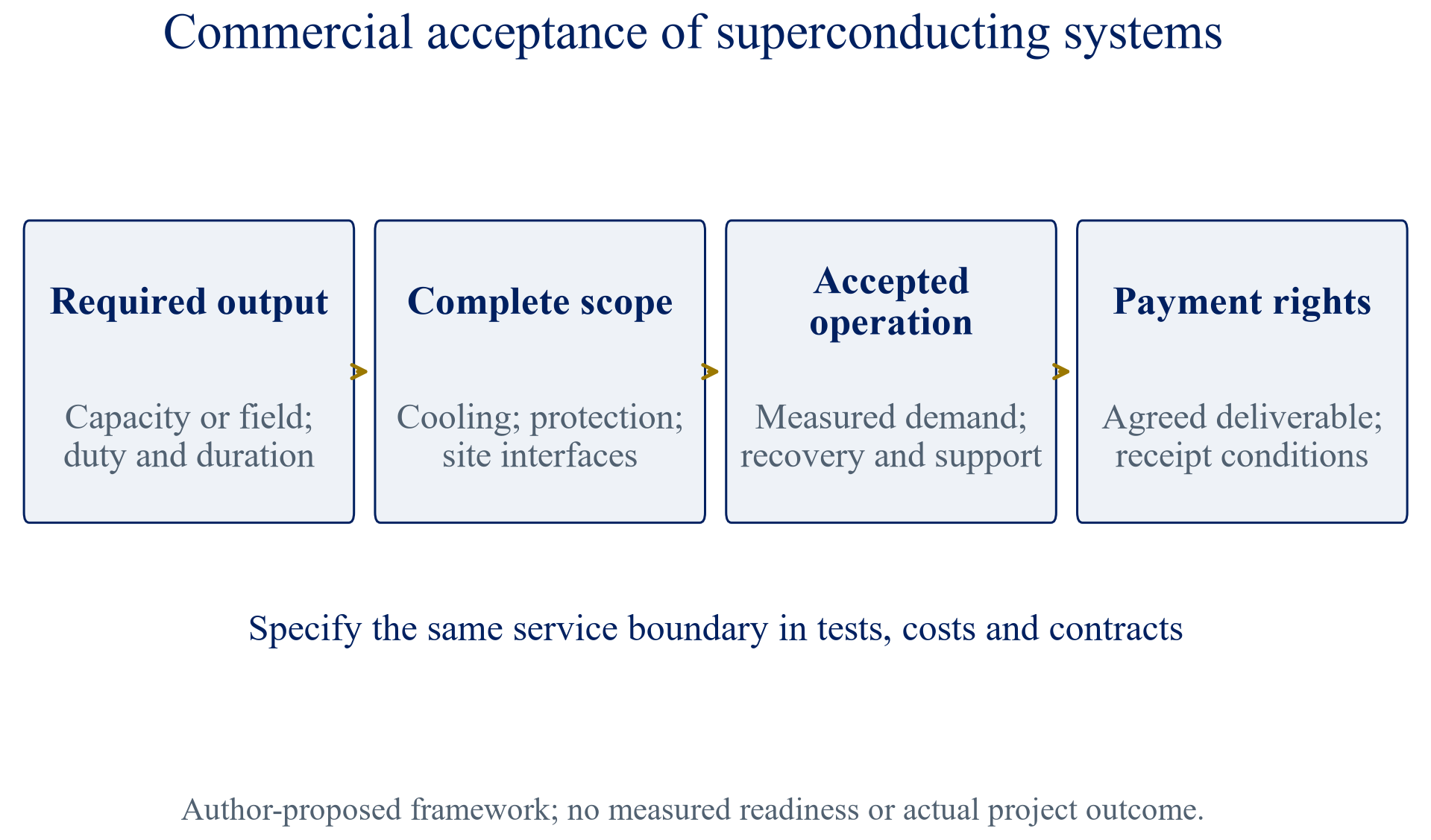
Qualitative decision structure connecting required output, complete equipment scope, accepted operation and payment. No measured readiness score or actual project performance is represented.
10 Build comparable cost and performance records
The cost-performance benchmark proposed here is a set of consistent records for alternatives providing the same specified service. It contains complete installed expenditure, operating demand, maintenance responsibilities, recovery requirements and contractual acceptance. Each figure should have an owner, basis date and evidence type. A budget estimate and a firm supplier offer can inform different decisions; the committee should retain that distinction when reading a comparison or approving expenditure.
Table 1. Author-proposed comparison of commercial service boundaries
| Application | Output to specify | Cost perimeter to request | Acceptance evidence |
|---|---|---|---|
| Cable connection | Usable current and agreed availability | Cable, cooling, protection, interfaces and civil works | Connection tests and required operating profile |
| Magnetic storage | Power, usable energy and response duration | Coil, cooling, converters, controls and recovery | Response tests and restored readiness |
| Fusion magnet supply | Field configuration and defined work package | Materials, manufacture, integration and support | Contract-specific design and delivery records |
| Integrated research system | Stated experimental operating conditions | Equipment, installation, utilities and qualified staff | Agreed protocol and complete test report |
Proposed review matrix. It contains no supplier quotation, cross-application maturity ranking or empirical cost benchmark.
The committee should examine which costs sit outside each offer. Network reinforcements, site preparation or purchaser-provided utilities might differ substantially in scope. The comparison should show exclusions openly and request the evidence needed to cost them. Where an alternative cannot meet the required operating condition, it should be marked unsuitable for that particular comparison with the technical reason recorded. This process helps the committee avoid assigning a benefit to an equipment feature while leaving the expenditure required to use it unexamined.
11 Define readiness through accepted evidence
The paper proposes a qualitative readiness progression containing component evidence, integrated testing, site qualification and accepted operation. Each stage has a defined deliverable and outstanding conditions. The progression is a review tool rather than a recognised certification system. It assigns no numerical maturity score, completion probability or universal timetable to a supplier. A project may have strong component evidence while an installation interface or support obligation remains unresolved.
At the component stage, the reviewer requests the relevant material or device records under specified conditions. Integrated testing asks whether connected equipment performs the agreed function within its full operating boundary. Site qualification examines the purchaser's installation and interfaces. Accepted operation asks whether the agreed service has been provided for the contractually required period and conditions. Each stage should retain the underlying protocol and result, including deviations that matter to the purchaser.
The financing decision can follow that progression. An initial allocation might pay for a defined test with an expenditure ceiling. A later allocation might require independently reviewed integrated results and a firm installation scope. The contract should make clear what happens when a test produces a different result or an unresolved requirement emerges. Additional work requires a revised decision and budget. This proposed approach gives the committee a way to link spending to evidence without presenting a smooth technology-readiness curve that implies automatic advancement or a predictable date for commercial operation.
12 Review recovery and continuing support
The proposed availability review includes the conditions under which the system stops providing its required service and the work needed to restore it. For the actual design, engineers should identify the relevant failure modes, detection arrangements, protection response, inspection requirements and restart procedure. The investor then asks who performs that work, how resources are obtained and which expenses remain with the purchaser. An uptime assumption needs those supporting records.
A support schedule should specify spare parts, trained personnel, documentation, access rights and the period covered by the quoted price. Reviewers should examine dependencies on a single supplier or facility and request an agreed treatment for delayed support. The financial model should distinguish scheduled maintenance, unplanned intervention and replacement expenditure. An availability statement covering one subsystem should not be applied to the complete purchased service without an engineering assessment of the remaining interfaces.
The author recommends testing a recovery scenario within the qualification programme where relevant and safe. The exercise should follow an approved procedure and record the resources and elapsed steps needed to restore service. Its commercial purpose is to examine the support obligation and budget, with specialist oversight of the technical method. A proposed payment or retention release can depend on accepted recovery evidence. This gives the purchaser a defined route for examining continued operation while preserving the distinction between a simulated exercise, a controlled test and an observed operating event.
13 Establish rights and usable operating knowledge
A purchaser needs the rights and information required to install, operate and support the asset described in its financial model. The author proposes separate schedules for physical equipment, design documentation, software, test records and relevant know-how. The agreement should identify what is delivered, how the purchaser may use it and which continuing dependencies require consent or payment. Qualified legal advisers must review the actual rights and restrictions.
The operating team should test whether the delivered documentation supports the tasks assigned to it. Access to a manual may provide a different practical capability from access to configuration files, repair procedures or diagnostic tools. Where the supplier retains responsibility, the support agreement should define the service and conditions. The model should include any licence or continuing support costs required to sustain the assumed operation. No valuation benefit is assigned here to rights that have not been identified and reviewed.
For collaborative development, the proposed schedule distinguishes background rights from new results and later improvements. Reviewers should identify which party can supply the agreed equipment or service outside the programme and what approvals are needed. A buyer of the operating company needs the same analysis for non-transferable licences or restricted customer data. The committee should receive a bounded legal assessment matched to the actual application and jurisdiction. Public technical evidence cannot establish that the relevant commercial rights are available to a proposed buyer on acceptable terms.
14 Introduce the fictional utility comparison
The worked example compares two invented cable-system options assumed to deliver the same accepted service for ten years. Both are assumed operational at time zero in the base case. The conventional complete installed cost is USD 120 million, including fictional corridor and civil-work expenditure. The superconducting complete installed cost is USD 105 million, including cooling and protection. The resulting initial expenditure difference is USD 15 million in favour of the superconducting option. These figures are chosen solely to examine the calculation.
Conventional whole-system electrical demand is assumed to average 1.00 MW. The superconducting option averages 0.75 MW under the boundary described earlier. Electricity is priced at an invented constant USD 110 per MWh for 8,760 hours each year. Conventional annual maintenance costs USD 0.55 million; superconducting annual maintenance costs USD 1.20 million. The comparison includes no debt, cash tax, inflation, tariff variation, terminal value or end-of-horizon renewal. All recurring differences are paid at the end of each year.
The discount rate is a fictional constant 10%. No actual utility required return or financing benchmark is inferred. The base model contains no value for improved capacity, reduced outages or environmental effects because none has been evidenced for a real project. It calculates the incremental present value of the stated expenditure differences under assumed equal service. The direction of every difference is defined from the conventional option to the superconducting option, allowing readers to reproduce both the positive initial difference and the negative recurring operating difference.
15 Calculate the base incremental present value
The assumed annual electricity reduction is 0.25 MW multiplied by 8,760 hours, giving 2,190 MWh. At USD 110 per MWh, the annual saving is USD 240,900, or USD 0.2409 million. Additional maintenance costs USD 0.65 million annually. Combining those two quantities produces a negative annual incremental cash flow of USD 0.4091 million. The superconducting option therefore has lower invented initial expenditure and higher invented recurring expenditure within this specific model.
The ten-year annuity factor at 10% is 6.144567. Incremental present value equals the initial USD 15 million difference less USD 0.4091 million multiplied by that factor. The result is USD 12.4862576 million, reported as USD 12.486 million. This quantity is an incremental project comparison before financing and tax. It is not an enterprise value, equity valuation, observed saving or price recommendation for any real system.
An equivalent fictional capital-expenditure ceiling can be calculated with the recurring assumptions held constant. Setting incremental present value to zero gives maximum superconducting initial expenditure of USD 117.486 million against the assumed USD 120 million conventional option. That ceiling is conditional on equal service and every stated model input. An actual procurement team would need evidence for those inputs and the treatment of remaining costs before using an equivalent calculation. The illustration shows how an expenditure difference and continuing operating obligations interact over a fixed horizon, without claiming that the assumed configuration is available for purchase.
Table 2. Fictional utility comparison assumptions and base calculation
| Model item | Conventional option | Superconducting option |
|---|---|---|
| Complete installed expenditure at time zero | USD 120.000m | USD 105.000m |
| Average whole-system electrical demand | 1.00 MW | 0.75 MW |
| Annual maintenance | USD 0.550m | USD 1.200m |
| Shared electricity price and annual hours | USD 110/MWh and 8,760 hours | Same assumptions |
| Model horizon and discount rate | Ten years and 10% | Same assumptions |
| Annual incremental cash flow | Comparison baseline | Negative USD 0.4091m |
| Incremental present value | Comparison baseline | Positive USD 12.486m |
Every input is fictional. Equal accepted service is assumed. No debt, tax, inflation, terminal value, probabilities or actual supplier offers are included.
16 Examine auxiliary demand and delay separately
The higher-auxiliary scenario assumes that superconducting whole-system electrical demand averages 1.25 MW. All other recurring assumptions remain unchanged. The system now uses 0.25 MW more electricity than the conventional option, creating an invented annual electricity cost difference of USD 0.2409 million. Together with additional maintenance, annual incremental cost becomes USD 0.8909 million. With the initial USD 15 million expenditure difference preserved, incremental present value falls to USD 9.526 million.
The delay scenario assumes additional expenditure of USD 8 million at the end of year one. Its recurring differences begin in year two and continue through year ten. The model retains its original end date and does not extend the horizon to recover the missed first year. It contains no separate value for construction-period service, lost capacity or financing consequences. On those restricted assumptions, incremental present value is USD 5.585 million. The omitted first-year recurring difference is a cost in this example, so its omission partly offsets the additional delayed expenditure.
The combined scenario applies both the higher complete electrical demand and the specified delay, producing USD 3.063 million. The scenarios contain no assigned likelihoods, and their average has no interpretation as expected value. A committee should examine actual interdependencies before applying similar cases to a project. The purpose of this illustration is to expose precisely how changes are applied. It demonstrates a reproducible arithmetic sensitivity and leaves real operating states, construction effects, taxes and financing to an evidenced project model.
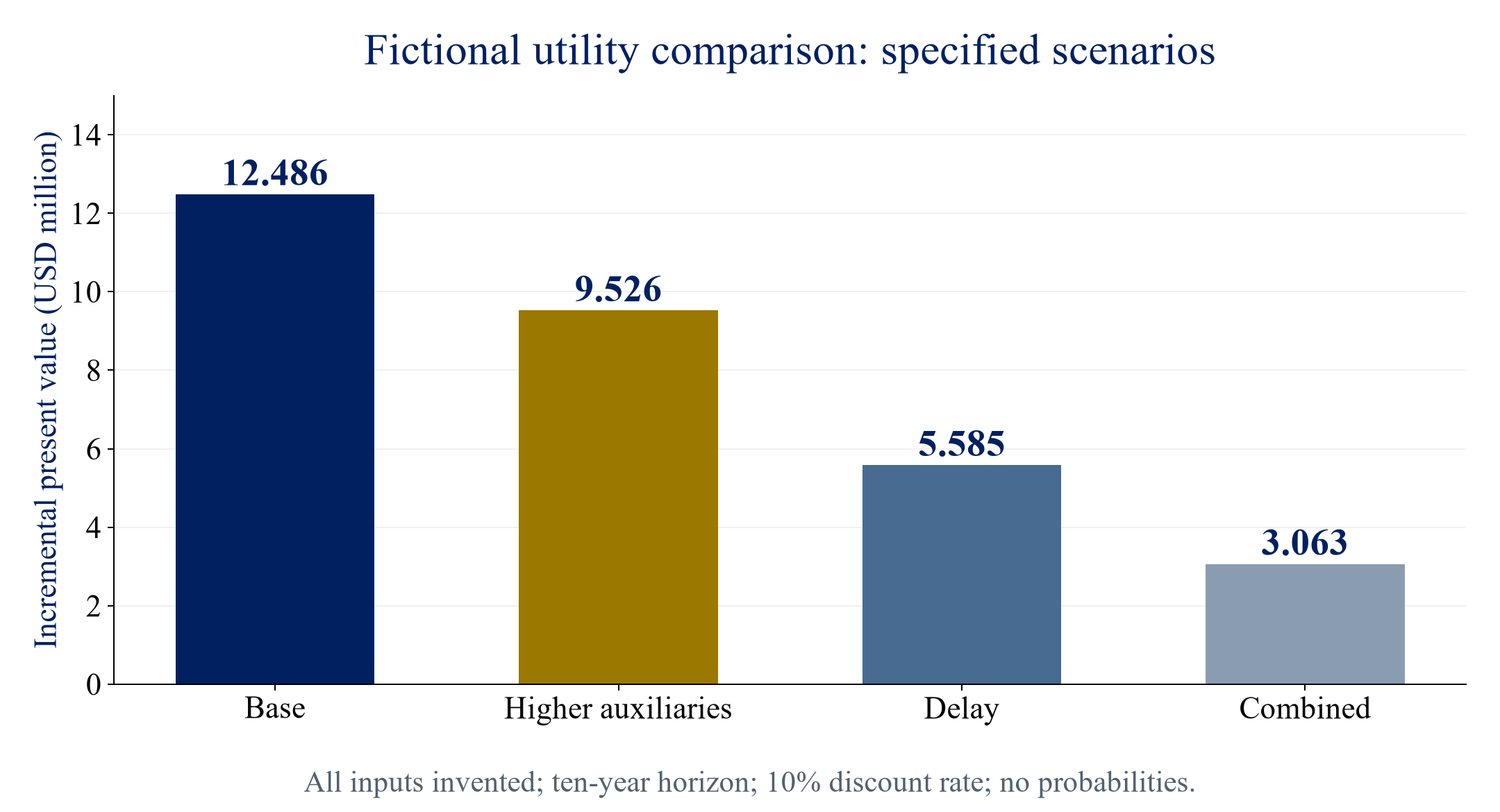
Values in USD million are 12.486 for the base case, 9.526 for higher auxiliary demand, 5.585 for delay and 3.063 for the combined case. Every input is invented; no scenario probabilities are assigned.
17 Make the model auditable and decision specific
The proposed model review starts with a signed description of the compared service. Reviewers then check each cost category, its timing, measurement units and evidence type. Initial expenditure should reconcile to the scope schedule. Electricity demand should reconcile to the operating profile. Maintenance should reconcile to the support obligations. A separate assumptions register records unresolved quantities and states what evidence would replace them. Changing one model input requires review of its dependent costs and operating conditions.
Numerical review should reproduce the cash-flow series and discounting independently. In this paper, decimal calculations were compared with a separate floating-point implementation for every illustrated scenario. Such reconciliation checks arithmetic under the specified assumptions. It does not validate those assumptions commercially. The reviewer should also check whether an investment conclusion survives reasonable project-specific changes that have an evidence basis, with clear descriptions of cases that remain judgemental.
The model should match the decision the committee is authorised to make. A limited qualification expenditure may need a budget and stop condition before a complete installed-system valuation is possible. A system purchase needs accepted service, scope and support evidence. A corporate acquisition adds company liabilities and consideration that this utility illustration excludes. The author recommends stating the decision at the top of the model and recording every excluded economic category. This helps readers understand which conclusion the calculation can support and which additional work is necessary before a broader commitment.
18 Connect supplier economics to deliverables
For a component or integrated-system supplier, the proposed commercial model begins with the actual delivery schedule. It should identify contract price, cash-payment events, remaining procurement, manufacturing expenditure, acceptance costs and continuing support. The committee needs to understand who funds work before each receipt and what happens when the customer requests a change. A disclosed programme budget cannot substitute for those contract-specific cash flows.
The author proposes examining gross margin through the defined work package, then reviewing company-level costs separately. Shared engineers, facilities and development programmes may support more than one contract. Their allocation should follow an explicit accounting and operating policy with the evidence available to the actual diligence team. Uncontracted opportunities should remain distinct from awarded work. Cash collected, revenue recognised and the announced award amount can have different timing and definitions; the model should show the applicable records for each.
A financing proposal can then be structured around the supplier's documented expenditure and payment cycle. Advance payments, milestone receipts, performance security or working-capital facilities require specific terms and lender review. This paper offers no view on the availability or pricing of such funding for a named company. Its proposed framework asks whether each financed activity produces a defined deliverable and whether the resulting receipt can support the obligation incurred. The analysis remains at the supplier's economic perimeter and includes the support duties that continue after initial acceptance.
19 Choose staged expenditure and consideration
Staged funding can be designed around the next unresolved commercial requirement. The proposed sequence begins with a limited budget for a defined evaluation, continues through integrated qualification and reaches installation or commercial delivery after the relevant evidence is accepted. The agreement should record the expenditure ceiling and the reviewer responsible for each stage. A milestone needs an observable result and an agreed treatment for deviations. General progress descriptions leave too much uncertainty about when additional capital becomes payable.
For a licence or development collaboration, consideration may contain an evaluation payment, accepted-deliverable payments and defined commercial receipts. For a supplier acquisition, deferred consideration could refer to specifically identified contract or qualification outcomes. These are possible author-developed structures requiring legal and commercial negotiation. The paper does not suggest that a seller will accept them or that they transfer every technology risk. Obligations should be costed by the party responsible for performing them.
The committee should examine what remains funded if a stage fails or stops. Required preservation, safe shutdown, data transfer and support obligations may continue beyond the last discretionary payment. The budget should therefore include an agreed stopping route and responsibilities for the assets created. A later stage should receive a fresh decision using the evidence produced, the revised expenditure estimate and the remaining contract terms. This approach allows the original investment thesis to be tested through actual deliverables while retaining explicit limits on further commitments.
20 Allocate integration risks in the commercial agreement
The proposed integration review identifies every interface needed to deliver the purchased service. Electrical, thermal, mechanical and operational requirements should have designated owners and agreed specifications. The agreement should state which party performs integration, who approves changes and how a disputed test is resolved. Where several suppliers participate, the purchaser needs a consistent overall acceptance definition and a mechanism for addressing requirements falling between individual scopes.
Table 3. Author-proposed allocation of delivery and support responsibilities
| Review area | Evidence or contractual item | Decision affected |
|---|---|---|
| Integrated performance | Agreed whole-system test and deviations process | Acceptance and final payment |
| Cooling and utilities | Equipment scope and measured demand boundary | Installed expenditure and operating model |
| Recovery | Approved procedure, resources and support duties | Availability assumptions and continuing costs |
| Documentation and rights | Delivered records and permitted operating use | Ability to operate and maintain the asset |
| Change control | Authority, revised scope and payment treatment | Additional expenditure approval |
| Stopping or replacement | Asset disposition and remaining obligations | Capital still required after discontinuation |
Proposed commercial review schedule. Actual terms require transaction-specific technical and legal advice.
The investment committee should review the agreement alongside the financial model. A performance assumption excluded from the supplier's contract needs a separate evidence and responsibility record. A contingency allowance should name the uncertainty it covers and who can approve its use. The author recommends resolving material scope differences before approving the installed-system commitment. Any remaining exception should have a visible treatment in the decision, including the additional qualification, funding or contractual protection needed for the purchaser's stated requirement.
21 Assess geography through site and operating requirements
This framework can be applied across jurisdictions when the actual installation and legal conditions are specified. The proposed geographical review considers the nominated site, operating environment, utility interfaces, procurement arrangements and required approvals. It contains no assumed national advantage or market-demand estimate. A technology demonstrated in one location needs an assessment of the differences relevant to another project's service specification and installation method.
For a proposed network connection, reviewers should obtain the project's corridor and interface records. For a magnet programme, they should examine the authorised test facilities, manufacturing arrangements and delivery location. For a storage service, they should identify how the purchaser defines and pays for the required response. Local permitting, safety, tax and regulatory questions require qualified advisers using current jurisdiction-specific evidence. None is resolved here by reference to an international technical demonstration.
The author proposes recording geographical changes as identifiable requirements in the qualification plan. A changed environmental assumption belongs in the operating profile and engineering review. A different delivery route belongs in the logistics and custody plan. A new legal condition belongs in the rights and approval schedule. The committee can then see how those changes affect expenditure and acceptance. This preserves a consistent investment method while allowing each geography's actual conditions to determine the required evidence, rather than assigning generic growth rates or commercial readiness to an entire region.
22 Use data and AI within controlled review tasks
The author proposes bounded uses of data tools and artificial intelligence in the diligence process. A structured evidence register could help reviewers locate test records, compare specification versions and flag inconsistencies between a scope schedule and model assumptions. These are proposed applications. This paper presents no measured improvement in speed, accuracy or investment results from an implemented AI system. Human reviewers remain responsible for accepting technical conclusions and approving financial or contractual changes.
A proposed automated comparison should preserve the source document, relevant version, extracted field and reviewer decision. Calculations should run through a deterministic model with visible units and timing. A generated explanation should be checked against those records before entering a committee paper. Confidential customer data requires authorised handling and appropriate access controls. A system should not create a missing test result, approval or contract term to complete an apparent gap in the register.
The practical question is whether the tool supports a defined review task with an auditable record. A comparison of required and supplied documentation can be tested against a human-reviewed sample. A proposed anomaly model needs an agreed operating boundary and validation method before it informs maintenance or recovery decisions. The paper recommends starting with a limited evidence-management task and retaining the existing decision authority. The resulting record can support later evaluation of usefulness without claiming that AI independently establishes system readiness, produces a valuation opinion or removes the need for specialist diligence.
23 Establish the commercialisation roadmap
The proposed roadmap has five decision stages: define the service, document component evidence, qualify the integrated system, prepare installation and support, and accept commercial delivery. At each stage the team records the required deliverable, expenditure ceiling, outstanding dependencies and decision authority. The sequence is qualitative and contains no promised timetable. Activities may run concurrently when the actual programme permits, with dependencies retained in the acceptance record.
The first stage ends with a purchaser-approved service description and comparison boundary. Component review produces a transfer assessment identifying what remains to be demonstrated. Integrated qualification produces an accepted test report and deviations record. Installation preparation produces a complete scope, required approvals and support plan. Commercial delivery produces the contract-specific acceptance documents and associated payment rights. Each stage should update the financial model only for evidenced changes and explicitly approved assumptions.
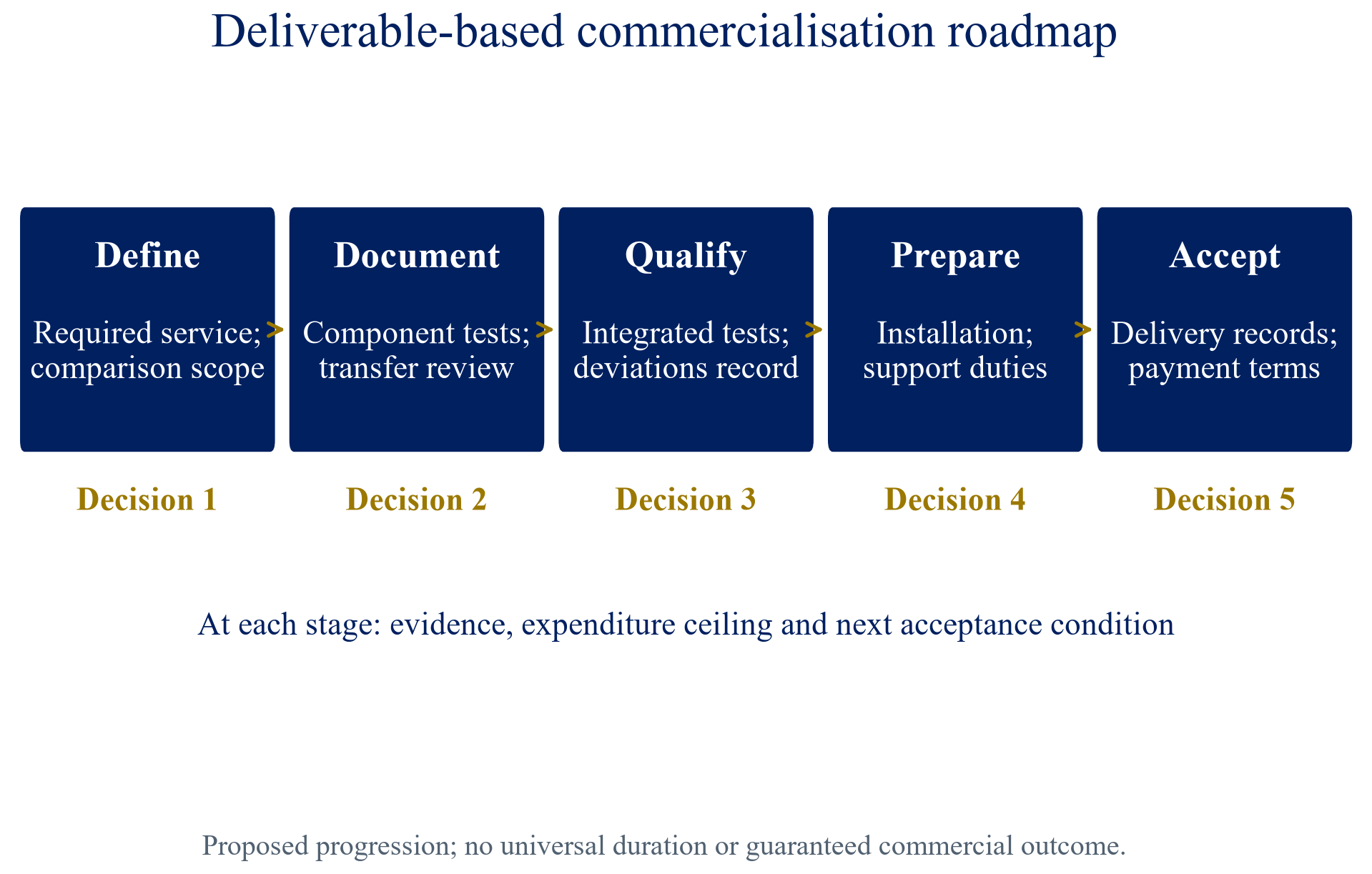
Proposed progression from service definition to accepted delivery. Stages carry no universal duration, empirical maturity score or guaranteed commercial outcome.
The committee should distinguish advancement from a decision to revise or stop. An unexpected test result may justify a narrower application or further work; it may also leave the proposed service uneconomic under the purchaser's requirements. The roadmap should retain those possible decisions and the evidence required for each. Its commercial purpose is to keep technical development connected to a specific acceptance condition and funding obligation throughout the programme, enabling the next commitment to be evaluated against the evidence actually obtained.
24 Conclusions and further research
Commercial value in superconducting systems can be analysed through a defined purchased service, complete operating scope and evidenced receipt mechanism. The public records reviewed here describe specific magnet demonstrations, cable development and procurement stages. They support targeted questions about qualification and delivery. The proposed investment framework connects those questions to acceptance, continued support, rights and expenditure. It leaves actual customer economics and valuation conclusions to project-specific evidence.
The fictional utility illustration quantifies the importance of explicitly specified boundaries. Its USD 12.486 million base incremental present value falls to USD 3.063 million when the invented higher-demand and delay assumptions are combined. Those values reflect the stated arithmetic alone. The comparison assumes equal accepted service and excludes financing, tax, terminal value and several real-project effects. It demonstrates how to make an investment sensitivity reproducible and how to state the decisions that remain outside its scope.
Further research could assess the framework using consented project records containing installed costs, complete operating demand, maintenance and recovery logs, acceptance documents and realised payments. Comparable service definitions would be necessary before constructing empirical cost-performance benchmarks or examining investment outcomes. The current paper has no such dataset. Its practical contribution is an investment review organised around the next accepted deliverable: specify the service, assess applicable evidence, cost unresolved work and connect payments to documented obligations. That process supports disciplined commercial evaluation while keeping research results, proposed structures and fictional financial analysis visible in their proper roles.
References
- Hartwig, Z. S. et al. The SPARC Toroidal Field Model Coil Program. arXiv:2308.12301, 2023. Original research overview; published journal DOI 10.1109/TASC.2023.3332613. https://arxiv.org/abs/2308.12301
- European Commission CORDIS. SCARLET: Superconducting cables for sustainable energy transition. Grant agreement 101075602. Current project fact sheet. https://cordis.europa.eu/project/id/101075602
- European Commission CORDIS. SCARLET periodic reporting for period 2, 1 March 2024 to 31 August 2025. Official development report. https://cordis.europa.eu/project/id/101075602/reporting
- Nexans. Superconducting cable systems and cryogenic solutions. Current supplier page; includes the June 2025 Hanover test-bench account. https://www.nexans.com/electrification-solutions/markets/distribution/superconductivity/
- Tokamak Energy. Tokamak Energy named Magnet Systems Partner for STEP Fusion programme. 14 April 2026. Company contract-award disclosure. https://tokamakenergy.com/2026/04/14/tokamak-energy-named-magnet-systems-partner-for-step-fusion-programme/
- Tokamak Energy. Tokamak Energy completes world-leading fusion magnet campaign, validating technology for commercial HTS systems. 9 September 2026. Company-reported Demo4 results. https://tokamakenergy.com/2026/09/09/tokamak-energy-completes-world-leading-fusion-magnet-campaign-validating-technology-for-commercial-hts-systems/
- Ballarino, A. and Leclercq, Y. Cold Powering System transitions into preparation stages for installation following completion of collaboration deliverables. CERN HLCB Newsletter, 15 June 2026. https://hlcb-newsletter.web.cern.ch/cold-powering-system-transitions-into-preparation-stages-for-installation-following-completion-of-collaboration-deliverables/
- DOE Office of Electricity Energy Storage Program at Sandia. I-R 100 Award Winner 1984: Superconducting Magnetic Energy Storage. Historical deployment account posted 25 August 2021. https://www.sandia.gov/ess/2021/08/25/1984-smes
About the Author
Chennakeshav (CK) is a corporate finance and investment banking executive with 25+ years of global experience in deal origination, structuring and execution across M&A, growth capital and corporate strategy. He has led value-creation mandates for founders, corporates and funds — bridging the boardroom view to hands-on execution and close.
His career spans Morgan Stanley, HSBC, Lloyds Banking Group, EWEC, ADQ portfolio companies and Emirates Growth Fund, across TMT, real estate, fintech, deeptech, cleantech, infrastructure and energy. He has partnered with C-suite leaders, private equity and venture funds, sovereign wealth funds and family offices to finance complex fund raises and scale-up ventures, and has led M&A due diligence, post-merger integration and business-transformation initiatives to create value.
At Matchpoint Partners he is Managing Partner, leading the firm's corporate finance, M&A and capital-raising practice. He holds an MBA from London Business School, an engineering degree from VTU and a Master of Laws (LLM, in progress) from UCL London.
An active start-up mentor, CK mentors at Techstars, DIFC FinTech Hive, Startup Grind, Founder Institute and IN5, serves as Entrepreneur Mentor in Residence (EMiR) at London Business School, and judges the Entrepreneurship World Cup.
