

1. Define the financed supply chain before choosing a facility
Supply-chain finance is a family of techniques. It should not be treated as one balance-sheet product. The Global Supply Chain Finance Forum defines the field around financing and risk-mitigation practices that optimise working capital and liquidity invested in supply-chain processes, with visibility of underlying trade flows as a necessary component.[5] Its standard terminology covers receivables discounting, factoring, payables finance, loans against receivables, distributor finance, inventory finance and pre-shipment finance. Those labels are useful only when they are tied to an observable commercial event.
The first credit deliverable should be a financed-supply-chain perimeter. It should identify the buyer, operating entities, suppliers, input categories, purchase orders, delivery terms, title transfer, inspection, invoices, payment obligations, production stages, finished goods, customers, receivables, warehouses, transport providers, insurers, banks and existing financiers. It should also identify which entity bears price, quality, delay, foreign-exchange, rejection, obsolescence and casualty risk at each stage.
A steel processor that imports coils, a food manufacturer that buys ingredients, a pharmaceutical company that procures active ingredients and a machinery producer that purchases specialised components have different conversion risks. Each can use supplier, inventory and receivables finance. The same product name can conceal different collateral, timing and legal outcomes.
The perimeter should state the financing purpose in operational terms. Funding can protect continuity of a critical input, capture an early-payment discount, bridge production, hold seasonal inventory or convert an accepted receivable. It should not fund accumulated losses, overdue tax, distributions, speculative inventory or unidentified general expenditure unless those uses are separately approved and transparently classified.
Table 1. Supply-chain-finance evidence perimeter
| Layer | Core evidence | Financing question | Potential control |
|---|---|---|---|
| procurement | approved supplier, purchase order, specification, price and incoterm | is the purchase genuine, necessary and properly authorised? | approved-supplier list and purchase-order limit |
| delivery | transport record, customs document, receipt and inspection | did the identified goods reach the agreed location and condition? | document match and independent inspection |
| obligation | invoice, acceptance, credit note, dispute and due date | is the payment unconditional and correctly measured? | three-way match and exception queue |
| inventory | title, quantity, location, age, insurance and sale evidence | can stock be observed, controlled and realised? | warehouse control, audits and eligibility grid |
| production | bill of materials, yield, work in progress and completion | how does the input convert into saleable output? | production reporting and yield variance trigger |
| customer | order, delivery, acceptance, invoice and collection | when does output become an eligible receivable and cash? | receivables borrowing base and controlled account |
| leverage | payables, facilities, guarantees, letters of credit and maturities | what cash obligation exists, when is it due and where is it reported? | total-debt reconciliation and maturity dashboard |
| exit | alternative buyer, supplier substitution and liquidation route | what action remains if production or collection fails? | substitution plan, reserve and controlled sale |
Evidence should be verified by legal entity, input category, supplier and customer.
2. Separate the physical, contractual and financial chains
The physical chain records goods from order to consumption or sale. The contractual chain records title, risk, acceptance, warranties, payment and remedies. The financial chain records invoices, credit, funding, settlement and cash. A finance programme is controllable only when these chains reconcile.
Physical delivery alone does not create an eligible payment obligation. Goods can arrive in the wrong specification, quantity or condition. A valid invoice does not prove receipt. A supplier payment does not prove that the borrower owns the goods. A finished product does not prove customer acceptance. The lender should define the documentary event that makes each exposure eligible and the exception that removes it.
The match can be simple for standard consumables and complex for engineered inputs. A purchase order, goods-received note and invoice may be sufficient for ordinary material. Imported chemicals may also require customs, origin, hazardous-material, storage and quality documents. A component made to specification may require testing and certification. Capital spares can require serial-number control and compatibility evidence.
Data ownership matters. Procurement can validate supplier and order. Operations can validate receipt and use. Quality can validate specification. Finance can validate invoice and payment. Treasury can validate funding and settlement. Legal can validate assignment and security. A programme controlled only by treasury can miss operational exceptions that determine whether an obligation or asset is real.
3. Measure the cash-conversion cycle by event and input
The cash-conversion cycle is often summarised through inventory days plus receivable days minus payable days. The formula is useful and can hide the event sequence that creates liquidity risk. An industrial borrower should therefore model purchase commitment, deposit, shipment, customs, receipt, inspection, production, finished-goods storage, customer delivery, acceptance, invoice, dispute and collection.
Different inputs create different cash curves. Commodity material can be bought against a liquid reference price and held briefly. Bespoke components can require an advance months before delivery and have little alternative use. Imported spares can have long lead times, low consumption and high shutdown value. Packaging can be low value and operationally essential. The funding tenor should follow the actual conversion path rather than an average inventory day.
The model should distinguish accounting days from cash exposure. Supplier-finance payment may settle the trade payable while creating a later obligation to a finance provider. Receivables purchase may accelerate cash while transferring or retaining credit risk depending on recourse. Inventory finance can fund stock that remains in the operating cycle while creating scheduled interest and principal.
Each financed lot should have a planned cash-out date and a planned cash-in source. Variance should be traced to price, quantity, delivery, inspection, yield, production, customer acceptance, invoice or collection. The diagnosis determines the cure. More facility capacity cannot correct rejected material, poor demand or disputed receivables.
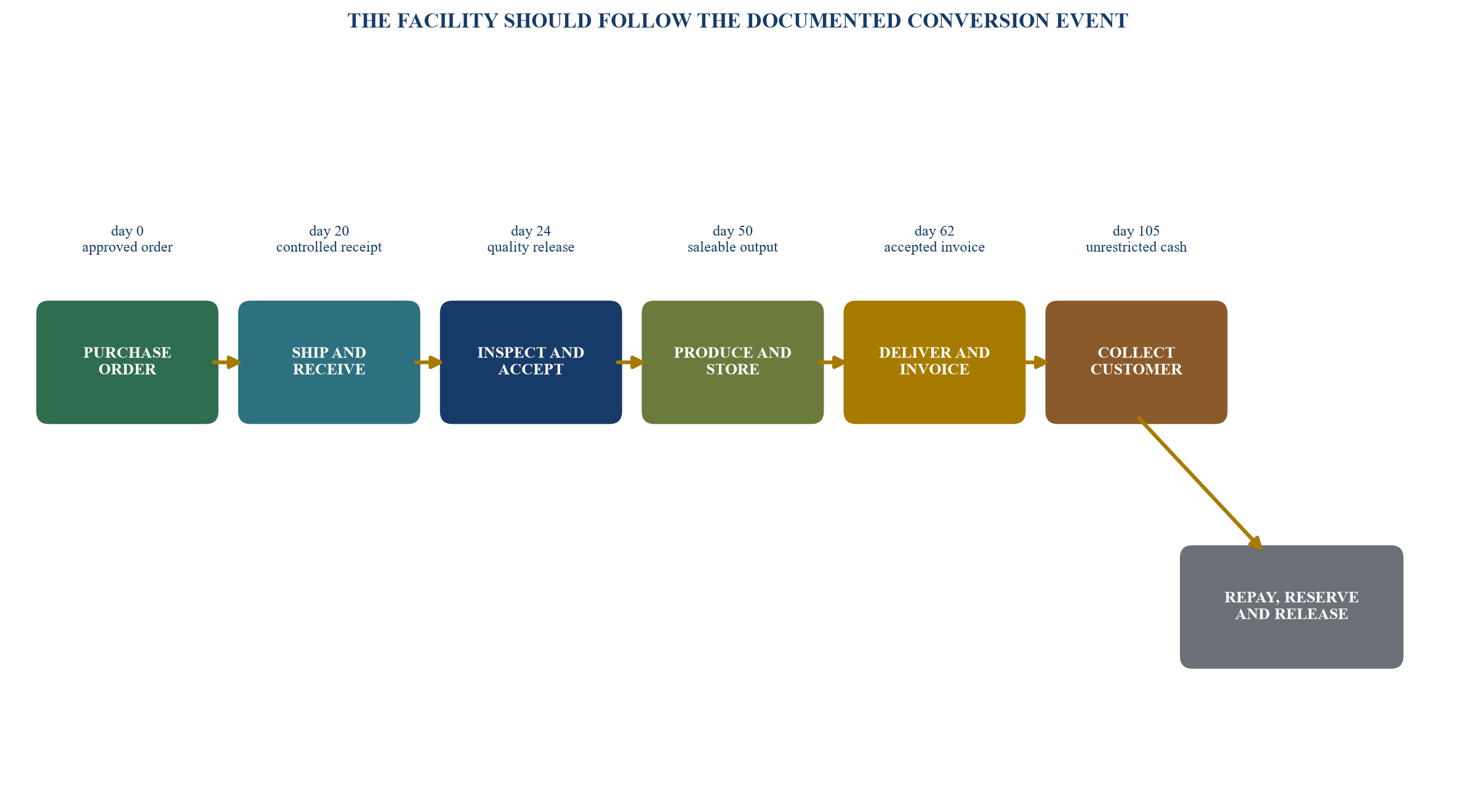
Hypothetical days show the sequence from supplier commitment to unrestricted customer cash.
4. Rank suppliers by operational criticality and financial replaceability
Supplier criticality is the expected operational and financial loss from interruption. It should combine production dependence, time to qualify an alternative, input uniqueness, quality sensitivity, inventory cover, substitution cost, supplier capacity, geopolitical exposure, logistics route and contractual protection. Purchase value alone is a poor ranking measure. A low-value seal, catalyst or electronic module can stop an expensive production line.
Financial replaceability asks whether another supplier can provide equivalent inputs on acceptable price, terms, lead time and qualification. Technical alternatives can remain economically unavailable when tooling, certification, regulatory approval or customer consent takes months. A supplier can be financially weak and operationally critical, creating a need for protected payment and a transition plan.
The matrix should guide programme design. Critical and hard-to-replace suppliers can receive early-payment options, direct-payment capacity, purchase-order assurance or carefully controlled pre-shipment funding. Critical suppliers should not automatically be financed. Sanctions, fraud, quality failure, related-party status, legal dispute or inability to evidence production can make funding unacceptable.
The borrower should identify supplier dependencies within groups. Two vendor names can share ownership, factory, port, sub-supplier or raw material. Concentration should be measured by the real failure point. A programme diversified across invoices and concentrated in one upstream source remains fragile.
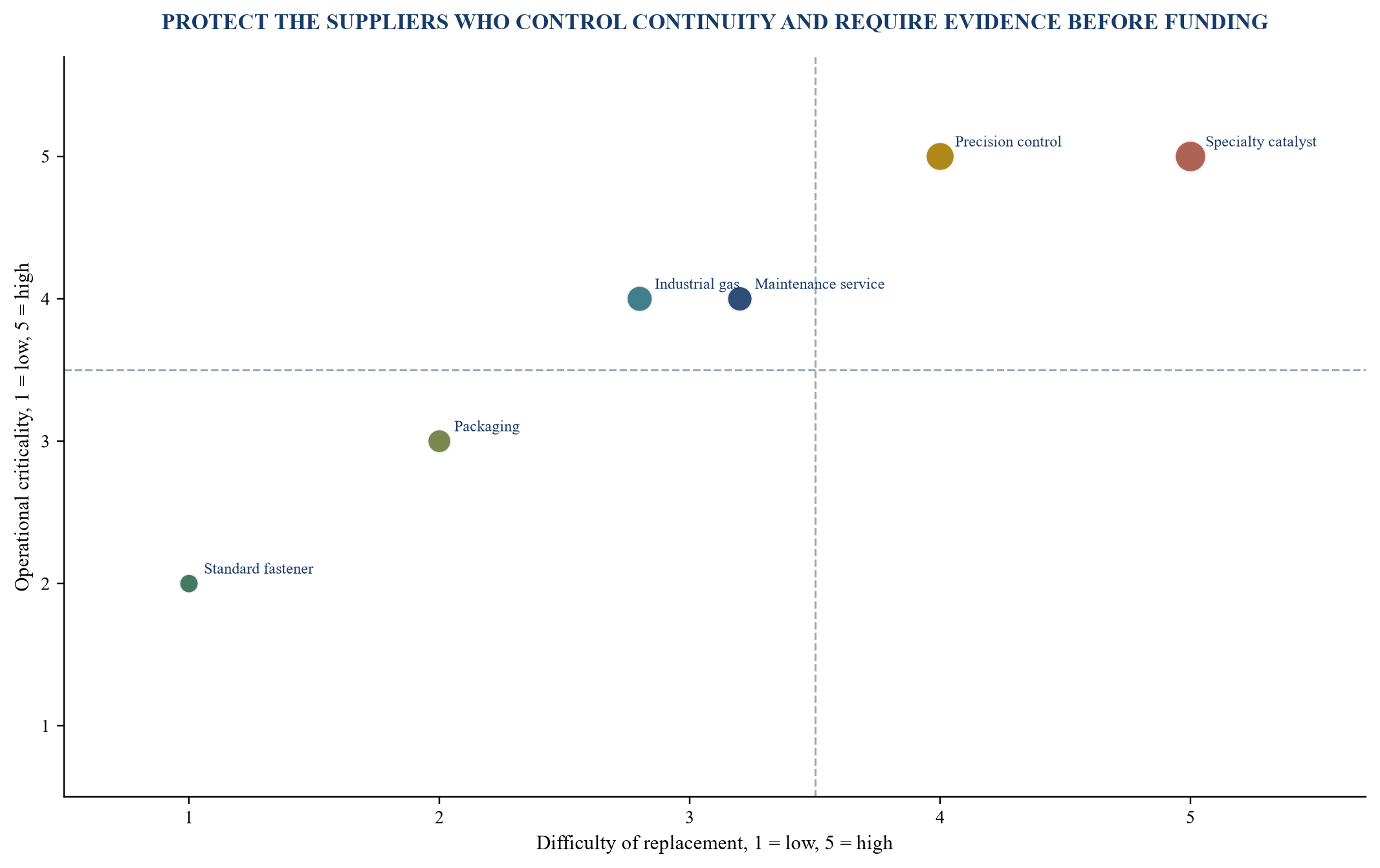
Hypothetical scores demonstrate how operating importance and substitution difficulty drive control intensity.
Table 2. Supplier criticality response framework
| Supplier position | Operating response | Finance response | Required evidence | Failed-gate action |
|---|---|---|---|---|
| critical and hard to replace | executive continuity plan and alternative qualification | protected early payment with tight limit | contract, capacity, production and delivery evidence | freeze new exposure and activate substitution |
| critical and replaceable | dual sourcing and tested emergency order | approved-payables capacity with concentration cap | accepted invoice and alternative-supplier plan | redirect volume and shorten tenor |
| important and hard to replace | inventory buffer and technical redesign path | inventory or pre-shipment facility where controls permit | title, warehouse, production and quality milestones | reserve increase and management review |
| important and replaceable | routine sourcing competition | ordinary programme eligibility | purchase order, receipt, invoice and acceptance | exclude disputed or late items |
| low criticality | standard procurement controls | finance only where economic | normal documentary match | remove without continuity escalation |
Funding remains subject to integrity, legal, sanctions, quality and documentary approval.
5. Design approved-payables finance around valid obligations
Approved-payables finance allows a supplier to receive early payment from a finance provider after the buyer has validated an invoice, while the buyer pays the finance provider according to agreed terms. The IFC Global Supply Chain Finance programme focuses on short-term supplier financing, including reverse factoring, through partner financial institutions and portfolio risk-sharing structures.[6] Emirates Development Bank also describes supply-chain-finance solutions that pay suppliers early on behalf of buyers.[7]
The eligible event should be unambiguous. The buyer should have received the goods or services, completed the required inspection, accepted the invoice, resolved quantity and price differences, and confirmed an unconditional obligation. The programme should prevent duplicate financing across the supplier, buyer, platform and other lenders.
Payment terms should be measured from the original commercial due date. If the supplier is paid at day 20 and the buyer pays at day 120, the programme has created one hundred days of funded exposure. Management should compare that term with ordinary supplier terms and the operating cycle. A repeated extension can create structural financing even when each invoice is short dated.
Supplier participation should be voluntary and commercially clear. Pricing, discount calculation, notice, recourse, dispute treatment and data use should be transparent. The buyer should not pressure a dependent supplier into accepting a discount that undermines production capacity. A resilient programme improves supplier liquidity while preserving the buyer's own obligation visibility.
6. Protect supplier economics and delivery capacity
Early payment can reduce a supplier's funding cost when the finance provider relies on the buyer's stronger credit. The benefit should be tested in cash terms. Management should compare the discount with the supplier's alternative funding, gross margin, production cash need and price adjustment. A small percentage discount can absorb a meaningful share of a thin manufacturing margin.
The programme should monitor supplier behaviour after enrolment. A supplier can use early cash to purchase material and expand output. It can also become dependent on continuous early payment. If the programme is withdrawn, the supplier may demand shorter terms, raise prices or reduce production. Liquidity planning should include a controlled wind-down and a minimum notice period where commercially and legally possible.
Critical suppliers may need direct-payment protections for specific material, labour, utilities or sub-suppliers. These controls should be bounded by verified production milestones and anti-duplication checks. Funding an undifferentiated supplier account exposes the financier to unrelated liabilities and weakens the link to the buyer's goods.
Supplier health indicators can include on-time delivery, quality rejection, capacity utilisation, lead-time change, late payroll, tax issues, insured events, concentration in the buyer and requests for accelerated payment. These indicators require validated data and proportionate escalation. A late delivery caused by customs differs from financial distress or quality failure.
7. Keep accounting presentation aligned with economic substance
Supplier finance can affect liability presentation, cash-flow classification and liquidity disclosure. The IASB issued Supplier Finance Arrangements amendments to IAS 7 and IFRS 7 in May 2023, effective for annual reporting periods beginning on or after 1 January 2024.[8] The amendments require information that helps users assess effects on liabilities, cash flows and liquidity risk, including terms and conditions, carrying amounts, amounts for which suppliers have already been paid and payment-date ranges.
The accounting conclusion depends on facts and current standards. Management and the auditor should assess whether an obligation remains a trade payable or has become another financial liability, whether cash flows are operating or financing, whether derecognition is appropriate and what disclosures are material. The IASB decided in July 2026 to withdraw the December 2020 reverse-factoring agenda decision as part of work connected with IFRS 18.[9] Reporting analysis should therefore use the standards and authoritative material current at the reporting date.
Credit analysis should operate independently from the line-item label. A liability can retain trade-payable presentation and still create lender concentration, extended maturity or programme-withdrawal risk. A separately presented finance liability can still be operationally tied to critical suppliers. The debt schedule should capture the obligation based on payee, due date, funding function, security, recourse and liquidity effect.
The board should approve an accounting memorandum and an economic-leverage memorandum. The first supports financial reporting. The second supports treasury, covenant and credit decisions. Both should reconcile to the general ledger, platform statements, bank confirmations and supplier records.
8. Reconcile leverage across every working-capital channel
Industrial leverage often appears across term loans, revolvers, overdrafts, letters of credit, trust receipts, import loans, supplier finance, inventory loans, receivables facilities, leases, guarantees and overdue obligations. A facility-by-facility schedule can miss the combined cash claim and correlated trigger.
The leverage reconciliation should begin with gross contractual obligations. It should show balance, undrawn commitment, due date, amortisation, currency, benchmark, margin, security, guarantee, covenant, cross-default, cash sweep and controlled account. Supplier-finance balances should show the original supplier due date, supplier payment date and buyer repayment date. Receivables programmes should show recourse, dilution reserve and repurchase obligations.
Net debt should be used only after cash quality is assessed. Restricted cash, customer deposits, margin accounts, tax balances and cash needed for critical operations should not offset debt available to those holders. The liquidity view should show unrestricted, accessible and legally transferable cash by entity.
Maturity concentration should be tested on a combined basis. A revolving supplier-finance programme can create a large weekly or monthly payment even when contractual final maturity appears distant. A receivables facility can reduce availability when sales weaken, creating a borrowing-base repayment at the same time that supplier obligations mature.
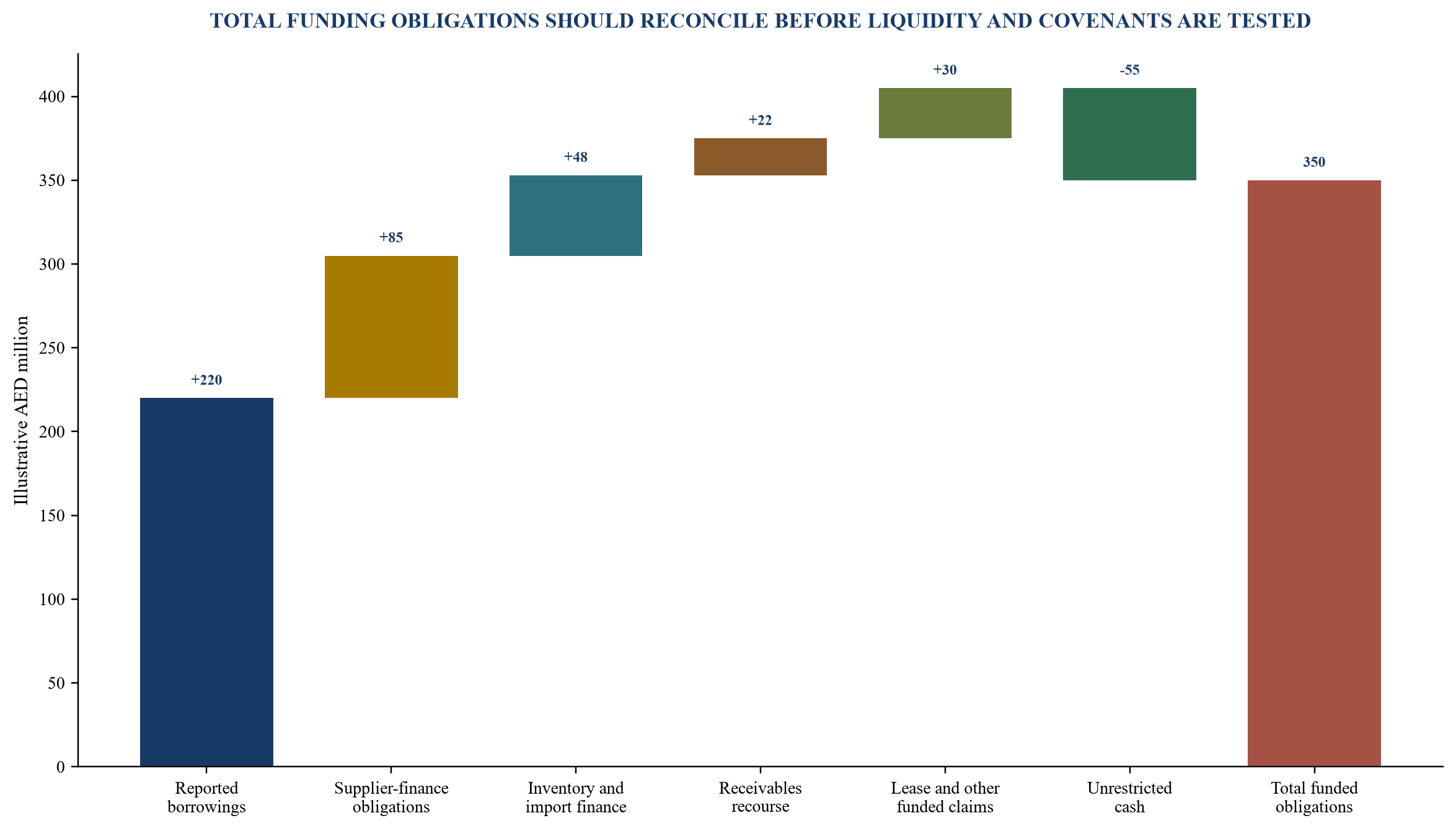
All AED amounts are hypothetical management assumptions for method demonstration.
Table 3. Leverage reconciliation controls
| Exposure | Required reconciliation | Liquidity issue | Covenant treatment |
|---|---|---|---|
| term and revolving debt | lender statement to ledger and bank confirmation | scheduled and accelerated principal | include according to documented definition |
| approved-payables finance | approved invoices to platform and finance-provider balance | concentrated repayment and withdrawal risk | disclose separately and include in total-obligation view |
| inventory and import finance | financed lot, title document and outstanding advance | repayment before stock conversion | include funded amount and contingent shortfall |
| receivables finance | assigned invoices, cash, reserve and repurchase obligation | dilution or eligibility-driven repayment | include recourse and reserve obligations |
| letters of credit and guarantees | issued instrument, utilisation and collateral | contingent draw and cash margin | stress full or probable funded exposure |
| leases | lease schedule, asset and payment | fixed operating cash claim | follow agreement and management leverage view |
| restricted or trapped cash | account, legal entity and restriction | unavailable for debt service | exclude from unrestricted cash offset |
Classification should be supported by accounting, legal and treasury analysis.
9. Build an inventory eligibility grid that can reject stock
Inventory finance should start with ownership and control. Eligible stock should be legally owned by the borrower or validly available as collateral, identifiable by type and quantity, located at an approved site, insured, within age limits, free of competing claims, valued using a supportable method and capable of sale or conversion. Each criterion should be evidenced.
Raw material can be attractive when standardised, liquid and observable. Work in progress can be difficult because value depends on completion, quality and buyer demand. Finished goods can be financeable when they meet specification and have a broad market or accepted customer order. Spare parts can preserve operations and have weak resale value. Consignment, customer-owned and supplier-reserved inventory should be excluded unless legal rights are clear.
The eligibility grid should use the lower of cost and supportable net realisable value where accounting and credit policies require. IFRS Accounting Standard IAS 2 measures inventories at the lower of cost and net realisable value and addresses cost, write-down and expense recognition.[10] Credit value can require additional haircuts for sale time, location, title, duty, handling, quality, concentration and enforcement.
Inventory should leave the base when it is missing, damaged, obsolete, slow moving beyond policy, rejected, commingled without reliable identification, subject to retention of title, located at an uncontrolled site, encumbered, unpaid where title is uncertain or tied to a sanctioned party. A high book value cannot cure failed control.
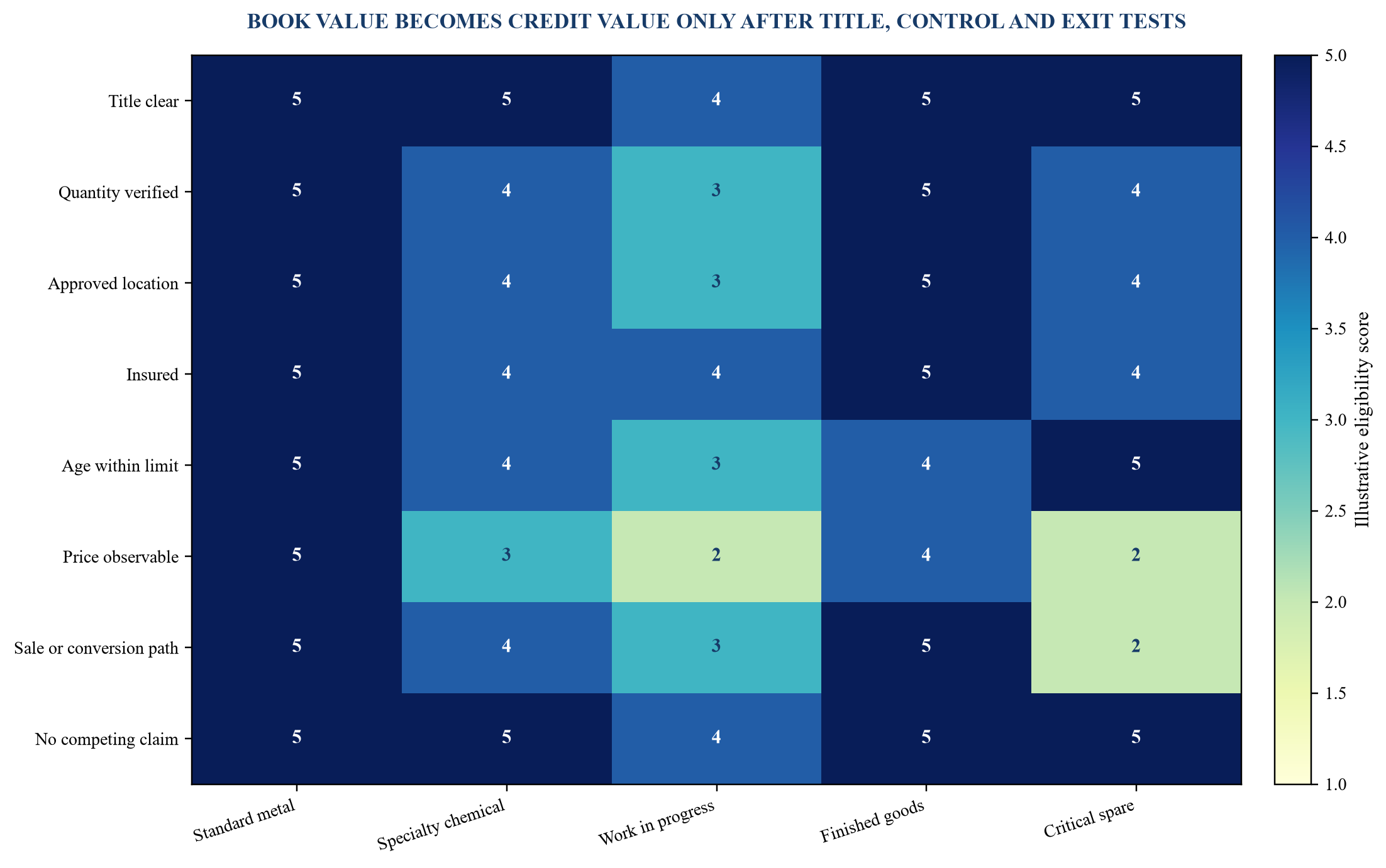
Hypothetical scores indicate relative eligibility; transaction policy should use verified evidence and defined exclusions.
Table 4. Inventory eligibility and lending response
| Inventory type | Strong evidence | Main vulnerability | Credit response |
|---|---|---|---|
| standard raw material | clear title, liquid market, verified quantity and approved warehouse | price volatility and commingling | frequent valuation, concentration limit and margin |
| specialty input | certified quality, documented demand and controlled storage | narrow buyer pool, expiry or hazardous handling | lower value, shorter age and specialist inspection |
| work in progress | traceable batch, reliable yield and funded completion | incomplete value and production failure | limited eligibility or exclusion until milestone |
| finished goods | completed specification, customer order or broad market | rejection, obsolescence and customer concentration | acceptance evidence and aging reserve |
| spare parts | serial control, compatibility and maintenance plan | low resale value despite high operational value | finance only against demonstrated secondary use |
| consigned or third-party stock | explicit ownership and legal rights | borrower may lack title | exclude unless counsel confirms enforceable collateral |
Advance rates shown are omitted because they require transaction-specific evidence and approval.
10. Make warehouse and possession controls operational
Warehouse control is a system of rights, records and physical verification. The lender should know where goods are, who can release them, how quantity is measured, how quality is preserved, which insurance applies and how a sale would occur. A monthly spreadsheet without independent physical evidence is insufficient for material inventory exposure.
Approved locations should have access control, segregation or reliable identification, inventory records, fire and hazard protection, appropriate environmental conditions and documented release authority. Third-party warehouse arrangements should address acknowledgement, liens, termination, access, reporting and delivery. On-site stock can require a field-audit protocol and restrictions on movement outside ordinary production.
Electronic and paper warehouse receipts can support title and collateral systems where applicable law gives them effect. The UNCITRAL-UNIDROIT Model Law on Warehouse Receipts was adopted in 2024 to help states modernise laws supporting electronic and paper receipts, transfer and use of stored goods as collateral.[11] A model law does not itself establish rights in a GCC jurisdiction. Counsel should confirm enactment, registry, priority and enforcement.
Stock counts should reconcile opening quantity, receipts, consumption, production transfer, sale, waste, damage and closing quantity. Negative stock, unexplained adjustments, repeated manual overrides and differences between enterprise-resource-planning and warehouse systems should stop availability until resolved.
11. Convert receivables into observable collateral
Receivables complete the conversion cycle. Eligibility should depend on an identifiable customer, executed commercial terms, completed delivery or service, acceptance where required, valid invoice, enforceable payment obligation, acceptable aging, limited dilution and a collection route that the financier can observe or control.
Customer credit should be assessed at obligor-group level. A large brand can contract through a weak subsidiary. Government-linked customers can have strong capacity and slow certification. Export receivables can carry currency, transfer, sanctions, tax and legal risks. Related-party balances should be excluded or separately approved.
Dilution should be measured from invoice to cash. It includes returns, rebates, warranty claims, quantity disputes, price adjustments, penalties, credit notes, set-off, retention and tax deductions. Historical dilution should be reconciled by customer and product. A gross invoice advance can become a cash shortfall when these deductions are ignored.
The finance product should match risk transfer. A receivables purchase can be with or without recourse, subject to representations, warranties and repurchase events. A loan against receivables retains borrower debt and collateral. Accounting derecognition under IFRS 9 depends on transfer of contractual rights, risks, rewards and control under the applicable facts.[12] The legal, accounting and credit conclusions should be documented separately and reconciled.
12. Link supplier, inventory and receivables limits
A programme that finances the same economic cycle at three points can create duplicate exposure. A lender can pay the supplier, lend against the resulting inventory and advance against the resulting receivable. The combined facility should recognise conversion rather than treat each stage as an independent asset.
The transaction ledger should assign a unique identifier to the purchase order, shipment, receipt, inventory lot, production batch, customer delivery, invoice and collection. Exposure should migrate from supplier stage to inventory stage and then to receivable stage. It should not accumulate across stages unless incremental value and separate collateral are documented.
Availability should be the lowest relevant limit after reserves. The supplier limit can be based on approved obligations for eligible vendors and inputs. The inventory limit can apply advance rates to eligible value. The receivables limit can apply advance rates after aging, dilution and concentration. A cash-flow limit can cap total debt at stressed repayment capacity. A liquidity limit can preserve the cash needed for operations and programme wind-down.
Intercreditor arrangements matter when separate providers finance stages. They should address title, proceeds, account control, notices, priority, releases, substitution, default and information. A platform view does not create legal priority. Each provider should understand the other claims on goods and cash.
13. Construct a borrowing base with independent evidence
The borrowing base should be calculated from source records and then certified by management. Approved supplier invoices should reconcile to purchase orders, receipts, acceptance and platform balances. Inventory should reconcile to stock records, counts, title, location, age and value. Receivables should reconcile to delivery, invoices, aging, customer confirmations and collections.
The World Bank's handbook for development banks and public entities describes supply-chain-finance programme design across product, institution, technology and operating-model considerations.[17] Its framework can inform governance. Transaction eligibility should still be supported by the borrower's own evidence and the finance provider's approved policy.
Reserves should be specific. A dilution reserve addresses expected deductions. A concentration reserve addresses exposure above approved customer, supplier, product or location limits. A price reserve addresses volatility. A duty and cost reserve addresses unpaid amounts required to realise stock. A completion reserve funds work in progress. A liquidity reserve protects critical operations and facility wind-down.
The certificate should state gross assets, exclusions, eligible assets, advance rates, reserves, availability, outstanding exposure, headroom and required repayment. It should include changes since the prior period and explain exceptions. A certificate produced entirely by the borrower can be tested through field audits, customer and supplier confirmation, warehouse reports, bank statements and system extracts.
Availability should reduce when data is late or unreliable. A missing field should not be treated as eligibility. The programme can use conservative fallback values for minor delays and suspend funding for material exceptions. This gives management an incentive to maintain evidence before liquidity is drawn.
14. Control concentration and wrong-way risk
Concentration should be measured across suppliers, customers, products, sites, countries, currencies, transport routes, platforms and finance providers. Connected counterparties should be aggregated. A single port, warehouse, certification body, technology platform or raw-material origin can create hidden dependence across many invoices.
Wrong-way risk occurs when collateral and obligor strength deteriorate together. A fall in commodity price can weaken a supplier, reduce inventory value and pressure the borrower's margin. A customer downturn can increase receivable aging and finished-goods inventory. A supply disruption can raise input prices while lowering output and cash.
The stress model should combine related events. It should test loss of the largest supplier, largest customer, main warehouse, primary logistics route and programme bank. It should also test a quality event that delays production and creates customer penalties. The response can include a lower advance rate, reserve, alternative supplier, controlled sale, sponsor liquidity or scheduled amortisation.
Country exposure should be based on the real supply route and legal claim. A supplier incorporated in the UAE can rely on a single overseas factory. A GCC customer can pay through another jurisdiction. Trade documents, beneficial ownership, shipping records and payment routes should be screened under current sanctions and financial-crime controls.
15. Apply legal assignment and security to the actual asset
The UAE's Federal Decree-Law No. 16 of 2021 governs factoring and transfer of receivables and addresses present and future receivables, effectiveness, notices, debtor rights and priority.[13] The exact transaction should be tested against the law, contract restrictions, governing law, debtor location and enforcement route. A platform assignment field is not a substitute for legal perfection.
The UAE's movable-security law permits security rights over categories including receivables, bank accounts, documents evidencing ownership of goods, equipment, raw material, work in progress and goods intended for sale or lease.[14] Counsel should confirm the current registration, priority, description, proceeds and enforcement requirements for each borrower and asset.
Security can include receivables assignment, inventory pledge, account security, share pledge, guarantees, insurance assignment and contractual acknowledgements. Its value depends on ownership, priority, control and practical enforcement. Retention-of-title clauses, warehouse liens, unpaid duties, employee claims, tax, landlord rights and competing financiers can reduce availability.
Cross-border structures should map law by asset and event. The law governing the receivable contract can differ from the law governing assignment, debtor discharge, bank account, inventory location and insolvency. The approval paper should identify each opinion, assumption and unresolved qualification.
16. Embed financial-crime and trade-integrity controls
Supply-chain finance relies on documents that can be duplicated, altered or matched to fictitious trade. Controls should validate counterparties, beneficial ownership, goods, quantity, price, route, vessel or carrier where relevant, customs, delivery, invoice and payment. Repeated round amounts, unusual margins, inconsistent descriptions, circuitous routing, duplicate documents and payments to unrelated accounts require investigation.
The FATF and Egmont Group report on trade-based money laundering describes risk indicators across business structures, trade activity, documents and account behaviour.[15] The programme should translate relevant indicators into onboarding, transaction monitoring and escalation without assuming that a single indicator proves wrongdoing.
Sanctions screening should cover parties, ownership, banks, carriers, vessels where applicable, goods, origin, destination and payment route. Dual-use and controlled goods may require licences or end-use evidence. A previously approved supplier or customer should be rescreened because ownership and restrictions can change.
Data controls should preserve the original document, extraction result, approval, override and payment instruction. A human should approve material exceptions. Automated matching can improve speed and still propagate incorrect master data or fabricated documents when source authenticity is weak.
17. Design the liquidity waterfall before setting the limit
Collected cash should first preserve the operations that create repayment. The waterfall should identify taxes and statutory amounts, critical payroll, utilities, safety, insurance, essential supplier payments, required maintenance, financing cost, principal, reserves and permitted release. Priority should be consistent with law and negotiated documents.
A critical-input reserve can fund a defined number of production days. Its size should use actual consumption, lead time, minimum order, price and supplier terms. A programme-withdrawal reserve can cover the cash impact if the finance provider stops paying suppliers and the borrower must revert to ordinary terms.
Cash should be allocated by legal entity. Group cash in another entity or jurisdiction may not be available because of restrictions, minority rights, covenants, tax or operational needs. The waterfall should use accessible cash and documented transfers.
The borrower should run a daily or weekly short-term cash forecast through the period of greatest risk. Monthly forecasts can miss a cluster of supplier-finance maturities, payroll, duty, loan payments and customer delays. Forecast variance should be measured by cause and owner.
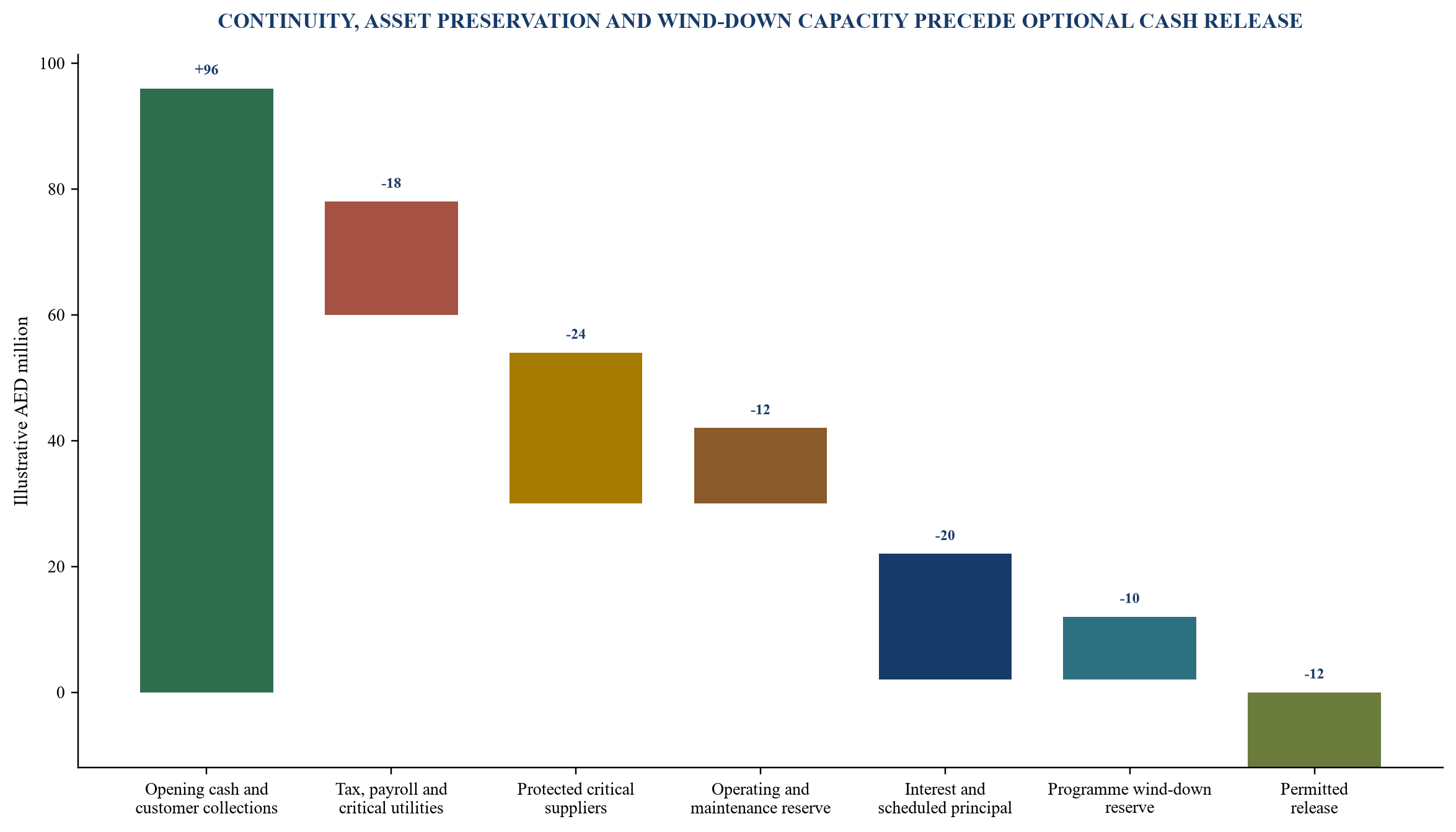
All AED amounts are hypothetical management assumptions for method demonstration.
Table 5. Liquidity waterfall and evidence gate
| Priority | Cash use | Required evidence | Control response |
|---|---|---|---|
| 1 | statutory amounts, safety, payroll and critical utilities | due schedule and verified operating need | reserve or direct payment |
| 2 | suppliers required for uninterrupted production | criticality matrix, accepted obligation and delivery plan | protected limit and supplier concentration cap |
| 3 | insurance, essential maintenance and warehouse cost | policy, maintenance plan and invoices | controlled reserve |
| 4 | financing cost and scheduled principal | lender statement and borrowing-base certificate | automatic payment from controlled account |
| 5 | programme wind-down and substitution | short-term cash forecast and supplier-term scenario | trapped liquidity until tested |
| 6 | permitted owner or group release | all prior obligations and covenants satisfied | board and lender approval where required |
Priority and account control require transaction-specific legal and operational design.
18. Set covenants around operating evidence
Financial covenants should include minimum liquidity, total funded obligations, fixed-charge or debt-service cover, borrowing-base headroom and concentration. Operational covenants should include critical-supplier coverage, eligible inventory, inventory aging, yield, customer acceptance, receivable dilution and controlled-account compliance.
Leverage definitions should state how supplier finance, inventory finance, receivables recourse, letters of credit, guarantees and leases are treated. An agreement can use a negotiated definition while management maintains a broader total-obligation view. Both should be reported without switching definitions between periods.
Early-warning triggers can include loss of a critical supplier, material price increase, reduced supplier terms, late delivery, quality rejection, stock-count variance, inventory obsolescence, customer dispute, dilution, overdue receivables, platform outage and finance-provider withdrawal. The trigger should specify owner, investigation deadline and remedy.
Remedies can include lower availability, reserve increase, direct supplier payment, alternative supplier, stock sale, customer confirmation, accelerated collection, cash sweep, equity cure or partial repayment. A covenant without a practical response produces late information and weak control.
19. Use technology to strengthen evidence rather than replace it
Technology can connect enterprise-resource-planning, procurement, warehouse, logistics, invoicing, bank and finance-platform data. IFC's handbook on technology and digitisation in supply-chain finance describes digital tools as an enabler for financial institutions expanding supply-chain-finance portfolios.[16] The control value comes from authenticated sources, reliable event capture and exception management.
The data architecture should maintain a unique identifier across purchase order, shipment, goods receipt, inspection, invoice, payment, inventory lot, production batch, customer delivery, receivable and collection. It should prevent duplicate financing and show when exposure converts from one stage to another.
Access controls should separate vendor creation, purchase approval, goods receipt, invoice approval, payment instruction and master-data change. Overrides should record user, time, reason and approval. Interfaces should reconcile totals and exceptions; a successful file transfer does not prove business validity.
Artificial intelligence can support document extraction, anomaly detection, supplier-risk monitoring and cash forecasting. Its output should be treated as a decision aid. Training data, thresholds, false positives, false negatives, model drift and human approval should be governed. Original evidence remains decisive for funding.
20. Stress the programme as a liquidity system
The base case should forecast input purchase, supplier terms, production, inventory, customer delivery, receivables, cash, interest and principal. Downside cases should combine events that occur together: input-price increase and slower production; supplier failure and expedited replacement; customer delay and inventory build; finance-provider withdrawal and shorter supplier terms.
Reverse stress testing should identify the point at which critical production, minimum liquidity, borrowing-base headroom or debt service fails. It should show the earliest management action available before failure. An uncommitted sponsor contribution should not be included as available cash.
Worked values should be transparent. A hypothetical case can assume AED 400 million of annual revenue, a 105-day cash-conversion path, AED 85 million of supplier-finance obligations, AED 48 million of inventory finance and AED 22 million of receivables recourse. These are management assumptions for demonstrating linkage. They should be replaced by reconciled company data in an actual transaction.
Scenario limitations should be stated. Historical delivery and collection do not establish future performance. Inventory sale values can change quickly. A legal opinion cannot predict enforcement timing. Supplier and customer behaviour can change when stress becomes visible. The model should therefore show ranges, decision points and liquidity actions.
Table 6. Illustrative integrated stress scenarios
| Scenario | Operating event | Borrowing-base effect | Liquidity effect | Planned response |
|---|---|---|---|---|
| reference | ordinary delivery, yield and collection | assets remain eligible | scheduled debt and reserve funded | normal monitoring |
| input shock | critical material price rises 20 per cent | concentration and price reserve increase | additional purchase cash required | price pass-through, lower advance and cash reserve |
| supplier interruption | largest critical supplier stops delivery for 30 days | approved-payables availability falls | expedited sourcing and idle cost | activate qualified alternative and distribution lock |
| quality failure | batch rejected and production delayed | affected inventory excluded | replacement and customer penalty cash | claim, reserve top-up and direct replacement funding |
| customer delay | largest customer pays 45 days late | receivable aging reserve rises | supplier and debt maturities cluster | controlled collection, cash sweep and reduced purchases |
| programme withdrawal | finance provider stops new supplier payments | no new payables availability | ordinary supplier terms return immediately | wind-down reserve and committed backup line |
| combined downside | input shock, delay and withdrawal | eligibility and advance rates fall together | minimum liquidity breached without action | sponsor cure, asset sale and consensual amortisation |
All values and responses are hypothetical management assumptions; they are not forecasts.
21. Build a one-hundred-and-twenty-day implementation programme
The first twenty days should define entities, suppliers, inputs, customers, facilities, accounts, systems and legal perimeter. Management should reconcile debt and working-capital obligations before designing new capacity. Days twenty-one to forty should map purchase-to-pay, inventory and order-to-cash processes and test source data.
Days forty-one to sixty should create supplier criticality, inventory eligibility and receivables rules. Legal, accounting, tax, insurance, sanctions and technology work should run in parallel. Days sixty-one to eighty should build the borrowing base, cash model, leverage reconciliation, waterfall, covenants and downside.
Days eighty-one to one hundred should configure platform and bank interfaces, notices, account control, security, reporting and exception workflows. Pilot invoices and inventory lots should be run without funding to test duplicate detection, eligibility and cash reconciliation.
Days one hundred and one to one hundred and twenty should complete closing, train users, establish opening reserves and run the first certificate. The programme should begin with bounded suppliers, inputs and customers. Expansion should follow observed control performance.
Table 7. One-hundred-and-twenty-day supply-chain-finance workplan
| Period | Primary work | Required output | Approval gate |
|---|---|---|---|
| days 1-20 | perimeter, obligations, facilities, suppliers and accounts | reconciled supply-chain and leverage map | entities, uses and existing claims defined |
| days 21-40 | process mapping and source-data testing | event-level data and exception inventory | physical, contractual and financial chains reconcile |
| days 41-60 | criticality, eligibility and professional diligence | supplier, inventory and receivables policies | legal and operational eligibility approved |
| days 61-80 | borrowing base, cash, waterfall, covenants and stress | integrated credit and liquidity model | limit supported through downside |
| days 81-100 | documents, security, platform, controls and pilot | tested operating workflow | duplicate, exception and cash controls pass |
| days 101-120 | closing, training, reserves and first certificate | controlled launch evidence file | first draw can be independently verified |
Timing depends on data quality, legal complexity, supplier onboarding, warehouse control and platform integration.
22. Monitor the conversion cycle after closing
Daily or weekly monitoring should focus on funding, exceptions and cash. It should show supplier payments, buyer obligations, inventory movement, receivable creation, collections, controlled-account balance, headroom and upcoming maturities. Monthly reporting should reconcile the full cycle and explain changes in supplier, inventory, customer and leverage exposure.
Supplier monitoring should combine criticality with performance and financial indicators. Inventory monitoring should include quantity, location, age, quality, price and insurance. Receivables monitoring should include aging, dilution, dispute, concentration and collection. Leverage monitoring should include drawn and contingent obligations, maturity and accessible cash.
Independent checks should be risk based. They can include supplier confirmation, customer confirmation, warehouse inspection, stock count, platform reconciliation, bank confirmation, invoice sampling and legal update. High automation should increase the importance of master-data and access-control testing.
The evidence calendar should identify each report, source, owner, frequency, due date and escalation. A missing certificate, late warehouse report or unreconciled platform balance should reduce availability according to policy. This converts reporting discipline into a real funding control.
23. Use an approval gate that can reject the programme
The approval paper should answer twelve questions. Which inputs are critical? Which suppliers can be replaced? Which event makes an obligation eligible? Who owns financed inventory? Where is it located? How is value determined? Which customer cash repays the exposure? What dilution is expected? Which provider controls each asset and account? How is every obligation classified and reconciled? What happens if the programme stops? Which action protects production before liquidity fails?
Funding should pause when suppliers, beneficial owners or trade are unverified; obligations are disputed; delivery or acceptance is missing; inventory title, quantity or location is uncertain; receivables are duplicated or ineligible; sanctions or fraud issues remain unresolved; accounting and leverage treatment is unclear; security is incomplete; or the downside depends on uncommitted cash.
Each management assumption should be dated, owned and sensitised. Each legal, accounting, tax, insurance and valuation conclusion should remain within the scope of qualified advisers. Policy support for GCC industrial development does not establish company credit or transaction eligibility.
The approval should cover operations after closing. It should name the owner of supplier onboarding, invoice approval, stock control, borrowing-base certification, cash forecasting, covenant reporting and exception cure. It should define the record system and the evidence retained. A programme can be declined even when it improves headline working capital if its controls, liquidity or leverage transparency are inadequate.
Conclusion
Supply-chain finance for GCC industrials can protect production and release working capital when finance follows verified commercial events. The programme begins with the physical, contractual and financial chains. It ranks suppliers by operational criticality and replaceability, funds accepted obligations, values inventory through title and exit evidence, and converts eligible receivables into controlled cash.
The framework then reconciles every working-capital obligation with ordinary debt. Supplier finance, inventory loans, receivables recourse, letters of credit, guarantees, leases and restricted cash enter one maturity and liquidity view. This gives management, lenders and financial-statement users a clearer picture of economic leverage.
Availability is governed by independent supplier, inventory, receivables, cash-flow and liquidity limits. Concentration, dilution, price, completion and programme-withdrawal reserves protect against correlated risk. The liquidity waterfall preserves statutory, safety, payroll, utility, critical-supplier, maintenance and wind-down needs before optional cash release.
The result is a finance structure that supports critical inputs while keeping debt visible. Industrial policy, local-content programmes and development-bank capacity provide a supportive setting. Financeability remains company specific and evidence led. A controlled programme can fund continuity, strengthen supplier relationships and convert operating assets into cash. An uncontrolled programme can defer obligations and concentrate a liquidity problem. The approval discipline described in this paper is designed to identify that difference before capital is committed.
References
- GCC Statistical Center. GCC Annual Statistical Yearbook 2025. https://gccstat.org/images/gccstat/docman/publications/GCC_YEAR_BOOK_2025.pdf
- UAE Ministry of Industry and Advanced Technology. About the National Strategy for Industry and Advanced Technology, Operation 300Bn. https://moiat.gov.ae/en/about-us/about-the-strategy
- Saudi Vision 2030. National Industrial Development and Logistics Program Annual Report 2024. https://www.vision2030.gov.sa/media/uvknp4di/nidlp_annual_report-2024_-en.pdf
- Emirates Development Bank. ADNOC becomes first partner to support the AED 1 billion National Industrial Resilience Fund, May 2026. https://www.edb.gov.ae/posts/adnok-aol-almndmyn-ldaam-alsndok-alotny-llmron-alsnaaay-otmkyn-alktaaaat-that-alaoloy
- Global Supply Chain Finance Forum and International Chamber of Commerce. Standard Definitions for Techniques of Supply Chain Finance. https://library.iccwbo.org/tfb/ps/ICC-Standard-Definitions-for-Techniques-of-Supply-Chain-Finance-Global-SCF-Forum-2016.pdf
- International Finance Corporation. Global Supply Chain Finance Program. https://www.ifc.org/en/what-we-do/sector-expertise/trade-and-supply-chain-finance/global-supply-chain-finance
- Emirates Development Bank. Supply Chain Finance. https://www.edb.gov.ae/index.php/solutions/supply-chain-finance
- IFRS Foundation. Supplier Finance Arrangements: Amendments to IAS 7 and IFRS 7. https://www.ifrs.org/projects/completed-projects/2023/supplier-finance-arrangements/webcast-supplier-finance-arrangements/
- IFRS Foundation. IASB Update July 2026, reverse-factoring agenda decision. https://www.ifrs.org/news-and-events/updates/iasb/2026/iasb-update-july-2026/
- IFRS Foundation. IAS 2 Inventories. https://www.ifrs.org/issued-standards/list-of-standards/ias-2-inventories/
- United Nations Commission on International Trade Law. UNCITRAL-UNIDROIT Model Law on Warehouse Receipts, 2024. https://uncitral.un.org/en/mlwr
- IFRS Foundation. IFRS 9 Financial Instruments. https://www.ifrs.org/issued-standards/list-of-standards/ifrs-9-financial-instruments/
- United Arab Emirates Government. Federal Decree-Law No. 16 of 2021 on Factoring and Transfer of Receivables. https://www.uaelegislation.gov.ae/en/legislations/1515/download
- United Arab Emirates Government. Federal Law No. 4 of 2020 on Securing the Rights in Movables. https://uaelegislation.gov.ae/en/legislations/1446/download
- Financial Action Task Force and Egmont Group. Trade-Based Money Laundering: Trends and Developments. https://www.fatf-gafi.org/en/publications/Methodsandtrends/Trade-based-money-laundering-trends-and-developments.html
- International Finance Corporation. Technology and Digitization in Supply Chain Finance Handbook. https://documents1.worldbank.org/curated/en/310261613738371600/pdf/Technology-and-Digitization-in-Supply-Chain-Finance-Handbook.pdf
- World Bank. Supply Chain Finance by Development Banks and Public Entities Handbook. https://documents1.worldbank.org/curated/en/359771613563556978/pdf/Supply-Chain-Finance-by-Development-Banks-and-Public-Entities-Handbook.pdf
- Saudi General Authority for Statistics. Annual Industrial Production Index 2025. https://stats.gov.sa/en/search-publication?category=publication&delta=20&q=Industrial+Production&sort=createDate-
