

1. The capital decision behind a synthetic risk transfer
A bank that wants to expand mid-market lending can raise equity, retain earnings, sell loans, reduce balance-sheet growth or transfer a defined layer of credit risk to investors. A synthetic risk transfer, or SRT, preserves the customer loans and servicing relationship on the bank's balance sheet while transferring specified portfolio losses through a guarantee, credit derivative or funded credit-linked note structure. The practical decision is whether the cost, complexity and retained risk of the transaction create more usable capital capacity than the alternatives.
The Basel Committee describes synthetic securitisation as a tranched structure in which credit risk on an underlying pool is transferred through funded or unfunded credit protection [1]. The Central Bank of the UAE uses the same core concept in its in-force securitisation standards and sets operational requirements for recognition of risk transfer [3][4]. Capital relief therefore follows regulatory recognition and economic substance. Contract language alone cannot make a transaction capital-efficient.
This paper develops a transaction framework for a GCC bank considering an SRT on a mid-market corporate portfolio. It connects reference-pool eligibility, data quality, loss allocation, investor economics, capital recognition, legal effectiveness, servicing, replenishment, disclosure, governance and new-lending deployment. The aim is to give the board a transparent basis for choosing, structuring and monitoring the transaction.
2. Separate customer continuity from credit-risk ownership
In a synthetic transaction the bank ordinarily remains lender of record. Borrowers continue to deal with the bank, make payments under existing loan documents and use established operating channels. The bank transfers a defined portion of credit risk rather than selling the loans. This can preserve customer continuity and avoid assignment mechanics that a true-sale transaction may require.
The bank still owns and services the exposures. It retains risks outside the protected tranche, including senior risk, excluded losses, operational risk, conduct risk, fraud risk, servicing obligations, legal disputes and any mismatch between the protection contract and underlying loans. Investors depend on accurate portfolio reporting and the operation of agreed credit-event definitions.
The board should describe the transaction as a reallocation of specified credit losses. It should not describe all portfolio risk as removed. The retained-risk map is as important as the transferred-risk waterfall.
Table 1. Proposed SRT decision architecture
| Decision module | Core question | Required evidence | Board output |
|---|---|---|---|
| Capital objective | Which constraint should the transaction relieve? | RWA, CET1, concentration and growth plan | Measurable capital-use case |
| Reference portfolio | Are exposures eligible, homogeneous enough and observable? | Loan tape, legal review and data-quality report | Approved pool and exclusions |
| Risk transfer | Which loss layer is genuinely transferred? | Waterfall, attachment, detachment and stress tests | Retained and transferred-risk map |
| Investor economics | Does premium compensate investors across scenarios? | Cash flows, loss timing and collateral terms | Executable pricing range |
| Deployment | Where will released capacity create value? | Lending pipeline, returns and limits | Ring-fenced allocation plan |
Regulatory treatment and legal effectiveness require jurisdiction-specific confirmation.
3. Define the capital constraint precisely
An SRT should begin with a documented balance-sheet problem. The constraint may be risk-weighted assets, CET1 ratio headroom, sector concentration, single-name limits, portfolio volatility, planned acquisition capacity or a desire to increase lending without selling customer assets. Each problem leads to a different reference pool and transaction design.
The capital bridge should show current CET1 capital, current RWA, management buffer, regulatory requirements, stressed headroom and the lending plan. It should distinguish gross RWA removed from net capital benefit after retained securitisation positions and other requirements. Supervisory recognition, tranche risk weights, maturity, excess spread and protection cost can materially affect the result.
BIS notes that SRTs are used for capital and credit-risk management and that their economic appeal depends on the trade-off between protection cost and the benefit of capital relief [8][9]. The board should therefore approve a minimum net benefit, not a gross RWA target.
4. Compare SRT with available balance-sheet alternatives
The bank should compare SRT with equity issuance, retained earnings, dividend restraint, loan sale, true-sale securitisation, syndication, sub-participation, insurance, bilateral guarantees, portfolio run-off and changes in origination mix. These alternatives differ in speed, cost, customer impact, accounting, funding, liquidity and supervisory treatment.
An equity raise provides broad loss-absorbing capacity but may be expensive or dilutive. A loan sale can create funding and risk transfer, while changing ownership and potentially affecting customer relationships. A bilateral guarantee may be simpler but create counterparty concentration. An SRT can target a portfolio and loss layer, though it requires granular data, complex documentation and continuing monitoring.
The comparison should use the same planning horizon and stress assumptions. A one-year premium should not be compared with a permanent capital benefit. Termination and refinancing risk should be included.
5. Establish early supervisory engagement
Capital recognition depends on the applicable prudential framework and supervisory assessment. Basel's supervisory review framework states that capital reduction should correspond to the amount of credit risk effectively transferred and that supervisors may deny or increase capital requirements where transfer is insufficient [2]. CBUAE standards specify operational requirements for traditional and synthetic securitisations [3][4].
The bank should engage its supervisor early with the capital objective, proposed portfolio, structure, counterparties, legal analysis, modeling, governance and timetable. It should maintain a question log and avoid assuming that a structure used in another jurisdiction will receive the same treatment.
Recent PRA guidance provides a comparative benchmark for senior-management accountability, legal opinions, early engagement and continuing commensurateness [11]. GCC requirements remain governed by the relevant local authority.
6. Build a reference-pool eligibility matrix
The reference portfolio determines both protection value and investor confidence. Each exposure should be tested for legal existence, obligor identity, product, jurisdiction, currency, industry, security, seniority, maturity, delinquency, default status, restructuring, documentation, data completeness and relationship to other exposures.
Eligibility criteria should be objective and reproducible. They can exclude defaulted loans, disputed claims, connected parties, exposures with missing documentation, very short maturities, certain currencies or sectors and loans whose terms permit unexpected changes. Concentration limits can cap single obligors, groups, industries, countries and product types.
The bank should preserve a snapshot at the cut-off date and a reconciliation to the general ledger, regulatory reporting and risk systems. Exceptions require documented approval. Investors should receive enough information to reproduce agreed calculations within confidentiality and banking-secrecy controls.
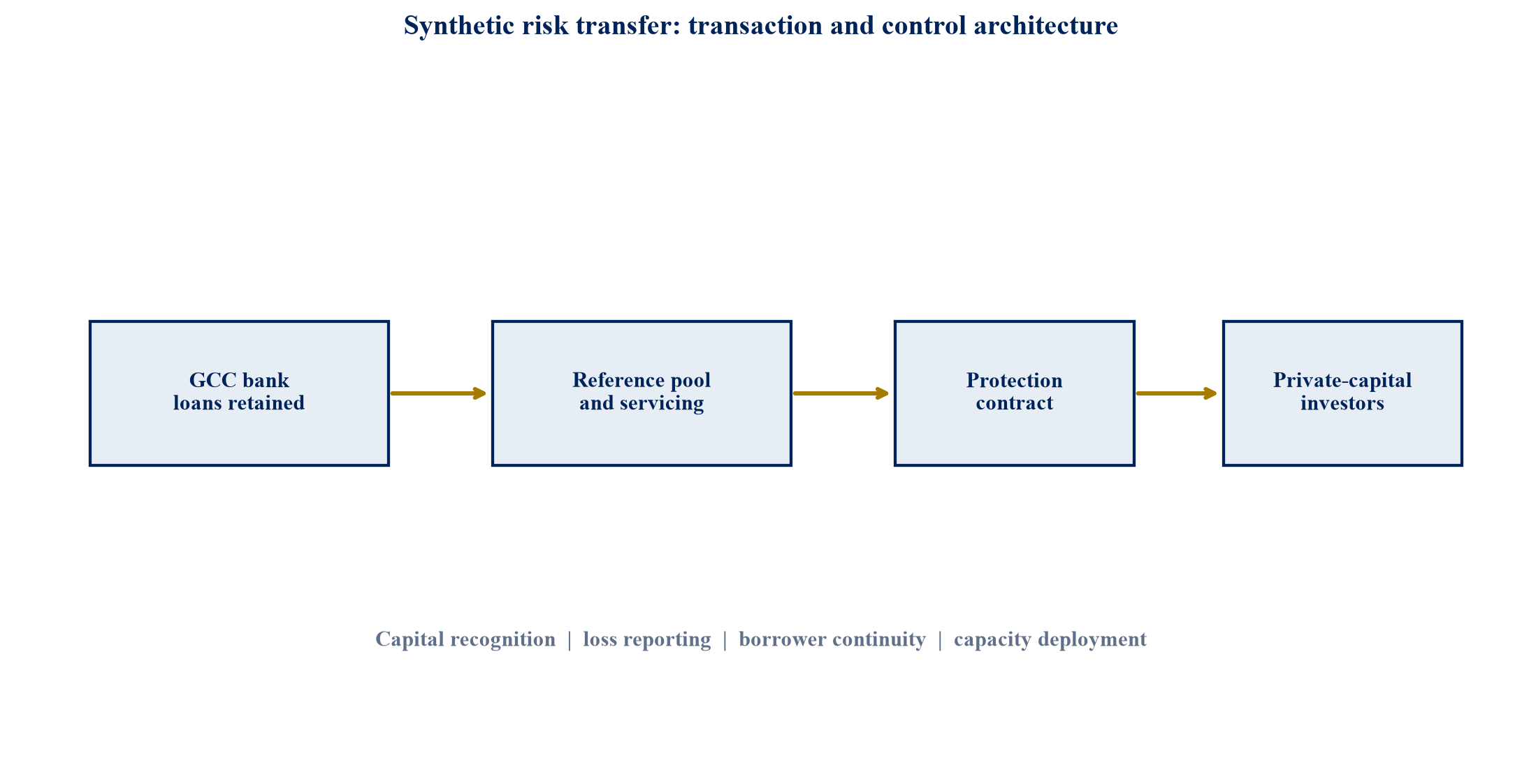
The structure is illustrative. Legal form, collateral, capital treatment and cash flows require transaction-specific confirmation.
7. Make data quality a closing condition
An SRT requires consistent historical and current data on balances, limits, ratings, arrears, defaults, recoveries, collateral, provisions, restructurings, migrations, sectors and jurisdictions. Missing fields can distort attachment points, pricing and capital calculations.
The data-quality report should measure completeness, accuracy, timeliness, lineage and reconciliation. It should identify manual overrides, system changes, definition changes and periods with weaker evidence. Historical default and recovery data should use stable definitions or explain adjustments.
Closing conditions can require a final loan tape, agreed exceptions, independent testing and signed data representations. Post-closing reporting should use the same controlled definitions. A portfolio that cannot be monitored should not be protected through a complex waterfall.
8. Define credit events and losses unambiguously
The protection agreement should define the events that create a covered loss. These may include failure to pay, bankruptcy, restructuring and other specified credit events. The contract must also define loss amount, recoveries, valuation, timing, dispute resolution and the effect of subsequent recoveries.
A mismatch between the underlying loan and protection definition creates basis risk. A loan may be economically impaired without meeting the contractual event. A restructuring may change maturity or principal in a way treated differently across systems. The bank should test historical problem cases against the proposed definitions.
Legal, credit, finance and operations teams should sign off one event dictionary. The servicing system must capture the evidence needed to make a valid protection claim.
9. Design the attachment and detachment points
The attachment point defines the portfolio-loss level at which the protected tranche begins to absorb loss. The detachment point defines where its protection is exhausted. The bank may retain a first-loss layer, transfer a mezzanine layer and retain the senior layer. The chosen band determines investor loss risk and the bank's residual capital treatment.
Attachment should be tested against expected loss, stress loss, model uncertainty, concentration and recovery timing. A thin tranche placed immediately above expected loss may be attractive to the bank but fragile for investors. A thicker or more remote tranche costs more in notional terms and may be easier to underwrite.
The board should view the full loss distribution and retained exposures. A transferred tranche does not eliminate tail risk above detachment or losses below attachment.
10. Match protection maturity to portfolio risk
The transaction term should cover the period during which the reference exposures generate capital and credit risk. Portfolio amortisation, loan maturity, prepayment, extension and replenishment affect effective protection. Maturity mismatch can reduce recognition under applicable rules.
The bank should model weighted-average life, longest maturity, expected amortisation and extensions. Protection should not disappear before the risk it is intended to cover. Call rights, step-ups and termination events require particular scrutiny because they can weaken effective transfer.
The current Basel Framework and CBUAE standards include operational conditions around risk transfer and transaction features [1][3]. Legal and regulatory teams should confirm the precise effect of maturity and termination provisions.
Table 2. Proposed reference-portfolio eligibility matrix
| Dimension | Eligibility test | Concentration control | Monitoring evidence |
|---|---|---|---|
| Obligor and group | Verified identity and connected exposure map | Single-name and group cap | Customer master and group hierarchy |
| Credit status | Performing under agreed definition at cut-off | Rating and watch-list limits | Arrears, rating and forbearance history |
| Documentation | Enforceable loan and security records | Exception cap | Legal file and collateral register |
| Industry and geography | Approved taxonomy and jurisdiction | Sector and country caps | Regulatory classification and address evidence |
| Maturity and currency | Within protection term and approved currencies | Weighted-life and FX limits | Contractual cash flow and hedge data |
Criteria and thresholds are illustrative and must be approved for the live portfolio.
11. Choose funded or unfunded protection deliberately
Funded structures can use credit-linked notes issued by the bank or an SPV, with proceeds held as collateral. Unfunded structures can use guarantees or credit derivatives from eligible protection providers. Each route changes counterparty risk, collateral, liquidity, documentation and investor transferability.
BIS describes direct bank-issued CLNs, guarantees or CDS, and SPV-issued CLNs as common forms [9]. Most current transactions are funded or secured by financial collateral, reducing counterparty exposure when properly structured [9]. The actual treatment depends on legal enforceability and prudential rules.
The bank should compare collateral location, permitted investments, interest, replacement mechanics, insolvency remoteness, tax, withholding, currency and enforcement. Investor economics should reflect the collateral return as well as the protection premium.
12. Build a transparent loss waterfall
The waterfall allocates portfolio losses among the bank and investors. It should show first-loss retention, protected tranche write-down, senior retention, recoveries, replenishment and termination. Every calculation should be reproducible from the servicing data.
Loss allocation can be sequential or use other permitted mechanics. Recoveries may restore tranche principal or reduce later claims. Timing affects investor returns because a loss early in the term removes principal that would otherwise earn premium.
The model should test clustered defaults, slow recoveries, sector stress, correlated obligors and currency mismatch. It should also show losses excluded by contract or eligibility breaches.
13. Prevent protection terms from limiting transfer
CBUAE guidance states that synthetic risk transfer may be recognised only where instruments do not contain terms or conditions that limit the amount of credit risk transferred [3]. It gives examples including materiality thresholds, termination linked to deterioration, requirements to improve pool quality, rising protection cost as quality deteriorates and increases in retained first-loss positions [3].
The bank should maintain a term-by-term risk-transfer checklist. Economic features, side letters, collateral arrangements and servicing discretion should be reviewed together. A formally broad guarantee can be weakened by exclusions or termination rights.
The board should receive legal and regulatory opinions addressing enforceability and effective transfer. Opinions should be refreshed when law or structure changes.
14. Control replenishment and portfolio substitution
A revolving portfolio can replace amortised exposures during a replenishment period. This helps maintain notional size and capital benefit, while introducing selection and migration risk. Eligibility and concentration tests must apply at each addition.
The bank should define replenishment frequency, cut-off, substitution rights, breach remedies and independent checks. It should prevent selection designed to improve the bank's retained book at investor expense or to weaken the protected pool.
Static pools are easier to observe but amortise more quickly. The choice should match business purpose, data capability and investor appetite.
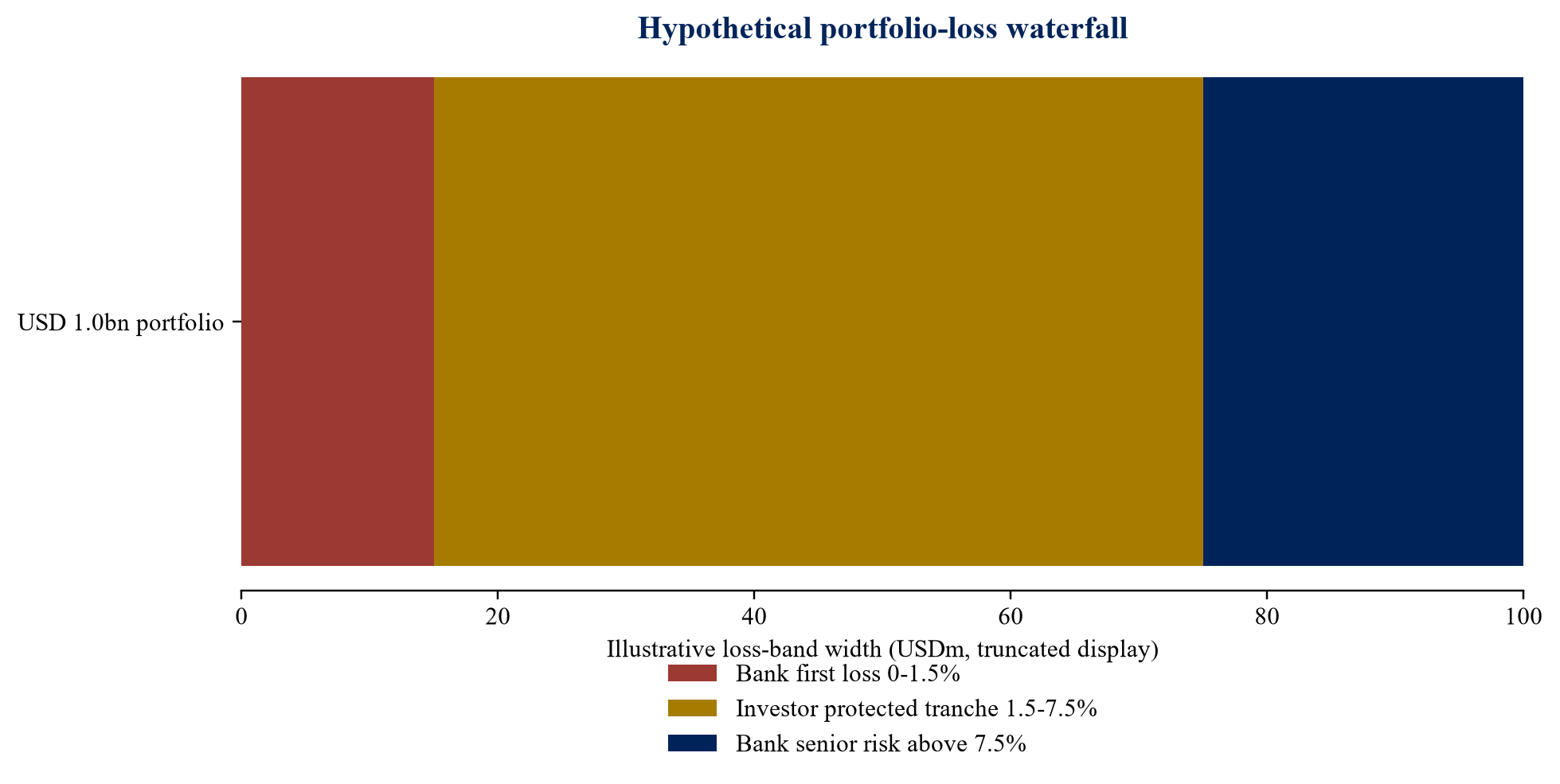
USD millions are author assumptions without empirical calibration. The figure does not predict losses or recoveries.
15. Price investor return from actual risk
Investor return consists of protection premium plus any collateral return, less credit losses, fees and financing costs. Pricing should reflect attachment, tranche thickness, portfolio risk, concentration, maturity, replenishment, recovery timing, data quality, collateral and liquidity.
The bank should provide base, moderate and severe scenarios without presenting them as forecasts. Investors need loan-level or sufficiently granular information, historical performance and a clear model of cash flows. The bank should retain an independent view of fair cost and capital value.
Competition among investors can improve price and terms. Process integrity requires consistent information, controlled Q&A and documented evaluation.
16. Measure capital benefit net of all costs
The capital model should compare RWA before and after the transaction, capital charges on retained positions, operational and counterparty effects, premium, fees, collateral costs and tax. It should calculate annual and life-of-transaction benefit.
Gross RWA reduction can overstate value. A bank may pay protection premium for several years while the reference pool amortises. Renewal may be expensive or unavailable. Capital benefit can change if risk transfer is re-characterised or pool performance breaches structural tests.
The board should approve a minimum net present value, a maximum protection cost and a minimum stressed capital buffer. It should also state where released capacity will be deployed.
17. Link released capacity to mid-market lending
An SRT does not automatically create new loans. The bank needs an approved origination pipeline, pricing, underwriting capacity, sector limits and relationship strategy. Released capital can otherwise remain unused or migrate into riskier assets without transparent approval.
The deployment ledger should identify target borrower segments, products, geographies, risk appetite, expected RWA, return, collateral and portfolio limits. New lending should follow the bank's normal credit standards. Capital relief should not weaken underwriting.
BIS research notes that evidence on how banks redeploy released capital remains limited and that possible uses include new lending or other higher-return businesses [9]. A GCC programme should measure actual incremental lending and performance rather than claim it in advance.
18. Preserve borrower continuity and confidentiality
Borrowers may have no direct role in an SRT, yet their information and relationship are central. The bank should review confidentiality, banking secrecy, data protection, consent and cross-border transfer requirements before sharing data with investors, arrangers, advisers or an SPV.
Data can be anonymised, aggregated or shared through controlled systems where permitted. Investor diligence still needs enough detail to assess risk. The disclosure design should balance these requirements with legal advice.
Servicing standards should remain clear. Credit decisions, waivers, restructurings and enforcement should follow agreed policies without allowing investor interests to distort fair customer treatment or bank judgment.
19. The hypothetical transaction establishes the mechanics
Consider a USD 1.0 billion reference portfolio of performing mid-market corporate loans. The bank retains a 1.5% first-loss layer, transfers a 6.0% mezzanine tranche attaching at 1.5% and detaching at 7.5%, and retains losses above 7.5%. The protected notional is USD 60 million.
The model assumes a 9.0% annual protection premium on outstanding protected notional, a three-year term and simplified immediate loss allocation. It assumes no amortisation, tax, collateral return, fees or time value for the scenario illustration. Those omissions make the model unsuitable for pricing a live transaction.
Three cumulative portfolio-loss scenarios are applied: 1.0%, 4.0% and 9.0%. Investor principal losses are zero, USD 25 million and USD 60 million respectively. All figures are author assumptions without empirical calibration.
Table 3. Hypothetical SRT loss and investor-return scenarios
| Scenario | Portfolio loss | Bank first-loss absorption | Investor principal loss | Bank senior loss | Three-year gross premium | Investor gross result before other costs |
|---|---|---|---|---|---|---|
| Low loss | 10 | 10 | 0 | 0 | 16.2 | 16.2 |
| Moderate loss | 40 | 15 | 25 | 0 | 16.2 | -8.8 |
| Severe loss | 90 | 15 | 60 | 15 | 16.2 | -43.8 |
USD millions. Assumptions exclude amortisation, fees, tax, collateral return and time value.
20. Interpret the low-loss scenario carefully
At 1.0% cumulative portfolio loss, the USD 15 million first-loss layer absorbs all assumed losses. Investor principal remains intact and the simplified three-year premium totals USD 16.2 million. This outcome illustrates tranche subordination, not an expected return forecast.
Actual premium accrues on outstanding notional and can change through amortisation, write-down, replenishment and termination. Collateral income, expenses, tax and financing also affect investor return. The bank still bears first loss and all retained non-credit risks.
The board should test whether the protection cost remains justified when losses stay below attachment. Capital and concentration benefits may still support the transaction.
21. Interpret moderate and severe stress
At 4.0% cumulative portfolio loss, the bank absorbs USD 15 million and the investor tranche absorbs USD 25 million. At 9.0%, the protected tranche is exhausted and the bank also bears USD 15 million of senior loss. The structure transfers a defined middle layer rather than all portfolio loss.
These scenarios demonstrate why investors analyse attachment, tranche thickness and tail correlation. They also show why the bank must stress retained first-loss and senior positions. A capital transaction can leave substantial economic exposure.
Live scenarios should incorporate default timing, recoveries, interest shortfalls, currency, replenishment and legal definitions. Model risk should be governed and independently validated.
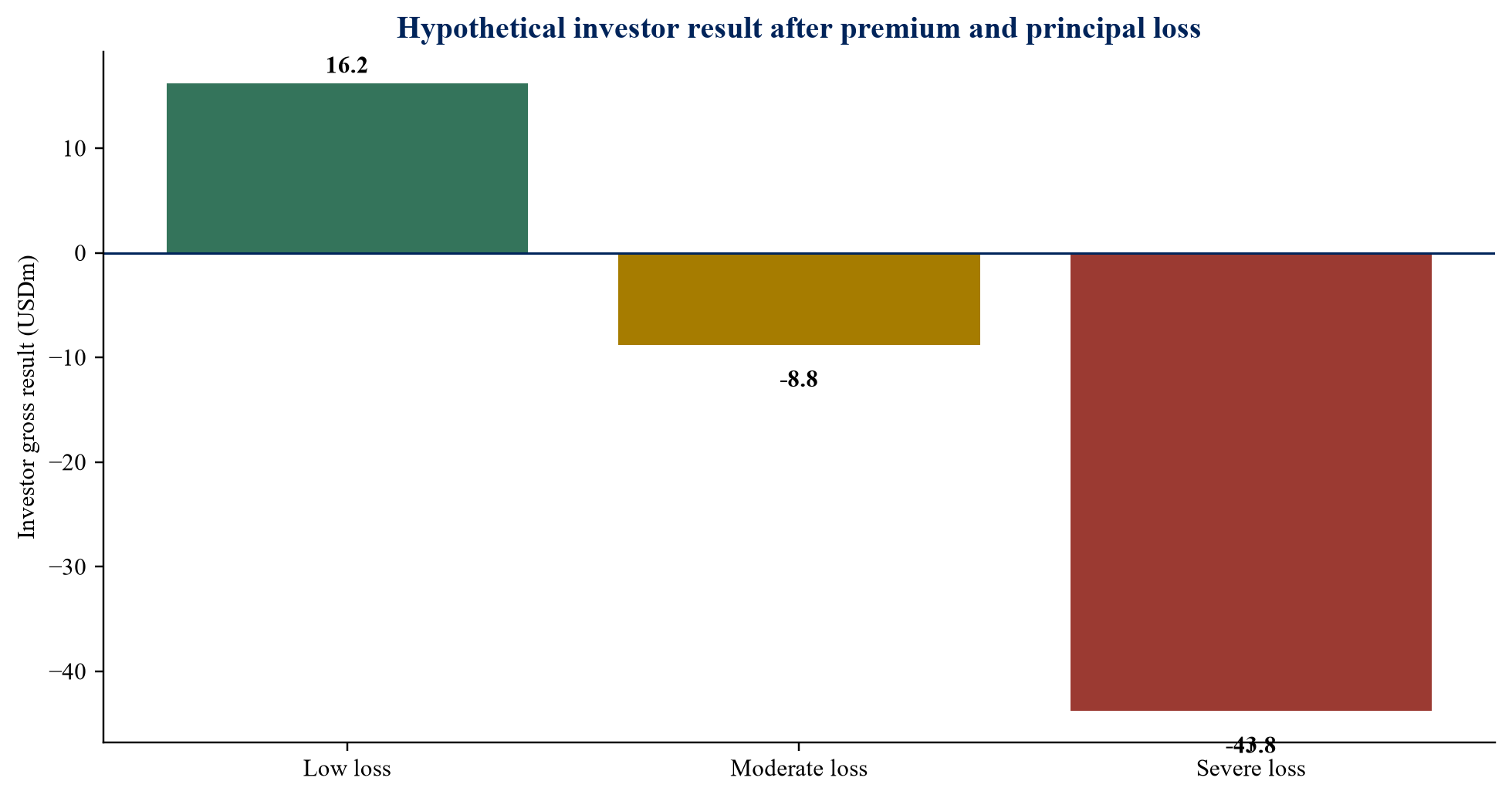
Author assumptions. Results exclude important cash-flow components and do not forecast investment performance.
22. Model the bank-capital bridge
Assume the bank has USD 8.0 billion of RWA and USD 1.04 billion of CET1 capital, producing a 13.0% CET1 ratio. A transaction that receives full recognition and reduces net RWA by USD 480 million would produce modeled RWA of USD 7.52 billion and a CET1 ratio of approximately 13.83%, before transaction costs and other balance-sheet changes.
If the bank maintains a 13.0% CET1 ratio, USD 480 million of RWA capacity corresponds to USD 62.4 million of CET1 headroom. The amount of new nominal lending that capacity supports depends on loan risk weights and other constraints. A 100% average risk weight would imply USD 480 million of nominal capacity; a different risk weight changes the amount.
Every number is an author assumption. Supervisory recognition, retained positions, floors, output constraints, leverage ratio, liquidity, concentration and management buffers can materially alter the result.
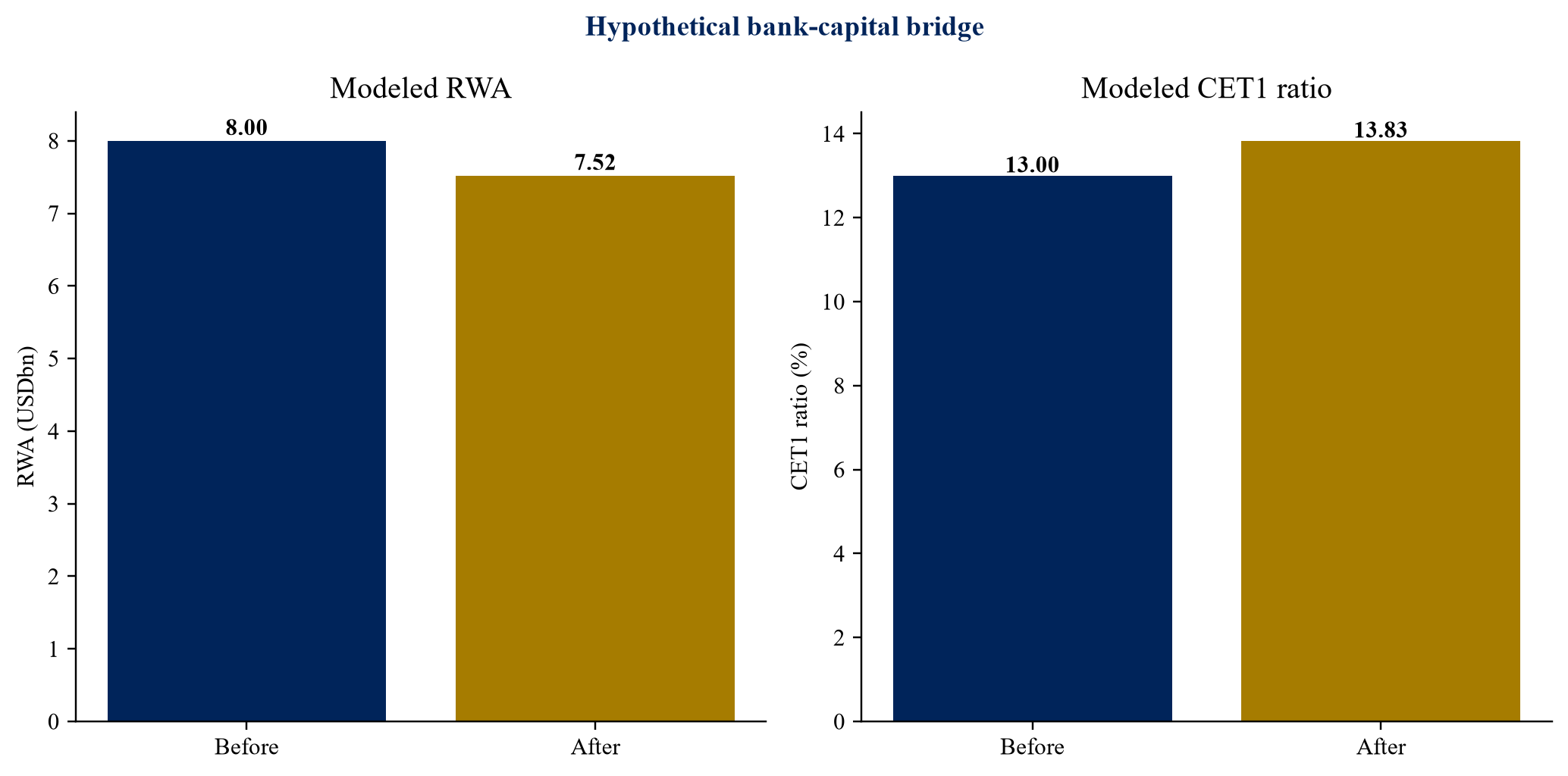
Author assumptions without empirical calibration. The figure does not predict regulatory capital recognition.
23. Keep capital relief commensurate through the life
Risk transfer must remain effective after closing. Portfolio performance, amortisation, substitutions, calls, excess spread, premium changes, investor actions and contractual amendments can change economic substance. The bank should monitor whether capital relief remains commensurate with transferred risk.
PRA guidance provides a useful comparative control by expecting continuing monitoring, stress testing and senior-management oversight [11]. The ECB's 2025 notification guide similarly emphasises transaction information, maturity and risk-transfer assessment within its jurisdiction [12].
The GCC bank should agree local reporting and notification requirements with its supervisor. A quarterly control pack can reconcile pool, tranche, losses, recoveries, capital, investor exposure and compliance events.
24. Prohibit implicit support
Implicit support arises when a bank supports a securitisation beyond contractual obligations, potentially undermining risk transfer. Examples can include repurchasing deteriorated exposures on favourable terms, altering pool quality for investors or providing unpriced protection.
CBUAE standards state that implicit support can negate the significance of synthetic risk transfer and require capital against underlying exposures as if they had not been securitised [4]. EBA guidance similarly addresses arm's-length conditions and the consequences of support in the EU [7].
The bank should require independent review of amendments, repurchases, substitutions, waivers and investor transactions. Commercial relationship considerations should never bypass the risk-transfer analysis.
25. Control counterparty, collateral and SPV risk
An unfunded guarantee creates exposure to the protection provider. A funded structure shifts attention to collateral custody, investment, valuation, liquidity and enforcement. An SPV introduces governance, insolvency-remoteness, account-bank and service-provider dependencies.
The control matrix should identify eligible collateral, haircuts, margining, account control, replacement triggers, permitted investments, currency mismatch and enforcement steps. Legal opinions should address the bank's ability to realise protection when losses occur.
Investors may finance their investment. That leverage can create forced sales or refinancing pressure outside the bank's direct control. BIS and IMF analyses highlight growing interconnections between banks and non-bank investors and the need for monitoring [8][10].
Table 4. Proposed SRT risk-control matrix
| Failure mode | Early indicator | Control | Evidence |
|---|---|---|---|
| Capital relief is denied or reduced | Structure or terms diverge from supervisory expectations | Early engagement and commensurateness analysis | Written submissions, opinions and capital model |
| Pool quality is unreliable | Missing fields, reconciliation breaks or definition changes | Eligibility engine and independent data testing | Exception report and signed tape |
| Protection does not respond | Credit-event or loss-definition mismatch | Historical case testing and legal review | Event dictionary and enforceability opinion |
| Investor protection is weakened | Termination, step-up or substitution changes economics | Restricted amendments and governance gate | Term checklist and approval record |
| Implicit support arises | Non-contractual repurchase or favourable amendment | Arm's-length review and escalation | Independent pricing and minutes |
| Released capacity migrates into uncontrolled risk | New lending exceeds approved segment or limit | Deployment ledger and portfolio monitoring | Origination, RWA and performance dashboard |
Controls require local regulatory, legal, accounting and tax confirmation.
26. Align accounting, tax and legal analyses
Regulatory capital recognition does not determine accounting, tax or legal treatment. The bank should obtain separate analysis of derivative or guarantee accounting, provisioning, hedge effectiveness where relevant, fees, SPV consolidation, withholding, value-added tax, transfer pricing and cross-border enforceability.
The analyses should use one transaction term sheet and one portfolio definition. Differences should be reconciled before approval. A feature added for tax or accounting reasons can alter prudential risk transfer.
Board materials should show the net economic result after all material effects. Unresolved positions require sensitivity analysis and conditions.
27. Design an investor process around evidence
The investor universe may include specialist credit funds, asset managers, insurers and public-sector risk-sharing institutions, subject to eligibility and local requirements. The bank should assess experience, funding, concentration, sanctions, KYC, reputation, conflicts and ability to hold through stress.
The information memorandum should describe portfolio, underwriting, servicing, historical performance, structure, waterfall, risks and reporting. Investor questions should be answered from controlled sources. Material corrections should reach all relevant participants.
Bid evaluation should compare premium, tranche, collateral, conditions, documentation, concentration, transferability and certainty. A lower premium can be offset by weak execution or restrictive terms.
28. Establish a continuing operating model
The transaction requires coordination among treasury, capital management, credit, risk, finance, legal, compliance, tax, operations, data and relationship teams. The operating model should define ownership of reference-pool reporting, credit events, recoveries, investor notices, capital calculations and supervisory communication.
Monthly controls can reconcile loan systems to the protected pool and investor report. Quarterly governance can review performance, concentrations, model outputs, capital benefit, retained risks and new lending deployment. Material events require prompt escalation.
The bank should plan for maturity, call, refinancing, amortisation and transaction unwind from inception. Capital planning should not assume perpetual renewal.
29. Use technology and AI within controlled boundaries
Authorised systems can reconcile loan tapes, test eligibility, map obligor groups, detect concentration breaches, compare documentation, classify credit events and generate investor reports from governed data. AI can assist with exception review and narrative preparation.
Controls should preserve data lineage, confidentiality, access rights, model versions, validation and human approval. Automated classification cannot determine legal enforceability, supervisory recognition or a disputed credit event. Outputs should link to source records.
The strongest use case is repeatable evidence production. The system should reduce manual error while making every material calculation reproducible.
30. Implement the decision framework in ten weeks
Weeks one and two define the capital objective, alternatives and supervisory engagement. Weeks three and four select the initial pool and complete data diagnostics. Weeks five and six design tranches, scenarios and investor economics. Weeks seven and eight obtain legal, regulatory, accounting and tax analysis and conduct investor engagement. Weeks nine and ten finalise terms, governance, reporting and the capacity-deployment plan.
Table 5. Proposed ten-week SRT readiness roadmap
| Period | Core action | Required output | Decision gate |
|---|---|---|---|
| Weeks 1 to 2 | Define constraint, alternatives and authority path | Capital bridge and supervisor engagement pack | Approve transaction objective |
| Weeks 3 to 4 | Select and test reference pool | Eligibility matrix, loan tape and data report | Approve pool perimeter |
| Weeks 5 to 6 | Design waterfall and price scenarios | Tranche model, stresses and investor range | Set risk and cost limits |
| Weeks 7 to 8 | Confirm treatment and market appetite | Opinions, submissions and indicative bids | Select executable structure |
| Weeks 9 to 10 | Finalise controls and deployment | Documents, reporting model and lending ledger | Authorise execution |
Execution and regulatory review can extend beyond this initial readiness period.
31. Set a board mandate with measurable boundaries
The board mandate should state the protected portfolio, target capital outcome, maximum premium, permitted attachment and detachment range, minimum investor quality, collateral principles, legal and regulatory conditions, execution deadline and deployment purpose. Management can then negotiate within an approved envelope while returning material deviations for decision.
The mandate should include conditions precedent to signing and conditions precedent to recognising capital benefit. These may differ. A commercial agreement can be executable while a regulatory conclusion remains conditional on final documents, opinions, data or supervisory assessment. Finance should prevent anticipated relief from entering the operating plan before the recognition gate is satisfied.
The board should receive a short reconciliation from approved mandate to final terms. Changes in tranche thickness, premium, call rights, replenishment, collateral, investor concentration or portfolio quality should be visible. This creates a controlled link from strategic objective to legal execution.
32. Create a repeatable issuance platform without weakening review
A first transaction requires substantial work to reconcile systems, definitions, legal documents, capital models and investor reporting. The bank can preserve that investment through a repeatable platform: standard eligibility fields, governed loan-tape extracts, model libraries, approved contract clauses, due-diligence protocols and a standing cross-functional control group.
Repeatability should improve evidence and cycle time. It should not turn supervisory or board analysis into a mechanical rollover. Each portfolio has different concentrations, performance, maturity, documentation and borrower restrictions. Market pricing, investor funding and regulation can also change.
The platform should maintain a lessons log after each reporting cycle and transaction. Data exceptions, credit-event disputes, investor questions and capital-model variances should feed into the next structure. A repeat transaction should be demonstrably better controlled than the first.
33. Test the programme against system-wide stress
The bank should consider how SRT protection behaves when credit losses, investor funding pressure and market volatility occur together. A diversified investor in normal markets may become correlated with the reference portfolio during regional or sector stress. Collateral or hedging arrangements can add liquidity demands at the same time.
BIS and IMF work highlights the growing connection between banks and non-bank financial intermediaries and the importance of monitoring leverage, rollover and concentration [8][9][10]. The bank should map protection providers, their funding, common ownership, collateral arrangements and exposure across its transactions where information is available.
Stress testing should include investor default or non-performance, collateral impairment, delayed recoveries, legal dispute, transaction refinancing failure and loss of future issuance capacity. The bank's capital plan should remain viable if the next SRT cannot be executed.
34. Measure whether the bridge creates additional productive credit
The programme's strategic claim should be tested through post-transaction evidence. The bank can track gross and net mid-market originations, approvals, pricing, RWA, sector distribution, borrower quality, arrears, defaults, recoveries and relationship revenue against the approved deployment plan.
The analysis should separate lending enabled by released capacity from lending that would have occurred anyway. This attribution will remain uncertain without a defined counterfactual. Management can use the pre-transaction capital plan and rejected or deferred pipeline as a documented reference while labelling the result as management analysis.
The board should also monitor whether lending standards change. Higher origination accompanied by weaker covenants, greater concentration or lower risk-adjusted return would undermine the intended value. A successful bridge creates governed credit capacity and preserves portfolio discipline.
35. Define renewal, amortisation and exit before closing
SRT protection usually has a finite term. The bank should decide how capital capacity will be managed as the pool amortises, protection expires or investors exercise permitted rights. Options include natural loan amortisation, replacement issuance, capital retention, portfolio sale or adjustment of future origination.
The exit plan should show capital ratios and business capacity under a no-renewal case. It should identify the earliest date for a replacement transaction, data and approval lead times, investor diversification and pricing sensitivities. Calls should be exercised only within contractual, economic and regulatory requirements.
This discipline prevents the bank from treating temporary protection as permanent capital. It also improves investor confidence because the transaction has a defined life-cycle rather than an unstated expectation of support or refinancing.
36. Limitations and conclusion
This paper is a general corporate-finance and transaction framework. It is not legal, regulatory, banking, accounting, tax, investment, credit-rating or risk advice. Securitisation rules, capital treatment, investor requirements and borrower-data restrictions vary by jurisdiction and institution. Qualified advisers and the relevant supervisor should confirm the live transaction.
The hypothetical scenarios use author assumptions without empirical calibration. They omit amortisation, timing, fees, taxes, collateral returns, model error and many balance-sheet constraints. No result predicts capital relief, lending, losses, investor return or regulatory approval.
An SRT can bridge bank capital and mid-market credit when it transfers a clearly defined loss layer, earns appropriate supervisory recognition and preserves disciplined underwriting. The board should begin with a precise capital constraint, build a verifiable reference pool, price the full risk-transfer economics, protect customer information, govern retained risks and ring-fence the use of released capacity. That structure converts a complex capital trade into an accountable lending programme.
References
- Basel Committee on Banking Supervision. Basel Framework, CRE40: Securitisation - general provisions. Current version; accessed 6 September 2026. https://www.bis.org/baselframework/BaselFramework.pdf
- Basel Committee on Banking Supervision. Basel Framework, SRP32: Credit risk and significant risk transfer. Accessed 6 September 2026. https://www.bis.org/committees/bcbs/basel-framework/standard/srp/32/inforce/2019-12-15/published/2019-12-15
- Central Bank of the UAE. Guidance for Capital Adequacy of Banks in the UAE. Accessed 6 September 2026. https://rulebook.centralbank.ae/en/rulebook/guidance-capital-adequacy-banks-uae
- Central Bank of the UAE. Standards for Capital Adequacy of Banks in the UAE, VIII Securitisation. In force; accessed 6 September 2026. https://rulebook.centralbank.ae/en/rulebook/viii-securitisation
- Basel Committee on Banking Supervision. Basel III Securitisation Framework, Executive Summary. Accessed 6 September 2026. https://www.bis.org/publications/fsi-summary-basel-iii-securitisation-framework-executive-summary
- European Banking Authority. Guidelines on Significant Credit Risk Transfer relating to Articles 243 and 244 of Regulation 575/2013. 7 July 2014; accessed 6 September 2026. https://www.eba.europa.eu/documents/10180/749215/5355e9d3-a565-4c58-bd93-0e888407306e/eba-gl-2014-05%20guidelines%20on%20significant%20risk%20transfer.pdf
- European Banking Authority. Guidelines on implicit support for securitisation transactions. 3 October 2016; accessed 6 September 2026. https://www.eba.europa.eu/publications-and-media/press-releases/eba-publishes-final-guidelines-implicit-support
- Basel Committee on Banking Supervision. Synthetic risk transfers. 17 February 2026; accessed 6 September 2026. https://www.bis.org/publications/synthetic-risk-transfers
- Bank for International Settlements. The rise and risks of synthetic risk transfers. BIS Quarterly Review, March 2026; accessed 6 September 2026. https://www.bis.org/publications/rise-and-risks-synthetic-risk-transfers
- International Monetary Fund. Recycling Risk: Synthetic Risk Transfers. October 2025; accessed 6 September 2026. https://www.imf.org/en/publications/wp/issues/2025/10/03/recycling-risk-synthetic-risk-transfers-570914
- Bank of England Prudential Regulation Authority. SS9/13: Securitisation - Significant Risk Transfer. January 2026 update; accessed 6 September 2026. https://www.bankofengland.co.uk/-/media/boe/files/prudential-regulation/supervisory-statement/2026/ss913-january-2026-update.pdf
- European Central Bank Banking Supervision. Guide on notification of significant risk transfer and implicit support for securitisations. December 2025; accessed 6 September 2026. https://www.bankingsupervision.europa.eu/ecb/pub/pdf/ssm.supervisory_guides202512_notification_SRT_securitisations.en.pdf
- European Banking Authority. Securitisation and Covered Bonds policy materials. Accessed 6 September 2026. https://www.eba.europa.eu/regulation-and-policy/securitisation-and-covered-bonds
- Financial Stability Board. Evaluation of the effects of the G20 financial regulatory reforms on securitisation. 2025; accessed 6 September 2026. https://www.fsb.org/work-of-the-fsb/market-and-institutional-resilience/post-2008-financial-crisis-reforms/evaluation-of-securitisation-reforms/
- Bank of England. Financial Stability Report, July 2026. Accessed 6 September 2026. https://www.bankofengland.co.uk/financial-stability-report/2026/july-2026
- International Association of Credit Portfolio Managers. Principles and Practices in Credit Portfolio Management. Accessed 6 September 2026. https://iacpm.org/
