

1. Define the transaction decision
The investment decision is whether the target owns a repeatable biotechnology platform that creates value beyond the lead asset. The answer affects enterprise value, the share of consideration paid at closing, the design of milestones, the scope of representations and the buyer's post-close investment plan. A label such as platform, engine or operating system does not establish repeatability.
The diligence mandate should state the transaction perimeter, intended use of the technology, programmes included in the valuation and evidence date. It should also identify the buyer's decision: acquire the company, license one asset, fund a defined programme, establish an option, or decline. Each route requires different proof. A buyer licensing one candidate can focus on that asset. A buyer paying for an enterprise platform must test whether knowledge, tools and processes transfer across candidates.
The analysis should separate four value pools. The first is the lead asset, including its clinical, regulatory and commercial cash flows. The second is shared platform capability, such as validated assays, delivery systems, data, algorithms, process controls and manufacturing knowledge. The third is the follow-on pipeline. The fourth is the ability to originate additional programmes after closing. Combining these pools can conceal weak evidence and double count future value.
2. Use the Platform Evidence and Value Framework
The proposed framework has eight gates: scientific claim; reproducibility and data integrity; transfer across programmes; translational evidence; product and manufacturing control; intellectual property and freedom to operate; organisational capability; and valuation and deal protection. Each gate has a defined evidence owner, a minimum acceptance test and a transaction response when the test fails.
One evidence register should connect raw data, protocols, analyses, programme decisions, regulatory records, intellectual property and the valuation model. Every material platform claim should identify the supporting experiment, dataset, version, date, accountable scientist and independent review. A claim that cannot be traced should receive no platform premium until the evidence is produced and tested.
The framework does not require every programme to succeed. It requires evidence that the system produces useful and repeatable outputs under stated conditions. Failure can be informative when the company records it, investigates the cause and improves the process. Selective presentation of successful experiments weakens the platform claim because it prevents the buyer from estimating true hit rates and failure modes.
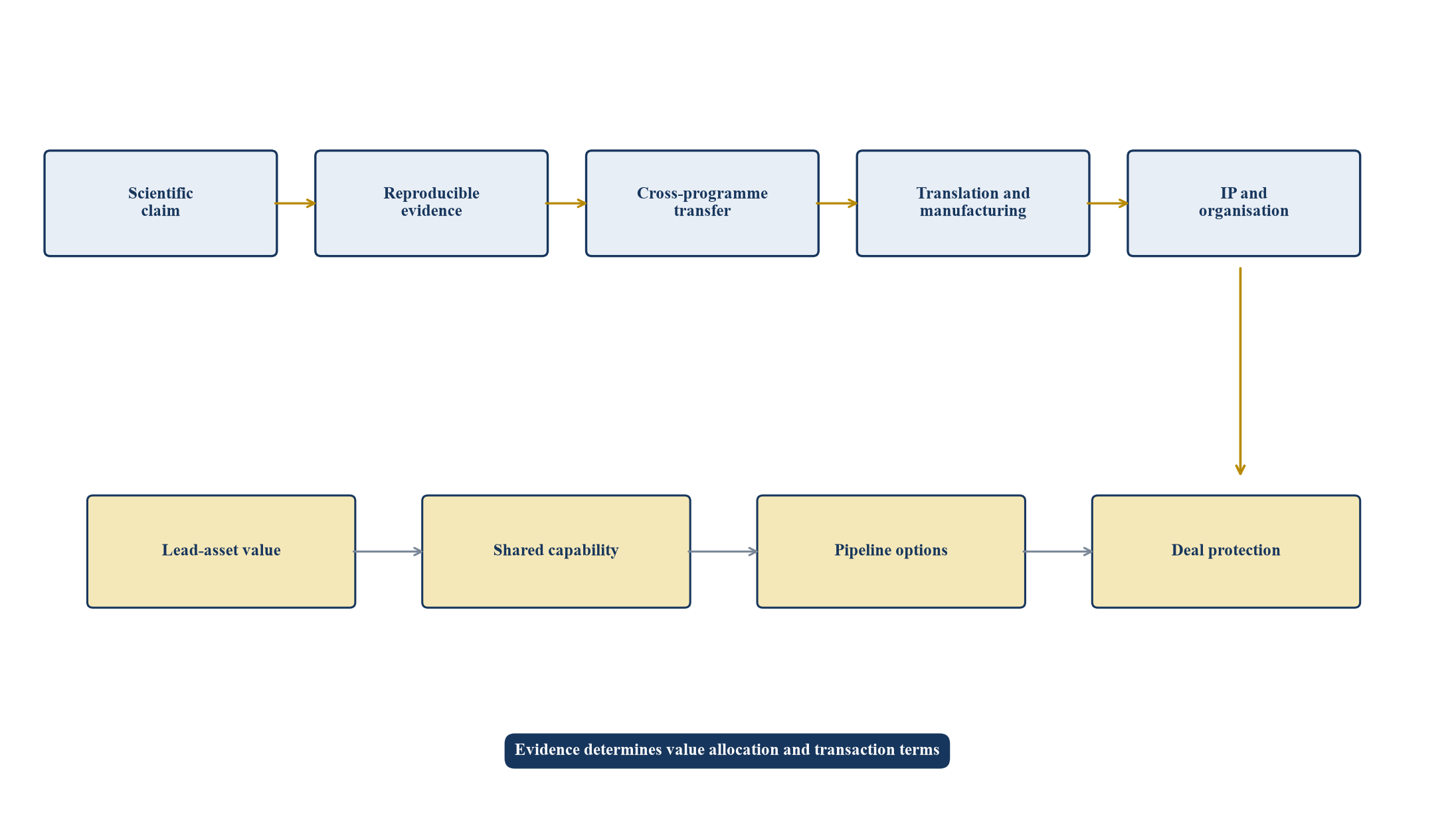
The architecture converts scientific and operating evidence into distinct lead-asset, shared-capability and option values.
3. Define what the platform is supposed to repeat
A platform claim should identify the invariant capability and the dimensions that change. An antibody discovery platform may claim repeatable target-to-candidate generation. A gene-editing platform may claim programmable recognition and controlled editing. A delivery platform may claim tissue-specific distribution across different payloads. A cell-therapy platform may claim a reusable cell source, engineering method and manufacturing process.
The claim must be narrow enough to test. Statements that the platform accelerates discovery or improves probability of success need a comparator, a measurement period and a definition of success. Time saved in candidate design may have limited value if validation, manufacturing or clinical development remains unchanged. A higher experimental hit rate may have limited value if the hits do not translate into relevant biological effects.
The diligence team should convert the claim into a chain of testable propositions. These can cover input quality, process consistency, output accuracy, transfer to a new target, scale-up, clinical relevance and economic impact. Each proposition should state the evidence required and the alternative explanations that must be ruled out.
4. Separate platform evidence from lead-asset evidence
The lead asset can validate parts of a platform without validating the whole system. A clinical response may support the target, molecule, delivery method and manufacturing process used for that product. It may not show that the same platform can select another target, design another candidate or reproduce the result in a different tissue or disease.
The diligence record should map each observation to the part of the system it supports. Target engagement can support biological mechanism. Pharmacokinetics can support exposure. A manufacturing campaign can support process control for a defined construct and scale. None of those observations automatically supports portfolio breadth.
The buyer should identify asset-specific advantages. A strong clinical result may arise from unusually favourable biology, a proprietary target, a special patient population or an experienced programme team. Removing those factors can change the expected performance of the next asset. Platform value should reflect the capability that remains after asset-specific effects are isolated.
| Claim | Lead-asset evidence | Additional platform evidence | Transaction response when missing |
|---|---|---|---|
| Repeatable discovery | One candidate meets selection criteria | Prospective results across independent targets and recorded failures | Value the candidate; defer platform premium |
| Transferable delivery | Exposure and activity for one payload | Comparable distribution and activity across payloads or constructs | Use milestone or option structure |
| Reusable manufacturing | One process and batch history | Defined design space, comparability and successful transfer | Fund validation; retain holdback |
| Predictive data model | Retrospective fit to one programme | Locked prospective predictions and independent validation | Exclude forecast benefit until validated |
| Pipeline optionality | Several named concepts | Rights, data, resources and feasible development plans | Value only executable options |
The required evidence depends on modality, development stage and the specific platform claim.
5. Test reproducibility before scale
NIH defines scientific rigor through unbiased and well-controlled design, methodology, analysis, interpretation and reporting [1]. For diligence, reproducibility begins with access to raw observations, protocol versions, sample lineage, inclusion and exclusion rules, analysis code, instrument metadata and contemporaneous decisions. A presentation slide or selected image cannot replace the underlying record.
The team should select material experiments for reconstruction. The company should reproduce the reported result from raw data using the recorded analysis. Independent reviewers should confirm that sample sizes, controls, randomisation, blinding, statistical methods and exclusions match the protocol. Differences should be documented and assessed for their effect on the conclusion.
Replication should cover more than the most successful study. The sample should include a core platform experiment, a lead-asset result, a follow-on programme and at least one failed or ambiguous experiment. The failure record reveals whether the organisation investigates unexpected results and whether its reported hit rate includes the full denominator.
6. Establish data provenance and integrity
Data value depends on traceability. FDA guidance explains that metadata provides the context required to understand data and that audit trails record the creation, modification or deletion of electronic records [2]. The diligence team should test whether data remain attributable, legible, contemporaneous, original or accurately copied, and complete throughout the relevant lifecycle.
The data map should identify laboratory information systems, electronic notebooks, sequencing and imaging repositories, cloud environments, instruments, analysis pipelines and archival locations. Access rights, administrator privileges, audit trails, backups, retention and change control should be tested. A platform whose advantage depends on a proprietary dataset requires evidence that the company can lawfully use, reproduce and transfer that dataset.
The buyer should compare selected figures in presentations, manuscripts and regulatory documents with source records. Repeated manual export, undocumented spreadsheet transformation or missing negative results raises uncertainty. The transaction response may include additional validation, a price holdback, a closing condition or a representation tailored to the affected data.
7. Measure prospective performance
Retrospective success can be affected by model selection, assay tuning and survivor bias. Prospective tests provide stronger evidence because the input, method and success criteria are fixed before the outcome is known. A buyer should seek locked predictions or candidate-selection criteria followed by blinded or independently observed results.
Performance metrics must match the platform's claimed economic function. A computational system can be assessed on predictive accuracy, calibration and enrichment relative to a defined baseline. A discovery platform can be assessed on time to validated hit, cost per candidate and attrition. A manufacturing platform can be assessed on yield, quality attributes, cycle time, batch success and transfer performance.
The denominator matters. Management should disclose all programmes initiated under the platform, including abandoned projects. Excluding failed programmes overstates success. The diligence team should construct cohorts by start date, target class, modality and stage, then compare actual progression with the company's original decision criteria.
8. Test transfer across targets and modalities
Transfer is the central test of platform value. The buyer should examine whether the same core process produced useful outputs across independent biological contexts. Evidence from closely related targets may support a narrower claim than evidence across different target classes. A platform can be repeatable within a defined domain while failing outside it.
The analysis should distinguish reuse from reinvention. If each programme requires new assays, bespoke chemistry, different delivery, different manufacturing and prolonged troubleshooting, the shared platform may be a research brand rather than an operating advantage. Shared tools still have value, although they should be valued through demonstrated cost and time savings.
Transfer should be measured prospectively where possible. The diligence team can select an unseen target or payload and observe the process from input through decision. The test should use predefined success criteria and record staff time, external spend, cycle time, exceptions and quality of output.
9. Evaluate translational evidence
Preclinical activity creates value when it predicts a clinically relevant result with stated uncertainty. The team should assess model relevance, exposure, target engagement, dose-response, durability, safety margins and the connection between biomarkers and patient outcomes. EMA guidance for first-in-human trials emphasises integration of non-clinical, pharmacokinetic, pharmacodynamic and emerging human safety data [3].
Translation can fail because an animal model does not represent human disease, the intervention does not reach the relevant tissue, the biomarker lacks clinical meaning, or tolerability limits the effective dose. The platform assessment should identify which translational risks are common across the pipeline and which are specific to one asset.
Clinical evidence should be interpreted against protocol, endpoint, population, missing data and multiplicity. A signal in a small or uncontrolled study may justify continued development while supporting only limited platform value. The valuation model should not treat early biological activity as proof of future approval.
10. Review clinical trial quality
ICH E6(R3) requires reliable trial results and promotes quality by design, with attention to factors critical to trial quality [4]. Diligence should examine protocol design, site selection, monitoring, deviations, data management, adjudication, statistical analysis and safety reporting. The buyer should identify whether the reported result depends on a small number of sites, post hoc subgroups or data corrections.
ClinicalTrials.gov records and regulatory registries can help verify registration, enrolment, endpoints and results [5]. Public records may be incomplete or lag current development. The company should provide controlled clinical reports, statistical analysis plans, data listings and regulator correspondence for material programmes.
Platform trials and master protocols can generate efficiencies, although their design introduces multiplicity, operational and interpretive issues. EMA has identified the need for specific planning when platform trials may support pivotal evidence [6]. The diligence team should separate efficiency created by trial design from repeatability of the underlying therapeutic platform.
11. Determine regulatory reuse
Regulatory value can arise when validated platform information supports later products. FDA's platform technology designation programme addresses technologies that may create efficiencies in development, manufacturing and review [7]. The May 2024 guidance is draft and contains non-binding recommendations. A company should not assume that a platform qualifies or that prior data will be accepted for a new product.
The buyer should review meeting minutes, written advice, submissions, questions and commitments by product and jurisdiction. It should identify data accepted by regulators, data likely to be reusable and product-specific evidence that must be regenerated. Informal statements should not be treated as a binding regulatory position.
Regulatory learning can still have economic value without formal designation. Standardised analytical methods, established control strategies, prior agency engagement and known safety monitoring can reduce execution uncertainty. The valuation should include these benefits only when their scope, ownership and expected effect are supported.
12. Test manufacturing as part of the platform
Manufacturing can determine whether scientific value becomes a product. The diligence team should review process definition, critical quality attributes, analytical methods, raw materials, scale, yield, batch history, deviations, stability, capacity, suppliers and technology transfer. A laboratory method is not a manufacturing platform until it produces controlled outputs at relevant scale.
ICH Q5E explains that comparability evaluates whether process changes affect quality, safety or efficacy and may require analytical, non-clinical or clinical evidence [8]. A platform that changes constructs, payloads or production sites should show how comparability will be established. Shared unit operations do not eliminate product-specific development.
The cost model should separate fixed platform infrastructure from programme-specific process development, release testing and capital expenditure. Claimed marginal-cost advantages should reconcile to batch data and supplier terms. Capacity constraints and single-source dependencies should be reflected in both valuation and integration planning.
13. Review product characterisation and control
Product characterisation should match modality and stage. For biologics and advanced therapies, identity, purity, potency, heterogeneity, stability and process-related impurities can affect development. EMA guidance for investigational advanced therapies warns that immature quality development can compromise later use of clinical data [9].
The buyer should examine whether assays are qualified or validated for their intended use, whether reference standards are controlled and whether specifications are justified. Potency assays deserve particular attention when mechanism and clinical response are complex. A result measured with an unstable or changing assay may be difficult to compare across programmes.
The platform claim should describe which quality attributes and controls are shared. If every new product needs a different potency assay or release strategy, the reusable component may be smaller than management suggests. That limitation can be reflected in staged capital and programme-specific budgets.
14. Map intellectual property and control
The intellectual-property review should connect patents, applications, know-how, data, software, biological materials and contractual rights to each platform component and programme. Ownership, inventorship, assignments, licences, government funding obligations, joint development and employee or consultant agreements should be verified.
A broad patent family can support value, although claim scope, remaining term, prosecution history and enforceability determine practical protection. The buyer should distinguish claims covering the core platform from claims covering the lead asset. It should also assess whether follow-on programmes depend on third-party patents or licences.
Freedom to operate is product, territory and time specific. It does not arise from ownership of a patent. Specialist counsel should review relevant claims and known disputes. Commercial valuation should model the cost, timing and scope of licences or design-arounds where material.
15. Test data and software rights
Many platforms rely on external datasets, open-source software, cloud services, academic collaborations or third-party models. The diligence team should verify licences, consent, permitted use, commercialisation rights, sublicensing, transfer, privacy restrictions and post-termination access. A model trained on data that cannot transfer to the buyer can lose value at closing.
Software review should cover repositories, documentation, dependencies, security, testing, deployment and key-person concentration. Model versions and training data should be linked to reported results. The buyer should identify manual steps that management describes as automated because those steps affect scale, reproducibility and staffing.
Where artificial intelligence supports candidate selection, FDA's January 2025 draft guidance proposes a risk-based credibility framework for AI models used in regulatory decision-making [10]. The buyer should distinguish exploratory tools from models used to support regulated evidence and assess validation accordingly.
16. Assess pipeline optionality
A named pipeline does not automatically create option value. Each programme needs a defined target, biological rationale, rights position, evidence package, development route, budget and decision point. Early concepts with no allocated resources may be strategic possibilities rather than financeable options.
The option model should reflect technical dependence. Programmes that share mechanism, delivery or manufacturing risk are correlated. Adding their stand-alone values can overstate the portfolio. The model should also account for capacity because teams, laboratories and manufacturing resources cannot progress every programme simultaneously.
Options should be valued at the date when management can make the next informed decision. The relevant inputs include the cost to reach that point, probability of useful evidence, value after success, time, exclusivity and abandonment rights. The model should avoid counting a follow-on asset both as part of the platform premium and as a separate pipeline value.
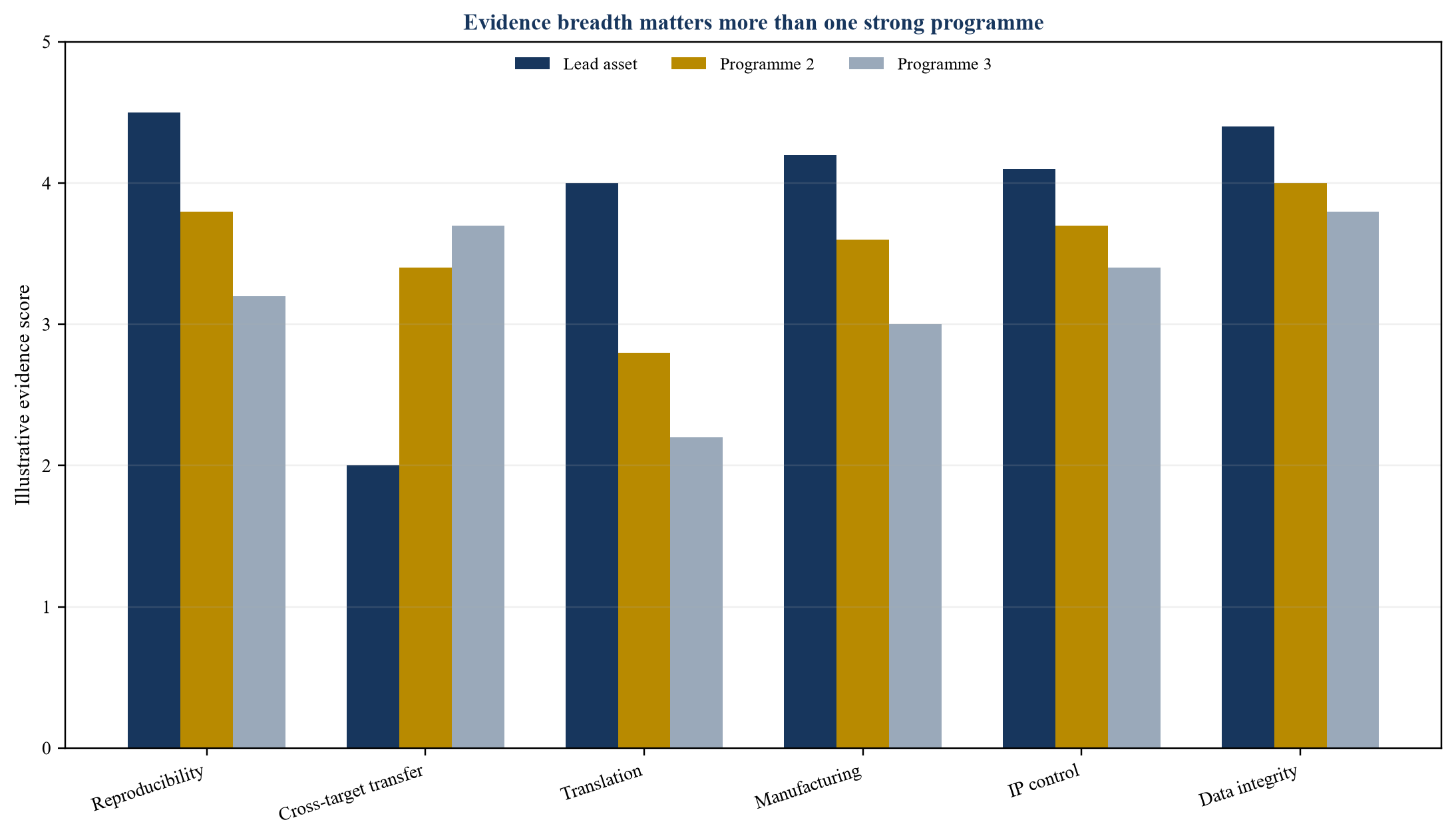
Scores are illustrative management assessments on a zero-to-five scale and do not represent observed company performance.
17. Evaluate the organisation that operates the platform
Platform value can depend on tacit knowledge held by a small team. The buyer should identify who designs experiments, interprets exceptions, maintains models, controls assays and decides which programmes advance. Documentation and cross-training determine whether the capability survives employee turnover and integration.
The organisation review should compare stated workflow with actual practice. Interview evidence should be tested against laboratory records, code commits, decision logs and programme history. Repeated exceptions that require one founder or scientist can limit scalability even when outcomes are strong.
Retention planning should focus on critical capabilities rather than titles alone. Employment terms, incentives, non-compete enforceability, immigration status, consultancy arrangements and academic affiliations require legal review. The integration plan should preserve scientific challenge and decision quality while adding controls required by the buyer.
18. Quantify platform economics
The economic claim should be translated into observable drivers. These include time to candidate, cost per validated candidate, probability of technical success, development cost, manufacturing yield, cycle time and probability of regulatory reuse. Each driver requires a baseline and an evidence range.
A platform can create value through lower cost, faster decisions, more shots on goal, better selection or stronger licensing economics. These benefits should be modelled separately. Combining them without controlling for overlap can double count the same improvement. Faster candidate selection, for example, can create value through earlier cash flows and lower cost, while a separate probability uplift may already incorporate part of that benefit.
The buyer should use cohort evidence and prospective results to set ranges. Management targets can define an upside case but should not determine the central case without supporting observations. Where evidence remains weak, the deal structure can defer payment until the economic driver is demonstrated.
19. Value the lead asset independently
The lead asset should be valued using its own development, regulatory, commercial, manufacturing and intellectual-property assumptions. Cash flows should include remaining development cost, launch investment, probability, timing, price, access, competition, exclusivity and tax. The platform premium should not substitute for this analysis.
Asset value may include contributions from shared tools already used to create the candidate. Those historical contributions are embedded in the asset's expected cash flows. Adding the full platform development cost or a general innovation premium can duplicate value. The separate platform value should arise from future reuse.
The buyer should reconcile the lead-asset case to regulatory documents, clinical data and the commercial forecast. Published sector probabilities can inform a range but do not establish the probability for a specific programme. Assumptions should have named owners and dates.
20. Value shared capability through future use
Shared capability value can be estimated from avoided cost, time advantage, licensing income or incremental programme value. The method should match the evidence. A validated manufacturing process may support avoided process-development cost. A discovery engine may support incremental option value from additional candidates. A proprietary dataset may support licensing or internal productivity.
The model should deduct the future cost required to maintain and improve the capability. Data curation, software engineering, assay development, quality systems, cloud services and specialised staff can be substantial. Gross savings without these costs overstate value.
The useful life of a platform may be shorter than its patents because science, competition and regulation change. The model should include obsolescence and replacement investment. A terminal value based on indefinite programme creation is inappropriate without evidence of durable rights, demand and operating capacity.
21. Build the hypothetical valuation bridge
The hypothetical target has one Phase 2 asset, one candidate approaching investigational submission and two discovery programmes. It owns laboratory infrastructure, curated data, validated assays and a modular manufacturing process. Management seeks a platform premium based on expected reuse across the pipeline.
The central case values the lead asset at USD 420 million. Shared capability contributes USD 86 million after maintenance cost and obsolescence. Three probability-weighted follow-on options contribute USD 64 million. Net cash adds USD 38 million. Expected transaction and integration costs reduce value by USD 28 million, producing an illustrative equity value of USD 580 million.
The downside case keeps the lead asset at USD 330 million but reduces shared capability to USD 18 million because independent replication and transfer are incomplete. Follow-on options fall to USD 22 million, and remediation plus integration costs rise to USD 47 million. The resulting illustrative equity value is USD 361 million after net cash. These outcomes show why platform evidence can affect price and consideration structure without changing the lead asset's science.
| Value component | Central case | Downside case | Evidence basis |
|---|---|---|---|
| Lead asset | 420 | 330 | Asset-specific clinical and commercial model |
| Validated shared capabilities | 86 | 18 | Reproducibility, transfer and avoided cost |
| Follow-on programme options | 64 | 22 | Programme-specific probability and cost |
| Net cash | 38 | 38 | Illustrative closing balance |
| Transaction and integration costs | (28) | (47) | Diligence, validation and integration plan |
| Illustrative equity value | 580 | 361 | Sum of separately controlled components |
All figures are illustrative management scenarios in USD millions and do not represent market data or a fairness opinion.
22. Stress the evidence assumptions
The valuation should test replication failure, lower transfer rates, slower candidate generation, higher manufacturing cost, delayed clinical translation, shorter useful life and loss of key personnel. These sensitivities affect different value pools. A replication failure can reduce shared capability and options while leaving lead-asset value partly intact.
Correlations should be explicit. A delivery problem can affect several programmes. A manufacturing constraint can delay the entire pipeline. Treating each programme as independent overstates diversification. The model can use common risk factors or scenario branches to preserve dependence.
Sensitivity output should be readable by the investment committee. The team should show value by component, cash required after closing and the consideration exposed to unvalidated claims. A large platform premium supported by one narrow assumption should trigger a milestone or holdback discussion.
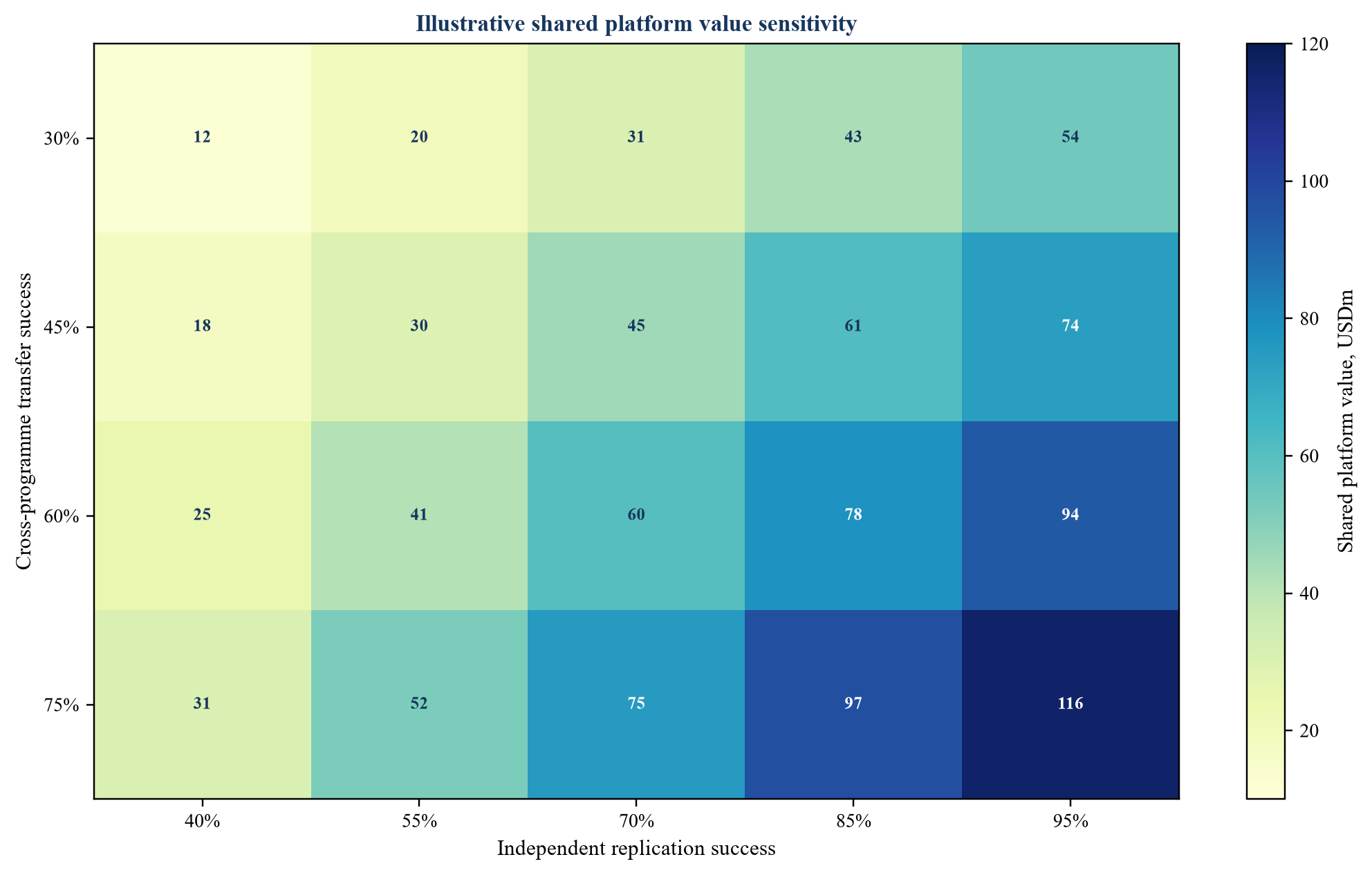
Values are illustrative USD millions based on assumed replication and cross-programme transfer scores.
23. Convert uncertainty into deal structure
The form of consideration should follow the evidence. Cash at closing can reflect the lead asset and capabilities already validated. Milestones can reflect replication, transfer, regulatory acceptance, manufacturing performance or clinical outcomes. Earn-outs should use objective definitions, measurement periods, information rights and dispute procedures.
An option-to-acquire structure can fund a defined validation programme before the buyer commits to the whole company. A licence can isolate one asset while preserving future access to the platform. A collaboration can share programme cost and generate additional evidence. Each route has different control, accounting, tax and competition implications.
Milestones should not depend entirely on the buyer's discretionary development choices. The documents should address programme substitution, reasonable efforts, budget, data access, changes in control and termination. Specialist legal advice is required to translate the commercial allocation into enforceable terms.
24. Design representations and closing conditions
Representations should cover ownership, data completeness, study conduct, regulatory correspondence, intellectual property, software and data rights, material contracts, manufacturing records and disclosed investigations. They should be tailored to the evidence that supports value. General representations can leave the parties uncertain about a specific platform claim.
Closing conditions may require delivery of missing raw data, assignments, third-party consents, completed replication, cybersecurity remediation or confirmation of key licences. A condition should address a fact that is material to closing and capable of objective verification. Post-close covenants are more suitable for longer validation work.
Indemnity, escrow and insurance should be considered alongside the scientific risk allocation. Insurance may exclude forward-looking performance or known issues. Price deferral can align payment with evidence more directly when the uncertainty concerns future platform performance.
25. Plan confirmatory diligence
The confirmatory phase should retest facts that can change before signing or closing. These include clinical events, regulatory communications, patent prosecution, data-room completeness, key-person status, manufacturing deviations, cyber incidents and material contracts. The team should use a dated bring-down list.
The buyer should preserve a record of evidence reviewed, unresolved questions and decision consequences. New information should flow into both valuation and documents. A scientific issue recorded in the diligence report but absent from the model and purchase agreement creates an avoidable gap.
The final investment paper should distinguish verified facts, management assumptions and buyer judgements. It should state the evidence date and identify decisions that require post-close validation. This discipline supports accountability if the platform later performs differently from the central case.
| Integration area | First control | Evidence of completion | Escalation trigger |
|---|---|---|---|
| Data and repositories | Preserve source systems and access logs | Reconciled inventory and tested retrieval | Missing lineage or altered audit trail |
| Scientific workflow | Retain protocols, decision criteria and failure records | Independent reproduction of selected results | Material result cannot be reconstructed |
| Manufacturing | Freeze uncontrolled process changes | Approved comparability and transfer plan | Batch failure or unassessed quality change |
| People and knowledge | Confirm critical roles and paired ownership | Completed knowledge-transfer record | Single-person dependency remains |
| Portfolio governance | Reconfirm programme budgets and decision points | Approved post-close portfolio plan | Capital exceeds approved evidence stage |
Owners and timing should be tailored to the buyer's operating model and the target's regulated obligations.
26. Prepare integration before closing
Integration should protect data integrity, scientific continuity and regulatory obligations. The first plan should cover systems access, repositories, quality responsibilities, programme governance, key personnel, laboratories, suppliers and decision rights. Rapid migration can damage provenance when metadata or audit trails are lost.
The buyer should decide which platform capabilities remain separate, which become shared services and which programmes will stop. Resource conflicts can arise when the transaction thesis assumes several programmes advance at once. The integration budget should include validation, data migration, quality remediation and retained specialist teams.
Scientific challenge should remain credible after the acquisition. Governance should permit independent review of major programme decisions and preserve the failure record. An integration plan focused only on cost savings can weaken the capability for which the buyer paid.
27. Establish post-close evidence milestones
Post-close governance should track platform claims as measurable outcomes. Metrics can include independent replication, prospective prediction accuracy, time to candidate, assay transfer, batch success, yield, clinical translation, regulatory acceptance and cost per programme. Each metric should have a definition, baseline, owner and review date.
The buyer should compare forecasts with actual results and explain variance. A programme can miss a date because of target biology, platform failure, supplier delay or management choice. These causes have different implications for value and strategy.
Capital allocation should respond to evidence. Strong transfer results can justify additional programmes. Repeated exceptions can justify narrowing the platform domain, licensing a specific asset or reducing fixed investment. The operating model should support those decisions without protecting the original transaction narrative.
| Gate | Required evidence | Minimum decision test | Possible transaction response |
|---|---|---|---|
| Reproducibility | Raw data, protocols, audit trail and independent reconstruction | Material results can be reproduced within defined tolerance | Holdback or validation condition |
| Transfer | Prospective results across independent programmes | Core process works in the claimed domain | Milestone or option structure |
| Translation | Relevant models, exposure, biomarkers and clinical linkage | Evidence supports the intended human hypothesis | Reduce probability or narrow scope |
| Manufacturing | Batch history, controls, comparability and transfer plan | Process can support the planned stage and scale | Fund remediation; defer premium |
| IP and data rights | Chain of title, licences, FTO and use rights | Buyer can own and operate the intended capability | Consent, licence or carve-out |
| Organisation | Documented workflow and critical-team plan | Capability can survive integration and turnover | Retention and knowledge-transfer terms |
Thresholds should be tailored to modality, stage, transaction and intended use.
28. Run the diligence programme through clear workstreams
The programme can be organised into seven workstreams: scientific claim and experiment reconstruction; clinical and translational evidence; manufacturing and quality; data and software; intellectual property; organisation; and valuation and deal terms. A central issues log should connect findings to price, conditions, documents and integration.
Workstreams should share evidence rather than operate as separate reviews. A change in assay validity can affect scientific conclusions, regulatory reuse, valuation and representations. The programme lead should require each material issue to state the affected value component and proposed response.
The timetable should reserve time for independent replication and management response. A compressed process may support an initial bid with explicit assumptions, but final approval should identify what remains unverified and how the transaction protects the buyer.
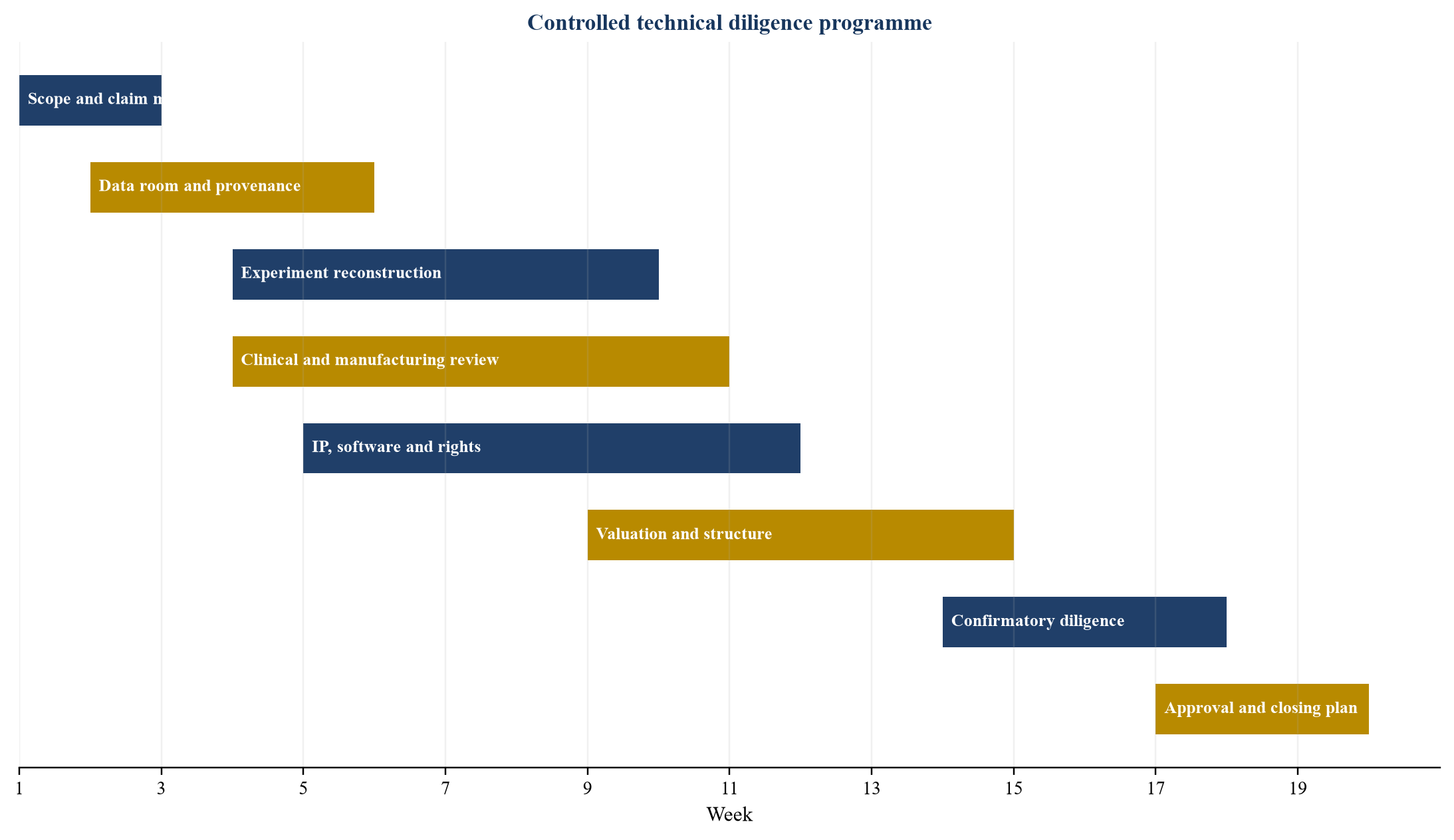
Timing is illustrative and depends on data access, modality, development stage and transaction structure.
29. Present the investment committee decision
The committee should also receive a disclosure-quality assessment. Scientific diligence can reach the correct conclusion while the information process remains unreliable. The assessment should compare management presentations with laboratory records, board papers, regulatory submissions and the full programme inventory. Differences in dates, programme status, sample counts, exclusions or success definitions should be reconciled before approval.
Management selection of evidence deserves a specific test. The team should request the universe of experiments and programmes before selecting samples for detailed review. It should then choose part of the sample independently. This reduces the risk that diligence is limited to prepared success cases. Late additions, unavailable raw records or repeated changes to the reported denominator should affect confidence and transaction protection.
The committee paper should show the cost of obtaining missing evidence. Independent replication may require external laboratories, new material, validated methods and several experimental cycles. Manufacturing verification may require engineering batches or a technology-transfer exercise. Data-right remediation may require consent, relicensing or deletion and retraining. These costs belong in the acquisition model rather than a separate integration narrative.
Commercial strategy should remain connected to technical scope. A platform validated in one target class, tissue or manufacturing range may still support an attractive focused business. The buyer should value that defined domain and avoid paying for expansion that remains untested. If broader use is central to the thesis, the expansion should become a funded validation programme with decision points and a limit on further capital.
The final recommendation should identify who bears each unresolved risk. A reduction in upfront price transfers risk to the seller only to the extent the seller retains consideration exposure. A milestone transfers risk when its trigger measures the disputed capability and can be verified. A covenant can preserve information or conduct but does not compensate for scientific failure. The chosen mechanism should match the finding.
External advisers should report within one controlled fact base. Scientific, clinical, regulatory, manufacturing, intellectual-property, cyber, finance and legal teams often use different terminology for the same asset. The transaction lead should maintain a definitions schedule covering programmes, constructs, datasets, product versions, territories and evidence dates. Findings should point to the same identifiers used in the valuation and definitive documents.
The committee should distinguish a remediable control gap from a failed scientific premise. Missing documentation, weak access control or incomplete validation may be repairable at a known cost. A result that cannot be reproduced, a delivery system that does not transfer or a right that cannot be acquired changes the transaction thesis. The recommendation should state which category applies and the evidence supporting that classification.
The recorded rationale should remain available for later portfolio review.
The decision paper should begin with the requested authority, price, consideration structure, intended platform use, evidence date and principal conditions. It should show lead-asset value, shared capability value, pipeline options, net cash, transaction costs and integration investment separately.
The scientific section should state the platform claim in testable language and summarise the evidence for reproducibility, transfer and translation. It should identify failed experiments and material exceptions. A confidence range is more useful than a single composite score when evidence differs across components.
The committee should receive the downside case, liquidity requirement and value protected by milestones or holdbacks. It should also see the cost and timetable for unresolved validation. Approval should expire if material evidence, price or scope changes before signing.
30. Make the decision
The transaction can proceed when the lead asset supports the price paid at closing, shared capabilities have evidence of repeatability in the stated domain, rights can transfer, manufacturing and data controls support the intended use, and remaining uncertainty is allocated through consideration and covenants.
The buyer should narrow or defer the platform premium when evidence comes mainly from one asset, raw data cannot be reconstructed, prospective transfer remains untested, intellectual-property or data rights are incomplete, or the capability depends on undocumented knowledge held by a few people. The commercial response can be a lower initial price, milestone, option, licence or validation programme.
The company can improve transaction readiness by maintaining complete programme denominators, locked prospective tests, traceable data, explicit platform boundaries and a valuation that separates asset and reusable capability. These controls also improve internal capital allocation before any transaction begins.
Technical due diligence should end with an executable plan. The investment committee needs to know what is proven, what remains an assumption, what the buyer is paying for, and which contractual or operating action protects value. The analysis remains company and transaction specific. Scientific, clinical, regulatory, manufacturing, intellectual-property, data, legal, tax, accounting and valuation specialists should assess the relevant evidence and documents.
Sources
- National Institutes of Health, Enhancing Reproducibility through Rigor and Transparency, updated 9 September 2024. Read the primary source
- United States Food and Drug Administration, Data Integrity and Compliance With Drug CGMP, Guidance for Industry. Read the primary source
- European Medicines Agency, Guideline on Strategies to Identify and Mitigate Risks for First-in-Human and Early Clinical Trials with Investigational Medicinal Products. Read the primary source
- European Medicines Agency, ICH E6(R3) Good Clinical Practice, current version effective 23 July 2025. Read the primary source
- ClinicalTrials.gov, ClinicalTrials.gov Policy and Reporting Requirements. Read the primary source
- European Medicines Agency, Platform Trials Scientific Guideline and Concept Paper. Read the primary source
- United States Food and Drug Administration, Platform Technology Designation Program for Drug Development, draft guidance, May 2024. Read the primary source
- International Council for Harmonisation, ICH Q5E Comparability of Biotechnological and Biological Products. Read the primary source
- European Medicines Agency, Guideline on Quality, Non-clinical and Clinical Requirements for Investigational Advanced Therapy Medicinal Products in Clinical Trials, 2025. Read the primary source
- United States Food and Drug Administration, Considerations for the Use of Artificial Intelligence to Support Regulatory Decision-Making for Drug and Biological Products, draft guidance, January 2025. Read the primary source
- National Institutes of Health, Data Management and Sharing Policy. Read the primary source
- United States Food and Drug Administration, Electronic Systems, Electronic Records, and Electronic Signatures in Clinical Investigations, October 2024. Read the primary source
- European Medicines Agency, Guideline on Registry-Based Studies. Read the primary source
- United States Food and Drug Administration, Search for Pharmaceutical Quality Documents, updated 2026. Read the primary source
- United States Food and Drug Administration, Notifications on Data Integrity, updated 2026. Read the primary source
- World Health Organization, Guidance on Good Data and Record Management Practices. Read the primary source
- World Intellectual Property Organization, WIPO Patent Landscape Reports. Read the primary source
- United States Patent and Trademark Office, Patent Assignment Search and Ownership Records. Read the primary source
- European Medicines Agency, Guideline on Data Requirements for Vaccine Platform Technology Master Files. Read the primary source
- IFRS Foundation, IFRS 3 Business Combinations and IAS 38 Intangible Assets. Read the primary source
