

1. Define the board decision before negotiating price
The board must decide which price, structure and financing remain supportable after competition review changes the original operating plan. That decision needs a defined counterfactual, a view of likely competitive harm, an evidence-backed efficiency case, a remedy envelope and a timetable that can survive an extended investigation. A headline synergy number cannot answer these questions. The model should show which benefits depend on eliminating overlapping networks, combining spectrum, migrating customers, renegotiating vendors or reducing duplicated staff, and which actions may be restricted, delayed or made conditional by regulators.
The mandate should specify the markets, jurisdictions, customer segments, network layers and transaction alternatives under review. Alternatives can include full merger, joint venture, network sharing, spectrum transaction, commercial partnership, asset carve-out or continued standalone investment. Each route should be tested on a common basis for customer outcomes, capital intensity, control, financing, execution risk and residual competition. The transaction team should identify the maximum remedy cost and delay that price can absorb before signing. It should also establish who can change the offer, accept a remedy, extend the long-stop date or terminate the transaction.
The approval paper should distinguish regulatory evidence from management assumptions. Market shares, switching data, network coverage, spectrum holdings, wholesale contracts and investment plans require source records and dates. Synergy timing, remedy probability and future competitive responses remain assumptions until supported. Every material assumption should have an owner, warning indicator and transaction consequence.
2. Use the Telecom Consolidation Competition and Value Framework
The framework joins six workstreams that are often analysed separately: competitive effects, network economics, customer outcomes, remedy design, transaction financing and integration control. It starts with the market counterfactual, identifies the competitive role of each party, tests how the merger changes incentives and capability, and then asks whether demonstrable efficiencies or remedies preserve customer benefit. The resulting cash-flow model should reconcile to the legal theory of harm and to the engineering plan.
This sequence matters because a regulatory filing can describe investment benefits that the financial model does not fund, while the financial model can assume integration savings that a remedy prevents. The same data should support the board, lenders, competition advisers, sector regulators and implementation teams. Differences in definitions, periods or perimeters should remain visible in a controlled reconciliation.
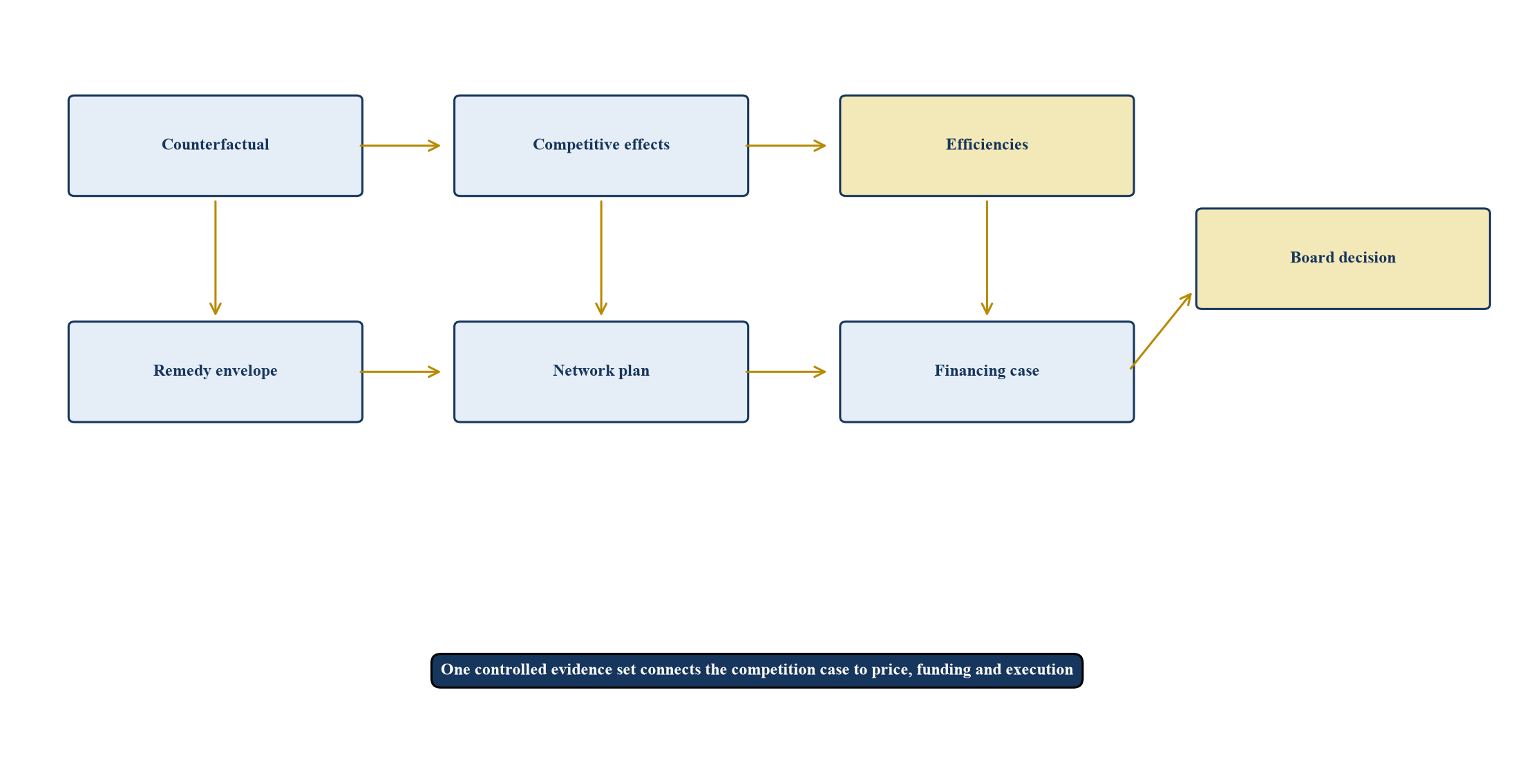
Transaction value depends on a consistent link between competitive evidence, network delivery, remedies and cash flow.
3. Establish the transaction counterfactual
Merger analysis compares the likely future with the transaction against the likely future without it. The standalone plan therefore deserves the same scrutiny as the merged plan. Review approved budgets, spectrum and network commitments, refinancing needs, vendor contracts, service launches, customer retention programmes and management incentives. A weak standalone forecast can overstate the merger's incremental benefits, while an unrealistic continuation case can understate the need for investment or restructuring.
The counterfactual should cover at least the investigation period and the years in which material network choices would occur. Separate committed projects from discretionary aspirations. Confirm whether either party would sell assets, enter network sharing, acquire spectrum, reduce capital expenditure, withdraw from regions, change wholesale terms or seek another transaction. Evidence created before the deal carries more weight than documents prepared to support clearance.
The financial model should preserve each counterfactual decision and its effect on customers, capacity, service quality and cash. A genuine funding constraint should be demonstrated through liquidity, leverage, covenant and capital-allocation evidence. A claim that consolidation is required for investment needs to show why standalone funding, sharing, asset sales or a narrower partnership cannot produce the proposed outcome. The board should see the strongest credible standalone alternative rather than a deliberately weakened base case.
4. Map retail wholesale and regional markets
Telecom businesses can compete differently across consumer mobile, enterprise connectivity, fixed broadband, wholesale access, international services, towers, fibre backhaul and regional coverage. Product bundles and shared infrastructure can connect these markets, yet a single national share can conceal local concentration or wholesale dependency. Build the market map from customer behaviour, contract substitution, network reach, price plans, service quality and supplier capability.
The unit of analysis should match the decision. Consumer switching may be national for a mobile brand while network quality varies by postcode. Enterprise customers may require multi-site coverage, service-level commitments and security certifications that remove smaller suppliers from the effective choice set. Mobile virtual network operators depend on wholesale hosts and can experience different bargaining conditions after a merger. Fixed-mobile bundles can make a nominally separate product market commercially linked to customer acquisition and churn.
| Question | Primary evidence | Model consequence | Decision use |
|---|---|---|---|
| Which customers switch between the parties | Porting, churn, win-loss and survey data | Diversion and revenue pressure | Test closeness of competition |
| Where networks overlap or complement | Site, coverage, capacity and quality maps | Integration and investment timing | Separate duplication from scarcity |
| How wholesale buyers negotiate | Contracts, tenders, host changes and margins | Access cost and remedy exposure | Test MVNO and enterprise effects |
| Which assets enable entry | Spectrum, sites, backhaul, retail channels and systems | Remedy perimeter and capital need | Assess remedy-taker viability |
| How rivalry affects investment | Historical decisions and internal plans | Quality and innovation scenarios | Test dynamic competition |
Each market proposition should connect observable evidence to the transaction model.
5. Measure closeness of competition
Market share is a starting point. The transaction risk often turns on how closely the parties compete. Analyse customer diversion, porting, tender results, plan changes, price responses, promotion matching, service quality and internal competitive monitoring. The evidence should identify whether one party disciplines the other's prices or brings a distinct offer that broad shares understate.
Diversion analysis needs consistent cohorts and time periods. A customer who leaves a budget brand for another budget brand provides different evidence from a household switching a fixed-mobile bundle. Enterprise tenders should be separated by required footprint, resilience and service level. Wholesale tenders should record feasible hosts, rejected bids and contractual constraints. Internal documents that identify a particular rival as the reason for a price, coverage or product response should be reconciled to observed behaviour.
The model should translate closeness into a range of revenue, churn and retention outcomes. It should avoid assuming that all lost rivalry becomes price. Harm can appear through smaller data allowances, slower quality improvement, weaker customer service, reduced promotional intensity or less favourable wholesale terms. A pricing model that ignores these non-price dimensions gives the board an incomplete view of remedy exposure and customer reaction.
6. Test unilateral effects
Unilateral effects arise when the merged firm can profitably worsen price, quality, choice or innovation because sales lost by one party are recaptured by the other. The assessment should combine diversion, margins, capacity, brand positioning, switching friction and competitor response. It should also consider whether the parties compete on network experience, device finance, content, bundles, service channels or wholesale flexibility.
Build a customer-level or cohort-level simulation where data permits. At minimum, show pre-transaction revenue, contribution, churn, likely diversion and feasible responses by rivals. The board should see how sensitive the result is to customer segmentation and the treatment of promotions. A small average price effect can conceal larger exposure for vulnerable or low-usage customers, enterprise accounts with few eligible suppliers or wholesale customers dependent on one host.
The financial case should not book retention gains that arise solely from weaker competition as a synergy. Keep operational cost savings separate from changes in commercial conduct. Any planned price harmonisation, migration or portfolio simplification should be tested for customer harm, regulatory visibility and remedy risk before it enters the central valuation case.
7. Test coordinated effects
Consolidation can make coordination among remaining operators easier when markets are transparent, products are comparable, competitors interact repeatedly and retaliation is credible. Telecom markets can exhibit visible tariffs, repeated spectrum and wholesale interactions, stable network footprints and similar cost structures. Coordination does not require an agreement. The assessment asks whether the merger changes incentives and market conditions in a way that makes aligned conduct more likely or durable.
Review historical pricing patterns, parallel promotions, capacity expansion, quality investment, wholesale negotiation and reactions to disruptive entry. Identify whether one party has acted as a maverick by offering aggressive prices, flexible wholesale terms, rapid product launches or distinctive network investment. Removing that role can matter even when the party has a modest share.
The downside model should include slower pass-through of network savings, reduced promotional intensity and weaker investment rivalry. The board should also test whether a remedy restores an effective independent constraint or merely creates a supplier dependent on the merged group. Assets, funding, management capability, customer scale and operational independence all affect whether a remedy taker can disrupt coordination.
8. Analyse wholesale access and virtual operators
Retail competition can depend on mobile virtual network operators, resellers and enterprise integrators that buy network access. A merger can remove one wholesale host, reduce bargaining options or align terms across a larger customer base. Wholesale harm can then flow into retail prices, product variety and entry. Review contracts, tenders, available hosts, capacity, technical onboarding, minimum commitments, data access, service quality and renewal rights.
The assessment should identify customers that can credibly switch and those constrained by coverage, technology, system integration or commercial terms. It should measure wholesale contribution separately from retail recapture. A merged firm may have less incentive to offer attractive wholesale terms when a wholesale customer's retail growth displaces its own subscribers.
If a remedy requires reference offers, price controls or pre-set contract terms, model the revenue and margin impact over the commitment period and the transition after expiry. Include implementation systems, reporting, disputes and capacity reservations. The value case should recognise that a wholesale remedy can preserve volume while reducing strategic flexibility and increasing compliance cost.
9. Examine spectrum sites and network capacity
Spectrum and network assets determine whether rivals can respond to the merger. Map holdings by band, geography, licence duration and deployment. Connect each block to sites, backhaul, device ecosystem, coverage and capacity. A national total can hide low-frequency concentration that affects coverage or mid-band concentration that affects capacity. Site density, planning access and fibre availability can also constrain expansion.
Network overlap can create savings through site consolidation, spectrum pooling and reduced duplicate investment. Complementarity can improve coverage or capacity. The same combination can deprive competitors of essential inputs or widen a quality gap. Engineering evidence should quantify traffic, congestion, propagation, carrier aggregation, decommissioning limits and migration timing before the synergy case is accepted.
Competition analysis should test feasible responses by existing and potential rivals. Buying spectrum without sites, backhaul, customers or roaming may not create an effective competitor. Divesting live customers without sufficient capacity can transfer a weak business. Remedy design therefore needs an integrated operating perimeter rather than an asset list assembled from accounting records.
10. Prove network and operating efficiencies
Efficiencies should be verifiable, merger specific, timely and capable of benefiting customers. Separate savings from network duplication, procurement, IT, distribution, overhead and financing. Identify the underlying resource, baseline cost, implementation action, timing, one-off cost, dependency and customer consequence. Reject benefits that could be achieved through ordinary procurement, standalone modernisation or a less restrictive sharing arrangement unless evidence explains the difference.
Network efficiencies require a site-level and traffic-level plan. The plan should show which sites remain, which close, where capacity moves, how coverage changes, which spectrum is refarmed and when customers migrate. It should recognise leases, decommissioning costs, power, backhaul, equipment compatibility, permits and service continuity. A top-down percentage of network cost does not demonstrate an executable benefit.
| Test | Evidence required | Common failure | Valuation treatment |
|---|---|---|---|
| Verifiable | Baseline, owner, calculation and source records | Management estimate without operational proof | Exclude or probability weight |
| Merger specific | Comparison with standalone and sharing alternatives | Benefit achievable without consolidation | Value against lower-risk alternative |
| Timely | Milestones, dependencies and customer migration | Savings booked before integration | Delay cash benefit |
| Customer benefit | Price, quality, coverage or innovation mechanism | Benefit retained entirely by shareholders | Exclude from regulatory offset |
| Net benefit | One-off cost, remedy leakage and execution risk | Gross synergy presented as value | Use net cash after constraints |
Only supported benefits should enter the central transaction case.
11. Build an auditable investment case
Investment claims deserve a funded delivery plan. Identify each network outcome, location, technology, capacity increment, timetable, procurement dependency and accountable owner. Reconcile the programme to cash, financing capacity and regulatory commitments. An investment promise that depends on uncommitted future cash or undefined engineering work is vulnerable in review and in the board model.
The plan should distinguish replacement capital, capacity capital, coverage expansion, resilience, security and product development. It should show what each party would invest standalone and the incremental amount attributable to the transaction. The benefit should be measured through observable service outcomes such as coverage, speed, latency, congestion, availability or wholesale capacity rather than gross capital alone.
If clearance depends on binding investment commitments, the capital becomes a transaction obligation. Model inflation, supplier capacity, permits, site access, energy, backhaul and delays. Establish governance that prevents discretionary distributions or other projects from displacing committed spend. The financing package should provide sufficient headroom for downside delivery because failure can trigger enforcement, reputational damage and loss of assumed value.
12. Evaluate service quality and innovation
Competition can affect service quality through network performance, customer support, contract flexibility, device offers and product launches. Innovation can involve 5G standalone capability, network slicing, private networks, edge services, security, wholesale APIs and new fixed-mobile propositions. The analysis should identify how rivalry influenced past decisions and what changes after consolidation.
Avoid equating a larger capital budget with better innovation. Examine incentives, execution capability, time to market and the availability of alternative suppliers. A combined business may have greater scale and expertise while facing less pressure to differentiate. Internal product roadmaps, lost tenders, customer research and investment committee records can help establish the pre-transaction constraint.
The model should use measurable milestones. Examples include supported devices, enterprise service availability, deployment coverage, capacity released, wholesale onboarding time and service reliability. Benefits should enter value when operational evidence supports the timing. The regulatory case should use the same milestone definitions as the integration programme.
13. Identify distributional customer effects
Average outcomes can conceal effects on particular customer groups. Map prepaid, low-usage, high-data, vulnerable, rural, small-business, enterprise and wholesale segments. Review tariffs, allowances, out-of-bundle charges, device finance, contract length, service access and switching capability. A remedy may need to protect selected products while allowing broader commercial flexibility.
Customer protection design should avoid creating a formal cap that can be offset through fees, reduced allowances, forced migration or lower service quality. Define the product perimeter, comparable tariff, quality standard, eligible customers, monitoring data and escalation process. The financial model should recognise foregone revenue and implementation cost across the full period.
Communication planning also affects value. Poorly managed migrations can increase complaints, churn and regulator attention. Integration teams should preserve customer records, consent, billing accuracy, accessibility and complaint handling. The board should receive segment-level indicators before approving migrations or portfolio changes.
14. Establish the remedy envelope before signing
Remedies can be structural, behavioural or mixed. A structural remedy may divest spectrum, customers, brands, sites, retail operations or a complete business. Behavioural measures can regulate wholesale access, prices, investment, quality, governance or information flows. Mixed packages often combine asset transfer with temporary access and monitoring. The likely remedy envelope should be built during valuation rather than after competition concerns become formal.
For each theory of harm, identify the minimum credible intervention, the likely authority position, operational feasibility, value leakage and implementation timetable. Test whether the remedy restores the lost constraint and whether it creates new dependencies. Consider purchaser suitability, financing, technical migration, approvals, transitional services and monitoring. The model should show the effect of remedy duration and delayed release.
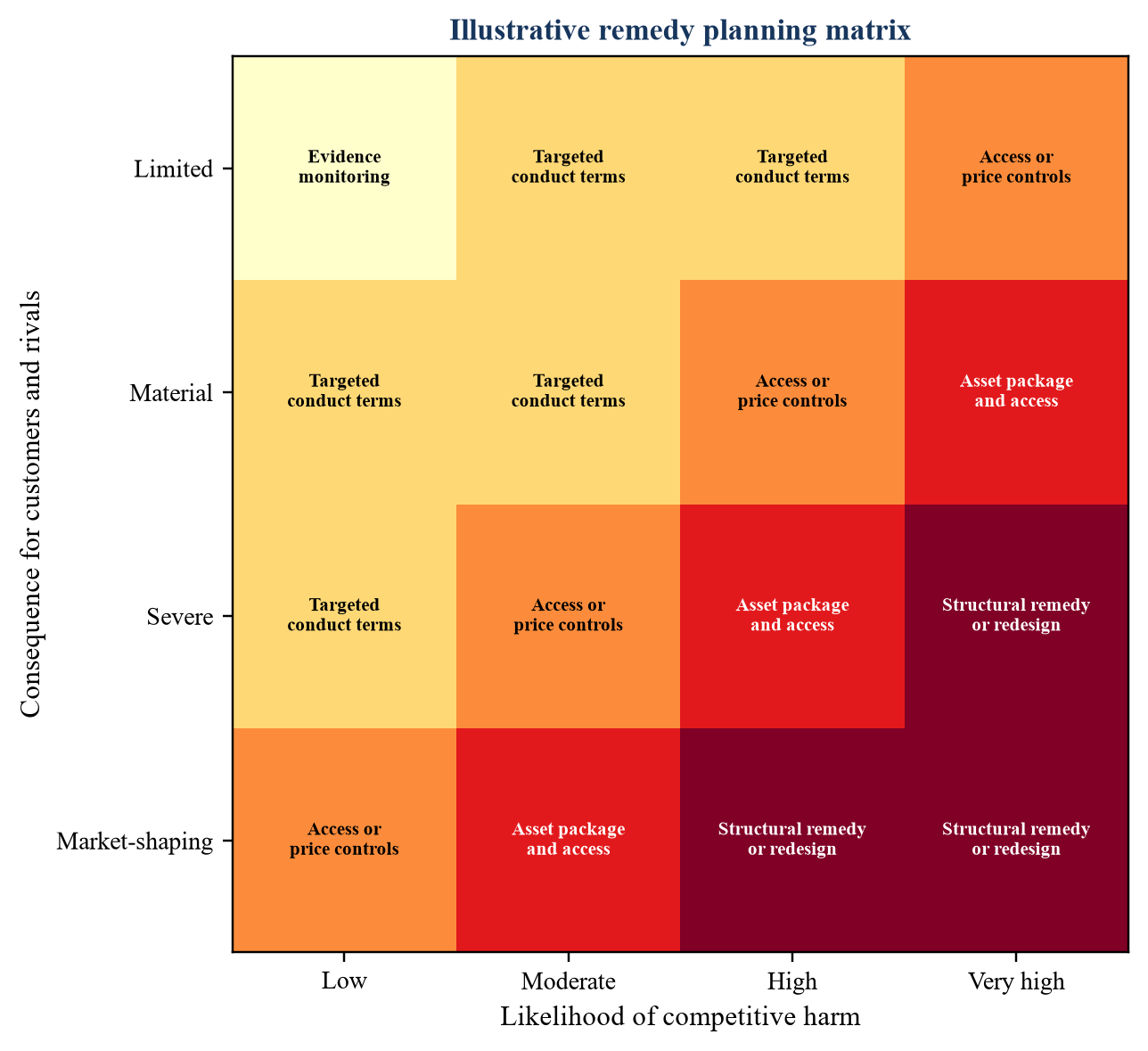
Remedy intensity rises with the likelihood and consequence of competitive harm.
15. Design a viable structural remedy
A structural remedy should transfer an operating capability that can compete independently. Define assets, people, contracts, systems, intellectual property, spectrum, sites, backhaul, customers, working capital and transitional support. Test whether the package has sufficient scale, coverage, quality and funding. A purchaser should have incentives and ability to operate the business, complete migration and invest after transfer.
Carve-out complexity can erode deal value. Shared billing, customer service, network operations, retail channels, data platforms and vendor arrangements may require separation or transitional services. Determine which party bears stranded cost, migration risk and service failure. Include the remedy perimeter in separation planning before offering it to an authority.
The sales process should preserve competition among credible buyers and allow regulatory assessment. Financing certainty, management capability, sector approvals and strategic conflicts matter as much as price. The transaction documents should allocate proceeds, tax, leakage, warranty, operating covenants and failure risk. A low-priced but executable divestiture can protect more value than an ambitious package that misses the clearance timetable.
16. Design wholesale access and roaming remedies
Access remedies can support a rival while it builds assets or preserve competition where infrastructure duplication is inefficient. Define services, geography, technology, quality, capacity, pricing, term, migration, information access and dispute resolution. The terms should let the access seeker compete without making it permanently dependent on the merged firm.
Pricing should address both level and structure. Minimum commitments, volume tiers, indexation, pass-through charges, service credits and upgrade costs can alter effective economics. Technical onboarding, device testing, provisioning, fraud controls and data interfaces determine whether commercial access is usable. The model should fund implementation and recognise revenue dilution.
Exit design matters. A temporary remedy should include milestones for independent capability, extensions for delay outside the access seeker's control and controls against strategic degradation. Monitoring should distinguish genuine capacity constraints from discriminatory treatment. The board should see the value effect under full use, low use, dispute and extension scenarios.
17. Assess investment and price commitments
Commitments to network investment or selected customer prices can address a period in which efficiencies are being delivered and competitive conditions are changing. They also create fixed obligations. Define the investment outcome, annual milestones, eligible expenditure, verification, governance, reporting and enforcement. For price protection, define the customer group, product attributes, benchmark, duration and treatment of new plans.
The commitment should remain measurable as technology and products evolve. Capital spending alone may reward inefficient delivery. Outcome measures such as coverage, capacity, quality or availability provide a stronger link to customer benefit. Price controls need safeguards against reducing allowances, weakening support or forcing migration.
The transaction model should show committed spend by year, incremental spend above the standalone plan, compliance cost and the effect on distributions and debt capacity. Board oversight should continue after integration because a remedy can outlast the original transaction team.
18. Test the remedy taker and replacement constraint
The remedy taker must replace the competitive influence lost through consolidation. Review its balance sheet, operating experience, management, systems, customer base, spectrum, network plan, supplier access and ability to withstand early losses. A small entrant can be effective when it has a differentiated offer and credible path to scale. Asset ownership alone does not create that path.
Model the remedy taker's coverage, capacity, customer migration and funding timetable. Identify dependencies on the merged firm and the point at which each ends. Stress delays in spectrum transfer, site access, network build, IT integration and customer acquisition. The remedy should provide enough support for transition while preserving independence.
The seller's model should include transfer costs, stranded cost and any revenue retained through access services. It should exclude benefits that rely on the remedy taker failing. Governance should prevent interference with transferred customers, staff or assets and should preserve confidential information boundaries.
19. Integrate competition review with transaction timing
Regulatory timetables affect financing, shareholder approval, separation, employee retention and customer confidence. Map pre-notification, initial review, in-depth investigation, remedy negotiation, market testing, purchaser approval and implementation. Add foreign investment, spectrum transfer and sector approvals where relevant. Each path should connect to the long-stop date and funding availability.
Financing commitments can expire before clearance. Interest, hedging, ticking fees and bridge exposure can increase while synergies remain delayed. Sellers may resist operating restrictions that constrain competition or investment during a long review. The sale agreement should define ordinary-course conduct, required actions, information rights, remedy obligations and termination outcomes.
The board should see a calendar-based value bridge. Every month of delay affects integration cost, duplicated operations, financing and employee retention. A remedy offered earlier can shorten review while transferring more value than a later negotiated package. Timing is therefore part of remedy economics.
20. Control clean teams and pre-closing conduct
The parties remain competitors until closing. Diligence and integration planning should use clean teams, access controls, aggregation and purpose limitations to prevent exchange of competitively sensitive information or premature coordination. Customer-specific prices, future strategy, bid intentions, network plans and wholesale negotiations require particular care.
Define which information each workstream needs, who can see it, how it is stored and when it can be released. External advisers can analyse detailed data and provide aggregated outputs. Integration planning should prepare options and day-one controls without directing current commercial decisions. Governance should record exceptions and preserve an audit trail.
Gun-jumping risk can delay clearance, create penalties and undermine the transaction narrative. The board should receive periodic assurance over information exchange, decision independence and customer contacts. Clean-team design should also support regulatory submissions by preserving the provenance of analyses.
21. Translate remedies into the purchase agreement
The sale agreement should allocate competition risk explicitly. Key provisions include the filing strategy, cooperation, information rights, remedy standard, divestiture obligations, purchaser approval, litigation, long-stop date, financing extension, interim covenants and termination rights. Broad efforts language can conceal materially different economic outcomes.
Define the maximum remedy the buyer must accept and the assets or earnings protected from compulsory sale. Consider value-based caps, specified excluded remedies or a reverse termination fee. The agreement should address who controls remedy negotiations and whether the seller can require an extension. Disclosure rules should protect privilege and competitively sensitive information.
Price mechanisms can respond to remedy outcomes through fixed deductions, contingent value, asset retention or perimeter changes. Each mechanism should be executable under tax, accounting, financing and minority protections. The model should calculate the buyer and seller result for each clearance path.
22. Build the licence and approval dependency map
Competition clearance may not transfer spectrum licences, numbering resources, security accreditations, tower leases or regulated contracts. Create a dependency map for each jurisdiction and asset. Identify the authority, filing, evidence, timing, conditions and responsible party. Link every approval to the closing checklist and integration plan.
Conditional clearance can require steps before closing and obligations afterwards. A spectrum divestiture may need separate approval and technical migration. Wholesale access can require operational readiness before customers move. Foreign investment review can impose governance or security conditions that affect integration.
The board model should distinguish legal closing from economic completion. Cash benefits can remain unavailable while licences, systems or customers are separated. Deferred dependencies need funded transitional arrangements and decision rights.
23. Model transaction value after competition intervention
Value should be built from stand-alone cash flow, verified efficiencies, integration cost, remedy leakage, committed investment, delay, financing and terminal effects. Each line should have an evidence basis and timing. The model should avoid netting unlike items into a single probability adjustment because the response differs by risk.
The central case can include only benefits supported by a deliverable plan and consistent with the remedy envelope. A separate regulatory upside can show additional value if clearance is less restrictive. The downside should combine lower synergies, higher customer protection costs, accelerated capital, slower migration and extended financing.
| Item | Stand-alone combination | Central case | Correlated downside |
|---|---|---|---|
| Base EBITDA | 780 | 780 | 780 |
| Recurring operating synergies | 0 | 150 | 90 |
| Incremental gross margin | 0 | 35 | 10 |
| Wholesale and remedy cost | 0 | (45) | (70) |
| Monitoring and compliance cost | 0 | (15) | (20) |
| Case EBITDA | 780 | 905 | 790 |
| Maintenance and committed network capital | (210) | (240) | (295) |
| Tax and working-capital use | (90) | (95) | (90) |
| Cash before debt service | 480 | 570 | 405 |
| Annual debt service | (460) | (460) | (460) |
| Debt-service coverage | 1.04x | 1.24x | 0.88x |
USD millions; every value is an illustrative management assumption.
24. Use a hypothetical integrated transaction case
Assume two operators generate combined revenue of USD 5,600 million and stand-alone EBITDA of USD 780 million. The proposed enterprise value is USD 4,800 million and debt funding is USD 2,300 million. Management identifies USD 190 million of gross recurring synergies before remedy effects. Detailed review supports USD 150 million in the central case after timing and execution constraints. A further USD 35 million of gross margin comes from improved coverage and service, while wholesale and remedy measures reduce EBITDA by USD 45 million and monitoring costs USD 15 million.
The central case therefore produces EBITDA of USD 905 million. Maintenance and committed network capital of USD 240 million and tax and working-capital use of USD 95 million leave USD 570 million before debt service. Annual debt service is USD 460 million, producing 1.24x coverage. The margin is useful but narrow for a regulated integration programme.
The correlated downside assumes USD 90 million of recurring synergies, USD 10 million of incremental gross margin, USD 70 million of wholesale and remedy cost and USD 20 million of compliance cost. EBITDA is USD 790 million. Higher committed capital of USD 295 million and USD 90 million of tax and working-capital use leave USD 405 million before debt service, or 0.88x. The case requires additional liquidity, lower leverage, price protection or delayed distributions. All values are hypothetical management assumptions.
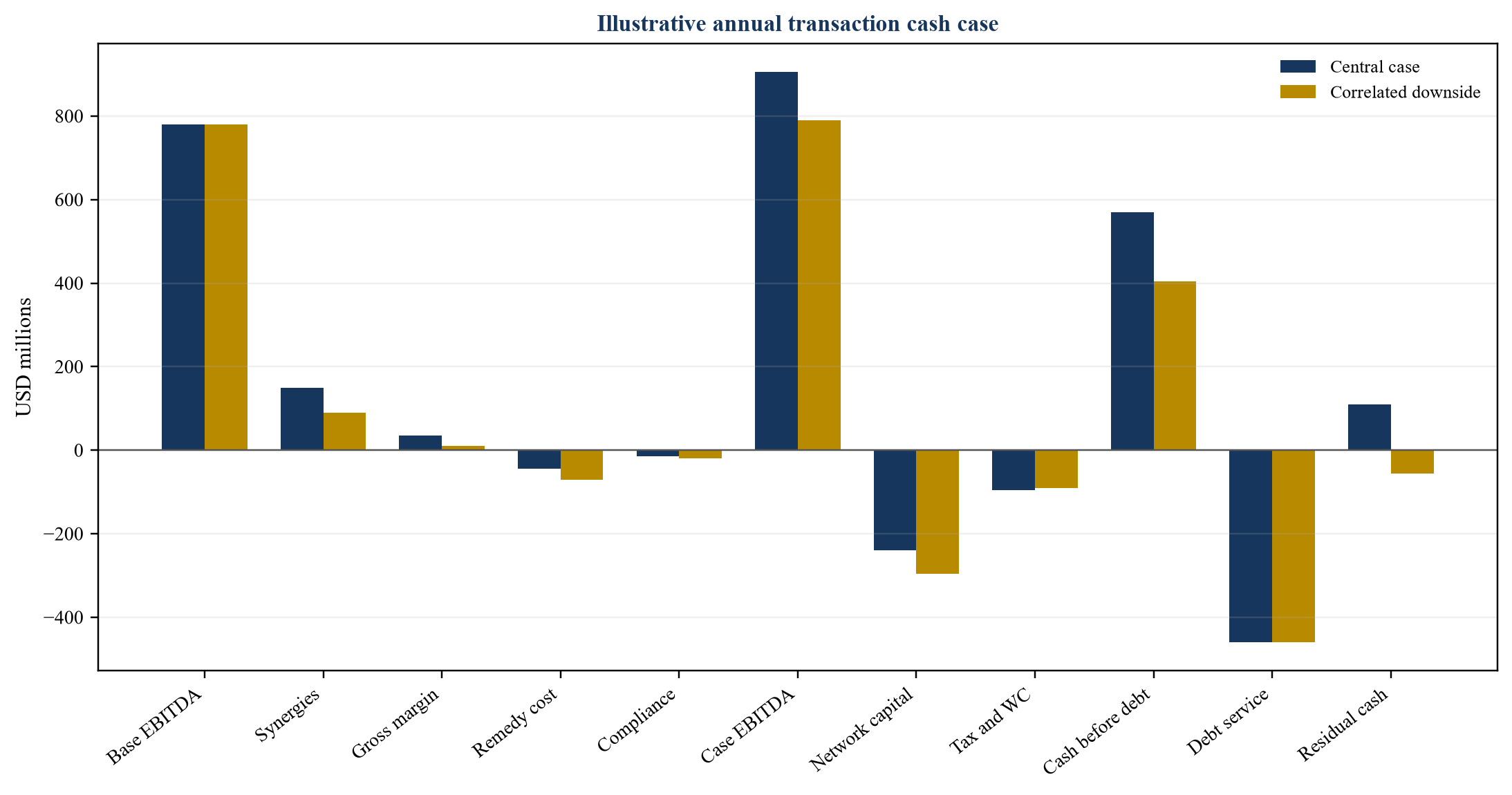
The bridge separates operating benefits from remedy costs, committed capital and debt service.
25. Run correlated downside scenarios
Competition outcomes, network execution and financing can deteriorate together. Test a longer review, a wider remedy, slower customer migration, lower synergy capture, accelerated investment, higher churn, delayed spectrum transfer and tighter credit. Link each stress to a date, warning indicator and management action. A set of independent sensitivities can miss the liquidity effect of related events.
The downside should preserve operational logic. Delayed site consolidation can retain duplicated costs while network commitments accelerate capital. Price protection can limit recovery of inflation. A wholesale remedy can increase capacity demand before integration releases that capacity. Employee attrition can slow both remedy separation and synergy delivery. Financing can become more expensive as the long-stop date approaches.
| Stress | Early warning indicator | Cash consequence | Required response |
|---|---|---|---|
| Review extends by nine months | Phase escalation and additional evidence requests | Financing fees and delayed synergies | Extend commitments and preserve liquidity |
| Remedy perimeter expands | Authority market test rejects initial package | Divestiture leakage and stranded cost | Reprice or redesign transaction perimeter |
| Network plan slips | Site and backhaul milestones miss baseline | Higher duplicate cost and capital | Add delivery capacity and defer distributions |
| Wholesale demand exceeds plan | Remedy customer volumes outpace forecast | Capacity and margin pressure | Trigger expansion plan and pricing governance |
| Customer migration raises churn | Complaints and porting exceed threshold | Revenue loss and retention spend | Slow migration and protect priority cohorts |
The table uses hypothetical triggers and management actions.
26. Size financing to the clearance and integration case
Debt sizing should use cash after remedy costs, committed investment and integration, with maturity and covenant headroom aligned to the regulatory timetable. Include financing extension fees, hedging, bridge exposure, mandatory prepayment from divestiture proceeds and restrictions on distributions. A leverage case based on unrestricted synergies can fail before benefits become available.
Lenders need visibility on clearance conditions, permitted remedies, asset sales, network commitments and integration controls. Information undertakings should align with regulatory reporting without creating inconsistent definitions. Covenant calculations should address divested EBITDA, stranded cost, restructuring charges and committed capital.
Liquidity facilities should fund both planned delivery and plausible delay. The board should define a minimum cash floor and corrective actions before a covenant breach. Options include lower initial debt, equity backstop, delayed consideration, vendor financing, asset-sale proceeds or staged integration.
27. Build the competition and remedy data room
The data room should support reconstruction of every material proposition. Include market definitions, customer data, switching, tenders, tariffs, network maps, spectrum holdings, capacity, quality, investment plans, wholesale agreements, product roadmaps, board records, synergy calculations and standalone alternatives. Preserve creation dates and document context.
Use consistent data dictionaries across parties. Reconcile customer identifiers, revenue, products, geography, channels, network measures and time periods. Competition models should be reproducible from controlled extracts. Legal privilege, personal data and competitively sensitive information require access controls and clean-team governance.
An exception register should identify missing, inconsistent or low-confidence evidence. Each exception needs an owner, due date and decision effect. The board should see which benefits and remedy positions remain unsupported before price or filings are finalised.
28. Establish board gates and accountability
The transaction should pass defined gates for counterfactual, market evidence, efficiency substantiation, remedy envelope, financing, agreement terms, filing, remedy offer, closing and integration. Each gate should state required evidence, approving authority and conditions. Material changes should return to the relevant gate rather than enter the plan through informal updates.
Competition counsel, economists, engineers, commercial leaders, finance and integration teams should use one decision log. The log should record assumptions, source evidence, changes, approved remedies and value effects. Board reporting should show central, regulatory and correlated downside cases with the same perimeter.
Post-closing ownership should transfer to permanent functions. Network delivery, wholesale access, price protection, compliance, monitoring and value capture require named executives and audit support. Incentives should reward remedy compliance and customer outcomes as well as synergies.
29. Build the thirty-month transaction roadmap
The roadmap should begin with the counterfactual and evidence plan, continue through filing and review, and extend into remedy implementation and network integration. Early work should define the likely theory of harm and remedy perimeter before transaction documents become fixed. Clean teams can prepare migration and separation options while the businesses remain independent.
The first six months cover evidence, valuation, agreement terms and initial filings. Months six to fifteen cover deeper review, market testing, remedy negotiation, purchaser work and financing extensions. Closing follows only after competition and sector conditions are satisfied. The next fifteen months focus on customer continuity, remedy transfer, network milestones, wholesale implementation and controlled synergy release.
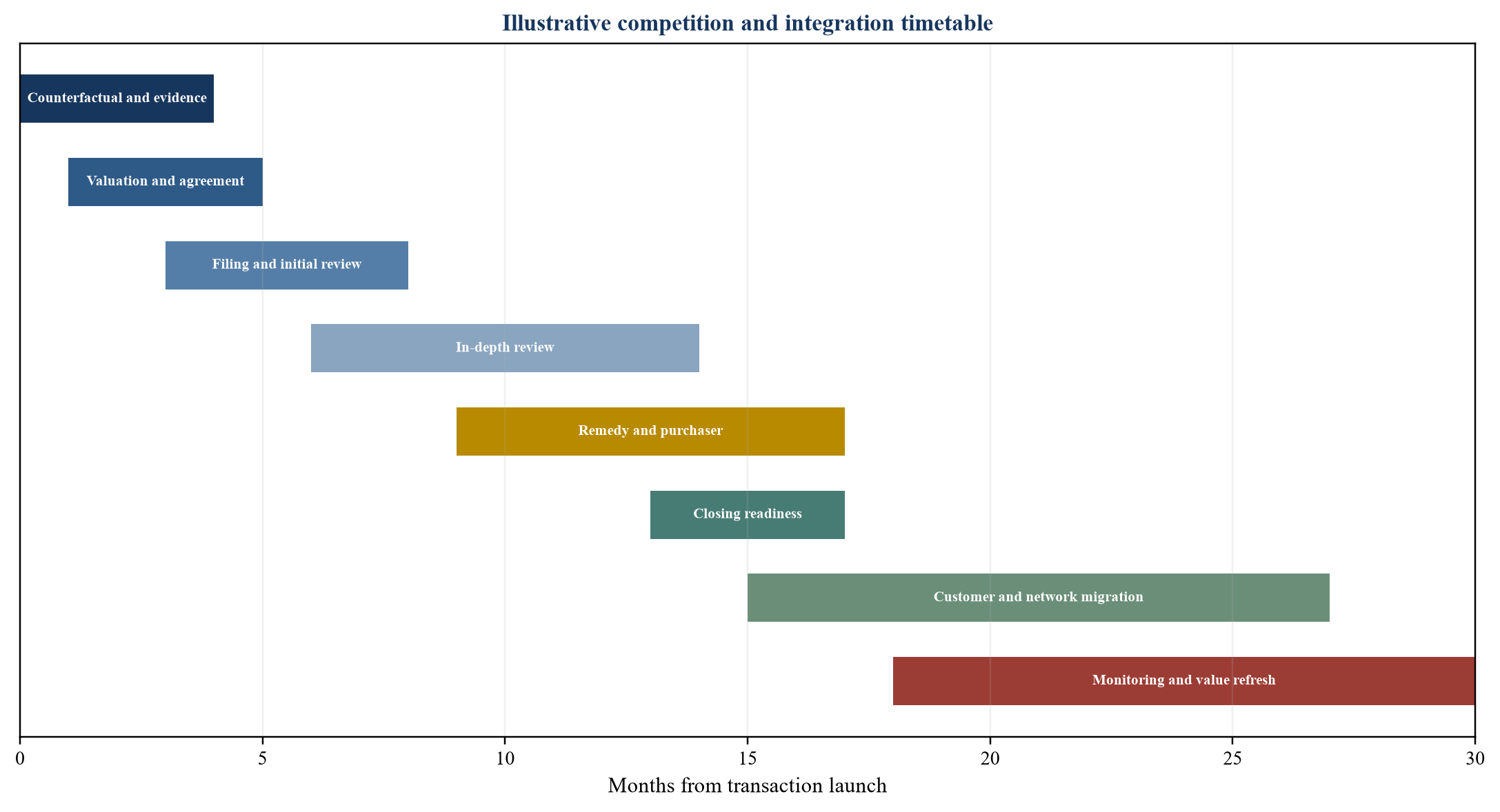
Regulatory, remedy, financing and integration milestones share one controlled timetable.
30. Define the investable consolidation case
An investable case combines a credible counterfactual, clear market evidence, substantiated efficiencies, funded network delivery, an executable remedy envelope, resilient financing and controlled integration. The final board memorandum should show what customers and rivals lose, what the transaction delivers, which commitments preserve competition and how value changes under each clearance route.
The board should approve a price only when the central case survives the remedy envelope and the downside retains sufficient liquidity. Benefits that depend on unrestricted consolidation should remain outside committed value when competition evidence points to intervention. Remedy design should preserve an effective constraint and remain operationally deliverable. Financing should fund commitments through delay rather than rely on immediate synergy release.
This discipline improves both regulatory credibility and transaction quality. It converts competition review from a late legal contingency into a priced operating workstream. It also gives integration teams a clear boundary between permitted preparation, closing conditions, remedy delivery and value capture.
The investment committee should retain a post-decision baseline containing the approved counterfactual, customer evidence, network plan, remedy assumptions, financing terms and expected cash profile. Actual results should be compared with that baseline at fixed intervals. Differences in churn, tariffs, quality, wholesale volumes, capital delivery, synergy capture and compliance cost should be traced to source records and assigned to an accountable executive. This review supports timely corrective action and prevents later performance reporting from redefining the original transaction case. Material departures should return to the board with an updated liquidity forecast and a clear decision on capital, pricing, migration pace or remedy delivery.
Sources
- Competition and Markets Authority. Vodafone and CK Hutchison joint venture merger inquiry, updated 31 July 2026. Read the primary source
- Competition and Markets Authority. Final report on the anticipated joint venture between Vodafone Group Plc and CK Hutchison Holdings Limited, 5 December 2024. Read the primary source
- Competition and Markets Authority. How we investigated the Vodafone and Three merger, updated 2 June 2025. Read the primary source
- Competition and Markets Authority. Final undertakings in the Vodafone and CK Hutchison joint venture inquiry, 28 March 2025. Read the primary source
- Competition and Markets Authority and Ofcom. Joint statement on oversight of the Vodafone and Three network commitment, 2 June 2025. Read the primary source
- European Commission. Decision in Case M.10896, Orange and MasMovil joint venture, 20 February 2024. Read the primary source
- European Commission. Competition Merger Brief 2/2024, Orange and MasMovil joint venture. Read the primary source
- European Commission. Draft Merger Guidelines for public consultation, 30 April 2026. Read the primary source
- European Commission. Review of the Merger Guidelines, updated 2026. Read the primary source
- European Commission. EU merger control procedures. Read the primary source
- European Union. Council Regulation EC No 139/2004 on the control of concentrations between undertakings. Read the primary source
- Body of European Regulators for Electronic Communications. Report on post-merger market developments and price effects of mobile mergers in Austria, Ireland and Germany, 15 June 2018. Read the primary source
- Body of European Regulators for Electronic Communications. Europe's Telecom Reality Check, draft fact-finding report, 12 March 2026. Read the primary source
- OECD. Emerging trends in communication market competition, Digital Economy Paper No. 316, 24 September 2021. Read the primary source
- United States Department of Justice. Court enters final judgment in T-Mobile and Sprint transaction, 1 April 2020, updated 5 February 2025. Read the primary source
- United States Department of Justice. United States and plaintiff states v Deutsche Telekom AG et al., case materials. Read the primary source
- Australian Competition and Consumer Commission. Optus Mobile and TPG Telecom proposed network and spectrum sharing, decision 5 September 2024. Read the primary source
- Australian Competition and Consumer Commission. Australian Competition Tribunal denies authorisation for Telstra and TPG regional network deal, 21 June 2023. Read the primary source
- Competition Bureau Canada. Acquisition of Manitoba Telecom Services by Bell, 15 February 2017. Read the primary source
- Competition Bureau Canada. A new era for competition: Driving affordability and economic growth, 2023. Read the primary source
