

1. Define the acquisition decision
The board must decide what price, structure and financing remain supportable after the target's spectrum rights and obligations are translated into cash flow. The decision should identify the services, jurisdictions, licences, bands, geographic areas, expiry dates, renewal processes, transfer approvals and build commitments on which the business plan depends. The analysis should distinguish observed legal, regulatory, technical, commercial and financial evidence from management assumptions and connect each material judgment to service continuity, capital requirements, financing and transaction value. Approval should compare acquisition, spectrum lease, network-sharing, asset purchase and standalone alternatives using the same regulatory and operating assumptions. The work should test central and correlated downside cases for renewal timing, licence fees, coverage capital, network integration, remedies, customer churn, interest rates, liquidity and exit value. Exceptions require a named owner, source, due date and decision consequence. Unsupported renewal, transfer, service flexibility, synergy, spectrum premium or refinancing remains outside the central case until authoritative evidence supports it. The section output should identify the licence, governing source, cash-flow line, accountable owner, evidence date, warning threshold and transaction consequence. This creates a traceable bridge from regulatory right to acquisition value.
Spectrum diligence should start with the authorised right and work outward to network operations and cash flow. The licence instrument, governing law, regulator correspondence and compliance evidence establish what can be used, by whom, where, for how long and subject to which conditions. Engineering evidence shows whether the nominal right can carry the forecast traffic. Commercial evidence shows which customers and services depend on it. The financial model should then recognise required fees, capital, remedies and renewal scenarios. This order keeps regulatory assumptions visible and prevents a corporate multiple from concealing a finite or conditional right. Scenario analysis should combine related pressures. Renewal can be delayed while new conditions or fees are imposed. Coverage milestones can require more sites as equipment, energy and backhaul costs rise. Competition authorities can require divestment or wholesale commitments while network integration is delayed. Service disruption can increase churn and reduce the cash available for mandatory build and debt service. A decision-grade model tests these relationships together and links each downside to warning indicators, contractual protections, operational remedies, capital gates and committed liquidity.
2. Use the Spectrum Rights Valuation and Transaction Framework
The framework connects legal rights, technical utility, network deployment, customer revenue, regulatory obligations and financing for every material licence. Each right should map to a licence instrument, holder, frequency block, geography, permitted use, operating network, customer service, cash-flow line and accountable executive. The analysis should distinguish observed legal, regulatory, technical, commercial and financial evidence from management assumptions and connect each material judgment to service continuity, capital requirements, financing and transaction value. Investment committees should reject a single spectrum premium or price-per-megahertz benchmark that cannot be reconciled to licence-specific cash flow and obligations. The work should test central and correlated downside cases for renewal timing, licence fees, coverage capital, network integration, remedies, customer churn, interest rates, liquidity and exit value. Exceptions require a named owner, source, due date and decision consequence. Unsupported renewal, transfer, service flexibility, synergy, spectrum premium or refinancing remains outside the central case until authoritative evidence supports it. Evidence should remain traceable to authorising instrument, amendment, filing, payment, network configuration, site, measurement, customer service, invoice, cash receipt and forecast period. Board and lender reporting should reconcile to the same controlled records.
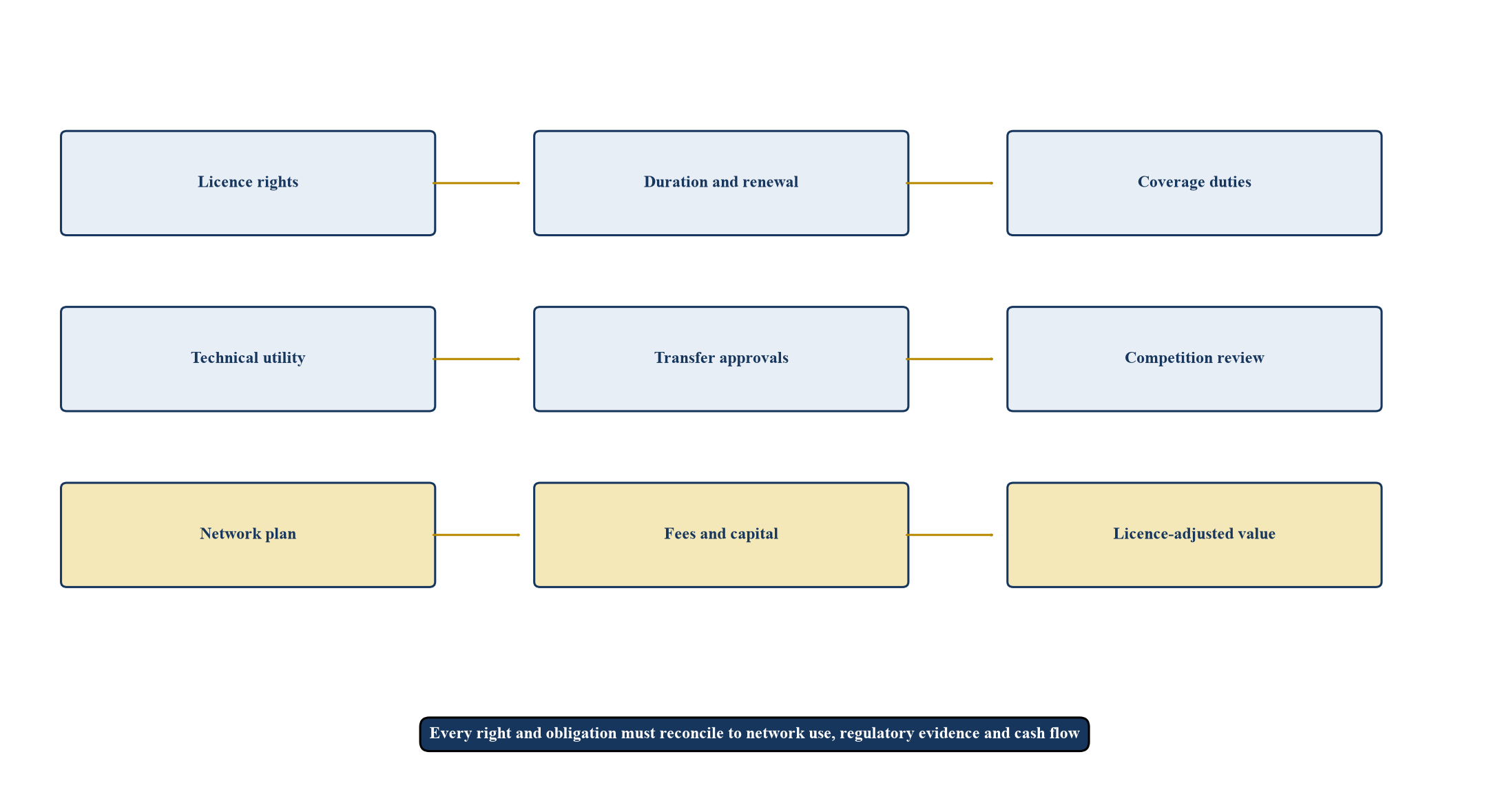
Transaction value requires alignment across legal rights, technical use, obligations, approvals and cash flow.
3. Build the spectrum rights inventory
A transaction can include national, regional, local, shared, leased and apparatus-based rights across low, mid and high frequency bands. Create a controlled register containing the authorising instrument, licence number, holder, band, paired or unpaired configuration, bandwidth, geography, issue date, expiry, renewal rule, fees, transferability and encumbrances. The analysis should distinguish observed legal, regulatory, technical, commercial and financial evidence from management assumptions and connect each material judgment to service continuity, capital requirements, financing and transaction value. The perimeter should exclude or separately value rights whose ownership, validity, transfer or technical parameters cannot be verified before signing. The work should test central and correlated downside cases for renewal timing, licence fees, coverage capital, network integration, remedies, customer churn, interest rates, liquidity and exit value. Exceptions require a named owner, source, due date and decision consequence. Unsupported renewal, transfer, service flexibility, synergy, spectrum premium or refinancing remains outside the central case until authoritative evidence supports it. Management should define the earliest warning indicator, intervention trigger and executable remedy. Reporting should preserve the approved baseline, change history, actual cost, regulatory response, service outcome and realised cash.
| Dimension | Evidence | Valuation consequence | Transaction response |
|---|---|---|---|
| Holder and control | Licence and corporate register | Right may not transfer with assets | Preserve entity or obtain consent |
| Band and geography | Technical schedule and map | Capacity and coverage differ | Model usable rights only |
| Duration and renewal | Licence and statutory process | Terminal cash flow can shorten | Scenario renewal cost and timing |
| Permitted use | Conditions and variations | New services may be restricted | Obtain variation or exclude revenue |
| Fees and obligations | Payment and compliance records | Additional cash and capital required | Adjust value and financing |
| Trading and security | Transfer rules and encumbrances | Closing or lender security constrained | Condition closing and covenants |
Each material licence should be tied to operating use and transaction treatment.
4. Confirm ownership control and beneficial rights
Economic use can differ from registered ownership when spectrum is leased, shared, subject to network arrangements or held in a regulated subsidiary. Review legal title, beneficial use, control rights, capacity reservations, sharing agreements, security interests, restrictions and change-of-control clauses. The analysis should distinguish observed legal, regulatory, technical, commercial and financial evidence from management assumptions and connect each material judgment to service continuity, capital requirements, financing and transaction value. The transaction structure should preserve the licensed entity and required governance until every consent, novation and post-closing filing is complete. The work should test central and correlated downside cases for renewal timing, licence fees, coverage capital, network integration, remedies, customer churn, interest rates, liquidity and exit value. Exceptions require a named owner, source, due date and decision consequence. Unsupported renewal, transfer, service flexibility, synergy, spectrum premium or refinancing remains outside the central case until authoritative evidence supports it. The section output should identify the licence, governing source, cash-flow line, accountable owner, evidence date, warning threshold and transaction consequence. This creates a traceable bridge from regulatory right to acquisition value.
5. Model licence duration and renewal
Remaining term determines how long the buyer can operate, recover network capital and earn a return before renewal or reassignment risk becomes material. Document statutory renewal criteria, application windows, performance tests, consultation periods, regulator discretion, fees, possible new conditions and evidence of compliance. The analysis should distinguish observed legal, regulatory, technical, commercial and financial evidence from management assumptions and connect each material judgment to service continuity, capital requirements, financing and transaction value. Terminal value should use scenarios for renewal timing, cost and conditions rather than assume that the current right continues indefinitely. The work should test central and correlated downside cases for renewal timing, licence fees, coverage capital, network integration, remedies, customer churn, interest rates, liquidity and exit value. Exceptions require a named owner, source, due date and decision consequence. Unsupported renewal, transfer, service flexibility, synergy, spectrum premium or refinancing remains outside the central case until authoritative evidence supports it. Evidence should remain traceable to authorising instrument, amendment, filing, payment, network configuration, site, measurement, customer service, invoice, cash receipt and forecast period. Board and lender reporting should reconcile to the same controlled records.
6. Price coverage and service obligations
Coverage duties can require population, geographic, road, railway, indoor or priority-area service by specified dates and quality levels. Map each obligation to required sites, radio equipment, backhaul, power, permits, spectrum configuration, operating cost and verification method. The analysis should distinguish observed legal, regulatory, technical, commercial and financial evidence from management assumptions and connect each material judgment to service continuity, capital requirements, financing and transaction value. Mandatory build capital belongs in acquisition value and financing capacity even when management would not choose the same deployment on commercial grounds. The work should test central and correlated downside cases for renewal timing, licence fees, coverage capital, network integration, remedies, customer churn, interest rates, liquidity and exit value. Exceptions require a named owner, source, due date and decision consequence. Unsupported renewal, transfer, service flexibility, synergy, spectrum premium or refinancing remains outside the central case until authoritative evidence supports it. Management should define the earliest warning indicator, intervention trigger and executable remedy. Reporting should preserve the approved baseline, change history, actual cost, regulatory response, service outcome and realised cash.
| Obligation | Measurement | Evidence | Deal treatment |
|---|---|---|---|
| Population coverage | Percentage and quality threshold | Regulator-approved model or test | Fund build and retain contingency |
| Geographic coverage | Area, roads or priority zones | Maps, sites and field measurements | Map incremental sites and backhaul |
| Deployment deadline | Milestone date | Licence, award or undertaking | Include long-stop and reporting |
| Service quality | Speed, latency or availability | Network data and test protocol | Cost capacity and operating controls |
| Continuing compliance | Periodic reporting or audit | Submitted returns and source data | Establish post-close control owner |
Mandatory deployment should be costed at site and milestone level.
7. Test use and technology flexibility
A licence can restrict technology, service, emissions, geography, equipment or network architecture and may require variation before a new use case is launched. Assess technology neutrality, refarming rights, private-network use, satellite-to-device capability, sharing, leasing, carrier aggregation and equipment constraints. The analysis should distinguish observed legal, regulatory, technical, commercial and financial evidence from management assumptions and connect each material judgment to service continuity, capital requirements, financing and transaction value. Revenue attributed to a new service should remain outside the central case until the existing licence permits it or an achievable variation path is evidenced. The work should test central and correlated downside cases for renewal timing, licence fees, coverage capital, network integration, remedies, customer churn, interest rates, liquidity and exit value. Exceptions require a named owner, source, due date and decision consequence. Unsupported renewal, transfer, service flexibility, synergy, spectrum premium or refinancing remains outside the central case until authoritative evidence supports it. The section output should identify the licence, governing source, cash-flow line, accountable owner, evidence date, warning threshold and transaction consequence. This creates a traceable bridge from regulatory right to acquisition value.
8. Underwrite interference and coexistence
The useful capacity of spectrum depends on coordination, guard bands, power limits, adjacent services, cross-border arrangements and site-specific restrictions. Review technical schedules, coordination zones, interference history, mitigation duties, international agreements and the cost of filters, retuning or lower power. The analysis should distinguish observed legal, regulatory, technical, commercial and financial evidence from management assumptions and connect each material judgment to service continuity, capital requirements, financing and transaction value. Valuation should reflect usable capacity and deployment economics rather than nominal bandwidth alone. The work should test central and correlated downside cases for renewal timing, licence fees, coverage capital, network integration, remedies, customer churn, interest rates, liquidity and exit value. Exceptions require a named owner, source, due date and decision consequence. Unsupported renewal, transfer, service flexibility, synergy, spectrum premium or refinancing remains outside the central case until authoritative evidence supports it. Evidence should remain traceable to authorising instrument, amendment, filing, payment, network configuration, site, measurement, customer service, invoice, cash receipt and forecast period. Board and lender reporting should reconcile to the same controlled records.
9. Map transfer lease and change-of-control approvals
Spectrum trades, leases, assignments and corporate control changes can require regulator approval, public notice or competition review before closing. Prepare a jurisdiction-by-jurisdiction consent matrix covering filing trigger, responsible party, evidence, consultation, expected timetable, conditions, appeal and long-stop date. The analysis should distinguish observed legal, regulatory, technical, commercial and financial evidence from management assumptions and connect each material judgment to service continuity, capital requirements, financing and transaction value. Signing documents should align closing, licence continuity, interim operating covenants and termination rights with the actual regulatory sequence. The work should test central and correlated downside cases for renewal timing, licence fees, coverage capital, network integration, remedies, customer churn, interest rates, liquidity and exit value. Exceptions require a named owner, source, due date and decision consequence. Unsupported renewal, transfer, service flexibility, synergy, spectrum premium or refinancing remains outside the central case until authoritative evidence supports it. Management should define the earliest warning indicator, intervention trigger and executable remedy. Reporting should preserve the approved baseline, change history, actual cost, regulatory response, service outcome and realised cash.
10. Test spectrum aggregation and competition
A combination can increase concentration in specific bands, especially scarce low-frequency spectrum, even when total market share appears acceptable. Calculate post-transaction holdings by band, geography and attributable control, then apply local spectrum screens, caps, competition theories and wholesale-market analysis. The analysis should distinguish observed legal, regulatory, technical, commercial and financial evidence from management assumptions and connect each material judgment to service continuity, capital requirements, financing and transaction value. The model should test divestment, leasing, access commitments, network investment, wholesale terms and behavioural remedies before treating the full portfolio as retained. The work should test central and correlated downside cases for renewal timing, licence fees, coverage capital, network integration, remedies, customer churn, interest rates, liquidity and exit value. Exceptions require a named owner, source, due date and decision consequence. Unsupported renewal, transfer, service flexibility, synergy, spectrum premium or refinancing remains outside the central case until authoritative evidence supports it. The section output should identify the licence, governing source, cash-flow line, accountable owner, evidence date, warning threshold and transaction consequence. This creates a traceable bridge from regulatory right to acquisition value.
11. Reconcile auction payments and continuing fees
Spectrum cost can include upfront auction consideration, instalments, annual administrative or incentive fees, revenue shares, renewal payments and performance security. Reconcile payment schedules, indexation, tax treatment, guarantees, default consequences and accounting records to the licence register. The analysis should distinguish observed legal, regulatory, technical, commercial and financial evidence from management assumptions and connect each material judgment to service continuity, capital requirements, financing and transaction value. Enterprise value and debt capacity should include all unavoidable spectrum cash costs and contingent payments under central and downside cases. The work should test central and correlated downside cases for renewal timing, licence fees, coverage capital, network integration, remedies, customer churn, interest rates, liquidity and exit value. Exceptions require a named owner, source, due date and decision consequence. Unsupported renewal, transfer, service flexibility, synergy, spectrum premium or refinancing remains outside the central case until authoritative evidence supports it. Evidence should remain traceable to authorising instrument, amendment, filing, payment, network configuration, site, measurement, customer service, invoice, cash receipt and forecast period. Board and lender reporting should reconcile to the same controlled records.
12. Value spectrum through incremental cash flow
Spectrum value derives from the revenue, avoided network cost, service quality, capacity and strategic options it enables after required capital and regulatory cash costs. Model traffic, subscribers, price, churn, network capacity, alternative bands, site density, equipment, energy, backhaul, fees, coverage capital and renewal cost. The analysis should distinguish observed legal, regulatory, technical, commercial and financial evidence from management assumptions and connect each material judgment to service continuity, capital requirements, financing and transaction value. The valuation should avoid counting both enterprise cash flow and a separate spectrum premium for the same economic benefit. The work should test central and correlated downside cases for renewal timing, licence fees, coverage capital, network integration, remedies, customer churn, interest rates, liquidity and exit value. Exceptions require a named owner, source, due date and decision consequence. Unsupported renewal, transfer, service flexibility, synergy, spectrum premium or refinancing remains outside the central case until authoritative evidence supports it. Management should define the earliest warning indicator, intervention trigger and executable remedy. Reporting should preserve the approved baseline, change history, actual cost, regulatory response, service outcome and realised cash.
| Value driver | Positive evidence | Deduction or risk | Model treatment |
|---|---|---|---|
| Capacity and propagation | Traffic carried and avoided sites | Congestion or limited geography | Incremental network cash flow |
| Licence term | Long remaining duration | Near expiry | Explicit term and renewal scenario |
| Flexibility | Technology-neutral rights | Use restrictions | Exclude unsupported services |
| Obligations | Funded and on track | Unfunded coverage commitment | Deduct required capital |
| Transferability | Clear consent path | approval or remedy risk | Probability and timing scenario |
| Renewal | Clear criteria and compliance | Discretion, fee or new conditions | Scenario terminal value |
The bridge prevents nominal bandwidth from being mistaken for unrestricted economic value.
13. Separate licence life from corporate terminal value
A perpetual corporate forecast can conceal a material mismatch when key licences expire within the explicit plan or shortly after it. Build a licence-expiry ladder and identify the EBITDA, customers, sites and debt maturities exposed in each year. The analysis should distinguish observed legal, regulatory, technical, commercial and financial evidence from management assumptions and connect each material judgment to service continuity, capital requirements, financing and transaction value. Terminal value should reflect renewal scenarios, replacement spectrum, network adaptation and the capital required to preserve service continuity. The work should test central and correlated downside cases for renewal timing, licence fees, coverage capital, network integration, remedies, customer churn, interest rates, liquidity and exit value. Exceptions require a named owner, source, due date and decision consequence. Unsupported renewal, transfer, service flexibility, synergy, spectrum premium or refinancing remains outside the central case until authoritative evidence supports it. The section output should identify the licence, governing source, cash-flow line, accountable owner, evidence date, warning threshold and transaction consequence. This creates a traceable bridge from regulatory right to acquisition value.
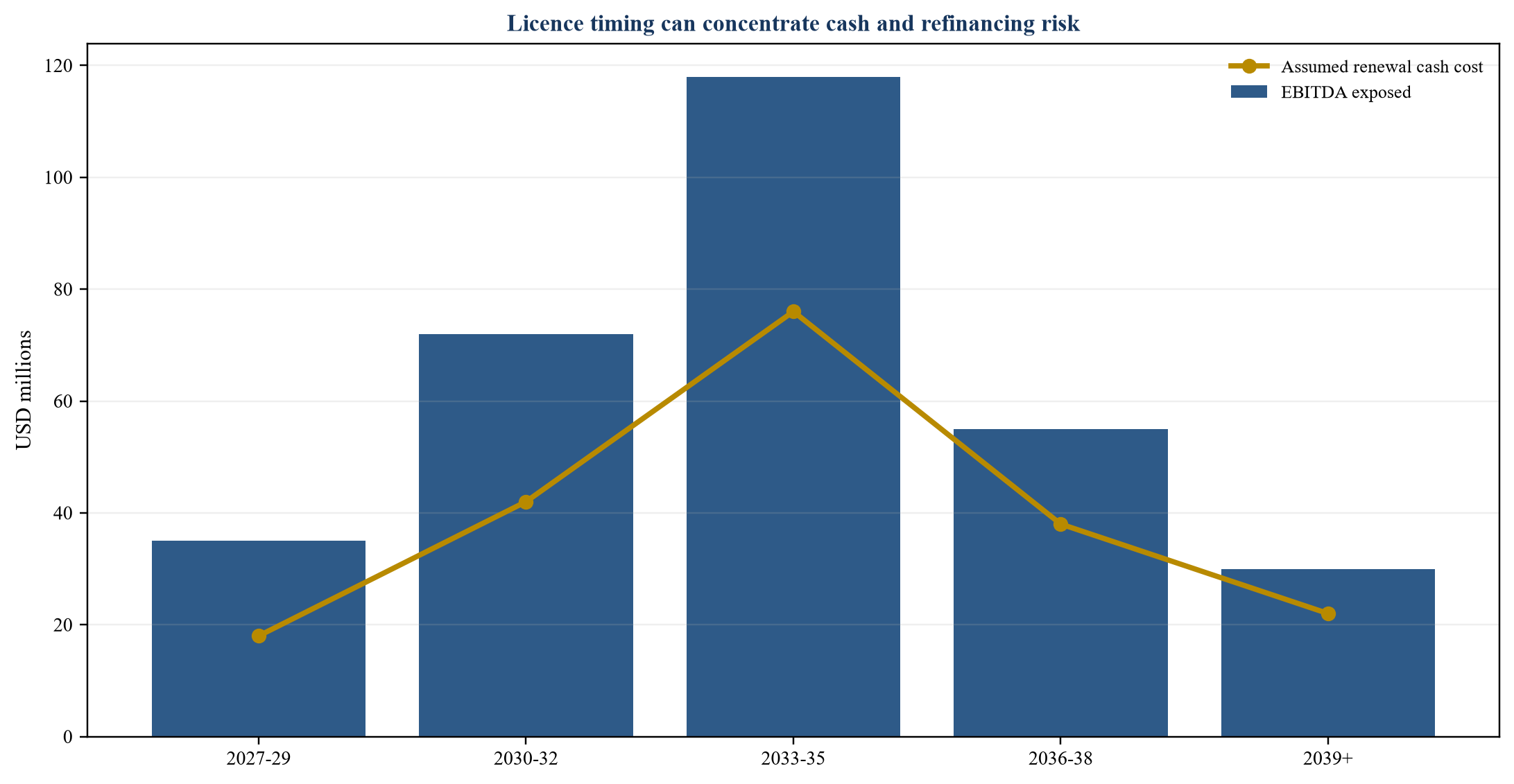
EBITDA exposure is illustrative and does not represent an observed company.
14. Build the coverage capital plan
Coverage obligations become financeable when technical design, unit cost, permits, supply chain, deployment capacity and evidence of completion are linked. Create a site and milestone plan with cost to complete, contingency, acceptance criteria, reporting date and responsible owner. The analysis should distinguish observed legal, regulatory, technical, commercial and financial evidence from management assumptions and connect each material judgment to service continuity, capital requirements, financing and transaction value. Capital releases should follow verified site rights, equipment availability, backhaul, power, commissioning and regulator-recognised evidence. The work should test central and correlated downside cases for renewal timing, licence fees, coverage capital, network integration, remedies, customer churn, interest rates, liquidity and exit value. Exceptions require a named owner, source, due date and decision consequence. Unsupported renewal, transfer, service flexibility, synergy, spectrum premium or refinancing remains outside the central case until authoritative evidence supports it. Evidence should remain traceable to authorising instrument, amendment, filing, payment, network configuration, site, measurement, customer service, invoice, cash receipt and forecast period. Board and lender reporting should reconcile to the same controlled records.
15. Measure spectrum utilisation and efficiency
Nominal holdings do not show whether capacity is deployed, congested, underused or technically stranded. Track population and geographic coverage, active sites, traffic per megahertz, busy-hour utilisation, quality, refarming status, sharing, leased capacity and unused blocks. The analysis should distinguish observed legal, regulatory, technical, commercial and financial evidence from management assumptions and connect each material judgment to service continuity, capital requirements, financing and transaction value. The deal thesis should explain how integration changes these measures and converts them into customer outcomes and cash flow. The work should test central and correlated downside cases for renewal timing, licence fees, coverage capital, network integration, remedies, customer churn, interest rates, liquidity and exit value. Exceptions require a named owner, source, due date and decision consequence. Unsupported renewal, transfer, service flexibility, synergy, spectrum premium or refinancing remains outside the central case until authoritative evidence supports it. Management should define the earliest warning indicator, intervention trigger and executable remedy. Reporting should preserve the approved baseline, change history, actual cost, regulatory response, service outcome and realised cash.
16. Design the network integration and refarming plan
A merger can combine complementary bands while creating difficult migration, equipment, site, handset and service-continuity dependencies. Sequence radio planning, spectrum reconfiguration, core integration, site changes, customer migration, device compatibility, testing and rollback. The analysis should distinguish observed legal, regulatory, technical, commercial and financial evidence from management assumptions and connect each material judgment to service continuity, capital requirements, financing and transaction value. Synergies should enter the central case only when the network plan identifies the affected sites, timing, cost, service risk and accountable delivery team. The work should test central and correlated downside cases for renewal timing, licence fees, coverage capital, network integration, remedies, customer churn, interest rates, liquidity and exit value. Exceptions require a named owner, source, due date and decision consequence. Unsupported renewal, transfer, service flexibility, synergy, spectrum premium or refinancing remains outside the central case until authoritative evidence supports it. The section output should identify the licence, governing source, cash-flow line, accountable owner, evidence date, warning threshold and transaction consequence. This creates a traceable bridge from regulatory right to acquisition value.
17. Protect customers and wholesale counterparties
Licence changes and network integration can affect coverage, quality, roaming, emergency services, virtual operators and enterprise service levels. Map customer and wholesale contracts to affected networks, bands, sites and milestones, including notice, consent, remedy and termination rights. The analysis should distinguish observed legal, regulatory, technical, commercial and financial evidence from management assumptions and connect each material judgment to service continuity, capital requirements, financing and transaction value. The transaction plan should protect service continuity and contract value during refarming, remedy implementation and licence transfer. The work should test central and correlated downside cases for renewal timing, licence fees, coverage capital, network integration, remedies, customer churn, interest rates, liquidity and exit value. Exceptions require a named owner, source, due date and decision consequence. Unsupported renewal, transfer, service flexibility, synergy, spectrum premium or refinancing remains outside the central case until authoritative evidence supports it. Evidence should remain traceable to authorising instrument, amendment, filing, payment, network configuration, site, measurement, customer service, invoice, cash receipt and forecast period. Board and lender reporting should reconcile to the same controlled records.
18. Test regulatory change and reallocation
Governments can revise fees, conditions, sharing rules, technology permissions, public-safety priorities or long-term allocations. Review current consultations, spectrum roadmaps, international harmonisation, refarming plans, court challenges and policy commitments. The analysis should distinguish observed legal, regulatory, technical, commercial and financial evidence from management assumptions and connect each material judgment to service continuity, capital requirements, financing and transaction value. The model should use dated evidence and scenarios for identifiable regulatory changes without treating consultation proposals as enacted rules. The work should test central and correlated downside cases for renewal timing, licence fees, coverage capital, network integration, remedies, customer churn, interest rates, liquidity and exit value. Exceptions require a named owner, source, due date and decision consequence. Unsupported renewal, transfer, service flexibility, synergy, spectrum premium or refinancing remains outside the central case until authoritative evidence supports it. Management should define the earliest warning indicator, intervention trigger and executable remedy. Reporting should preserve the approved baseline, change history, actual cost, regulatory response, service outcome and realised cash.
19. Review security foreign ownership and critical infrastructure
Telecom spectrum and networks can trigger national-security, foreign-investment, lawful-access, supply-chain and resilience controls. Map ownership thresholds, approval regimes, restricted vendors, data requirements, operational control, emergency obligations and continuing reporting. The analysis should distinguish observed legal, regulatory, technical, commercial and financial evidence from management assumptions and connect each material judgment to service continuity, capital requirements, financing and transaction value. Transaction conditions and governance should reflect the approvals, mitigation agreements and operating restrictions required in each jurisdiction. The work should test central and correlated downside cases for renewal timing, licence fees, coverage capital, network integration, remedies, customer churn, interest rates, liquidity and exit value. Exceptions require a named owner, source, due date and decision consequence. Unsupported renewal, transfer, service flexibility, synergy, spectrum premium or refinancing remains outside the central case until authoritative evidence supports it. The section output should identify the licence, governing source, cash-flow line, accountable owner, evidence date, warning threshold and transaction consequence. This creates a traceable bridge from regulatory right to acquisition value.
20. Align financial reporting tax and valuation evidence
Auction payments, annual fees, licence intangibles, impairment, deferred tax and purchase-price allocation can affect reported results and covenants. Reconcile legal rights and payment obligations with accounting records, tax positions, valuation models and lender definitions using qualified advice. The analysis should distinguish observed legal, regulatory, technical, commercial and financial evidence from management assumptions and connect each material judgment to service continuity, capital requirements, financing and transaction value. The investment memorandum should show where accounting or tax presentation differs from cash economics and regulatory rights. The work should test central and correlated downside cases for renewal timing, licence fees, coverage capital, network integration, remedies, customer churn, interest rates, liquidity and exit value. Exceptions require a named owner, source, due date and decision consequence. Unsupported renewal, transfer, service flexibility, synergy, spectrum premium or refinancing remains outside the central case until authoritative evidence supports it. Evidence should remain traceable to authorising instrument, amendment, filing, payment, network configuration, site, measurement, customer service, invoice, cash receipt and forecast period. Board and lender reporting should reconcile to the same controlled records.
21. Size debt to licence-adjusted cash flow
Acquisition leverage must survive renewal payments, mandatory coverage capital, delayed integration, service disruption and remedy cost. Model draw, interest, amortisation, hedging, covenant headroom, licence expiry, restricted payments, reserve accounts and refinancing dates. The analysis should distinguish observed legal, regulatory, technical, commercial and financial evidence from management assumptions and connect each material judgment to service continuity, capital requirements, financing and transaction value. Debt maturity and amortisation should remain compatible with licence duration and downside cash after unavoidable regulatory and network spending. The work should test central and correlated downside cases for renewal timing, licence fees, coverage capital, network integration, remedies, customer churn, interest rates, liquidity and exit value. Exceptions require a named owner, source, due date and decision consequence. Unsupported renewal, transfer, service flexibility, synergy, spectrum premium or refinancing remains outside the central case until authoritative evidence supports it. Management should define the earliest warning indicator, intervention trigger and executable remedy. Reporting should preserve the approved baseline, change history, actual cost, regulatory response, service outcome and realised cash.
22. Draft spectrum protections into the transaction documents
The buyer needs contractual protection where licence validity, compliance, transfer, renewal or obligations remain uncertain at signing. Consider conditions precedent, warranties, covenants, specific indemnities, price adjustment, escrow, earn-out, termination, cooperation and information rights with counsel. The analysis should distinguish observed legal, regulatory, technical, commercial and financial evidence from management assumptions and connect each material judgment to service continuity, capital requirements, financing and transaction value. Each protection should map to a verified diligence gap, quantifiable exposure, responsible party and enforceable remedy. The work should test central and correlated downside cases for renewal timing, licence fees, coverage capital, network integration, remedies, customer churn, interest rates, liquidity and exit value. Exceptions require a named owner, source, due date and decision consequence. Unsupported renewal, transfer, service flexibility, synergy, spectrum premium or refinancing remains outside the central case until authoritative evidence supports it. The section output should identify the licence, governing source, cash-flow line, accountable owner, evidence date, warning threshold and transaction consequence. This creates a traceable bridge from regulatory right to acquisition value.
23. Underwrite remedy and divestment execution
A regulator can require spectrum disposal, network access, pricing commitments, investment milestones or monitoring as a condition of clearance. Value the retained and divested rights, buyer universe, separation steps, interim restrictions, trustee powers, timetable and stranded network cost. The analysis should distinguish observed legal, regulatory, technical, commercial and financial evidence from management assumptions and connect each material judgment to service continuity, capital requirements, financing and transaction value. The downside case should include a failed or delayed remedy sale, lower proceeds, duplicated operating cost and weaker network integration. The work should test central and correlated downside cases for renewal timing, licence fees, coverage capital, network integration, remedies, customer churn, interest rates, liquidity and exit value. Exceptions require a named owner, source, due date and decision consequence. Unsupported renewal, transfer, service flexibility, synergy, spectrum premium or refinancing remains outside the central case until authoritative evidence supports it. Evidence should remain traceable to authorising instrument, amendment, filing, payment, network configuration, site, measurement, customer service, invoice, cash receipt and forecast period. Board and lender reporting should reconcile to the same controlled records.
24. Build the hypothetical acquisition case
The hypothetical operator produces USD 1,150 million of revenue and USD 310 million of EBITDA at an assumed enterprise value of USD 1,800 million. The portfolio has an assumed weighted average remaining licence life of eight years, annual spectrum fees of USD 38 million, a USD 420 million five-year coverage programme and USD 120 million of integration spending. The analysis should distinguish observed legal, regulatory, technical, commercial and financial evidence from management assumptions and connect each material judgment to service continuity, capital requirements, financing and transaction value. The case treats every value as a management assumption and uses a correlated downside to test whether price, debt and implementation remain supportable. The work should test central and correlated downside cases for renewal timing, licence fees, coverage capital, network integration, remedies, customer churn, interest rates, liquidity and exit value. Exceptions require a named owner, source, due date and decision consequence. Unsupported renewal, transfer, service flexibility, synergy, spectrum premium or refinancing remains outside the central case until authoritative evidence supports it. Management should define the earliest warning indicator, intervention trigger and executable remedy. Reporting should preserve the approved baseline, change history, actual cost, regulatory response, service outcome and realised cash.
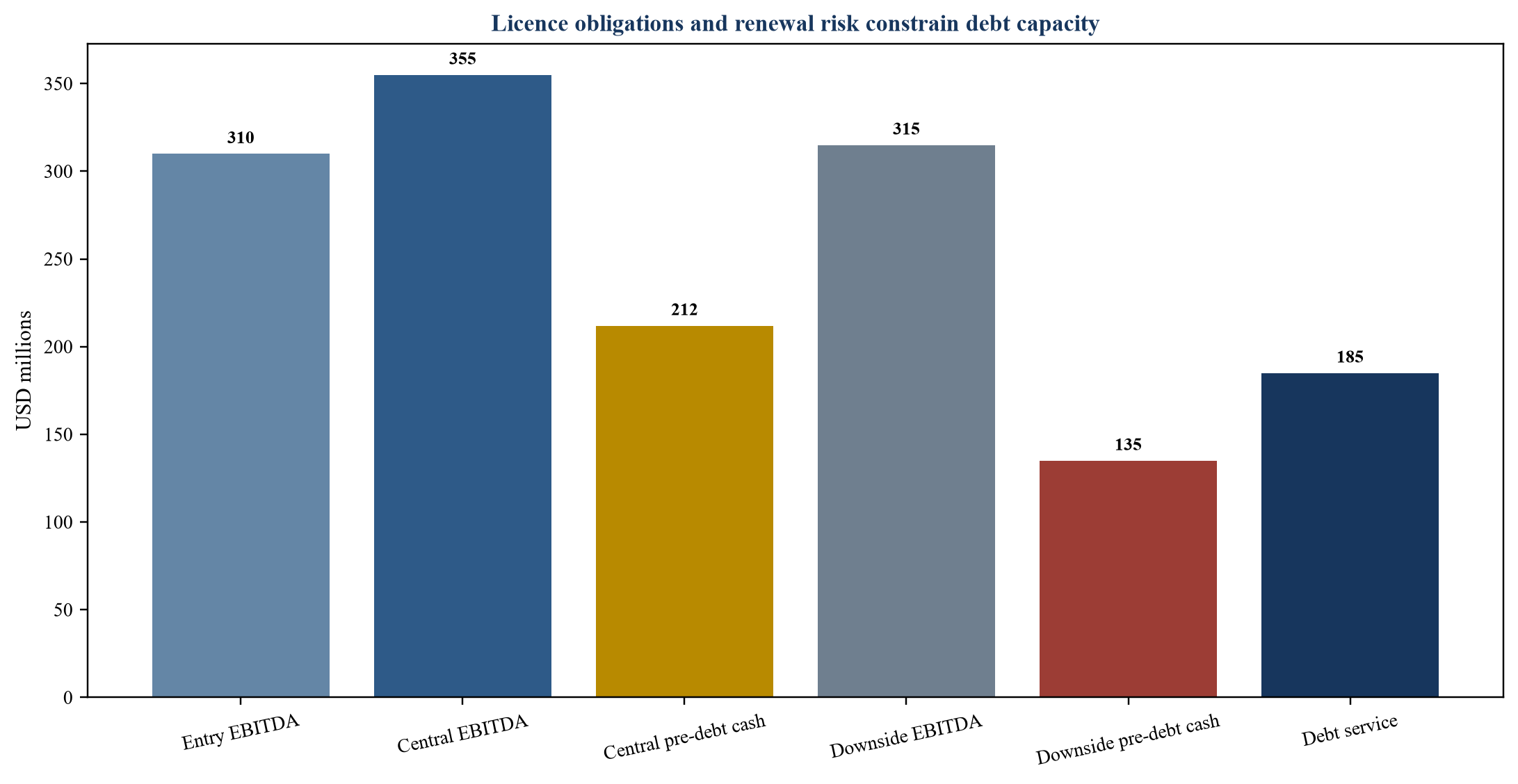
USD millions before tax and working capital; every value is an illustrative management assumption.
| Measure | Entry case | Central case | Correlated downside |
|---|---|---|---|
| Revenue | 1,150 | 1,225 | 1,145 |
| EBITDA | 310 | 355 | 315 |
| Acquisition enterprise value | 1,800 | 1,800 | 1,800 |
| Weighted remaining licence life | 8 | 8 | 8 |
| Annual spectrum and regulatory cash cost | 38 | 38 | 45 |
| Five-year coverage programme | 420 | 420 | 510 |
| Integration spending | 120 | 120 | 155 |
| Maintenance and mandatory coverage capital | 96 | 105 | 135 |
| Cash before debt service | 176 | 212 | 135 |
| Annual debt service | 185 | 185 | 185 |
| DSCR | 0.95x | 1.15x | 0.73x |
| EV / case EBITDA | 5.81x | 5.07x | 5.71x |
USD millions except ratios and years; every value is an illustrative management assumption.
25. Run correlated spectrum downside scenarios
Licence renewal, remedies, coverage build and network integration can deteriorate together rather than as isolated sensitivities. Test delayed renewal, higher fees, additional conditions, divestment, slower refarming, customer churn, capex inflation, interest rates and lower exit value in one coherent scenario. The analysis should distinguish observed legal, regulatory, technical, commercial and financial evidence from management assumptions and connect each material judgment to service continuity, capital requirements, financing and transaction value. Every downside should identify a warning signal, decision date, contractual protection, operating response and liquidity consequence. The work should test central and correlated downside cases for renewal timing, licence fees, coverage capital, network integration, remedies, customer churn, interest rates, liquidity and exit value. Exceptions require a named owner, source, due date and decision consequence. Unsupported renewal, transfer, service flexibility, synergy, spectrum premium or refinancing remains outside the central case until authoritative evidence supports it. The section output should identify the licence, governing source, cash-flow line, accountable owner, evidence date, warning threshold and transaction consequence. This creates a traceable bridge from regulatory right to acquisition value.
26. Establish regulatory and valuation governance
Spectrum decisions cross legal, regulatory, engineering, commercial, finance, tax, security and integration functions. Set a single controlled rights register, change process, evidence owner, valuation owner, approval threshold and board reporting calendar. The analysis should distinguish observed legal, regulatory, technical, commercial and financial evidence from management assumptions and connect each material judgment to service continuity, capital requirements, financing and transaction value. Management reporting should reconcile licence status, obligation delivery, network performance, capex, fees, cash flow and transaction value. The work should test central and correlated downside cases for renewal timing, licence fees, coverage capital, network integration, remedies, customer churn, interest rates, liquidity and exit value. Exceptions require a named owner, source, due date and decision consequence. Unsupported renewal, transfer, service flexibility, synergy, spectrum premium or refinancing remains outside the central case until authoritative evidence supports it. Evidence should remain traceable to authorising instrument, amendment, filing, payment, network configuration, site, measurement, customer service, invoice, cash receipt and forecast period. Board and lender reporting should reconcile to the same controlled records.
27. Build the diligence data room and evidence chain
A decision-grade data room should let reviewers trace each licence from authorising document through compliance evidence to the financial model. Include current licences, amendments, renewal filings, fee records, coverage reports, regulator correspondence, technical schedules, trading agreements, network maps, capex plans and accounting reconciliations. The analysis should distinguish observed legal, regulatory, technical, commercial and financial evidence from management assumptions and connect each material judgment to service continuity, capital requirements, financing and transaction value. Missing or conflicting evidence should remain visible in an exception register with owner, due date and decision consequence. The work should test central and correlated downside cases for renewal timing, licence fees, coverage capital, network integration, remedies, customer churn, interest rates, liquidity and exit value. Exceptions require a named owner, source, due date and decision consequence. Unsupported renewal, transfer, service flexibility, synergy, spectrum premium or refinancing remains outside the central case until authoritative evidence supports it. Management should define the earliest warning indicator, intervention trigger and executable remedy. Reporting should preserve the approved baseline, change history, actual cost, regulatory response, service outcome and realised cash.
28. Control post-closing compliance
Closing does not end licence duties, remedy reporting, fee payments, coverage milestones or regulator engagement. Create a compliance calendar for filings, payments, measurements, certifications, audits, renewals, variations and change notifications. The analysis should distinguish observed legal, regulatory, technical, commercial and financial evidence from management assumptions and connect each material judgment to service continuity, capital requirements, financing and transaction value. Internal controls should preserve source evidence and escalate missed or at-risk obligations before they impair licence value or service continuity. The work should test central and correlated downside cases for renewal timing, licence fees, coverage capital, network integration, remedies, customer churn, interest rates, liquidity and exit value. Exceptions require a named owner, source, due date and decision consequence. Unsupported renewal, transfer, service flexibility, synergy, spectrum premium or refinancing remains outside the central case until authoritative evidence supports it. The section output should identify the licence, governing source, cash-flow line, accountable owner, evidence date, warning threshold and transaction consequence. This creates a traceable bridge from regulatory right to acquisition value.
29. Build the thirty-month transaction roadmap
The roadmap should move from rights inventory and regulatory strategy through signing, approvals, closing, network integration, obligation delivery and valuation refresh. Each workstream needs a milestone, evidence requirement, owner, budget, warning indicator and fallback action. The analysis should distinguish observed legal, regulatory, technical, commercial and financial evidence from management assumptions and connect each material judgment to service continuity, capital requirements, financing and transaction value. Board gates should control price, financing, consent strategy, remedy acceptance, capital release and the pace of spectrum refarming. The work should test central and correlated downside cases for renewal timing, licence fees, coverage capital, network integration, remedies, customer churn, interest rates, liquidity and exit value. Exceptions require a named owner, source, due date and decision consequence. Unsupported renewal, transfer, service flexibility, synergy, spectrum premium or refinancing remains outside the central case until authoritative evidence supports it. Evidence should remain traceable to authorising instrument, amendment, filing, payment, network configuration, site, measurement, customer service, invoice, cash receipt and forecast period. Board and lender reporting should reconcile to the same controlled records.
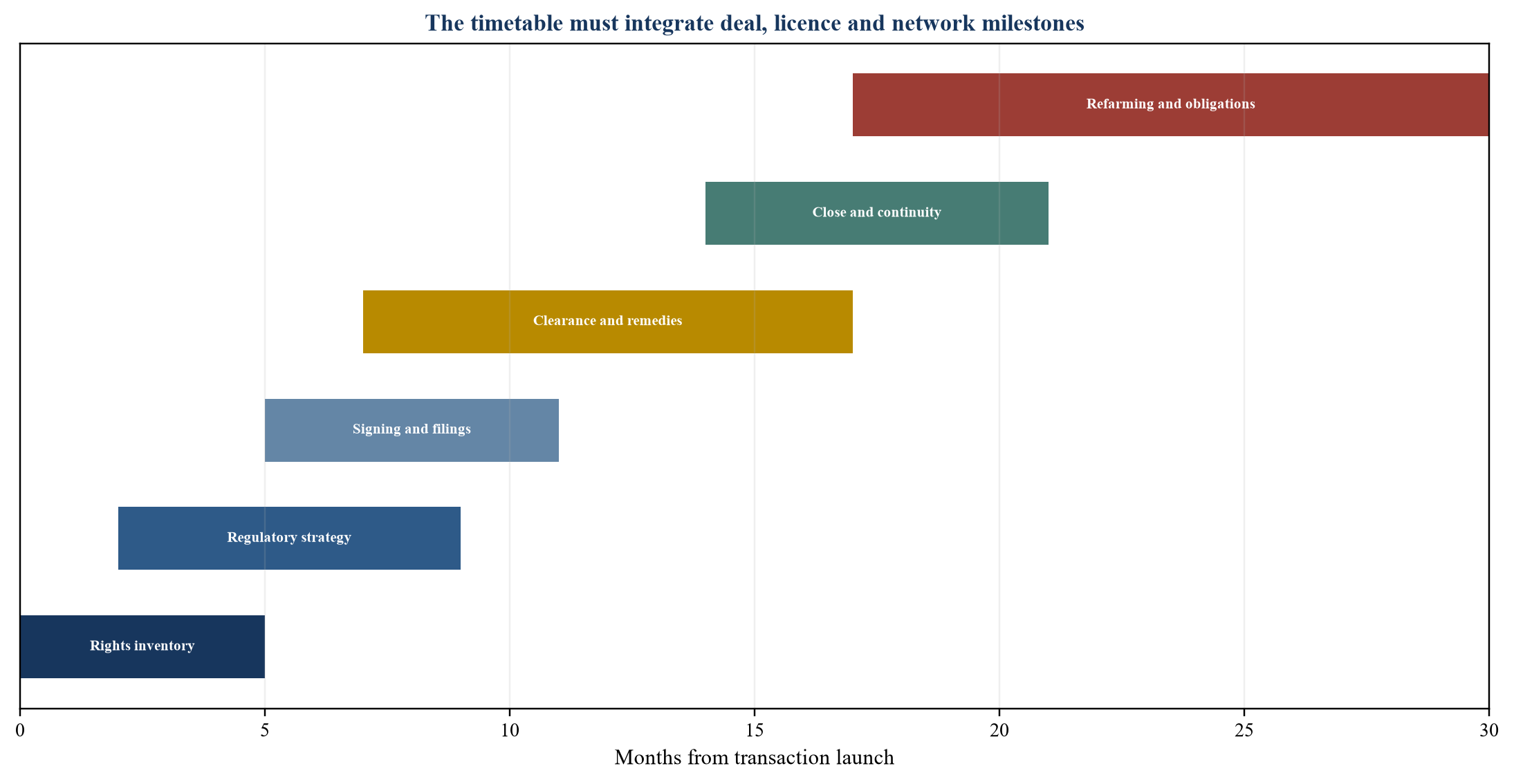
Closing and capital release follow verified approvals and obligation evidence.
30. Define the investable spectrum case
An investable case combines verified rights, sufficient licence duration, credible renewal, funded obligations, transferable control, technically usable capacity and resilient downside cash. The final memorandum should present the rights register, expiry ladder, consent map, obligation cost, network plan, valuation bridge, remedy case, financing and governance. The analysis should distinguish observed legal, regulatory, technical, commercial and financial evidence from management assumptions and connect each material judgment to service continuity, capital requirements, financing and transaction value. Commitment conditions should close material evidence gaps before nominal bandwidth or strategic scarcity is treated as acquisition value. The work should test central and correlated downside cases for renewal timing, licence fees, coverage capital, network integration, remedies, customer churn, interest rates, liquidity and exit value. Exceptions require a named owner, source, due date and decision consequence. Unsupported renewal, transfer, service flexibility, synergy, spectrum premium or refinancing remains outside the central case until authoritative evidence supports it. Management should define the earliest warning indicator, intervention trigger and executable remedy. Reporting should preserve the approved baseline, change history, actual cost, regulatory response, service outcome and realised cash.
Sources
- International Telecommunication Union. Report ITU-R SM.2012-7: Economic approaches to spectrum management, June 2025. Read the primary source
- International Telecommunication Union. Assignment and use of radio spectrum: policy guidelines and economic aspects, 2016. Read the primary source
- International Telecommunication Union. Recommendation ITU-T D.609R: Guidelines for determining the size of fees associated with authorizations and licences, February 2025. Read the primary source
- International Telecommunication Union. Handbook on National Spectrum Management, 2015. Read the primary source
- European Commission. EU radio spectrum policy for wireless connections across borders. Read the primary source
- European Union. Directive (EU) 2018/1972 establishing the European Electronic Communications Code. Read the primary source
- European Commission. Report on the functioning of the European Electronic Communications Code, 2026. Read the primary source
- Radio Spectrum Policy Group. Opinion on the future use of the 2 GHz band for mobile satellite services, RSPG24-007, 2024. Read the primary source
- Ofcom. Mobile and wireless broadband below 5 GHz, updated 26 August 2026. Read the primary source
- Ofcom. Frequency and technical information, updated 6 May 2026. Read the primary source
- Ofcom. Transfer Notification Register. Read the primary source
- Ofcom. Our approach to spectrum compliance and enforcement. Read the primary source
- Ofcom. Award of 26 GHz and 40 GHz millimetre-wave spectrum by auction, 2025. Read the primary source
- Competition and Markets Authority. Vodafone and CK Hutchison joint venture merger inquiry, updated 31 July 2026. Read the primary source
- Competition and Markets Authority. CMA clears Vodafone and Three merger subject to legally binding commitments, 5 December 2024. Read the primary source
- Federal Communications Commission. Secondary Markets Report and Order, FCC 04-167. Read the primary source
- Federal Communications Commission. Safeguarding and Securing the Open Internet, mobile spectrum holdings discussion, FCC 24-28. Read the primary source
- Federal Communications Commission. Citizens Broadband Radio Service rules including licence term and performance requirements, FCC 18-149. Read the primary source
- GSMA. Spectrum Licensing: Best Practice for Mobile Networks, 30 January 2026. Read the primary source
- United States National Telecommunications and Information Administration. Evidence-Based National Spectrum Decision-Making Methodology. Read the primary source
