

1. INTRODUCTION
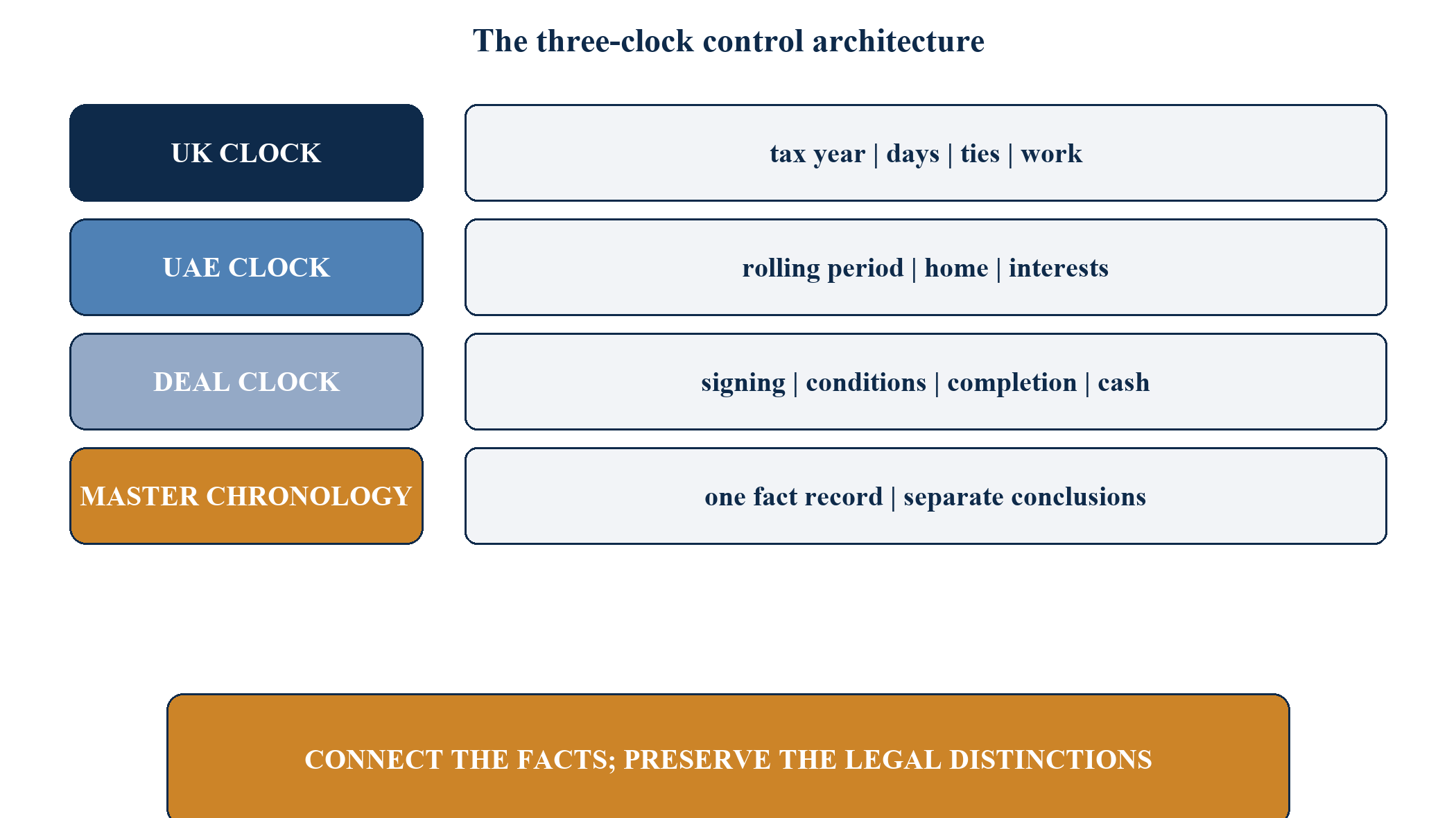
A relocation from the United Kingdom to the United Arab Emirates can appear to have one decisive date: the flight, the handover of a London home, the start of a Dubai lease, the signing of a sale agreement or the receipt of proceeds. Each date may matter, yet each belongs to a different legal and evidential timetable. A defensible move therefore requires three clocks to be managed together.
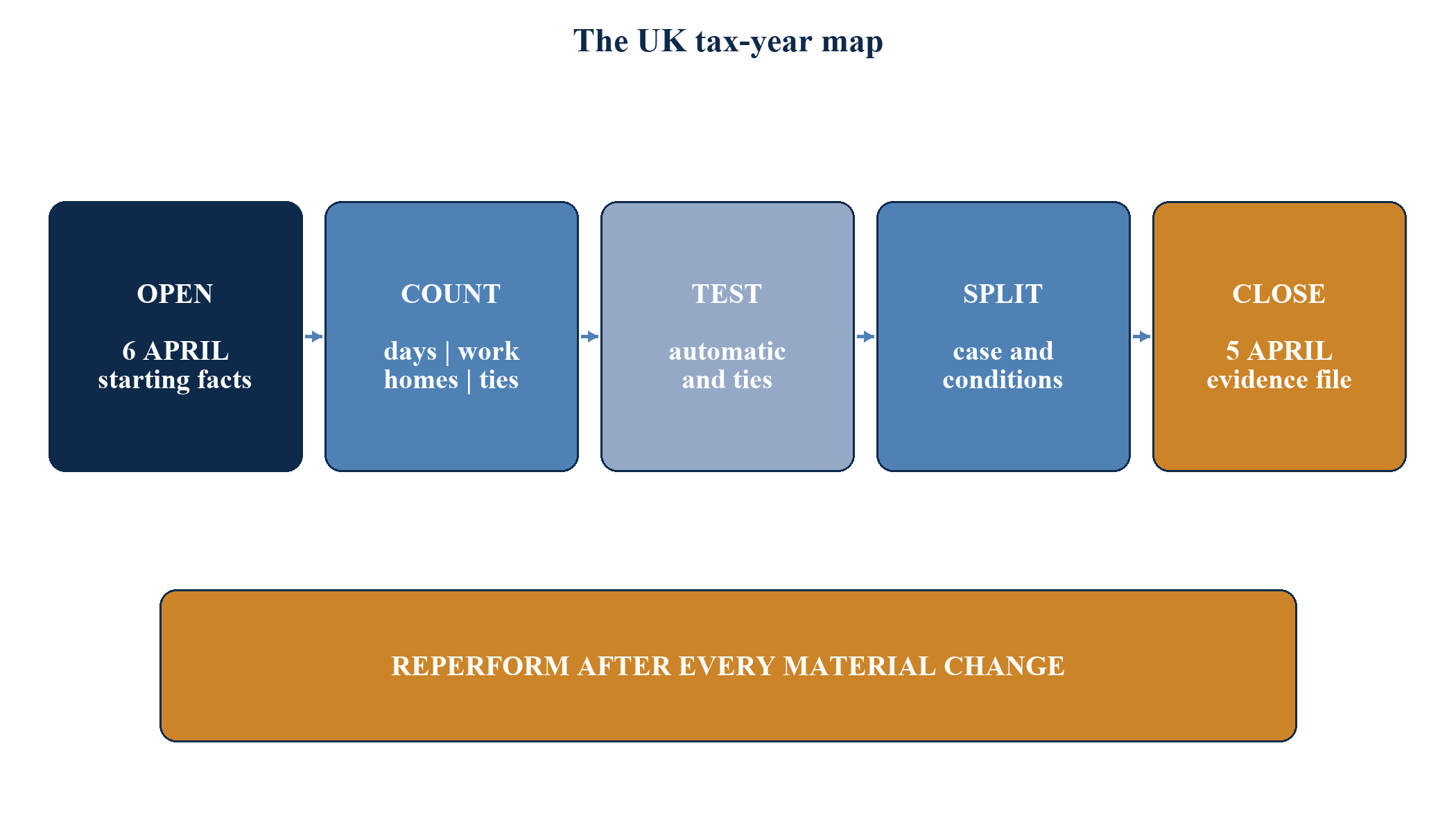
The first clock is the UK tax year and the individual's residence position within it. The current UK tax year runs from 6 April 2026 to 5 April 2027 [1]. Residence is determined for a tax year under the Statutory Residence Test, subject to detailed automatic tests, sufficient ties and possible split-year treatment [2,3]. Presence, work, homes, family contact and prior-year history can use different day concepts. A diary that records flights alone cannot answer every question.
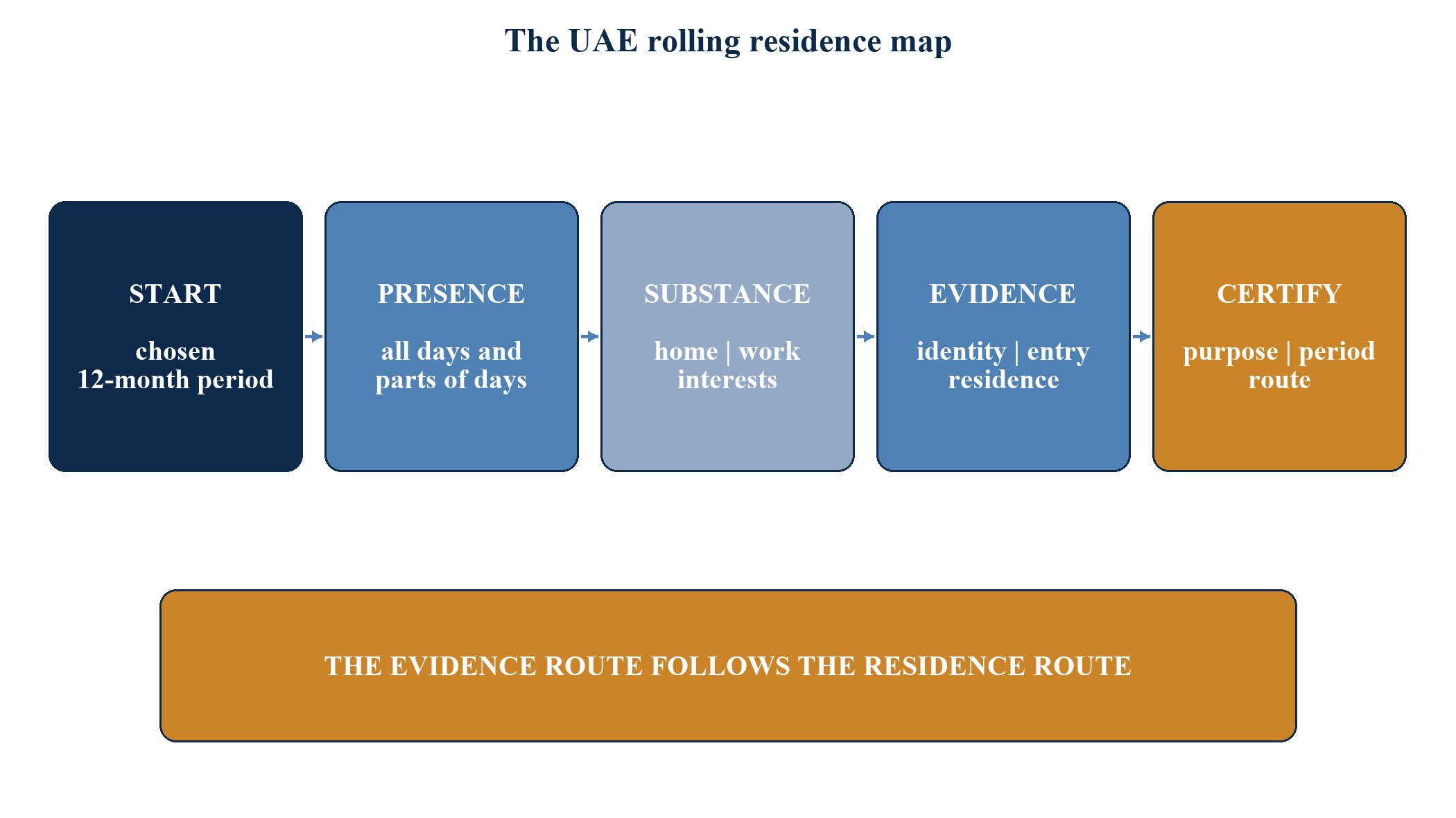
The second clock is the UAE residence calendar. The domestic rules can examine physical presence over a consecutive 12-month period, or the individual's usual or primary place of residence and centre of financial and personal interests [29-32]. Days and parts of days spent in the UAE count for the relevant domestic thresholds. A certificate application requires evidence that corresponds to the route relied upon. The measurement period can begin on a date chosen for the relevant certificate request, while the underlying facts develop through travel, housing, work, family and economic connections.
The third clock is the transaction timetable. A founder, investor or family office may be preparing a business sale, share exchange, distribution, property disposal, capital call, refinancing or ownership reorganisation. Commercial events have their own legal effects. For a disposal under an unconditional contract, UK capital-gains rules generally use the date the contract is made; a conditional contract can use the date on which the conditions are satisfied [23,24]. Completion, consideration, reporting and cash receipt may occur later. A timetable that treats completion as the only important transaction date can therefore misstate the sequence.
This paper develops a controlled method for synchronising the three clocks without collapsing them into one. It separates facts from conclusions, identifies the earliest legally effective event, records the latest evidence needed for the intended position and creates decision gates before irreversible steps. The result is a practical relocation calendar for principals, founders and family offices who require a coherent personal, corporate and transaction record.
The paper provides general research. Every legal, tax, regulatory, immigration, employment, corporate, transaction and treaty conclusion depends on current law and the complete facts. The models are hypothetical and simplified. Qualified advisers should approve the actual sequence before residence facts change, transaction documents become binding or assets move.
2. THE THREE-CLOCK CONTROL MODEL
2.1 Define each clock by its legal question
The UK clock asks which residence tests apply for each tax year, whether split-year treatment applies and which income, gains or duties fall in a UK or overseas part. The UAE clock asks which domestic residence route is supported for the relevant consecutive 12-month period and whether treaty residence must also be analysed. The transaction clock asks when legal and economic rights change, when a disposal occurs for the relevant tax rule, when conditions are satisfied, when consideration becomes due and when reporting obligations arise.
Each clock requires its own source records and adviser conclusion. The UK record may include daily location, midnight presence, UK work hours, homes, family contact, prior-year day counts and exceptional circumstances [4-18]. The UAE record may include entry and exit reports, Emirates ID and visa documents, tenancy or title evidence, utility records, employment or business evidence, family connections and financial interests [29-33]. The transaction record may include board papers, offers, conditions, contracts, completion accounts, consideration schedules and tax clearances [23-27,37].
2.2 The earliest-effect and latest-evidence rules
The control model uses two planning rules. The earliest-effect rule identifies the first event that may have legal, tax or commercial effect. A binding contract, satisfied condition, workday, home-use day or board decision can matter before cash, publicity or physical relocation. The latest-evidence rule asks when every fact and document needed for the intended position is actually available.
These rules create a useful discipline. An intended transaction may be commercially ready before the residence record is defensible. The residence record may be strong while the transaction remains subject to an unresolved condition. The board can approve a step only after the relevant legal event and supporting evidence have been reconciled.
2.3 One chronology, three conclusions
The office should maintain one master chronology with three linked ledgers. Events appear once in the chronology and receive clock-specific attributes. A flight from London to Dubai has a travel date, a UK presence consequence, a UAE presence consequence and an evidence source. A sale agreement has a signing date, a condition status, a disposal-date analysis, a board approval and a consideration schedule. A UK visit may affect residence, company governance, transaction diligence and employment duties at the same time.
| Clock | Core question | Primary evidence | Decision owner |
|---|---|---|---|
| UK tax year and residence | What is the person's UK residence position for the tax year and any UK or overseas part? | daily location, work hours, homes, family, prior years, advice | individual and UK tax adviser |
| UAE residence period | Which domestic or treaty residence route is supported for the relevant period? | entry and exit report, home, work or business, family, interests, certificate file | individual and UAE tax adviser |
| Transaction timetable | Which event changes rights, creates a disposal, fixes consideration or starts a deadline? | offers, approvals, conditions, contracts, completion and reporting records | board, transaction counsel and tax advisers |
The chronology is a control record. It cannot replace professional conclusions. Its value lies in preventing one team from using a date that another team has defined differently.
3. CLOCK ONE: THE UK TAX YEAR
3.1 The tax-year frame
The UK tax year supplies the annual frame for the Statutory Residence Test. The 2026 to 2027 tax year runs from 6 April 2026 to 5 April 2027 [1]. A move on 4 April and a move on 7 April sit in different tax years, yet the residence analysis still depends on the applicable tests and surrounding facts. The tax-year boundary is therefore a measurement boundary rather than a universal relocation deadline.
The office should open a separate residence file for every relevant person and every tax year. Spouses, partners, adult children, minor children, trustees, directors and founders can have different day counts, work patterns, homes and conclusions. A family calendar is useful operationally; each person's conclusion remains separate.
3.2 The test hierarchy
HMRC's guidance applies a sequence: automatic overseas tests, automatic UK tests and, where required, the sufficient-ties test [2,3]. The result depends on prior residence, days, work, homes and ties. A day budget based only on a headline threshold can fail when the wrong test, prior-year history or work pattern has been assumed.
The sufficient-ties analysis links the number of UK ties to days spent in the UK and distinguishes individuals who were UK resident in one or more of the previous three tax years from other arrivals [7]. Family, accommodation, work and 90-day ties have specific definitions [8-11]. A country tie can also apply to a leaver. Each tie should be recorded as a legal proposition with facts, evidence and adviser conclusion.
3.3 Day counting and the deeming rule
For many SRT tests, a day generally counts when the individual is present in the UK at the end of the day [4]. The deeming rule can add certain qualifying days after the first 30 when the statutory conditions are met, including prior UK residence, at least three ties and more than 30 qualifying days [5]. Transit and exceptional-circumstance rules also require specific analysis [18].
A relocation calendar should record arrival and departure times, location at the end of the day, purpose of travel, work performed, home use, family contact and supporting evidence. It should retain itinerary changes and cancellations. A simple total of nights produces an incomplete control record.
4. WORK, HOMES AND FAMILY FACTS
4.1 Workdays carry more than one consequence
Work takes its ordinary meaning for SRT purposes and includes employee duties, self-employed activities, certain travel time and job-related training [6]. Several tests use a threshold of more than three hours of UK work on a day. HMRC's record-keeping guidance points to diaries or timesheets that show hours, nature of duties, work location, leave, contracts and exceptional circumstances [17].
Transaction work can create UK workdays. Management presentations, buyer meetings, diligence responses, signing sessions, integration planning and earn-out duties should be captured by actual location and hours. A founder who has left the UK physically may still return repeatedly for a sale process. The transaction timetable should therefore feed the residence ledger rather than sit in a separate deal room.
4.2 Homes require fact-rich evidence
Home and accommodation tests use defined conditions. HMRC describes evidence that may support the existence and use of a home, including utilities, parking, clubs, mobile-phone usage, lifestyle purchases, family presence, domestic staff, security, maintenance, insurance, mail, driving-licence details, banking and medical registration [16]. The evidence works collectively; one document rarely carries the conclusion by itself.
The move plan should record when a UK property becomes unavailable, available on a restricted basis, let, sold or retained. It should record when UAE accommodation becomes continuously available and when it becomes part of the person's settled routine. Keys, access rights, furniture, family occupation and actual use can matter as much as a contract date.
4.3 Family facts change the travel budget
A spouse or partner's residence, a minor child's residence and contact with a child in the UK can affect the family-tie analysis [8]. School calendars and custody arrangements can create predictable travel pressure. The master chronology should convert these personal commitments into dated assumptions and should flag changes before tickets are booked.
The framework protects family autonomy. It provides visibility rather than prescribing where family members should live. Advisers can then evaluate the actual family pattern, including education, care, health and employment needs.
5. SPLIT-YEAR TREATMENT
5.1 A specific statutory outcome
Split-year treatment can divide a tax year into a UK part and an overseas part when one of the statutory cases applies [13]. It follows from facts and conditions; it is not an elective date chosen for convenience. The relevant case determines the split date and the conditions that must continue to be met.
Case 1 concerns starting full-time work overseas and uses a relevant period ending with the last day of the tax year [14]. Case 3 concerns ceasing to have a home in the UK and has its own detailed conditions [15]. Other cases address partners, overseas homes, work and arrivals. A relocation plan should identify every plausible case, select the case supported by the facts and monitor the conditions through the rest of the year.
5.2 The split date is a monitored date
The office should treat the proposed split date as a monitored date until the full-year conditions have been confirmed. Subsequent UK visits, workdays, home availability, partner facts or changes to overseas work can affect the conclusion. The year-end review should therefore reperform the calculation from source records.
Capital-gains treatment also requires separate analysis. HMRC states that split-year treatment can place a year into UK and overseas parts, while specific rules can continue to apply to temporary non-residence, UK property and other statutory categories [22]. A transaction completed during an overseas part still requires asset-specific analysis.
5.3 Build a split-year evidence pack
The evidence pack should contain the applicable case memorandum, exact split-date calculation, work schedule, home timeline, travel ledger, partner and family facts, employment or business documents, exceptional-circumstance log and year-end confirmation. It should show who approved each conclusion and when.
The pack should also reconcile deal activity. If a transaction contributed to continued UK work, retained accommodation or board activity, those facts belong in the residence memorandum. A clean deal file and a clean residence file can still conflict when their chronologies differ.
6. CLOCK TWO: THE UAE RESIDENCE CALENDAR
6.1 Domestic residence routes
UAE Cabinet Decision No. 85 of 2022 and Ministerial Decision No. 27 of 2023 provide domestic tax-residence rules for natural persons [30,31]. The Ministry of Finance explains that every day or part of a day in the UAE counts toward the relevant 183-day or 90-day threshold. It also explains that a permanent place of residence may be rented and must be continuously available, and that financial and personal interests consider work, personal and economic relationships [31].
The FTA certificate service describes three domestic evidence routes for natural persons: presence for at least 183 days in a consecutive 12-month period; presence between 90 and 182 days with specified status and employment, business or permanent-home evidence; or a primary place of residence and centre of financial and personal interests in the UAE [32]. The route used determines the evidence file.
6.2 A rolling period changes planning
The UAE domestic presence tests use a consecutive 12-month period. The period can cross two UK tax years and two calendar years. A person who arrives in the UAE in October can build a 12-month UAE record while the UK position is measured across a tax year ending the following 5 April. The two clocks therefore cannot be reconciled by placing one annual total beside another.
The office should maintain rolling 90-day, 183-day and 12-month views, while advisers determine which route is relevant. Each view should use official entry and exit information and reconcile it to passports, boarding passes and travel records. Parts of UAE days count under the domestic guidance, while UK tests often focus on presence at the end of the day. One travel event can therefore have different counting effects.
6.3 Residence evidence grows over time
UAE evidence includes immigration status, entry and exit records, residence, work or business, income sources, family connections, banking, memberships and the pattern of ordinary life [32,33]. A visa or Emirates ID supplies important evidence and legal status. The broader residence file requires the facts relevant to the route claimed.
The office should record when each evidence category begins, when it becomes continuous and who controls the source. A lease signed before arrival, a utility account opened after arrival and a business launched later have different evidential dates. The residence memorandum should describe the sequence faithfully.
7. DOMESTIC AND TREATY RESIDENCE
7.1 Domestic conclusions come first
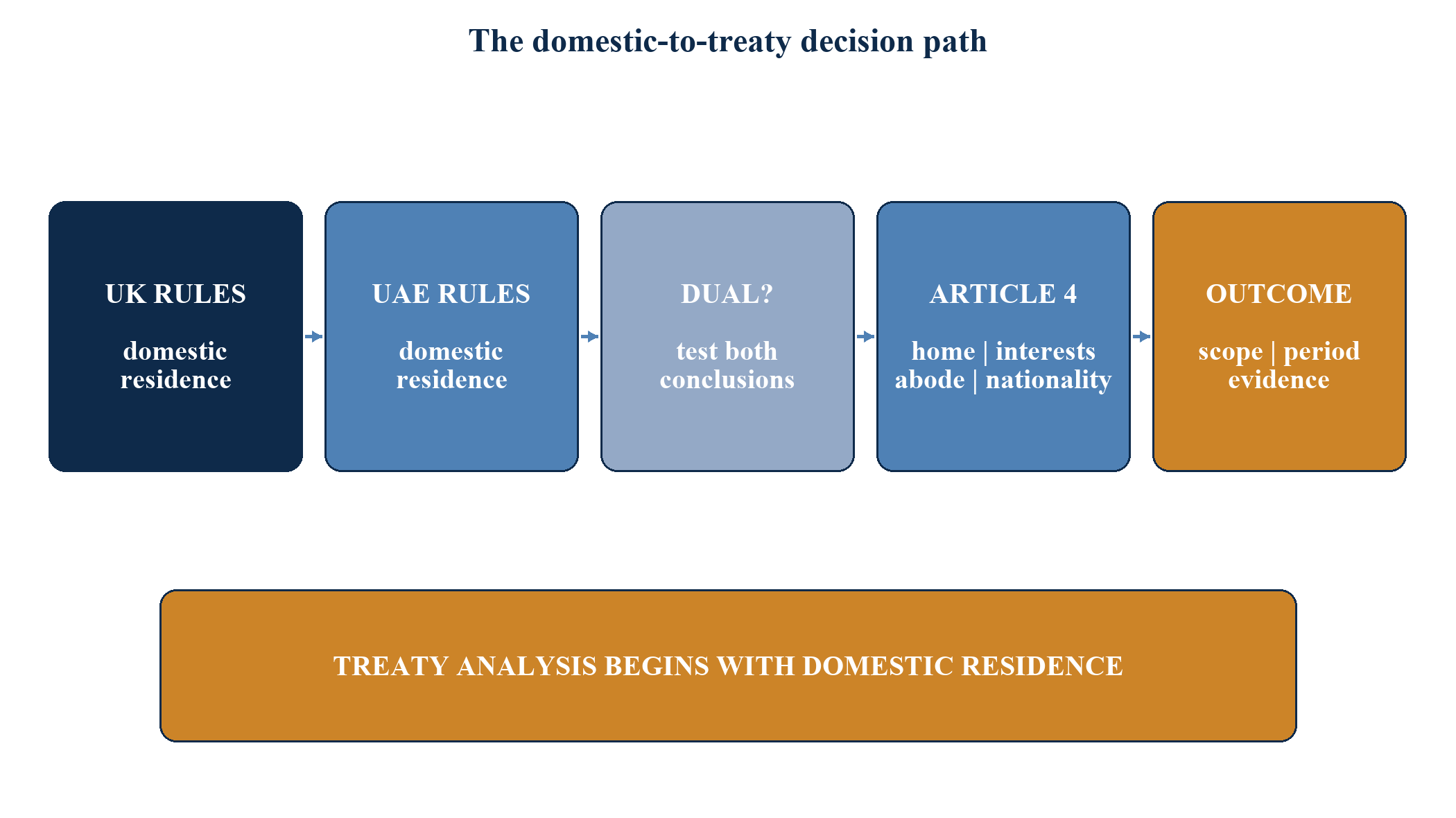
An individual can meet domestic residence rules in more than one country. The UK-UAE convention then provides a treaty framework for taxes and persons within its scope [29]. Article 4 addresses residence and applies a sequence for an individual who is resident in both states: permanent home, centre of vital interests, habitual abode, nationality and, if necessary, mutual agreement.
The treaty analysis should be documented separately from each domestic conclusion. A UAE Tax Residency Certificate may support an application or treaty claim; the certificate process and the treaty's own wording must be reviewed together [28,31,32]. The calendar should allow sufficient time to assemble the certificate evidence and obtain adviser review.
7.2 The certificate period must match the claim
The FTA service permits a natural person to apply when the relevant criteria are met and asks for documents based on the purpose and route [32]. The requested certificate period, domestic residence period, UK tax year and income or gain period should therefore be reconciled. A certificate covering a stated period cannot answer a fact outside that period.
The evidence calendar should show application preparation, entry and exit report availability, translations or certifications, adviser review, submission, questions, approval and final certificate. The transaction team should know whether a treaty claim is required before payment, reporting or withholding decisions.
7.3 Treat treaty position as an output
The treaty conclusion is an output from complete domestic and treaty facts. It should never be used as a planning assumption that causes the underlying facts to be rewritten. Permanent homes, family, economic relationships, habitual patterns and nationality require a coherent narrative supported by source records [28,40].
8. CLOCK THREE: THE TRANSACTION TIMETABLE
8.1 Build the timetable from legal states
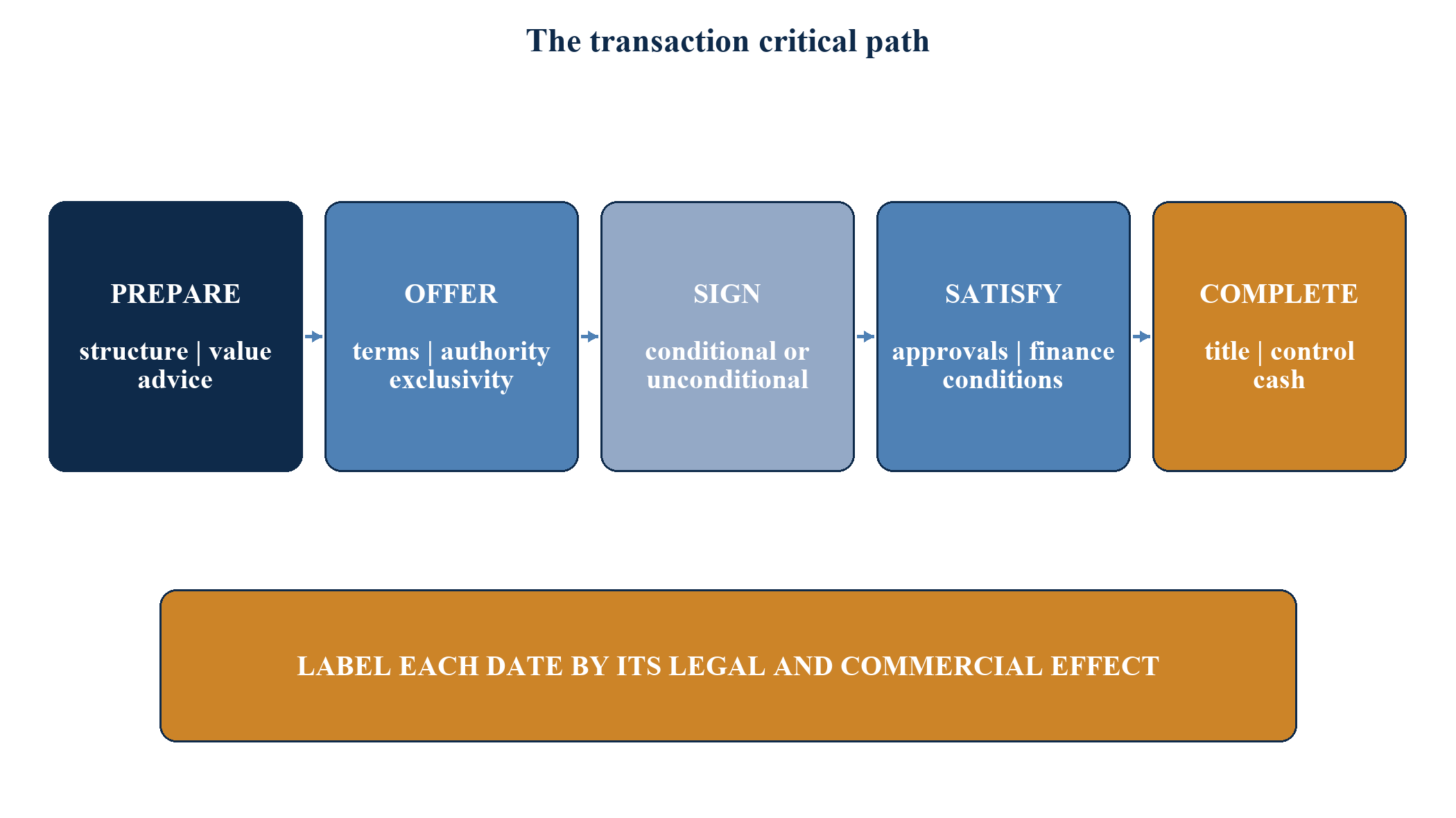
A transaction should be mapped by legal state rather than by presentation label. The critical states can include preparation, indicative offer, exclusivity, due diligence, board approval, signing, satisfaction of conditions, completion, consideration receipt, escrow release, earn-out measurement and final reporting. The applicable documents and governing law determine which states are binding.
The residence team should receive the transaction map before the first irreversible step. Deal work may create UK workdays, retained management duties, travel and accommodation. Transaction terms may also fix a disposal date, establish deferred consideration or require continuing employment.
8.2 Identify binding and non-binding events
An indicative offer, heads of terms or letter of intent may contain a mixture of binding and non-binding provisions. Exclusivity, confidentiality, cost, governing-law or process clauses can become binding while price and sale obligations remain subject to contract. Transaction counsel should classify each provision and record the effective date.
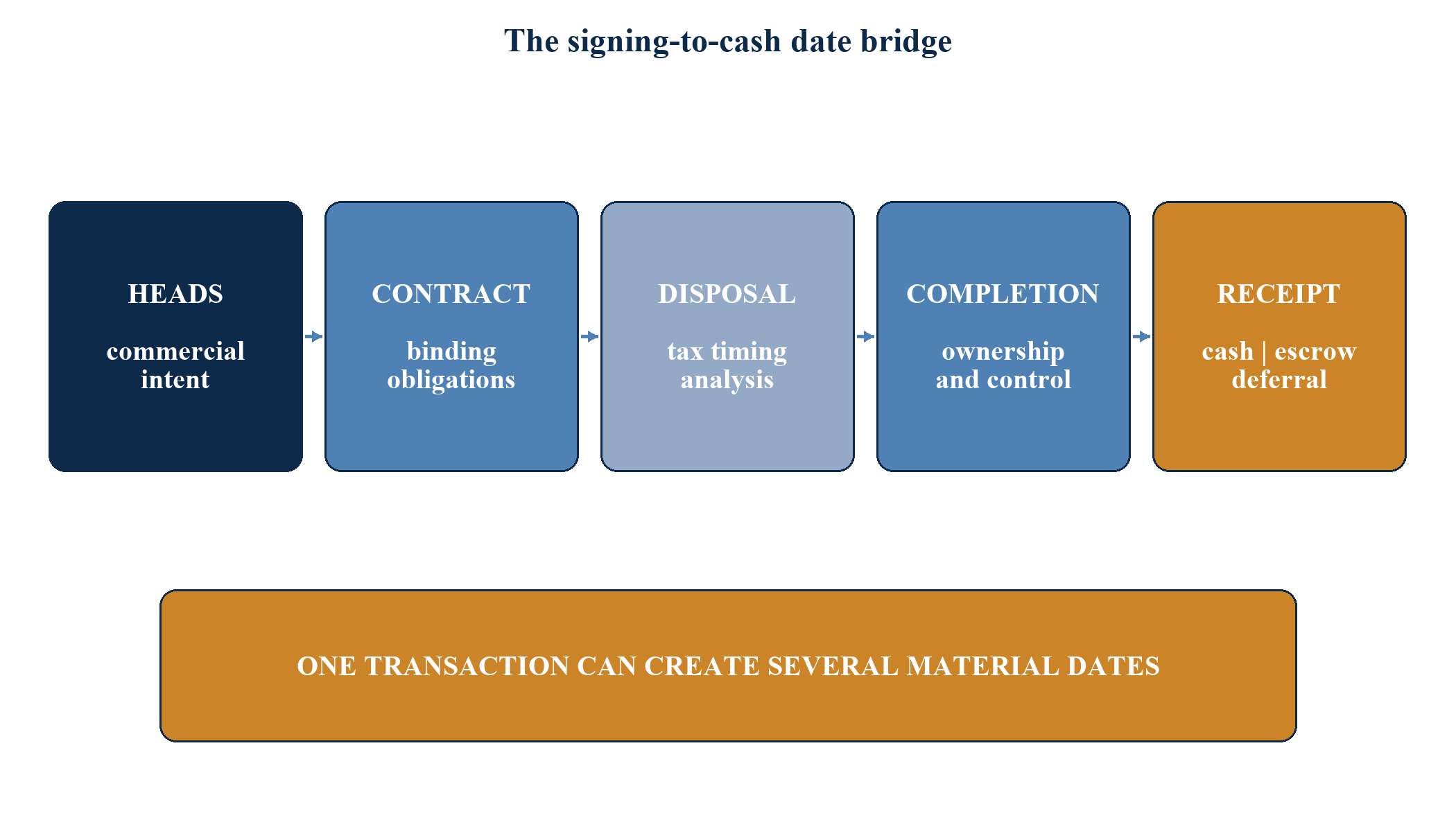
The master chronology should distinguish commercial intent from legal effect. A board decision to pursue a sale, a signed exclusivity agreement and an unconditional sale contract may each matter for different purposes. The paper does not assign legal status to any generic document; counsel must interpret the actual terms and governing law.
8.3 Conditions and completion
Conditions can include regulatory approval, lender consent, third-party consent, restructuring, buyer financing, employee consultation or specified performance. The parties may sign before conditions are satisfied and complete later. The transaction ledger should record every condition, owner, evidence, satisfaction date, waiver right and consequence.
Completion transfers the agreed rights and activates payment, governance and integration mechanics. It can also start reporting or payment deadlines. The tax analysis may use another date for a particular rule, so the completion date should remain one field within the wider chronology.
9. SIGNING, DISPOSAL AND CASH RECEIPT
9.1 The disposal-date rule
HMRC states that the date of disposal can determine the tax year, reporting deadline, tax rate, payment date, available annual exemption and residence relevance [23]. Under section 28 of the Taxation of Chargeable Gains Act 1992, an unconditional contract generally fixes the disposal date when the contract is made. For a conditional contract, the date generally falls when all conditions are satisfied [23,24].
The applicable law determines whether a contract exists and whether it is conditional [24]. Transaction counsel and tax advisers should review the final documents together. The control record should retain the signed agreement, execution evidence, condition schedule, waiver record and completion documents.
9.2 Consideration has its own timetable
Cash may be paid at completion, held in escrow, deferred, contingent, rolled into buyer securities or linked to an earn-out. The amount, tax point, valuation, reporting and liquidity effects can differ. The model should bridge legal disposal date to consideration recognition, cash receipt and final release.
The office should avoid using bank receipt as a proxy for disposal. It should also avoid using a transaction announcement as proof of legal effect. Each date needs a defined source and adviser conclusion.
9.3 Relief conditions and reporting deadlines
Business Asset Disposal Relief uses detailed eligibility conditions, including periods up to the disposal date, and the applicable rate changed for qualifying disposals from 6 April 2026 [25]. The residence and transaction teams should preserve evidence for ownership, employment or office, voting rights, trading status and the exact disposal date. A projected relief should remain conditional until advisers confirm every requirement.
UK property reporting can use a 60-day completion-based deadline in specified cases, and non-residents must report disposals of UK property or land under current guidance even when no tax is due [27,28]. The master calendar should therefore include asset-specific reporting rules alongside the transaction dates.
10. SYNCHRONISING THE CLOCKS
10.1 Create a clock register
The clock register lists every date that can affect the intended outcome. Each entry includes the clock, event, legal question, current status, source document, adviser, decision owner and next review. Dates are classified as planned, observed, legally effective, evidenced or concluded.
The classification prevents a target date from becoming a stated fact. A proposed move date remains planned until travel occurs. A lease date is observed from the executed contract; actual use requires other evidence. A disposal date becomes concluded after advisers interpret the transaction documents and applicable rules.
10.2 The synchronisation gate
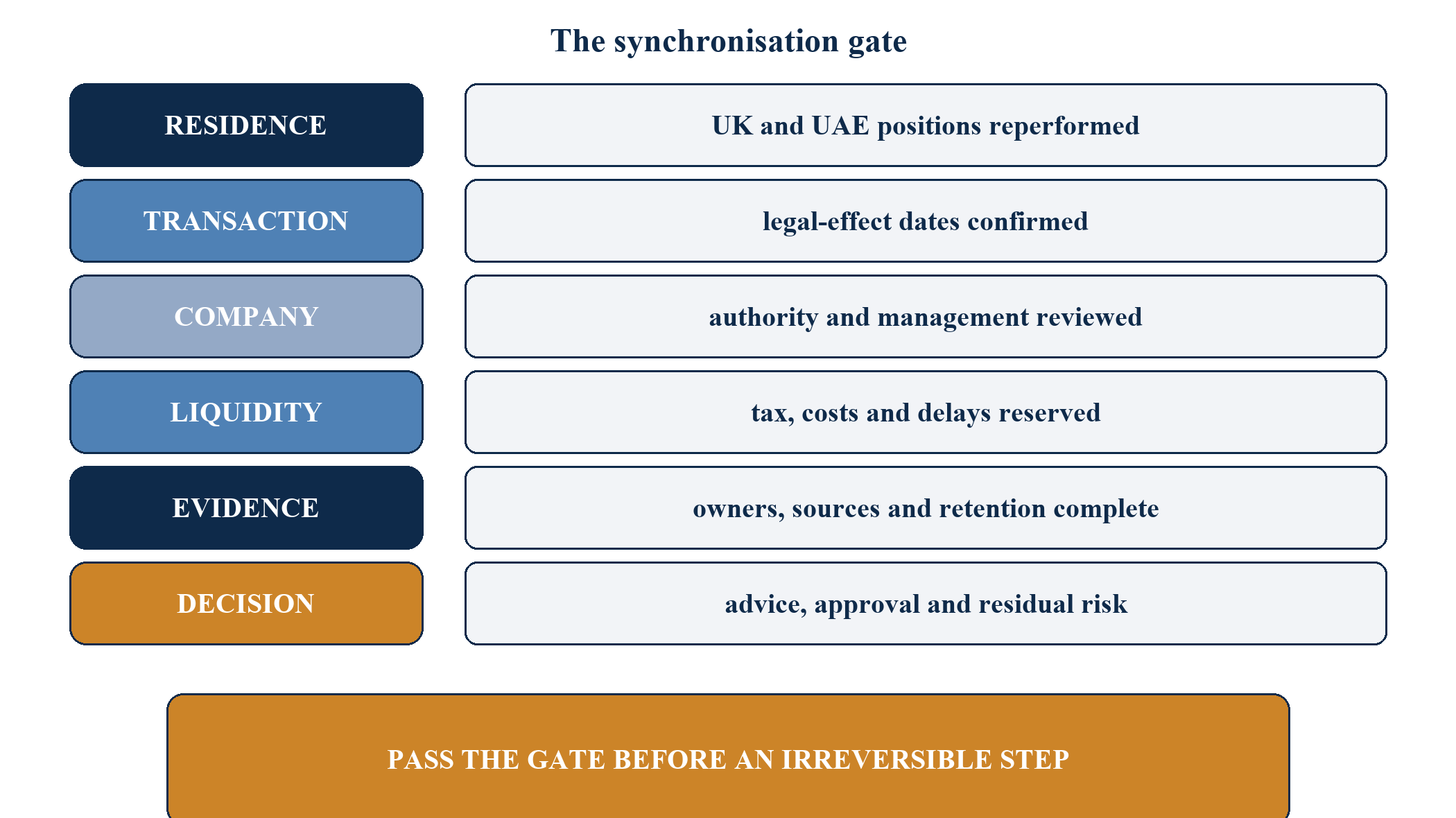
Before an irreversible transaction step, the gate asks six questions:
- What is the earliest event that may have legal or tax effect?
- Which UK tax year and residence period contain that event?
- Which UAE residence period and evidence route are relevant?
- Which transaction condition, signing or completion date applies?
- Which personal, family, company or work facts could change the conclusion?
- Which advisers have approved the evidence and residual uncertainty?
The gate produces one of three outcomes: proceed, proceed subject to stated conditions, or pause. A condition must have an owner, evidence requirement and expiry. A pause protects the intended sequence when the facts remain incomplete.
10.3 Maintain a change protocol
Transaction dates move. Travel changes. Schools, health, family duties and buyer requests create new facts. The office should require a change notice whenever a critical date or assumption changes. The notice should identify affected clocks, recalculate day and work budgets, update evidence tasks and obtain the required approvals.
| Event change | UK clock review | UAE clock review | Transaction review |
|---|---|---|---|
| signing moves before 6 April | tax year, residence, split year, relief period | certificate period and available evidence | disposal date and conditions |
| completion is delayed | UK visits, workdays, home access | rolling presence and business evidence | long-stop date, consideration and reporting |
| founder retains an operating role | UK work and employment income | UAE work or business facts | earn-out, covenants and decision rights |
| family remains in the UK | family and accommodation ties | centre of personal interests | travel and availability obligations |
| new holding company is introduced | company and individual tax analysis | incorporation, management and corporate tax | clearance, consent, valuation and buyer approval |
11. FAMILY AND HOUSEHOLD EXECUTION
11.1 Convert plans into dated facts
A household move contains several independent events: home availability, school attendance, healthcare, employment, pet or dependent arrangements, insurance, banking, licences, utilities, clubs and ordinary spending. The residence file should record actual changes and preserve the underlying documents.
The calendar should distinguish the principal's move from each family member's position. A founder may travel ahead of the family, while a spouse or children remain in the UK. The UK residence analysis and treaty facts should reflect that pattern. UAE evidence should reflect the person's own settled routine and interests.
11.2 Plan UK visits before booking
Every proposed UK visit should be checked against the live day budget, work budget, family contact, home use and transaction requirements. The decision should use a conservative buffer because unexpected events can consume days later in the tax year. The calendar should show the remaining budget after every confirmed trip.
The visit record should capture actual arrival, departure and work activity. Flights can be delayed, rerouted or cancelled. The final ledger should use observed facts and retain evidence of changes.
11.3 Keep safety and compliance central
Tax sequencing cannot justify unsafe travel, artificial personal arrangements or incomplete compliance. The plan should accommodate family welfare, legal responsibilities and actual commercial needs. When facts change for legitimate reasons, the record should explain them accurately and advisers should update the conclusions.
12. COMPANY GOVERNANCE AND MANAGEMENT
12.1 Personal relocation and company residence are separate
A principal's move does not determine a company's residence. UK incorporation, central management and control, foreign law, constitutional documents and treaty rules require their own analysis [35,36]. HMRC's guidance asks where and by whom management ought to be exercised and whether those entrusted with management actually exercise it [35].
The transaction and relocation calendar should identify board meetings, reserved matters, delegated powers, executive decisions, bank authority, contract approvals and the location of decision makers. Minutes should record real deliberation and supporting materials. A videoconference label cannot replace the factual location and conduct of decision making.
12.2 Protect transaction governance
During a sale, founders often retain extensive influence over negotiations, warranties, disclosure, buyer access and operational decisions. The board should define who can approve each stage, who signs, which conflicts exist and how records are retained. Deal urgency should not bypass corporate authority.
If a restructuring or share exchange is considered, current legal, tax, valuation, stamp and clearance advice is required. HMRC provides a statutory-clearance process for specified transactions [37]. The calendar should allow for submission, questions, response and any conditions before the proposed step.
12.3 Build a location-of-decision ledger
The ledger should record each material decision, participants, legal capacity, location, documents considered, advice, decision and execution. It should reconcile with personal work records. A board meeting can be a corporate governance event and a UK workday for the same person.
13. THE EVIDENCE CALENDAR
13.1 Daily evidence
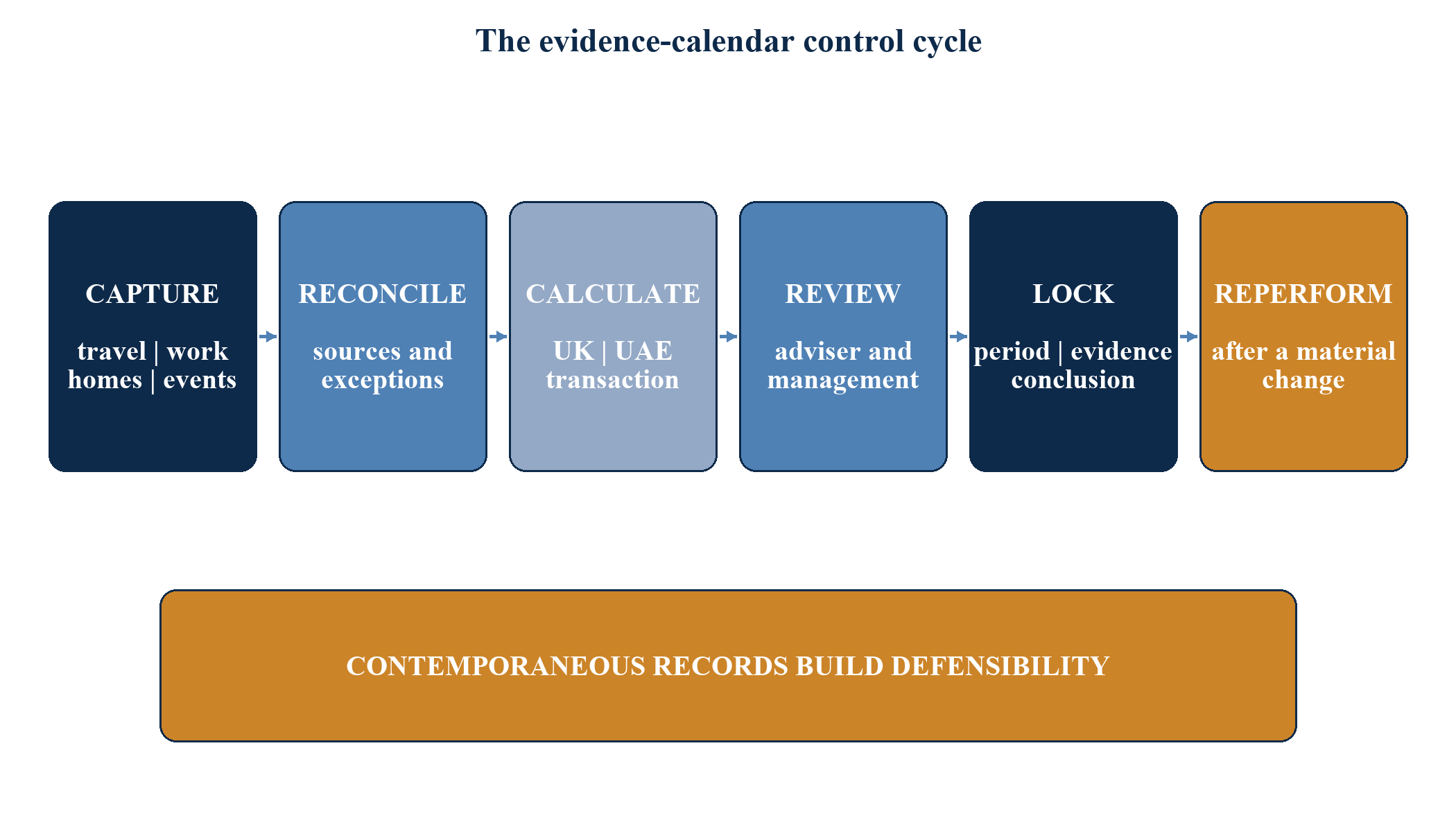
Daily evidence covers location, presence at the end of the UK day, parts of UAE days, work location and hours, home use, family contact and travel purpose. The primary sources can include official entry and exit data, passports, boarding passes, calendars, timesheets, mobile records and transaction meeting logs.
The office should reconcile records monthly while memories and documents remain available. Differences should be investigated and resolved through source evidence. The system should retain both the original record and the approved correction.
13.2 Monthly evidence
Monthly evidence covers housing, utilities, employment or business, banking, family life, memberships, healthcare, company decisions and adviser reviews. It demonstrates how the person's ordinary life and economic interests developed. The file should avoid a late collection exercise assembled only when a certificate or enquiry is expected.
13.3 Transaction evidence
Transaction evidence covers each offer, board approval, condition, contract, signature, completion item, payment, escrow, earn-out and filing. The transaction counsel's closing set should be linked to the clock register. Tax advisers should record the disposal-date and reporting conclusions with citations to the executed documents.
| Frequency | Evidence set | Control |
|---|---|---|
| daily | travel, presence, work, home use, family contact | automated capture plus human confirmation |
| monthly | housing, utilities, business, banking, company and family facts | reconciliation and exception review |
| event-driven | offers, board decisions, contracts, conditions, completion, payments | legal classification and approval gate |
| tax-year end | full SRT, split-year and income or gain review | UK adviser sign-off |
| rolling 12 months | UAE presence and evidence route | UAE adviser sign-off and certificate readiness |
| transaction close | disposal, consideration, relief and reporting file | counsel, tax and board sign-off |
14. LIQUIDITY, REPORTING AND RESERVES
14.1 Separate value from cash
The transaction model should distinguish enterprise value, equity value, debt, costs, current tax, contingent tax, escrow, deferred consideration, rollover securities, earn-out and net cash received. Residence and relief assumptions should be visible rather than embedded in one net figure.
The office should maintain a liquidity reserve for filing, tax, advice, relocation and transaction costs. A delayed certificate, changed disposal date or revised residence conclusion can alter payment timing. The reserve should follow the most conservative current adviser scenario until conclusions are final.
14.2 Create a reporting matrix
The reporting matrix should list each person, entity, asset, jurisdiction, return, deadline, payment, evidence owner and adviser. It should include Self Assessment, UK property reporting, company filings, UAE corporate-tax obligations where applicable and treaty or certificate procedures. The FTA explains that wages, personal investment income and personal real-estate investment income sit outside the natural-person business rules, while UAE business activity above the relevant turnover threshold can enter the corporate-tax regime [34]. Actual classifications require current advice.
14.3 Control adviser assumptions
Every model input should be tagged as observed fact, contractual term, official rate, adviser conclusion or hypothetical scenario. The source and effective date should be visible. A change in law, guidance or facts should trigger a controlled update rather than a silent overwrite.
15. HYPOTHETICAL RELOCATION PATHS
15.1 Scenario design
The following scenarios are hypothetical and simplified. They illustrate how dates interact and do not describe any client, expected transaction or tax outcome. Each conclusion remains open for qualified adviser determination.
15.2 Path A: transaction first, move later
A founder signs an unconditional share-sale agreement on 20 March, completes on 30 April and relocates physically on 15 May. The disposal-date review focuses on the March contract and the tax year containing that date [23,24]. The April completion and May move remain important for cash, reporting, work and residence, yet they cannot be used as substitutes for the contract analysis.
The control file would test UK residence for the relevant tax year, the founder's work and home facts, relief conditions up to the disposal date, consideration timing and any continuing duties. The UAE residence file begins from actual UAE presence and supporting facts. A later UAE certificate cannot rewrite the earlier transaction chronology.
15.3 Path B: move first, signing after evidence develops
A principal moves on 10 April, makes the UAE home continuously available, begins ordinary work and life in the UAE, and enters a transaction process in June. Signing is planned for December, subject to diligence and buyer financing. UK visits continue for family and management meetings.
The UK file monitors the full tax year, split-year conditions, day and work budgets, homes and family ties. The UAE file monitors the rolling 12-month period and selected evidence route. The transaction file classifies each offer, exclusivity term and condition. The synchronisation gate runs before binding documents, using observed residence facts rather than the original plan.
15.4 Path C: conditional signing across the tax-year boundary
A sale agreement is signed on 25 March subject to a specified regulatory condition. The condition is satisfied on 20 May and completion occurs on 31 May. Transaction counsel confirms whether and when the contract became unconditional under the applicable law. Tax advisers then determine the disposal date using the actual contract and condition evidence [23,24].
The move occurs on 1 April, placing physical relocation before the new UK tax year while the condition and completion fall later. The residence outcome cannot be inferred from the flight date. The file must reconcile the tax-year boundary, split-year rules, UAE evidence and the legally effective transaction date.
15.5 Path D: retained role and earn-out
A founder completes a sale after relocating and remains chief executive for an 18-month earn-out. The role requires monthly UK visits, buyer meetings and operational approvals. The work schedule affects the UK residence ledger and employment-income analysis. The transaction schedule affects earn-out valuation, consideration, covenants and liquidity.
The board should approve a travel and decision protocol before completion. The calendar should record actual duties and locations, and advisers should review whether the role changes personal, company or treaty conclusions.
15.6 Comparative control results
| Hypothetical path | Earliest transaction event requiring review | Residence focus | Primary control response |
|---|---|---|---|
| transaction first | unconditional signing before relocation | full UK tax-year facts and later UAE evidence | classify disposal date before using completion or cash dates |
| move first | first UAE presence and UK departure facts | split year, UK visits and rolling UAE period | maintain two residence calculations and gate binding documents |
| conditional cross-boundary | signing, condition satisfaction and completion | tax-year boundary plus actual split-year conditions | obtain legal classification of conditions and date effects |
| retained role | completion and continuing employment duties | UK workdays, homes, family and treaty facts | control travel, authority, work records and earn-out evidence |
16. A HYPOTHETICAL THREE-CLOCK STRESS TEST
16.1 Model facts
This case is hypothetical and simplified. A family-office principal owns a private operating company and a portfolio of investments. A sale process begins while the family prepares a UAE move. The proposed enterprise value is represented as 100 units. Ten units are debt and transaction costs; 15 units are deferred or contingent; 75 units are expected at completion before tax. The numbers are illustrative and do not forecast value or tax.
The proposed move date is 8 April. The principal retains a UK home for four months, the family follows later, and the founder expects 24 UK workdays during diligence. Signing is targeted for 15 September, with two material conditions and completion expected six weeks later. The UAE residence file relies on a route that advisers will select from the actual presence, home, business and personal-interest facts.
16.2 Stress events
The test applies five events. Buyer diligence extends by eight weeks. The founder makes ten additional UK workdays. The UK home remains available for two extra months. One transaction condition is satisfied before the other. The UAE entry and exit report contains a discrepancy that requires correction.
Each event changes more than one clock. The delay can increase UK visits and push signing or completion into another period. Continued UK home availability can affect residence facts. Separate conditions can affect the contract analysis. The UAE evidence discrepancy can delay certificate readiness.
16.3 Control interpretation
The model assigns no tax outcome. It measures control readiness. The principal passes only when each critical date has a source, the residence calculations have been refreshed, transaction counsel has classified legal effect, liquidity covers conservative obligations and the board has approved residual uncertainty.
The exercise often reveals that date certainty is uneven. Travel facts can be observed daily, while residence conclusions mature later. A transaction may have a scheduled completion date while its legal effect depends on conditions. The control system should state that uncertainty clearly.
16.4 Board decisions
The board can approve a revised work and travel budget, an earlier evidence reconciliation, a contract review before signing, a larger liquidity reserve and a condition that no structural step occurs before required clearances. It can also approve a pause when the timetable has outrun the evidence.
17. ADVISERS, DECISION RIGHTS AND DOCUMENT CONTROL
17.1 Define adviser scope
The advisory team can include UK and UAE tax advisers, immigration counsel, corporate and transaction lawyers, accountants, valuation specialists, trustees, wealth managers and family-governance advisers. Each engagement should define the persons, entities, taxes, assets, periods and transactions covered.
The office should identify gaps and overlaps. One adviser may conclude UK residence while another addresses UAE domestic residence. Treaty analysis may require both. Transaction counsel may classify conditions while tax advisers determine the resulting date effect.
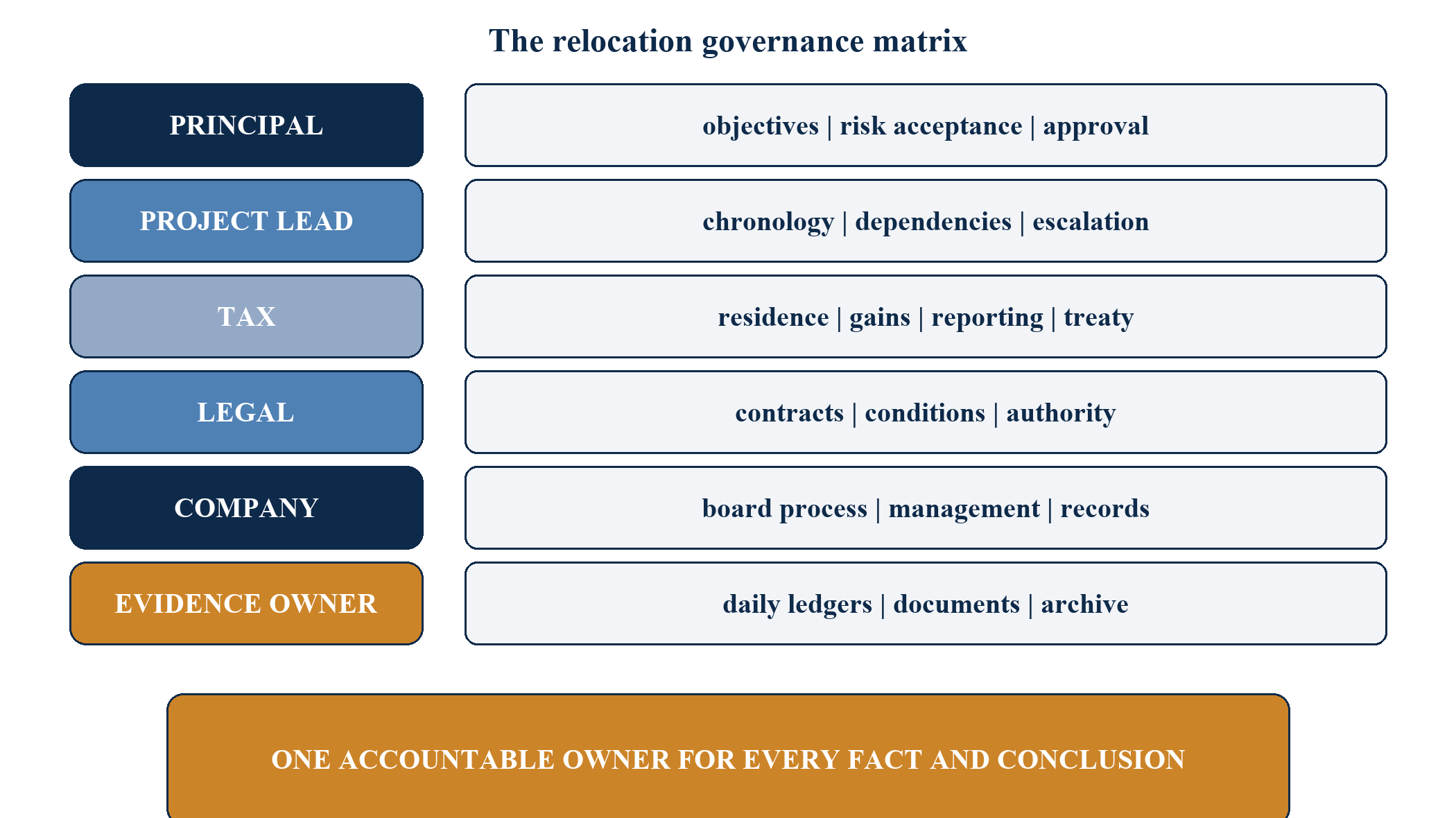
17.2 Use a decision-rights matrix
The principal owns personal facts and decisions. The board owns corporate authority and transaction approval. Tax advisers own stated tax opinions within scope. Counsel owns legal document interpretation. The family office maintains the chronology, evidence register and action log.
No project manager should convert an adviser caveat into a conclusion. The decision record should preserve qualifications, assumptions, reliance limits and required follow-up.
17.3 Control documents and versions
The data room should contain executed documents, dated advice, official evidence and approved models. Drafts should be versioned and clearly identified. The master chronology should link to sources rather than reproduce sensitive data unnecessarily.
Access should follow role and confidentiality. Personal travel, health and family records require appropriate privacy controls. The final file should retain the evidence needed for reporting, claims and future review.
18. A 90-DAY IMPLEMENTATION PROGRAMME
18.1 Days 1 to 15: establish mandate and scope
Appoint the principal sponsor and programme owner. Define the people, entities, assets and transactions in scope. Confirm UK and UAE advisers, transaction counsel and corporate decision makers. Approve privacy and document-control rules.
18.2 Days 16 to 30: build the three ledgers
Create the UK residence ledger, UAE residence ledger and transaction ledger. Import prior-year UK day counts, homes, work and family facts. Obtain UAE entry and exit data and residence evidence. Build the transaction milestone and condition register.
18.3 Days 31 to 45: draft the integrated chronology
Merge the ledgers into one chronology. Classify dates as planned, observed, legally effective, evidenced or concluded. Identify conflicts, missing evidence and events that touch more than one clock.
18.4 Days 46 to 60: model paths and liquidity
Model the proposed sequence and at least two alternative sequences. Include tax-year boundaries, rolling UAE periods, binding transaction events, workdays, home facts, family travel, consideration and reporting. Size a conservative liquidity reserve.
18.5 Days 61 to 75: run the gate and stress test
Test delay, extra UK work, retained home access, changed family travel, conditional signing and certificate-evidence gaps. Obtain adviser conclusions for the live facts. Convert every condition into an owned action.
18.6 Days 76 to 90: approve and operate
The principal and board approve the sequence, authorities, buffers, reporting matrix and pause triggers. Begin monthly reconciliation. Reperform the full analysis before binding transaction steps and at UK tax-year end.
19. LIMITATIONS AND CONCLUSION
This paper provides a coordination framework based on official sources available at the publication date. It does not determine residence, treaty status, company residence, tax liability, relief eligibility, disposal date, immigration status or transaction validity for any person or entity. Those conclusions require current law, executed documents and complete facts.
The models simplify complex legal and commercial arrangements. Different assets, trusts, partnerships, companies, funds, properties, employments, jurisdictions and treaty claims can produce different results. Law and official guidance can change. Advisers should confirm every material point immediately before action.
The central finding is practical. A defensible relocation uses one chronology and three separate conclusions. The UK tax-year clock measures residence and related facts within statutory periods. The UAE clock measures domestic and treaty evidence across the relevant period. The transaction clock identifies binding events, conditions, disposal dates, consideration and deadlines. The synchronisation gate connects them without hiding their differences.
The strongest control is a current evidence record. It allows the principal, board and advisers to see which dates are planned, which have occurred, which have legal effect and which conclusions remain open. That clarity protects decision quality when family life, business execution and capital movement develop at different speeds.
APPENDIX A. MASTER CHRONOLOGY FIELDS
Record event ID, date and time, person, entity, jurisdiction, location, clock, event type, planned or actual status, legal question, source document, adviser, conclusion, dependency, approval, next action and retention period. Keep the original source and an audit trail for corrections.
| Field group | Minimum content | Control owner | Review cadence |
|---|---|---|---|
| Event identity | unique ID, date, time, timezone, person and entity | project lead | on capture |
| Location | country, city, premises, arrival and departure evidence | evidence owner | weekly |
| Legal effect | planned, observed, binding, completed or cash-settled | legal adviser | each milestone |
| Residence effect | UK day, workday, home, tie, UAE day or interest | tax adviser | monthly |
| Evidence | source, custodian, version, retention and access | document controller | monthly |
| Decision | conclusion, assumption, approval, expiry and next action | principal or board | each gate |
APPENDIX B. UK RESIDENCE DAILY LEDGER
Record date, location at the end of the UK day, arrival and departure time, transit status, UK work hours, overseas work hours, work description, home used, family contact, exceptional circumstance, transaction activity and evidence reference. Reconcile monthly and at tax-year end.
| Daily field | Required evidence | Exception trigger | Reconciliation |
|---|---|---|---|
| UK presence | passport, itinerary, travel provider and device record | conflicting source | resolve within five working days |
| UK work | calendar, time record, meeting and work description | three-hour threshold proximity | adviser review |
| Home use | address, availability, overnight use and supporting record | new or surrendered home | update test model |
| Family contact | relevant family location and contact facts | changed family pattern | update tie analysis |
| Exceptional event | event, dates, control, exit attempts and evidence | day claimed outside ordinary count | contemporaneous memorandum |
| Transaction activity | meeting, negotiation, signature or authority | binding or decision event | link to deal register |
APPENDIX C. UAE RESIDENCE EVIDENCE REGISTER
Record consecutive 12-month period, entry and exit data, visa and Emirates ID, home availability, actual residence pattern, employment or business, income source, family location, financial interests, personal interests, certificate purpose, evidence status, adviser review and application status.
| Evidence category | Example source | Period covered | Readiness test |
|---|---|---|---|
| Presence | official entry and exit report | selected consecutive 12 months | complete and reconciled |
| Identity and status | passport, visa and Emirates ID | validity period | current and legible |
| Residence | title, lease, utilities and occupancy evidence | claimed residence period | continuously available where relevant |
| Work or business | contract, licence, payroll or board records | claimed period | matches actual activity |
| Financial interests | accounts, assets, obligations and income sources | claimed period | consistent with residence narrative |
| Personal interests | family, memberships and ordinary-life evidence | claimed period | source-dated and attributable |
| Certificate | purpose, period, domestic route and treaty use | requested period | adviser-approved submission pack |
APPENDIX D. TRANSACTION DATE REGISTER
Record milestone, document, governing law, binding status, condition, satisfaction or waiver date, board approval, signature evidence, tax-date conclusion, consideration effect, reporting deadline, owner and adviser. Link every conclusion to the executed document.
| Milestone | Date classification | Evidence | Required conclusion |
|---|---|---|---|
| Heads or offer | commercial intent | signed terms and authority | binding provisions identified |
| Contract | legal effect | executed agreement and signature record | conditionality and disposal date reviewed |
| Conditions | satisfaction or waiver | certificates, consents and notices | final condition date confirmed |
| Completion | title and control | completion set and board records | ownership and control transferred |
| Consideration | cash or non-cash effect | bank, escrow, note or securities record | tax and liquidity treatment reviewed |
| Reporting | statutory deadline | return, computation and payment record | owner and reserve confirmed |
APPENDIX E. SYNCHRONISATION GATE CHECKLIST
- Confirm the next irreversible personal, corporate or transaction event.
- Refresh UK days, work, homes, family and prior-year facts.
- Refresh UAE presence, home, business, family and interests.
- Classify signing, conditions, completion and consideration.
- Reconcile personal work with company and transaction records.
- Update domestic and treaty residence memoranda.
- Confirm liquidity and reporting deadlines.
- Obtain required legal, tax and board approvals.
- Record conditions, owners and expiry dates.
- Approve proceed, conditional proceed or pause.
| Gate | Minimum evidence | Decision | Escalation |
|---|---|---|---|
| UK residence | current day, work, home and tie model | current position approved | unresolved fact or low headroom |
| UAE residence | rolling count and route-specific evidence | current route approved | source conflict or period gap |
| Treaty | domestic conclusions and Article 4 memorandum | conclusion approved | dual residence or factual ambiguity |
| Transaction | executed drafts, conditions and date analysis | milestone approved | date or legal effect unresolved |
| Company | authority, location and management record | governance approved | control exercised inconsistently |
| Liquidity | tax, cost, delay and reporting reserve | funds ring-fenced | contingent liability unfunded |
APPENDIX F. QUESTIONS FOR ADVISERS
- Which UK residence tests and split-year cases apply to each person?
- Which day, work, home and family records are required?
- Which UAE domestic residence route is supported for the requested period?
- Is treaty residence relevant, and which certificate evidence is required?
- When does the actual transaction document create legal effect?
- Is the contract conditional, and when are all conditions satisfied?
- Which date governs the disposal, relief conditions and reporting?
- How are escrow, deferred consideration, earn-out and rollover securities treated?
- Do retained duties create UK work, employment or company-residence issues?
- Which corporate approvals, consents, valuations or clearances are required?
- Which assumptions remain open, and what evidence will close them?
- Which events require an immediate re-review?
| Adviser | Core deliverable | Open-assumption record | Sign-off point |
|---|---|---|---|
| UK tax | residence, split year, gains and reporting memorandum | days, work, homes, ties and transaction dates | before irreversible step |
| UAE tax | domestic route, certificate and business analysis | presence, home, interests and activities | before certificate filing |
| Treaty | Article 4 analysis and period mapping | dual-residence facts and evidence | after domestic conclusions |
| Transaction counsel | binding effect, conditions, completion and authority | governing law and executed terms | before signing and completion |
| Corporate counsel | board authority, management and company residence | decision makers and locations | before governance change |
| Valuation and finance | value, consideration, funding and reserves | assumptions and sensitivities | before approval |
APPENDIX G. MONTHLY BOARD DASHBOARD
Show UK days used and remaining, UK workdays, home and family changes, UAE rolling presence, evidence completion, certificate readiness, transaction stage, unresolved conditions, next irreversible event, adviser conclusions, liquidity reserve, reporting deadlines, open exceptions and decisions required. Use a red status for a missing critical conclusion, amber for an owned condition and green for current evidence and approval.
| Dashboard block | Current measure | Threshold or due date | Owner action |
|---|---|---|---|
| UK clock | days, workdays, homes and ties | approved operating headroom | reforecast and escalate |
| UAE clock | rolling presence and evidence completion | route and certificate requirement | close evidence gaps |
| Deal clock | stage, conditions and next legal-effect date | gate date | confirm advice and approvals |
| Company | decision locations and authority record | governance policy | correct process or location |
| Liquidity | reserve, currency and access | approved downside requirement | fund shortfall |
| Reporting | returns, certificates, payments and filings | statutory or adviser deadline | assign and evidence completion |
| Exceptions | conflicts, missing sources and expired advice | agreed remediation date | resolve or pause decision |
REFERENCES
[1] HM Revenue & Customs. *Estimate your Income Tax for the current year.* Current tax year 6 April 2026 to 5 April 2027. https://www.gov.uk/estimate-income-tax
[2] HM Revenue & Customs. *RDR3: Statutory Residence Test.* Updated 11 June 2026. https://www.gov.uk/government/publications/rdr3-statutory-residence-test-srt
[3] HM Revenue & Customs. *RFIG20000: Statutory Residence Test contents.* Updated 3 July 2026. https://www.gov.uk/hmrc-internal-manuals/residence-and-fig-regime-manual/rfig20000
[4] HM Revenue & Customs. *RFIG20710: Meaning of a day spent in the UK.* Updated 3 July 2026. https://www.gov.uk/hmrc-internal-manuals/residence-and-fig-regime-manual/rfig20710
[5] HM Revenue & Customs. *RFIG20720: The deeming rule.* Updated 3 July 2026. https://www.gov.uk/hmrc-internal-manuals/residence-and-fig-regime-manual/rfig20720
[6] HM Revenue & Customs. *RFIG20740: Work for the purpose of the SRT.* Updated 3 July 2026. https://www.gov.uk/hmrc-internal-manuals/residence-and-fig-regime-manual/rfig20740
[7] HM Revenue & Customs. *RFIG20520: Number of UK ties.* Updated 3 July 2026. https://www.gov.uk/hmrc-internal-manuals/residence-and-fig-regime-manual/rfig20520
[8] HM Revenue & Customs. *RFIG20530: Family tie.* Updated 3 July 2026. https://www.gov.uk/hmrc-internal-manuals/residence-and-fig-regime-manual/rfig20530
[9] HM Revenue & Customs. *RFIG20550: Accommodation tie.* Updated 3 July 2026. https://www.gov.uk/hmrc-internal-manuals/residence-and-fig-regime-manual/rfig20550
[10] HM Revenue & Customs. *RFIG20560: Work tie.* Updated 3 July 2026. https://www.gov.uk/hmrc-internal-manuals/residence-and-fig-regime-manual/rfig20560
[11] HM Revenue & Customs. *RFIG20570: 90-day tie.* Updated 3 July 2026. https://www.gov.uk/hmrc-internal-manuals/residence-and-fig-regime-manual/rfig20570
[12] HM Revenue & Customs. *RFIG20140: Third automatic overseas test.* Updated 3 July 2026. https://www.gov.uk/hmrc-internal-manuals/residence-and-fig-regime-manual/rfig20140
[13] HM Revenue & Customs. *RFIG21010: Split-year treatment overview.* Updated 3 July 2026. https://www.gov.uk/hmrc-internal-manuals/residence-and-fig-regime-manual/rfig21010
[14] HM Revenue & Customs. *RFIG21040: Split year, Case 1.* Updated 3 July 2026. https://www.gov.uk/hmrc-internal-manuals/residence-and-fig-regime-manual/rfig21040
[15] HM Revenue & Customs. *RFIG21130: Split year, Case 3.* Updated 3 July 2026. https://www.gov.uk/hmrc-internal-manuals/residence-and-fig-regime-manual/rfig21130
[16] HM Revenue & Customs. *RFIG21920: Record keeping for homes.* Updated 3 July 2026. https://www.gov.uk/hmrc-internal-manuals/residence-and-fig-regime-manual/rfig21920
[17] HM Revenue & Customs. *RFIG21930: Record keeping for working hours and location.* Updated 3 July 2026. https://www.gov.uk/hmrc-internal-manuals/residence-and-fig-regime-manual/rfig21930
[18] HM Revenue & Customs. *RFIG22230: Exceptional circumstances and day counting.* Updated 3 July 2026. https://www.gov.uk/hmrc-internal-manuals/residence-and-fig-regime-manual/rfig22230
[19] HM Revenue & Customs. *RFIG21510: Temporary non-residence introduction.* Updated 3 July 2026. https://www.gov.uk/hmrc-internal-manuals/residence-and-fig-regime-manual/rfig21510
[20] HM Revenue & Customs. *RFIG21550: Year of departure and period of return.* Updated 3 July 2026. https://www.gov.uk/hmrc-internal-manuals/residence-and-fig-regime-manual/rfig21550
[21] HM Revenue & Customs. *RFIG21630: Temporary non-residence, capital gains and offshore income gains.* Updated 3 July 2026. https://www.gov.uk/hmrc-internal-manuals/residence-and-fig-regime-manual/rfig21630
[22] HM Revenue & Customs. *CG10978: Split-year treatment for capital gains.* Updated 24 July 2026. https://www.gov.uk/hmrc-internal-manuals/capital-gains-manual/cg10978
[23] HM Revenue & Customs. *CG14250: Date of disposal.* Updated 24 July 2026. https://www.gov.uk/hmrc-internal-manuals/capital-gains-manual/cg14250
[24] HM Revenue & Customs. *CG14261: Disposals under contract.* Updated 24 July 2026. https://www.gov.uk/hmrc-internal-manuals/capital-gains-manual/cg14261
[25] HM Revenue & Customs. *Business Asset Disposal Relief: eligibility.* Updated 2026. https://www.gov.uk/business-asset-disposal-relief
[26] HM Revenue & Customs. *Business Asset Disposal Relief: how to claim.* Updated 2026. https://www.gov.uk/business-asset-disposal-relief/how-to-claim
[27] HM Revenue & Customs. *Reporting and paying Capital Gains Tax.* Updated 2026. https://www.gov.uk/capital-gains-tax/reporting-and-paying-capital-gains-tax
[28] HM Revenue & Customs. *Capital Gains Tax for non-residents disposing of UK property or land.* Updated 13 January 2026. https://www.gov.uk/guidance/capital-gains-tax-for-non-residents-uk-residential-property
[29] HM Revenue & Customs. *2016 UK-UAE Double Taxation Convention.* https://www.gov.uk/government/publications/united-arab-emirates-tax-treaties/2016-uk-uae-double-taxation-convention
[30] United Arab Emirates. *Cabinet Decision No. 85 of 2022 on Determination of Tax Residency.* https://www.tax.gov.ae/Datafolder/Files/Legislation/Corporate%20Tax/Cabinet%20Decision%2085%20of%202022%20-%20For%20publishing.pdf
[31] United Arab Emirates Ministry of Finance. *Ministerial Decision No. 27 of 2023 on implementation of tax-residency provisions.* https://mof.gov.ae/wp-content/uploads/2023/03/Ministerial-Decision-27-of-2023-of-Tax-Residency.pdf
[32] United Arab Emirates Federal Tax Authority. *Issuance of Tax Certificates for Tax Residency.* Updated 6 April 2026. https://tax.gov.ae/en/services/issuance.of.tax.certificates.aspx
[33] United Arab Emirates Federal Tax Authority. *Tax Resident and Tax Residency Certificate; Tax Procedures Guide TPGTR1.* https://tax.gov.ae/Datafolder/Files/Guides/VAT/VAT%20Guides/Tax-Resident-and-TRC--18-10-2024.pdf
[34] United Arab Emirates Federal Tax Authority. *Basis of taxation for a natural person.* Updated 2026. https://tax.gov.ae/en/taxes/corporate.tax/corporate.tax.topics/basis.of.taxation.natural.person.aspx
[35] HM Revenue & Customs. *INTM120180: Company residence, how to review residence.* Updated 24 July 2026. https://www.gov.uk/hmrc-internal-manuals/international-manual/intm120180
[36] HM Revenue & Customs. *INTM120060: Company residence and central management and control.* Updated 24 July 2026. https://www.gov.uk/hmrc-internal-manuals/international-manual/intm120060
[37] HM Revenue & Customs. *Apply for statutory clearance for a transaction.* https://www.gov.uk/guidance/apply-for-statutory-clearance-for-a-transaction
[38] United Kingdom. *Finance Act 2026.* https://www.legislation.gov.uk/ukpga/2026/11/contents
[39] United Kingdom. *Finance Act 2025.* https://www.legislation.gov.uk/ukpga/2025/8/contents
[40] HM Revenue & Customs. *INTM154020: Double taxation agreements and dual residents.* Updated 24 July 2026. https://www.gov.uk/hmrc-internal-manuals/international-manual/intm154020
ABOUT THE AUTHOR
Chennakeshav Adya is an independent researcher whose work examines capital, ownership, governance and cross-border decision making. His research converts complex legal, financial and institutional frameworks into practical tools for principals, family offices, investors and management teams.
Authored by Chennakeshav Adya
Independent Researcher
