

1. Treat the tail as an active balance-sheet period
Leaving the United Kingdom can change daily life immediately while leaving the inheritance-tax perimeter in place. Under the rules applying from 6 April 2025, a person who remains a long-term UK resident can be exposed to UK Inheritance Tax on overseas assets when a chargeable lifetime transfer occurs or on death. HMRC describes long-term residence by reference to UK tax residence in at least 10 of the 20 tax years immediately preceding the tax year of the chargeable event. A person who becomes non-resident can remain within that status for between three and ten tax years, depending on the residence history at departure [1-4].
The tail is therefore an operating period, not a waiting period. The family can relocate its members, custody, advisers and investment activity while ownership, situs, liquidity and succession arrangements continue to create chargeable-event risk. A gift, trust distribution, addition to a settlement, death, cessation of a reserved benefit, ten-year trust anniversary or trust exit can each require a separate analysis. The relevant date may not be the departure date. It may be the date of the transfer, death, anniversary or other event [19-24].
The management task has four layers. First, establish the status of each person for each tax year. Second, identify every asset and legal interest, including indirect and settled interests. Third, identify the events that could occur before the tail expires. Fourth, make liquidity, governance and evidence ready for those events. A family that focuses only on a projected death-tax number can miss lifetime charges, trust charges, a spouse-status mismatch or the cash needed before assets can be administered.
The board or family council should approve a controlled work programme. Tax advisers determine legal treatment. Lawyers validate ownership, wills, trusts, foundations and governing law. Valuers support market values. Banks, custodians and insurers provide asset and liquidity evidence. The family office maintains the integrated record and monitors changes. The resulting file should show what the family owns, who owns it, where it is situated, which person or settlement drives the UK analysis, what may happen during the tail and who has authority to act.
Table 1. Three-year tail decision diagnostic
| Gate | Decision question | Minimum evidence | Failure signal | Required action |
|---|---|---|---|---|
| person | who may remain long-term UK resident and for how many tax years? | twenty-year residence ledger and departure analysis | one family-wide tail date | calculate separately for every person |
| event | which deaths, gifts, trust events or benefit changes could create a charge? | event inventory and governing documents | planning assumes death is the only event | map lifetime and settlement events |
| asset | which outright, indirect or settled assets enter the analysis? | ownership, situs and valuation register | bank statements treated as the whole estate | reconcile every legal and economic interest |
| relief | which exemptions or reliefs may apply and on what conditions? | eligibility evidence and current advice | relief treated as permanent value | model full, partial and failed-relief cases |
| liquidity | how would tax, costs and debt be funded on time? | cash map, insurance and financing evidence | forced sale is the default plan | establish staged liquidity routes |
| succession | can valid decision-makers access records and assets across jurisdictions? | wills, mandates, powers and key-person map | one principal controls all access | test incapacity and death activation |
| monitoring | what changes could reset or extend the perimeter? | travel, residence and transaction calendar | tail date sits in a static spreadsheet | operate quarterly review and event escalation |
The diagnostic organises management work. Person-specific legal and tax advice determines the actual result.
2. Calculate the residence tail person by person
HMRC's published table converts the relevant UK residence history into a continuing period. A person with 13 or fewer relevant UK-resident years remains in scope for three tax years. Fourteen years produces four years; fifteen produces five; the sequence continues to a maximum of ten years for a person with 20 relevant years. The years of non-residence must be consecutive. Intermittent UK residence can prevent the required sequence from completing [1,4].
The phrase "three-year tail" can consequently be both useful and dangerous. It describes the minimum continuing period for many leavers, including those with 10 to 13 resident years. It does not describe every leaver. A family member with a longer history can carry a materially longer tail. A spouse who arrived later, an adult child who studied elsewhere and a founder who spent several intervening years abroad may all have different results.
The residence ledger should cover at least the 20 tax years required by the statutory test and enough earlier history to explain transitional positions. For each year, it should record the residence conclusion, days, homes, work, family ties, split-year position, treaty position, return filing and supporting evidence. Split-year treatment does not simply erase the tax year from the residence count; HMRC's Statutory Residence Test guidance treats a split year as a UK-resident year with separate overseas and UK parts for relevant tax treatment. Qualified advice should confirm the count [51,52].
Transitional rules require a separate branch. HMRC states that a person who was not UK domiciled or deemed domiciled on 30 October 2024, is non-resident for 2025/26 and does not return can fall outside the new long-term residence treatment. A person who had deemed UK domicile, is non-resident in 2025/26 and does not return can cease long-term residence after three years of non-residence. Common-law domicile on 30 October 2024 and later return patterns can produce different outcomes [1,5]. The family should preserve the facts and advice supporting whichever route is used.
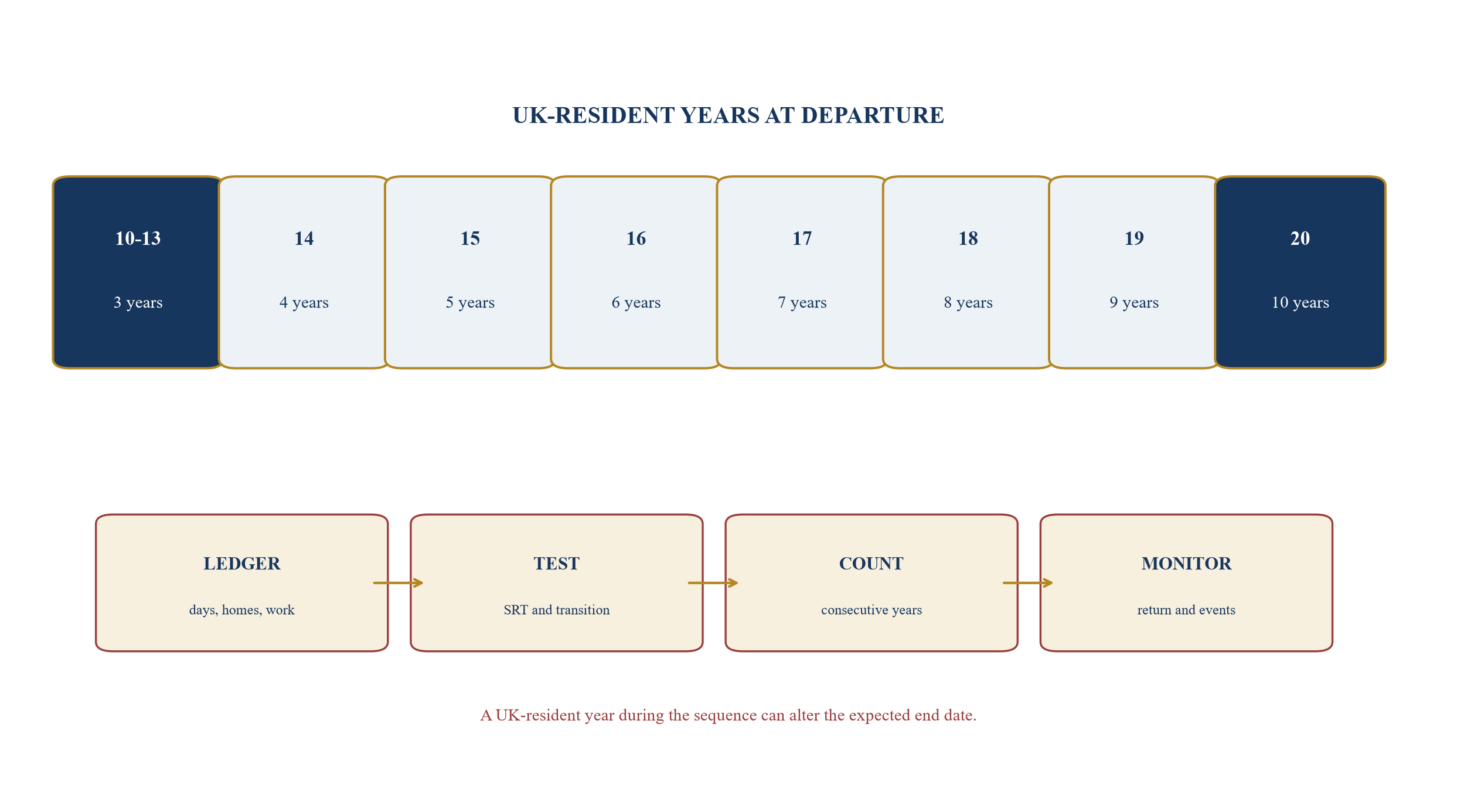
The published tail varies from three to ten tax years. The diagram is a management map and does not determine an individual's status.
3. Use tax years and chargeable-event dates precisely
The tail runs through tax years rather than a simple number of calendar days after the flight. A departure on 30 April and a departure on 30 March can sit in different residence years. The conclusion for the departure year, including any split-year treatment, should be prepared before management fixes the expected end date. Travel plans, UK work, accessible accommodation, family presence and exceptional circumstances can affect the Statutory Residence Test [51,52].
Management should maintain three dates for every person. The first is the physical relocation date. The second is the advised date and tax year from which the person is non-UK resident. The third is the earliest tax year in which the person is expected to cease long-term UK residence if consecutive non-residence continues. None should be used as a substitute for the others.
The chargeable-event calendar then overlays the residence calendar. A planned gift in the second non-resident year can be treated differently from a transfer after long-term status has ended. A trust anniversary falling during the tail can bring foreign settled property into the relevant-property calculation. A death before the projected end date can bring worldwide outright property into scope. A return to UK residence can change the sequence. The legal analysis belongs to the event date, using the law, residence history, ownership and asset situs then in force [4,19-24].
The family office should create alerts at least 18, 12, six and three months before a projected tail end. The purpose is not to execute a tax-motivated transaction automatically. It is to validate the residence record, identify planned transactions, update valuations, test liquidity and obtain advice before action. A delayed asset transfer, unsigned will, trust distribution or company reorganisation can create consequences that a calendar reminder alone cannot solve.
The end-date memorandum should include assumptions and a change protocol. It should state which years were counted, which evidence supports each conclusion, which transitional provision was considered, whether a spouse election exists and which events require re-analysis. Travel or personal changes should be reported before they occur where possible. The memorandum should be refreshed after each tax year and after any material change.
4. Build one global asset, ownership and situs register
Worldwide exposure cannot be managed through a UK property schedule and a set of bank balances. The register should include cash, listed investments, private funds, carried interests, partnership interests, private-company shares, shareholder loans, real estate, insurance, pensions, intellectual property, art, aircraft, vessels, digital assets, trusts, foundations and contractual claims. It should also record guarantees, secured debt, tax liabilities and contingent obligations.
Each line needs a legal owner, beneficial interest, jurisdiction, custodian, governing law, acquisition date, source of funds, current value, valuation date, currency, liquidity, restrictions, debt, adviser and supporting document. Interests held through companies or partnerships require a look-through architecture that shows the immediate asset and the underlying value. Joint assets require the documented share and survivorship arrangement. Nominee and custodial holdings require the beneficial ownership evidence.
Situs is a legal conclusion, not the country displayed in an app. HMRC distinguishes UK and foreign property and applies specific rules to shares, bank accounts, securities and indirectly held UK residential property. From 6 April 2026, Finance Act 2026 extended Schedule treatment to certain indirectly held UK agricultural property. An offshore entity can therefore hold value that remains within the UK IHT perimeter [4,28-32,54].
The register should show the tax perimeter under at least three states: while the person remains long-term UK resident; after the expected tail ends; and after a possible UK return. A fourth state should cover death or incapacity during the transition. Management should avoid marking an asset simply "in" or "out" without identifying the person, event, date and legal reasoning.
Table 2. Global asset and evidence register
| Asset class | Ownership evidence | Situs evidence | Tail-period question | Control record |
|---|---|---|---|---|
| cash and custody | account mandate and beneficial owner | bank branch, contract and currency | is the account foreign property and who owns each pool? | statement archive and access map |
| listed securities | custodian and trade records | issuer, register and instrument terms | which holdings remain UK-situs or specifically excluded? | security master and valuation |
| private companies | register, cap table and agreements | incorporation, business assets and share rights | what is the open-market value and relief position? | valuation pack and rights matrix |
| real estate | title, financing and beneficial interest | land registry and indirect holding chain | does Schedule or direct UK situs apply? | title, debt and use file |
| funds and partnerships | subscription and partnership records | vehicle, interest and governing law | what interest is owned and how is it valued? | capital account and transfer terms |
| trusts and foundations | deed, charter, by-laws and accounts | asset-by-asset location | whose residence drives each charge point? | settlor, beneficiary and event map |
| insurance and pensions | policy, beneficiary and trust documents | issuer and contractual rights | does value or payment enter the estate or trust analysis? | policy schedule and claims route |
Situs and tax treatment require advice. The table defines the management data required for that advice.
5. Separate UK-situs property from worldwide-tail property
Ending long-term residence can remove qualifying foreign property from the worldwide IHT scope. It does not generally remove UK property from UK IHT. HMRC's guidance for people based abroad identifies UK property and UK bank accounts as examples of assets that can remain in scope. It also identifies particular excluded assets, including some foreign-currency accounts, overseas pensions and holdings in authorised unit trusts or open-ended investment companies, subject to the detailed rules [4,28-31].
This distinction matters for portfolio design. Moving a person and transferring investment management to the UAE does not change a UK company's share register, a UK bank relationship or the situs of UK land. Replacing one security with another can change situs and risk. Borrowing can affect value, but debt deductibility has its own conditions and tracing rules. A management model should therefore show gross assets, allowable debt assumptions and net chargeable value separately.
Indirect UK residential property has a dedicated anti-avoidance regime. HMRC states that Schedule brings within scope overseas property whose value is attributable to UK residential property, together with related loan finance. Finance Act 2026 extended the scope from 6 April 2026 to certain UK agricultural property held indirectly [31,32,54]. A family cannot treat an offshore holding company as conclusive evidence that the underlying UK value is foreign.
Asset substitutions during the tail deserve a before-and-after review. Selling a UK property, contributing shares to a holding company, refinancing, changing a fund vehicle or transferring an insurance policy can change legal ownership, situs, liquidity, relief and control. Transaction costs and other taxes may also arise. The decision memo should state the commercial purpose, tax advice, valuation, funding, authority, implementation steps and evidence to retain.
The asset map should remain useful after the tail. Once long-term residence has ended, the same data supports UK-situs monitoring, succession administration, UAE banking, CRS self-certification, investment governance and a possible return to the United Kingdom. A register designed only to calculate one tax number will decay quickly.
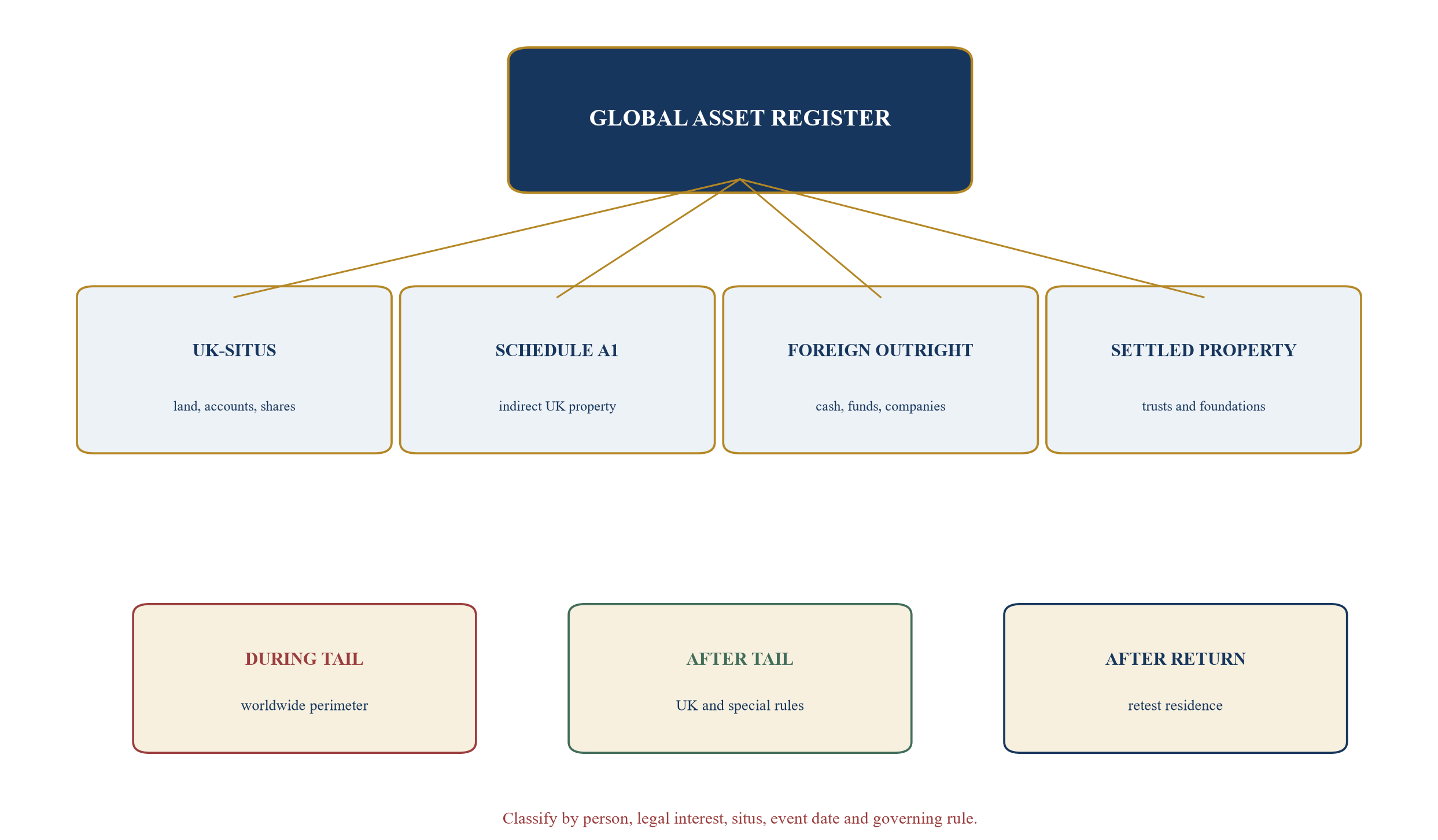
Asset situs, excluded-property status and relief depend on current law and facts. The map is a classification workflow.
6. Map every chargeable event before modelling tax
The operating model should distinguish event types. Death is one event. A potentially exempt transfer to an individual, an immediately chargeable transfer to a discretionary trust, a trust ten-year anniversary, a trust exit, an addition to a settlement, a transfer between spouses with different long-term residence status and the ending of a retained benefit can each produce different questions [19-27,40-43].
For outright foreign property, HMRC states that Inheritance Tax can apply on death or a transfer when the owner is long-term UK resident. For gifts to individuals, the seven-year rule and exemptions require analysis. Gifts into many trusts can create immediate charges. Trust property can move into or out of the relevant-property regime as the settlor's long-term residence changes, subject to transition and deceased-settlor rules. The event inventory should therefore connect every contemplated action to its legal form.
The family office should operate a pre-transaction gate. A proposed transfer begins with a term sheet describing the asset, parties, current and future ownership, consideration, retained rights, commercial purpose, governing law, intended timing and funding. Tax and legal advisers then classify the event. The family council approves only after it receives the advice, valuation, liquidity impact, implementation steps and evidence-retention plan.
Unplanned events require a different path. Death, incapacity, a bank account freeze, a lender enforcement, a divorce, a beneficiary request or a trustee deadline can compress decision time. The governance blueprint should identify who informs UK and UAE advisers, who values assets, who accesses records, who controls entities and who funds urgent obligations. Powers of attorney, wills, foundation by-laws and company mandates should be tested for the actual jurisdictions and institutions involved.
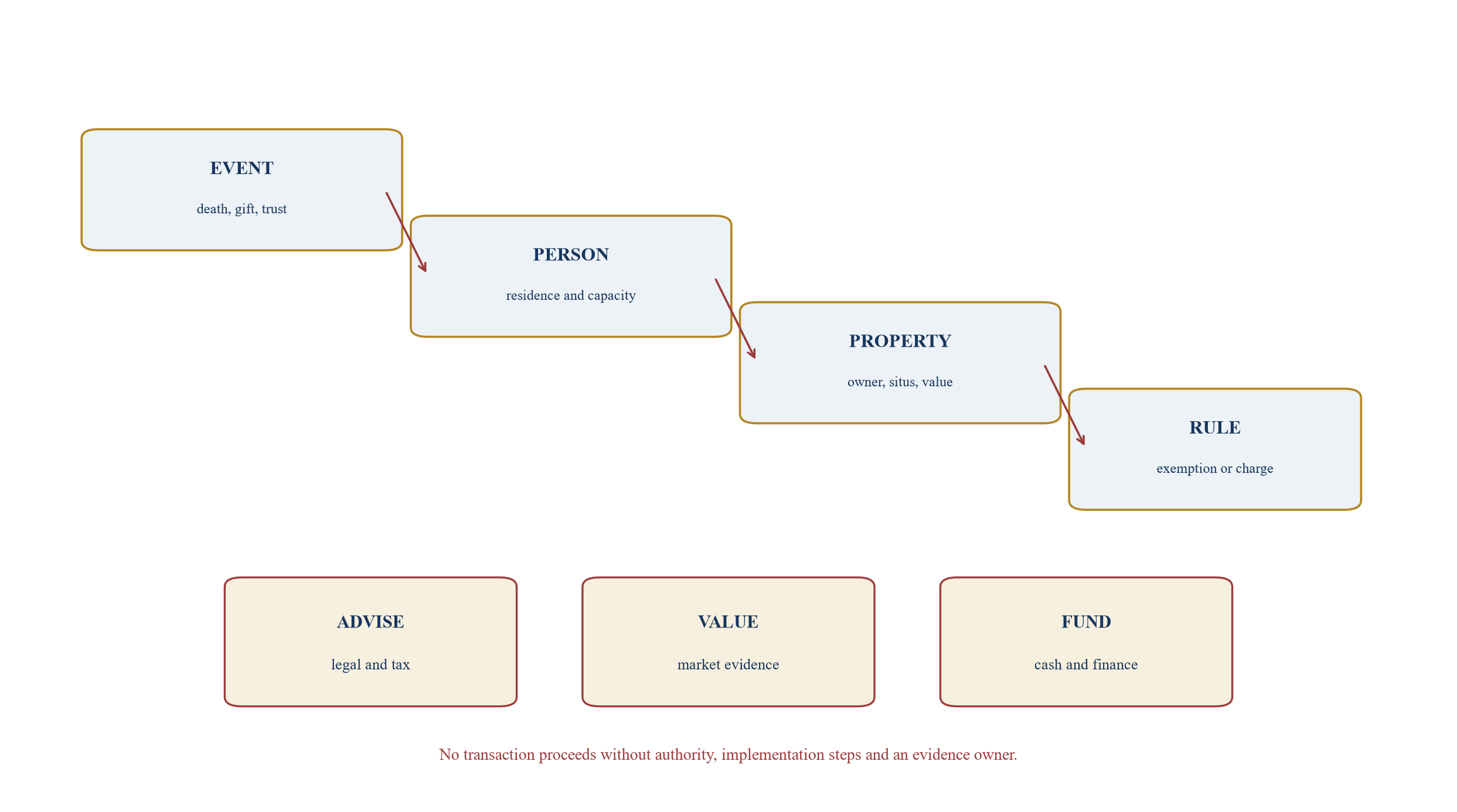
The outcome at each gate depends on the governing documents, residence, situs, reliefs and professional advice.
7. Reconcile outright assets, liabilities and beneficial ownership
Outright ownership can look simple while cross-border facts make it complex. A portfolio may be in one person's name but funded jointly. A property may be registered to a nominee. A family company can own personal-use assets. A loan can be documented but never serviced. A spouse may hold legal title while another person receives the economics. The IHT analysis begins with the legal and beneficial position rather than family convention.
The family office should reconcile four records: the legal register, the financial ledger, the tax return history and the succession documents. Differences are exceptions to resolve. A shareholder register should agree to the cap table and accounts. A loan agreement should agree to bank movements and accrued interest. A trust schedule should agree to trustee accounts. A will should describe assets and executors consistently with current ownership.
Liabilities need their own analysis. The balance-sheet model should record lender, borrower, purpose, security, location of borrowed funds, use of proceeds, currency, maturity, repayment history and connected-party status. An accounting liability is not automatically deductible for IHT. Qualified advisers should test statutory restrictions, tracing and anti-avoidance rules. Management should run both gross-estate and advised net-estate scenarios.
Beneficial ownership evidence also supports UAE banking and tax residence. The FTA's current Tax Residency Certificate service asks natural persons for evidence based on the applicable route, including identity, entry and exit data, residence, employment or business, financial and personal interests and sources of income [56]. UAE Ministry of Finance materials describe participation in the Common Reporting Standard [57]. Consistent self-certification, account ownership and source-of-wealth records reduce the risk of contradictory files across institutions.
The owner register should identify authority during incapacity and after death. A bank mandate, power of attorney or company signatory right can cease or operate differently on death. Executors may need tax funding before probate or access to assets. The family should obtain institution-specific confirmation and maintain a tested contact path.
8. Re-underwrite private companies and business relief
Private-company value often dominates the estate while remaining difficult to realise. HMRC states that unlisted shares should be valued at open-market value, considering company assets, performance, the size and rights of the holding, dividends and the economic background. Face value is rarely an adequate measure [38,50]. A family should therefore maintain an annual valuation pack and refresh it after material transactions.
Relief assumptions changed from 6 April 2026. Current HMRC guidance states that the combined amount qualifying for 100 percent Agricultural Relief and Business Relief is capped at GBP 2.5 million, with 50 percent relief for qualifying value above the allowance. Unused allowance can be transferred between spouses or civil partners where the conditions and claim requirements are met. Shares traded on certain markets receive 50 percent Business Relief. Eligibility conditions, ownership periods, investment-business exclusions and excepted assets still matter [36,37,47-49,54].
The family model should separate enterprise value, equity value, the value of the actual shareholding, qualifying business value, excepted assets, the 100 percent allowance, 50 percent relief and unrelieved value. It should also show debt and shareholder loans separately. A single percentage applied to a headline company valuation can conceal both valuation and relief risk.
Operational decisions can change the result. Surplus cash, investment assets, property use, a sale process, a share exchange, a holding-company insertion, a demerger or a shift in trading activity can affect value and relief. The board should require tax review before material capital allocation or restructuring during the tail. Commercial decisions should remain supportable without relying on a particular tax conclusion.
Liquidity analysis is as important as relief. HMRC permits ten annual instalments for qualifying business assets and, from 6 April 2026, states that instalments for assets qualifying for Agricultural or Business Relief are interest-free while the conditions apply. Sale of the asset can accelerate payment [46]. The estate still needs cash for the first instalment, advisers, valuations, probate and operating commitments.
Table 3. Private-company IHT underwriting bridge
| Layer | Management measure | Evidence | Downside case | Decision use |
|---|---|---|---|---|
| enterprise value | maintainable earnings and asset value | accounts, forecasts and market evidence | lower earnings and higher discount | valuation range |
| equity value | enterprise value less net debt | debt, cash and shareholder loans | debt not deductible or cash restricted | estate value bridge |
| holding value | rights and size of actual interest | articles, agreements and cap table | minority discount challenged | open-market value |
| qualifying value | trading value meeting current rules | activity, ownership period and asset use | investment activity or excepted assets | relief perimeter |
| allowance | current family and spouse position | prior transfers and claims | allowance partly consumed | 100 percent relief case |
| excess value | qualifying value beyond allowance | advised computation | only 50 percent relief | residual exposure |
| liquidity | cash, insurance and instalment eligibility | policy, facility and asset plan | sale accelerates payments | funding reserve |
Amounts and relief cases are hypothetical. Qualified valuers and tax advisers must establish value and eligibility.
9. Analyse property and indirect holding chains separately
Real estate combines situs, use, leverage, valuation and liquidity. UK land remains a core UK-situs exposure. Overseas real estate can enter the worldwide perimeter while a person remains long-term UK resident. Indirect UK residential property and, from 6 April 2026, certain indirect UK agricultural property require a Schedule analysis even when the immediate holding entity is outside the United Kingdom [31,32,54].
The property schedule should record legal title, beneficial ownership, occupation, lease, valuation, acquisition history, financing, security, related-party debt, development status and indirect holding chain. For family homes, management should also record who occupies the property, on what terms and whether any prior gift or trust arrangement leaves a retained benefit. For development or investment assets, it should separate trading stock, investment property and personal use.
Valuation timing can create liquidity risk. A family may hold an illiquid property whose value rises in sterling while rental cash is in another currency. A development can have contingent obligations, guarantees and future capital calls. A property sale may take longer than the IHT payment deadline. The scenario model should use current market evidence, sale costs, debt, currency and a time-to-cash estimate rather than a single gross valuation.
Succession law and administration require an asset-specific route. UAE Federal Decree-Law No. 41 of 2022 provides civil personal-status rules for specified non-Muslim residents and includes provisions for estates and wills. The newer federal personal-status law contains a separate estate and wills framework [58,59]. The applicable regime, will registration, asset registration and court procedure require local legal advice. A UK will, UAE will, foundation charter and company articles should be reviewed as one architecture to avoid conflicting appointments or asset descriptions.
Property decisions during the tail should pass a purpose-and-control gate. The file should explain why the family buys, sells, gifts, refinances or contributes the asset; who approves; what valuation is used; which taxes and fees apply; how occupation changes; how proceeds are held; and how succession documents are updated. The transaction should not be described as complete until registries, banks, accounts and records agree.
10. Distinguish completed gifts from retained benefits
HMRC's public guidance states that gifts to individuals can fall outside IHT if the donor survives seven years, subject to exemptions, the nil-rate band and other rules. Gifts made within seven years of death can affect the tax computation. Trust gifts follow different rules. Records should show what was given, to whom, when and at what value [40,41].
The tail and seven-year period solve different questions. Long-term residence helps determine whether foreign property is within the IHT scope at the transfer or death event. The seven-year rule determines the treatment of many lifetime gifts. A person can cease long-term residence before a seven-year survival period ends. Qualified advice must connect the residence status, asset situs, transfer type, exemptions and death date rather than treating either clock as decisive on its own.
A gift with reservation of benefit can remain in the donor's estate. HMRC describes the rule as applying where the donor gives property away and continues to benefit. If the benefit remains at death, the property can be treated as part of the estate, with tracing into replacement property. If the reservation ends within seven years of death, a potentially exempt transfer can arise [23,33]. Family occupation of a transferred home, use of a yacht, access to an investment account or informal enjoyment of company assets should be reviewed on their actual facts.
The gift file should contain the deed or transfer, valuation, acceptance, bank trail, tax advice, board or trustee approvals, updated register, possession and use evidence, and confirmation of any retained rights. Where the asset is private-company equity, it should also include shareholder rights, governance, dividend arrangements and employment or service relationships. A document that transfers title while leaving all economics and control unchanged is a red flag.
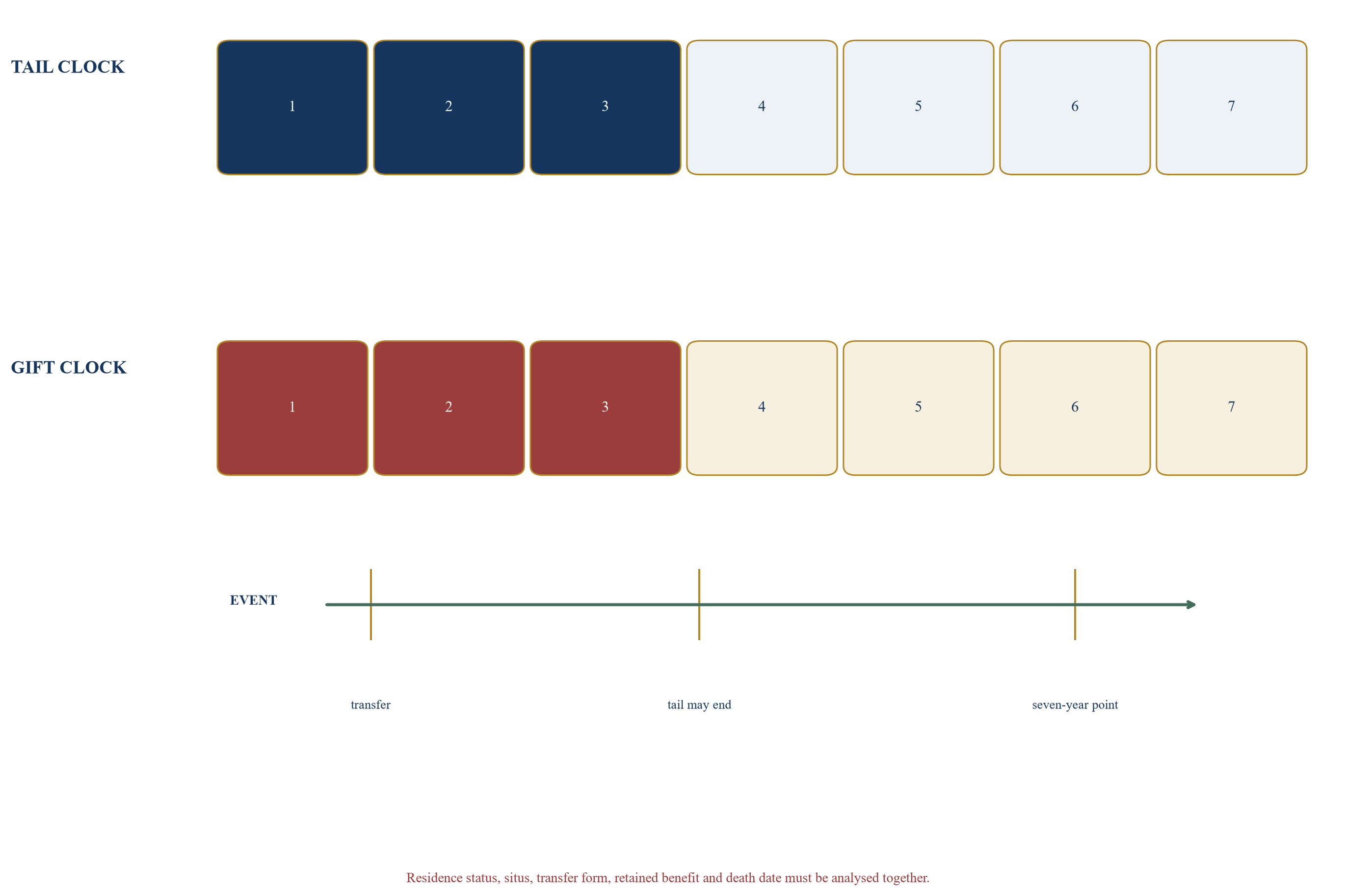
The two clocks answer different legal questions. The example periods are illustrative and require advice.
11. Re-underwrite trusts and foundations event by event
Trust and foundation planning needs an event ledger, not a label. The relevant questions include when property was settled, the settlor's long-term-residence status at each event, whether the settlor is alive, whether a beneficiary has a qualifying interest in possession, where the property is situated, whether benefits can return to the settlor, and which periodic or exit charge can arise. HMRC's post-2025 guidance makes excluded-property status dynamic in several circumstances [10-22]. A family should therefore reject any assumption that a historic offshore structure permanently fixes the IHT result.
For a living settlor, foreign settled property can move into or out of the relevant-property regime as the settlor becomes or ceases to be long-term UK resident. When the settlor dies, HMRC's guidance generally freezes the long-term-residence test by reference to the settlor at death. A qualifying interest in possession can introduce a separate beneficiary status test. Pre-30 October 2024 settlements may obtain limited transitional treatment in specified circumstances, including rules involving deaths before 6 April 2025 and certain qualifying interests [17-22]. Each trust requires advice against its own deed, funding history and benefit pattern.
The residence tail can remain relevant after the settlor relocates. A distribution, appointment, addition of property, change of trustees, exercise of a power, ten-year anniversary or death may have a different IHT consequence. The trust file should therefore pair every contemplated action with its legal and tax event date. Trustee minutes should describe the commercial or family purpose, the information considered, conflicts, beneficiary circumstances, valuation and advice. A transaction entered only because a model shows a lower tax cost can still fail on governance, documentation or other-tax grounds.
An ADGM foundation or trust can support governance, asset separation, succession and continuity. ADGM publishes dedicated regimes for family offices, foundations and trusts [60]. Those features are operational and legal benefits; they do not themselves determine the UK IHT classification of the assets or parties. The UK analysis should identify the legal owner, beneficial interests, reserved powers, settlor or founder rights, beneficiary rights and actual administration. The UAE analysis should confirm registration, constitutional documents, council or trustee authority, accounting, beneficial-ownership obligations and succession effects.
Table 4. Trust and foundation event matrix
| Event | Evidence required | UK IHT question | Governance response |
|---|---|---|---|
| Addition of property | deed, valuation, transfer trail and settlor status | is the transfer chargeable and is the property excluded? | approve purpose, advice, conflicts and post-transfer control |
| Ten-year anniversary | historic funding, asset values and status timeline | which property is relevant and what rate applies? | commission valuation and reserve liquidity before the date |
| Distribution or appointment | beneficiary status, minutes and valuation | does an exit charge, gift or estate inclusion arise? | document beneficiary need, fairness and payment route |
| Settlor departure | SRT evidence and prior twenty-year residence record | when does long-term residence cease? | maintain the annual status file through the full tail |
| Settlor death | death date, status, deed and asset register | how is excluded-property status fixed after death? | freeze records, notify advisers and reconcile succession powers |
| Qualifying interest change | deed, appointment and beneficiary status | does the beneficiary long-term-residence test apply? | obtain advice before changing beneficial rights |
| Foundation migration or conversion | statutes, council resolutions and asset register | what UK legal and tax character follows? | map legal continuity, powers, ownership and reporting |
Every event requires advice against the governing documents, residence status, asset facts and law applying on the event date.
12. Treat spouse and civil-partner status as a separate workstream
Transfers between spouses or civil partners can produce a deceptively simple headline. The result can depend on the transferor's and recipient's long-term-residence status. HMRC's guidance states that where the transferor is long-term UK resident and the recipient is not, the spouse or civil-partner exemption can be restricted to the prevailing nil-rate band unless an election is made [25-27]. The election can bring the recipient into long-term-resident treatment for IHT and is irrevocable. Its consequences can extend beyond the asset received.
The election should therefore be modelled across the recipient's worldwide balance sheet, expected gifts, trust interests, life expectancy, residence path and succession plan. HMRC states that an election can cease to have effect after ten consecutive tax years of non-UK residence, subject to the statutory conditions [25-27]. A family expecting a three-year tail for one spouse may discover that an election creates a different and longer exposure for the other. Advice should compare the restricted exemption, the election, asset-specific alternatives, insurance and liquidity before any filing deadline.
Residence records must be person specific. Married couples can have different travel, work, home, tie and historic-residence facts. The family office should maintain two separate SRT files, two prior-20-year maps and a consolidated transfer ledger. The consolidated view matters because a transaction can shift both ownership and future IHT exposure. The individual files matter because one person's conclusion cannot be copied to the other.
The decision paper should show at least four cases: no election and no transfer; no election with the restricted exemption; election with the transfer; and a delayed or differently structured transfer where legally and commercially appropriate. Each case should show the taxable estate, available bands and reliefs, projected liquidity, control implications, succession effect and the sensitivity to return to the UK. Assumptions should be dated and labelled as management scenarios rather than advice or forecasts.
13. Build a double-tax relief file before a conflict appears
The UK has estate-tax treaties with a limited list of jurisdictions. HMRC's published list does not include the UAE [44]. The UK-UAE double taxation convention addresses taxes on income and capital gains and should not be presented as an estate-tax treaty [55]. Where the same asset is taxed by the UK and another jurisdiction on death, unilateral relief may be available under UK rules, subject to conditions, attribution and evidence [44]. The relief analysis needs to be asset specific.
A family with globally mobile members can still face overlapping claims involving other countries. Citizenship, domicile concepts, habitual residence, situs, forced-heirship rules, entity classification and local inheritance or estate taxes can point in different directions. The master register should identify the jurisdictional connection for each person, entity and asset. Local counsel should confirm the tax base, valuation date, payer, filing deadline, credit mechanism and documentary requirements.
The relief file should include foreign assessments, proof of payment, exchange rates, valuation reports, ownership evidence and the computation connecting the foreign tax to the UK charge. Timing can create a financing gap if one authority requires payment before another grants credit. The liquidity plan should therefore fund gross claims and treat credit recovery as a later cash inflow until advisers confirm the mechanics.
14. Design the UAE architecture around evidence, control and succession
A UAE move creates a new operating system for the family. The system should connect personal tax residence, immigration, homes, banking, investment management, corporate governance, succession documents and information reporting. The UAE Federal Tax Authority sets evidence requirements for a Tax Residency Certificate, and the Ministry of Finance administers automatic exchange of information under CRS and related frameworks [56,57]. A certificate is useful evidence within its stated purpose and period; it does not replace the UK SRT analysis.
The architecture begins with people. Record visas, entry and exit data, UAE and overseas homes, work patterns, board roles, family presence, day counts and material ties. It then maps ownership and control. Each company, partnership, trust and foundation should have an identified legal owner, beneficial owner, decision body, bank mandate, accounting owner, adviser and document repository. Board and investment decisions should occur through the authority described in constitutional documents and should be evidenced contemporaneously.
Succession documents should be reconciled across jurisdictions and asset registries. UAE federal legislation provides personal-status and estate rules that can apply to specified residents and circumstances [58,59]. Applicable law, will registration and court competence require qualified advice. The objective is a coherent chain from incapacity or death through authority, asset identification, probate or administration, company control, liquidity and distribution.
The family should also decide what must remain outside a holding structure. Personal-use assets, regulated investments, partnership interests, carried interests, employment-related rights and assets with financing covenants can carry restrictions or adverse consequences on transfer. The architecture is a controlled map of legal and economic relationships, not a programme to place every asset into one vehicle.
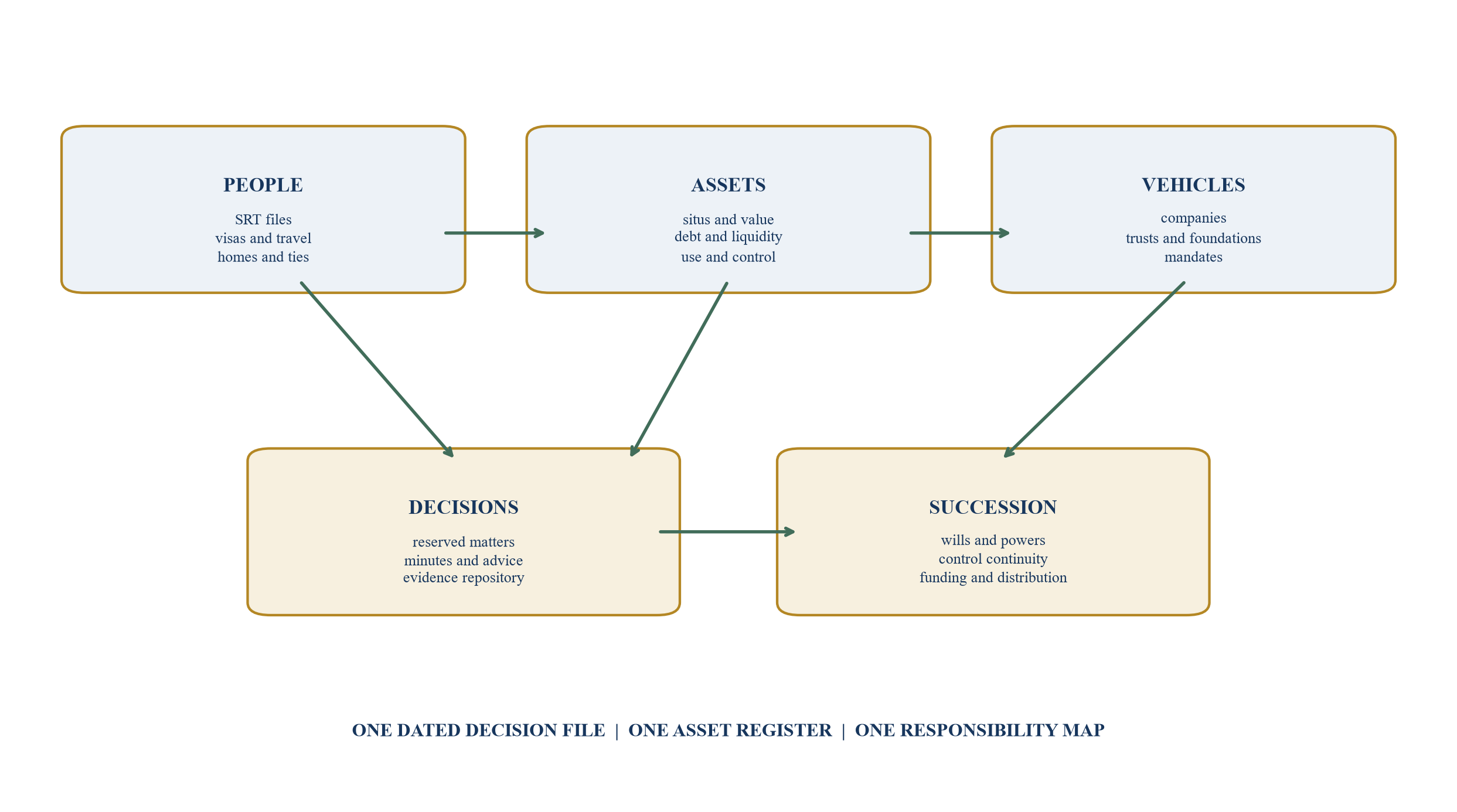
A coordinated operating model links people, assets, vehicles, decisions and succession. Legal and tax treatment remains asset and fact specific.
15. Fund tax, administration and family continuity
IHT is a cash obligation attached to an asset base that may be illiquid. HMRC states that payment is generally due by the end of the sixth month after death, with interest applying after the due date. Certain property and business assets can qualify for payment by instalments, subject to the rules and continuing interest or acceleration consequences [45,46]. Probate, foreign administration, valuations and bank access can take longer than the payment timetable.
The family office should maintain a liquidity ladder rather than a single insurance number. Tier one covers immediate household, legal and administrative costs. Tier two covers expected tax payments before probate or asset sales. Tier three is committed contingent liquidity, such as a documented facility or callable portfolio reserve. Tier four is an orderly-sale plan for assets whose disposal will not impair the operating business or destroy value. Each tier needs an owner, access test, currency, counterparty, expiry date and documentary route after incapacity or death.
Life assurance can be useful when ownership, trust, beneficiary designation, underwriting, premiums and jurisdictional tax treatment are aligned. It can also fail operationally if proceeds fall into the estate, the policy lapses, premiums create transfer issues, trustees cannot access the account or the currency mismatches the liability. Advice should evaluate insurance alongside lending, cash, portfolio liquidity, dividends and staged disposals.
Private-company families need a corporate funding protocol. The company may have cash while the estate has the liability. A dividend, share buyback, loan, asset sale or insurance arrangement can have company-law, tax, covenant and minority-shareholder implications. The board should approve a lawful response after considering duties and the company's own solvency and investment needs. Family expectations cannot substitute for corporate authority.
Table 5. Estate-liquidity ladder
| Layer | Purpose | Evidence | Test |
|---|---|---|---|
| Immediate reserve | household, advisers, filings and administration | cash account, mandate, power and currency | authorised person can access funds within five business days |
| Tax reserve | estimated UK and foreign tax before credits | dated computation and sensitivity | covers the base case plus approved contingency |
| Contingent facility | bridge timing gaps and gross double-tax claims | signed terms, security, covenant and expiry | draw route survives incapacity or death |
| Portfolio liquidity | secondary source without forced disposal | custody statement and sale restrictions | assets can settle within the required period |
| Insurance | transfer defined mortality risk | policy, trust, premiums and beneficiary file | proceeds reach the intended payee outside administration delay |
| Orderly disposals | monetise selected illiquid assets | valuation, broker plan and board approvals | sale does not impair business continuity or destroy value |
Amounts and access periods should be stress-tested in the liability currency and reverified after material balance-sheet changes.
16. Install a family-capital governance blueprint
The residence tail is a recurring governance process. A steering group should include the relevant family members, family-office lead, UK tax and legal advisers, UAE advisers, investment lead, finance lead and succession counsel. Specialists join for valuations, insurance, regulated assets, real estate or operating companies. The group should have a written mandate; it should not blur professional responsibilities or allow one adviser to opine outside their jurisdiction.
The governing document can be a short decision charter. It specifies objectives, risk tolerances, reserved matters, meeting cadence, evidence standards and escalation thresholds. Reserved matters may include gifts above a threshold, new trusts or foundations, changes to beneficial rights, acquisition or disposal of UK-situs assets, shareholder restructurings, spouse elections, significant debt, new homes and any decision that may alter residence status.
Every material proposal should use the same decision paper. The paper records facts, missing facts, legal and tax questions, commercial purpose, alternatives, valuations, liquidity, control, succession, implementation dependencies, decision maker and review date. An assumptions register should state the source and owner of each management estimate. Open questions remain open until the responsible qualified adviser closes them in writing.
The architecture should have three lines of control. The first line is the family office and asset owners who maintain records and execute decisions. The second line is professional advisers and compliance functions that test legal, tax and regulatory treatment. The third line is an annual independent review of the residence analysis, asset register, trust ledger, relief evidence, wills, powers and liquidity test. Independence in this context means a reviewer who did not prepare the underlying conclusion.
Digital controls matter because the evidence horizon is long. The repository should use versioned files, named owners, retention periods and restricted access. It should contain travel evidence, tax returns, residence opinions, valuations, deeds, company registers, trustee and board minutes, wills, powers, bank evidence, policy documents and tax computations. A document index should show the effective date and next review date. Data protection and cybersecurity controls should reflect the sensitivity of family and asset information.
17. Make valuation a maintained evidence system
IHT valuations are not an administrative afterthought. HMRC's guidance requires the open-market basis for unlisted shares, and separate rules govern quoted shares, land, interests and liabilities [38,50]. The relevant value can depend on the event date, the rights attached to the interest, control, restrictions, related holdings, debt and information available. A funding round, internal model or accounting carrying value may answer a different question.
The valuation register should identify the subject interest, legal owner, percentage and rights, valuation date, purpose, standard of value, currency, adviser, information set and sensitivity. Private-company files should include constitutional documents, cap tables, shareholder agreements, forecasts, customer concentration, key-person dependency, debt, comparable transactions and subsequent events. Property files should include title, leases, occupancy, restrictions, planning, debt and current market evidence.
Reliefs require their own evidence. Business Relief depends on ownership periods, the nature of the business and statutory exclusions. Investment activity, surplus assets, binding contracts for sale and group structures can affect qualification [34-37,47,48]. Agricultural Relief depends on the property and use rules [49]. Finance Act 2026 changes the scale and allocation of 100% relief from April 2026; families should model the combined allowance, 50% relief on excess qualifying value, spouse transferability and interactions with ownership and succession [54].
The relief file should not assume that a current qualifying business will still qualify at death. It should track trading or investment indicators, asset use, group activities, shareholder arrangements, sale processes and legislative changes. Quarterly reporting can flag a drift before it becomes an estate problem. The board can then make a commercially grounded decision while preserving evidence of purpose.
18. Use scenarios to expose decisions, not to predict tax
Consider a hypothetical family whose principal leaves the UK after fourteen residence years in the preceding twenty. On the simplified HMRC scale, the tail may be seven tax years, subject to the detailed statutory history and transitional rules [4-9]. The family owns a UK home, UAE home, global portfolio, private trading company, investment company, trust settled before 30 October 2024 and life policy. A single estate percentage would conceal material differences between those assets.
Scenario one assumes no changes. The family maintains accurate residence evidence, retains the portfolio and companies, reviews the trust and funds the projected liability. This case establishes the baseline cost, liquidity and control position. Scenario two considers selected lifetime gifts with genuine transfer of benefit and control. The model shows the transfer date, value, tail status, seven-year survival period, loss of income or control, recipient governance and tax sensitivity. Scenario three considers company succession, including voting and economic rights, relief evidence, governance and liquidity. Scenario four tests a return to the UK before the tail ends and re-runs the prior-20-year residence record.
All figures in such a model are management scenarios until verified. A useful output presents ranges and triggers: low, central and high asset values; relief available, restricted or unavailable; sterling strengthening or weakening; death during or after a relevant period; spouse election made or not made; and liquidity available early or delayed. It should state which decisions are robust across cases and which require a specific outcome.
The scenario workshop should finish with named actions. Examples include obtaining a formal residence opinion, commissioning an unlisted-share valuation, reviewing retained benefits, confirming trust event dates, reconciling wills, increasing the tax reserve or changing an investment mandate to protect liquidity. A scenario that produces no owner, deadline or evidence requirement has limited operational value.
19. Execute through an eighteen-month transition programme
The first thirty days are for containment and fact capture. Freeze undocumented ownership changes. Assemble the residence record, entity chart, asset register, trust and foundation schedule, wills, powers, insurance, debt and professional-adviser list. Record filing and anniversary dates. Identify any imminent gift, distribution, refinancing, share sale, ten-year charge, policy renewal or travel decision that needs advice.
Days thirty-one to ninety establish the legal and analytical baseline. UK advisers confirm the SRT and long-term-residence history for each relevant person. Local counsel confirms UAE residence, succession and vehicle matters. Valuers prioritise private companies and material property. The family office builds the liquidity estimate, spouse-status matrix, relief file and trust event ledger. Missing documents receive an owner and deadline.
Months four to six are the design phase. The family agrees its control, income, succession, philanthropy and liquidity objectives. Advisers compare the baseline with viable alternatives. Decision papers cover gifts, ownership changes, wills, powers, foundation or trust governance, company succession, insurance and financing. Each recommendation includes implementation steps, conditions, costs, tax sensitivities and a reversal or contingency plan where feasible.
Months seven to twelve are the controlled execution phase. Documents are approved and signed in the correct sequence. Registries, banks, custodians, insurers, trustees, company registers and accounts are updated. Cash and facilities are placed and tested. Board and trustee minutes record purpose, advice and conflicts. The evidence repository is reconciled against actual execution rather than intended execution.
Months thirteen to eighteen convert the project into routine governance. The steering group closes exceptions, performs the first annual residence and asset review, re-runs valuation and liquidity sensitivities, updates the family continuity pack and tests access after incapacity or death. The programme then moves to quarterly event monitoring and an annual independent review.
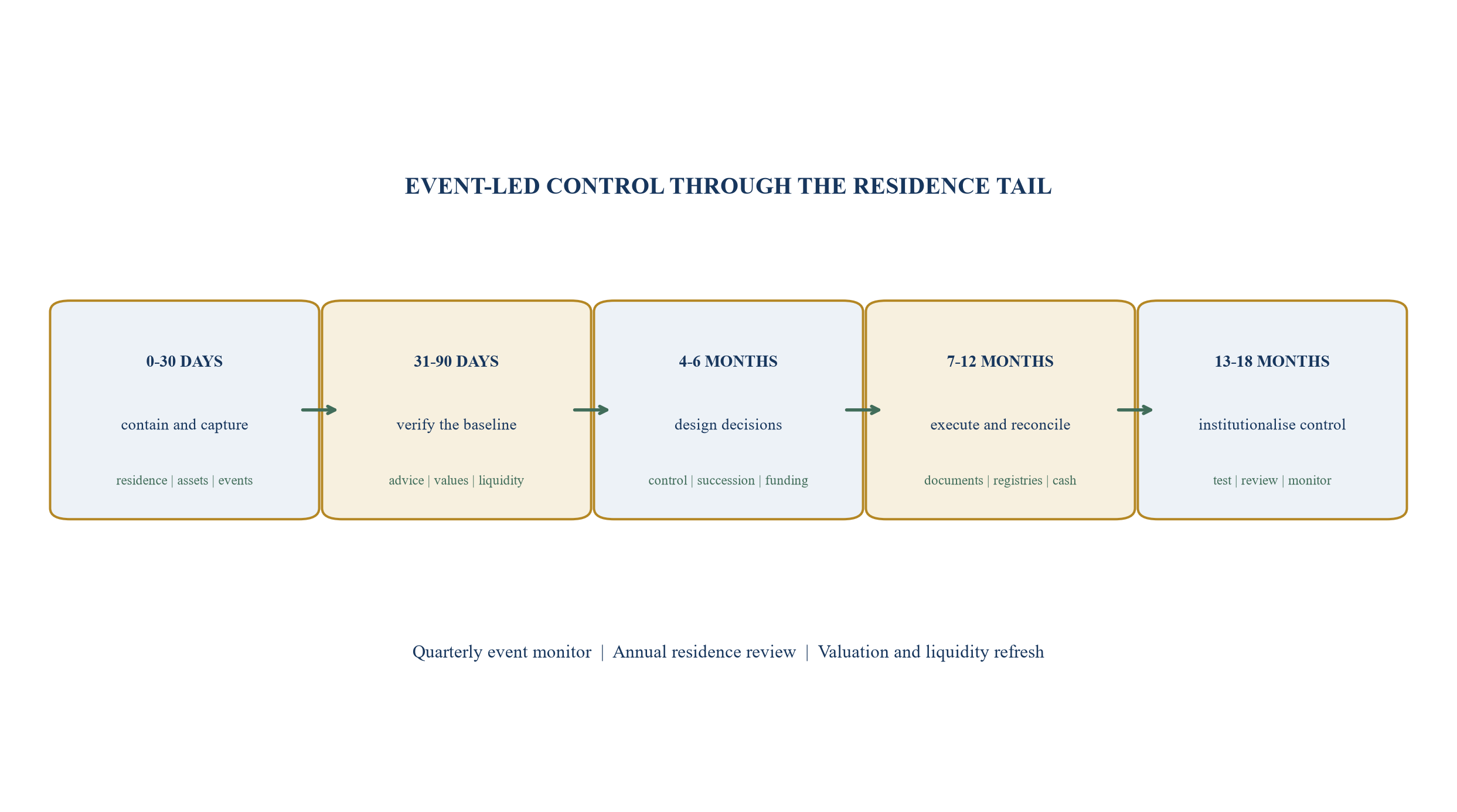
The sequence is illustrative. Urgent legal, tax, residence or liquidity deadlines should be prioritised as advisers direct.
Table 6. Transition control checklist
| Workstream | First deliverable | Decision gate | Recurring control |
|---|---|---|---|
| Residence | separate SRT and long-term-residence files | adviser confirms the status timeline | annual update plus event-driven travel review |
| Assets | ownership, situs, value and liquidity register | every material asset has an evidence owner | quarterly changes and annual valuation triage |
| Trusts and foundations | funding and event ledger | advice before each chargeable or governance event | anniversary and distribution monitor |
| Companies | cap table, rights, relief and control file | board-approved succession and liquidity path | quarterly relief and covenant indicators |
| Spouses | status and election comparison | written decision on transfer and election | revisit after residence or asset change |
| Succession | reconciled wills, powers and authority map | cross-jurisdiction counsel confirms coherence | annual test and after every material acquisition |
| Liquidity | tiered reserve and facility schedule | base and stress cases funded | quarterly access, currency and expiry test |
| Evidence | versioned repository and index | execution waits for required documents | monthly exception report |
Each workstream has a named owner, evidence requirement, decision gate and recurring control.
20. The board-ready decision file
The final output should allow a family member, executor, trustee, director or adviser to reconstruct the logic without relying on memory. It should contain the residence timeline, family and authority map, asset and entity registers, trust event ledger, spouse analysis, valuation and relief files, gift register, double-tax file, wills and powers map, liquidity ladder, scenario model, implementation log and unresolved matters register.
The dashboard should focus on decisions and evidence. Useful measures include percentage of assets with verified ownership and situs, percentage of material assets with current values, number of trust events due within twelve months, uncovered liquidity under the stress case, documents awaiting registry confirmation, spouse-election deadline, unresolved residence days and relief indicators outside tolerance. Traffic-light status should have a defined threshold and named owner.
The tail ends only after the legally relevant conditions are satisfied. The closing memo should confirm the final non-resident tax year sequence, subsequent return history, asset-by-asset consequences and any exposures that continue through gifts, trusts, UK-situs property, administration or foreign rules. Records should be retained for the periods advisers specify. A move date alone is not a closing event.
For families leaving the UK for the UAE, disciplined execution creates value by protecting optionality. It reduces the chance that an attractive investment, family transfer or corporate transaction is delayed by missing facts. It gives decision makers a shared view of control, liquidity and succession. It also makes risk visible while action remains possible. The result is a maintained family-capital operating system for a multi-year transition.
Sources and further reading
- HM Revenue & Customs, “Inheritance Tax if you’re a long-term UK resident”, 2026. Official source
- HMRC Inheritance Tax Manual, “Long-term UK residence: contents”, IHTM47000. Official source
- HMRC Inheritance Tax Manual, “Long-term UK residence: introduction”, IHTM47001. Official source
- HMRC Inheritance Tax Manual, “Long-term UK residence: determining status”, IHTM47020. Official source
- HMRC Inheritance Tax Manual, “Long-term UK residence: residence years”, IHTM47021. Official source
- HMRC Inheritance Tax Manual, “Long-term UK residence: residence history”, IHTM47022. Official source
- HMRC Inheritance Tax Manual, “Long-term UK residence: leaving the UK”, IHTM47023. Official source
- HMRC Inheritance Tax Manual, “Long-term UK residence: tail provisions”, IHTM47024. Official source
- HMRC Inheritance Tax Manual, “Long-term UK residence: examples”, IHTM47025. Official source
- HMRC Inheritance Tax Manual, “Excluded property: contents”, IHTM47030. Official source
- HMRC Inheritance Tax Manual, “Excluded property: settled property”, IHTM47031. Official source
- HMRC Inheritance Tax Manual, “Excluded property: settlor status”, IHTM47032. Official source
- HMRC Inheritance Tax Manual, “Excluded property: deceased settlors”, IHTM47033. Official source
- HMRC Inheritance Tax Manual, “Excluded property: qualifying interests”, IHTM47034. Official source
- HMRC Inheritance Tax Manual, “Excluded property: special cases”, IHTM47037. Official source
- HMRC Inheritance Tax Manual, “Excluded property: transitional rules”, IHTM47038. Official source
- HMRC Inheritance Tax Manual, “Settled property: introduction”, IHTM47040. Official source
- HMRC Inheritance Tax Manual, “Settled property: relevant property”, IHTM47041. Official source
- HMRC Inheritance Tax Manual, “Trusts: qualifying interest in possession”, IHTM47050. Official source
- HMRC Inheritance Tax Manual, “Trusts: beneficiary status”, IHTM47051. Official source
- HMRC Inheritance Tax Manual, “Trusts: settlor and beneficiary tests”, IHTM47052. Official source
- HMRC Inheritance Tax Manual, “Trusts: transitional treatment”, IHTM47053. Official source
- HMRC Inheritance Tax Manual, “Gifts with reservation: post-2025 rules”, IHTM47060. Official source
- HMRC Inheritance Tax Manual, “Gifts with reservation: examples”, IHTM47061. Official source
- HMRC Inheritance Tax Manual, “Spouse and civil partner election”, IHTM47070. Official source
- HMRC Inheritance Tax Manual, “Election procedure and effect”, IHTM47071. Official source
- HMRC Inheritance Tax Manual, “Election cessation”, IHTM47072. Official source
- HMRC Inheritance Tax Manual, “Excluded property: foreign property”, IHTM04260. Official source
- HMRC Inheritance Tax Manual, “Excluded property: foreign currency accounts”, IHTM04262. Official source
- HMRC Inheritance Tax Manual, “Excluded property: UK residential property interests”, IHTM04271. Official source
- HMRC Inheritance Tax Manual, “Liabilities: general principles”, IHTM04311. Official source
- HMRC Inheritance Tax Manual, “Liabilities: property nexus”, IHTM04315. Official source
- HMRC Inheritance Tax Manual, “Gifts with reservation: tracing and cessation”, IHTM14396. Official source
- HMRC Inheritance Tax Manual, “Business Relief: investment businesses”, IHTM42088. Official source
- HMRC Inheritance Tax Manual, “Business Relief: binding contract for sale”, IHTM42161. Official source
- HMRC Inheritance Tax Manual, “Business Relief: general requirements”, IHTM25500. Official source
- HMRC Inheritance Tax Manual, “Business Relief: qualifying interests”, IHTM25550. Official source
- HMRC Inheritance Tax Manual, “Valuation of unquoted shares”, IHTM18131. Official source
- HM Revenue & Customs, “Inheritance Tax”, 2026. Official source
- HM Revenue & Customs, “How Inheritance Tax works: thresholds, rules and allowances; gifts”, 2026. Official source
- HM Revenue & Customs, “Work out Inheritance Tax due on gifts”, 2026. Official source
- HM Revenue & Customs, “Trusts and Inheritance Tax”, 2026. Official source
- HM Revenue & Customs, “Non-resident trusts”, 2026. Official source
- HM Revenue & Customs, “Inheritance Tax: double taxation relief”, 2026. Official source
- HM Revenue & Customs, “Paying Inheritance Tax”, 2026. Official source
- HM Revenue & Customs, “Paying Inheritance Tax in yearly instalments”, 2026. Official source
- HM Revenue & Customs, “Business Relief for Inheritance Tax”, 2026. Official source
- HM Revenue & Customs, “What qualifies for Business Relief”, 2026. Official source
- HM Revenue & Customs, “Agricultural Relief on Inheritance Tax”, 2026. Official source
- HM Revenue & Customs, “Valuing stocks and shares for Inheritance Tax”, 2026. Official source
- HM Revenue & Customs, “RDR3: Statutory Residence Test”, 2026. Official source
- HM Revenue & Customs, “Guidance note for the Statutory Residence Test”, 2026. Official source
- UK Parliament, Finance Act 2025. Official source
- UK Parliament, Finance Act 2026. Official source
- Government of the United Kingdom and Government of the United Arab Emirates, “Convention for the avoidance of double taxation”, 2016. Official source
- UAE Federal Tax Authority, “Issuance of Tax Certificates”, 2026. Official source
- UAE Ministry of Finance, “Automatic Exchange of Information”, 2026. Official source
- United Arab Emirates, Federal Decree-Law No. 41 of 2022 on Civil Personal Status. Official source
- United Arab Emirates, Federal Decree-Law No. 41 of 2024 on the Issuance of the Personal Status Law. Official source
- Abu Dhabi Global Market, “Family Offices”, 2026. Official source
