

1. Define the claim before calculating the number
A track record is a set of claims supported by records, methodology and authority. The first control is to state exactly what is being claimed.
A firm claim attributes performance to an investment organisation. A fund claim reports the result of a defined legal vehicle. A mandate or portfolio claim reports a managed account or composite. A deal claim isolates one investment or a defined group of investments. An individual claim describes a person's role in sourcing, underwriting, approving, monitoring or exiting an investment. These claims answer different questions and require different evidence.
The claim also needs an audience and use. An internal lessons review, an institutional due-diligence response, a private placement memorandum, a website, a presentation and a regulated advertisement can sit within different review and legal perimeters. Approval for one use does not create approval for every other use.
The controlled claim statement records entity, portfolio, period, currency, methodology, gross or net basis, valuation date, financing treatment, role, source, owner, reviewer and approved channels. It also identifies limitations.
An emerging manager should resist beginning with the most attractive output. Starting with a selected return encourages a search for supporting material. Starting with the claim creates an evidence test that can succeed, narrow or fail.
The institutional question is therefore more precise than whether the founders have done good deals. It asks which results can be reconstructed, attributed and communicated fairly under the applicable standards and rules.
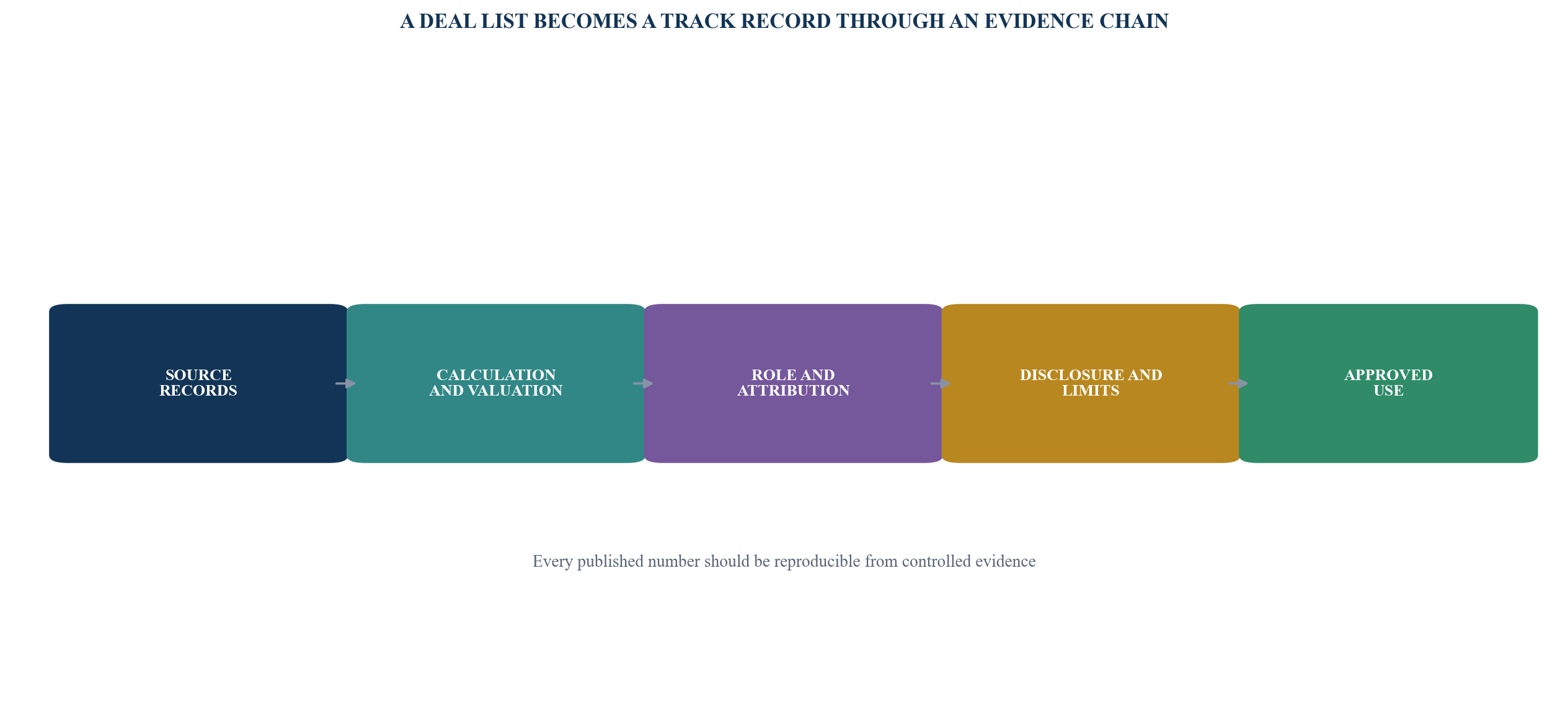
A claim is usable only when source, calculation, role, disclosure and approval remain linked.
2. Separate firm, fund, deal and individual performance
Performance can belong to several overlapping systems. Institutional evidence should preserve those boundaries.
The legal fund owns investments and receives or pays cash. The manager or adviser exercises defined responsibilities. An investment committee can approve decisions. Individual professionals contribute within that system. A current firm may employ people who generated experience at a predecessor.
A deal return does not equal a fund return. Fund expenses, management fees, carried interest, subscription financing, currency, timing, cash drag and other investments affect the investor outcome. A strong realised deal can coexist with a weaker fund result.
An individual's involvement does not establish sole authorship. A transaction may involve originators, sector experts, underwriting, committee members, portfolio operators and exit leads. Senior title alone does not prove decision contribution.
A firm cannot automatically present predecessor results as its own. Records, people, decision process, continuity, ownership and applicable rules affect whether and how performance can be linked or described. CFA Institute's published GIPS materials state specific conditions for linking past-firm performance under those standards. Other legal and regulatory frameworks require separate analysis.
The evidence architecture therefore uses distinct identifiers for entity, fund, portfolio, asset, transaction, person, role and period. Every output is generated from those identifiers rather than from a single master spreadsheet with ambiguous ownership.
Table 1. Claim-level evidence boundaries
| Claim level | Claim object | Minimum evidence | Common overstatement |
|---|---|---|---|
| firm | investment organisation | firm definition, portfolio population and policies | presenting selected accounts as the firm result |
| fund | legal vehicle | governing records, complete cash flows and valuations | using one strong deal as the fund outcome |
| portfolio or composite | defined strategy population | inclusion rules, complete accounts and methodology | excluding terminated or weak portfolios |
| deal | one investment or defined extract | asset cash flows, valuation and allocation | presenting gross deal return as investor return |
| individual | person's actual contribution | contemporaneous role and decision evidence | claiming sole authorship from title or attendance |
| predecessor | prior firm or affiliation | rights, continuity, records and disclosure | relabelling prior-firm performance as current-firm history |
Required evidence and permitted presentation depend on the facts, documents, audience and applicable rules.
3. Build the population before selecting examples
The deal universe should be reconstructed before deciding which examples appear in diligence or marketing. This reduces survivorship and selection bias.
The population starts with funds, accounts, portfolios and mandates within the relevant strategy and period. It then maps every investment, follow-on, partial exit, write-off, restructuring and remaining position. Cancelled transactions can belong in a separate experience log while staying outside performance calculations.
Sources include audited statements, fund administrators, capital-account records, bank statements, general ledgers, portfolio systems, investment papers, legal closing files, board records and valuation packs. Personal deal lists and biographies can help locate evidence; they do not replace it.
Each item receives a status: verified, partially verified, conflicting, unavailable or outside scope. Conflicts remain visible until resolved. A missing weak deal should receive the same escalation as a missing successful deal.
The population rule states geography, sector, strategy, instrument, vintage, decision period, realised status and ownership. If an early team worked across several strategies, the register should avoid creating a synthetic history that no single product actually pursued.
Selection for case studies follows an approved purpose. A representative set can illustrate the intended strategy, decision range and lessons. Any subset should disclose the selection basis and relationship to the complete population where required.
The output is a population certificate listing included, excluded and unresolved items, the rule applied and the approving owner.
4. Reconstruct the legal and economic perimeter
Private-market deals can involve feeders, blockers, holding companies, co-investment vehicles, warehousing entities, continuation vehicles and parallel funds. Cash flows should follow the legal and economic perimeter being reported.
The investment identifier maps acquisition entities, securities, currencies, ownership, allocation and transfers. The fund identifier maps which vehicle funded each flow and received each distribution. The manager identifier maps the party responsible during each period.
Warehoused investments need special care. An asset can be acquired before a fund closes and later transferred. The relevant performance start, transfer price, fees and financing depend on the claim and governing facts.
Co-investment performance should not be blended into the main fund without a valid methodology. Co-investors may enter on different dates, pay different fees or hold different instruments.
Continuation transactions and restructurings can crystallise, roll or reset exposures. The evidence file should show the seller-fund outcome, buyer-vehicle basis and continuing ownership separately.
Currency conversion requires source rates and dates. Fund-level results can differ from local-currency asset results. Hedging belongs in the perimeter where the reported return includes it.
The perimeter memo explains each inclusion, allocation and transfer. It also records legal ownership and economic exposure. This memo becomes a required input to calculation and disclosure review.
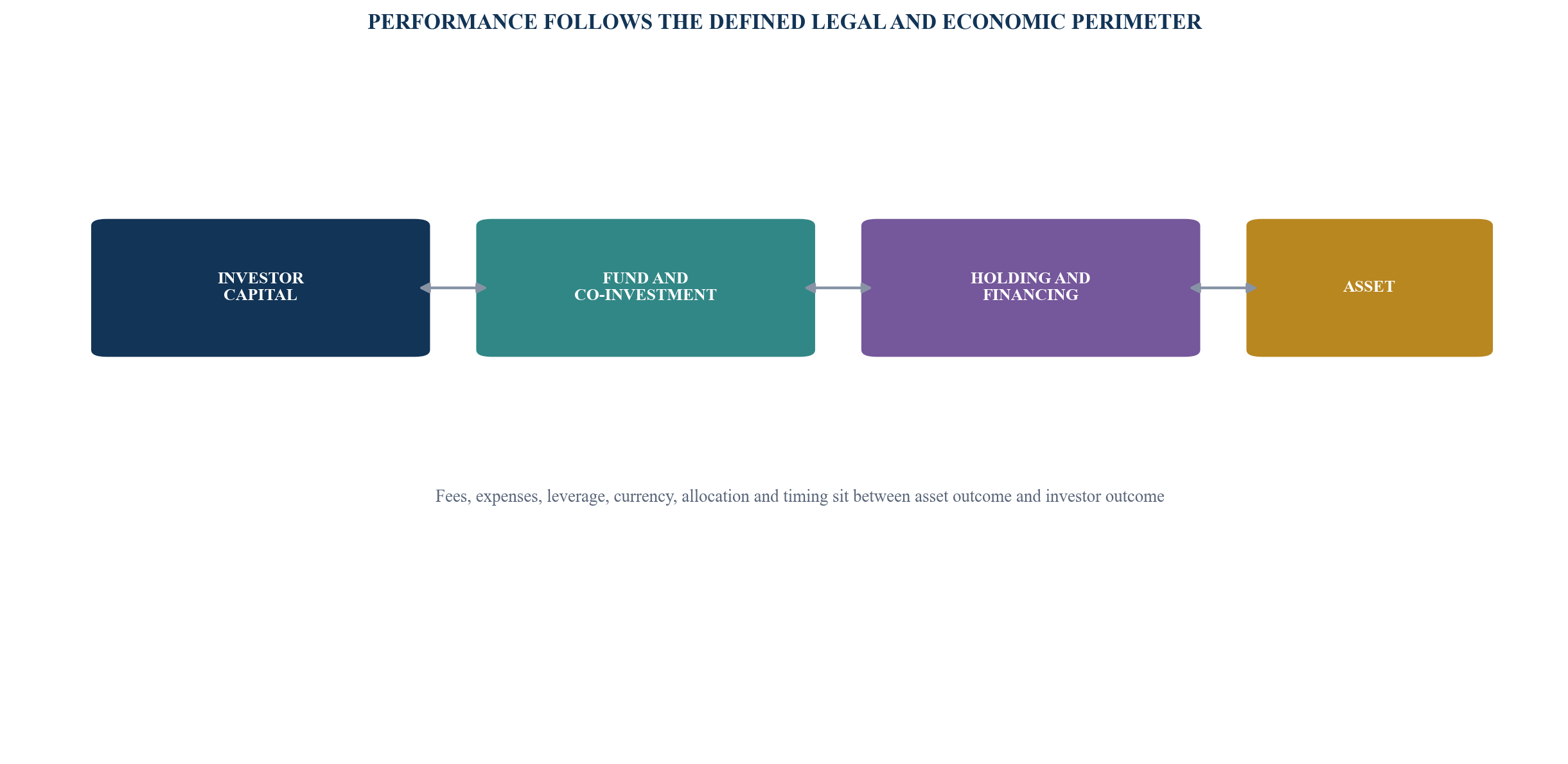
The diagram is illustrative; actual entities, flows and reporting perimeters require transaction-specific evidence.
5. Create one controlled cash-flow ledger
Performance calculation begins with dated cash flows. The controlled ledger records every contribution, acquisition, fee, expense, interest, dividend, repayment, refinancing, follow-on, distribution, sale and residual value relevant to the claim.
Each line stores source document, entity, asset, fund, currency, date, amount, classification, approval and reconciliation status. The ledger preserves original currency and records the translation rate used for the reporting currency.
Bank and administrator records generally provide stronger evidence than a presentation model. The ledger should reconcile to audited or approved financial statements and explain differences. Timing conventions and non-cash events require documented treatment.
Subscription facilities can change measured timing between fund cash and investor capital calls. The presentation should state the treatment and show the methodology required for the intended audience. Asset-level leverage and fund-level leverage are recorded separately.
Fees and expenses need complete classification. Gross deal performance may exclude management fees, carried interest and fund expenses. Net investor performance should follow the applicable legal and methodological definition.
The ledger should be immutable at source level. Corrections are recorded through controlled adjustments with reason, reviewer and date. Calculations draw from approved views rather than overwriting original inputs.
The cash-flow certificate states the population reconciled, unresolved items and financial statement tie-out. A return should not be released when material flows remain unsupported.
6. Govern realised and unrealised value separately
Realised cash has completed a transaction path. Unrealised value is a measurement at a date. Both can inform performance, while their evidence and uncertainty differ.
The valuation register records asset, instrument, ownership, valuation date, method, inputs, source data, adjustments, reviewer, approval and subsequent events. It links every reported residual value to the relevant pack.
The 2025 IPEV Guidelines state current best-practice recommendations for fair-value measurement of private-capital investments and apply across venture, buyout, infrastructure, credit and fund investments. Applicable accounting and regulatory requirements take precedence.
Early deals frequently rely on financing rounds or transaction prices. Those data points require an assessment of instrument rights, transaction circumstances, market conditions and time elapsed. A recent price is evidence, not an automatic answer.
Operational metrics, market multiples, discounted cash flows, debt values and scenario analysis should reconcile to the selected methodology. Adjustments need a stated rationale and approved source.
The performance output should distinguish realised proceeds, current approved unrealised value, total value and valuation date. It should also state whether values are audited, administrator-reported, manager-approved or otherwise reviewed.
Subsequent events can provide relevant evidence without rewriting historical knowledge improperly. The policy identifies the date at which information became available and the treatment used.
Table 2. Valuation-evidence hierarchy
| Evidence layer | Example | Control question | Disclosure consequence |
|---|---|---|---|
| realised transaction | completed cash sale or repayment | did cash settle and reconcile? | report realised amount and date |
| external transaction | arm's-length financing or secondary | are rights and circumstances comparable? | explain calibration and differences |
| market evidence | comparable company or transaction data | is selection current and supportable? | identify method and material adjustments |
| operating evidence | revenue, margin, users or contracts | is source complete, current and approved? | state period and link to valuation method |
| model evidence | forecast or discounted cash flow | are assumptions controlled and tested? | identify uncertainty and key inputs |
| manager judgement | scenario or specific adjustment | is rationale documented and challenged? | disclose material judgement where required |
Evidence strength depends on the circumstances; this hierarchy does not prescribe a valuation method.
7. Calculate gross and net on controlled definitions
Gross and net performance answer different questions. Their calculation and presentation should use documented definitions that match the applicable framework and audience.
Gross deal return can measure investment value before fund-level fees and carry. Net fund return can measure investor economics after defined fees, expenses and carried interest. Other measures include multiple of invested capital, distributed to paid-in capital, residual value to paid-in capital, total value to paid-in capital and public-market comparisons.
The calculation policy defines dates, day count, sign convention, currency, fee treatment, leverage, recalls, recycling, escrow, tax, write-offs and valuation. It also defines how partial realisations and follow-ons are allocated.
Current SEC marketing FAQs address gross and net performance, extracted performance and model fees under the US marketing rule. The FAQ updated in January 2026 explains staff views and expressly states that it has no legal force or effect. The actual rule and current advice govern a live communication.
Current FCA rules contain requirements for past-performance information in relevant communications, including period, prominence, warnings and treatment of fees under the applicable provisions. Current DFSA COB materials require fair and balanced past-performance information targeted at Retail Clients, identifiable sources and assumptions, and a prominent warning.
The calculation engine should produce reproducible outputs from the approved ledger. An independent reviewer reruns the calculation and compares it with published figures.
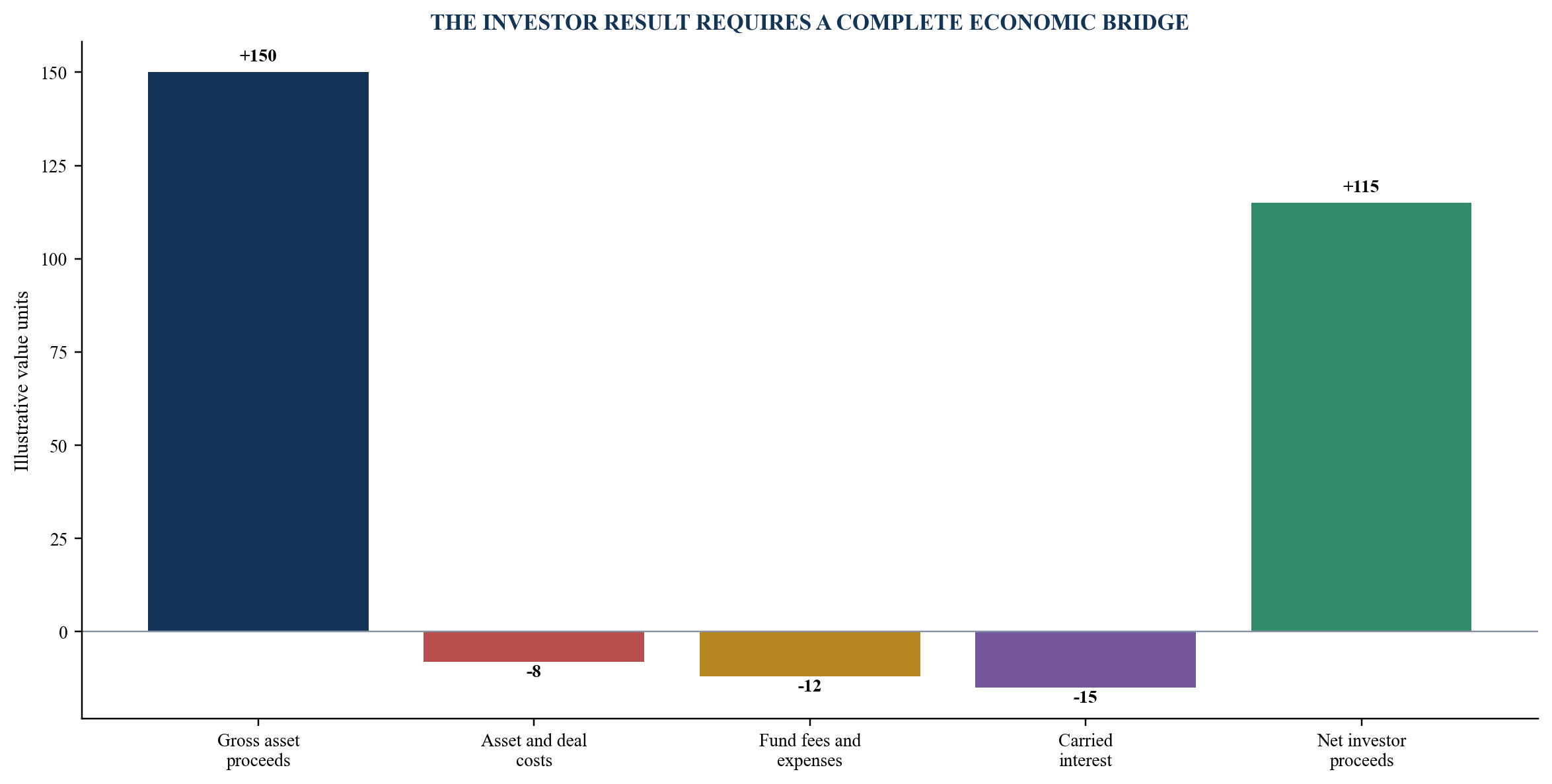
Values are management assumptions used to demonstrate the reconciliation method; they are not actual performance.
8. Treat extracted and selected performance as a governed subset
Emerging managers often use selected deals because a complete fund history is short, belongs to a predecessor or includes a wider strategy. Selected deals can be informative when the subset is defined and presented fairly.
The selection rule should be written before results are viewed. It can identify deals led by the current team, a target sector, instrument, geography, vintage or realised status. The rule should include weak and written-off deals when they meet the definition.
The presentation should state how many deals exist in the complete relevant population, how many are shown, why they were selected and what the subset does not represent. A case study can explain decision process without becoming a claim about a fund return.
Extracted performance has jurisdiction-specific requirements. Current SEC staff FAQs discuss an investment or group of investments extracted from a private fund or portfolio and conditions related to gross and net presentation under the cited framework. A live US advertisement needs current rule analysis.
Cherry picking can also occur through time periods, metrics, currencies and valuation dates. The claim register controls these dimensions.
The extracted-performance file links every selected item to population, selection rule, calculation, disclosures and approval. Reviewers should be able to reproduce the subset without knowing which deals performed best.
9. Build individual role attribution from contemporaneous evidence
Individual attribution should describe work performed and decision authority rather than assign a synthetic percentage of credit to each person.
The role taxonomy can include origination, relationship ownership, screening, commercial diligence, financial underwriting, structuring, negotiation, investment-committee preparation, vote, board service, portfolio support, follow-on, restructuring and exit.
Evidence includes investment papers, version history, emails, committee minutes, approval logs, board records, deal-team lists, operating plans and legal documents. Interviews can clarify the record; they should be identified as recollection where contemporaneous evidence is unavailable.
Committee attendance does not establish sponsorship. Board membership does not establish responsibility for every operating outcome. Origination does not establish underwriting or final approval. The role file should state the actual contribution and the governance context.
The taxonomy also records dates. A professional can join after acquisition, leave before exit or contribute only during a restructuring. Attribution should match the period.
The evidence score can express record completeness, not investment skill. A high score indicates a well-supported role file. A low score limits the claim.
Individuals and predecessor firms can hold contractual confidentiality, intellectual-property or data rights. Permission to retain or use records should be confirmed before building the evidence room.
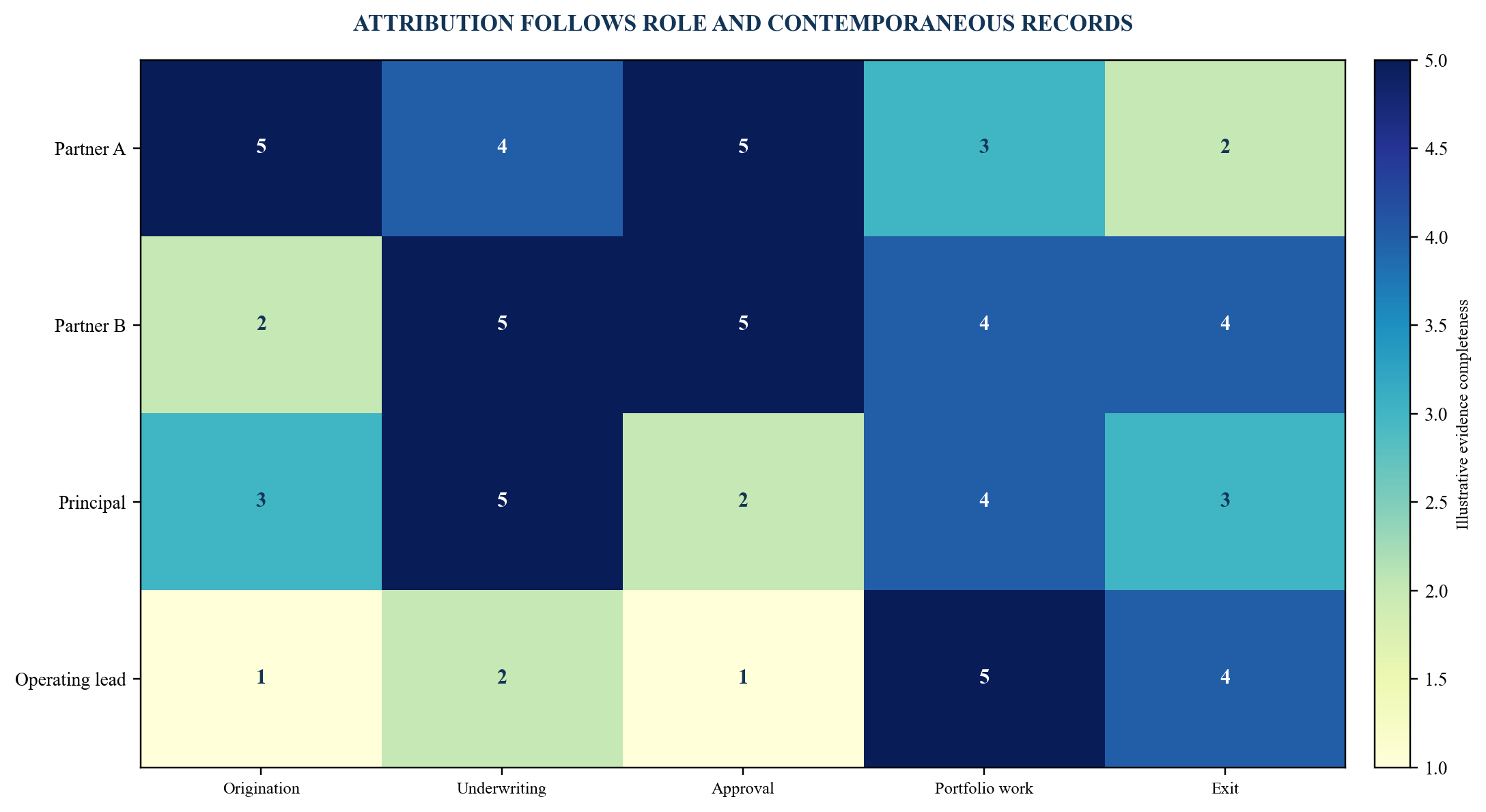
Scores show hypothetical evidence completeness, not credit for investment performance.
10. Govern predecessor and portable performance
Professionals often launch a firm after investing at another organisation. Their experience can be relevant to investors, while the prior firm's performance cannot simply be relabelled.
The predecessor map identifies the employing entity, portfolio owner, decision process, investment team, records, calculation policy, continuity and rights. It separates biographical experience from firm-level performance.
CFA Institute's current materials describe conditions under which performance from a past firm or affiliation may be linked under the GIPS standards, including decision-maker continuity, an intact decision process, supporting records and no break in the track record. A firm claiming GIPS compliance must meet all applicable requirements.
CFA Institute's Standard III(D) guidance also addresses fair, accurate and complete performance presentation and discusses prior-firm records with appropriate disclosure of where performance occurred and the person's specific role.
Regulatory marketing rules can impose different or additional conditions. Contractual confidentiality and data ownership can restrict records. The new firm should obtain permission and advice rather than assume that participation creates ownership.
Where complete portability is unavailable, the manager can present verified biographies, role-based case studies and clearly identified predecessor experience. The output should avoid implying that the new firm existed during the prior period.
The portability memo records the applicable standard, facts, supporting records, permission, disclosures and approved form of use.
Table 3. Predecessor-performance decision file
| Test | Evidence question | Possible outcome | Control output |
|---|---|---|---|
| legal ownership | who owns and may use the records? | permitted, restricted or unavailable | permission and data-rights memo |
| team continuity | which decision makers moved? | substantial, partial or limited continuity | named role and employment record |
| process continuity | did the decision process remain intact? | linked, changed or reconstructed process | governance comparison |
| record completeness | can results be reproduced? | complete, partial or unsupported | source and calculation certificate |
| time continuity | is there a break in the record? | continuous or interrupted | dated chronology |
| disclosure | can audience understand the predecessor boundary? | approved, revised or prohibited claim | controlled wording and channel |
The table is a diligence framework; current rules, standards, contracts and professional advice determine the permitted use.
11. Reconcile track record with the target strategy
Historical experience is most useful when its relevance to the proposed strategy is explicit. Similarity should be demonstrated rather than asserted.
The strategy bridge compares sector, geography, stage, instrument, ownership, ticket, leverage, sourcing, governance, value creation, holding period, currency, return source and risk. It identifies matches, differences and missing experience.
A senior credit professional moving into control equity has transferable underwriting experience and a material strategy difference. A Gulf real-estate investor launching a European infrastructure fund has transaction skills and different assets, rules, counterparties and risks.
The bridge can classify evidence as direct, adjacent or contextual. Direct evidence closely matches the proposed decision system. Adjacent evidence supports selected capabilities. Contextual evidence informs judgement without establishing a track record for the new strategy.
The proposed portfolio construction should not be backfilled into historic deals. A new concentration limit, leverage policy or sustainability screen does not change how predecessor investments were selected.
Institutional diligence should see the gap and the mitigation. Mitigation can include hires, committees, partners, limits, advisers, pilot investments and a staged first fund.
The strategy-relevance memo prevents a collection of impressive but unrelated deals from being presented as a coherent product history.
12. Preserve denominator, benchmark and currency integrity
Performance can change materially through denominator, timing, benchmark and currency choices. These choices require documented policy.
Invested capital, committed capital, called capital, cost and net asset value answer different questions. Multiples should identify numerator and denominator. A gross multiple calculated on invested deal cost should not be compared casually with a net fund multiple on paid-in capital.
Internal rate of return is sensitive to timing. Subscription facilities, delayed calls, early distributions and partial realisations can affect it. Multiple measures can provide complementary context.
Benchmark selection should follow strategy, geography, currency, period and liquidity. A public-market equivalent can support comparison when methodology and cash-flow treatment are explained. It does not turn a private asset into a liquid public investment.
Currency presentation identifies local, fund and investor reporting currency and the exchange-rate source. Currency gains or losses should remain visible where material.
Inflation and leverage can also affect interpretation. The disclosure should identify whether return arose from operating change, market movement, financing, currency or timing where the evidence supports that analysis.
Methodology changes require controlled restatement, reason and version history. A manager should not select whichever method produces the strongest outcome for each deal.
13. Build attribution around value drivers and decision evidence
Performance attribution in private markets can decompose value change into supported drivers. It should not imply a precision that the data cannot support.
Possible drivers include revenue growth, margin change, multiple movement, debt paydown, acquisitions, dilution, currency, distributions and time. Credit investments can use carry, fees, spread movement, amortisation, recovery and currency. Real assets can use income, occupancy, development, cap-rate movement, financing and currency.
The opening and closing values need consistent perimeter and dates. Intermediate flows and follow-ons should be reconciled. Driver order can affect a bridge, so methodology should be fixed and disclosed.
Management and market contributions can interact. Revenue growth may reflect team execution and market demand. Multiple movement may reflect asset quality and market conditions. The analysis should avoid claiming causality beyond evidence.
Decision attribution then connects supported drivers to the investment thesis, board actions and operating initiatives. A board slide stating an aspiration is weaker than an approved action with measured implementation.
The output can identify evidenced contribution, shared contribution and external effect. It should retain unresolved drivers rather than allocating every value unit.
The investment lessons file records thesis, evidence, decision, result and counterfactual. This makes the track record useful for current investment governance as well as fundraising.
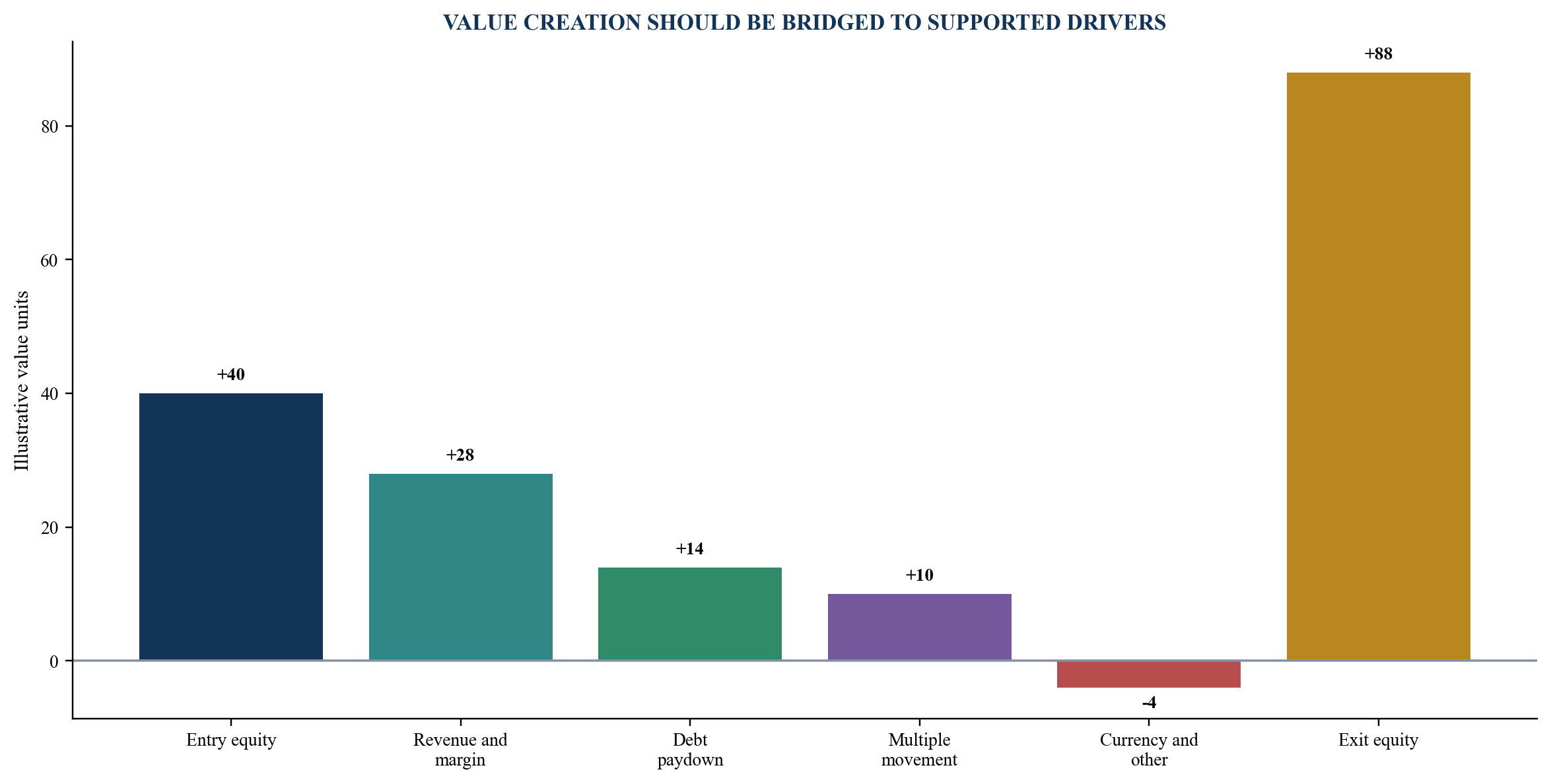
Values and classifications are management assumptions used to demonstrate the method; they do not describe an actual investment.
14. Design case studies as controlled evidence products
A case study combines decision context, role, evidence, result and lessons. It should remain traceable to the complete performance file.
The opening section defines investment date, security, ownership, strategy, thesis, governance and approved role. Sensitive company information is included only with appropriate rights and confidentiality treatment.
The underwriting section states the evidence and assumptions available at the decision date. It separates contemporary knowledge from later outcomes.
The execution section records follow-ons, governance, operating actions, financing, risk events and material decisions. It distinguishes manager action from company management and external market effects.
The result section presents cash flows, realised proceeds, residual value, valuation date, gross or net basis, currency and calculation. The case study should identify whether it is part of a wider fund and how the fund performed where required and permitted.
The lessons section discusses what worked, what failed and which current process changed. A failed or impaired deal can provide strong institutional evidence when the decision and response are honestly documented.
Every public or diligence version has an owner, approval, audience and expiry or refresh date. Values and descriptions are updated through a controlled process.
Table 4. Institutional deal case-study structure
| Module | Required content | Evidence source | Approval test |
|---|---|---|---|
| context | date, instrument, strategy and thesis | closing and investment records | perimeter and confidentiality confirmed |
| decision | underwriting, alternatives and authority | investment paper and minutes | contemporaneous record reconciled |
| role | named contribution by period | work product and governance record | wording matches evidence |
| execution | follow-on, governance and operating actions | board and portfolio records | company and manager roles separated |
| result | cash, value, metric, currency and date | ledger and valuation pack | calculation independently rerun |
| lessons | result, error, response and current change | post-investment review | balanced and approved narrative |
Content and disclosure should be tailored to the rights, audience and applicable communication rules.
15. Create an institutional DDQ evidence room
The evidence room should answer the next diligence question without exposing material outside the permitted perimeter.
Core modules include firm definition, strategy, team, portfolio population, fund and deal cash flows, valuation, calculations, attribution, compliance policy, approvals, case studies and reference materials. A claims index links every external number to its source file and calculation version.
ILPA's published DDQ provides institutional diligence prompts across organisation, team, strategy, performance, governance, operations and related topics. A manager should answer the applicable questions from controlled evidence and identify gaps.
Access levels distinguish public, prospect, advanced diligence, adviser, verifier and restricted material. Confidential company, investor and employee records require appropriate controls.
The question log records request, response, source, owner and approval. New facts or corrections feed back into the source record rather than creating uncontrolled side versions.
The room should preserve superseded calculations and explain changes. A corrected return without version history can undermine confidence even when the correction is proper.
The diligence certificate states as-of date, reviewed population, unresolved items, verifier or auditor involvement and limits. Verification status should be described accurately. A firm should not imply GIPS compliance, audit or independent verification without the required basis.
16. Govern marketing, diligence and regulatory use separately
The same performance fact can require different context across channels. The use matrix identifies audience, jurisdiction, communication type, approving entity, required disclosures and recordkeeping.
Current SEC marketing materials describe general prohibitions and specific performance requirements for advertisements by registered or required-to-register advisers under the relevant US rule. Current staff FAQs provide views on extracted performance, gross and net calculations and model fees.
Current FCA COBS materials include rules for past performance in relevant communications and financial promotions. Current DFSA COB 3.2.6 addresses past-performance and forecast information targeted at Retail Clients, including fair balance, source, assumptions and a warning. Other DIFC provisions and fund-specific rules can apply.
Jurisdiction and client classification matter. A communication to an institutional allocator can sit within a different regime from a public website. Cross-border access can introduce more than one perimeter.
The claim approval process includes legal and compliance review where required, calculation sign-off, source lock, disclosure, audience, channel and expiry date. Approved wording is versioned.
Social-media excerpts should not detach a performance number from material context. A link to a longer document may not cure every issue. The communication should be designed for its actual medium and audience.
Table 5. Performance-claim use matrix
| Use | Evidence minimum | Context control | Release gate |
|---|---|---|---|
| internal investment review | source ledger and role file | decision and lessons | investment governance approval |
| institutional DDQ | complete population and methodology | fund, team and predecessor boundaries | diligence and compliance approval |
| private presentation | approved numbers and disclosures | audience and jurisdiction | authorised release version |
| public website | public rights and complete context | access, promotion and update controls | legal and compliance approval |
| social excerpt | independently understandable statement | limits, link and medium | channel-specific approval |
| regulatory or verifier file | source records and version history | complete audit trail | responsible owner certification |
This planning matrix does not determine whether a communication is permitted; current jurisdiction-specific advice is required.
17. Build a claim-control and refresh process
Performance changes as cash flows settle, valuations update, funds close and roles change. A claim needs an as-of date and refresh rule.
The claims register stores claim text, metric, source, calculation version, disclosure, owner, approver, audience, channel, publication date and next review. It also records where the claim appears.
Triggers include quarter-end valuation, audit, realisation, financing, write-down, restatement, team departure, predecessor permission change, regulatory update and new use. A trigger can require update, suspension or withdrawal.
The published-content inventory makes corrections executable. Website, deck, DDQ, data room, profile, database and social content can otherwise retain inconsistent versions.
Material errors are escalated through a defined process. The firm records impact, affected audience, correction, communication and control change. A correction should not silently replace the record where notification is required.
The approval committee should include investment, finance, valuation, compliance and communications expertise. Independence and escalation should reflect the firm's scale and applicable duties.
The control process also archives support. Current DFSA materials contain recordkeeping requirements for relevant marketing materials and activities. Other jurisdictions impose their own retention obligations.
18. Use external review accurately
External review can strengthen confidence when its scope is understood. Audit, valuation review, calculation assurance, GIPS verification and legal review cover different questions.
A fund audit addresses financial statements under its engagement and standards. It does not automatically approve a marketing presentation or an individual's deal attribution.
An independent valuation review can assess methods, inputs and conclusions. It does not establish cash-flow completeness or communication compliance.
A calculation review can rerun returns from a supplied ledger. Its value depends on the population and source evidence supplied.
GIPS verification assesses firm-wide policies and procedures within the applicable standards and verification scope. A manager should describe the verification precisely and avoid implying broader assurance.
Legal or compliance review addresses a defined communication, rules and facts. It should receive the complete claim file and intended audience.
The assurance map records provider, scope, period, standard, exceptions and report. External-provider names should not appear as endorsement without permission.
The board should prioritise review where the claim is material, complex, public, cross-border or dependent on judgement. Internal controls remain necessary after external work.
19. Run a ten-day track-record diagnostic
Days one and two define intended strategy, audiences, jurisdictions, claim levels and current materials. The team freezes existing decks, DDQs, biographies and website claims for reconciliation.
Days three and four reconstruct funds, portfolios, deals, cash flows, valuations, entities and predecessor boundaries. Missing and conflicting evidence enters the exception log.
Days five and six build role attribution, decision chronology, strategy relevance and permissions. Current advisers identify jurisdictional requirements and prohibited or conditional uses.
Days seven and eight recalculate metrics, reconcile financial statements, test gross and net definitions and draft balanced case studies. Reviewers rerun calculations independently.
Days nine and ten deliver the population certificate, claims register, track-record schedule, role matrix, case-study templates, disclosure library, evidence-room index and remediation plan.
The output grades claims as approved, approved with disclosure, internal only, pending evidence or unavailable. It should preserve unavailable claims rather than manufacture precision.
Commercial qualification requires a live fundraising, product-launch, strategic transaction or institutional diligence decision; an accountable sponsor; access to records; current advisers; budget; and a decision calendar. A request to improve a biography alone does not establish a full evidence mandate.
The diagnostic can be followed by reconstruction, external review, DDQ production, data-room implementation and a recurring claims office within agreed responsibilities.
20. Operate a recurring performance-claims office
A recurring office coordinates investment, finance, valuation, operations, compliance, legal, communications, administrators, auditors and external reviewers.
It maintains the deal population, cash-flow ledger, valuation register, role files, methodology, claim inventory, approvals, source archive, DDQ responses and published-content map.
The quarterly cycle starts with cash and valuation close, reconciles calculations, updates role and event records, reruns claims, obtains approvals and refreshes controlled materials. Event-driven review handles realisations, write-downs, errors, people changes and regulatory developments.
The weekly forum during fundraising resolves diligence questions and evidence gaps. It distinguishes a fact request from a new claim and routes each response through the approved source.
Board reporting covers verified performance, unrealised exposure, evidence completeness, exceptions, approvals, expired claims and external-review status. Investor demand, mandate probability and collected fees remain separate commercial evidence.
Retainer scope should identify the paid decision, portfolio perimeter, deliverables, cadence, client records, adviser roles, exclusions, acceptance and fee. Demand and fee outcomes remain unverified until supported by signed and paid engagements.
The institutional value of a track record lies in reproducibility and relevance. Cash flows establish the economic record. Valuation states what remains unrealised. Decision files show how judgement operated. Role evidence describes who did what. Methodology makes the result comparable. Disclosure explains the limits. Approval determines where the claim can be used.
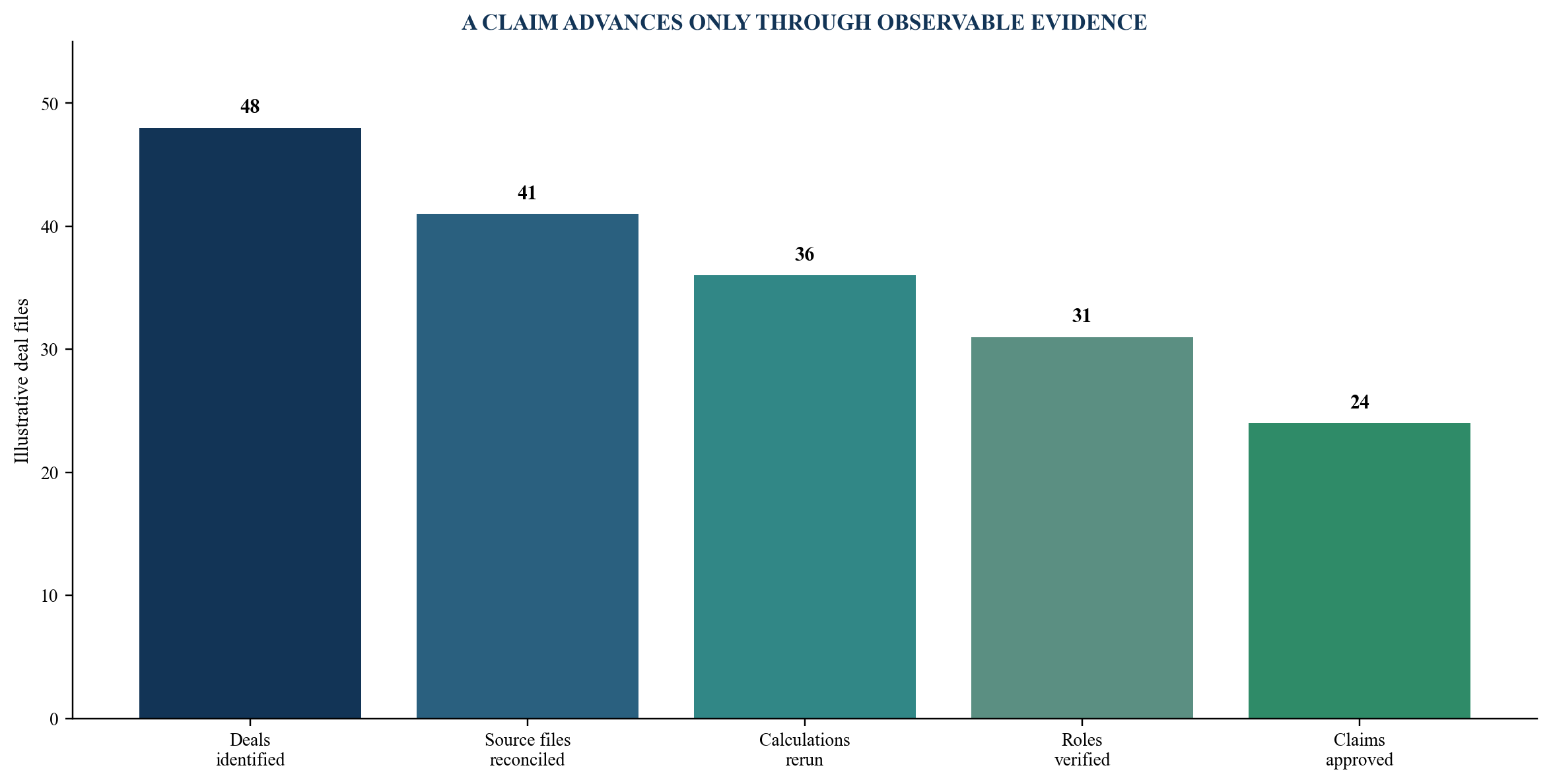
Counts are management assumptions used to demonstrate evidence gates; they do not describe an actual portfolio.
Table 6. Recurring performance-claims office
| Cadence | Review | Evidence | Decision output |
|---|---|---|---|
| daily during active diligence | questions, claims and source gaps | controlled Q&A and claim file | approved response or escalation |
| weekly | population, exceptions and publications | claims register and issue log | owner actions and release status |
| quarterly | cash, valuation and calculations | ledger, valuation pack and rerun | refreshed performance schedule |
| semi-annual | role, strategy and predecessor status | governance and permission records | attribution and disclosure update |
| annual | methodology, controls and assurance | policy, audit and reviewer reports | board certification and remediation |
| event-driven | exit, write-down, error or team change | transaction and incident evidence | update, suspension or correction |
Cadence, review and authority should reflect the firm, funds, communications and applicable requirements.
References
- Dubai Financial Services Authority. COB 3.2.6: Past Performance and Forecasts. https://dfsaen.thomsonreuters.com/rulebook/cob-326
- Dubai Financial Services Authority. COB 3.2: Communication of Information and Marketing Material. https://dfsaen.thomsonreuters.com/rulebook/cob-32-communication-information-and-marketing-material
- Dubai Financial Services Authority. Conduct of Business Module, current version. https://dfsaen.thomsonreuters.com/entiresection/12383
- United Kingdom Financial Conduct Authority. COBS 4: Communicating with Clients, Including Financial Promotions. https://www.handbook.fca.org.uk/handbook/COBS/4.pdf
- United Kingdom Financial Conduct Authority. PERG 8: Financial Promotion and Related Activities. https://handbook.fca.org.uk/handbook/perg8
- United Kingdom Financial Conduct Authority. Financial Promotions and Adverts. https://www.fca.org.uk/firms/financial-promotions-adverts
- United States Securities and Exchange Commission. Marketing Compliance: Frequently Asked Questions, updated January 15, 2026. https://www.sec.gov/rules-regulations/staff-guidance/division-investment-management-frequently-asked-questions/marketing-compliance-frequently-asked-questions
- United States Securities and Exchange Commission. Investment Adviser Marketing: Small Entity Compliance Guide. https://www.sec.gov/resources-small-businesses/small-business-compliance-guides/investment-adviser-marketing
- United States Securities and Exchange Commission. Investment Adviser Marketing Rule, Release IA-5653. https://www.sec.gov/files/rules/final/2020/ia-5653.pdf
- CFA Institute. Overview of the Global Investment Performance Standards. https://www.cfainstitute.org/insights/professional-learning/refresher-readings/2026/overview-of-the-global-investment-performance-standards
- CFA Institute. GIPS Standards: Performance Ethics and Reporting. https://rpc.cfainstitute.org/gips-standards
- CFA Institute. Standard III(D): Performance Presentation. https://www.cfainstitute.org/standards/professionals/code-ethics-standards/standards-of-practice-iii-d
- CFA Institute. GIPS Standards Compliance Tools for Firms. https://rpc.cfainstitute.org/gips-standards/tools-and-resources
- Institutional Limited Partners Association. Due Diligence Questionnaire 2.0. https://ilpa.org/wp-content/uploads/2021/11/ILPA-DDQ-2.0.pdf
- Institutional Limited Partners Association. Reporting Template. https://ilpa.org/reporting-template/
- International Private Equity and Venture Capital Valuation Board. 2025 IPEV Valuation Guidelines. https://www.privateequityvaluation.com/Portals/0/Documents/Guidelines/2025%20IPEV%20Valuation%20Guidelines.pdf
About the Author
Chennakeshav Adya, Independent Researcher
