

1. Define the transaction value-creation office
The transaction value-creation office is the controlled bridge between transaction evidence and operating delivery. Its mandate begins when diligence findings can still influence valuation, financing, contractual terms and readiness; it continues through signing, closing, Day 1, the 100-day period and the first board-confirmed benefit cycle. The office owns the integrity of the value chain while business executives own the underlying decisions and results.
The office should answer six questions for every material issue. What evidence supports the finding? What does the finding change in the investment thesis or valuation? Which legal or commercial treatment is required before closing? Which operating control must function on Day 1? Which action will resolve, exploit or monitor the issue? Which evidence will allow finance and the board to confirm the result? A finding without those links remains analysis; an action without those links can consume management time without protecting or creating transaction value.
The TVCO is distinct from a conventional project-management office. A project-management office can coordinate tasks, deadlines and dependencies. The TVCO adds economic logic, source traceability, decision rights, contractual obligations, benefit accounting and risk acceptance. It should be able to reconstruct why an initiative exists, who accepted the underlying risk, which baseline applies, what costs were authorised and how an outcome changes the transaction case.
The office is also distinct from the integration leader. The integration leader directs execution across functions and businesses. The TVCO supplies the governed register, cadence and evidence that keep execution connected to the approved deal thesis. In a smaller transaction, one team can perform both roles if responsibilities remain explicit and independent review is preserved where required.
Table 1. Evidence states in the transaction value chain
| Evidence state | Minimum record | Permitted decision | Control requirement |
|---|---|---|---|
| observed signal | source, date, scope and limitation | commission further work | preserve source and restrict circulation |
| supported finding | corroborated evidence and quantified exposure range | adjust thesis or assign treatment | reviewer and confidence assessment |
| approved transaction response | investment-committee, board or delegated decision | price, protect, condition, accept or withdraw | authority and rationale retained |
| executable commitment | SPA term, closing condition, Day 1 control or funded initiative | mobilise accountable owner | legal and operating traceability |
| delivered result | completed action and operating evidence | recognise controlled progress | finance and risk review |
| verified benefit or resolved risk | baseline comparison and approved evidence | report to board and update thesis | anti-double-counting and audit trail |
A finding advances only when its evidence, decision and ownership are explicit.
2. Freeze the transaction thesis and decision baseline
The TVCO requires a frozen transaction baseline because execution cannot be governed against a moving narrative. The baseline should record strategic rationale, valuation case, financing assumptions, stand-alone plan, expected control premium or discount, synergy categories, dis-synergies, one-time costs, timing, regulatory remedies, separation dependencies, material risks and conditions. The baseline should identify which claims were approved, which remained provisional and which were excluded from valuation.
The stand-alone case matters because a combined result can appear favourable while the acquired business underperforms the plan used to justify price. The office should preserve buyer, target and transaction cases separately. It records source systems, forecast date, management owner, accounting basis, currency, perimeter and known adjustments. Later performance should be compared with the relevant baseline, with changes approved and explained rather than silently rebased.
The baseline should distinguish value protection from value creation. Avoiding a customer loss, tax exposure, cyber incident or covenant breach protects value. Procurement consolidation, pricing improvement, cross-selling, working-capital release or footprint redesign may create incremental value. Both matter, while their evidence and recognition rules differ. A prevented loss is usually a risk outcome and should not be added mechanically to recurring earnings benefits.
The investment committee or board should approve the baseline before execution reporting begins. Approved changes require a dated change log that records reason, evidence, economic effect and authority. Foreign exchange, commodity prices, interest rates, accounting changes and market demand can change results without reflecting management delivery. The benefit ledger should therefore separate controllable execution from external movement.
3. Convert diligence into a single value map
Diligence workstreams often produce separate red-flag reports. The TVCO should convert them into one diligence-to-value map. Each material finding receives a unique record with source, fact pattern, affected perimeter, confidence, financial range, timing, interdependency, legal privilege or clean-team restriction, decision owner and recommended treatment. The record links to source evidence without copying sensitive material beyond authorised access.
The map classifies findings into seven dispositions: price adjustment; financing or covenant treatment; SPA representation, warranty, indemnity or covenant; condition precedent or regulatory remedy; Day 1 control; 100-day initiative; and monitored risk acceptance. A finding can require more than one disposition. A cyber weakness may affect price, require a specific indemnity, trigger a Day 1 access control and create a remediation initiative. The map preserves those connections.
Materiality should be multidimensional. A finding with a modest expected financial value can still be material because it can stop closing, breach law, interrupt cash, damage a critical customer relationship or prevent financial reporting. The TVCO can score economic consequence, control severity, probability range, reversibility, time to impact and critical-path effect. Scores support prioritisation; they do not replace judgement or professional advice.
The map should also record negative findings that were investigated and closed. This avoids repeated work, supports disclosure consistency and shows the basis for a decision. A closed finding needs evidence, reviewer and reopening trigger. The office should never describe an absence of evidence as evidence of absence.
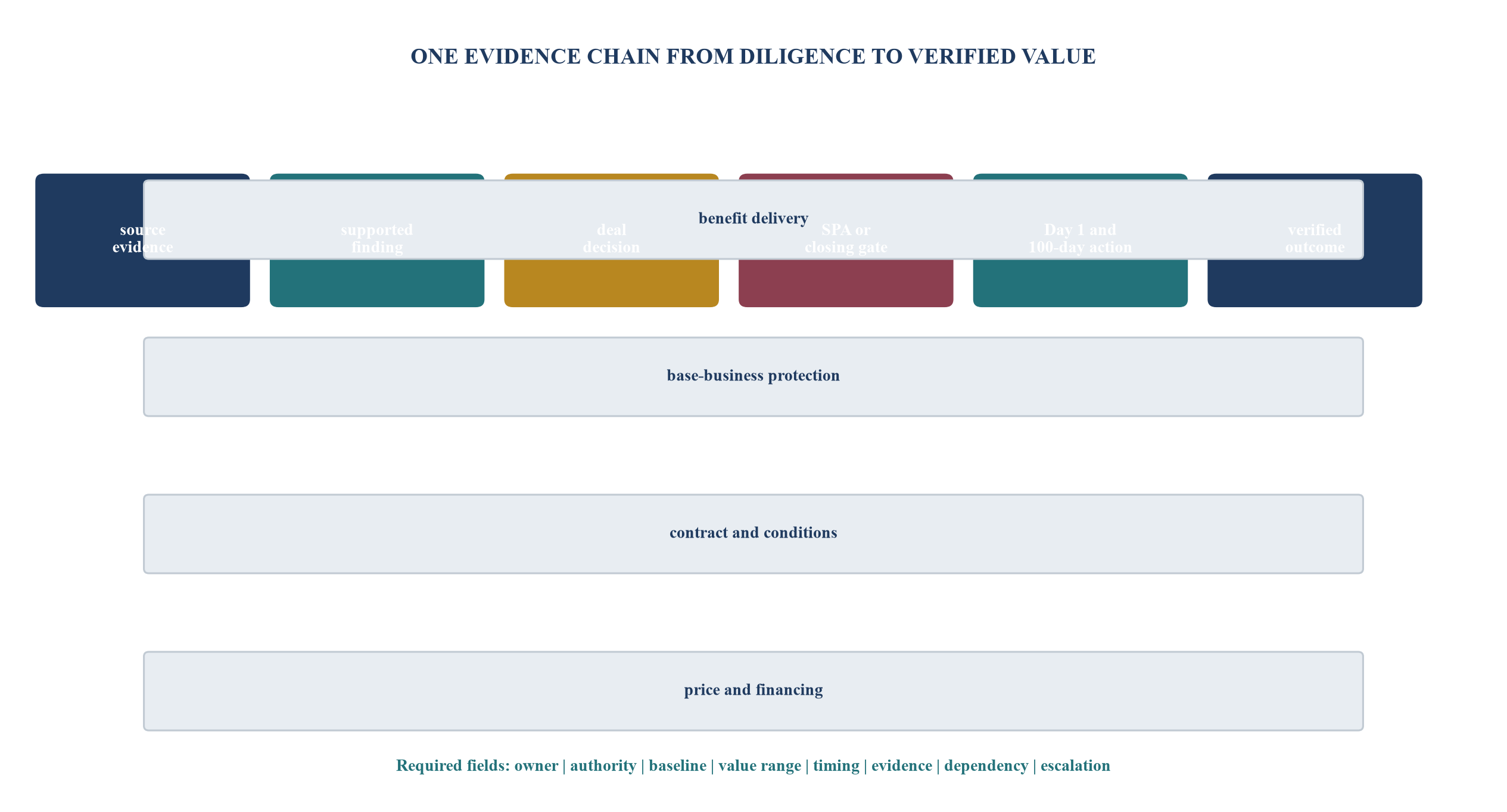
Every material finding retains its source while moving through transaction and operating decisions.
4. Decide how each finding changes the transaction
A material finding should reach a decision forum while there is still time to act. The decision can change price, structure, financing, contract, closing conditions, integration scope, management capacity or the decision to proceed. The TVCO prepares a concise disposition paper showing evidence, uncertainty, downside range, available responses, residual exposure, timing and recommended authority.
Price treatment should avoid false precision. A recurring earnings issue may affect maintainable EBITDA, multiple, debt capacity and covenant headroom. A one-time remediation cost may affect cash consideration or completion accounts. A contingent exposure may require escrow, holdback, insurance or indemnity. The office should show the valuation path and prevent the same issue from being reflected twice across price, reserve and benefit assumptions.
Financing treatment connects diligence to liquidity. Lenders may require information, conditions, undertakings, security, insurance, hedging or covenant adjustments. A delayed regulatory approval can extend commitment periods and fees. A working-capital weakness can increase Day 1 liquidity need. The TVCO records the financing consequence beside the underlying finding so that the treasury and legal workstreams operate from the same evidence.
Risk acceptance should be explicit. A decision to proceed without price or contractual protection is still a decision. The record should identify authority, rationale, exposure, mitigation, monitor, trigger and review date. Accepted risk cannot disappear from the integration register merely because it was known before signing.
Table 2. Diligence finding disposition register
| Disposition | Typical use | Required evidence | Primary approval |
|---|---|---|---|
| price adjustment | earnings, cash, debt or capital requirement changes | quantified bridge and valuation effect | investment committee or board |
| financing treatment | liquidity, covenant, security or condition impact | lender and treasury analysis | authorised finance forum |
| SPA protection | contingent or seller-controlled exposure | legal drafting linked to finding | authorised deal and legal forum |
| closing condition | action required before ownership transfers | objective completion evidence | board, counsel and relevant regulator |
| Day 1 control | immediate continuity, cash, access or compliance need | operating design and tested owner | executive sponsor |
| 100-day initiative | remediable or value-creating opportunity | business case, resources and dependencies | value-creation steering forum |
| monitored acceptance | exposure retained with defined tolerance | rationale, trigger and residual-risk owner | designated risk authority |
The live register should record deal-specific evidence, authority and legal treatment.
5. Translate evidence into SPA and closing protection
The SPA should not become a dumping ground for every diligence concern. Legal counsel determines the appropriate drafting and enforceability. The TVCO supplies traceability: which finding prompted the provision, which exposure it addresses, what evidence is required, who monitors compliance and what happens after closing. This prevents contractual protection from becoming disconnected from the operating team that must use it.
Representations and warranties allocate statements of fact and associated remedies. Indemnities can address specified exposures. Covenants govern conduct before or after closing. Conditions precedent control whether completion can occur. Purchase-price mechanisms allocate cash, debt and working-capital outcomes. Escrow, holdback and insurance can support recovery. The proper combination depends on law, bargaining position, materiality and insurability.
The TVCO maintains an SPA protection matrix with provision, finding, value range, survival period, cap, threshold, notice requirement, evidence owner, claim owner and operating dependency. It also distinguishes protection from cure. An indemnity can transfer some financial exposure while the acquired business still needs to remediate the underlying problem.
Closing conditions require objective evidence. The office should define responsible party, dependency, expected completion date, long-stop consequence, waiver authority and verification source. A waiver should record the residual exposure and post-close action. Regulatory commitments and remedies require separate governance because they can constrain integration, data access, customer conduct, divestment or operating design.
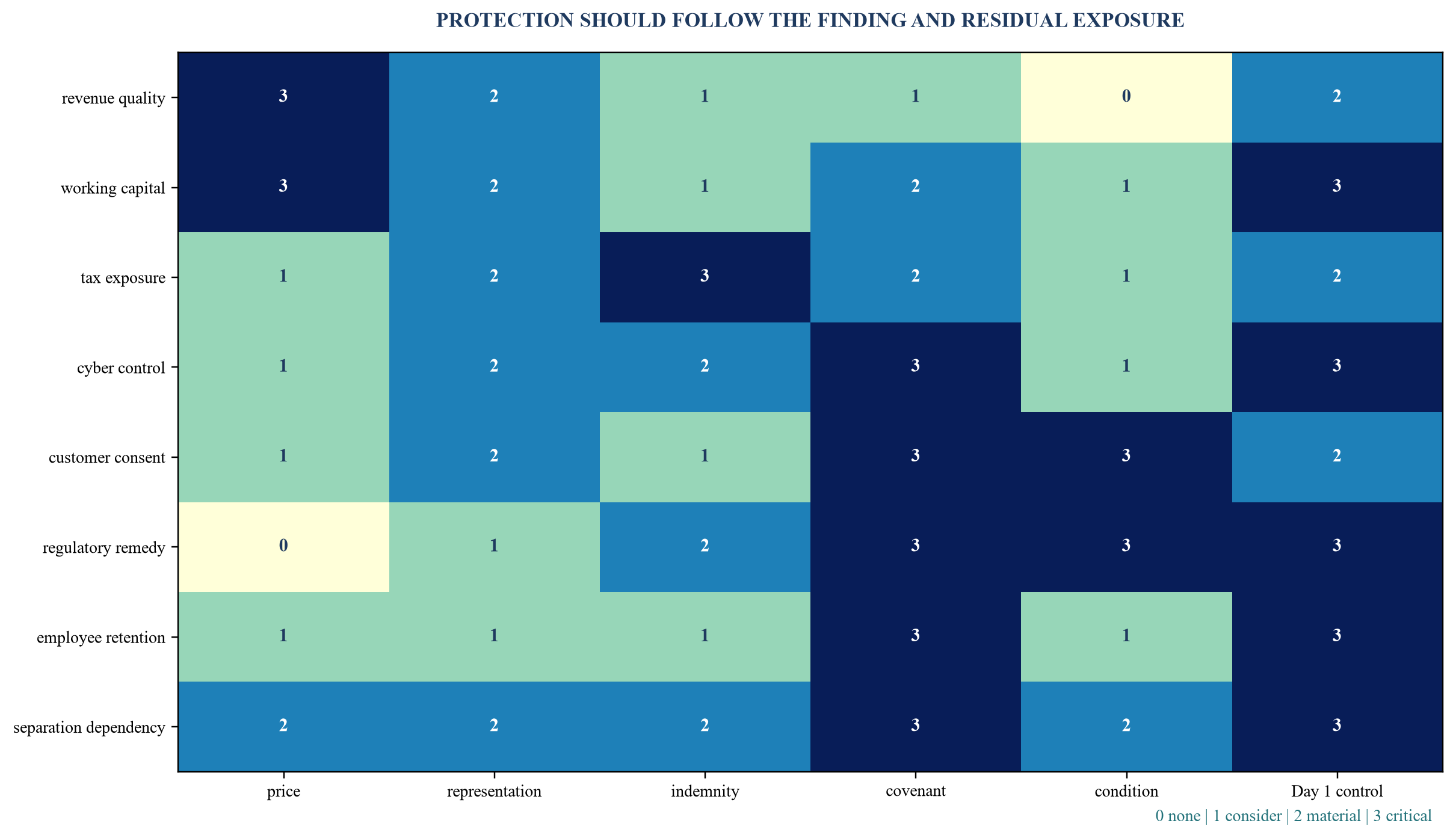
Scores are illustrative. Live drafting and remedies require transaction-specific legal advice.
6. Preserve competition, clean-team and regulatory boundaries
Execution pressure cannot override merger-control, gun-jumping, confidentiality or sector restrictions. The TVCO should maintain a legal-boundary map covering permitted information, clean-team access, competitively sensitive data, pre-closing conduct, integration-planning limits, regulatory filings, national-security review, foreign-investment control, sector approvals and remedies. Counsel defines the rules; the office embeds them in workflows and access.
Current regimes demonstrate why this needs active management. The 2023 US Merger Guidelines describe evidence and analytical frameworks the agencies may use.[1] The FTC's premerger programme states that, following a March 2026 court development, agencies again accept the form and instructions that preceded 10 February 2025, while voluntary use of the newer form remains accepted at the date of this paper.[2] The TVCO should therefore link each filing workstream to the current regulator source rather than relying on a static checklist.
The CMA updated its substantive Merger Assessment Guidelines in June 2026 and its jurisdiction and procedure guidance in December 2025.[3][4] The European Commission lists the EU Merger Regulation and Implementing Regulation 2023/914, corrected by Implementing Regulation 2024/2776.[5] UAE Cabinet Decision No. 3 of 2025 sets notification thresholds at more than AED 300 million of relevant-market UAE sales or more than 40 per cent market share, subject to the governing law and official interpretation.[6]
The office should convert legal advice into operational controls: named clean-team members, secure repositories, approved aggregation, meeting protocols, restricted dashboards, access logs and escalation. Each workstream should know which planning can proceed, which action requires approval and which information cannot be shared. Closing does not automatically remove remedy, ring-fencing or data-use restrictions.
7. Design Day 1 around continuity and control
Day 1 is the first operating test of ownership. The objective is continuity, legal control and confidence. The TVCO should prioritise authority, cash, payroll, customer and supplier continuity, safety, cyber access, regulatory reporting, financial close, insurance, communications, governance and critical talent. Discretionary transformation follows once the base business is stable.
The Day 1 plan should distinguish legal close from operational readiness. Some actions can occur only after control transfers. Others should be prepared, tested and staged before close. The office maintains a cutover register showing dependency, legal permission, owner, rehearsal, go/no-go criterion, fallback, evidence and command-centre escalation.
Banking and payment authority deserve explicit control. The buyer confirms accounts, signatories, dual approval, payment files, fraud checks, liquidity and treasury visibility. Identity and system access require joiner, mover and leaver controls. Communications should be approved for employees, customers, suppliers, regulators, lenders and other stakeholders, with a route for unresolved questions.
Day 1 evidence includes signed authorities, completed access, reconciled opening positions, successful payroll and payment tests, regulatory notifications, communication records and unresolved exception logs. Completion of a checklist item is insufficient where the underlying control has not operated.
8. Sequence the 100-day roadmap
The 100-day plan should translate the transaction thesis into a limited number of governed outcomes. It should protect the base business, satisfy closing and regulatory obligations, validate assumptions, stop leakage, establish operating control and mobilise the highest-confidence value initiatives. A long list of functional activities can obscure the few decisions that determine value.
The roadmap can use four horizons. Days 0 to 10 stabilise control and continuity. Days 11 to 30 validate the baseline, leadership, customer health, liquidity and critical risks. Days 31 to 60 launch approved value initiatives and structural decisions. Days 61 to 100 verify early results, resolve dependencies and refresh the full-year plan. Each initiative has a value hypothesis, owner, resources, dependency, milestone, metric, evidence and escalation.
Sequencing should respect causal order. Customer cross-selling may depend on product readiness, data permissions, incentive design and account ownership. Procurement savings may depend on contract terms, specification harmonisation and service risk. Organisation changes may depend on consultation, retention and leadership appointments. The TVCO maps those dependencies and prevents benefits from being scheduled before enabling work.
The plan should include stop decisions. If evidence invalidates a value hypothesis, management should close or redesign the initiative rather than maintain an artificial green status. Releasing resources from weak initiatives is an execution outcome.
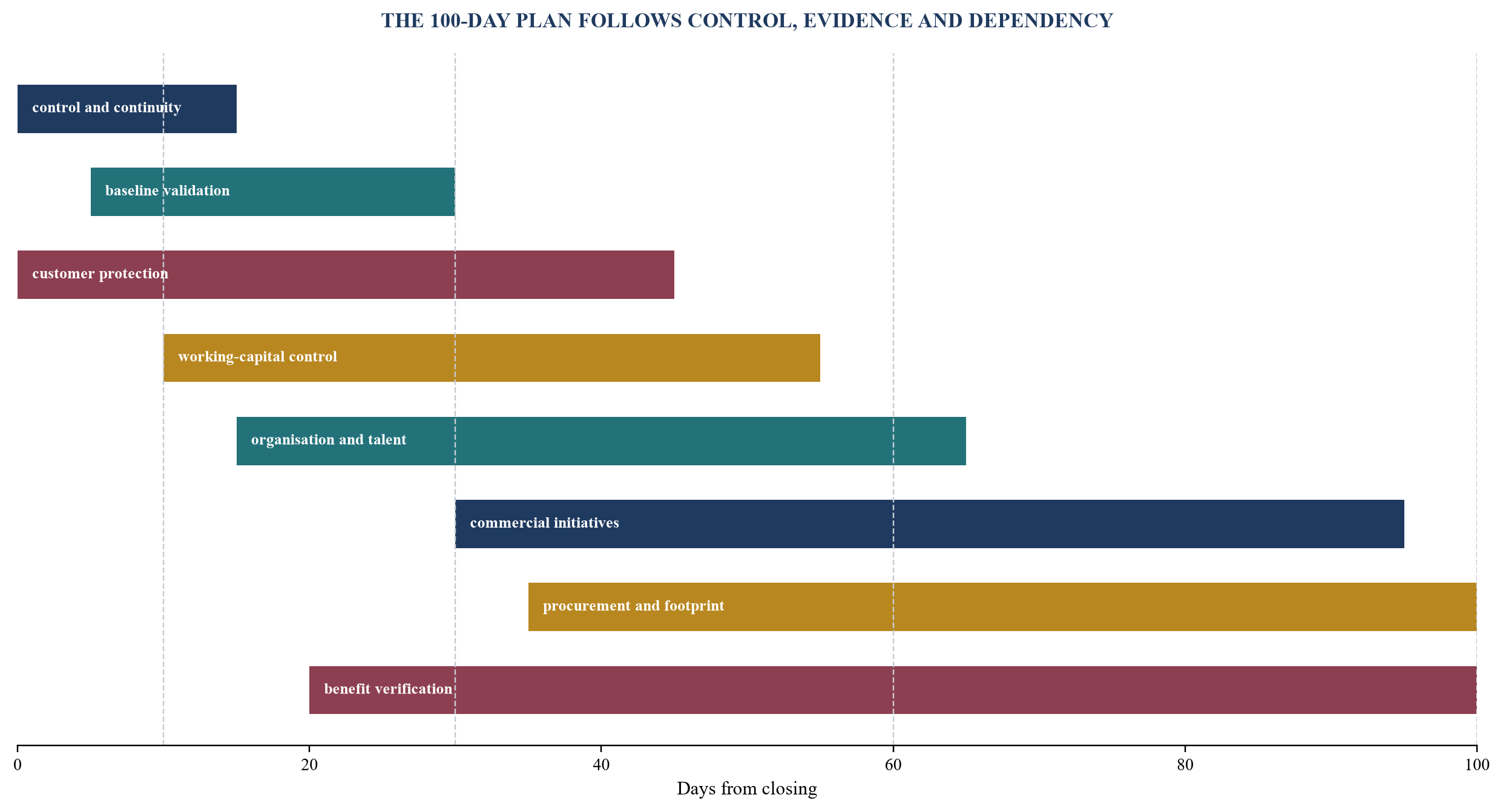
Timing is hypothetical. Legal, regulatory, employee and operating constraints determine a live sequence.
9. Build a controlled benefit ledger
The benefit ledger is the economic core of the TVCO. Every initiative receives a benefit category, baseline, counterfactual, calculation rule, timing, gross value, recurring or one-time classification, enabling cost, dis-synergy, cash effect, accounting treatment, tax effect, owner, finance reviewer, evidence and recognition status. The ledger should prevent double counting across revenue, margin, cost, working capital and capital expenditure.
Benefits should progress through controlled stages: hypothesis, approved target, action launched, operational evidence, finance-validated run rate, realised profit-and-loss or cash effect, and sustained result. A target is not a realised benefit. A contract renegotiation may establish a run rate; financial statements, purchasing data and volume adjustments determine realised impact. A headcount action can have notice, severance, vacancy, replacement and productivity effects that differ from a simple salary multiple.
The baseline and counterfactual require discipline. If input prices fall across the market, the ledger should separate market movement from negotiated savings. If the target's plan already assumed growth, only performance beyond the approved counterfactual belongs in incremental transaction value. If two initiatives affect the same cost pool, the ledger assigns precedence or allocates the overlap.
Working-capital release should be treated as cash, not recurring EBITDA. Capital-expenditure avoidance requires proof that the spend was necessary in the counterfactual and genuinely avoided rather than deferred. Revenue synergy should incorporate gross margin, churn, cannibalisation, incentives, fulfilment cost and bad debt. The ledger should retain both gross opportunity and controlled net value.
Table 3. Benefit-ledger minimum fields
| Field | Purpose | Required evidence | Common failure |
|---|---|---|---|
| baseline and counterfactual | define the starting case | approved plan, source system and date | silent rebasing |
| gross value driver | show volume, rate and timing | contract, operating data or approved model | unsupported top-down target |
| cost and leakage | calculate controlled net value | severance, capex, tax, churn and delivery costs | reporting gross value only |
| owner and reviewer | separate delivery from validation | named executive and finance reviewer | self-certification |
| recognition stage | distinguish target, run rate, realised and sustained | milestone and financial evidence | calling a forecast realised |
| overlap rule | prevent double counting | linked initiative and precedence decision | two workstreams claiming one result |
Recognition rules should be approved by finance and adapted to the transaction's accounting basis.
10. Use worked economics without manufacturing certainty
Consider a hypothetical acquisition with an enterprise value of USD 500 million and an approved gross annual opportunity of USD 42 million. The opportunity comprises USD 18 million of procurement and operating cost, USD 14 million of commercial gross margin, USD 6 million of organisation efficiency and USD 4 million of other improvement. Management also estimates USD 11 million of annual dis-synergy and leakage, USD 28 million of one-time implementation cost and USD 12 million of working-capital release.
The TVCO should avoid presenting USD 42 million as realised value. It maps each component to baseline, action, timing and evidence. Suppose procurement contracts support USD 9 million of annualised savings, while volume and specification changes reduce the controlled net amount to USD 7 million. Suppose commercial activity produces USD 20 million of incremental revenue at 40 per cent gross margin, with USD 2 million of selling and fulfilment cost; the controlled contribution is USD 6 million. Organisation actions produce a finance-validated USD 4 million run rate after replacement hires and retention costs.
The resulting controlled annual run rate is USD 17 million before remaining dis-synergy, rather than the USD 42 million gross opportunity. If USD 8 million of annual dis-synergy remains, net run rate is USD 9 million. The USD 12 million working-capital release is reported separately as cash. Implementation cost is tracked against approval and cash timing. These amounts remain hypothetical and do not imply a return or valuation.
The example illustrates why recognition stages matter. A board can see gross opportunity, approved target, contracted run rate, realised result, remaining leakage and cash cost without collapsing them into one number. Sensitivity can show how timing, attrition, price, volume and implementation cost affect the transaction case.
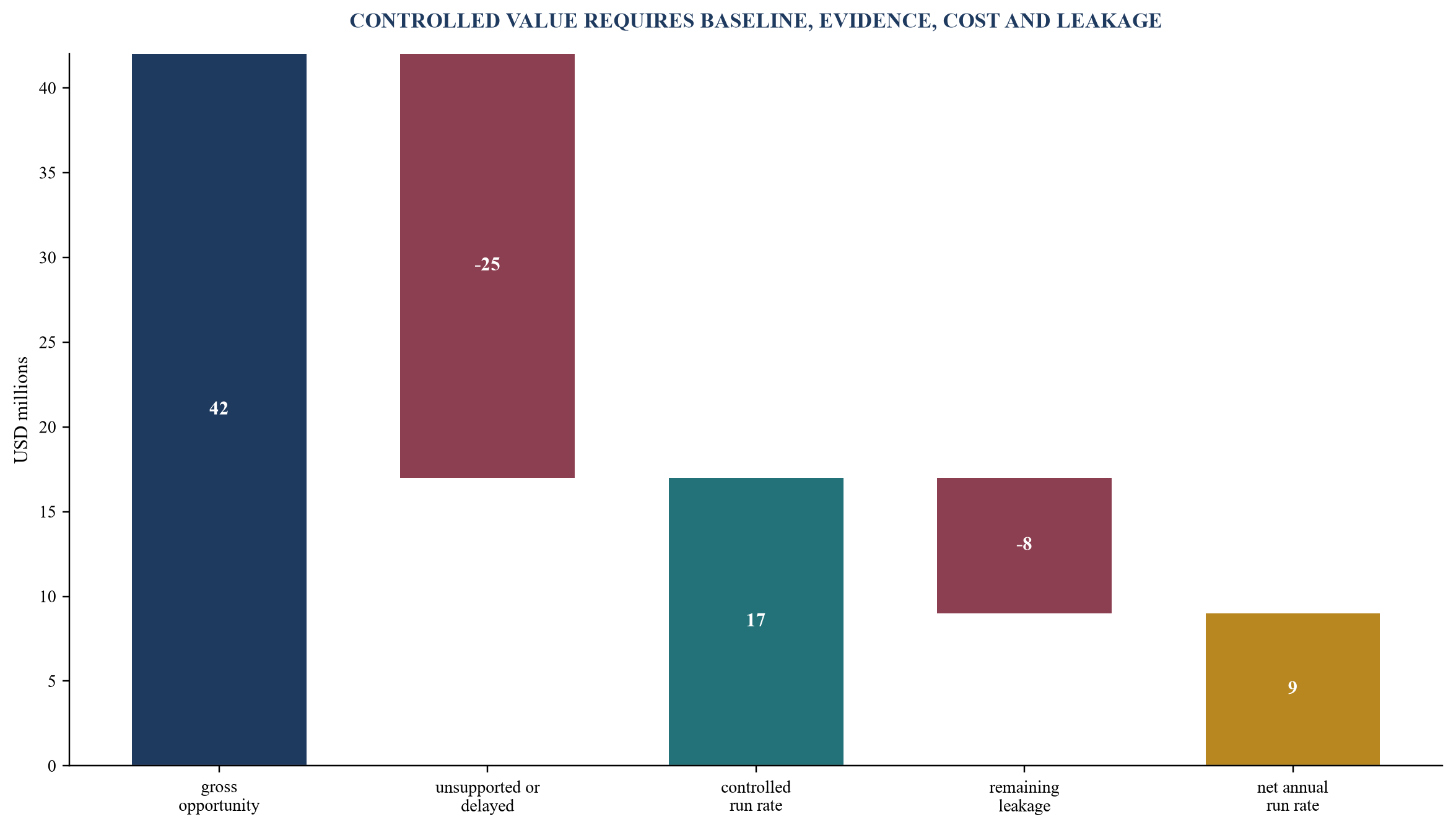
All amounts are modelling assumptions in USD millions and do not represent a live transaction.
11. Connect accounting and disclosure to execution
Transaction accounting is not a post-close administrative workstream. It affects data requirements, opening balances, valuation, earnings presentation, controls and board communication. The TVCO should connect the diligence data room, purchase-price allocation, completion accounts, pro forma information, management reporting and benefit ledger while preserving their different purposes.
SEC Regulation S-X Article 11 guidance explains the circumstances and objectives for pro forma financial information in relevant US filings. The SEC describes required transaction-accounting adjustments, autonomous-entity adjustments and optional management adjustments, with specified presentation and disclosure rules.[7][8] A TVCO should not substitute internal synergy reporting for regulated pro forma disclosure or mix management adjustments with historical accounting without the required treatment.
IFRS 3 establishes recognition, measurement and disclosure principles for an acquirer in a business combination, including identifiable assets and liabilities, goodwill and information about the transaction's financial effects.[9] IFRS 13 provides the fair-value measurement framework where another standard requires or permits fair value.[10] IAS 36 governs impairment testing and related disclosures.[11] These requirements create data, valuation and control dependencies that the 100-day plan should recognise.
The IASB continued redeliberations in July 2026 on proposed disclosures about the subsequent performance of business combinations.[12] The project remains under development at the date of this paper. The direction illustrates why management should preserve the transaction objectives, key metrics and evidence used by the board, even before any future standard change becomes effective.
12. Govern people, customers and operating continuity
Value plans can fail when management treats people and customers as implementation variables rather than sources of continuity and knowledge. The TVCO should connect diligence findings on leadership, incentives, culture, labour obligations, critical roles, customer concentration, service commitments and operational dependencies to named actions and evidence.
Critical-role mapping should identify decision authority, customer relationships, technical knowledge, licences, safety responsibility, system access and succession. Retention decisions should reflect role criticality, transition period, market alternatives, performance and cost. A broad retention pool can spend capital without securing the people who protect value; a narrow plan can miss informal knowledge and second-line capacity.
Customer protection should begin before ambitious cross-selling. The office tracks change-of-control consents, key account ownership, service-level risks, pricing commitments, product roadmap, complaint trends and communications. Management should establish a customer heat map and escalation path. Lost revenue should be connected to the original diligence assumptions and action taken.
The operating model should clarify who decides, who executes and who reviews after close. Duplicated authority and unresolved reporting lines delay action. Premature restructuring can remove capability before processes and knowledge are mapped. The 100-day sequence should protect continuity while making time-bound structural decisions.
13. Build the weekly operating cadence
The TVCO converts the transaction into a weekly decision cycle. Workstream teams maintain detailed plans. The value office receives only the information needed to govern value, risk, dependencies and decisions. A consistent cadence reduces presentation work and makes exceptions comparable over time.
A Monday evidence cut can capture milestone completion, benefit data, risks and decisions. Tuesday finance and risk review challenges baselines, calculations and controls. Wednesday dependency review resolves cross-functional issues. Thursday executive steering makes decisions and assigns resources. Friday records decisions, updates the board dashboard and releases approved actions. The cadence can be adapted to the transaction, while cut-off and authority remain clear.
Status should be evidence-based. Green means the milestone and evidence meet the approved definition. Amber means a recoverable variance with owner, due date and no unapproved material value or control impact. Red means decision, critical-path, value, legal or control exposure beyond delegated tolerance. A workstream cannot remain green because activity is high while the economic outcome is deteriorating.
Decision papers should be short and reconstructable: issue, evidence, options, economic and control effect, recommendation, authority, decision and follow-up. The office tracks decision ageing. A delayed decision can destroy value even when tasks remain on schedule.
Table 4. Weekly TVCO governance cadence
| Forum | Primary input | Required output | Escalation test |
|---|---|---|---|
| workstream evidence cut | milestones, source evidence and exceptions | controlled status and decision request | missing evidence or critical dependency |
| finance and benefit review | ledger, baseline, costs and realised data | approved recognition stage | material variance or double counting |
| risk and obligation review | SPA, conditions, remedies, controls and incidents | residual-risk decision | breach, waiver or tolerance exceedance |
| dependency forum | cross-functional critical path | sequenced owner and date | two owners, no authority or missed gate |
| executive steering | decision papers and resource conflicts | authorised decision | outside delegation or thesis change |
| board reporting | value, risk, control and strategic exceptions | direction and recorded oversight | material change to approved transaction case |
Meeting frequency should follow transaction complexity and decision velocity.
14. Give the board a decision dashboard
The board dashboard should explain whether the transaction case remains valid, which value is protected or created, what is at risk and which decisions require authority. It should avoid a catalogue of activities. The core views are thesis bridge, benefit ledger, cash and cost, top risks, closing or remedy obligations, customer and people indicators, critical-path milestones, decision ageing and forecast sensitivity.
Board reporting should distinguish fact, estimate and judgement. Realised cash, finance-validated run rate, management target and gross opportunity should appear separately. Risk exposure should show range, control, owner and trend. Changes to baseline, perimeter or recognition rule should be visible. A board cannot oversee value when the reporting basis changes without explanation.
The UK Corporate Governance Code 2024 applies to relevant financial years beginning on or after 1 January 2025, with Provision 29 applying from financial years beginning on or after 1 January 2026.[13] The FRC explains that boards should monitor and review risk management and internal controls and make the required declaration based on evidence. A listed acquirer should connect the transaction control environment to its wider governance and reporting obligations.
ISO 31000 remains a current risk-management guideline at the date of this paper and emphasises integration into governance, strategy, planning and reporting.[14] COSO's ERM framework similarly connects risk with strategy and performance.[15] These sources support a dashboard that treats value and risk as one decision system.
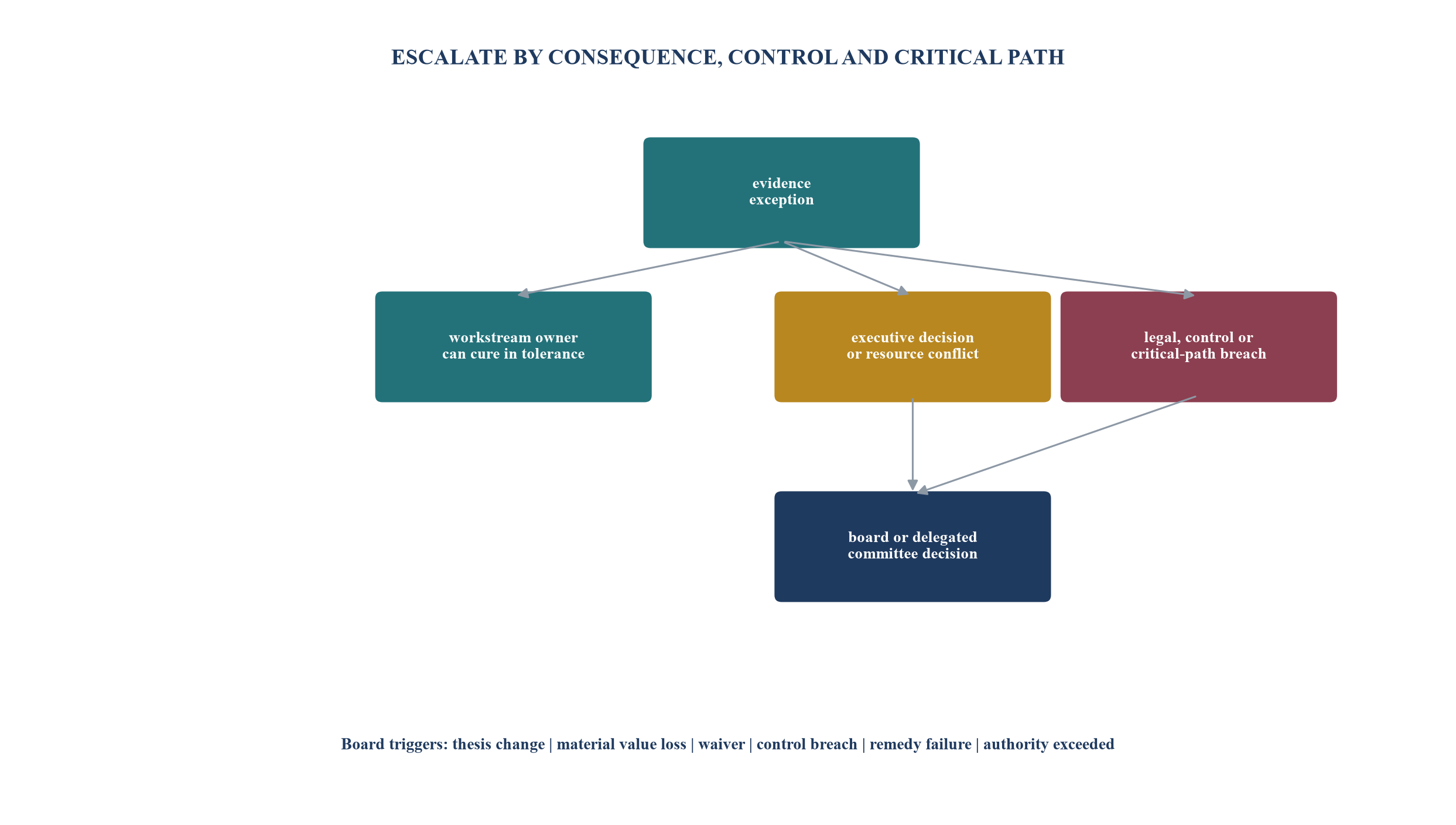
Thresholds and authorities are illustrative and require board-approved delegation.
15. Manage separations, carve-outs and transition services
Carve-outs create a second value chain because the acquired business must become operationally autonomous. The TVCO should map legal perimeter, people, contracts, systems, data, assets, licences, cash, tax, insurance, intellectual property, shared services and stranded costs. Each dependency receives an interim solution, target state, owner, cost, date and exit criterion.
Transition service agreements should be connected to the 100-day roadmap. The register records service, volume, standard, price, dependency, access, data, security, change control, dispute path, termination, extension and exit plan. An agreement can preserve continuity while delaying autonomy. The office should measure remaining dependency and prevent extensions from becoming the default operating model.
Stranded costs require a separate baseline. Seller savings and buyer costs can be confused when shared functions are removed. The TVCO should map the cost to legal entity, function, service and exit action. Double counting occurs when an assumed seller cost reduction is also recorded as a buyer synergy without reflecting replacement capacity.
Separation and integration can compete for the same people and systems. The critical path should show sequencing and resource conflicts. A Day 1 workaround needs a tested control and sunset date. The board dashboard should show autonomy readiness, TSA exposure, exit cost and unresolved legal or data constraint.
16. Sequence implementation through the first 180 days
The first thirty days before or after signing establish the value chain. The office freezes the transaction baseline, ingests material diligence findings, assigns dispositions, maps SPA protections and conditions, establishes legal boundaries and identifies Day 1 critical controls. It also defines the benefit-recognition policy and decision authorities.
The next thirty days mobilise owners and evidence. The TVCO builds the cutover register, benefit ledger, customer and people heat maps, regulatory obligation register, 100-day roadmap and weekly cadence. It tests critical access, cash, payroll, reporting and communication procedures where legally permitted. Unresolved conditions and waivers remain visible.
Days sixty-one to one hundred execute the highest-priority initiatives, validate stand-alone and synergy baselines, close critical control gaps and produce the first finance-reviewed benefit report. Management should stop or redesign initiatives unsupported by evidence. The board reviews thesis variance, costs, customer and talent outcomes, remedy compliance and critical-path decisions.
Days one hundred and one to one hundred and eighty transition from transaction cadence to sustainable operating governance. Initiatives move to business owners, while the TVCO retains benefit assurance, major dependencies and unresolved risks. The full-year plan, impairment indicators, capital allocation and strategic options should reflect the updated evidence.
Table 5. First 180-day TVCO implementation plan
| Period | Principal work | Required evidence | Governance decision |
|---|---|---|---|
| signing to Day 1 | freeze thesis, map findings, contract protection and cutover | baseline, finding register and readiness evidence | proceed, cure, waive or escalate |
| days 1-30 | stabilise control, customers, people, cash and reporting | operating controls and exception log | confirm base-business protection |
| days 31-60 | launch sequenced value initiatives | funded plans, owners and dependency map | approve or stop initiatives |
| days 61-100 | validate benefits and close critical risks | finance-reviewed ledger and risk evidence | refresh transaction case |
| days 101-180 | transfer ownership and sustain results | operating acceptance and board dashboard | close TVCO items or extend assurance |
Timing is illustrative and should follow the legal close, operating perimeter and transaction conditions.
17. Test whether the office is creating decision quality
The TVCO should measure the quality and speed of decisions, not the volume of reporting. Useful indicators include percentage of material findings with approved disposition, conditions with objective evidence, Day 1 controls successfully tested, benefits with finance-approved baselines, decisions beyond tolerance, unresolved dependencies, realised cash, net run rate, initiative stop rate and board exceptions closed.
The office should also test evidence retrieval. A reviewer should be able to move from a board-reported benefit back to the finance record, calculation, baseline, initiative, owner, original diligence finding and approved transaction response. Broken links indicate governance weakness even when the reported number is favourable.
Retrospective review compares the approved thesis with observed performance. It should assess diligence accuracy, risk calibration, contractual effectiveness, Day 1 readiness, benefit timing, cost, customer and people outcomes, regulatory commitments and decision bottlenecks. Lessons should change future diligence scopes, models, SPA playbooks and integration standards.
The office can close when material transaction obligations are embedded in business processes, benefits have transitioned to finance and operating owners, unresolved risks have accepted governance, and the board agrees the transaction no longer requires a separate decision system. Closure should produce an archive and a lessons register.
18. Conclusion
Transaction value is lost when diligence, contract, integration and board reporting operate as separate systems. A finding can influence price and still fail to produce a Day 1 control. A synergy target can survive in a board pack without a defensible baseline. A completed action can create activity without changing the transaction case.
The transaction value-creation office creates one governed evidence chain. It freezes the thesis, maps findings to transaction responses, preserves legal boundaries, connects SPA and closing obligations to operating owners, sequences Day 1 and the first 100 days, controls benefit recognition and gives the board a decision dashboard. It makes accepted risks, stopped initiatives, costs and leakage as visible as upside.
The office succeeds when management can explain what the transaction was expected to achieve, which evidence changed the decision, how protections and actions followed, what value has been verified and which exposure remains. That discipline turns transaction execution into an accountable operating capability rather than a temporary collection of workstreams.
References
- United States Department of Justice and Federal Trade Commission. 2023 Merger Guidelines. 18 December 2023. https://www.justice.gov/atr/2023-merger-guidelines
- Federal Trade Commission. Premerger Notification Program, current notices and filing guidance. Accessed 30 August 2026. https://www.ftc.gov/enforcement/premerger-notification-program
- Competition and Markets Authority. Merger Assessment Guidelines, updated 3 June 2026. https://www.gov.uk/government/publications/merger-assessment-guidelines/merger-assessment-guidelines-html-version
- Competition and Markets Authority. Mergers: Guidance on Jurisdiction and Procedure, December 2025 version. https://www.gov.uk/government/publications/mergers-guidance-on-the-cmas-jurisdiction-and-procedure
- European Commission. Mergers Legislation, including Regulation (EC) No 139/2004 and Implementing Regulation (EU) 2023/914 as corrected. https://competition-policy.ec.europa.eu/mergers/legislation_en
- United Arab Emirates Cabinet. Cabinet Decision No. 3 of 2025 on thresholds related to Federal Decree-Law No. 36 of 2023. https://www.moet.gov.ae/documents/20121/0/Cabinet%2BDecision%2BNo.%2B%283%29%2Bof%2B2025%2BOn%2Bthe%2BThresholds%2BRelated%2Bto%2Bthe%2BImplementation%2Bof%2BFederal%2BDecree-Law%2BNo.%2B%2836%29%2Bof%2B2023%2BRegulati.pdf
- United States Securities and Exchange Commission. Financial Reporting Manual, Topic 3: Pro Forma Financial Information, updated through 2026. https://www.sec.gov/about/divisions-offices/division-corporation-finance/financial-reporting-manual/frm-topic-3
- United States Securities and Exchange Commission. Financial Disclosures about Acquired and Disposed Businesses. https://www.sec.gov/resources-small-businesses/small-business-compliance-guides/financial-disclosures-about-acquired-disposed-businesses
- IFRS Foundation. IFRS 3 Business Combinations. https://www.ifrs.org/issued-standards/list-of-standards/ifrs-3-business-combinations/
- IFRS Foundation. IFRS 13 Fair Value Measurement. https://www.ifrs.org/issued-standards/list-of-standards/ifrs-13-fair-value-measurement/
- IFRS Foundation. IAS 36 Impairment of Assets. https://www.ifrs.org/issued-standards/list-of-standards/ias-36-impairment-of-assets/
- IFRS Foundation. Business Combinations: Disclosures, Goodwill and Impairment, project update including July 2026 deliberations. https://www.ifrs.org/projects/work-plan/goodwill-and-impairment/
- Financial Reporting Council. UK Corporate Governance Code 2024 and guidance, current through 2026. https://www.frc.org.uk/library/standards-codes-policy/corporate-governance/uk-corporate-governance-code/
- International Organization for Standardization. ISO 31000:2018 Risk Management Guidelines, confirmed current in 2023. https://www.iso.org/standard/65694.html
- Committee of Sponsoring Organizations of the Treadway Commission. Enterprise Risk Management: Integrating with Strategy and Performance. https://www.coso.org/enterprise-risk-management
- Project Management Institute. Benefits Realization Management Framework. 2016. https://www.pmi.org/learning/thought-leadership/series/benefits-realization/benefits-realization-management-framework
