

1. The escrow liquidity paradox
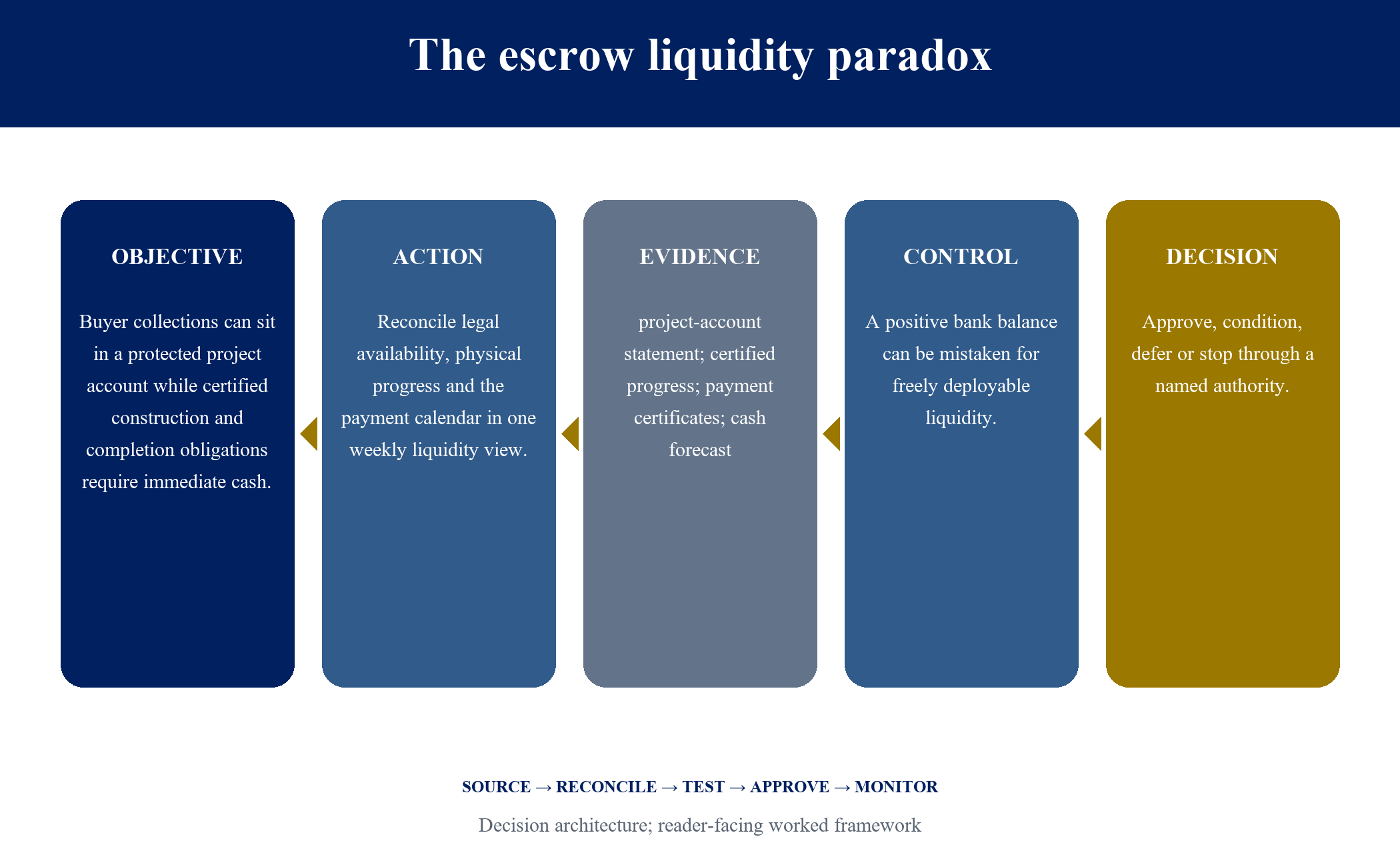
Buyer collections can sit in a protected project account while certified construction and completion obligations require immediate cash. This matters in trapped in escrow because the economics, legal rights, operating evidence and timing can move on different clocks. A useful analysis therefore begins with the decision being made, the party authorised to make it and the date on which the evidence is expected to be current. The work should distinguish source facts, management representations, analytical assumptions and professional judgement so that a reviewer can see where each conclusion originates.
The recommended workstream is to reconcile legal availability, physical progress and the payment calendar in one weekly liquidity view. The team should translate that instruction into named owners, dated gates and a common set of definitions. A base case should describe the expected path; a downside case should test weaker operating performance or slower execution; and a delay case should test what happens when a required approval, document, counterparty or financing event arrives later than planned. Any decision threshold used in the model should be recorded as a management choice unless it comes directly from a cited rule or contract.
The decision framework has four layers. First, define the commercial objective and non-negotiable constraints. Second, assemble the minimum source record and reconcile it to the numbers used in the analysis. Third, compare executable alternatives under consistent assumptions, including cost, control, liquidity, timing and downside. Fourth, approve the route, its conditions and the fallback. This sequence keeps a transaction from moving ahead on an attractive headline while unresolved implementation questions remain outside the decision paper.
1.2 Evidence and controls
The minimum evidence for this module is project-account statement; certified progress; payment certificates; cash forecast Each item should have an owner, effective date, source location and review status. Where information is produced through a model or transformation, the file should preserve the original input, calculation logic and output version. The reviewer should be able to reproduce the material conclusion without relying on a presentation slide, an uncited summary or the memory of the person who prepared it.
Control quality can be tested through three questions. Does the source support the stated fact? Does the calculation use the approved definition? Does the proposed action remain within the authority and risk limits already granted? An exception to any of these tests should enter a dated register with a named resolver and a stop, proceed or conditional-proceed decision. Completion means that the evidence and decision have been accepted by the accountable owner; document production alone is an intermediate output.
The principal failure mode is that a positive bank balance can be mistaken for freely deployable liquidity. The response is to make the vulnerable assumption visible, test a plausible adverse state and identify the earliest observable warning indicator. The analysis should also state what remains outside its scope and which legal, tax, regulatory, accounting, valuation, technical or investment conclusions require qualified advice. This creates a practical boundary between a research framework and a conclusion for a particular company, investor, lender, family or transaction.
| Control question | Required record | Decision response |
|---|---|---|
| What is being decided? | Reconcile legal availability, physical progress and the payment calendar in one weekly liquidity view. | Approve objective and authority. |
| What proves the case? | project-account statement; certified progress; payment certificates; cash forecast | Reconcile and sign off. |
| What can fail? | A positive bank balance can be mistaken for freely deployable liquidity. | Test downside and escalation. |
2. Define the regulatory perimeter
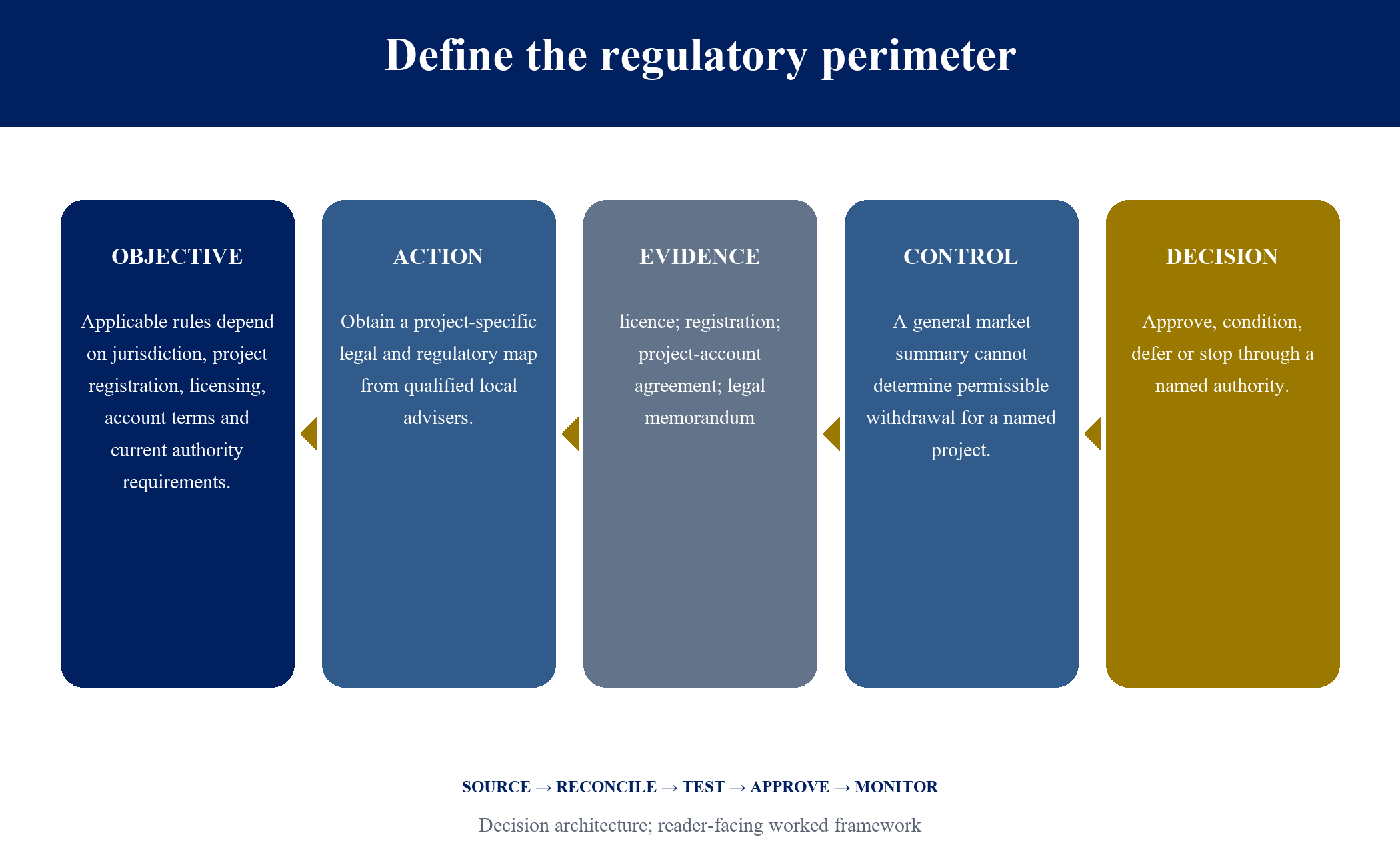
Applicable rules depend on jurisdiction, project registration, licensing, account terms and current authority requirements. This matters in trapped in escrow because the economics, legal rights, operating evidence and timing can move on different clocks. A useful analysis therefore begins with the decision being made, the party authorised to make it and the date on which the evidence is expected to be current. The work should distinguish source facts, management representations, analytical assumptions and professional judgement so that a reviewer can see where each conclusion originates.
The recommended workstream is to obtain a project-specific legal and regulatory map from qualified local advisers. The team should translate that instruction into named owners, dated gates and a common set of definitions. A base case should describe the expected path; a downside case should test weaker operating performance or slower execution; and a delay case should test what happens when a required approval, document, counterparty or financing event arrives later than planned. Any decision threshold used in the model should be recorded as a management choice unless it comes directly from a cited rule or contract.
The decision framework has four layers. First, define the commercial objective and non-negotiable constraints. Second, assemble the minimum source record and reconcile it to the numbers used in the analysis. Third, compare executable alternatives under consistent assumptions, including cost, control, liquidity, timing and downside. Fourth, approve the route, its conditions and the fallback. This sequence keeps a transaction from moving ahead on an attractive headline while unresolved implementation questions remain outside the decision paper.
2.2 Evidence and controls
The minimum evidence for this module is licence; registration; project-account agreement; legal memorandum Each item should have an owner, effective date, source location and review status. Where information is produced through a model or transformation, the file should preserve the original input, calculation logic and output version. The reviewer should be able to reproduce the material conclusion without relying on a presentation slide, an uncited summary or the memory of the person who prepared it.
Control quality can be tested through three questions. Does the source support the stated fact? Does the calculation use the approved definition? Does the proposed action remain within the authority and risk limits already granted? An exception to any of these tests should enter a dated register with a named resolver and a stop, proceed or conditional-proceed decision. Completion means that the evidence and decision have been accepted by the accountable owner; document production alone is an intermediate output.
The principal failure mode is that a general market summary cannot determine permissible withdrawal for a named project. The response is to make the vulnerable assumption visible, test a plausible adverse state and identify the earliest observable warning indicator. The analysis should also state what remains outside its scope and which legal, tax, regulatory, accounting, valuation, technical or investment conclusions require qualified advice. This creates a practical boundary between a research framework and a conclusion for a particular company, investor, lender, family or transaction.
| Control question | Required record | Decision response |
|---|---|---|
| What is being decided? | Obtain a project-specific legal and regulatory map from qualified local advisers. | Approve objective and authority. |
| What proves the case? | licence; registration; project-account agreement; legal memorandum | Reconcile and sign off. |
| What can fail? | A general market summary cannot determine permissible withdrawal for a named project. | Test downside and escalation. |
3. Dubai project-account baseline
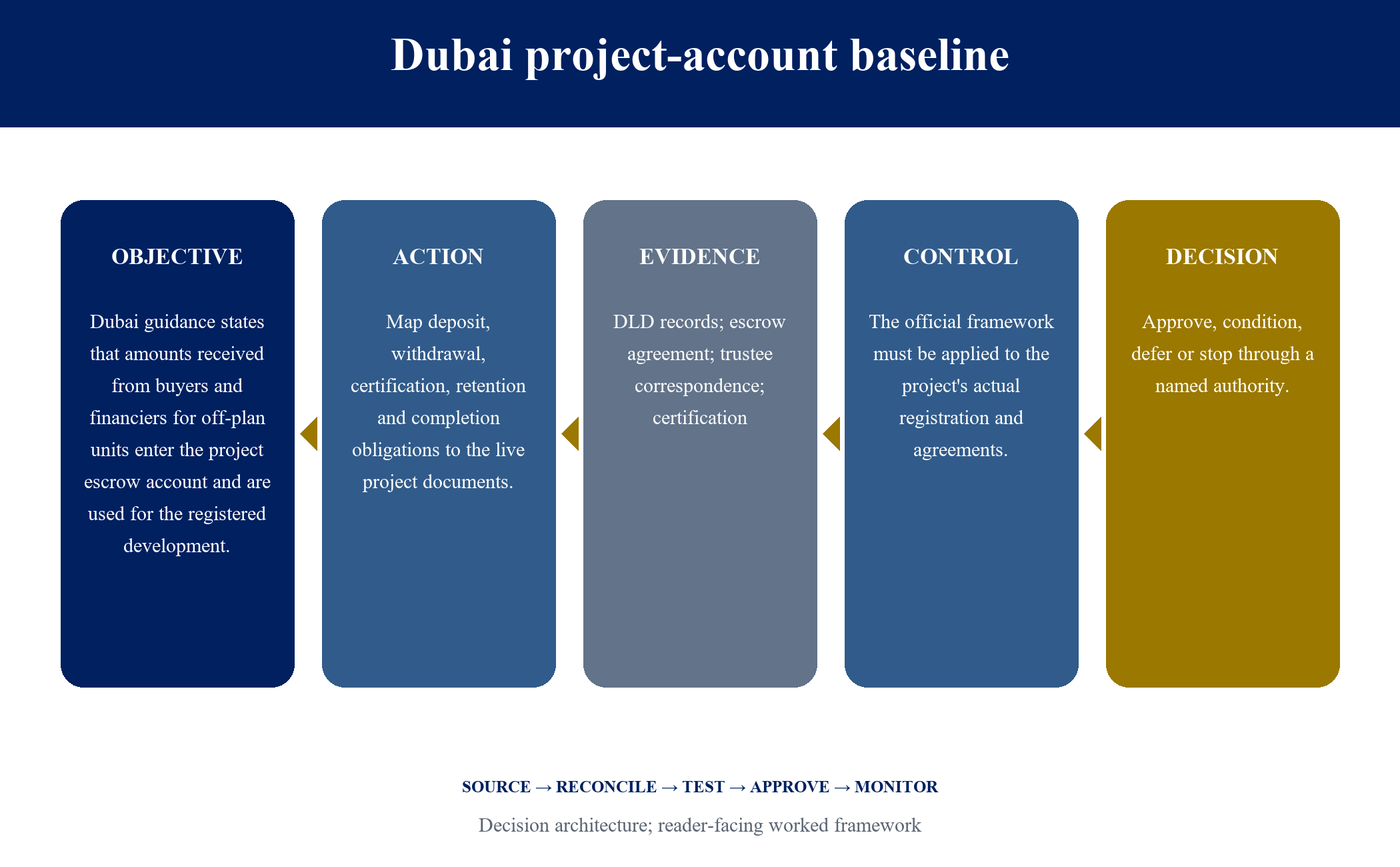
Dubai guidance states that amounts received from buyers and financiers for off-plan units enter the project escrow account and are used for the registered development. This matters in trapped in escrow because the economics, legal rights, operating evidence and timing can move on different clocks. A useful analysis therefore begins with the decision being made, the party authorised to make it and the date on which the evidence is expected to be current. The work should distinguish source facts, management representations, analytical assumptions and professional judgement so that a reviewer can see where each conclusion originates.
The recommended workstream is to map deposit, withdrawal, certification, retention and completion obligations to the live project documents. The team should translate that instruction into named owners, dated gates and a common set of definitions. A base case should describe the expected path; a downside case should test weaker operating performance or slower execution; and a delay case should test what happens when a required approval, document, counterparty or financing event arrives later than planned. Any decision threshold used in the model should be recorded as a management choice unless it comes directly from a cited rule or contract.
The decision framework has four layers. First, define the commercial objective and non-negotiable constraints. Second, assemble the minimum source record and reconcile it to the numbers used in the analysis. Third, compare executable alternatives under consistent assumptions, including cost, control, liquidity, timing and downside. Fourth, approve the route, its conditions and the fallback. This sequence keeps a transaction from moving ahead on an attractive headline while unresolved implementation questions remain outside the decision paper.
3.2 Evidence and controls
The minimum evidence for this module is dLD records; escrow agreement; trustee correspondence; certification Each item should have an owner, effective date, source location and review status. Where information is produced through a model or transformation, the file should preserve the original input, calculation logic and output version. The reviewer should be able to reproduce the material conclusion without relying on a presentation slide, an uncited summary or the memory of the person who prepared it.
Control quality can be tested through three questions. Does the source support the stated fact? Does the calculation use the approved definition? Does the proposed action remain within the authority and risk limits already granted? An exception to any of these tests should enter a dated register with a named resolver and a stop, proceed or conditional-proceed decision. Completion means that the evidence and decision have been accepted by the accountable owner; document production alone is an intermediate output.
The principal failure mode is that the official framework must be applied to the project's actual registration and agreements. The response is to make the vulnerable assumption visible, test a plausible adverse state and identify the earliest observable warning indicator. The analysis should also state what remains outside its scope and which legal, tax, regulatory, accounting, valuation, technical or investment conclusions require qualified advice. This creates a practical boundary between a research framework and a conclusion for a particular company, investor, lender, family or transaction.
| Control question | Required record | Decision response |
|---|---|---|
| What is being decided? | Map deposit, withdrawal, certification, retention and completion obligations to the live project documents. | Approve objective and authority. |
| What proves the case? | DLD records; escrow agreement; trustee correspondence; certification | Reconcile and sign off. |
| What can fail? | The official framework must be applied to the project's actual registration and agreements. | Test downside and escalation. |
4. Saudi off-plan baseline
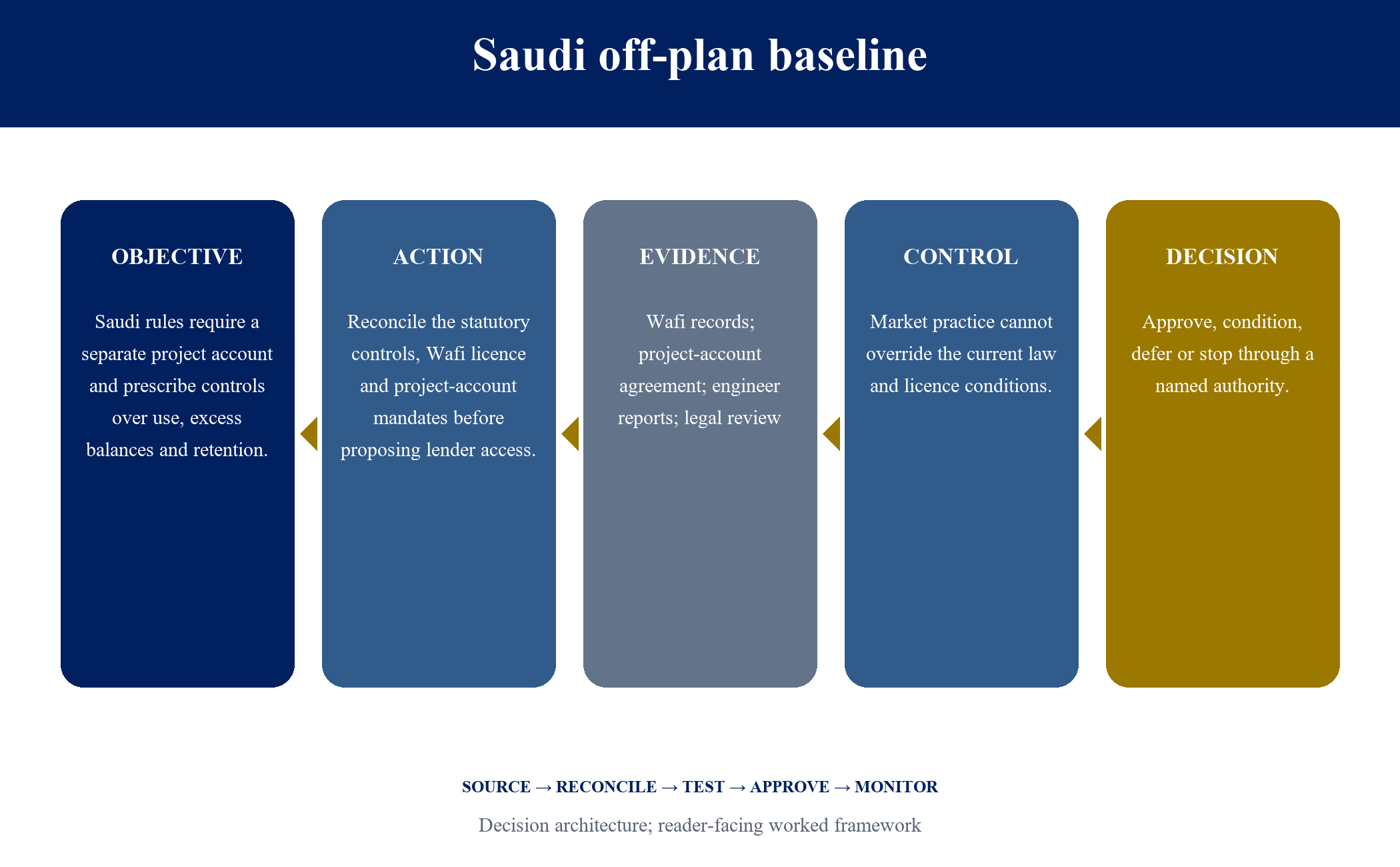
Saudi rules require a separate project account and prescribe controls over use, excess balances and retention. This matters in trapped in escrow because the economics, legal rights, operating evidence and timing can move on different clocks. A useful analysis therefore begins with the decision being made, the party authorised to make it and the date on which the evidence is expected to be current. The work should distinguish source facts, management representations, analytical assumptions and professional judgement so that a reviewer can see where each conclusion originates.
The recommended workstream is to reconcile the statutory controls, Wafi licence and project-account mandates before proposing lender access. The team should translate that instruction into named owners, dated gates and a common set of definitions. A base case should describe the expected path; a downside case should test weaker operating performance or slower execution; and a delay case should test what happens when a required approval, document, counterparty or financing event arrives later than planned. Any decision threshold used in the model should be recorded as a management choice unless it comes directly from a cited rule or contract.
The decision framework has four layers. First, define the commercial objective and non-negotiable constraints. Second, assemble the minimum source record and reconcile it to the numbers used in the analysis. Third, compare executable alternatives under consistent assumptions, including cost, control, liquidity, timing and downside. Fourth, approve the route, its conditions and the fallback. This sequence keeps a transaction from moving ahead on an attractive headline while unresolved implementation questions remain outside the decision paper.
4.2 Evidence and controls
The minimum evidence for this module is wafi records; project-account agreement; engineer reports; legal review Each item should have an owner, effective date, source location and review status. Where information is produced through a model or transformation, the file should preserve the original input, calculation logic and output version. The reviewer should be able to reproduce the material conclusion without relying on a presentation slide, an uncited summary or the memory of the person who prepared it.
Control quality can be tested through three questions. Does the source support the stated fact? Does the calculation use the approved definition? Does the proposed action remain within the authority and risk limits already granted? An exception to any of these tests should enter a dated register with a named resolver and a stop, proceed or conditional-proceed decision. Completion means that the evidence and decision have been accepted by the accountable owner; document production alone is an intermediate output.
The principal failure mode is that market practice cannot override the current law and licence conditions. The response is to make the vulnerable assumption visible, test a plausible adverse state and identify the earliest observable warning indicator. The analysis should also state what remains outside its scope and which legal, tax, regulatory, accounting, valuation, technical or investment conclusions require qualified advice. This creates a practical boundary between a research framework and a conclusion for a particular company, investor, lender, family or transaction.
| Control question | Required record | Decision response |
|---|---|---|
| What is being decided? | Reconcile the statutory controls, Wafi licence and project-account mandates before proposing lender access. | Approve objective and authority. |
| What proves the case? | Wafi records; project-account agreement; engineer reports; legal review | Reconcile and sign off. |
| What can fail? | Market practice cannot override the current law and licence conditions. | Test downside and escalation. |
5. Build the cost-to-complete
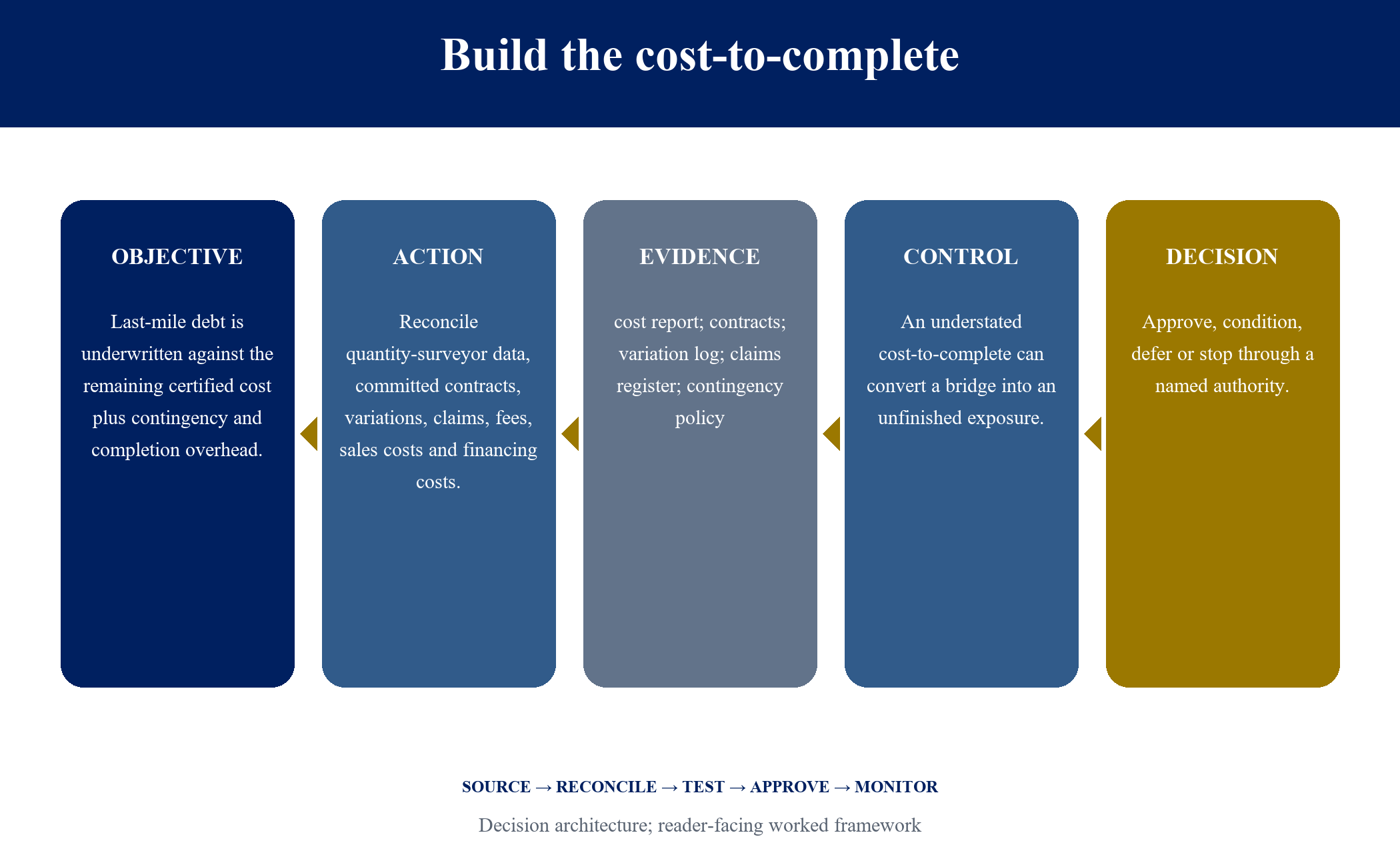
Last-mile debt is underwritten against the remaining certified cost plus contingency and completion overhead. This matters in trapped in escrow because the economics, legal rights, operating evidence and timing can move on different clocks. A useful analysis therefore begins with the decision being made, the party authorised to make it and the date on which the evidence is expected to be current. The work should distinguish source facts, management representations, analytical assumptions and professional judgement so that a reviewer can see where each conclusion originates.
The recommended workstream is to reconcile quantity-surveyor data, committed contracts, variations, claims, fees, sales costs and financing costs. The team should translate that instruction into named owners, dated gates and a common set of definitions. A base case should describe the expected path; a downside case should test weaker operating performance or slower execution; and a delay case should test what happens when a required approval, document, counterparty or financing event arrives later than planned. Any decision threshold used in the model should be recorded as a management choice unless it comes directly from a cited rule or contract.
The decision framework has four layers. First, define the commercial objective and non-negotiable constraints. Second, assemble the minimum source record and reconcile it to the numbers used in the analysis. Third, compare executable alternatives under consistent assumptions, including cost, control, liquidity, timing and downside. Fourth, approve the route, its conditions and the fallback. This sequence keeps a transaction from moving ahead on an attractive headline while unresolved implementation questions remain outside the decision paper.
5.2 Evidence and controls
The minimum evidence for this module is cost report; contracts; variation log; claims register; contingency policy Each item should have an owner, effective date, source location and review status. Where information is produced through a model or transformation, the file should preserve the original input, calculation logic and output version. The reviewer should be able to reproduce the material conclusion without relying on a presentation slide, an uncited summary or the memory of the person who prepared it.
Control quality can be tested through three questions. Does the source support the stated fact? Does the calculation use the approved definition? Does the proposed action remain within the authority and risk limits already granted? An exception to any of these tests should enter a dated register with a named resolver and a stop, proceed or conditional-proceed decision. Completion means that the evidence and decision have been accepted by the accountable owner; document production alone is an intermediate output.
The principal failure mode is that an understated cost-to-complete can convert a bridge into an unfinished exposure. The response is to make the vulnerable assumption visible, test a plausible adverse state and identify the earliest observable warning indicator. The analysis should also state what remains outside its scope and which legal, tax, regulatory, accounting, valuation, technical or investment conclusions require qualified advice. This creates a practical boundary between a research framework and a conclusion for a particular company, investor, lender, family or transaction.
| Control question | Required record | Decision response |
|---|---|---|
| What is being decided? | Reconcile quantity-surveyor data, committed contracts, variations, claims, fees, sales costs and financing costs. | Approve objective and authority. |
| What proves the case? | cost report; contracts; variation log; claims register; contingency policy | Reconcile and sign off. |
| What can fail? | An understated cost-to-complete can convert a bridge into an unfinished exposure. | Test downside and escalation. |
6. Reconcile sources and uses
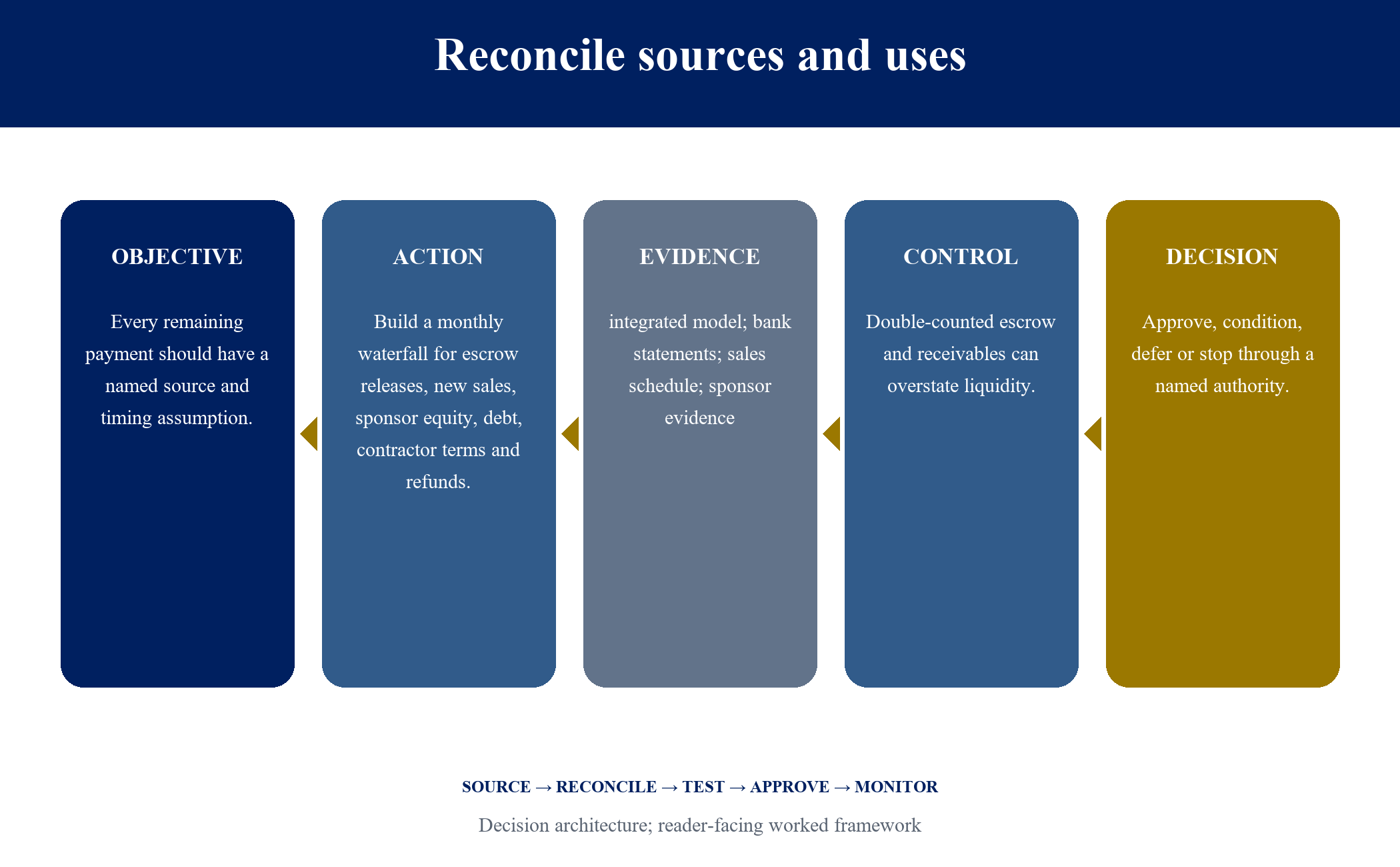
Every remaining payment should have a named source and timing assumption. This matters in trapped in escrow because the economics, legal rights, operating evidence and timing can move on different clocks. A useful analysis therefore begins with the decision being made, the party authorised to make it and the date on which the evidence is expected to be current. The work should distinguish source facts, management representations, analytical assumptions and professional judgement so that a reviewer can see where each conclusion originates.
The recommended workstream is to build a monthly waterfall for escrow releases, new sales, sponsor equity, debt, contractor terms and refunds. The team should translate that instruction into named owners, dated gates and a common set of definitions. A base case should describe the expected path; a downside case should test weaker operating performance or slower execution; and a delay case should test what happens when a required approval, document, counterparty or financing event arrives later than planned. Any decision threshold used in the model should be recorded as a management choice unless it comes directly from a cited rule or contract.
The decision framework has four layers. First, define the commercial objective and non-negotiable constraints. Second, assemble the minimum source record and reconcile it to the numbers used in the analysis. Third, compare executable alternatives under consistent assumptions, including cost, control, liquidity, timing and downside. Fourth, approve the route, its conditions and the fallback. This sequence keeps a transaction from moving ahead on an attractive headline while unresolved implementation questions remain outside the decision paper.
6.2 Evidence and controls
The minimum evidence for this module is integrated model; bank statements; sales schedule; sponsor evidence Each item should have an owner, effective date, source location and review status. Where information is produced through a model or transformation, the file should preserve the original input, calculation logic and output version. The reviewer should be able to reproduce the material conclusion without relying on a presentation slide, an uncited summary or the memory of the person who prepared it.
Control quality can be tested through three questions. Does the source support the stated fact? Does the calculation use the approved definition? Does the proposed action remain within the authority and risk limits already granted? An exception to any of these tests should enter a dated register with a named resolver and a stop, proceed or conditional-proceed decision. Completion means that the evidence and decision have been accepted by the accountable owner; document production alone is an intermediate output.
The principal failure mode is that double-counted escrow and receivables can overstate liquidity. The response is to make the vulnerable assumption visible, test a plausible adverse state and identify the earliest observable warning indicator. The analysis should also state what remains outside its scope and which legal, tax, regulatory, accounting, valuation, technical or investment conclusions require qualified advice. This creates a practical boundary between a research framework and a conclusion for a particular company, investor, lender, family or transaction.
| Control question | Required record | Decision response |
|---|---|---|
| What is being decided? | Build a monthly waterfall for escrow releases, new sales, sponsor equity, debt, contractor terms and refunds. | Approve objective and authority. |
| What proves the case? | integrated model; bank statements; sales schedule; sponsor evidence | Reconcile and sign off. |
| What can fail? | Double-counted escrow and receivables can overstate liquidity. | Test downside and escalation. |
7. Identify the timing gap
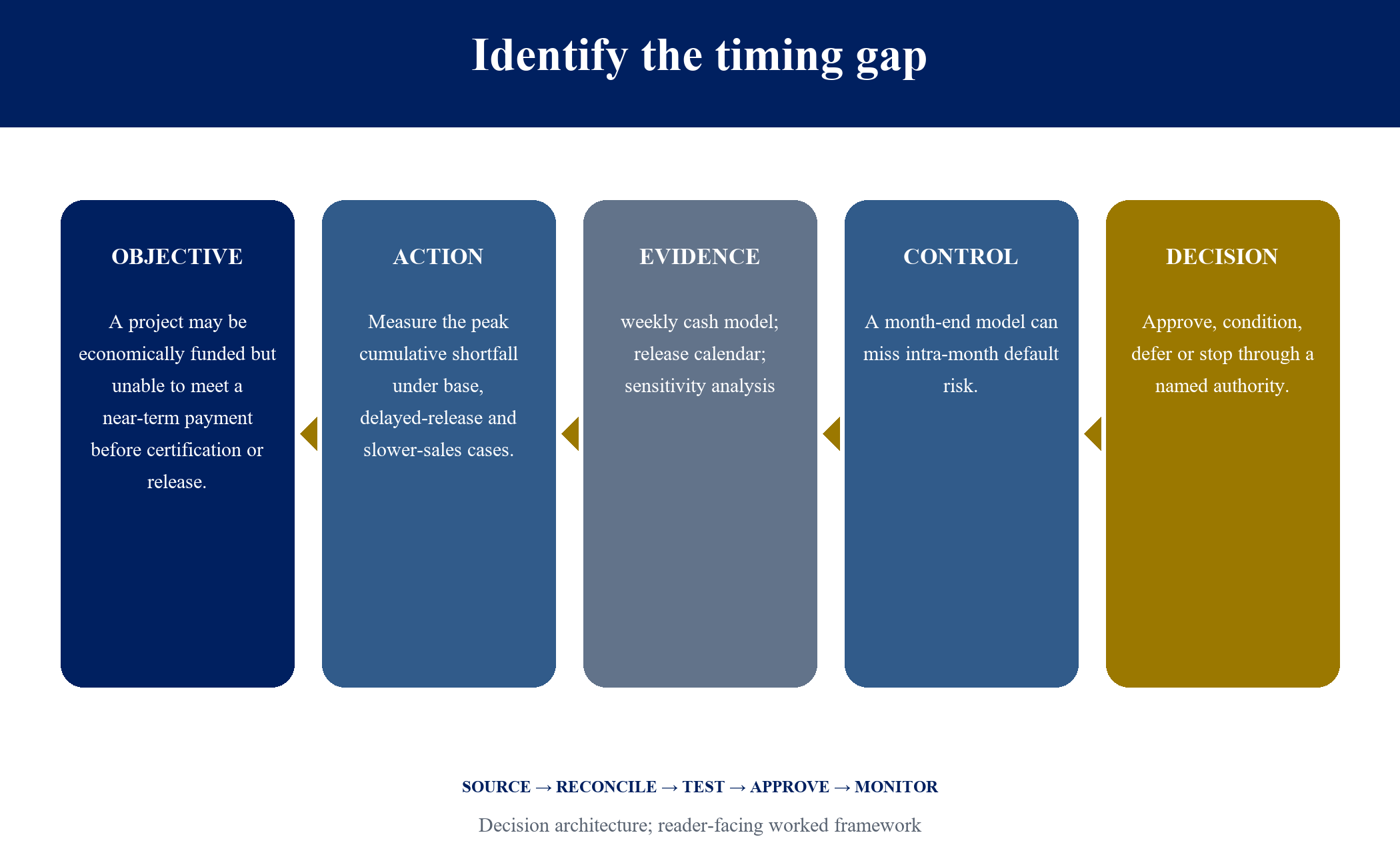
A project may be economically funded but unable to meet a near-term payment before certification or release. This matters in trapped in escrow because the economics, legal rights, operating evidence and timing can move on different clocks. A useful analysis therefore begins with the decision being made, the party authorised to make it and the date on which the evidence is expected to be current. The work should distinguish source facts, management representations, analytical assumptions and professional judgement so that a reviewer can see where each conclusion originates.
The recommended workstream is to measure the peak cumulative shortfall under base, delayed-release and slower-sales cases. The team should translate that instruction into named owners, dated gates and a common set of definitions. A base case should describe the expected path; a downside case should test weaker operating performance or slower execution; and a delay case should test what happens when a required approval, document, counterparty or financing event arrives later than planned. Any decision threshold used in the model should be recorded as a management choice unless it comes directly from a cited rule or contract.
The decision framework has four layers. First, define the commercial objective and non-negotiable constraints. Second, assemble the minimum source record and reconcile it to the numbers used in the analysis. Third, compare executable alternatives under consistent assumptions, including cost, control, liquidity, timing and downside. Fourth, approve the route, its conditions and the fallback. This sequence keeps a transaction from moving ahead on an attractive headline while unresolved implementation questions remain outside the decision paper.
7.2 Evidence and controls
The minimum evidence for this module is weekly cash model; release calendar; sensitivity analysis Each item should have an owner, effective date, source location and review status. Where information is produced through a model or transformation, the file should preserve the original input, calculation logic and output version. The reviewer should be able to reproduce the material conclusion without relying on a presentation slide, an uncited summary or the memory of the person who prepared it.
Control quality can be tested through three questions. Does the source support the stated fact? Does the calculation use the approved definition? Does the proposed action remain within the authority and risk limits already granted? An exception to any of these tests should enter a dated register with a named resolver and a stop, proceed or conditional-proceed decision. Completion means that the evidence and decision have been accepted by the accountable owner; document production alone is an intermediate output.
The principal failure mode is that a month-end model can miss intra-month default risk. The response is to make the vulnerable assumption visible, test a plausible adverse state and identify the earliest observable warning indicator. The analysis should also state what remains outside its scope and which legal, tax, regulatory, accounting, valuation, technical or investment conclusions require qualified advice. This creates a practical boundary between a research framework and a conclusion for a particular company, investor, lender, family or transaction.
| Control question | Required record | Decision response |
|---|---|---|
| What is being decided? | Measure the peak cumulative shortfall under base, delayed-release and slower-sales cases. | Approve objective and authority. |
| What proves the case? | weekly cash model; release calendar; sensitivity analysis | Reconcile and sign off. |
| What can fail? | A month-end model can miss intra-month default risk. | Test downside and escalation. |
8. Choose the financing structure
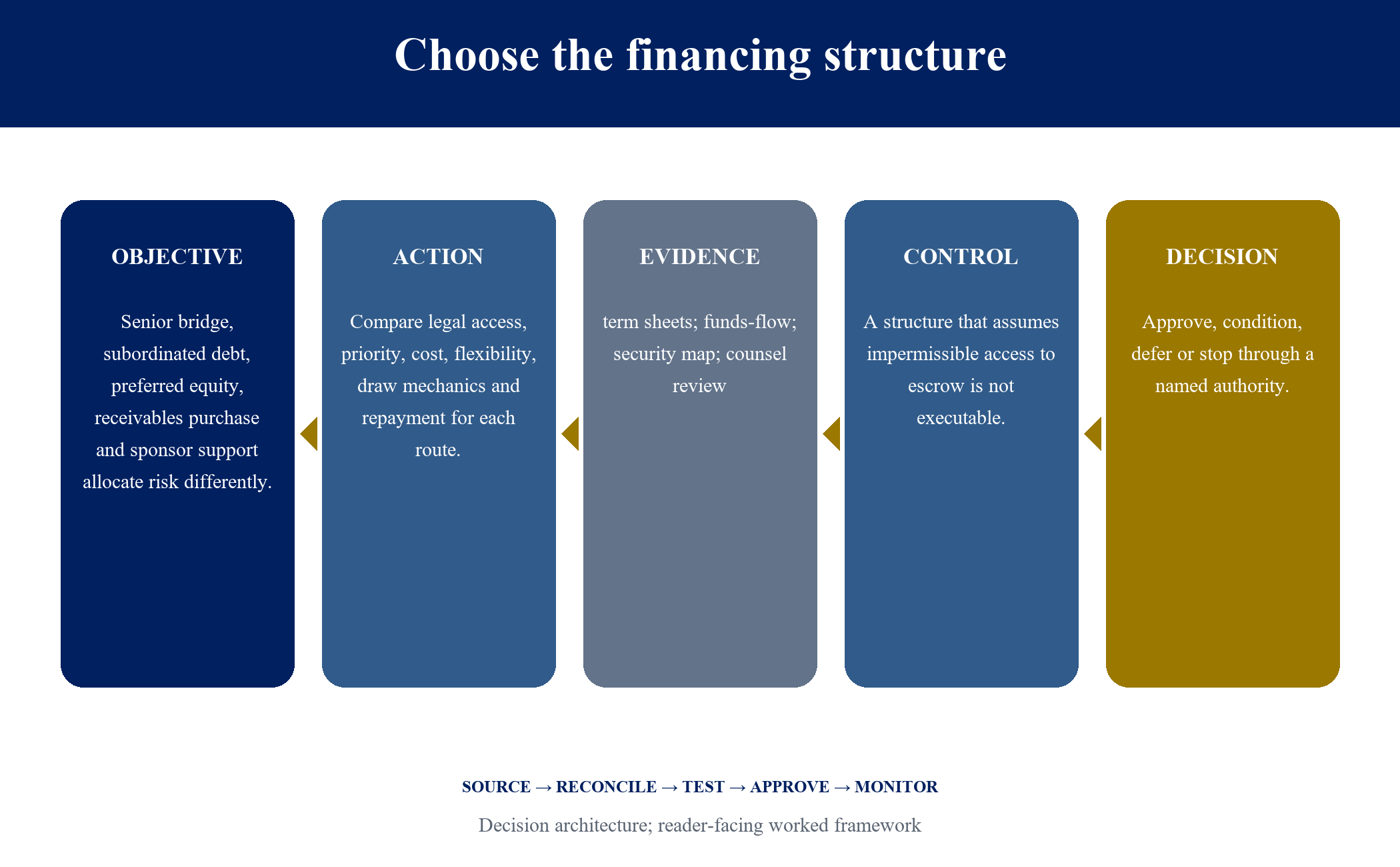
Senior bridge, subordinated debt, preferred equity, receivables purchase and sponsor support allocate risk differently. This matters in trapped in escrow because the economics, legal rights, operating evidence and timing can move on different clocks. A useful analysis therefore begins with the decision being made, the party authorised to make it and the date on which the evidence is expected to be current. The work should distinguish source facts, management representations, analytical assumptions and professional judgement so that a reviewer can see where each conclusion originates.
The recommended workstream is to compare legal access, priority, cost, flexibility, draw mechanics and repayment for each route. The team should translate that instruction into named owners, dated gates and a common set of definitions. A base case should describe the expected path; a downside case should test weaker operating performance or slower execution; and a delay case should test what happens when a required approval, document, counterparty or financing event arrives later than planned. Any decision threshold used in the model should be recorded as a management choice unless it comes directly from a cited rule or contract.
The decision framework has four layers. First, define the commercial objective and non-negotiable constraints. Second, assemble the minimum source record and reconcile it to the numbers used in the analysis. Third, compare executable alternatives under consistent assumptions, including cost, control, liquidity, timing and downside. Fourth, approve the route, its conditions and the fallback. This sequence keeps a transaction from moving ahead on an attractive headline while unresolved implementation questions remain outside the decision paper.
8.2 Evidence and controls
The minimum evidence for this module is term sheets; funds-flow; security map; counsel review Each item should have an owner, effective date, source location and review status. Where information is produced through a model or transformation, the file should preserve the original input, calculation logic and output version. The reviewer should be able to reproduce the material conclusion without relying on a presentation slide, an uncited summary or the memory of the person who prepared it.
Control quality can be tested through three questions. Does the source support the stated fact? Does the calculation use the approved definition? Does the proposed action remain within the authority and risk limits already granted? An exception to any of these tests should enter a dated register with a named resolver and a stop, proceed or conditional-proceed decision. Completion means that the evidence and decision have been accepted by the accountable owner; document production alone is an intermediate output.
The principal failure mode is that a structure that assumes impermissible access to escrow is not executable. The response is to make the vulnerable assumption visible, test a plausible adverse state and identify the earliest observable warning indicator. The analysis should also state what remains outside its scope and which legal, tax, regulatory, accounting, valuation, technical or investment conclusions require qualified advice. This creates a practical boundary between a research framework and a conclusion for a particular company, investor, lender, family or transaction.
| Control question | Required record | Decision response |
|---|---|---|
| What is being decided? | Compare legal access, priority, cost, flexibility, draw mechanics and repayment for each route. | Approve objective and authority. |
| What proves the case? | term sheets; funds-flow; security map; counsel review | Reconcile and sign off. |
| What can fail? | A structure that assumes impermissible access to escrow is not executable. | Test downside and escalation. |
9. Security and control
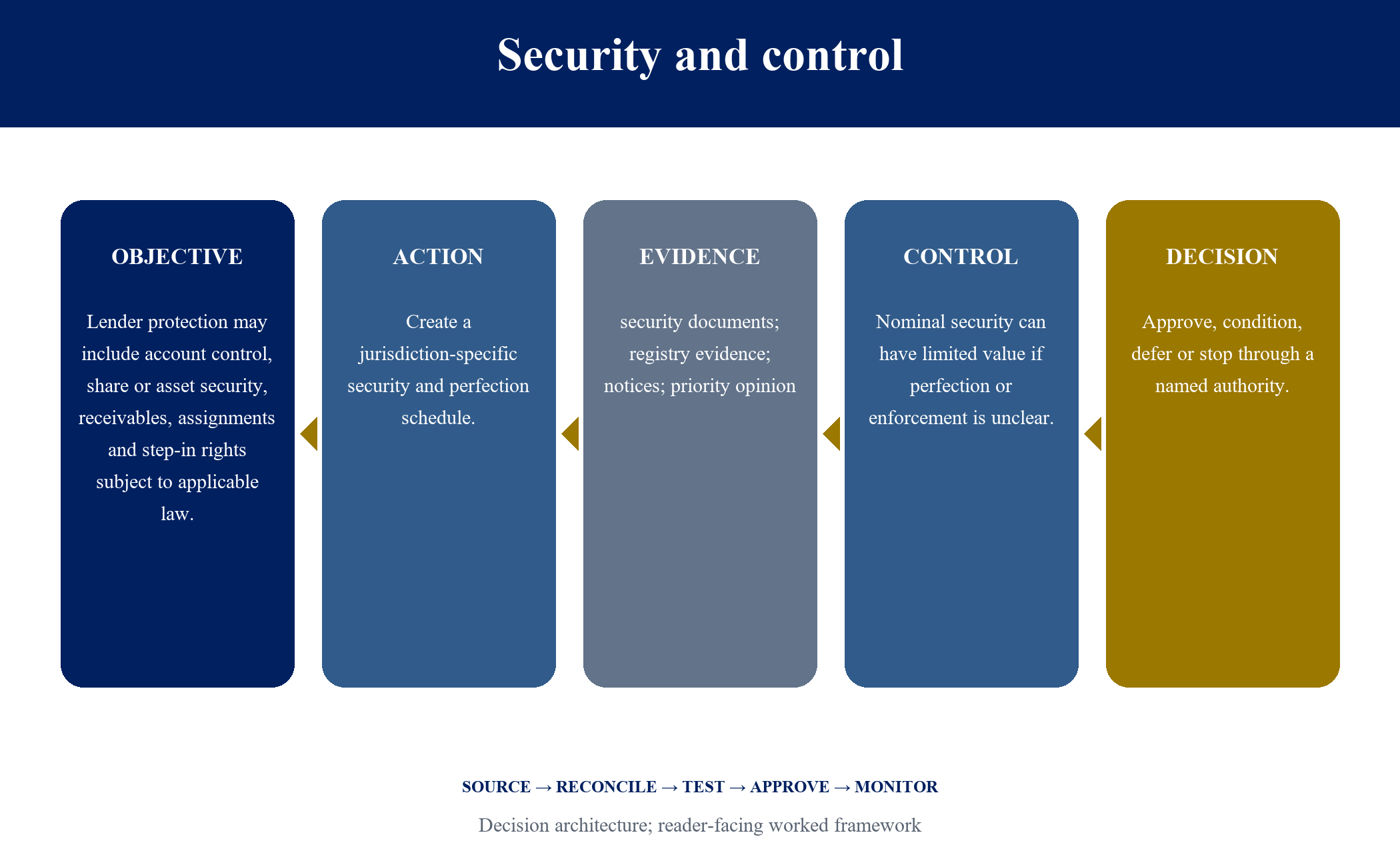
Lender protection may include account control, share or asset security, receivables, assignments and step-in rights subject to applicable law. This matters in trapped in escrow because the economics, legal rights, operating evidence and timing can move on different clocks. A useful analysis therefore begins with the decision being made, the party authorised to make it and the date on which the evidence is expected to be current. The work should distinguish source facts, management representations, analytical assumptions and professional judgement so that a reviewer can see where each conclusion originates.
The recommended workstream is to create a jurisdiction-specific security and perfection schedule. The team should translate that instruction into named owners, dated gates and a common set of definitions. A base case should describe the expected path; a downside case should test weaker operating performance or slower execution; and a delay case should test what happens when a required approval, document, counterparty or financing event arrives later than planned. Any decision threshold used in the model should be recorded as a management choice unless it comes directly from a cited rule or contract.
The decision framework has four layers. First, define the commercial objective and non-negotiable constraints. Second, assemble the minimum source record and reconcile it to the numbers used in the analysis. Third, compare executable alternatives under consistent assumptions, including cost, control, liquidity, timing and downside. Fourth, approve the route, its conditions and the fallback. This sequence keeps a transaction from moving ahead on an attractive headline while unresolved implementation questions remain outside the decision paper.
9.2 Evidence and controls
The minimum evidence for this module is security documents; registry evidence; notices; priority opinion Each item should have an owner, effective date, source location and review status. Where information is produced through a model or transformation, the file should preserve the original input, calculation logic and output version. The reviewer should be able to reproduce the material conclusion without relying on a presentation slide, an uncited summary or the memory of the person who prepared it.
Control quality can be tested through three questions. Does the source support the stated fact? Does the calculation use the approved definition? Does the proposed action remain within the authority and risk limits already granted? An exception to any of these tests should enter a dated register with a named resolver and a stop, proceed or conditional-proceed decision. Completion means that the evidence and decision have been accepted by the accountable owner; document production alone is an intermediate output.
The principal failure mode is that nominal security can have limited value if perfection or enforcement is unclear. The response is to make the vulnerable assumption visible, test a plausible adverse state and identify the earliest observable warning indicator. The analysis should also state what remains outside its scope and which legal, tax, regulatory, accounting, valuation, technical or investment conclusions require qualified advice. This creates a practical boundary between a research framework and a conclusion for a particular company, investor, lender, family or transaction.
| Control question | Required record | Decision response |
|---|---|---|
| What is being decided? | Create a jurisdiction-specific security and perfection schedule. | Approve objective and authority. |
| What proves the case? | security documents; registry evidence; notices; priority opinion | Reconcile and sign off. |
| What can fail? | Nominal security can have limited value if perfection or enforcement is unclear. | Test downside and escalation. |
10. Construction monitoring
Draws should follow verified progress, updated cost-to-complete and controlled payment evidence. This matters in trapped in escrow because the economics, legal rights, operating evidence and timing can move on different clocks. A useful analysis therefore begins with the decision being made, the party authorised to make it and the date on which the evidence is expected to be current. The work should distinguish source facts, management representations, analytical assumptions and professional judgement so that a reviewer can see where each conclusion originates.
The recommended workstream is to appoint an independent monitor and define draw tests, exception authority and reporting cadence. The team should translate that instruction into named owners, dated gates and a common set of definitions. A base case should describe the expected path; a downside case should test weaker operating performance or slower execution; and a delay case should test what happens when a required approval, document, counterparty or financing event arrives later than planned. Any decision threshold used in the model should be recorded as a management choice unless it comes directly from a cited rule or contract.
The decision framework has four layers. First, define the commercial objective and non-negotiable constraints. Second, assemble the minimum source record and reconcile it to the numbers used in the analysis. Third, compare executable alternatives under consistent assumptions, including cost, control, liquidity, timing and downside. Fourth, approve the route, its conditions and the fallback. This sequence keeps a transaction from moving ahead on an attractive headline while unresolved implementation questions remain outside the decision paper.
10.2 Evidence and controls
The minimum evidence for this module is monitor report; certificates; site evidence; draw package Each item should have an owner, effective date, source location and review status. Where information is produced through a model or transformation, the file should preserve the original input, calculation logic and output version. The reviewer should be able to reproduce the material conclusion without relying on a presentation slide, an uncited summary or the memory of the person who prepared it.
Control quality can be tested through three questions. Does the source support the stated fact? Does the calculation use the approved definition? Does the proposed action remain within the authority and risk limits already granted? An exception to any of these tests should enter a dated register with a named resolver and a stop, proceed or conditional-proceed decision. Completion means that the evidence and decision have been accepted by the accountable owner; document production alone is an intermediate output.
The principal failure mode is that reliance on sponsor reporting alone can conceal slippage. The response is to make the vulnerable assumption visible, test a plausible adverse state and identify the earliest observable warning indicator. The analysis should also state what remains outside its scope and which legal, tax, regulatory, accounting, valuation, technical or investment conclusions require qualified advice. This creates a practical boundary between a research framework and a conclusion for a particular company, investor, lender, family or transaction.
| Control question | Required record | Decision response |
|---|---|---|
| What is being decided? | Appoint an independent monitor and define draw tests, exception authority and reporting cadence. | Approve objective and authority. |
| What proves the case? | monitor report; certificates; site evidence; draw package | Reconcile and sign off. |
| What can fail? | Reliance on sponsor reporting alone can conceal slippage. | Test downside and escalation. |
11. Contractor and supplier strategy
Completion can require negotiated payment sequencing without destabilising the delivery chain. This matters in trapped in escrow because the economics, legal rights, operating evidence and timing can move on different clocks. A useful analysis therefore begins with the decision being made, the party authorised to make it and the date on which the evidence is expected to be current. The work should distinguish source facts, management representations, analytical assumptions and professional judgement so that a reviewer can see where each conclusion originates.
The recommended workstream is to rank critical suppliers, document arrears and align catch-up payments with milestones. The team should translate that instruction into named owners, dated gates and a common set of definitions. A base case should describe the expected path; a downside case should test weaker operating performance or slower execution; and a delay case should test what happens when a required approval, document, counterparty or financing event arrives later than planned. Any decision threshold used in the model should be recorded as a management choice unless it comes directly from a cited rule or contract.
The decision framework has four layers. First, define the commercial objective and non-negotiable constraints. Second, assemble the minimum source record and reconcile it to the numbers used in the analysis. Third, compare executable alternatives under consistent assumptions, including cost, control, liquidity, timing and downside. Fourth, approve the route, its conditions and the fallback. This sequence keeps a transaction from moving ahead on an attractive headline while unresolved implementation questions remain outside the decision paper.
11.2 Evidence and controls
The minimum evidence for this module is creditor ageing; criticality map; settlements; programme Each item should have an owner, effective date, source location and review status. Where information is produced through a model or transformation, the file should preserve the original input, calculation logic and output version. The reviewer should be able to reproduce the material conclusion without relying on a presentation slide, an uncited summary or the memory of the person who prepared it.
Control quality can be tested through three questions. Does the source support the stated fact? Does the calculation use the approved definition? Does the proposed action remain within the authority and risk limits already granted? An exception to any of these tests should enter a dated register with a named resolver and a stop, proceed or conditional-proceed decision. Completion means that the evidence and decision have been accepted by the accountable owner; document production alone is an intermediate output.
The principal failure mode is that broad payment deferral can create claims and slow completion. The response is to make the vulnerable assumption visible, test a plausible adverse state and identify the earliest observable warning indicator. The analysis should also state what remains outside its scope and which legal, tax, regulatory, accounting, valuation, technical or investment conclusions require qualified advice. This creates a practical boundary between a research framework and a conclusion for a particular company, investor, lender, family or transaction.
| Control question | Required record | Decision response |
|---|---|---|
| What is being decided? | Rank critical suppliers, document arrears and align catch-up payments with milestones. | Approve objective and authority. |
| What proves the case? | creditor ageing; criticality map; settlements; programme | Reconcile and sign off. |
| What can fail? | Broad payment deferral can create claims and slow completion. | Test downside and escalation. |
12. Sales, receivables and refunds
Collections, cancellations and refund obligations affect the cash available to complete and repay. This matters in trapped in escrow because the economics, legal rights, operating evidence and timing can move on different clocks. A useful analysis therefore begins with the decision being made, the party authorised to make it and the date on which the evidence is expected to be current. The work should distinguish source facts, management representations, analytical assumptions and professional judgement so that a reviewer can see where each conclusion originates.
The recommended workstream is to segment contracted sales by collection status, default risk and legal collectability. The team should translate that instruction into named owners, dated gates and a common set of definitions. A base case should describe the expected path; a downside case should test weaker operating performance or slower execution; and a delay case should test what happens when a required approval, document, counterparty or financing event arrives later than planned. Any decision threshold used in the model should be recorded as a management choice unless it comes directly from a cited rule or contract.
The decision framework has four layers. First, define the commercial objective and non-negotiable constraints. Second, assemble the minimum source record and reconcile it to the numbers used in the analysis. Third, compare executable alternatives under consistent assumptions, including cost, control, liquidity, timing and downside. Fourth, approve the route, its conditions and the fallback. This sequence keeps a transaction from moving ahead on an attractive headline while unresolved implementation questions remain outside the decision paper.
12.2 Evidence and controls
The minimum evidence for this module is sPA schedule; receivables ageing; cancellation log; collection history Each item should have an owner, effective date, source location and review status. Where information is produced through a model or transformation, the file should preserve the original input, calculation logic and output version. The reviewer should be able to reproduce the material conclusion without relying on a presentation slide, an uncited summary or the memory of the person who prepared it.
Control quality can be tested through three questions. Does the source support the stated fact? Does the calculation use the approved definition? Does the proposed action remain within the authority and risk limits already granted? An exception to any of these tests should enter a dated register with a named resolver and a stop, proceed or conditional-proceed decision. Completion means that the evidence and decision have been accepted by the accountable owner; document production alone is an intermediate output.
The principal failure mode is that gross sales value can overstate usable cash. The response is to make the vulnerable assumption visible, test a plausible adverse state and identify the earliest observable warning indicator. The analysis should also state what remains outside its scope and which legal, tax, regulatory, accounting, valuation, technical or investment conclusions require qualified advice. This creates a practical boundary between a research framework and a conclusion for a particular company, investor, lender, family or transaction.
| Control question | Required record | Decision response |
|---|---|---|
| What is being decided? | Segment contracted sales by collection status, default risk and legal collectability. | Approve objective and authority. |
| What proves the case? | SPA schedule; receivables ageing; cancellation log; collection history | Reconcile and sign off. |
| What can fail? | Gross sales value can overstate usable cash. | Test downside and escalation. |
13. Sponsor support and contingency
The sponsor should define the cash, guarantees and decision rights available if the project underperforms. This matters in trapped in escrow because the economics, legal rights, operating evidence and timing can move on different clocks. A useful analysis therefore begins with the decision being made, the party authorised to make it and the date on which the evidence is expected to be current. The work should distinguish source facts, management representations, analytical assumptions and professional judgement so that a reviewer can see where each conclusion originates.
The recommended workstream is to document committed support, funding dates, proof of funds and escalation triggers. The team should translate that instruction into named owners, dated gates and a common set of definitions. A base case should describe the expected path; a downside case should test weaker operating performance or slower execution; and a delay case should test what happens when a required approval, document, counterparty or financing event arrives later than planned. Any decision threshold used in the model should be recorded as a management choice unless it comes directly from a cited rule or contract.
The decision framework has four layers. First, define the commercial objective and non-negotiable constraints. Second, assemble the minimum source record and reconcile it to the numbers used in the analysis. Third, compare executable alternatives under consistent assumptions, including cost, control, liquidity, timing and downside. Fourth, approve the route, its conditions and the fallback. This sequence keeps a transaction from moving ahead on an attractive headline while unresolved implementation questions remain outside the decision paper.
13.2 Evidence and controls
The minimum evidence for this module is support agreement; bank evidence; board approval; contingency plan Each item should have an owner, effective date, source location and review status. Where information is produced through a model or transformation, the file should preserve the original input, calculation logic and output version. The reviewer should be able to reproduce the material conclusion without relying on a presentation slide, an uncited summary or the memory of the person who prepared it.
Control quality can be tested through three questions. Does the source support the stated fact? Does the calculation use the approved definition? Does the proposed action remain within the authority and risk limits already granted? An exception to any of these tests should enter a dated register with a named resolver and a stop, proceed or conditional-proceed decision. Completion means that the evidence and decision have been accepted by the accountable owner; document production alone is an intermediate output.
The principal failure mode is that an informal equity promise provides little protection at the point of stress. The response is to make the vulnerable assumption visible, test a plausible adverse state and identify the earliest observable warning indicator. The analysis should also state what remains outside its scope and which legal, tax, regulatory, accounting, valuation, technical or investment conclusions require qualified advice. This creates a practical boundary between a research framework and a conclusion for a particular company, investor, lender, family or transaction.
| Control question | Required record | Decision response |
|---|---|---|
| What is being decided? | Document committed support, funding dates, proof of funds and escalation triggers. | Approve objective and authority. |
| What proves the case? | support agreement; bank evidence; board approval; contingency plan | Reconcile and sign off. |
| What can fail? | An informal equity promise provides little protection at the point of stress. | Test downside and escalation. |
14. Repayment and take-out
The bridge needs a credible route through releases, unit collections, bulk sale, refinancing or sponsor repayment. This matters in trapped in escrow because the economics, legal rights, operating evidence and timing can move on different clocks. A useful analysis therefore begins with the decision being made, the party authorised to make it and the date on which the evidence is expected to be current. The work should distinguish source facts, management representations, analytical assumptions and professional judgement so that a reviewer can see where each conclusion originates.
The recommended workstream is to model multiple take-out routes and require a dated fallback before maturity. The team should translate that instruction into named owners, dated gates and a common set of definitions. A base case should describe the expected path; a downside case should test weaker operating performance or slower execution; and a delay case should test what happens when a required approval, document, counterparty or financing event arrives later than planned. Any decision threshold used in the model should be recorded as a management choice unless it comes directly from a cited rule or contract.
The decision framework has four layers. First, define the commercial objective and non-negotiable constraints. Second, assemble the minimum source record and reconcile it to the numbers used in the analysis. Third, compare executable alternatives under consistent assumptions, including cost, control, liquidity, timing and downside. Fourth, approve the route, its conditions and the fallback. This sequence keeps a transaction from moving ahead on an attractive headline while unresolved implementation questions remain outside the decision paper.
14.2 Evidence and controls
The minimum evidence for this module is repayment waterfall; lender indications; sales evidence; exit gates Each item should have an owner, effective date, source location and review status. Where information is produced through a model or transformation, the file should preserve the original input, calculation logic and output version. The reviewer should be able to reproduce the material conclusion without relying on a presentation slide, an uncited summary or the memory of the person who prepared it.
Control quality can be tested through three questions. Does the source support the stated fact? Does the calculation use the approved definition? Does the proposed action remain within the authority and risk limits already granted? An exception to any of these tests should enter a dated register with a named resolver and a stop, proceed or conditional-proceed decision. Completion means that the evidence and decision have been accepted by the accountable owner; document production alone is an intermediate output.
The principal failure mode is that a single optimistic exit creates refinancing concentration. The response is to make the vulnerable assumption visible, test a plausible adverse state and identify the earliest observable warning indicator. The analysis should also state what remains outside its scope and which legal, tax, regulatory, accounting, valuation, technical or investment conclusions require qualified advice. This creates a practical boundary between a research framework and a conclusion for a particular company, investor, lender, family or transaction.
| Control question | Required record | Decision response |
|---|---|---|
| What is being decided? | Model multiple take-out routes and require a dated fallback before maturity. | Approve objective and authority. |
| What proves the case? | repayment waterfall; lender indications; sales evidence; exit gates | Reconcile and sign off. |
| What can fail? | A single optimistic exit creates refinancing concentration. | Test downside and escalation. |
15. Completion governance
Last-mile finance should be governed through a joint regulatory, construction and capital dashboard. This matters in trapped in escrow because the economics, legal rights, operating evidence and timing can move on different clocks. A useful analysis therefore begins with the decision being made, the party authorised to make it and the date on which the evidence is expected to be current. The work should distinguish source facts, management representations, analytical assumptions and professional judgement so that a reviewer can see where each conclusion originates.
The recommended workstream is to establish weekly controls until completion, handover, retention and final account are resolved. The team should translate that instruction into named owners, dated gates and a common set of definitions. A base case should describe the expected path; a downside case should test weaker operating performance or slower execution; and a delay case should test what happens when a required approval, document, counterparty or financing event arrives later than planned. Any decision threshold used in the model should be recorded as a management choice unless it comes directly from a cited rule or contract.
The decision framework has four layers. First, define the commercial objective and non-negotiable constraints. Second, assemble the minimum source record and reconcile it to the numbers used in the analysis. Third, compare executable alternatives under consistent assumptions, including cost, control, liquidity, timing and downside. Fourth, approve the route, its conditions and the fallback. This sequence keeps a transaction from moving ahead on an attractive headline while unresolved implementation questions remain outside the decision paper.
15.2 Evidence and controls
The minimum evidence for this module is dashboard; decision log; completion certificates; retention register Each item should have an owner, effective date, source location and review status. Where information is produced through a model or transformation, the file should preserve the original input, calculation logic and output version. The reviewer should be able to reproduce the material conclusion without relying on a presentation slide, an uncited summary or the memory of the person who prepared it.
Control quality can be tested through three questions. Does the source support the stated fact? Does the calculation use the approved definition? Does the proposed action remain within the authority and risk limits already granted? An exception to any of these tests should enter a dated register with a named resolver and a stop, proceed or conditional-proceed decision. Completion means that the evidence and decision have been accepted by the accountable owner; document production alone is an intermediate output.
The principal failure mode is that governance that ends at physical completion can miss final cash and liability exposure. The response is to make the vulnerable assumption visible, test a plausible adverse state and identify the earliest observable warning indicator. The analysis should also state what remains outside its scope and which legal, tax, regulatory, accounting, valuation, technical or investment conclusions require qualified advice. This creates a practical boundary between a research framework and a conclusion for a particular company, investor, lender, family or transaction.
| Control question | Required record | Decision response |
|---|---|---|
| What is being decided? | Establish weekly controls until completion, handover, retention and final account are resolved. | Approve objective and authority. |
| What proves the case? | dashboard; decision log; completion certificates; retention register | Reconcile and sign off. |
| What can fail? | Governance that ends at physical completion can miss final cash and liability exposure. | Test downside and escalation. |
Primary and authoritative sources
- Dubai Land Department, Frequently Asked Questions. https://dubailand.gov.ae/en/frequently-asked-questions/
- Dubai Land Department, Register Project. https://dubailand.gov.ae/en/eservices/register-project/
- Dubai Land Department, Real Estate Legislation. https://rdc.dubailand.gov.ae/Assets/img/Real_Estate_Legislation_en.pdf
- Saudi Real Estate General Authority, Off-Plan Sales and Lease Law. https://rega.gov.sa/en/laws-and-decisions/regulations-and-by-laws/rules/law-of-selling-and-leasing-off-plan-real-estate-projects/
- Saudi Real Estate General Authority, Wafi Platform. https://rega.gov.sa/en/rega-services/platforms/wafi-off-plan-sales-and-lease/
- Saudi Real Estate General Authority, Off-Plan Law PDF. https://rega.gov.sa/media/lj3hhr42/law-of-selling-and-leasing-off-plan-real-estate-projects.pdf
