

1. Mandate the turnaround management office
A turnaround management office should be established when liquidity, covenant, profitability, operating continuity or stakeholder confidence requires a concentrated decision system. Its mandate should state the legal entities, jurisdictions, bank accounts, facilities, cash horizon, businesses, decision rights, reserved matters and reporting recipients in scope. It should identify the accountable executive and the competent legal, restructuring, finance, tax and operational advisers.
The office coordinates evidence and execution. It does not replace the board, directors, statutory officers, management or qualified professionals. Decisions about trading, creditor treatment, asset disposal, new money, security, insolvency filings, employee matters and public disclosure can carry legal consequences. The office should route those matters to the proper authority and preserve the advice and approval relied upon.
The first operating principle is one cash truth. Every material cash balance, receipt, payment, facility, restriction and forecast assumption should have a source, owner, date and reconciliation status. Management may need multiple views for operating, legal, tax or accounting purposes, but the views should reconcile through controlled definitions.
The second principle is a decision clock. A liquidity event changes the value of time. An action that produces cash after a payment default may have a different value from the same action completed before the due date. Every action should therefore show the earliest decision date, implementation lead time, expected cash date, dependencies and consequence of delay.
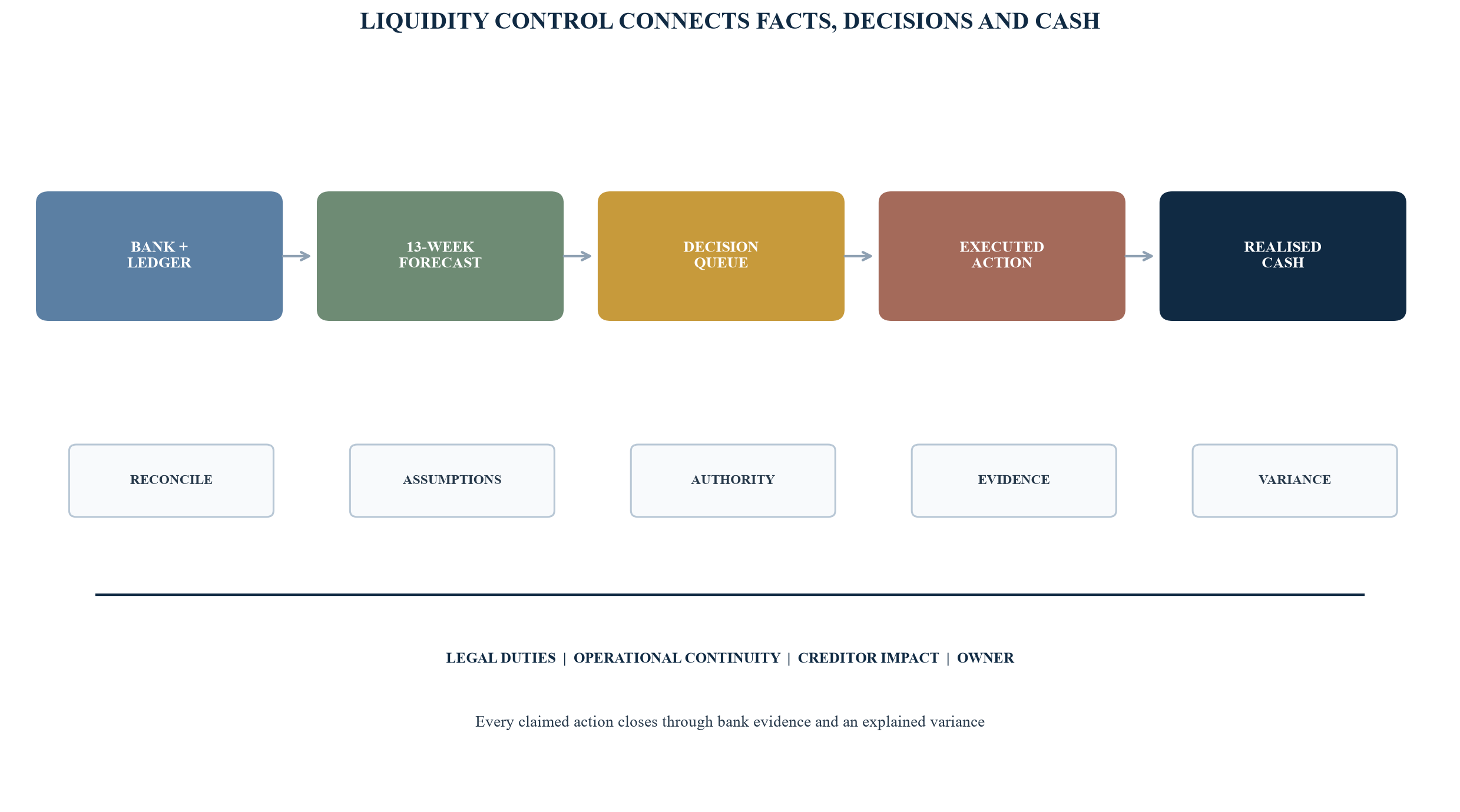
The system is illustrative. Governance and reserved decisions require entity-specific professional advice.
Table 1. Turnaround office mandate and evidence register
| Domain | Minimum evidence | Accountable decision | Control question |
|---|---|---|---|
| governance | board mandate, authority schedule, advisers and meeting cadence | who may approve each action | Are reserved and professional matters routed correctly? |
| cash | bank statements, reconciliations, restricted cash and payment files | which cash is available | Can every balance be independently reconstructed? |
| obligations | payroll, tax, debt, suppliers, rent, utilities and contingent claims | what must be paid and when | Are due dates, disputes, priority and legal consequences evidenced? |
| facilities | agreements, limits, drawings, security, guarantees and covenants | which funding can be used | Are conditions, headroom and lender rights current? |
| operations | orders, production, inventory, delivery and critical suppliers | which activity preserves value | Does the cash decision protect a viable operating path? |
| initiatives | action, owner, timing, value, cost, dependency and risk | which interventions proceed | Has expected cash been separated from realised cash? |
| stakeholders | information request, position, authority and next decision | what support is being requested | Is the pack consistent, timely and decision-ready? |
The register should be adapted to the entity, distress stage and relevant law.
2. Build the cash fact base before forecasting
The opening position should be reconciled from bank evidence. The office should identify every account, currency, overdraft, sweep, deposit, escrow, blocked balance, merchant account, collection account and facility. Legal ownership and practical availability can differ. Restricted, pledged, trapped or operationally inaccessible cash should remain separate from freely available cash.
The bank view should reconcile to the general ledger and material subledgers. Differences may arise from unpresented payments, deposits in transit, bank charges, foreign exchange, manual journals, disputed items or cut-off. The reconciliation should state the amount, age, explanation, owner and resolution date. Unexplained differences should not be converted into forecast assumptions.
The obligation register should be built from contracts, payroll, tax records, supplier ledgers, debt schedules, leases, litigation, purchase orders and operating plans. It should show legal entity, counterparty, due date, amount, currency, status, dispute, security, personal guarantee, criticality and decision authority. Management should distinguish a recorded accounting liability from the timing and legal enforceability of a cash demand.
IAS 7 explains that cash-flow information supports assessment of an entity's ability to generate cash and cash equivalents and the timing and certainty of those flows.[1] A thirteen-week forecast is a management control and does not replace the statutory statement of cash flows. Definitions should reconcile where relevant and remain clearly named.
3. Construct the thirteen-week direct cash forecast
The forecast should use direct receipts and payments. Its opening balance should equal reconciled available cash. Receipts should include customer collections, asset proceeds, tax refunds, insurance, equity, debt drawdowns and other evidenced inflows. Payments should include payroll, tax, suppliers, rent, utilities, debt service, capital expenditure, professional fees and other obligations. The closing balance becomes the next week's opening balance.
Thirteen weeks is an operating convention rather than a statutory rule. It often covers several payroll cycles, supplier terms, tax dates and short-term facility decisions while remaining detailed enough for weekly control. Businesses with daily liquidity risk should maintain a daily view for the immediate period and reconcile it to the weekly model. Longer-cycle businesses should connect the thirteen-week model to a monthly integrated forecast.
Every line should have an owner and evidence class. Contractual, scheduled, behaviour-based and management-estimated items should be distinguishable. A customer promise, historic collection curve and management target carry different evidential weight. The office should state confidence and timing range without converting uncertainty into false precision.
The model should retain a weekly frozen vintage. Actual bank movements are loaded, differences are explained, assumptions are refreshed and a new vintage is approved. Historical vintages allow management and lenders to see forecast quality, bias and changes in underlying conditions.
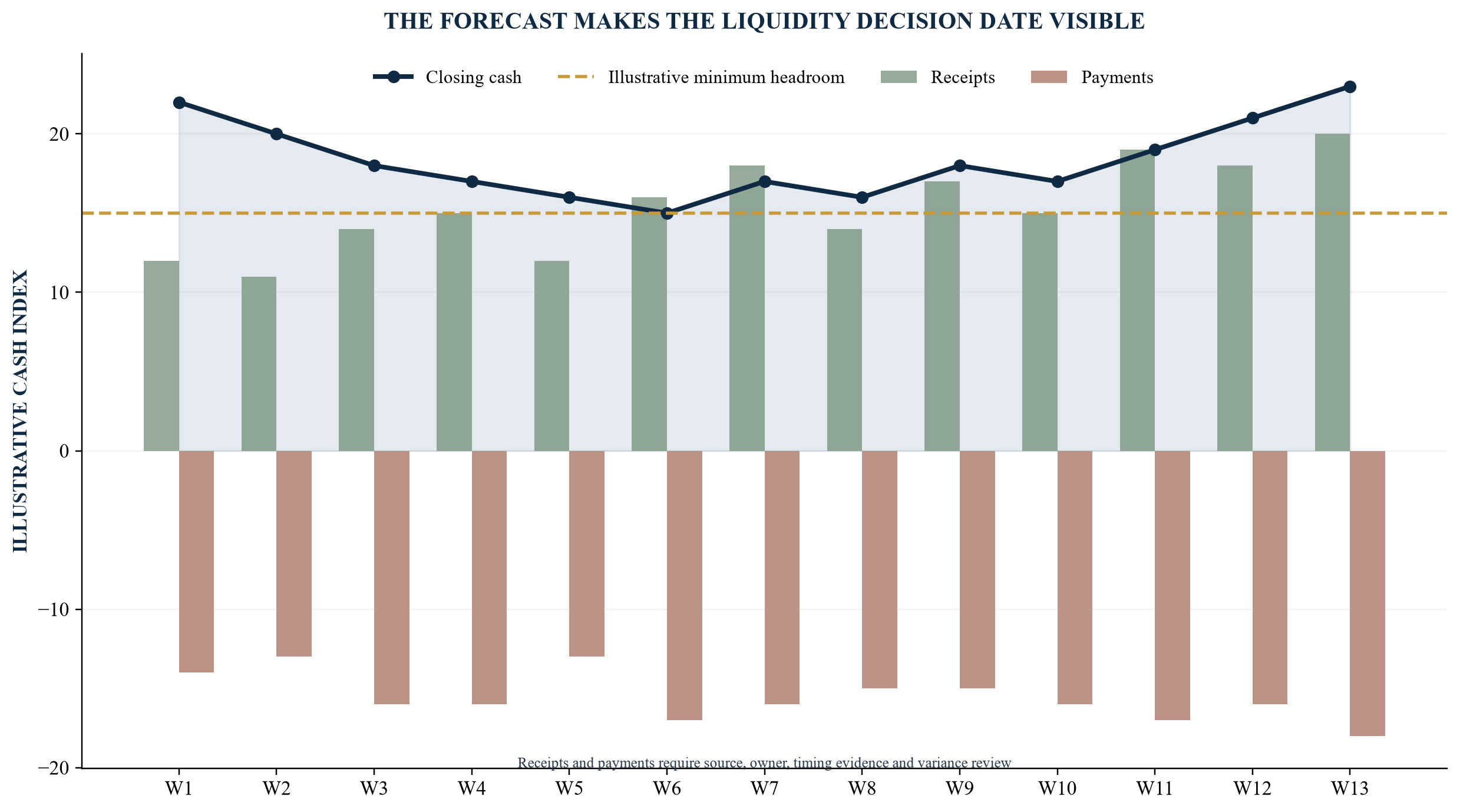
Values are illustrative management assumptions and do not represent an actual business.
Table 2. Thirteen-week forecast architecture
| Forecast block | Evidence | Timing method | Weekly control |
|---|---|---|---|
| opening cash | bank statement, reconciliation and restriction analysis | observed cut-off balance | agrees to bank and prior closing balance |
| customer receipts | invoice, dispute, customer confirmation and collection history | invoice-level date or controlled cohort | actual receipt and timing variance by owner |
| recurring payments | payroll, tax, rent, utilities, debt and contracts | contractual or statutory date | completeness and authority check |
| supplier payments | ledger, purchase order, delivery, criticality and agreed term | due date adjusted only through approved action | payment decision and creditor impact recorded |
| funding | executed facility, condition precedent and draw notice | earliest legally and operationally available date | availability and covenant headroom confirmed |
| initiatives | approved action and implementation evidence | risk-adjusted expected cash date | gross, probability-weighted and realised values separate |
| closing liquidity | opening plus receipts less payments and permitted drawings | calculated each period | minimum headroom and decision trigger visible |
Granularity should reflect the decision horizon and materiality of the business.
4. Forecast receipts from customer evidence
Accounts receivable should be forecast at the lowest practical decision level. Material invoices need customer, amount, due date, dispute status, approval status, expected date, collector and next action. Smaller balances may use controlled cohorts based on observed collection behaviour. The model should separate a contractual due date from the expected cash date.
The office should run a daily collection cadence for material items. Each commitment should state who made it, when, what condition remains and the next contact. A promise to pay is evidence of an intention, not cash. Repeated broken promises should change the expected date and risk assessment.
Disputes require cause codes and accountable owners. Pricing, quantity, quality, delivery, documentation, tax, credit-note and procurement disputes have different resolution paths. Commercial teams should not grant concessions outside authority to accelerate cash without showing the economic effect and precedent risk.
Cash application matters. Unidentified receipts can leave a customer ledger appearing overdue and trigger unnecessary collection or credit action. The office should reconcile bank receipts to invoices and customer accounts promptly. Factoring, receivables finance or assignment may accelerate cash, but eligibility, recourse, dilution, concentration, notice, fees and security require review.
5. Govern disbursements through evidence and authority
A payment queue should show the legal entity, creditor, amount, currency, due date, goods or service, operational criticality, legal consequence, security, guarantee, dispute and requested decision. Payments should follow approved authority and current professional advice. A simple ranking of creditors by management preference can create legal, operational and reputational exposure.
The office should identify critical operational dependencies. Electricity, water, digital infrastructure, payroll, safety, insurance, licences, essential materials and key logistics may determine whether the company can continue trading and preserve value. Criticality should be evidenced through a continuity plan and alternatives, not asserted by the requesting function.
Payment holds and negotiated extensions should be documented. The record should state the counterparty agreement, revised terms, conditions, effect on supply, security, guarantees, taxes and future pricing. An unpaid invoice is not a liquidity benefit when the counterparty has not accepted the delay and enforcement or supply interruption remains possible.
Connected-party and personally guaranteed obligations require particular scrutiny. Directors and managers should obtain advice before making decisions that may alter creditor positions. The UK Insolvency Service, for example, states that directors of an insolvent company should protect assets, avoid worsening creditors' position, treat creditors appropriately and seek professional advice.[2] Duties and tests differ by jurisdiction.
6. Measure forecast variance and bias
Every weekly vintage should be compared with actual cash. Variances should separate amount, timing, omission, classification and model changes. A receipt that arrives one week late has a different operating cause from a receipt that disappears. A payment omitted from the forecast is a completeness failure even when total cash remains above plan.
Signed variance reveals persistent optimism or conservatism. Absolute variance shows error magnitude. Forecast coverage measures the share of cash movement supported by defined evidence. Management should examine error by owner, line type, horizon and evidence class. The goal is improved decisions, not punishment that encourages hidden buffers.
Changes to assumptions should be visible through a bridge from the prior vintage. New information, executed actions, timing changes, lost receipts, added obligations, facility changes and foreign exchange should explain the movement. Manual plugs should be prohibited or isolated as unresolved items.
The office should agree thresholds for escalation. A material deterioration in headroom, forecast accuracy, covenant position, customer collection, supplier continuity or funding availability should trigger a defined decision. Thresholds are company-specific and should consider legal and operational consequences.
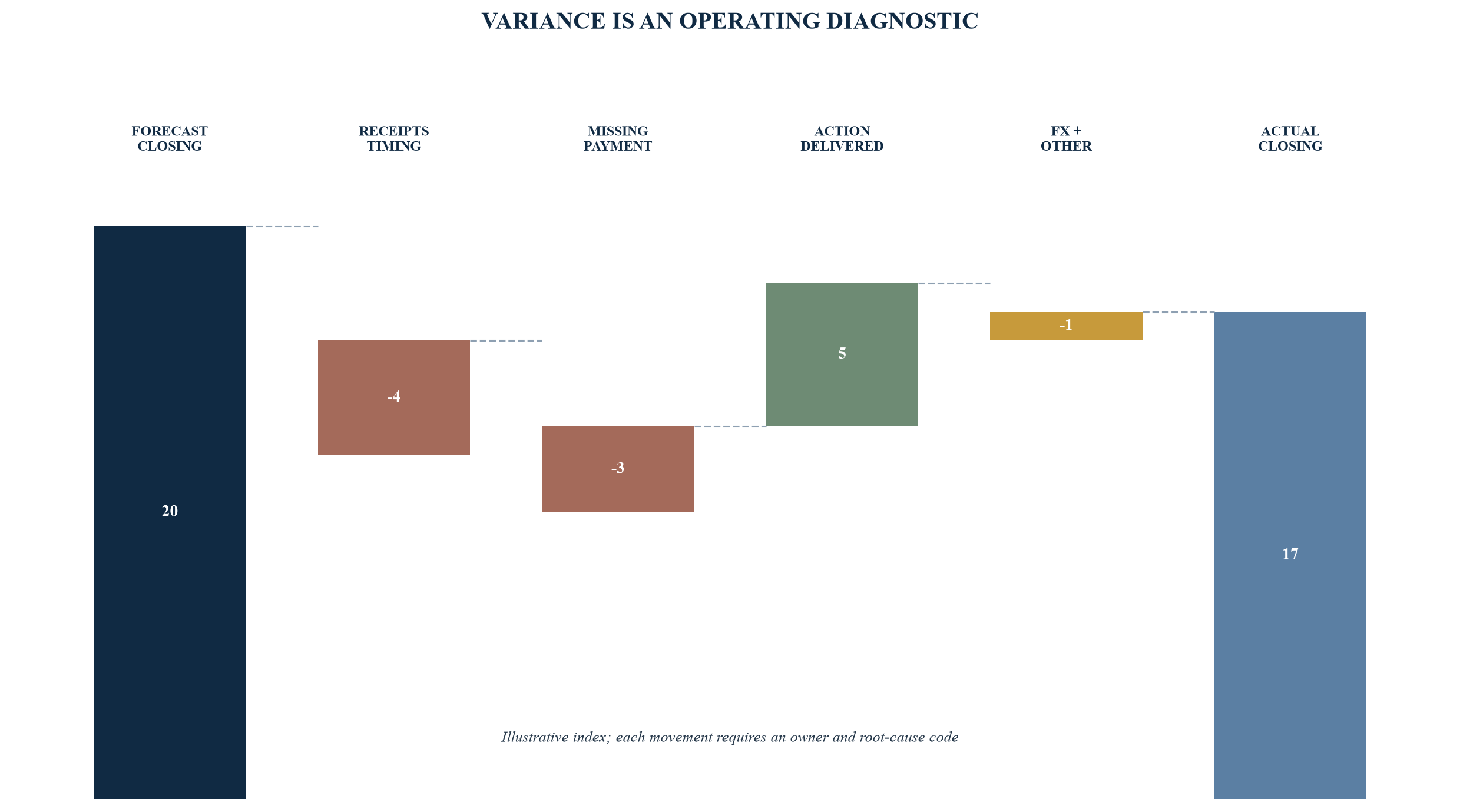
The indexed values are illustrative and should be replaced by reconciled company evidence.
Table 3. Forecast variance taxonomy
| Variance type | Meaning | Required evidence | Management response |
|---|---|---|---|
| timing | cash occurred in a different period | contractual date, expected date and actual bank date | correct collection, payment or scheduling process |
| amount | cash occurred at a different value | invoice, credit, quantity, rate and bank evidence | resolve commercial, operational or estimation cause |
| omission | material movement was absent | source record and reason it was missed | repair completeness control and accountability |
| classification | cash was placed in the wrong category | transaction evidence and corrected mapping | update controlled definition without hiding total error |
| assumption | model input changed before cash occurred | new evidence, approval and effect | bridge the vintage and test decision consequence |
| initiative | approved action delivered or failed | implementation and realised bank evidence | scale, redesign, stop or reforecast |
| unexplained | reconciliation remains incomplete | open issue, owner and deadline | exclude unsupported benefit and escalate |
The taxonomy should remain stable enough to reveal recurring operating causes.
7. Build the liquidity bridge and downside cases
The liquidity bridge should start with reconciled available cash and committed facilities. It should show operating cash generation, mandatory payments, debt service, approved initiatives, implementation costs, funding and minimum headroom. The bridge should state whether facility availability depends on conditions, representations, borrowing-base calculations or lender discretion.
Management should prepare central, downside and severe-but-plausible cases. Drivers may include collection delay, revenue loss, margin pressure, supplier tightening, inventory disruption, tax demands, covenant consequences, funding withdrawal, foreign exchange and execution slippage. Scenarios should be internally consistent. Delayed production may reduce receipts and some purchases while increasing expedite or penalty costs.
Reverse stress testing begins with the liquidity failure point and asks what combination of events reaches it. The result identifies critical assumptions and decision dates. It should not be interpreted as a probability unless supported by a proper method and evidence.
The bridge should separate gross headroom from usable headroom. Trapped cash, restricted facilities, unfulfilled conditions, unavailable collateral and operational minimums can reduce practical access. Management should show the date at which action is required, not only the date at which cash becomes negative.
8. Convert liquidity options into an initiative portfolio
Every liquidity intervention should be managed as an initiative. The record needs a precise action, owner, baseline, gross cash effect, probability-weighted effect, expected date, implementation cost, dependencies, operational consequence, legal and stakeholder review, approval and realised evidence.
Initiatives can include collection acceleration, payment negotiation, inventory reduction, purchase control, discretionary-spend reduction, asset sale, tax recovery, insurance recovery, capex deferral, facility draw, new money, equity, cost action and contract restructuring. Each mechanism has different timing, reversibility and risk.
Double counting is common. Inventory liquidation may already appear in the receipts forecast. A supplier extension can improve the thirteen-week position while creating a later payment wall. A cost reduction may require severance and produce no immediate cash. The office should link each initiative to exact forecast lines and show rebound effects beyond the horizon.
The value of an initiative should be updated only when evidence changes. Management aspiration remains separate from approved and executed action. Realised cash is confirmed through the bank and reconciled transaction.
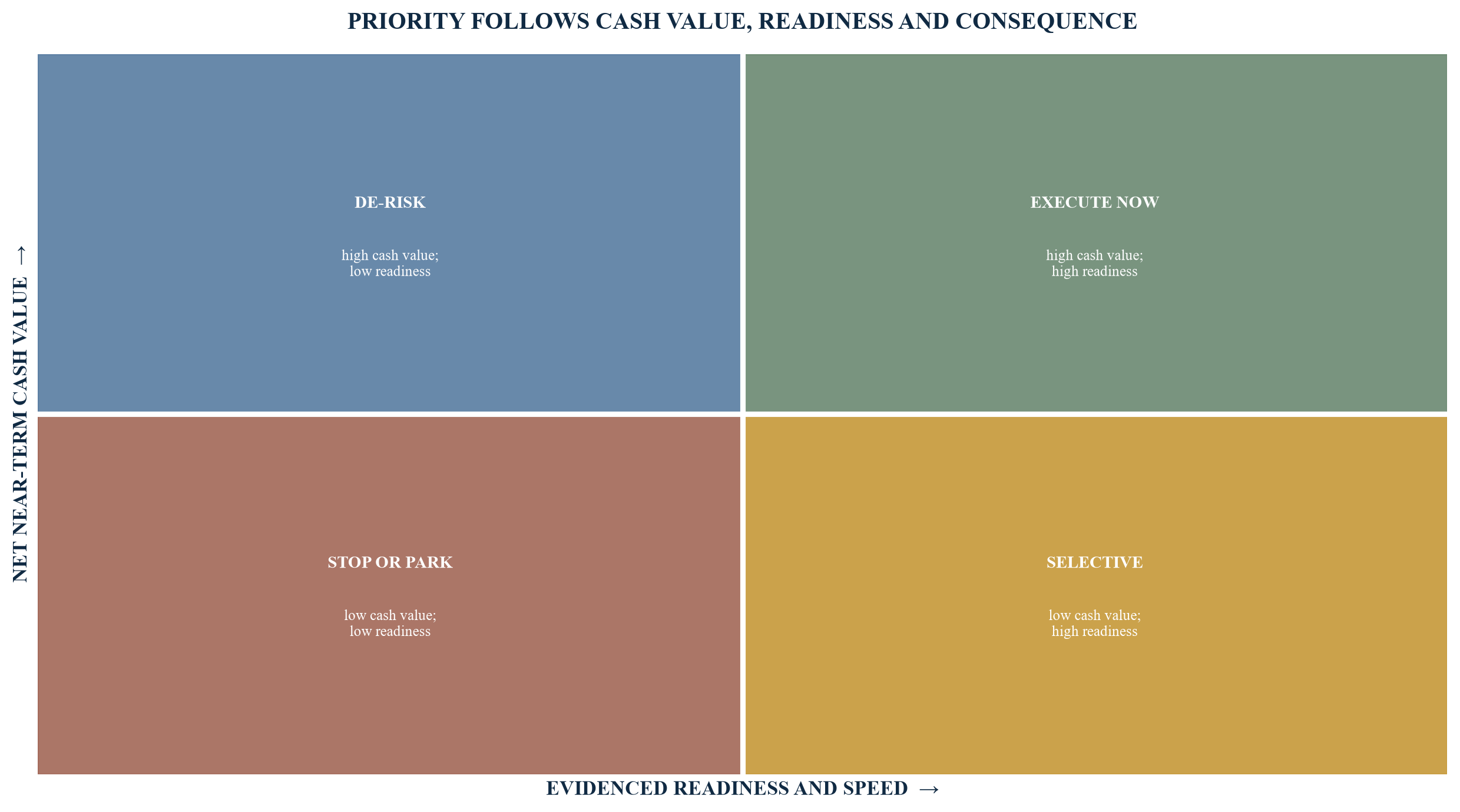
Initiative placement is illustrative. Legal, operational and stakeholder consequences require separate review.
Table 4. Liquidity initiative tracker
| Field | Required content | Failure signal | Closure evidence |
|---|---|---|---|
| action | specific intervention and affected forecast line | broad label without executable step | approved action and implementation record |
| value | gross, cost, net, timing and confidence | benefit shown without cost or rebound | bank receipt or avoided payment reconciled to baseline |
| owner | accountable executive and delivery team | collective ownership | named owner accepts date and evidence requirement |
| dependencies | customer, supplier, employee, lender, legal, tax and system needs | assumed cooperation | condition completed or explicitly unresolved |
| consequence | service, capacity, reputation, creditor and future cash effect | near-term cash isolated from operating impact | competent review and accepted mitigation |
| decision | authority, alternatives, rationale and date | action starts before approval | decision record and reserved-matter clearance |
| status | proposed, approved, executing, realised, failed or stopped | percentage complete without evidence | current status supported by observable milestone |
Expected and realised values should remain separate throughout execution.
9. Release working capital without destroying the franchise
Receivables, inventory and payables can produce rapid liquidity, but each action changes customer, supplier and operating relationships. The office should reconcile working-capital actions to transaction evidence and model the consequence beyond thirteen weeks.
Receivables actions include dispute resolution, billing completion, milestone evidence, credit-note control, deposits, payment methods and financing. Inventory actions include stopping excess purchases, reallocating stock, selling slow items, improving planning and changing service commitments. Payables actions include term negotiation, purchasing discipline, contract correction and controlled scheduling.
An improvement in days sales outstanding, inventory days or payable days is an analytical outcome, not cash evidence. Changes in revenue, seasonality, mix, currency and cut-off can alter ratios. The office should show the underlying invoices, stock movements and payments.
Supplier finance arrangements require accounting and disclosure analysis. IAS 7 includes disclosure requirements relating to supplier finance arrangements following amendments issued in May 2023.[1] Management should obtain accounting and legal advice on classification, disclosure, covenants and dependency.
10. Prepare a lender evidence pack that supports a decision
Lenders need a coherent explanation of the problem, liquidity requirement, management action, viable path and requested decision. The pack should include the reconciled opening position, thirteen-week forecast and vintages, downside cases, liquidity bridge, debt and security map, covenant status, operating performance, initiative tracker, management actions, information limitations and request.
The request should be precise. It may concern continued availability, waiver, amendment, standstill, maturity, payment profile, additional facility, consent, security or information timing. The office should state amount, period, conditions, use of proceeds, milestones and reporting offered. Legal and financial advisers should review the request and consequences.
The Basel Committee's 2025 Principles for the Management of Credit Risk describe sound credit environments, granting processes, administration, measurement, monitoring and controls.[3] A borrower cannot determine a lender's credit decision. It can improve decision quality by providing timely, traceable and internally consistent information and by demonstrating action within management's control.
Bad news should be presented with evidence and a response. Delayed disclosure can damage credibility when the variance later appears in bank movements or covenant reporting. Unsupported upside should remain outside the base request.
11. Map facilities, covenants, security and guarantees
The debt map should cover borrower, lender, instrument, commitment, drawing, maturity, interest, repayment, covenant, testing date, security, guarantee, cross-default, reporting duty, cure, waiver status and contact. The office should use executed documents and competent legal interpretation.
Covenant forecasts should reconcile to contractual definitions. EBITDA, net debt, cash, permitted debt, exceptional items and cure rights may differ from management reporting. The office should show the calculation, headroom, forecast range and decision date. A management adjustment should not be assumed to be permitted.
Security and guarantee changes require authority and legal review. New money can improve liquidity while changing priority, control or recoveries. The World Bank's insolvency and creditor-rights principles emphasise risk management, workouts, creditor rights and effective insolvency systems.[4] The company should assess options under the applicable framework rather than assume a global template determines local rights.
IFRS 9 measures expected credit losses using probability-weighted cash shortfalls and considers timing as well as amount.[5] Lenders' accounting and regulatory assessments are their responsibility. Borrower information on timing, scenarios, collateral and restructuring terms may affect that assessment and should be accurate.
12. Understand the legal and restructuring perimeter
The office should maintain a legal-entity and jurisdiction map. Cash ownership, set-off, guarantees, security, director duties, creditor priorities, transactions at undervalue, preferences, moratoria and filing obligations vary. Cross-border groups can have different liquidity and insolvency positions by entity.
The UAE framework includes Federal Decree-Law No. 51 of 2023 promulgating the Financial Reorganisation and Bankruptcy Law and Cabinet Resolution No. 94 of 2024 concerning its executive regulations.[6][7] Saudi Arabia's Bankruptcy Law provides procedures administered through the relevant legal and institutional framework, including preventive settlement, financial restructuring and liquidation procedures.[8] Application depends on the facts and competent advice.
INSOL International's principles for multi-creditor workouts describe cooperation, limited standstill, information sharing and protection of relative creditor positions as elements of an out-of-court process.[9] They are a professional framework and do not displace applicable law, contracts or court procedures.
The office should prepare options early: solvent operating turnaround, consensual amendment, new money, asset sale, accelerated transaction, formal restructuring or insolvency process. Each option should show liquidity need, time, control, stakeholder support, value, cost and execution risk. Management should avoid presenting the existence of an option as evidence that it is available.
13. Connect the cash process to going-concern assessment
IAS 1 requires management to assess an entity's ability to continue as a going concern and addresses disclosure of material uncertainties.[10] The assessment considers available information about the future for at least twelve months from the end of the reporting period. A thirteen-week forecast is therefore one component of a broader assessment.
The going-concern evidence should connect the short-term cash model to budgets, debt maturities, covenant forecasts, funding availability, restructuring options, board decisions and downside cases. Forecasts should use consistent operating drivers and show the source and approval of management actions.
ISA 570 (Revised 2024) enhances auditor work and reporting relating to going concern and is effective for audits of financial statements for periods beginning on or after 15 December 2026.[11] Management remains responsible for its assessment and disclosures. Early engagement with auditors can clarify evidence expectations without transferring management's judgement.
The office should preserve forecast vintages, board papers, lender correspondence, adviser input, contracts and executed actions. Contradictions between the lender pack, board pack, statutory reporting and operating forecast should be resolved and documented.
14. Run a decision-led weekly war room
The weekly war room should begin with safety, legal duties and critical continuity issues, then review bank reconciliation, prior actions, forecast variance, minimum headroom, receipts, disbursements, initiatives, facilities, covenants, stakeholders and decisions. Each discussion should end with a decision, owner, due date and closure evidence.
The pack should be issued from controlled data. Participants need the same cut-off, definitions and version. Changes after cut-off should appear in an exception log. Sensitive legal or personal information should be restricted to authorised recipients.
Daily huddles may be required for collections, payments or immediate liquidity. They should feed the same records rather than create competing spreadsheets. A monthly review should reconcile the cash process to management accounts and update the longer-term restructuring plan.
Decision fatigue is a risk. The office should define which routine actions proceed within guardrails and which matters require executive, board, legal, lender or court approval. Service times and escalation paths should be visible.
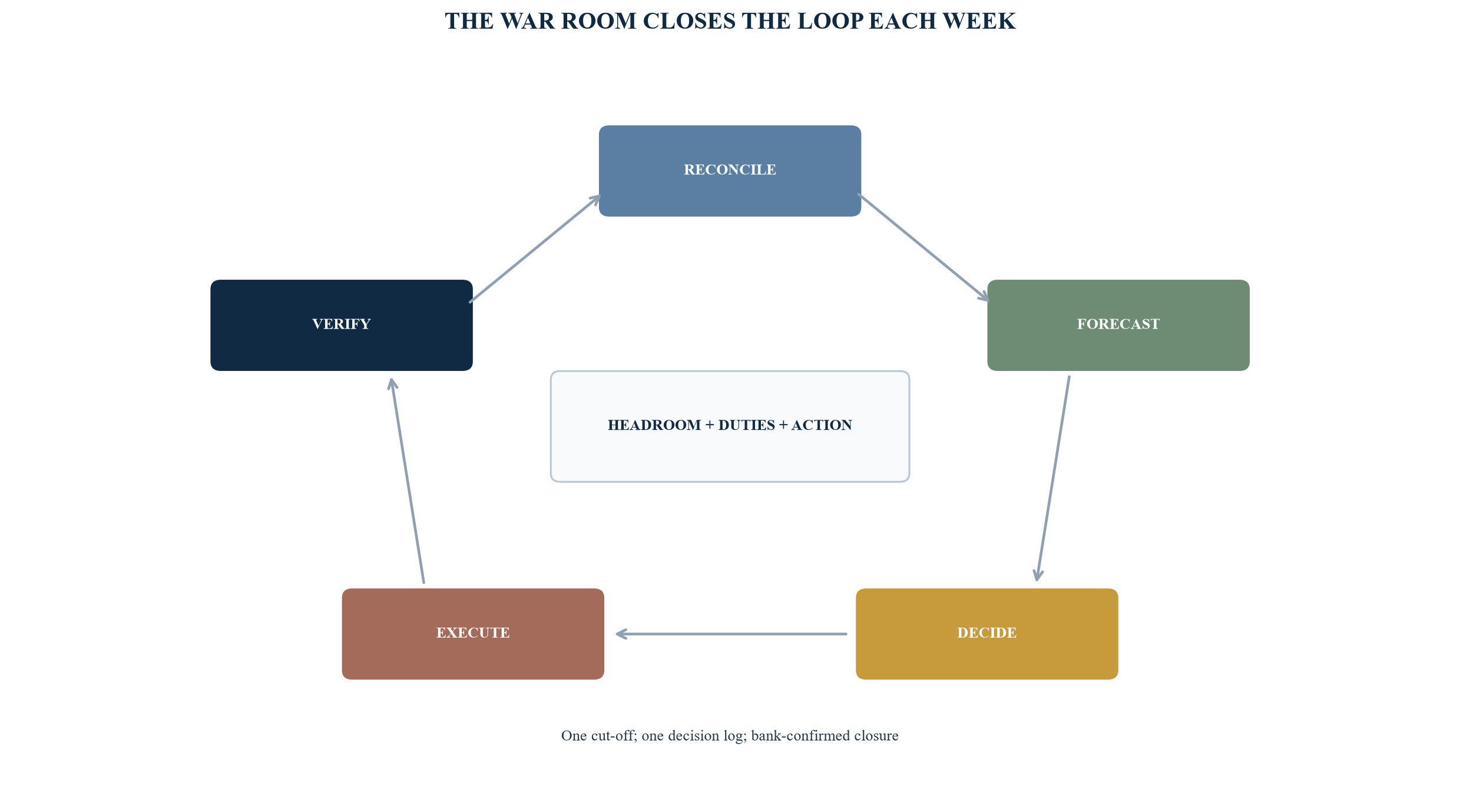
The cadence should be adapted to legal duties, liquidity severity and operational complexity.
Table 5. Weekly turnaround war-room agenda
| Agenda block | Evidence presented | Decision output | Closure test |
|---|---|---|---|
| duties and continuity | legal issues, safety, payroll, tax and critical operations | escalation, advice or protected action | competent owner confirms next step |
| cash reconciliation | bank, ledger, restrictions and unexplained items | accepted opening position and issue owners | all material differences resolved or isolated |
| forecast and headroom | current vintage, variance, scenarios and decision date | approved assumptions and trigger response | vintage frozen and distributed |
| receipts and payments | material movements, commitments, disputes and queue | collection and payment decisions | bank evidence or updated exception |
| initiatives | value, timing, dependencies, cost and consequence | execute, redesign, stop or escalate | milestone and realised cash recorded |
| facilities and covenants | availability, calculation, security and lender status | request, waiver, draw or contingency action | executed evidence or current status |
| stakeholders | information requests, position and upcoming decision | owner, message, pack and date | delivery and response recorded |
Reserved legal and professional matters should be handled by the competent authority.
15. Mobilise across thirteen weeks
Week one should establish governance, professional advice, bank access, cash reconciliation, obligations, facilities, immediate continuity and the first forecast. Unsupported payments, unknown accounts, missing authorities and imminent legal or operational triggers require immediate escalation.
Weeks two and three should stabilise the process: validate receipts, create the payment queue, complete the debt and covenant map, launch priority initiatives, prepare downside cases and issue the first lender pack where required. Management should freeze weekly vintages and explain every material variance.
Weeks four to six should deepen execution. Working-capital actions, supplier agreements, cost and capacity measures, asset options and funding requests move through defined approvals. The office should update the longer-term operating plan and test whether the near-term cash actions support a viable path.
Weeks seven to ten should evidence delivery, refresh stakeholder decisions, refine scenarios and address structural issues. Actions that only move cash beyond the thirteen-week horizon should be visible. The board should compare consensual and formal options with current advice.
Weeks eleven to thirteen should determine the continuing model. A stabilised business may transfer controls to line management with defined reporting. A continuing restructuring may retain the office, change governance or enter a formal process. Closure should depend on evidenced liquidity, sustainable operations, clear duties and an approved forward plan.
Table 6. Thirteen-week mobilisation roadmap
| Period | Primary objective | Core outputs | Gate to proceed |
|---|---|---|---|
| week 1 | establish control and protect immediate continuity | mandate, advisers, bank truth, obligations, payment authority and first forecast | opening cash and imminent decisions are evidenced |
| weeks 2-3 | stabilise the information and stakeholder process | collections, payment queue, debt map, scenarios, initiatives and lender pack | decisions use one reconciled forecast |
| weeks 4-6 | deliver rapid cash and operating actions | working-capital actions, agreements, cost measures and funding progress | execution milestones and consequences are visible |
| weeks 7-10 | test viability and structural options | refreshed plan, downside evidence, stakeholder positions and option analysis | board has current professional advice and decision dates |
| weeks 11-13 | select the continuing governance path | sustainable forecast, transition or restructuring mandate and controls | ownership and evidence process continue beyond mobilisation |
| every week | reconcile, decide, execute and verify | frozen vintage, variance bridge, decision log and realised cash | no unsupported benefit or unresolved material variance is hidden |
Timing is illustrative and should be accelerated when legal, liquidity or continuity triggers require action.
16. Board and lender diagnostic
The board should be able to identify the lowest usable cash point, the date action is required, the obligations that drive it, the evidence supporting receipts, the availability of facilities and the downside events that change the conclusion. It should understand legal duties and obtain current professional advice.
Management should explain every material change from the prior forecast. It should distinguish executed action from proposed action, committed funding from a request, customer promises from receipts and accounting measures from cash. The initiative portfolio should reconcile to forecast lines and bank evidence.
Lenders should receive a consistent request supported by a controlled information pack. The pack should show management action, information limitations, covenant position, options and reporting cadence. Credibility develops through timely accuracy, transparent variance and delivery against commitments.
The turnaround management office succeeds when the company can make lawful, timely and economically coherent decisions from one cash truth. Its thirteen-week horizon creates urgency and control. The longer-term objective remains a viable operating and capital structure or an orderly alternative that protects value under the applicable framework.
References
- IFRS Foundation. IAS 7 Statement of Cash Flows. https://www.ifrs.org/issued-standards/list-of-standards/ias-7-statement-of-cash-flows.html/
- UK Insolvency Service. Director information hub: Director duties upon insolvency. 2023. https://www.gov.uk/guidance/director-information-hub-director-duties-upon-insolvency
- Basel Committee on Banking Supervision. Principles for the Management of Credit Risk. 2025. https://www.bis.org/bcbs/publ/d595.htm
- World Bank. Principles for Effective Insolvency and Creditor/Debtor Regimes. 2021.
- IFRS Foundation. IFRS 9 Financial Instruments. https://www.ifrs.org/issued-standards/list-of-standards/ifrs-9-financial-instruments/
- United Arab Emirates. Federal Decree-Law No. 51 of 2023, Financial Reorganisation and Bankruptcy Law. https://uaelegislation.gov.ae/en/legislations/2190
- United Arab Emirates. Cabinet Resolution No. 94 of 2024, Bankruptcy Executive Regulations. https://uaelegislation.gov.ae/en/legislations/2582
- Saudi Bankruptcy Commission. Bankruptcy Law and Implementing Regulations. https://www.bankruptcy.gov.sa/en/BankruptcyLaw/SystemAndRegulations/Pages/default.aspx
- INSOL International. Principles for a Global Approach to Multi-Creditor Workouts II. 2017. https://www.insol.org/focus-groups/financiers-group/technical-projects
- IFRS Foundation. IAS 1 Presentation of Financial Statements, paragraphs 25-26, Going Concern. https://www.ifrs.org/issued-standards/list-of-standards/ias-1-presentation-of-financial-statements/
- IAASB. ISA 570 (Revised 2024), Going Concern. 2025. https://www.iaasb.org/publications/isa-570-revised-2024-going-concern
- U.S. SEC. Liquidity and Capital Resources Disclosure Guidance. Release 33-9144. 2010. https://www.sec.gov/rules/interp/2010/33-9144.pdf
- UK Government. Corporate Financial Distress Guidance Note. 2026. https://www.gov.uk/government/publications/the-sourcing-and-consultancy-playbooks/corporate-financial-distress-guidance-note-html
- IFRS Foundation. Supplier Finance Arrangements, IAS 7 and IFRS 7 amendments. 2023. https://www.ifrs.org/projects/completed-projects/2023/supplier-finance-arrangements/
- IMF. Policy Options for Supporting and Restructuring Firms Hit by the COVID-19 Crisis. 2022.
- Altman, E. I. (1968). Financial Ratios, Discriminant Analysis and the Prediction of Corporate Bankruptcy. Journal of Finance, 23(4), 589-609. https://doi.org/10.1111/j.1540-6261.1968.tb00843.x
- Ohlson, J. A. (1980). Financial Ratios and the Probabilistic Prediction of Bankruptcy. Journal of Accounting Research, 18(1), 109-131. https://doi.org/10.2307/2490395
- Beaver, W. H. (1966). Financial Ratios as Predictors of Failure. Journal of Accounting Research, 4, 71-111. https://doi.org/10.2307/2490171
About the Author
Chennakeshav Adya is an independent researcher in corporate finance, strategy, transactions and operating transformation.
