

1. Define the asset before setting the advance
The proposed financing decision concerns a specific contractual right to receive money from an identified debtor. The lender needs to know which legal entity performed the service, which customer owes the amount, which contract created the right and which conditions remain before payment. A general ledger balance supplies a starting population. It does not establish that every recorded amount is due, assignable, free from competing claims or available within the debt-service period. The underwriting file should preserve that distinction from the first data request through approval and monitoring.
Facilities management can include planned maintenance, reactive work, cleaning, security coordination, energy services, helpdesk activity, lifecycle replacement and specialist subcontracting. The payment basis can differ across a single contract. A monthly fixed charge may become due after submission of a service report. Variable work may require an approved order and completion certificate. A retention can remain payable only after a stated event. Performance deductions can depend on service levels, response times or other measures defined in the agreement. The lender should map each material balance to the payment mechanism that applies to it.
The borrower perimeter also matters. A group may bid through one entity, employ people through another, subcontract specialist work through a third and invoice from a fourth. The receivable belongs to the entity with the contractual right to payment. Cash may arrive in an account controlled by another group company or be reduced through group-level set-off. Obtain the executed contract, approved assignment or novation documents, invoicing records and bank statements needed to identify the actual path. Group reputation supplies no substitute for this legal and cash perimeter.
This paper proposes a method for an initial investment or credit decision. It does not determine the rights arising under any unnamed contract or the permissions required for a particular capital provider. Federal, local-government, government-related and private-sector customers may use different agreements and processes. UAE financial free zones can also raise separate governing-law and regulatory questions. The relevant lender should obtain current advice on its structure, the receivable, the debtor, the notice route, any registry filing and enforcement before advancing money.
2. Use public rules within their stated scope
UAE Federal Decree-Law No. 16 of 2021 defines a receivable as a contractual right to satisfy a monetary amount owed by the receivable's debtor. Its definition of transfer includes security, collateral and irrevocable-sale arrangements. Article 2 applies the law to commercial and civil transactions and identifies exclusions. Article 4 permits generally or specifically described current and future receivables to be covered, while Articles 8 and 15 connect registration and debtor notice with third-party priority and discharge through payment. These provisions frame questions for counsel rather than conclusions about an unidentified financing. [1]
The same law preserves important debtor-side issues. Article 13 states that a transfer does not change rights, obligations or original payment terms unless the debtor accepts the change. Article 16 permits specified defences and set-off rights to be raised against the transferee. Article 5 addresses restrictions on transfer while preserving debtor set-off or interests against the transferor. A lender therefore needs more than a valid agreement with the borrower. The actual original contract, accrued rights, notices, debtor responses, competing claims and applicable law remain central to collections and priority. [1]
Federal Law No. 4 of 2020 includes present or future accounts receivable among movable property that may be pledged. It treats the transferee's right in a sale of accounts receivable as a security right for the law's purposes, subject to its stated exception. Its priority provisions show why an earlier registration, proceeds and a bank's set-off rights can affect the asset available to a new lender. Transaction counsel should identify the required filing, search results and priority analysis for the actual obligor, receivable and collection account. [2]
The federal procurement materials supply a bounded example of why an invoice total can contain withheld amounts. Cabinet Resolution No. 122 of 2024 allows an authorised committee to approve withholding or deduction from invoices instead of a performance bond within the applicable procedures. Its SME provision states that an amount may be deducted from initial invoices in place of a performance bond. Federal Law No. 11 of 2023 places payment deadlines in the contract. These federal rules do not establish the terms of every UAE facilities-management contract. They support reading the executed agreement and invoice status rather than assuming that an invoiced balance is presently payable. [3] [4]
3. Reconcile the register to an unconditional receivable
IFRS 15 distinguishes a contract asset from a receivable. Paragraph 108 describes a receivable as an unconditional right to consideration, where only the passage of time is required before payment is due. A contract asset remains conditional on something other than time. This accounting distinction gives a lender a useful first question: what still has to happen before the customer owes the amount without another performance condition? The accounting answer does not settle assignability or finance eligibility, but it helps expose amounts whose cash date depends on further action. [6]
Request the invoice register with invoice number, legal supplier, legal debtor, contract, service period, issue date, due date, currency, gross amount, tax, credit notes, cash received and current status. Add the customer's portal identifier and the date on which the invoice passed each validation step. Reconcile the total to the general ledger and financial statements. Then reconcile a sample to service records and bank receipts. Differences should remain visible until resolved. Replacing a discrepancy with an unexplained manual adjustment weakens the evidence chain.
Create four initial classes. The first is an unconditional receivable supported by contract-compliant service evidence and a valid invoice. The second is a contract asset or other conditional amount that still requires performance, certification or another event. The third is a retained amount governed by a release condition. The fourth comprises disputed, reduced or reversed balances, including provisional deductions, final deductions, credit notes and contra claims. A fifth operational label can identify amounts whose accounting status is established but whose finance eligibility remains unresolved due to legal, concentration, aging or documentation issues.
The classification should follow the actual source document. A portal label such as approved may refer to technical approval, budget approval, invoice validation or payment release. Ask the customer or borrower to explain the workflow and retain evidence showing what the status means. A due date entered by the supplier may differ from the contractual due date if the customer starts the payment period after acceptance of a complete submission. The lender should calculate due dates from the governing terms and evidenced events, then retain the borrower's reported date for reconciliation.
| Balance class | Cash characteristic | Evidence required for review | Initial finance treatment |
|---|---|---|---|
| Unconditional receivable | Only time remains before contractual payment is due | Contract, accepted service, invoice and supported due date | Test for eligibility |
| Conditional service amount | Further performance or approval remains | Work order, service record and open condition | Exclude until condition is satisfied or separately approved |
| Contractual retention | Payment depends on a stated release event | Retention clause, deducted amount, expiry or release event and offset rights | Track separately from current receivables |
| Provisional performance deduction | Amount remains under review or dispute | KPI record, notice, response and decision | Reserve or exclude according to documented policy |
| Final deduction or credit | Customer obligation has been reduced | Agreed reduction record or credit note | Remove from receivable and dilution history |
| Eligibility exception | Right exists but a lender condition remains open | Aging, concentration, assignment and priority evidence | Apply the agreed exclusion or reserve |
Original framework. Transaction evidence and advice govern each conclusion.
4. Separate retention from the current payable amount
A retention can represent a contractual amount withheld from otherwise measured work, a substitute for a performance bond or another security mechanism. Its economic value depends on the exact clause. The lender should record the retention basis, cumulative amount, maximum, release event, release date or long-stop date, rights of deduction, termination consequences and documentary steps required for payment. A ledger that adds retention to the current invoice balance can overstate near-term collections even when the borrower may ultimately retain a valid claim.
Read the clause together with the payment mechanism and performance provisions. The customer may calculate the retention from initial invoices, every invoice, a subset of work or a percentage of contract value. Release may occur after contract completion, acceptance, expiry of a defect period, delivery of replacement security or resolution of open claims. Some amounts can be applied against customer losses or unpaid obligations. The lender should avoid assigning an expected cash date until the relevant event and required documentation are identified.
The federal procurement example shows how a withheld amount can stand in place of a performance bond for eligible SME suppliers. The implementing resolution also defines a performance bond as an unconditional guarantee valid for the contract period and up to ninety days after its end. Those rules illustrate a security purpose. They do not prove that a retention in a private or local-government facilities contract has the same duration, amount or release conditions. The executed agreement and current customer records control the transaction analysis. [4] [5]
Model retained amounts outside the current borrowing base unless the lender has approved a separate method supported by evidence. A capital provider may decide to give some value to a near-term, independently confirmed release. That decision should specify the haircut, collection date and events that can reduce the amount. The credit memorandum should also explain whether retention release depends on continued performance under the same contract that generates repayment. A forecast that uses full retention release immediately after a borrower default requires particular scrutiny because the default may affect the release right.
5. Distinguish performance deductions from payment delay
Facilities-management contracts can connect payment to specified service outcomes. The relevant contract might provide service credits, abatements, liquidated damages, penalties, back-charges or rights to recover the cost of replacement performance. These terms can operate differently. The lender should use the contractual label and legal analysis applicable to the agreement rather than applying one generic deduction category. For each item, identify the event, calculation, cap, notice, dispute process, final decision and relationship to amounts otherwise due.
A provisional deduction requires a different cash treatment from a final deduction. The provisional amount may be restored after correction or dispute, paid later, settled for a smaller amount or confirmed in full. The model should carry the best supported current status and show the open range where material. Once the customer and supplier agree a permanent reduction, the receivable and revenue records should reflect the final result under applicable accounting advice. The lender's dilution history should preserve the original invoice and subsequent reduction so trends remain visible.
Payment delay also requires separate treatment. An accepted invoice can remain collectible in full while arriving after the original date. A permanent deduction reduces the amount collected. Mixing the two effects inside an average days-sales-outstanding assumption can hide how much liquidity is needed and how much economic value has disappeared. Build a cash calendar for late but fully collectible invoices. Build a separate deduction or dilution analysis for amounts that will not be collected. Combine the effects only after each component has been calculated once.
Review cross-contract and group set-off rights. A customer may claim that poor performance under one site or contract can reduce amounts due elsewhere. A prime contractor may deduct costs arising from a subcontractor or another group entity if the agreement permits it. The lender needs counsel's view of the relevant rights, together with the customer's actual notices and the borrower's records. Concentration analysis should group invoices that share the same deduction mechanism or customer decision-maker, because one dispute can affect several balances at the same time.
6. Trace each invoice to accepted service evidence
ISO 41001 describes a facilities-management system that supports effective and efficient service delivery, interested-party needs and applicable requirements. The standard is non-sector-specific. Its public summary supports organising service evidence around defined requirements and delivery. It provides no conclusion about the performance, certification or payment entitlement of an unnamed supplier. A lender should request the contract-specific records that show what was required, what was delivered, who accepted it and how the invoice amount was calculated. [8]
For fixed monthly services, trace the invoice to the site list, scope, staffing or output requirements, service report and customer acceptance step. For reactive work, connect the request, approved authority, completion record, parts or labour evidence and sign-off. For variable or project work, add the quotation, purchase order, variation approval and valuation certificate where applicable. The evidence should identify the legal customer representative with authority to approve the relevant stage. An operational acknowledgement can prove that a technician attended while leaving the payment amount unresolved.
Test the data path from source systems to the invoice. A work-order platform may record timestamps, status changes, technician notes and customer acknowledgements. The billing file may summarise these records using separate pricing rules. Reperform a sample calculation from the raw event to the billed amount and subsequent receipt. Review cancelled and reopened tasks as well as successful work. The lender should understand how duplicate tickets, incomplete fields, manual overrides and late approvals affect both revenue and cash.
Subcontracted activity creates another evidence chain. Federal procurement rules for their own scope require specified subcontracting information and retain responsibility with the main supplier. They also describe circumstances in which a federal entity may pay a subcontractor directly and deduct that payment from the main supplier's contract value. A private contract can operate differently. The lender should identify approved subcontractors, the borrower's obligation to pay them, any direct-payment right and whether the customer can deduct subcontractor amounts from the receivable offered for financing. [3] [4]
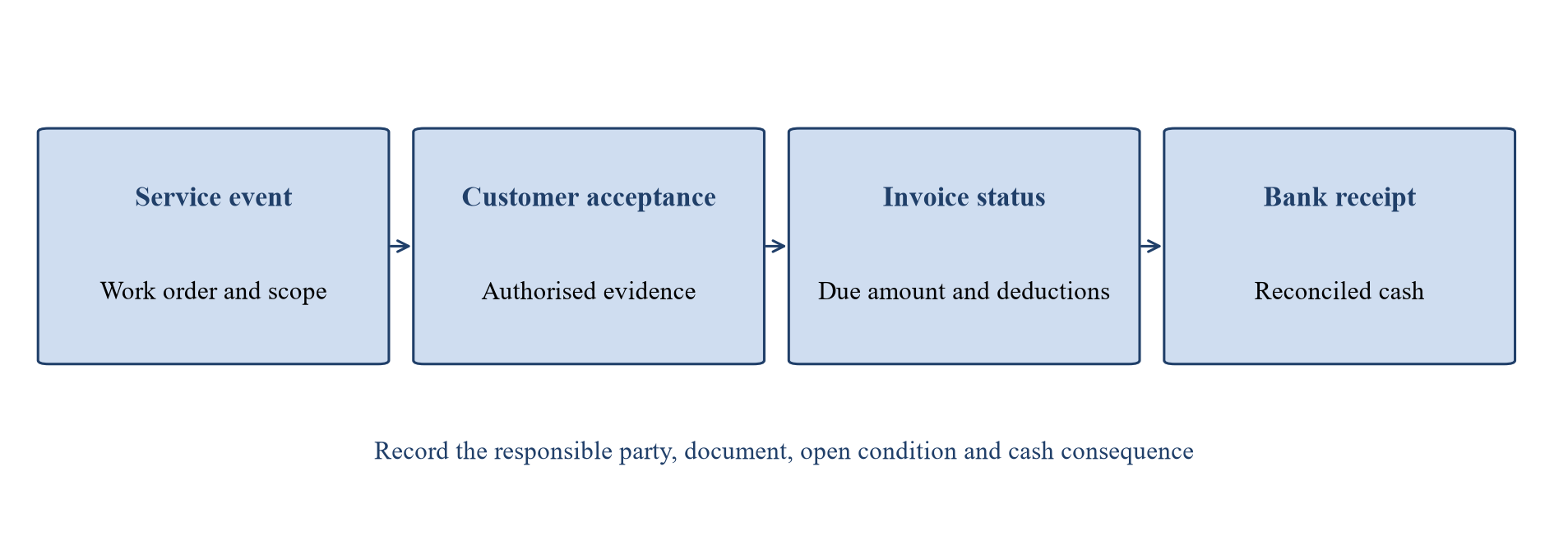
Original lender framework. Every stage requires contract-specific evidence; the sequence carries no assumed approval or payment date.
7. Identify the debtor and contractual payment chain
The named end user of a facility may differ from the legal debtor. A property owner can appoint a managing agent, main contractor or special-purpose company that enters the supplier contract. A government-related brand can appear in tender material while another entity carries the payment obligation. The lender should identify the counterparty from the executed contract and verify the invoice addressee, purchase order, tax record and bank receipt. Any proposed reliance on a parent, owner or government body requires an enforceable obligation or other evidence reviewed for that purpose.
Map each participant's authority. The person validating service, the person approving an invoice, the person authorising a deduction and the person releasing payment can sit in different organisations. Record the documents each can issue and the conditions under which another party can override or challenge them. This helps distinguish an accepted service record from a payable certificate and a payable certificate from cash. It also identifies where a notice of assignment or payment instruction must travel under the contract and applicable law.
Review contract amendments and variations. Federal procurement law requires specified approvals for amendments within its scope. Private customers will have their own authority rules. A service expansion recorded only in email or an operational system may lack the approval required to change the contract price. The lender should request the executed variation, the authority supporting it and the resulting invoicing basis. Where the borrower has already performed additional work without completed approval, classify the balance according to the remaining condition and avoid treating the expected approval as current cash.
Termination, suspension and contract expiry can alter both new billings and outstanding claims. The federal implementing resolution distinguishes certain payments due before suspension or termination and links contract closure to completed receipt and payment procedures. These provisions apply within their own federal scope. They show why the lender should identify the service period, accrued entitlement, termination rights, performance security and unresolved claims. The cash forecast should stop new billings at the scenario date and separately analyse amounts already earned, conditional or disputed under the actual contract. [4]
8. Verify transfer notice priority and set-off
The proposed legal workstream begins with the transfer agreement and the receivable description. Counsel should confirm the parties, capacity, governing law, current and future receivables covered, secured obligations, recourse, collections, representations and events of default. Article 4 of the UAE factoring law allows a general or specific description that identifies current or future receivables. The facility documents still need language suited to the actual transaction. The lender should reconcile the legal description to the debtor and contract codes used in the borrowing-base data. [1]
Third-party effectiveness and priority require a separate conclusion. The UAE factoring law ties those matters to registration and the movables-security framework. Search the relevant register and corporate records, identify earlier transfers or security rights and obtain releases or intercreditor arrangements where needed. A borrower warranty that no competing claim exists provides contractual recourse. It does not replace the searches and legal steps required for the lender's intended priority. The analysis should also cover proceeds after they reach the collection account.
Debtor notice affects payment discharge. Under Article 15, payment made according to the original contract before notice can discharge the debtor, while the rules change after effective notice. The law also addresses multiple notices and requests for proof of transfer. Use counsel-approved notices and evidence of receipt. Confirm the debtor's systems can direct payment to the agreed account and determine whether the original contract or procurement process requires consent, acknowledgement or a specified channel. An email sent to an operational contact may fail to establish the intended legal and processing result.
Set-off and defences can reduce collections even when the transfer is valid. Article 16 preserves stated debtor defences and netting rights, and Article 5 addresses restrictions and debtor interests. Counsel should review cross-contract set-off, tax, customer claims, service credits, subcontractor payments and any account-bank rights. The credit team should quantify current exposures and define how new claims affect availability. A clean debtor confirmation can support the analysis at a stated date. It cannot waive future rights unless the relevant document and law make that effect clear.
| Review item | Evidence to obtain | Cash or priority question | Responsible specialist |
|---|---|---|---|
| Receivable creation | Executed contract, order, service evidence and invoice | Has an identifiable monetary right arisen and when is it due | Legal, commercial and finance |
| Retention | Clause, calculation, cumulative ledger and release record | Which event releases cash and what can reduce it | Legal, commercial and finance |
| Performance deductions | KPI method, notices, disputes, decisions and credits | Is the amount delayed, uncertain or permanently reduced | Commercial, operational and finance |
| Transfer scope | Transfer agreement and receivable schedule | Does the description cover the offered balance and future additions | Transaction counsel |
| Contract restrictions | Original contract and consent requirements | What approvals, breaches or debtor rights may affect collection | Transaction counsel |
| Notice and payment instruction | Approved notice, receipt and debtor acknowledgement | Which payment discharges the debtor and into which account | Transaction counsel and operations |
| Registration and priority | Registry searches, filings, releases and intercreditor terms | Does another claimant rank ahead or share proceeds | Transaction counsel |
| Set-off and defences | Contract rights, claims, tax and customer confirmation | What amount can the debtor withhold or net against payment | Transaction counsel and credit |
| Collection account | Bank mandate, control terms and account searches | Can proceeds be identified and applied as intended | Legal, treasury and operations |
Questions for the transaction team. The table makes no legal finding and should be completed with current advice and documents.
9. Set eligibility rules that can be reproduced
A borrowing base should convert the approved legal and credit policy into a calculation that another reviewer can reproduce. Define the eligible debtor, contract, currency, invoice status, maximum age, documentation, concentration limit, dispute treatment and required notice or acknowledgement. Specify how taxes, retentions, unbilled amounts, credit notes, contra balances and intercompany items are handled. The agreement and reporting template should use consistent definitions. A spreadsheet field called eligible carries little value if its formula or source status changes between reporting dates.
Eligibility should begin after the unconditional-receivable test. The lender can then apply additional credit rules. An amount can satisfy IFRS presentation as a receivable and remain outside the borrowing base because it is overdue beyond policy, concentrated above a limit, owed by an excluded debtor, denominated in an unsupported currency or subject to unresolved assignment evidence. Keep the accounting classification and finance classification in separate columns. This preserves the reason for each exclusion and allows the lender to update one rule without rewriting the underlying accounting record.
Define reserves separately from exclusions. An exclusion removes the relevant amount before the advance rate. A reserve reduces availability after another calculation. A lender might use a dilution reserve for recent credit-note behaviour, a collection reserve for operational friction or a specific reserve for an unresolved exposure. The actual definitions require negotiated terms and evidence. The model later uses two fixed hypothetical reserves only to illustrate arithmetic. It provides no recommended reserve, advance rate or eligibility threshold for a UAE transaction.
Version control is essential. Each certificate should retain the source-file timestamp, extraction criteria, exchange rates if applicable, eligibility rules, manual adjustments, reviewer and approval date. Reconcile the current certificate to the previous one through additions, collections, exclusions, releases, write-offs and rule changes. Investigate a large movement before funding. A record that moved from disputed to eligible should carry the customer decision that resolved the dispute. A retention release should show both the original withheld balance and the later cash receipt.
10. Reproduce the hypothetical borrowing base
The worked example begins with a management invoice register of USD 12.0 million. All amounts are USD millions, net of tax for simplicity. The register includes USD 1.2 million for services or acceptance steps that remain incomplete, USD 0.8 million of retention that is not yet due, USD 0.7 million of disputed performance deductions and USD 0.3 million of credit notes or contra balances. Removing those four categories produces USD 9.0 million of unconditional receivables for the purpose of the illustration. These classifications are assumptions rather than findings about a borrower.
The model then removes USD 0.8 million of over-age or unconfirmed balances, USD 1.0 million above an assumed debtor-concentration limit and USD 0.6 million with unresolved assignment or notice evidence. The eligible pool is USD 6.6 million. Applying an assumed 75 percent advance rate gives USD 4.95 million. Fixed hypothetical reserves of USD 0.30 million for dilution and USD 0.25 million for collection reduce the borrowing base to USD 4.40 million. Current utilisation of USD 3.50 million leaves USD 0.90 million of headroom.
Each step must appear once. The USD 0.7 million disputed deduction is removed before the unconditional-receivable subtotal and should not also enter the dilution reserve as the same expected loss. The reserve could reflect separate historical behaviour or another defined exposure. Likewise, the USD 0.8 million retention is excluded because it is not currently due. It is not written off. The retention register should continue to track its potential future release and any subsequent reduction. The lender can add a separate retained-amount analysis without counting it as current availability.
The example assumes the concentration excess is calculated after the initial ledger classification and before the advance rate. A real agreement may use a different sequence, debtor grouping or concentration formula. It could also impose cross-aging, minimum debtor quality, jurisdiction, currency or invoice-verification tests absent from this model. The committee should approve a worked example attached to the documents and test it against representative data before first draw. A formula dispute during a funding request can create the same liquidity problem the facility is intended to address.
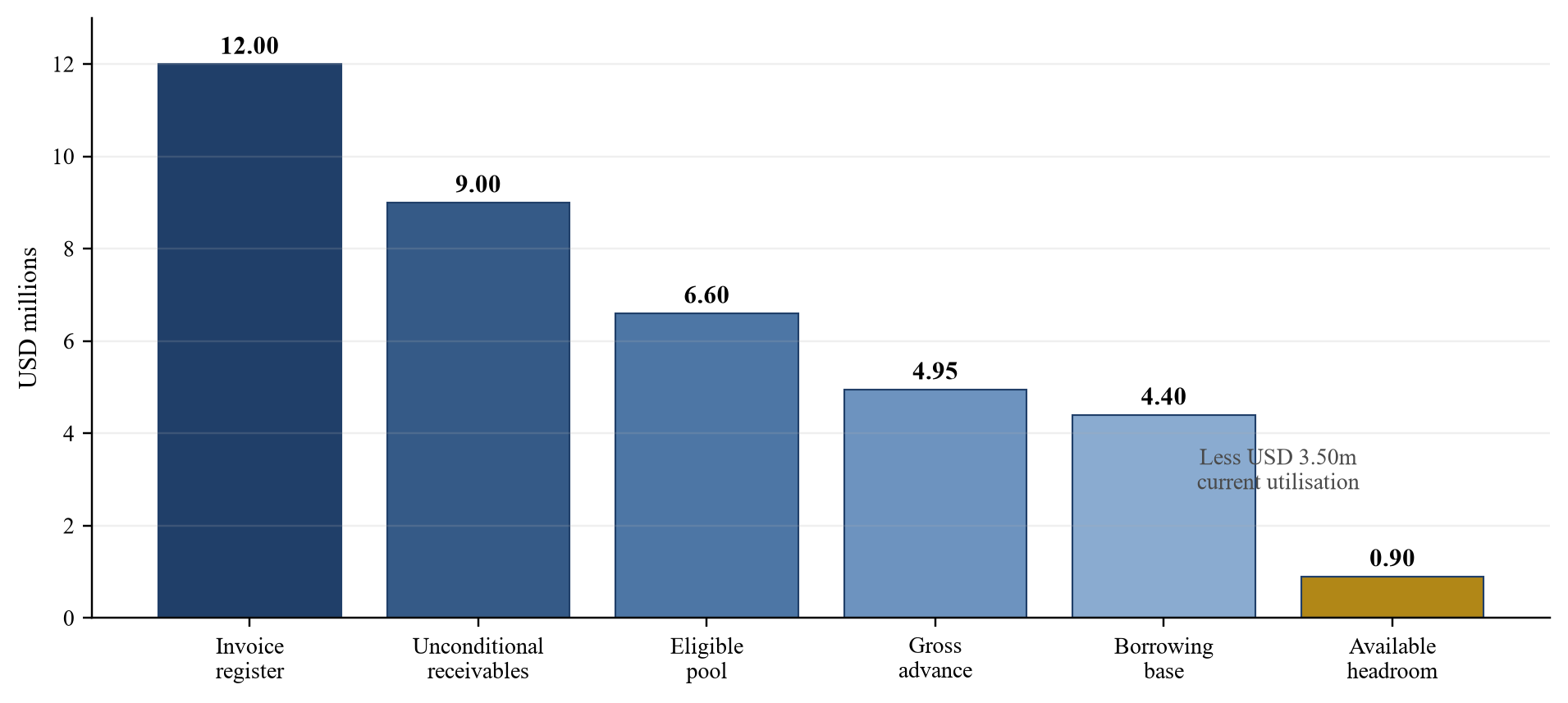
USD millions. Every amount, exclusion, reserve and financing term is hypothetical and supplies no UAE market benchmark.
11. Connect certified amounts to collected cash
Availability against receivables and ability to service debt answer related questions. A borrowing base measures collateral under agreed rules at a date. Debt service is paid with cash received after operating and other required payments. The lender should build both calculations and reconcile them. A facility can have collateral headroom while customer cash arrives too late for an interest or principal date. It can also generate operating cash while a breach of eligibility or concentration requires a borrowing-base repayment.
The annual illustration starts with USD 24.0 million of gross billings. It assumes USD 1.2 million of retention remains unreleased through the twelve-month horizon, USD 0.8 million of performance deductions is permanently lost and USD 0.4 million becomes credit notes or contra balances. Unconditional receivable additions are therefore USD 21.6 million. Opening receivables of USD 3.0 million plus those additions, less closing receivables of USD 4.2 million, produce USD 20.4 million of cash collections. The calculation assumes no other write-off or acquisition of receivables.
Assumed operating cash payments are USD 17.0 million and tax and capital expenditure are USD 0.8 million. Cash available for debt service is USD 2.6 million. Debt service is assumed at USD 2.0 million, producing coverage of 1.30 times and residual cash of USD 0.6 million. The model does not include interest on additional drawings, fees, trapped cash, intramonth timing, foreign exchange, value-added tax, acquisitions or distributions. A transaction model should include the relevant flows and their actual dates.
Reconcile the annual bridge to a monthly calendar before approval. The lender should identify payroll, subcontractor payments, taxes, rent, insurance, equipment payments and debt dates. Collections should follow invoice-level evidence or clearly stated assumptions. If a customer pays a batch of invoices together, reproduce the observed allocation from bank receipt to ledger. Any expected retention release should enter the calendar on its evidenced date and remain separate from ordinary invoice collections so a delay or deduction can be stressed directly.
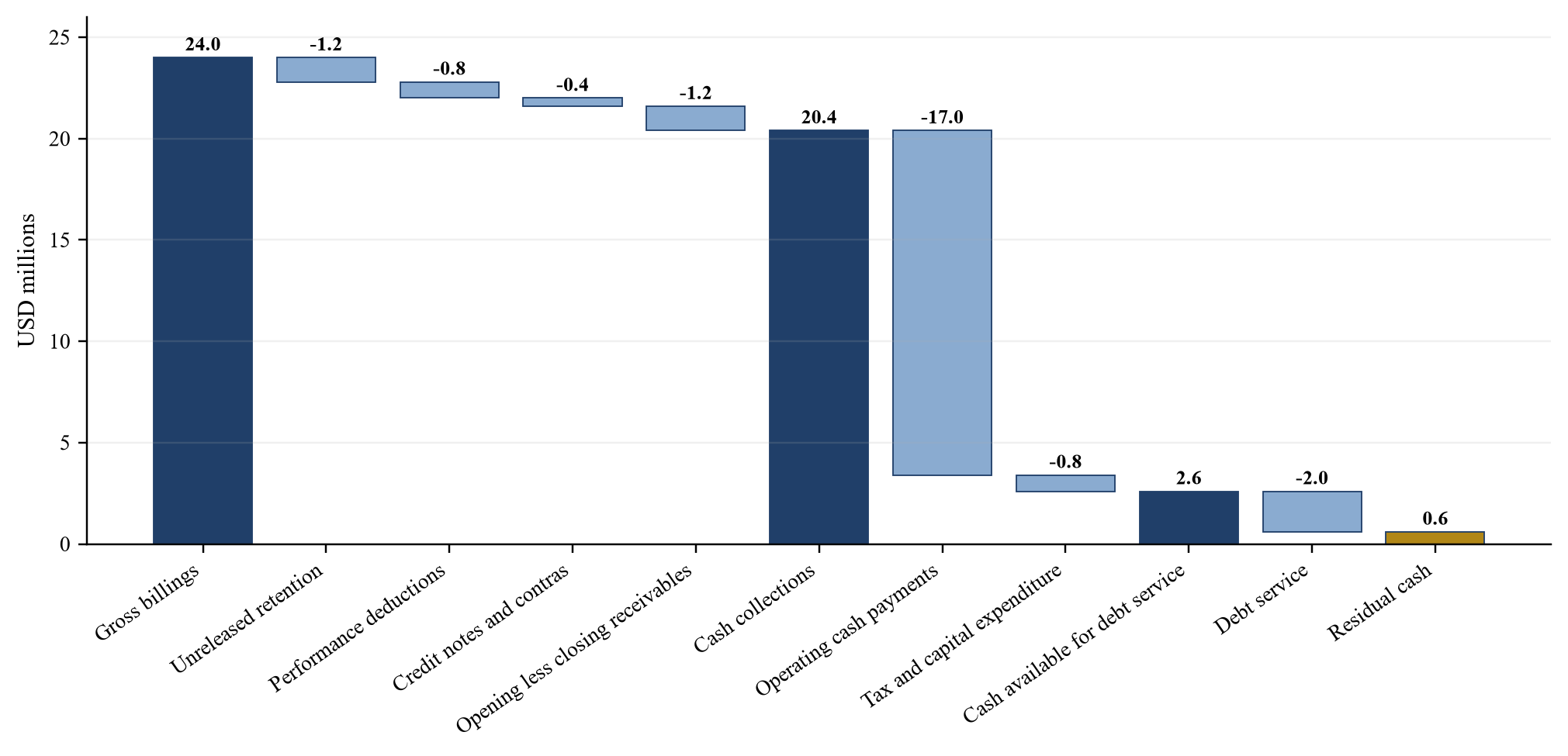
USD millions. The bridge uses stated assumptions and does not forecast a borrower or estimate market terms.
12. Stress retention and deductions independently
The downside grid changes two annual assumptions while holding every other model input constant. Retention unreleased through the horizon takes values of USD 0.6 million, USD 1.2 million and USD 1.8 million. Permanent performance deductions take values of USD 0.4 million, USD 0.8 million and USD 1.2 million. Credit notes remain USD 0.4 million, opening and closing receivables remain USD 3.0 million and USD 4.2 million, operating cash payments remain USD 17.0 million, tax and capital expenditure remain USD 0.8 million, and debt service remains USD 2.0 million.
At the lowest retention and deduction amounts, cash available for debt service is USD 3.6 million and coverage is 1.80 times. The central case produces USD 2.6 million and 1.30 times. At the highest amounts, cash available for debt service is USD 1.6 million and coverage is 0.80 times. The low case therefore lacks USD 0.4 million of cash relative to the assumed annual debt service before any financing cost, timing mismatch or other omitted flow. These outcomes are arithmetic consequences of the assumptions and carry no assigned probability.
Retention and deductions should remain separate because their recovery paths differ. The retention cases assume the relevant amount is withheld beyond the horizon while preserving no cash release inside the year. They do not assume a permanent loss. The deduction cases assume a permanent reduction. If the borrower expects part of a disputed deduction to be restored, model the receipt only when its basis and timing are stated. A combined scenario can include both a delayed retention release and a final deduction without describing the two amounts as equivalent.
The lender should derive transaction scenarios from actual contract and operating evidence. Historical retention releases can inform timing after adjustments for current contract terms. Customer notices and service data can inform the deduction range. The model should also test a delayed invoice-validation process, customer concentration, contract termination and borrower cost response where material. Avoid adding several assumptions that express the same event. A contract termination scenario may already stop billings and prevent retention release, so a separate universal haircut to those same amounts could count the loss twice.
| Retention unreleased within year | Deductions USD 0.4m | Deductions USD 0.8m | Deductions USD 1.2m |
|---|---|---|---|
| USD 0.6m | 1.80x | 1.60x | 1.40x |
| USD 1.2m | 1.50x | 1.30x | 1.10x |
| USD 1.8m | 1.20x | 1.00x | 0.80x |
Coverage equals hypothetical cash available for debt service divided by USD 2.0 million of annual debt service. Retention and permanent deductions are USD millions.
13. Analyse aging concentration and dilution
Aging should start from the evidenced contractual due date. Separate invoices that are current, overdue, disputed, under validation and subject to an agreed payment plan. An invoice that remains in a customer portal queue for missing documentation may not have reached its payment date. A genuinely overdue unconditional receivable raises a different collection question. The lender should track both operational age from service delivery and legal age from the due date where useful, while preventing one label from replacing the other.
Concentration needs more than the debtor name. Group customers where payments depend on the same budget, contract administrator, property portfolio, main contractor or dispute. Several special-purpose debtors may share one controlling payment process. Conversely, a large group can contain separately creditworthy and independently paying entities. Define the concentration unit in the approved policy and legal documents. The hypothetical borrowing-base example removes USD 1.0 million as concentration excess without asserting a suitable threshold or debtor grouping for a real facility.
Dilution records reductions between original receivable amounts and final cash collected, subject to the lender's agreed definition. Track credit notes, pricing errors, service deductions, rebates, tax corrections, returns, contra arrangements and write-offs by cause. Exclude timing-only differences from permanent dilution while preserving them in collection performance. Calculate historical ratios from reconciled populations and note changes in contract mix. A low past ratio from fixed-price contracts may not support the same reserve after the borrower adds performance-sensitive sites.
Fraud and operational errors require direct testing. Confirm a sample of balances with debtors through an independent process suited to the transaction. Compare invoice sequences, duplicate amounts, altered bank details, unusual manual status changes and post-reporting credit notes. Reconcile collections after the borrowing-base date to the offered invoices. The test design should consider data access, materiality and legal restrictions. This paper prescribes no confirmation sample size or fraud conclusion. The lender's authorised teams should approve the procedure and investigate exceptions before funding.
14. Control collections and borrowing-base changes
The cash-control structure should reflect the agreed financing and applicable law. Possible arrangements include a designated collection account, account control, payment instructions, cash sweeps and defined application rules. Counsel and the account bank should confirm how the arrangement works, whether it is enforceable and how set-off or competing claims affect proceeds. The operating process should identify incoming cash by debtor and invoice. Unidentified receipts should remain separate until reconciled rather than being allocated to eligible balances through an unsupported assumption.
Set a reporting cycle aligned with funding. The borrower can provide the invoice register, eligibility calculation, retentions register, deductions register, collection reconciliation, customer concentrations and compliance certificate. The lender should define the data cutoff and the time allowed to report credit notes or disputes arising after that cutoff. A material new deduction can reduce availability before the next scheduled report if the documents require prompt notice. The credit memorandum should explain the approved response and who can authorise an exception.
Reperform the calculation on a sample and compare it with the facility formula. Review manual overrides, new debtors, rule changes and items that re-enter eligibility after an exception. Monitor the headroom relative to current utilisation and any mandatory repayment. The hypothetical USD 0.9 million headroom is a point-in-time result. It provides no evidence that the borrower can draw that amount after a new reserve, concentration change, collection or utilisation movement. The lender should use the latest verified certificate and actual conditions at each funding date.
Track retentions to final resolution even when they are excluded from current availability. A separate register should show origin, contractual release event, expected date, customer confirmation, amounts applied against claims and cash received. Compare expected and actual release dates. Persistent slippage can inform liquidity scenarios and contract selection. The same discipline applies to disputed deductions. A resolved item should move through the register with the decision evidence and ledger entry, preserving an audit trail from original claim to final cash or reduction.
15. Define the advisory and diligence mandate
A capital provider commissioning a market screen should state its target borrower type, receivable characteristics, jurisdiction, transaction structure, ticket size, currency, concentration tolerance and required return framework. The first deliverable can map facilities-management operators and contract types using verified public and management information. Selected candidates can then progress to contract review, invoice testing, debtor analysis, operating diligence and a reconciled cash model. Each report should identify source dates, management-provided data and independent corroboration.
The proposed paid advisory scope can include borrower mapping, commercial diligence coordination, data-room design, receivables reconciliation, borrowing-base modelling and preparation of an investment-committee memorandum. Scope, fees and deliverables require a separate executed engagement. This paper establishes no mandate, client budget, retainer, funding commitment or expected advisory revenue. The size of a proposed facility does not establish the fee for professional work. Commercial reporting should distinguish prospective capital, approved exposure, drawn capital, signed fees and collected fees.
Legal advice, audit conclusions, accounting opinions, regulatory permissions, debtor confirmations and specialist operational assessments should be provided by qualified and authorised parties for their assigned questions. An adviser can coordinate those workstreams and integrate the evidence into a credit package. The adviser role described here includes no custody of money, discretionary investment management, lender approval authority or legal opinion. A capital provider should verify each provider's mandate, competence, independence and permissions before relying on its work.
A useful initial discussion starts with a genuine deployment brief. The capital provider should identify the amount available for consideration, decision process, permitted structures, target duration and evidence needed for approval. Matchpoint Partners can assess a separately agreed research or transaction-support scope against those requirements. Any introduction, financing, acquisition or return remains subject to counterparties, diligence, approvals and executed documents. The paper makes no promise of capital placement, borrower acceptance, transaction completion or financial performance.
16. Record a decision that remains auditable
The approval memorandum should state the proposed borrower, facility, debtor pool, contract perimeter, borrowing-base definitions, legal conclusions, cash model and conditions precedent. Attach the service-to-cash evidence map, retentions and deductions registers, rights matrix, sample test results and sensitivity analysis. For every unresolved item, identify the amount exposed, required evidence, responsible reviewer and approval authority. The committee should be able to connect each dollar of proposed availability with the records supporting its legal existence, eligibility and expected conversion to cash.
One possible decision is to approve only confirmed unconditional receivables from named debtors after notice and priority conditions are satisfied. Another is to include a separately verified retention component with a specific reserve and lower limit. A lender may also exclude performance-sensitive contracts until sufficient history and evidence support an approved treatment. These are alternatives for evaluation. Their suitability depends on the lender's mandate, actual documents, borrower information and specialist advice. This paper provides no universal structure or ranking.
Conditions should use evidence that can be tested. Complete the assignment notice and receive confirmation from the named debtor is clearer than improve assignment readiness. Provide the executed contract and a reconciled schedule of retained amounts states a measurable task. The documents should name the person with authority to accept each item and any continuing condition after funding. Exceptions should be time-limited, quantified and approved under the lender's process. The following certificate should disclose whether the exception was resolved, extended or converted into a permanent rule.
The central decision is the amount of cash a lender can reasonably expect to control and collect within the proposed facility terms. The invoice register cannot answer that question alone. Contract rights, service acceptance, retention release, performance deductions, notice, priority, set-off, concentration and collection timing all shape the result. The proposed framework converts those issues into a reconciled asset pool, an auditable borrowing base and a cash calendar. A final commitment still requires the lender's own authorised judgment on risk and return.
17. Research limits and conclusion
The research reviewed for this paper consists of selected public sources accessed on 10 September 2026. They support specific propositions concerning UAE receivables transfers, movable security, federal procurement, accounting presentation, credit-risk governance and facilities-management systems. They provide no dataset of UAE facilities-management receivables, retentions, deductions, payment timing, defaults or recoveries. The paper therefore estimates no market rate, probability, expected loss or investment return. A capital provider should obtain current transaction evidence before relying on the proposed method.
The numerical examples are intentionally simple. The borrowing-base calculation uses one date, one currency, a fixed advance rate, fixed reserves and assumed exclusions. The annual bridge uses aggregate amounts and no monthly timing. It omits value-added tax, financing fees, interest on changing utilisation, intramonth liquidity, foreign exchange, acquisitions, restricted cash and several possible claim types. The sensitivity changes only two inputs. A live model should extend the horizon and include the cash flows and contractual events material to the selected borrower.
The public UAE legislation is presented for general research. Its application can depend on current law, implementing rules, governing law, the location and status of the parties, financial-free-zone regimes, the type of receivable and transaction documents. The federal procurement sources apply to their stated federal scope. The CBUAE material applies to licensed financial institutions within scope, and its online Rulebook states that formal issuances prevail if the presentation is inaccurate. Qualified advisers should confirm all transaction-specific legal, accounting, tax and regulatory conclusions.
The practical conclusion is an evidence sequence. Establish the contractual right. Separate conditional amounts, retentions and deductions. Verify service acceptance, debtor, due date, transfer, notice, priority and set-off. Apply documented eligibility and reserve rules. Reconcile the result to cash collections and debt service. Stress the assumptions that can change the amount or date of cash. This sequence gives a capital provider a transparent basis for approval, conditions, monitoring and a decision to decline when the evidence remains insufficient.
Appendix A. Lender evidence checklist
| Review area | Record to request | Responsible review |
|---|---|---|
| Borrower and contract perimeter | Entity, ownership, licences, executed contracts and amendments | Legal and credit |
| Service delivery | Work orders, site reports, completion records and authorised acceptance | Operational and commercial |
| Invoice status | Invoice, portal history, due-date calculation and debtor confirmation | Finance and credit |
| Retentions | Clause, withheld amounts, release events, claims and receipts | Legal, finance and commercial |
| Performance deductions | KPI calculations, notices, disputes, decisions and credit notes | Operational, commercial and finance |
| Transfer and priority | Transfer agreement, notices, searches, filings and priority opinion | Transaction counsel |
| Set-off and defences | Customer claims, cross-contract rights, tax and account-bank position | Transaction counsel and credit |
| Eligibility and reserves | Approved definitions, concentration, aging and reserve calculations | Credit and operations |
| Collections | Controlled account records, remittance evidence and ledger allocation | Treasury, finance and operations |
| Debt service | Monthly cash forecast, facility payments and liquidity support | Finance and credit |
Original checklist. It makes no finding about a borrower, debtor, receivable or professional appointment.
The checklist should produce identifiable records with dates and responsible people. Management statements should remain identified as management-provided until independently corroborated. A missing document should remain an open item. The lender should decide whether that item stops the draw, reduces availability, creates a reserve or represents an explicitly accepted risk. The decision and authority should appear in the credit file. A general description that diligence is complete supplies insufficient evidence for a reviewer attempting to reproduce the approval.
Appendix B. Reproducible calculations and committee questions
For the borrowing-base illustration, begin with USD 12.0 million of gross invoice-register balances. Deduct USD 1.2 million for incomplete service or acceptance, USD 0.8 million of retention not due, USD 0.7 million of disputed performance deductions and USD 0.3 million of credit notes or contra balances. The resulting unconditional receivables are USD 9.0 million. Deduct USD 0.8 million of over-age or unconfirmed balances, USD 1.0 million of concentration excess and USD 0.6 million with unresolved assignment or notice evidence. Apply 75 percent to the resulting USD 6.6 million eligible pool, then deduct USD 0.55 million of reserves. Availability is USD 4.4 million before USD 3.5 million of current utilisation, leaving USD 0.9 million of headroom.
For the annual cash bridge, subtract USD 1.2 million of unreleased retention, USD 0.8 million of permanent deductions and USD 0.4 million of credit notes from USD 24.0 million of billings. Add USD 3.0 million of opening receivables and subtract USD 4.2 million of closing receivables to obtain USD 20.4 million of collections. Subtract USD 17.0 million of operating cash payments and USD 0.8 million of tax and capital expenditure. Cash available for debt service is USD 2.6 million. Divide by USD 2.0 million of debt service to obtain 1.30 times coverage, with USD 0.6 million of residual cash.
The committee should ask which documents support each classification and due date. Which retained amounts can be released during the facility period, and what events can reduce them? Which performance deductions remain provisional and which are final? Has the debtor received an effective notice, and what rights of set-off or defence remain? Does the lender hold its intended priority over the receivables and proceeds? Which eligibility movement could require an immediate repayment? What unrestricted liquidity covers delayed collections? The answers should identify evidence, unresolved assumptions and the specific authority required before funding.
Sources
- United Arab Emirates. Federal Decree-Law No. 16 of 2021 on Factoring and Transfer of Receivables. Articles 1, 2, 4, 5, 8, 13-16 and 20-22. Accessed 10 September 2026. Read the primary source
- United Arab Emirates. Federal Law No. 4 of 2020 on Securing Rights in Movables. Articles 2, 3, 19, 21 and 42. Accessed 10 September 2026. Read the primary source
- United Arab Emirates. Federal Decree-Law No. 11 of 2023 on Procurement in the Federal Government. Articles 32-35 and 37. Accessed 10 September 2026. Read the primary source
- United Arab Emirates Cabinet. Cabinet Resolution No. 122 of 2024 regarding the Implementing Regulations of Federal Law No. 11 of 2023 on Procurement in the Federal Government. Definitions and Articles 4, 13 and 39-45. Accessed 10 September 2026. Read the primary source
- UAE Ministry of Finance. Register Suppliers in the Federal Supplier Register. Invoice workflow and SME retention in place of a performance bond. Accessed 10 September 2026. Read the primary source
- IFRS Foundation. IFRS 15 Revenue from Contracts with Customers. Paragraphs 105-109 and official standard overview. Accessed 10 September 2026. Read the primary source
- Central Bank of the UAE. Credit Risk Management Regulation and Credit Risk Management Standards, C 3/2024 and C 3/2024 STA, effective 30 November 2024. Articles 3, 5, 10 and 11 and corresponding standards. Accessed 10 September 2026. Read the primary source
- International Organization for Standardization. ISO 41001:2018 Facility management management systems requirements with guidance for use. Published abstract and status. Accessed 10 September 2026. Read the primary source
