

1. Treat the parent as part of the financing instrument
An institutional investor buys a security issued by a legal entity. The rights attached to that security depend on the entity's constitutional documents, the applicable company law, the shareholders' agreement and the closing documents. The entity is therefore part of the financing instrument. It is the place where economic rights, voting rights, board appointment, information access, pre-emption, anti-dilution, liquidation preference, transfer controls and exit mechanics are assembled.
The parent also defines the perimeter of the investment. If material intellectual property, regulated permissions, customer contracts, bank accounts, employees or data rights sit outside the investment perimeter, the investor must understand how value reaches the parent and whether the parent controls it. A neat cap table at the top can conceal an operating group that is fragmented below. The board should begin with the rights and cash-flow map rather than a jurisdictional preference.
The decision has three time horizons. The closing horizon asks whether the intended round can be documented, approved and completed. The operating horizon asks whether the group can hire, contract, invoice, protect intellectual property, comply with licences, manage tax and move cash. The exit horizon asks whether a buyer or public-market process can acquire the group with clean title, reliable governance and manageable leakage. A parent that works for one horizon and obstructs the others is incomplete.
Investor familiarity matters because repeated use can reduce drafting and diligence time. The National Venture Capital Association publishes an integrated set of model documents for United States venture financings, including a certificate of incorporation, stock purchase agreement, investors' rights agreement, voting agreement and right of first refusal and co-sale agreement. Those models demonstrate the breadth of rights that an institutional round may require. They do not make a Delaware parent universally superior. They show that the parent constitution and transaction documents must work as one system.
The board should set a design objective before advisers begin. A useful objective is: create the simplest structure that can receive the target capital, control the value-producing assets and operations, satisfy current obligations, support the next two financing or transaction events, and remain governable with evidence. This objective prevents both premature complexity and a late restructuring driven by a single term sheet.
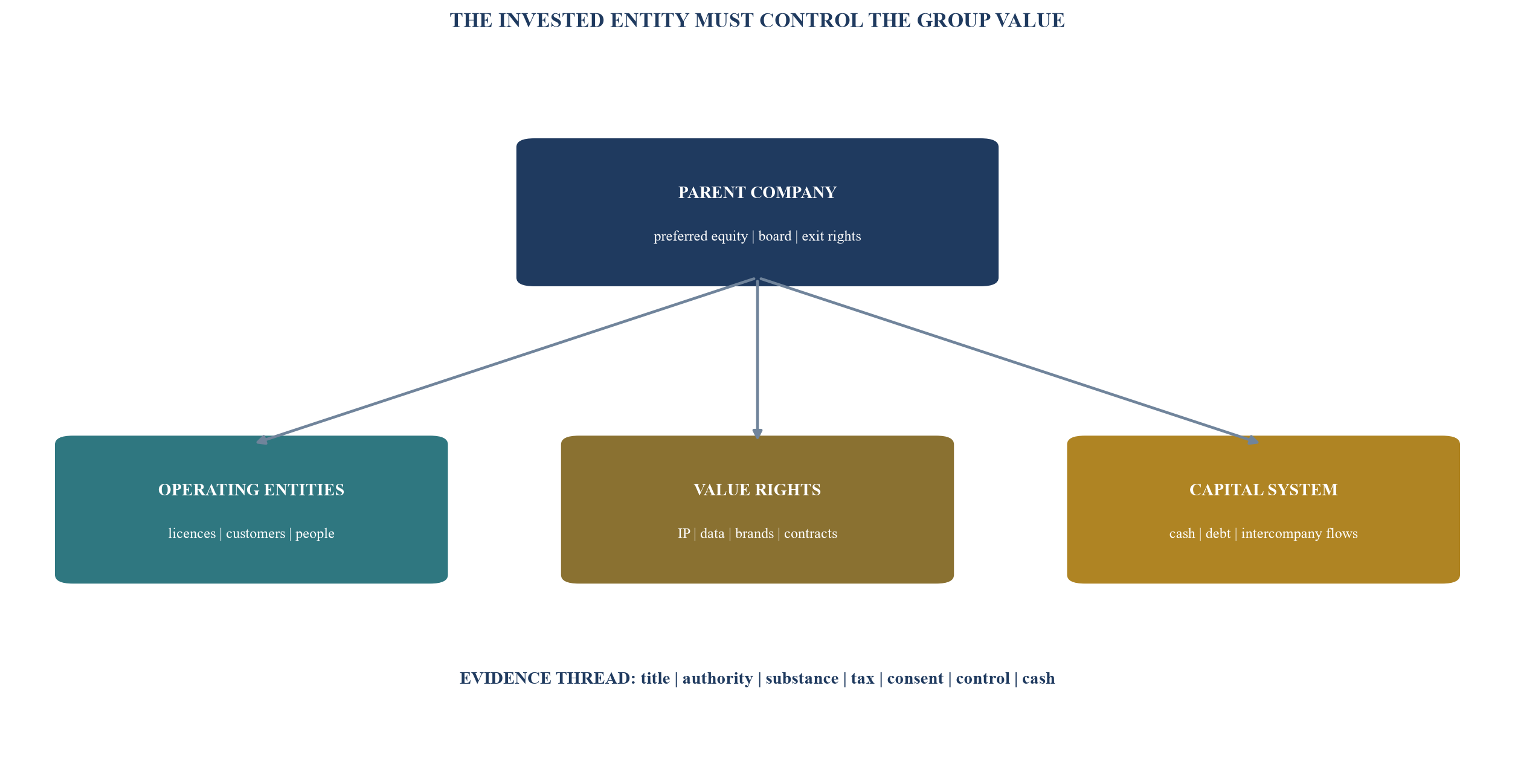
The parent must control the security, governance, value-producing rights and cash pathways that the investor underwrites.
2. Define the architecture families
The first architecture is a single UAE company that owns the business, employs the team, contracts with customers and issues the round security. It has low entity count and can align ownership with the actual centre of operations. Its suitability depends on the applicable UAE company regime, the investor's required rights, the company's activities, the shareholder profile and the planned international footprint.
The second architecture is a UAE parent with one or more operating subsidiaries. The parent holds shares, intellectual property or strategic assets, while subsidiaries hold local licences, employ people or contract in relevant markets. ADGM and DIFC offer companies limited by shares under their own legal frameworks. ADGM's Companies Regulations provide for private companies and share-based limited liability. DIFC's Companies Law provides for private and public companies limited by shares. Both regimes also provide routes for continuation in appropriate circumstances, subject to their rules and the law of the original jurisdiction.
The third architecture is a Delaware corporation above UAE and other subsidiaries. Delaware law permits multiple classes and series of stock and allows preferences, voting powers and other rights to be set in the certificate of incorporation or under authorised board resolutions. This architecture can align with United States venture documentation and an investor base accustomed to preferred stock. It adds a foreign parent, United States corporate and tax administration, a UAE subsidiary relationship and cross-border flows. Founder, asset and shareholder connections to the United States can create additional tax analysis, including the outbound-transfer rules in section 367 of the Internal Revenue Code.
The fourth architecture is a United Kingdom private company above the operating group. It can be familiar to United Kingdom and European investors and service providers. The corporate and tax outcome depends on actual facts. HM Revenue & Customs explains that central management and control remains relevant to non-UK incorporated companies and certain treaty cases, and that the location of board meetings is important but not conclusive. A share-for-share insertion can require analysis of the statutory conditions and, where appropriate, advance clearance.
The fifth architecture is a Singapore private company above the operating group. ACRA administers share allotments and an inward re-domiciliation regime for qualifying foreign entities. IRAS determines corporate tax residence by where control and management is exercised, with strategic decision-making and the real board process among the relevant facts. A Singapore label without Singapore control, management and substance may fail to produce the expected residency outcome.
These five families are starting points. A group may need a regulated entity, a property-holding company, a joint venture, a special-purpose vehicle or country subsidiaries. Each additional entity should answer a specific legal, regulatory, commercial, tax, financing or risk-separation need. Complexity that has no documented purpose adds cost, KYC friction and failure points.
Table 1. Parent architecture decision questions
| Decision area | Evidence required | Consequence for parent choice | Board question |
|---|---|---|---|
| target investor pool | named funds, mandate geography, required security and model documents | determines documentation familiarity and acceptable issuing entities | which investors have confirmed an entity requirement in writing? |
| management and substance | director locations, strategic decisions, people, premises and decision records | affects residence, governance credibility and operating control | where will the parent actually be directed and managed? |
| licences and customers | activity permissions, customer terms, procurement rules and local-presence needs | may require operating subsidiaries regardless of parent location | which entity must legally perform and invoice each activity? |
| intellectual property and data | creation records, assignments, licences, hosting, privacy roles and restrictions | determines where value can be owned and how it is licensed | does the invested group control every material right? |
| tax and cash | shareholder profiles, residence, transfer pricing, withholding, reliefs and distributions | affects restructuring leakage and recurring group economics | what is the verified tax path from operations to investors? |
| financing and exit | next two rounds, debt, acquisition plan and likely buyer or market | determines share classes, governance and transaction readiness | will the structure remain workable after the next event? |
The board should answer these questions with documents and adviser conclusions before selecting a jurisdiction.
3. Separate investor preference from investor requirement
Founders frequently hear that investors require a particular jurisdiction. The statement should be converted into evidence. The company should identify the investor, fund vehicle, mandate restriction, legal policy, tax constraint, security requirement and decision-maker. A preference expressed by an intermediary has a different weight from an investment-committee condition confirmed by the fund's counsel.
The analysis should cover the entire syndicate. A lead investor may accept a UAE parent while a strategic co-investor has a jurisdiction restriction. A United States fund may prefer a Delaware corporation because its documents and governance processes are familiar. A regional fund may be comfortable with ADGM or DIFC. A sovereign, development or sector investor may require operating presence, local expenditure or local intellectual property. The target architecture should be tested against the investors most likely to set closing conditions.
The company should request a short structure requirements note before accepting a term sheet. The note can record the acceptable issuer, required share instrument, board rights, information rights, tax documentation, sanctions and KYC expectations, employee-plan requirements, regulated-activity concerns and any side-letter constraints. This process turns vague market convention into a diligence input.
Investor familiarity has an economic value that can be estimated. It may reduce legal drafting, counsel education, closing conditions and future round friction. It can also increase operating cost through a second jurisdiction, additional tax filings, registered agents, local directors, audits, intercompany agreements and bank accounts. The board should compare the expected closing advantage with the present value of recurring complexity and restructuring risk.
The analysis remains conditional until investors and counsel confirm it. A company should avoid restructuring solely to improve the appearance of investability. The restructuring should create a durable legal and operating architecture supported by the actual financing plan.
4. Compare legal flexibility and governance mechanics
Company law provides the legal container; the financing documents allocate control within it. The board should test whether the proposed parent can issue the required security, create the intended preferences, authorise option pools, recognise nominee or custodian arrangements where relevant, enforce transfer controls, appoint investor directors, reserve matters to shareholders or the board, distribute information and execute an exit.
Delaware's statutory framework expressly allows classes and series with different voting powers, preferences and rights. The NVCA documents show how those features are commonly integrated across a charter and contractual agreements. ADGM and DIFC companies limited by shares can also be designed for private ownership and investment, subject to their laws, articles and registration processes. The comparison should be performed by counsel on the exact rights requested rather than by assuming that one label is flexible and another is inflexible.
The parent should begin the round with constitutional headroom. Authorised share capital or share-authority mechanics should support the financing, option pool and anticipated follow-on issuance. Existing pre-emption, veto, transfer and consent rights should be mapped. Founders, early investors, accelerators, employee nominees and convertible holders should be included. An undocumented promise can become a closing blocker even if it does not appear in the statutory register.
Board architecture matters from the first institutional closing. The company should define board size, founder seats, investor seats, independent seats, observer rights, quorum, casting votes, conflicts, committees, information cadence and emergency authority. Reserved matters should protect fundamental decisions without turning normal operations into a consent queue. The constitution, shareholders' agreement, delegations and banking authorities should use the same decision model.
Governance evidence matters as much as legal wording. Board minutes should show that directors received information, considered conflicts and exercised judgement. A foreign parent controlled entirely through informal instructions from another country can create residence and governance concerns. Substance is demonstrated through actual people, authority, decisions, records and execution.
Table 2. Jurisdiction and operating-fit comparison
| Parent family | Document and governance feature | Operating implication | Required confirmation |
|---|---|---|---|
| UAE single company | one issuer and operating entity under its applicable UAE regime | simple perimeter; operating and financing risks remain combined | share rights, activity, ownership, investor eligibility and exit mechanics |
| ADGM or DIFC parent | company limited by shares within an international financial-centre framework | can hold UAE and foreign subsidiaries; local obligations and service arrangements apply | articles, licence, registered office, beneficial ownership, tax and investor rights |
| Delaware corporation | statutory classes and series; established venture model-document ecosystem | foreign parent above UAE operations; US and UAE administration and intercompany flows | US tax, securities, franchise, banking, subsidiary, IP and founder consequences |
| UK private company | familiar UK corporate framework and financing documentation | residence and substance depend on facts as well as incorporation and treaty rules | share exchange, tax clearance, option plans, residence, filings and UAE subsidiary flows |
| Singapore private company | ACRA share register and allotment process; inward re-domiciliation for qualifying entities | Singapore control and management determine residence; regional subsidiary administration | constitution, residence, director, tax, employment, banking and re-domiciliation eligibility |
The entries describe official legal or administrative features and required diligence; they do not rank jurisdictions or replace transaction advice.
5. Build a weighted structure scorecard
A scorecard makes the decision record explicit. The board selects factors and weights before evaluating jurisdictions. Typical factors include investor acceptance, legal flexibility, restructuring leakage, tax residence, operating substance, regulated-activity fit, intellectual-property control, employee equity, banking, recurring cost, reporting, acquisition capacity and exit pathways.
The weights should reflect the company's facts. A regulated fintech may give high weight to licensing and data permissions. A software company targeting United States venture capital may give higher weight to investor-document fit and employee equity. A UAE-based industrial technology company may prioritise regional contracting, management substance and strategic investors. A company with existing shareholders in several tax jurisdictions must give greater weight to restructuring tax and consent.
Scoring should use a scale with evidence definitions. A high score can mean that the current facts and confirmed adviser position support the factor with limited remediation. A medium score can mean that the factor is workable with identified actions. A low score can mean that the factor is blocked, uncertain or disproportionately costly. Scores without evidence are recorded as unresolved rather than averaged into confidence.
The scorecard should contain a veto column. A jurisdiction may score well overall and still fail because a regulated licence cannot be held, a material investor cannot invest, a share transfer creates unacceptable tax, or a government contract cannot be novated. Vetoes should be closed or accepted by the board before work begins.
Figure 2 illustrates the method using management assumptions. It is deliberately non-prescriptive. The scores are examples of how different architecture families can carry different friction profiles; they are not findings about a particular company or market benchmark.
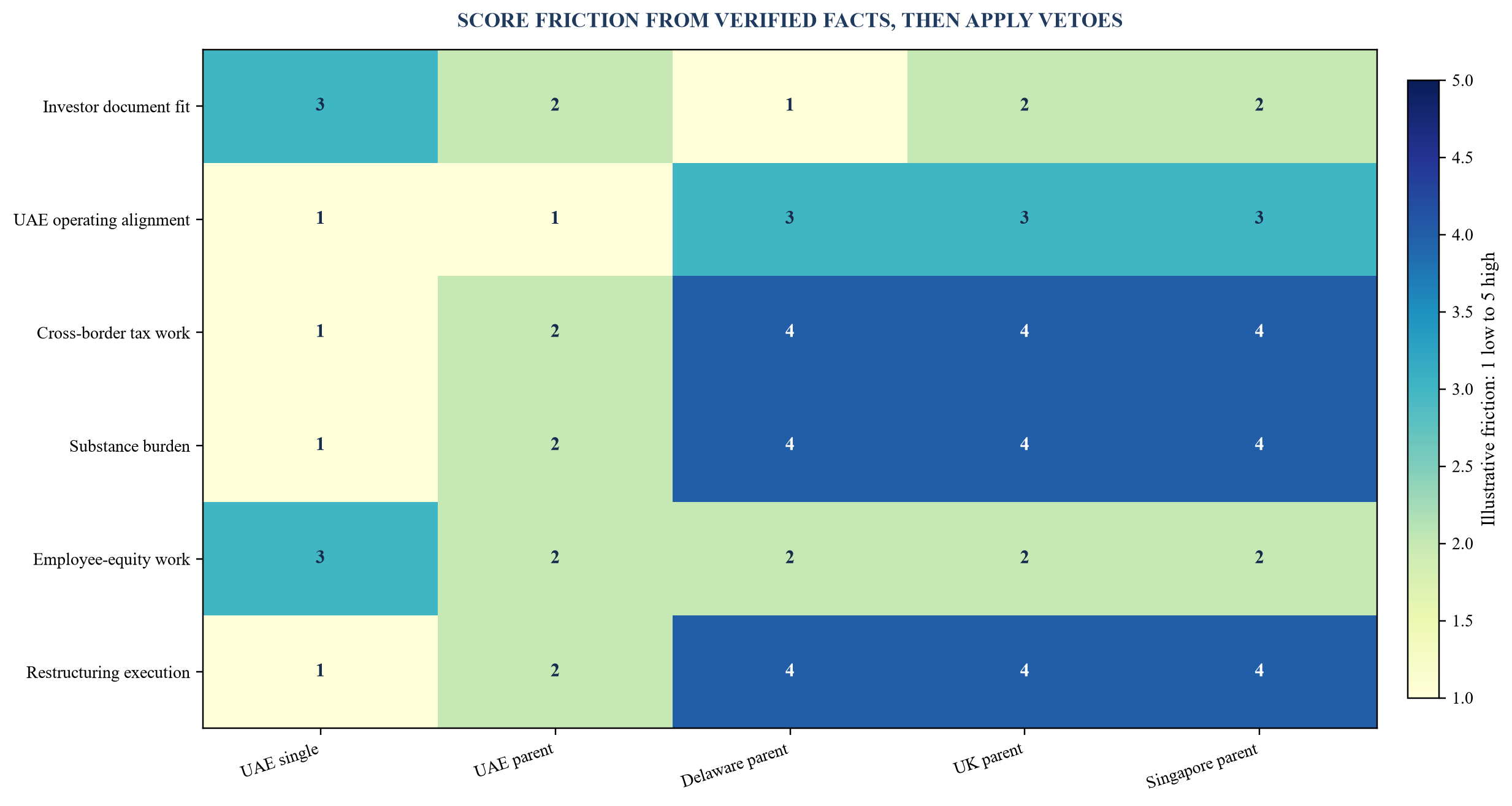
Lower friction scores are better. All values are illustrative management assumptions and must be replaced with transaction-specific evidence.
6. Determine tax residence and substance from conduct
Incorporation is a legal fact. Tax residence can depend on incorporation, management, control, treaty rules and other statutory tests. The board should obtain a written residence and permanent-establishment analysis for the proposed parent and material subsidiaries. The analysis should specify the people who make strategic decisions, where they are located, what authority they exercise and how decisions are recorded.
HM Revenue & Customs states that central management and control is a factual test focused on the highest level of control. Board-meeting location can be relevant without being conclusive. IRAS similarly explains that Singapore corporate residence is generally based on where control and management is exercised, with strategic board decisions, director locations and key employees among the facts. These official positions demonstrate why nominal directors and calendar invitations cannot manufacture substance.
The UAE corporate-tax analysis should begin with the Federal Tax Authority's legislation and current guides. A UAE resident parent may receive exempt dividends from UAE entities and may qualify for participation exemption on certain foreign holdings when the statutory conditions are met. Tax groups require detailed ownership, residence and other conditions; the FTA's guide describes a 95 per cent ownership threshold and explains how UAE resident subsidiaries under a foreign ultimate parent can, in appropriate circumstances, form a group under a qualifying UAE parent. The exact structure, free-zone status and tax period matter.
Transfer pricing applies to related-party transactions. The FTA's Transfer Pricing Guide explains that both domestic and cross-border related-party dealings are subject to the arm's-length principle. A parent that owns intellectual property or provides management, treasury, technology or financing services needs agreements, functional analysis, pricing support, invoices and evidence of performance. A paper charge without people or activity can weaken both tax and investor diligence.
Tax substance should be designed as an operating model. The parent has a competent board, an information pack, a decision calendar, bank authority, accounting records, contracts, service capacity and evidence that decisions occur where claimed. The model should remain proportionate. The purpose is to make the legal structure reflect how the group is genuinely governed.
7. Map participation, group relief and cash pathways
The investor underwrites cash generation at group level. The company should map how cash moves from customers to operating entities, from subsidiaries to the parent and from the parent to investors or reinvestment. The map should include dividends, service fees, royalties, interest, capital contributions, shareholder loans, debt service, withholding, foreign-exchange controls, distributable reserves and banking execution.
Participation exemption is a conditional rule rather than a label. The FTA's guide describes ownership, holding-period, subject-to-tax and other conditions that can apply to dividends and gains from qualifying interests. Management should test each material subsidiary against the current law and document the result. A planned sale should be modelled both with and without an exemption until the conditions and holding period are established.
Tax grouping and qualifying-group relief can affect internal transfers and loss utilisation. Their conditions may conflict with free-zone treatment, minority investment, different accounting periods or a foreign parent. The structure should preserve flexibility for an institutional round that dilutes the parent or brings investors into a subsidiary. Relief that works only before financing can create a hidden reorganisation dependency.
Cash movement also depends on governance. Subsidiary boards must consider local solvency, creditor and statutory duties before distributions. Loan covenants may restrict dividends. Customer or licence conditions may require capital to remain in an operating entity. The parent should avoid assuming that consolidated cash is immediately fungible.
The board model should show source cash, tax, restriction, approval, timing and destination. An investor should be able to reconcile the model to bank statements, statutory accounts, tax returns, intercompany agreements and board approvals. This evidence can reduce the discount applied to structural complexity.
8. Select the restructuring route before setting the timetable
If the existing company will remain the parent, the work may focus on constitutional amendments, share classes, governance, option plans and subsidiary organisation. If a new parent is inserted, the route may involve a share-for-share exchange, contribution, sale, asset transfer, merger, continuation or a combination. Each route changes legal title, tax, accounting, valuation, consent and timing.
A share-for-share exchange can preserve the operating company while placing a new parent above it. The founders and other shareholders transfer their existing shares and receive shares in the new parent. The exchange requires accurate ownership, agreed exchange ratios, securities-law analysis, shareholder approvals, tax advice and updated registers. In the United Kingdom, HMRC provides a statutory clearance process for relevant share exchanges and reconstructions. In the United States, section 351 can provide non-recognition for qualifying transfers to a controlled corporation, while section 367 can override normal non-recognition in certain transfers to foreign corporations. These rules illustrate why the shareholder's residence and the direction of the transfer matter.
An asset or intellectual-property transfer moves selected value into the parent or another group entity. It can require valuation, assignment, customer and counterparty consents, employee transfer, licence changes, data-protection analysis, tax and accounting recognition. It should be used only where the operating model requires it. Moving legal title without moving functions, people and control can create a substance gap.
Continuation or re-domiciliation preserves the legal identity under a new jurisdiction where both regimes permit it. ADGM publishes guidance for continuation into ADGM and requires eligibility under the original jurisdiction, constitutional material and solvency information. DIFC recognises continued companies. ACRA's inward re-domiciliation regime applies to qualifying foreign entities and includes size, solvency, legal and procedural conditions. Continuation can preserve contracts and history, although every licence, bank, customer and tax authority should confirm its treatment.
The chosen route should be approved before announcing a closing date. The critical path is driven by the slowest consent, valuation, tax clearance, regulatory approval, bank KYC, employee action or investor requirement.
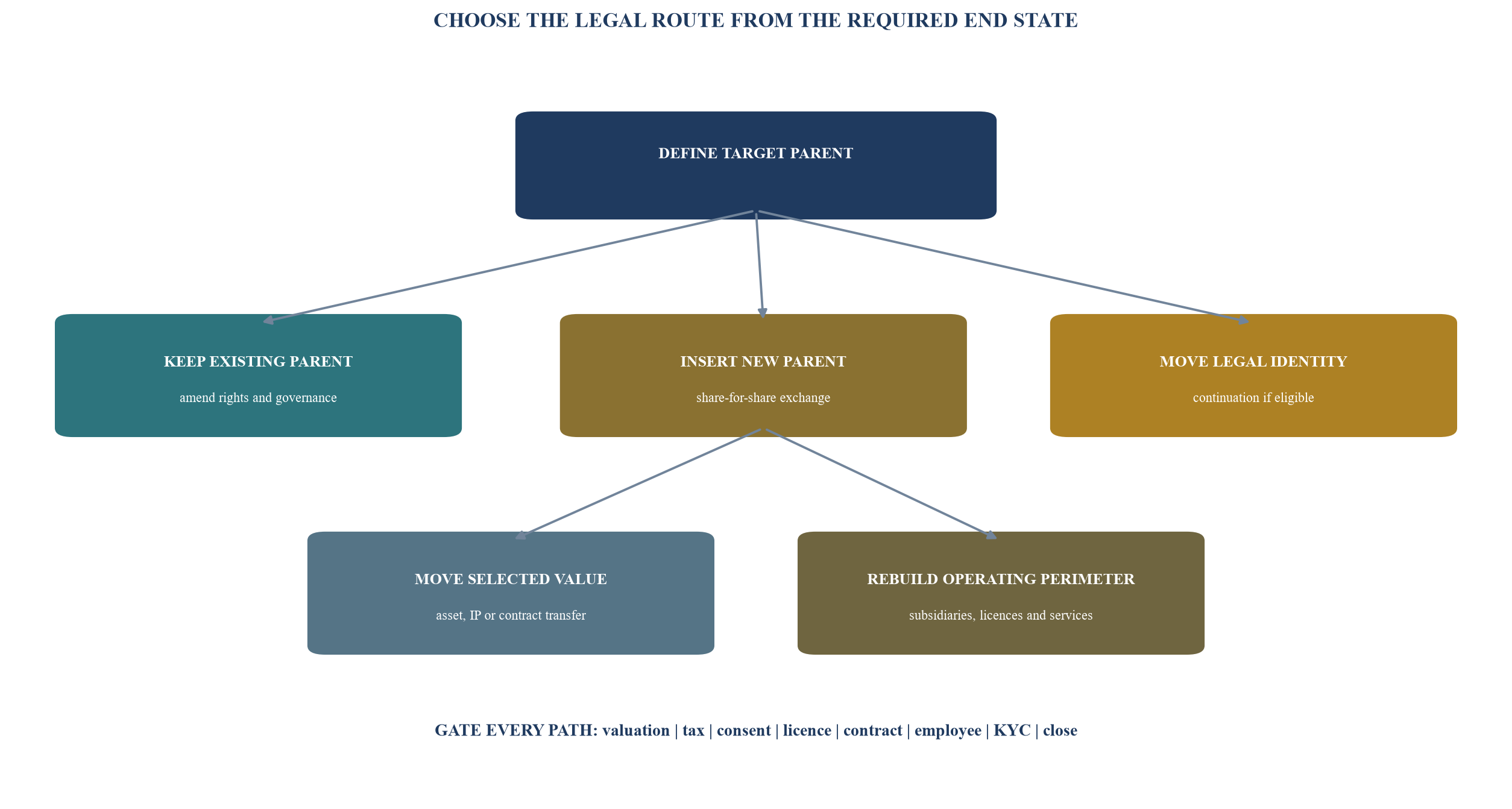
Legal identity, rights, licences and tax consequences determine the route; the shortest apparent route can carry the longest unverified dependency.
Table 3. Restructuring route and dependency matrix
| Route | What changes | Potential advantage | Principal dependency | Closing evidence |
|---|---|---|---|---|
| amend existing parent | constitution, share authorities, governance and option pool | preserves entity, contracts and operating continuity | investor accepts issuer and required rights are legally available | amended constitution, approvals, registers and financing documents |
| share-for-share insertion | shareholders exchange operating-company shares for new-parent shares | preserves operating subsidiary while creating new issuer | shareholder tax, exchange ratio, approvals and securities compliance | transfer instruments, tax advice, registers and consolidated cap table |
| asset or IP transfer | selected assets and rights move between entities | aligns value ownership with target operating model | valuation, tax, assignment, consent, people and substance | executed assignments, valuation, invoices, consents and operational capability |
| continuation | same legal person becomes governed by another jurisdiction | can preserve legal identity and contractual history | both jurisdictions permit it and counterparties recognise the result | certificates, constitutional documents, solvency and updated licences or KYC |
| new parent plus service model | parent owns shares and provides defined group services | separates group governance from local operations | people, authority, pricing, agreements and real delivery | service agreements, transfer-pricing support, invoices and board evidence |
The matrix identifies workstreams to verify; transaction-specific counsel determines availability and legal effect.
9. Protect cap-table continuity
The cap table is a legal reconciliation, not a spreadsheet presentation. It should reconcile issued shares, paid status, classes, options, warrants, convertibles, SAFEs or similar instruments, phantom equity, nominee holdings, transfers, vesting, repurchase rights, liens and undisclosed promises. Statutory registers, certificates, board approvals, contracts and accounting records should agree.
A parent insertion requires an exchange ratio. A one-for-one numerical exchange may be simple, while the legal and economic result must preserve each holder's percentage, class rights, vesting and claims unless changes are expressly approved. Fractional interests, different currencies, par values and employee-plan limits can require adjustments. Convertible instruments must specify whether they remain obligations of the subsidiary, are assumed by the parent or convert in the restructuring.
The round model should contain four states: verified pre-transaction ownership; ownership immediately after the parent insertion; ownership after the option-pool change; and ownership after the institutional round. Each state should be shown on an issued, fully diluted and as-converted basis. The model should reconcile to the security documents and clearly allocate the dilution from any pre-money pool increase.
Figure 4 illustrates a continuity bridge. The example assumes founders hold 72 per cent, employees and advisers 8 per cent and seed investors 20 per cent before the transaction. A new parent preserves those percentages, expands the employee pool by 7 percentage points on a pre-money basis and issues 20 per cent post-money to the institutional investor. The resulting percentages are management assumptions for demonstration. They are not financing terms or a valuation forecast.
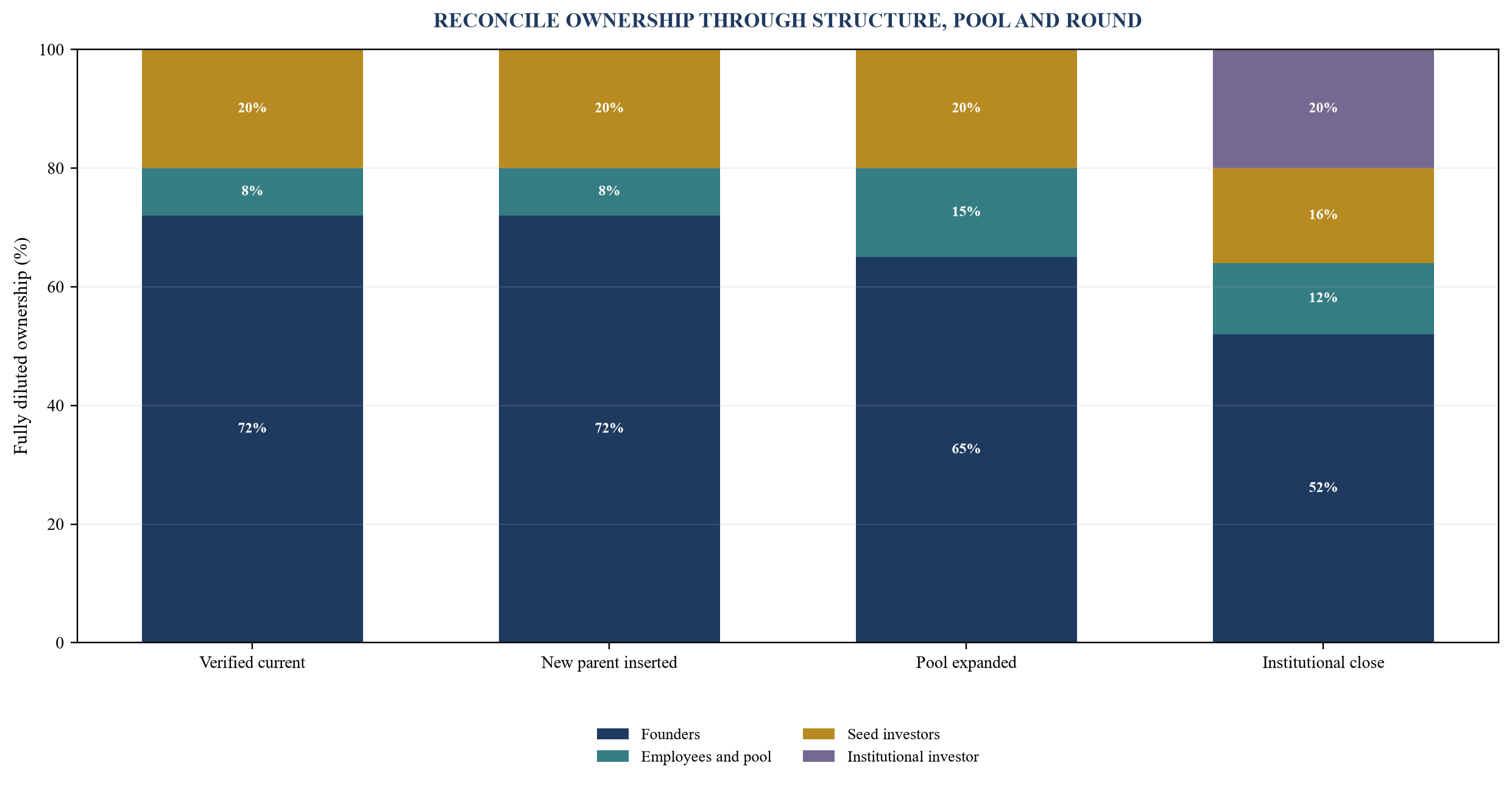
Percentages are illustrative management assumptions. The legal registers and transaction documents must reproduce the approved ownership at every step.
10. Make the investor-rights package internally consistent
The financing package should be designed as a rights system. The constitution or charter creates the share class and core preferences. The subscription or stock purchase agreement governs issuance, representations, conditions and closing. The investors' rights agreement can govern information, registration or participation rights. A voting agreement can govern board composition and selected voting matters. A right of first refusal and co-sale agreement can govern founder transfers. Local forms and terminology will differ, while the need for internal consistency remains.
The company should build a rights matrix that identifies each right, its legal source, holder, approval threshold, duration, transferability, termination event and operational owner. The matrix should capture liquidation preference, dividends, conversion, anti-dilution, pre-emption, pro rata rights, information, inspection, board appointment, observer rights, protective provisions, founder vesting, transfer restrictions, drag, tag, redemption if permitted, pay-to-play where relevant and exit cooperation.
Operational feasibility should be tested. Monthly reporting promised to investors requires a finance close and approved metrics. Consent rights require a transaction calendar that allows time for notice and response. Board observer rights require confidentiality, conflicts and privilege protocols. A pro rata right requires accurate notices and allocation records. The company should avoid granting rights it cannot administer.
Side letters must be included in the governance map. Most-favoured-nation, sanctions, environmental, social and governance, reporting, tax, excuse, strategic and regulatory terms can create obligations outside the main documents. The company needs a single obligations register with an owner and evidence cadence.
Table 4. Institutional-round rights and evidence register
| Rights area | Legal source | Pre-close evidence | Post-close operating owner | Failure signal |
|---|---|---|---|---|
| economics and conversion | constitution or charter; subscription agreement | cap-table model, preference waterfall and conversion scenarios | CFO and company secretary | spreadsheet and legal terms do not reconcile |
| board and protective matters | constitution; shareholders or voting agreement | board matrix, reserved-matter list and delegation schedule | chair, CEO and company secretary | ordinary decisions repeatedly wait for unclear consent |
| information and inspection | investors' rights agreement or side letter | reporting pack, close calendar and data definitions | CFO | promised metrics cannot be reproduced from source systems |
| participation and pre-emption | constitution and investors' rights agreement | notice process, eligible holders and allocation method | legal and finance | financing timetable omits notice and election periods |
| founder and employee transfers | vesting documents, ROFR and co-sale agreement | award register, leaver terms, transfer history and tax review | people lead and company secretary | vesting or ownership differs across records |
| exit rights | constitution, shareholders' agreement and transaction documents | drag, tag, consent, preference and proceeds waterfall | board and transaction lead | buyer cannot identify authority or clean title |
The register links legal rights to the operating evidence required after closing.
11. Put intellectual property inside the diligence perimeter
Institutional investors need evidence that the group controls the intellectual property required to operate and scale. The company should build an intellectual-property chain-of-title schedule covering founders, employees, contractors, universities, incubators, customers, open-source software, data sets, models, domains, trademarks, patents, know-how and confidential information.
Ownership should follow real development. If engineers in a UAE operating company create the product, an offshore parent cannot simply assert ownership without assignments, service arrangements, consideration, transfer-pricing support and substance. If the parent becomes the principal risk owner, it should have the authority, people, budget and decision-making consistent with that role. Tax and accounting advisers should assess any transfer or licence before execution.
Customer contracts can allocate rights in foreground intellectual property, improvements, data and models. Government and enterprise contracts can impose local hosting, export, security, audit or subcontracting conditions. A restructuring should identify whether assignment or change-of-control consent is required. The company should not discover during closing that a strategic customer can terminate because the group changed control or moved a contract.
Open-source and third-party components require a reproducible inventory. The company should record licence, version, use, modification, distribution, attribution and security status. Model and data licences should be reviewed for commercial use, training, fine-tuning, outputs, indemnity, confidentiality, transfer and change of control. The diligence answer should come from records rather than a founder recollection.
The board should decide where each category of rights belongs and why. Core group intellectual property may sit in the parent or a dedicated group entity. Regulated data or local licences may remain in an operating company. Local brands or customer-specific deliverables may be licensed. The architecture should make ownership, permission and economics visible.
12. Preserve licences, contracts, banking and data roles
A parent restructuring can succeed in company-law terms and fail operationally if counterparties do not recognise the new structure. The company should inventory every material licence, customer contract, supplier agreement, bank facility, payment account, insurance policy, lease, grant, government programme, data-processing agreement and platform account. Each item should be classified by legal entity, assignment rule, change-of-control clause, consent, notice, KYC and timing.
Regulated activities remain with the licensed entity unless the regulator approves a change. A holding company should not perform a regulated service merely because it owns the subsidiary. Marketing, contracting, invoicing and client communication must match the permissions and legal entities. Regulatory counsel should confirm the target operating model before documents are signed.
Bank KYC can be a critical path. A new foreign parent, shareholder, director or beneficial owner can trigger refreshed documentation. ADGM explains that relevant entities must identify and maintain records of beneficial owners and notify changes. ADGM's 2026 commercial-law amendments also strengthened aspects of beneficial ownership and expressly prohibited bearer shares. Equivalent obligations under the applicable regimes should be included in the closing checklist.
Data roles should be remapped. The parent may become a controller, joint controller, processor, recipient or service provider. Cross-border transfers, customer restrictions, cybersecurity approvals and data-residency requirements can change. The data map should identify legal basis, contract, location, access, retention, incident responsibility and subprocessor approval for each material data flow.
Operational continuity should be tested before legal completion. Invoices, collections, payroll, cloud access, customer support, signing authority and tax registration should continue on day one. A structure that depends on manual workarounds after closing is not ready.
Table 5. Value and continuity transfer matrix
| Workstream | Current evidence | Transfer or continuity action | Approval or dependency | Closing proof |
|---|---|---|---|---|
| shares and convertibles | registers, certificates, instruments and approvals | exchange, assumption, amendment or continuation | holders, board, tax and securities analysis | updated registers, instruments and cap-table reconciliation |
| intellectual property | assignments, licences, repositories and creator records | assign, license or preserve with functional substance | owners, counterparties, valuation, tax and open-source review | executed chain-of-title pack and operating agreements |
| customer and supplier contracts | executed agreements and change clauses | consent, notice, novation or documented continuity | counterparty, procurement and licence conditions | consent or reasoned no-consent schedule |
| people and equity | employment, contractor, award and immigration records | transfer, secondment, service agreement and plan rollover | labour, tax, visa and employee consent | signed documents, payroll and award register |
| banking and financing | accounts, mandates, facilities, security and covenants | KYC refresh, mandate, accession, consent or refinancing | bank, lender, beneficial ownership and cash timing | active accounts, approved mandates and lender confirmation |
| data and systems | data map, contracts, access and hosting inventory | role update, transfer mechanism, access and security change | privacy, customer, regulator and platform provider | approved data map, amended terms and access test |
Each workstream requires a named owner, legal route, effective date and closing evidence.
13. Rebuild employee equity for the parent
Employees should participate in the entity that captures group value. If awards remain in an operating subsidiary while investors own preferred shares in a new parent, economic alignment can fracture. The company should decide whether existing options or awards are exchanged, assumed, cancelled and regranted, or left in place with a documented value and exit path.
The review should cover plan authority, pool size, award terms, vesting, cliffs, acceleration, leaver treatment, exercise price, currency, tax withholding, securities compliance, employee residence and administration. Employees in different countries can face different tax points and reporting obligations. The plan should support the actual hiring geography rather than a single template.
Exchange ratios must preserve intended value while complying with local rules. A parent insertion can change the share class, nominal value, currency and liquidity rights. The board should approve a conversion methodology and provide employees with clear documents. Informal assurances create future disputes and diligence exceptions.
The institutional round may require a pool increase. The company should show whether the increase occurs before or after the financing and who bears the dilution. The hiring plan should justify the pool through named roles, timing, cash-equity trade-off and grant ranges. An arbitrary pool percentage can weaken founder economics without improving recruitment.
Administration should be investor-ready. The award register, board approvals, signed grant documents, vesting schedule, exercise records, tax elections and cap table should reconcile. Future grants should use a repeatable approval process and current fair-value support where required.
14. Model the full cost of structural complexity
Structure cost includes more than incorporation fees. The board should model one-off and recurring cash, management time and risk. One-off items can include legal drafting, tax advice, valuation, regulatory applications, shareholder consents, contract novation, employee documents, bank KYC, accounting conversion, audit and technology changes. Recurring items can include registered office, company secretary, directors, audits, tax filings, transfer pricing, payroll, insurance, accounting, banking and board operations.
Time cost matters because management attention is scarce during fundraising. Every entity adds decisions, records, accounts and compliance. Every intercompany flow adds agreement, pricing, invoicing and settlement. Every jurisdiction adds an adviser and deadline calendar. These costs can be justified by investor access, operational permission, risk separation or exit flexibility. They should be measured.
The model should include error cost. Missed filings, inconsistent contracts, weak substance, late consents or inaccurate cap tables can delay a round or create warranties and indemnities. A contingency should be tied to identified uncertainties rather than applied as a generic percentage.
The board should compare the architecture with a simpler counterfactual. If the target investor will accept a UAE issuer with tailored rights, a foreign parent may be unnecessary. If the target syndicate cannot invest in the current entity, the cost of a new parent can be compared with the expected financing access. The decision remains commercial and evidence-led.
15. Open a parent-readiness data room
The data room should tell the structure story in a reproducible sequence. Folder one contains entity charts, certificates, constitutions, registers and licences. Folder two contains the cap table, instruments, option plan and approvals. Folder three contains board and shareholder minutes, delegations and reserved matters. Folder four contains tax registrations, returns, residence analysis, transfer-pricing policy and intercompany agreements. Folder five contains intellectual-property chain of title, data rights and material technology licences.
The remaining folders cover customer and supplier contracts, people, banking and debt, regulatory and compliance, litigation and insurance, financial statements, management reporting and the restructuring workplan. A structure issues log records every exception, owner, action and expected closure date.
Documents should reconcile across folders. The entity chart matches statutory registers. The cap table matches issued documents and accounts. The contract schedule identifies the contracting entity shown in invoices. The IP schedule matches employment and contractor agreements. The transfer-pricing policy matches actual invoices and services. The board matrix matches constitutional authority and bank mandates.
The company should provide a parent architecture memo. It explains the selected structure, alternatives considered, evidence, adviser conclusions, unresolved conditions, tax and substance model, rights map, restructuring route, cap-table bridge, operating continuity and the next two expected transactions. It should state assumptions and limitations without presenting advice as certainty.
Investor Q&A can then focus on residual judgement rather than missing records. A well-built data room does not determine valuation or funding. It can reduce preventable diligence friction and expose genuine issues early enough to solve them.
16. Execute a twelve-week parent-readiness programme
Weeks one and two establish truth. The team freezes non-essential equity changes, verifies entities and ownership, inventories rights and obligations, maps management and substance, and obtains written structure requirements from target investors. It records blockers without choosing a jurisdiction prematurely.
Weeks three and four decide. Legal, tax, regulatory, accounting and valuation advisers assess the short-listed architectures and restructuring routes. Management builds the weighted scorecard and recurring-cost model. The board approves the target architecture, route, decision assumptions, vetoes and closing conditions.
Weeks five through eight implement legal and operating continuity. The company forms or continues the parent, executes share exchanges or transfers, updates constitutions and registers, deals with convertibles and employee awards, obtains consents, refreshes beneficial ownership and bank KYC, and executes intercompany agreements. The workstream owners test invoices, collections, payroll, licences, systems and decision authority.
Weeks nine and ten build the institutional governance package. The company prepares the proposed rights matrix, board model, reserved matters, information pack, delegations, cap-table scenarios, closing checklist and obligations register. Counsel aligns the constitution and transaction documents.
Weeks eleven and twelve gate release. The company reconciles the data room, closes priority exceptions, refreshes tax and legal advice for final facts, runs a mock investor diligence and obtains board approval to launch. Timelines can be longer where regulatory approval, tax clearance, continuation, employee transfer or customer consent is required. The figure is a control programme rather than a promise of completion within twelve weeks.
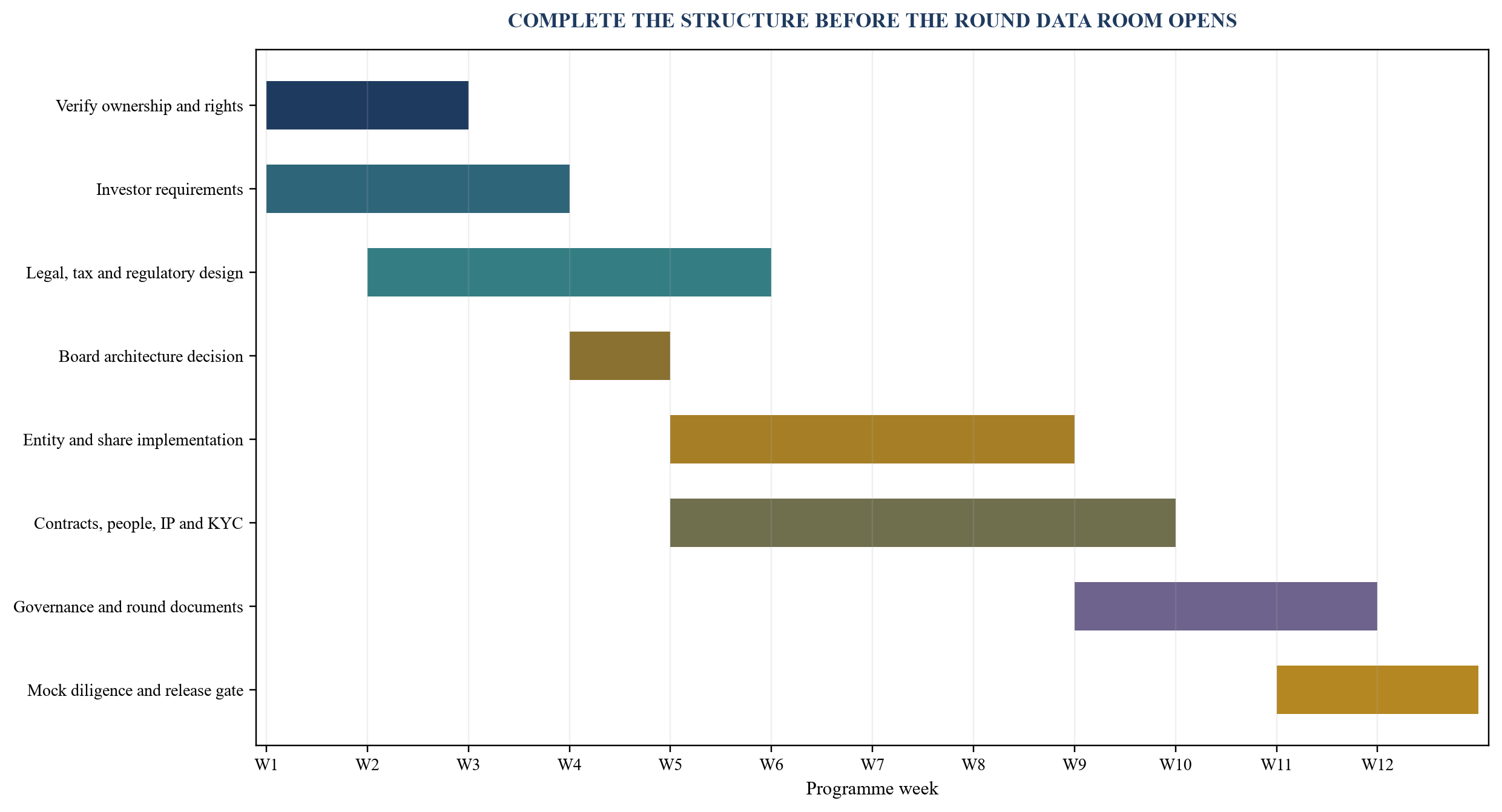
The timing is an illustrative management plan. Regulatory, tax, counterparty and shareholder dependencies can extend the critical path.
17. Operate the parent as a governance system
Closing creates ongoing obligations. The parent needs a calendar for board meetings, management reporting, tax filings, statutory filings, beneficial ownership, insurance, option grants, investor notices, reserved matters, transfer pricing, intercompany settlements and licence renewals. Every obligation should have an owner, evidence source and escalation route.
The board pack should connect group strategy, operating performance, liquidity, capital allocation, risks and compliance. Subsidiary boards should receive the information required for their own duties and licensed activities. Parent oversight should be documented without erasing subsidiary governance or placing regulated decisions in an unlicensed entity.
The rights matrix becomes an operating control. Before a financing, acquisition, material contract, debt facility, budget change, senior hire, share issuance or related-party transaction, the company identifies the approvals and notices required. Decision owners should not rely on memory or search several agreements during a live transaction.
Tax and substance evidence should be maintained contemporaneously. Board papers show where decisions were made and by whom. Intercompany services are documented and delivered. Transfer-pricing positions are reconciled to invoices. Intellectual-property development and licences follow the approved model. Bank and signing authority reflect delegations.
Figure 6 presents the evidence loop. The loop begins with operating facts, converts them into decision material, records an authorised decision, executes it through the correct entity and reconciles the outcome to investors and authorities. Exceptions return to the board rather than remaining as undocumented workarounds.
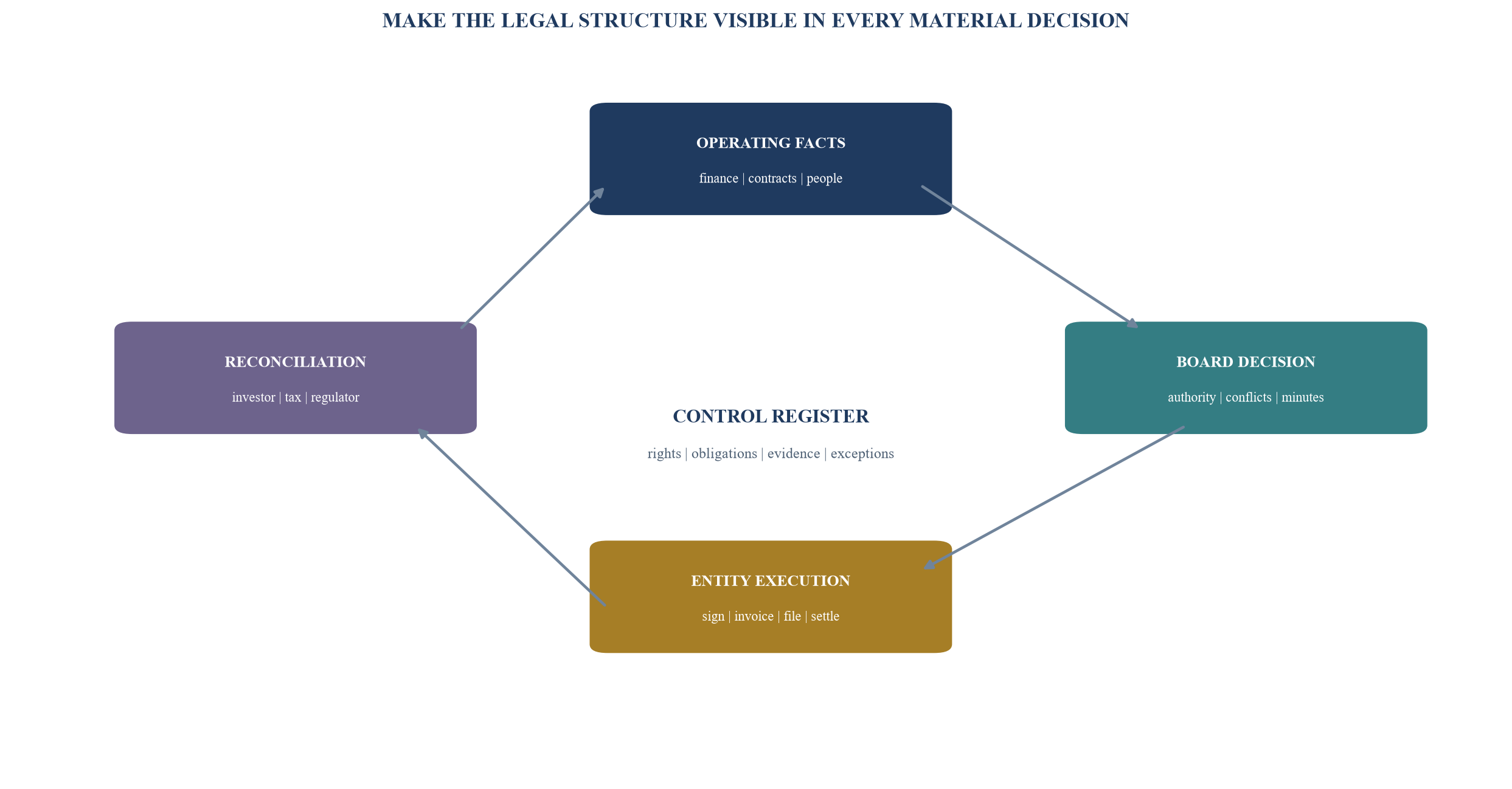
Governance quality depends on repeated evidence and execution, not incorporation documents alone.
Table 6. Board parent-readiness gate
| Gate | Green evidence | Amber condition | Red blocker |
|---|---|---|---|
| investor acceptance | lead and material syndicate requirements confirmed | preference known; counsel confirmation pending | target investor cannot invest in issuer |
| ownership and rights | statutory records, instruments and cap table reconcile | minor historic correction in progress | title, promise, lien or holder dispute unresolved |
| tax and substance | written transaction and operating analysis approved | filing, clearance or implementation step pending | material leakage, residence conflict or unsupported substance |
| licences and contracts | operating entities, consents and continuity verified | non-critical notices or KYC in progress | regulated permission or material contract at risk |
| IP, data and people | chain of title, roles, awards and transfers complete | bounded remediation with owner and date | core IP, data permission or employee transfer unresolved |
| governance and close | documents, authorities, data room and obligations register aligned | drafting point with agreed resolution path | constitution, financing documents or approvals conflict |
A red item blocks launch unless the board accepts a documented residual risk with adviser input and a closing condition.
18. Use structure discipline to create transaction readiness
A parent choice cannot guarantee a financing or valuation. It can improve the quality of the investable perimeter, governance, evidence and closing process. The value mechanism is practical: investors receive the security they can underwrite; the parent controls the assets and subsidiaries that produce value; management and tax positions reflect actual conduct; contracts and licences continue; employee equity aligns with the group; and future decisions follow a visible authority model.
The decision should remain reversible where possible. The company can defer a parent insertion until investor requirements are confirmed, preserve alternative routes in the constitutional and consent design, and avoid moving assets without a clear operating purpose. Once restructuring begins, the board should control scope and prevent parallel equity changes that break reconciliation.
The board should answer nine questions before opening the institutional data room. Which investor pool is being targeted? Which entity will issue the security? Where is the group genuinely managed? Which entities hold licences, people, customers, data and intellectual property? How does cash reach the parent? Which tax and consent conditions apply to the restructuring? Does the cap table reconcile at every step? Can the group operate without interruption on day one? Will the architecture support the next financing, acquisition or exit?
An affirmative answer requires documents, not confidence. The parent architecture memo, scorecard, adviser opinions, cap-table bridge, continuity matrix, rights register, data room and board approval provide that evidence. The result is a company designed for institutional scrutiny and ongoing execution.
References
- Abu Dhabi Global Market, Companies Regulations 2020. https://assets.adgm.com/download/assets/ADGM1547_20963_VER072020.pdf/fb4a15ce5d4111efaccc3653e4bba5a5
- Abu Dhabi Global Market Registration Authority, Guidance on Continuance into ADGM. https://www.adgm.com/documents/legal-framework/guidance-and-policy/ra/guidance-for-applicants/guidance-on-continuance--101120.pdf
- Abu Dhabi Global Market, Beneficial Ownership and Control. https://www.adgm.com/operating-in-adgm/obligations-of-adgm-registered-entities/beneficial-ownership-and-control
- Abu Dhabi Global Market, Registration Authority Publishes Amendments to the Commercial Legislation, 1 May 2026. https://www.adgm.com/media/announcements/adgm-registration-authority-publishes-amendments-to-the-commercial-legislation
- Dubai International Financial Centre, Companies Law, DIFC Law No. 5 of 2018. https://assets.difc.com/v1/media/edge/images/dubaiintern0078-difcexperie96c5-production-3253/media/project/difcexperiences/difc/difcwebsite/documents/laws--regulations/companies_law.pdf
- Dubai International Financial Centre, Registrar of Companies. https://www.difc.com/business/registrars-and-commissioners/registrar-of-companies
- UAE Federal Tax Authority, Corporate Tax General Guide. https://www.tax.gov.ae/DataFolder/Files/Guides/CT/CT%20General%20Guide%20-%20EN%20-%2010%2009%202023.pdf
- UAE Federal Tax Authority, Exempt Income: Dividends and Participation Exemption. https://tax.gov.ae/Datafolder/Files/Guides/CT/CT%20-%20Exempt%20Income%20-%20Dividends%20and%20Participation%20Exemption%20-%2016%2010%202023.pdf
- UAE Federal Tax Authority, Transfer Pricing Guide. https://tax.gov.ae/Datafolder/Files/Pdf/2023/Transfer%20Pricing%20Guide%20-%20EN%20-%2023%2010%202023.pdf
- UAE Federal Tax Authority, Tax Groups Guide. https://tax.gov.ae/Datafolder/Files/Guides/CT/Tax%20Groups%20-%2008%2001%202024.pdf
- Delaware Code Online, Title 8, Chapter 1, Subchapter I: Formation. https://delcode.delaware.gov/title8/c001/sc01/index.html
- Delaware Code Online, Title 8, Chapter 1, Subchapter V: Stock and Dividends. https://delcode.delaware.gov/title8/c001/sc05/index.html
- National Venture Capital Association, Model Legal Documents. https://nvca.org/model-legal-documents/
- United States Code, Title 26, Section 351: Transfer to corporation controlled by transferor. https://uscode.house.gov/view.xhtml?edition=prelim&num=0&req=granuleid%3AUSC-prelim-title26-section351
- United States Code, Title 26, Section 367: Foreign corporations. https://uscode.house.gov/view.xhtml?edition=prelim&req=granuleid%3AUSC-prelim-title26-section367
- HM Revenue & Customs, Company residence: central management and control. https://www.gov.uk/hmrc-internal-manuals/international-manual/intm120060
- HM Revenue & Customs, Apply for statutory clearance for a transaction. https://www.gov.uk/guidance/apply-for-statutory-clearance-for-a-transaction
- HM Revenue & Customs, Share exchange qualifying conditions. https://www.gov.uk/hmrc-internal-manuals/capital-gains-manual/cg52523
- Accounting and Corporate Regulatory Authority Singapore, Transferring a foreign entity's registration. https://www.acra.gov.sg/register/foreign-business/transferring-foreign-entity-registration-redomiciliation/
- Accounting and Corporate Regulatory Authority Singapore, Filing a return of allotment of shares. https://www.acra.gov.sg/manage/companies/shares/allotment-of-shares/
- Inland Revenue Authority of Singapore, Tax Residency of a Company and Certificate of Residence. https://www.iras.gov.sg/taxes/corporate-income-tax/basics-of-corporate-income-tax/tax-residency-of-a-company-certificate-of-residence
