

1. Define the valuation decision
The decision question is which decision the analysis must support: financing, acquisition, internal capital allocation, public investment, partnership or impairment review. The evidence file should begin with decision mandate, unit-of-account schedule, ownership map, financing perimeter, governing approvals and intended users. Every item should identify its source, date, legal owner, responsible reviewer, expiry or refresh date and the valuation ledger it affects. Public strategy and announced projects establish context. They do not establish the cash flow, transferability, financing capacity or value of the subject asset. [1][16]
The principal failure is that one blended value is presented to lenders, investors and policy makers even though each relies on different rights, cash flows and decision criteria. A sovereign AI campus contains infrastructure, equipment, contracts, operational capabilities and policy objectives with different useful lives and beneficiaries. Combining them prematurely can count the same benefit twice, capitalise outcomes that cannot be sold and expose senior debt to risks that sponsors or public authorities intended to retain.
The recommended response is to state the decision, valuation date, currency, perspective, unit of account and permitted uses before selecting a method. Scenario assumptions should be identified with their valuation date, probability, evidence and decision owner. The central case should use current rights, enforceable commitments and achievable operating performance. Downside analysis should combine power, technology, demand, policy, partnership, security, liquidity and recovery effects rather than treating each risk as independent.
2. Map the sovereign AI campus stack
The decision question is which land, grid, generation, cooling, fibre, secure facilities, accelerators, software, models, data rights, people and operating capabilities create service. The evidence file should begin with site rights, designs, power studies, equipment schedules, network maps, licences, contracts, staffing plans and operating procedures. Every item should identify its source, date, legal owner, responsible reviewer, expiry or refresh date and the valuation ledger it affects. Public strategy and announced projects establish context. They do not establish the cash flow, transferability, financing capacity or value of the subject asset. [2][3]
The principal failure is that the campus is described as a single real-estate asset while most cost, risk and differentiation sit in equipment, energy, contracts and operating capability. A sovereign AI campus contains infrastructure, equipment, contracts, operational capabilities and policy objectives with different useful lives and beneficiaries. Combining them prematurely can count the same benefit twice, capitalise outcomes that cannot be sold and expose senior debt to risks that sponsors or public authorities intended to retain.
The recommended response is to value each layer through its legal owner, useful life, cash-flow role, transferability and replacement path. Scenario assumptions should be identified with their valuation date, probability, evidence and decision owner. The central case should use current rights, enforceable commitments and achievable operating performance. Downside analysis should combine power, technology, demand, policy, partnership, security, liquidity and recovery effects rather than treating each risk as independent.
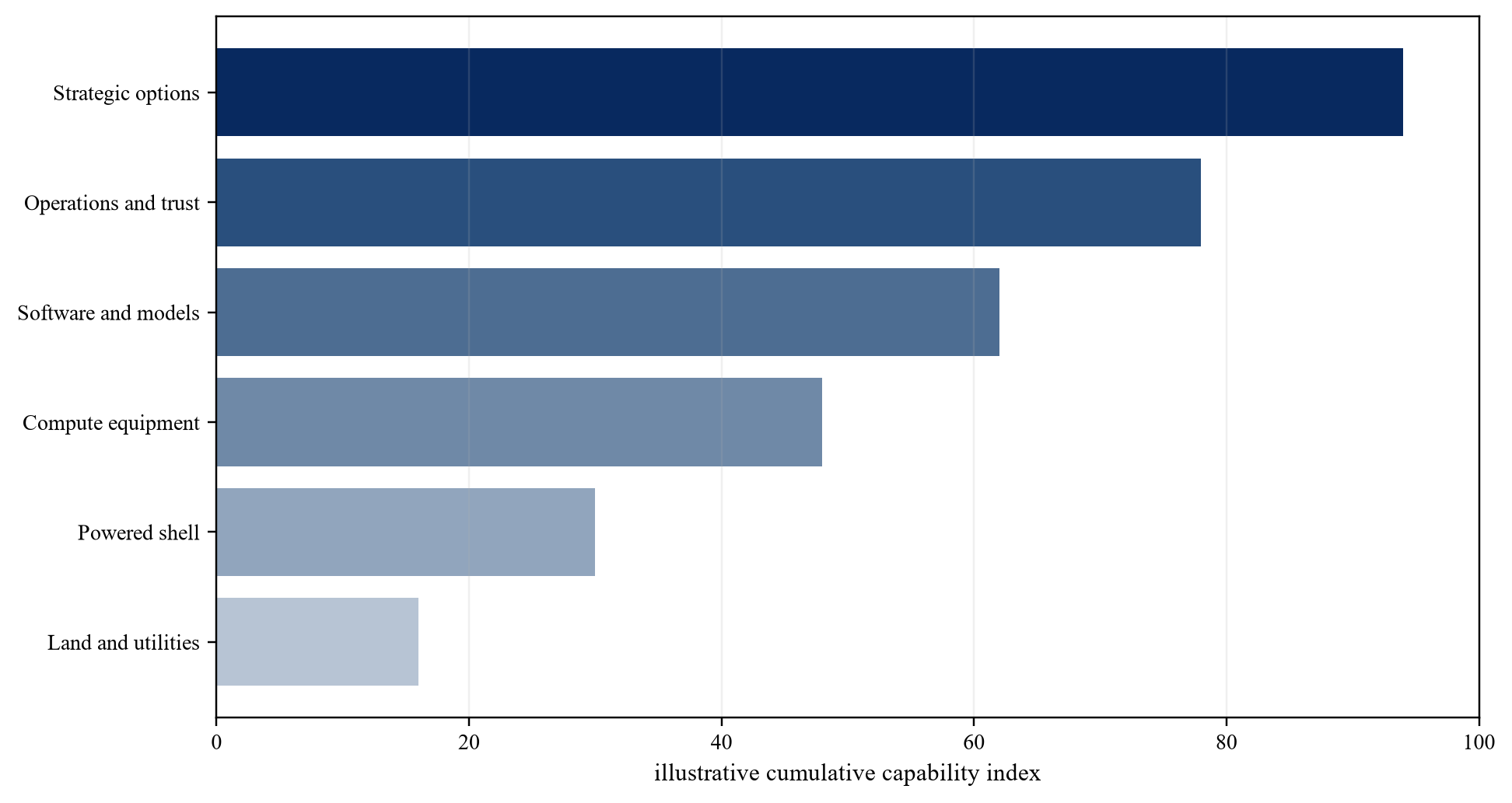
Analytical framework; layers overlap operationally but require separate evidence.
3. Separate public announcements from transaction evidence
The decision question is which announced capacity, investment and delivery milestones are confirmed and which remain prospective. The evidence file should begin with official releases, executed contracts, permits, export authorisations, board approvals, construction records and acceptance evidence. Every item should identify its source, date, legal owner, responsible reviewer, expiry or refresh date and the valuation ledger it affects. Public strategy and announced projects establish context. They do not establish the cash flow, transferability, financing capacity or value of the subject asset. [2][3][4]
The principal failure is that headline gigawatts and investment totals are treated as operating capacity or committed cash flow before the underlying conditions are met. A sovereign AI campus contains infrastructure, equipment, contracts, operational capabilities and policy objectives with different useful lives and beneficiaries. Combining them prematurely can count the same benefit twice, capitalise outcomes that cannot be sold and expose senior debt to risks that sponsors or public authorities intended to retain.
The recommended response is to maintain an evidence register that distinguishes announced, permitted, financed, ordered, installed, energised, accepted and revenue-producing capacity. Scenario assumptions should be identified with their valuation date, probability, evidence and decision owner. The central case should use current rights, enforceable commitments and achievable operating performance. Downside analysis should combine power, technology, demand, policy, partnership, security, liquidity and recovery effects rather than treating each risk as independent.
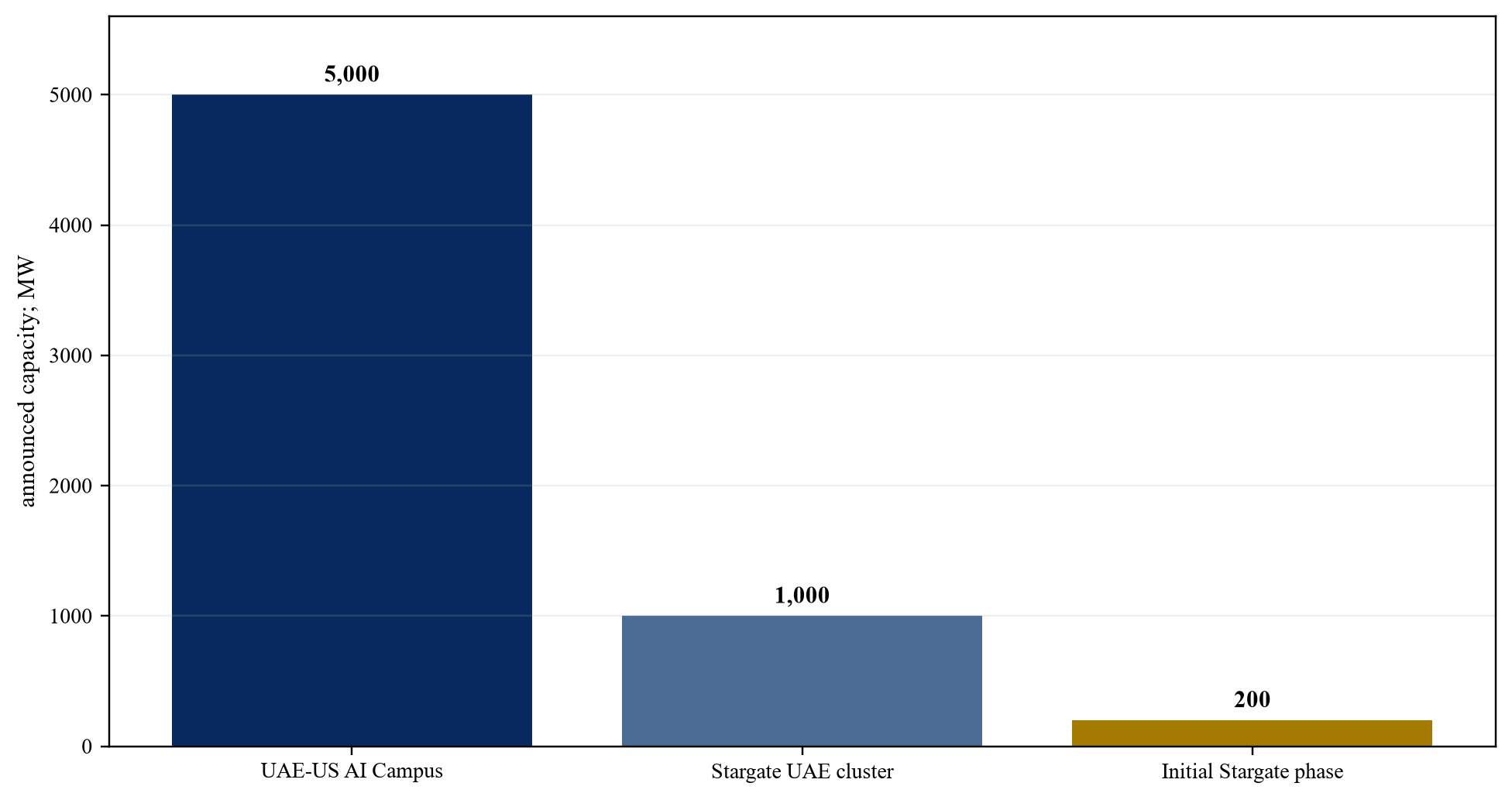
Official announcements; 5 GW campus, 1 GW Stargate UAE cluster and 200 MW initial phase expected in 2026.
4. Establish the four valuation ledgers
The decision question is which components belong to market value, owner-specific investment value, public value and strategic option value. The evidence file should begin with market-participant assumptions, owner plans, public objectives, option triggers, probability evidence and governance records. Every item should identify its source, date, legal owner, responsible reviewer, expiry or refresh date and the valuation ledger it affects. Public strategy and announced projects establish context. They do not establish the cash flow, transferability, financing capacity or value of the subject asset. [16][21]
The principal failure is that strategic benefits are added to commercial enterprise value without checking overlap, transferability or who captures the benefit. A sovereign AI campus contains infrastructure, equipment, contracts, operational capabilities and policy objectives with different useful lives and beneficiaries. Combining them prematurely can count the same benefit twice, capitalise outcomes that cannot be sold and expose senior debt to risks that sponsors or public authorities intended to retain.
The recommended response is to calculate each ledger independently, reconcile overlaps and prohibit automatic summation. Scenario assumptions should be identified with their valuation date, probability, evidence and decision owner. The central case should use current rights, enforceable commitments and achievable operating performance. Downside analysis should combine power, technology, demand, policy, partnership, security, liquidity and recovery effects rather than treating each risk as independent.
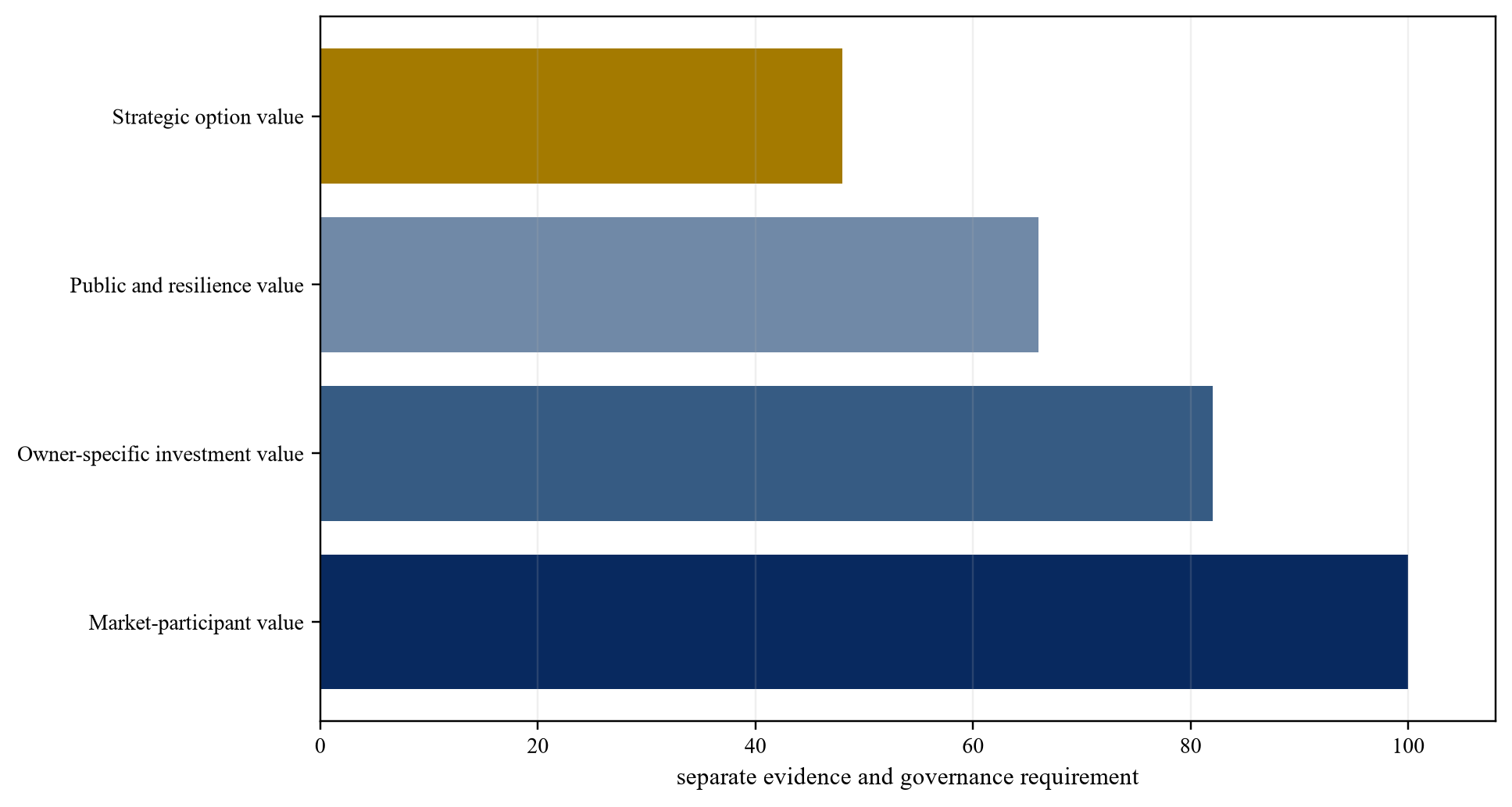
Proposed framework; ledgers are reconciled and are not automatically additive.
| Ledger | Principal question | Permitted evidence | Output |
|---|---|---|---|
| market participant | what would an informed buyer pay | transferable cash, assets and market risk | enterprise or asset value |
| specific owner | what is the investment worth to this owner | incremental synergies and avoided cost | investment value |
| public value | what services and resilience justify public support | outcomes, counterfactual and fiscal cost | benefit and accountability record |
| strategic options | what future rights have decision value | exercisable rights, triggers and probabilities | option value range |
Proposed framework; accounting, transaction and public-policy decisions remain distinct.
5. Build the contracted commercial cash-flow base
The decision question is which capacity, service, availability and price obligations create enforceable and transferable revenue. The evidence file should begin with executed capacity agreements, service schedules, acceptance tests, minimum payments, indexation, credit support, termination rights and collections. Every item should identify its source, date, legal owner, responsible reviewer, expiry or refresh date and the valuation ledger it affects. Public strategy and announced projects establish context. They do not establish the cash flow, transferability, financing capacity or value of the subject asset. [5][22]
The principal failure is that market demand, government ambition or customer discussions substitute for bankable contracts. A sovereign AI campus contains infrastructure, equipment, contracts, operational capabilities and policy objectives with different useful lives and beneficiaries. Combining them prematurely can count the same benefit twice, capitalise outcomes that cannot be sold and expose senior debt to risks that sponsors or public authorities intended to retain.
The recommended response is to model revenue only from executed obligations after acceptance, credits, curtailment, taxes, collection risk and renewal assumptions. Scenario assumptions should be identified with their valuation date, probability, evidence and decision owner. The central case should use current rights, enforceable commitments and achievable operating performance. Downside analysis should combine power, technology, demand, policy, partnership, security, liquidity and recovery effects rather than treating each risk as independent.
| Evidence | Commercial treatment | Finance treatment |
|---|---|---|
| policy ambition | market context | none |
| customer pipeline | probability-weighted demand | none |
| reservation | conditional future demand | limited |
| prepayment | cash subject to refund and performance terms | restricted source |
| take-or-pay capacity | enforceable minimum payment | stressed contracted cash |
| supported payment | obligation plus valid credit support | enhanced within support limits |
Proposed classification; executed terms determine treatment.
6. Underwrite sovereign and anchor demand
The decision question is which government, government-related, hyperscaler and enterprise workloads can support utilisation. The evidence file should begin with procurement approvals, framework agreements, service orders, budget authority, minimum-use terms, data classifications and payment history. Every item should identify its source, date, legal owner, responsible reviewer, expiry or refresh date and the valuation ledger it affects. Public strategy and announced projects establish context. They do not establish the cash flow, transferability, financing capacity or value of the subject asset. [1][21]
The principal failure is that a strategic relationship is treated as a guarantee of utilisation or payment. A sovereign AI campus contains infrastructure, equipment, contracts, operational capabilities and policy objectives with different useful lives and beneficiaries. Combining them prematurely can count the same benefit twice, capitalise outcomes that cannot be sold and expose senior debt to risks that sponsors or public authorities intended to retain.
The recommended response is to classify demand by legal commitment, appropriation risk, counterparty, term, workload portability and remedy. Scenario assumptions should be identified with their valuation date, probability, evidence and decision owner. The central case should use current rights, enforceable commitments and achievable operating performance. Downside analysis should combine power, technology, demand, policy, partnership, security, liquidity and recovery effects rather than treating each risk as independent.
7. Value powered shell and utility infrastructure
The decision question is how land rights, substations, cooling systems, water systems, buildings and network entry points contribute to cash and recovery. The evidence file should begin with title, leases, permits, connection agreements, design capacity, replacement cost, depreciation, condition surveys and comparable transactions. Every item should identify its source, date, legal owner, responsible reviewer, expiry or refresh date and the valuation ledger it affects. Public strategy and announced projects establish context. They do not establish the cash flow, transferability, financing capacity or value of the subject asset. [9][18]
The principal failure is that installed nameplate capacity is valued without testing energisation, customer usability or remaining life. A sovereign AI campus contains infrastructure, equipment, contracts, operational capabilities and policy objectives with different useful lives and beneficiaries. Combining them prematurely can count the same benefit twice, capitalise outcomes that cannot be sold and expose senior debt to risks that sponsors or public authorities intended to retain.
The recommended response is to use eligible customer-usable capacity and reconcile cost, income and market evidence after physical and economic obsolescence. Scenario assumptions should be identified with their valuation date, probability, evidence and decision owner. The central case should use current rights, enforceable commitments and achievable operating performance. Downside analysis should combine power, technology, demand, policy, partnership, security, liquidity and recovery effects rather than treating each risk as independent.
8. Value accelerator and compute equipment
The decision question is how chip generation, interconnect, memory, servers and storage convert capital cost into sellable compute. The evidence file should begin with purchase orders, export licences, delivery schedules, serialised assets, benchmarks, utilisation, warranty, maintenance and secondary-market evidence. Every item should identify its source, date, legal owner, responsible reviewer, expiry or refresh date and the valuation ledger it affects. Public strategy and announced projects establish context. They do not establish the cash flow, transferability, financing capacity or value of the subject asset. [6][19]
The principal failure is that invoice cost is assumed to equal enduring value despite performance-per-watt gains and rapid product cycles. A sovereign AI campus contains infrastructure, equipment, contracts, operational capabilities and policy objectives with different useful lives and beneficiaries. Combining them prematurely can count the same benefit twice, capitalise outcomes that cannot be sold and expose senior debt to risks that sponsors or public authorities intended to retain.
The recommended response is to forecast cash and recovery by equipment cohort with explicit useful life, refresh cost, residual value and substitution assumptions. Scenario assumptions should be identified with their valuation date, probability, evidence and decision owner. The central case should use current rights, enforceable commitments and achievable operating performance. Downside analysis should combine power, technology, demand, policy, partnership, security, liquidity and recovery effects rather than treating each risk as independent.
| Field | Evidence | Valuation use |
|---|---|---|
| generation and configuration | serialised asset register | performance cohort |
| delivery and licence | orders and authorisations | availability date |
| benchmark performance | repeatable workload tests | service capacity |
| utilisation and failure | telemetry and maintenance | cash and downtime |
| refresh path | supplier plan and capital approval | future cost |
| residual route | buyer, transfer rights and cost | recovery value |
Proposed control by equipment cohort.
9. Value software, models and operating capability
The decision question is which orchestration, security, model access, optimisation and service capabilities are owned, licensed or partner-dependent. The evidence file should begin with licences, source rights, service agreements, model terms, technical documentation, staffing, performance data and transition rights. Every item should identify its source, date, legal owner, responsible reviewer, expiry or refresh date and the valuation ledger it affects. Public strategy and announced projects establish context. They do not establish the cash flow, transferability, financing capacity or value of the subject asset. [5][14]
The principal failure is that technology partnerships are treated as owned intangible assets without transfer or continuation rights. A sovereign AI campus contains infrastructure, equipment, contracts, operational capabilities and policy objectives with different useful lives and beneficiaries. Combining them prematurely can count the same benefit twice, capitalise outcomes that cannot be sold and expose senior debt to risks that sponsors or public authorities intended to retain.
The recommended response is to value only controllable benefits and deduct replacement, dependency and transition cost. Scenario assumptions should be identified with their valuation date, probability, evidence and decision owner. The central case should use current rights, enforceable commitments and achievable operating performance. Downside analysis should combine power, technology, demand, policy, partnership, security, liquidity and recovery effects rather than treating each risk as independent.
10. Prove power deliverability
The decision question is which grid, generation, storage, backup and flexibility resources can support the campus across phases. The evidence file should begin with connection agreements, system studies, energisation milestones, tariffs, generation contracts, fuel arrangements, telemetry and curtailment rules. Every item should identify its source, date, legal owner, responsible reviewer, expiry or refresh date and the valuation ledger it affects. Public strategy and announced projects establish context. They do not establish the cash flow, transferability, financing capacity or value of the subject asset. [9][12]
The principal failure is that a power allocation or memorandum is treated as firm, continuous and financeable electricity supply. A sovereign AI campus contains infrastructure, equipment, contracts, operational capabilities and policy objectives with different useful lives and beneficiaries. Combining them prematurely can count the same benefit twice, capitalise outcomes that cannot be sold and expose senior debt to risks that sponsors or public authorities intended to retain.
The recommended response is to measure deliverable power by date, reliability, price, carbon attributes and contractual remedy. Scenario assumptions should be identified with their valuation date, probability, evidence and decision owner. The central case should use current rights, enforceable commitments and achievable operating performance. Downside analysis should combine power, technology, demand, policy, partnership, security, liquidity and recovery effects rather than treating each risk as independent.
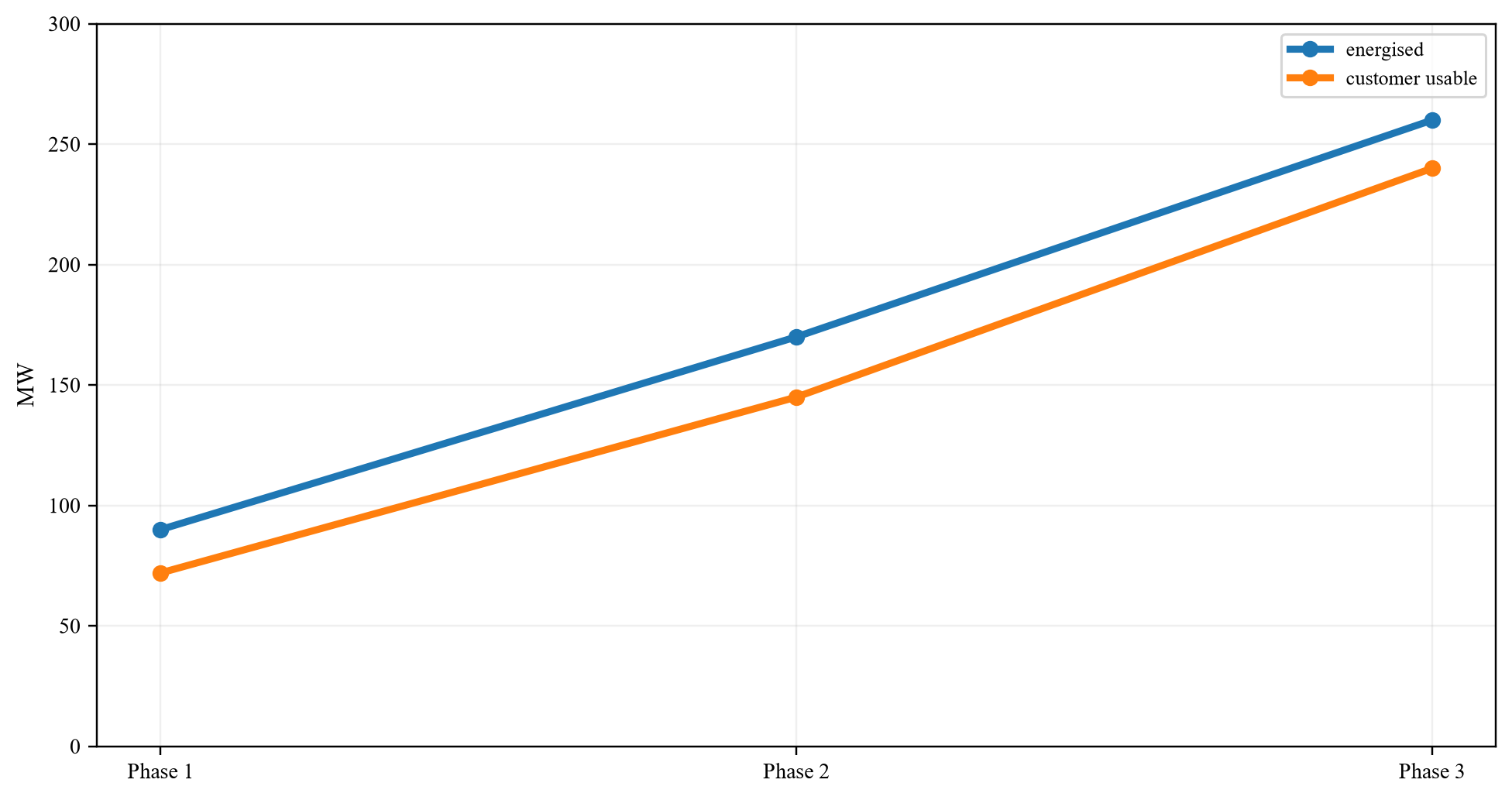
Wholly hypothetical; customer-usable MW.
11. Integrate energy and carbon economics
The decision question is how electricity cost, clean-energy procurement, efficiency and carbon constraints affect competitiveness and value. The evidence file should begin with tariffs, PPAs, renewable certificates, PUE data, hourly load, cooling profile, storage dispatch, grid factors and policy targets. Every item should identify its source, date, legal owner, responsible reviewer, expiry or refresh date and the valuation ledger it affects. Public strategy and announced projects establish context. They do not establish the cash flow, transferability, financing capacity or value of the subject asset. [9][12]
The principal failure is that annual renewable matching conceals hourly reliability, marginal cost and physical supply constraints. A sovereign AI campus contains infrastructure, equipment, contracts, operational capabilities and policy objectives with different useful lives and beneficiaries. Combining them prematurely can count the same benefit twice, capitalise outcomes that cannot be sold and expose senior debt to risks that sponsors or public authorities intended to retain.
The recommended response is to model delivered energy cost and emissions by hour or representative period and disclose contractual versus physical attributes. Scenario assumptions should be identified with their valuation date, probability, evidence and decision owner. The central case should use current rights, enforceable commitments and achievable operating performance. Downside analysis should combine power, technology, demand, policy, partnership, security, liquidity and recovery effects rather than treating each risk as independent.
12. Underwrite water and thermal constraints
The decision question is which cooling technology, climate conditions, water sources and heat-rejection limits determine usable capacity. The evidence file should begin with design basis, weather files, water rights, consumption data, discharge permits, maintenance records and stress tests. Every item should identify its source, date, legal owner, responsible reviewer, expiry or refresh date and the valuation ledger it affects. Public strategy and announced projects establish context. They do not establish the cash flow, transferability, financing capacity or value of the subject asset. [9][13]
The principal failure is that desert-climate cooling is assumed to scale linearly without water, temperature or equipment derating. A sovereign AI campus contains infrastructure, equipment, contracts, operational capabilities and policy objectives with different useful lives and beneficiaries. Combining them prematurely can count the same benefit twice, capitalise outcomes that cannot be sold and expose senior debt to risks that sponsors or public authorities intended to retain.
The recommended response is to test extreme-temperature performance, water scarcity, alternative cooling and associated capital and operating costs. Scenario assumptions should be identified with their valuation date, probability, evidence and decision owner. The central case should use current rights, enforceable commitments and achievable operating performance. Downside analysis should combine power, technology, demand, policy, partnership, security, liquidity and recovery effects rather than treating each risk as independent.
13. Treat export control as a value condition
The decision question is which accelerators, software and technical services can be lawfully delivered, operated, refreshed and transferred. The evidence file should begin with current regulations, licences, approved-consignee status, end-use controls, compliance systems, expiry dates and supplier confirmations. Every item should identify its source, date, legal owner, responsible reviewer, expiry or refresh date and the valuation ledger it affects. Public strategy and announced projects establish context. They do not establish the cash flow, transferability, financing capacity or value of the subject asset. [6][24]
The principal failure is that current access to advanced chips is capitalised through the full forecast without renewal, expiry or policy-change risk. A sovereign AI campus contains infrastructure, equipment, contracts, operational capabilities and policy objectives with different useful lives and beneficiaries. Combining them prematurely can count the same benefit twice, capitalise outcomes that cannot be sold and expose senior debt to risks that sponsors or public authorities intended to retain.
The recommended response is to scenario-test authorisation, quantity, timing, reporting and renewal conditions and link them to draw and valuation milestones. Scenario assumptions should be identified with their valuation date, probability, evidence and decision owner. The central case should use current rights, enforceable commitments and achievable operating performance. Downside analysis should combine power, technology, demand, policy, partnership, security, liquidity and recovery effects rather than treating each risk as independent.
| Condition | Evidence | Valuation response |
|---|---|---|
| eligible consignee | official approval and entity match | permit delivery assumption |
| authorised quantity | licence terms and supplier allocation | cap equipment case |
| end-use controls | compliance design and audit | operating cost and risk |
| expiry or renewal | stated date and process | probability-weight refresh |
| retransfer limits | legal advice and buyer eligibility | residual-value haircut |
| policy change | scenario and alternatives | liquidity and option response |
Proposed diligence; current law and authorisations govern.
14. Price trust, cybersecurity and assurance
The decision question is which controls protect models, data, workloads, equipment and cross-border partnerships. The evidence file should begin with security architecture, certifications, assurance agreements, audit reports, incident response, access logs and independent testing. Every item should identify its source, date, legal owner, responsible reviewer, expiry or refresh date and the valuation ledger it affects. Public strategy and announced projects establish context. They do not establish the cash flow, transferability, financing capacity or value of the subject asset. [5][14][15]
The principal failure is that trusted-infrastructure language is treated as value without measurable control performance or contractual consequence. A sovereign AI campus contains infrastructure, equipment, contracts, operational capabilities and policy objectives with different useful lives and beneficiaries. Combining them prematurely can count the same benefit twice, capitalise outcomes that cannot be sold and expose senior debt to risks that sponsors or public authorities intended to retain.
The recommended response is to translate trust requirements into operating cost, customer eligibility, downtime risk, insurance and contract retention. Scenario assumptions should be identified with their valuation date, probability, evidence and decision owner. The central case should use current rights, enforceable commitments and achievable operating performance. Downside analysis should combine power, technology, demand, policy, partnership, security, liquidity and recovery effects rather than treating each risk as independent.
15. Define data sovereignty and workload eligibility
The decision question is which data classes and workloads may use the campus under applicable law and customer policy. The evidence file should begin with data maps, localisation rules, sector regulations, cloud classifications, encryption controls, contractual restrictions and audit rights. Every item should identify its source, date, legal owner, responsible reviewer, expiry or refresh date and the valuation ledger it affects. Public strategy and announced projects establish context. They do not establish the cash flow, transferability, financing capacity or value of the subject asset. [1][22]
The principal failure is that domestic location is assumed to make every workload sovereign, compliant and portable. A sovereign AI campus contains infrastructure, equipment, contracts, operational capabilities and policy objectives with different useful lives and beneficiaries. Combining them prematurely can count the same benefit twice, capitalise outcomes that cannot be sold and expose senior debt to risks that sponsors or public authorities intended to retain.
The recommended response is to assess sovereignty across ownership, control, legal jurisdiction, operations, encryption keys, support access and continuity. Scenario assumptions should be identified with their valuation date, probability, evidence and decision owner. The central case should use current rights, enforceable commitments and achievable operating performance. Downside analysis should combine power, technology, demand, policy, partnership, security, liquidity and recovery effects rather than treating each risk as independent.
16. Measure capacity effectiveness
The decision question is how installed compute becomes available, allocated and productively used capacity. The evidence file should begin with energised racks, accelerator hours, utilisation, job queues, failure rates, model throughput, customer acceptance and billing records. Every item should identify its source, date, legal owner, responsible reviewer, expiry or refresh date and the valuation ledger it affects. Public strategy and announced projects establish context. They do not establish the cash flow, transferability, financing capacity or value of the subject asset. [10][23]
The principal failure is that gigawatts or accelerator counts are treated as output without measuring usable compute and service quality. A sovereign AI campus contains infrastructure, equipment, contracts, operational capabilities and policy objectives with different useful lives and beneficiaries. Combining them prematurely can count the same benefit twice, capitalise outcomes that cannot be sold and expose senior debt to risks that sponsors or public authorities intended to retain.
The recommended response is to track availability, allocation, useful utilisation, throughput, customer outcomes and revenue per constrained resource. Scenario assumptions should be identified with their valuation date, probability, evidence and decision owner. The central case should use current rights, enforceable commitments and achievable operating performance. Downside analysis should combine power, technology, demand, policy, partnership, security, liquidity and recovery effects rather than treating each risk as independent.
17. Apply market-participant fair value
The decision question is what an informed market participant would pay for the asset or business under current conditions. The evidence file should begin with transferable contracts, current operating data, market yields, comparable transactions, replacement cost, risk and market-participant assumptions. Every item should identify its source, date, legal owner, responsible reviewer, expiry or refresh date and the valuation ledger it affects. Public strategy and announced projects establish context. They do not establish the cash flow, transferability, financing capacity or value of the subject asset. [8][16]
The principal failure is that entity-specific strategic intent is embedded in fair value even when another buyer could not capture it. A sovereign AI campus contains infrastructure, equipment, contracts, operational capabilities and policy objectives with different useful lives and beneficiaries. Combining them prematurely can count the same benefit twice, capitalise outcomes that cannot be sold and expose senior debt to risks that sponsors or public authorities intended to retain.
The recommended response is to apply IFRS 13 market-participant logic and disclose significant unobservable inputs and sensitivities. Scenario assumptions should be identified with their valuation date, probability, evidence and decision owner. The central case should use current rights, enforceable commitments and achievable operating performance. Downside analysis should combine power, technology, demand, policy, partnership, security, liquidity and recovery effects rather than treating each risk as independent.
18. Calculate owner-specific investment value
The decision question is which synergies, avoided costs, integration benefits and strategic access accrue to the actual owner. The evidence file should begin with approved operating plan, existing workloads, alternative costs, integration requirements, governance rights and accountable benefit owners. Every item should identify its source, date, legal owner, responsible reviewer, expiry or refresh date and the valuation ledger it affects. Public strategy and announced projects establish context. They do not establish the cash flow, transferability, financing capacity or value of the subject asset. [17][20]
The principal failure is that all sponsor aspirations are valued as synergies without incremental cash, cost, timing or execution evidence. A sovereign AI campus contains infrastructure, equipment, contracts, operational capabilities and policy objectives with different useful lives and beneficiaries. Combining them prematurely can count the same benefit twice, capitalise outcomes that cannot be sold and expose senior debt to risks that sponsors or public authorities intended to retain.
The recommended response is to include only incremental owner-capturable benefits net of implementation cost, tax, risk and overlap with the commercial case. Scenario assumptions should be identified with their valuation date, probability, evidence and decision owner. The central case should use current rights, enforceable commitments and achievable operating performance. Downside analysis should combine power, technology, demand, policy, partnership, security, liquidity and recovery effects rather than treating each risk as independent.
19. Value phased expansion options
The decision question is which rights allow the owner to expand, pause, redesign, substitute equipment or admit new partners. The evidence file should begin with land and utility reservations, modular designs, supplier options, customer pipeline, permits, capital approvals and trigger milestones. Every item should identify its source, date, legal owner, responsible reviewer, expiry or refresh date and the valuation ledger it affects. Public strategy and announced projects establish context. They do not establish the cash flow, transferability, financing capacity or value of the subject asset. [2][7]
The principal failure is that undeveloped capacity is valued as completed capacity or as a generic growth premium. A sovereign AI campus contains infrastructure, equipment, contracts, operational capabilities and policy objectives with different useful lives and beneficiaries. Combining them prematurely can count the same benefit twice, capitalise outcomes that cannot be sold and expose senior debt to risks that sponsors or public authorities intended to retain.
The recommended response is to value each option from the right, exercise cost, expiry, trigger evidence, uncertainty and probability of execution. Scenario assumptions should be identified with their valuation date, probability, evidence and decision owner. The central case should use current rights, enforceable commitments and achievable operating performance. Downside analysis should combine power, technology, demand, policy, partnership, security, liquidity and recovery effects rather than treating each risk as independent.
20. Record national resilience value
The decision question is which critical services gain continuity, recovery, domestic control or reduced external dependency. The evidence file should begin with critical-service maps, outage scenarios, alternative capacity, recovery objectives, security requirements and tested continuity plans. Every item should identify its source, date, legal owner, responsible reviewer, expiry or refresh date and the valuation ledger it affects. Public strategy and announced projects establish context. They do not establish the cash flow, transferability, financing capacity or value of the subject asset. [14][21]
The principal failure is that resilience is expressed as an unlimited premium without defining the protected service or avoided loss. A sovereign AI campus contains infrastructure, equipment, contracts, operational capabilities and policy objectives with different useful lives and beneficiaries. Combining them prematurely can count the same benefit twice, capitalise outcomes that cannot be sold and expose senior debt to risks that sponsors or public authorities intended to retain.
The recommended response is to measure service coverage, recovery improvement, substitution cost and residual risk in a public-value ledger. Scenario assumptions should be identified with their valuation date, probability, evidence and decision owner. The central case should use current rights, enforceable commitments and achievable operating performance. Downside analysis should combine power, technology, demand, policy, partnership, security, liquidity and recovery effects rather than treating each risk as independent.
21. Measure ecosystem and capability outcomes
The decision question is which skills, research, suppliers, applications, investment and productivity outcomes the campus is expected to enable. The evidence file should begin with workforce baselines, training completions, research access, supplier spend, start-up usage, patents, adoption and productivity measures. Every item should identify its source, date, legal owner, responsible reviewer, expiry or refresh date and the valuation ledger it affects. Public strategy and announced projects establish context. They do not establish the cash flow, transferability, financing capacity or value of the subject asset. [1][7][23]
The principal failure is that jobs and ecosystem effects are claimed from gross construction spend without attribution, additionality or displacement analysis. A sovereign AI campus contains infrastructure, equipment, contracts, operational capabilities and policy objectives with different useful lives and beneficiaries. Combining them prematurely can count the same benefit twice, capitalise outcomes that cannot be sold and expose senior debt to risks that sponsors or public authorities intended to retain.
The recommended response is to set baselines, target beneficiaries, time horizons, counterfactuals and independent measurement rules. Scenario assumptions should be identified with their valuation date, probability, evidence and decision owner. The central case should use current rights, enforceable commitments and achievable operating performance. Downside analysis should combine power, technology, demand, policy, partnership, security, liquidity and recovery effects rather than treating each risk as independent.
22. Allocate common and enabling costs
The decision question is how grid works, security, network, software, workforce, compliance and programme management are shared across phases and services. The evidence file should begin with cost centres, asset registers, service agreements, allocation drivers, budgets and utilisation. Every item should identify its source, date, legal owner, responsible reviewer, expiry or refresh date and the valuation ledger it affects. Public strategy and announced projects establish context. They do not establish the cash flow, transferability, financing capacity or value of the subject asset. [18][20]
The principal failure is that phase or tenant economics omit central costs and public enabling investment. A sovereign AI campus contains infrastructure, equipment, contracts, operational capabilities and policy objectives with different useful lives and beneficiaries. Combining them prematurely can count the same benefit twice, capitalise outcomes that cannot be sold and expose senior debt to risks that sponsors or public authorities intended to retain.
The recommended response is to allocate cost by causal driver and show commercial, owner and public ledgers before and after shared cost. Scenario assumptions should be identified with their valuation date, probability, evidence and decision owner. The central case should use current rights, enforceable commitments and achievable operating performance. Downside analysis should combine power, technology, demand, policy, partnership, security, liquidity and recovery effects rather than treating each risk as independent.
23. Design the financeable perimeter
The decision question is which cash flows and assets support senior debt, leases, vendor finance and sponsor capital. The evidence file should begin with legal structure, contracts, accounts, security, equipment title, insurance, cash waterfall, reserves and enforcement opinions. Every item should identify its source, date, legal owner, responsible reviewer, expiry or refresh date and the valuation ledger it affects. Public strategy and announced projects establish context. They do not establish the cash flow, transferability, financing capacity or value of the subject asset. [16][19]
The principal failure is that lenders receive an enterprise narrative while repayment depends on narrower contracted cash and assets. A sovereign AI campus contains infrastructure, equipment, contracts, operational capabilities and policy objectives with different useful lives and beneficiaries. Combining them prematurely can count the same benefit twice, capitalise outcomes that cannot be sold and expose senior debt to risks that sponsors or public authorities intended to retain.
The recommended response is to cap debt at the lower of stressed cash-flow capacity, eligible asset value and executable recovery. Scenario assumptions should be identified with their valuation date, probability, evidence and decision owner. The central case should use current rights, enforceable commitments and achievable operating performance. Downside analysis should combine power, technology, demand, policy, partnership, security, liquidity and recovery effects rather than treating each risk as independent.
| Exposure | Primary capital | Repayment or return basis |
|---|---|---|
| contracted powered shell | senior project debt | contracted service cash |
| accelerators | lease or asset finance | equipment cash and residual |
| development and expansion | sponsor equity | future contracted value |
| strategic redundancy | sponsor or public capital | resilience outcome |
| training and ecosystem | programme funding | measured capability outcomes |
| uncontracted option land | equity | future exercise decision |
Proposed allocation; transaction documents determine final treatment.
24. Apply the hypothetical campus case
The decision question is how a 240 MW three-phase campus with USD 9.6 billion of uses produces distinct valuation and financing outcomes. The evidence file should begin with the stated hypothetical cost, phasing, contracts, funding, utilisation, refresh and option assumptions. Every item should identify its source, date, legal owner, responsible reviewer, expiry or refresh date and the valuation ledger it affects. Public strategy and announced projects establish context. They do not establish the cash flow, transferability, financing capacity or value of the subject asset. [9][16]
The principal failure is that commercial, owner-specific and public outcomes are combined into one unsupported headline value. A sovereign AI campus contains infrastructure, equipment, contracts, operational capabilities and policy objectives with different useful lives and beneficiaries. Combining them prematurely can count the same benefit twice, capitalise outcomes that cannot be sold and expose senior debt to risks that sponsors or public authorities intended to retain.
The recommended response is to show each ledger, funding source, conversion test and sensitivity separately. Scenario assumptions should be identified with their valuation date, probability, evidence and decision owner. The central case should use current rights, enforceable commitments and achievable operating performance. Downside analysis should combine power, technology, demand, policy, partnership, security, liquidity and recovery effects rather than treating each risk as independent.
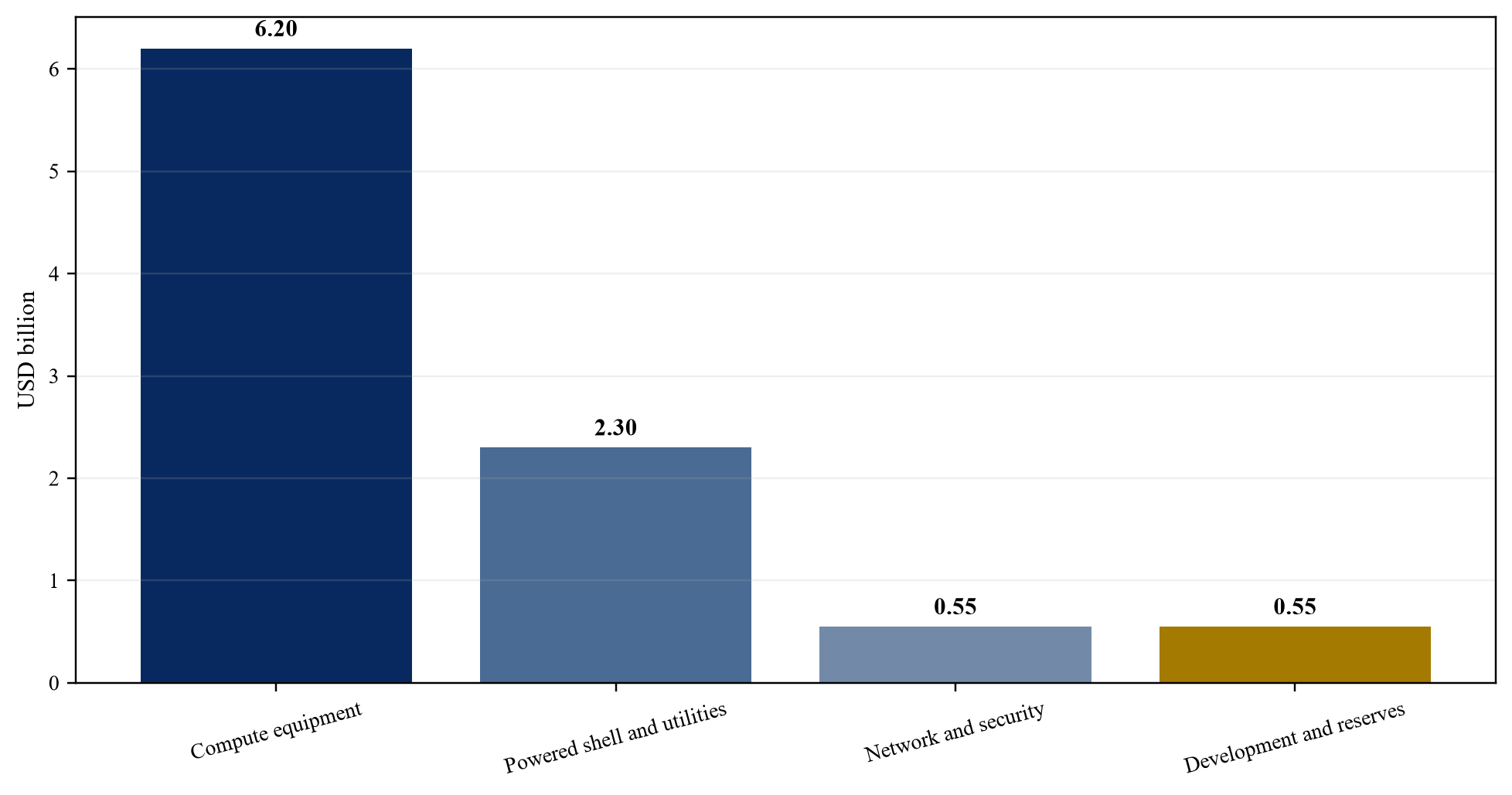
Wholly hypothetical; USD billion.
| Metric | Central assumption | Downside or gate |
|---|---|---|
| customer-usable capacity | 240 MW | 190 MW |
| capacity contracted at close | 150 MW | minimum 130 MW |
| total initial uses | USD 9.6bn | USD 10.6bn cap |
| senior secured debt | USD 2.4bn | cash-flow cap applies |
| equipment lease and vendor finance | USD 1.8bn | cohort eligibility |
| sponsor equity | USD 4.6bn | plus committed cures |
| customer prepayments | USD 0.8bn | net of refund exposure |
| central market-participant EV | USD 10.4bn | USD 7.8bn downside |
| specific-owner investment value | USD 12.1bn | separately evidenced |
Wholly hypothetical; figures do not describe an announced project.
25. Stress technology and demand pathways
The decision question is how model efficiency, accelerator generations, inference economics, customer concentration and demand timing alter value. The evidence file should begin with equipment roadmap, benchmark trends, contract terms, utilisation, customer pipeline, power cost and refresh plan. Every item should identify its source, date, legal owner, responsible reviewer, expiry or refresh date and the valuation ledger it affects. Public strategy and announced projects establish context. They do not establish the cash flow, transferability, financing capacity or value of the subject asset. [8][10]
The principal failure is that only a high-growth AI demand case is used while unit compute costs and workload architectures evolve. A sovereign AI campus contains infrastructure, equipment, contracts, operational capabilities and policy objectives with different useful lives and beneficiaries. Combining them prematurely can count the same benefit twice, capitalise outcomes that cannot be sold and expose senior debt to risks that sponsors or public authorities intended to retain.
The recommended response is to run coordinated downside, central and upside pathways with explicit refresh and reconfiguration actions. Scenario assumptions should be identified with their valuation date, probability, evidence and decision owner. The central case should use current rights, enforceable commitments and achievable operating performance. Downside analysis should combine power, technology, demand, policy, partnership, security, liquidity and recovery effects rather than treating each risk as independent.
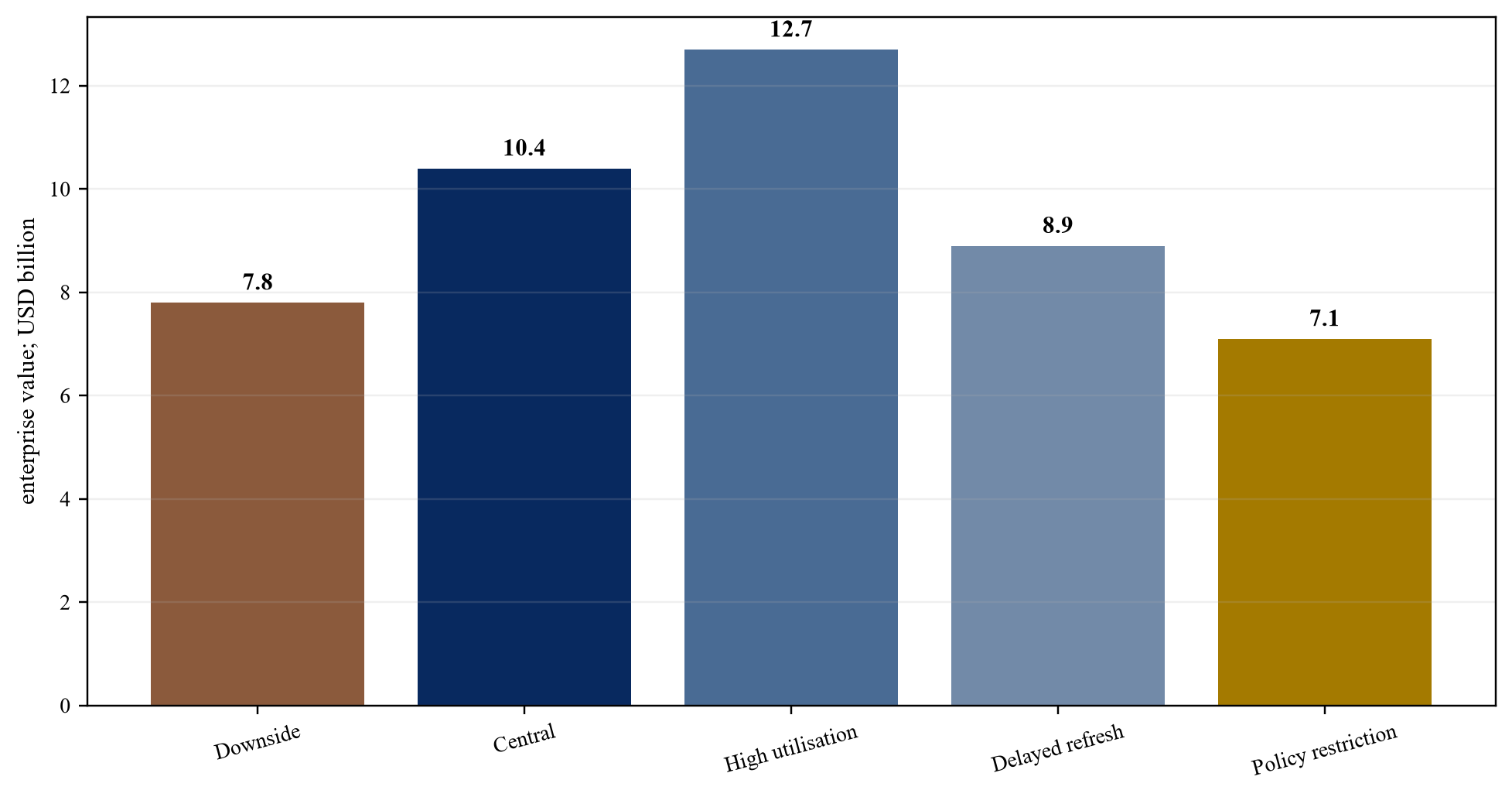
Wholly hypothetical; USD billion; strategic and public ledgers excluded.
26. Stress policy and partnership continuity
The decision question is how export authorisation, technology partnerships, security requirements and cross-border policy affect operations. The evidence file should begin with licences, assurance agreements, partner contracts, termination rights, compliance evidence and alternative suppliers. Every item should identify its source, date, legal owner, responsible reviewer, expiry or refresh date and the valuation ledger it affects. Public strategy and announced projects establish context. They do not establish the cash flow, transferability, financing capacity or value of the subject asset. [5][6][24]
The principal failure is that a strategic partnership is assumed to continue on unchanged terms through the valuation horizon. A sovereign AI campus contains infrastructure, equipment, contracts, operational capabilities and policy objectives with different useful lives and beneficiaries. Combining them prematurely can count the same benefit twice, capitalise outcomes that cannot be sold and expose senior debt to risks that sponsors or public authorities intended to retain.
The recommended response is to model expiry, renewal, restriction, termination and transition cost and preserve liquidity for the response. Scenario assumptions should be identified with their valuation date, probability, evidence and decision owner. The central case should use current rights, enforceable commitments and achievable operating performance. Downside analysis should combine power, technology, demand, policy, partnership, security, liquidity and recovery effects rather than treating each risk as independent.
27. Create milestone-based governance
The decision question is which board, lender and public-authority decisions release capital and recognise value as evidence matures. The evidence file should begin with stage-gate plan, approval matrix, independent reports, value ledger, risk register, benefit owners and audit trail. Every item should identify its source, date, legal owner, responsible reviewer, expiry or refresh date and the valuation ledger it affects. Public strategy and announced projects establish context. They do not establish the cash flow, transferability, financing capacity or value of the subject asset. [4][14]
The principal failure is that full strategic value is recognised at announcement and is not revisited after cost, schedule or policy changes. A sovereign AI campus contains infrastructure, equipment, contracts, operational capabilities and policy objectives with different useful lives and beneficiaries. Combining them prematurely can count the same benefit twice, capitalise outcomes that cannot be sold and expose senior debt to risks that sponsors or public authorities intended to retain.
The recommended response is to release capital and update ledgers only when defined power, equipment, contract, acceptance and capability milestones are passed. Scenario assumptions should be identified with their valuation date, probability, evidence and decision owner. The central case should use current rights, enforceable commitments and achievable operating performance. Downside analysis should combine power, technology, demand, policy, partnership, security, liquidity and recovery effects rather than treating each risk as independent.
28. Reach the valuation and capital decision
The decision question is whether contracted economics, owner benefits, public outcomes and options justify the proposed capital and risk. The evidence file should begin with four reconciled ledgers, sources and uses, downside model, financing capacity, milestones, controls and alternatives. Every item should identify its source, date, legal owner, responsible reviewer, expiry or refresh date and the valuation ledger it affects. Public strategy and announced projects establish context. They do not establish the cash flow, transferability, financing capacity or value of the subject asset. [16][26]
The principal failure is that strategic importance substitutes for a disciplined comparison of value, cost, risk and alternative uses of capital. A sovereign AI campus contains infrastructure, equipment, contracts, operational capabilities and policy objectives with different useful lives and beneficiaries. Combining them prematurely can count the same benefit twice, capitalise outcomes that cannot be sold and expose senior debt to risks that sponsors or public authorities intended to retain.
The recommended response is to approve the commercial exposure, owner-specific investment and public commitment through separate accountable decisions. Scenario assumptions should be identified with their valuation date, probability, evidence and decision owner. The central case should use current rights, enforceable commitments and achievable operating performance. Downside analysis should combine power, technology, demand, policy, partnership, security, liquidity and recovery effects rather than treating each risk as independent.
| Decision | Minimum evidence | Possible action |
|---|---|---|
| commercial investment | contracts, power, cost and operations | approve, resize or defer |
| senior debt | stressed cash, assets and security | lend, condition or decline |
| owner synergy | incremental cash and accountable plan | include or exclude |
| public support | measured outcome and fiscal counterfactual | fund, contract or reject |
| strategic option | right, trigger, cost and probability | preserve, exercise or lapse |
| impairment or exit | current cash, market evidence and recovery | retain, restructure or sell |
Proposed governance; each decision requires its own authority.
Sources
- UAE Government, *UAE National Strategy for Artificial Intelligence 2031*. Read the primary source
- OpenAI, *Introducing Stargate UAE*. Read the primary source
- G42, *Global Tech Alliance Launches Stargate UAE*. Read the primary source
- Microsoft, *Microsoft's USD 15.2 Billion Investment in the UAE*. Read the primary source
- Microsoft, *Microsoft Invests USD 1.5 Billion in G42*. Read the primary source
- G42, *U.S. Approval for Advanced AI Chip Exports*. Read the primary source
- MGX, *Investment Strategy*. Read the primary source
- MGX, *AIP, MGX and GIP to Acquire Aligned Data Centers*. Read the primary source
- International Energy Agency, *Energy and AI*. Read the primary source
- International Energy Agency, *Key Questions on Energy and AI*. Read the primary source
- International Energy Agency, *Energy and AI Data Product*. Read the primary source
- UAE Government, *UAE Energy Strategy 2050*. Read the primary source
- UAE Government, *UAE Water Security Strategy 2036*. Read the primary source
- National Institute of Standards and Technology, *AI Risk Management Framework*. Read the primary source
- National Institute of Standards and Technology, *Cybersecurity Framework 2.0*. Read the primary source
- IFRS Foundation, *IFRS 13 Fair Value Measurement*. Read the primary source
- IFRS Foundation, *IAS 36 Impairment of Assets*. Read the primary source
- IFRS Foundation, *IAS 16 Property, Plant and Equipment*. Read the primary source
- IFRS Foundation, *IFRS 16 Leases*. Read the primary source
- IFRS Foundation, *IFRS 9 Financial Instruments*. Read the primary source
- World Bank Group, *Building Data Infrastructure for AI Readiness*. Read the primary source
- World Bank Group, *Advancing Cloud and Data Infrastructure Markets*. Read the primary source
- OECD, *A Blueprint for Building National Compute Capacity for Artificial Intelligence*. Read the primary source
- U.S. Bureau of Industry and Security, *Export Administration Regulations Part 740*. Read the primary source
- International Organization for Standardization, *ISO/IEC 27001 Information Security Management Systems*. Read the primary source
- World Bank Group, *Infrastructure Foundations: From Current Assets to Future Growth*. Read the primary source
