

1. Treat talent landing as launch infrastructure
Market entry fails when the commercial promise arrives before the operating capability. A licence, office and bank account can create a corporate shell. Customers still need named executives who can make decisions, staff who may lawfully work, contracts that describe the real relationship, payroll that pays on time, systems that protect data and managers who can deliver. The talent plan therefore belongs on the launch critical path with incorporation, licensing, customer contracts and funding.
The board should ask a practical question: which people must be present, authorised and effective for the first customer obligation to be fulfilled? The answer usually includes more than a country manager. A regulated or technical business may need an accountable executive, finance controller, compliance owner, operations lead, customer-delivery leader, cybersecurity owner or locally qualified professional. Several roles can initially be held by one person where law, workload and control independence permit. Each accountability must still be explicit.
The first design step is a launch-capability map. Management lists each Day-One obligation, the role that owns it, the authority required, the physical or remote location, the intended immigration and employment route, the evidence of competence, the successor and the date by which the role must operate. Dependencies are then linked. The person who signs a customer contract may depend on a board delegation and bank mandate. The person who hires may depend on an establishment file and authorised signatory. The person who processes employee data may depend on access controls and a privacy notice.
UAE employment rules place real obligations around job offers, contracts and work permits. The official government portal explains that an expatriate's offer, employment contract and permit process are connected. The Ministry of Human Resources and Emiratisation states that an employer may not employ a worker without the required permit. The executive regulations define multiple permit types, including recruitment from outside the UAE, transfers, family-sponsored residents, temporary and mission permits, Golden Visa holders and freelance work. Route selection must follow the role and facts.
The launch plan should be governed as an investment programme. Every role has an owner, budget, route, evidence pack, decision gate and fallback. The board sees readiness as a set of controlled capabilities rather than a headcount number. A role is green only when the person can lawfully work, exercise authority, access required systems, receive compliant pay and deliver the relevant operating obligation.
Table 1. Day-One role criticality and evidence matrix
| Launch obligation | Accountable role | Evidence before launch | Dependency | Fallback if delayed |
|---|---|---|---|---|
| bind the company | country leader or authorised executive | board delegation, licence scope, signature matrix and identity record | incorporation and bank mandate | limited interim delegation with value cap |
| protect cash | finance controller | banking access, payment authority, payroll calendar and reporting controls | bank onboarding and accounting system | parent-controlled treasury with documented local process |
| deliver customer work | operations or engagement leader | work authorisation, competency evidence, staffing plan and acceptance process | role route and customer security clearance | approved cross-border support within legal and contract limits |
| manage people | people leader or designated executive | hiring authority, approved offer templates, onboarding and grievance process | establishment and labour-system access | external administrator under management supervision |
| manage compliance | compliance or risk owner | obligations register, reporting line, escalation and access to records | regulator and governance design | qualified interim appointment if permitted |
| secure information | technology or security owner | access model, device controls, incident process and vendor register | systems and data map | restricted launch environment with monitored access |
| build local capability | business and people leaders | Emiratisation plan, role families, recruitment channels and development measures | workforce plan and job architecture | staged hiring with approved milestones |
Roles and evidence are illustrative. Regulated activities and specific licences can require additional accountable persons or qualifications.
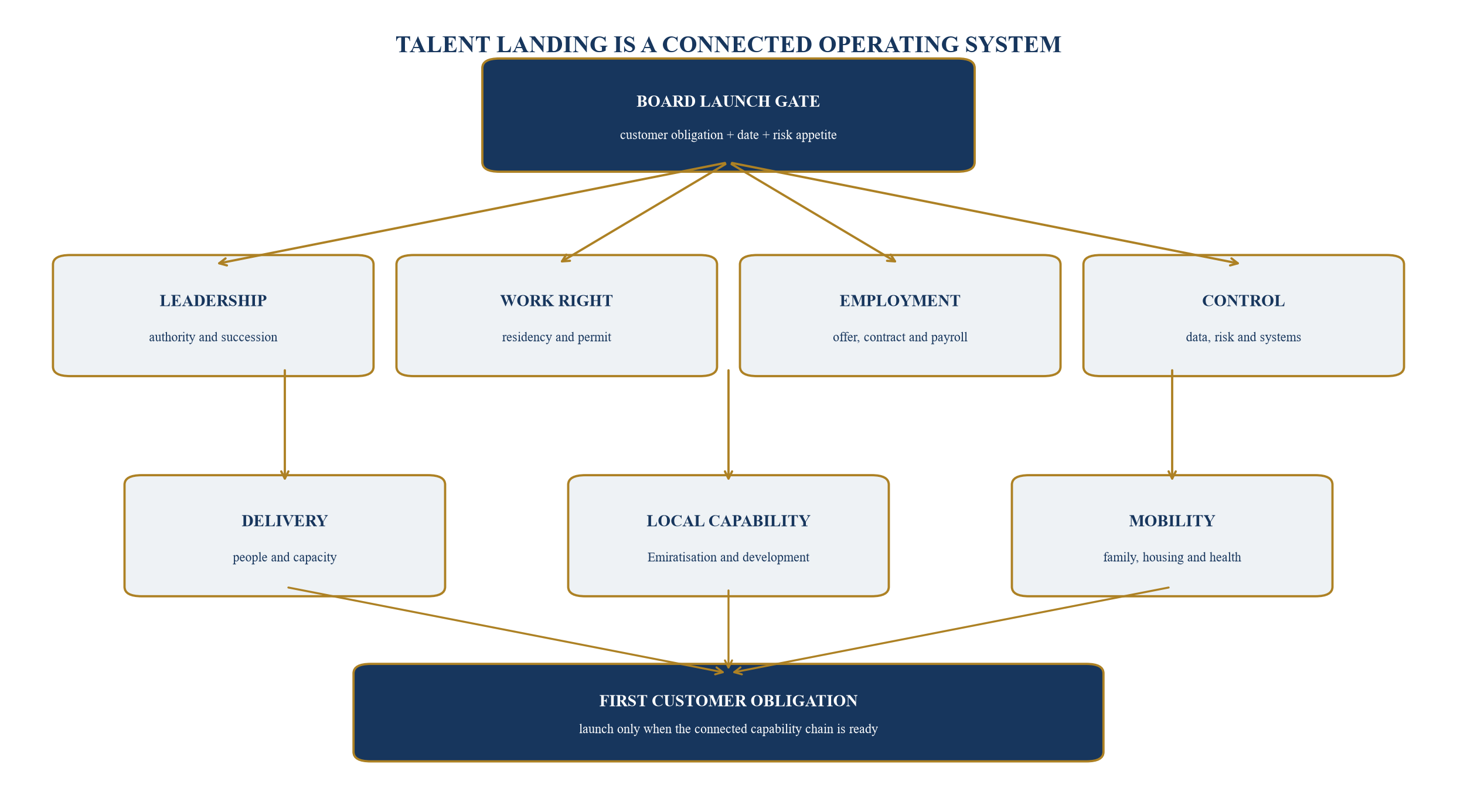
The map identifies minimum connected capabilities. It does not prescribe a particular organisation structure.
2. Define leadership before selecting names
The board should define roles through decisions and outcomes before it selects people. A country leader title can conceal very different mandates. One mandate is a sales outpost with limited authority. Another is a full operating company with pricing, hiring, delivery, risk and investment decisions. A third is a regional headquarters that coordinates several countries. Each requires a different capability profile, delegation and cost base.
The role charter should state the decisions the person owns, decisions shared with headquarters, reserved board matters, performance measures, compliance duties, resources and escalation path. It should identify whether the person represents the company to customers, authorities, banks, employees and counterparties. The charter must align with corporate documents, bank mandates, powers of attorney, system permissions and employment terms. Authority described in a presentation has little value when legal and operational instruments say something else.
Leadership sequencing matters. The first senior hire influences location, team design, suppliers, culture and customer promises. Hiring a commercial leader without finance, delivery or risk support can create commitments that the platform cannot fulfil. Installing a control-heavy organisation before demand is tested can consume runway. A balanced landing team pairs revenue accountability with the smallest capable set of delivery and control owners.
Role criticality should be scored on five dimensions: revenue dependency, regulatory dependency, operational dependency, control independence and replacement lead time. A high-scoring role is recruited or relocated early and receives a documented contingency. A lower-scoring role can be phased, outsourced or supported from abroad where law, customer contracts, data rules and tax advice permit. The score is a management tool and cannot replace a regulator's fit-and-proper or qualification test.
Succession begins before launch. The board should know who performs each critical accountability if the selected leader's move is delayed, the permit route changes, the family cannot relocate or the candidate leaves. Interim arrangements need a defined duration, authority cap, data-access model and handover plan. A named deputy and documented decision log reduce dependence on one individual's presence.
Leadership incentives should reinforce the entry thesis. Measures can include qualified pipeline, gross margin, customer retention, operating cash, compliance, local hiring, capability transfer and employee stability. Equity or long-term incentives require tax, securities, valuation, plan-document and cross-border advice. An incentive that rewards bookings without cash, delivery or risk quality can weaken enterprise value.
Leadership design should establish the relationship with global and regional headquarters. The local executive needs access to product, capital and specialists while retaining enough authority to respond to customers and authorities. A responsibility matrix can distinguish who recommends, decides, executes and verifies each material action. Unresolved overlaps should be settled before hiring because senior people can interpret an ambiguous mandate differently.
The board should test capacity as well as competence. A launch leader can become the default owner of sales, hiring, premises, banking, government relations, customer escalation and reporting. This creates delay and key-person risk. A weekly workload view should show recurring responsibilities, projects and decision bottlenecks. Administrative support and qualified external help can protect the leader's time when their limits and supervision are explicit.
3. Build the role-to-route architecture
The UAE offers several residence and work-authorisation pathways. The appropriate route depends on nationality, employment relationship, qualifications, compensation, location, licence, duration and the person's existing residence status. The route should be selected after the role and employer are known. A prestigious residence category cannot cure an employment arrangement that lacks the required work permit or contractual controls.
The Federal Authority for Identity, Citizenship, Customs and Port Security describes Green Residency as a renewable five-year, self-sponsored route. Its published skilled-worker criteria include a valid UAE employment contract, an occupational level within the first three categories, at least a bachelor's degree and monthly salary of at least AED 15,000. Freelancers and self-employed applicants have distinct permit, qualification and income requirements. Evidence must be checked against the current service and the applicant's facts.
The official UAE portal describes Golden Visa routes that provide long-term residence without a sponsor for qualifying categories. Golden residence can support stability and family sponsorship. The labour executive regulations separately recognise a work permit for a Golden Visa holder employed by an establishment. This distinction is important: residence status and permission to work are connected layers, yet they are not identical.
A standard employer-sponsored residence route remains common. The official portal states that a standard work visa is normally valid for two years and that the employer applies for it. The process includes job-offer, work-permit, entry or status steps, medical fitness, Emirates ID and residence requirements as applicable. The employer, activity, emirate and employee facts determine the operative sequence.
Other cases include family-sponsored residents, transfers between establishments, temporary or mission work, part-time arrangements, freelance activity and virtual work. The UAE virtual-work residence is a one-year self-sponsored route for a person employed outside the UAE who meets the published requirements, including income evidence. A company should not use a remote-work residence as a substitute for analysing whether the person is employed by, working for or creating obligations for the UAE business.
Route feasibility should be tested before a final offer becomes unconditional. The pre-validation pack can include passport and residence history, intended employer, role description, occupational classification, qualifications, salary, work location, family needs and required attestations. Sensitive data is collected with an approved purpose and access model. The assessment should record open questions and the authority or adviser responsible for resolving them.
Expiry and change controls begin at onboarding. HR should track passport, residence, permit, identity, insurance and professional-registration dates with sufficient lead time. Changes in employer, role, salary, workplace or working pattern can require review. A recurring control meeting can reconcile the immigration register with payroll, HR, premises and organisation records so that actual work remains aligned with the approved route.
Table 2. Residency and work-authorisation route screen
| Route | Published design feature | Suitable planning question | Key evidence | Control risk |
|---|---|---|---|---|
| employer-sponsored standard route | employer-led work and residence process, commonly two-year residence | is the role tied to the UAE employing entity and operating plan? | approved offer, permit, passport, qualifications, medical and identity records | start date assumed before all approvals |
| Green Residency for skilled worker | five-year self-sponsored residence with published occupation, degree and salary conditions | does the employee meet every current criterion and still require an establishment work permit? | contract, occupational classification, degree and salary evidence | residence and employment permissions are conflated |
| Golden Visa holder employment | long-term qualifying residence plus a recognised employment permit route | does the person already hold valid status and what permit must the employer obtain? | residence record, job terms and employer permit | long residence is treated as unrestricted work authority |
| family-sponsored resident | residence sponsored through a qualifying family member | can the employer use the applicable family-sponsored work permit? | family residence and labour permit documents | payroll begins without employer authorisation |
| temporary or mission permit | time-bounded work for defined circumstances | is the work genuinely limited and within the permit scope? | assignment, duration, role and permit | repeated temporary use creates an unmanaged permanent role |
| virtual work residence | one-year self-sponsored residence for qualifying foreign employment | does the arrangement remain foreign employment and who controls the work? | foreign contract, income and insurance evidence | shadow employment, tax, data or permanent-establishment exposure |
Published criteria can change. The competent authorities and qualified advisers should confirm eligibility, documents, work permits and processing steps.
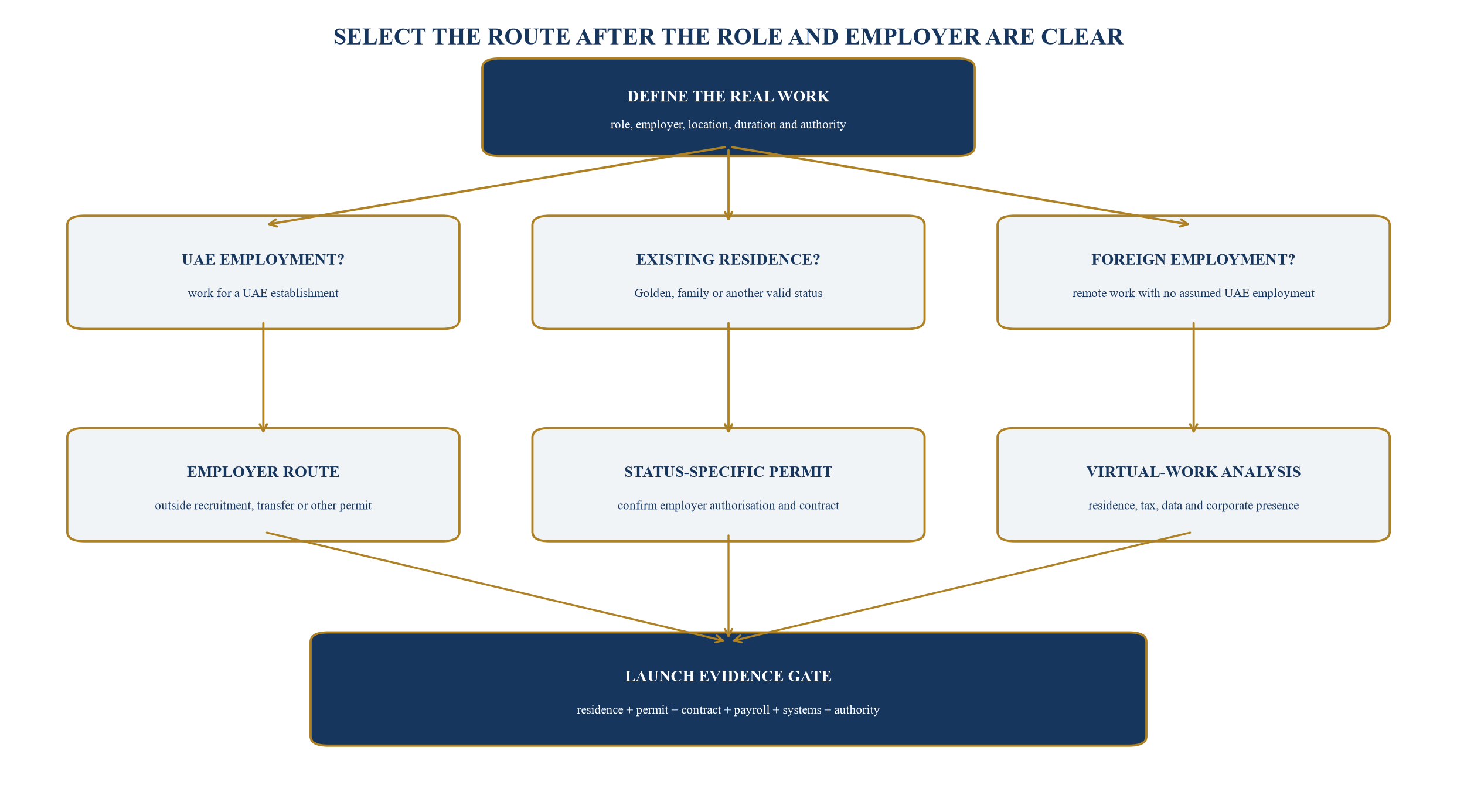
This management screen organises evidence. Authority confirmation remains required for every person.
4. Control the documentation chain
Talent landing depends on a chain of documents that must agree. The commercial plan names the role. The workforce plan assigns the employing entity and location. The approved job offer states the economic terms. The employment contract records the relationship. The permit and residence processes use identity, qualification and employer information. Payroll, insurance, systems and authority records then operationalise the same facts. Inconsistency creates delay and control risk.
The official UAE portal states that expatriate private-sector employees receive an official job offer and that the contract terms should be consistent with the signed offer. Federal Decree-Law No. 33 of 2021 and Cabinet Resolution No. 1 of 2022 establish the employment framework. The executive regulations list contract information such as the identities of the parties, qualification, occupation, start date, workplace, hours, probation, term, wage, allowances, leave, notice and termination provisions.
Qualification evidence can be a critical dependency. The official preparing-to-work guidance calls for relevant degree certificates to be authenticated where required. Regulated professions can require additional examinations or authority approvals. Passports must satisfy validity requirements. Medical fitness and Emirates ID steps apply to residence processing as specified. Management should gather and validate documents before committing a public start date.
The control file should record the source, owner, version, translation, attestation status, expiry and authority submission for every item. Personally identifiable information and health records require restricted access, retention rules and secure transfer. A spreadsheet distributed widely by email is a weak control for passports, family documents and medical information. The UAE Personal Data Protection Law provides the federal data-protection framework, subject to its scope and exclusions.
The company should use a four-eyes review before submission and before payroll activation. The reviewer compares name spellings, passport data, job title, occupation code, salary, employer, location and dates across the offer, contract, application and HR system. The approved start condition should be explicit. An employee can attend orientation or travel for meetings only within the permitted legal arrangement; management should obtain specific advice rather than improvising work before authorisation.
Document requests should explain why an item is needed, which authority or provider receives it, the required format, translation or attestation, and the secure upload route. The employee should see one current checklist rather than repeated requests from several providers. Status language should distinguish collected, validated, submitted, accepted and operative because each stage represents a different level of readiness.
Exceptions need controlled resolution. A qualification mismatch, name variation, expired document or classification question should be logged with evidence, owner and decision date. Management should avoid changing a title merely to fit a route when the employee will perform different work. Employment and authority records should represent the real facts.
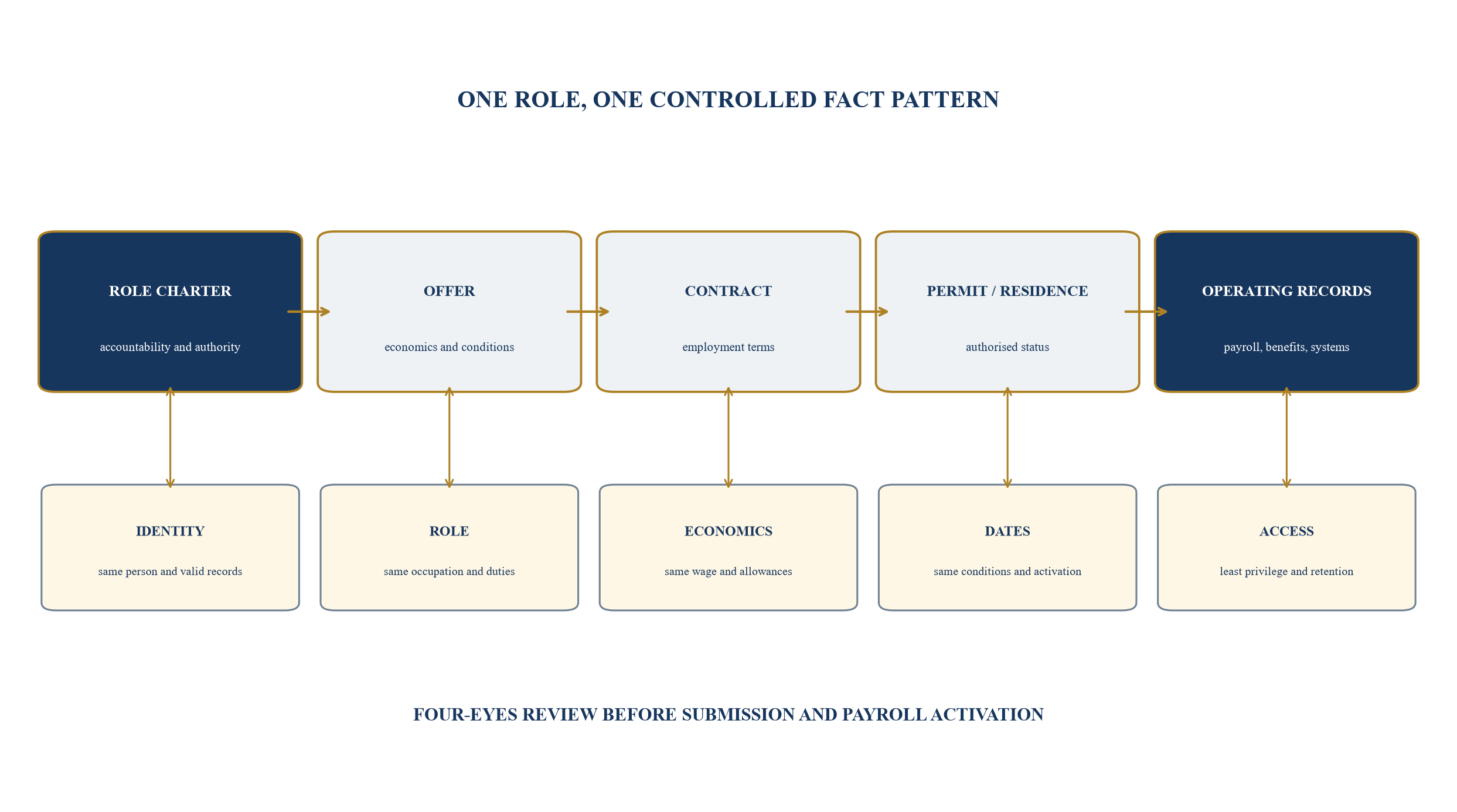
Each record should reconcile to the real role and the competent authority's current requirements.
5. Design employment terms around the operating model
Employment terms should express the real operating relationship. The contract identifies the employer, role, workplace, wage and core conditions. The organisation also needs policies and governance covering authority, confidentiality, intellectual property, data, conflicts, expenses, remote work, travel, gifts, records, performance, discipline, grievances and termination. The documents should be adapted to the applicable UAE regime and the employer's location.
Federal labour law applies across the UAE private sector subject to stated exclusions and the distinct employment regimes in financial free zones. Employers in ADGM or DIFC should use the relevant local employment law and regulations. Sector regulators can impose additional requirements for approved persons, competence, fitness and propriety, notification, handover or record keeping. The plan should identify the controlling regime for each employing entity.
Probation, notice, leave, working time, non-compete provisions and termination require current legal review. A multinational template can conflict with mandatory local rules or omit required terms. The policy set should also reflect how the company actually works. A regional executive who travels, accesses group data and approves cross-border transactions needs a different control schedule from a locally based field employee.
Authority and employment are related. A senior title does not automatically allow the person to bind the company. Board delegations, powers of attorney, authorised signatory records, procurement limits, pricing matrices, bank mandates and system roles should define the operative authority. The employment contract can refer to the applicable governance without attempting to replace it.
Intellectual-property and confidentiality design should follow the value chain. The company should identify what the employee will create, which entity directs the work, which systems and information are used, how ownership is assigned and how group companies receive rights. Cross-border access, model training, source code, customer data and trade secrets deserve specific treatment. Offboarding should revoke access, recover devices, preserve records and transfer authority before the last working day.
Employee handbooks should match the contract hierarchy. They can explain practices and benefits while reserving appropriate flexibility. Mandatory terms, individual promises and discretionary policies should remain distinguishable. Managers need training on which commitments they may make. A message promising a guaranteed bonus, permanent remote arrangement or early release can create expectations when the approved terms say something else.
The company should rehearse difficult events before launch. Scenarios include a grievance against the country leader, suspected data loss, prolonged sickness, underperformance during probation, a conflict, a payroll error and abrupt resignation of an authorised signatory. The rehearsal identifies who receives the report, protects confidentiality, preserves evidence, makes decisions and informs authorities or counterparties where required.
Table 3. Employment and operating-control schedule
| Control area | Employment document | Corporate or operating record | Launch test |
|---|---|---|---|
| employer and workplace | offer and employment contract | entity, licence and workplace map | person works for the named entity in the permitted arrangement |
| pay and benefits | wage, allowances, bonus and benefit terms | payroll setup, WPS route and benefit enrolment | first payroll dry run reconciles to contract |
| authority | role description and duties | delegation, signature matrix and bank mandate | employee can approve only within recorded limits |
| intellectual property | creation, assignment and confidentiality clauses | group IP and development agreements | ownership follows actual direction and contribution |
| data and systems | privacy, monitoring and security acknowledgements | access matrix, device standard and retention schedule | least-privilege access is approved and logged |
| conflicts and conduct | conflicts, gifts and outside-interest rules | declaration register and escalation path | disclosed interests are reviewed before access or decisions |
| mobility | place of work, travel and remote-work terms | tax, immigration, insurance and security review | cross-border work is approved before it starts |
| exit | notice, return and continuing obligations | offboarding, succession and authority revocation | access and signing power end at the correct time |
The schedule supports implementation and cannot replace jurisdiction-specific drafting.
6. Build total reward from the value proposition
The compensation question is broader than salary. A candidate evaluates cash, variable pay, housing, schooling, health coverage, relocation, travel, leave, long-term incentives, career scope, family stability, tax position and the credibility of the role. The employer evaluates productive capacity, payroll cost, benefits, visa and relocation cost, recruitment fees, workspace, equipment, travel, management time, statutory obligations and exit cost. A decision-grade package connects both views.
The board should begin with the role's economic value and the market-entry thesis. A leader responsible for building a regulated platform, raising capital or integrating an acquisition carries different risk and workload from a representative-office role. Compensation should reflect the scope that has actually been delegated. Large guarantees can transfer launch risk to the employer. A heavily variable package can encourage short-term bookings or underinvestment in controls. The mix should align with measurable value creation.
Base salary and allowances must be represented consistently in the offer, contract and payroll. The company should define what is fixed, discretionary, reimbursed or provided in kind. Bonus plans need measures, thresholds, quality gates, approval, deferral, malus or clawback terms where applicable, and treatment on leave or termination. Revenue measures should reconcile to cash, margin, delivery and risk. Management assumptions used for recruitment should not become undisclosed guarantees.
Long-term incentives require careful design. Options, restricted units, phantom equity, carried interest or value-sharing can create different accounting, tax, valuation, securities and liquidity consequences across jurisdictions. The plan should state the granting entity, instrument, vesting, performance, leaver treatment, change of control, settlement, currency and source of funds. Employees should receive clear documents and appropriate advice; recruitment language should not imply a value that cannot be supported.
Mobility support can be structured as reimbursements, fixed allowances, direct vendor arrangements or a combination. The company should define eligible family members, shipment, temporary housing, flights, schooling, immigration fees, tax support, home leave and repatriation. Each element needs a cap, approval, evidence and policy on repayment if the employee leaves early. Fairness and consistency matter because individually negotiated packages can become a hidden internal market.
Package governance should include an approval ladder and a total-value summary. Recruiters and hiring managers often negotiate different components at different times. Finance should see the combined first-year cash, recurring annual cost, accounting treatment and downside exposure before final approval. Each exception should state its business rationale, duration and comparator group. This supports consistent renewals and reduces hidden obligations.
Currency deserves explicit treatment. A UAE salary is commonly denominated locally while an executive may compare obligations in another currency. The company should state the payment currency and avoid an informal exchange-rate promise. If protection is commercially approved, the formula, reference date, range, duration and approval should be documented and tested under sensitivities.
Table 4. Fully loaded talent-landing cost bridge
| Cost layer | Typical components | Evidence source | Timing question | Sensitivity |
|---|---|---|---|---|
| fixed reward | salary and contractual allowances | approved role band and signed terms | when does payroll start? | exchange rate and annual review |
| variable reward | annual bonus, commission and milestone awards | plan rules and approved targets | when is value earned and paid? | revenue quality, margin and discretion |
| benefits | health, life, wellbeing and retirement arrangements | insurer and plan quotations | when must coverage be active? | family size, age and claims experience |
| mobility | permits, relocation, temporary housing, travel and schooling | vendor quotes and policy caps | which cash is paid before productive work? | family needs and delayed move |
| employer obligations | payroll administration, WPS, pensions or savings and insurance | authority rules and adviser calculation | what is monthly, annual or exit-funded? | salary base and employee category |
| workplace and tools | premises, equipment, software, security and travel | operating budget and supplier contracts | when can the person work securely? | role location and technology stack |
| recruitment and onboarding | search, assessment, background checks and management time | contracts and internal effort estimate | which fees are contingent? | replacement clauses and time to fill |
| exit exposure | notice, accrued entitlements, repatriation and handover | contract and legal calculation | what cash can arise in downside cases? | tenure, performance and dispute risk |
Values are management inputs. The board should model cash timing, accounting, tax and downside scenarios with qualified advice.
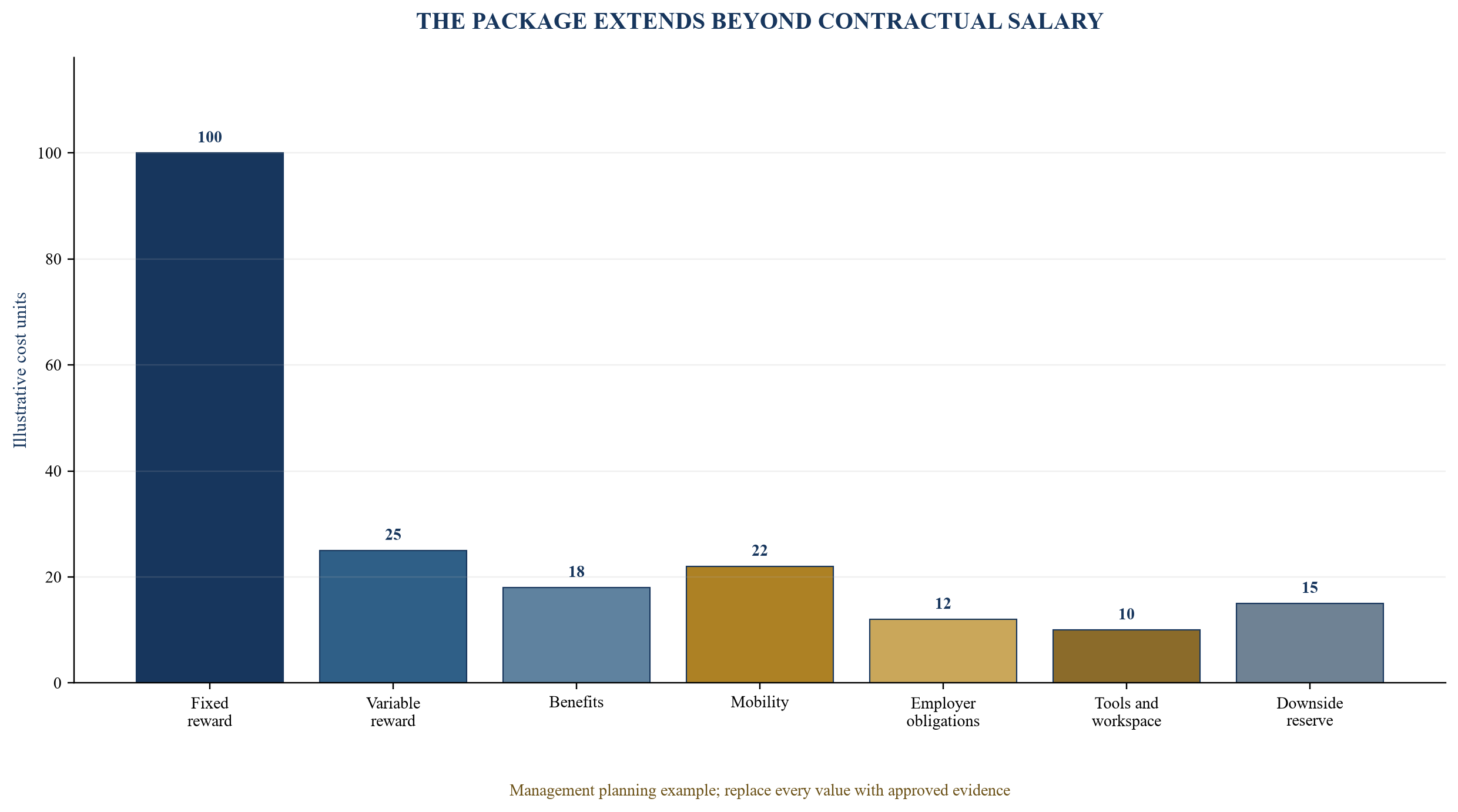
The bridge separates recurring reward from landing, operating and downside cash. Values shown are illustrative management assumptions.
7. Make payroll and protection launch-ready
Payroll is a control system. The signed employment terms must flow into the HR record, payroll calculation, payment file, accounting ledger and employee statement. The Ministry of Human Resources and Emiratisation describes the Wages Protection System as the mechanism through which establishments pay wages through approved channels. The company should determine the applicable payroll route for each employing entity and test it before the first due date.
A payroll readiness file should cover employee master data, bank details, fixed and variable components, unpaid leave, expense treatment, cut-off, approvals, payment release, accounting entries, reconciliation and exception handling. Duties should be separated among data input, approval, bank release and reconciliation. A small launch team may use external administration, yet management remains accountable for accurate and timely payment.
Health insurance must be planned by emirate and applicable regime. Dubai and Abu Dhabi operate mandatory health-insurance frameworks with employer responsibilities. Coverage should be active at the required point and aligned with residence processing. The company should compare network, geography, exclusions, maternity, chronic conditions, dependants, emergency care, claims service and continuity. A low premium can produce a weak mobility experience when key hospitals or family needs are excluded.
The UAE unemployment insurance scheme has published coverage and subscription rules. Employees need clear onboarding information about their obligations and the consequences of non-subscription where applicable. HR should communicate the official route and retain appropriate evidence without giving personal legal advice.
End-of-service funding should be forecast rather than treated as a remote exit item. The traditional statutory calculation and the voluntary alternative end-of-service benefits Savings Scheme have different operating implications. MoHRE describes the alternative system as an investment-based arrangement to which participating employers contribute monthly. The employer should obtain advice on eligibility, employee categories, registration, fund selection, contribution, accounting, communication and exit processing.
Protection also includes death, disability, travel, professional liability and directors' cover where relevant. Policies should align with the employee's actual work, travel and authority. The board should see uninsured or self-insured exposures and confirm who funds them. Vendor promises, policy terms and operational enrolment must agree.
Payroll changes require the same discipline as the first setup. A promotion, allowance, commission, unpaid leave, deduction, recovery or final settlement should originate from an authorised record and flow through review, payment and accounting. Reconciliations should compare the contract population, active permits, benefit enrolment and bank file to identify a person missing from one system.
Final-settlement readiness is part of launch design. HR and finance should know which inputs, approvals, assets, access and calculations are needed when employment ends. The process should coordinate notice, work status, insurance, immigration, expenses, leave, end-of-service amounts and repatriation. Specific legal advice is needed for the actual facts.
8. Integrate Emiratisation into capability design
Emiratisation should be built into the operating model rather than added as a year-end numerical exercise. MoHRE publishes targets for covered private-sector establishments, including annual growth requirements for Emiratis in skilled jobs at larger companies and applicable requirements for certain smaller establishments in selected activities. The current coverage, establishment classification, calculation and financial consequences require verification against official guidance.
The board should connect the target to real roles and career architecture. Sustainable local capability comes from defined job families, meaningful work, capable managers, development, fair reward, performance feedback and visible progression. Hiring into nominal roles without productive accountabilities can fail employees, customers and the organisation. MoHRE's published guidance and enforcement communications emphasise compliance with the applicable targets and rules.
Workforce planning should identify roles that can be filled locally at launch, roles that need structured development and roles where international expertise will transfer capability. Each expatriate critical role can carry a localisation or succession responsibility. The plan should specify the skills to transfer, named counterpart or team, milestones, evidence and time horizon. Knowledge transfer is stronger when it is embedded in live work, customer delivery and decision rights.
Recruitment evidence should be retained. The company can track sourcing channels, qualified applicants, assessment standards, offers, acceptances, retention, development and promotions. This helps management distinguish a brand, pay, manager, role-design or supply problem. Data should be used fairly and in line with privacy and employment requirements.
Incentives can support the flywheel. Senior leaders can have measures for local recruitment, retention, capability building, successor readiness and employee experience alongside commercial performance. Targets need controllable definitions and quality gates. The board should avoid rewarding a raw hiring count while turnover, underemployment or weak development erodes value.
Managers convert hiring into capability. The organisation should select managers who can define work, coach, give evidence-based feedback and delegate responsibility. Development plans should connect courses to projects, customer exposure and decisions. Attendance does not demonstrate capability; observed performance and increasing accountability provide stronger evidence.
Retention analysis should be segmented by role, manager, tenure and reason. Exit interviews, engagement data and performance records can reveal whether pay, workload, progression or culture drives loss. The company should protect confidentiality and avoid identifying individuals through small-group data. Actions should be owned, funded and reviewed for effect.
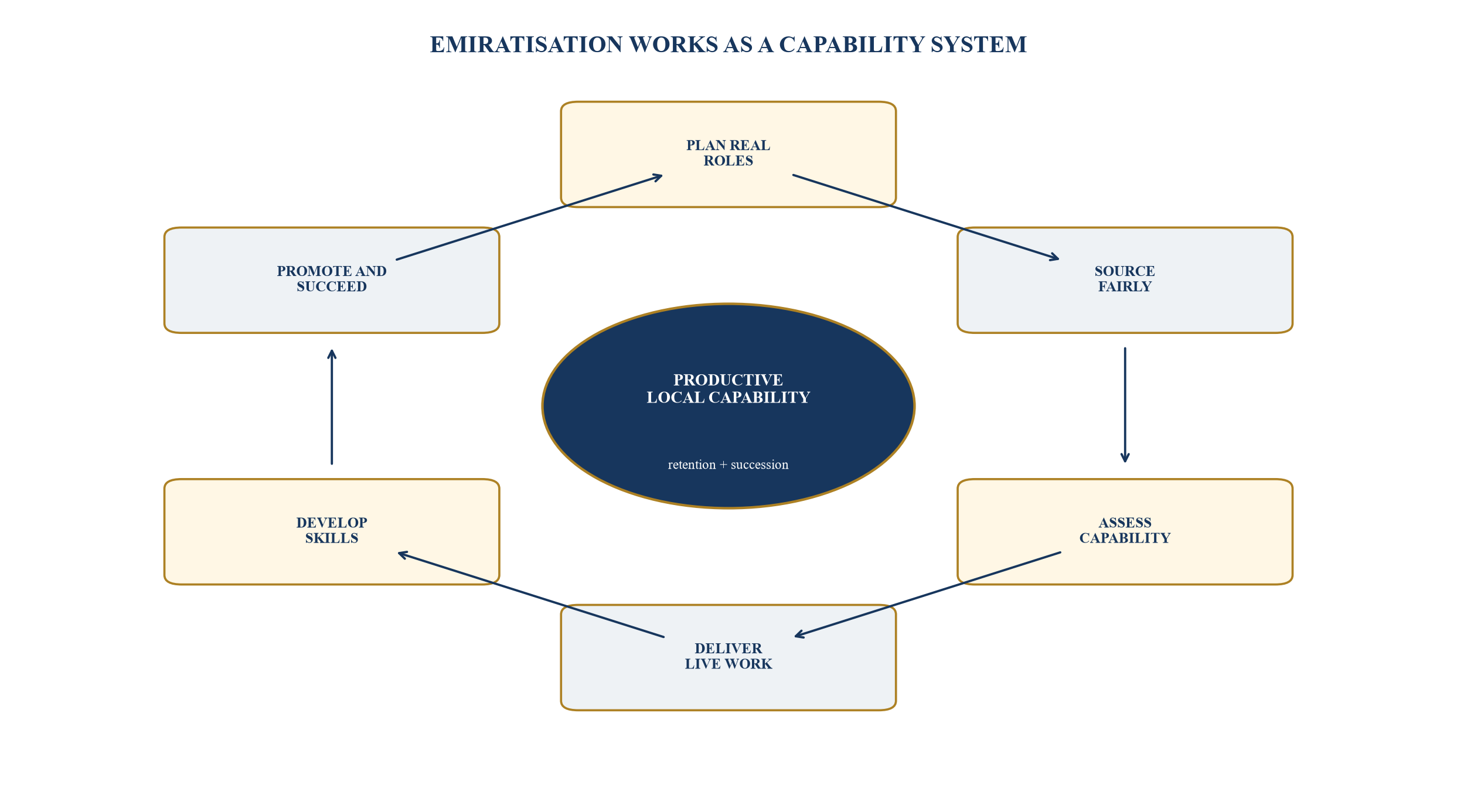
The flywheel connects compliant workforce planning with productive roles, development and succession.
9. Register pension obligations correctly
Nationality and employing location affect pension administration. The General Pension and Social Security Authority states that employers should register when they employ at least one eligible Emirati or GCC national within its remit. Its service information describes employer and employee registration evidence and deadlines. Abu Dhabi has a separate pension authority for relevant cases. The plan should identify the competent scheme before payroll activation.
Eligible Emirati employees require timely registration and contribution treatment under the applicable law. The employer should validate nationality, age, employment, salary components, prior registration and contribution basis. An employee's previous service or pension status may affect the process. HR, payroll and finance should reconcile the registered salary and contributions to the contract and ledger.
GCC nationals can fall under the Protection Extension System, through which the rules of the employee's home-country pension system extend to employment in another GCC state, subject to the applicable framework. GPSSA has published reminders about mandatory registration, contribution due dates and late-payment penalties. A company should obtain current instructions for the employee's nationality and keep evidence of registration and payment.
Pension readiness should be a pre-payroll gate. The file should state the authority, scheme, registration date, contribution basis, employer share, employee share, payment calendar, payroll code, accounting treatment and owner. Exceptions should be escalated before wages are finalised. A delayed registration can create arrears, corrections and employee concern.
The board does not need individual pension details. It does need assurance that all employee categories have been mapped, obligations are funded, registration is timely and payroll reconciles. The launch dashboard can show eligible population, registration completion, contribution exceptions and unresolved authority questions.
Acquisitions and transfers need special attention because historic registration and contribution records can move into the transaction perimeter. Diligence should reconcile employee lists, nationality, pension authority, registered salary, payments, arrears, disputes and warranties. The integration plan should identify who corrects legacy exceptions and how continuity is communicated.
10. Solve the family landing problem
Senior talent decisions are household decisions. A candidate can accept the professional case and decline the move because schooling, healthcare, housing, partner employment, elder care, travel or uncertainty remains unresolved. The landing plan should therefore include a family workstream with consent, privacy and clear policy limits.
The official UAE portal publishes residence sponsorship criteria for family members, including income thresholds for standard sponsorship routes and medical-fitness requirements for adult dependants. Eligibility and documents depend on the sponsor, relationship and current rules. Golden and Green residence routes can provide their own family-sponsorship features. The company should guide employees to official information and qualified support without promising an outcome.
Housing affects commute, school access, budget, tenancy timing and employee stability. Temporary accommodation can bridge the period before residence, bank account, local records and a suitable lease are complete. Policy should define duration, cap, location flexibility, deposits, utilities, early termination and responsibility for personal choices. Cash-flow timing matters because deposits, agent fees and school payments can precede payroll.
Schooling support should state eligible children, covered cost categories, caps, payment method and treatment of waiting lists or mid-year admission. Healthcare design should test family network access and continuity of treatment. Partner support can include practical orientation and lawful information about separate employment opportunities; it should respect privacy and avoid creating an employment promise.
The employee should receive a single landing calendar covering immigration, medical, identity, housing, banking, insurance, schooling, payroll and orientation. Each step has a responsible party and document list. Personal information is collected only as needed, stored securely and retained under an approved schedule. A humane process also improves control because employees are less likely to seek unofficial shortcuts when the legitimate route is clear.
Arrival support should have a defined end state. The employee and family should know when company-provided accommodation, transport or concierge support ends and which recurring responsibilities become personal. A closing review can confirm residence records, insurance, payroll, emergency contacts and important documents. Open matters remain in the ledger with an owner.
11. Separate tax residence from employment marketing
The UAE does not impose federal personal income tax on wages. The Federal Tax Authority's guide on natural persons explains that wages are outside the scope of natural-person corporate tax. This fact should be communicated with precision. An individual's tax outcome can still depend on residence, source, citizenship, foreign assets, departure rules, social security, double-tax treaties and obligations in other jurisdictions.
The FTA's Tax Residency Certificate service describes evidence for UAE tax residence. Its published natural-person tests include day-count routes and factual connections such as employment, residence and the centre of personal and financial interests. A certificate application requires documentary evidence and is not created by an employment contract alone. The employee should maintain travel, residence, home and economic records appropriate to the relevant test.
Home-country exposure requires individual advice. A UK executive, for example, may need to analyse the statutory residence test, split-year treatment, workdays, ties, remittances, property, pensions and the UK-UAE double taxation convention. Other countries use different tests, including citizenship-based rules in some cases. The employer should avoid providing a headline net-pay comparison as a personal tax conclusion.
Employer issues are separate. Relocation packages, equity, bonuses, pension contributions, benefits, business travel and cross-border work can create payroll reporting, withholding, corporate-tax, permanent-establishment or transfer-pricing questions. The company should map who employs, directs, benefits from and bears the cost of each role. Intercompany charges and secondment agreements should reflect the actual arrangement.
Tax support can be offered through a defined policy: initial briefing, individual consultation, filing assistance for a limited period, equalisation or protection where approved, and treatment of company-paid advice. The policy should state who owns personal decisions and what information the employer receives. Privacy is essential; the company generally needs compliance confirmation and cost inputs rather than an employee's full financial affairs.
Travel tracking should use an agreed source and respect privacy. The organisation may need workday and location information for payroll, tax, immigration, security or customer obligations. The policy should explain the purpose, fields, access and retention. Employees should correct inaccuracies promptly. Regular attestation creates stronger evidence than rebuilding a calendar after the year ends.
12. Govern remote and cross-border work
Remote work expands talent access and also changes the control perimeter. The company should know where each person works, which entity employs them, what systems they access, whose customers they serve and what authority they exercise. An informal pattern of working from another country can affect immigration, labour, payroll, tax, social security, data, insurance, export controls and corporate presence.
The UAE's National Secure Remote Work Policy provides federal guidance around governance, risk assessment, zero-trust principles, device security, access, data residency and incident management. A company policy should translate these concepts into approved locations, devices, identity controls, privileged access, monitoring, storage, printing, meetings, travel and reporting. High-risk roles may require UAE-based access or a controlled office environment.
Cross-border approval should occur before travel or a change of location. The request records country, dates, reason, employer, role, customer, data, systems and authority. Immigration, tax, legal, security, insurance and manager reviews are triggered according to thresholds. The response can approve, approve with restrictions or decline. The company should keep a calendar and reassess repeated patterns.
Remote onboarding needs identity verification, secure device delivery, contract completion, work-authorisation confirmation, training and controlled access. A person should not receive customer data or signing authority merely because a start date appears in the HR system. Access should follow the same readiness evidence as physical onboarding.
The virtual-work residence route can support qualifying foreign employees who live in the UAE while working for an organisation outside the country. The published residence criteria do not determine the foreign employer's corporate, tax, data or labour position. Companies should analyse the complete arrangement and maintain a clear boundary around authority, customers, costs and place of management.
Emergency work abroad needs a fast review route. Illness, family events, travel disruption or security incidents can change an employee's location unexpectedly. The employee should notify a single channel, and the company should assess duration, access, insurance, work permission and sensitive duties. Temporary controls can include restricted systems, delegated authority or leave until the arrangement is confirmed.
13. Protect data, intellectual property and regulated access
The talent landing process collects passports, photographs, signatures, addresses, qualifications, salary, family details, medical information and government identifiers. This is a concentrated privacy and security risk. The company should establish a data map before recruitment begins, identifying purpose, legal basis, recipient, transfer, system, retention, access and disposal for each category.
Federal Decree-Law No. 45 of 2021 provides the UAE federal personal-data protection framework, subject to its scope and exclusions. Financial free zones maintain distinct data-protection regimes. Health, financial and regulated data can have additional rules. The company should identify the applicable regime by entity, activity, data and location rather than adopting a generic regional policy.
Recruiters, immigration providers, payroll administrators, insurers, background-screening firms and relocation vendors can process sensitive records. Vendor diligence should cover identity, service scope, data use, hosting, subprocessors, access, incident reporting, retention, deletion, continuity and termination. Contracts should allocate responsibilities and provide evidence. A shared-drive link without access expiry or audit logging should not be the default transfer method.
Role access should be activated through an approved matrix. The person's manager requests the minimum systems and data needed for the role. System owners confirm the access level, security team applies device and identity controls, and HR confirms work readiness. Privileged, finance, source-code, customer and employee-data access receive enhanced approval. Temporary access expires automatically.
Intellectual property also follows actual work. A regional leadership team can direct product development across several entities. The group should document employment assignments, intercompany development, licences, open-source use, confidential information and invention disclosure. Model inputs, training data, prompts, outputs and generated code require their own controls when artificial-intelligence tools are used. The legal owner, operational controller and economic beneficiary should reconcile.
Joiner, mover and leaver controls should be integrated. A promotion or transfer can change data need, system authority, work location and immigration facts. Access inherited from an earlier role should be removed. Periodic certification by managers and system owners can identify dormant, excessive or conflicting permissions. Critical actions should leave a reviewable audit trail.
14. Build recruitment evidence and candidate diligence
Executive recruitment should test the entry thesis as well as the candidate. A person with a strong local network cannot compensate for an uncompetitive product, unclear authority or unfunded delivery platform. The search brief should explain the customer problem, market evidence, operating route, decision rights, resources, risk appetite and measures. Candidates can then assess a real mandate.
The assessment process should use consistent, job-related criteria. It can test customer judgement, leadership, technical competence, commercial discipline, ethics, risk management, team development and capacity to operate across cultures. Work samples and structured interviews provide decision evidence. Regulated or specialised roles can require formal qualification and fitness checks under the relevant authority.
Background checks should be proportionate, lawful and transparent. The company should define the permitted checks, obtain required consent, protect results, handle discrepancies fairly and use qualified providers. Identity, employment, education, directorship, sanctions, conflicts, litigation or criminal-record checks can have different legal availability and relevance. A negative data point should be reviewed in context and through an approved process.
References should verify specific accountabilities and outcomes. The interviewer can ask how the candidate exercised authority, built a team, managed setbacks, controlled risk and transferred capability. Customer or regulator claims should be substantiated. Confidential information from a current employer should not be solicited or accepted.
The board should see the evidence for critical leadership appointments: role charter, assessment scorecard, conflicts, checks, references, compensation, route feasibility, succession and unresolved conditions. The decision record should distinguish verified evidence from management judgement. This improves governance and creates a clear basis for the first performance review.
Candidate experience is also market intelligence. Repeated questions about mandate, governance, relocation, package or local capability can reveal weaknesses in the entry plan. The search team should log themes without disclosing candidates and return them to management. A high refusal rate from qualified candidates warrants a review of the role and proposition before compensation is increased.
15. Use scenarios before committing the launch date
A single hiring plan hides dependency risk. Management should model at least three operating scenarios. The controlled-base case assumes the primary leader and critical team obtain required permissions and complete onboarding within the planned windows. A staged case assumes one or more dependencies take longer and limits the commercial scope. A contingency case assumes the preferred route or candidate fails and activates an alternative structure.
Each scenario defines the customer commitments the organisation may accept. In the base case, the local team can contract, deliver and control the full initial offer. In the staged case, sales or pilot activity proceeds within a narrower scope while delivery remains partly cross-border under approved arrangements. In the contingency case, the organisation defers regulated or high-risk work and preserves cash until the leadership and authorisation gap is closed.
The scenario must show cash. Recruitment fees, relocation, deposits, insurance, payroll and systems can be paid before revenue. A delayed start can create duplicated compensation or temporary-support costs. A candidate withdrawal can trigger a second search. The board should fund the controlled downside and define when additional commitments stop.
The scenario must also show control capacity. If the finance controller is delayed, who approves payroll and reconciles the bank? If the country leader is delayed, who has local signature authority? If the security owner is unavailable, which systems remain closed? A fallback is credible only when the substitute has lawful authority, capacity, access and a clear time limit.
Table 5. Talent-landing launch scenarios
| Dimension | Controlled-base case | Staged-capability case | Contingency case |
|---|---|---|---|
| leadership | country leader and control owners ready before customer obligation | country leader ready; selected control or delivery roles phased | interim leader with capped authority and named end date |
| work authorisation | all critical roles hold the required status and permits | non-critical roles delayed; no work before authorisation | preferred route fails; approved alternative candidate or route activated |
| customer scope | full approved initial offer | pilot or narrow service within ready capability | commitments deferred or served through a separately approved entity |
| payroll and benefits | tested payroll, insurance and obligations active | limited employee population with controlled manual review | parent-funded temporary administration with documented ownership |
| local capability | first local roles hired and development plan active | recruitment continues against dated milestones | launch scope reduced to protect compliant workforce design |
| data and systems | role-based access and devices fully operational | restricted access for phased roles | sensitive environments remain closed |
| cash posture | funded base plan plus reserve | additional temporary and duplicated cost budget | stop-loss gate and board reapproval before expansion |
| board decision | launch | launch limited scope | hold, redesign or exit |
Timing and costs are management assumptions. They should be replaced with authority-confirmed and vendor-supported inputs for the actual launch.
16. Execute a 120-day landing roadmap
The 120-day roadmap begins with the customer obligation and works backwards. Days are management planning windows and do not represent official processing times. Authority, document, nationality, profession, security, medical, employer and volume factors can change the sequence. The roadmap should use current service information and maintain contingency.
In the first 30 days, the board confirms the entry thesis, employing entity, launch scope and role charter. Management maps critical roles, routes, documents, costs, authority, data and dependencies. Recruiters or relocation providers receive approved briefs. Legal and tax advisers identify high-risk cross-border arrangements. The organisation selects payroll, insurance and HR-system routes.
During days 31 to 60, the company completes candidate assessment, offers, background checks and route pre-validation. It gathers and authenticates documents, prepares contracts, establishes secure data exchange and confirms benefit quotations. Delegations, bank mandates, procurement limits and system roles are drafted. The local capability and recruitment plan is approved.
During days 61 to 90, applications proceed through the competent channels. Payroll and benefit setup is tested. Devices, premises and secure access are prepared. The team conducts customer-delivery, incident, payment and decision simulations. Family landing steps are sequenced with employee consent. Open items appear on the board readiness dashboard with owners and fallback dates.
During days 91 to 120, the organisation activates only approved workers and permissions, completes orientation, verifies payroll and benefit enrolment, and executes the authority handover. The first 30-day operating review examines customer delivery, workload, access, employee experience, recruitment and exceptions. The board releases the full commercial scope only when the connected capability chain is evidenced.
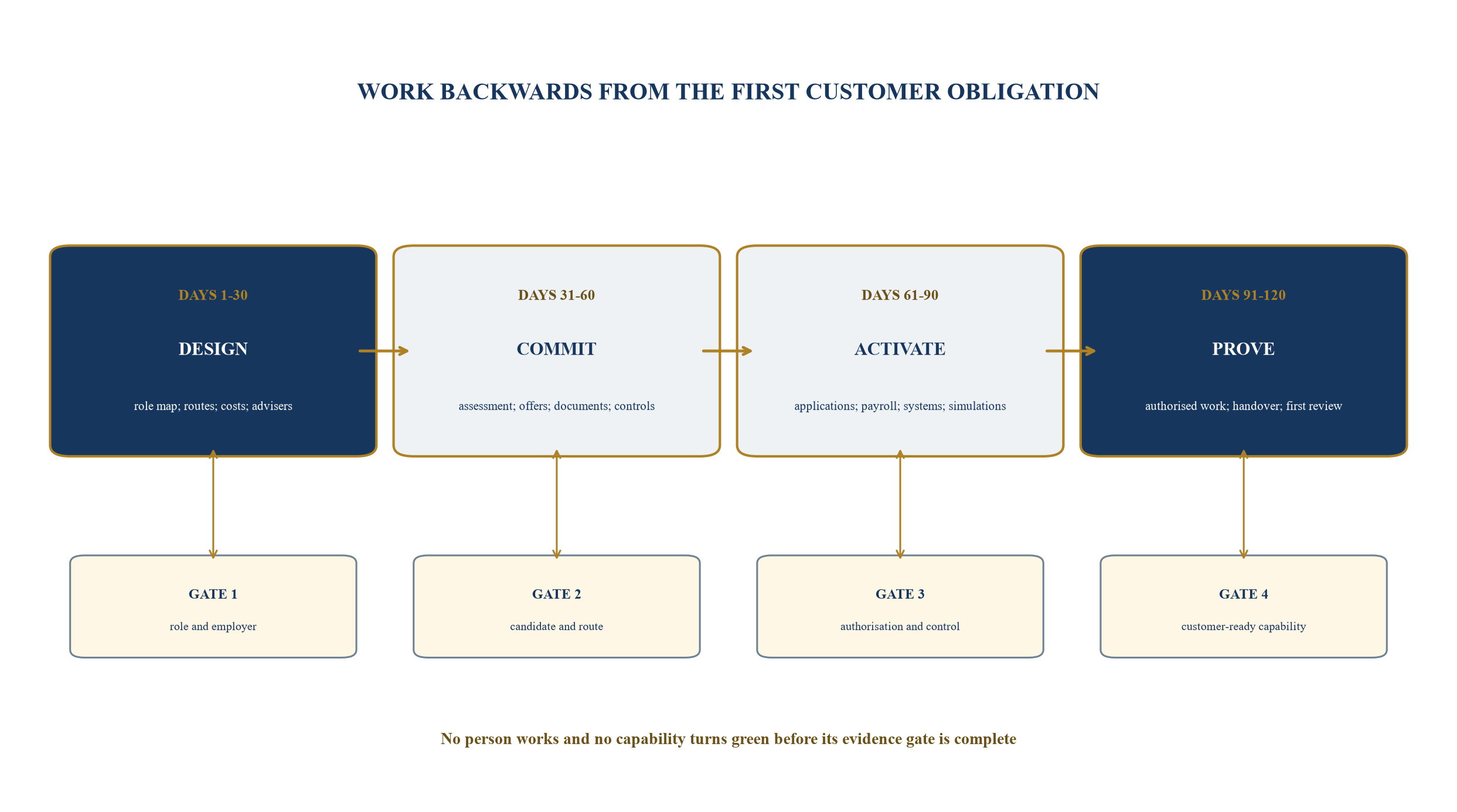
The phases are a management framework. Official processing times and route requirements must be confirmed for each person.
17. Learn from international talent-route design
International comparators provide design lessons rather than a ranking. Singapore's Employment Pass uses a two-stage eligibility framework. Candidates must meet a qualifying salary threshold and, unless exempt, pass the points-based Complementarity Assessment Framework known as COMPASS. COMPASS includes firm-related and individual attributes such as salary, qualifications, diversity and support for local employment. The lesson for a UAE entrant is to maintain job, pay, qualification and workforce evidence as a coherent case.
The United Kingdom's sponsored-worker system places ongoing duties on licensed sponsors. Official guidance describes record keeping, reporting and responsibilities related to sponsored workers. The lesson is that sponsorship should be governed as a continuing control relationship. A visa grant is an opening event; changes in role, salary, location or employment can require review and action.
Saudi Arabia's Ministry of Human Resources and Social Development operates professional verification and classification initiatives designed to validate skills and qualifications for selected occupations. This reinforces the importance of qualification evidence and role classification across the region. A GCC workforce strategy should not assume that one country's role title or document pack transfers unchanged to another.
Canada's Global Talent Stream connects eligible high-skill recruitment with a Labour Market Benefits Plan. Employers commit to activities and benefits such as job creation, skills transfer or training, according to the applicable category and programme. The design lesson is to connect international recruitment with measurable domestic capability outcomes.
Australia provides several employer-sponsored skilled visa options with occupation, sponsorship, nomination and visa requirements. Ireland distinguishes Critical Skills, General, Intra-Company Transfer and other permit types, and publishes an occupation list. These systems show the value of route-specific job classification and evidence. A regional employer benefits from a global mobility control library while maintaining country-specific rules.
The UAE's approach combines employer-sponsored, self-sponsored and category-based routes with a rapidly developing labour-market policy. The OECD's 2026 investment-policy review of the UAE highlights demand for advanced digital skills and the interaction among foreign investment, skills, retention and Emiratisation. The strongest landing plan uses international expertise to build local capability and durable operating substance.
18. Govern providers without outsourcing accountability
Most entrants use immigration, recruitment, payroll, insurance, relocation, tax and legal providers. This can accelerate execution when scope and evidence are controlled. The company remains responsible for its employment decisions, data, authority, cash and operating conduct. A provider's portal status should not be the only source of truth.
The provider register should state the legal entity, service, licence or professional status where relevant, contract, fees, service levels, data access, subprocessors, insurance, escalation, continuity and exit arrangements. Each provider receives only the information needed for its task. The company retains copies of submissions, receipts, approvals and operative documents in its controlled repository.
Service levels should measure outcomes and quality. Examples include complete-first-time submissions, response time, payroll accuracy, benefit enrolment, issue ageing, candidate experience, data deletion and handover. A speed metric can encourage incomplete submissions. A low fixed fee can hide pass-through charges, rework or weak senior attention. The commercial model should match complexity and risk.
The company should verify important authority outcomes directly through official records or channels. It should reconcile provider reports to government documents, payroll files, bank payments and employee records. Material exceptions require named management decisions. No provider should approve its own payment or hold sole control of an employee's original documents.
Continuity planning is essential. The company should be able to change provider without losing access to applications, employee files or deadlines. Contracts need return and deletion obligations, assistance and record formats. Internal owners should understand the process well enough to supervise it and protect employees during a transition.
19. Use a board dashboard that measures readiness
The board dashboard should answer whether the organisation can fulfil the first customer obligation safely and economically. It should separate evidence from forecast. A green status requires an operative document, completed control or tested capability. An expected approval date remains amber. A verbal assurance is not evidence.
The dashboard can track critical roles filled, route eligibility confirmed, work authorisation complete, contracts signed, payroll tested, benefits active, pension registration, Emiratisation plan, authority instruments, systems access, family landing risks, budget, exceptions and succession. Each metric has a definition, source, owner, date and threshold. Personal data should be minimised in board materials.
Commercial readiness should be linked. The dashboard can show which customer activities each role unlocks and the value at risk from delay. It should also show cash committed before launch, remaining reserve and downside exposure. This prevents management from reporting recruitment progress without the operating or financial consequence.
The board should receive leading and lagging measures. Leading measures include document completeness, route validation, time to decision, offer acceptance, onboarding readiness and training completion. Lagging measures include payroll errors, employee turnover, customer-delivery failure, access incidents, absenteeism and missed localisation outcomes. Trends and exceptions matter more than decorative averages.
Table 6. Board talent-landing dashboard
| Measure | Green evidence | Amber condition | Red condition | Owner |
|---|---|---|---|---|
| critical leadership | signed role, accepted person, succession and operative authority | candidate committed; one dependency open | no accountable owner for a launch obligation | board sponsor |
| work authorisation | current status and permit verified for the real role | application or final step pending | work planned without required authorisation | people lead |
| employment and payroll | signed compliant terms and successful payroll dry run | data complete; activation pending | contract, wage or employer mismatch | people and finance |
| protection | health, pension or savings and required schemes active | enrolment submitted with dated confirmation | uncovered employee or missed registration | people lead |
| local capability | approved roles, owners and development measures | recruitment active against dated plan | target or capability gap without recovery plan | country leader |
| authority and systems | delegations, bank rights and least-privilege access tested | one non-critical instrument pending | person cannot act or has excessive access | finance and security |
| customer capability | staffed rehearsal passes acceptance criteria | limited scope can launch | customer promise exceeds ready capability | operations leader |
| cash and downside | funded plan and reserve within approved limit | sensitivity approaching threshold | uncontrolled cost or unfunded obligation | finance controller |
Status is evidence-based. Sensitive personal information should remain in restricted operating records.
20. Board decisions and limitations
Before launch, the board should approve the employing entities, first customer obligation, critical role map, leadership charters, route strategy, workforce budget, local-capability plan, authority matrix, protection design, data controls, implementation gates and downside plan. Approval should be conditional on evidence. Management should return when a material route, role, cost or launch assumption changes.
The board should ask nine questions. What must the local organisation be able to do on Day One? Which named person owns each obligation? Does every person have the correct residence and work authorisation for the real role? Do contract, payroll, benefits and authority records agree? Which customer promises depend on a person who is not ready? How is international expertise building local capability? What personal data is collected and who can access it? What cash is committed before productive work? What happens if the primary leader or route fails?
This framework supports structured decisions and implementation. It cannot determine eligibility, approve a permit, calculate an individual's tax position, interpret a contract, set compensation, establish a pension obligation or provide a regulatory conclusion. The competent authorities, official sources and qualified advisers should confirm the current rules and apply them to complete facts.
Official services, thresholds, occupational classifications, targets, processing channels and documentation requirements can change. Employer jurisdiction, free-zone regime, nationality, profession, salary, qualification, family status, travel, prior residence and activity affect the result. Management should date every source and revalidate it before application or commitment.
Illustrative scores, timing windows, cost units and scenarios in this paper are management assumptions for planning. They are not official processing times, quotations, forecasts or promised outcomes. No launch date, permit, tax result, employee acceptance, retention, customer revenue or valuation outcome is guaranteed. The value of the framework comes from making dependencies, evidence, ownership and limitations visible before the organisation commits.
The enduring control is a talent-landing ledger connected to the operating model. It records each critical role, person, employer, work location, route, contract, pay, benefit, authority, access, local-capability commitment, evidence, expiry and fallback. The ledger turns mobility from a sequence of disconnected applications into a governed operating capability.
Sources and further reading
- UAE Federal Authority for Identity, Citizenship, Customs and Port Security, UAE Green Residency Official source
- UAE Government, Golden Visa Official source
- UAE Government, Job offers, work permits and employment contracts for expatriates Official source
- UAE Government, Work permits Official source
- UAE Government, Employment of expatriates in privately held companies Official source
- UAE Government, Federal Decree-Law No. 33 of 2021 on the Regulation of Labour Relations Official source
- UAE Government, Cabinet Resolution No. 1 of 2022 on the Executive Regulations Official source
- UAE Government, Preparing to work Official source
- UAE Government, Residence visa for working in the UAE Official source
- UAE Government, Residence visa for family members Official source
- UAE Government, Residence visa for working outside the UAE Official source
- UAE Government, National Secure Remote Work Policy Official source
- UAE Ministry of Human Resources and Emiratisation, Wages Protection System Official source
- UAE Ministry of Human Resources and Emiratisation, Emiratisation targets Official source
- UAE Ministry of Human Resources and Emiratisation, 2025 Emiratisation target notice Official source
- UAE Ministry of Human Resources and Emiratisation, Alternative End-of-Service Benefits System Official source
- UAE Ministry of Human Resources and Emiratisation, Savings Scheme announcement Official source
- UAE Ministry of Human Resources and Emiratisation, Unemployment Insurance Scheme Official source
- UAE Ministry of Human Resources and Emiratisation, UAE Labour Market Observatory update Official source
- UAE Labour Market Observatory Official source
- General Pension and Social Security Authority, Employer registration Official source
- General Pension and Social Security Authority, Mandatory registration FAQ Official source
- General Pension and Social Security Authority, GCC employee contribution penalties Official source
- Dubai Health Authority, Dubai Health Insurance Corporation Official source
- Abu Dhabi Department of Health, Health insurance frequently asked questions Official source
- UAE Legislation, Federal Decree-Law No. 45 of 2021 on Personal Data Protection Official source
- UAE Legislation, Cabinet Resolution No. 1 of 2022 labour executive regulation Official source
- UAE Federal Tax Authority, Issuance of Tax Certificates Official source
- UAE Federal Tax Authority, Taxation of Natural Persons guide Official source
- United Kingdom Government, 2016 UK-UAE Double Taxation Convention Official source
- OECD, Investment Policy Perspectives in the United Arab Emirates Official source
- OECD, Harnessing FDI for UAE digital transformation and skills development Official source
- UAE Federal Competitiveness and Statistics Centre Official source
- World Bank, United Arab Emirates Human Capital Country Brief Official source
- Singapore Ministry of Manpower, Employment Pass eligibility and COMPASS Official source
- Singapore Ministry of Manpower, Employment Pass key facts Official source
- United Kingdom Government, Sponsor a worker guidance Official source
- United Kingdom Government, Visa sponsor responsibilities Official source
- Saudi Ministry of Human Resources and Social Development, Skills and professional verification Official source
- Government of Canada, Global Talent Stream Official source
- Australian Department of Home Affairs, Visa options for sponsoring skilled workers Official source
- Government of Ireland, Employment permit types Official source
