

Introduction
Accounting technology has moved beyond ledger entry and reporting. Current products can extract invoices, classify transactions, reconcile accounts, identify journal anomalies, prepare tax work, draft audit documentation, search technical literature and coordinate engagement teams. Generative and agentic systems can connect several of these tasks. Their commercial appeal is clear: a product positioned inside a recurring close, tax or audit process can reduce manual work and become difficult to replace. Its transaction risk is equally material because the same product may transform evidence on which a regulated professional relies.
The UK Financial Reporting Council published guidance on artificial intelligence in audit in June 2025 and guidance on generative and agentic AI in March 2026 [1-3]. The guidance connects technology use with audit quality, appropriate confidence in outputs, documentation and professional judgement. ICAEW stated in May 2026 that audit firms need clear policies, training and oversight, and reminded firms that individual and audit-team responsibility remains when AI is used [4]. These expectations make evidence architecture and operating governance central to acquisition value.
Transactions in adjacent accounting technology demonstrate strategic interest in owned workflow. Thomson Reuters acquired SafeSend for USD 600 million in January 2025 and described the product as automating the last mile of tax-return assembly, review, signature and delivery [44]. MRI Software's completed acquisition of Capita One was reviewed by the Competition and Markets Authority, whose published decision illustrates the importance of product scope, customer alternatives and competitive effects in software combinations [42]. Neither transaction supplies a valuation multiple for a UK accounting-AI target. They show why a buyer should investigate workflow position, interoperability and customer choice.
This paper is designed for strategic buyers, private-capital investors, lenders, boards and management teams evaluating UK accounting-AI acquisitions. It addresses transaction decisions rather than the technical approval of any tool. It does not provide audit, legal, regulatory, tax or valuation advice.
1 State the acquisition thesis in evidence terms
An acquisition thesis should identify the evidence-bearing workflow expected to improve after closing. Examples include invoice to approved payable, bank feed to reconciled balance, journal population to tested exception, trial balance to financial statements, tax return to authorised filing, or source record to audit conclusion. A broad label such as accounting AI does not define the asset. Each workflow has different data, users, controls, professional consequences and systems of record.
The thesis should describe three elements: the target asset, the buyer contribution and the value mechanism. The target asset may be a labelled accounting corpus, a rules library, an evidence graph, an integration layer, a customer distribution channel, an engagement workpaper system or a model specialised for a defined task. The buyer may contribute installed customers, trusted technical content, distribution, capital, infrastructure or a larger workflow. Value may arise through retention, cross-sell, reduced rework, improved evidence coverage, faster completion or lower operating cost.
Every mechanism needs an owner, baseline, timing, cost and failure condition. A claim that the combination will automate audit testing should specify which assertions, populations, procedures and evidence will be affected. It should identify who validates the tool, who approves engagement use, how exceptions are resolved, how results enter the audit file and what continuing cost is needed to maintain confidence. The buyer should assign no value to a workflow that cannot be reproduced or accepted by the responsible professional.
| Value claim | Required evidence | Decision question | Principal risk |
|---|---|---|---|
| Controlled workflow | process maps telemetry accepted outputs and systems of record | does the target control a complete valuable task | feature use without workflow ownership |
| Reproducible evidence | source lineage versions transformations review and retention | can a reviewer reproduce the material conclusion | plausible output without sufficient evidence |
| Accountable use | policies roles approvals competence and escalation | does professional responsibility remain clear | automation obscures the responsible decision maker |
| Customer depth | cohorts engagement use renewal and migration behaviour | will customers remain through integration | contract renewal hides shallow adoption |
| Data and content rights | provenance licences purposes locations and change-of-control terms | can the combined group continue each use | rights narrow or terminate after closing |
| Sustainable economics | full model data quality security support and integration cost | what recurring cash remains after control cost | reported margin omits essential operations |
Proposed structure; target-specific legal regulatory audit technical commercial accounting cyber and client review is required.
2 Map the accounting evidence chain
The evidence chain starts with an underlying transaction or event and ends with an approved accounting, tax or audit output. Between those points sit capture, identity, authorisation, classification, transformation, reconciliation, exception handling, review, approval, reporting and retention. The acquisition team should map these stages for each material product and customer cohort.
The map should distinguish source evidence, management records, derived data and professional conclusions. A bank statement can be source evidence. A mapped ledger entry is a management record. An anomaly score is a derived output. An audit conclusion is a professional judgement supported by evidence. Combining these layers without lineage can make an apparently efficient product difficult to defend or reperform.
Systems of record and systems of action should be identified separately. An enterprise resource planning system may own the ledger. A document store may retain invoices and contracts. An audit platform may own the engagement file. An AI tool may orchestrate extraction, matching and drafting without controlling the authoritative record. Transferable value depends on the target's durable position across these systems and the contractual right to access them.
Telemetry should connect the input, data source, model and version, rule set, human reviewer, exceptions, corrections, final output, elapsed time, engagement outcome, invoice and renewal. Prompt counts and generated text volumes provide weak evidence of value. Accepted outputs, reduced rework, improved coverage, controlled completion and retained customers provide stronger evidence.
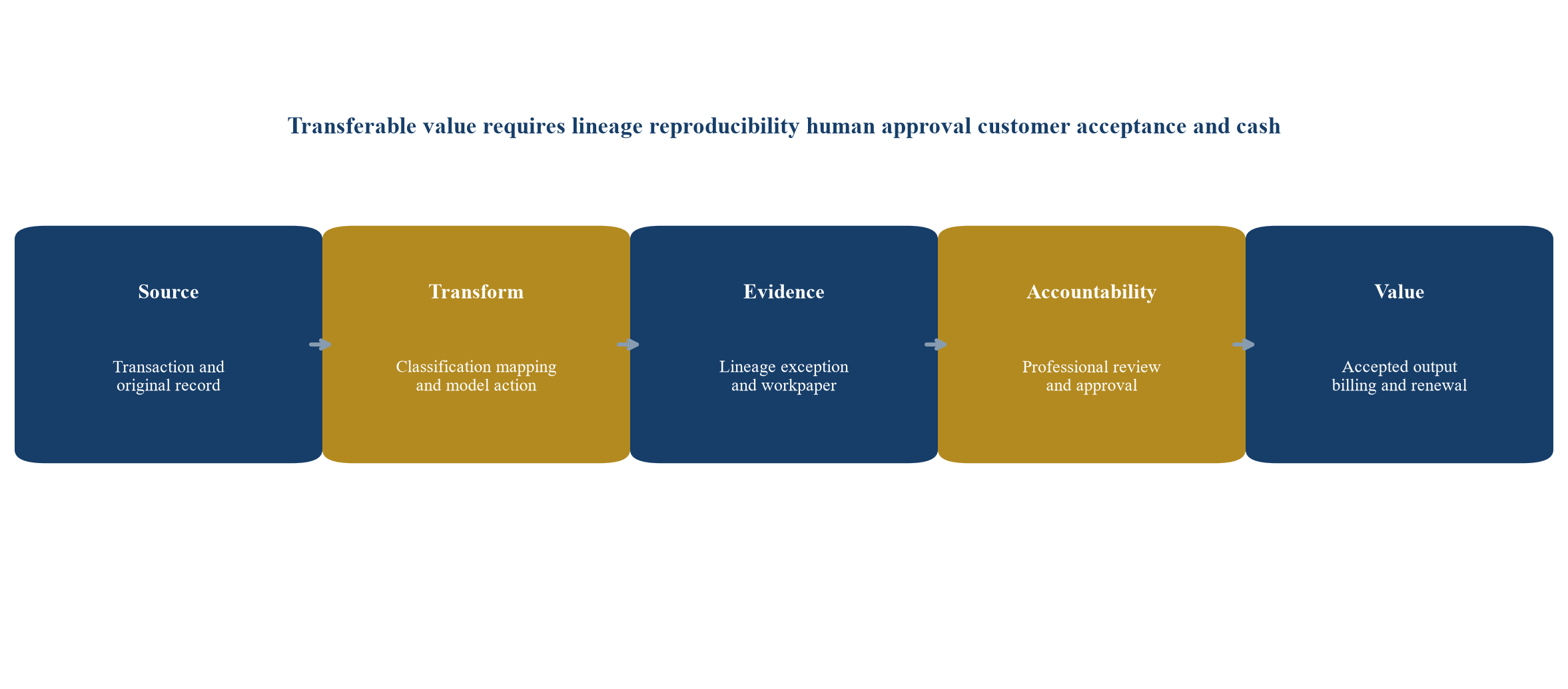
Proposed acquisition map; actual controls should reflect the engagement task customer system and applicable requirement.
3 Test workflow ownership
Workflow ownership means that customers repeatedly enter a valuable process through the product, complete material steps inside it and rely on retained evidence when the process is reviewed. A target can have high user activity without ownership when customers export data to spreadsheets, depend on consultants to finish the work or treat the tool as a narrow drafting assistant.
The buyer should determine which system controls entity identity, chart of accounts, source documents, engagement permissions, version history, exception resolution, final approval and record retention. It should trace where users start and finish, which integrations are necessary and what happens if one supplier withdraws an interface. A connector can be commercially valuable, but its bargaining power differs from that of a system of record or a system holding the accepted workpaper.
Workflow depth can be measured through the proportion of eligible entities or engagements using the product, share of process steps completed, exception-resolution rate, reviewer intervention, acceptance after review, persistence of retained context and switching effort. These measures should be analysed by customer type, workflow and implementation cohort. Average usage can conceal a small group of embedded customers and a larger group of trials.
The acquisition model should distinguish licensed access from active workflow control. Contracted annual recurring revenue can continue during a period of low use. It can therefore lag deterioration in product acceptance. Cohort evidence should connect depth, renewal, expansion, support cost and collected cash.
4 Define professional accountability
Professional accountability cannot be transferred to a model. The responsible firm and professionals remain accountable for the work they perform and conclusions they reach under the applicable framework. ISA (UK) 220 addresses quality management at the engagement level and the engagement partner's responsibility for managing and achieving quality [8]. ISQM (UK) 1 addresses the firm's system of quality management, including technological resources and responses to quality risks [7].
The diligence team should create a responsibility map covering the target, customer firm, engagement partner, engagement team, reviewer, data owner, model provider and outsourced service providers. For every material action, the map should identify who configures, validates, approves, monitors, overrides, documents and remediates it. A label such as human in the loop is incomplete unless the human has time, competence, evidence and authority to challenge the output.
ICAEW has emphasised policies, training, oversight and individual responsibility for AI use in audit [4]. This has two transaction consequences. First, the product must support a customer's governance rather than rely on informal user behaviour. Second, recurring product cost includes continuing validation, training, documentation, change management and customer support. These activities sustain regulated adoption.
| Decision | Product provider | Customer firm | Engagement partner or responsible professional | Required record |
|---|---|---|---|---|
| approve use case | supply capability limits and evidence | set policy and risk acceptance | confirm engagement suitability | approval scope and conditions |
| validate tool | maintain test evidence and version control | evaluate firm-specific use | assess relevant engagement implications | validation results and exceptions |
| configure workflow | control model rules and permissions | approve data and process configuration | confirm procedure design | configuration and change history |
| review output | expose sources limitations and confidence | provide trained review process | exercise judgement and approve conclusion | review evidence corrections and sign-off |
| monitor operation | detect drift incidents and service failure | monitor quality outcomes | escalate engagement effects | monitoring and remediation log |
| manage change | notify and retest material changes | approve deployment timing | reassess reliance | release record and renewed approval |
Proposed allocation; exact responsibilities depend on the engagement standard contract architecture and regulatory perimeter.
5 Establish the audit-evidence threshold
Audit evidence must be sufficient and appropriate for the purpose for which it is used. ISA (UK) 500 addresses the auditor's responsibility to design and perform procedures to obtain sufficient appropriate audit evidence [10]. AI output may help identify a population, perform a transformation, flag an exception or draft documentation. Its status depends on the source, completeness, accuracy, relevance, reliability and the auditor's procedures.
The buyer should avoid treating a product demonstration as proof of evidence quality. Demonstrations often use curated datasets and known questions. Diligence should test representative customer data, incomplete records, unusual transactions, changing formats, adversarial inputs and conditions outside the training distribution. It should preserve the full test record so that errors can be assigned to data, integration, model, configuration, user or review.
Evidence quality has several dimensions. Provenance establishes origin. Integrity addresses unauthorised change. Completeness addresses whether the relevant population was captured. Accuracy addresses faithful transformation. Relevance addresses the assertion or decision. Reproducibility allows an independent reviewer to obtain the same material result. Retention preserves the record for inspection and challenge.
Where an AI system supports a regulated conclusion, the product should expose enough information for the professional to understand the basis of the output. A confidence score alone is insufficient. The reviewer needs the underlying record, transformation, exception logic, model version, relevant limitations and a route to correction.
6 Validate models in the actual workflow
Model validation should match the consequence of the task. An extraction model that proposes invoice fields presents a different risk from an agent that selects audit procedures or drafts a conclusion. The validation design should cover intended use, excluded use, data representativeness, benchmark performance, error severity, calibration, robustness, security, human review and monitoring.
The target should maintain a controlled inventory of models, prompts, rules, external services and versions. Each entry should have an owner, approved purpose, validation record, data dependency, change threshold, monitoring metric and retirement process. Undocumented experimentation within customer work creates a quality and transaction risk because the buyer cannot establish which system produced which evidence.
Aggregate accuracy can conceal material failure. A model may achieve high overall extraction accuracy while performing poorly on a rare field that controls payment or tax treatment. The test set should therefore weight errors by financial and professional consequence. False negatives, false positives and abstentions should be reported separately. Performance should be segmented by customer, document type, accounting regime, language, period and workflow stage where relevant.
The buyer should test reproducibility across versions. If the same evidence can yield a materially different output after an unrecorded model update, the workpaper becomes difficult to reperform. Version freezing, retained inputs, source links and documented review can preserve the decision record while the live product continues to evolve.
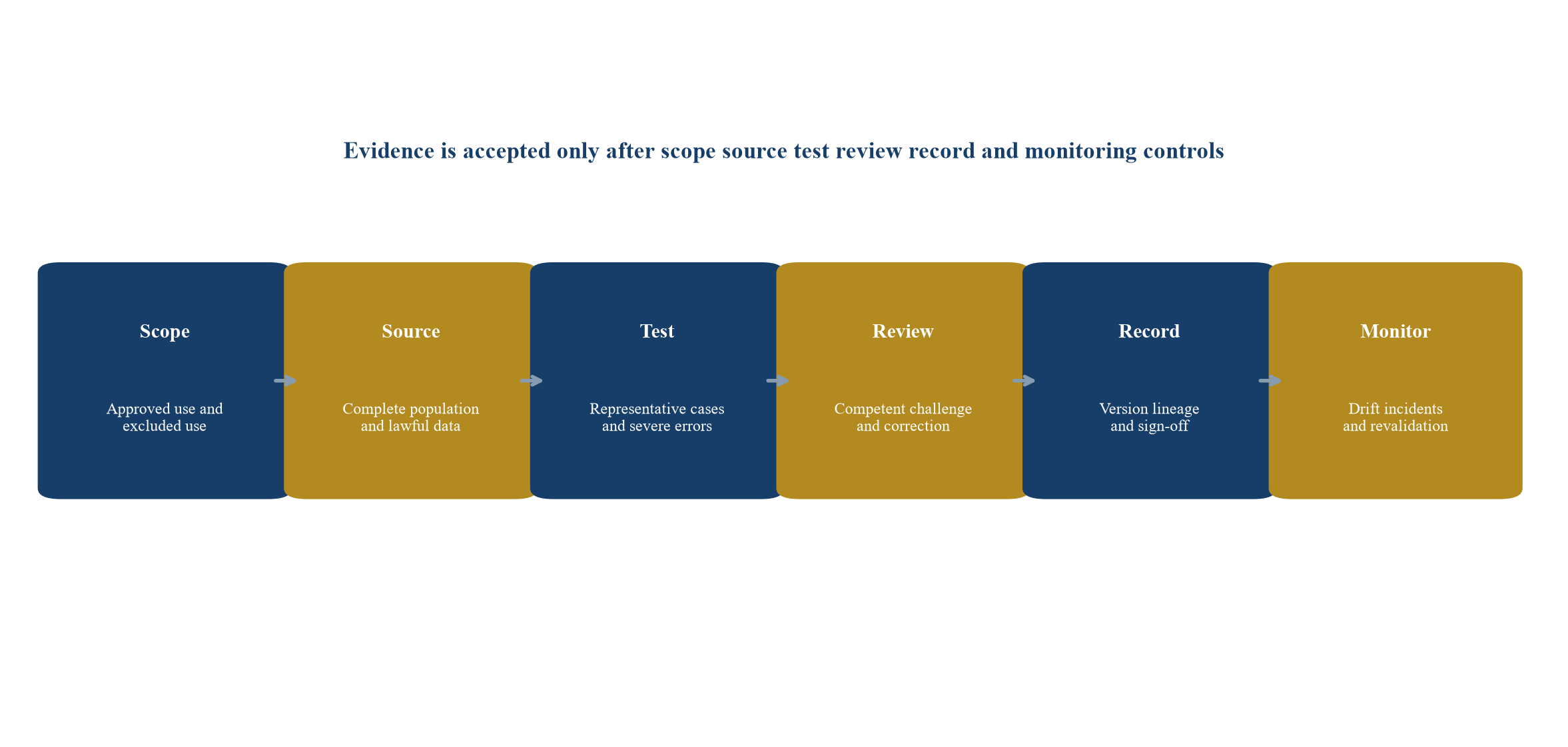
Proposed control sequence; acceptance thresholds should be defined for the specific accounting or audit use case.
7 Preserve documentation and reproducibility
Documentation should enable an experienced reviewer to understand the work performed, evidence obtained and conclusions reached. ISA (UK) 230 addresses audit documentation [9]. When AI influences a material procedure, the engagement record should show the approved purpose, source data, relevant model or tool version, output, exceptions, human work, corrections and final conclusion.
The target's architecture should support retention without turning a transient interface into the only record. Chat histories, cached retrievals and external model calls may not remain available for the required period. The product should therefore create a durable evidence package or controlled reference into the customer's system of record. The package should survive supplier change and allow lawful export.
Reproducibility does not require every stochastic token to repeat. It requires the material basis of the professional decision to remain available and understandable. The buyer should test whether a reviewer can trace a selected conclusion back to the original data and recreate the transformations that mattered.
The acquisition team should treat missing historical evidence as a valuation issue. A product with strong current controls may still carry exposure from earlier periods. The buyer should quantify affected cohorts, inspection windows, contractual obligations, remediation effort and potential customer claims. It should align warranties, indemnities, escrow or contingent consideration with the evidence gap.
8 Protect confidentiality and data rights
Accounting workflows can contain payroll, banking, tax, supplier, customer and personal data. The acquisition team should trace each data route through ingestion, storage, retrieval, training, inference, logging, support, analytics, backup, export and deletion. It should identify the legal entity, purpose, lawful basis, location, retention and subprocessor at each stage.
The UK Information Commissioner's Office describes accountability and data-protection impact assessment as central to AI governance [25-27]. The Data (Use and Access) Act 2025 changed parts of the UK data-protection framework, including automated decision-making provisions [24]. The exact effect depends on the processing and implementation status. Current legal review is therefore required for the target and proposed combined architecture.
Data rights should be tested at field and purpose level. A customer may permit processing to deliver a service without permitting model training, benchmarking, product development or cross-customer analytics. A target may license technical content for display without the right to use it in retrieval or generation. Change-of-control, location, subcontracting and deletion provisions may affect continued use after closing.
| Data state | Evidence to inspect | Failure mode | Transaction response |
|---|---|---|---|
| source ingestion | contracts notices permissions and system access | data enters the product beyond authorised purpose | remediate rights restrict use or exclude cohort |
| transformation | lineage mapping rules and validation | derived data cannot be reconciled to source | rebuild lineage and limit professional reliance |
| model processing | provider terms retention regions and human access | sensitive data reaches an unapproved service | architecture change consent or closing condition |
| output and workpaper | sources versions reviewer and retention | unsupported output enters a regulated record | evidence gate and workflow limitation |
| support and telemetry | redaction roles tickets analytics and retention | support or analytics exposes customer information | minimise redesign roles and audit access |
| backup and exit | backup scope deletion export and portability | data persists unlawfully or cannot migrate | reserve covenant and verified exit plan |
Proposed matrix; current legal and technical review is required for each data route and jurisdiction.
9 Assess quality management as a product dependency
An accounting-AI product used in audit becomes part of a firm's broader quality-management environment. ISQM (UK) 1 requires firms to design, implement and operate a system of quality management responsive to their circumstances [7]. Technology is one resource within that system. The product can support quality, but the customer firm still needs governance, risk assessment, policies, competence, monitoring and remediation.
The buyer should examine how the target supports customer quality management. Relevant capabilities include approved-use configuration, role-based access, validation evidence, version notifications, training records, exception escalation, monitoring dashboards, incident communication and exportable documentation. Sales language that implies automatic compliance creates risk if the product cannot support these operational needs.
FRC reviews of systems of quality management and audit quality emphasise evidence, monitoring and remediation [5-6]. A buyer should therefore examine the target's own quality loop. Product incidents, customer complaints, validation failures and regulatory findings should feed root-cause analysis, corrective action and retesting. Repeated workarounds indicate a workflow design problem rather than isolated user error.
Quality-management cost should be included in sustainable earnings. Product governance, validation, release control, customer assurance and remediation are recurring activities. Removing them may improve short-term EBITDA and weaken the conditions that support revenue.
10 Test customer acceptance and cohort economics
Customer retention should be tested below the contract level. The acquisition team should build cohorts by product, workflow, customer type, implementation period and depth of use. For each cohort it should track contracted revenue, active entities or engagements, accepted outputs, seat depth, support hours, implementation cost, renewal, expansion, contraction and cash collection.
A product embedded in monthly close or annual audit may show seasonal activity. The analysis should account for workflow frequency rather than treating quiet periods as churn. It should also distinguish use driven by a small internal champion from institutional adoption supported by policy, training and process ownership.
Customer references should address evidence and accountability. Questions should cover which tasks are completed, how outputs are reviewed, where errors occur, what records are retained, which integrations are critical, how updates are approved and what would cause the customer to leave. Reference selection should include recent implementations, mature users, reduced accounts and customers that declined expansion.
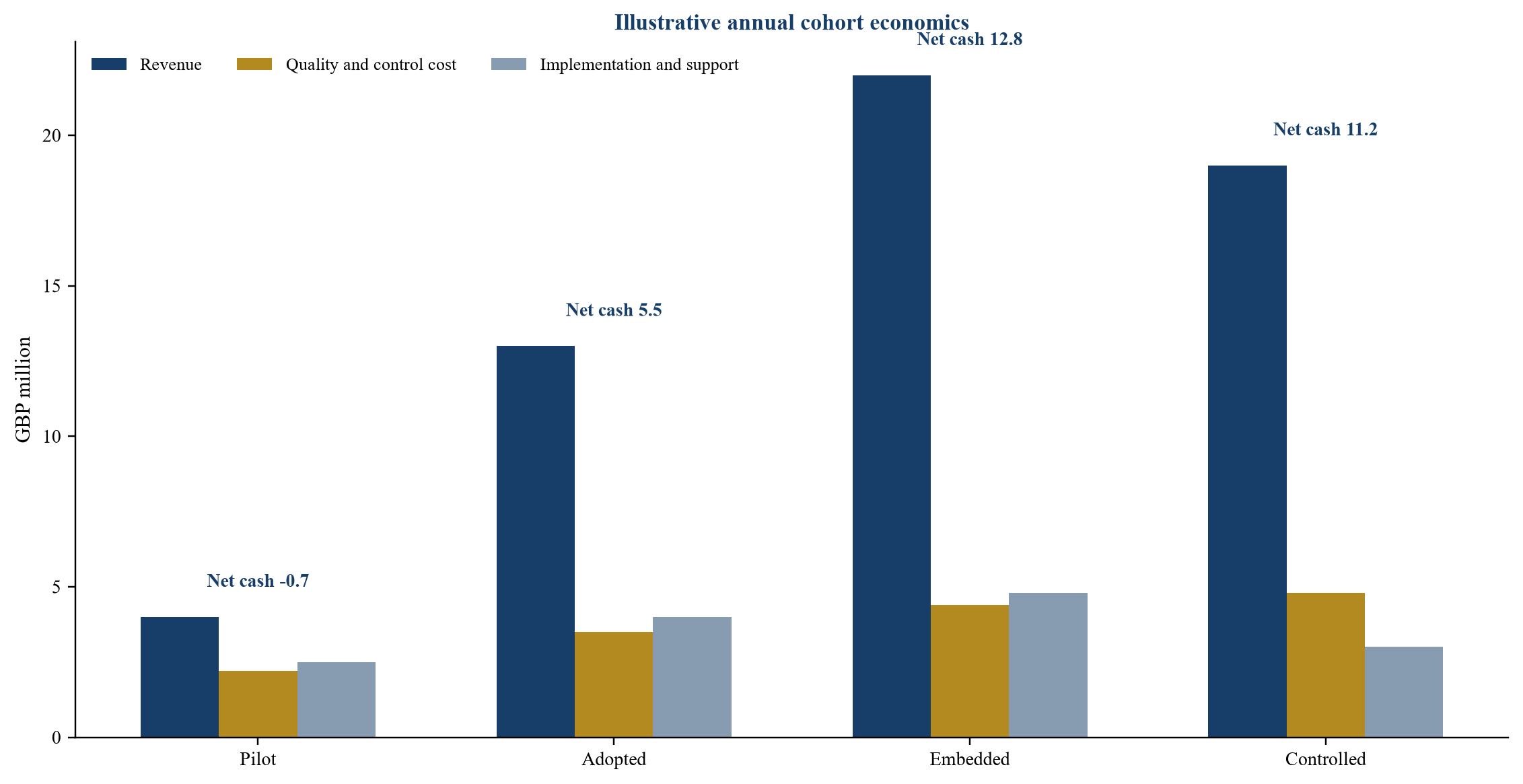
Management assumptions used solely to demonstrate cohort analysis; figures do not describe a company or market.
11 Rebuild sustainable earnings
Reported EBITDA should be rebuilt from the operating requirements of accepted workflows. Adjustments may include capitalised development, founder compensation, data licensing, cloud and model charges, security, validation, customer implementation, professional support, incident response, regulatory change and product maintenance. The purpose is to identify the recurring cash cost of delivering the product within its intended control environment.
Development accounting needs particular attention. Capitalisation can make a product company appear more profitable while current cash funds continuing development. The buyer should analyse engineering spend by maintenance, control remediation, customer implementation, new capability and research. It should assess useful lives, impairment indicators and whether acquired technology will be replaced during integration.
Revenue quality should be tested against acceptance. Multi-year contracts and upfront billing can support reported recurring revenue while workflow depth weakens. The buyer should connect revenue to active use, accepted output, support burden, renewal decision and cash. Services hidden in software gross margin should be separated where customer-specific work is necessary to make the product function.
| Item | Amount | Diligence treatment |
|---|---|---|
| Reported EBITDA | 15.0 | starting point |
| capitalised development normalisation | -2.0 | recurring cash development required for current product |
| model evaluation and evidence control | -1.2 | recurring regulated-workflow cost |
| data and technical content | -0.8 | sustainable licensing and provenance cost |
| cyber privacy and customer assurance | -0.7 | recurring control operation |
| implementation and professional support | -1.0 | cost required for accepted customer outcomes |
| key-person and governance normalisation | -0.6 | replacement and oversight capacity |
| Sustainable EBITDA | 8.7 | basis for illustrative valuation |
GBP millions; management assumptions used solely to demonstrate the framework.
12 Convert synergy into evidence-weighted cash
Synergy should be traced from commercial claim to recurring cash. Cross-sell requires eligible customers, permission to contact, product fit, integration, trained sales teams, implemented workflow, accepted output, renewal and collection. Cost savings require an activity that can genuinely stop without weakening product quality or customer service.
The buyer should classify synergy as committed, evidenced, contingent or aspirational. Committed synergy is supported by approved actions and enforceable arrangements. Evidenced synergy has representative customer or operating proof. Contingent synergy depends on a defined event such as successful validation. Aspirational synergy lacks sufficient proof and should remain outside the base valuation.
Integration costs should include continuing expenses, not only one-time projects. A combined platform may need additional model evaluation, interface support, data-rights work, security monitoring, customer migration, professional review and release management. Where those activities continue, they reduce recurring synergy.
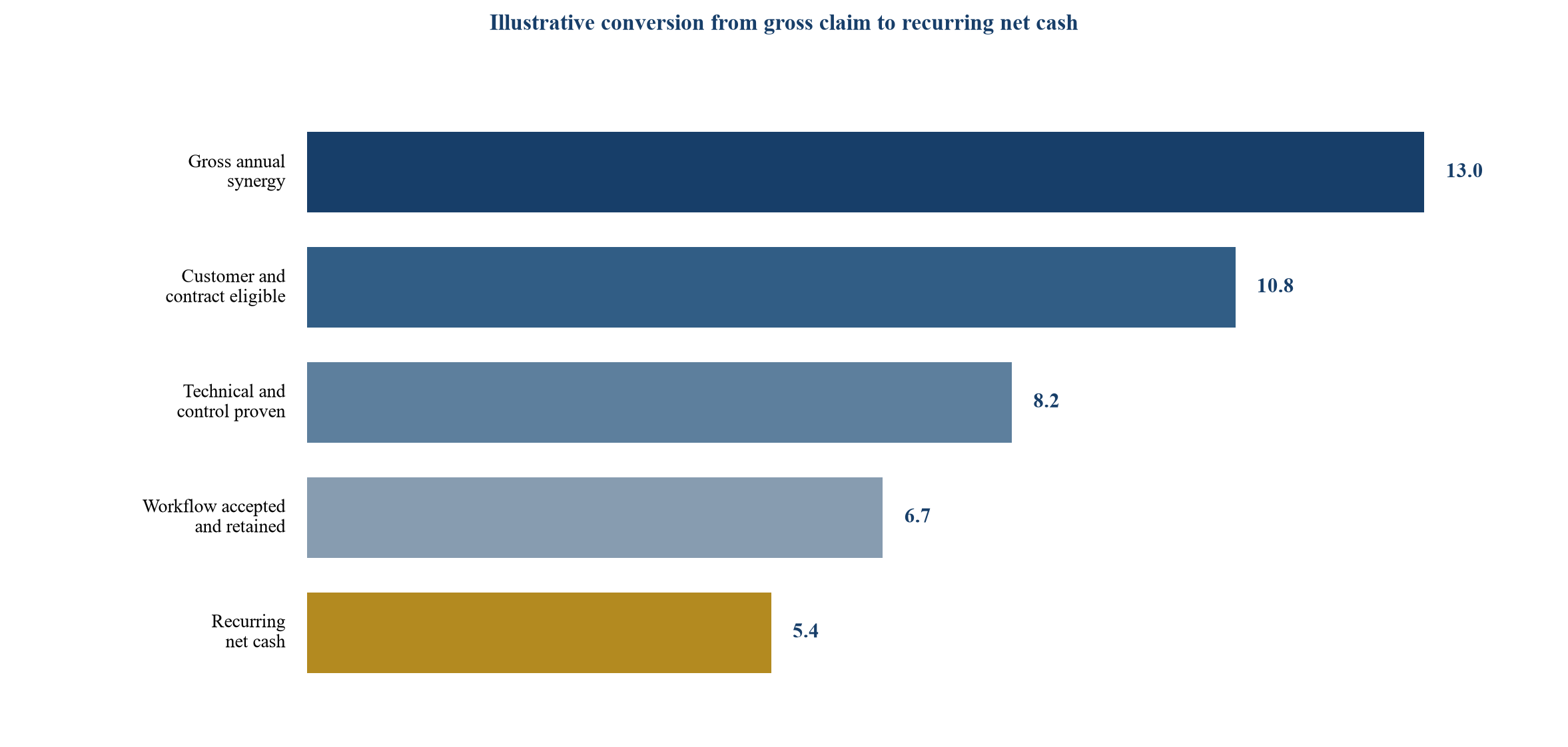
GBP millions; management assumptions used solely to demonstrate the framework.
13 Build the valuation bridge
The valuation bridge should begin with sustainable earnings. A multiple should reflect growth, retention, workflow depth, concentration, control maturity, technical dependence and expected capital requirements. A high growth rate does not compensate automatically for weak evidence or customer acceptance.
Synergy value should be probability weighted and discounted for timing, cost and tax. Integration and control risk should be deducted separately so that the investment committee can see which assumptions create the proposed price. Double counting is a recurring danger: the same workflow position can influence the multiple, synergy and terminal value.
The hypothetical case begins with GBP 8.7 million of sustainable EBITDA and a thirteen-times multiple, producing GBP 113 million. It adds GBP 18 million of evidence-weighted synergy present value. It deducts GBP 12 million for integration and migration, GBP 8 million for control remediation and historical exposure, GBP 6 million for customer and interoperability risk, and GBP 5 million for key-person and execution risk. The resulting illustrative value is GBP 100 million.
| Component | Amount | Evidence requirement |
|---|---|---|
| sustainable EBITDA | 8.7 | rebuilt recurring cash earnings |
| illustrative multiple | 13.0x | cohort quality workflow depth and risk |
| standalone enterprise value | 113.1 | multiplication before transaction adjustments |
| evidence-weighted synergy present value | 18.0 | customer technical acceptance and cash proof |
| integration and migration deduction | -12.0 | executable plan and cost estimate |
| control and historical exposure deduction | -8.0 | validation documentation and remediation evidence |
| customer and interoperability deduction | -6.0 | retention and ecosystem evidence |
| key-person and execution deduction | -5.1 | continuity plan and delivery capacity |
| Illustrative enterprise value | 100.0 | rounded framework output |
GBP millions; management assumptions used solely to demonstrate the framework and not an opinion of value.
14 Examine competition and interoperability
Accounting software markets can exhibit switching cost, data dependence, integration effects and ecosystem control. The buyer should assess whether the combined group could limit interoperability, bundle products, degrade interfaces, restrict data portability or make customer choice more difficult. These issues matter commercially even when a transaction does not raise a competition concern.
The CMA's current Merger Assessment Guidelines describe its approach to merger assessment, including theories of harm and evidence [39]. The Digital Markets, Competition and Consumers Act 2024 introduced a digital-markets regime for firms designated with strategic market status [40]. The application of these frameworks depends on the facts and current regulatory decisions.
The MRI Software and Capita One decision illustrates how the CMA examines software product scope, competitive alternatives, customer evidence and entry [42]. An accounting-AI buyer should prepare a product and data map early. It should identify overlaps, complements, integrations, customer segments, switching routes and potential foreclosure mechanisms. Internal documents should describe the commercial thesis accurately.
Interoperability can also preserve value. Customers may prefer a product that works across ledgers, practice-management systems, document stores and tax platforms. A forced migration can weaken retention and create regulatory or operational risk. The integration plan should therefore set objective criteria for interface continuation, product retirement and customer consent.
15 Assess technical and vendor dependence
An AI product may depend on external models, cloud infrastructure, document-processing services, accounting data providers, identity platforms and customer-system interfaces. The buyer should map each dependency to contractual rights, technical substitutability, cost, concentration, service level, security and change notification.
Model dependence requires more than a supplier list. The team should determine whether performance arises from proprietary data, prompts, orchestration, retrieval, workflow design or the underlying foundation model. It should test the time and cost to substitute the model while preserving accepted outputs. A target whose differentiation disappears when a supplier changes price or policy may have limited durable value.
Software architecture should support evidence isolation. Development, test and production environments should be separated. Customer data should not enter model development without rights and controls. Logging should be sufficient for incident investigation while minimising sensitive data. Release management should identify which customer workflows are affected by a change.
Cyber diligence should cover identity, tenant isolation, encryption, secrets, software supply chain, vulnerability management, incident response, backup, recovery and third-party access. A penetration test is one input. The buyer also needs evidence that the control environment operates over time.
16 Analyse people and professional knowledge
Accounting-AI products often depend on a small group who understand both the software and the professional workflow. The acquisition team should identify product architects, domain leaders, data stewards, security owners, implementation specialists and customer champions. It should assess responsibilities, decision rights, documented knowledge, succession and retention.
Domain expertise should be tested through product evidence rather than biography alone. The team should inspect how accounting and audit requirements enter product design, validation cases, release approval, training and customer support. A product that depends on undocumented judgement by one founder may face a larger integration risk than its headcount suggests.
The buyer should also examine organisational incentives. Sales targets can encourage claims beyond validated use. Engineering incentives can favour release speed over evidence. Professional staff may lack authority to stop deployment. A durable operating model gives quality, security and data owners clear escalation and veto rights within defined thresholds.
Retention arrangements should align with evidence transfer, customer continuity and control remediation. Cash or equity retention alone does not document the workflow. The integration plan should require operating manuals, validation assets, customer histories, dependency maps and trained successors.
17 Structure transaction protection
Deal terms should follow identified evidence gaps. Representations can address data rights, model and software ownership, compliance, customer contracts, cyber incidents, accuracy claims, validation records and professional-use limitations. Disclosure should be specific enough to allow the buyer to price known matters.
Closing conditions may be appropriate where a material right, customer consent, technical remediation or regulatory outcome is required for the thesis. A pre-closing covenant can preserve evidence, restrict material model changes and require ordinary-course support. The buyer should avoid a condition that cannot be objectively tested.
Escrow, indemnity or contingent consideration can address historical exposure and uncertain value. Earn-out metrics should follow accepted workflow and cash rather than prompt volume or unreviewed output. Examples include retained controlled customers, accepted workflow volume, validated performance within defined error thresholds and collected recurring revenue after support cost.
| Evidence gap | Value consequence | Potential transaction response | Post-close gate |
|---|---|---|---|
| uncertain data or content rights | workflow cannot lawfully continue | consent condition covenant indemnity or exclusion | verified rights inventory |
| incomplete model validation | reliance and retention uncertain | price deferral and validation milestone | representative test passed |
| weak historical documentation | inspection or claim exposure | escrow indemnity and remediation reserve | affected cohorts remediated |
| customer concentration | cash exposed to limited decisions | retention condition earn-out or price adjustment | named cohort renewal and collection |
| key-person dependence | product and customer continuity risk | retention succession and knowledge-transfer covenant | trained successor operating independently |
| uncertain integration | synergy timing and cost risk | staged consideration and board release gates | accepted parallel migration |
Proposed framework; legal drafting and allocation depend on the transaction and governing law.
18 Integrate by workflow cohort
Integration should proceed by workflow and cohort rather than by legal-entity deadline. The sequence should preserve source data, versions, validation evidence, customer configuration and engagement records before any system change. Each cohort should move only after technical performance, evidence continuity, professional approval, customer acceptance and support readiness have been demonstrated.
Parallel operation can compare old and new results for representative cases. Differences should be investigated and classified. A favourable average does not justify migration if severe errors remain in material edge cases. The decision record should state thresholds, exceptions, residual risk and the person authorised to proceed.
Product retirement should be evidence driven. The combined company may seek to reduce duplicate systems. Retirement can create value when workflows are genuinely substitutable and customers accept the replacement. It can destroy value when a product retains unique integrations, evidence history or professional trust.
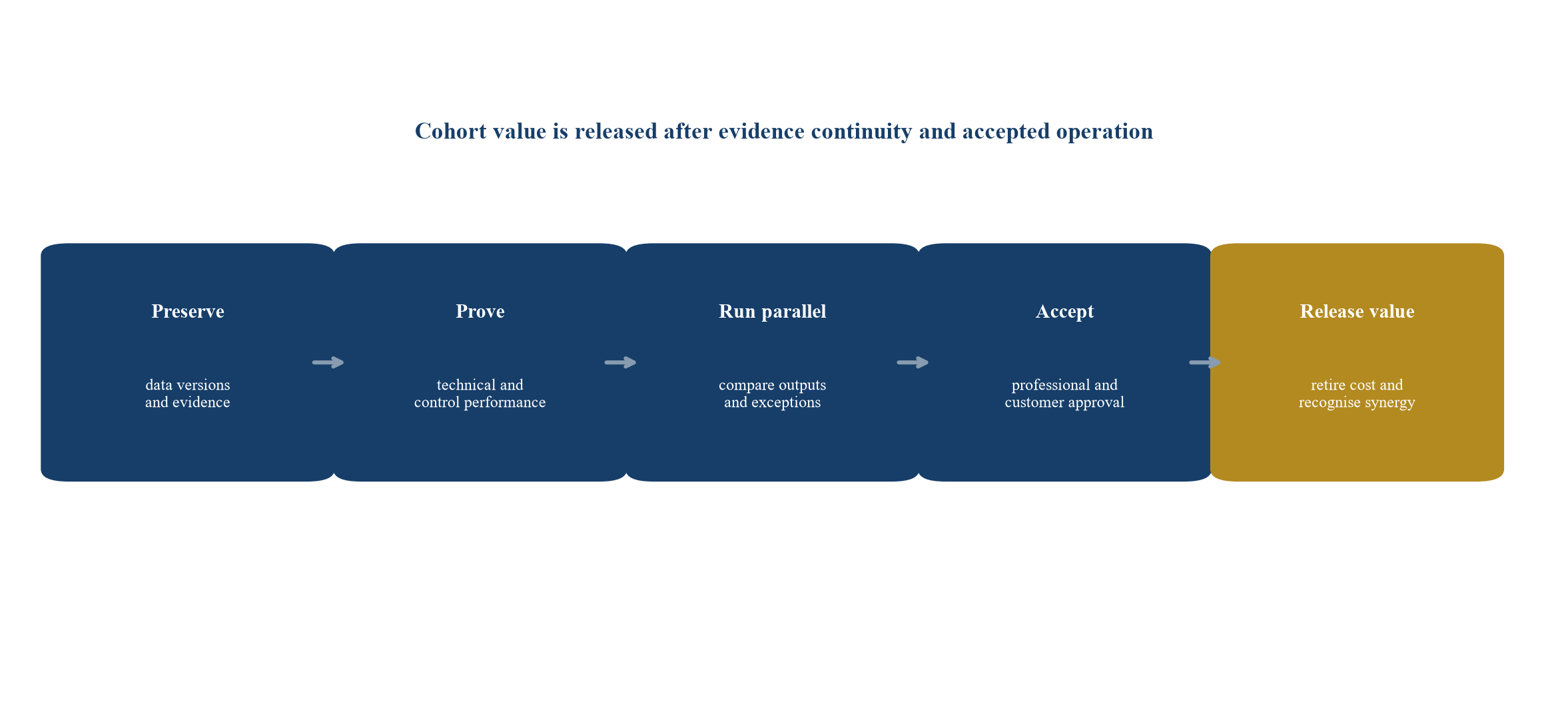
Proposed sequence; gate criteria require target-specific technical professional contractual and customer evidence.
19 Govern the first one hundred days
The first one hundred days should protect evidence and stabilise accountability. The buyer should freeze deletion, unrecorded model changes and uncontrolled data movement at closing. It should confirm system owners, incident routes, customer commitments and release authority. A controlled freeze should still allow necessary security and service fixes through documented approval.
During the first thirty days, the combined group should reconcile the model inventory, data rights, critical dependencies, customer workflows, open incidents and validation records. It should identify gaps that affect active regulated work and assign remediation owners. Customer communication should be accurate and coordinated with contractual obligations.
Days thirty to sixty should focus on representative revalidation, access review, evidence export, continuity testing and integration design. Days sixty to one hundred should complete priority remediation, approve cohort migration pilots and establish the recurring board dashboard. Synergy recognition should follow evidence rather than the passage of time.
| Period | Required action | Evidence gate | Board decision |
|---|---|---|---|
| day 0 to 10 | preserve data models versions contracts and workpapers | verified preservation and ownership | authorise controlled operation |
| day 10 to 30 | reconcile inventories incidents rights and dependencies | complete risk register and accountable owners | set remediation priority and reserve |
| day 30 to 60 | revalidate priority workflows and access controls | representative tests and exception resolution | approve limited pilot scope |
| day 60 to 80 | run parallel cohort migration and customer acceptance | evidence continuity and accepted outcomes | approve staged migration |
| day 80 to 100 | establish monitoring reporting and value gates | dashboard baseline and control assurance | release evidenced synergy only |
Proposed operating sequence; timing should reflect transaction risk and customer commitments.
20 Use a board decision scorecard
The board should receive a compact scorecard linked to source evidence. Suggested dimensions are workflow ownership, evidence reproducibility, professional accountability, data rights, customer depth, sustainable earnings, technical resilience and integration readiness. Each score should have an owner, threshold, evidence date and unresolved exception.
The scorecard should separate current condition from planned remediation. A strong roadmap does not change the condition at signing. The board should see the cash, time and dependency required to move from current to target state. It should also see which valuation components depend on that movement.
Traffic-light labels need defined criteria. A green evidence-chain score could require representative end-to-end reproduction, version retention, accepted reviewer output and no unresolved severe exception. An amber score might permit a bounded gap with funded remediation and no active customer impact. Red should identify a condition incompatible with the intended use or transaction thesis.
The final decision record should state the approved price range, downside, funding, conditions, reserved matters, value-release gates and reasons. It should identify which claims remain management assumptions. This record supports disciplined ownership after closing.
21 Assess fraud and anomaly workflows
Fraud and anomaly products can create value through broader population testing and faster investigation. Their transaction risk lies in false confidence, poor explainability and incomplete follow-through. ISA (UK) 240 addresses the auditor's responsibilities relating to fraud [13]. A model score does not replace the auditor's risk assessment, professional scepticism or response.
The buyer should inspect population completeness, feature design, benchmark cases, false negatives, false positives, override behaviour and escalation. It should determine whether alerts produce documented procedures and resolved conclusions. Commercial evidence should connect alerts to accepted work, reduced rework or improved coverage rather than to alert volume alone.
22 Test group-audit and multi-entity use
Group and multi-entity workflows can strengthen a target's position because they coordinate data, components, currencies, systems and reviewers. They can also amplify error when a common mapping or model is applied across dissimilar entities. ISA (UK) 600 addresses special considerations in group audits [15].
The buyer should test component identity, scoping, instructions, access, translation, consolidation adjustments, intercompany elimination, review and retention. It should identify where local requirements or data structures differ. The platform should preserve entity-level evidence while supporting group oversight.
23 Evaluate tax and statutory-accounting boundaries
Tax and statutory-accounting workflows can combine calculations, rules, filing interfaces, signatures and deadline management. The diligence team should separate deterministic rules from model-generated interpretation and drafting. It should verify content ownership, update processes, jurisdiction coverage, approval and filing evidence.
Customer value may arise from controlled completion rather than prediction. The buyer should therefore measure completed accepted filings, corrections, penalties, support effort and renewal by jurisdiction and workflow. It should identify whether the target carries professional liability or relies on customers to approve all material positions.
24 Stress customer and financing downside
The acquisition model should include downside cases for slower adoption, delayed validation, customer churn, supplier repricing, remediation and product retirement. A lender should receive the same evidence chain used by the investment committee, with additional focus on cash conversion, concentration, covenant headroom and required investment.
Debt capacity should be based on recurring cash after quality and control costs. Synergy dependent on unapproved customer migration should not support near-term debt service. The downside should include the cost and timing of preserving separate products when consolidation cannot proceed.
25 Plan for regulatory and standards change
The combined company needs a controlled process for standards, law and guidance change. The process should identify applicable change, assign interpretation, assess products and customers, approve remediation, test releases and communicate limits. A current control can become insufficient when a workflow or external requirement changes.
The buyer should examine historical response to change. Timely evidence includes tracked requirements, impact assessments, release records, customer notices and post-implementation review. Repeated emergency patches or unsupported interpretations indicate higher recurring cost and execution risk.
26 Define exit and separation readiness
Exit readiness begins at acquisition. The buyer should preserve product-level economics, data rights, intellectual property, customer contracts, evidence repositories and operating knowledge. A future buyer or carve-out team will need to understand which workflows can operate independently and which depend on shared infrastructure or licences.
Separation planning also protects customers if an integration fails. Data portability, evidence export, controlled deletion, transition support and supplier substitution should be tested. These capabilities reduce lock-in risk and can strengthen the credibility of customer commitments.
27 Limitations and conclusion
This paper provides a decision framework rather than an assessment of a named company, product, transaction or audit engagement. The hypothetical financial case does not represent market data, a forecast or an opinion of value. Actual outcomes depend on customer contracts, product architecture, data rights, professional use, regulation, competition, tax, financing and execution.
The cited standards and guidance should be read in their complete current form. Requirements can change, and their application depends on facts and professional judgement. AI systems, supplier terms and market practices also change quickly. A transaction team should obtain current specialist advice and perform representative technical and workflow testing.
Public transaction disclosures provide limited information about private product economics, controls and integration. They should not be used as direct comparables without adjustment. Survey and inspection results use different populations and methodologies and should not be combined into a single market estimate.
UK accounting-AI acquisition value rests on evidence-bearing workflow. A target creates durable value when it can lawfully access the necessary data, preserve lineage, produce reproducible outputs, support accountable professional decisions and retain customers through controlled integration. Automation volume alone does not establish these conditions.
The buyer should begin with the accounting evidence chain, test workflow ownership, map professional accountability, validate models in representative use, rebuild sustainable earnings and convert synergy into accepted recurring cash. It should translate unresolved gaps into price, conditions, protection and post-close gates.
This approach allows the investment committee to connect product claims with professional standards and transaction economics. It also gives the combined company a practical integration rule: preserve evidence first, prove operation second, migrate by cohort and release value only after acceptance.
Sources
- Financial Reporting Council, AI in Audit, 2026, Read the primary source
- Financial Reporting Council, Generative and Agentic AI Guidance, 30 March 2026, Read the primary source
- Financial Reporting Council, AI in audit illustrative example and documentation guidance, 26 June 2025, Read the primary source
- ICAEW, Artificial intelligence in audit work managing the risks, 6 May 2026, Read the primary source
- Financial Reporting Council, Annual Review of Audit Quality 2026, 22 July 2026, Read the primary source
- Financial Reporting Council, Audit Quality Review overview, 2025, Read the primary source
- Financial Reporting Council, ISQM UK 1, updated September 2025, Read the primary source
- Financial Reporting Council, ISA UK 220 Quality Management for an Audit of Financial Statements, updated September 2025, Read the primary source
- Financial Reporting Council, ISA UK 230 Audit Documentation, updated September 2025, Read the primary source
- Financial Reporting Council, ISA UK 500 Audit Evidence, updated September 2025, Read the primary source
- Financial Reporting Council, ISA UK 315 Identifying and Assessing the Risks of Material Misstatement, updated September 2025, Read the primary source
- Financial Reporting Council, ISA UK 330 The Auditor's Responses to Assessed Risks, updated September 2025, Read the primary source
- Financial Reporting Council, ISA UK 240 The Auditor's Responsibilities Relating to Fraud, updated September 2025, Read the primary source
- Financial Reporting Council, ISA UK 540 Auditing Accounting Estimates and Related Disclosures, updated September 2025, Read the primary source
- Financial Reporting Council, ISA UK 600 Special Considerations Audits of Group Financial Statements, updated September 2025, Read the primary source
- Financial Reporting Council, ISQM UK 2 Engagement Quality Reviews, updated September 2025, Read the primary source
- Financial Reporting Council, Ethical Standard for Auditors, 2024, Read the primary source
- Financial Reporting Council, Audit Firm Resources overview, 2026, Read the primary source
- Financial Reporting Council, Annual Review of Audit Quality 2025, July 2025, Read the primary source
- ICAEW, Audit Monitoring Report 2026, Read the primary source
- ICAEW, UK Audit Regulations and Guidance, 2026, Read the primary source
- ICAEW, Generative AI Guide, 2025, Read the primary source
- UK Parliament, Data Use and Access Act 2025, Read the primary source
- UK Parliament, Data Use and Access Act 2025 explanatory notes on automated decision making, Read the primary source
- Information Commissioner's Office, Guidance on AI and data protection, Read the primary source
- Information Commissioner's Office, Accountability and governance implications of AI, Read the primary source
- Information Commissioner's Office, When do we need to do a DPIA, Read the primary source
- Information Commissioner's Office, How should we assess security and data minimisation in AI, Read the primary source
- International Auditing and Assurance Standards Board, Technology Quality Management Workstream, 2026, Read the primary source
- International Auditing and Assurance Standards Board, Technology Position, 2024, Read the primary source
- International Auditing and Assurance Standards Board, Technology and Quality Management roundtable feedback, 10 February 2026, Read the primary source
- International Auditing and Assurance Standards Board, ISA 500 Audit Evidence, Read the primary source
- National Institute of Standards and Technology, Artificial Intelligence Risk Management Framework, 2023, Read the primary source
- National Institute of Standards and Technology, Generative Artificial Intelligence Profile, 2024, Read the primary source
- UK Government, AI assurance roadmap, 2025, Read the primary source
- UK Government, Introduction to AI assurance, 2024, Read the primary source
- UK Government, AI management essentials tool, 2025, Read the primary source
- Competition and Markets Authority, Merger Assessment Guidelines, updated 3 September 2026, Read the primary source
- Competition and Markets Authority, Digital markets competition regime guidance, 2025, Read the primary source
- UK Parliament, Digital Markets Competition and Consumers Act 2024, Read the primary source
- Competition and Markets Authority, MRI Software and Capita One merger inquiry, 2025, Read the primary source
- Competition and Markets Authority, MRI Software and Capita One full decision, 18 March 2025, Read the primary source
- Thomson Reuters, Acquisition of SafeSend, 2 January 2025, Read the primary source
- Thomson Reuters, 2025 Annual Report, 2026, Read the primary source
- Thomson Reuters, Acquisition of Materia, 2024, Read the primary source
- Sage Group, Annual Report and Accounts 2025, Read the primary source
- Xero, Annual Report 2026, Read the primary source
- Companies House, Companies House strategy 2025 to 2030, Read the primary source
- Financial Reporting Council, Audit market and competition, Read the primary source
- Financial Reporting Council, What Makes a Good Audit, 2021, Read the primary source
