

1. Make the next draw a forward-looking completion decision
The next draw is a decision about future completion, not a reimbursement exercise. Historic invoices, certificates and bank statements establish what has been spent. They do not establish whether the remaining facility, equity, permitted revenue and verified support are enough to deliver the property, approvals, infrastructure, warranties and handover evidence assumed in the valuation and facility agreement.
The re-baseline begins with a single evidence date. All costs, commitments, programme dates, procurement statuses, revenues, taxes, financing assumptions and risk allowances should be stated as at that date. Later information is recorded separately and assessed through a controlled update. This prevents a report from combining a current contractor account with an older sales forecast, an original programme and a facility balance measured on another day.
Three budgets should be visible. The original approved budget preserves the decision baseline. The current control budget records the most likely evidence-led route to completion. A downside completion case tests a defined combination of cost, delay, revenue and funding stresses. Replacing the original budget erases variance; relying on it conceals the present obligation. Keeping all three allows lender, sponsor and board to understand movement, authority and remaining exposure.
The governing question is whether available and legally usable sources cover the latest cost-to-complete plus the required liquidity buffer through the relevant completion standard. Sources should exclude undocumented promises, revenue that cannot be recycled, tax recoveries without a credible timetable and facility amounts subject to unmet conditions. Uses should include the full work, professional, statutory, finance and close-out burden. The decision should identify the consequence of drawing, delaying, conditioning, resizing or declining the requested amount.
Table 1. Evidence hierarchy for a development-finance re-baseline
| Evidence state | Minimum evidence | Permitted use | Required challenge |
|---|---|---|---|
| original assumption | board appraisal, facility model, base programme | preserve baseline | do not treat as current fact |
| incurred and paid | invoice, certificate, bank evidence, approved allocation | reconcile historic use | test scope, cut-off and duplication |
| committed | executed contract or order, scope, price, programme | forecast contracted work | include variations, exclusions and solvency |
| current forecast | measured quantities, quotations, design and programme | estimate unplaced or changed work | test inflation, interfaces and deliverability |
| risk allowance | cause, range, probability, owner, mitigation | fund uncertainty transparently | prevent overlap with package forecasts |
| verified funding | facility availability, cash, permitted revenue, support evidence | assess sufficient funds | test conditions, timing and legal usability |
A higher evidence state supports a stronger conclusion; professional judgement and facility terms remain controlling.
2. Build one cost taxonomy before calculating the bridge
A reliable cost-to-complete model begins with a taxonomy that reconciles the development appraisal, cost report, contractor account, procurement schedule, draw request and lender model. Common headings include land and acquisition, enabling works, main construction, infrastructure and utilities, professional fees, planning and statutory obligations, sales and marketing, insurance, taxes, finance costs, contingency and close-out. Each heading should reconcile to package detail and to the accounting ledger without forcing unlike items into a balancing line.
The model should distinguish cost incurred, cost certified, cost paid and cost allocated. These measures can diverge around retention, accruals, disputed certificates, advance payments, materials off site, VAT and intercompany charges. A cash-flow model built only from paid cost can omit an accrued obligation. A progress report built only from certified cost can misstate cash need. The reconciliation should show all four and explain the route from accounting evidence to development use.
Committed cost also needs definition. A signed contract may contain provisional sums, inflation provisions, exclusions, loss-and-expense rights, fluctuation clauses and incomplete design. A purchase order may lack the installation, testing or interface work needed for completion. A fixed price can transfer some price risk while leaving scope, delay, credit and change risk with the project. The register should therefore capture committed amount, remaining committed amount, price basis, exclusions, change, payment timing, security and counterparty status.
Unplaced packages should use current quantities and executable market evidence. The estimate should state quotation date, scope alignment, bidder qualifications, procurement route, lead time and the adjustment from quote to delivered cost. A general inflation uplift is a cross-check rather than a substitute for package evidence. ONS construction output price indices and official materials statistics provide macro context; their relevance depends on the project's location, trade mix, timing and contractual allocation.[4][5]
3. Reconstruct cost-to-complete package by package
The cost-to-complete bridge starts with the latest approved control budget and replaces stale allowances with current evidence. For each package, the model subtracts verified cost incurred against scope, adds the remaining committed amount, prices unplaced scope, includes approved and probable change, forecasts prolongation and professional fees, records statutory and utility costs, updates finance carry and adds distinct risk allowances. Verified credits, insurance recoveries, tax refunds or contractor claims reduce cost only when entitlement, amount and timing are sufficiently supported.
One useful identity is: revised cost-to-complete equals remaining committed cost plus forecast uncommitted scope plus approved change plus evidence-weighted probable change plus time-related cost plus statutory, professional and finance cost plus risk allowances, less verified recoveries and credits. The identity creates discipline; it does not replace professional measurement. Every term requires an owner, evidence date and path to conversion into a committed or closed item.
The bridge should explain movement from the original budget and from the prior monitoring report. Price movement, scope movement, design development, quantity movement, programme movement, contractor distress, approval conditions, finance carry and forecast correction should be separated. A single cost-overrun number prevents management from deciding which portion can be mitigated, transferred, deferred, redesigned or funded.
The lender should also see completion standard. Practical completion may not unlock occupation, sales, refinance or facility exit if commissioning, Building Safety Regulator approval, utilities, roads, adoption, warranties, title documents, defects, affordable-housing obligations or handover evidence remain outstanding. Cost-to-complete should run to the milestone required by the financing and valuation, with residual close-out cost identified after that milestone.
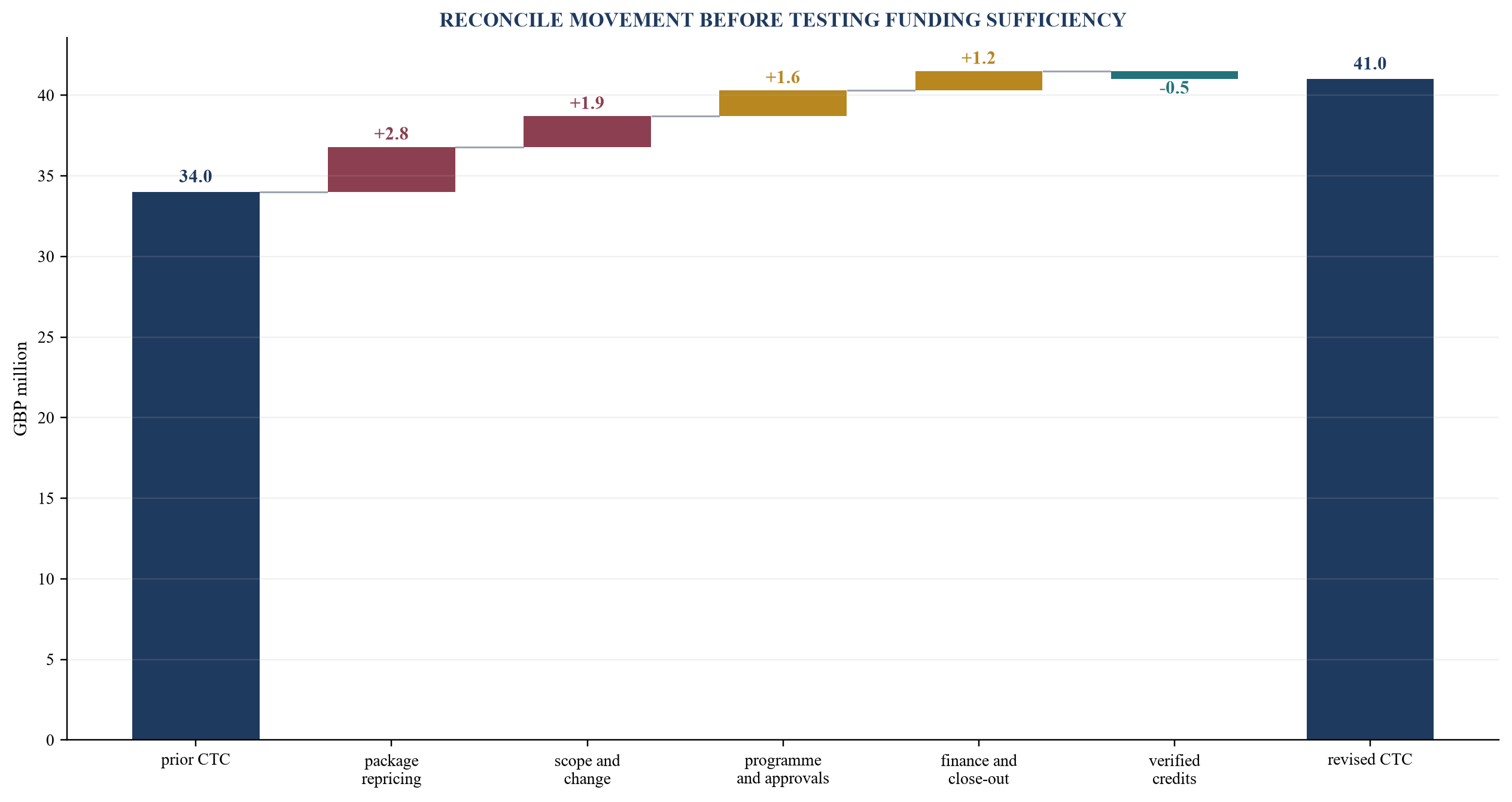
Values are hypothetical GBP millions; a live bridge requires measured package evidence and facility-specific definitions.
4. Reconcile programme, approvals and cost on one timeline
Cost and programme cannot be re-baselined independently. Delay extends preliminaries, professional fees, security, insurance, financing, temporary works, warranties and exposure to price movement. Acceleration can add shifts, supervision, logistics, re-sequencing and productivity risk. A revised budget without a logic-linked programme can therefore understate both cost and cash timing.
The critical path should include design release, procurement, mobilisation, construction, commissioning, utility connection, inspection, statutory approval, practical completion, occupation, sales delivery and facility exit. Each activity should show remaining duration, float, predecessor, evidence, owner and downside range. Contractor programmes are challenged against design status, labour, materials, access, interfaces and approvals rather than accepted as reporting artefacts.
Higher-risk buildings require particular attention. Official guidance states that relevant work requires Building Safety Regulator approval before it begins.[11] Current regulator data records application volumes, decisions, approval rates and elapsed periods, with material variability across case types.[10] A project model should use its own application quality, design maturity, response history and regulator engagement. A national median or target is context, not a project completion date.
Programme delay can also change revenue timing. Pre-sale completion dates, affordable-housing receipts, grant milestones, refinance dates and long-stop obligations should move with the construction programme. The resulting interest, fees and liquidity effects belong in the cost-to-complete and downside case. A recovery programme is credible when resources, access, design, approvals, procurement and decision rights are demonstrated together.
5. Separate price inflation from scope, quantity and productivity
Headline construction inflation can become a convenient explanation for every variance. A sound re-baseline separates price, scope, quantity, productivity, programme and error. Price variance compares the same defined item at different evidence dates. Scope variance records changed output or specification. Quantity variance captures measurement movement. Productivity variance covers labour or plant performance. Programme variance captures time-dependent cost. Error identifies omission, duplication or incorrect assumption in the prior model.
This separation matters because the mitigations differ. Price can be fixed, hedged through procurement timing, substituted or shared contractually. Scope can be redesigned or removed subject to value and compliance. Quantity requires remeasurement and design control. Productivity may require method, labour, supervision or sequencing changes. Programme needs critical-path action. Error requires correction and governance.
ONS reported annual construction output price growth of 1.9 per cent to June 2026, alongside an 11.8 per cent quarterly fall in new orders.[3] These aggregate measures do not establish a project's package cost. Market capacity can differ by trade, region and procurement route. Official material statistics report divergent movements across products.[5] The re-baseline should therefore use indices to challenge, triangulate and scenario-test package evidence.
Contract allocation is equally important. A fixed-price contract can still expose the development to employer change, provisional sums, loss and expense, contractor default, excluded inflation or non-compliant design. An index-linked contract can be modelled transparently when the index, base date, lag, cap, floor and applicable cost base are known. The budget should represent contractual mechanics rather than a generic assumption about who carries inflation.
6. Build a contingency ladder that shows ownership
Contingency should not be one percentage applied to a partially defined cost base. It should be a ladder of uncertainty with evidence, control and ownership. The first layer covers measured design development and known incomplete scope. The second covers procurement uncertainty on packages not yet fixed. The third covers programme and interface risk. The fourth covers statutory approvals, utilities and third parties. The fifth covers retained sponsor risks and a board downside reserve.
Each allowance should state gross exposure, funded amount, probability or scenario basis, mitigation, release condition and decision owner. Correlated risks should be tested together. A delayed approval can produce prolongation, inflation, finance carry and revenue delay; adding independent expected values may understate the tail while adding maximum values may overstate a realistic case. Scenario design should show the dependency.
Contingency drawdown should require evidence that the relevant event occurred and that recovery, transfer or mitigation has been assessed. Release should occur when the exposure is contracted, closed or no longer plausible. Moving an overrun into contingency without updating the base forecast hides variance. A used allowance becomes forecast cost; the remaining reserve then reduces.
The lender and sponsor may hold different reserves. The development budget can carry working contingency; the sponsor can hold committed support outside the project account; the lender can retain facility headroom subject to conditions. These layers should not be double counted. Their legal availability, timing and priority determine whether they are usable completion capital.
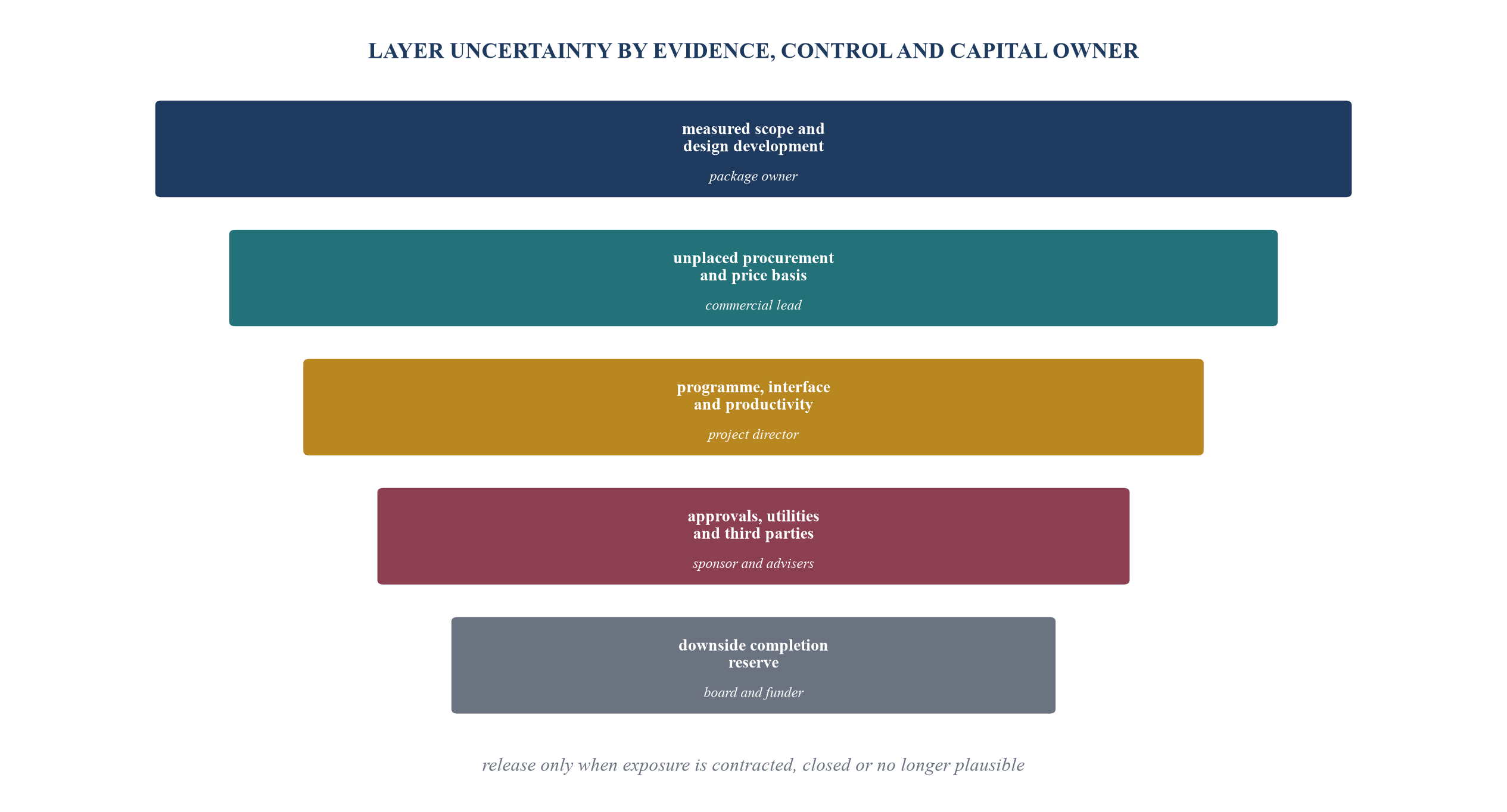
Percentages are hypothetical shares of total risk funding and do not represent market practice.
Table 2. Contingency governance register
| Risk layer | Evidence | Funding treatment | Release or escalation trigger |
|---|---|---|---|
| measured scope | design register, quantities, cost plan | current base forecast | package contracted or scope removed |
| procurement | aligned quotations, tender return, lead time | working contingency | award, expiry or market movement |
| programme | logic-linked plan, resources, approvals | time-risk allowance | float consumed or recovery verified |
| statutory and third party | application, condition, utility offer | specific reserve | approval, connection or obligation fixed |
| downside completion | correlated stress scenario | committed external support | downside breached or board releases reserve |
The range and funding treatment are project-specific; the table shows the required decision fields.
7. Rebuild monthly cash flow and finance carry
An adequate total budget can still fail through timing. The revised cash flow should model certified work, contractual payment dates, retention, advance payments, VAT, tax recovery, professional fees, interest, commitment fees, sales receipts, grant, affordable-housing proceeds, refinance and sponsor support. Each source should be available before the related use falls due.
The model should begin with actual bank and facility balances, not an abstract funding total. Restricted cash, retention accounts, purchaser deposits and amounts subject to lender control should be identified. The facility should show gross commitment, amount drawn, interest or fees added to the loan, remaining availability, further conditions and any amount reserved for interest or specific costs. Equity should distinguish paid-in cash, approved but unpaid contributions and contingent support.
Interest depends on rate, margin, utilisation and time. IAS 23 states that borrowing costs directly attributable to a qualifying asset form part of its cost, while other borrowing costs are expensed within the standard's scope.[13] Accounting classification does not create liquidity; the cash model should show payments and capitalisation separately. Delayed completion can consume facility headroom even if construction cost is unchanged.
VAT and tax timing can be material. A forecast recovery is not cash until eligibility, submission, evidence and timing are credible. The project should record gross payments, recoverable amount, expected receipt, evidence and fallback if delayed. Similar discipline applies to insurance recoveries, contractor credits and claims. A delayed source should be tested as a temporary funding requirement.
8. Use a draw-stoplight dashboard with hard gates
The draw decision should combine technical, financial, legal, valuation and governance evidence. A green status means the current request satisfies defined conditions and sufficient completion funds remain. Amber means the draw may proceed only with specific conditions, reduced amount, retained funds, sponsor cure or enhanced monitoring. Red means a hard stop, such as insufficient funds, unlawful work, material unapproved change, unsupported valuation, unavailable sponsor support or a critical programme failure without a credible recovery plan.
The dashboard should avoid averaging. Five green categories do not neutralise one red condition. Each hard gate should state the authority that can waive, cure or redefine it. Conditions should be objective enough to verify and connected to the facility agreement. Vague requirements such as satisfactory progress create debate without specifying evidence.
Homes England's 2026 monitoring-surveyor scope illustrates the discipline: the consultant reviews expenditure against appraisal, cash flow and agreed plans; a certificate is a condition to draw; the interim report addresses sufficient funds, cost-to-complete, variation, revenue, quality, programme and compliance.[1][2] Private facilities will have their own terms, but the evidence architecture is transferable.
The dashboard should state the consequences of each option. Funding the draw can preserve programme and collateral while increasing exposure. Delaying can protect cash while causing contractor claims, lost procurement slots or programme damage. A partial draw can fund critical path only. A conditioned draw can require equity first, direct payment, escrow, contractor security, revised contracts, sales evidence or board-approved support.
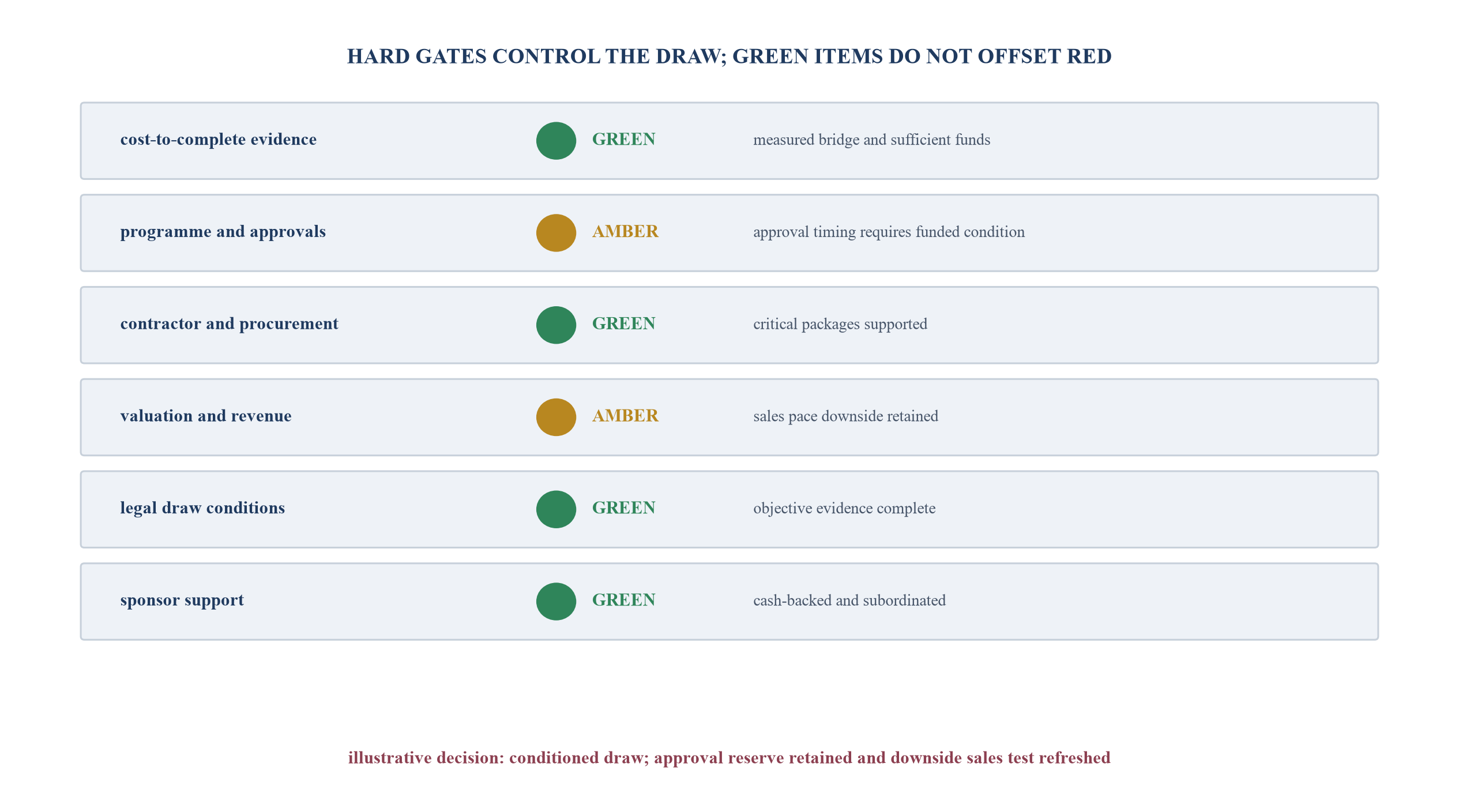
Status definitions are illustrative; live authority and conditions come from the facility agreement and professional advice.
Table 3. Draw decision matrix
| Gate | Green evidence | Amber response | Red response |
|---|---|---|---|
| sufficient funds | verified sources exceed completion use and buffer | equity first, reserve or reduced draw | stop and restructure funding |
| programme | logic-linked and resourced | milestone condition and enhanced monitoring | stop where completion path is not credible |
| approvals | required approvals in place or funded plan supported | ring-fenced risk and dated condition | stop unlawful or unapproved work |
| contractor | capacity, security and procurement supported | direct payment, bond or replacement plan | stop exposure to unsupported default risk |
| value and revenue | current valuation and sales evidence support exit | downside covenant or cash trap | resize where exit no longer supports debt |
| legal conditions | all conditions satisfied or validly waived | documentary cure before release | no draw without authorised waiver or cure |
Conditions should be objective, time-bound and linked to authority.
9. Assess contractor and supply-chain resilience
Construction counterparty risk belongs inside cost-to-complete. Official statistics recorded 3,803 construction insolvencies in the 12 months to May 2026, 17 per cent of cases where industry was captured.[12] The statistics do not establish the probability that a particular contractor will fail. They support a stronger project-specific review of financial condition, payment flow, disputes, subcontractor exposure, bonds, guarantees, vesting, collateral warranties and replacement capacity.
Replacement cost includes more than the remaining contract sum. It can include re-procurement premium, mobilisation, design review, survey of completed work, defects, lost warranties, security, site protection, delay, professional fees and duplicate preliminaries. Existing bonds or guarantees reduce exposure only to the extent that validity, amount, expiry, claim conditions and counterparty ability are verified.
Direct payment or project-bank arrangements can preserve critical supply where contractually and legally appropriate. They can also create preference, certification, control and interface issues. The decision requires legal advice and documented authority. Cost forecasting should show the economic effect and avoid assuming that a payment mechanism resolves performance risk.
10. Re-test revenues, valuation and exit timing
Completion funding cannot rely on a stale gross development value. The revenue model should reconcile units, area, tenure, price, incentives, sales status, purchaser funding, deposit, exchange, completion conditions, affordable-housing receipts, grant and disposal timing. Evidence should distinguish asking price, reservation, exchange and completed sale.
The June 2026 UK House Price Index reported 1.8 per cent annual growth in England with pronounced regional variation; London recorded an annual decline of 2.5 per cent.[9] Completed transaction data are backward-looking and provisional at the recent end. A development should use current comparable evidence, scheme-specific demand, absorption and incentives. National growth should not be applied mechanically to every unit.
Sales delay affects more than revenue. It can extend interest, marketing, service, security and holding costs; delay facility exit; trigger cash traps; and increase unsold-stock exposure. A rental or bulk-sale fallback should include price, timing, purchaser capacity, tax, operating cost and legal feasibility. Optionality has value only when executable.
The valuer should receive the revised cost, programme, specification, approvals, sales evidence and completion standard. The lender should understand whether the existing valuation assumptions remain valid and how value changes affect loan-to-cost, loan-to-value, interest cover, covenant and exit. IAS 36 and IAS 2 provide accounting contexts for impairment and inventory measurement within their scope; the live conclusion belongs to qualified accountants using entity-specific facts.[14][15]
11. Structure sponsor support as completion capital
A sponsor support letter without amount, timing and enforceability may be management intent rather than available funding. The support register should state provider, instrument, maximum amount, currency, funding date, conditions, subordination, repayment, security, approvals, evidence of capacity and consequence of non-payment. Group cash should be distinguished from cash legally available to the project.
The capital waterfall normally starts with project cash and permitted revenue, then committed equity, undrawn senior facility, approved subordinate capital and a downside completion reserve. The order depends on documents. Equity-first mechanics can protect the lender; pari passu funding can align capital; a cost-overrun guarantee can place defined excess with the sponsor. Each structure changes incentives, control and timing.
Support should match the risk. A finite package overrun can be cured with cash or an instrument sized to the evidence range. A persistent viability gap may require facility resize, additional equity, subordinate debt, scope redesign, asset sale or a controlled restructuring. Funding one more draw without resolving structural insufficiency can increase exposure and reduce options.
The waterfall should include fallback. If support is not funded by the required date, options can include draw suspension, cash trap, direct payment, enforcement of security, replacement funding, controlled sale or restructuring. Counsel should determine enforceability and priority. The cost model should assess timing and execution cost rather than assuming immediate recovery.
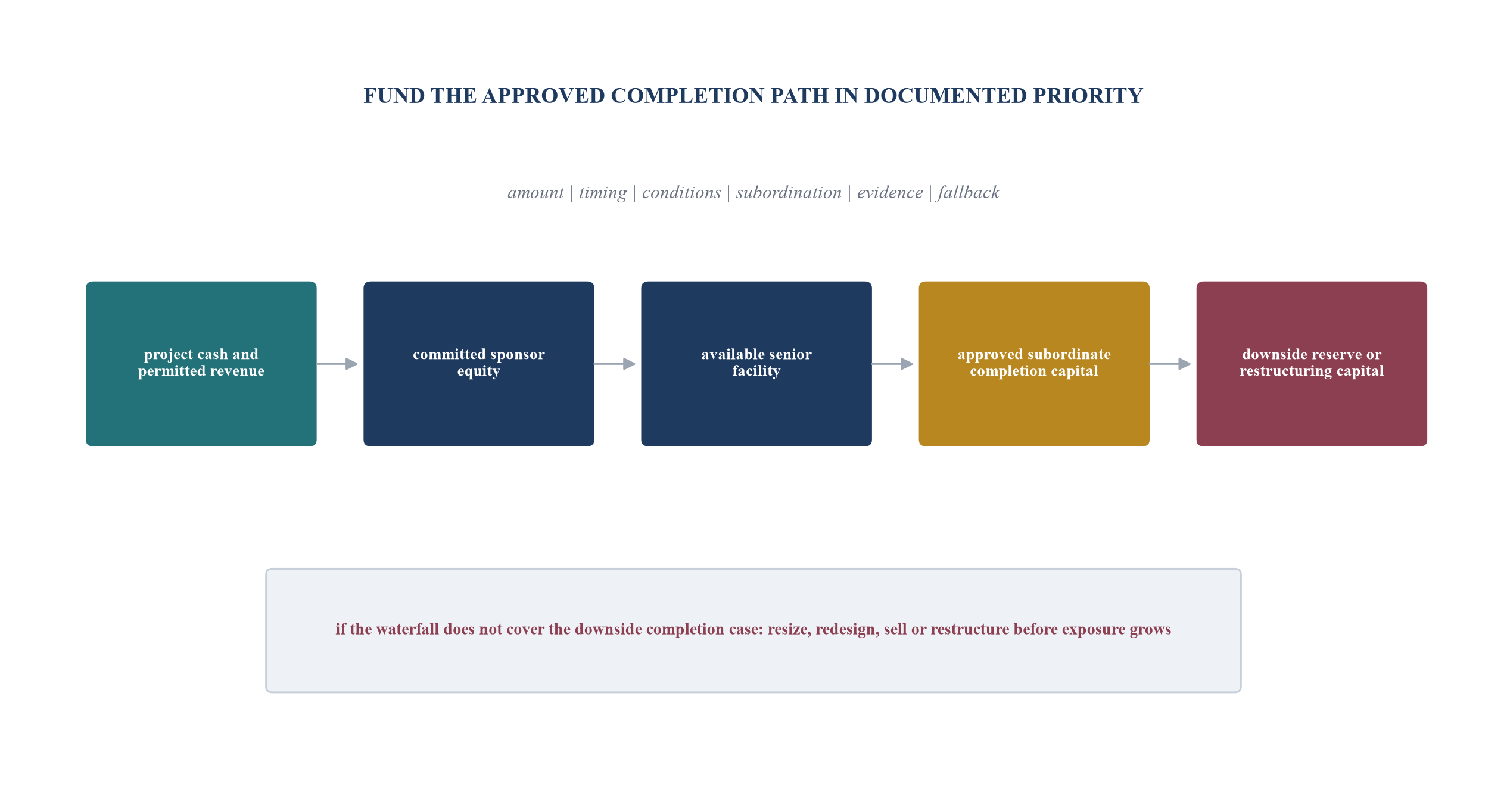
The ordering is illustrative; live priority, control and availability follow the financing documents.
Table 4. Sponsor-support instrument register
| Instrument | Evidence of availability | Control feature | Principal residual risk |
|---|---|---|---|
| paid-in equity | cleared project-account cash | equity-first application | cash already consumed by other uses |
| equity commitment | board approval, funding evidence, binding terms | dated call and draw condition | provider capacity or conditionality |
| cost-overrun support | defined covered costs, cap, demand mechanics | cure right and lender enforcement | exclusions, expiry and dispute |
| subordinated loan | executed documents, cash source, priority | payment block and standstill | maturity, interest and intercreditor terms |
| standby facility | committed lender, conditions, availability period | controlled draw and purpose | conditions or expiry before need |
| completion reserve | ring-fenced cash or eligible instrument | release only against defined downside | insufficiency under correlated stress |
Legal, tax, accounting and regulatory advice is required for live structures.
12. Decide whether to fund, condition, resize or stop
The decision menu should be explicit. A full draw may be appropriate where evidence is current, conditions are satisfied, sufficient funds remain and the draw protects completion. A conditioned draw can require sponsor equity first, a reduced request, direct payment, retained contingency, package award, approval evidence, revised programme, valuation update or additional security. A temporary stop can preserve options while a discrete evidence gap is cured.
Resizing becomes relevant when the project remains viable but capital structure is inadequate. Options include additional senior debt, subordinate capital, equity, asset disposal, bulk sale, grant, scope change or phased completion. Each option should be tested for time, certainty, cost, ranking, covenant and effect on value. A larger facility may solve liquidity while worsening leverage and exit risk.
A managed restructuring is required when the current completion path is not supportable. The board and lender should preserve site, approvals, contracts, information, insurance and critical relationships while comparing rescue, sale, enforcement and insolvency pathways with qualified advisers. Delay can reduce options, but speed without evidence can crystallise avoidable loss.
The decision paper should record facts, assumptions, evidence, cases, options, authority, conflicts and conditions. Companies Act duties apply to directors; professional advice is required as financial distress develops.[16]
13. Apply a worked re-baselining scenario
Consider a hypothetical 180-unit residential scheme in England. The original total development cost is GBP 82.0 million, funded by GBP 24.0 million sponsor equity, a GBP 50.0 million senior facility and GBP 8.0 million permitted sale and other receipts. At the evidence date, GBP 41.0 million has been paid, GBP 28.5 million of senior debt has been drawn and GBP 21.5 million remains available before interest and conditions.
The prior report states cost-to-complete of GBP 34.0 million. The package review identifies GBP 2.8 million of current repricing and incomplete procurement, GBP 1.9 million of scope and change, GBP 1.6 million of programme and approval exposure, GBP 1.2 million of finance and close-out cost and GBP 0.5 million of verified credits. Revised cost-to-complete is GBP 41.0 million. A further GBP 2.2 million liquidity buffer is retained for a defined downside case.
Verified project cash, remaining facility, permitted receipts and already committed sponsor equity provide GBP 39.6 million before new support. The base completion need plus buffer is GBP 43.2 million, creating a GBP 3.6 million funding gap. The sponsor proposes GBP 4.5 million of additional subordinated completion capital, cash-backed and available before the draw. The lender retains GBP 0.9 million as excess cushion subject to draw conditions.
The next requested draw is GBP 4.0 million. Technical evidence supports GBP 3.4 million of certified and critical-path uses. An approval-related package can be deferred without damaging the critical path, and GBP 0.6 million is held. The illustrative decision is a GBP 3.4 million conditioned draw after sponsor capital is funded, the revised programme is approved, critical procurement evidence is delivered and the monitoring surveyor confirms sufficient funds under the base case.
Every amount in this scenario is hypothetical. A different programme, facility definition, tax position, valuation, support instrument or approval status could change the decision materially.
14. Run completion sensitivity before approving support
Sensitivity should combine cost, time, revenue and funding. Single-variable tests are useful for attribution but can miss correlation. A cost increase can cause delay; delay adds interest and may weaken sales; weak sales delay repayment; contractor distress can create both cost and programme effects. The downside case should therefore combine plausible pathways supported by project evidence.
The matrix can test package repricing, delay months, interest rate, sales-price movement, absorption, approval timing, contractor replacement and recovery delay. Outputs include funding gap, peak debt, covenant headroom, completion date, interest, gross development value and facility exit. Each cell should state whether current support covers the result and which decision trigger is reached.
Probabilities should be used carefully. A precise expected value can disguise a completion threshold. If the project needs GBP 6 million in a downside state and only GBP 3 million is available, a lower probability does not make the project fundable when that state occurs. Liquidity decisions often require coverage of a defined adverse scenario rather than an average outcome.
Sensitivity also tests mitigations. Early procurement can reduce price uncertainty while increasing deposit and counterparty exposure. Phasing can reduce peak cash while delaying revenue or adding interfaces. Bulk sale can improve certainty at a lower price. Scope reduction can protect cost while impairing valuation or approval. The model should record both sides.
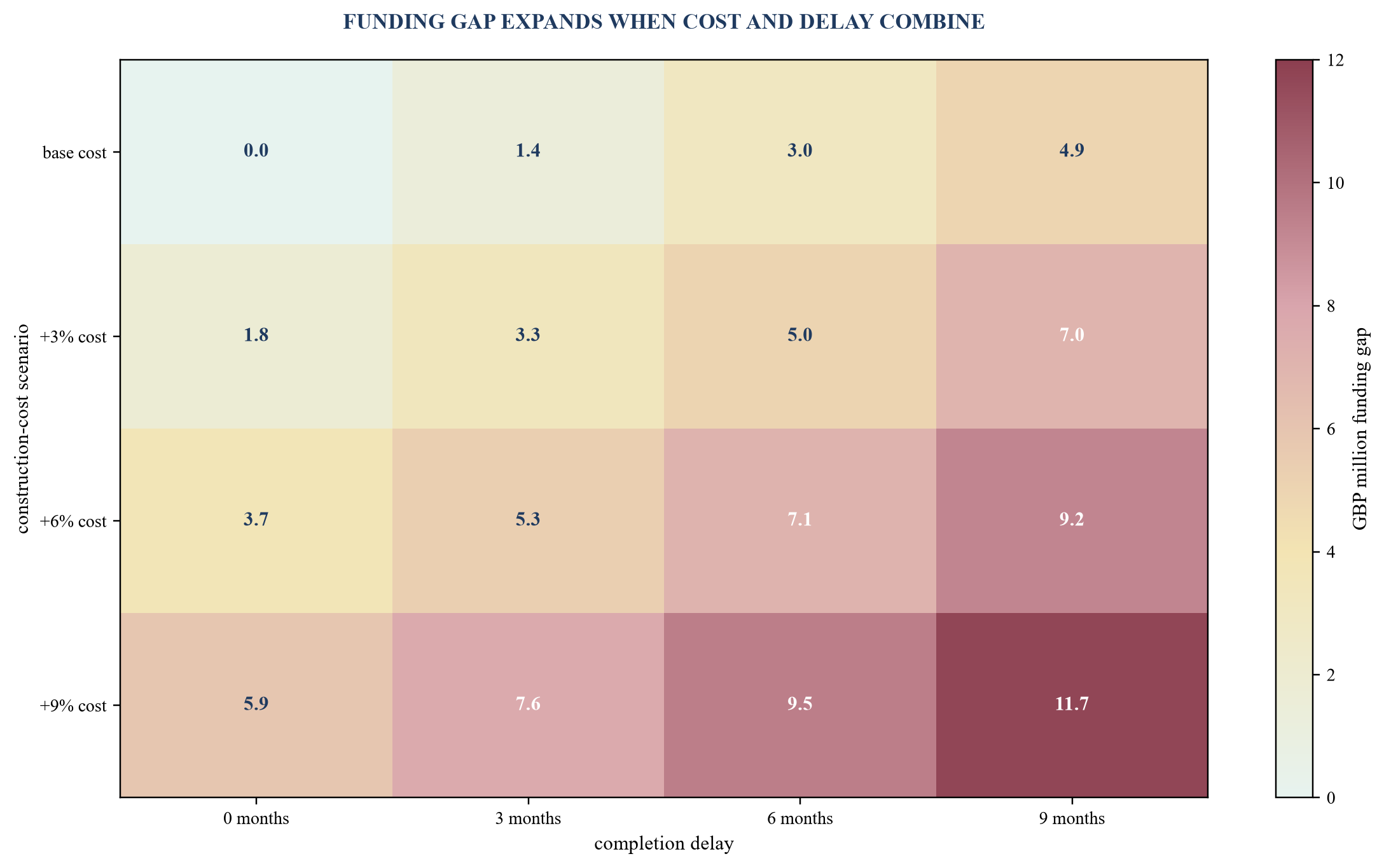
Funding gaps are hypothetical GBP millions; live scenarios require project-specific cost, programme, revenue and financing evidence.
Table 5. Illustrative completion cases
| Case | Revised cost-to-complete | Completion delay | Revenue effect | Funding response |
|---|---|---|---|---|
| current base | GBP 41.0m | 0 months | current evidence | GBP 4.5m committed support covers gap and buffer |
| procurement stress | GBP 43.1m | 1 month | none assumed | draw reserve and additional package evidence |
| approval delay | GBP 44.0m | 6 months | receipts delayed | larger support, interest reserve and milestone condition |
| sales downside | GBP 42.2m | 3 months | 5% lower selected receipts | cash trap, revised valuation and exit plan |
| combined downside | GBP 47.6m | 9 months | 7% lower and slower | capital restructure before further exposure |
All amounts and outcomes are hypothetical modelling assumptions.
15. Establish weekly governance and monthly certification
The re-baseline is a controlled system rather than a one-off spreadsheet. The weekly project forum should review change, procurement, programme, approvals, contractor health, cash, sales and decisions. The monthly lender cycle should freeze evidence, reconcile cost and funding, complete site inspection, update valuation or sales evidence where required, certify conditions and record the draw decision.
Owners should be clear. The sponsor owns the development and funding plan. The project director owns programme and delivery evidence. The cost consultant owns professional cost measurement within the appointment. The monitoring surveyor provides independent monitoring under its duty and scope. The valuer owns valuation advice. The lender owns credit decisions. Counsel, accountant and other advisers own their professional conclusions. Combining these roles into one dashboard should not blur accountability.
Escalation thresholds can include forecast cost movement, contingency consumption, funding headroom, programme delay, covenant headroom, sales pace, contractor signals or overdue decisions. A threshold prompts review; it does not determine the answer. The board and lender need the underlying evidence and options.
16. Draft objective draw conditions and cure mechanics
Conditions should describe evidence that can be delivered and verified. Examples include paid-in sponsor equity, an executed support instrument, monitoring-surveyor confirmation of sufficient funds, a revised programme, specified package awards, approval, valuation, insurance, bond extension, contractor evidence, updated sales schedule or direct-payment mechanics. Each condition states form, owner, deadline, reviewer and consequence.
Conditions subsequent can support timing where the risk is bounded and the facility permits them. Their use should not defer a hard prerequisite. A condition that remains overdue across draws becomes structural. The dashboard should show ageing and prevent repeated waiver without a fresh authority decision.
Cure mechanics should align with the risk. A cash shortfall requires usable capital. A programme gap requires a credible and resourced recovery plan. A contractor risk may require security, replacement capacity or controlled payment. An approval gap requires lawful and technically acceptable evidence. An unsupported valuation requires updated advice. Documents cannot cure the absence of the underlying capability.
17. Connect the re-baseline to accounting and board reporting
The development cost model and financial statements serve different purposes and should reconcile. The cost model forecasts cash and completion. The accounting ledger records transactions under applicable standards and policies. Differences can arise through accruals, capitalised borrowing costs, inventory measurement, impairment, provisions, VAT, intercompany balances and revenue recognition. A reconciliation should explain these differences rather than forcing one model to mimic the other.
IAS 23 addresses borrowing costs directly attributable to qualifying assets.[13] IAS 2 governs inventories and includes measurement at the lower of cost and net realisable value within its scope.[15] IAS 36 addresses impairment for assets within its scope.[14] The entity's accountants determine application. A revised cost, delay or revenue downside can be relevant to accounting estimates, liquidity and disclosure even before the cash is spent.
Board reporting should show base, downside and funding response; key assumptions; evidence quality; draw status; support availability; covenant and liquidity headroom; valuation and revenue movement; decisions and unresolved matters. The FRC's going-concern guidance emphasises proportionate assessment and disclosure of material uncertainties for relevant UK entities.[17] Project reporting should give directors enough evidence to assess obligations and options.
The board should also test conflicts. Sponsor, lender, contractor, shareholder and director interests may diverge as headroom reduces. Decisions, advice, recusals and authority should be documented.
18. Implement the reset before the next draw
The first two days freeze evidence and definitions. Confirm the evidence date, facility terms, completion standard, cost taxonomy, programme baseline, cash balance, draw request and owners. Days three to five reconcile paid, accrued, committed and forecast cost; review unplaced packages, change, approvals, contractor health, revenue and finance carry. The cost consultant and monitoring surveyor conduct their work under their appointments and duties.
Days six to eight build the cost-to-complete bridge, contingency ladder, monthly cash flow, funding waterfall and base/downside sensitivities. The sponsor prepares support evidence and options. The valuer, lawyer, accountant and other specialists address issues within their scope. The team tests whether the requested draw protects the critical path and whether any amount can be deferred.
Days nine and ten produce the decision pack. It includes the evidence register, reconciliation, programme, sufficient-funds test, stoplight dashboard, support instruments, conditions, options and recommendations. The authorised decision makers approve, condition, resize, defer or decline the draw. The next monitoring cycle begins from the revised control budget without erasing the original baseline.
The durable result is a project where cost, programme, value and capital tell the same story. Re-baselining does not remove uncertainty. It converts uncertainty into measured packages, explicit reserves, timed funding, objective conditions and decisions that can be revisited as evidence changes. That discipline protects completion value and preserves options for lender and sponsor before a stale budget turns into an unmanaged funding gap.
References
- Homes England. Lot 3 - Monitoring surveyor - Interim report. 10 July 2026. https://www.gov.uk/government/publications/homes-england-property-financial-and-development-services-framework-2026-to-2030/lot-3-monitoring-surveyor-interim-report
- Homes England. Lot 3 - Monitoring surveyor - Initial report. 10 July 2026. https://www.gov.uk/government/publications/homes-england-property-financial-and-development-services-framework-2026-to-2030/lot-3-monitoring-surveyor-initial-report
- Office for National Statistics. Construction output in Great Britain: June 2026, new orders and Construction Output Price Indices, April to June 2026. 13 August 2026. https://www.ons.gov.uk/businessindustryandtrade/constructionindustry/bulletins/constructionoutputingreatbritain/latest
- Office for National Statistics. Construction output price indices, January 2014 to June 2026. 13 August 2026. https://www.ons.gov.uk/businessindustryandtrade/constructionindustry/datasets/interimconstructionoutputpriceindices/current
- Department for Business and Trade. Construction building materials: commentary July 2026. https://www.gov.uk/government/statistics/building-materials-and-components-statistics-july-2026/construction-building-materials-commentary-july-2026
- Bank of England. Credit Conditions Survey: 2026 Q2. 2 July 2026. https://www.bankofengland.co.uk/credit-conditions-survey/2026/2026-q2
- Bank of England. Agents' summary of business conditions: July 2026. https://www.bankofengland.co.uk/agents-summary/2026/july-2026
- Bank of England. Financial Stability Report: July 2026. https://www.bankofengland.co.uk/financial-stability-report/2026/july-2026
- HM Land Registry. UK House Price Index for June 2026. 19 August 2026. https://www.gov.uk/government/statistics/uk-house-price-index-for-june-2026
- Building Safety Regulator. Building control approval application data May to July 2026. https://www.gov.uk/government/publications/building-safety-regulator-building-control-approval-application-data-may-to-july-2026/building-safety-regulator-building-control-approval-application-data-may-to-july-2026
- UK Government. Building regulations approval: when you need approval. https://www.gov.uk/building-regulations-approval
- The Insolvency Service. Commentary: Company Insolvency Statistics May 2026. https://www.gov.uk/government/statistics/company-insolvencies-may-2026/commentary-company-insolvency-statistics-may-2026
- IFRS Foundation. IAS 23 Borrowing Costs. https://www.ifrs.org/issued-standards/list-of-standards/ias-23-borrowing-costs/
- IFRS Foundation. IAS 36 Impairment of Assets. https://www.ifrs.org/issued-standards/list-of-standards/ias-36-impairment-of-assets/
- IFRS Foundation. IAS 2 Inventories. https://www.ifrs.org/issued-standards/list-of-standards/ias-2-inventories/
- United Kingdom. Companies Act 2006, Chapter 2, general duties of directors. https://www.legislation.gov.uk/ukpga/2006/46/part/10/chapter/2
- Financial Reporting Council. Guidance on the Going Concern Basis of Accounting and Related Reporting, including Solvency and Liquidity Risks. 2025. https://www.frc.org.uk/library/standards-codes-policy/accounting-and-reporting/going-concern-and-related-reporting/
