

1. Define the asset that must trade on Day 1
An e-commerce carve-out is a business-separation problem before it is a valuation problem. The buyer needs to know which legal rights, assets, contracts, people, data, systems and operating capabilities cross the perimeter. A brand and website may appear self-contained while orders are authorised through the seller's payment account, customer identities sit in a group platform, stock is managed in a shared warehouse and marketing audiences depend on group consent language. The headline transaction perimeter therefore needs an operating perimeter and an evidence perimeter.
The investment committee should define the Day-one promise in observable terms. Customers must be able to browse, purchase, pay, receive, return, obtain refunds, manage preferences and exercise information rights. Finance must reconcile orders, cash, refunds, chargebacks, inventory and tax. Operations must see stock, release orders, ship within promised service levels and manage exceptions. Technology must authenticate users, protect data, monitor availability and recover critical services. Every promise needs an accountable owner and a fallback that has been tested before closing.
The central financing question is whether the carved-out entity can convert lawful customer demand into cash after paying product, fulfilment, payment, marketing, service, technology and standalone overhead costs. That question cannot be answered from group segment profit alone. It requires a reconciled order-to-cash model and a separation plan that shows when temporary seller support ends.
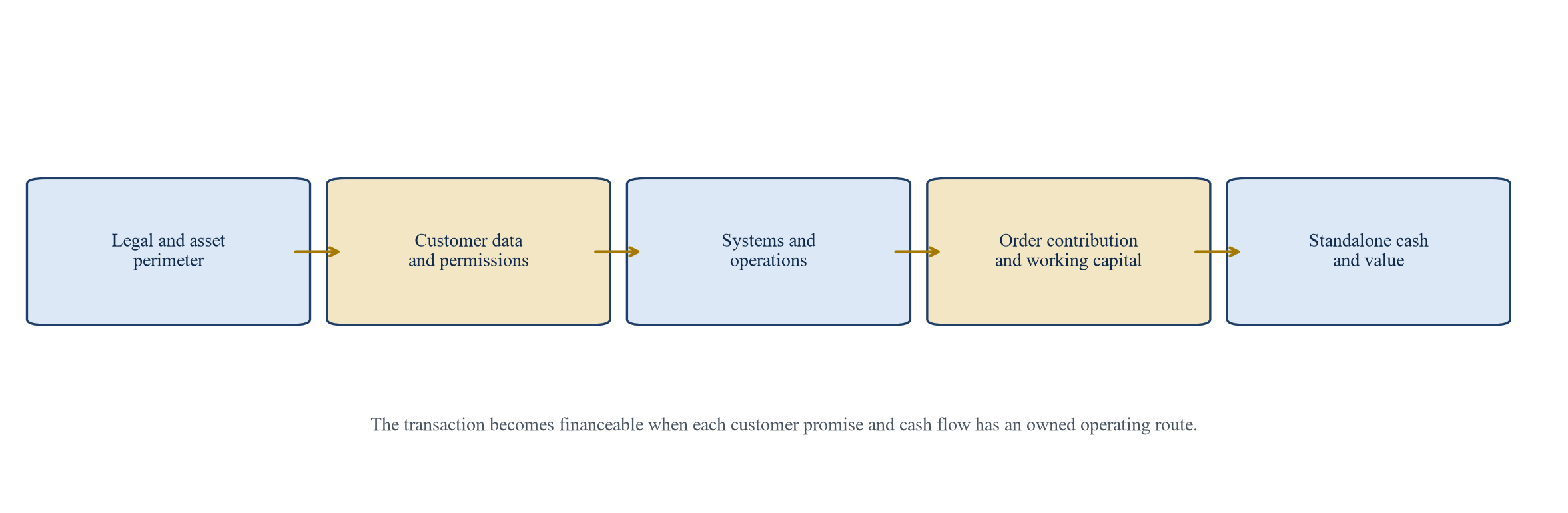
Proposed evidence chain. Each stage requires a defined asset, accountable owner, control and financial consequence.
| Decision | Evidence required | Failure signal | Transaction response |
|---|---|---|---|
| What transfers? | asset schedule, contracts, licences, data register | critical right remains with seller | amend perimeter or secure service |
| Can customers trade? | tested journey, service levels, incident plan | dependency has no fallback | condition closing or retain TSA |
| Can data be used? | purpose, lawful basis, consent and notice evidence | buyer purpose exceeds original use | restrict use or obtain new permission |
| What does an order earn? | cohort and order-level contribution bridge | group allocation masks variable cost | rebuild economics from source records |
| When does independence begin? | separation plan, owners, costs and exit tests | service exit depends on unbuilt system | fund and gate the replacement |
| What funds the transition? | cash model, working-capital and contingency plan | liquidity falls below operating floor | resize price, equity or facility |
The questions connect legal perimeter, operational continuity and value.
2. Establish the legal and commercial perimeter
The sale agreement should identify the customer-facing rights that support the revenue model. These can include trade marks, domains, app-store accounts, content, product images, supplier terms, marketplace accounts, warehouse rights, carrier contracts, payment arrangements, customer-service tools, warranties, returns obligations, gift cards, loyalty liabilities and historic claims. A schedule that simply lists "customer database" or "technology" does not identify what can actually be transferred or used.
The legal entity and asset route influence continuity. A share sale may preserve contracts and the identity of the controller while transferring ownership of the company. An asset sale may require contract novations, new merchant accounts, employee transfers and a change of controller for personal data. The analysis should be transaction-specific and reviewed by qualified advisers. This paper provides a decision framework rather than a legal conclusion.
Competition analysis should be connected to the operating model. The CMA's merger guidelines focus on whether a transaction may result in a substantial lessening of competition and recognise the significance of digital technologies, dynamic competition and non-price dimensions.[1] A carve-out may create a stronger independent competitor, yet the buyer still needs evidence on customer switching, data advantages, marketplace access, supplier leverage and potential future competition. If a remedy or hold-separate commitment changes access to data or systems, the financial model must reflect it.
The Digital Markets, Competition and Consumers Act 2024 strengthens the UK's digital-markets and consumer-protection framework.[2] It also addresses unfair commercial practices, subscription contracts, drip pricing and fake reviews. The buyer should test the carved-out customer journey against the current rules and enforcement guidance rather than inherit the seller's interface assumptions. A commercially attractive conversion tactic can create remediation cost, refund exposure or reputational damage when the interface or price presentation is not compliant.
3. Treat customer data as a governed operating capability
The Information Commissioner's Office states that where a merger, acquisition or organisational change transfers data to a different or additional controller, the parties should include data sharing in due diligence, identify what data transfers, establish original purposes and lawful basis, document the sharing, consider information to data subjects and maintain governance and security.[3] This makes customer-data value conditional. The buyer receives responsibilities and constraints alongside records.
Build a data register at dataset and field-group level. Each record should identify source, controller, purpose, lawful basis, consent language where relevant, data subjects, geography, sensitivity, retention, processor, system, recipients, transfer mechanism, accuracy issue, suppression status and proposed buyer use. Link the register to the purchase agreement and the systems plan. A field can be present in an export while remaining unusable for a planned purpose.
Purpose limitation deserves explicit testing. ICO guidance links specified purpose to transparency, data minimisation and accountability and requires organisations to assess compatibility and update privacy information before reusing personal data for a new purpose.[4] A buyer that wants to train a recommendation model, combine records with another brand or expand third-party advertising may create a purpose beyond the original customer expectation. The diligence record should show the legal analysis, decision owner and launch condition for each proposed use.
Accuracy and suppression records are operational assets. An email file without unsubscribe history, identity resolution, complaint status or deletion instructions can cause unlawful or damaging contact. The transfer package should preserve the evidence required to honour objections, withdrawals, access requests, erasure outcomes and restrictions. Data minimisation can reduce separation risk by limiting the transfer to records and fields needed for the approved purpose.
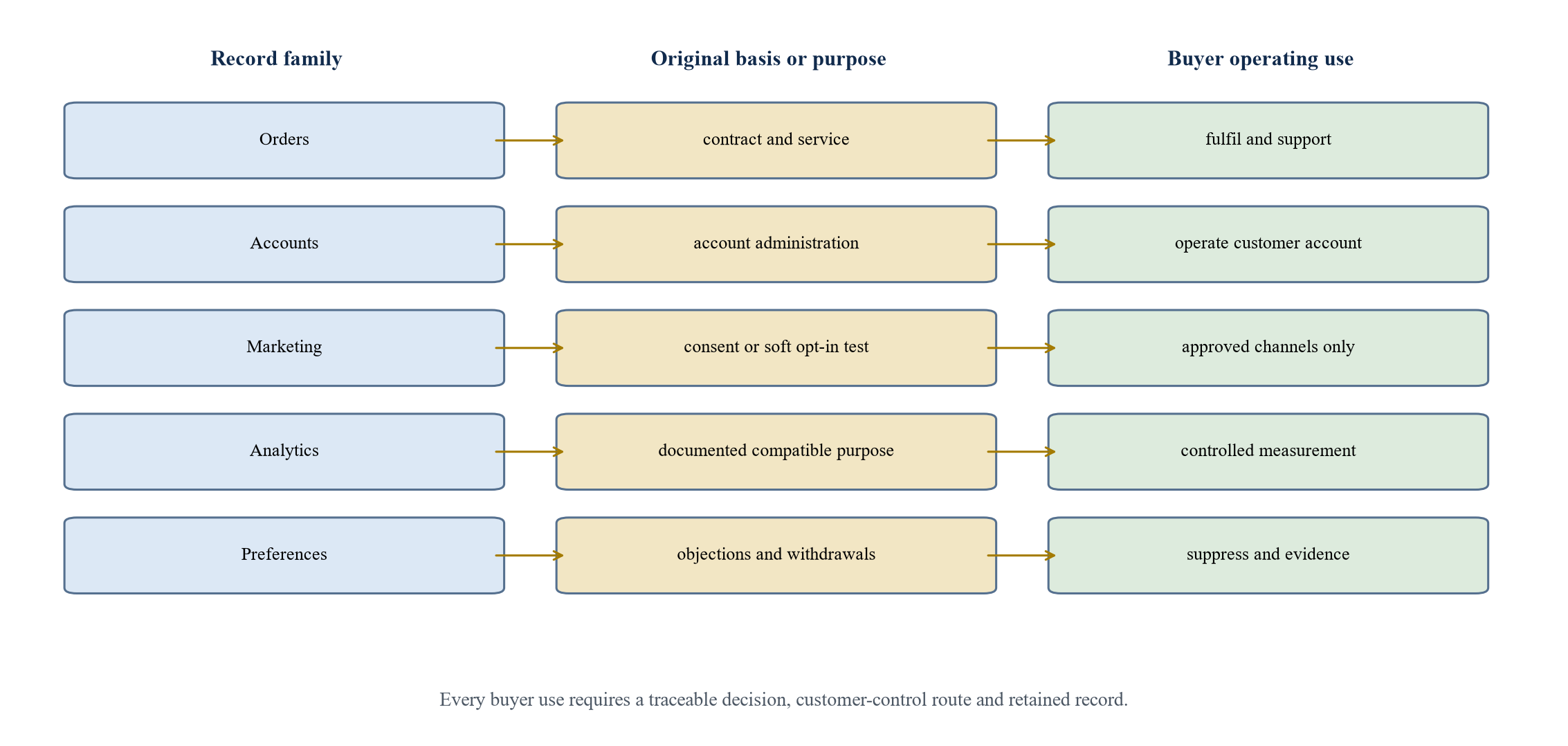
Proposed architecture connecting source purpose, transfer decision, buyer use, customer controls and retained evidence.
| Field group | Required evidence | Buyer decision | Stop condition |
|---|---|---|---|
| identity and account | source, controller, notice, authentication status | transfer fields needed to operate accounts | identity cannot be reconciled |
| order and fulfilment | contract purpose, retention, returns and warranty links | retain for service and legal obligations | order cannot be tied to obligation |
| marketing permissions | channel, wording, date, method, organisation named | use only where permission or exception is supported | generic or missing evidence |
| browsing and analytics | cookie or device source, purpose, platform and retention | separate essential operations from optional analytics | purpose or collection route unknown |
| complaints and rights | complaint, objection, erasure, restriction and outcome | preserve control history and open actions | suppression record is missing |
| derived segments | model, inputs, version, purpose and validation | approve only for documented compatible use | segment cannot be explained or reproduced |
The register should reconcile the proposed transfer with the buyer's approved operating purpose.
4. Test direct-marketing permissions channel by channel
Direct marketing often drives the value case for an online retailer, yet a customer email address does not automatically carry a transferable marketing permission. ICO guidance explains that PECR restricts unsolicited marketing through electronic channels and that consent must be freely given, specific, informed and unambiguous where required.[5] Indirect consent requires particular care and generic consent covering any third party is insufficient. The due-diligence test should identify the organisation named, communication channel, product scope, collection route, date, wording and withdrawal record.
The soft opt-in, where available, has conditions that must be tested against the actual seller, sale or negotiation, similar products and opt-out opportunities. An asset buyer should not assume that the seller's relationship transfers with the database. Counsel should determine the position for the transaction structure and proposed communications. The model should assign zero marketing value to records that have not passed the applicable test until a lawful route is established.
Separate service communications from marketing. Order confirmations, delivery updates, security notices and product-recall messages support the customer contract or legal obligation. Cross-selling, win-back messages, promotional recommendations and loyalty offers may be direct marketing. The same platform can send both, so templates, triggers and audience rules need to be classified before migration.
Preference centres, unsubscribe links and suppression services must operate from Day 1. A transition service that sends messages from the seller's platform can confuse controller identity and accountability unless roles, instructions, templates, evidence and incident procedures are precise. The buyer should run a sample reconstruction that proves how a selected customer entered a campaign and how an objection prevents the next send.
| Test | Evidence | Commercial treatment | Control owner |
|---|---|---|---|
| named organisation | consent wording and customer view | include only if buyer use is covered | privacy lead |
| channel specificity | separate email, SMS, push and call fields | value each channel separately | marketing operations |
| collection and timestamp | form, system log, date and source | exclude records without reproducible provenance | data owner |
| soft opt-in conditions | sale context, similar product and opt-out history | include after documented legal test | legal and privacy |
| withdrawal and objection | current suppression and preference records | apply before first buyer communication | CRM owner |
| ongoing evidence | campaign list, rule version and send log | retain audit trail for every send | campaign owner |
Legal conclusions require transaction-specific advice; the table defines the evidence questions.
5. Reconstruct customer cohorts from source transactions
Customer value should be rebuilt from observed transactions rather than a single lifetime-value output. Define cohorts by first purchase period, acquisition source, product category, geography, device, discount status and any other dimension that materially changes economics. Reconcile gross orders to completed orders, returns, cancellations, refunds, chargebacks and cash receipts. A repeat-purchase curve based on placed orders can overstate value when return rates differ across channels or product groups.
The cohort table should distinguish observed maturity from forecast periods. Recent cohorts have less time to repeat, so a simple comparison can make them appear weaker. Use fixed observation windows and show the number of customers remaining eligible for each measure. Seasonality, promotions, stock availability, shipping thresholds and changes to attribution logic should be visible.
Acquisition cost must include the complete economic burden. Platform fees, agency cost, creative production, affiliates, voucher leakage, influencer payments and internal campaign labour can sit in different ledgers. Organic traffic may still require content, search and brand investment. A buyer should separate variable acquisition cost from the fixed capability required to sustain the channel after separation.
Retention forecasts should connect to customer experience. Delivery reliability, return friction, product quality, stock availability, loyalty benefits, price and service response can drive repeat behaviour. A model that relies on customer identity, recommendation logic or promotional cadence hosted by the seller must show the performance effect during transition and after replacement.
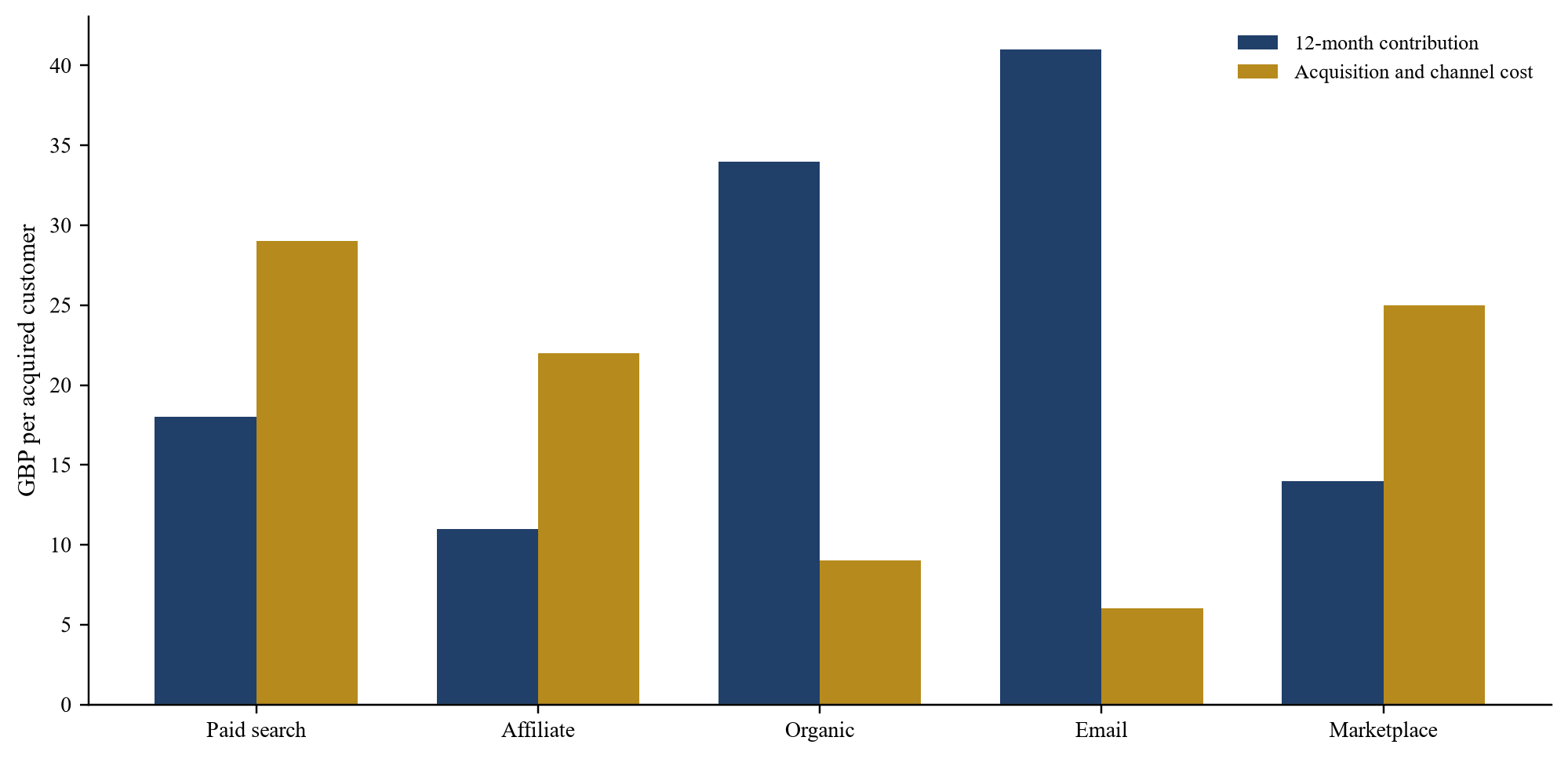
Modelling assumptions in GBP per acquired customer; values do not represent an identified retailer.
| Measure | Numerator | Denominator | Diligence control |
|---|---|---|---|
| completed-order rate | shipped less cancelled orders | placed orders | consistent order-status map |
| net revenue | cash sales less returns, refunds and taxes | completed orders or customers | reconcile to ledger and payment processor |
| product contribution | net revenue less product and inbound cost | completed orders | SKU cost and rebate policy |
| fulfilment contribution | product contribution less pick, pack, carrier and return handling | completed orders | cost by size, route and service level |
| repeat rate | customers with qualifying later purchase | mature starting cohort | fixed observation window |
| contribution after acquisition | cohort contribution less complete acquisition cost | acquired customers | channel attribution and cost completeness |
Each measure should reconcile to transaction and cash records before it enters valuation.
6. Build order economics before accepting segment margin
The order is the smallest useful unit of standalone economics. Begin with item revenue and deduct discounts, refunds, sales taxes collected on behalf of authorities, product cost, inbound freight, duties, packaging, payment fees, fraud losses, outbound delivery, warehouse activity, customer service, returns processing and disposal or markdown. Some costs behave by item, parcel, order, payment, customer contact or return event; the model should preserve those drivers.
Returns can change the economics twice. They reverse revenue and can add collection, inspection, repackaging, refurbishment, disposal, refund and customer-service cost. Returned inventory may recover value later, so the accounting and cash timing must be reconciled. Categories with similar gross margin can generate different cash because return rate, fulfilment footprint and recovery value differ.
Payment economics require more than the headline merchant-service rate. Gateway, acquirer, scheme, fraud, chargeback, reserve, currency and alternative-payment costs can vary by method and geography. A new buyer merchant account may have different pricing, settlement timing, rolling reserves or approval thresholds. The working-capital model should use the proposed arrangement rather than the seller's group terms.
Shipping thresholds and promotions change both demand and cost. The diligence team should test order contribution around the threshold, the proportion of orders that add low-margin items to qualify, and the fulfilment effect of split shipments. Price and discount governance also matters under consumer-protection rules. The buyer should preserve the evidence behind reference prices, urgency claims and mandatory charges.[6][7]
7. Map the technology perimeter to customer journeys
The systems inventory should follow customer and operating journeys rather than application names alone. Map identity, catalogue, pricing, promotions, search, recommendations, content, consent, checkout, fraud, payments, order management, warehouse, carriers, customer service, returns, refunds, finance, tax, analytics and cyber monitoring. For each service record the owner, contract, hosting environment, data flows, interface, identity dependency, service level, cost, replacement plan and recovery method.
Shared identity is a frequent hidden dependency. If customers authenticate through a group account, the buyer needs a secure migration route that preserves access and preference history. Password material should not be moved casually. The plan may use federation during transition, an account-claim process or another approved route. Security and privacy teams should review the architecture and the customer communication.
The website can be portable while the operating data is not. Product content may be held in a seller platform, inventory availability may come from a group ERP and refunds may require the seller's payment credentials. A source-code transfer does not deliver licences, environments, deployment pipelines, monitoring, secrets management, operational knowledge or third-party rights. The schedule should separate owned assets, assigned contracts, transitional access and buyer replacements.
Cyber security belongs in the investment case. NCSC board guidance states that security should be considered in procurement, mergers and acquisitions.[8] The separation plan should protect privileged access, remove unnecessary trust paths, rotate credentials, establish logging, test backups and define incident cooperation. A rushed connection between buyer and seller environments can expand the attack surface at the point when responsibilities are changing.
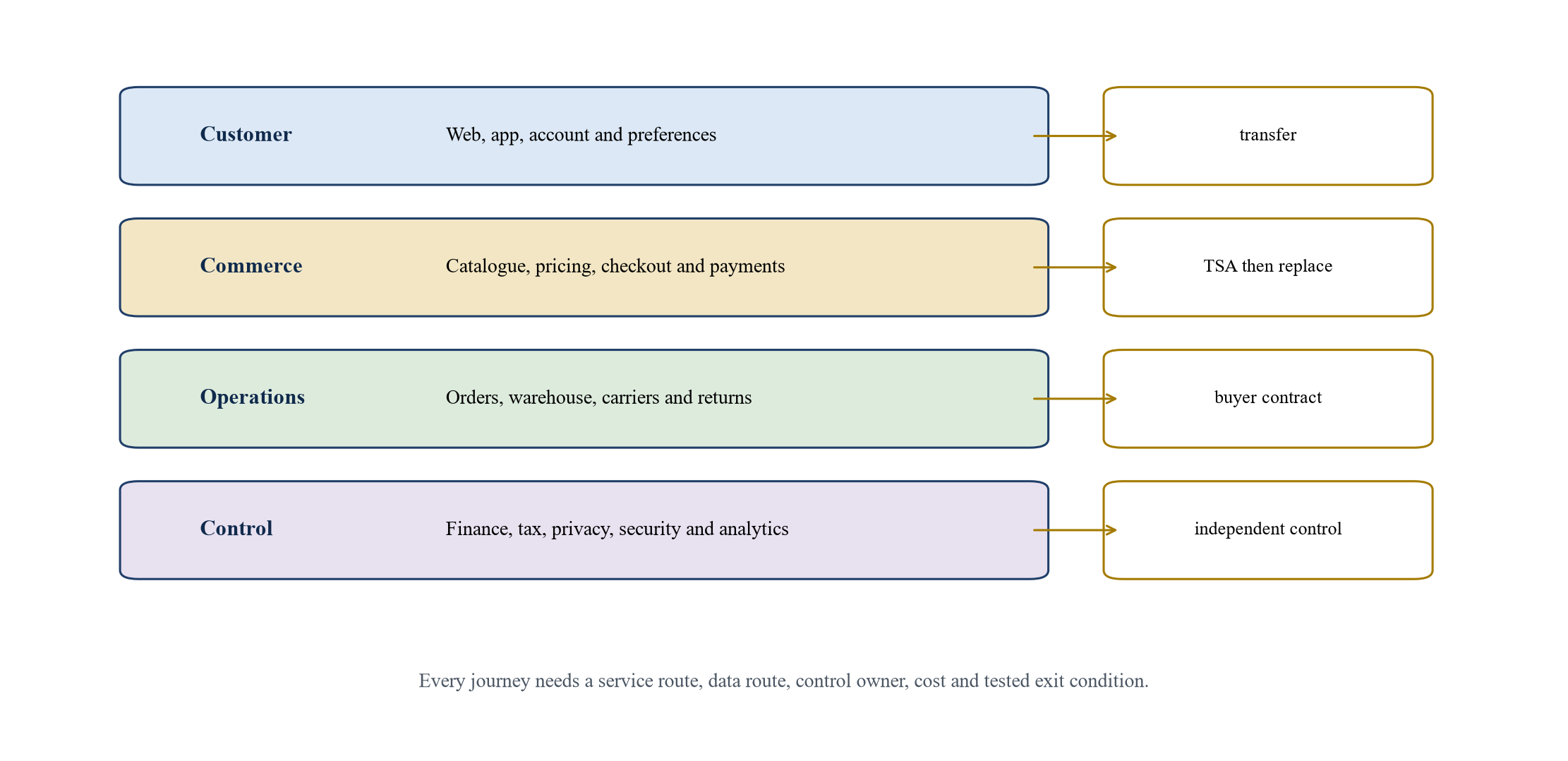
Proposed service map distinguishing transferred capability, transition service and buyer replacement.
| Capability | Day-one route | Evidence | Exit condition |
|---|---|---|---|
| customer identity | controlled transitional federation | architecture, access and test results | buyer identity proven at required scale |
| checkout and payments | buyer gateway and merchant account | approval, settlement and refund test | independent processing and reconciliation |
| order and warehouse | TSA or assigned fulfilment contract | inventory and order-cycle test | buyer operation meets service level |
| customer service | transferred team plus temporary knowledge access | staffing, scripts and case migration | buyer tooling and knowledge base accepted |
| finance and tax | parallel reporting and reconciliation | chart of accounts, tax rules and close test | standalone close completed on time |
| cyber operations | separated identities, logging and incident route | access review, monitoring and recovery exercise | independent monitoring and response proven |
The service catalogue should be contractually aligned with the separation plan.
8. Design transition services as finite products
A transition services agreement should define services, volumes, service levels, security, data access, change control, charges, liability, termination assistance and exit conditions. Broad language such as "continue services as currently provided" leaves scope unclear. The operating team needs a service catalogue tied to the systems map and the Day-one journey tests.
Charges should reveal economic behaviour. A fixed charge can support planning but hide volume changes. A unit charge can align cost and usage but needs clear measurement. Pass-through costs require verification and treatment of seller rebates. Separation projects should have approved budgets outside recurring services, with acceptance criteria for deliverables.
Exit dates should follow replacement readiness and business seasonality. An aggressive deadline can force an unsafe migration; an open-ended TSA can weaken accountability and bargaining power. Use milestone reviews with objective acceptance tests, early-warning indicators and a controlled extension mechanism. The financial model should include central, delayed-exit and accelerated-exit cases.
Knowledge transfer is a deliverable. Record operating procedures, exception routes, vendor contacts, configuration, data definitions, reconciliations and decision rights. Shadow and reverse-shadow periods allow the buyer team to observe, perform and then operate under supervision. Completion should require demonstrated capability rather than document delivery alone.
9. Rebuild the standalone organisation and cost base
Reported segment results often include allocations that neither disappear nor transfer. Rebuild the organisation by role and process. Identify transferred employees, vacancies, contractor dependencies, shared specialists, management roles, control functions and separation workload. Estimate recruitment, retention, consultation, transfer and temporary staffing costs with qualified advice.
Technology cost should distinguish recurring run cost, contracts that transfer, licences priced by group scale, cloud consumption, security, support, development and one-time migration. A buyer may reduce some complexity while losing seller purchasing power. Replacement systems can also change operating efficiency, so benefits should be credited only after implementation cost, timing and adoption are modelled.
Fulfilment cost depends on footprint, volume, peak shape, order profile, service promise and return behaviour. If the carved-out brand uses shared warehouse capacity, the buyer should compare a dedicated facility, third-party logistics, buyer-network integration and transitional seller service. Include dual running, stock movement, systems integration, carrier minimums and peak-readiness risk.
Central functions include finance, tax, treasury, legal, privacy, cyber, procurement, insurance, HR and governance. Some work scales with revenue, some with transaction volume, some with entities and some represents a minimum viable control environment. The standalone model should name the operating owner and sourcing route for every essential responsibility.
Management capacity deserves separate treatment. The seller may have supplied executives, commercial planning, vendor negotiation and incident leadership without charging the segment for the full time consumed. A buyer that transfers only operating staff can inherit a leadership gap at the moment when the business must complete separation. Map recurring responsibilities, transaction work and peak-period duties to named roles. Where one person owns several critical controls, test absence, conflict and workload. Interim leaders and specialist contractors should have documented authority, deliverables, knowledge-transfer obligations and exit dates.
Insurance and risk financing can also change. Group policies for cyber, product liability, business interruption, directors and officers, cargo, property and employer obligations may cease at closing or offer only limited run-off protection. The carved-out entity should obtain quotations, define deductibles and exclusions, confirm historic-claims responsibility and align incident notification across seller and buyer. Insurance cannot replace an operating control, yet the premium and retained risk belong in standalone economics.
Vendor separation should address concentration and consent. A supplier may permit assignment while changing volume rebates, credit terms, minimum commitments or termination rights. Cloud, software and marketplace contracts can contain usage, geography, sub-processing, audit and data-transfer conditions. The buyer should identify which commercial terms depend on seller scale and obtain executable replacement offers. A management estimate without a vendor response is useful for scenario planning and remains unverified until supported by a proposal or contract.
| Cost layer | Seller reporting treatment | Buyer model | Evidence gate |
|---|---|---|---|
| transferred direct cost | recorded in segment | retain and normalise | payroll, vendor and operational reconciliation |
| shared variable service | allocated or embedded | rebuild by volume driver | service units and proposed pricing |
| minimum standalone function | absent or partially allocated | add accountable capability | organisation and sourcing plan |
| TSA | absent from historic segment | include service and project charges | negotiated service catalogue |
| separation investment | outside recurring profit | fund by milestone and contingency | implementation plan and quotes |
| stranded or duplicated cost | held by seller or buyer | identify duration and owner | contract and exit timetable |
Costs and timings should be supported by contracts, quotes, organisation design and implementation plans.
10. Convert earnings into cash and funding need
The cash model should begin with settled customer receipts and show timing for refunds, chargebacks, taxes, supplier payments, inventory purchases, fulfilment, payroll, marketing, technology, TSA charges, separation investment, debt service and working-capital facilities. Historic cash conversion may depend on seller treasury practices that will not continue.
Inventory is both value and funding need. Reconcile SKU quantity, ownership, location, cost, age, markdown, returns status and purchase commitments. Test seasonal builds, minimum orders, supplier terms and stock movement during warehouse transition. An apparently asset-light digital brand can require substantial cash when supplier credit, payment settlement or fulfilment arrangements reset after closing.
Gift cards, loyalty points, refunds, warranties and customer claims create liabilities tied to the transferred customer relationship. The purchase agreement should allocate economic responsibility and operational execution. The opening balance sheet and completion mechanism need consistent definitions so the buyer does not fund obligations that were excluded from price without compensation.
Funding should cover purchase price, opening liquidity, seasonal working capital, separation investment, contingency and potential TSA delay. Debt sizing should use standalone cash under downside cases. Availability can be linked to eligible inventory or receivables where appropriate, but asset quality, title, returns, dilution, processor reserves and concentration require evidence.
Build cash at daily or weekly resolution around closing and the first trading peak. Monthly models can hide payment-settlement delays, large inventory receipts, payroll, tax remittances and refund waves that occur on different dates. The opening sequence should show which bank accounts receive customer cash, when processors release funds, who can initiate payments, how refunds are funded and when seller sweeps stop. Reconcile the first independent settlement before relying on the forecast balance.
Stress combinations rather than isolated assumptions. A delayed systems exit can coincide with weaker conversion, higher returns, processor reserves and a seasonal inventory build. The downside case should show the earliest liquidity breach, the operational cause and an executable response. Actions can include delaying discretionary marketing, resizing inventory purchases, extending a committed facility or using additional equity. Each action has a lead time and may affect revenue or customer service, so the model should not treat all remedies as immediately available.
Completion accounts or locked-box terms should use definitions aligned with the operating model. Cash, debt, working capital, deferred revenue, gift cards, refunds, tax, inventory provisions and separation liabilities can move between purchase price and post-close funding depending on the agreement. Finance and legal teams should test the same sample transactions through the accounting definition, cash model and purchase-price mechanism. Differences belong in the negotiation record before signing.
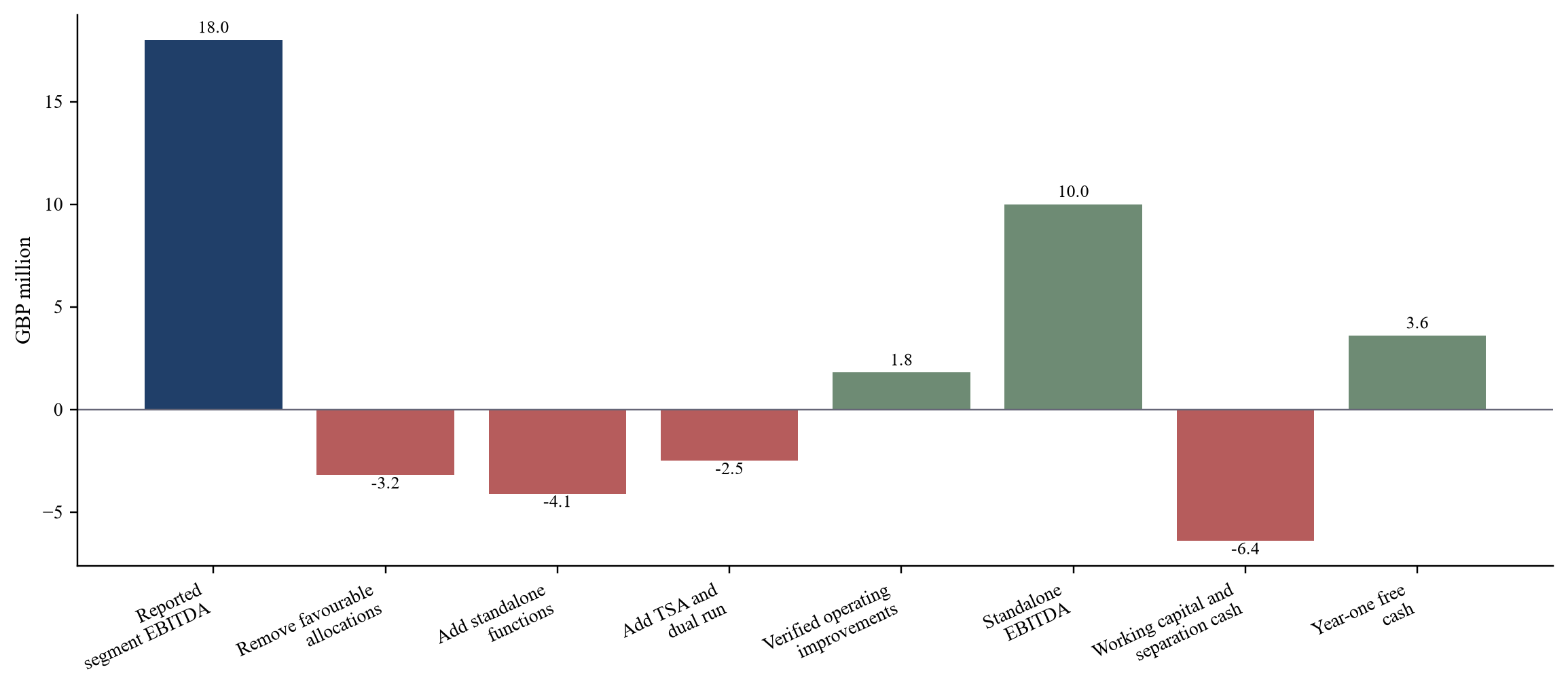
GBP millions; all figures are modelling assumptions for an illustrative carve-out.
11. Work through a hypothetical UK e-commerce carve-out
Consider a hypothetical UK consumer-products group selling a digital brand to a strategic buyer. The business records GBP 126 million of net revenue and GBP 18 million of segment EBITDA. It serves 620,000 active customers through a website, app and selected marketplaces. The seller provides shared identity, cloud infrastructure, analytics, payment orchestration, warehouse management, customer service tooling, finance and procurement. All figures are assumptions created solely to demonstrate the framework.
The customer database contains 2.4 million records. Diligence shows that 620,000 customers purchased within twelve months, 410,000 have an email-marketing flag, 290,000 have a mobile-notification flag and 1.1 million have older account records with inconsistent source evidence. The model initially applies a uniform value per marketable customer. The permission review instead separates service use, account administration, marketing by channel, analytics and suppression. Until evidence is reconstructed, the buyer assigns no marketing value to the uncertain population.
Cohort analysis shows that reported repeat purchase is strongest in email and organic cohorts, but the metric had counted placed orders before returns. After completed-order and return reconciliation, twelve-month contribution after acquisition is GBP 41 per customer for email, GBP 34 for organic, GBP 18 for paid search, GBP 14 for marketplace and GBP 11 for affiliate cohorts. These amounts remain modelling assumptions. The buyer uses them to rank migration and retention priorities rather than claim a general market benchmark.
The segment EBITDA bridge removes GBP 3.2 million of favourable allocations, adds GBP 4.1 million of minimum standalone functions, includes GBP 2.5 million of TSA and dual-running cost and credits GBP 1.8 million of operating improvements supported by specific actions. This produces GBP 10 million of standalone EBITDA. Working capital and separation cash use GBP 6.4 million during the first year, leaving GBP 3.6 million before financing and tax in the illustrative case.
The systems review identifies thirty-two critical services. Eighteen can transfer or be replaced before closing; eleven require a twelve-month TSA; three need a controlled extension option because identity, warehouse execution and historic order evidence are connected to the seller environment. The buyer conditions closing on payment approval, a full order-to-refund test, customer-rights routing, independent privileged access and a reconciled opening inventory file.
The transaction committee reduces upfront value credit for unverified marketing permissions and delays synergy recognition. It approves a separation reserve, a working-capital facility and a milestone-linked price holdback. The decision illustrates the framework: customer records, technology and reported profit become valuable when they can be lawfully used, operationally controlled and reconciled to standalone cash.
12. Govern Day 1 and the first reporting cycles
Day-one governance should connect commercial, operational, data, technology, financial and legal decisions. Establish a separation steering group with named workstream owners, a decision log, risk register, service dashboard and escalation path. Reserve matters should cover changes to data use, customer communications, service levels, security, critical vendors, pricing logic and separation scope.
Run integrated rehearsals. A customer places and cancels an order; another returns a product after the change of control; a payment dispute arrives; an unsubscribe request is submitted; a data-access request spans both seller and buyer records; a warehouse interface fails; a product recall requires historic order evidence; and the month-end close reconciles receipts, refunds, stock and tax. Each exercise should identify the accountable party, evidence retained and fallback time.
The first reporting pack should combine trading and separation. Include orders, net revenue, gross margin, return rate, fulfilment performance, payment settlement, customer contacts, complaints, marketing eligibility, preference changes, data incidents, service availability, TSA performance, separation milestones, cash, working capital and forecast headroom. Define every measure and reconcile it to source systems.
Independent assurance can focus on the highest-consequence claims: data-transfer completeness, suppression application, payment and refund controls, inventory ownership, privileged access, customer-rights routing and finance reconciliation. The objective is to test whether the operating evidence supports the board's decision, not to replace management accountability.
| Domain | Daily or weekly evidence | Escalation example | Accountable owner |
|---|---|---|---|
| customer | conversion, delivery, returns, complaints and rights requests | journey failure or unresolved rights case | chief operating officer |
| data | transfer exceptions, suppression, access and incidents | unauthorised use or missing control history | privacy and data owner |
| technology | availability, change, capacity, backup and security | critical service breach or failed recovery | technology lead |
| operations | order backlog, inventory, fulfilment and refunds | service level below approved floor | operations lead |
| finance | settlement, cash, margin, working capital and close | unreconciled cash or covenant pressure | finance director |
| separation | TSA performance, milestones, cost and exit risk | critical dependency misses exit gate | separation director |
Thresholds are transaction-specific management decisions and should be approved before closing.
13. Sequence the carve-out through six evidence gates
Gate one defines the perimeter and customer promise. Gate two establishes lawful data-transfer and approved buyer uses. Gate three proves order economics and standalone costs. Gate four secures systems, contracts, people and funding. Gate five completes integrated Day-one rehearsal. Gate six demonstrates independent operation and exits transition services.
Each gate should specify the decision, evidence, accountable approver, conditions, exceptions and fallback. A green project report without source reconciliation does not prove readiness. Evidence can mature at different speeds, so the transaction committee may approve conditional progression where the unresolved item has a bounded consequence, funded remedy and enforceable completion route.
The route to closing should protect regulatory and customer obligations. Legal, privacy, competition, tax, accounting, employment and cyber conclusions require appropriate specialists. Commercial teams should see those conclusions translated into data fields, system requirements, communications, costs, timelines and transaction protections.
The buyer should retain a post-close value ledger. Each value initiative records baseline, action, investment, owner, dependencies, timing and realised cash. Customer-data and technology initiatives receive credit after their approved uses are operational and their outcomes can be reconciled. This prevents the separation programme from claiming benefits that arise from changed definitions, deferred cost or unsupported attribution.
Information release before closing should follow purpose, necessity and authority. Customer-level records may be unnecessary for early commercial diligence; aggregated cohort and order evidence may answer the investment question with lower exposure. Where detailed records are required, access can be staged through restricted teams, controlled environments, masking and logged exports. The transaction team should preserve who received which dataset, for what purpose, under which restriction and when it was returned or destroyed.
The communications plan should distinguish transaction announcement, controller information, service messages, account actions and marketing. Customers need clear information at the appropriate time without language that implies consent or agreement where none is being sought. Customer-service teams should receive scripts, escalation routes and current facts. Monitoring complaints, preference changes and contact volumes after communication can reveal confusion or a broken journey before it becomes a wider conduct issue.
Seller governance also matters. The seller remains responsible for retained customers, systems, data and stranded costs while supporting transition services. Establish clean interfaces between seller and buyer decisions, especially where the same platform hosts retained and transferred brands. Service changes should be assessed for both sides, with emergency authority, notification and rollback defined. A buyer migration that improves independence can still harm the retained environment if shared dependencies are poorly understood.
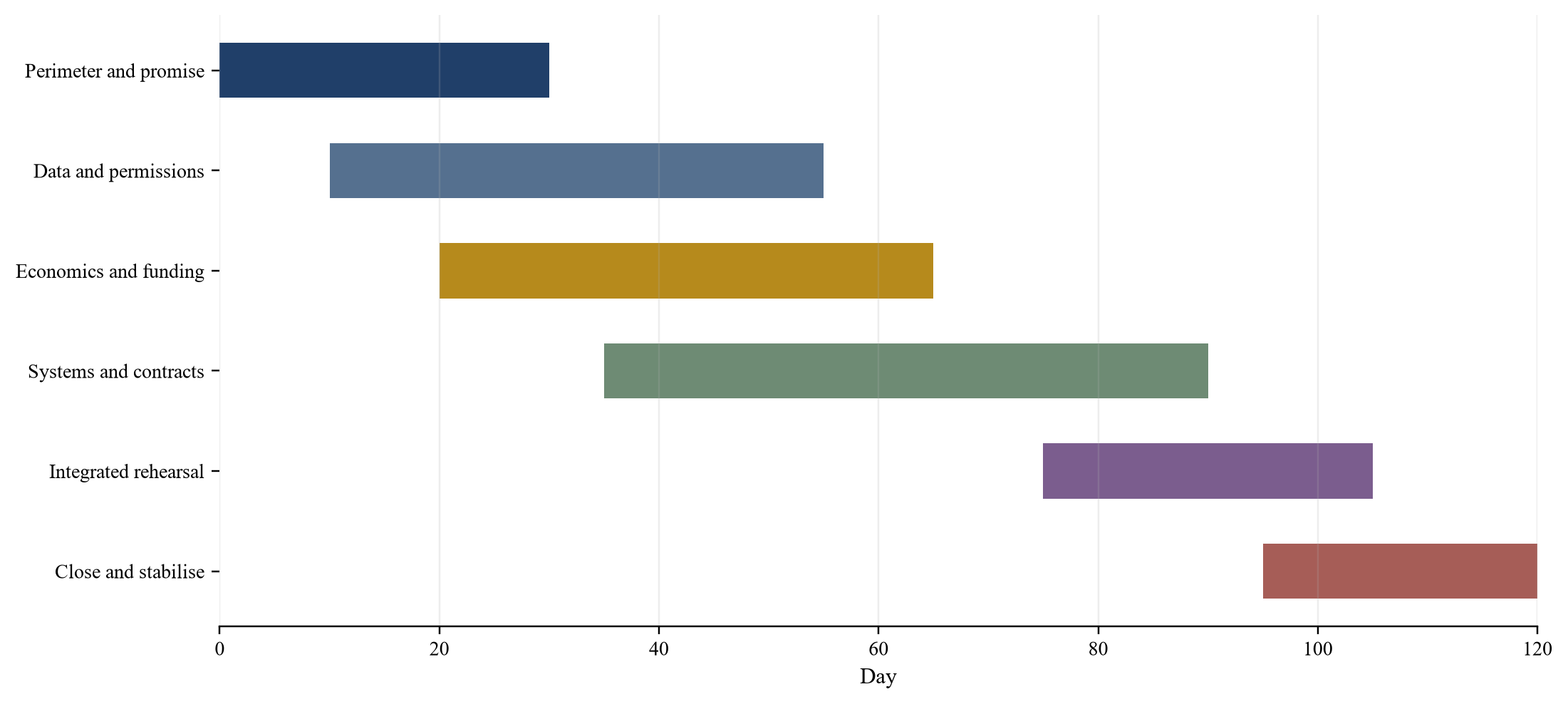
Sequence is illustrative and should be adapted to transaction scope, approvals and closing timetable.
14. Limitations and further research
This framework cannot determine whether a particular data transfer, marketing use, contract assignment, merger filing, accounting treatment, tax position or employment action is lawful or appropriate. Those conclusions depend on current transaction facts and qualified professional advice. ICO guidance cited in this paper is under continuing review following legislative change, so parties should confirm the version and commencement position at the relevant decision date.
Customer behaviour is not stable. Acquisition channels, search algorithms, privacy controls, device rules, marketplace terms, carrier performance, economic conditions and product mix can change cohort outcomes. Historic relationships do not prove post-separation results. Validation should preserve time order, show uncertainty and identify material changes in definition or operating context.
The hypothetical case provides mechanics rather than market forecasts. Monetary amounts, customer counts, cohort rates, cost estimates, service periods, thresholds and transaction protections are assumptions. They do not describe an identified retailer or imply that an actual investment will achieve those results.
Further research could compare announced UK carve-out cases with later standalone cost and cash outcomes; examine the effect of consent wording and controller change on usable marketing populations; test how payment, fulfilment and marketplace contract resets affect working capital; and develop standard evidence protocols for customer-rights continuity across seller, buyer and transition providers.
15. Conclusion
A UK e-commerce carve-out is investible when the buyer can show how the business will serve customers, use data, operate systems and generate cash as an independent entity. The transaction perimeter, data register, permission tests, cohort economics, systems map, service catalogue and standalone model must tell one consistent story.
Customer information carries obligations, provenance and purpose constraints. Reported segment earnings carry allocations and dependencies. Treating both as evidence questions produces a stronger valuation and a more executable separation. The buyer can then direct price, protection, funding and management attention toward the assumptions that genuinely determine Day-one continuity and standalone value.
Appendix A. A1. Customer, order and consent evidence
Customer and account records with source, purpose, lawful basis, consent, preference, suppression, retention and rights history.
Order, shipment, cancellation, return, refund, chargeback, payment and cash-settlement records linked by controlled identifiers.
Marketing campaign, audience, channel, rule, template, send, delivery, objection and withdrawal evidence.
Product, price, promotion, reference-price, fee, review and customer-journey records supporting consumer-law review.
Appendix A. A2. Technology and operating evidence
Application, interface, data-flow, identity, vendor, licence, environment, monitoring, backup and recovery inventory.
Warehouse, carrier, payment, customer-service, finance, tax and cyber process maps with owners and service levels.
Transition-service catalogue, cost, volume, dependency, security, change, incident, exit and termination-assistance terms.
Separation plan, acceptance tests, rehearsals, issue log, contingency, funding and post-close stabilisation measures.
Appendix B. B1. Before signing
Reconcile legal, operating, data, systems, people and financial perimeters.
Reconstruct sample customer permissions, cohorts, order economics and cash settlement.
Price standalone functions, transition services, separation investment, working capital and contingency.
Define closing conditions, holdbacks, warranties, indemnities, services, exit gates and fallback rights with advisers.
Appendix B. B2. Before closing and during transition
Complete customer-journey, rights-request, incident, recovery and financial-close rehearsals.
Verify transferred assets, contracts, people, inventory, data, permissions, cash and opening liabilities.
Monitor trading, customer, privacy, service, cyber, financial and separation evidence through one control report.
Exit each transition service after the buyer capability meets its approved acceptance test.
Sources
- Competition and Markets Authority. Merger Assessment Guidelines, updated 3 September 2026. Read the primary source
- UK Parliament. Digital Markets, Competition and Consumers Act 2024. Read the primary source
- Information Commissioner's Office. Due diligence when sharing data following mergers and acquisitions. Read the primary source
- Information Commissioner's Office. Purpose limitation. Read the primary source
- Information Commissioner's Office. Electronic and telephone marketing under PECR. Read the primary source
- Competition and Markets Authority. Online choice architecture. Read the primary source
- Competition and Markets Authority. What businesses need to know about unfair commercial practices. Read the primary source
- National Cyber Security Centre. Cyber Security Toolkit for Boards. Read the primary source
- Information Commissioner's Office. Direct marketing guidance. Read the primary source
- Information Commissioner's Office. How to comply with PECR electronic mail marketing rules. Read the primary source
- Information Commissioner's Office. The right to be informed. Read the primary source
- Information Commissioner's Office. How should we draft our privacy information? Read the primary source
- Information Commissioner's Office. Records of processing and lawful basis. Read the primary source
- UK Parliament. Data Protection Act 2018. Read the primary source
- UK Parliament. Privacy and Electronic Communications Regulations 2003. Read the primary source
- UK Parliament. Data Use and Access Act 2025. Read the primary source
- Competition and Markets Authority. Digital markets competition regime guidance. Read the primary source
- Competition and Markets Authority. Evidence review of online choice architecture and consumer and competition harm. Read the primary source
- Financial Reporting Council. FRS 100 Application of Financial Reporting Requirements. Read the primary source
- Financial Reporting Council. FRS 102 The Financial Reporting Standard applicable in the UK and Republic of Ireland. Read the primary source
- UK Government. Consumer Contracts Regulations 2013. Read the primary source
- UK Government. Consumer Rights Act 2015. Read the primary source
