

1. Define the transaction decision
The transaction decision is whether the proposed perimeter constitutes an operable freight business at completion and whether the price and protections reflect what actually transfers. Legal ownership of vehicles and customer contracts does not answer that question. The buyer must identify the capabilities required to quote, plan, dispatch, track, deliver, evidence, invoice and collect each service, then prove that the rights, systems, people and controls supporting those capabilities will be available.
The board paper should state the transaction form, target perimeter, intended completion date, regulatory path, operating model and value thesis. An asset purchase, business transfer, share sale and internal reorganisation create different consent, tax, employment and separation consequences. Qualified counsel, tax advisers, accountants, technology specialists, pensions advisers and operational experts must determine the treatment of an actual transaction.
The decision framework separates six questions: what transfers, what remains, what must be copied or recreated, what requires third-party consent, what needs transitional access and what changes the price or risk allocation. Every diligence finding should resolve into one of these decisions. A long issue list without a transaction response creates activity but does not establish an executable carve-out.
2. Start with the customer service promise
The perimeter should begin with services rather than assets. A freight contract may promise timed collection, route optimisation, temperature control, proof of delivery, live tracking, customs support, returns management, emissions reporting or dedicated capacity. Each promise depends on a chain of technology, data, fleet, people, licences, depots and external suppliers.
For every material service, the team should map the order-to-cash and incident-to-resolution paths. The map should identify who receives the order, how capacity is confirmed, which engine selects the route, where driver and vehicle data originate, how exceptions are managed, which evidence supports invoicing and who owns the customer relationship. Shared parent systems can appear invisible until the service is traced end to end.
The output is a minimum viable operating perimeter. It defines the capabilities that must work on Day One even if the buyer plans a later platform migration. Optional enhancements, synergies and future transformation should remain separate. This protects the closing decision from relying on improvements that have not yet been delivered.
| Perimeter class | Typical freight example | Required evidence | Principal transaction response |
|---|---|---|---|
| Transfer | Vehicles, depot leases, assigned employees | Title, condition, lease and employment records | Include in transfer instruments and completion evidence |
| Novate or consent | Customer and supplier contracts | Assignment, novation and change-of-control clauses | Obtain consent, condition completion or allocate attrition risk |
| Licence | Routing code, databases, brands or mapping rights | Ownership, permitted use, territory and sublicensing rights | Execute durable licence with support, audit and exit rights |
| Duplicate | Interfaces, data stores and operating procedures | Architecture, lineage, build plan and acceptance tests | Fund separation plan and prove independent operation |
| Transitional service | Hosting, payroll, finance, cyber monitoring | Service catalogue, capacity, security and exit dependencies | Define TSA service levels, charges, remedies and exit milestones |
| Retain with seller | Group treasury, unrelated customer data | Boundary evidence and access controls | Exclude cleanly and prevent continuing access or economic leakage |
The final legal and accounting treatment requires transaction-specific professional advice.
3. Establish the legal-entity perimeter
The legal-entity map should list each company, branch, partnership, depot vehicle, employee population, contract, licence, permit, bank account and asset relevant to the freight operation. A division may trade through several seller entities while vehicles are leased by one company, employees sit in another and customer invoices are raised centrally. Financial reports prepared by management can combine these elements without showing their legal ownership.
The map should distinguish a transfer of shares from a transfer of selected assets and liabilities. In a share sale, contracts and licences may remain with the same legal entity but change-of-control clauses can still apply. In an asset sale, assignment or novation may be required and some liabilities may remain by law or contract. The transaction documents should reconcile the commercial perimeter with the legal transfer mechanism.
Intercompany balances, guarantees, cash-pooling arrangements, insurance, tax grouping and shared registrations require separate treatment. The buyer should not assume that an operating licence, credit line or insurance programme follows the activity. The seller should identify what will terminate, be replaced, be released or remain temporarily, together with the party responsible and the deadline.
4. Build a controlled dependency register
The dependency register is the central record for separation. Each row should identify the capability, asset or service, current owner, user, location, contractual basis, data involved, transfer route, Day One requirement, target-state solution, accountable owner, cost, decision date and evidence status. A controlled identifier should link the same item across diligence, the sale agreement, TSA, technology plan and valuation model.
Dependencies should be recorded at a level that supports action. “IT separation” is too broad. “Routing optimisation production environment,” “vehicle-position message broker,” “customer proof-of-delivery portal” and “invoice-rating table” can each have different owners and transfer routes. The register should distinguish software code, configured instances, credentials, documentation, data, interfaces, hosting, support and underlying third-party licences.
The programme office should retain the closing baseline and log changes. New dependencies often emerge when interfaces are tested or customer terms are reviewed. A change should state its effect on Day One, separation cost, timing, price, consent and risk allocation. This prevents late discoveries from disappearing into narrative status reports.
5. Decompose the routing algorithm
The routing capability should be decomposed into source code, compiled services, optimisation logic, model parameters, maps, traffic feeds, constraint libraries, customer rules, configuration, interfaces, testing assets, monitoring and documentation. Ownership can differ across these components. A seller may own the orchestration layer while using third-party solvers, map data and open-source libraries under separate licences.
The buyer should identify whether the business needs ownership, a perpetual licence, a term licence or only transitional access. The right to use code can be more important than nominal ownership when the licence covers the required fields, territories, users, modifications, interfaces, hosting models and successors. UK government IP guidance similarly emphasises case-specific rights and the practical importance of licences [8-10].
Algorithm diligence should examine reproducibility and operating control. The buyer needs build instructions, deployment pipelines, model versions, change logs, test suites, incident history and the people able to maintain the service. A code repository without the data, keys, infrastructure and expertise required to run it does not create an independent routing capability.
6. Test intellectual-property ownership and licences
The IP schedule should identify copyright, database rights, patents, trademarks, domains, know-how, confidential information and contract-based rights. Software created by employees, contractors, vendors and joint-development partners can carry different ownership terms. The transaction team should trace material components to executed employment, assignment, development and licence documents.
Third-party licences require special attention to assignment, change of control, affiliate use, territory, processing volume, hosting, sublicensing and termination. Open-source dependencies require a complete bill of materials and compliance record. HMRC software standards note the need to understand ownership and adhere to open-source licences, particularly during contract transitions [11].
Database rights can protect the contents of qualifying databases separately from copyright in their selection or arrangement [9,12]. The buyer should therefore assess both the right to receive data and the right to extract, reuse and continue enriching it. Legal rights, contractual restrictions and data-protection obligations should be analysed together.
7. Define the fleet-data perimeter
Fleet data includes vehicle identity, location, speed, fuel or energy use, maintenance, defects, driver interactions, route execution, loading, temperature, incident and proof-of-delivery records. It can originate from vehicle manufacturers, telematics providers, mobile devices, depot equipment, subcontractors and customer systems. The seller may possess the data without owning every right needed to transfer or reuse it.
The register should record each dataset’s source, controller, processor, contractual owner, lawful purpose, retention period, refresh frequency, geography, security classification and intended buyer use. Personal data should be separated from operational data wherever feasible. Driver location and performance records can identify individuals and require a lawful, fair and transparent processing basis.
Historical data can support route calibration, pricing, maintenance and valuation. Its usefulness depends on completeness, continuity and permitted use. A buyer should not pay for a machine-learning advantage that cannot be transferred, reproduced or lawfully applied. The data room should contain field definitions, lineage, quality metrics, licences and a sample extraction that can be reconciled to source systems.
8. Apply data-protection diligence to the transaction
The ICO states that M&A due diligence should establish what personal data transfers, the original purposes, lawful basis, data-protection principles, documentation, security and communication to data subjects [5]. The Data (Use and Access) Act 2025 has changed parts of the UK data-protection regime, and the ICO notes that related guidance remains under review [5-7]. Current legal advice is therefore required at signing, completion and migration.
The parties should distinguish diligence disclosure from completion transfer. Clean teams, aggregation, redaction, controlled access and staged disclosure can reduce risk before completion. The buyer should identify whether it becomes a new controller, joint controller or processor for each activity and update notices, records, contracts and rights-handling processes accordingly.
Data migration should be tested for completeness, accuracy, access control, retention and deletion. The seller must remove buyer data from retained systems according to the agreed plan while preserving records it is legally required to keep. The buyer should prove that it can answer data-subject requests and investigate incidents after separation.
9. Map customer contracts to operating dependencies
Customer contracts should be reviewed beyond headline revenue. The schedule should capture legal entity, service scope, volume commitment, pricing, indexation, term, renewal, termination, assignment, novation, change of control, exclusivity, subcontracting, service levels, data terms, audit, cyber requirements, liability, insurance and governing law.
Each contract should link to the systems and data required to perform it. A contract may transfer legally while the seller retains the customer portal, tariff engine or reporting process needed for delivery. Conversely, a routing platform may transfer while the contract prohibits subcontracting or customer data migration. The perimeter is complete only when rights and operating capability align.
Revenue quality should be assessed at the contract-service lane level. Minimum volume, spot pricing, pass-through fuel mechanisms, claims, penalties and loss-making lanes can change the economic value of a customer relationship. IFRS 3 requires identifiable acquired assets and liabilities to be recognised and measured, including qualifying customer-related and contract-based intangibles [19-21]. Transaction valuation should use the actual rights and economics that transfer.
| Consent position | Operating position | Day One risk | Possible response |
|---|---|---|---|
| No consent required and capability transfers | Service can continue on existing terms | Low, subject to verification | Confirm transfer evidence and customer communication plan |
| Consent required and obtained | Service can continue after novation or approval | Moderate implementation risk | Make consent effective at completion and test billing and data migration |
| Consent required and pending | Revenue and service continuity are uncertain | High | Condition completion, exclude contract, escrow value or allocate attrition risk |
| Contract transfers but capability remains with seller | Buyer lacks independent delivery capability | High operational risk | TSA, licence, personnel transfer and tested exit plan |
| Capability transfers but data use is restricted | Performance or optimisation may be impaired | High compliance and value risk | Amend data terms, minimise data, rebuild model or adjust value |
Contract interpretation and transfer mechanics require qualified legal advice.
10. Prioritise consents by value and critical path
Consent management should prioritise economic materiality, operational dependency and lead time. A simple count of obtained consents can mislead when the remaining contracts represent most EBITDA or contain the longest notice periods. The tracker should show revenue, margin, service dependency, consent route, counterparty, owner, request date, conditions and fall-back plan.
The seller should decide when to approach customers with regard to confidentiality, competition and deal certainty. The buyer should prepare a credible continuity narrative and avoid promising capabilities that depend on untested separation. Material amendments sought by customers should be quantified and approved before acceptance.
The sale agreement can address missing consents through conditions, delayed transfer, agency arrangements, economic pass-through, price retention, escrow or specific indemnity. Each method has legal, tax, accounting and operational consequences. The chosen response should match the customer’s value and the time needed to obtain a durable solution.
11. Assess supplier and subcontractor continuity
Road freight commonly relies on vehicle lessors, fuel-card providers, maintenance networks, tyre suppliers, subcontracted carriers, warehouse operators, map and traffic-data providers, telecommunications, payment services and insurance. Supplier dependencies can be as critical as customer contracts because a failure can interrupt the entire service chain.
The buyer should test assignment, minimum commitment, credit support, pricing tiers, volume rebates, data rights, audit rights and termination. Group purchasing power may not transfer. A new standalone entity can face higher unit costs, reduced credit limits or collateral requirements. These effects belong in standalone EBITDA and working-capital analysis.
Subcontractor diligence should include operator credentials, insurance, safety, cyber access, data processing and customer approval. The buyer needs the right to supervise and replace providers. Where a seller remains the contractual counterparty during transition, the TSA should state authority, liability, payment flow and the route to direct contracting.
12. Identify people and TUPE consequences
The people perimeter should map roles to capabilities and systems. Routing engineers, transport planners, dispatchers, depot managers, fleet compliance specialists, pricing analysts, customer teams, finance staff and cyber personnel may support both the carved-out business and retained operations. Organisational charts alone do not reveal actual time allocation or critical knowledge.
TUPE may protect employees when a UK business transfers. Government guidance states that employment terms and continuity generally transfer, subject to the applicable facts and exceptions [13-16]. The outgoing employer must provide specified employee-liability information, and consultation obligations can apply before transfer [14-16]. Qualified employment counsel should determine the affected population and process.
The buyer should plan for roles that do not transfer but remain essential. Options include recruitment, secondment, retention, knowledge transfer and managed service. The plan should distinguish temporary capacity from permanent capability. Named-person dependencies require a succession response rather than an assumption that individuals will remain.
13. Confirm transport licensing and compliance
The operating model should identify every operator licence, transport manager, vehicle base, maintenance arrangement, driver process, safety system and regulatory record required to continue operating. A licence held by the seller or another group entity may not be available to the buyer at completion. Vehicle movement without the correct authority can destroy the Day One plan.
Compliance diligence should cover vehicle roadworthiness, inspections, defects, driver hours, tachograph records, dangerous goods where relevant, permits, insurance and subcontractor controls. The buyer should reconcile fleets across asset registers, licensing records, telematics and maintenance systems. Exceptions should be assigned to remedy, exclusion or pricing.
Regulatory readiness belongs in the completion evidence. The buyer should have accepted applications, responsible managers, insurance, maintenance providers, operating centres and system access in place to the extent required. Any reliance on seller licences or staff should be reviewed by counsel and the regulator rather than assumed under a commercial TSA.
14. Screen competition and national-security issues
The CMA’s merger guidance requires a case-specific assessment of whether a transaction may substantially lessen competition [1-4]. In technology-enabled freight, relevant issues can include customer access, capacity concentration, commercially sensitive data, routing algorithms and foreclosure. The 2026 guidance specifically recognises that access to rival information, including pricing strategies, algorithms and technical specifications, can affect competition [2].
The clean-team design should therefore restrict access to competitively sensitive customer, lane, price and capacity information before clearance. The separation plan should preserve independent decision-making when interim measures apply. Integration activity should follow legal advice and the applicable CMA process.
The National Security and Investment regime can be relevant where an acquired entity undertakes specified activities in transport, AI, data infrastructure, advanced robotics or other mandatory sectors [17-18]. Asset acquisitions are treated differently from entity acquisitions for mandatory notification, although call-in powers can still matter [18]. The parties should screen the actual target and technology early.
15. Protect cyber security through separation
Carve-outs create privileged-access changes, duplicated environments, temporary interfaces and compressed timelines. These conditions increase cyber risk. The NCSC advises boards to consider cyber risk in mergers, acquisitions, suppliers and partnerships and to identify access, sensitive data and security requirements across those relationships [22-23].
The programme should maintain an identity and access register covering employees, vendors, service accounts, application keys, certificates, devices and administrative privileges. Access should follow the target operating model and be revoked at defined milestones. Shared credentials and undocumented integrations should be treated as separation defects.
The buyer should test incident detection, logging, backups, vulnerability management and recovery in the separated environment. The TSA needs cyber-notification, cooperation, evidence preservation and audit provisions. A legal right to receive a system is insufficient if the buyer cannot detect compromise or recover service.
16. Design the target technology architecture
The target architecture should show applications, data stores, interfaces, infrastructure, identities, networks, vendors and owners for every critical capability. It should distinguish Day One from the final state. A temporary replicated environment can be acceptable when it is secure, supported and tied to an executable exit plan.
The architecture decision should compare clone, migrate, replace, retain and consume-as-a-service options. Clone can preserve functionality but duplicate technical debt. Replacement can improve the platform but increases delivery risk. A licence to use the seller’s service may accelerate completion while creating dependency and information-separation issues.
Acceptance criteria should be operational. The buyer should demonstrate order intake, route calculation, dispatch, tracking, exception management, proof of delivery, invoicing and management reporting using representative data. Interface success alone does not prove that the end-to-end service works.
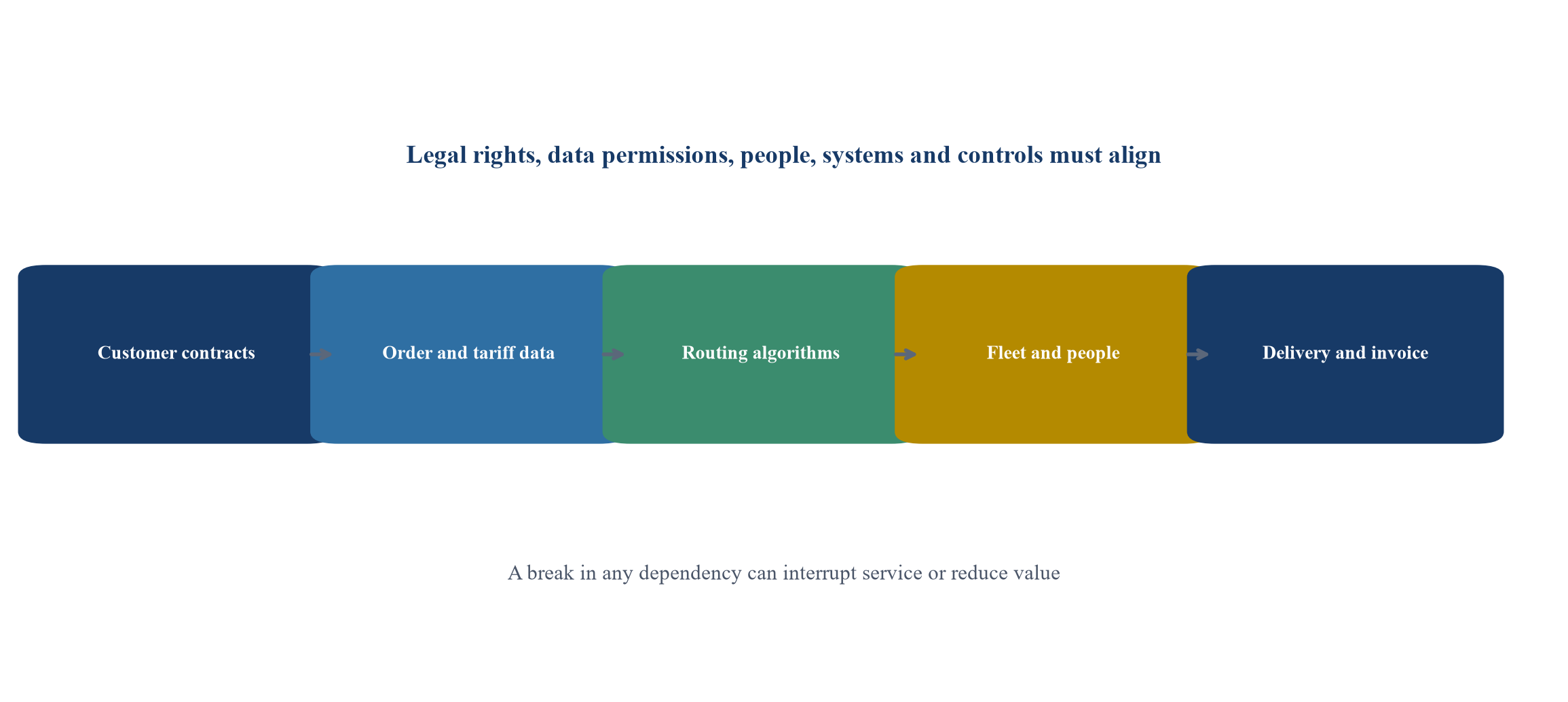
The architecture is a decision framework and does not represent an identified company.
17. Create the data-separation plan
The data plan should classify records as transfer, copy, retain, delete, anonymise, aggregate or provide under transitional access. Rules should operate at dataset and field level where customer, employee and retained-business information coexist. The plan should preserve referential integrity so transferred orders, journeys, invoices and claims remain usable.
Extraction should be repeatable from a defined cut-off with controlled deltas between test, signing and completion. Reconciliations should compare record counts, control totals and economic balances. Samples should trace from customer contract through route, delivery and invoice to cash collection.
Deletion and access termination are part of acceptance. The seller should prove that buyer-only data is removed from retained environments subject to legal-retention obligations, and the buyer should remove seller data outside the agreed perimeter. Exceptions require an owner, lawful basis, security control and expiry.
18. Separate models, parameters and operational judgement
Routing performance often depends on more than an algorithm. Dispatchers may apply local restrictions, customer preferences, loading rules, driver knowledge and exception judgement that are absent from the code. The buyer should capture these operating rules and determine which are contractual, regulatory, technical or experiential.
Model parameters and training data should be versioned and linked to the relevant service. The team should test whether the transferred model reproduces expected routes and service levels in the buyer environment. Differences should be explained through data, configuration or infrastructure rather than accepted as unexplained variance.
Human decision rights should remain explicit. Automation can recommend routes, prices or capacity, while authorised staff approve exceptions and safety-critical decisions. The separation should preserve escalation, override records and accountability. A model that cannot be governed after transfer is not a complete operating asset.
19. Define the transition-services agreement
The TSA should be a service contract linked to the dependency register. Each service needs a scope, user population, operating window, capacity, data boundary, service level, security control, charge, change process, remedy, exit dependency and termination date. Broad labels such as “IT support” or “finance services” create disputes and weak exit accountability.
Charges should distinguish cost recovery, pass-through costs, one-off separation work and volume-dependent pricing. The buyer should model both TSA cost and the cost of the target replacement. A low monthly TSA fee can conceal an expensive exit if documentation, licences or people are withheld.
The parties should establish service governance, incident escalation and evidence requirements before completion. Critical services need continuity and recovery obligations. The TSA should not give either party uncontrolled access to the other’s commercially sensitive information.
20. Make TSA exit measurable
Every TSA service should have an exit criterion that can be tested. Examples include successful data migration, buyer acceptance of interfaces, completion of parallel runs, receipt of third-party consents, transfer of licences, user training and recovery testing. Calendar expiry alone does not establish readiness.
The exit plan should identify the longest critical path and the dependencies among services. Routing may depend on telematics, identity, map data and customer interfaces. Exiting hosting before those dependencies are ready can interrupt operations. Sequencing should follow capability rather than organisational convenience.
Readiness reviews should use evidence and named decision rights. Waivers should state risk, duration, mitigation and accountable approver. Extension pricing can increase over time to encourage exit, but it should not create coercive economics where the seller controls essential deliverables.
21. Quantify standalone operating cost
Standalone cost analysis should rebuild the target cost base by capability. Allocated seller charges can be higher or lower than the resources required after separation. The buyer should identify direct costs, transferred employees, replacement hires, vendor contracts, infrastructure, insurance, compliance, public-company or group functions and one-off separation expenditure.
The model should distinguish recurring standalone cost, temporary TSA expense, stranded seller cost, dis-synergy and synergy. These categories have different valuation and negotiation consequences. Seller stranded cost does not automatically belong in target EBITDA, while buyer integration savings should not be used to conceal an incomplete perimeter.
Each adjustment should have an owner, source, timing, confidence and implementation plan. A run-rate claim supported only by a future programme belongs in a separate case from contractual savings already available at completion.
22. Rebuild working capital and cash conversion
Freight working capital can depend on customer billing cycles, fuel cards, subcontractor terms, claims, duties, driver expenses and group treasury. The carve-out model should reconstruct receivables, payables, accrued revenue, deferred revenue, provisions and cash by contract and legal entity.
The buyer should test whether billing and collections can continue independently. Customer master data, tariffs, proof of delivery, tax configuration and bank details must align. A Day One failure in invoice generation can create liquidity pressure even when routes operate successfully.
The sale agreement should define normalised working capital and leakage consistently with the perimeter. Items settled centrally by the seller require a cut-over mechanism. The closing statement should avoid counting cash or liabilities that remain with the seller while transferring the related economic obligation.
23. Value customer relationships and technology separately
IFRS 3 identifies contractual and separable intangible assets that may require recognition apart from goodwill, including customer relationships, technology and contract-based rights [19-21]. Transaction valuation should similarly distinguish the cash flows attributable to customer relationships, routing technology, workforce, brand and physical assets.
The value of a customer relationship depends on enforceable terms, renewal behaviour, margin, service quality, switching cost and consent. The value of routing technology depends on ownership, licence scope, performance, replicability, data access and maintenance capability. Double counting can occur when technology benefits are embedded in customer cash flows and also valued separately.
The valuation should reconcile legal rights to economic benefits. A model may indicate high expected savings, yet a restricted licence or unavailable dataset can prevent their realisation. IFRS 13 fair-value principles and IAS 38 intangible-asset guidance provide relevant accounting concepts, while transaction pricing requires evidence specific to the deal [20-21].
24. Translate dependencies into purchase-price decisions
Every material dependency should affect one or more deal levers: perimeter, price, condition, covenant, indemnity, escrow, retention, earn-out, TSA, licence, service level or termination right. The response should reflect likelihood, value at risk, controllability and duration.
A missing customer consent may justify a delayed transfer or value retention tied to receipt. An algorithm licence restriction may require a durable licence, replacement funding or price reduction. Uncertain data-transfer rights may require clean-room remediation and a limitation on intended use. The mechanism should be executable and measurable.
Price adjustments should avoid false precision. The team should show ranges and scenarios where probability or timing is uncertain. The investment committee needs to understand which value is paid at completion, which depends on future evidence and which remains exposed after contractual protection.
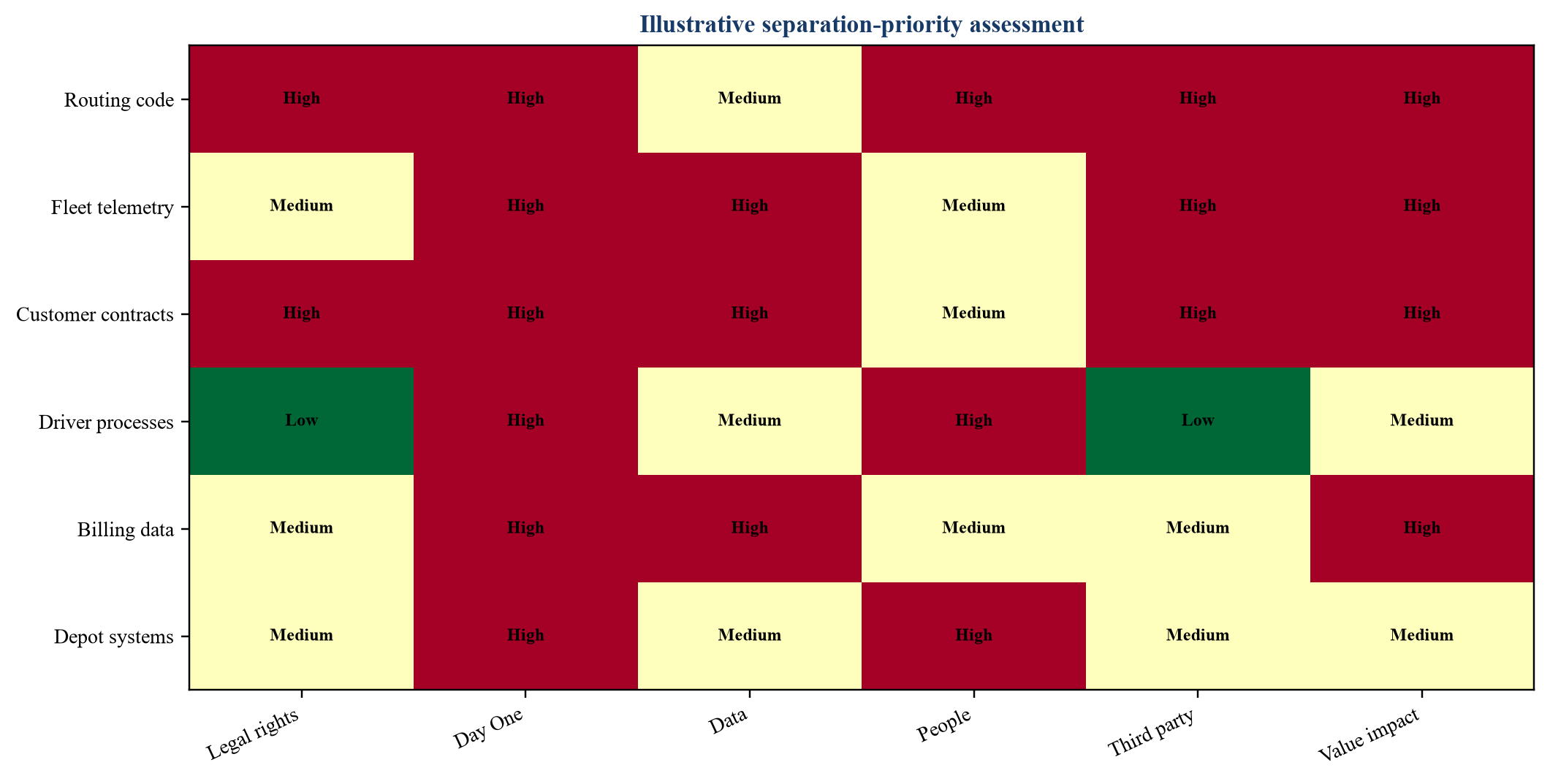
Scores are management assumptions used to demonstrate prioritisation only.
25. Build the completion evidence pack
The completion pack should prove that the agreed perimeter and conditions are satisfied. It can include executed transfers and novations, IP assignments and licences, employee records, operator-licence evidence, insurance, bank accounts, data-migration reconciliations, access-control reports, TSA schedules and acceptance certificates.
Evidence should be indexed to the sale agreement and dependency register. A status of “complete” should identify the document, approver and date. Screenshots and informal assurances are weak evidence for rights, reconciliations or acceptance.
The buyer should retain post-completion access to evidence needed for audit, tax, claims and regulatory response. The seller should retain only information it is entitled or required to keep. The records protocol should address custody, retrieval, confidentiality and destruction.
26. Prepare Day One operations
Day One planning should cover the first order, first dispatch, first exception, first invoice, first payroll and first incident. Each scenario should have an owner, runbook, contact path and fallback. The buyer should know how to operate if a seller interface is unavailable.
Command-centre metrics should focus on service continuity and control: orders accepted, routes generated, vehicles dispatched, failed messages, proof-of-delivery completion, invoice exceptions, safety incidents, data incidents and customer escalations. Thresholds should trigger action rather than only reporting.
The customer communication plan should identify new legal entities, bank details, portals, contacts, data notices and support channels. Fraud controls are important when bank details change. Communications should be timed with consent and competition advice.
27. Model the illustrative freight division
Consider a hypothetical UK road-freight division operating seven depots with 64 enterprise customers and 1,280 powered and unpowered fleet units. Management reports annual revenue of GBP 420 million and EBITDA of GBP 38 million. Eighteen material software services support quoting, routing, telematics, dispatch, proof of delivery, billing and reporting.
The routing platform is shared with the seller and includes seller-owned orchestration, third-party mapping, telematics feeds and customer-specific rules. Nine customer contracts require consent or novation; five represent 38 per cent of division EBITDA. Payroll, treasury, procurement, cyber monitoring and finance operate through seller systems.
The scenario assumes that an asset transaction transfers selected fleet, depot rights, employees, customer contracts and operating records. The buyer receives a five-year routing licence and a twelve-month TSA with extension options. All figures are hypothetical management assumptions and do not describe an identified transaction.
| Measure | Reported position | Evidence-adjusted position | Principal dependency |
|---|---|---|---|
| Revenue | GBP 420m | GBP 397m at risk-adjusted consent case | Customer novations and retention |
| EBITDA | GBP 38m | GBP 31m maintainable standalone EBITDA | Standalone systems, procurement and central functions |
| Enterprise customers | 64 | 55 transferable without unresolved material condition | Consent, data rights and capability continuity |
| Software services | 18 material services | 7 transfer, 5 licence, 6 TSA or replace | IP ownership, vendor consent and migration |
| Fleet units | 1,280 | 1,214 verified for transfer at cut-off | Title, lease, condition and operator readiness |
Values are management assumptions created to demonstrate the framework.
28. Reconcile reported to maintainable EBITDA
The illustrative bridge begins with GBP 38 million of reported EBITDA. It deducts GBP 4 million for unallocated standalone corporate and compliance costs, GBP 2 million for loss of group procurement economics and GBP 3 million for technology, cyber and data capability required outside the TSA. It adds GBP 2 million of identified, executable operating mitigation. Maintainable standalone EBITDA is therefore GBP 31 million.
TSA charges are modelled separately from recurring cost because they expire as target capabilities are delivered. One-off separation expenditure is also separate. The investment case should show the cash profile, rather than capitalising all transition cost or embedding temporary charges indefinitely.
The bridge is a management scenario. Actual treatment depends on the perimeter, accounting policies, evidence and contractual outcomes. Each adjustment should be reconciled to roles, systems, vendors or contracts in the dependency register.
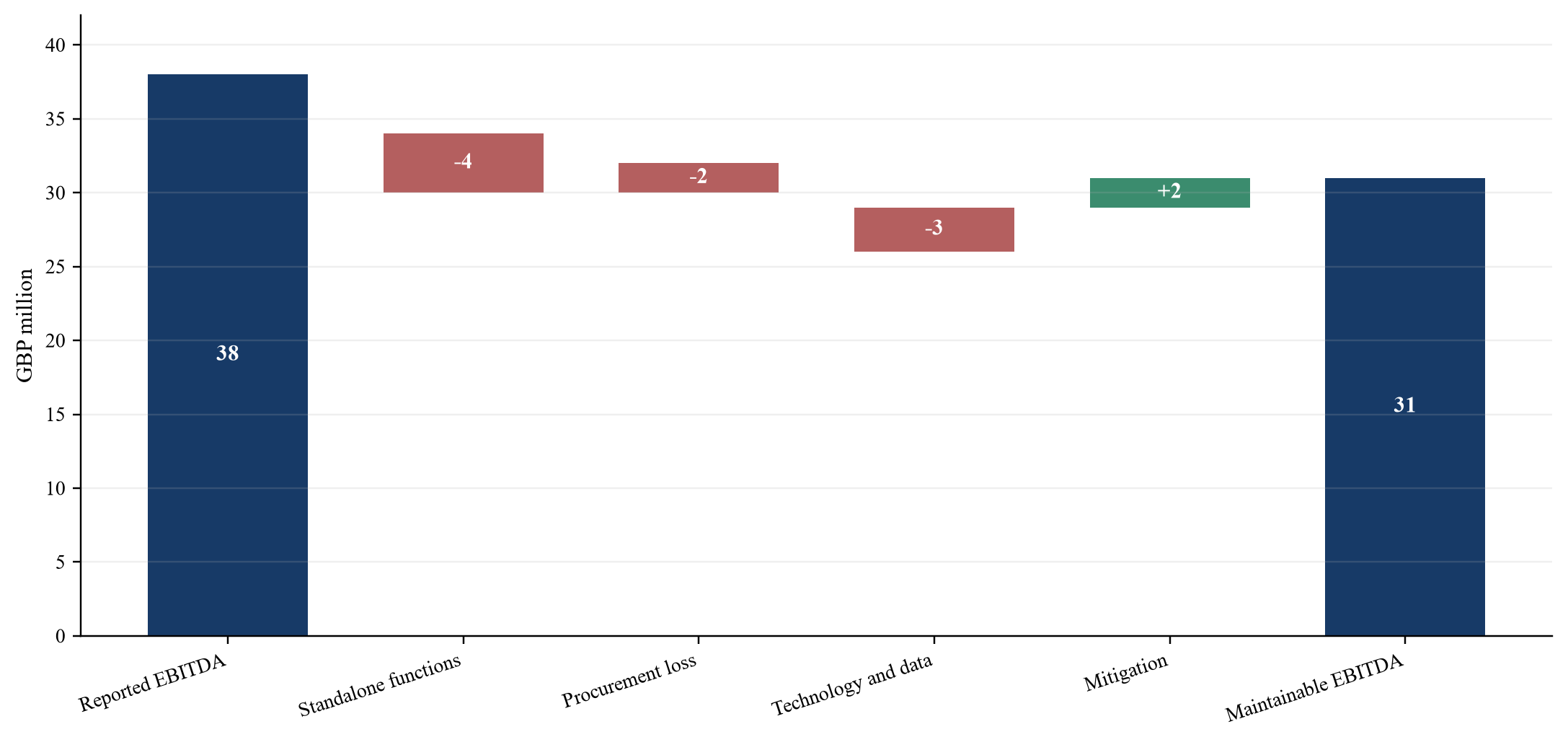
Amounts are management assumptions in GBP million and are not observed company results.
29. Test price under separation scenarios
The hypothetical headline enterprise value is GBP 285 million. The central executable case deducts GBP 18 million for the restricted algorithm-rights package, GBP 22 million for customer-consent and attrition exposure, GBP 9 million for data remediation and GBP 12 million for separation expenditure. It adds GBP 15 million for mitigations supported by executed licences, customer evidence and a funded build plan, producing an illustrative value of GBP 239 million.
The downside case assumes delayed consent for two major customers, a six-month TSA extension and slower replacement of the routing platform. Maintainable EBITDA falls to GBP 27 million and value to GBP 205 million. The protected case uses completion conditions, contract-linked retention and seller-funded remediation to preserve GBP 252 million, subject to delivery.
These values do not constitute a valuation opinion. They demonstrate how perimeter evidence can affect price, deferred consideration and protection. The investment committee should view value together with cash outflow, completion probability and residual exposure.
| Scenario | Maintainable EBITDA | Illustrative enterprise value | Principal response |
|---|---|---|---|
| Central executable case | 31 | 239 | Licence, consent plan, funded separation and measured TSA exit |
| Downside delay case | 27 | 205 | Price reduction, greater retention and extended liquidity plan |
| Protected completion case | 31 | 252 | Conditions, customer-linked retention and seller-funded remediation |
| Unresolved perimeter | Not reliably measurable | Defer decision | Do not rely on headline value until rights and capability are evidenced |
Values are management assumptions in GBP million and are not a fairness or valuation opinion.
30. Reverse-stress the Day One plan
Reverse stress asks which failure causes the transaction thesis to break. For the illustrative case, the critical failures are loss of routing rights, non-transfer of the two largest customers, inability to lawfully use historical fleet data, delay in operator readiness and failure of the seller-hosted billing interface.
The team should model combinations rather than isolated issues. A routing delay can reduce service quality and trigger customer termination, while invoice failure increases working-capital needs. Correlation matters because multiple dependencies may share the same seller platform or specialist employees.
The board should define boundaries for price, timing and residual risk. If a failure cannot be prevented or protected contractually, the response may be to change the perimeter, defer completion or stop the transaction. Reverse stress turns operational evidence into an explicit investment decision.
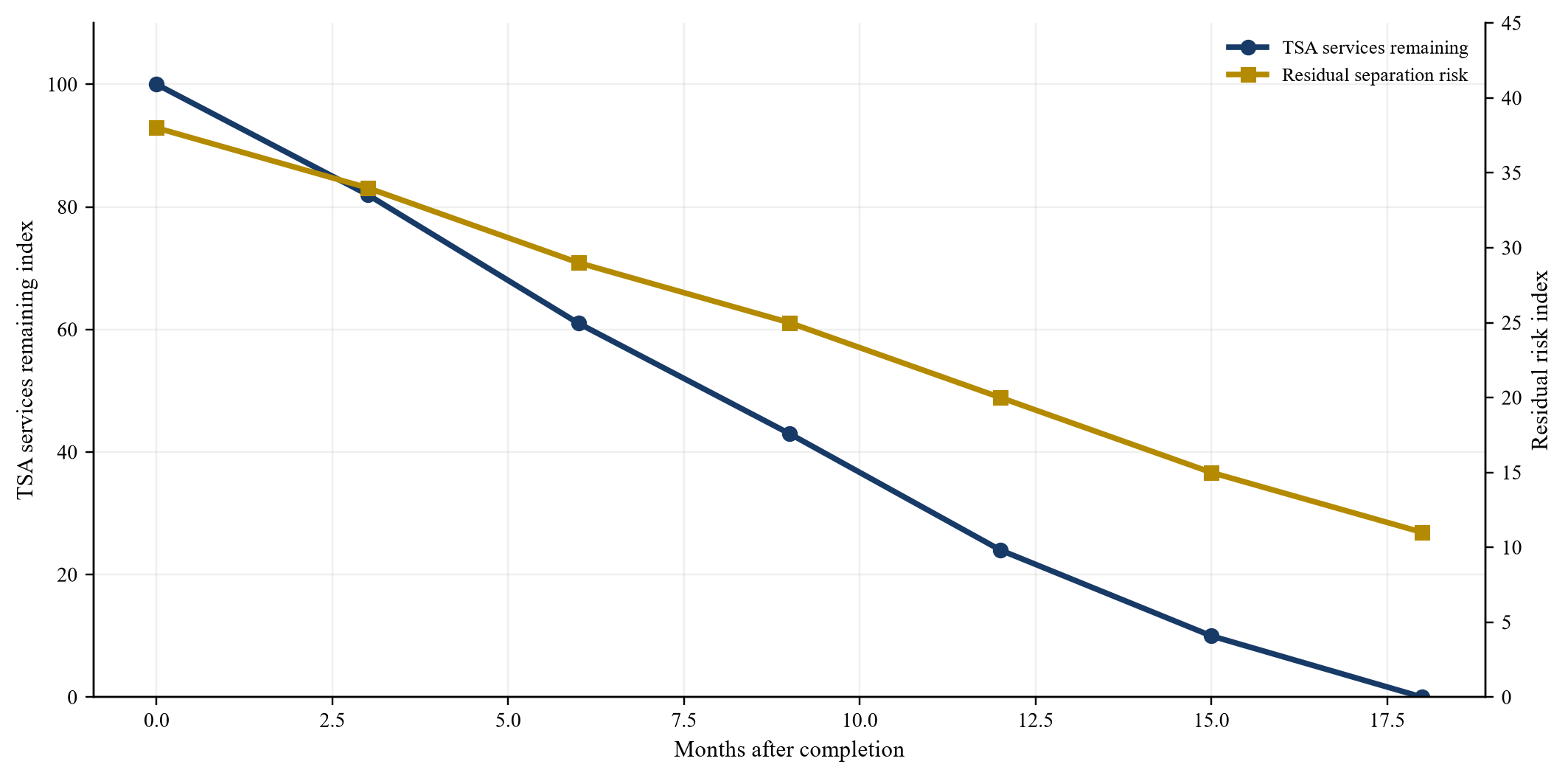
Indices are management assumptions and demonstrate governance of transition only.
31. Establish post-completion governance
The separation governance body should own dependencies, customer consents, TSA performance, cyber incidents, data migration, cost, value and risk. It should include transaction, operations, technology, finance, legal, people and customer leaders with explicit decision rights.
Reporting should distinguish fact, management assumption, professional judgement and unresolved evidence. Measures should include service availability, customer retention, order and invoice exceptions, migration reconciliation, access closure, TSA exit, spend, standalone EBITDA and value protection.
Changes should follow a controlled process. A proposed extension, design change or scope transfer should state cost, timing, security, data, customer and value consequences. The closing baseline enables the board to see whether the thesis is being delivered or deferred.
32. Design the first 100 days
The first 100 days should stabilise service, close evidence gaps and accelerate exit from the highest-risk seller dependencies. The plan should prioritise customer continuity, regulatory compliance, cyber access, cash collection, data control and critical-person retention before discretionary transformation.
Workstreams should have measurable milestones. Examples include completing priority novations, validating fleet title and condition, moving privileged identities, reconciling opening data, parallel-running billing, transferring vendor contracts and accepting the target routing environment.
Value creation should remain linked to the transaction thesis. Route-density improvement, empty-mile reduction, customer repricing and fleet utilisation can follow once baseline controls are stable. Benefits should be measured against the evidence-adjusted closing baseline.
33. Recognise limitations
The framework does not determine the legal effectiveness of an assignment, the application of TUPE, the lawful basis for data processing, CMA jurisdiction, NSI notification, accounting classification, tax treatment, operator licensing or fair value. Those conclusions require current transaction-specific evidence and qualified professional advice.
Routing performance can change with customer mix, traffic, weather, network constraints, driver behaviour and data quality. Historical results may not reproduce in the buyer environment. The buyer should validate models and operations before relying on projected efficiencies.
The illustrative division, EBITDA, value, consents, systems and scenarios are hypothetical. They should not be attributed to an identified company. Commercial demand for an advisory mandate and resulting fees remain unverified until supported by executed and paid engagement evidence.
34. Conclude the carve-out case
A UK freight carve-out is executable when the buyer can prove that the transferred rights and capabilities support the customer promise on Day One and after TSA exit. Vehicles and contracts are necessary, while algorithms, data rights, people, licences, systems and controls determine whether those assets operate as a business.
The dependency register should connect diligence to transaction documents, separation design and value. Customer consents, IP rights, data permissions, operator readiness and cyber controls deserve the same investment-committee attention as EBITDA and purchase price.
The transaction should proceed when the perimeter is legally coherent, operationally tested, financially reconciled and protected against material gaps. A buyer that can trace every critical service from contract through route, delivery, invoice and cash has a defensible basis for price and execution. A seller using the same evidence can reduce uncertainty, protect value and shorten the path to completion.
Sources
- Competition and Markets Authority, Merger assessment guidelines, updated 3 September 2026. Read the primary source
- Competition and Markets Authority, Merger assessment guidelines, HTML version, updated 3 September 2026. Read the primary source
- Competition and Markets Authority, Mergers: how they are investigated, updated 23 June 2025. Read the primary source
- Competition and Markets Authority, Mergers charter, 12 March 2025. Read the primary source
- Information Commissioner's Office, Due diligence when sharing data following mergers and acquisitions. Read the primary source
- Information Commissioner's Office, Data sharing: a code of practice. Read the primary source
- UK Parliament, Data (Use and Access) Act 2025. Read the primary source
- Intellectual Property Office, Licensing intellectual property, updated 1 April 2026. Read the primary source
- Government Office for Technology Transfer, KAM Guide: Intellectual property management. Read the primary source
- Government Office for Technology Transfer, KAM Guide: IP in agreements. Read the primary source
- HM Revenue and Customs, Software licensing standard, updated 21 March 2025. Read the primary source
- Intellectual Property Office, Sui generis database rights. Read the primary source
- UK Government, Business transfers, takeovers and TUPE: overview. Read the primary source
- UK Government, Business transfers, takeovers and TUPE: information about employees during transfers. Read the primary source
- UK Government, Business transfers, takeovers and TUPE: transfers of employment contracts. Read the primary source
- UK Government, Business transfers, takeovers and TUPE: consulting and informing. Read the primary source
- Cabinet Office, National Security and Investment Act: details of the 17 types of notifiable acquisitions. Read the primary source
- Cabinet Office, The National Security and Investment Act alongside regulatory requirements. Read the primary source
- IFRS Foundation, IFRS 3 Business Combinations. Read the primary source
- IFRS Foundation, IAS 38 Intangible Assets. Read the primary source
- IFRS Foundation, IFRS 13 Fair Value Measurement. Read the primary source
- National Cyber Security Centre, Cyber Security Toolkit for Boards. Read the primary source
- National Cyber Security Centre, Assessing supply chain cyber security. Read the primary source
- Driver and Vehicle Standards Agency, Guide to maintaining roadworthiness. Read the primary source
