

1. Define the financed asset
The decision question is what the lender is actually financing before electricity capacity becomes operational. The evidence file should begin with the executed connection agreement, project rights, land package, consents, studies, programme, securities and corporate ownership. Each item should record its source, date, legal owner, responsible person, expiry or review date and relationship to the current programme. Official reform objectives provide context. Executed project documents determine rights, cash obligations and remedies. [1][2]
The principal failure is that a queue position is described as a standalone asset even though value depends on an integrated and conditional project package. Pre-energisation debt converts future network access into funded exposure before stable operating cash exists. The lender needs an observable chain from the current legal position to the next milestone, the funding required to reach it and the value preserved if progress stops.
The recommended response is to define the financed package, excluded value and evidence required for each advance. Management estimates may support scenarios when identified as assumptions and reconciled to external evidence. The central case should retain current rights, committed funding and costed obligations. The downside should combine related grid, planning, construction and financing effects.
The credit record should state funded exposure, the next evidence gate, remaining cost, minimum liquidity, cure period and recovery route. It should identify the party able to act, required consent and the last date for value-preserving intervention.
2. Use a connection-status dictionary
The decision question is how application, Gate 1, Gate 2, agreement, works, backfeed, energisation and operational capacity differ. The evidence file should begin with NESO and network-company rules, offers, agreements, notices, methodologies and technical approvals. Each item should record its source, date, legal owner, responsible person, expiry or review date and relationship to the current programme. Official reform objectives provide context. Executed project documents determine rights, cash obligations and remedies. [3][4]
The principal failure is that participants use the word connection for legally and economically different states. Pre-energisation debt converts future network access into funded exposure before stable operating cash exists. The lender needs an observable chain from the current legal position to the next milestone, the funding required to reach it and the value preserved if progress stops.
The recommended response is to adopt one status dictionary and prohibit value attribution beyond the evidenced state. Management estimates may support scenarios when identified as assumptions and reconciled to external evidence. The central case should retain current rights, committed funding and costed obligations. The downside should combine related grid, planning, construction and financing effects.
The credit record should state funded exposure, the next evidence gate, remaining cost, minimum liquidity, cure period and recovery route. It should identify the party able to act, required consent and the last date for value-preserving intervention.
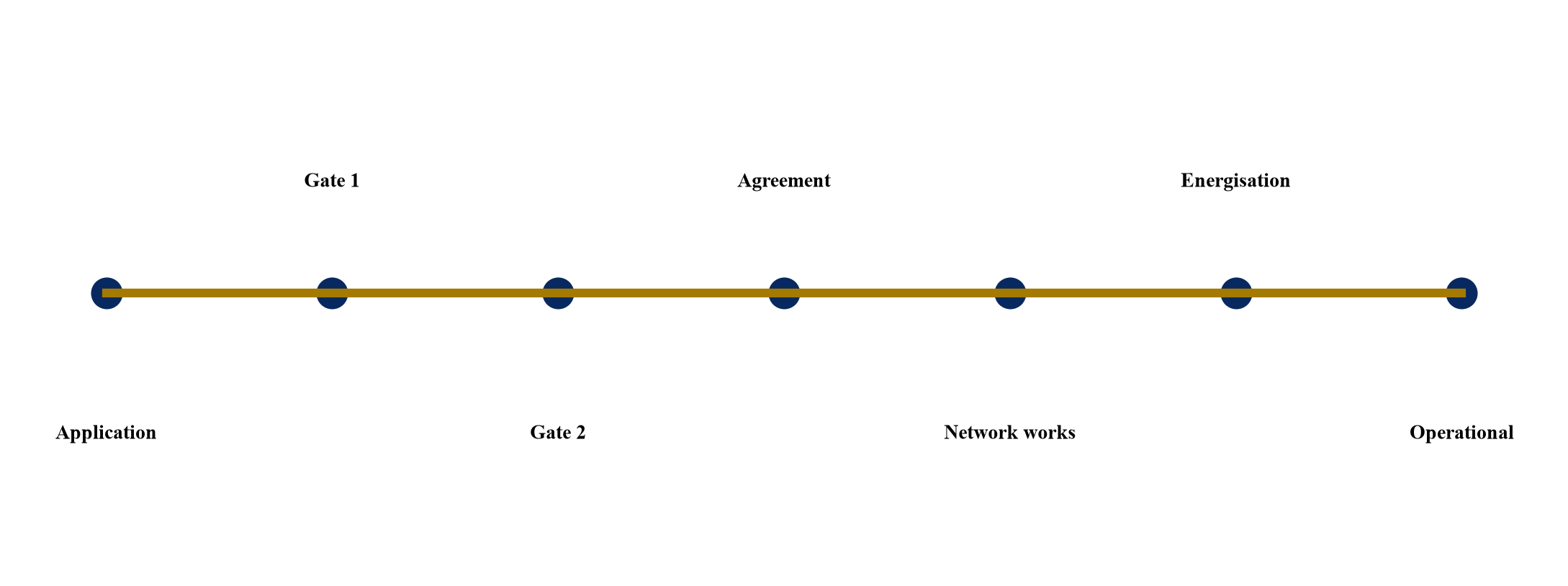
Conceptual framework based on official connections-reform materials; project documents determine actual status.
| State | Minimum evidence | Financing treatment |
|---|---|---|
| application | accepted submission and fee | no capacity value |
| Gate 1 | issued indicative offer | development evidence only |
| Gate 2 | readiness and alignment determination | conditional milestone value |
| executed agreement | signed rights and obligations | financeable subject to review |
| network works | certified progress and current programme | higher advance subject to funding |
| energisation | written authority and tested capacity | completion test input |
Proposed definitions; official methodologies and executed agreements control treatment.
3. Test Gate 2 readiness
The decision question is whether the project satisfies applicable readiness and strategic-alignment requirements. The evidence file should begin with readiness declarations, land evidence, planning route, technology classification and official guidance. Each item should record its source, date, legal owner, responsible person, expiry or review date and relationship to the current programme. Official reform objectives provide context. Executed project documents determine rights, cash obligations and remedies. [3][5]
The principal failure is that a prior offer is assumed to survive queue reform without complete or current evidence. Pre-energisation debt converts future network access into funded exposure before stable operating cash exists. The lender needs an observable chain from the current legal position to the next milestone, the funding required to reach it and the value preserved if progress stops.
The recommended response is to independently reconcile every Gate 2 criterion to dated and reviewable evidence. Management estimates may support scenarios when identified as assumptions and reconciled to external evidence. The central case should retain current rights, committed funding and costed obligations. The downside should combine related grid, planning, construction and financing effects.
The credit record should state funded exposure, the next evidence gate, remaining cost, minimum liquidity, cure period and recovery route. It should identify the party able to act, required consent and the last date for value-preserving intervention.
4. Verify the legal holder
The decision question is which entity owns each connection right and bears each obligation. The evidence file should begin with company records, executed agreements, accession documents, land interests and organisational chart. Each item should record its source, date, legal owner, responsible person, expiry or review date and relationship to the current programme. Official reform objectives provide context. Executed project documents determine rights, cash obligations and remedies. [6][7]
The principal failure is that connection rights, land and the borrowing entity sit in different companies without enforceable linkage. Pre-energisation debt converts future network access into funded exposure before stable operating cash exists. The lender needs an observable chain from the current legal position to the next milestone, the funding required to reach it and the value preserved if progress stops.
The recommended response is to align ownership or create enforceable assignments, security and completion rights. Management estimates may support scenarios when identified as assumptions and reconciled to external evidence. The central case should retain current rights, committed funding and costed obligations. The downside should combine related grid, planning, construction and financing effects.
The credit record should state funded exposure, the next evidence gate, remaining cost, minimum liquidity, cure period and recovery route. It should identify the party able to act, required consent and the last date for value-preserving intervention.
5. Map land and planning dependencies
The decision question is which property rights and planning steps support continued readiness and construction. The evidence file should begin with options, leases, easements, letters of authority, planning status, conditions and expiry dates. Each item should record its source, date, legal owner, responsible person, expiry or review date and relationship to the current programme. Official reform objectives provide context. Executed project documents determine rights, cash obligations and remedies. [2][8]
The principal failure is that a project preserves a connection date while land control or consent assumptions expire. Pre-energisation debt converts future network access into funded exposure before stable operating cash exists. The lender needs an observable chain from the current legal position to the next milestone, the funding required to reach it and the value preserved if progress stops.
The recommended response is to maintain a dependency schedule linking each property and planning event to the connection package. Management estimates may support scenarios when identified as assumptions and reconciled to external evidence. The central case should retain current rights, committed funding and costed obligations. The downside should combine related grid, planning, construction and financing effects.
The credit record should state funded exposure, the next evidence gate, remaining cost, minimum liquidity, cure period and recovery route. It should identify the party able to act, required consent and the last date for value-preserving intervention.
6. Read the connection agreement as a cash contract
The decision question is which payments, securities, milestones, liabilities and termination rights create value or loss. The evidence file should begin with the full agreement, construction programme, charging statements, securities and correspondence. Each item should record its source, date, legal owner, responsible person, expiry or review date and relationship to the current programme. Official reform objectives provide context. Executed project documents determine rights, cash obligations and remedies. [9][10]
The principal failure is that the headline capacity and date receive attention while payment and termination obligations remain unfunded. Pre-energisation debt converts future network access into funded exposure before stable operating cash exists. The lender needs an observable chain from the current legal position to the next milestone, the funding required to reach it and the value preserved if progress stops.
The recommended response is to convert every obligation into a dated cash, evidence and remedy schedule. Management estimates may support scenarios when identified as assumptions and reconciled to external evidence. The central case should retain current rights, committed funding and costed obligations. The downside should combine related grid, planning, construction and financing effects.
The credit record should state funded exposure, the next evidence gate, remaining cost, minimum liquidity, cure period and recovery route. It should identify the party able to act, required consent and the last date for value-preserving intervention.
| Obligation | Evidence | Financing response |
|---|---|---|
| application and study fees | invoices and receipts | sunk-cost classification |
| securities | instrument and expiry | reserve and renewal control |
| network charges | statement and schedule | funded use |
| milestones | notice and evidence standard | covenant and draw gate |
| change costs | modification terms | consent and contingency |
| termination liability | agreement and estimate | downside reserve |
Proposed review structure; executed terms determine actual exposure.
7. Separate firm and flexible access
The decision question is what capacity can operate, under which constraints, before all reinforcements are complete. The evidence file should begin with technical offer, active-network-management terms, curtailment rules, protection design and operating data. Each item should record its source, date, legal owner, responsible person, expiry or review date and relationship to the current programme. Official reform objectives provide context. Executed project documents determine rights, cash obligations and remedies. [1][11]
The principal failure is that non-firm access is modelled as uninterrupted firm capacity. Pre-energisation debt converts future network access into funded exposure before stable operating cash exists. The lender needs an observable chain from the current legal position to the next milestone, the funding required to reach it and the value preserved if progress stops.
The recommended response is to model constrained operation, curtailment and revenue eligibility explicitly. Management estimates may support scenarios when identified as assumptions and reconciled to external evidence. The central case should retain current rights, committed funding and costed obligations. The downside should combine related grid, planning, construction and financing effects.
The credit record should state funded exposure, the next evidence gate, remaining cost, minimum liquidity, cure period and recovery route. It should identify the party able to act, required consent and the last date for value-preserving intervention.
8. Rebuild sources and uses
The decision question is how development, land, planning, grid securities, network charges, equipment, construction and financing costs are funded. The evidence file should begin with contracts, budgets, invoices, network estimates, financing terms and sponsor evidence. Each item should record its source, date, legal owner, responsible person, expiry or review date and relationship to the current programme. Official reform objectives provide context. Executed project documents determine rights, cash obligations and remedies. [12][13]
The principal failure is that connection preservation costs and network liabilities are omitted from project cost. Pre-energisation debt converts future network access into funded exposure before stable operating cash exists. The lender needs an observable chain from the current legal position to the next milestone, the funding required to reach it and the value preserved if progress stops.
The recommended response is to reconcile all uses to committed funding and distinguish refundable, recoverable and sunk amounts. Management estimates may support scenarios when identified as assumptions and reconciled to external evidence. The central case should retain current rights, committed funding and costed obligations. The downside should combine related grid, planning, construction and financing effects.
The credit record should state funded exposure, the next evidence gate, remaining cost, minimum liquidity, cure period and recovery route. It should identify the party able to act, required consent and the last date for value-preserving intervention.
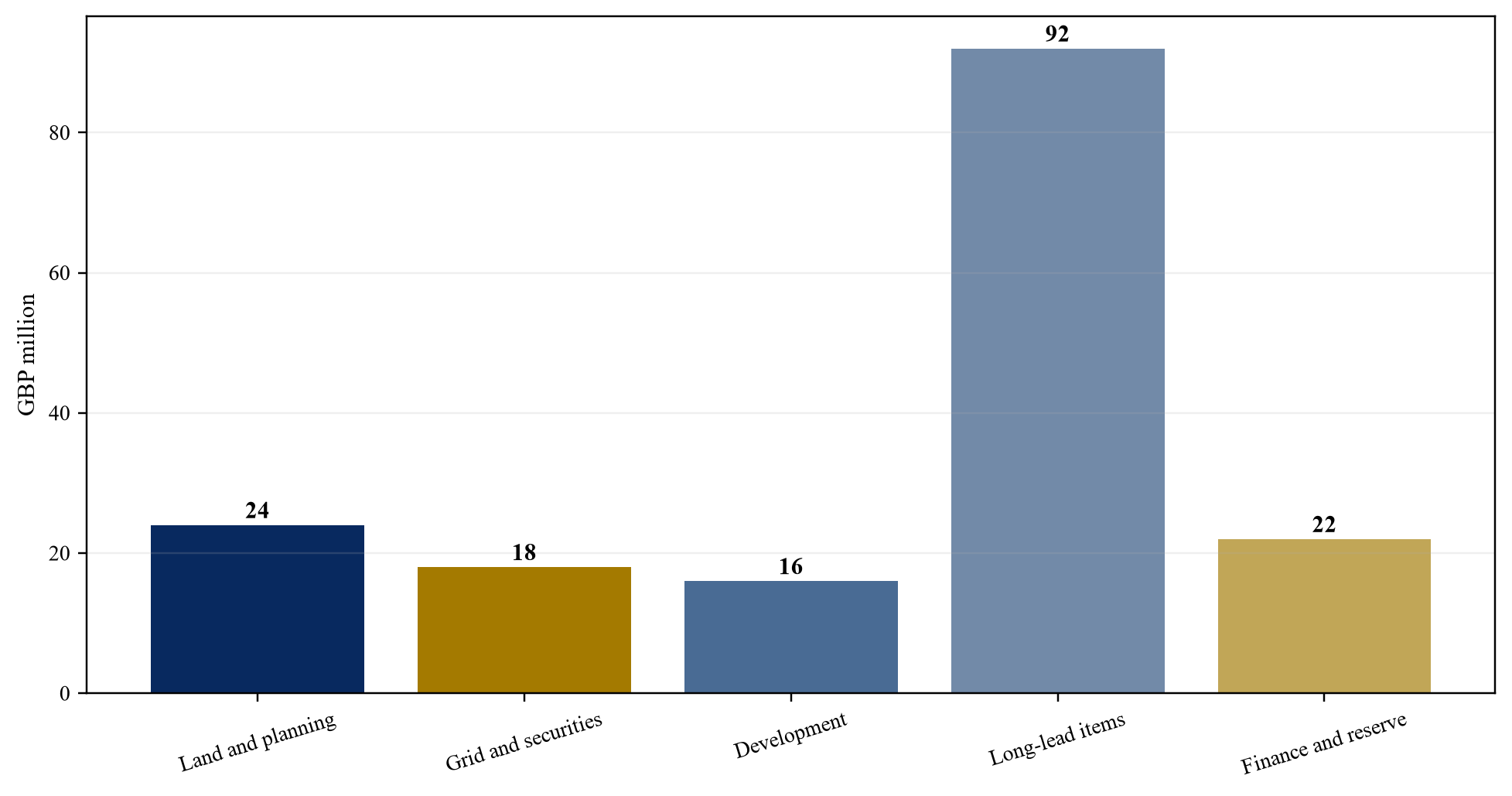
Wholly hypothetical; GBP million.
9. Size a pre-energisation facility
The decision question is which costs are eligible before construction and operating cash exist. The evidence file should begin with verified expenditure, valuation evidence, milestone status, remaining funding and takeout conditions. Each item should record its source, date, legal owner, responsible person, expiry or review date and relationship to the current programme. Official reform objectives provide context. Executed project documents determine rights, cash obligations and remedies. [12][14]
The principal failure is that the facility is sized as a percentage of forecast enterprise value rather than supported cost and recovery. Pre-energisation debt converts future network access into funded exposure before stable operating cash exists. The lender needs an observable chain from the current legal position to the next milestone, the funding required to reach it and the value preserved if progress stops.
The recommended response is to cap exposure at the lower of eligible cost, milestone advance rate and stressed recovery. Management estimates may support scenarios when identified as assumptions and reconciled to external evidence. The central case should retain current rights, committed funding and costed obligations. The downside should combine related grid, planning, construction and financing effects.
The credit record should state funded exposure, the next evidence gate, remaining cost, minimum liquidity, cure period and recovery route. It should identify the party able to act, required consent and the last date for value-preserving intervention.
| Eligible component | Principal evidence | Advance constraint |
|---|---|---|
| land rights | enforceable title or option | stressed transferable value |
| planning and studies | completed deliverables | supported cost |
| grid securities | enforceable recovery terms | net recoverable amount |
| network payments | agreement and invoice | milestone-adjusted value |
| long-lead equipment | title, inspection and assignment | liquidation value |
| interest and fees | controlled budget | funded reserve |
Proposed method; values and advance rates require transaction-specific evidence.
10. Sequence sponsor equity
The decision question is when sponsor cash absorbs development, reform, delay and overrun risk. The evidence file should begin with bank evidence, escrow, shareholder instruments, funding notices and subordination terms. Each item should record its source, date, legal owner, responsible person, expiry or review date and relationship to the current programme. Official reform objectives provide context. Executed project documents determine rights, cash obligations and remedies. [14][15]
The principal failure is that future equity commitments are treated as cash available to preserve the connection package. Pre-energisation debt converts future network access into funded exposure before stable operating cash exists. The lender needs an observable chain from the current legal position to the next milestone, the funding required to reach it and the value preserved if progress stops.
The recommended response is to require funded equity before debt and automatic replenishment when the budget becomes unbalanced. Management estimates may support scenarios when identified as assumptions and reconciled to external evidence. The central case should retain current rights, committed funding and costed obligations. The downside should combine related grid, planning, construction and financing effects.
The credit record should state funded exposure, the next evidence gate, remaining cost, minimum liquidity, cure period and recovery route. It should identify the party able to act, required consent and the last date for value-preserving intervention.
11. Design drawdown gates
The decision question is which legal, technical, property, grid and funding evidence permits each advance. The evidence file should begin with draw request, invoices, milestone register, title update, budget, engineer report and compliance certificate. Each item should record its source, date, legal owner, responsible person, expiry or review date and relationship to the current programme. Official reform objectives provide context. Executed project documents determine rights, cash obligations and remedies. [12][16]
The principal failure is that debt exposure rises while connection readiness or remaining funding deteriorates. Pre-energisation debt converts future network access into funded exposure before stable operating cash exists. The lender needs an observable chain from the current legal position to the next milestone, the funding required to reach it and the value preserved if progress stops.
The recommended response is to condition every draw on current readiness, balanced funding and no unresolved termination trigger. Management estimates may support scenarios when identified as assumptions and reconciled to external evidence. The central case should retain current rights, committed funding and costed obligations. The downside should combine related grid, planning, construction and financing effects.
The credit record should state funded exposure, the next evidence gate, remaining cost, minimum liquidity, cure period and recovery route. It should identify the party able to act, required consent and the last date for value-preserving intervention.
12. Create a milestone control system
The decision question is how queue-management, contractual, planning and construction milestones interact. The evidence file should begin with agreement schedules, official methodology, notices, baseline programme, owners and evidence repository. Each item should record its source, date, legal owner, responsible person, expiry or review date and relationship to the current programme. Official reform objectives provide context. Executed project documents determine rights, cash obligations and remedies. [5][17]
The principal failure is that teams track dates in separate systems and miss a dependency or cure period. Pre-energisation debt converts future network access into funded exposure before stable operating cash exists. The lender needs an observable chain from the current legal position to the next milestone, the funding required to reach it and the value preserved if progress stops.
The recommended response is to use one controlled register with evidence, lead time, consequence and escalation threshold. Management estimates may support scenarios when identified as assumptions and reconciled to external evidence. The central case should retain current rights, committed funding and costed obligations. The downside should combine related grid, planning, construction and financing effects.
The credit record should state funded exposure, the next evidence gate, remaining cost, minimum liquidity, cure period and recovery route. It should identify the party able to act, required consent and the last date for value-preserving intervention.
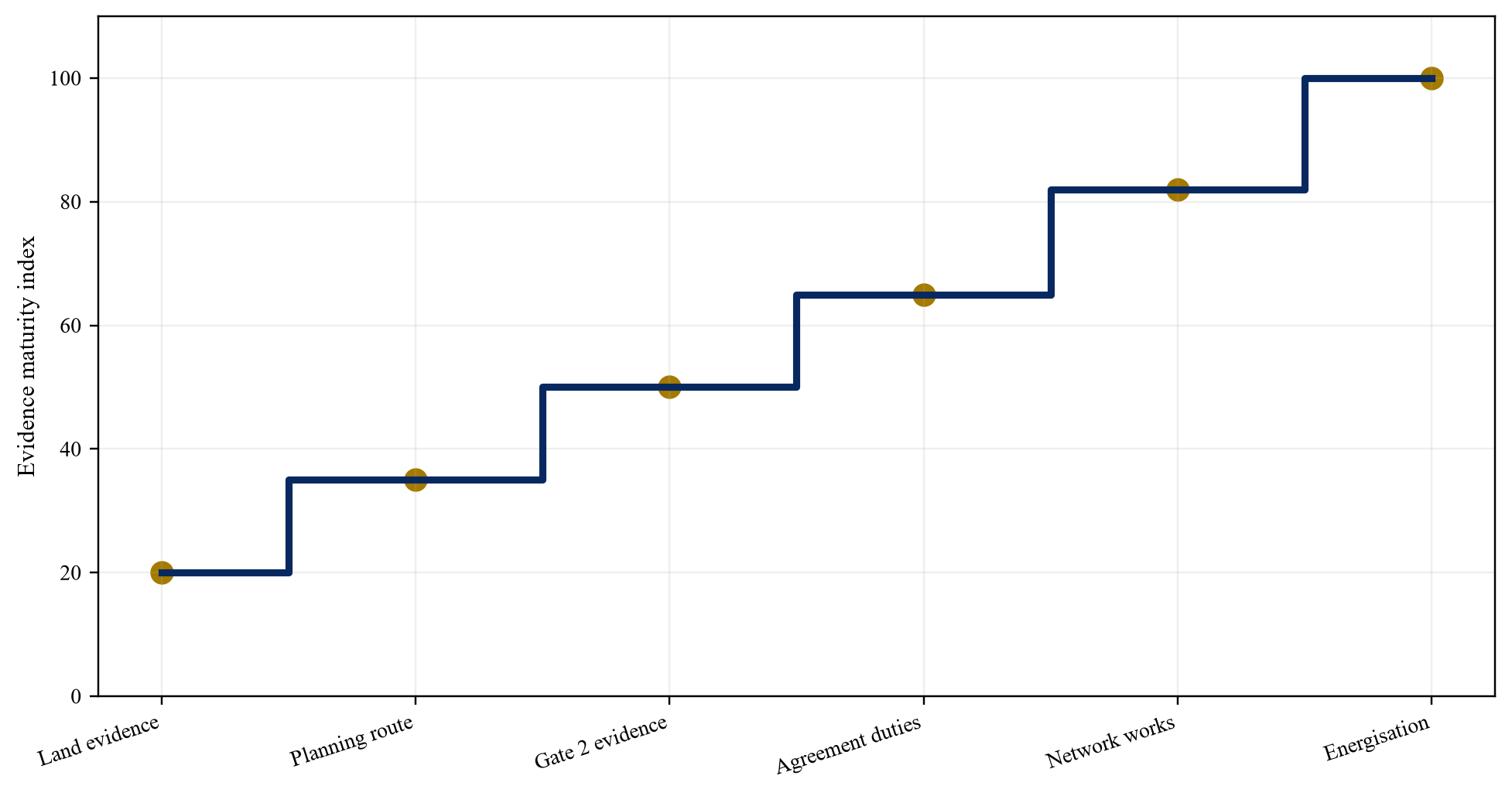
Proposed governance sequence; actual milestones and consequences are contract-specific.
| Milestone | Evidence owner | Warning indicator | Lender action |
|---|---|---|---|
| land readiness | sponsor and counsel | expiry or title defect | stop draw and cure |
| planning | planning adviser | unclosed condition | resize programme |
| Gate 2 | sponsor and grid adviser | evidence rejection | reassess value |
| connection duty | sponsor and network party | missed payment or notice | fund or protect |
| network work | engineer and network party | delay or scope change | update liquidity |
| energisation | network party | failed test or no authority | block conversion |
Proposed governance; each project requires its own agreement-led milestones.
13. Control modifications and change
The decision question is which design, capacity, date, technology, ownership or land changes require approval. The evidence file should begin with change procedures, gated-modification guidance, lender consent rights and updated studies. Each item should record its source, date, legal owner, responsible person, expiry or review date and relationship to the current programme. Official reform objectives provide context. Executed project documents determine rights, cash obligations and remedies. [18][19]
The principal failure is that a commercial change unintentionally reopens or weakens the connection position. Pre-energisation debt converts future network access into funded exposure before stable operating cash exists. The lender needs an observable chain from the current legal position to the next milestone, the funding required to reach it and the value preserved if progress stops.
The recommended response is to screen each proposed change for grid, planning, cost, contract and financing consequences before commitment. Management estimates may support scenarios when identified as assumptions and reconciled to external evidence. The central case should retain current rights, committed funding and costed obligations. The downside should combine related grid, planning, construction and financing effects.
The credit record should state funded exposure, the next evidence gate, remaining cost, minimum liquidity, cure period and recovery route. It should identify the party able to act, required consent and the last date for value-preserving intervention.
14. Diligence network dependencies
The decision question is which reinforcements, third-party projects, outages and approvals sit outside borrower control. The evidence file should begin with network programme, dependency map, outage plan, delivery updates and interface agreements. Each item should record its source, date, legal owner, responsible person, expiry or review date and relationship to the current programme. Official reform objectives provide context. Executed project documents determine rights, cash obligations and remedies. [1][20]
The principal failure is that the borrower programme treats a network target date as an unconditional delivery promise. Pre-energisation debt converts future network access into funded exposure before stable operating cash exists. The lender needs an observable chain from the current legal position to the next milestone, the funding required to reach it and the value preserved if progress stops.
The recommended response is to identify external dependencies, evidence owner and funded delay response. Management estimates may support scenarios when identified as assumptions and reconciled to external evidence. The central case should retain current rights, committed funding and costed obligations. The downside should combine related grid, planning, construction and financing effects.
The credit record should state funded exposure, the next evidence gate, remaining cost, minimum liquidity, cure period and recovery route. It should identify the party able to act, required consent and the last date for value-preserving intervention.
15. Value connection expenditure conservatively
The decision question is which deposits, securities, charges and completed works have recoverable value. The evidence file should begin with payment records, security instruments, refund provisions, completed assets and legal advice. Each item should record its source, date, legal owner, responsible person, expiry or review date and relationship to the current programme. Official reform objectives provide context. Executed project documents determine rights, cash obligations and remedies. [9][21]
The principal failure is that book cost is assumed recoverable despite termination deductions and limited transferability. Pre-energisation debt converts future network access into funded exposure before stable operating cash exists. The lender needs an observable chain from the current legal position to the next milestone, the funding required to reach it and the value preserved if progress stops.
The recommended response is to value each item by legal recovery route, time, cost and counterparty credit. Management estimates may support scenarios when identified as assumptions and reconciled to external evidence. The central case should retain current rights, committed funding and costed obligations. The downside should combine related grid, planning, construction and financing effects.
The credit record should state funded exposure, the next evidence gate, remaining cost, minimum liquidity, cure period and recovery route. It should identify the party able to act, required consent and the last date for value-preserving intervention.
16. Define collateral and control
The decision question is which shares, accounts, land rights, contracts, receivables, insurance and project rights secure the facility. The evidence file should begin with security documents, account controls, assignments, acknowledgements, consents and legal opinions. Each item should record its source, date, legal owner, responsible person, expiry or review date and relationship to the current programme. Official reform objectives provide context. Executed project documents determine rights, cash obligations and remedies. [7][12]
The principal failure is that the lender has security over the borrower while critical rights cannot be assigned or exercised. Pre-energisation debt converts future network access into funded exposure before stable operating cash exists. The lender needs an observable chain from the current legal position to the next milestone, the funding required to reach it and the value preserved if progress stops.
The recommended response is to obtain the strongest permitted control package and price residual transfer risk. Management estimates may support scenarios when identified as assumptions and reconciled to external evidence. The central case should retain current rights, committed funding and costed obligations. The downside should combine related grid, planning, construction and financing effects.
The credit record should state funded exposure, the next evidence gate, remaining cost, minimum liquidity, cure period and recovery route. It should identify the party able to act, required consent and the last date for value-preserving intervention.
| Asset or right | Control sought | Residual risk |
|---|---|---|
| borrower shares | first-ranking charge | entity-level liabilities |
| land interests | mortgage or assignment | consent and expiry |
| connection package | assignment and acknowledgement | transfer restriction |
| project accounts | account control | permitted leakage |
| material contracts | assignment and step-in | termination on default |
| insurance proceeds | loss-payee protection | coverage exclusions |
Proposed matrix; legal opinions and counterparty consents determine enforceability.
17. Test transferability
The decision question is whether a lender or buyer can preserve, transfer or novate the connection package after default. The evidence file should begin with agreement restrictions, code requirements, network consent process, land assignment and buyer eligibility. Each item should record its source, date, legal owner, responsible person, expiry or review date and relationship to the current programme. Official reform objectives provide context. Executed project documents determine rights, cash obligations and remedies. [6][18]
The principal failure is that a valuation assumes a liquid market for rights that cannot be transferred independently. Pre-energisation debt converts future network access into funded exposure before stable operating cash exists. The lender needs an observable chain from the current legal position to the next milestone, the funding required to reach it and the value preserved if progress stops.
The recommended response is to base recovery on the executable transaction structure rather than an assumed standalone sale. Management estimates may support scenarios when identified as assumptions and reconciled to external evidence. The central case should retain current rights, committed funding and costed obligations. The downside should combine related grid, planning, construction and financing effects.
The credit record should state funded exposure, the next evidence gate, remaining cost, minimum liquidity, cure period and recovery route. It should identify the party able to act, required consent and the last date for value-preserving intervention.
18. Align construction and supply contracts
The decision question is how equipment, EPC, land, offtake and network dates fit the connection programme. The evidence file should begin with integrated schedule, contracts, notice dates, delay regimes, warranties and termination rights. Each item should record its source, date, legal owner, responsible person, expiry or review date and relationship to the current programme. Official reform objectives provide context. Executed project documents determine rights, cash obligations and remedies. [13][22]
The principal failure is that the project pays for equipment or capacity before the grid path can support use. Pre-energisation debt converts future network access into funded exposure before stable operating cash exists. The lender needs an observable chain from the current legal position to the next milestone, the funding required to reach it and the value preserved if progress stops.
The recommended response is to sequence commitments and cancellation rights around evidenced connection progress. Management estimates may support scenarios when identified as assumptions and reconciled to external evidence. The central case should retain current rights, committed funding and costed obligations. The downside should combine related grid, planning, construction and financing effects.
The credit record should state funded exposure, the next evidence gate, remaining cost, minimum liquidity, cure period and recovery route. It should identify the party able to act, required consent and the last date for value-preserving intervention.
19. Build the delay-liquidity model
The decision question is how interest, fees, securities, staff, land, equipment and network payments continue during delay. The evidence file should begin with monthly cash model, reserve accounts, committed equity, payment schedule and downside actions. Each item should record its source, date, legal owner, responsible person, expiry or review date and relationship to the current programme. Official reform objectives provide context. Executed project documents determine rights, cash obligations and remedies. [14][23]
The principal failure is that the project remains economically attractive but loses its position because liquidity expires. Pre-energisation debt converts future network access into funded exposure before stable operating cash exists. The lender needs an observable chain from the current legal position to the next milestone, the funding required to reach it and the value preserved if progress stops.
The recommended response is to fund a coherent delay period and establish decision points before minimum cash is reached. Management estimates may support scenarios when identified as assumptions and reconciled to external evidence. The central case should retain current rights, committed funding and costed obligations. The downside should combine related grid, planning, construction and financing effects.
The credit record should state funded exposure, the next evidence gate, remaining cost, minimum liquidity, cure period and recovery route. It should identify the party able to act, required consent and the last date for value-preserving intervention.
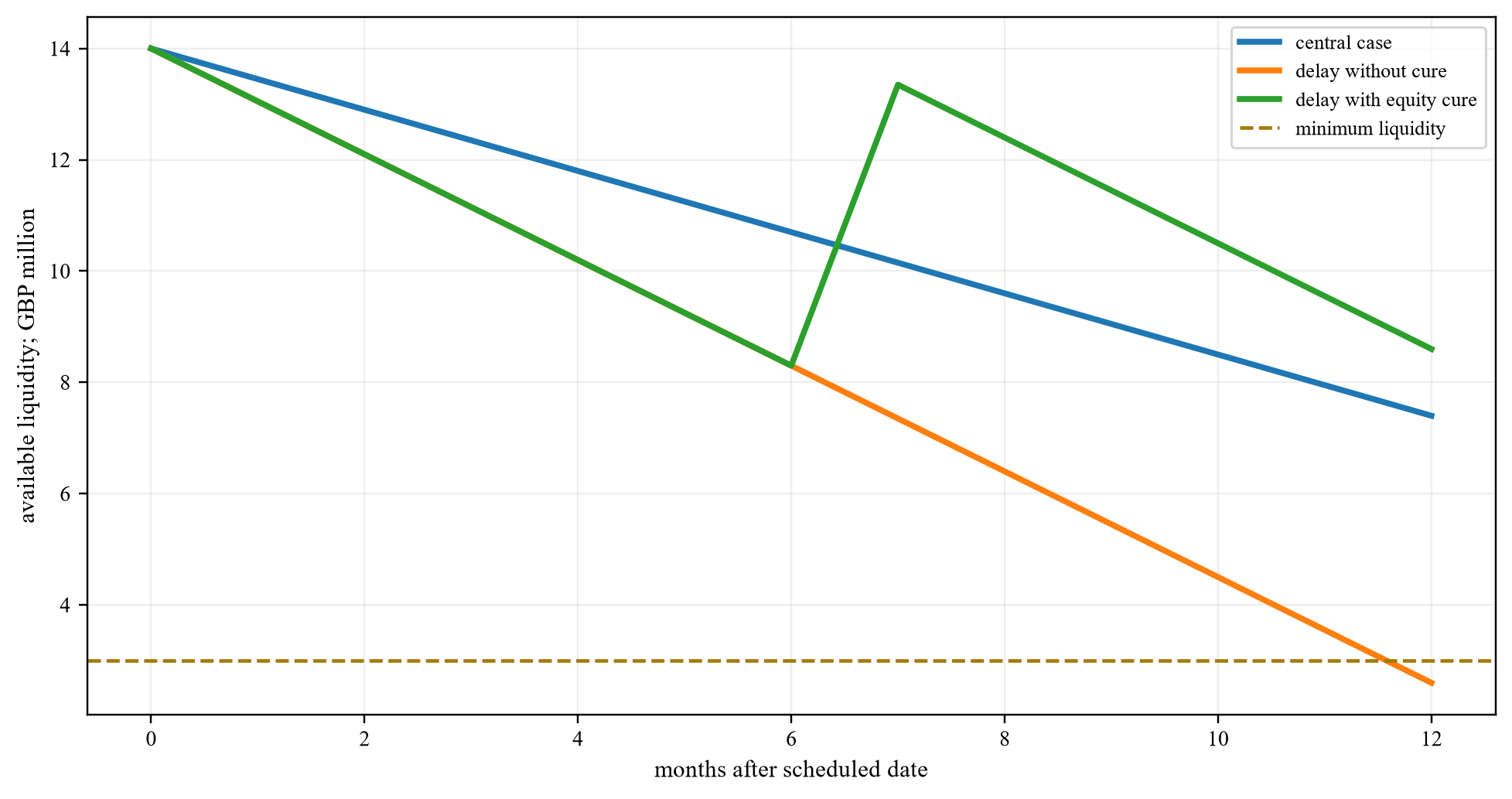
Wholly hypothetical; GBP million and excludes any unidentified project.
20. Design covenants and stop-draw events
The decision question is which readiness, milestone, funding, cost, date and legal failures require intervention. The evidence file should begin with facility terms, compliance certificates, milestone dashboard and cure mechanics. Each item should record its source, date, legal owner, responsible person, expiry or review date and relationship to the current programme. Official reform objectives provide context. Executed project documents determine rights, cash obligations and remedies. [12][16]
The principal failure is that financial covenants react after the connection package has already weakened. Pre-energisation debt converts future network access into funded exposure before stable operating cash exists. The lender needs an observable chain from the current legal position to the next milestone, the funding required to reach it and the value preserved if progress stops.
The recommended response is to use forward-looking project covenants tied to evidence and defined remedies. Management estimates may support scenarios when identified as assumptions and reconciled to external evidence. The central case should retain current rights, committed funding and costed obligations. The downside should combine related grid, planning, construction and financing effects.
The credit record should state funded exposure, the next evidence gate, remaining cost, minimum liquidity, cure period and recovery route. It should identify the party able to act, required consent and the last date for value-preserving intervention.
21. Define the takeout
The decision question is which conditions permit construction debt, operating debt, equity sale or refinancing. The evidence file should begin with term sheets, completion tests, grid status, customer or route-to-market contracts, valuation and coverage. Each item should record its source, date, legal owner, responsible person, expiry or review date and relationship to the current programme. Official reform objectives provide context. Executed project documents determine rights, cash obligations and remedies. [12][24]
The principal failure is that a future refinancing is treated as committed despite unsatisfied conditions or expiry. Pre-energisation debt converts future network access into funded exposure before stable operating cash exists. The lender needs an observable chain from the current legal position to the next milestone, the funding required to reach it and the value preserved if progress stops.
The recommended response is to model takeout as conditional and maintain an alternative funding route. Management estimates may support scenarios when identified as assumptions and reconciled to external evidence. The central case should retain current rights, committed funding and costed obligations. The downside should combine related grid, planning, construction and financing effects.
The credit record should state funded exposure, the next evidence gate, remaining cost, minimum liquidity, cure period and recovery route. It should identify the party able to act, required consent and the last date for value-preserving intervention.
22. Apply the hypothetical financing case
The decision question is how a GBP 24 million facility behaves across a 42-month connection programme. The evidence file should begin with the stated hypothetical project cost, grid expenditure, reserve, equity and timing assumptions. Each item should record its source, date, legal owner, responsible person, expiry or review date and relationship to the current programme. Official reform objectives provide context. Executed project documents determine rights, cash obligations and remedies. [14][23]
The principal failure is that a single base case conceals exposure growth and liquidity demands during delay. Pre-energisation debt converts future network access into funded exposure before stable operating cash exists. The lender needs an observable chain from the current legal position to the next milestone, the funding required to reach it and the value preserved if progress stops.
The recommended response is to show monthly draws, milestone evidence, remaining funds and recovery under three coherent cases. Management estimates may support scenarios when identified as assumptions and reconciled to external evidence. The central case should retain current rights, committed funding and costed obligations. The downside should combine related grid, planning, construction and financing effects.
The credit record should state funded exposure, the next evidence gate, remaining cost, minimum liquidity, cure period and recovery route. It should identify the party able to act, required consent and the last date for value-preserving intervention.
| Metric | Central assumption | Delay or range |
|---|---|---|
| project capacity | 200 MW | 150-200 MW |
| total project cost | GBP 172m | GBP 172m-195m |
| grid-related cost | GBP 18m | GBP 18m-27m |
| pre-energisation facility | GBP 24m | capped at GBP 24m |
| sponsor equity before takeout | GBP 42m | GBP 42m plus cures |
| scheduled energisation | month 42 | month 48-60 |
| delay reserve | GBP 14m | GBP 14m plus equity |
| forward conversion DSCR | 1.35x | 1.20x-1.35x |
Wholly hypothetical; figures do not describe an identified project or financing.
23. Set milestone-linked advance rates
The decision question is how eligible debt increases as readiness, planning, land and network evidence strengthen. The evidence file should begin with cost ledger, milestone status, valuation, remaining expenditure and recovery analysis. Each item should record its source, date, legal owner, responsible person, expiry or review date and relationship to the current programme. Official reform objectives provide context. Executed project documents determine rights, cash obligations and remedies. [12][21]
The principal failure is that a fixed advance rate ignores material changes in enforceability and recovery. Pre-energisation debt converts future network access into funded exposure before stable operating cash exists. The lender needs an observable chain from the current legal position to the next milestone, the funding required to reach it and the value preserved if progress stops.
The recommended response is to increase availability only after objective evidence and reduce it when the package deteriorates. Management estimates may support scenarios when identified as assumptions and reconciled to external evidence. The central case should retain current rights, committed funding and costed obligations. The downside should combine related grid, planning, construction and financing effects.
The credit record should state funded exposure, the next evidence gate, remaining cost, minimum liquidity, cure period and recovery route. It should identify the party able to act, required consent and the last date for value-preserving intervention.
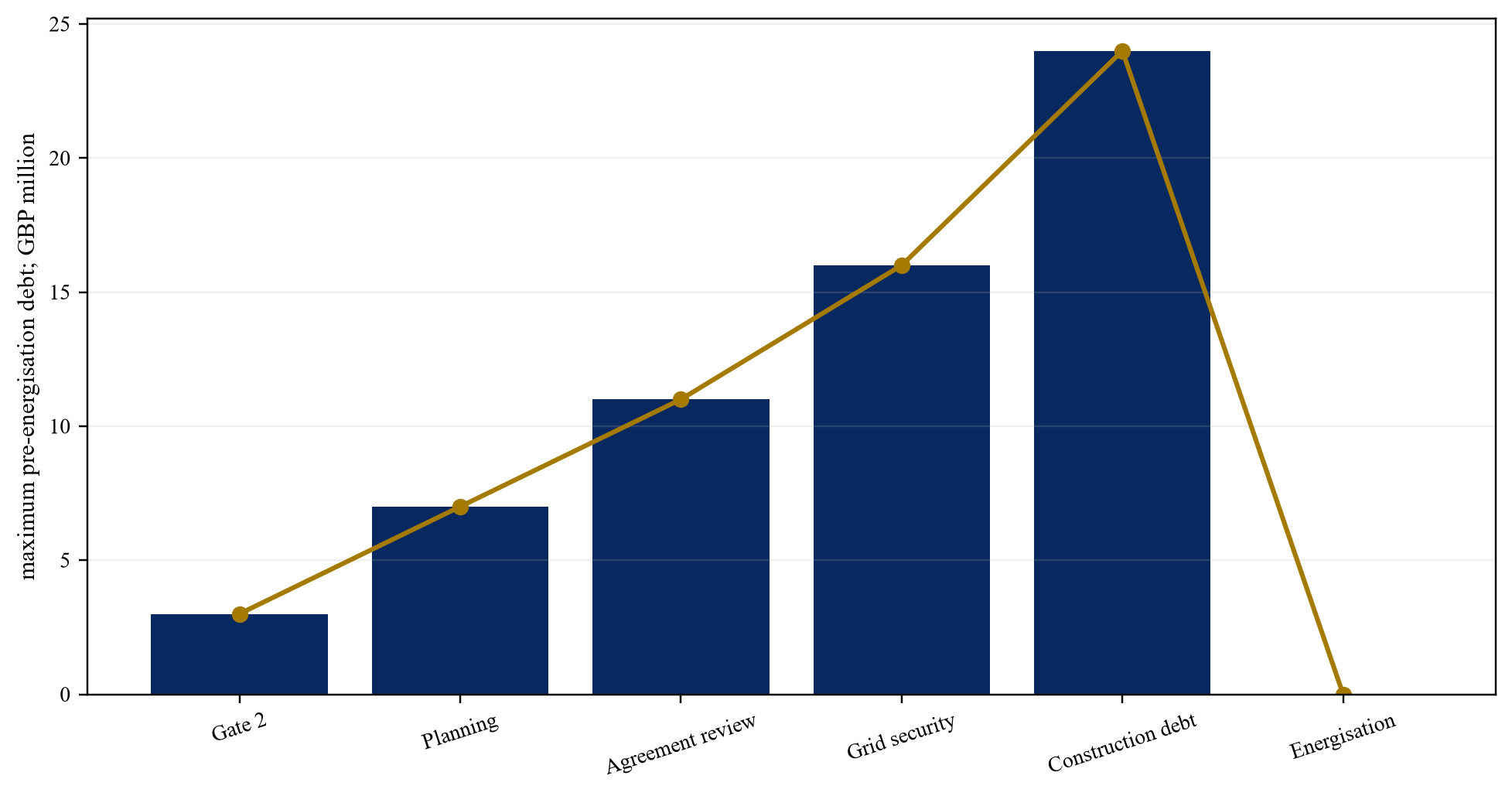
Wholly hypothetical; availability remains subject to all finance-document conditions.
24. Stress queue and energisation risk
The decision question is which combinations of reform, milestone failure, network delay, cost overrun and higher rates impair repayment. The evidence file should begin with official decisions, agreement terms, programme, budget, liquidity and market evidence. Each item should record its source, date, legal owner, responsible person, expiry or review date and relationship to the current programme. Official reform objectives provide context. Executed project documents determine rights, cash obligations and remedies. [4][23]
The principal failure is that single-variable sensitivities overlook compounding legal and cash effects. Pre-energisation debt converts future network access into funded exposure before stable operating cash exists. The lender needs an observable chain from the current legal position to the next milestone, the funding required to reach it and the value preserved if progress stops.
The recommended response is to run coherent delay, modification, capacity-reduction and termination scenarios. Management estimates may support scenarios when identified as assumptions and reconciled to external evidence. The central case should retain current rights, committed funding and costed obligations. The downside should combine related grid, planning, construction and financing effects.
The credit record should state funded exposure, the next evidence gate, remaining cost, minimum liquidity, cure period and recovery route. It should identify the party able to act, required consent and the last date for value-preserving intervention.
25. Plan downside recovery
The decision question is whether cure, redesign, partial capacity, sale, novation, completion or enforcement preserves value. The evidence file should begin with rights package, buyer universe, remaining cost, consents, tax, time and specialist advice. Each item should record its source, date, legal owner, responsible person, expiry or review date and relationship to the current programme. Official reform objectives provide context. Executed project documents determine rights, cash obligations and remedies. [7][21]
The principal failure is that an enterprise valuation substitutes for executable net recovery. Pre-energisation debt converts future network access into funded exposure before stable operating cash exists. The lender needs an observable chain from the current legal position to the next milestone, the funding required to reach it and the value preserved if progress stops.
The recommended response is to compare net proceeds and probability by route after all costs and delays. Management estimates may support scenarios when identified as assumptions and reconciled to external evidence. The central case should retain current rights, committed funding and costed obligations. The downside should combine related grid, planning, construction and financing effects.
The credit record should state funded exposure, the next evidence gate, remaining cost, minimum liquidity, cure period and recovery route. It should identify the party able to act, required consent and the last date for value-preserving intervention.
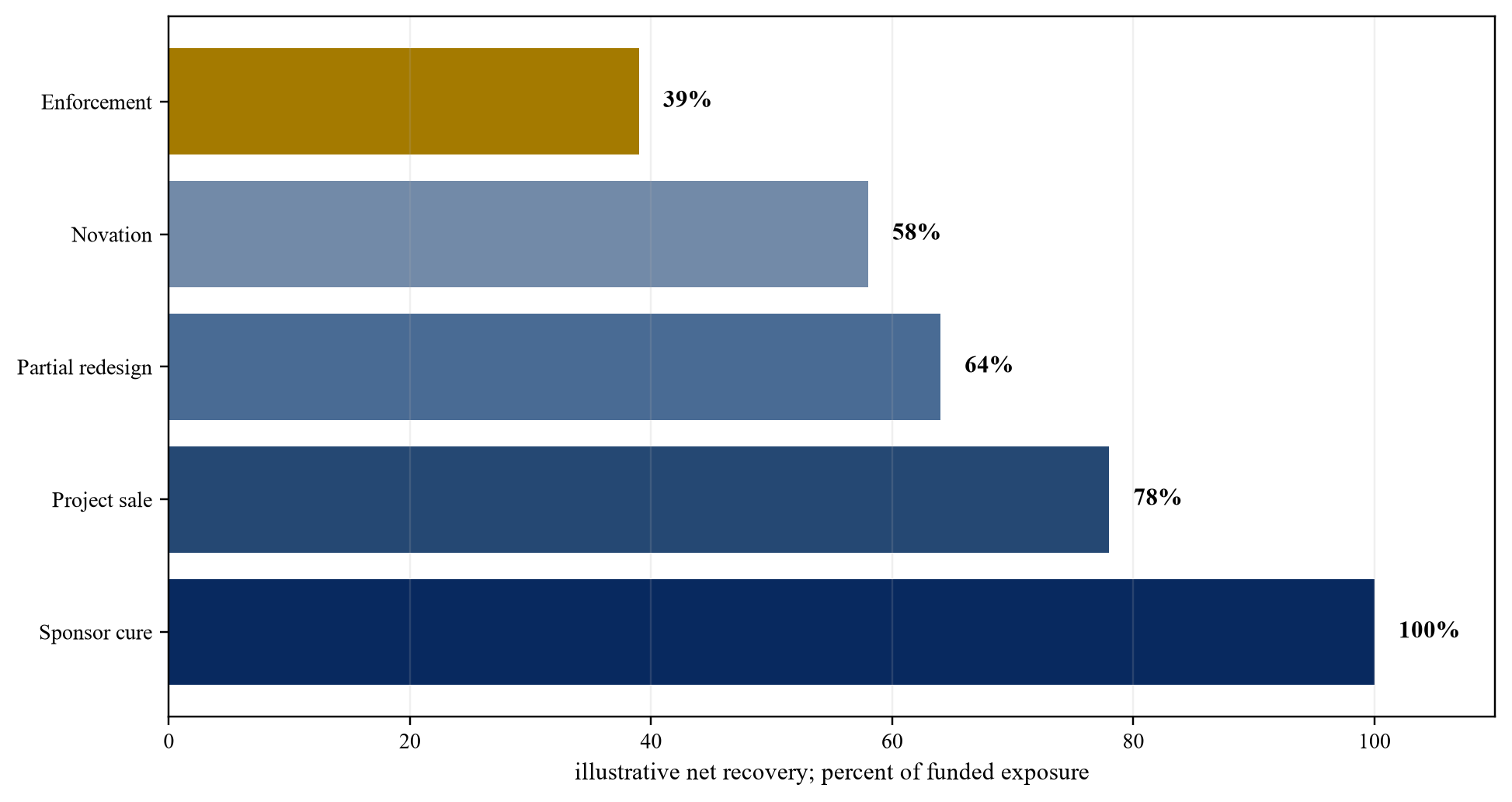
Wholly hypothetical; values are illustrative percentages of funded exposure.
26. Govern information and decisions
The decision question is which party owns each evidence item, forecast, exception and approval. The evidence file should begin with data room, responsibility matrix, reporting calendar, issue log and committee record. Each item should record its source, date, legal owner, responsible person, expiry or review date and relationship to the current programme. Official reform objectives provide context. Executed project documents determine rights, cash obligations and remedies. [12][16]
The principal failure is that critical updates arrive as narrative without reconciled impact on funding or recovery. Pre-energisation debt converts future network access into funded exposure before stable operating cash exists. The lender needs an observable chain from the current legal position to the next milestone, the funding required to reach it and the value preserved if progress stops.
The recommended response is to use a monthly evidence certificate and exception-led credit review. Management estimates may support scenarios when identified as assumptions and reconciled to external evidence. The central case should retain current rights, committed funding and costed obligations. The downside should combine related grid, planning, construction and financing effects.
The credit record should state funded exposure, the next evidence gate, remaining cost, minimum liquidity, cure period and recovery route. It should identify the party able to act, required consent and the last date for value-preserving intervention.
27. Translate diligence into documents
The decision question is which condition, representation, covenant, reserve, guarantee and remedy allocates each risk. The evidence file should begin with diligence findings, model, legal review, technical report and draft facility. Each item should record its source, date, legal owner, responsible person, expiry or review date and relationship to the current programme. Official reform objectives provide context. Executed project documents determine rights, cash obligations and remedies. [7][12]
The principal failure is that risks appear in the credit paper without becoming enforceable controls. Pre-energisation debt converts future network access into funded exposure before stable operating cash exists. The lender needs an observable chain from the current legal position to the next milestone, the funding required to reach it and the value preserved if progress stops.
The recommended response is to map every material dependency to a finance term, owner, deadline and remedy. Management estimates may support scenarios when identified as assumptions and reconciled to external evidence. The central case should retain current rights, committed funding and costed obligations. The downside should combine related grid, planning, construction and financing effects.
The credit record should state funded exposure, the next evidence gate, remaining cost, minimum liquidity, cure period and recovery route. It should identify the party able to act, required consent and the last date for value-preserving intervention.
28. Reach the lending decision
The decision question is whether the connection package, funded preservation plan, takeout and recovery justify exposure. The evidence file should begin with status dictionary, readiness file, agreement review, balanced budget, downside cases and security package. Each item should record its source, date, legal owner, responsible person, expiry or review date and relationship to the current programme. Official reform objectives provide context. Executed project documents determine rights, cash obligations and remedies. [1][24]
The principal failure is that strategic demand for capacity displaces project-specific evidence. Pre-energisation debt converts future network access into funded exposure before stable operating cash exists. The lender needs an observable chain from the current legal position to the next milestone, the funding required to reach it and the value preserved if progress stops.
The recommended response is to approve only the exposure that verified rights, funded obligations and credible recovery support. Management estimates may support scenarios when identified as assumptions and reconciled to external evidence. The central case should retain current rights, committed funding and costed obligations. The downside should combine related grid, planning, construction and financing effects.
The credit record should state funded exposure, the next evidence gate, remaining cost, minimum liquidity, cure period and recovery route. It should identify the party able to act, required consent and the last date for value-preserving intervention.
| Decision | Evidence required | Possible action |
|---|---|---|
| commitment | verified package and balanced funding | approve or resize |
| each draw | current milestones and eligible cost | fund, defer or stop |
| modification | impact analysis and required consents | approve or reject |
| delay | liquidity, cure and recovery update | cure or restructure |
| takeout | energisation and financing conditions | refinance or extend |
| deterioration | quantified legal and cash effect | protect, sell or enforce |
Proposed governance; transaction-specific approvals remain necessary.
Sources
- Department for Energy Security and Net Zero and Ofgem, *Electricity Networks Connections Action Plan*. Read the primary source
- National Energy System Operator, *Connections Reform Evidence Handbook and Submission Resources*. Read the primary source
- National Energy System Operator, *Connections Reform and the Gate 2 to Whole Queue Process*. Read the primary source
- Ofgem, *Implementing Connections Reform: Our Role in Supporting a Strong and Fair Outcome*. Read the primary source
- Ofgem, *Decision on the Connections Reform Package*. Read the primary source
- National Energy System Operator, *Connection and Use of System Code*. Read the primary source
- UK Government, *Companies Act 2006*. Read the primary source
- Planning Inspectorate, *National Infrastructure Planning Guidance*. Read the primary source
- National Energy System Operator, *Connection Application and Agreement Guidance*. Read the primary source
- National Energy System Operator, *User Commitment Methodology*. Read the primary source
- Energy Networks Association, *Open Networks*. Read the primary source
- Office of the Comptroller of the Currency, *Project Finance*. Read the primary source
- Infrastructure and Projects Authority, *Project Routemap*. Read the primary source
- European Banking Authority, *Guidelines on Loan Origination and Monitoring*. Read the primary source
- IFRS Foundation, *IFRS 9 Financial Instruments*. Read the primary source
- Basel Committee on Banking Supervision, *Principles for the Management of Credit Risk*. Read the primary source
- National Energy System Operator, *Queue Management Guidance*. Read the primary source
- National Energy System Operator, *Gated Modification Guidance*. Read the primary source
- Ofgem, *CMP434 Implementing Connections Reform*. Read the primary source
- UK Government, *Transmission Acceleration Action Plan*. Read the primary source
- IFRS Foundation, *IFRS 13 Fair Value Measurement*. Read the primary source
- Infrastructure and Projects Authority, *Government Functional Standard GovS 002 Project Delivery*. Read the primary source
- Bank of England, *Financial Stability in Focus: Interest Rate Risk*. Read the primary source
- Ofgem, *Connect Update: Demand Connections Reform*. Read the primary source
- Ofgem, *CMP448 Connection and Use of System Code Changes*. Read the primary source
- Department for Energy Security and Net Zero, *Clean Power 2030 Action Plan: Connections Reform Annex*. Read the primary source
