

1. Define the credit question and the risk horizon
A climate assessment should begin with the loan decision. The relevant questions are whether the asset can support interest and scheduled debt service, whether collateral value remains sufficient, whether capital works can be funded, and whether the borrower can refinance or repay at maturity. A hazard score alone cannot answer those questions. The lender needs to know how an event or transition requirement reaches rent, operating cost, capital expenditure, insurability, liquidity, value and refinance proceeds.
The risk horizon should cover the loan term, extension options, expected stabilisation period and the refinancing lender's likely holding period. A five-year loan on an asset with a fifteen-year business plan still has exposure to later requirements if buyers and refinancing lenders price those requirements before maturity. The Bank of England's climate scenario work separates early transition, late transition and no-additional-action pathways and emphasises uncertainty rather than forecasts.[1] For real-estate credit, the practical implication is to test more than one coherent path and to avoid false precision.
Define the decisions before selecting data or models. At origination, the lender may change leverage, price, tenor, amortisation, reserves, conditions precedent or security. During the loan, it may release a reserve, consent to works, require additional information or respond to a covenant breach. At refinancing, it may revise value, proceeds or exit timing. Each decision needs a named owner, evidence threshold, expiry date and escalation route.
The underwriting policy should state what the analytical system cannot do. It cannot decide whether a property complies with law, certify a flood defence, verify title, determine an Energy Performance Certificate rating, prescribe engineering works, set market value or bind the credit committee. Those tasks remain with qualified and accountable people. The system can organise evidence, reproduce calculations, highlight conflicts and show the financial effect of agreed assumptions.
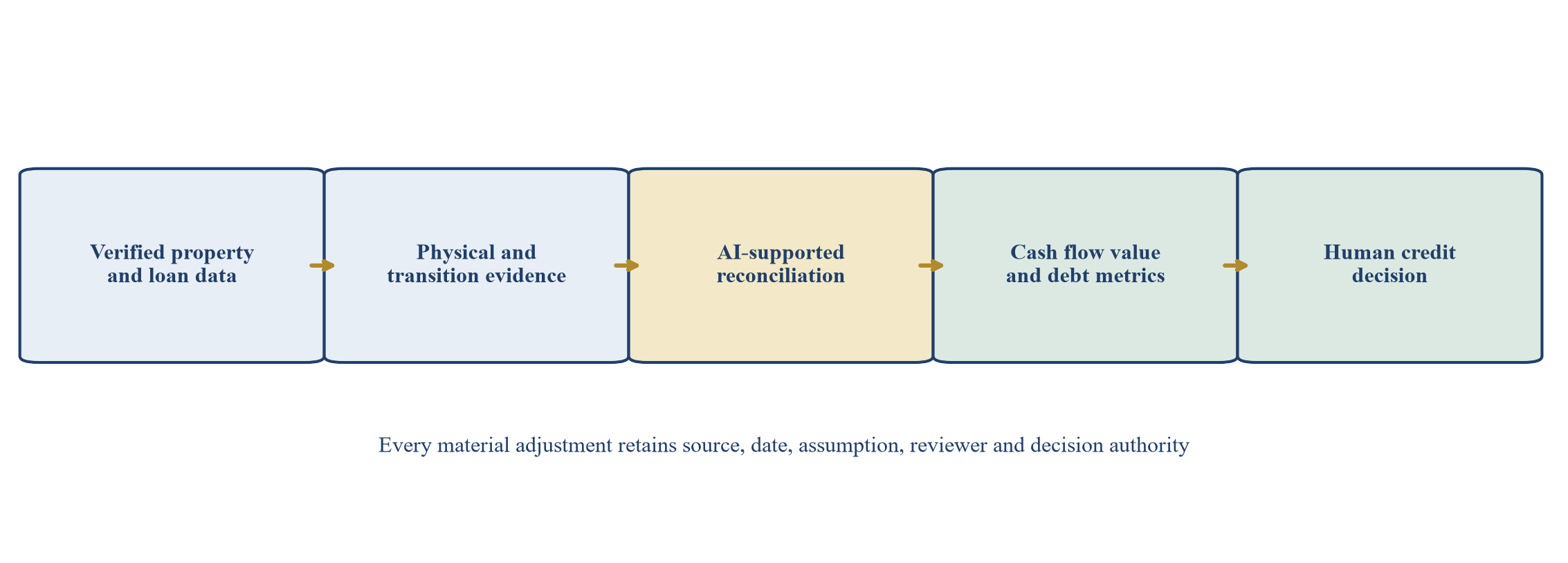
Proposed control architecture. Automated analysis supports professional judgement and documented credit authority.
2. Build a property and loan evidence base
Property identity is the first control. Record the title reference, postal address, coordinates, asset boundary, gross and net area, use, construction date, material alterations, listed status, planning position and ownership vehicle. Mixed-use or multi-building estates should be split into units that align with leases, meters, insurance and capital plans. A coordinate attached to the wrong entrance or centroid can misstate flood and heat exposure; an area mismatch can distort energy intensity and cost per square metre.
The loan file should connect facility amount, drawn balance, interest, amortisation, maturity, extension tests, hedging, cash control, reserves, permitted indebtedness and security to the asset model. The property file should connect leases, rent roll, recoverability, arrears, break dates, expiry, incentives, service charges, insurance, condition surveys, fire and life-safety records, utility bills, meters, EPCs, Display Energy Certificates where applicable, and planned works. Evidence should carry source, date, scope and responsible provider.
Energy certificates are a useful regulatory and comparative input; they are not a complete operating-energy record. The UK government provides bulk and API access to non-domestic EPC data for England and Wales and warns that records may have expired or been replaced.[2] The lender should identify the current certificate, reconcile floor area and use, and compare modelled performance with actual bills and occupancy. Gaps between certificate and operating data are questions for investigation rather than automatic evidence of error.
The evidence register should distinguish observed facts, professional opinions, model outputs and lender assumptions. A building survey can describe condition. A valuer can give an opinion of market value. A hazard provider can estimate exposure under a methodology. The lender can choose a downside assumption. These categories should not be merged into one apparently objective score.
| Evidence domain | Core fields | Financial connection | Control question |
|---|---|---|---|
| property identity | title, boundary, coordinates, use, area, construction | correct asset, unit cost and comparable set | do all sources describe the same property and scope? |
| income and lease | rent, indexation, expiry, break, repair, service charge | income durability and recoverability | who bears energy, insurance and works costs? |
| condition and plant | fabric, roof, drainage, cooling, heating, electrical systems | repair cost, downtime and replacement timing | are condition and remaining life independently assessed? |
| energy | EPC, bills, meters, operating hours, fuel, controls | operating cost, tenant demand and retrofit need | are modelled and actual performance reconciled? |
| physical hazards | flood, heat, storm, subsidence, water stress | damage, interruption, insurance and value | is exposure translated through asset vulnerability? |
| finance | debt, interest, hedge, reserves, maturity, covenants | LTV, debt yield, cover and refinance | can the facility absorb the timed downside? |
The lender should set recency, provider and verification requirements by asset type and decision materiality.
3. Map physical hazards through vulnerability and adaptation
Physical-risk underwriting should separate hazard, exposure, vulnerability and financial consequence. Hazard describes the potential event or chronic change. Exposure establishes whether the asset, access, utilities or supply chain lies within the affected area. Vulnerability reflects construction, equipment location, drainage, maintenance, defences and continuity arrangements. Financial consequence reflects repair, interruption, insurance, rent, expenditure, value and liquidity.
Flood analysis illustrates the sequence. The Environment Agency publishes climate-change allowances for river flow, rainfall intensity and sea-level change and expects relevant allowances to be used in flood-risk assessments for development.[3] A lender should obtain the relevant map layers and site-specific assessment, then ask whether the building's thresholds, basement, electrical intake, plant, data rooms, access routes and evacuation arrangements are vulnerable. A low annual probability can still be material if a single event causes prolonged closure or uninsured loss.
Heat risk should consider both external temperature and internal performance. Construction, glazing, orientation, shading, ventilation, cooling capacity, plant redundancy, grid constraint and tenant density affect operational consequences. UK Climate Projections provide probabilistic and local information with published caveats; the Met Office tells users to understand limitations and select data appropriate to the decision.[4] The lender should avoid treating a coarse regional percentile as a property loss estimate.
Adaptation changes risk only when it is funded, technically credible, permitted, maintained and available when needed. Flood barriers require storage, deployment, testing and responsible operators. Drainage upgrades depend on capacity beyond the boundary. Cooling changes may increase electrical demand. A credit file should distinguish completed measures, contracted measures, approved plans and management intentions.
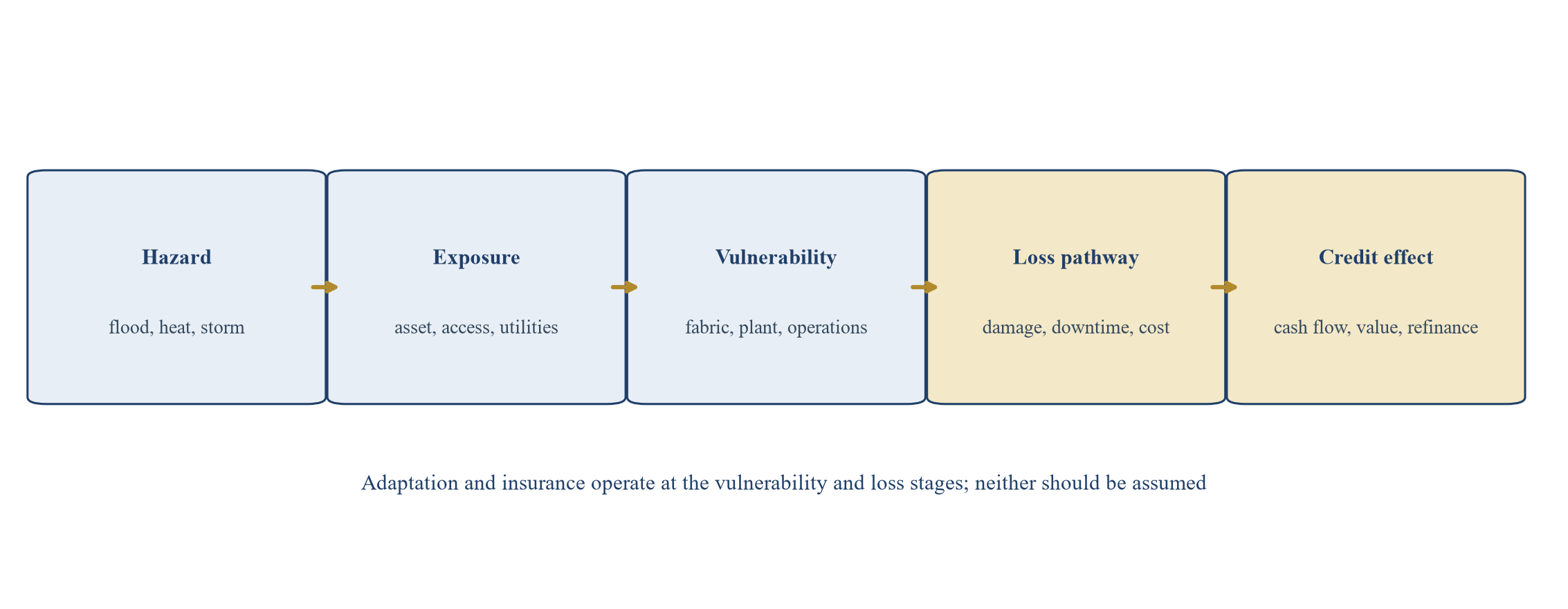
The pathway prevents a hazard score from becoming a value adjustment without property-specific evidence.
| Hazard | Property evidence | Financial transmission | Possible credit control |
|---|---|---|---|
| river, surface-water or coastal flood | mapped depth, site survey, floor levels, plant location, access and defences | damage, closure, excess, premium, void and saleability | specialist assessment, works reserve, insurance covenant and reporting |
| extreme heat | local projections, overheating study, fabric, cooling and power capacity | comfort, productivity, energy cost, plant failure and tenant retention | capex plan, resilience test, monitoring and reserve |
| storm and wind | roof, facade, trees, drainage, maintenance and local exposure | repair, water ingress, downtime and claims | condition works, inspection and insurance terms |
| subsidence and ground movement | geology, claims, structure, drainage and vegetation | repair, monitoring, delay and valuation uncertainty | engineer review, exclusion analysis and contingency |
| water stress | supply resilience, process need, leakage, storage and utility plan | operating interruption, cost and tenant suitability | efficiency works, continuity plan and information covenant |
The list is illustrative. Asset location, use and construction determine the relevant hazards and specialist work.
4. Translate energy performance into operating cash flow
Energy underwriting should reconstruct consumption and cost before estimating improvement. Gather at least two to three years of bills where available, meter reads, tariffs, standing charges, fuel mix, operating hours, occupancy, weather adjustment, service-charge treatment and landlord-versus-tenant responsibility. Separate landlord-controlled consumption from tenant-controlled consumption. A landlord may fund plant while a tenant receives the energy saving; lease terms determine whether the investment supports rent, retention, service-charge recovery or only compliance.
Current non-domestic minimum energy-efficiency guidance for England and Wales requires covered privately rented property to achieve at least EPC E unless a valid exemption applies.[5] A June 2026 government interim response states an intention to require EPC B from 2031 for private rented buildings over 1,000 square metres where cost-effective, while smaller buildings would remain at the current minimum standard under that proposal.[6] Because policy can change, underwriting should record the effective rules and proposals as of the decision date, obtain legal advice, and test plausible transition cases rather than treating a proposal as enacted law.
Convert energy use to cash using transparent tariffs and escalation. Then identify which saving belongs to lower consumption, tariff change, occupancy change or operational management. Capital works may also change maintenance, insurance, reliability, comfort and lettable area. Some measures interact: fabric improvement can reduce plant capacity; electrification can require electrical upgrades; controls may underperform without commissioning and user training.
The lender should model income as well as cost. Energy and comfort can affect tenant demand, incentives, lease length and renewal, but the direction and magnitude require local leasing evidence. A valuation adjustment should be supported by market evidence or an explicit sensitivity. The RICS commercial-property valuation standard requires significant sustainability and ESG factors to be considered in valuation and distinguishes valuation advice from broader strategic ESG advice.[7]
| Input | Evidence | Cash-flow treatment | Underwriting caution |
|---|---|---|---|
| baseline consumption | bills, meters, weather and occupancy | landlord energy cost or service charge | remove vacancies and exceptional operations |
| tariff and fuel | contract, regulated charges and tax | unit cost and escalation | separate price from volume effects |
| proposed saving | engineering model and commissioning plan | lower consumption after implementation | apply ramp-up, degradation and verification |
| capital cost | scope, design, quote, professional fees and tax | timed capex and reserve draw | include access, disruption and contingency |
| tenant effect | lease, service-charge clause and leasing evidence | recoverability, rent, void or incentive | avoid unsupported green-premium assumptions |
| residual performance | post-works meter data and controls | revised forecast and covenant test | measure actual outcome against baseline |
Values should be derived from asset evidence and lease allocation rather than generic savings percentages.
5. Design AI as an evidence and exception layer
Artificial intelligence can reduce manual reconciliation across leases, valuations, surveys, EPCs, bills, maps and capital plans. Document models can extract dates, areas, obligations and costs. Geospatial tools can join property coordinates to hazard layers. Computer vision can classify visible plant or fabric from controlled inspections. Statistical models can estimate ranges where data are missing and identify properties whose consumption differs from peers. Scenario engines can propagate agreed assumptions through cash flow and debt metrics.
The lender should define each use case and its consequence. A tool that suggests a missing field has a different risk from one that adjusts collateral value. Each model needs an owner, intended use, prohibited use, input specification, benchmark, validation, performance threshold, monitoring plan and fallback. The PRA's model-risk principles cover governance, development, independent validation and mitigants and explicitly encompass artificial intelligence and machine learning within broader model management.[8]
Source lineage is essential. Every extracted lease clause should link to the page and document version. Every hazard value should retain provider, layer, date, coordinate, resolution and scenario. Every estimated cost should identify whether it came from a quote, benchmark or model. Human reviewers should see conflicts and confidence, not only a final score.
The model should be tested for the decision population. An energy model trained on modern offices may be unsuitable for converted warehouses or heritage buildings. Geospatial error can be concentrated around boundaries. Missing data may correlate with weaker management or older assets. NIST's AI Risk Management Framework organises activities around govern, map, measure and manage and emphasises validity, reliability, transparency, explainability, privacy and ongoing monitoring.[9] These principles support a credit process in which automation remains reviewable and reversible.
6. Convert evidence into a scenario architecture
The lender should build a small number of coherent scenarios rather than independently shocking every variable. A central case can reflect the current business plan with evidenced works. A transition case can accelerate standards, tenant requirements, energy costs and retrofit timing. A physical-risk case can test event loss, interruption, insurance and adaptation. A combined severe case can test correlated pressure, subject to avoiding economically inconsistent assumptions.
Each scenario should state the pathway, time horizon, variables, source, effective date and management response. IFRS S2 requires climate-related scenario analysis for resilience assessment using an approach commensurate with the entity's circumstances and relevant to its physical and transition risks.[10] A private-credit lender can apply the same discipline to property collateral without claiming that disclosure standards prescribe loan terms.
Scenario variables should enter the model through explicit bridges. Physical damage affects repair cost, rent abatement, service charge, insurance recovery and timing. Retrofit affects capital expenditure, disruption, consumption and sometimes leasing. Market repricing affects exit yield and liquidity. Financing conditions affect interest, coverage and refinance leverage. These paths should be visible to credit officers.
Avoid probability-weighted precision when probabilities cannot be supported. Credit decisions can use threshold and reverse-stress analysis: determine which combination of net operating income, yield, capex and refinance leverage causes a covenant or repayment failure. The result directs diligence toward the assumptions that matter most.
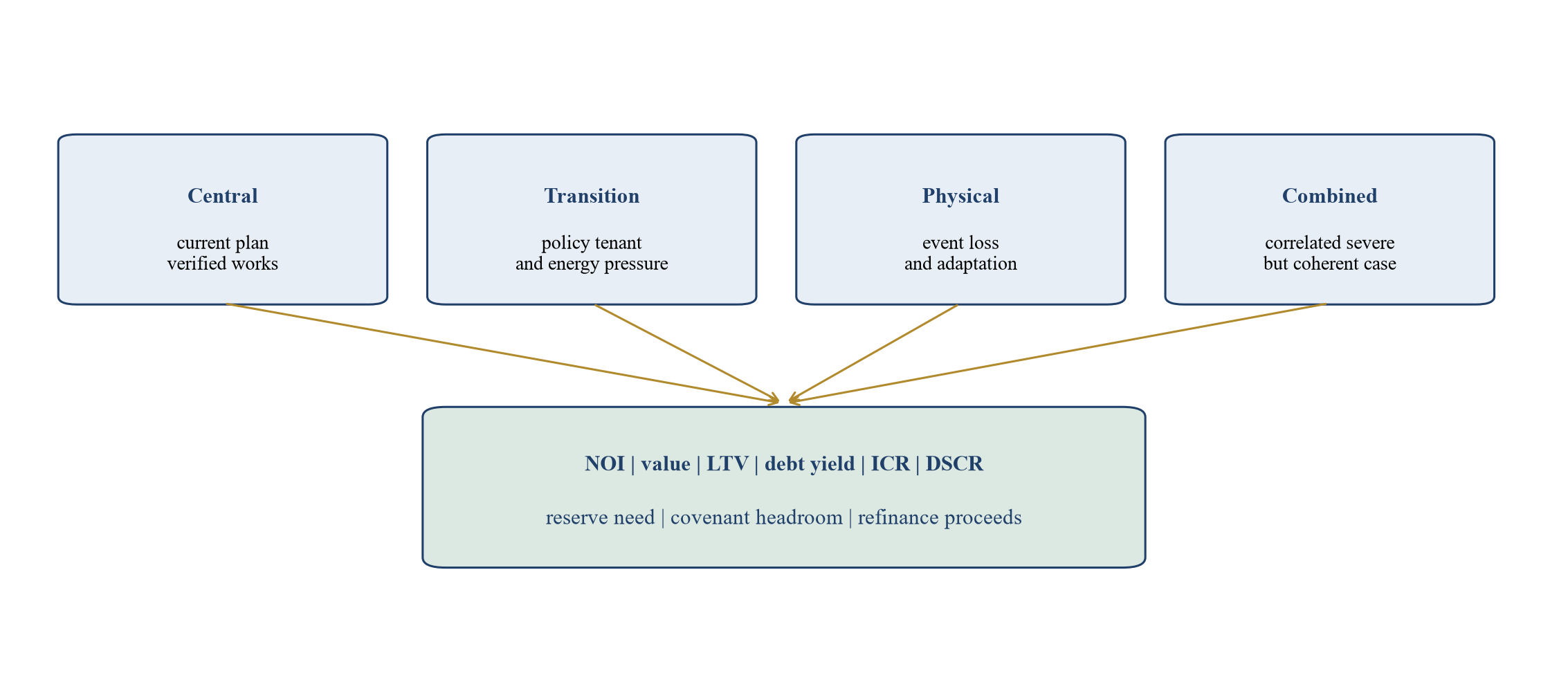
Central, transition, physical and combined cases share one evidence base and feed common credit measures.
7. Value the asset under climate and retrofit cases
Valuation should begin with the conventional market method appropriate to the asset, supported by comparable transactions, investment evidence and rental analysis. Climate and retrofit factors then enter where market participants would reflect them: rent, growth, void, incentives, operating expenditure, capital expenditure, yield, liquidity or an explicit special assumption. Double counting is a central risk. A capex deduction and a higher yield may both capture the same deficiency unless the rationale is clear.
The valuer should receive the same controlled evidence used by the lender, including hazards, condition, energy, leases and works. The instruction should request commentary on material sustainability factors, market evidence, uncertainty and assumptions. It should also distinguish current market value from scenario sensitivities. RICS states that sustainability factors should be considered where significant and that valuers should explain their treatment.[7]
The lender's credit value may differ from reported market value because it applies facility-specific costs, timing and downside assumptions. That difference should be presented as a bridge, not as a claim that the valuer is wrong. A useful bridge starts with market value, subtracts unfunded immediate works and transaction leakage where appropriate, applies scenario income and yield changes, and shows the resulting collateral value.
Liquidity belongs in the analysis. Assets with uncertain flood exposure, obsolete systems, weak data or large works can take longer to sell and attract a narrower buyer pool. The lender can test marketing time, carrying cost and forced-sale execution separately from market value. These are credit assumptions and should be labelled as such.
| Case | Stabilised NOI | Capitalisation yield | Unfunded works deduction | Indicated value | LTV on 55.0 million loan |
|---|---|---|---|---|---|
| central with funded plan | GBP 5.60m | 6.25% | GBP 0.0m | GBP 89.6m | 61.4% |
| transition delay | GBP 5.20m | 6.75% | GBP 5.0m | GBP 72.0m | 76.4% |
| physical-risk disruption | GBP 4.95m | 7.00% | GBP 3.0m | GBP 67.7m | 81.2% |
| combined severe | GBP 4.55m | 7.50% | GBP 7.0m | GBP 53.7m | 102.4% |
All figures are hypothetical analytical assumptions and do not describe a market transaction.
8. Size debt through cash flow value and refinance capacity
Loan-to-value remains important, but it should not carry the whole decision. Debt yield compares net operating income with loan balance. Interest cover compares income with interest. Debt-service cover includes amortisation and other scheduled debt service. Refinance capacity estimates the proceeds a future lender may advance under its own leverage, coverage, reserve and pricing constraints.
Calculate each metric from the same scenario cash flow. Net operating income should reflect contractual income, vacancy, incentives, arrears, operating costs, non-recoverable service charge, insurance, energy responsibility and recurring capital requirements according to the lender's policy. Interest should reflect drawn balance, hedge, margin and downside rates. The model should show covenant definitions as well as analytical measures because facility agreements may treat items differently.
Refinance capacity is often the binding measure for transitional assets. A future lender may apply a lower LTV, require works to be completed, retain a reserve or size to interest cover. The current lender should test proceeds at maturity after remaining capex, sale costs and debt repayment. A central value with a credible works plan can still produce a shortfall if the works are late or refinance standards tighten.
The underwriting conclusion should identify which constraint sizes the loan in each case. This makes the decision auditable and points to mitigants. If capex funding is the constraint, a reserve or sponsor equity may help. If income disruption is the constraint, leasing or works sequencing matters. If value and market liquidity are the constraints, leverage or tenor may need to change.
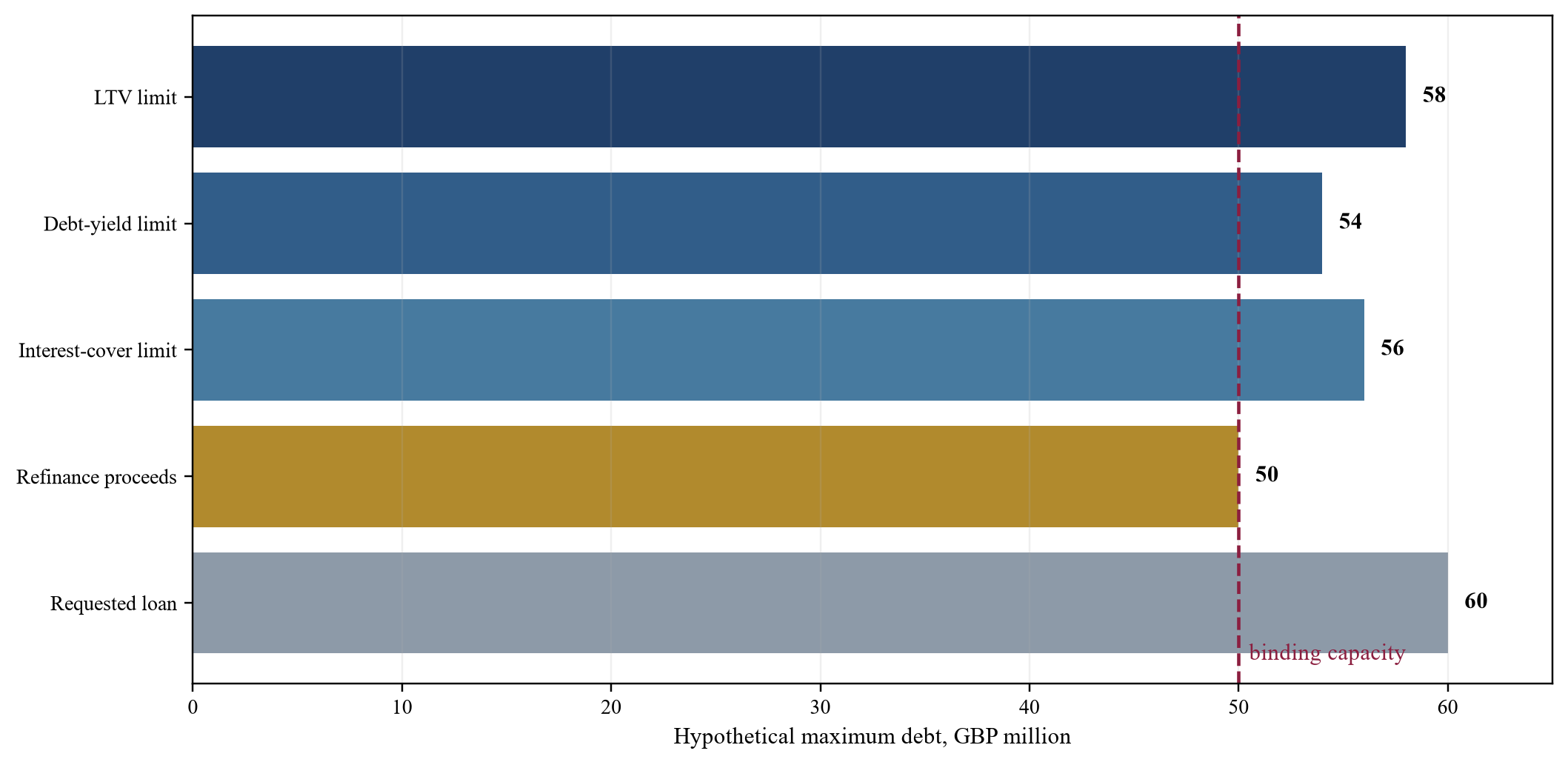
A proposed lender should use the most conservative applicable constraint after checking definitions and evidence.
9. Build an executable retrofit pathway
A retrofit plan should move from diagnosis to design, permission, procurement, installation, commissioning and measured performance. The asset may need fabric, glazing, controls, lighting, heating, cooling, ventilation, electrical capacity, renewables, storage or water measures. The plan should show dependencies. Installing new plant before reducing loads can oversize equipment. Electrification without grid capacity can create delay. External works may require planning or landlord and tenant consent.
Cost estimates should identify scope, quantities, basis, date, tax, professional fees, surveys, access, tenant decant, lost income, inflation and contingency. A benchmark cost is suitable for early screening and unsuitable as the sole basis for a committed reserve. Material works need design and cost evidence proportionate to the credit consequence.
Sequence works around leases and occupancy. A vacant floor may offer low-disruption access; a lease event can create both execution opportunity and income risk. The lender should test who can instruct works, who pays, whether costs are recoverable, whether tenants must consent, and how performance is verified. A technically sound plan can fail if legal rights or operational access are missing.
The reserve should follow the schedule rather than sit as one static amount. Draw conditions can require contracts, professional certification, evidence of permits, contingency remaining and performance tests. Cost overruns should have a predefined funding route. Savings should be measured after commissioning using bills or meters adjusted for occupancy and weather.
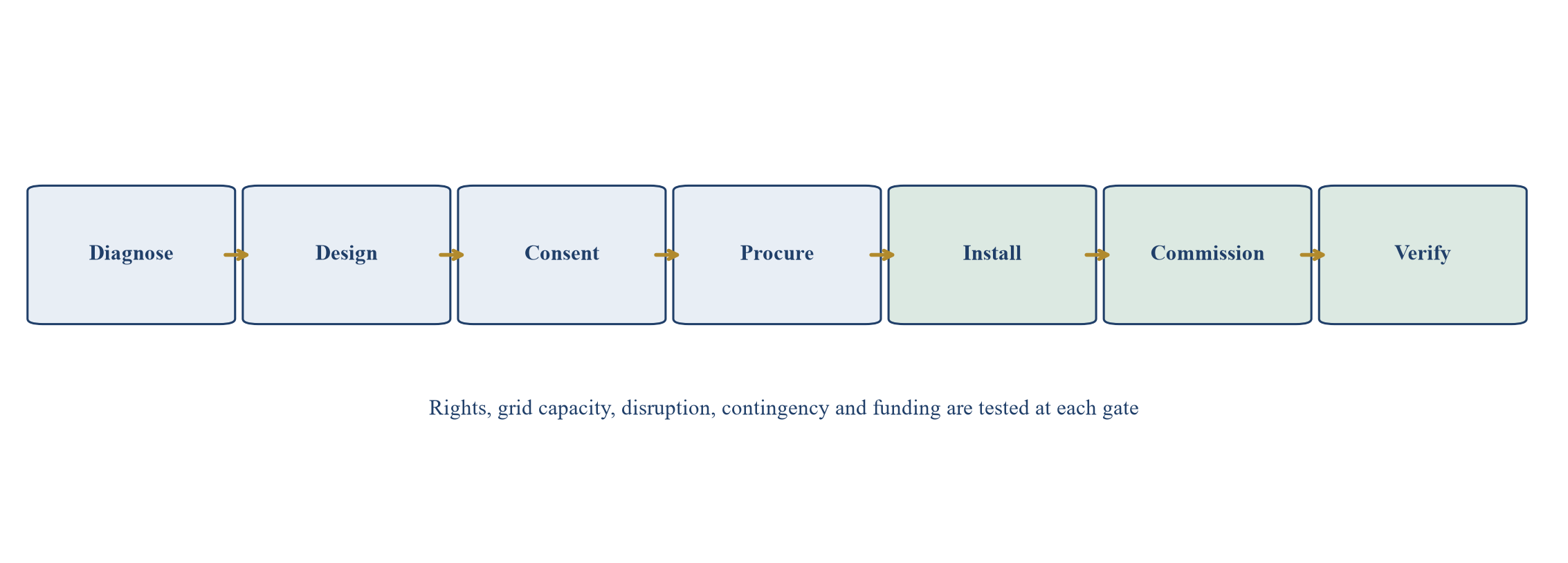
The lender funds a controlled sequence with decision gates and post-completion measurement.
| Workstream | Decision evidence | Cost components | Financing control |
|---|---|---|---|
| fabric and glazing | survey, thermal model, planning and design | works, access, professional fees and disruption | approved scope, contract and contingency |
| heating cooling and ventilation | load model, plant condition, refrigerant and power | equipment, enabling works, commissioning and maintenance | reserve draw against certification and performance test |
| controls and metering | points list, architecture, cyber review and baseline | hardware, software, integration, licence and training | data access, acceptance test and ongoing support |
| electrification and grid | demand study, connection offer and resilience plan | transformer, cabling, connection, backup and delay | condition precedent, long-stop date and sponsor overrun support |
| renewables and storage | structural, planning, fire, grid and yield studies | equipment, installation, insurance and replacement | conservative generation, degradation and revenue treatment |
The register should be supported by project-specific technical, legal and cost advice.
10. Underwrite tenant lease and income interactions
The lender should read the lease structure before allocating retrofit benefits and costs. Full repairing and insuring arrangements, service-charge caps, exclusions, consent rights, reinstatement, alterations and data-access clauses affect execution. Green-lease language may support data sharing or cooperation, but its enforceability and economic effect depend on the actual drafting.
Tenant credit and operational needs also matter. A tenant may value lower energy cost, resilience and comfort, yet may resist disruption or capital recovery. Some tenants have their own climate commitments and procurement standards. Others prioritise total occupancy cost and lease flexibility. Underwriting should use property-specific leasing evidence and broker advice rather than a universal rent premium.
Model lease events explicitly. At break or expiry, test vacancy, rent-free periods, fit-out contributions, works timing and reletting probability. A retrofit may reduce future incentives or broaden demand, while a poorly sequenced project may extend downtime. The scenario should show both the cost of action and the potential cost of delay.
Information covenants can support monitoring. The borrower can provide updated rent rolls, utility data, certificates, insurance, works progress and tenant notices. Data rights should be secured before the lender relies on automated monitoring. Personal data and commercially sensitive tenant information require lawful and proportionate handling.
11. Analyse insurance and residual loss
Insurance should be assessed as a financial contract, not as proof that risk is removed. Record insurer, policy period, insured perils, limits, sublimits, excesses, exclusions, reinstatement basis, business interruption period, indexation, conditions and claims history. Confirm the security agent's interest and the process for applying proceeds.
Test affordability and availability at renewal. A property may remain insurable while premiums, excesses or exclusions weaken cash flow and loss protection. Bank of England climate work notes that physical-risk exposure can affect insurance affordability and credit outcomes.[1] A lender should model the uninsured and timing portions of a credible loss, including professional fees, code upgrades, rent interruption and delays in recovery.
Adaptation evidence can support the discussion with insurers, but expected premium savings should be treated cautiously until quoted. A barrier or drainage project may reduce one loss pathway while leaving access or utility exposure. The credit file should document residual risk after works.
Policy covenants should require timely renewal, compliant cover, notice of material changes, delivery of broker reports and control of proceeds. For high-consequence assets, an independent insurance adviser can assess adequacy and market conditions.
12. Work through a hypothetical UK office loan
Consider a hypothetical regional office property with market value of GBP 92 million, proposed senior debt of GBP 55 million and in-place annual net operating income of GBP 5.6 million. The loan has a five-year term. The property contains 18,000 square metres and several leases expire or break during the term. An EPC identifies weak energy performance, while bills show high landlord electricity consumption. A site review identifies surface-water exposure around access and basement plant. These facts and every number in this section are invented analytical assumptions for method illustration.
The sponsor proposes GBP 8 million of works covering drainage, plant relocation, controls, lighting, fabric repairs and heat-pump conversion. An engineering review estimates a GBP 1.5 million risk range around the plan because grid works, tenant access and design are incomplete. The lender therefore does not treat the headline budget as certain. It requires design completion, a grid route, tenant-access analysis, a quantified cost plan and a dedicated contingency.
The central case assumes the works are fully funded at closing, delivered over thirty months and followed by verified energy improvement. The transition-delay case assumes twelve months of delay, GBP 5 million of unfunded cost at valuation and weaker leasing. The physical case assumes a flood-related closure before adaptation, with excess, uninsured cost and income interruption. The combined severe case assumes delay, disruption, weaker income, a higher exit yield and lower refinance leverage.
At the proposed loan, initial LTV is 59.8 per cent and debt yield is 10.2 per cent. These ratios do not capture the timing of capex. The lender models interest and reserve draws monthly, then tests coverage and refinance. Under the combined severe assumptions in Table 4, indicated value falls below the loan. The reverse stress shows that a smaller change in income and yield can also produce a refinancing gap if remaining works must be deducted from proceeds.
The proposed decision is therefore conditional. The lender sizes debt to the lower of leverage, debt yield, coverage and refinance constraints; traps a works reserve; requires sponsor funding for overrun; restricts distributions; and sets milestones for design, procurement, adaptation and energy verification. The credit committee receives the central and downside bridges, unresolved evidence and named professional opinions.
| Measure | At closing | Central maturity | Transition delay | Combined severe |
|---|---|---|---|---|
| net operating income | GBP 5.60m | GBP 6.05m | GBP 5.20m | GBP 4.55m |
| property value | GBP 92.0m | GBP 96.8m | GBP 72.0m | GBP 53.7m |
| loan balance | GBP 55.0m | GBP 52.5m | GBP 52.5m | GBP 52.5m |
| LTV | 59.8% | 54.2% | 72.9% | 97.8% |
| debt yield | 10.2% | 11.5% | 9.9% | 8.7% |
| refinance proceeds | not applicable | GBP 58.1m | GBP 43.2m | GBP 32.2m |
| remaining unfunded works | GBP 0.0m | GBP 0.0m | GBP 5.0m | GBP 7.0m |
All amounts and ratios are invented analytical assumptions for demonstrating the framework.
13. Draft covenants reserves and information undertakings
Credit controls should correspond to the risk pathway. A generic sustainability covenant may produce reports without changing loss capacity. If the material issue is unfunded retrofit cost, the facility needs a reserve, milestone and overrun route. If the issue is flood vulnerability, it needs works, insurance, maintenance and incident reporting. If the issue is data uncertainty, it needs access, refresh and independent review.
Covenant definitions should align with the financial model. LTV testing should specify valuation frequency, basis, deductions and treatment of unfunded works. Interest and debt-service cover should specify income, operating cost, capex and reserve treatment. Distribution conditions can depend on milestone delivery, reserve adequacy and no continuing default.
Milestones need objective evidence and realistic cure periods. A borrower should not be in technical default because a model provider changes a score. Material determinations should rely on defined evidence and, where appropriate, qualified advisers. The lender should preserve discretion for urgent safety or regulatory matters while avoiding automatic actions from unreviewed analytics.
| Risk | Proposed control | Evidence | Escalation |
|---|---|---|---|
| retrofit budget | funded reserve plus sponsor overrun undertaking | approved cost plan, contracts, contingency and certificates | stop distributions, require cure or reassess facility |
| delivery delay | dated design, procurement, access and completion milestones | adviser report and programme | enhanced reporting, remedial plan and cash trap |
| physical adaptation | specified works and maintenance obligation | engineer sign-off, test and inspection log | independent review and reserve restriction |
| insurance deterioration | minimum cover, broker report and renewal notice | policy, endorsements, valuation and adviser review | additional protection, reserve or waiver decision |
| value and income pressure | LTV, debt yield and coverage tests | valuation, rent roll, accounts and model bridge | cash trap, amortisation, equity cure or enforcement review |
| data and model weakness | delivery, audit access, validation and fallback | source register, model inventory and exception log | manual review, model suspension or wider diligence |
Actual drafting requires property, facility and jurisdiction-specific legal advice.
14. Govern model data and professional judgement
The lender should maintain a model inventory covering document extraction, geospatial matching, energy estimation, valuation support and scenario tools. Record purpose, owner, developer, vendor, version, inputs, outputs, users, decisions, materiality and validation. Independent review should be proportionate to consequence and complexity. The current PRA model-risk statement identifies model inventory, governance, development, validation and mitigants as core principles.[8]
Validation should test accuracy, completeness, stability and decision relevance. For document extraction, test field and clause accuracy on representative leases and reports. For geospatial tools, test coordinate, boundary and layer errors. For estimates, compare predictions with observed outcomes and report intervals. For scenario models, independently reproduce formulas and trace assumptions.
Human review should be substantive. A reviewer needs the source evidence, uncertainty and alternative result, along with time and authority to challenge the output. Override rates and reasons should be monitored. Frequent overrides in one asset type may indicate model weakness or unsuitable use.
Data protection, confidentiality, cyber security and vendor resilience belong in the control design. The system should minimise data, restrict access, log changes, protect documents and maintain a tested fallback. Vendor contracts should address data use, subcontractors, service continuity, model changes, audit rights and exit. The AI output should be reproducible enough for credit review even when a vendor service is unavailable.
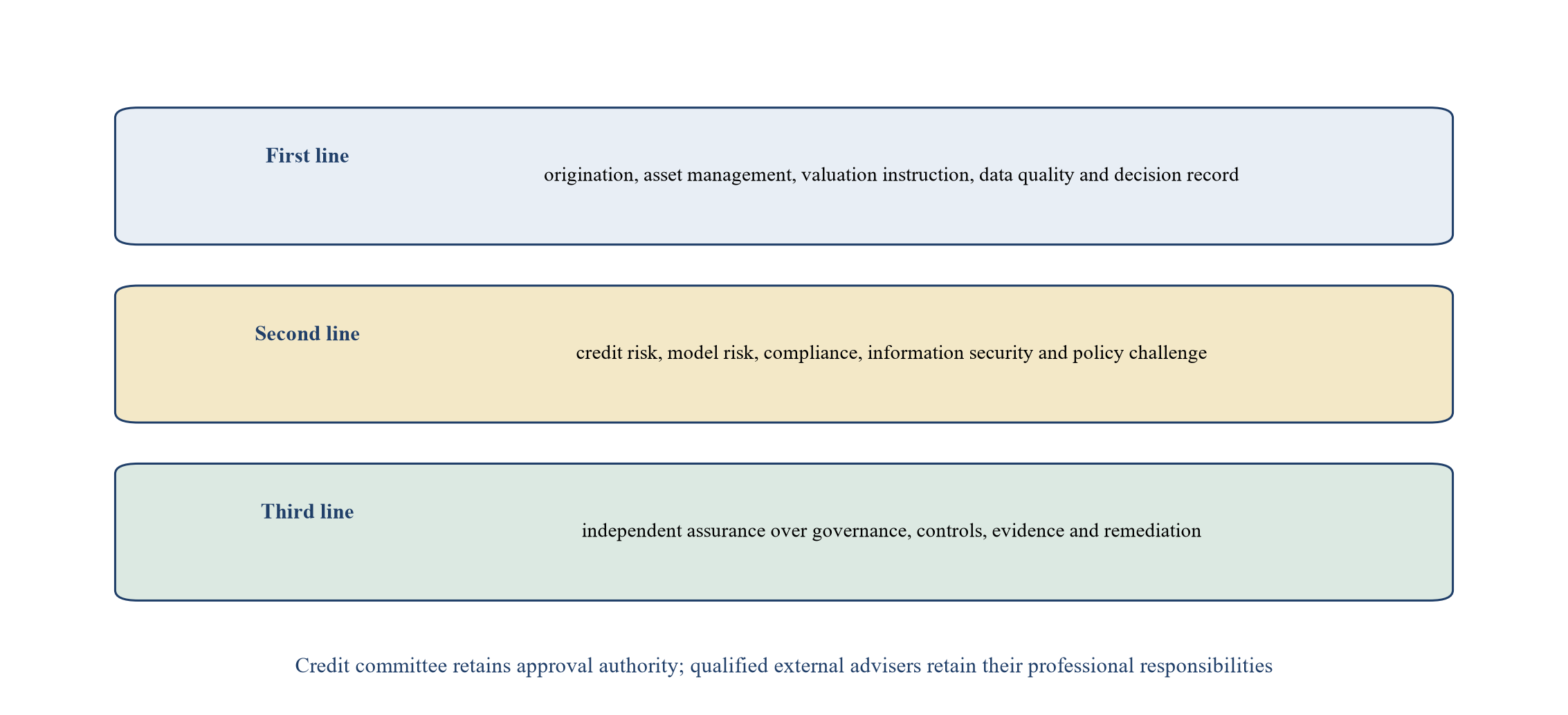
Business ownership, independent risk control and assurance remain distinct even where technology is supplied externally.
15. Monitor the loan as evidence and conditions change
Climate-aware underwriting should produce a monitoring plan at closing. Monthly or quarterly information can include rent roll, arrears, occupancy, service-charge position, utilities, insurance, incidents, works progress, reserve balance and covenant calculations. Annual or event-driven updates can include valuation, EPC, condition, hazard, insurance-market and policy review.
Trigger events should be defined. They can include flood or heat incident, insurance restriction, material EPC change, policy change, tenant departure, works delay, cost overrun, planning refusal, grid delay, model validation failure or sale and refinancing activity. A trigger begins a review; it should not produce an automatic credit action unless the facility clearly provides for it.
Compare forecasts with outcomes. Track actual capex, delivery time, energy use, operating cost, leasing, valuation and insurance. The comparison improves both asset management and model validation. A lender can learn whether its adjustments were conservative, incomplete or wrongly directed.
Portfolio monitoring should aggregate location, hazard, asset type, energy performance, works, insurer, borrower and refinancing concentrations. Aggregation can reveal simultaneous calls on capital or management capacity. It should preserve the underlying property evidence so a portfolio heat map does not replace asset-level review.
16. Implement through a ninety-day controlled pilot
The first thirty days should define scope and evidence. Select a small group of loans that represent different asset types and data quality. Freeze the decision questions, source register, metric definitions, authority map and prohibited uses. Reconcile property identifiers, coordinates, current values, balances, rents, insurance, condition and energy evidence.
Days thirty-one to sixty should build and test. Configure document extraction and geospatial joins, create scenario bridges, and reproduce results manually for a sample. Independent reviewers should challenge source quality, model outputs, valuation treatment and legal assumptions. Material conflicts should be resolved or carried visibly into the decision pack.
Days sixty-one to ninety should run in shadow mode. Produce the climate-aware credit view alongside the existing process without allowing the model to change terms automatically. Compare decisions, time, errors, overrides and additional information requests. Approve production use only for bounded purposes that meet performance and governance thresholds.
Success should be measured through decision quality: fewer unresolved property mismatches, clearer capex funding, earlier identification of refinance shortfalls, stronger evidence trails and timely escalation. A faster report is useful only when it preserves or improves the quality of the credit decision.
17. Limitations and conclusion
Climate models, hazard maps, energy certificates, valuation evidence and retrofit estimates all contain uncertainty. Public datasets have coverage and timing limits. Physical events can differ from modelled pathways. Policy and tenant expectations can change. Market evidence can be sparse, especially where several asset characteristics move together. Artificial intelligence can scale inconsistency as easily as it can scale analysis.
This framework does not provide a universal climate score or a forecast of loss. It provides a route from verified property evidence to transparent financial sensitivities and credit controls. The lender should use the level of analysis proportionate to the asset, exposure and consequence, while commissioning specialist work where uncertainty is material.
The most useful output is a decision bridge. It states what was observed, which assumptions were made, how income and value changed, which debt constraint binds, what mitigation is funded, who owns delivery and what evidence will cause the decision to be revisited. That bridge allows the borrower, professionals and credit committee to discuss the same risks in financial terms.
UK real-estate private credit can integrate climate, energy and retrofit evidence without replacing established valuation, engineering, insurance, legal and credit disciplines. AI can organise evidence, expose conflicts and run controlled scenarios. Accountable people should determine materiality, professional conclusions, loan terms and remedies. The result is a more reproducible underwriting process with clearer funding, monitoring and refinancing decisions.
Appendix A. Climate and Retrofit Underwriting Evidence Request
A1. Property income and finance
Title, boundary, coordinates, area, use, planning and ownership structure.
Facility, security, balance, interest, hedge, maturity, reserves and covenants.
Rent roll, leases, arrears, breaks, expiries, incentives and service charges.
Current valuation, market evidence, transaction assumptions and liquidity commentary.
A2. Climate energy and condition
Hazard reports, map layers, coordinates, site levels, adaptation and incidents.
EPCs, utility bills, meter register, operating hours, tariffs and energy audits.
Condition, planned maintenance, plant age, critical equipment and access.
Insurance policies, exclusions, excesses, claims, renewal and broker advice.
A3. Retrofit execution and governance
Scope, design, consents, procurement, programme, cost plan and contingency.
Tenant rights, access, disruption, recoverability and performance measurement.
Model inventory, source register, versions, validation, overrides and fallback.
Named professional advisers, decision owners, milestones and escalation routes.
Appendix B. Credit Review Checklist
B1. Before modelling
Confirm property identity, boundaries, coordinates, areas and decision date.
Separate facts, professional opinions, model outputs and lender assumptions.
Identify missing evidence, material uncertainty and specialist-review needs.
Freeze the source set, model versions, scenarios and metric definitions.
B2. Before approval
Translate hazards and energy performance into cash flow and timed capex.
Reconcile market value, credit adjustments and possible double counting.
Test LTV, debt yield, coverage, reserve and refinance capacity by scenario.
Record mitigants, conditions, responsible owners, deadlines and fallback.
B3. After closing
Monitor income, energy, insurance, incidents, works, reserves and covenants.
Compare forecast costs, savings, leasing and values with realised outcomes.
Revalidate material models and investigate overrides or performance drift.
Revisit the credit decision when defined evidence or policy triggers occur.
Sources
- Bank of England. Results of the 2021 Climate Biennial Exploratory Scenario, 2022. Read the primary source
- UK Government. Get energy performance of buildings data. Read the primary source
- Environment Agency. Flood risk assessments: climate change allowances. Read the primary source
- Met Office. UK Climate Projections guidance and reports. Read the primary source
- Department for Energy Security and Net Zero. Non-domestic private rented property minimum energy efficiency standard: landlord guidance. Read the primary source
- Department for Energy Security and Net Zero. Non-domestic private rented sector minimum energy efficiency standards: interim response, 2026. Read the primary source
- Royal Institution of Chartered Surveyors. ESG and sustainability in commercial property valuation, 4th edition, 2026. Read the primary source
- Prudential Regulation Authority. SS1/23 Model risk management principles for banks, current version 2026. Read the primary source
- National Institute of Standards and Technology. Artificial Intelligence Risk Management Framework 1.0. Read the primary source
- IFRS Foundation. IFRS S2 Climate-related Disclosures. Read the primary source
- Bank of England. Climate-scenario analysis and stress testing. Read the primary source
- Prudential Regulation Authority. Climate Change Adaptation Report 2025. Read the primary source
- Bank of England. Measuring climate-related financial risks using scenario analysis, 2024. Read the primary source
- Bank of England. Financial Stability Report, December 2025. Read the primary source
- Prudential Regulation Authority. CP10/25 Enhancing banks' and insurers' approaches to managing climate-related risks. Read the primary source
- IFRS Foundation. Disclosing information about an entity's climate-related transition in accordance with IFRS S2, 2025. Read the primary source
- IFRS Foundation. Introduction to ISSB and IFRS Sustainability Disclosure Standards. Read the primary source
- Ministry of Housing Communities and Local Government. Record-level Energy Performance Certificate data. Read the primary source
- National Institute of Standards and Technology. AI Risk Management Framework resources. Read the primary source
- National Institute of Standards and Technology. AI RMF Core. Read the primary source
- Bank of England and Financial Conduct Authority. Artificial Intelligence and Machine Learning Feedback Statement 2/23. Read the primary source
- Royal Institution of Chartered Surveyors. RICS publishes updated global standard on ESG and sustainability in commercial property valuation, 2026. Read the primary source
