

Introduction
The US legal-technology market is consolidating around connected workflows. Thomson Reuters agreed to acquire Casetext for USD 650 million in 2023, describing the transaction as part of a build, partner and buy strategy for generative AI [43]. Clio agreed to acquire vLex for USD 1 billion in 2025, combining practice management with legal research, drafting and AI [44]. LexisNexis acquired Henchman to connect internal law-firm documents with legal content and drafting tools [45]. These transactions show strategic demand for legal data, workflow position and AI capability. They do not establish a universal valuation benchmark.
Adoption has expanded while governance remains uneven. The American Bar Association reported that 30.2 percent of surveyed attorneys said their offices used AI-based tools in 2024, with higher adoption at the largest firms [38]. Thomson Reuters reported in 2025 that many professional-services organisations were using generative AI while few measured return on investment or provided comprehensive training [39]. Its 2026 survey found that only 18 percent of respondents said their organisations tracked AI return on investment [40]. Different surveys use different samples and definitions, so the figures should not be combined into one market-size estimate.
Legal work creates a distinct acquisition problem. A product can save time and still destroy value if it exposes client information, fabricates authority, weakens supervision, disrupts a firm's document system or makes work product difficult to reproduce. A roll-up can amplify these risks because it links datasets, models, permissions and workflows that were previously separated. The buyer needs a diligence model that follows information from client instruction through AI processing, lawyer review, final work product, billing and cash.
This paper is designed for strategic buyers, financial sponsors, lenders, boards and management teams evaluating US legal-AI acquisitions. It focuses on transaction decisions. It does not offer legal advice and does not treat professional-responsibility guidance as a product certification.
1 State the acquisition thesis in workflow terms
The investment committee should define the workflow it expects to own after closing. Examples include research to verified memorandum, matter intake to conflict check, contract upload to reviewed issue list, discovery corpus to production set, or client instruction to approved filing. A label such as legal AI is too broad to support diligence because the rights, evidence, users and consequences differ across these workflows.
The thesis should name the acquired asset, the buyer contribution and the value mechanism. The acquired asset may be permissioned content, a document-management connector, matter context, lawyer annotations, a verified citation graph, customer distribution or a specialised model. The buyer may contribute a broader installed base, trusted content, practice-management data, sales capacity or infrastructure. Value can arise from retention, cross-sell, lower service cost, improved completion or a faster product roadmap.
Each mechanism needs an owner, baseline, timing, cost and failure condition. If the thesis assumes that law firms will move privileged material into a combined platform, the buyer should identify the client permissions, security architecture and migration evidence required before assigning value. If the thesis assumes product consolidation, it should quantify which tools can retire without reducing accepted outcomes or breaching contract commitments.
| Value claim | Required evidence | Decision question | Principal risk |
|---|---|---|---|
| Owned legal workflow | product telemetry process maps and accepted outputs | does the target control a complete valuable task | feature use without workflow ownership |
| Privilege-safe operation | architecture contracts access logs retention and client terms | can confidential work remain protected after closing | disclosure reuse or uncontrolled access |
| Verifiable output | citation trace source links evaluation and lawyer review | can users reproduce and correct material conclusions | plausible unsupported authority |
| Customer stickiness | cohorts renewals seat depth matter use and migration behaviour | will customers remain through integration | contract renewal hides shallow adoption |
| Data and content rights | licences provenance purpose and change-of-control rights | can the combined platform continue each use | rights narrow after transaction |
| Sustainable economics | full content model security support and integration cost | what recurring cash remains after control cost | reported margin omits essential operations |
Proposed structure; target-specific legal technical commercial accounting security and client review is required.
2 Map the legal work evidence chain
The evidence chain begins with a client instruction and ends with work accepted by a lawyer, client, counterparty, regulator or court. Between those points sit matter opening, identity, conflict checking, document ingestion, privilege classification, retrieval, model inference, citation verification, lawyer review, approval, delivery, billing and retention. The buyer should map this chain for each material product and revenue cohort.
The map should identify systems of record and systems of action. A practice-management system may own the matter identifier and billing record. A document-management system may own the authoritative file. A legal-research platform may own licensed authority. An AI assistant may orchestrate tasks without owning the underlying evidence. Acquisition value depends on which layer can be transferred and which remains controlled by a customer or supplier.
Telemetry should show completion, intervention and outcome. Counts of prompts or generated words can overstate value because they do not prove that work was accepted. Better evidence connects input, retrieved authority, model and version, human reviewer, corrections, final artifact, elapsed time, invoice and renewal. Where professional rules require independent judgment, the workflow must preserve the lawyer's responsibility rather than present the model as the decision maker [1-5].
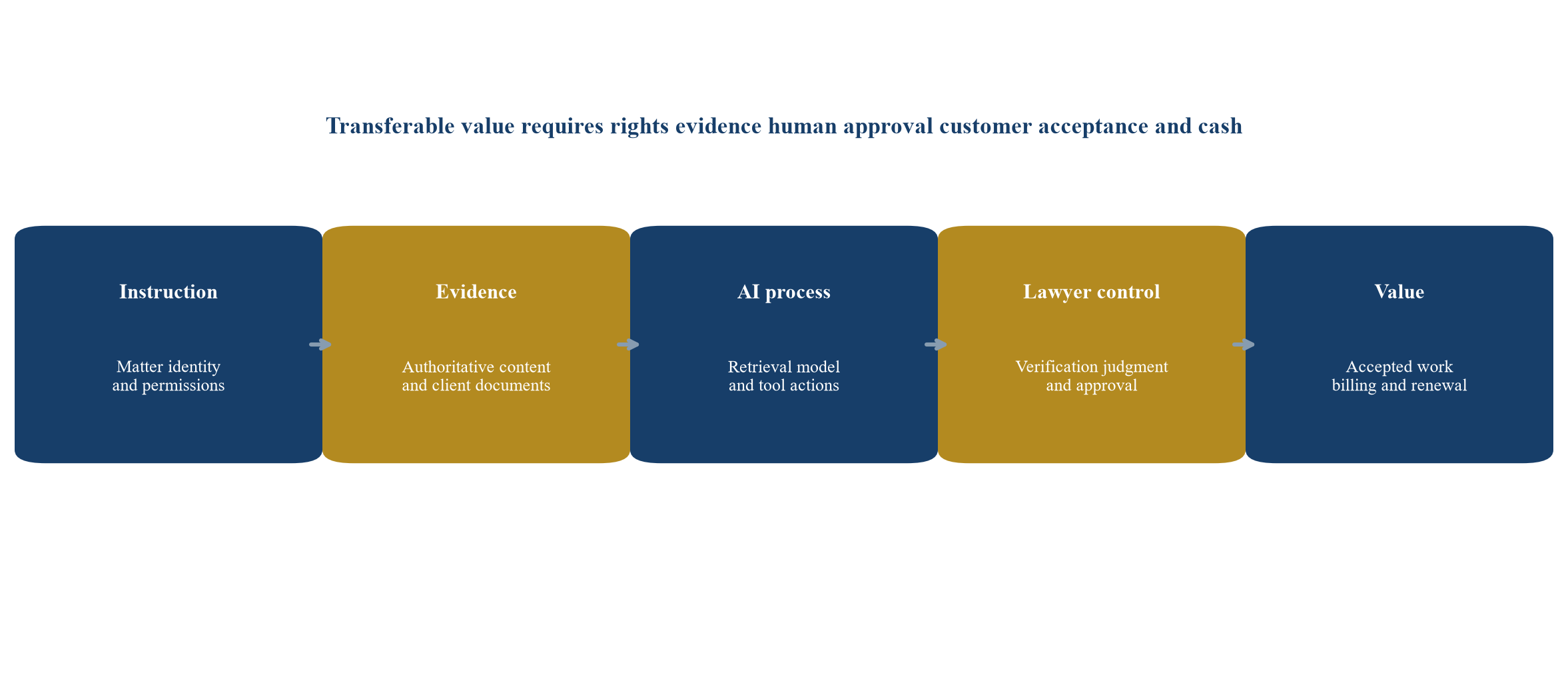
Proposed acquisition map; actual controls should reflect the matter client jurisdiction and consequence.
3 Test workflow ownership
Workflow ownership means that customers repeatedly enter a valuable task through the product, complete the material steps inside it and rely on its retained evidence. A target can have high usage without ownership when customers export work to another system, use the product only for a narrow research step or require manual services to finish the task.
The buyer should identify the system that controls matter identity, source documents, permissions, version history, final approval and billing. It should examine where users start and end, which integrations are essential, and whether another vendor can replace the target without disrupting the matter. A connector can be valuable, but its bargaining position differs from a system of record or a system that controls the accepted work product.
Workflow depth can be measured through the share of relevant matters using the product, the proportion of steps completed, the percentage of outputs accepted after review, the persistence of retained context and the cost of switching. These measures should be analysed by customer cohort and practice area. An average can conceal a small group of deeply embedded customers and a large group of experimental users.
4 Define privilege and confidentiality boundaries
Attorney-client privilege and professional confidentiality are related but distinct. Privilege is an evidentiary protection governed by applicable law. Professional rules can impose broader duties concerning information relating to representation. Federal Rule of Evidence 502 addresses waiver in federal proceedings and links protection against waiver after inadvertent disclosure to reasonable preventive and corrective steps [6]. It does not certify any AI architecture.
The diligence team should trace every route by which client information enters, leaves or influences the product. The inventory should cover prompts, uploaded files, embeddings, caches, logs, support tickets, model training, human review, analytics, backups and subprocessors. It should record the legal entity receiving data, purpose, location, retention, deletion, encryption, access and incident process.
ABA Formal Opinion 512 requires lawyers using generative AI to consider competence, confidentiality, communication, supervision, candor and reasonable fees [1]. California guidance states that lawyers should not enter confidential client information into a system lacking adequate protections [3]. Florida Opinion 24-1 addresses data retention, sharing, self-learning and oversight [4]. These authorities make product and contract details material to adoption. The buyer should therefore value a privilege architecture through verified controls and customer permissions, not through a generic statement that data is secure.
| Data state | Evidence to inspect | Failure mode | Transaction response |
|---|---|---|---|
| Prompt and upload | tenant controls encryption purpose and terms | confidential data enters shared training or logs | restrict use remediate terms or exclude workflow |
| Retrieval and embedding | source lineage access filtering and deletion | one client retrieves another client's material | closing condition technical remediation and testing |
| Model processing | provider terms retention regions and human access | subprocessor receives data beyond permission | consent architecture change or private deployment |
| Output and citation | matter link source trace reviewer and version | unsupported output enters work product | verification gate and product limitation |
| Support and telemetry | redaction roles tickets analytics and retention | support personnel or analytics expose matter content | role redesign minimisation and audit |
| Backup and exit | backup scope deletion evidence export and portability | data persists after termination or cannot migrate | escrow retention reserve and exit covenant |
Proposed matrix; privilege and professional duties require matter and jurisdiction specific legal analysis.
5 Treat privilege as an operating system
Privilege protection depends on daily operation. Contract language has limited value if engineers can access production prompts without approval, support tickets copy matter content into a separate system, or acquired products retain inconsistent deletion rules. The buyer should test policy, architecture and behaviour together.
A workable operating system starts with matter identity and client instructions. It applies least-privilege access, segregates tenants, limits subprocessors, records authorised purposes, redacts where feasible and preserves evidence of review. It should support legal holds, exports, deletion and incident response without making the AI output the only surviving record.
The acquisition model should include recurring cost for security engineering, privacy operations, access reviews, client audits, legal analysis, incident exercises and controlled model evaluation. These expenses sustain revenue and should not be treated entirely as discretionary integration investment. A target with stronger controls can carry a lower remediation burden, but that conclusion needs technical testing and client evidence.
6 Measure hallucination as a workflow defect
Hallucination is often described as a model problem. For transaction diligence, it is a workflow defect when an unsupported statement survives retrieval, generation, verification and human review into an accepted artifact. The relevant measure is therefore the residual material error rate after the complete production process.
Court materials show the consequence of fabricated cases and quotations. The 2026 federal Civil Rules agenda materials discussed recurring AI-generated citation failures and possible rule responses [10]. Federal Rule of Civil Procedure 11 requires an attorney or unrepresented party to certify, after reasonable inquiry, that filed content has a proper basis [8]. Judicial orders increasingly require verification or disclosure in specific courts [9-10]. The governing requirement depends on the court and current order.
The buyer should test realistic matters with known answers and adversarial ambiguities. It should record unsupported authority, incorrect proposition, missing jurisdiction, stale law, quotation error and false factual assertion. It should then measure detection by automated checks and reviewers. A target should not claim that retrieval eliminates hallucination unless representative production evidence supports the claim.
7 Build a citation verification control
A citation control should confirm that an authority exists, the quoted text appears in the source, the proposition is supported, the jurisdiction and date are appropriate, and later treatment has been considered. Link presence alone is insufficient. A model can cite a real case for a proposition the case does not support.
The diligence team should inspect the target's authoritative content, citator coverage, retrieval method, version controls and reviewer interface. It should sample memoranda and filings from multiple practice areas. The test should preserve the prompt, retrieved passages, generated draft, corrections and final approved artifact so the buyer can distinguish model error from process failure.
The combined company may have an opportunity to connect practice-management context, client documents and trusted legal authority. This can improve completion and product position. It also expands the permission and competition perimeter. The buyer should maintain source-level traceability and allow customers to review how their data and licensed content contribute to an answer.
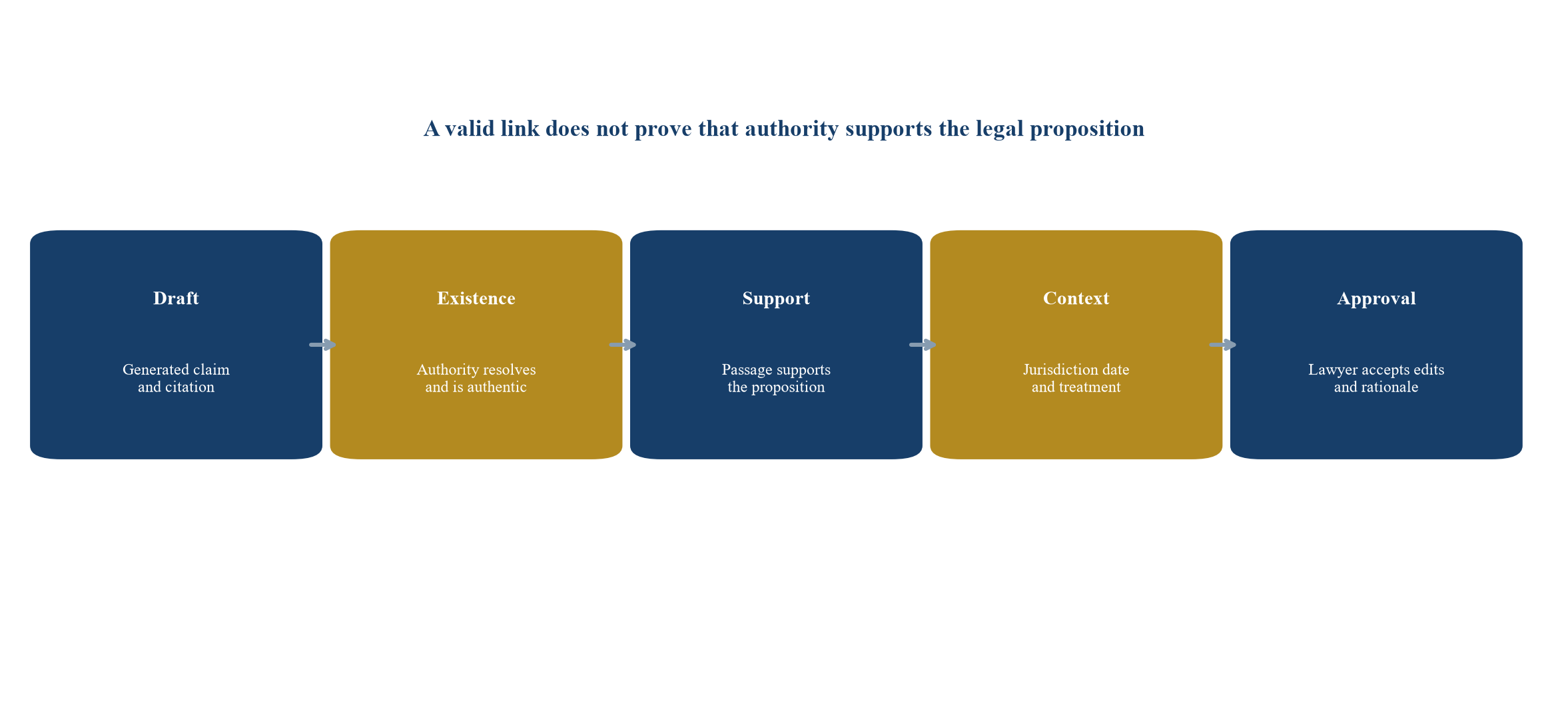
Proposed control flow; lawyers retain responsibility for professional judgment and final work product.
8 Evaluate by consequence and practice area
Legal-AI performance varies by task, jurisdiction, document type and consequence. A contract-clause extraction system should be tested differently from a litigation research assistant or client-intake chatbot. The buyer should avoid one blended accuracy figure.
The evaluation matrix should include high-volume tasks, high-consequence tasks and difficult edge cases. Measures can include precision, recall, unsupported-authority rate, material omission, reviewer correction, first-pass acceptance, time, cost and downstream error. The target should disclose who created the benchmark, how contamination was controlled and whether the current production model was tested.
Evaluation should repeat after model, prompt, retrieval, content or integration changes. NIST's AI Risk Management Framework and Generative AI Profile organise governance, mapping, measurement and management across the lifecycle [13-14]. These voluntary resources provide a useful diligence vocabulary. They do not set a legal safe harbour or a universal threshold.
9 Reconcile product claims with professional duties
Marketing can describe a tool as autonomous, lawyer-grade or accurate. Professional obligations still rest with lawyers and firms. The buyer should examine whether product language, interface design and default settings encourage overreliance or obscure uncertainty.
Competence requires a reasonable understanding of capabilities and limits. Confidentiality requires safeguards appropriate to the information and system. Supervision requires policies and review. Candor requires accuracy in submissions. Fee rules affect whether efficiency can be billed as time and how technology cost is communicated [1-5]. The product should help customers meet these duties through transparency, controls and records.
The transaction team should compare marketing pages, sales scripts, contracts, user training, in-product warnings, support practices and actual telemetry. A disclaimer does not cure a workflow designed to bypass review. Conversely, a product with strong source traceability and approval controls can still create risk if customers disable them or use the product outside the tested perimeter.
10 Verify content and data rights
Legal-AI products can depend on statutes, regulations, opinions, treatises, briefs, contracts, firm precedents, client documents, annotations and interaction histories. The buyer should identify the source and permitted use of every material corpus. Public availability does not automatically establish permission to copy, train, retrieve, summarise or commercialise content.
The inventory should record ownership, licence scope, territory, users, model and retrieval rights, derivative outputs, retention, deletion, audit, exclusivity, royalties, minimum commitments, termination and change of control. It should distinguish content used for model training, retrieval, evaluation, product display and customer-specific personalisation. Rights can differ across these purposes.
Firm and client data require separate treatment. A customer may permit processing for its matters without permitting the vendor to improve a shared product. An acquired company's product telemetry may contain privileged or personally identifiable material that cannot be freely combined. The buyer should make synergy conditional on permission and technical separation rather than assuming that all acquired data can enter one corpus.
11 Inspect the model and supplier dependency stack
Many legal-AI businesses combine proprietary workflow software with third-party foundation models, cloud infrastructure, licensed legal content, document-management interfaces and identity systems. The target may own the user relationship while depending on suppliers for the capabilities customers value.
The buyer should map model providers, versions, pricing, data treatment, service levels, rate limits, geographic availability, indemnities, termination rights and substitution paths. It should repeat this work for cloud, content and integration providers. Gross margin can change when token prices, content royalties or customer demand for private deployment changes.
Substitution should be demonstrated on representative workflows. A claim that models are interchangeable has limited value if a replacement changes citation quality, latency, tool behaviour or customer acceptance. The transaction model should reflect migration engineering, re-evaluation, parallel operation and client approval. Concentrated dependence can justify a valuation adjustment, closing condition or transition covenant.
| Dependency | Evidence | Substitution test | Economic treatment |
|---|---|---|---|
| Foundation model | contracts versions prompts evaluations and cost | replace model on representative matters | recurring cost plus migration reserve |
| Legal content | licence scope coverage citator and update latency | preserve authority and verification coverage | royalty minimums and renewal risk |
| Document system | API rights permissions mappings and rate limits | migrate matter context without leakage | integration cost and customer consent |
| Cloud infrastructure | regions encryption service levels and portability | restore workload in approved environment | resilience and duplicate operating cost |
| Identity and access | roles federation logs and offboarding | reproduce matter-level permissions | security remediation and support cost |
| Specialist reviewers | qualification capacity location and contracts | maintain evaluation and escalation service | recurring quality-assurance cost |
Proposed structure; contracts and technical behaviour require current target-specific verification.
12 Measure customer stickiness at the matter level
Annual recurring revenue and logo retention can overstate durability. A law firm may renew a broad contract while only a small group uses the AI module. A corporate legal department may run a pilot without moving material work. The buyer should analyse customers by matter use, active professionals, completed workflows and accepted outputs.
Useful measures include monthly active users, matters touched, workflow completion, approved-output rate, seat depth, practice-area spread, integration depth, data retained, time to value, support burden, renewal, expansion and contraction. The analysis should distinguish contracted seats from active qualified users and distinguish usage from accepted legal work.
Stickiness can arise from genuine workflow value, accumulated matter context, trusted content, integrations and training. It can also arise from difficult exports, proprietary formats or contractual friction. The former can support durable value. The latter can invite customer dissatisfaction, regulatory attention or rapid churn when an alternative appears. The buyer should examine portability and customer references before treating switching cost as a moat.
13 Analyse revenue quality and concentration
Revenue should be separated into recurring software, content subscriptions, usage, implementation, managed services, professional review, training and other items. Each category has a different margin and retention profile. A contract described as recurring can include implementation effort or minimum usage that does not repeat economically.
The buyer should reconcile bookings, invoices, recognised revenue, deferred revenue, credits, collections and cash by customer. It should identify pilots, free periods, bundled AI features, channel sales, reseller margins and renewal uplifts. Concentration should be measured by customer, firm network, practice area, channel and underlying supplier.
AI adoption may alter price architecture. Time savings can weaken hourly billing volume for firms while strengthening value-based or flat-fee products. ABA Formal Opinion 512 states that lawyers generally should bill actual time spent and charge reasonable fees, while allowing disclosed technology costs in appropriate circumstances [1]. A legal-AI target's growth forecast should therefore reflect how customers capture value and how client procurement responds.
14 Build a sustainable earnings bridge
Reported EBITDA can omit the operating cost required to keep a legal-AI workflow safe and accepted. The buyer should normalise content licensing, model use, evaluation, legal and ethics review, security, privacy, customer-specific integrations, professional support, incident readiness, product reliability and key-person continuity.
The bridge should separate recurring run-rate cost from one-time remediation. Recurring costs reduce sustainable EBITDA. Remediation belongs in integration investment or a transaction adjustment. Costs should not be excluded merely because the target expects the buyer's platform to absorb them. The combined company still incurs people, infrastructure or opportunity cost.
The hypothetical bridge below begins with reported EBITDA of USD 18 million. It deducts continuing costs that management may have treated as growth investment or shared overhead. The resulting USD 10.2 million is illustrative and does not represent a market benchmark.
| Item | USD million | Treatment | Evidence required |
|---|---|---|---|
| Reported EBITDA | 18.0 | starting point | audited and management accounts |
| Content and data rights | (1.7) | recurring | licences royalties updates and permitted uses |
| Model evaluation and verification | (1.5) | recurring | benchmark operations reviewers and release gates |
| Privilege security and privacy controls | (1.6) | recurring | architecture access review audit and incident readiness |
| Customer integration and support | (1.4) | recurring | connectors migrations support and professional operations |
| Product reliability and compliance | (0.9) | recurring | monitoring resilience records and current legal review |
| Key people and specialised expertise | (0.7) | recurring | retention succession and capability coverage |
| Sustainable EBITDA | 10.2 | valuation earnings | reconciled target operating model |
Hypothetical management assumptions in USD million; figures are not observed target data or valuation advice.
15 Translate product quality into economics
Quality affects revenue, cost and liability through observable pathways. Better retrieval and verification can increase acceptance, reduce rework and strengthen renewal. Weak quality can increase professional-support cost, customer complaints, credits, remediation and insurance exposure. The buyer should connect evaluation results to these economic outcomes.
The analysis should use cohorts rather than a single product-wide score. A litigation research workflow can have low measured error and high consequence. A contract summarisation workflow may tolerate more minor differences while requiring high recall for defined risks. Each cohort should have a threshold, reviewer process, residual error measure and economic consequence.
The buyer should compare claimed time savings with actual elapsed time and reviewer effort. AI may reduce drafting time while increasing verification. It may shift work from senior lawyers to specialists or from customer teams to vendor support. Sustainable value appears when total accepted-work cost falls or revenue grows after all review and control effort.
16 Value synergies through evidence gates
Legal-AI roll-up synergies often include cross-selling modules, combining data and content, retiring duplicate infrastructure, unifying research and practice workflows, reducing model cost, expanding distribution and improving retention. Each synergy should be defined by customer cohort, owner, action, cost, timing and cash effect.
An evidence weight should reflect what has been demonstrated. A signed customer permission and completed migration carry more weight than a product-roadmap claim. A tested integration with accepted outputs carries more weight than an API diagram. Revenue synergy should reflect adoption, price, churn and sales capacity. Cost synergy should retain all continuing control and service costs.
The illustrative example starts with USD 16 million of gross annual synergy. Continuing content, verification, migration, support and retention cost reduces this to USD 6.8 million. The present value used later is a management assumption. A buyer should calculate its own timing, tax, discount rate and probability.
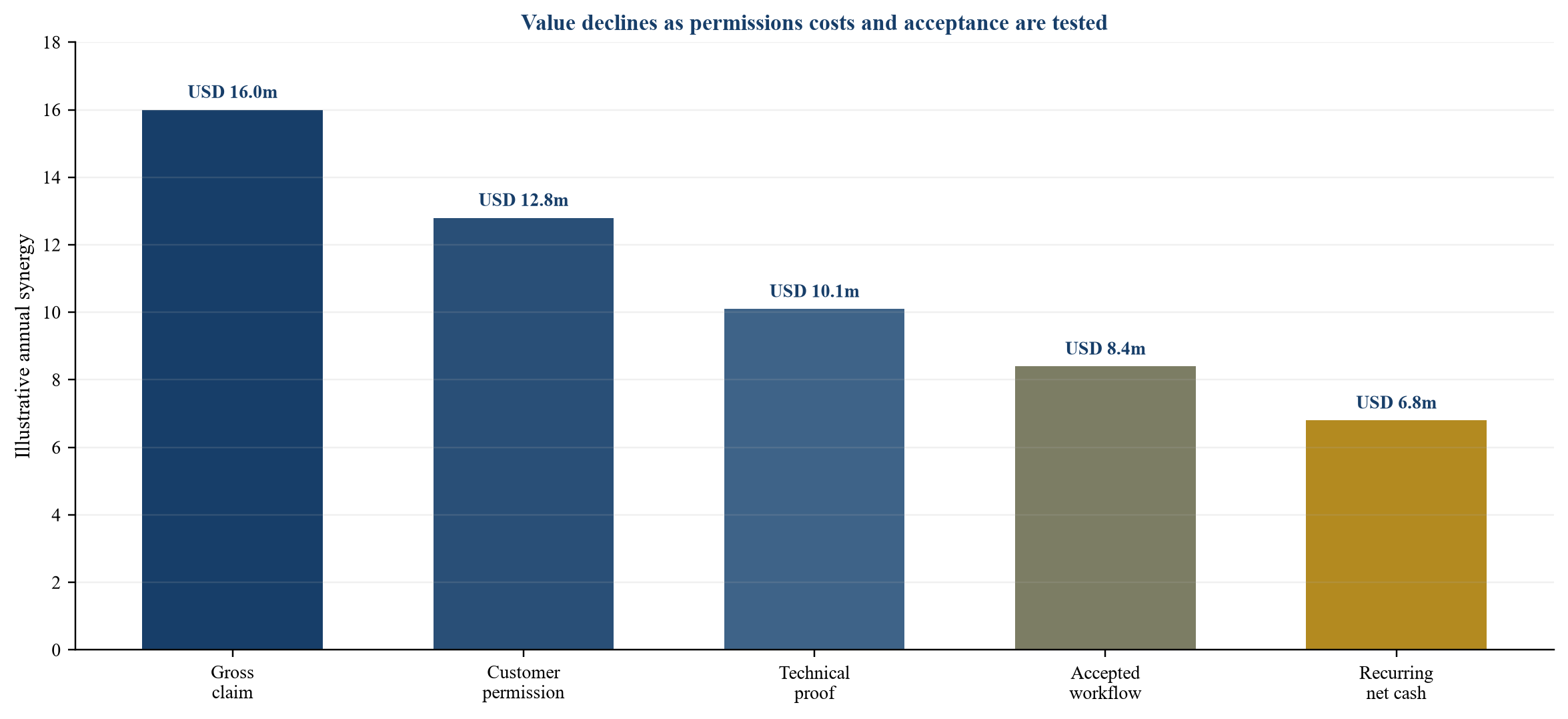
Hypothetical transaction framework; values are illustrative management assumptions.
17 Build the valuation bridge
The buyer should start with sustainable earnings and value synergies separately. This prevents an unverified growth thesis from inflating both the earnings base and the multiple. It also makes integration and risk deductions visible to the investment committee.
Intangible assets may include customer relationships, developed technology, databases, content rights, trade names and non-compete arrangements, subject to the accounting framework. The commercial diligence should test useful life, obsolescence, supplier dependence and the cost required to maintain each asset. Rapid model and product change can shorten the period over which current technology contributes value.
The hypothetical bridge applies twelve times sustainable EBITDA of USD 10.2 million, adds USD 24 million of evidence-weighted synergy present value and deducts USD 41.4 million for integration, control and customer risk. It produces USD 105 million after rounding. The multiple and deductions are management assumptions, not observed market data.
| Component | USD million | Basis | Principal sensitivity |
|---|---|---|---|
| Sustainable EBITDA value | 122.4 | 10.2 at an assumed 12 times | recurring cost retained revenue and multiple |
| Evidence weighted synergy present value | 24.0 | discounted implemented benefits | permissions timing acceptance and cash conversion |
| Integration and platform investment | (19.5) | architecture migration content and controls | product overlap and customer sequencing |
| Privilege accuracy and supplier risk | (12.4) | residual remediation and dependency exposure | incident history rights and substitution |
| Customer and retention risk | (9.5) | concentration migration and pricing exposure | renewal adoption and consent |
| Illustrative enterprise value | 105.0 | rounded resulting bridge | all underlying assumptions |
Hypothetical management assumptions in USD million; no forecast benchmark recommendation or target valuation.
18 Structure diligence around proof
The data room should follow the investment thesis. Corporate and financial materials remain necessary, but the distinctive evidence sits in product telemetry, matter-level permissions, source lineage, evaluations, model and content contracts, incident records, customer instructions and accepted work products.
The buyer should request representative cohorts with appropriate redaction or controlled access. It should reconcile management presentations with logs, invoices and customer evidence. It should examine failures as well as successes because remediation behaviour reveals governance maturity.
Diligence should use a common issue register linking each finding to value, legal consequence, deal response, integration owner and post-close measure. This avoids separate technical, legal and commercial reports that describe the same problem in incompatible terms.
19 Use deal terms to allocate uncertain value
Deal protections should follow the evidence gap. A missing right may require a consent condition, specific indemnity, escrow, price adjustment or excluded asset. Unproven customer migration may support deferred consideration tied to retained revenue or accepted workflows. A critical founder or content relationship may require retention, transition services or replacement evidence.
Representations can cover data and content rights, confidentiality, security, professional claims, customer commitments, model and supplier contracts, incidents, evaluations and compliance with stated policies. Their scope should reflect current legal advice and the transaction structure. A representation does not repair the product or preserve customers.
Earn-outs should use metrics the buyer and seller can observe and influence fairly. Revenue alone can reward low-quality expansion. EBITDA can be distorted by integration choices. A balanced metric may include retained recurring revenue, accepted workflow migration and defined control completion, with clear accounting policies and dispute procedures.
| Finding | Value effect | Potential deal response | Post-close measure |
|---|---|---|---|
| Verified end-to-end workflow ownership | supports retention and cross-sell | base value or evidence-weighted synergy | completed matters accepted outputs and renewal |
| Unclear client-data permission | restricts consolidation and model use | consent condition segregation or price adjustment | permission coverage and deletion evidence |
| Unsupported citation performance | increases remediation and liability exposure | product limit escrow or specific remediation covenant | residual material error and reviewer detection |
| Essential supplier dependence | affects margin resilience and roadmap | consent price protection transition or reserve | substitution outcome cost and service |
| Shallow customer adoption | weakens retention and synergy | deferred value or cohort-specific earn-out | active matters workflow depth and collected cash |
| Founder or specialist dependence | threatens product and customer continuity | retention succession and knowledge transfer | coverage customer continuity and release cadence |
Proposed commercial framework; legal drafting requires transaction-specific counsel.
20 Plan integration by workflow cohort
A legal-AI roll-up should not force all customers onto one product at closing. Integration should proceed by workflow cohort after rights, controls, technical performance and customer acceptance are verified. Some products may remain separate while the buyer builds common identity, evidence and governance layers.
The integration team should preserve source data, model versions, prompts, evaluations, logs, customer configurations, incident records and product commitments. It should prevent undocumented changes to high-consequence workflows during the initial control period. Customer support and security response must continue.
Each migration should have entry criteria, parallel operation, acceptance tests, rollback and a named accountable owner. Cost and synergy should be released after the cohort passes. This sequence protects customer trust and produces evidence the board can use to decide whether to accelerate or stop consolidation.
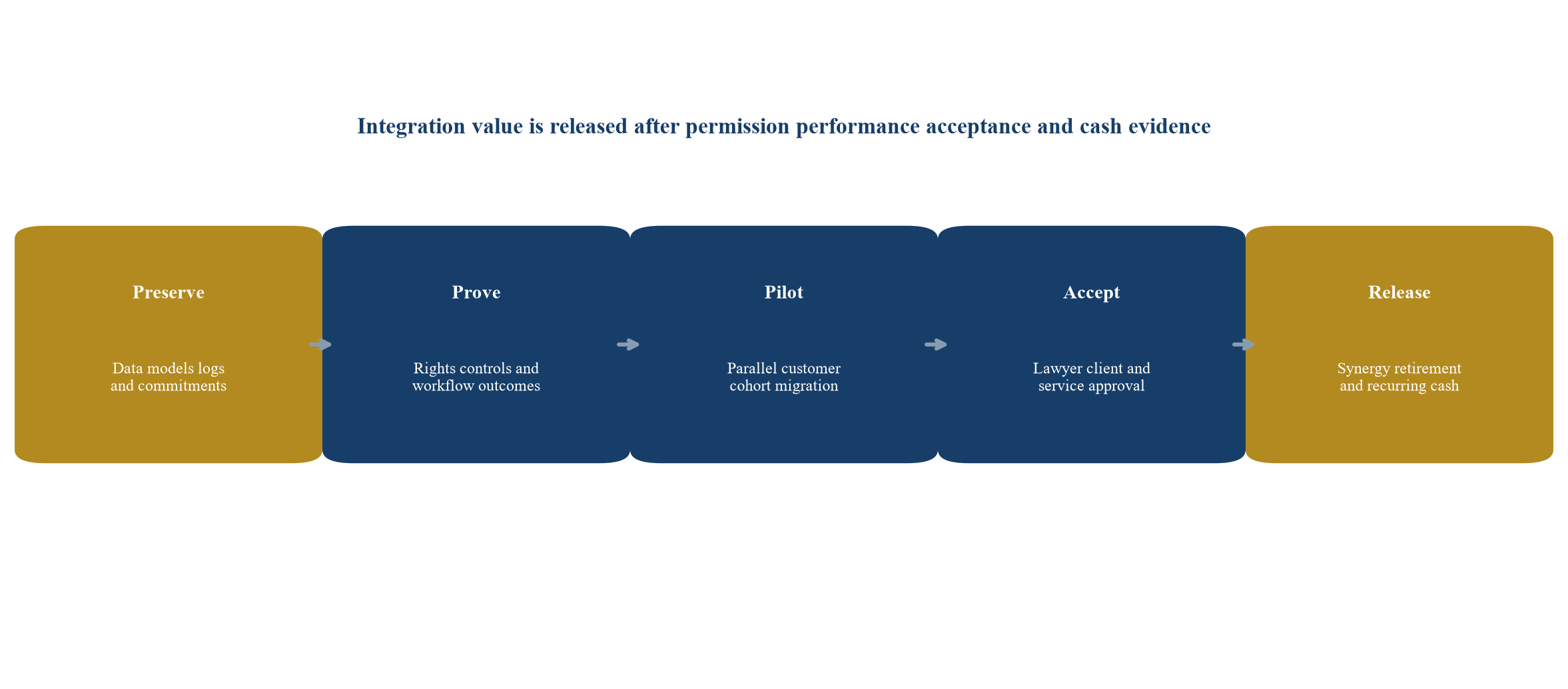
Proposed sequence; timing should reflect client permissions product risk and operational readiness.
21 Govern the first hundred days
Days one to fifteen should preserve evidence and operating continuity. The buyer should confirm privileged-data boundaries, freeze undocumented high-risk changes, validate access, retain critical staff and notify customers only through the agreed plan. It should establish one issue register and decision authority for product, legal, security and customer matters.
Days sixteen to thirty-five should reconcile product claims with evidence. Teams should map workflows, rights, suppliers, customer cohorts, model versions, evaluations and full cost. They should identify no-go use cases, material remediation and consent requirements. Finance should rebuild sustainable EBITDA and the synergy bridge.
Days thirty-six to sixty-five should remediate priority controls and run representative evaluations. The combined company can establish shared identity, logging, evaluation and approval standards while keeping customer-facing products stable. It should obtain required permissions before combining data or changing processing.
Days sixty-six to one hundred should pilot migrations with rollback, customer acceptance and cash measures. Product retirement and cost takeout should follow successful cohort evidence. The board should receive a concise record of accepted value, residual risk and decisions deferred.
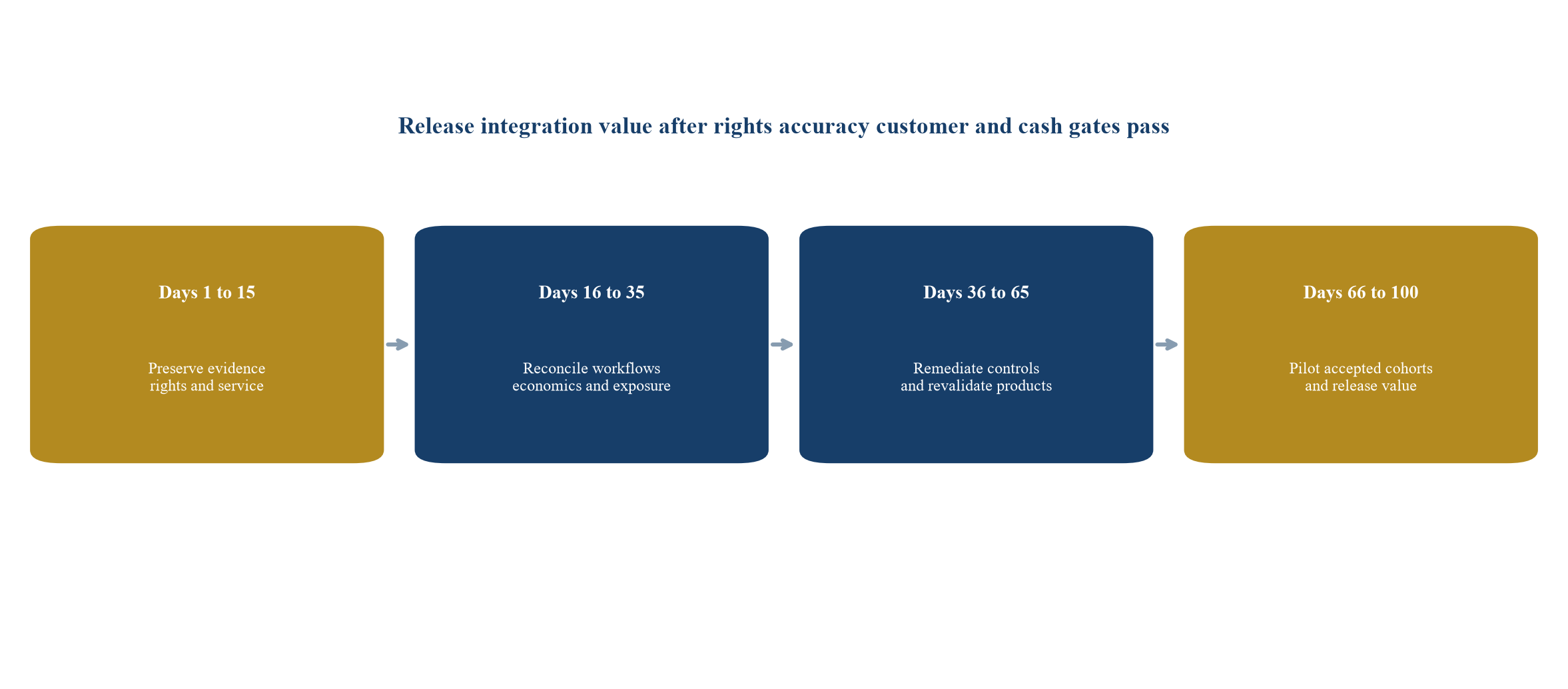
Proposed sequence; actual timing should reflect clients courts regulators products people and systems.
22 Control product retirement
Roll-ups often justify value through product rationalisation. A retirement decision can save development and support cost. It can also trigger churn if the surviving product lacks a relied-on workflow, integration, jurisdiction, content set or evidence feature.
The buyer should inventory contractual support periods, data export, retention, client instructions, integrations, accessibility, security approvals and matter deadlines. It should compare accepted outcomes rather than feature lists. A missing audit trail may matter more than several additional drafting functions.
Retirement should occur after customers have a supported migration path and the target cohort has passed acceptance. The model should include dual-running cost and delayed savings. If a product remains necessary for a material cohort, the buyer should preserve it or revise the synergy rather than compress the timetable.
23 Assess competition and platform effects
Legal-AI combinations can unite content, workflow, customer access and data. The 2023 US Merger Guidelines state that agencies may examine acquisitions that limit access to products rivals use, entrench a dominant position, form part of a series of acquisitions or affect multi-sided platforms [19-24]. The guidelines are non-binding and transaction outcomes depend on facts and law.
The buyer should identify where the combined company could restrict interoperability, content access, document-system interfaces, customer portability or data needed by rivals. It should examine whether a target is a nascent alternative, a multi-homing tool or an input used across platforms. Internal documents should describe efficiencies with evidence and avoid unsupported claims about eliminating competitors.
Competition diligence should run alongside commercial modelling. A remedy that preserves interoperability or limits data combination can reduce the synergy case. Filing timing, information requests and integration restrictions can affect financing and closing. The investment committee should understand these consequences before treating platform control as certain value.
24 Evaluate cyber and model security
Legal-AI platforms can hold sensitive client records, litigation strategy, transaction documents and credentials. A roll-up enlarges the attack surface and creates new trust relationships. The buyer should examine security design, testing, identity, secrets, software supply chain, model endpoints, prompt injection, retrieval poisoning, exfiltration, logging and incident response.
NIST's Secure Software Development Framework, Cybersecurity Framework and Privacy Framework provide structured diligence references [15-17]. CISA and international partners have published guidance for secure AI system development [18]. OWASP and MITRE provide threat taxonomies for large-language-model and adversarial-AI risks [31-32]. These resources help organise tests and controls. They do not certify a target.
The buyer should inspect incidents, vulnerability management, penetration tests, customer questionnaires, audit reports and remediation closure. It should test whether matter-level permissions remain effective across AI retrieval and tool calls. Integration plans should avoid connecting products before identity, logging and data boundaries are proven.
25 Design board reporting around residual risk
The board needs decisions and evidence rather than a long list of technical findings. Reporting should show the acquisition thesis, workflow cohorts, sustainable earnings, evidence-weighted synergies, material rights, residual privilege and accuracy risk, customer migration and integration gates.
Each material issue should have an owner, due date, financial exposure, control status and decision. Measures should distinguish leading evidence from realised value. Completion of an integration task is a leading measure. Retained revenue, accepted work and collected cash show realised value.
The board should receive incident and exception trends, including unsupported authorities detected, privileged-data control failures, customer opt-outs, material model changes and supplier disruptions. A zero-incident claim should be supported by detection coverage. Weak monitoring can create an apparently clean record.
| Dimension | Leading evidence | Realised outcome | Escalation trigger |
|---|---|---|---|
| Workflow ownership | mapped steps integrations and accepted pilots | completed matters and retained use | export or manual repair rises materially |
| Privilege and confidentiality | permissions access tests and deletion proof | no material unauthorised disclosure | boundary failure or disputed data use |
| Output reliability | benchmark coverage and reviewer detection | accepted work with residual error in threshold | unsupported material authority survives review |
| Customer value | migration consent training and support | renewal expansion and collected cash | opt-out churn or price concession exceeds plan |
| Sustainable economics | reconciled run-rate control and supplier cost | contribution margin and cash conversion | continuing cost exceeds approved bridge |
| Integration | cohort gates rollback and product plan | recurring net synergy after all costs | retirement or consolidation harms acceptance |
Proposed scorecard; thresholds and escalation should reflect the transaction and product perimeter.
26 Compare target archetypes
A legal-content company can own trusted authority and citator infrastructure while carrying high acquisition cost and update obligations. A workflow application can own a narrow task and strong user experience while depending on external models and content. A document connector can create valuable access to firm knowledge while depending on third-party systems and customer permissions.
A practice-management platform can control matter identity, billing and distribution, but may lack substantive legal content. An AI-native assistant can have rapid adoption and strong product talent while its recurring revenue, accuracy and workflow depth remain young. A managed-service provider can show accepted outcomes while relying on professional labour that limits software margins.
The buyer should value each archetype through the assets and obligations it actually acquires. Revenue multiples should not replace analysis of rights, workflow position, accepted outcomes and sustainable cost. The strongest combination connects complementary assets while preserving customer choice, evidence and professional accountability.
27 Limitations and conclusion
Legal-AI products, models, court practices, professional guidance and competition policy continue to evolve. Public sources reviewed for this paper describe the position available on the publication date. Customer contracts, privilege, confidentiality, unauthorised-practice rules, court orders, data rights and regulatory duties require current transaction-specific advice. The hypothetical numbers illustrate method and provide no forecast, benchmark, investment recommendation or valuation conclusion.
US legal-AI roll-ups can create value when they connect trusted content, client context and complete workflows while keeping sources, permissions and human responsibility visible. Their economics weaken when the acquired product owns only a feature, depends on rights that do not transfer, requires undisclosed professional labour or moves customers into a platform they do not accept.
The valuation model should begin with sustainable earnings after content, models, security, evaluation and support. Synergies should be weighted by customer permission, technical proof and accepted migration. Deal terms should allocate value where evidence remains incomplete, and integration should proceed by cohort with rollback.
The decisive evidence is operational. The combined company can show what information entered the workflow, which authority supported the result, which model and tools acted, who reviewed the output, what the customer accepted and how the outcome produced recurring cash. That chain turns legal-AI consolidation from a product narrative into an investable and governable transaction case.
Sources
- American Bar Association Standing Committee on Ethics and Professional Responsibility. Formal Opinion 512 Generative Artificial Intelligence Tools. Read the primary source
- American Bar Association. Model Rules of Professional Conduct. Read the primary source
- State Bar of California. Practical Guidance for the Use of Generative Artificial Intelligence in the Practice of Law. Read the primary source
- The Florida Bar. Ethics Opinion 24-1. Read the primary source
- New York City Bar Association. Formal Opinion 2024-5 Generative Artificial Intelligence in the Practice of Law. Read the primary source
- Legal Information Institute. Federal Rule of Evidence 502 Attorney Client Privilege and Work Product Limitations on Waiver. Read the primary source
- Legal Information Institute. Federal Rule of Civil Procedure 26 Duty to Disclose and General Provisions Governing Discovery. Read the primary source
- Legal Information Institute. Federal Rule of Civil Procedure 11 Signing Pleadings Motions and Other Papers. Read the primary source
- United States District Court Northern District of California. Civil Standing Order Regarding Artificial Intelligence. Read the primary source
- Administrative Office of the United States Courts. Advisory Committee on Civil Rules April 2026 Agenda Materials on Artificial Intelligence Hallucinations. Read the primary source
- New York State Unified Court System. Advisory Committee on Judicial Ethics Opinion 26-37. Read the primary source
- New York State Unified Court System. Advisory Committee on Artificial Intelligence and the Courts Annual Report 2025. Read the primary source
- National Institute of Standards and Technology. Artificial Intelligence Risk Management Framework 1.0. Read the primary source
- National Institute of Standards and Technology. Artificial Intelligence Risk Management Framework Generative Artificial Intelligence Profile. Read the primary source
- National Institute of Standards and Technology. Secure Software Development Framework Version 1.1. Read the primary source
- National Institute of Standards and Technology. Cybersecurity Framework 2.0. Read the primary source
- National Institute of Standards and Technology. Privacy Framework. Read the primary source
- Cybersecurity and Infrastructure Security Agency. Guidelines for Secure AI System Development. Read the primary source
- United States Department of Justice and Federal Trade Commission. 2023 Merger Guidelines. Read the primary source
- United States Department of Justice. Merger Guideline 5 Products or Services Rivals Use to Compete. Read the primary source
- United States Department of Justice. Merger Guideline 6 Entrenchment or Extension of a Dominant Position. Read the primary source
- United States Department of Justice. Merger Guideline 7 Trend Toward Consolidation. Read the primary source
- United States Department of Justice. Merger Guideline 8 Series of Multiple Acquisitions. Read the primary source
- United States Department of Justice. Merger Guideline 9 Multi Sided Platforms. Read the primary source
- Federal Trade Commission. Premerger Notification and the Merger Review Process. Read the primary source
- Federal Trade Commission. Keep Your AI Claims in Check. Read the primary source
- Federal Trade Commission. Aiming for Truth Fairness and Equity in Your Company's Use of AI. Read the primary source
- California Privacy Protection Agency. California Consumer Privacy Act Regulations. Read the primary source
- California Privacy Protection Agency. Automated Decisionmaking Technology Regulations. Read the primary source
- Colorado General Assembly. Senate Bill 24-205 Consumer Protections for Artificial Intelligence. Read the primary source
- OWASP Foundation. OWASP Top 10 for Large Language Model Applications. Read the primary source
- MITRE. Adversarial Threat Landscape for Artificial Intelligence Systems. Read the primary source
- International Organization for Standardization. ISO IEC 42001 Artificial Intelligence Management System. Read the primary source
- International Organization for Standardization. ISO IEC 27001 Information Security Management Systems. Read the primary source
- American Institute of Certified Public Accountants. SOC for Service Organizations. Read the primary source
- United States Securities and Exchange Commission. Cybersecurity Risk Management Strategy Governance and Incident Disclosure. Read the primary source
- American Bar Association. 2024 Legal Technology Survey Report. Read the primary source
- American Bar Association. 2024 Artificial Intelligence TechReport. Read the primary source
- Thomson Reuters Institute. 2025 Generative AI in Professional Services Report. Read the primary source
- Thomson Reuters Institute. 2026 AI in Professional Services Report. Read the primary source
- Clio. 2025 Legal Trends Report. Read the primary source
- Association of Corporate Counsel. GenAI and Future Corporate Legal Work. Read the primary source
- Thomson Reuters. Agreement to Acquire Casetext for USD 650 Million. Read the primary source
- Clio. Agreement to Acquire vLex for USD 1 Billion. Read the primary source
- LexisNexis. Completion of the Henchman Acquisition. Read the primary source
- Litera. Expanded Kira Contract Intelligence Capabilities. Read the primary source
- Thomson Reuters. 2025 Annual Report. Read the primary source
- RELX. Annual Reports. Read the primary source
- Financial Accounting Standards Board. Business Combinations Topic 805. Read the primary source
- Financial Accounting Standards Board. Intangibles Goodwill and Other Topic 350. Read the primary source
