

Introduction
Quantum-computing M&A sits at the intersection of industrial strategy, national security, research commercialisation and government procurement. The United States and the United Kingdom both support quantum research and commercialisation while controlling specified technologies, foreign ownership and access to sensitive programmes. A transaction can therefore receive corporate approval and still fail to deliver the technology access, personnel mobility or customer continuity assumed in the valuation.
The principal difficulty is that several legal objects move differently. Shares can change hands without moving a contract. Patent title can transfer while export law restricts technical data. A licence can remain valid while a change-of-control clause requires consent. A government customer can continue buying while security rules limit the acquiring group’s access. Employees can remain employed while nationality, location, clearance or technology-access conditions narrow the work they can perform.
The board needs a single transaction architecture that connects these objects. This paper provides that architecture. It begins with the capability and customer outcomes the buyer wants, maps the regulatory and contractual perimeter, and then links value to evidence. It also proposes a controlled diligence model and a post-close operating structure that can accommodate continuing restrictions without fragmenting technical accountability.
1 Define the acquisition outcome before selecting the legal structure
The buyer should state the exact capability, customer access and time advantage it intends to acquire. A broad objective such as acquiring a quantum platform provides little help when regulators, sellers and integration teams must decide which assets, people and information can cross a border. The outcome should identify the relevant hardware, software, control stack, manufacturing process, error-performance evidence, customer programme and technical milestone.
The statement should distinguish current capability from future option value. Verified performance belongs in the base case. Roadmap claims require defined dependencies, funding and technical evidence. Government relationships need their own evidence because participation in a programme can indicate credibility without creating transferable revenue.
Structure follows this outcome. A share acquisition may preserve the employing and contracting entity. An asset acquisition may isolate selected technology while creating assignment and novation work. A minority investment can provide capital and governance rights while limiting operational control. A joint venture, licence or programme partnership may preserve sovereign capability and customer eligibility. The board should compare these alternatives before treating full ownership as the default.
2 Build a cross-border control map
The control map should show the target, buyer, ultimate owners, government customers, research institutions, facilities, data repositories, cloud environments, technical teams and controlled technologies. It should identify the legal owner, physical location, system administrator, access population and approval authority for each critical asset.
This map prevents a common sequencing error. Teams often start with corporate ownership and later discover that material technology is licensed, hosted, government-funded or accessible through a separate institution. The map should connect each value component to its ownership chain and to every rule that could restrict use after closing.
The same map should support UK national-security analysis, US foreign-investment review where relevant, export classification, industrial-security planning and contract diligence. Each regime uses different legal tests, and the underlying facts overlap. A consistent fact base reduces contradictory filings and gives the board a reliable picture of the proposed operating model.
3 Screen the UK National Security and Investment regime early
UK government guidance includes quantum technologies within the mandatory notification regime when the statutory conditions are met. The guidance covers quantum communications, connectivity, imaging, sensing, timing, navigation, information processing, computing, simulation and quantum-resistant cryptography. It also addresses development and production activities across software, tools and cloud-hosted quantum services.
The buyer should complete the scope analysis before signing terms that assume an unrestricted timetable. The analysis should cover the target's actual activities rather than its marketing category. It should identify the relevant trigger event, ownership threshold, control rights, technology, facilities, customers, public programmes, access arrangements and international links.
The 2025-26 annual report records 1,324 notifications received, 1,242 accepted notifications, 60 call-in notices and nine final orders during the reporting period. One transaction was blocked or ordered to unwind. These figures describe the regime as a whole rather than the probability of a particular quantum transaction. They nevertheless support planning for information requests, conditions and timetable uncertainty.
4 Translate potential UK remedies into operating economics
National-security conditions can affect location, access, manufacturing, governance, reporting, personnel and infrastructure. The public final order concerning IonQ's acquisition of Oxford Ionics required the parties to host current and future generations of specified trapped-ion hardware in the United Kingdom for independent assessment and validation when requested for government programmes or contracts. It also required maintenance in the United Kingdom of specified science, engineering and infrastructure functions, including suitably qualified personnel, tangible and intangible assets and manufacturing capacity related to the hardware.
These conditions provide a useful public reference for transaction design. They do not establish the likely outcome for another acquisition. A buyer should model the cost and value effects of plausible conditions before signing. The model should test duplicated facilities, restricted remote access, local capital expenditure, ring-fenced governance, reporting, personnel commitments and the loss of planned centralisation benefits.
The acquisition agreement should allocate the economic consequences. Relevant provisions can include a defined mitigation perimeter, buyer conduct obligations, seller cooperation, long-stop dates, termination rights and limits on remedies the buyer must accept. The board should approve the maximum acceptable restriction by reference to the operating thesis.
5 Determine whether US CFIUS jurisdiction or filing obligations arise
CFIUS reviews certain foreign investments in US businesses and specified real-estate transactions. A US acquisition of a UK target does not automatically create a CFIUS filing. Jurisdiction can arise when the transaction includes a US business, US subsidiary, US operations or covered investment rights, or when a broader structure involves foreign investors and a US technology business. The parties should analyse the actual perimeter and ownership chain.
Treasury guidance states that mandatory declarations can apply to certain transactions involving critical technologies and to certain transactions in which a foreign government acquires a substantial interest in a TID US business. The United Kingdom is an excepted foreign state for specified purposes, subject to the applicable investor conditions. Excepted status does not remove every transaction from CFIUS jurisdiction or eliminate export-control, industrial-security and other reviews.
The buyer should decide whether a short-form declaration or full notice is appropriate when CFIUS is relevant. Treasury's 2024 annual report records 116 declarations, of which 36 were subject to mandatory filing requirements. A declaration can produce clearance, a request for a full notice, inability to conclude action or unilateral review. The transaction timetable should reflect this range of outcomes.
6 Classify the technology before opening the data room
Export-control diligence begins with classification. The UK control list and the US Commerce Control List contain controls relevant to quantum computers, related equipment, components, materials, software and technology. Classification requires technical evidence. Product names, investor descriptions and patent abstracts are insufficient.
The target should identify each controlled item, software repository, design file, process specification, test method and technical assistance activity. It should record the applicable classification, reason for control, licence basis, authorised destinations, end users, end uses, nationality restrictions and technology-release conditions. Where classification is unresolved, access should remain restricted until qualified analysis is complete.
The data room should enforce the classification. Commercial reviewers can receive summaries, contracts and financial information. Technical clean teams can review controlled detail under an approved access plan. The parties should log downloads, demonstrations, questions and expert access. This approach allows diligence to progress while preserving a record of who received what technology and why.
Classification should also cover prototypes, calibration procedures, manufacturing recipes, firmware, test fixtures, cryogenic integration, control electronics and technical support. A commercially minor component can become essential when it embodies a controlled performance threshold or enables a controlled system. The target should reconcile the classification schedule with bills of material, architecture diagrams, source repositories and customer deliverables. The buyer should test whether the schedule includes obsolete and developmental items because old versions can still contain transferable know-how. Any advisory conclusion should record the technical facts supplied, the edition of the control list used and the assumptions requiring confirmation.
7 Treat electronic access as a technology transfer question
Technology can move without physical shipment. UK guidance addresses transfer by electronic means, remote access and cloud use. The US EAR also treats release of controlled technology and source code as a regulated event in specified circumstances. Shared repositories, screen sharing, support sessions, source-code access, laboratory telemetry and remote administration require the same discipline as hardware movement.
The buyer should map identity, nationality, location, device, network, repository and permission for every person who may access controlled technical information. Pre-close integration planning should remain within approved boundaries. A global engineering team should not receive default access solely because it belongs to the acquiring group.
The operating model should include role-based permissions, segregated environments, access approval, logging, training and incident response. Technical architects and export-control advisers should design these controls together. A legal memo without system implementation leaves the transaction exposed; a technical restriction without legal classification can block legitimate work unnecessarily.
8 Reconcile US and UK classifications item by item
Allied export-control systems can pursue similar security objectives while using different entries, thresholds, licence exceptions and administrative processes. A UK classification should not be copied into the US analysis. Each jurisdiction requires its own determination based on the item, technology, destination, end user and end use.
The reconciliation schedule should contain the UK control entry, US Export Control Classification Number, technical basis, controlled attributes, current licences, authorised users and planned post-close access. It should identify gaps where one jurisdiction controls an item or release that the other treats differently.
This schedule informs the integration plan. A technology may remain in a UK environment, move under licence, be accessed through a controlled service, or be excluded from specified workstreams. The transaction model should recognise the cost, delay and technical consequences of each route. Synergies that depend on unlicensed access should not enter the base valuation.
9 Separate patent ownership from freedom to use
Patent title establishes a legal right to exclude; it does not by itself prove that the company owns every relevant invention, may practise the technology, can transfer the know-how or avoids third-party rights. Quantum products can combine patents, trade secrets, software, university licences, background intellectual property, standards, open-source components and government-funded inventions.
The buyer should build a rights tree from inventors and contributors to the company. It should test employment assignments, consultancy agreements, university policies, sponsored research, joint development, improvement rights, licence fields, sublicensing, prosecution control and change-of-control provisions. Patent families should be connected to actual product and roadmap claims.
Freedom-to-operate work has a different purpose. It examines third-party rights and the practical ability to commercialise the planned product. The buyer should distinguish ownership diligence, validity analysis, infringement risk and commercial freedom. Each produces a different risk allocation and valuation consequence.
10 Identify government-funded invention rights
US federal funding can create government rights under the Bayh-Dole framework and the applicable funding agreement. Under 35 USC 202, qualifying contractors can elect to retain title to subject inventions, subject to specified obligations. The federal government can receive a nonexclusive, nontransferable, irrevocable, paid-up licence to practise or have practised the subject invention on behalf of the United States. Disclosure, election, patent filing and government-support statements can also matter.
The buyer should identify every grant, cooperative agreement, subcontract and government-funded research programme connected to the target's patents and know-how. It should reconcile invention disclosures, title elections, patent filings, government-support clauses, utilisation reporting and domestic-manufacturing requirements where applicable. A patent schedule that omits funding provenance is incomplete.
UK public funding can also impose intellectual-property, collaboration, location, reporting and change-control obligations through the relevant award terms. The transaction team should review the executed instrument and current programme terms. Announced funding and general programme descriptions do not prove the target's rights.
11 Review university licences as transaction infrastructure
Quantum businesses frequently emerge from universities and rely on continuing licences, facilities and research relationships. The UK Intellectual Property Office's Knowledge Asset Management guidance emphasises intellectual-property due diligence, freedom-to-operate work, export controls and national-security obligations in technology transfer.
The buyer should review each licence for ownership, exclusivity, field, territory, sublicensing, assignment, change of control, improvement rights, prosecution, enforcement, royalties, milestones, diligence obligations and termination. It should also identify informal dependencies on academic staff, students, laboratories and equipment.
The transaction should secure the rights needed for the approved roadmap. Consent may be a closing condition, a pre-close covenant or a milestone. Where consent timing is uncertain, the buyer can use a holdback or alternative structure. Value attributed to university relationships should be limited to evidenced rights and a credible operating plan.
12 Map government customers contract by contract
Government-customer value should be underwritten at the contract level. The target's description of a strategic relationship may cover a signed contract, framework, task order, grant, research agreement, memorandum, pilot, procurement qualification or non-binding discussion. These instruments have different revenue, transfer and continuity implications.
The contract map should record the legal customer, contracting entity, programme, scope, term, funded amount, remaining obligations, renewal rights, termination, assignment, change-of-control, security, data rights, intellectual property, audit, location, subcontracting and notification provisions. It should reconcile backlog to funded orders rather than treating ceiling values as committed revenue.
The buyer should identify the individual contracting officers, programme owners and security officials whose approvals or communications matter. Customer engagement should follow the agreement and applicable procurement rules. Informal reassurance does not replace a consent, novation or documented determination.
Revenue quality should be traced from appropriation and programme authority to the signed instrument, funded order, accepted deliverable and cash collection. A framework ceiling, indefinite-delivery vehicle or announced budget can create access without committed volume. The target should disclose bid protests, stop-work instructions, option exercise history, audit findings, disputed costs and performance assessments where relevant. The buyer should also identify dependencies on small-business status, domestic sourcing, named subcontractors or incumbent clearances. A change in ownership can alter the commercial position even when the written contract survives.
13 Distinguish share purchases from asset transfers in US federal contracts
FAR Subpart 42.12 governs recognition of a successor in interest when contract assets transfer. FAR 42.1204 states that a novation is generally unnecessary for a stock purchase when the contracting party remains the same legal entity, retains control of the assets and continues performance. It also states that ownership changes can still create matters appropriately addressed with the government.
An asset transaction can require a novation when the government agrees to recognise a successor. The required submission can include the transaction document, affected-contract schedule, evidence of performance capability, corporate approvals, legal opinions, financial statements, security-clearance evidence and surety consent. Timing and outcome should therefore be incorporated into the deal plan.
The structure choice should account for this distinction. A share purchase may simplify contract continuity while retaining legacy liabilities. An asset purchase can isolate liabilities while creating transfer and novation dependencies. The board should compare the full economics rather than choosing structure solely for tax or corporate reasons.
14 Protect industrial-security eligibility and classified work
A target with classified US contracts or facility clearance can be affected by foreign ownership, control or influence. DCSA states that a company operates under FOCI when a foreign interest has the power, directly or indirectly, to direct or decide matters affecting management or operations in a way that may permit unauthorised access to classified information or adversely affect classified-contract performance.
The transaction team should identify facility clearances, classified contracts, key management personnel, cleared locations, classified information systems and existing mitigation instruments. The ownership and governance model should be tested against the required mitigation path. Board rights, parent access, shared services, information systems and executive appointments can all matter.
FOCI mitigation can affect control and synergy. A proxy agreement, special security agreement, security control agreement or board resolution can impose different governance and access consequences. Qualified industrial-security counsel and DCSA engagement should inform the transaction structure before the buyer values unrestricted operational integration.
Shared services need specific review. Finance, human resources and general IT can often be separated from programme networks, while engineering support, cybersecurity administration and executive oversight may involve sensitive access. The operating plan should identify which parent services are permitted, which require cleared or approved personnel and which must remain inside the mitigated entity. Costs for independent directors, security staff, segregated systems and reporting should enter the acquisition model. The buyer should also test whether financing rights, lender information and step-in provisions create access or control concerns under the proposed mitigation structure.
15 Assess UK government-customer national-security provisions
The Procurement Act 2023 framework and current Cabinet Office guidance allow national-security considerations to affect supplier exclusion and contract termination in relevant circumstances. Updated guidance asks contracting authorities to consider foreign ownership, control or influence and the legal or policy environment affecting a supplier.
The buyer should review contract-specific change provisions and the procurement regime that applies to the award. It should identify security schedules, national-security termination rights, personnel requirements, data-location commitments, supply-chain restrictions and notification duties. Defence and exempt contracts may follow additional rules.
The commercial model should separate revenue that is contractually durable from revenue exposed to ownership or security review. A probability adjustment should follow documented evidence and qualified advice. Government-customer concentration can justify specific closing conditions, customer continuity payments or termination rights.
16 Evaluate competition in technology and talent markets
Current UK CMA guidance and the US merger guidelines address innovation, potential competition, access to inputs and labour-market effects. Quantum markets can have limited present revenue, uncertain product definitions and scarce technical teams. Competitive significance may therefore appear in research paths, future entry, intellectual property, cloud access, government procurement or specialist hiring.
The buyer should map overlapping technical approaches, products, customers, research partnerships, distribution channels and talent pools. It should identify whether the target is an important independent path or potential entrant. Internal documents should describe the genuine rationale and counterfactual consistently.
Remedy analysis should cover the capability that creates concern. A licence or behavioural commitment may preserve some competition while changing the buyer's economics. A divestiture can separate assets from the team or facilities needed to use them. The board should understand these operational consequences before agreeing remedy obligations.
17 Design the diligence clean room around legal and scientific need
The clean-room design should allocate reviewers by question. Commercial teams need customer, price and pipeline evidence. Technical reviewers need performance data and selected design information. Regulatory advisers need ownership, access, classification and end-use facts. Competition counsel may require a separate protocol for competitively sensitive information.
Each dataset should have an owner, purpose, legal basis, access population, location, retention period and permitted output. Summaries should reveal enough to support a decision while withholding unnecessary controlled or competitively sensitive detail. Expert reports should distinguish observed test evidence from management explanation.
The buyer should define escalation paths before review begins. If a document appears controlled, improperly shared, classified or outside the agreed perimeter, reviewers should stop and refer it. A disciplined clean room can protect the parties while producing a stronger investment record.
18 Build an intellectual-property mobility graph
The IP mobility graph should connect each critical capability to patents, trade secrets, source code, technical data, licences, funding rights, contributors, repositories and permitted users. It should show whether ownership, licence, access and export permission remain together after closing.
A critical item can have several states. The target may own the patent but license background technology from a university. The buyer may acquire the shares but lack authority to disclose source code to a US team. A US government-funded invention may carry government rights. A customer contract may grant data or software rights that limit reuse.
The graph converts these relationships into closing and integration tasks. Missing assignments become remediation. Consent requirements become conditions. Export restrictions become access controls. Shared ownership becomes governance. Rights that cannot move become valuation deductions or reasons to choose a licence, joint venture or ring-fenced subsidiary.
19 Value government access separately from technology
Technology value and customer-access value should be modelled separately. A technically strong target can lose programme eligibility after a control change. A government relationship can remain intact while export restrictions prevent the buyer from using the technology in the intended global platform.
The value bridge should identify verified technology, transferable rights, permitted technical access, government-contract backlog, programme options, team continuity and facilities. Each component should have an evidence gate and downside case. Revenue should be linked to funded orders, renewal evidence and delivery capacity.
This approach prevents double counting. A patent portfolio should not receive full value if its commercialisation depends on a contract already valued elsewhere. A government programme should not receive option value when the technical work cannot continue under the proposed access model.
20 A hypothetical GBP 540 million transaction
Assume a US strategic buyer considers acquiring a UK quantum systems company for GBP 540 million. The target develops quantum control hardware and software, employs a specialist UK team, licences background intellectual property from a university, participates in UK public programmes, sells to commercial customers and supports government-related work. These facts and every figure in this section are hypothetical management assumptions.
Management allocates GBP 205 million to verified technology and intellectual property, GBP 105 million to teams and know-how, GBP 80 million to government and regulated-customer access, GBP 65 million to university, facility and public-programme relationships, GBP 50 million to commercial customer access, and GBP 35 million to other net assets and strategic option value.
Proposed consideration includes GBP 300 million at closing, GBP 85 million subject to an acceptable national-security and export-control operating path, GBP 60 million linked to government-contract continuity, GBP 55 million tied to defined technical-access milestones, and GBP 40 million reserved for team continuity. This allocation demonstrates how consideration can follow evidence without representing a market benchmark.
21 Stress the hypothetical value against access outcomes
The base case assumes that the UK entity remains operational, key personnel continue, required technology access is licensed or otherwise permitted, principal government contracts continue, university rights remain effective and the buyer can implement the approved product roadmap. Management should test downside cases independently and in combination.
One downside case retains technology ownership but restricts group access, delaying engineering integration and reducing expected synergies. A second preserves technical access but loses a government programme. A third retains customers and rights but loses critical technical teams. A fourth imposes continuing UK location and capital commitments above the base plan.
The board should examine cash requirement, milestone delay, duplicate cost, customer concentration and terminal value under each case. The acquisition price should remain acceptable under the board's approved probability-weighted outcome. A scenario that destroys the central rationale should become a walk-away condition or a reason to restructure.
22 Tie consideration to evidence the buyer can observe
Consideration should be linked to outcomes within a reasonably measurable perimeter. A regulatory holdback can address an approved operating model or specified restriction. A contract-continuity payment can depend on documented continuation of named programmes. A technical milestone can use defined test conditions, data and independent review. A retention pool should remain separate from seller consideration where the legal and commercial purpose differs.
The mechanism should state who controls the actions required to achieve the outcome. A seller should not bear risk created solely by the buyer's post-close decisions. The buyer should not pay for an outcome that can be satisfied by a low-quality substitute. Dispute procedures, partial achievement and long-stop treatment need clear drafting.
The board should also test accounting, tax, employment and securities consequences. Economic alignment can fail when the legal instrument creates unintended treatment or cannot be offered to the people whose continuity matters.
23 Choose among six operating structures
A full acquisition with integrated operations can deliver control and coordination when technology and customer access can move. A ring-fenced UK subsidiary can preserve local capability, contracts and regulatory commitments while allowing selected group services. A minority investment can fund growth with limited control. A joint venture can divide sovereign, customer or technology rights. A field-limited licence can provide commercial access without ownership. A programme partnership can target one customer or technical milestone.
Each structure should be assessed against control, regulatory review, export permissions, intellectual-property rights, contract continuity, financing, tax, talent, governance and exit. The least complex corporate form may create the most complex operational restrictions.
The board should select the structure that preserves the capability and customer outcome at an acceptable risk-adjusted cost. Full ownership has limited value when the buyer cannot lawfully access the acquired technology or sustain the relevant contracts.
24 Prepare a regulatory and contract critical path
The critical path should run from classification and scope analysis through filings, consents, customer engagement, licences, security arrangements, financing and closing. It should identify dependencies and the evidence required to move each item.
Early activities include confirming legal entities, beneficial ownership, technology classifications, government contracts, university rights, facilities and personnel. Signing conditions can cover national-security approval, competition clearance, export licences, key consents and financing. Post-signing covenants should control information access and preserve the business.
The plan should include realistic review time, information requests and remedy negotiation. Employee, customer and investor communications should remain consistent with the regulatory status. Integration actions that assume control or transfer before closing should be prohibited.
The critical path should include a decision owner and fallback for every dependency. If a licence cannot be obtained by the long-stop date, the fallback might retain technology in the UK entity, narrow the transaction perimeter or convert a transfer into a service arrangement. If a customer delays consent, the seller may continue performance under an agreed transition structure where lawful and acceptable to the customer. If a remedy removes a material capability, the buyer should have a pre-agreed price or termination response. These fallbacks should be designed before signing because leverage and implementation time usually decline after commitments become public.
25 Establish a controlled Day One
Day One should preserve the approved information and operating perimeter. Corporate ownership may change immediately; technical access, systems, contracts and facilities should change only according to authorised plans. The combined group needs a clear statement of who may access what, from where and for which work.
The buyer should activate governance, security, export-control, contract and incident owners. Systems integration should begin with identity and logging rather than broad repository migration. Government and university communications should follow agreed protocols. Existing programme reporting should continue without disruption.
The board should receive a Day One certificate covering approvals, licences, access controls, customer status, key people and exceptions. Unresolved items should have owners, due dates and restrictions. The certificate should support action rather than imply that every regulatory question has disappeared at closing.
26 Govern the first 180 days through observable evidence
The first 180 days should be organised around capability, rights, access, customers and people. The buyer should preserve technical baselines, reconcile repositories, validate permissions, confirm contract performance and establish the combined roadmap. Each workstream needs measurable outcomes.
Capability evidence can include reproduced tests, controlled transfer, validated build instructions and successor coverage. Rights evidence can include recorded assignments, consents and licence status. Access evidence can include classification, approved users and audit logs. Customer evidence can include contracting-officer communication, novation or change documentation where needed, delivery and funded backlog.
The board should review exceptions and trends. A stable headcount does not prove capability continuity. A current contract does not prove renewal. A granted licence does not prove successful technical integration. The dashboard should connect operational evidence to the value bridge.
Evidence should be archived in a transaction-control record. The record can contain approvals, classifications, licence determinations, access lists, customer communications, contract modifications, security plans, board decisions and exceptions. Owners should attest to current status at defined intervals. Internal audit or another independent control function should test selected items against system logs and contract evidence. This record supports regulatory compliance and gives management a way to identify value leakage before a missed milestone or customer failure appears in financial results.
27 Protect scientific independence within the controlled perimeter
Quantum development benefits from open technical challenge, publication and collaboration, while controlled programmes can limit disclosure and access. The post-close model should give researchers clear rules and credible scientific governance. Uncertainty about what can be discussed can suppress collaboration as effectively as an explicit prohibition.
The buyer should define publication review, conference participation, external collaboration, university appointments, student work, open-source contribution and invention disclosure. The process should distinguish restricted information from general scientific knowledge and public-domain material under the applicable rules.
Scientific leadership should participate in governance. Compliance teams set legal boundaries; technical leaders decide how to pursue the roadmap within those boundaries. Escalation should be prompt enough to avoid paralysing research.
28 Finance the retained operating model
Regulatory and customer conditions can require continuing UK facilities, manufacturing, personnel, security systems and programme support. The acquisition model should fund these obligations and the technical roadmap. Synergy assumptions should exclude cost reductions that conflict with approved commitments.
Debt providers and equity investors need a transparent description of material conditions and contingent payments. Financing documents should accommodate regulatory long stops, restricted distributions where relevant, delayed synergies and capital expenditure. Covenant headroom should be tested against downside cases.
The board should distinguish transaction consideration from the cash needed to make the acquisition work. A lower purchase price can still produce a poor return when the retained operating model is underfunded. Integration funding should be approved alongside the acquisition.
The financing model should treat contingent consideration and customer-dependent payments as part of the liquidity plan. Regulatory delay can extend commitment fees, hedging costs and seller-support obligations. Restricted entities may have limited ability to upstream cash or provide guarantees under the chosen structure. The buyer should reconcile debt-service assumptions with cash location, permitted distributions and continuing capital expenditure. A consolidated accounting view can conceal liquidity trapped within a regulated or contract-bound operating perimeter.
29 Create an approval memorandum that joins every workstream
The approval memorandum should describe the capability, customer outcome, transaction structure, ownership, technology classifications, intellectual-property chain, government rights, contract continuity, regulatory path, operating model, people plan, valuation and downside cases. Appendices can hold detailed schedules while the main memorandum explains the decision.
Each material value component should point to evidence and a responsible reviewer. Each unresolved issue should state its effect, proposed protection and decision date. Advice should identify its scope and assumptions. The memorandum should distinguish legal clearance, technical feasibility, commercial value and management judgement.
This integrated record helps the board compare price with executable value. It also gives the post-close team the assumptions it must preserve and test.
30 Establish board gates before signing and closing
Before signing, the board should require a defined capability and customer thesis, a viable structure, preliminary regulatory analysis, technology classification, rights map, contract inventory, financing and a downside case. Before closing, it should require the agreed approvals, licences, consents, access controls, operating plan and funded integration programme.
A red condition arises when the acquisition depends on technology access, contract continuity or ownership rights that cannot be established. An amber condition can proceed only when the gap is bounded, protected and funded. A green condition requires evidence that the relevant capability and relationship can operate under the approved structure.
The board should record the conditions it is willing to accept and the point at which the price or structure must change. This discipline preserves negotiating clarity when regulatory or customer conditions emerge late in the process.
Conclusion
US-UK quantum M&A requires the buyer to acquire and operate a controlled system. Shares, patents, technology, government contracts, security eligibility, university licences and technical knowledge follow different rules. The transaction succeeds when these elements remain connected under an executable operating model.
The board should begin with the capability and customer outcome, establish the cross-border control map, classify technology, trace rights, examine public funding, secure contract continuity and price each dependency. Diligence access should follow legal and scientific need. Consideration should follow observable outcomes. Integration should preserve the approved perimeter while the combined company proves that it can reproduce the technology, serve customers and fund the roadmap.
The resulting transaction may use full ownership, ring-fencing, minority capital, a joint venture, licensing or a programme partnership. The appropriate structure is the one that preserves lawful access, technical accountability and customer continuity at an acceptable risk-adjusted cost.
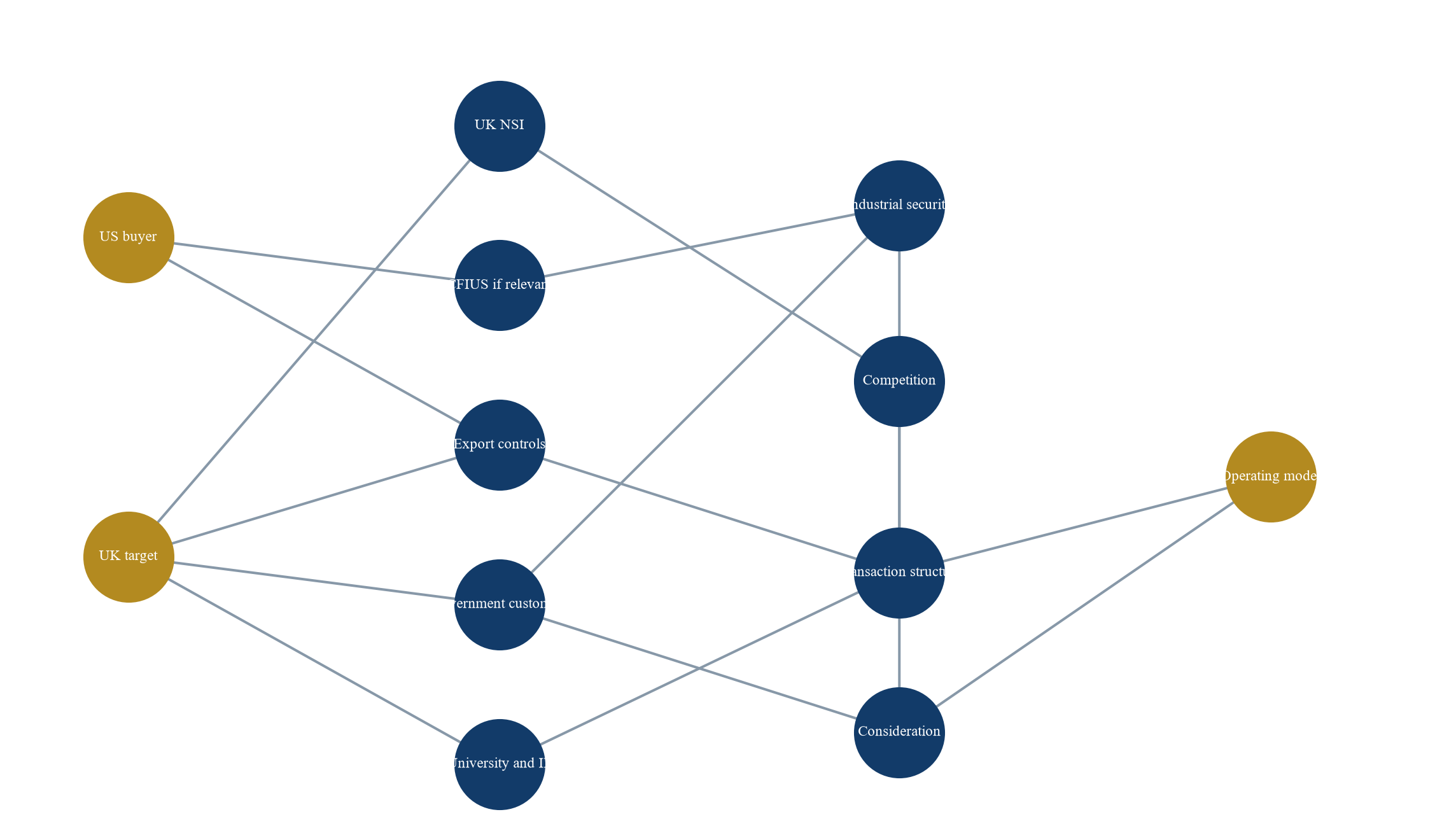
Proposed transaction-control architecture; actual jurisdiction and approvals depend on transaction facts.
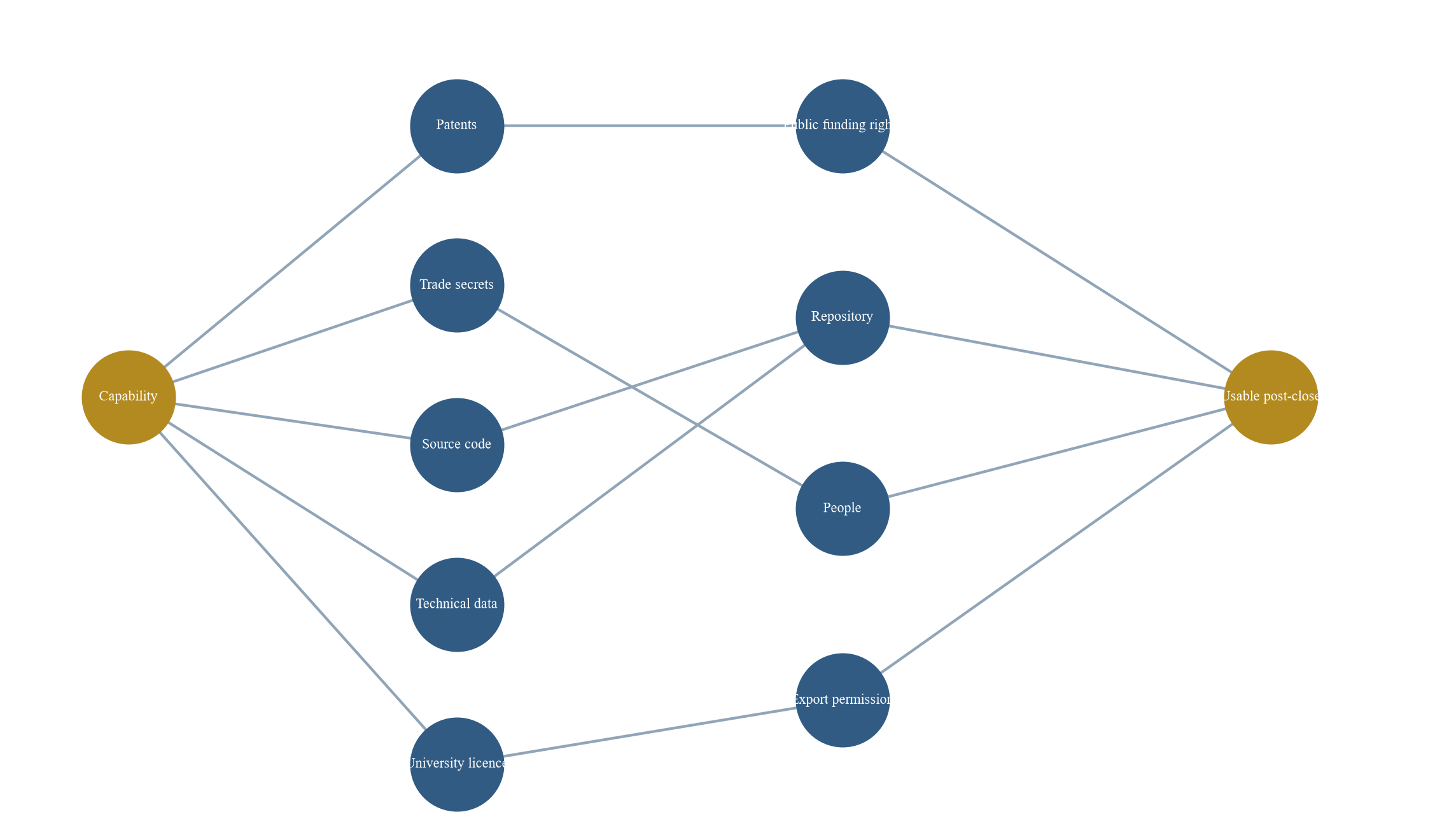
Proposed diligence graph distinguishing legal rights from permitted and practical access.
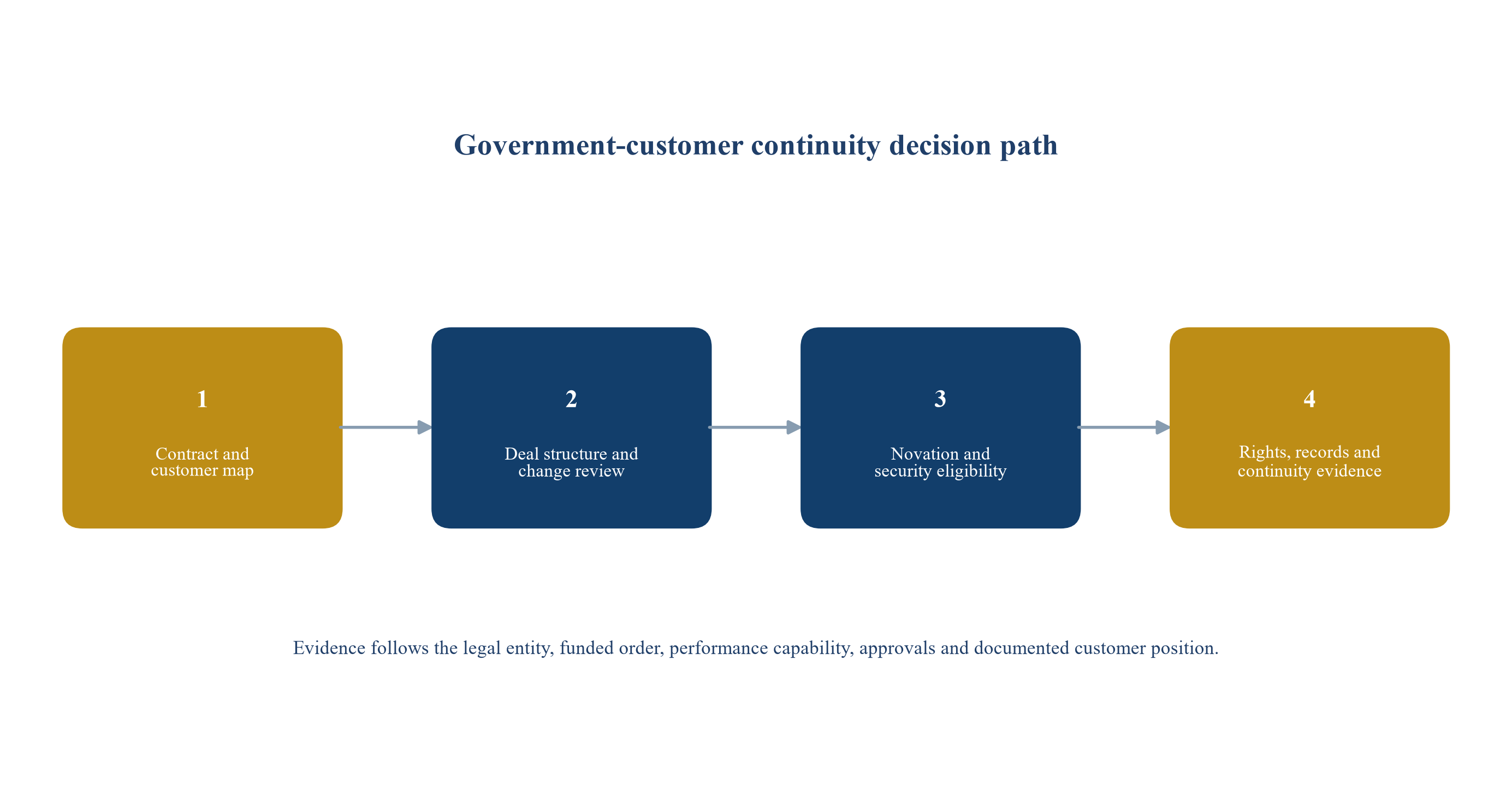
Proposed contract-level decision sequence; contract terms and procurement rules determine the outcome.
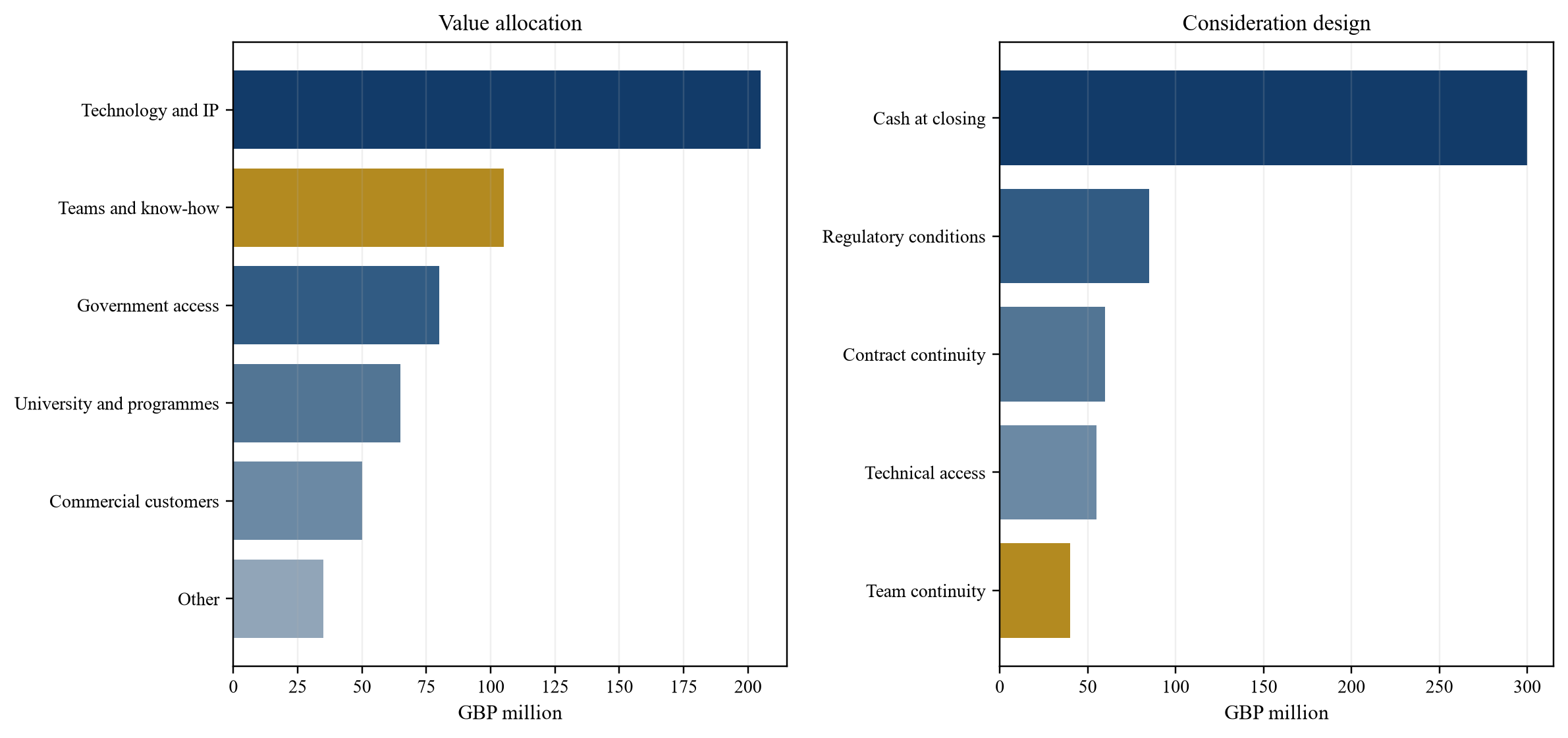
Wholly hypothetical management assumptions; GBP million.
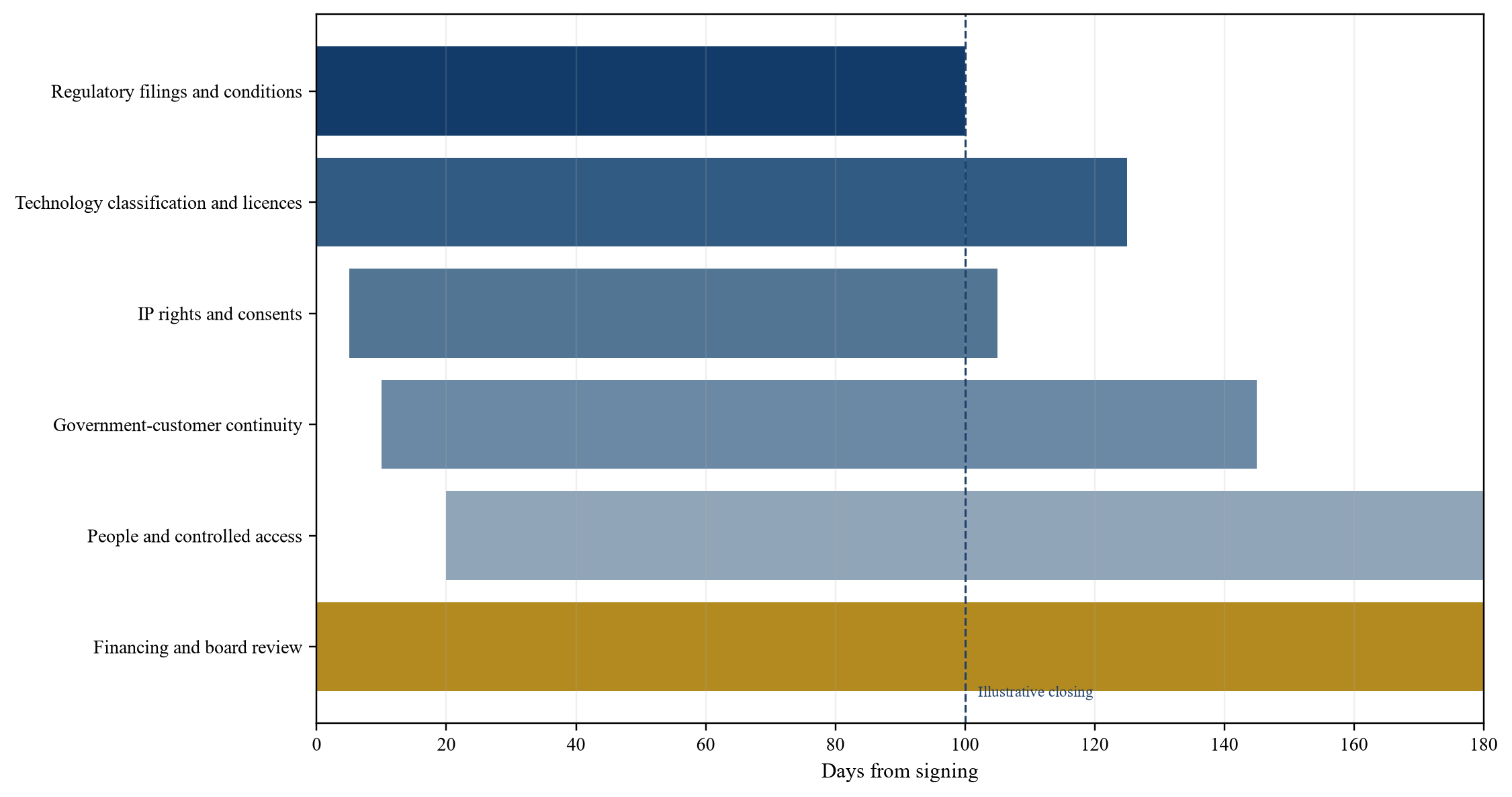
Proposed sequence; actual dates depend on approvals, consents and transaction structure.
| Regime | Trigger question | Evidence required | Transaction response |
|---|---|---|---|
| UK NSI | Does the acquisition meet the control and sector conditions? | Activities, technology, ownership and trigger rights | Mandatory or voluntary filing analysis, timetable and remedy plan |
| US CFIUS | Does the perimeter include a covered US business, investment or relevant rights? | US entities, operations, technology, owners and governance | Mandatory declaration, voluntary notice or documented non-filing analysis |
| UK competition | Could the transaction substantially lessen competition? | Capabilities, innovation paths, customers, channels and talent | Filing strategy, evidence and remedy analysis |
| US antitrust | Could the transaction lessen competition or eliminate important future rivalry? | Markets, concentration, potential entry, inputs and labour | HSR and substantive review strategy where applicable |
Qualified advisers should confirm current transaction-specific requirements.
| Item | UK analysis | US analysis | Operating implication |
|---|---|---|---|
| Quantum hardware | Control-list entry, parameters, destination and licence | ECCN, reason for control, destination and licence | Shipment, installation and maintenance perimeter |
| Software and source code | Classification, electronic transfer and user access | ECCN, source-code treatment and release | Repository, support and development permissions |
| Technical data | Technology entry and remote-access analysis | Controlled technology and deemed-release analysis | Clean rooms, demonstrations and collaboration controls |
| Technical assistance | Service scope, recipient, location and end use | Technology release, defence or end-use restrictions | Training, troubleshooting and integration limits |
Item-level analysis is required; descriptions are not classifications.
| Right or asset | Core evidence | Mobility question | Protection |
|---|---|---|---|
| Patents | Inventors, assignments, prosecution and ownership | Can title and enforcement remain effective? | Remediation, warranty, indemnity or holdback |
| University licence | Scope, exclusivity, assignment, control and improvements | Does the transaction require consent or alter rights? | Consent condition, alternative licence or structure |
| Trade secrets | Provenance, controls, contributors and repositories | Can authorised teams receive and protect the know-how? | Access plan, transfer milestone and covenant |
| Government-funded invention | Award, disclosure, election and government rights | What rights and obligations continue after closing? | Compliance cure, agency engagement and valuation adjustment |
| Customer data and software rights | Contract clauses, deliverables and markings | May the buyer use, modify or disclose the material? | Segregation, consent and field-limited use |
Review executed agreements and funding records.
| Contract situation | Continuity question | Evidence | Deal consequence |
|---|---|---|---|
| US federal stock acquisition | Does the same contractor retain assets and performance responsibility? | Entity, contract, ownership and performance plan | Ownership notification and issue resolution as required |
| US federal asset transfer | Will the government recognise the successor? | Novation package, capability, financials and clearances | Closing condition, long stop or retained performance |
| US classified work | Can facility clearance and FOCI mitigation continue? | FCL, ownership, governance, KMP and system plans | Mitigation structure and restricted integration |
| UK public contract | Can ownership or security provisions affect continuation? | Contract, procurement regime, security schedule and customer record | Consent, notification, ring-fencing or value adjustment |
Contract terms and the applicable procurement regime control.
| Value component | Amount | Evidence gate | Consideration protection |
|---|---|---|---|
| Verified technology and IP | GBP 205 million | Technical evidence, ownership, licence and access | GBP 55 million technical-access milestone shared with other capability evidence |
| Specialist teams and know-how | GBP 105 million | Critical-team continuity and transfer plan | GBP 40 million team-continuity pool |
| Government and regulated-customer access | GBP 80 million | Contract, eligibility and customer continuity | GBP 60 million contract-continuity payment |
| University, facility and public programmes | GBP 65 million | Rights, consents, facilities and awards | Regulatory holdback and specific consents |
| Commercial customer access | GBP 50 million | Funded contracts, renewals and delivery capacity | Working-capital and continuity adjustments |
| Other net assets and option value | GBP 35 million | Asset verification and board-approved option case | Capped upfront allocation |
Wholly hypothetical management assumptions; not observed transaction terms or market benchmarks.
| Structure | Control | Technology access | Contract continuity | Principal tradeoff |
|---|---|---|---|---|
| Full acquisition | High | Subject to licences and controls | Entity continuity may help in a share purchase | Highest regulatory and integration exposure |
| Ring-fenced UK subsidiary | High with controlled interfaces | Selective group access | Supports local entity and programme continuity | Duplicated governance and cost |
| Minority investment | Limited | Contractual information and licence rights | Target remains independent | Less operational control |
| Joint venture | Shared | Defined contributions and fields | Programme-specific continuity possible | Governance and boundary complexity |
| Field-limited licence | Contractual | Defined technology, field and territory | Customer access remains with licensor unless agreed | Dependence on licensor and enforcement |
| Programme partnership | Narrow | Access limited to programme need | Strong fit for a named customer or milestone | Limited enterprise-wide value |
The preferred structure depends on the verified capability and customer outcome.
| Area | Green evidence | Amber condition | Red condition |
|---|---|---|---|
| Technology access | Classifications, licences and approved users support the roadmap | Bounded licence or access gap has an executable plan | Core technology cannot be accessed or transferred as required |
| Intellectual property | Ownership, licences and government rights are reconciled | Remediation or consent is specific and protected | Essential right is missing, terminable or unusable |
| Government customers | Contract and security continuity is documented | Defined consent, novation or mitigation path remains | Material programme is expected to terminate or become ineligible |
| Regulation | Viable approval and mitigation path supports the thesis | Restrictions are costed and within board limits | Likely condition defeats the capability or customer outcome |
| Economics | Price reflects retained rights, access and funded obligations | Contingent value is capped and evidence-linked | Base value depends on unsupported access or revenue assumptions |
Proposed decision framework.
Sources
- UK Cabinet Office, National Security and Investment Act: Details of the 17 Types of Notifiable Acquisitions, updated 2026. Read the primary source
- National Security and Investment Act 2021. Read the primary source
- National Security and Investment Act 2021 (Notifiable Acquisition) (Specification of Qualifying Entities) Regulations 2021. Read the primary source
- UK Cabinet Office, Guidance on Completing and Registering a Notification Form, updated 22 August 2026. Read the primary source
- UK Cabinet Office, National Security and Investment Act 2021 Annual Report 2025-26. Read the primary source
- UK Cabinet Office, Acquisition of Oxford Ionics Limited by IonQ Inc.: Notice of Final Order, 11 September 2025. Read the primary source
- US Department of the Treasury, The Committee on Foreign Investment in the United States. Read the primary source
- US Department of the Treasury, CFIUS Declarations. Read the primary source
- US Department of the Treasury, 2024 CFIUS Annual Report. Read the primary source
- 31 CFR Part 800, Regulations Pertaining to Certain Investments in the United States by Foreign Persons. Read the primary source
- US Department of Commerce, Bureau of Industry and Security, Commerce Implements Controls on Quantum Computing and Other Advanced Technologies, 5 September 2024. Read the primary source
- US Department of Commerce, Commerce Control List Additions and Revisions; Implementation of Controls on Advanced Technologies Consistent with Controls Implemented by International Partners, 89 FR 72926. Read the primary source
- Electronic Code of Federal Regulations, 15 CFR Parts 730-774, Export Administration Regulations. Read the primary source
- UK Export Control Joint Unit, UK Strategic Export Controls, updated 23 April 2026. Read the primary source
- UK Export Control Joint Unit, UK Strategic Export Control Lists. Read the primary source
- UK Export Control Joint Unit, Export of Technology, Remote Access and the Use of Cloud Computing Services. Read the primary source
- Federal Acquisition Regulation, Subpart 42.12, Novation and Change-of-Name Agreements. Read the primary source
- Federal Acquisition Regulation, Clause 52.215-19, Notification of Ownership Changes. Read the primary source
- Defense Counterintelligence and Security Agency, Foreign Ownership, Control or Influence. Read the primary source
- Defense Counterintelligence and Security Agency, FOCI Mitigation Process. Read the primary source
- UK Cabinet Office, Guidance: Exclusions Annex 2: National Security Grounds, updated 17 August 2026. Read the primary source
- UK Cabinet Office, Protecting the UK's National Security Through Public Procurement, updated 3 July 2026. Read the primary source
- Intellectual Property Office, KAM Guide: IP and Wider Knowledge Assets in Technology Transfer, updated 6 August 2026. Read the primary source
- Intellectual Property Office, KAM Guide: IP in Agreements. Read the primary source
- 35 USC 202, Disposition of Rights in Federally Funded Inventions. Read the primary source
- National Institute of Standards and Technology, Bayh-Dole Regulations for Federally Funded Inventions. Read the primary source
- 37 CFR Part 401, Rights to Inventions Made by Nonprofit Organizations and Small Business Firms Under Government Grants, Contracts, and Cooperative Agreements. Read the primary source
- Competition and Markets Authority, Merger Assessment Guidelines, updated 3 September 2026. Read the primary source
- US Department of Justice and Federal Trade Commission, 2023 Merger Guidelines. Read the primary source
- IonQ Inc., Current Report on Form 8-K, completion of Oxford Ionics transaction, 17 September 2025. Read the primary source
- IonQ Inc., Annual Report, Oxford Ionics acquisition consideration, 2026. Read the primary source
- UK Cabinet Office, National Security Unit for Procurement, updated 24 June 2026. Read the primary source
