

Introduction
Data is routinely described as an asset in AI transactions. That description is directionally useful and financially incomplete. A buyer cannot value a training-data estate until it knows what the target controls, what uses are permitted, which technical characteristics affect model performance, how quickly the data decays and which cash flows depend on continued access. A folder containing images, conversations or sensor histories is not equivalent to an enforceable right to develop and commercialise a model.
The issue has become more important as AI companies seek capital, strategic partnerships and exits. Buyers may encounter claims based on record count, annotation expenditure, years of collection, rarity, domain coverage or the performance of a model trained on the dataset. Each claim can be relevant. Each can also overstate value when provenance is incomplete, rights are narrow, labels are inconsistent, records are duplicated, customers can revoke access, the data is stale or the model would perform nearly as well without it.
WIPO identifies data, algorithms and trade secrets as emerging intangible assets that present valuation challenges, and its IP-valuation materials emphasise identifiability, evidence, transferability and measurable economic benefit [1-4]. Financial-reporting standards distinguish recognition from economic value and require acquisition-date analysis of identifiable intangibles in business combinations [5-8]. Privacy, copyright, database, trade-secret, competition and AI rules can shape permitted use and transfer [9-26]. Technical frameworks emphasise provenance, documentation, testing, security and lifecycle management [27-40].
This paper is designed for boards, corporate-development teams, private-equity investors, venture investors, lenders, founders, valuation specialists and integration leaders. It provides a transaction decision system. It does not provide legal, regulatory, accounting, tax, technical-security or valuation advice. Applicable law, contract terms, technical evidence and market circumstances require target-specific professional review.
1 Define the asset before discussing value
The phrase training data may refer to raw source records, cleaned observations, labels, features, prompts, preference rankings, synthetic records, evaluation sets, red-team cases, human feedback, retrieval corpora or the data pipeline that continuously produces them. These components can have different owners, restrictions, economic lives and contributions. A single headline valuation therefore needs a component inventory.
The inventory should identify the record class, originating party, collection event, applicable contract, lawful basis, permitted purpose, territory, retention rule, transformation history, quality controls, security classification, model use and commercial workflow. It should distinguish records that the target owns from records it licenses, hosts, accesses under customer instructions or obtains from public sources. It should also distinguish data rights from software, models, know-how, customer relationships and assembled workforce.
A useful unit of account is the smallest collection that has a coherent rights package and measurable economic use. A clinical image library licensed for one diagnostic task may be one unit. Technician-labelled failure histories for a defined equipment family may be another. Customer conversations gathered under different terms should be separated by contract cohort. Combining them into one data lake does not combine the rights.
The buyer should map dependencies. Labels may rely on specialist annotators, customer confirmations or later outcomes. Features may depend on proprietary software. A dataset may be valuable only with a taxonomy, ontology, retrieval layer or feedback loop. The transaction perimeter should show whether each dependency transfers, remains available under a transition arrangement or needs replacement.
| Asset component | Evidence of control | Economic use | Principal valuation question |
|---|---|---|---|
| raw source records | contracts consents notices collection logs and access controls | observation of the underlying domain | can the buyer lawfully retain transfer and reuse the records |
| labels and annotations | employment supplier or customer terms plus quality records | supervised learning and evaluation | who owns the labels and how reproducible is their quality |
| derived features | transformation code lineage and documentation | improved model efficiency or accuracy | are the features separately transferable or inseparable from software |
| evaluation sets | locked versions sampling rules and test governance | evidence of generalisation and safety | are results independent representative and free from contamination |
| feedback and preference data | collection terms reviewer instructions and audit trail | alignment ranking and product improvement | does the target control continued collection after closing |
| retrieval corpus | source licence index history and update process | grounded responses and workflow knowledge | what content can be retrieved reproduced and commercialised |
| data production system | people contracts tools controls and refresh schedule | continued creation of current data | what recurring cost and operational dependency sustains the asset |
Proposed diligence record; legal accounting tax privacy competition and technical specialists should test each material data class.
2 Establish the rights chain and transaction perimeter
Value begins with enforceable use. WIPO's valuation guidance links quantifiable value to identifiable assets, evidence of existence, enforceability, transferability and measurable benefit [2-4]. Training data often has overlapping rights and duties. Copyright may protect source works or selection and arrangement. Database rights may apply in relevant jurisdictions. Trade-secret protection may depend on secrecy and reasonable protective measures. Contracts can create broader or narrower permissions. Privacy law can regulate processing even when the dataset is commercially controlled.
The buyer should reconstruct the rights chain from origin to closing. For each material source, it should identify who created or collected the information, which notices and permissions applied, which entity contracted with the source, what transformations occurred, where the data and model are hosted, who can access them, what customer or contributor rights remain and whether change of control affects use. The analysis should cover training, fine-tuning, evaluation, inference, retrieval, benchmarking, product improvement, sublicensing and post-termination retention separately.
Permission to provide a service does not automatically establish permission to train a general model. A licence to use content may exclude machine learning, derivative datasets or redistribution. A customer agreement may authorise improvement of that customer's instance while prohibiting pooled learning. Public availability does not itself resolve copyright, privacy, contract, confidentiality or database questions. The United States Copyright Office's work on generative-AI training and the European Data Protection Board's opinion on AI models illustrate the continuing importance of source-specific and use-specific analysis [15-18].
Rights should be scored by evidence maturity. A signed agreement with an explicit training and transfer clause carries more weight than a historic policy, a general representation or an undocumented practice. The score should reflect revocability, exclusivity, term, territory, field of use, sublicensing, audit rights, indemnity, survival and change-of-control provisions. A dataset with narrow but clear rights may be more valuable than a larger collection whose use remains disputed.
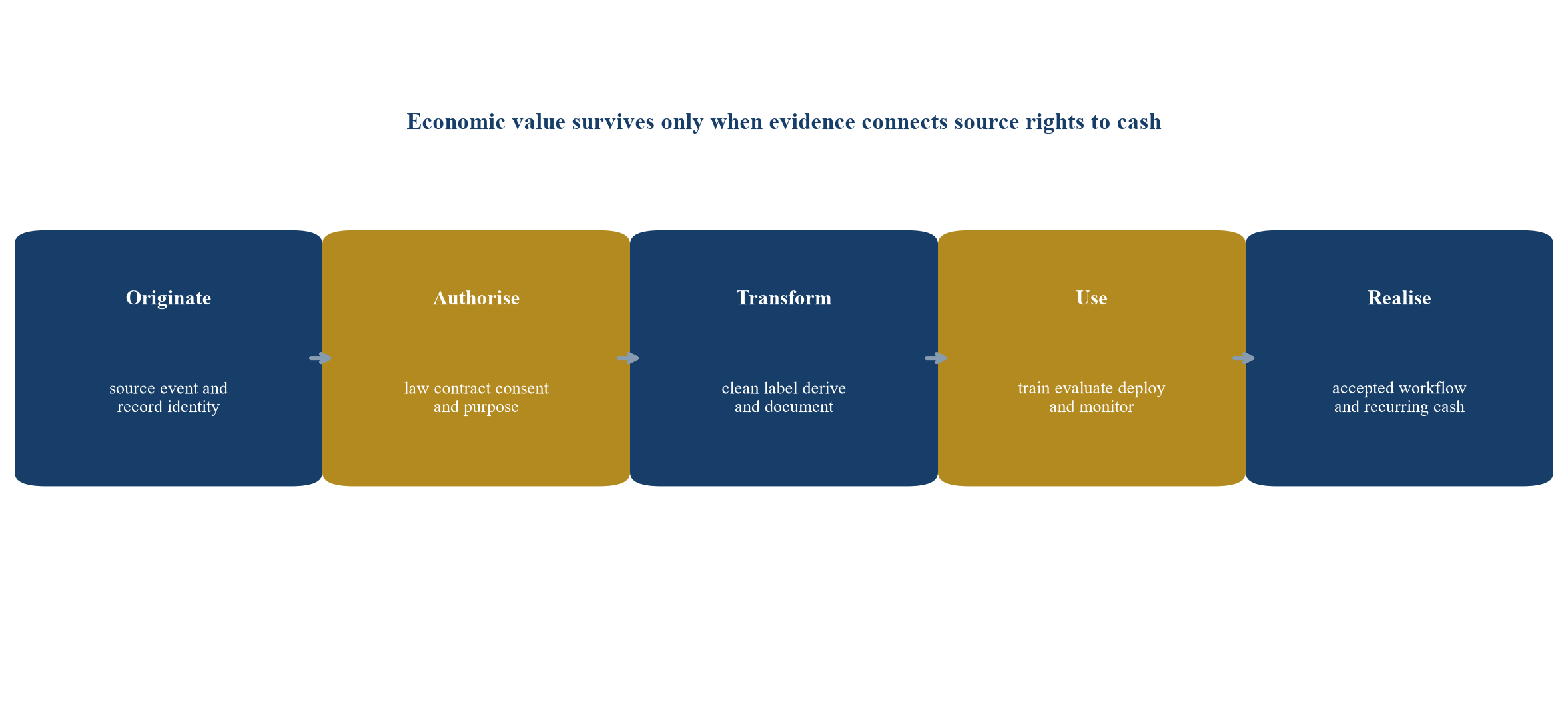
Proposed transaction map; target-specific counsel should determine the effect of applicable law contracts notices and technical controls.
3 Measure uniqueness without confusing scarcity and usefulness
Uniqueness has several dimensions. A dataset may contain observations that competitors cannot readily obtain. It may cover rare events, difficult environments, specialist judgments or outcomes observed over a long period. It may have unusually consistent labels, rich context or a direct link between intervention and result. These features can support value when they improve a commercial decision.
Scarcity alone is insufficient. A rare dataset can be irrelevant to the buyer's target task. A large corpus can be redundant because similar information is licensed cheaply or generated through ordinary operations. A proprietary collection can lose distinctiveness when public datasets, synthetic data, customer-owned data or improved foundation models reduce the marginal benefit of the original records.
The buyer should compare the target dataset against realistic alternatives. The comparison should include direct licensing, renewed collection, partnerships, customer-contributed data, public sources, simulation, synthetic augmentation and acquisition of another company. It should consider time to obtain rights, time to achieve usable quality, domain coverage, rare-event density, annotation reliability, refreshability and the buyer's ability to integrate the alternative.
Uniqueness should be tested at the decision level. For a fraud model, rare confirmed outcomes and changing attack patterns may matter more than gross transaction count. For industrial maintenance, failure histories linked to operating conditions and interventions may matter more than unlabelled sensor volume. For an enterprise assistant, current permissions and retrieval quality may matter more than the age of the corpus. For autonomous systems, edge cases and scenario coverage may matter more than average-condition observations.
The target should provide nearest-alternative evidence. Useful records include data-licensing quotes, internal collection budgets, annotation yields, duplicate analysis, overlap tests, domain coverage, benchmark results and expert interviews. The buyer should test whether management selected comparisons that make the dataset look artificially scarce.
| Dimension | Strong evidence | Weak evidence | Valuation effect |
|---|---|---|---|
| source exclusivity | enforceable exclusive or structurally privileged access | internal assertion of ownership | supports scarcity only for the permitted use and term |
| rare-event coverage | verified event counts with outcomes and representative sampling | gross record volume | may reduce collection time and model error in valuable cases |
| label quality | independent agreement adjudication and outcome linkage | single untested annotator | affects usable quantity and retraining cost |
| contextual depth | linked operating conditions interventions and results | isolated records without context | can improve causal interpretation and workflow fit |
| alternative availability | current quotes and tested substitutes show material delay or loss | no documented market search | supports replacement-time and income advantage |
| refresh access | renewable sources and continuing rights | one-off historic snapshot | extends economic life and supports continuing differentiation |
Proposed scoring framework; conclusions should be based on current target and alternative evidence.
4 Reconstruct provenance quality and usable quantity
Record count is a starting point. Usable quantity is lower after removing duplicates, corrupted files, records outside the permitted purpose, unresolved identities, inconsistent labels, contaminated evaluation examples and observations that do not represent the intended deployment population. NIST's generative-AI profile emphasises training-data provenance and documentation as risk-management practices [27-30]. ISO and OECD materials similarly support systematic governance, traceability and accountability [31-36].
The buyer should reproduce the target's data lineage. It should select representative records from each source cohort and trace them through collection, cleaning, annotation, transformation, feature generation, training, evaluation and deletion processes. Hashes, version identifiers, manifests, access logs and code commits should support the trace. A polished data catalogue without record-level correspondence is weaker evidence.
Quality should be defined by the task. Relevant dimensions can include accuracy, completeness, consistency, timeliness, coverage, class balance, label agreement, outcome maturity, measurement error and robustness to distribution shift. The buyer should test whether quality metrics were calculated across the whole estate or only on a curated subset. It should identify records excluded from production and the reasons for exclusion.
Evaluation leakage deserves specific attention. If examples from the same customer, patient, asset, document family or time period appear in both training and test sets, reported performance can overstate generalisation. Benchmark contamination can produce a similar effect. The buyer should inspect split logic, near-duplicate detection, temporal holdouts and independent replication. Locked evaluation sets need access controls and version governance.
Usable quantity should be reported as a waterfall. Starting records are reduced for rights uncertainty, duplication, corruption, inadequate labels, population mismatch and evaluation isolation. The remaining data should be grouped by task, geography, period and customer cohort. This provides a more useful valuation input than a single terabyte or record figure.
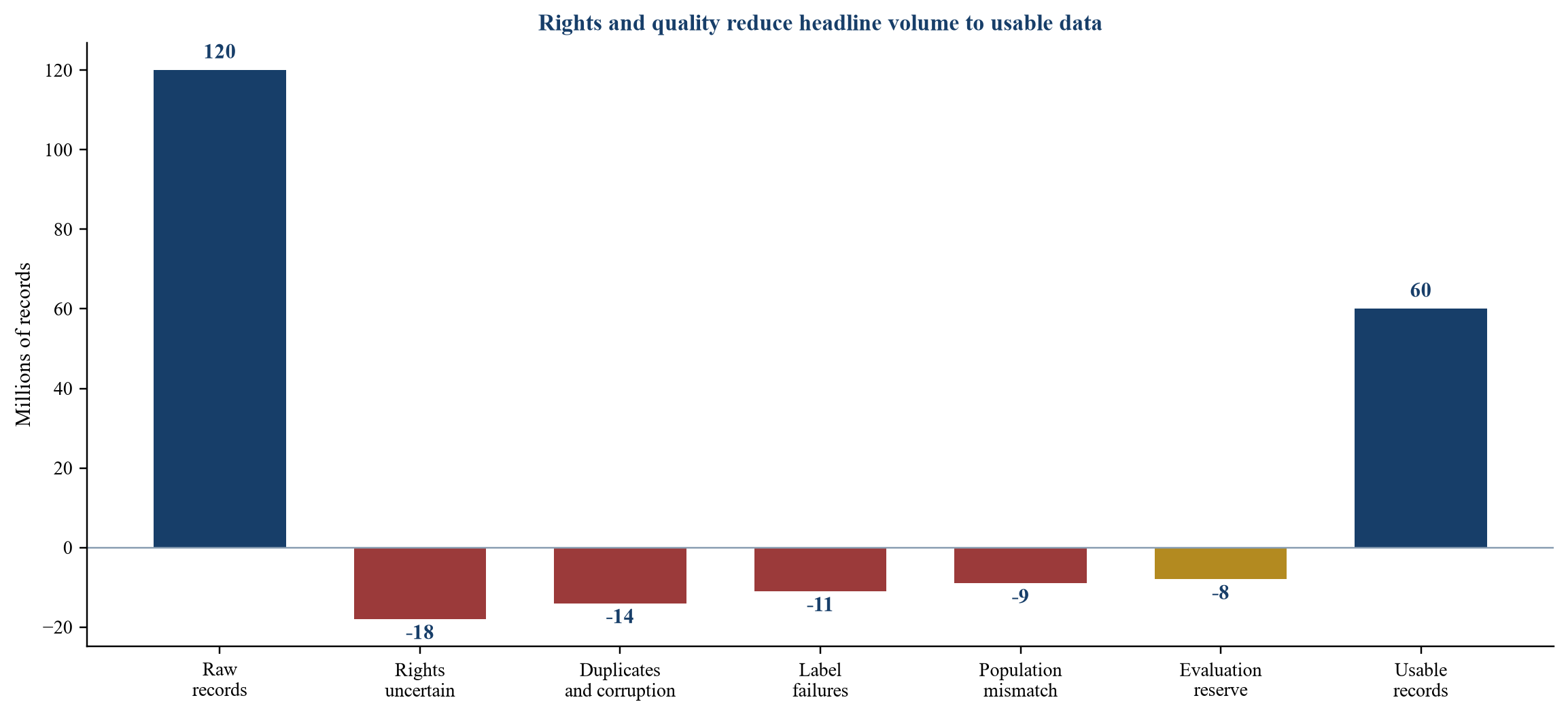
Millions of records; management assumptions used only to demonstrate the method.
5 Isolate the dataset's contribution to model and workflow performance
Training data creates economic value through an effect on a product or decision. The target should demonstrate that effect with controlled comparisons. A model trained with the claimed dataset should be compared with a credible baseline trained without it, with smaller samples, with alternative sources and with the buyer's existing data. The test design should hold architecture, compute, tuning and evaluation conditions sufficiently constant to isolate contribution.
Performance should be measured in the context of use. Accuracy, precision, recall, calibration, ranking quality, latency, robustness and hallucination rates can matter. The economic metric may be avoided loss, lower review time, higher conversion, reduced downtime, faster approval or improved retention. A statistically visible improvement may have little cash value if it occurs on low-value cases. A modest average improvement may be valuable if concentrated on rare and costly events.
The buyer should require confidence intervals, subgroup results and temporal tests. It should identify where the dataset improves performance, where it has no effect and where it harms performance. The target should disclose failed experiments and selection decisions. Results generated by the seller should be independently reproduced on a controlled environment when practical.
Contribution can interact with model architecture and workflow design. A dataset may be valuable with one representation and less useful after a foundation-model upgrade. A retrieval corpus may create value through factual grounding without changing model weights. Human feedback may matter because it reflects a specific customer workflow. The valuation should specify the configuration in which contribution was observed and the cost of maintaining it.
The buyer should also test model extraction and memorisation risk. If protected or personal information can be elicited from a model, the economic asset may carry remediation, claims and deployment restrictions. EDPB guidance treats anonymity and unlawful processing as case-specific questions with potential consequences for later deployment [16-18]. Security testing should therefore connect data lineage to model behaviour.
| Comparison | What it isolates | Minimum evidence | Common failure |
|---|---|---|---|
| target data versus no target data | gross incremental effect | fixed architecture compute tuning and evaluation set | other changes are attributed to data |
| full dataset versus size cohorts | diminishing returns | learning curves and repeated samples | largest run is compared with an under-tuned baseline |
| target data versus alternative source | substitutability | equivalent rights quality and domain tests | weak alternative is selected |
| historic versus current cohort | decay and drift | time-based holdout and refresh record | old benchmark masks current deterioration |
| model metric versus workflow outcome | economic translation | accepted operational measure and accountable owner | technical gain lacks adoption or cash evidence |
| central versus subgroup results | representativeness and harm | material customer geography and population cohorts | average result hides weak or harmful segments |
Proposed evidence record; test design should be independently reviewed for each material use case.
6 Model refresh cost decay and economic life
Training data is often a wasting and renewable asset at the same time. Labels can become stale, product taxonomies change, language evolves, fraud tactics adapt, sensors are replaced and customer behaviour shifts. The dataset may require continuous acquisition, adjudication, deletion, security, documentation and revalidation. These recurring activities affect both sustainable earnings and the asset's economic life.
The buyer should create a refresh ledger for every material data class. The ledger should show observation frequency, collection yield, consent or contract renewal, annotation hours, specialist review, dispute resolution, quality-control sampling, storage, security, privacy operations, model retraining, validation and retirement. It should identify which activities are performed by scarce employees, customers, contractors or embedded product workflows.
Historical expenditure should be separated into creation, maintenance and failed work. Replacement cost should exclude waste that a rational buyer would avoid. It should include the current cost of obtaining comparable lawful rights, rebuilding taxonomies, recruiting specialists, reproducing labels, collecting rare outcomes, establishing controls and waiting for results to mature. Time can create a significant opportunity cost where outcomes require years of observation.
Economic life should be linked to the period over which the dataset provides incremental cash before replacement or substantial refresh. Contract terms, legal changes, customer churn, model architecture, source continuity, competition and domain drift can shorten that period. A perpetual growth assumption is rarely compatible with a finite rights term and high refresh dependence.
Refresh cost also affects EBITDA. If management capitalises data work or classifies essential annotation and governance as growth investment, reported operating profit may overstate sustainable earnings. The buyer should normalise the cost required to maintain current revenue and performance before applying a transaction multiple.
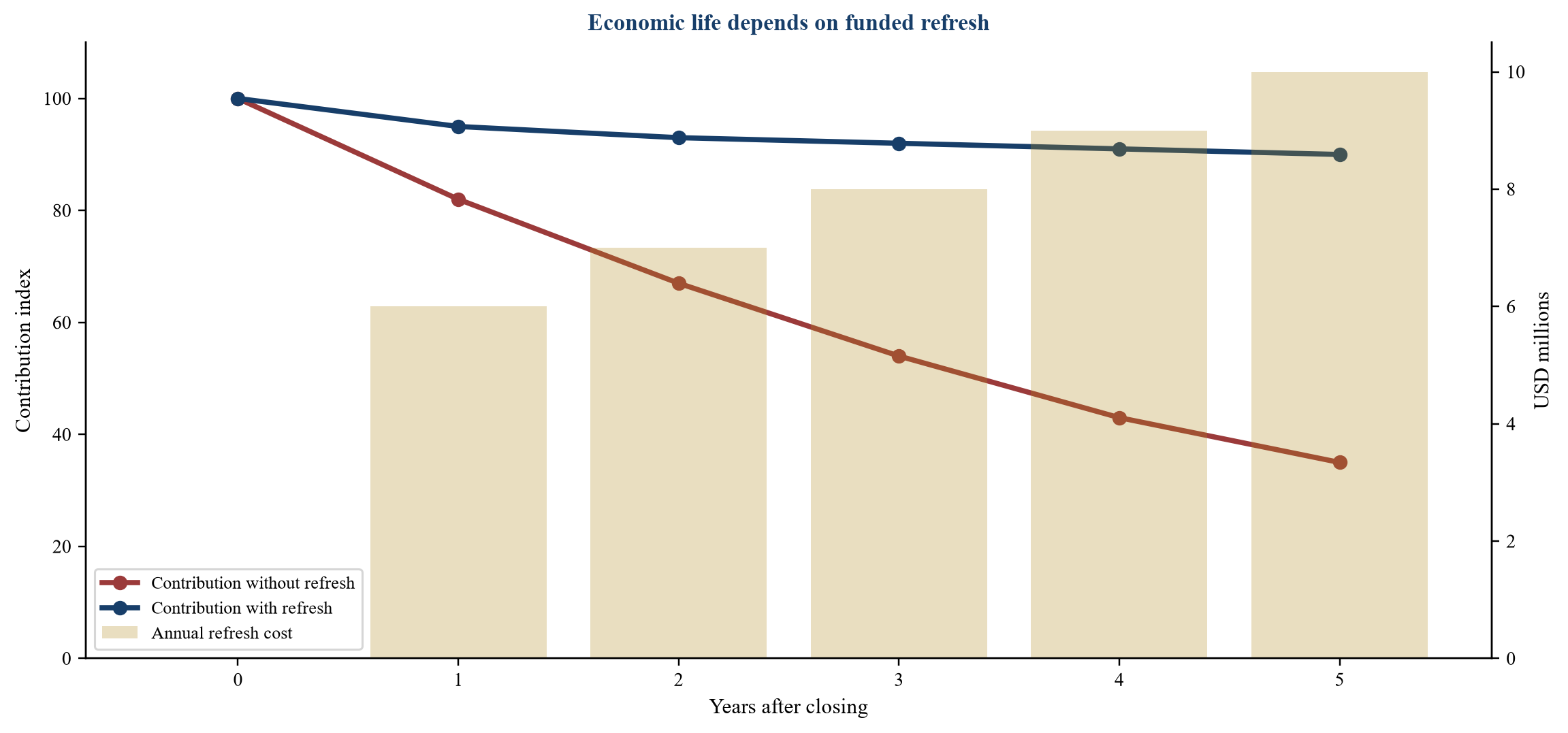
Index values and USD millions; management assumptions used only to demonstrate the method.
7 Reconstruct sustainable earnings and avoid double counting
A training-data valuation should be consistent with the enterprise valuation. If forecast revenue and margins already reflect the product advantage created by proprietary data, adding the full value of that advantage as a separate asset can double count it. The valuation bridge should identify where each benefit enters the model and how contributory assets are charged.
The illustrative target reports USD 210 million of revenue and USD 34 million of EBITDA. Diligence identifies USD 5 million of genuine non-recurring expense. It also identifies USD 8 million of recurring annotation and data acquisition, USD 4 million of privacy, provenance and security operations, and USD 3 million of model evaluation and customer-specific maintenance that are necessary to sustain current performance but are incompletely reflected. Sustainable EBITDA is therefore USD 24 million. Every figure is a management assumption used only to demonstrate the method.
The income attributable to data is not total product income. Software, model architecture, compute, brand, customer relationships, distribution, workforce and working capital also contribute. A multi-period excess-earnings analysis should apply charges for these contributory assets. A with-and-without analysis should model the cash-flow difference between continued lawful access to the data and the best realistic alternative. A relief-from-royalty method may be considered where comparable licensing evidence exists and the licensed asset can be defined consistently.
The buyer should reconcile the data valuation to purchase-price allocation without assuming that accounting recognition equals deal value. IAS 38 defines identifiable intangibles through separability or contractual and legal rights, while IFRS 3 and IFRS 13 govern relevant business-combination and fair-value concepts [5-8]. Professional accounting and valuation judgment is required for the actual transaction.
| Item | Amount | Treatment | Reason |
|---|---|---|---|
| reported EBITDA | 34 | starting point | seller-reported operating result |
| genuine non-recurring expense | 5 | add | separately evidenced one-time cost |
| recurring annotation and acquisition | 8 | deduct | required to maintain current data coverage |
| provenance privacy and security operations | 4 | deduct | recurring control needed for lawful trusted use |
| model evaluation and customer maintenance | 3 | deduct | recurring cost needed to sustain acceptance |
| sustainable EBITDA | 24 | conclusion | illustrative maintainable operating result |
USD millions; management assumptions used only to demonstrate the method.
8 Apply three valuation approaches and reconcile them
The cost approach estimates the current expenditure and time required to recreate an asset of equivalent utility. It is useful where the buyer can define the replacement specification and observe collection, licensing, annotation, control and validation costs. Cost does not capture all economic benefit. It can overvalue wasted effort and undervalue rare observations, time advantage, exclusive access or a proven feedback loop.
The income approach estimates cash flows attributable to the data and discounts them for risk. A with-and-without method compares the business with continued access against the best available alternative. A multi-period excess-earnings method deducts contributory-asset charges. A relief-from-royalty method estimates avoided licence payments where defensible comparable evidence exists. Income methods require careful separation of data contribution from model, software, workforce, customer and brand effects.
The market approach uses prices or licence terms for comparable assets. Training datasets are heterogeneous and transaction details are often confidential. Comparability should cover rights, exclusivity, domain, quality, scale, rare-event density, recency, permitted use, geographic scope, refresh access and buyer-specific synergies. A price per record can mislead when records differ in utility and rights.
The illustrative replacement-cost analysis begins with USD 51 million of current collection, annotation, validation, governance and waiting-time cost. It deducts USD 9 million for avoidable historic inefficiency, producing USD 42 million. The income analysis produces USD 76 million after contributory-asset charges, refresh cost, tax and risk. A limited market analysis indicates USD 45 million to USD 70 million. The evidence-weighted conclusion is USD 58 million after considering rights uncertainty, concentration and refresh dependence. These figures demonstrate the method and do not describe a company or market.
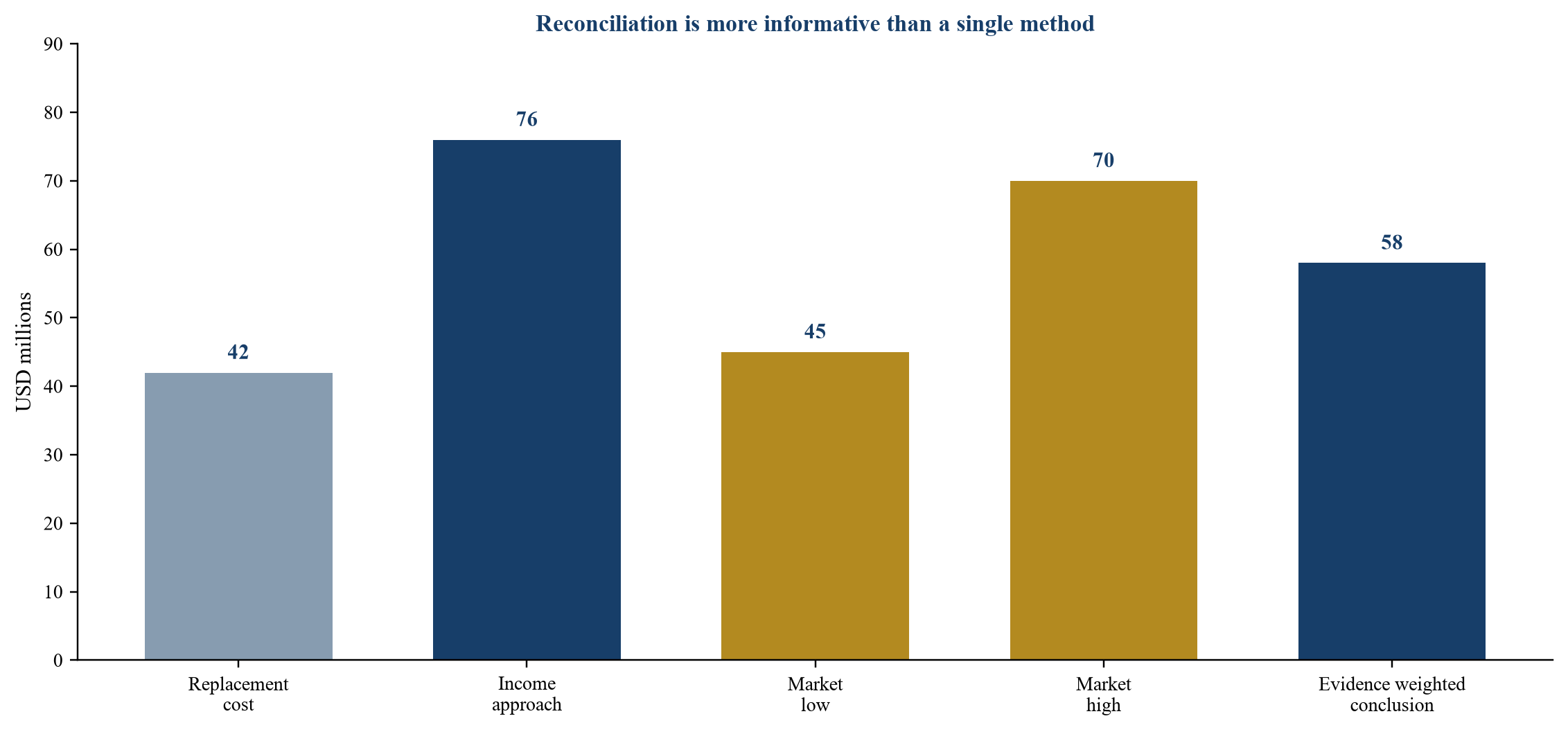
USD millions; management assumptions used only to demonstrate the method.
9 Convert uncertainty into an evidence weighted conclusion
Valuation uncertainty should be expressed through scenarios, ranges and explicit deductions rather than a false point estimate. The buyer should distinguish factual uncertainty from commercial optionality. Missing source contracts, unresolved deletion duties or untested model contribution reduce confidence in the existing asset. A possible future licensing product is an option that requires investment and market evidence.
An evidence-weighting model can score rights, provenance, uniqueness, quality, contribution, refreshability, security and cash realisation. Weighting should reflect the transaction thesis. A buyer acquiring an AI safety platform may place greater weight on representative evaluation data and incident outcomes. A buyer acquiring a vertical workflow product may emphasise customer permissions, outcome linkage and embedded refresh.
Scores should change the valuation mechanics. Rights uncertainty can reduce the eligible dataset, shorten life, increase probability-weighted remediation cost or support a specific indemnity. Weak contribution evidence can move value from upfront consideration to an earn-out. Customer concentration can affect both forecast cash and continued data access. High refresh dependence can reduce sustainable margin and require a funded operating plan.
The conclusion should reconcile with the overall enterprise value. In the illustrative case, management's USD 110 million claim exceeds each independently supported indication. The evidence-weighted USD 58 million amount is incorporated within the enterprise valuation rather than added mechanically. A separate USD 12 million reserve is assumed for remediation, relicensing and deletion work. The buyer should avoid both double counting and the opposite error of ignoring a data asset already reflected in earnings.
Sensitivity analysis should expose the assumptions that move value. The most important variables will often be the percentage of records with durable transfer rights, the remaining rights term, the rate at which model contribution decays, the annual refresh cost, the time needed to build an alternative, customer retention and the portion of workflow cash that can reasonably be attributed to data. The board should see changes to each variable separately and in coherent downside combinations. Correlations matter because loss of a major customer can reduce revenue, remove a refresh source and narrow the deployment population at the same time.
The valuation date should also be explicit. Rights, records, models and alternatives can change quickly. A later foundation-model release, regulatory decision, customer amendment or newly available dataset can alter the conclusion. The transaction model should therefore include a closing-date update process. Material changes between signing and closing should be routed to the responsible workstream, incorporated into the eligible-data register and reflected in price, conditions or the integration plan where appropriate.
| Factor | Evidence assessment | Valuation treatment | Illustrative effect |
|---|---|---|---|
| replacement specification and cost | strong | supports cost floor for equivalent utility | 42 |
| attributable income | moderate | discounted for contribution and adoption uncertainty | 76 |
| market references | limited | used as a broad reasonableness range | 45 to 70 |
| source rights and transfer | moderate | deduct for unresolved cohorts and consent work | negative 7 |
| label recency and refresh | moderate | shorten life and include annual refresh cost | negative 5 |
| workflow adoption | strong in core segment | retain evidence-backed income in that segment | positive support |
| evidence weighted conclusion | reconciled | embedded within enterprise value | 58 |
USD millions and qualitative scores; management assumptions used only to demonstrate the method.
10 Design diligence around reproducible evidence
Data diligence should be conducted through a controlled environment. The seller can provide a data-room inventory, contract matrix, lineage extracts, representative samples, model cards, evaluation reports, access logs, security evidence and cost records. Highly sensitive records may remain in a clean room or seller-controlled environment. The buyer should agree sampling, queries, permitted outputs and destruction rules before access.
Legal, technical, commercial, finance and security teams should use one asset taxonomy. Separate workstreams often create gaps. Counsel may review source agreements without knowing which data cohorts drive performance. Data scientists may test a dataset without seeing purpose restrictions. Finance may model margin without including refresh cost. A shared identifier for each data class connects these conclusions.
Reperformance should focus on material claims. The buyer can trace selected records, reproduce deduplication, inspect annotation agreement, rebuild time-based splits, rerun ablation tests and reconcile refresh expenditure to the ledger. It can compare the data catalogue with storage and access logs. It can test whether deleted or restricted records persist in derived datasets or models.
The seller should disclose known disputes, takedown requests, licence limitations, security incidents, regulator correspondence and customer objections. It should identify where provenance is inferred from system history rather than supported by source documentation. Representations should follow the evidence and avoid absolute claims that no diligence process can substantiate.
| Workstream | Core evidence | Reperformance | Decision output |
|---|---|---|---|
| rights | source contracts notices consents licences and transfer terms | sample records to governing documents | eligible use and transfer matrix |
| provenance | manifests hashes lineage logs and version history | trace records from source to model input | confidence by data cohort |
| quality | duplicate error label agreement and coverage reports | rerun selected controls | usable quantity and remediation plan |
| contribution | ablation learning curve and temporal tests | reproduce material experiments | attributable performance and cash |
| economics | historic cost headcount supplier invoices and forecasts | rebuild replacement and refresh ledger | sustainable margin and cost indication |
| security | access control encryption incident and deletion evidence | test selected controls and model leakage | risk reserve and closing conditions |
| commercial | customer use adoption retention and outcome evidence | reconcile workflow results to contracts and cash | income indication and concentration risk |
Proposed work plan; access should follow confidentiality privacy security and competition controls.
11 Translate findings into transaction terms
Price should follow evidence maturity. An asset with clear transferable rights, reproducible contribution and renewable sources can support upfront value. Unresolved rights, untested contribution or customer-dependent refresh may justify deferred consideration. Transaction design can allocate uncertainty without pretending it has disappeared.
Representations can address ownership, licences, permitted use, privacy compliance, trade-secret measures, security, provenance records, disputes, deletion duties and material model uses. Their scope, qualifiers, survival and remedies require transaction counsel. Specific indemnities may address identified cohorts, claims or remediation obligations. Escrow can support recovery where exposure is measurable and time bound.
Earn-outs should use observable outcomes within the buyer's control. Possible measures include retained eligible records, customer renewals that preserve training rights, independently reproduced performance, accepted deployment, recurring revenue or gross profit after refresh cost. Gross dataset size is usually a weak earn-out metric because it can reward low-quality volume.
Carve-outs or staged access may be appropriate where only part of the estate has clear rights. The buyer can exclude restricted data, license a defined corpus, require pre-closing remediation or fund a post-closing rights conversion programme. Transition services may preserve access to annotation teams or data-generation workflows while the buyer establishes its own controls.
Closing conditions can require delivery of a verified data inventory, transfer of key licences, customer consents, deletion of ineligible copies, remediation of critical security gaps and successful reproduction of agreed tests. The board should understand which items affect closing, price, covenants or the integration plan.
| Finding | Potential structure | Evidence after closing | Release condition |
|---|---|---|---|
| uncertain source rights | cohort exclusion escrow or specific indemnity | executed licence or documented deletion | verified lawful replacement or expiry of claim period |
| unproven incremental performance | contingent consideration | independent ablation and accepted workflow result | agreed performance and commercial threshold |
| customer-dependent refresh | retention or consent earn-out | renewed contracts and continuing lawful feeds | defined retained revenue and data rights |
| weak provenance | remediation covenant and holdback | completed lineage and sample verification | agreed coverage and exception closure |
| high refresh cost | price adjustment and operating covenant | actual cost and data-quality dashboard | sustainable economics within agreed range |
| leakage or memorisation risk | security condition and reserve | completed testing remediation and monitoring | independent acceptance against agreed criteria |
Illustrative structure; transaction counsel should tailor terms to facts law bargaining position and remedy limitations.
12 Integrate without destroying the asset
Integration can reduce value if the buyer commingles datasets before resolving rights, changes identifiers without preserving lineage, removes specialists who maintain labels or shifts the model to a workflow where the data has not been validated. The integration plan should preserve reversibility until the evidence supports consolidation.
The first phase should freeze the inventory, record hashes, access controls, source terms, model versions, evaluation sets and responsible owners. Restricted cohorts should remain segregated. New access should follow least-privilege rules. The buyer should establish incident, deletion and customer-request procedures before expanding use.
The second phase should reproduce priority performance and economics. Teams should run agreed tests, confirm current refresh flows, reconcile costs, interview workflow owners and verify customer acceptance. This establishes a closing-date baseline against which integration effects can be measured.
The third phase should migrate selected data and pipelines through documented interfaces. Each migration should preserve lineage, purpose limits, retention rules and audit evidence. Combined-model experiments should use approved cohorts and locked evaluations. Results should be reviewed for performance, subgroup effects, privacy, security and commercial relevance.
The final phase should release value in increments. Product expansion, cross-customer learning, sublicensing or new geographies should proceed only when rights, technical performance, controls and customer acceptance support them. Integration incentives should reward recurring cash and control quality rather than raw data consolidation.
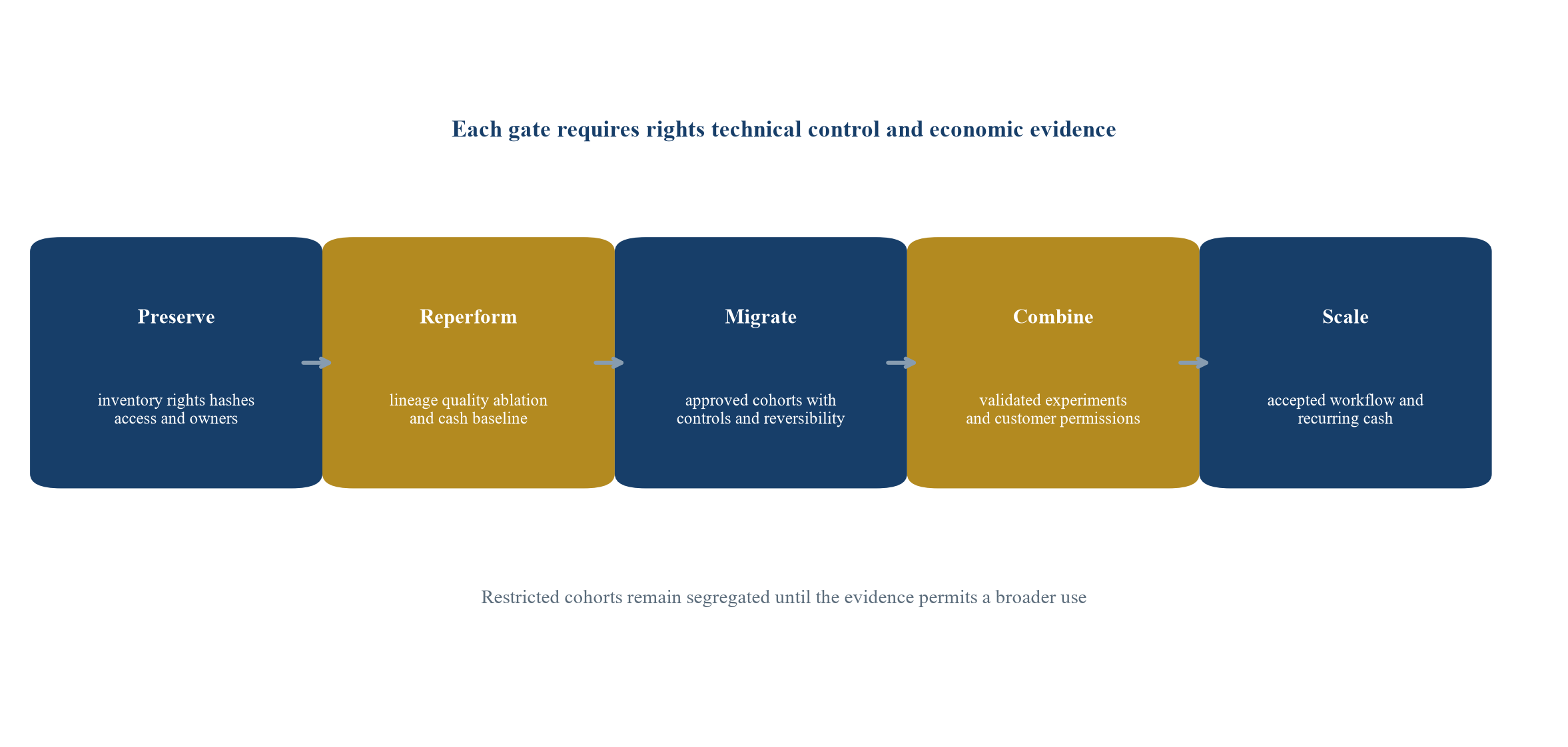
Proposed sequence; timing and approvals depend on applicable law contracts technical risk and the transaction perimeter.
13 Establish board reporting and post-close impairment signals
The board should receive a compact dashboard that connects rights, quality, contribution, refresh and cash. A headline record count should be accompanied by eligible-record coverage, provenance confidence, label agreement, drift, cost per usable record, test performance, workflow adoption, customer concentration, unresolved claims and recurring cash attributable to the relevant products.
Thresholds should be defined before closing. A fall in eligible-record coverage can trigger remediation. Loss of a major source can prompt a valuation review. Rising refresh cost can reduce sustainable margin. A model upgrade that diminishes the dataset's incremental contribution can shorten economic life. Customer restrictions or regulatory findings can change permitted use.
Post-close reporting should preserve the distinction between observed facts and management estimates. Actual records, contracts, costs, test results and cash can be reported as evidence. Future adoption, synergies and option value remain assumptions until supported by accepted use and collected revenue. The board should see scenario ranges and the reasons for changes.
Accounting teams should monitor indicators relevant to recognised intangible assets and goodwill under the applicable reporting framework. Transaction valuation, purchase-price allocation and subsequent impairment are connected decisions with different purposes and standards. Professional advice is required for the actual accounts.
The audit trail should allow a later reviewer to understand why the buyer paid for the asset, which assumptions were critical, what evidence supported them and how outcomes compared with the acquisition case. This discipline improves integration decisions and future transactions even when initial estimates prove inaccurate.
Conclusion
Proprietary training data can create substantial value in an AI acquisition. The value arises from enforceable and renewable rights, usable quality, scarcity relative to practical alternatives, measurable model contribution, operational adoption and recurring cash. None of these features can be established by record count or historic expenditure alone.
A defensible valuation begins with a component inventory and rights chain. It reduces headline volume to usable data, tests uniqueness against substitutes, reproduces incremental contribution, models decay and refresh, reconstructs sustainable earnings and reconciles cost, income and market indications. It then converts remaining uncertainty into price, escrow, indemnity, earn-out, closing conditions and a gated integration plan.
The result is an evidence-based transaction decision. It allows a buyer to distinguish a durable data production system from a costly archive, a transferable advantage from a customer-specific permission and demonstrated cash from an untested option. The same framework gives sellers a practical route to readiness: document provenance, clarify rights, isolate contribution, fund refresh and connect technical performance to accepted customer outcomes.
Sources
- World Intellectual Property Organization. WIPO supports aligning valuation standards with the modern economy. 2026. Read the primary source
- World Intellectual Property Organization. Valuing intellectual property assets. Read the primary source
- World Intellectual Property Organization. Intellectual property valuation in technology transfer. Read the primary source
- World Intellectual Property Organization. Frequently asked questions on AI and IP policy. Read the primary source
- IFRS Foundation. IAS 38 Intangible Assets. Read the primary source
- IFRS Foundation. IFRS 3 Business Combinations. Read the primary source
- IFRS Foundation. IFRS 13 Fair Value Measurement. Read the primary source
- IFRS Foundation. Module 18 Intangible Assets other than Goodwill. Read the primary source
- European Union. Regulation EU 2016/679 General Data Protection Regulation. 2016. Read the primary source
- European Union. Directive EU 2019/790 on copyright and related rights in the Digital Single Market. 2019. Read the primary source
- European Union. Directive 96/9/EC on the legal protection of databases. 1996. Read the primary source
- European Union. Directive EU 2016/943 on protection of undisclosed know-how and business information. 2016. Read the primary source
- European Union. Regulation EU 2023/2854 on harmonised rules on fair access to and use of data. 2023. Read the primary source
- European Union. Regulation EU 2024/1689 laying down harmonised rules on artificial intelligence. 2024. Read the primary source
- United States Copyright Office. Copyright and Artificial Intelligence. Read the primary source
- United States Copyright Office. Copyright and Artificial Intelligence Part 3 Generative AI Training pre-publication version. 2025. Read the primary source
- European Data Protection Board. Opinion 28/2024 on data protection aspects related to processing personal data in AI models. 2024. Read the primary source
- European Data Protection Board. GDPR principles support responsible AI. 2024. Read the primary source
- United Kingdom Information Commissioner's Office. Guidance on AI and data protection. Read the primary source
- United Kingdom Information Commissioner's Office. Explaining decisions made with AI. Read the primary source
- European Commission. Data Act explained. Read the primary source
- European Commission. Data Act model contractual terms and standard contractual clauses. Read the primary source
- European Commission. AI Act regulatory framework. Read the primary source
- European Commission. Common European data spaces. Read the primary source
- European Commission. Competition policy and data. Read the primary source
- European Commission. EU merger control. Read the primary source
- National Institute of Standards and Technology. Artificial Intelligence Risk Management Framework 1.0. 2023. Read the primary source
- National Institute of Standards and Technology. Generative Artificial Intelligence Profile. 2024. Read the primary source
- National Institute of Standards and Technology. AI RMF Playbook. Read the primary source
- National Institute of Standards and Technology. AI Resource Center. Read the primary source
- International Organization for Standardization. ISO IEC 42001 artificial intelligence management systems. Read the primary source
- International Organization for Standardization. ISO IEC 23894 artificial intelligence risk management. Read the primary source
- International Organization for Standardization. ISO IEC 27001 information security management systems. Read the primary source
- International Organization for Standardization. ISO IEC 5259 data quality for analytics and machine learning. Read the primary source
- OECD. Recommendation of the Council on Artificial Intelligence. Read the primary source
- OECD. OECD AI Principles. Read the primary source
- European Union Agency for Cybersecurity. Data protection engineering. Read the primary source
- National Institute of Standards and Technology. Cybersecurity Framework 2.0. 2024. Read the primary source
- National Institute of Standards and Technology. Privacy Framework. Read the primary source
- National Institute of Standards and Technology. Secure Software Development Framework. Read the primary source
- Data Management Association International. Data Management Body of Knowledge. Read the primary source
- International Valuation Standards Council. International Valuation Standards. Read the primary source
- International Valuation Standards Council. Perspectives on intangible assets. Read the primary source
- Financial Accounting Standards Board. Business combinations topic 805. Read the primary source
- United States Securities and Exchange Commission. Regulation S-K. Read the primary source
- Federal Trade Commission. Artificial intelligence and algorithmic tools. Read the primary source
- United States Department of Justice and Federal Trade Commission. Merger Guidelines. 2023. Read the primary source
- European Commission. Guidelines on the definition of an artificial intelligence system. Read the primary source
- World Intellectual Property Organization. World Intangible Investment Highlights 2026. Read the primary source
- World Intellectual Property Organization. Technology Trends Artificial Intelligence. Read the primary source
