

1. Define the valuation decision
The valuation must state whether it supports an acquisition, financing, equity raise, impairment review or internal capital allocation. [1][2][22][25] The work should identify the affected legal entity, customer, asset cohort, financing claim and decision owner. Public disclosures provide context. Company-specific terms, condition and performance require direct evidence.
The evidence package should include valuation date, ownership perimeter, security class, transaction purpose, accounting basis, currency and decision rights. Each input should retain its definition, date, source, owner and expiry. Reported metrics require reconciliation to filed measures where available. Estimates should remain visible until contracts, telemetry, commissioning records, invoices or cash receipts replace them.
The principal failure is that one headline multiple is used for every decision. The practical response is to set the perimeter and valuation standard before selecting assumptions. The model should record each revision and its effect on enterprise value, adjusted net debt and equity value. A conclusion remains conditional where material evidence is unavailable.
2. Define the neocloud perimeter
A neocloud may own GPUs, lease data-centre space, contract for power, finance equipment through special-purpose entities and sell managed or bare-metal services. [1][6][7][9] The work should identify the affected legal entity, customer, asset cohort, financing claim and decision owner. Public disclosures provide context. Company-specific terms, condition and performance require direct evidence.
The evidence package should include legal-entity chart, asset register, contracts, leases, guarantees, debt, software, employees and shared services. Each input should retain its definition, date, source, owner and expiry. Reported metrics require reconciliation to filed measures where available. Estimates should remain visible until contracts, telemetry, commissioning records, invoices or cash receipts replace them.
The principal failure is that the operating brand is treated as one unencumbered enterprise. The practical response is to map assets, cash flows and claims by legal entity. The model should record each revision and its effect on enterprise value, adjusted net debt and equity value. A conclusion remains conditional where material evidence is unavailable.
3. Separate contract states
Remaining performance obligations, backlog, reservations, orders, capacity options and customer forecasts carry different conditions and accounting meaning. [1][2][3][24] The work should identify the affected legal entity, customer, asset cohort, financing claim and decision owner. Public disclosures provide context. Company-specific terms, condition and performance require direct evidence.
The evidence package should include signed agreements, order forms, cancellation rights, termination, delivery dependencies, acceptance, performance obligations and collection. Each input should retain its definition, date, source, owner and expiry. Reported metrics require reconciliation to filed measures where available. Estimates should remain visible until contracts, telemetry, commissioning records, invoices or cash receipts replace them.
The principal failure is that company-defined backlog is valued as unconditional receivables. The practical response is to build a contract-state waterfall and value each state by evidence. The model should record each revision and its effect on enterprise value, adjusted net debt and equity value. A conclusion remains conditional where material evidence is unavailable.
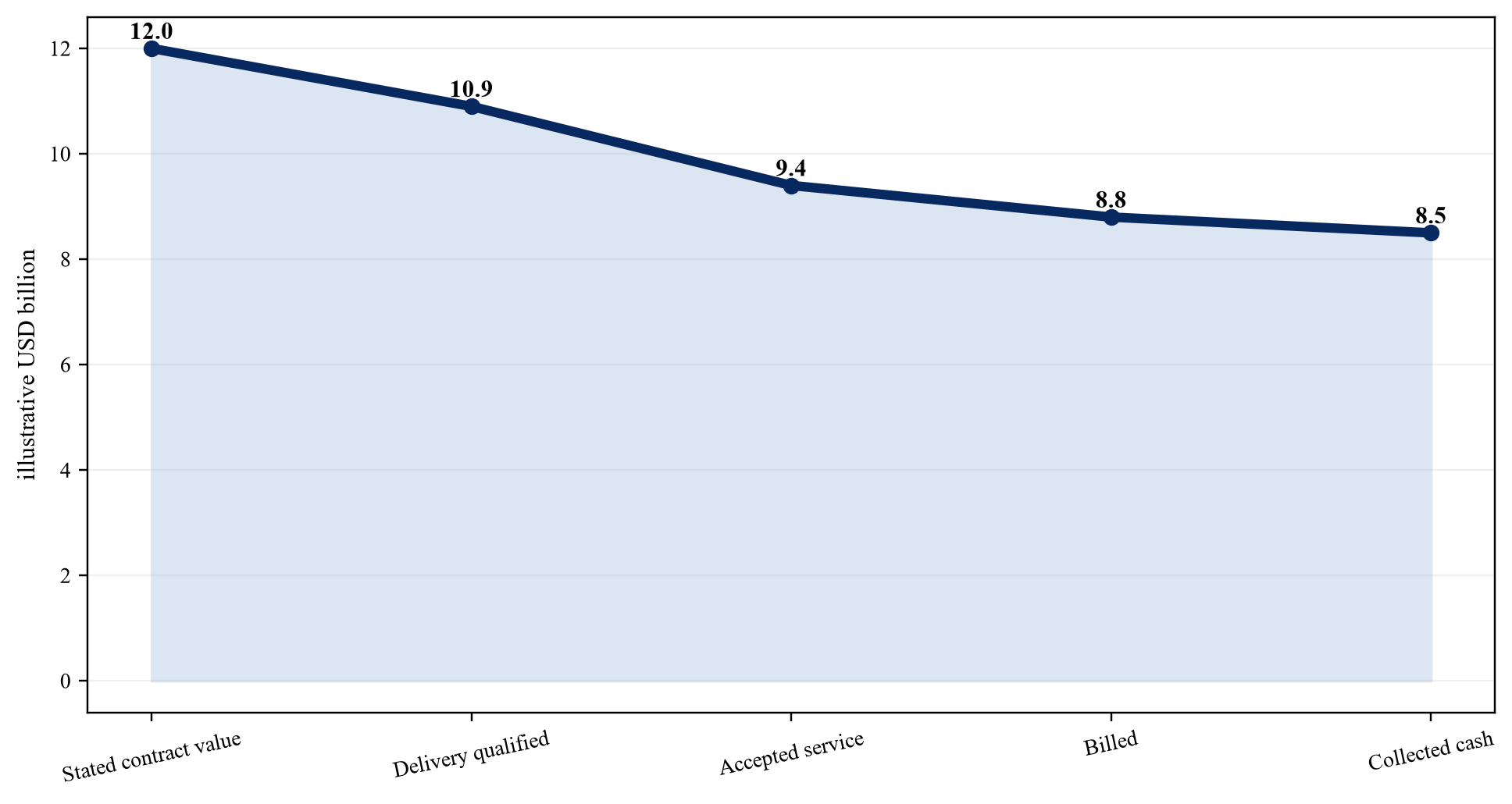
Proposed evidence waterfall; quantities are illustrative and do not describe an identified company.
| State | Evidence | Valuation treatment |
|---|---|---|
| commercial pipeline | customer dialogue | excluded from contracted case |
| signed order | executed order and pricing | condition-adjusted schedule |
| RPO | accounting-policy definition | reconcile timing and exclusions |
| delivered service | commissioning and availability | eligible for acceptance test |
| accepted and billed | acceptance and invoice | credit and collection analysis |
| collected cash | bank receipt | cash-flow evidence |
Proposed framework; governing documents and accounting policy determine treatment.
4. Reconcile customer concentration
A large anchor contract may support financing and create correlated delivery, credit, renewal and bargaining risk. [1][6][10][12] The work should identify the affected legal entity, customer, asset cohort, financing claim and decision owner. Public disclosures provide context. Company-specific terms, condition and performance require direct evidence.
The evidence package should include revenue, backlog, RPO, receivables, prepayments, credit support, parent obligations, termination and renewal by customer. Each input should retain its definition, date, source, owner and expiry. Reported metrics require reconciliation to filed measures where available. Estimates should remain visible until contracts, telemetry, commissioning records, invoices or cash receipts replace them.
The principal failure is that contract scale is credited without a concentration adjustment. The practical response is to model customer-level cash and explicit replacement time. The model should record each revision and its effect on enterprise value, adjusted net debt and equity value. A conclusion remains conditional where material evidence is unavailable.
5. Build the GPU cohort ledger
Every GPU, server and network cohort has a generation, delivery date, cost, financing, warranty, useful life, workload fit and residual value. [1][13][14][15] The work should identify the affected legal entity, customer, asset cohort, financing claim and decision owner. Public disclosures provide context. Company-specific terms, condition and performance require direct evidence.
The evidence package should include serialised asset register, bill of materials, commissioning, location, title, lien, warranty, benchmark and retirement plan. Each input should retain its definition, date, source, owner and expiry. Reported metrics require reconciliation to filed measures where available. Estimates should remain visible until contracts, telemetry, commissioning records, invoices or cash receipts replace them.
The principal failure is that all computing equipment receives one average life and value. The practical response is to forecast each material cohort separately. The model should record each revision and its effect on enterprise value, adjusted net debt and equity value. A conclusion remains conditional where material evidence is unavailable.
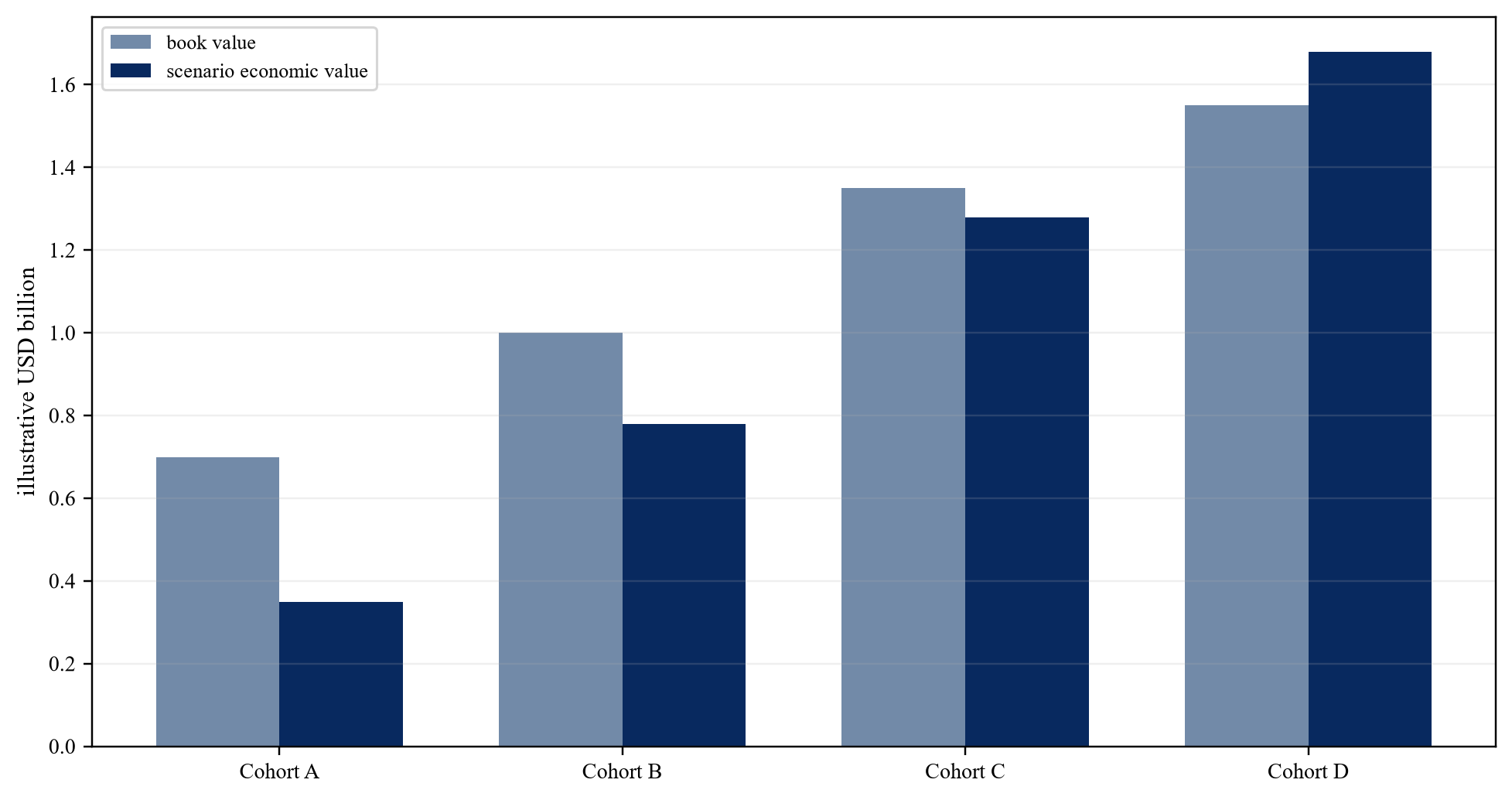
Wholly hypothetical; economic value is scenario-based and distinct from accounting carrying amount.
| Field | Operating question | Valuation effect |
|---|---|---|
| generation and configuration | which workloads remain competitive | price and utilisation |
| placed in service | when depreciation and revenue begin | timing |
| useful life | how long benefits are expected | accounting and DCF |
| refresh plan | when replacement capital is needed | free cash flow |
| title and lien | who can sell or refinance | recovery and debt |
| residual evidence | where equipment can redeploy | terminal value |
Proposed minimum fields; asset-level evidence remains required.
6. Distinguish accounting depreciation from economic decay
Reported depreciation allocates cost under an accounting estimate, while economic value changes with performance, energy efficiency, software support, supply and customer preference. [1][25][26][28] The work should identify the affected legal entity, customer, asset cohort, financing claim and decision owner. Public disclosures provide context. Company-specific terms, condition and performance require direct evidence.
The evidence package should include accounting policy, useful-life estimate, residual value, impairment testing, market benchmarks, maintenance and observed resale data. Each input should retain its definition, date, source, owner and expiry. Reported metrics require reconciliation to filed measures where available. Estimates should remain visible until contracts, telemetry, commissioning records, invoices or cash receipts replace them.
The principal failure is that book value is treated as recoverable value. The practical response is to run separate accounting, operating and market-value schedules. The model should record each revision and its effect on enterprise value, adjusted net debt and equity value. A conclusion remains conditional where material evidence is unavailable.
7. Map revenue to physical delivery
Contracted service becomes revenue only after the required cluster, power, network, software and operational support are available and accepted. [2][3][6][9] The work should identify the affected legal entity, customer, asset cohort, financing claim and decision owner. Public disclosures provide context. Company-specific terms, condition and performance require direct evidence.
The evidence package should include delivery schedule, data-centre ready date, energisation, installation, burn-in, acceptance certificate, SLA and invoice trigger. Each input should retain its definition, date, source, owner and expiry. Reported metrics require reconciliation to filed measures where available. Estimates should remain visible until contracts, telemetry, commissioning records, invoices or cash receipts replace them.
The principal failure is that signature date becomes the revenue commencement date. The practical response is to link every contract tranche to a commissioned asset cohort. The model should record each revision and its effect on enterprise value, adjusted net debt and equity value. A conclusion remains conditional where material evidence is unavailable.
8. Measure utilisation by workload
Training, fine-tuning, inference and specialised computing use different cluster sizes, scheduling, memory, network and continuity. [1][6][7][13] The work should identify the affected legal entity, customer, asset cohort, financing claim and decision owner. Public disclosures provide context. Company-specific terms, condition and performance require direct evidence.
The evidence package should include reserved and on-demand hours, billable utilisation, idle time, failed jobs, maintenance, queue, workload mix and customer tier. Each input should retain its definition, date, source, owner and expiry. Reported metrics require reconciliation to filed measures where available. Estimates should remain visible until contracts, telemetry, commissioning records, invoices or cash receipts replace them.
The principal failure is that fleet-wide utilisation hides stranded or oversubscribed cohorts. The practical response is to measure utilisation by generation, site, customer and workload. The model should record each revision and its effect on enterprise value, adjusted net debt and equity value. A conclusion remains conditional where material evidence is unavailable.
9. Forecast price and performance
Nominal price per GPU-hour is incomplete because successive systems can change throughput, energy use and customer cost per completed workload. [13][14][15][16] The work should identify the affected legal entity, customer, asset cohort, financing claim and decision owner. Public disclosures provide context. Company-specific terms, condition and performance require direct evidence.
The evidence package should include contracted price, indexation, effective discount, benchmark throughput, software stack, token or job economics and switching cost. Each input should retain its definition, date, source, owner and expiry. Reported metrics require reconciliation to filed measures where available. Estimates should remain visible until contracts, telemetry, commissioning records, invoices or cash receipts replace them.
The principal failure is that constant nominal pricing is carried beyond the competitive life of the cohort. The practical response is to forecast effective price per delivered outcome and migration path. The model should record each revision and its effect on enterprise value, adjusted net debt and equity value. A conclusion remains conditional where material evidence is unavailable.
10. Value power and data-centre access
Contracted power is not equivalent to connected or active power, and a lease does not establish that IT capacity is commissioned. [6][9][11][29] The work should identify the affected legal entity, customer, asset cohort, financing claim and decision owner. Public disclosures provide context. Company-specific terms, condition and performance require direct evidence.
The evidence package should include site, power state, utility agreement, lease, construction, cooling, network, redundancy, energisation and acceptance. Each input should retain its definition, date, source, owner and expiry. Reported metrics require reconciliation to filed measures where available. Estimates should remain visible until contracts, telemetry, commissioning records, invoices or cash receipts replace them.
The principal failure is that announced megawatts are valued as operating capacity. The practical response is to apply evidence-weighted values to each capacity state. The model should record each revision and its effect on enterprise value, adjusted net debt and equity value. A conclusion remains conditional where material evidence is unavailable.
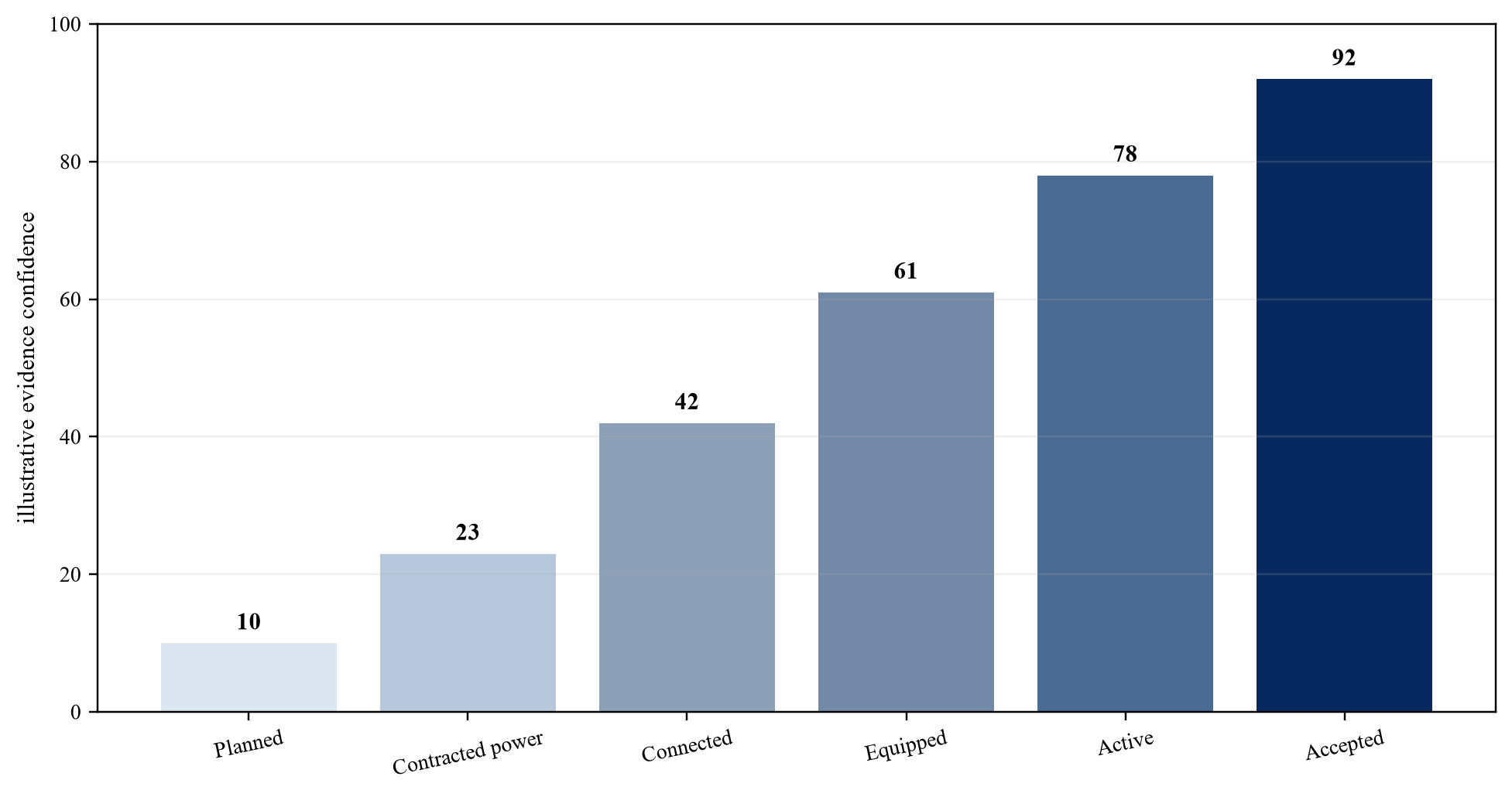
Proposed framework; confidence rises as rights and operations become observable.
| State | Required evidence | Common overstatement |
|---|---|---|
| planned | site concept and schedule | treated as controlled capacity |
| contracted power | executed rights and conditions | treated as energised |
| connected | utility delivery and infrastructure | treated as revenue ready |
| equipped | installed hardware and network | treated as accepted service |
| active | operating IT load | treated as fully utilised |
| accepted | customer test and billing start | treated as collected cash |
Proposed framework; capacity labels require consistent definitions.
11. Model service performance
Availability, job completion, network performance and support affect credits, renewals, margins and termination rights. [1][24][32] The work should identify the affected legal entity, customer, asset cohort, financing claim and decision owner. Public disclosures provide context. Company-specific terms, condition and performance require direct evidence.
The evidence package should include SLA, telemetry, outage history, credits, incident reports, support cost, customer acceptance and remedies. Each input should retain its definition, date, source, owner and expiry. Reported metrics require reconciliation to filed measures where available. Estimates should remain visible until contracts, telemetry, commissioning records, invoices or cash receipts replace them.
The principal failure is that gross contract value ignores performance leakage. The practical response is to deduct expected credits, downtime and retention cost from contract cash. The model should record each revision and its effect on enterprise value, adjusted net debt and equity value. A conclusion remains conditional where material evidence is unavailable.
12. Reconcile prepayments and financing
Customer prepayments can fund equipment and reduce risk, while creating delivery obligations, refund exposure and restricted cash. [7][8][24] The work should identify the affected legal entity, customer, asset cohort, financing claim and decision owner. Public disclosures provide context. Company-specific terms, condition and performance require direct evidence.
The evidence package should include prepayment agreement, milestone, refund, security, permitted use, escrow, accounting and interaction with lender collateral. Each input should retain its definition, date, source, owner and expiry. Reported metrics require reconciliation to filed measures where available. Estimates should remain visible until contracts, telemetry, commissioning records, invoices or cash receipts replace them.
The principal failure is that prepayments are counted as free cash and full contract value. The practical response is to model cash timing and the related obligation together. The model should record each revision and its effect on enterprise value, adjusted net debt and equity value. A conclusion remains conditional where material evidence is unavailable.
13. Map debt to assets and contracts
Equipment facilities, delayed-draw loans, notes, revolvers, leases and vendor finance may have different borrowers, collateral and recourse. [1][2][4][7] The work should identify the affected legal entity, customer, asset cohort, financing claim and decision owner. Public disclosures provide context. Company-specific terms, condition and performance require direct evidence.
The evidence package should include principal, draw conditions, interest, maturity, amortisation, collateral, guarantees, covenants, reserves and cash sweeps. Each input should retain its definition, date, source, owner and expiry. Reported metrics require reconciliation to filed measures where available. Estimates should remain visible until contracts, telemetry, commissioning records, invoices or cash receipts replace them.
The principal failure is that gross debt is netted against enterprise value without claim analysis. The practical response is to build a legal-entity debt and collateral schedule. The model should record each revision and its effect on enterprise value, adjusted net debt and equity value. A conclusion remains conditional where material evidence is unavailable.
| Claim | Typical linkage | Valuation question |
|---|---|---|
| equipment debt | financed GPU cohort | amortisation versus cohort life |
| project debt | site and customer cash | delivery and concentration |
| lease liability | data-centre capacity | unavoidable fixed payment |
| customer prepayment | delivery obligation | refund and restricted use |
| vendor finance | hardware or software | lien and maturity |
| corporate debt | consolidated cash | structural priority and guarantees |
Proposed diligence; actual priority follows governing documents.
14. Test lease and purchase commitments
Data-centre leases, power commitments, equipment orders and software obligations may create fixed cash needs before revenue begins. [1][6][27] The work should identify the affected legal entity, customer, asset cohort, financing claim and decision owner. Public disclosures provide context. Company-specific terms, condition and performance require direct evidence.
The evidence package should include contracted payments, commencement, escalation, minimums, termination, assignment, guarantees and accounting treatment. Each input should retain its definition, date, source, owner and expiry. Reported metrics require reconciliation to filed measures where available. Estimates should remain visible until contracts, telemetry, commissioning records, invoices or cash receipts replace them.
The principal failure is that off-balance-sheet or future commitments are omitted from valuation. The practical response is to include unavoidable obligations and associated capacity rights. The model should record each revision and its effect on enterprise value, adjusted net debt and equity value. A conclusion remains conditional where material evidence is unavailable.
15. Estimate maintenance and refresh capital
Keeping a cohort commercially useful requires repairs, spares, networking, software, liquid cooling, memory and periodic replacement. [1][7][13][15] The work should identify the affected legal entity, customer, asset cohort, financing claim and decision owner. Public disclosures provide context. Company-specific terms, condition and performance require direct evidence.
The evidence package should include maintenance history, vendor support, failure rates, spares, upgrade path, refresh policy, lead time and capital approval. Each input should retain its definition, date, source, owner and expiry. Reported metrics require reconciliation to filed measures where available. Estimates should remain visible until contracts, telemetry, commissioning records, invoices or cash receipts replace them.
The principal failure is that reported EBITDA is converted to cash without maintenance and refresh. The practical response is to deduct cohort-specific sustaining and refresh capital. The model should record each revision and its effect on enterprise value, adjusted net debt and equity value. A conclusion remains conditional where material evidence is unavailable.
16. Measure residual value
Residual value depends on generation, configuration, title, liens, export controls, software support, removal cost and the market for redeployment. [1][14][25][33] The work should identify the affected legal entity, customer, asset cohort, financing claim and decision owner. Public disclosures provide context. Company-specific terms, condition and performance require direct evidence.
The evidence package should include broker quotes, auction data, vendor trade-in, alternate workloads, removal, shipping, tax, sanctions and time to sell. Each input should retain its definition, date, source, owner and expiry. Reported metrics require reconciliation to filed measures where available. Estimates should remain visible until contracts, telemetry, commissioning records, invoices or cash receipts replace them.
The principal failure is that a fixed percentage of original cost is assumed across cohorts. The practical response is to use observable ranges net of recovery cost and delay. The model should record each revision and its effect on enterprise value, adjusted net debt and equity value. A conclusion remains conditional where material evidence is unavailable.
17. Build the contract to cash bridge
The USD 12.0 billion hypothetical schedule must pass delivery, acceptance, credit, performance, billing and collection gates. [1][3][24] The work should identify the affected legal entity, customer, asset cohort, financing claim and decision owner. Public disclosures provide context. Company-specific terms, condition and performance require direct evidence.
The evidence package should include monthly contracted schedule, conditions, probability or scenario, service credits, invoices, receivables and cash receipts. Each input should retain its definition, date, source, owner and expiry. Reported metrics require reconciliation to filed measures where available. Estimates should remain visible until contracts, telemetry, commissioning records, invoices or cash receipts replace them.
The principal failure is that a long-dated total is multiplied by an EBITDA margin. The practical response is to translate every contract tranche into dated cash. The model should record each revision and its effect on enterprise value, adjusted net debt and equity value. A conclusion remains conditional where material evidence is unavailable.
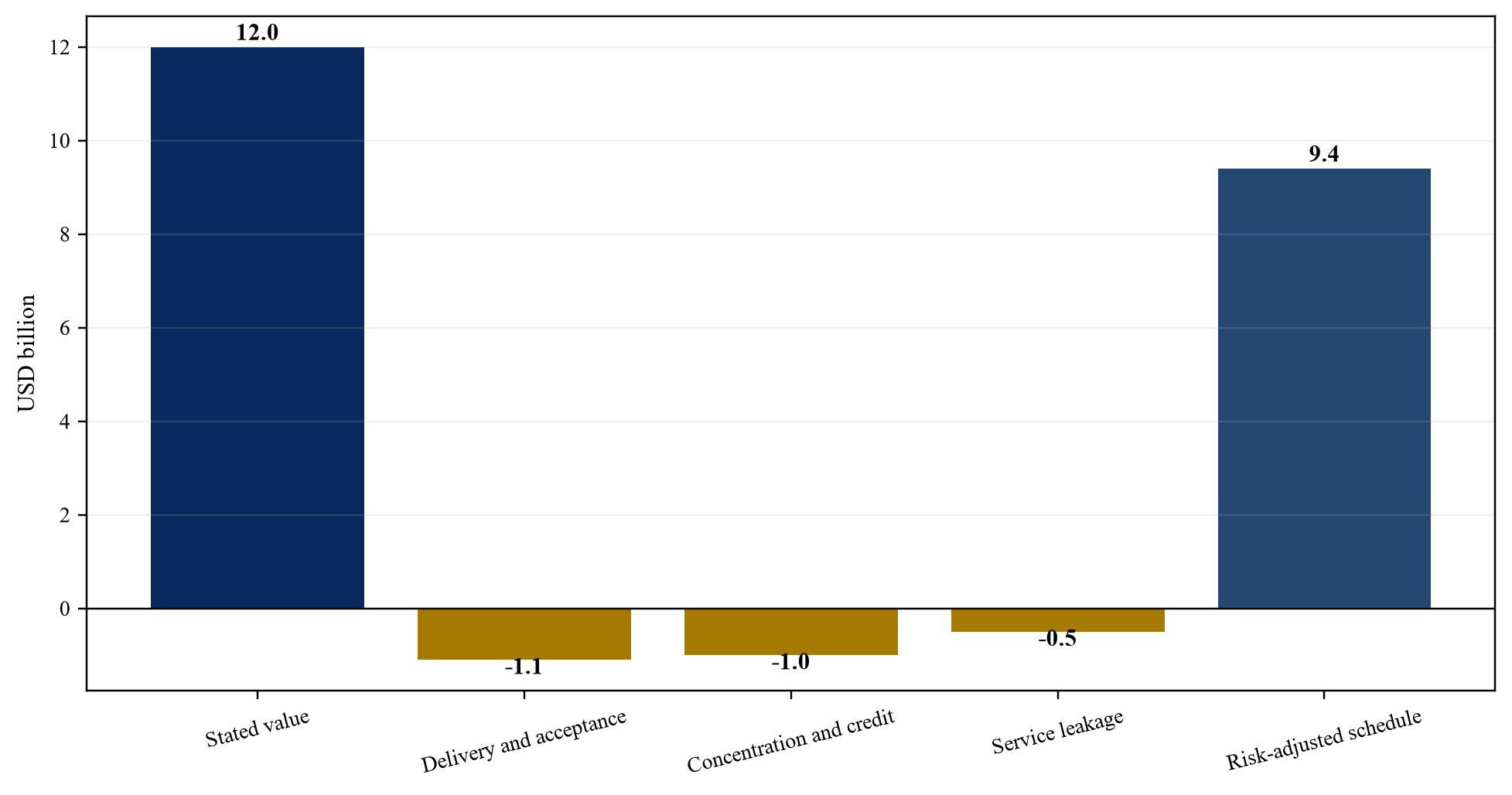
Wholly hypothetical; USD billion.
| Metric | Central case | Combined downside |
|---|---|---|
| stated contracted revenue | USD 12.0bn | USD 12.0bn |
| risk-adjusted scheduled revenue | USD 9.4bn | USD 6.5bn |
| billable utilisation | 78% | 58% |
| steady-state EBITDA margin | 38% | 20% |
| hardware residual | 16% of cost | 5% of cost |
| delivery delay | plan | 9 months |
Wholly hypothetical; figures do not describe an identified business.
18. Build the asset cash bridge
The USD 5.4 billion hypothetical deployment must reconcile procurement, commissioning, depreciation, financing, operation, refresh and disposal. [1][7][25][26] The work should identify the affected legal entity, customer, asset cohort, financing claim and decision owner. Public disclosures provide context. Company-specific terms, condition and performance require direct evidence.
The evidence package should include cohort cost, delivery, placed-in-service date, useful life, interest, maintenance, refresh and residual. Each input should retain its definition, date, source, owner and expiry. Reported metrics require reconciliation to filed measures where available. Estimates should remain visible until contracts, telemetry, commissioning records, invoices or cash receipts replace them.
The principal failure is that capital expenditure is treated as a one-time opening amount. The practical response is to model cash by cohort through retirement. The model should record each revision and its effect on enterprise value, adjusted net debt and equity value. A conclusion remains conditional where material evidence is unavailable.
19. Use discounted cash flow carefully
DCF requires contract timing, operating costs, taxes, working capital, refresh, terminal assets and a discount rate consistent with leverage and risk. [22][23][25] The work should identify the affected legal entity, customer, asset cohort, financing claim and decision owner. Public disclosures provide context. Company-specific terms, condition and performance require direct evidence.
The evidence package should include monthly or quarterly forecast, tax, capex, working capital, terminal assumptions and discount-rate build-up. Each input should retain its definition, date, source, owner and expiry. Reported metrics require reconciliation to filed measures where available. Estimates should remain visible until contracts, telemetry, commissioning records, invoices or cash receipts replace them.
The principal failure is that reported EBITDA or backlog determines value without cash conversion. The practical response is to discount unlevered cash after cohort and contract reconciliation. The model should record each revision and its effect on enterprise value, adjusted net debt and equity value. A conclusion remains conditional where material evidence is unavailable.
20. Use capacity valuation carefully
Value per active megawatt or GPU can test results where capacity states, density, location and contract quality are comparable. [6][9][11] The work should identify the affected legal entity, customer, asset cohort, financing claim and decision owner. Public disclosures provide context. Company-specific terms, condition and performance require direct evidence.
The evidence package should include active power, equipment generation, utilisation, contract, margin, lease, capex and useful life. Each input should retain its definition, date, source, owner and expiry. Reported metrics require reconciliation to filed measures where available. Estimates should remain visible until contracts, telemetry, commissioning records, invoices or cash receipts replace them.
The principal failure is that contracted or planned capacity receives the value of active capacity. The practical response is to apply different values to planned, connected and active capacity. The model should record each revision and its effect on enterprise value, adjusted net debt and equity value. A conclusion remains conditional where material evidence is unavailable.
21. Use market references carefully
Public-company multiples reflect different leverage, accounting, customer mix, owned assets, growth and contract quality. [1][2][6][7] The work should identify the affected legal entity, customer, asset cohort, financing claim and decision owner. Public disclosures provide context. Company-specific terms, condition and performance require direct evidence.
The evidence package should include enterprise value date, diluted shares, debt, leases, cash, revenue, EBITDA, capex, growth, concentration and accounting policy. Each input should retain its definition, date, source, owner and expiry. Reported metrics require reconciliation to filed measures where available. Estimates should remain visible until contracts, telemetry, commissioning records, invoices or cash receipts replace them.
The principal failure is that an observed multiple is applied to an unmatched metric. The practical response is to normalise both numerator and denominator before comparison. The model should record each revision and its effect on enterprise value, adjusted net debt and equity value. A conclusion remains conditional where material evidence is unavailable.
22. Triangulate the central valuation
The hypothetical central case weights DCF, capacity and market-reference methods after reconciling their assumptions. [19][20][21] The work should identify the affected legal entity, customer, asset cohort, financing claim and decision owner. Public disclosures provide context. Company-specific terms, condition and performance require direct evidence.
The evidence package should include method outputs, weights, cross-checks, sensitivity and reasons for differences. Each input should retain its definition, date, source, owner and expiry. Reported metrics require reconciliation to filed measures where available. Estimates should remain visible until contracts, telemetry, commissioning records, invoices or cash receipts replace them.
The principal failure is that three methods are averaged although they rely on inconsistent cash and capacity assumptions. The practical response is to use one reconciled operating model beneath every method. The model should record each revision and its effect on enterprise value, adjusted net debt and equity value. A conclusion remains conditional where material evidence is unavailable.
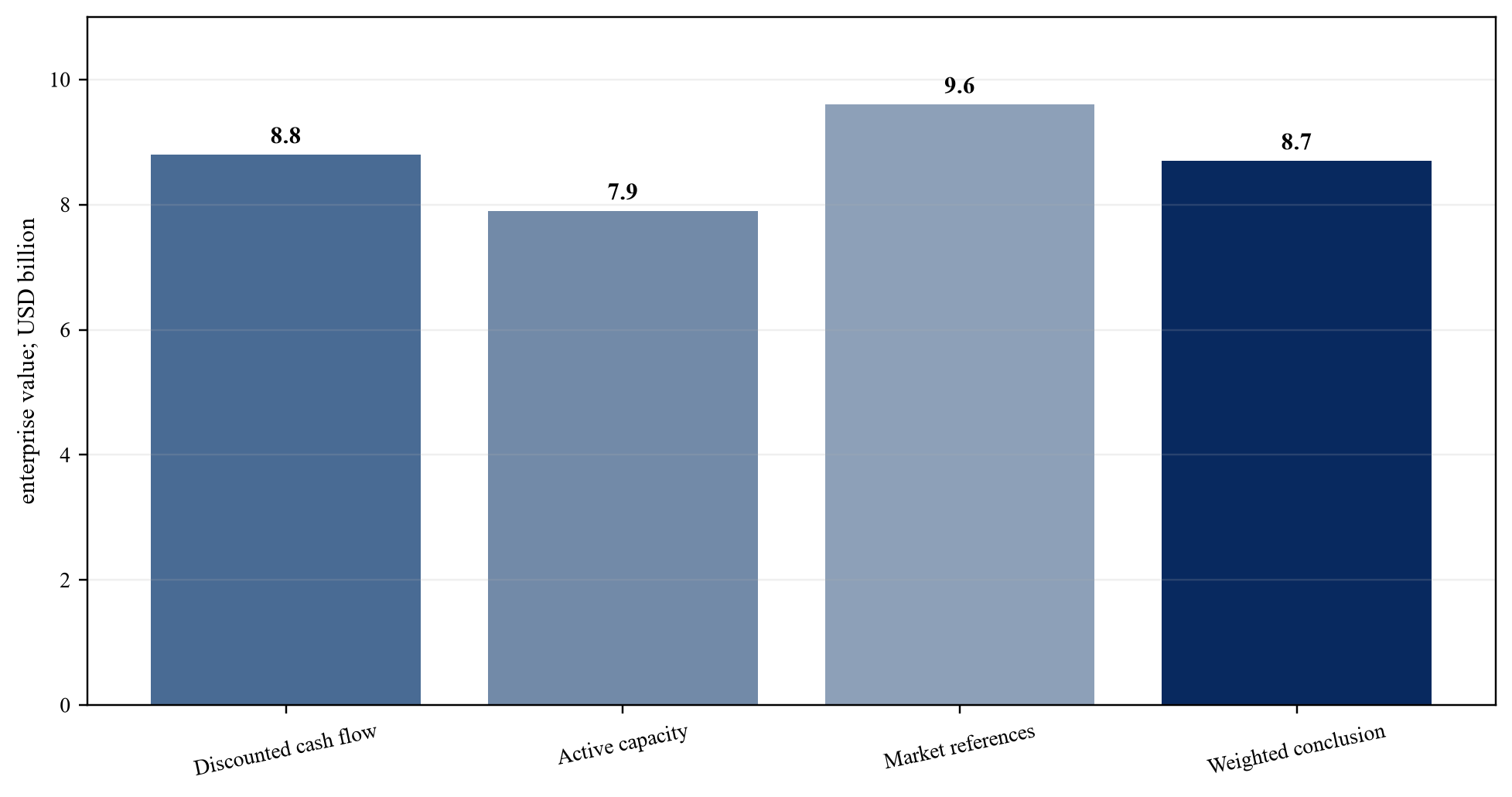
Wholly hypothetical; USD billion of enterprise value.
| Item | Central case | Combined downside |
|---|---|---|
| weighted enterprise value | 8.7 | 3.6 |
| equipment and project debt | 3.2 | 3.2 |
| lease and debt-like adjustments | 1.1 | 1.1 |
| unrestricted cash | 0.7 | 0.5 |
| adjusted net debt | 3.6 | 3.8 |
| illustrative equity value | 5.1 | 0.0 |
Wholly hypothetical; USD billion.
23. Deduct debt and debt-like claims
Equity value follows senior and secured claims, leases, equipment obligations, restricted cash and other unavoidable commitments. [1][2][4][27] The work should identify the affected legal entity, customer, asset cohort, financing claim and decision owner. Public disclosures provide context. Company-specific terms, condition and performance require direct evidence.
The evidence package should include debt by entity, accrued interest, make-wholes, leases, guarantees, vendor obligations, restricted cash and minority interests. Each input should retain its definition, date, source, owner and expiry. Reported metrics require reconciliation to filed measures where available. Estimates should remain visible until contracts, telemetry, commissioning records, invoices or cash receipts replace them.
The principal failure is that headline enterprise value is presented as equity value. The practical response is to bridge enterprise value to each security class. The model should record each revision and its effect on enterprise value, adjusted net debt and equity value. A conclusion remains conditional where material evidence is unavailable.
24. Stress contract and cohort mismatch
Revenue may outlive hardware, equipment may arrive before revenue, or debt may mature before contracted cash is earned. [1][2][7][13] The work should identify the affected legal entity, customer, asset cohort, financing claim and decision owner. Public disclosures provide context. Company-specific terms, condition and performance require direct evidence.
The evidence package should include contract tenor, cohort life, delivery date, acceptance, debt maturity, refresh date, residual and refinancing. Each input should retain its definition, date, source, owner and expiry. Reported metrics require reconciliation to filed measures where available. Estimates should remain visible until contracts, telemetry, commissioning records, invoices or cash receipts replace them.
The principal failure is that base-case timing is assumed to remain aligned. The practical response is to test timing mismatches explicitly and preserve liquidity. The model should record each revision and its effect on enterprise value, adjusted net debt and equity value. A conclusion remains conditional where material evidence is unavailable.
25. Apply the combined downside
The hypothetical downside combines delay, lower utilisation, price pressure, accelerated obsolescence, lower residual and higher refinancing cost. [2][7][14][30] The work should identify the affected legal entity, customer, asset cohort, financing claim and decision owner. Public disclosures provide context. Company-specific terms, condition and performance require direct evidence.
The evidence package should include integrated monthly model, covenant headroom, minimum cash, refresh, customer remedies and recovery value. Each input should retain its definition, date, source, owner and expiry. Reported metrics require reconciliation to filed measures where available. Estimates should remain visible until contracts, telemetry, commissioning records, invoices or cash receipts replace them.
The principal failure is that single-variable sensitivities understate correlated stress. The practical response is to run an internally consistent downside and identify the first cash failure. The model should record each revision and its effect on enterprise value, adjusted net debt and equity value. A conclusion remains conditional where material evidence is unavailable.
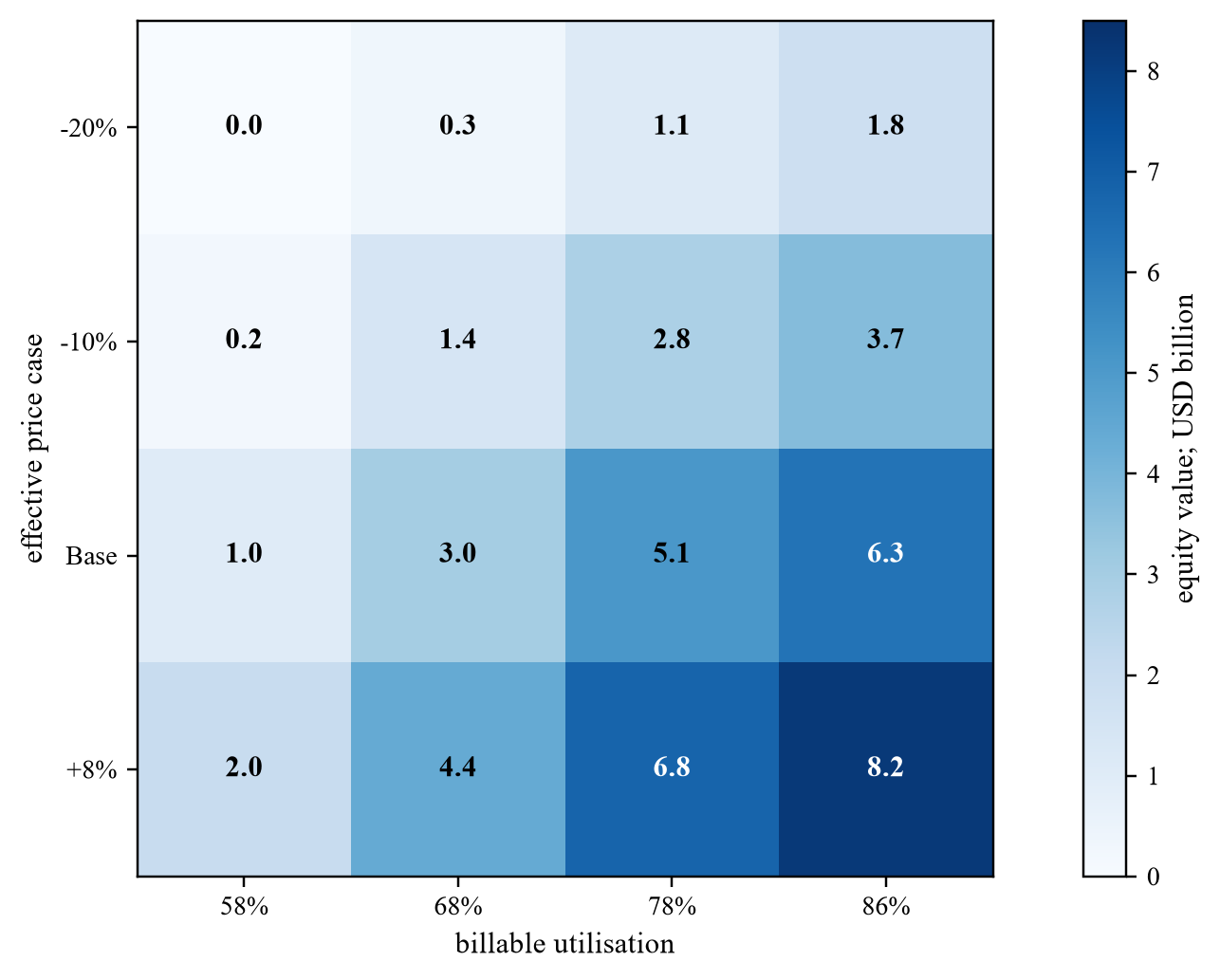
Wholly hypothetical; USD billion after adjusted net debt.
26. Design diligence and evidence controls
A valuation should identify source, owner, date, definition, evidence quality and expiry for every material operating input. [22][24][31] The work should identify the affected legal entity, customer, asset cohort, financing claim and decision owner. Public disclosures provide context. Company-specific terms, condition and performance require direct evidence.
The evidence package should include data room, contract abstraction, asset ledger, telemetry, model version, source log, approval and exception register. Each input should retain its definition, date, source, owner and expiry. Reported metrics require reconciliation to filed measures where available. Estimates should remain visible until contracts, telemetry, commissioning records, invoices or cash receipts replace them.
The principal failure is that management labels and presentation metrics enter the model without reconciliation. The practical response is to maintain an evidence ledger linked to the model. The model should record each revision and its effect on enterprise value, adjusted net debt and equity value. A conclusion remains conditional where material evidence is unavailable.
27. Define transaction protections
Price adjustments, earn-outs, escrow, debt paydown, capex commitments, customer consents and representations can allocate valuation uncertainty. [22][23][24] The work should identify the affected legal entity, customer, asset cohort, financing claim and decision owner. Public disclosures provide context. Company-specific terms, condition and performance require direct evidence.
The evidence package should include purchase agreement, financing, closing conditions, leakage, working capital, debt, capex, consent, indemnity and earn-out metrics. Each input should retain its definition, date, source, owner and expiry. Reported metrics require reconciliation to filed measures where available. Estimates should remain visible until contracts, telemetry, commissioning records, invoices or cash receipts replace them.
The principal failure is that valuation uncertainty is left entirely in the headline price. The practical response is to convert unresolved risks into defined transaction terms. The model should record each revision and its effect on enterprise value, adjusted net debt and equity value. A conclusion remains conditional where material evidence is unavailable.
28. Reach the valuation conclusion
A supportable conclusion reconciles contracts, assets, operations, financing and downside before assigning equity value. [1][2][6][7] The work should identify the affected legal entity, customer, asset cohort, financing claim and decision owner. Public disclosures provide context. Company-specific terms, condition and performance require direct evidence.
The evidence package should include contract ledger, cohort ledger, capacity map, cash model, debt bridge, sensitivities, evidence register and approval record. Each input should retain its definition, date, source, owner and expiry. Reported metrics require reconciliation to filed measures where available. Estimates should remain visible until contracts, telemetry, commissioning records, invoices or cash receipts replace them.
The principal failure is that growth in AI demand substitutes for company-specific evidence. The practical response is to approve a range with explicit conditions and update triggers. The model should record each revision and its effect on enterprise value, adjusted net debt and equity value. A conclusion remains conditional where material evidence is unavailable.
| Decision | Minimum evidence | Update trigger |
|---|---|---|
| contract value | signed terms and conditions | amendment or cancellation |
| cohort value | register, benchmarks and life | new generation or impairment |
| capacity value | connected and active evidence | delay or energisation |
| debt adjustment | facility and collateral schedule | draw, refinance or covenant breach |
| equity conclusion | reconciled methods and downside | material operating variance |
Proposed governance; each conclusion retains evidence and update triggers.
Appendix A. Integrated monthly model
The integrated model should operate at a monthly level until delivery, acceptance, utilisation and financing have stabilised. Each customer order is divided into tranches with a named site, equipment cohort, scheduled delivery, acceptance test, billing start, minimum commitment, price, escalation, service-credit mechanism, termination right and payment date. The contract schedule should preserve the difference between an enforceable minimum, expected on-demand use and management's wider opportunity estimate. Revenue recognition, invoice issuance and cash collection should remain separate fields. A delay in one field should not automatically move every later field without checking the governing contract.
The asset schedule should connect each contract tranche to specific GPU, server, network, storage and cooling assets. It should record purchase price, delivery, placed-in-service date, useful life, accounting depreciation, maintenance, warranty, refresh date, financing, lien and expected recovery route. A cohort can support more than one workload or customer, but its total scheduled use cannot exceed tested capacity after maintenance, redundancy and operating headroom. Where a contract permits migration to new hardware, the model should include the replacement cost, transition downtime and acceptance obligations. Where migration is absent or disputed, the existing cohort remains the service constraint.
The operating schedule should reconcile reserved capacity, delivered jobs, billable utilisation, failed or repeated jobs, service credits, power consumption, data-centre payments, network cost, software licences, support and customer-specific engineering. Gross margin should be calculated after the costs required to deliver the contracted service. EBITDA should not substitute for cash available to investors. The cash schedule should deduct taxes, working capital, maintenance, refresh, lease payments, interest, mandatory amortisation and restricted reserve movements before distributions.
The valuation schedule should use the same operating case for discounted cash flow, capacity references and market references. The DCF should discount unlevered cash flows and apply a terminal value only to capacity and assets expected to remain competitive after the explicit forecast. Capacity references should use active or accepted capacity with comparable density, rights and customer quality. Public-market references should use a consistent enterprise-value date and adjust debt, leases, restricted cash and diluted securities. The bridge to equity should deduct claims according to their legal and economic priority.
The downside should change related assumptions together. A nine-month site delay can postpone customer acceptance, extend interest during construction, increase lease and labour cost, reduce contract life available after acceptance and force a newer equipment purchase. Lower utilisation can weaken pricing and reduce the value of older cohorts. A new GPU generation can increase refresh capital and reduce resale proceeds. The model should identify the first month in which minimum liquidity, debt service, covenant headroom or refresh funding fails. The investment committee can then decide whether price, capital structure, customer protection, delivery sequencing or transaction terms provide an adequate remedy.
Sources
- CoreWeave, Inc., Annual Report on Form 10-K for the year ended 31 December 2025. Read the primary source
- CoreWeave, Inc., Quarterly Report on Form 10-Q for the quarter ended 30 June 2026. Read the primary source
- CoreWeave, Inc., Second Quarter 2026 Earnings Release. Read the primary source
- CoreWeave, Inc., 2026 Convertible Notes Investor Presentation. Read the primary source
- CoreWeave, Inc., EDGAR filing index for 2025 Form 10-K. Read the primary source
- Nebius Group N.V., Annual Report on Form 20-F for the year ended 31 December 2025. Read the primary source
- IREN Limited, Annual Report for the year ended 30 June 2026. Read the primary source
- IREN Limited, FY2026 Results and Business Update, 27 August 2026. Read the primary source
- Applied Digital Corporation, Second Quarter Fiscal 2026 Earnings Release. Read the primary source
- WhiteFiber, Inc., Annual Report on Form 10-K for the year ended 31 December 2025. Read the primary source
- Core Scientific, Inc., Annual Report on Form 10-K for the year ended 31 December 2025. Read the primary source
- Galaxy Digital Inc., Annual Report on Form 10-K for the year ended 31 December 2025. Read the primary source
- NVIDIA Corporation, Annual Report for fiscal 2026. Read the primary source
- NVIDIA Corporation, Quarterly Report on Form 10-Q for the quarter ended 26 July 2026. Read the primary source
- NVIDIA Corporation, Annual Report for fiscal 2025. Read the primary source
- Advanced Micro Devices, Inc., Annual Report on Form 10-K for 2025. Read the primary source
- Microsoft Corporation, Annual Report for fiscal 2026. Read the primary source
- Alphabet Inc., Quarterly Report on Form 10-Q for the quarter ended 30 June 2026. Read the primary source
- Amazon.com, Inc., Annual Reports. Read the primary source
- Digital Realty Trust, Inc., SEC Filings. Read the primary source
- Equinix, Inc., SEC Filings. Read the primary source
- U.S. Securities and Exchange Commission, Staff Accounting Bulletin No. 99 Materiality. Read the primary source
- U.S. Securities and Exchange Commission, Non-GAAP Financial Measures Compliance and Disclosure Interpretations. Read the primary source
- IFRS Foundation, IFRS 15 Revenue from Contracts with Customers. Read the primary source
- IFRS Foundation, IAS 16 Property Plant and Equipment. Read the primary source
- IFRS Foundation, IAS 36 Impairment of Assets. Read the primary source
- IFRS Foundation, IFRS 16 Leases. Read the primary source
- U.S. Securities and Exchange Commission, CoreWeave Draft Registration Statement Comment Letter, 13 January 2025. Read the primary source
- Lawrence Berkeley National Laboratory, 2024 United States Data Center Energy Usage Report. Read the primary source
- U.S. Department of Energy, Data Centers and Servers. Read the primary source
- International Energy Agency, Energy and AI. Read the primary source
- National Institute of Standards and Technology, Cybersecurity Framework 2.0. Read the primary source
- U.S. Department of Commerce Bureau of Industry and Security, Advanced Computing and Semiconductor Manufacturing Controls. Read the primary source
