

1. Define the financing question before discussing quantum
Venture debt is a specialised loan for venture-backed, high-growth companies. The British Business Bank describes it as an additional source of liquidity between equity rounds and notes that lenders typically examine investors, recent equity financing and cash burn.[4] That description captures the product category, but an AI company still needs to establish why debt is the correct instrument for its specific plan. Debt is most useful when it finances a bounded period of execution and the expected evidence can improve financing options before repayment becomes unavoidable.
The board should begin with a financing question rather than a desired cheque size. The question should identify the value-inflection milestone, the amount and timing of cash required, the operational dependencies, the downside if the milestone slips, and the expected source of repayment or refinancing. Examples include completing an enterprise product, converting contracted pilots into production, achieving a defined deployment margin, securing regulatory clearance, reaching a customer-diversification threshold or bridging to a priced equity round. Each milestone needs an observable completion test.
Debt can appear cheaper than equity because it limits immediate dilution. Its economic cost includes cash interest, fees, warrants, security, reporting, covenants, restricted flexibility and the consequences of default. A loan that delays an equity round by six months can create value when the intervening milestone is credible and valuation-relevant. The same loan can destroy negotiating leverage when it simply funds unresolved product-market fit or a structurally negative unit-economics model.
The financing purpose should therefore be written as a uses-and-outcomes schedule. Product development, compute, sales expansion, working capital, acquisitions and refinancing have different risk profiles. General working capital is an inadequate description when the lender must judge whether cash creates durable evidence. The schedule should show when each use occurs, the responsible owner, the decision gate, the measurable output and the route from output to enterprise value or repayment capacity.
2. Apply six gates to the venture-debt decision
The six gates are sequential. A failure at an early gate changes the work required at later gates. A company without a defined financing purpose cannot size debt coherently. A company with weak revenue evidence cannot use a headline annual recurring revenue figure as a repayment proxy. A company with large fixed compute commitments needs a different liquidity and covenant structure from a software company whose infrastructure cost flexes directly with usage.
Gate one tests purpose and timing. Gate two tests revenue quality. Gate three maps compute and other infrastructure commitments. Gate four integrates operating cash, debt service and minimum liquidity. Gate five tests covenants and downside decision points. Gate six examines repayment, refinancing and stakeholder support. The decision should proceed only when the six gates form one internally consistent financing case.
The gates should be owned by the board and management rather than delegated entirely to advisers. Finance can assemble the model, commercial leaders can evidence customers, engineering can evidence capacity and model architecture, legal advisers can review contracts and security, and investors can explain support. The board remains responsible for the financing decision, risk appetite and information approved for lenders.
An evidence register should sit beneath every gate. Each material number needs a definition, source, owner, cut-off date and reconciliation status. Management forecasts should remain distinguishable from executed contracts and observed results. The process should preserve prior model vintages so that changes in revenue, compute usage, cash, milestones and financing assumptions remain visible.
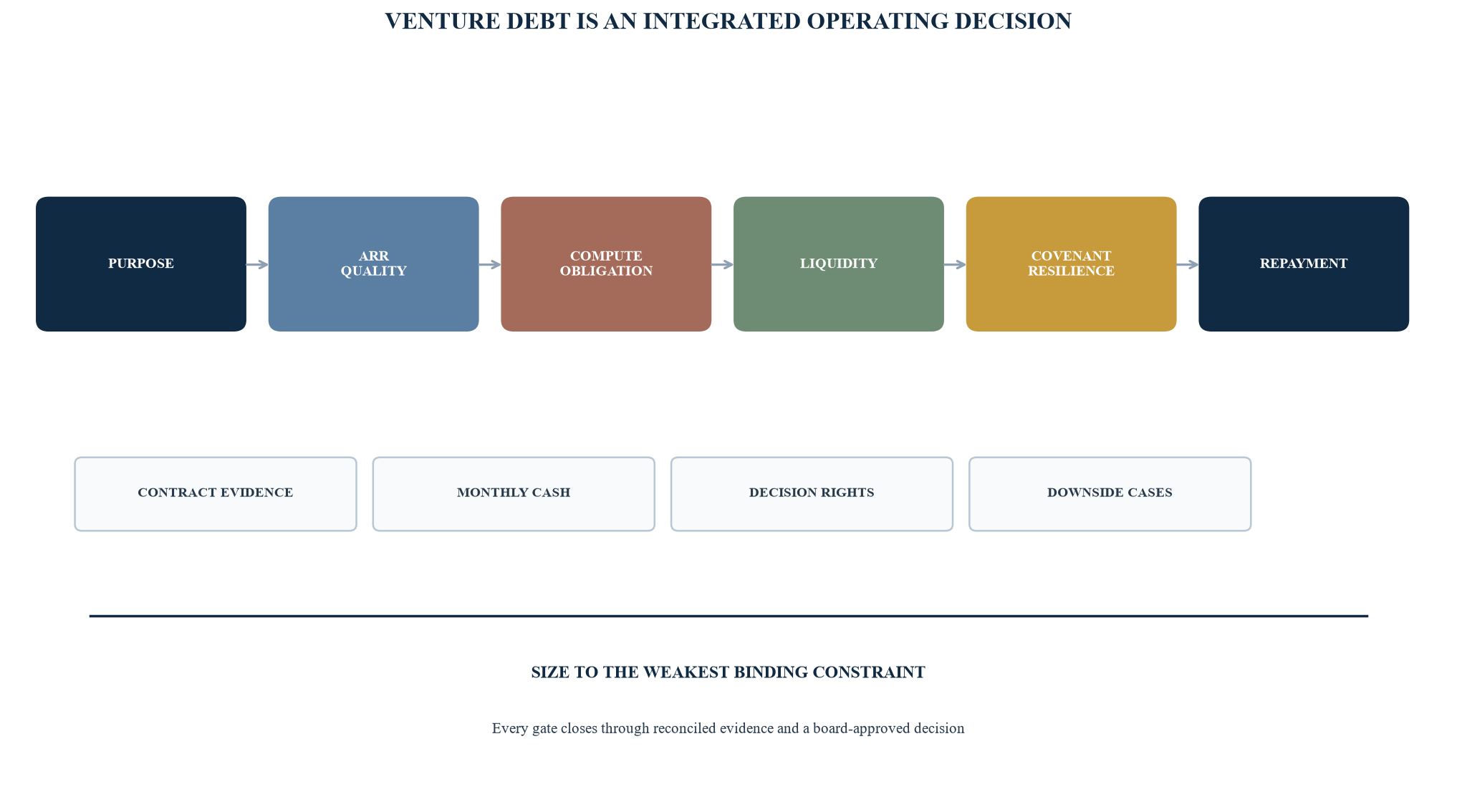
The gates are an analytical framework and should be adapted to the borrower, lender and transaction documents.
Table 1. Six-gate decision matrix
| Gate | Core evidence | Decision test | Failure response |
|---|---|---|---|
| purpose | uses, milestone, timing and ownership | Does the debt finance a specific value-inflection plan? | redefine the plan or use another financing instrument |
| revenue | contracts, billing, usage, retention and collections | Is recurring revenue durable, measurable and collectible? | reduce recognised base and improve commercial evidence |
| compute | provider contracts, minimums, capacity and unit cost | Can infrastructure obligations flex with revenue and cash? | renegotiate, stage capacity or hold more liquidity |
| liquidity | monthly integrated model, runway and debt service | Does usable cash remain adequate in approved downside cases? | reduce debt, delay draw or add equity support |
| covenants | definitions, thresholds, cures and reporting | Do triggers provide warning without causing avoidable default? | redesign metrics, headroom, cure and waiver mechanics |
| repayment | cash generation, equity support, refinance and exit | Is there a credible route to discharge the fixed claim? | change tenor, amortisation, quantum or instrument |
A lender may use different terminology and require additional tests.
3. Convert reported ARR into lender-grade recurring revenue
Annual recurring revenue is a management metric. It is not a defined IFRS measure and should not be confused with revenue recognised under IFRS 15. IFRS 15 applies a five-step model based on contracts with customers, performance obligations, transaction price and satisfaction of those obligations.[5] A lender-grade ARR schedule should therefore state its own definition and reconcile to invoicing, recognised revenue, deferred revenue, contract assets, cash collections and the general ledger.
The first distinction is contracted versus live revenue. A signed multi-year agreement may contain implementation conditions, acceptance tests, termination rights, volume variability or delayed deployment. Contracted value should not automatically enter live ARR. The schedule should show contract date, service commencement, current deployment status, minimum commitment, price metric, renewal, termination, credit terms and collection status.
The second distinction is subscription versus consumption. A fixed platform fee normally produces a different cash profile from token, model, compute, seat, workflow or transaction usage. Consumption may be recurring in customer behaviour while remaining volatile in amount. Management should show contracted minimums, observed usage cohorts, expansion, contraction and sensitivity to customer optimisation or model substitution.
The third distinction is recurring product revenue versus implementation, services, bespoke development and reimbursed infrastructure. Services can support adoption and may be commercially valuable. They can also consume scarce technical capacity and carry lower or less scalable margins. The bridge should isolate each component so a lender can assess durability and cash conversion without assuming that every invoiced pound has the same credit quality.
The fourth distinction is booked versus collectible. Ageing, disputes, credits, acceptance, customer solvency, concentration and payment behaviour affect the conversion of revenue into cash. ARR quality should include a collections view and a direct bridge to the cash forecast. Overdue invoices and contract assets should remain visible rather than being absorbed into a headline growth rate.
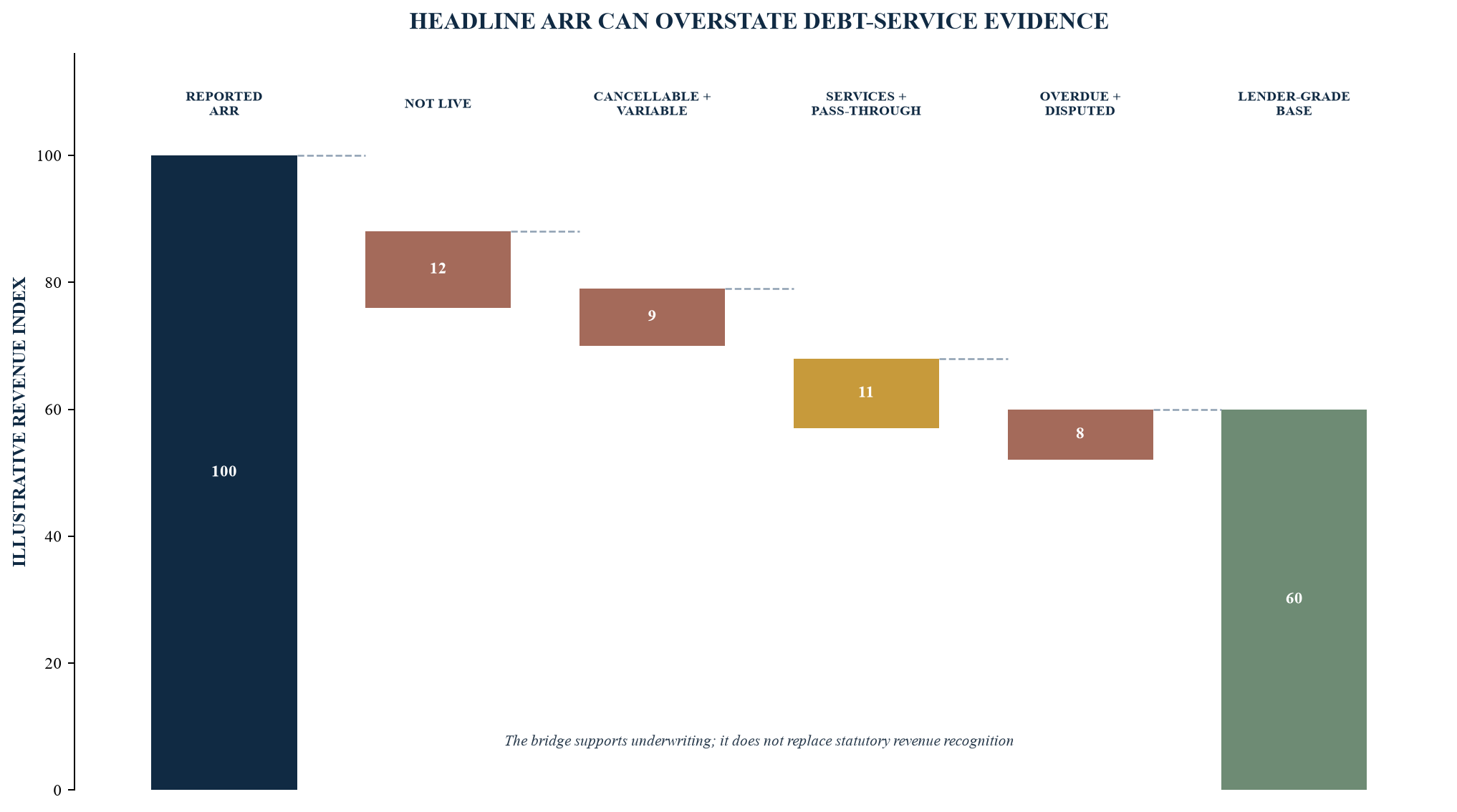
Values are illustrative management assumptions and do not represent an actual company.
Table 2. ARR evidence architecture
| Revenue element | Minimum evidence | Underwriting treatment | Monthly control |
|---|---|---|---|
| fixed subscription | executed contract, commencement and billing | include when live and enforceable, adjusted for termination and credit risk | additions, renewals, churn, invoices and cash |
| consumption | price metric, minimums and usage history | use contracted floor plus controlled cohort evidence | usage, unit price, optimisation and concentration |
| pilot | scope, acceptance and conversion condition | exclude from core base until production criteria are met | conversion, loss and time-to-production |
| implementation | statement of work, milestones and capacity | separate from recurring base and test delivery margin | backlog, utilisation, acceptance and collection |
| bespoke development | ownership, reuse, cost and customer dependency | treat as project revenue unless repeatability is evidenced | milestone delivery, scope change and cash |
| pass-through compute | customer terms and provider invoice | separate gross billing from economic revenue and margin | billed cost, recovery, timing and exposure |
| overdue or disputed | invoice, ageing, correspondence and provision | haircut or exclude according to evidence | resolution, credit, write-off and collection |
Definitions should be approved, stable across reporting periods and reconciled to statutory accounts.
4. Test retention, concentration and contract durability
Revenue growth can obscure fragility. Gross revenue retention should measure the opening recurring base retained before expansion. Net revenue retention should add expansion and subtract contraction and churn. Both measures require stable cohort definitions and should be shown by customer segment, product, contract type and age. A company should preserve the opening customer schedule so that a later change in definition cannot rewrite history.
Concentration should be measured across revenue, contracted minimums, cash collections, pipeline and product dependency. A large customer can strengthen credit through scale and reference value while also creating renewal, pricing and bargaining risk. The lender should see the top customer, top five and top ten shares, contract expiry ladder, termination rights, unresolved service issues and expected decision dates.
AI contracts can contain performance, accuracy, latency, security, data-protection, model, indemnity and audit provisions that influence durability. A customer may have a right to terminate or withhold payment when deployment, acceptance or service levels are not met. Management should identify obligations that can convert commercial underperformance into cash delay or liability. Contractual analysis requires qualified legal advice and should not be reduced to a sales-system field.
Renewal evidence should separate automatic renewal from economic renewal. An automatically renewing contract may still be cancellable before a notice date. A multi-year contract may allow usage to decline toward a low minimum. A customer can remain active while unit prices fall or workloads move to a competing architecture. The forecast should show renewal probability, timing, price and capacity implications as management assumptions supported by contract and customer evidence.
Pipeline should remain separate from ARR. Signed order forms awaiting implementation, late-stage opportunities and unqualified demand have different evidential weight. The cash model may include risk-adjusted new business when the assumptions are explicit, but debt capacity should not depend on a pipeline conversion that lacks adequate downside room.
5. Decompose compute economics before calculating gross margin
Compute is both a cost of delivery and a financing exposure. The unit may be a token, inference, training run, GPU hour, reserved instance, vector query, storage unit, data transfer, model call or workload. A single gross-margin percentage can hide minimum commitments, step pricing, credits, expiry, variable usage, vendor concentration, implementation inefficiency and customer-specific architecture.
The cost bridge should start with provider invoices and reconcile to the general ledger. It should then allocate cost to products, customers and workloads using a controlled driver. Allocation precision should match the decision. A lender needs to understand which cost is variable, which is fixed, which can be avoided, which supports future capacity and which remains unallocated. Management should avoid presenting an adjusted margin that excludes material infrastructure used to deliver the service.
AI workloads can change rapidly as models, context windows, hardware and customer behaviour evolve. Unit cost reductions can arise from model routing, caching, quantisation, batch processing, prompt design, smaller models, reserved capacity and engineering improvements. These improvements should be evidenced through controlled cohorts and realised invoices. A technical benchmark that has not reached production should remain an initiative rather than being embedded silently in the base case.
The commercial model matters. A fixed customer price against variable compute transfers usage risk to the company. Consumption pricing can improve alignment while exposing the business to volume volatility. Minimum commitments can protect revenue while creating service obligations. Pass-through pricing can preserve margin while affecting customer value and competitive position. Contract and infrastructure design should therefore be modelled together.
The CMA's UK cloud-services investigation examined market concentration, switching, egress fees, committed-spend agreements and customer purchasing behaviour.[6] Its evidence supports a practical underwriting question: can the borrower reduce, move or optimise its compute obligation when demand, architecture or pricing changes? The answer should be established from actual contracts and technical migration plans.
6. Build the compute-commitment ladder
The compute register should capture every cloud, model, data, colocation, connectivity and hardware obligation. For each contract, it should state provider, legal entity, service, currency, term, committed amount, consumption window, credit expiry, unit rate, ramp, renewal, termination, security, data location, portability, service level and operational dependency. Side letters, reseller agreements and bundled credits should be included.
Obligations should be placed into four layers. Fixed obligations are payable regardless of usage. Minimum obligations are payable unless a threshold is met. Variable obligations flex with actual activity. Contingent obligations arise from growth, overage, termination, migration, take-or-pay or other events. This layering converts a technical procurement schedule into a cash exposure map.
Timing matters. An annual commitment paid upfront has a different liquidity effect from monthly billing. Credits that expire can encourage uneconomic consumption or create a later cost cliff. A low introductory rate can reset before the next equity round. A contract denominated in dollars creates foreign-exchange exposure for a sterling revenue base. The monthly cash model should include these details directly.
Operational substitutability should be tested rather than asserted. Portability depends on data, model interfaces, orchestration, security approvals, engineering capacity, customer commitments and migration time. Multi-cloud architecture may improve resilience while increasing complexity and minimum-spend exposure. The business should identify the earliest realistic exit, the cost of migration and the service consequence.
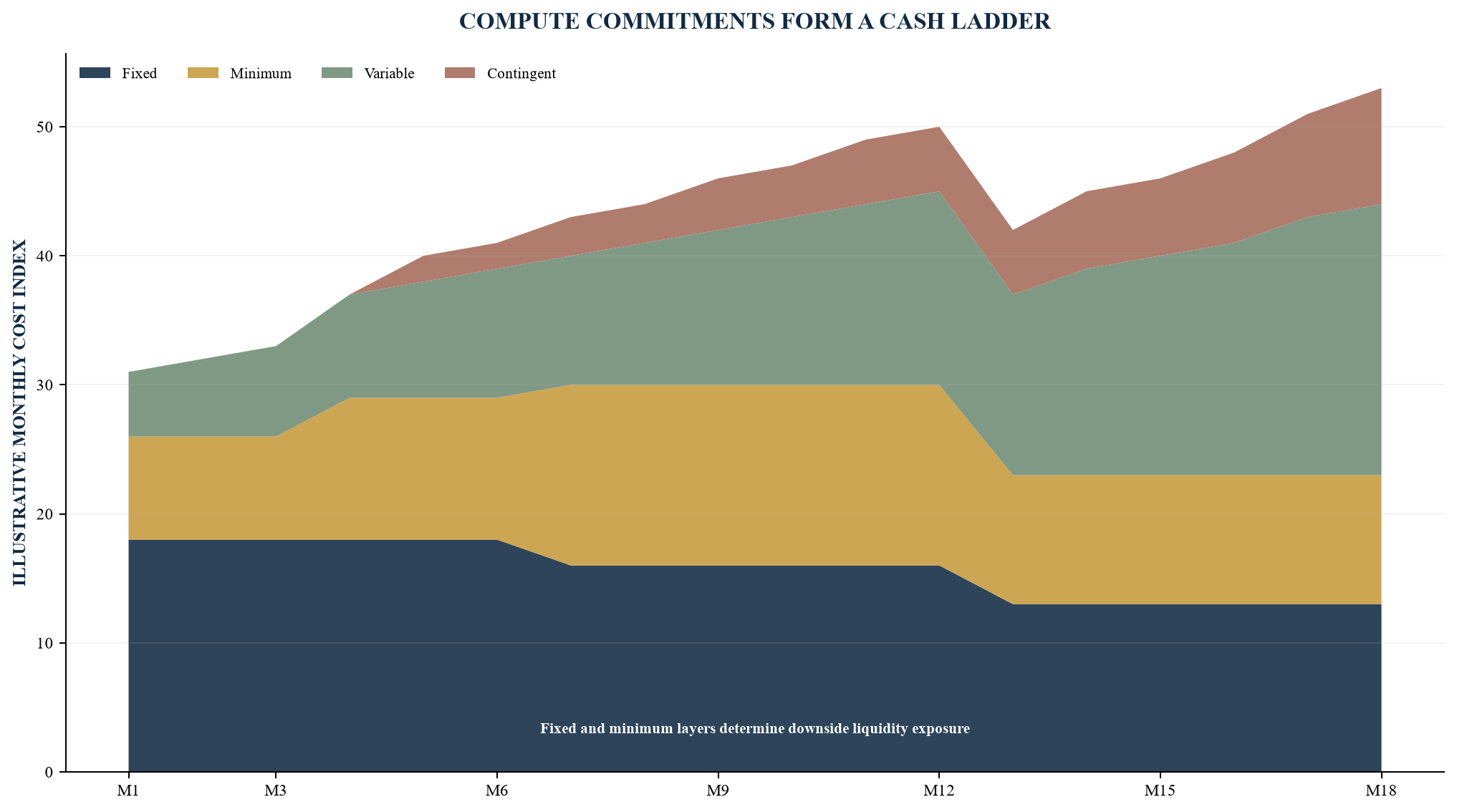
The indexed commitments are illustrative and require contract-level validation.
Table 3. Compute-contract register
| Contract layer | Evidence | Cash risk | Financing response |
|---|---|---|---|
| fixed | executed order, invoice schedule and service term | payment continues when usage falls | size minimum liquidity against the full fixed schedule |
| minimum | consumption floor, true-up and credit rules | unused capacity can become stranded cost | align draw and customer ramp with commitment step-ups |
| variable | unit pricing, usage telemetry and invoice | cost follows demand but unit price may change | test price, usage, margin and collection sensitivity |
| contingent | overage, termination, migration and renewal clauses | shock appears after a trigger or decision | include trigger-specific cash and approval paths |
| foreign currency | denomination, hedge and payment date | sterling cash cost moves independently of usage | model rates, headroom and hedging governance |
| portability | architecture, data, approvals and migration plan | practical lock-in can exceed contractual term | preserve alternatives and fund realistic migration time |
| customer recovery | pricing, pass-through and minimum commitment | infrastructure cost may not convert into cash promptly | reconcile billing rights, invoice timing and collections |
Legal, accounting, tax, data and operational treatment should be reviewed for each arrangement.
7. Integrate runway, milestones and debt service
Runway should be calculated from a monthly integrated cash model. Opening unrestricted cash plus receipts, financing and permitted facility drawings, less operating payments, compute obligations, capital expenditure, taxes, fees, interest and principal, produces closing cash. The model should reconcile to bank statements and the statutory cash-flow architecture described by IAS 7.[7] Restricted cash, undrawn facilities subject to conditions and expected equity should remain separate from available cash.
Gross runway is the period until cash reaches zero. Usable runway is the period until cash reaches the board-approved minimum liquidity or another decision threshold. The threshold should reflect payroll, taxes, critical suppliers, service continuity, covenant headroom, notice periods and the time required to raise alternative capital. Financing action should begin before usable runway expires.
Milestones should be placed on the same monthly axis as cash. Each milestone needs a definition, owner, evidence, earliest completion, central date, downside date and cash implication. The model should show whether a delayed milestone increases product cost, postpones revenue, extends compute commitments or moves the next financing event. A milestone that does not change cash generation, risk or financing options may be operationally important while offering little repayment support.
Debt service should be modelled from the actual term sheet. Interest-only periods, payment-in-kind options, amortisation, final maturity, fees, warrants, prepayment, draw windows and minimum cash requirements affect runway. Management should include professional fees and transaction taxes where applicable. A delayed draw may reduce interest cost but can create funding risk if conditions cannot be met later.
Forecast vintages should be preserved monthly. Actual cash, revenue, retention, compute cost and milestone status should be loaded and explained. The board and lender should see forecast error and assumption changes. A financing model that is refreshed by overwriting prior assumptions cannot support disciplined covenant or liquidity decisions.
8. Size debt to the weakest binding constraint
Debt capacity should be the lowest amount supported by several independent tests. A revenue multiple can provide a market reference, but it does not capture compute obligations, cash timing, concentration, covenant headroom or refinancing. An equity-round percentage can reflect sponsor support, but it may become stale as cash is spent and market conditions change. The integrated model should identify the binding constraint.
The liquidity test asks how much debt can be drawn while maintaining minimum cash through approved downside cases. The debt-service test asks whether interest and principal can be paid from credible cash sources. The revenue-quality test limits reliance on weak, concentrated, cancellable or uncollected ARR. The compute-coverage test examines fixed and minimum infrastructure obligations. The milestone test limits debt to the amount needed to reach an observable financing inflection. The repayment test assesses cash generation, equity support, refinancing or exit.
Sizing should include a no-debt case, proposed case and reduced case. This allows the board to compare dilution avoided, interest and fees, runway gained, covenant exposure and financing outcomes. The analysis should also test a later equity round at a lower valuation, because debt can concentrate negotiating pressure when the company is close to a covenant or maturity date.
The final quantum should include a liquidity reserve. Drawing every available pound can create interest drag and lender concern while leaving no room for forecast error. Committing a facility with staged draws can preserve optionality when conditions and availability are clear. A larger headline commitment is valuable only when the company can access it at the required time.
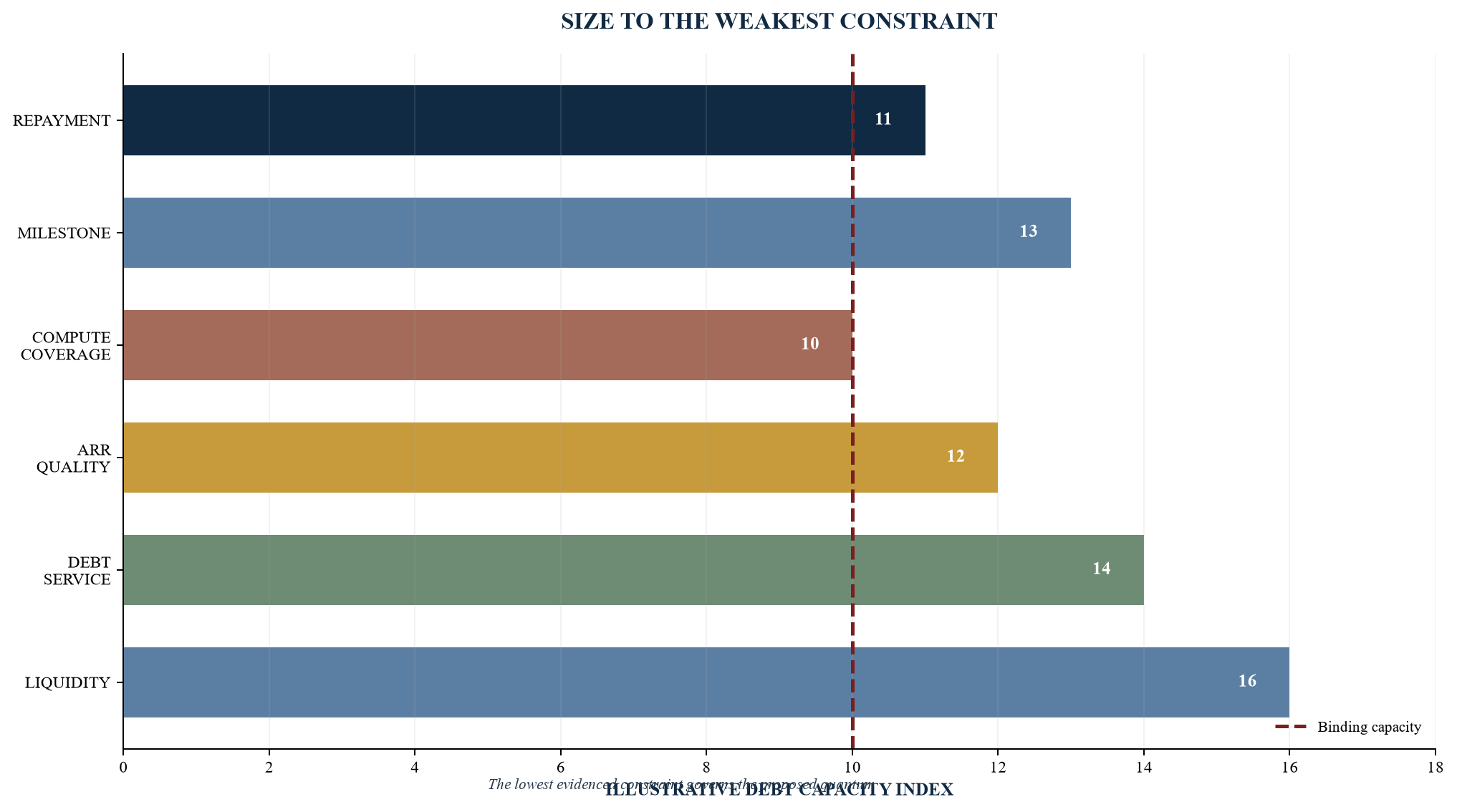
Values are illustrative management assumptions; actual capacity depends on transaction-specific evidence and terms.
Table 4. Illustrative debt-sizing cases
| Case | Draw index | Minimum cash | Milestone timing | Compute response | Financing consequence |
|---|---|---|---|---|---|
| central | 10 | 6 | approved date | planned optimisation delivered | runway reaches evidence-led equity process |
| commercial delay | 8 | 6 | three months late | variable use falls; minimum persists | smaller draw and earlier equity preparation |
| compute shock | 7 | 7 | one month late | unit cost and minimum step-up increase | staged draw, procurement action and more reserve |
| concentration loss | 5 | 8 | milestone redefined | stranded capacity requires mitigation | equity support or restructuring before debt |
| stronger conversion | 10 | 6 | two months early | utilisation improves within commitment | preserve prepayment and delayed-draw options |
| severe downside | 0 | 9 | not achieved in horizon | fixed obligations dominate | avoid draw and implement board-approved contingency |
Values are illustrative management assumptions and are not financing terms or forecasts.
9. Design economics, draw mechanics and maturity together
The cost of venture debt has several components. Cash interest affects monthly runway. Payment-in-kind interest preserves near-term cash while increasing the claim at maturity. Arrangement, commitment, monitoring, legal and exit fees change the effective cost. Warrants or other equity participation create dilution that should be modelled under several valuation outcomes. Prepayment premiums and make-whole provisions can make a successful early refinance expensive.
The company should calculate an all-in financing schedule under central and downside cases. The schedule should show cash paid, principal accretion, warrant dilution, fees, professional costs and the timing of each item. A single annual percentage can be misleading when draws are staged or when a material part of the return is contingent on equity value. The analysis should use the actual term sheet and receive legal, tax and accounting review.
Draw mechanics should follow the operating plan. A single initial draw provides certainty but starts interest immediately and can encourage premature spending. Tranches can align funding with milestones and reduce carry cost, but later availability may depend on conditions that become difficult to satisfy. The company should identify which conditions are objective, which require lender discretion, how long evidence preparation takes and what happens if a milestone is achieved after the draw window.
Maturity should extend beyond the expected financing milestone by enough time to absorb delay, complete diligence and negotiate alternatives. A maturity that sits immediately after a product or revenue milestone transfers execution delay into refinancing distress. An excessively long maturity can increase total cost and impose covenants beyond the period the debt is intended to bridge. The board should see the schedule from draw through milestone, financing process, documentation, funding and repayment.
Amortisation should reflect the expected cash profile. Early principal payments can reduce risk and total interest for a company approaching cash generation. They can also consume cash before the growth plan matures. A bullet maturity preserves runway while concentrating refinancing risk. A hybrid structure with an interest-only period followed by amortisation may fit some cases when the conversion from milestone to cash generation is credible.
10. Build covenants as early decision points
Covenants should create useful decision points before value is impaired. They should use definitions that can be measured from the company's systems and reconciled to approved accounts. A covenant that relies on an undefined ARR figure or an untested forecast invites dispute. Definitions, exclusions, currency translation, acquisitions, disposals, intercompany items and accounting changes should be documented.
Minimum liquidity is often central for a loss-making borrower. The threshold should reflect usable cash and facility access, excluding restricted or trapped balances. The testing frequency, cure period and notice mechanics matter. A high threshold can force early action and protect stakeholders, while an inflexible threshold can create a technical default during normal working-capital volatility. The board should test the trigger across daily and monthly cash patterns.
Revenue covenants may use ARR, recurring revenue, recognised revenue, bookings or customer metrics. The measure should match the evidence and risk. An ARR test can be useful when the definition removes non-live, cancellable or weak revenue. A recognised-revenue test benefits from accounting discipline but can lag changes in the recurring base. Customer concentration, gross retention and collections may provide complementary warning signals without all becoming formal covenants.
Compute exposure can be controlled through reporting, negative covenants or consent rights. Examples include limits on new minimum-spend commitments, hardware purchases, liens, long-term data contracts or material architecture changes. These controls should preserve ordinary-course engineering and procurement within approved budgets. Decision rights should focus on obligations that alter downside liquidity or lender security.
Headroom should be measured in time and value. Management should identify the date at which a covenant is expected to be tested, the earliest forecast breach, the cash or operating movement needed to breach, and the action lead time. The covenant calendar should include certificates, accounts, budgets, compliance information, board approvals, draw notices and renewal dates. A delayed certificate can create an avoidable default even when the underlying business remains within limits.
Cure rights and waiver mechanics should be understood before signing. An equity cure may permit shareholders to contribute cash, but its application to revenue, EBITDA, liquidity or leverage can differ. Repeated cures may be restricted. Waivers can carry fees, revised economics or new conditions. The board should not assume that supportive investors or lenders will provide capital or consent; support should be evidenced through executed arrangements.
Table 5. Covenant architecture for an AI venture-debt facility
| Control | Definition focus | Headroom evidence | Escalation design |
|---|---|---|---|
| minimum liquidity | unrestricted cash, permitted accounts and available drawings | daily cash plus monthly downside forecast | early-warning threshold, board review, formal test and cure |
| recurring revenue | live contracted base, permitted usage floor and exclusions | customer-level bridge reconciled to billing and accounts | variance explanation, remediation plan and test date |
| customer concentration | top exposures by revenue, cash and contract minimum | renewal ladder and collections history | lender notice before material loss or amendment |
| compute commitment | fixed, minimum and contingent obligations | contract register and monthly cash ladder | consent for material new commitments outside plan |
| additional debt and liens | permitted baskets, security and intercompany claims | legal-entity debt and security register | prior approval and document delivery |
| reporting | accounts, forecasts, compliance and milestone evidence | controlled close calendar and named owners | notice, remediation period and reserved decision |
| material adverse change | negotiated legal wording and disclosed risks | legal advice and contemporaneous board evidence | immediate escalation under transaction documents |
Covenant design and enforceability depend on negotiated documents and applicable law.
11. Use downside cases to expose the failure path
A downside case should describe an internally consistent operating state. Cutting revenue without changing usage, hiring, compute or collections can produce a mathematically simple but operationally impossible model. The business should specify customer behaviour, sales conversion, product delivery, infrastructure use, staffing, payment timing and financing availability for each scenario.
The first downside should delay the core milestone. The second should combine commercial delay with a compute or cost shock. The third should test customer concentration or investor-support failure. A severe case should identify when the board must change the plan, raise equity, negotiate terms, sell assets, reduce cost or seek restructuring advice. Probabilities may be used when supported, but decision-making should still examine the full consequence of plausible failure.
Reverse stress testing starts from a liquidity or covenant failure and works backward to the combination of events that creates it. The analysis can reveal that a relatively small collection delay, customer loss or infrastructure step-up becomes critical when it occurs near a debt-service date. It can also identify the lead time available for mitigation.
The downside waterfall should distinguish cash preservation from value preservation. A rapid reduction in research, engineering, safety, security or customer support may extend near-term cash while reducing revenue durability or enterprise value. Actions should show timing, implementation cost, reversibility, contractual consequence, stakeholder effect and expected cash benefit. Gross savings should not be treated as realised cash until implementation and bank evidence support the claim.
The company should maintain a decision log. Each trigger needs an owner, authority, date, information requirement and approved action. Decisions about workforce, creditor payments, security, fundraising, asset sales and continued trading can have legal consequences. Current UK corporate, employment, insolvency, tax and regulatory advice should be obtained before action.
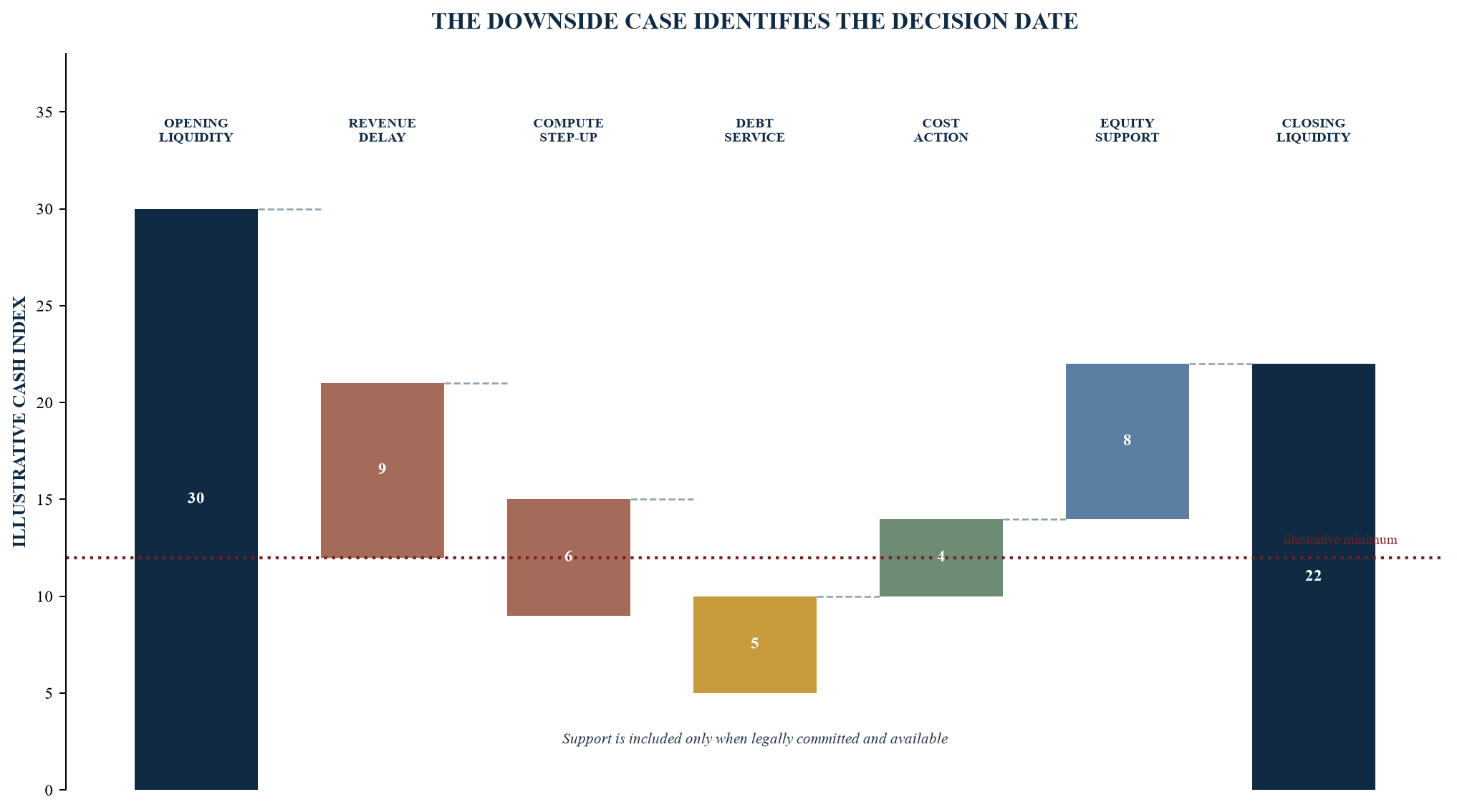
Values and actions are illustrative management assumptions and do not represent an actual company.
12. Align security, priority and investor support
Venture-debt security can include bank accounts, receivables, intellectual property, shares, equipment and other company assets. The practical value and enforceability of security depend on ownership, legal entity, jurisdiction, registration, prior liens, contractual restrictions and transaction documents. Intellectual property may be central to enterprise value while being difficult to realise independently of the team, data, customers and operating platform.
The company should maintain an entity and asset map. It should identify where contracts, revenue, cash, employees, data, models, code, trademarks, patents, hardware and licences sit. Intercompany arrangements should be documented. A lender taking security over one entity may have limited access to value held elsewhere. The map also supports tax, data-protection and regulatory analysis.
Existing investor rights can interact with debt. Reserved matters, consent rights, negative pledges, liquidation preferences, pro rata rights, convertible instruments and shareholder loans should be reviewed. The financing process should establish which approvals are required and when. Investor support should be evidenced from formal commitments rather than management expectations.
Priority should be modelled in a downside distribution. Secured debt, insolvency costs, preferential claims, other creditors and shareholder instruments can have different ranks and recoveries. The model should use legal advice and realistic realisation costs. An enterprise-value multiple applied to headline ARR is not a substitute for analysing the assets, liabilities, security and time needed to realise value.
Intercreditor arrangements matter when the company has bank facilities, asset finance, revenue finance, government-backed instruments or shareholder debt. Standstill, payment blockage, enforcement control, turnover and lien-priority provisions can affect liquidity and restructuring options. These terms should be evaluated before adding debt, rather than discovered during a covenant event.
13. Build a lender evidence room around the credit decision
The lender data room should mirror the six gates. It should contain the financing purpose, board-approved plan, historical and forecast financials, monthly cash model, ARR bridge, customer contracts, compute register, product and security evidence, cap table, debt and lien register, legal-entity map, tax and regulatory information, insurance, material disputes and transaction approvals. Each file should have an owner and cut-off date.
Quality matters more than volume. A lender needs consistent definitions across the model, management presentation, accounts, customer schedule and legal documents. If ARR in the presentation differs from the customer file, the company should provide a reconciliation. If cloud commitments in procurement differ from the cash model, the difference should be resolved before lender diligence.
Customer and provider contracts contain confidential information and may restrict disclosure. The company should follow legal advice, confidentiality obligations, data-protection requirements and controlled-access procedures. Personal data should be minimised. Redaction should preserve the evidence needed for underwriting while protecting information that the recipient is not entitled to receive.
The model should include an assumptions register. Each assumption needs a source, owner, approval, central value, downside value and sensitivity. Commercial assumptions should link to customer evidence. Compute assumptions should link to provider contracts and telemetry. Financing assumptions should link to term sheets or executed documents. Unsupported amounts should remain visible as management estimates.
Questions and answers should be logged. The log should show request, date, owner, response, evidence, follow-up and closure. This prevents inconsistent answers and reveals where the financing case lacks evidence. Material corrections should be communicated through a controlled process. A lender should receive the same current version that management and the board use for the decision.
14. Govern the financing process as a 100-day programme
The first phase establishes the fact base. Management should confirm purpose, governance, model definitions, bank and ledger reconciliation, customer contracts, compute obligations, existing debt, security and approvals. The output is a board-approved financing brief and an evidence-gap register. Major gaps should be addressed before broad lender outreach.
The second phase builds the credit case. Finance should produce the integrated monthly model, ARR bridge, compute ladder, sizing constraints, covenants and downside cases. Commercial, engineering, legal and investor inputs should be reviewed through named owners. Management should decide the preferred quantum, draw structure, maturity, security and fallback plan.
The third phase runs the lender process. The company should approve the lender universe, information release, management presentation, response protocol and evaluation scorecard. Proposals should be compared on availability, total economics, draw conditions, amortisation, covenants, security, reporting, cure, prepayment, documentation and execution certainty. Headline interest alone is an incomplete comparison.
The fourth phase documents and closes. Legal advisers should negotiate facility, security, intercreditor, warrant and corporate documents. Finance should update the model for final terms. The board should review the final economics, downside effects, conditions precedent and authority. Closing evidence should be preserved with an obligations calendar.
The fifth phase begins after funding. Monthly reporting, covenant certificates, ARR and compute reconciliations, milestone evidence, cash forecasting and decision logs should operate from the first month. Debt should become part of the operating system. A financing process that ends at cash receipt leaves the company exposed to avoidable reporting failures and late covenant decisions.
Table 6. One-hundred-day venture-debt execution plan
| Phase | Primary work | Decision output | Control evidence |
|---|---|---|---|
| days 1-15 | mandate, purpose, cash, ARR, compute, debt and security fact base | financing brief and evidence-gap register | board mandate, reconciliations and owner map |
| days 16-30 | integrated model, six gates, downside and quantum | approved financing parameters and fallback | model version, assumptions and sensitivity record |
| days 31-45 | lender universe, materials and controlled data room | approved outreach and evaluation scorecard | confidentiality, release log and complete core pack |
| days 46-65 | lender meetings, diligence and proposals | shortlisted executable structures | question log, proposal comparison and model updates |
| days 66-85 | term-sheet selection and documentation | approved legal and economic position | board paper, advice, drafts and conditions register |
| days 86-100 | closing, draw readiness and reporting mobilisation | funded facility and operating calendar | executed documents, cash evidence and covenant schedule |
| post-close | monthly reconciliation, reporting and decision management | maintained headroom and financing options | compliance certificates, forecasts, milestones and logs |
Timing is indicative and should reflect company readiness, lender process and transaction complexity.
15. Set board governance and information standards
The board should approve the financing purpose, quantum range, minimum liquidity, material assumptions, covenant risk, security, investor support and fallback plan. It should receive enough information to understand both the expected value and the path to failure. The paper should show the company without debt, with proposed debt and under downside cases.
Directors' duties continue through the financing process. Section 172 of the UK Companies Act 2006 requires a director to act in the way considered, in good faith, most likely to promote the success of the company for the benefit of members as a whole, while having regard to specified factors.[8] Duties and creditor considerations can change as financial distress develops; current legal advice should be obtained for the company's circumstances.[9]
The monthly board pack should include cash, runway, covenant headroom, ARR bridge, retention, concentration, collections, compute obligations, gross margin, milestone status, forecast variance and financing actions. Definitions should remain stable. When management changes a metric, the pack should explain the change and provide a bridge to prior periods.
The board should distinguish observed results, executed commitments and management forecasts. Forecasts are necessary for financing decisions, but their uncertainty should be visible. Scenario assumptions should be approved. Investor support, customer renewals, provider concessions and lender waivers should not be included as available cash until the relevant arrangement is legally effective and conditions are satisfied.
Information provided externally should be controlled. Material statements about contracts, customers, technology, intellectual property, security, compliance and forecasts should be reviewed by accountable owners and advisers. Corrections should be issued promptly. The objective is a financing record that the board, management and lender can reconstruct later.
16. Decision framework and conclusion
The company should proceed when the six gates close coherently. The debt finances a defined value-inflection plan. ARR is reconciled and sufficiently durable. Compute obligations are understood and manageable. The integrated model preserves usable liquidity in approved downside cases. Covenants provide workable headroom and early decisions. Repayment or refinancing has a credible route supported by cash generation, equity, refinance or exit evidence.
The company should resize or stage the facility when the financing purpose is sound but uncertainty remains concentrated in timing. Tranches, delayed draws, longer maturity, lower amortisation, wider headroom or a larger equity reserve can align funding with evidence. Every structural change has a cost and should be evaluated in the same integrated model.
The company should pause when debt would mainly fund an unresolved business model, weak revenue evidence, inflexible compute commitments or a financing cliff. Equity, strategic capital, customer prepayment, contract restructuring, revenue finance, grants, cost action or a smaller plan may fit better. The decision should protect operating options and stakeholder value rather than maximise debt proceeds.
The central insight is that venture debt for an AI company is an operating-design problem expressed through finance. ARR quality determines how commercial claims convert into cash evidence. Compute commitments determine how technical architecture converts into fixed and variable obligations. Covenants determine when performance variance becomes a financing decision. The six-gate framework connects these systems before fixed claims are added to the balance sheet.
The framework also supports lender credibility. A borrower that can reconcile revenue, compute, cash, milestones and downside actions gives the lender a clearer basis for underwriting and monitoring. A lender can then focus terms on the actual risks rather than compensate for opacity through blunt restrictions. This creates a more useful negotiation and a stronger post-close operating discipline.
References
- British Business Bank. (2026). AI dominates UK smaller-business equity market: record investment share as overall funding falls. https://www.british-business-bank.co.uk/news-and-events/news/ai-dominates-uk-smaller-business-equity-market-record-investment-share-overall-funding-falls
- Bank of England. (2026). Financial Stability Report, July 2026; Section 2, the macrofinancial implications of AI. https://www.bankofengland.co.uk/financial-stability-report/2026/july-2026
- Bank for International Settlements. (2026). AI disruption in private credit: exposure to software firms in BDCs. BIS Bulletin No. 128. https://www.bis.org/publ/bisbull128.htm
- British Business Bank. What is venture debt? https://www.british-business-bank.co.uk/business-guidance/guidance-articles/finance/what-is-venture-debt
- IFRS Foundation. IFRS 15 Revenue from Contracts with Customers. https://www.ifrs.org/issued-standards/list-of-standards/ifrs-15-revenue-from-contracts-with-customers/
- Competition and Markets Authority. (2025). Cloud services market investigation: final decision and supporting appendices. https://www.gov.uk/cma-cases/cloud-services-market-investigation
- IFRS Foundation. IAS 7 Statement of Cash Flows. https://www.ifrs.org/issued-standards/list-of-standards/ias-7-statement-of-cash-flows/
- UK Parliament. Companies Act 2006, section 172. https://www.legislation.gov.uk/ukpga/2006/46/section/172
- Insolvency Service. Director information hub: company insolvency and director responsibilities. https://www.gov.uk/guidance/director-information-hub-company-insolvency
- Bank for International Settlements. (2026). Private credit's software lending meets AI disruption. BIS Quarterly Review, March 2026. https://www.bis.org/publ/qtrpdf/r_qt2603v.htm
- Basel Committee on Banking Supervision. (2025). Principles for the Management of Credit Risk. https://www.bis.org/bcbs/publ/d591.htm
- Competition and Markets Authority. (2026). CMA announces package of actions on business software and cloud services. https://www.gov.uk/government/news/cma-announces-package-of-actions-on-business-software-and-cloud-services
- UK Government. (2025). AI Opportunities Action Plan. https://www.gov.uk/government/publications/ai-opportunities-action-plan
- IFRS Foundation. IAS 1 Presentation of Financial Statements; going-concern requirements. https://www.ifrs.org/issued-standards/list-of-standards/ias-1-presentation-of-financial-statements/
- IFRS Foundation. IFRS 9 Financial Instruments. https://www.ifrs.org/issued-standards/list-of-standards/ifrs-9-financial-instruments/
- Information Commissioner's Office. Guidance on AI and data protection. https://ico.org.uk/for-organisations/uk-gdpr-guidance-and-resources/artificial-intelligence/
- National Cyber Security Centre. Guidelines for secure AI system development. https://www.ncsc.gov.uk/collection/guidelines-secure-ai-system-development
- British Business Bank. (2026). Small Business Finance Markets 2025/26. https://www.british-business-bank.co.uk/research-and-publications/small-business-finance-markets-report-2026
About the Author
Chennakeshav Adya is an independent researcher and Managing Partner of Matchpoint Partners. His work focuses on corporate finance, transactions, private capital, strategic execution and the operating systems required to convert financing into measurable enterprise value.
