

1. The portfolio begins before the first asset closes
A warehouse is an operating system for acquiring, funding, controlling and reporting assets during the period before long-term ownership or take-out. It can sit on a bank balance sheet, within a private fund, inside a special-purpose vehicle or across a managed account. The legal form changes the analysis. The core discipline remains: each acquired asset must satisfy the warehouse mandate on the acquisition date and remain measurable throughout its life.
The design should begin with the intended destination of the assets. A bank treasury, a closed-end fund, a family-office mandate, a takaful investor and a sukuk investor can require different cash-flow profiles, liquidity, ratings, concentration, documentation and governance. A warehouse built without an identified investor evidence set can accumulate assets that are individually sound yet difficult to finance or sell as a portfolio.
The acquisition team should therefore define four things before origination: the eligible asset universe, the portfolio construction limits, the data and servicing standard, and the permitted exits. The mandate should also specify who can approve exceptions, how exceptions affect advance rates, and when an asset must be removed or funded with equity.
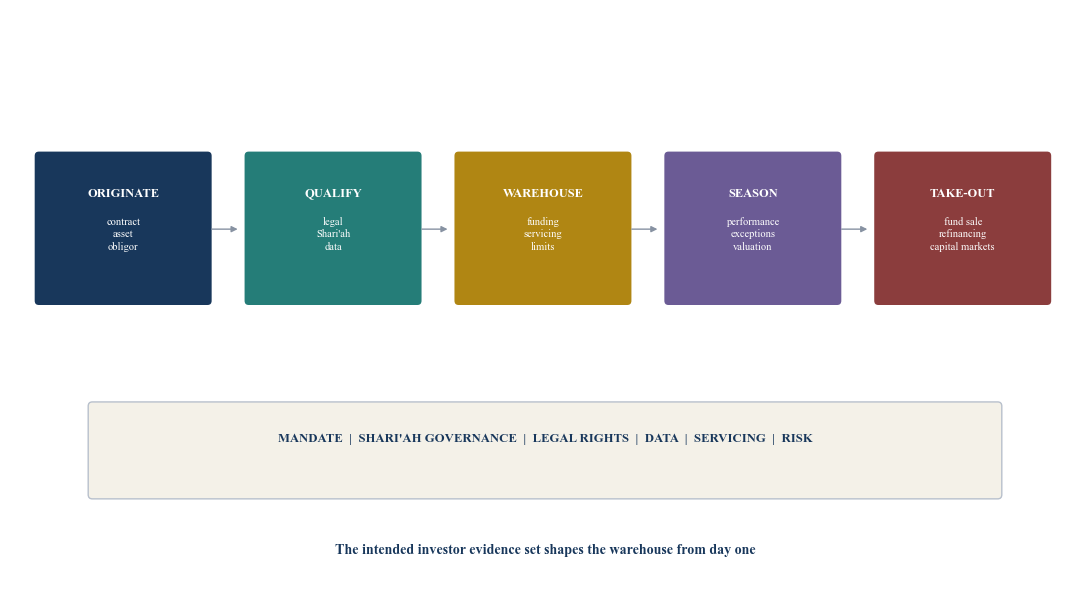
Author framework. Each gate requires evidence, an accountable owner and a recorded decision.
2. Separate the financing contract from the portfolio instrument
The bilateral financing contract establishes the relationship with the obligor and the asset or transaction being financed. The portfolio instrument establishes how a warehouse lender, fund investor or capital-markets investor gains economic and legal exposure to a pool. The two layers can use different contracts, entities, cash waterfalls and governance.
The portfolio should not be described by a product label alone. A murabaha financing can contain a receivable created by a documented sale, yet the originator's title chain, purchase evidence, payment schedule, security, representations, set-off exposure and transfer restrictions still require review. An ijara arrangement can involve ownership of a leased asset or an interest in lease cash flows, with maintenance, insurance, residual-value and asset-condition obligations. Musharaka, diminishing musharaka, wakala and other structures create their own rights and duties.
The IFSB capital standard notes that assets in a sukuk securitisation must comply with Shari'ah principles and identifies ijara assets, murabaha or salam receivables, istisna assets and partnership interests as possible underlying exposures, subject to Shari'ah rules. It also recognises that a mixed portfolio can have different tradability considerations.[9] That regulatory discussion is a useful warning against treating all cash flows as interchangeable.
The portfolio designer should map the precise asset and right being acquired, the transfer mechanism, the continuing obligations of the originator, and the rights available after default. Transaction-specific Shari'ah and legal opinions remain essential.
3. Establish Shari'ah governance at portfolio level
Shari'ah approval of an original product does not by itself determine the treatment of a later sale, participation, warehouse financing or portfolio issuance. The new structure can change ownership, agency, cash-flow priority, liquidity support, purchase undertakings, fees, default treatment and the composition of the asset pool.
The CBUAE's in-force Shari'ah Governance Standard requires Islamic financial institutions within scope to maintain governance controls appropriate to the size and complexity of their operations. It assigns responsibilities to the board and senior management and requires an Internal Shari'ah Supervision Committee, internal control and internal audit functions.[1] The 2025 standard on the Shari'ah compliance function complements that framework and requires policies and mechanisms that address the relevant regulatory requirements.[2]
A warehouse governance map should state which entity is within a regulated Islamic-finance perimeter, which Shari'ah body approves the asset and portfolio documents, who verifies ongoing compliance, and how a breach is treated. It should address asset substitution, late-payment amounts, purification where applicable, amendments, restructurings, enforcement and sale at exit.
The approval record should identify the exact documents and conditions reviewed. A generic product resolution should not be used as evidence for a materially different transfer or portfolio structure without confirmation from the relevant qualified authority.
Table 1. Minimum diligence file for each acquired asset
| File component | Evidence | Portfolio question | Accountable review |
|---|---|---|---|
| Executed financing documents | signed facility, schedules and amendments | what right and payment obligation exist? | legal and credit |
| Asset transaction evidence | purchase, title, lease or partnership records | did the underlying steps occur as documented? | operations, legal and Shari'ah |
| Shari'ah approval | product and transaction resolutions or certification | which structure and conditions were approved? | Shari'ah governance |
| Obligor diligence | ownership, financial, KYC and sanctions records | who owes the cash and under what capacity? | compliance and credit |
| Security package | registration, notices, control and valuation | what protection is perfected and enforceable? | legal and collateral |
| Payment schedule | amount, date, currency and account | can cash flows be modelled and reconciled? | servicing and finance |
| Transfer analysis | consent, notice, prohibition and perfection | can the intended interest be transferred? | legal |
| Tax and accounting | adopted treatment and open issues | how does transfer affect cash, value and reporting? | tax and finance |
| Data record | field dictionary, lineage and exception log | can investors reproduce the portfolio view? | data owner |
| Servicing plan | collection, allocation, arrears and continuity | who performs each duty after transfer? | servicer and operations |
The required evidence depends on the product, parties, jurisdiction, mandate and investor.
4. Build an asset taxonomy that reflects legal substance
The taxonomy should classify assets by economic purpose and by legal form. Economic purpose can include working capital, equipment, real estate, acquisition, project, trade or growth finance. Legal form can include sale-based receivables, leased assets or lease rights, partnership interests, agency investments and other approved structures.
The classification should extend to obligor sector, jurisdiction, currency, maturity, amortisation, payment frequency, security, guarantor, seniority and collateral type. It should record whether the asset is fully funded, partially drawn, revolving, under construction, contingent or subject to performance obligations.
Portfolio construction depends on the interaction of those fields. A pool described as mid-market murabaha can still concentrate on one sponsor, one commodity broker, one payment account, one governing law or one maturity date. An ijara pool can share exposure to one asset supplier, maintenance agent or residual-value assumption.
The taxonomy should be version controlled. A restructuring can convert the payment schedule or change security. An amendment can alter transfer consent. A partial prepayment can change weighted-average life. The warehouse record should retain the original classification and the current classification with an effective date.
Table 2. Product-feature matrix for portfolio design
| Structure family | Portfolio asset to identify | Cash-flow evidence | Transfer and servicing focus | Portfolio risk focus |
|---|---|---|---|---|
| Murabaha | identified receivable and supporting sale steps | deferred-price schedule and receipts | receivable assignment, notice, set-off and collection | obligor, documentation and concentration |
| Ijara | owned asset, usufruct or lease-related right | rental schedule and asset records | title, lease transfer, maintenance and insurance | asset condition, lessee and residual value |
| Diminishing musharaka | partnership interest and acquisition units | rent, profit and unit-purchase records | interest transfer, undertakings and asset ownership | partner performance and valuation |
| Wakala investment | agency mandate and underlying investments | agency reports and realised cash | authority, segregation, substitution and reporting | agent, underlying asset and operational risk |
| Istisna-based finance | construction or manufacture obligation and related right | milestone, delivery and payment records | completion, acceptance, parallel contracts and transfer | performance, completion and counterparty |
| Mixed portfolio | defined interests across approved structures | consolidated schedule with asset-level lineage | composition tests and structure-specific controls | tradability, concentration and complexity |
The matrix identifies questions for specialist review and does not state a universal Shari'ah or legal outcome.
5. Underwrite the obligor and the asset twice
The first underwriting decision asks whether the bilateral financing should be originated. The second asks whether it belongs in the warehouse and at what advance rate. An asset can be acceptable for a lender's balance sheet and still be unsuitable for a portfolio because its documentation, data, transferability, maturity or concentration does not fit the mandate.
The CBUAE Credit Risk Management Regulation applies to licensed financial institutions within its scope and covers the full credit lifecycle, including origination, underwriting, approval, monitoring, portfolio management, recovery and provisioning.[4] Its underwriting standard requires governance, due diligence, financial analysis, collateral, documentation and an independent credit view. For securitisations, the standard calls for understanding both the underlying assets and the structured vehicle.[5]
A private warehouse outside that direct scope can still use the same evidence disciplines as a design benchmark. The credit file should include obligor cash generation, leverage, debt service, liquidity, sponsor support, structural subordination, collateral, legal risks and downside recovery. The portfolio file should add data completeness, transfer conditions, servicing readiness, concentration consumption and exit compatibility.
The warehouse should calculate eligibility independently of the originator's commercial team. Exceptions should be visible before funding and retained in the investor data room.
6. Test legal transfer, perfection and insolvency outcomes
The transfer analysis should identify whether the warehouse acquires legal title, beneficial ownership, an assignment, participation, security interest, agency right or another form of exposure. It should state when the transfer becomes effective between the parties, against the obligor and against third parties. Consent, notice, registration, possession and control requirements should be mapped.
UAE Federal Decree-Law No. 16 of 2021 defines factoring and transfer of current or future receivables and addresses transfer as a sale, collateral transfer or security arrangement.[7] Federal Law No. 4 of 2020 addresses security rights in movable property, including accounts receivable, and treats certain transferee rights as security rights for the law's purposes.[6] The exact application depends on the transaction and the governing legal regime.
The current UAE Financial Restructuring and Bankruptcy Law establishes priorities and rules affecting secured and ordinary creditors.[8] A transaction opinion should test whether the assets remain beyond the reach of the originator and its creditors, whether a transfer may be recharacterised or challenged, and whether collections remain available after an insolvency event.
The CBUAE's simple, transparent and comparable securitisation criteria describe a true-sale analysis that includes enforceability, separation from the seller and its creditors, recourse to the ultimate obligor and an independent legal opinion.[11] Those criteria have a defined regulatory scope. They provide a useful diligence checklist for a warehouse contemplating a later asset sale.
7. Define eligibility as a three-layer gate
Eligibility should be binary at the asset level and quantitative at portfolio level. The asset gate tests documentation, Shari'ah approval, legal effectiveness, payment status, data, security and servicing. The portfolio gate tests concentrations, weighted-average metrics, maturity, currency and composition. The funding gate applies advance rates, reserves, haircuts and triggers.
The eligibility schedule should contain objective tests where possible. Examples include fully executed documents, completed KYC, no material dispute, at least one observed payment where required, maximum days past due, minimum remaining term, approved currency and complete core data. Subjective terms such as satisfactory should point to an approved methodology and decision authority.
The CBUAE securitisation standard states that assets in a simple, transparent and comparable pool should have defined eligibility criteria and consistent underwriting. It emphasises homogeneity, periodic payment streams, loan-level or stratified data and independent review of initial portfolio conformity.[11] A warehouse can adopt these disciplines well before a capital-markets transaction.
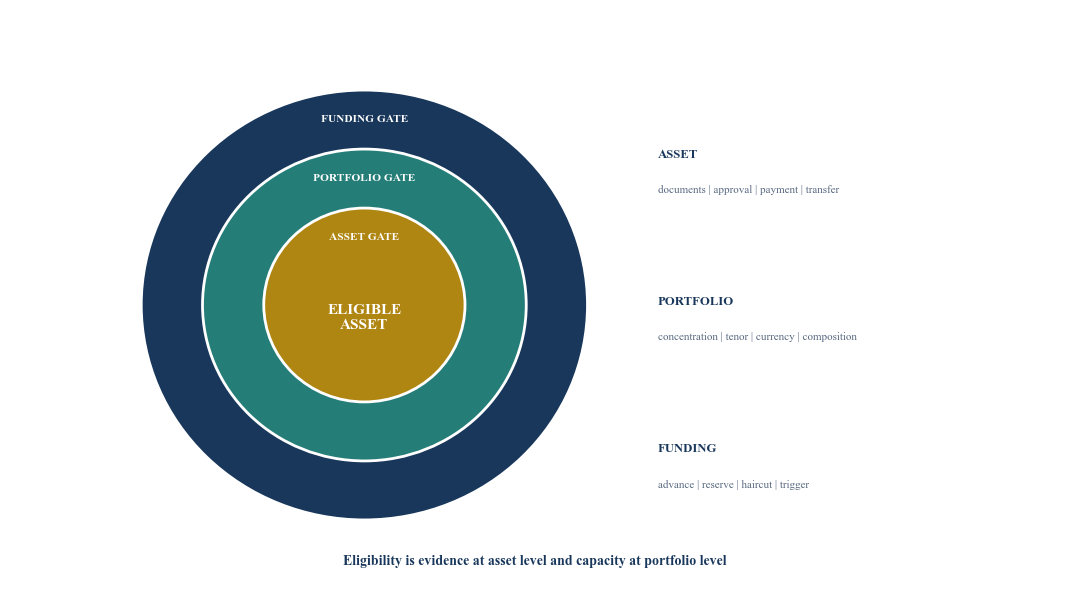
Author framework. Failure at an inner gate prevents the asset from contributing to funded availability unless an approved exception applies.
Table 3. Illustrative warehouse eligibility schedule
| Test | Asset-level evidence | Portfolio calculation | Failure treatment |
|---|---|---|---|
| Executed and complete documents | signed originals or verified electronic record | percentage complete | ineligible until cured |
| Shari'ah approval | identified resolution and compliance confirmation | composition by approved structure | escalate material change |
| Legal transfer | opinion, consent, notice and perfection evidence | percentage perfected | zero advance or approved holdback |
| Payment status | servicer ledger and bank reconciliation | current, arrears and default buckets | haircut, reserve or exclusion |
| Data completeness | mandatory-field validation | field-level completeness rate | cure before funding |
| Remaining maturity | contractual schedule | weighted-average life and maturity wall | limit or exclude |
| Obligor concentration | verified group identifier | group exposure divided by eligible pool | excess funded with equity |
| Sector and geography | approved taxonomy | exposure by sector and jurisdiction | concentration haircut |
| Currency | contractual cash-flow currency | exposure and hedging by currency | currency reserve or exclusion |
| Security status | registration and valuation evidence | secured share and coverage | revalue, reserve or exclude |
| Dispute and set-off | legal and servicing confirmation | disputed share of pool | exclude affected amount |
| Sanctions and KYC | current screening and ownership record | exceptions and refresh status | acquisition blocked |
Tests are examples for design. Every threshold requires approval for the actual mandate.
8. Design the cash and asset-flow architecture
The operating model should show every asset, document and cash movement. The originator executes the bilateral financing and transfers the approved interest to the warehouse under the selected legal mechanism. The servicer bills and collects. Collections move through controlled accounts and are allocated according to the agreed priority.
The warehouse can be funded by equity, a senior facility, a junior facility or another approved instrument. Each funding provider needs defined rights over assets, accounts, data and control events. The priority of payments should address operating expenses, taxes where relevant, senior funding, reserves, junior amounts and distributions.
Commingling risk arises when collections remain in an originator or servicer account. Set-off risk arises when an obligor has claims against the collecting institution. Transition risk arises when servicing must move after default or termination. The structure should define account control, sweep frequency, reconciliation, backup servicing, data access and notices.
Shari'ah review should follow the legal and cash-flow architecture, including fees, liquidity support, reserves, defaults, purchase undertakings, asset substitution and enforcement proceeds. A diagram cannot replace document-level approval.
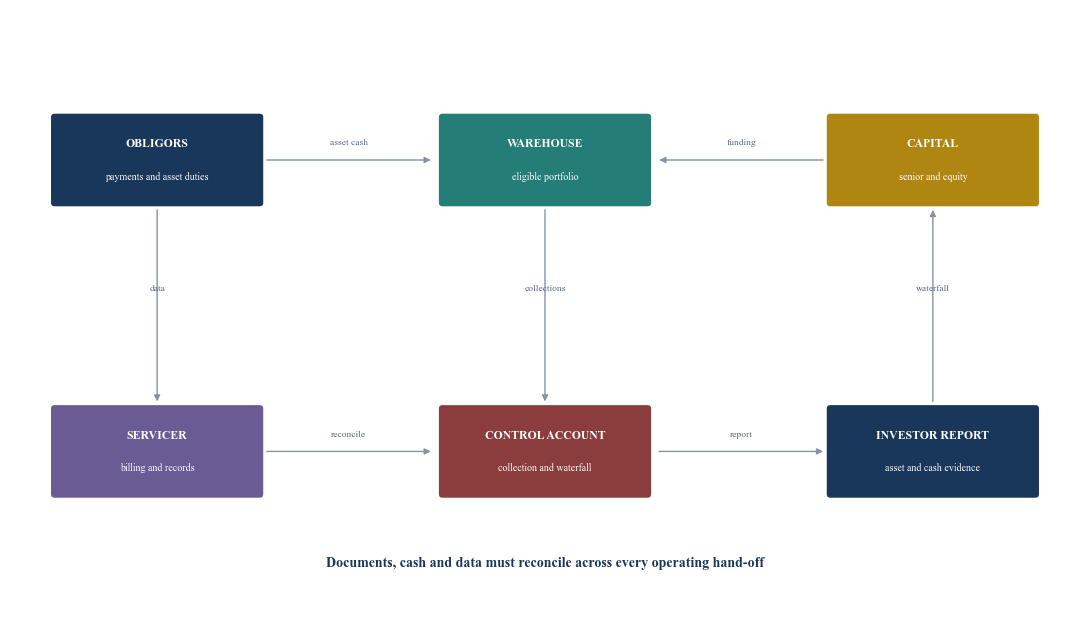
Author framework. Legal title, beneficial ownership, agency and security depend on the approved transaction documents.
9. Create a borrowing base that reflects eligibility and risk
The borrowing base translates eligible assets into funded availability. It begins with the gross portfolio and removes ineligible assets. It then applies concentration exclusions, reserves, advance rates and other approved adjustments. The calculation should be reproducible from asset-level data.
Advance rates can differ by structure, obligor grade, security, tenor, currency, seasoning, data quality or transfer status. A high advance rate increases capital efficiency and reduces protection against loss or uncertainty. The warehouse should align the rate with verified risk and available structural protections.
Reserves should have defined purposes. A dilution reserve can address credits, disputes or offsets. A commingling reserve can address collections held by a servicer. An interest reserve can cover timing under approved documents. A concentration reserve can remove exposure above a limit. A data reserve can reduce availability when mandatory records are incomplete.
Each adjustment needs a calculation owner, data source, effective date and approval. Manual overrides should be rare, logged and time limited.
Table 4. Hypothetical borrowing-base calculation
| Step | Assumed amount | Calculation | Availability effect |
|---|---|---|---|
| Gross portfolio balance | 520.0 | opening asset ledger | starting pool |
| Ineligible documentation | (18.0) | incomplete transfer or approval evidence | excluded |
| Arrears and dispute exclusion | (12.0) | assumed affected balance | excluded |
| Concentration excess | (35.0) | exposure above assumed limits | excluded |
| Eligible portfolio | 455.0 | gross less exclusions | advance-rate base |
| Weighted advance rate | 72.0% | assumed asset-level rates | 327.6 gross availability |
| Commingling reserve | (8.0) | assumed collection exposure | deduction |
| Data and servicing reserve | (4.5) | assumed exception reserve | deduction |
| Currency reserve | (6.0) | assumed unmatched exposure | deduction |
| Final borrowing base | 309.1 | availability less reserves | maximum funded amount |
| Senior funding outstanding | 286.0 | assumed ledger balance | current utilisation |
| Headroom | 23.1 | base less outstanding | subject to all conditions |
Every amount, rate, limit and result is an illustrative management assumption in AED millions.
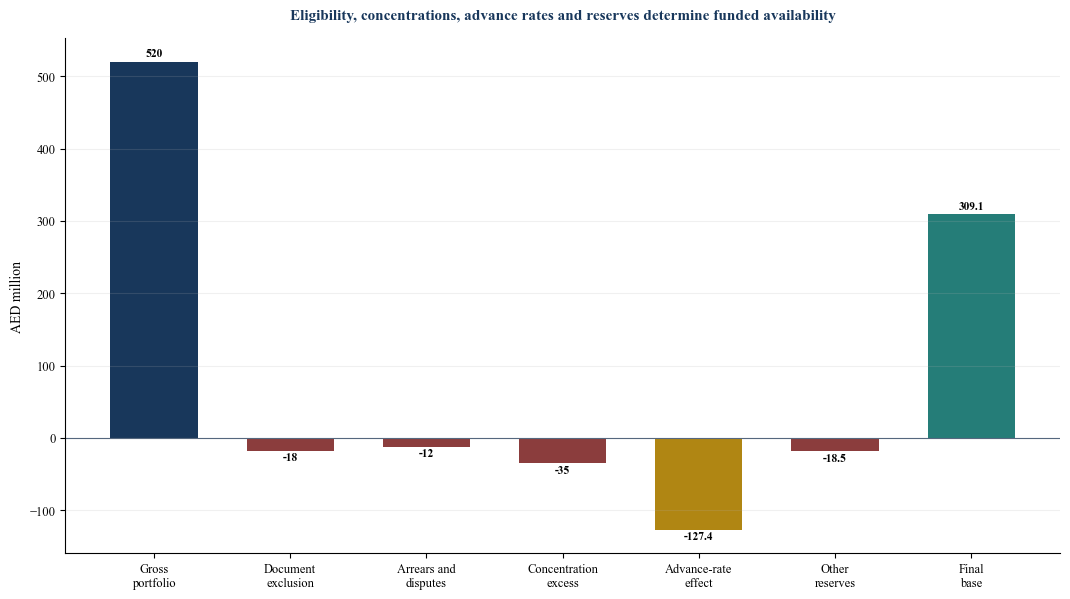
Every displayed amount is an illustrative management assumption in AED millions.
10. Control concentration and correlation
Diversification should be measured by common drivers rather than asset count. Ten facilities can represent one risk when they share an obligor group, sponsor, sector, government contract, commodity, geography, currency, supplier, broker, guarantor or maturity date.
The limit schedule should include single obligor, connected group, sector, jurisdiction, currency, product, security type, maturity band, risk grade, servicer and counterparty. It should also identify less visible dependencies such as one property valuer, one payment account, one takaful provider or one commodity platform.
Correlation assumptions should be documented as management judgements where reliable data are limited. Stress scenarios can test common shocks without presenting the assumed relationship as an observed fact. Examples include a construction slowdown, delayed government receivables, a commodity price shock, higher benchmark rates or interruption at a common servicer.
Concentration excess can be handled through exclusion, a lower advance rate, a reserve, additional equity or a prohibition on further acquisition. The chosen mechanism should be visible in the borrowing base and investor report.
11. Make servicing an investible capability
The servicer converts contractual rights into collected cash and usable data. Its duties should include billing, payment allocation, reconciliation, covenant collection, arrears management, amendments, security monitoring, asset inspections, notices, recovery and reporting. Structure-specific duties can include title records, maintenance or insurance oversight for leased assets and verification of approved asset steps.
The servicing agreement should define standard of care, authority, conflicts, fees, data ownership, audit rights, termination, transition and liability. It should distinguish routine administration from actions requiring lender, trustee, investor or Shari'ah approval.
Collections should reconcile from obligor to bank account, servicer ledger, asset ledger, borrowing base, general ledger and investor report. Breaks should be aged and assigned. A portfolio with attractive yield and weak cash reconciliation remains difficult to finance.
Backup servicing should be practical. A named replacement without data access, document custody, account control, staff procedures and tested migration offers limited continuity.
Table 5. Servicing and continuity controls
| Process | Primary evidence | Control | Escalation trigger |
|---|---|---|---|
| Billing | contractual schedule and approved amendment | maker-checker invoice generation | amount or date differs from contract |
| Collection | controlled bank statement and remittance | daily cash-to-asset reconciliation | unidentified or commingled cash |
| Allocation | approved priority and asset ledger | automated rule with exception queue | manual allocation or partial payment |
| Covenant monitoring | borrower certificate and source documents | due-date calendar and independent review | missing, breached or qualified covenant |
| Asset oversight | title, inspection, takaful or maintenance records | structure-specific checklist | lapsed cover, title issue or asset impairment |
| Arrears | ageing and contact record | defined early-stage and recovery workflow | days past due or dispute threshold |
| Amendment | executed document and approvals | version control and data refresh | economic or Shari'ah terms change |
| Investor reporting | reconciled asset and cash ledger | field validation and sign-off | unexplained variance or late report |
| Document custody | indexed originals or controlled electronic record | completeness and access testing | missing original or inaccessible file |
| Servicer transition | current data extract and procedure manual | periodic migration rehearsal | servicer default, termination or control event |
The control design depends on asset type, mandate, documents and operational model.
12. Build investor-grade data and reporting
An investor should be able to move from portfolio totals to the underlying asset evidence. The data model should use stable identifiers for obligor group, facility, asset, payment, security, account and document. It should retain source, owner, refresh date and validation status for each critical field.
The initial tape should include contractual balance, currency, structure, dates, payment frequency, arrears, obligor group, sector, geography, risk grade, security, valuation, advance rate, eligibility, exception and concentration fields. The investor report should reconcile opening balance, acquisitions, collections, prepayments, defaults, recoveries, write-offs and closing balance.
Historical performance matters. A newly originated pool can lack seasoning. The warehouse should distinguish observed performance from modelled assumptions and originator history from asset-pool history. Definitions of default, cure, restructuring, recovery and loss should remain consistent across reporting periods.
The CBUAE securitisation criteria call for timely loan-level or granular stratification data and standardised investor reporting at least quarterly within their stated scope.[11] A private warehouse can report more frequently when its funding documents or risk profile require it.
13. Value the portfolio and measure loss without false precision
Private Islamic credit assets can lack observable market prices. Valuation can therefore combine contractual cash flows, current credit assessment, benchmark or profit-rate assumptions, prepayment, default, recovery, liquidity and structure-specific obligations. Each input should be classified as observed, contractual or management-estimated.
The valuation policy should define frequency, methodology, data sources, overrides, independent review and escalation. It should address amendments, arrears, payment deferrals, collateral changes, restructurings and impaired assets. The fund's valuation objective can differ from a warehouse borrowing-base calculation or a bank's accounting measurement.
Expected loss analysis should connect probability of default, exposure at default and loss given default under an approved method. A recovery model should include time, enforcement cost, ranking, security perfection, asset condition and operational continuity. The existence of an asset or guarantee should not be converted into an assumed cash recovery without evidence.
Sensitivity ranges are more useful than a single unsupported value. The investor report should explain material changes in contractual balance, fair value, provision, borrowing-base value and recovery estimate.
14. Design the warehouse funding and liquidity plan
The funding structure should match acquisition pace, asset tenor, payment profile, currency and exit horizon. Equity absorbs first uncertainty. Senior funding can increase acquisition capacity subject to eligibility, advance rates, covenants and control rights. A junior facility can add leverage and complexity.
Liquidity needs can arise from delayed collections, asset substitutions, margin or hedging requirements, taxes where relevant, operating costs, funding interest, mandatory prepayment and an exit delay. The plan should include committed cash, reserve accounts, undrawn availability and decision rights.
The funding maturity should allow time for asset ramp-up, seasoning, diligence and take-out. A short facility can force a sale before the portfolio reaches its intended quality. An extension option should not be treated as committed liquidity until its conditions are understood and achievable.
The warehouse should test base, slow-ramp, arrears, concentration-breach, servicer-transition and delayed-exit scenarios. Each scenario should identify the first binding constraint and the management action available under executed documents.
15. Prepare the take-out while the warehouse ramps
Take-out options can include a whole-loan or participation sale, transfer to a permanent fund, refinancing, managed-account allocation or a capital-markets structure. Each option has its own investor universe, documents, diligence, economics and execution timetable.
The warehouse should maintain a take-out matrix from inception. It should map asset eligibility, minimum pool size, seasoning, concentrations, weighted-average life, currency, performance, legal opinions, Shari'ah approvals, data history, audit evidence, ratings where relevant and required credit enhancement.
A later sukuk or securitisation requires analysis beyond the warehouse. The CBUAE capital framework applies to banks within scope and covers traditional and synthetic securitisation exposures, risk transfer, due diligence and capital treatment.[10][11] The IFSB standard addresses Islamic financial institutions and Shari'ah-compliant underlying assets.[9] Neither source establishes eligibility for a particular issuance.
The committee should compare execution cost, time, residual risk, investor price and strategic value across exits. The highest headline price can produce a weaker net result after reserves, warranties, retained risk, servicing duties and transaction costs.
16. Govern exceptions and asset removals
Exceptions are inevitable in a negotiated portfolio. They become dangerous when they are hidden, repeated or economically unpriced. The warehouse should distinguish a curable documentation exception, a temporary data exception, a concentration excess, a credit deterioration and a fundamental eligibility breach.
Every exception record should show the affected asset, rule, amount, reason, owner, approval, expiry, funding consequence and cure evidence. The originator should not approve its own material exception without independent authority. Repeated exceptions should trigger review of the acquisition process or eligibility rule.
Asset removal can occur through cure, substitution, repurchase, prepayment, sale, enforcement or equity funding. The documents should define when removal is mandatory, how value is determined and what happens when the originator lacks liquidity to repurchase.
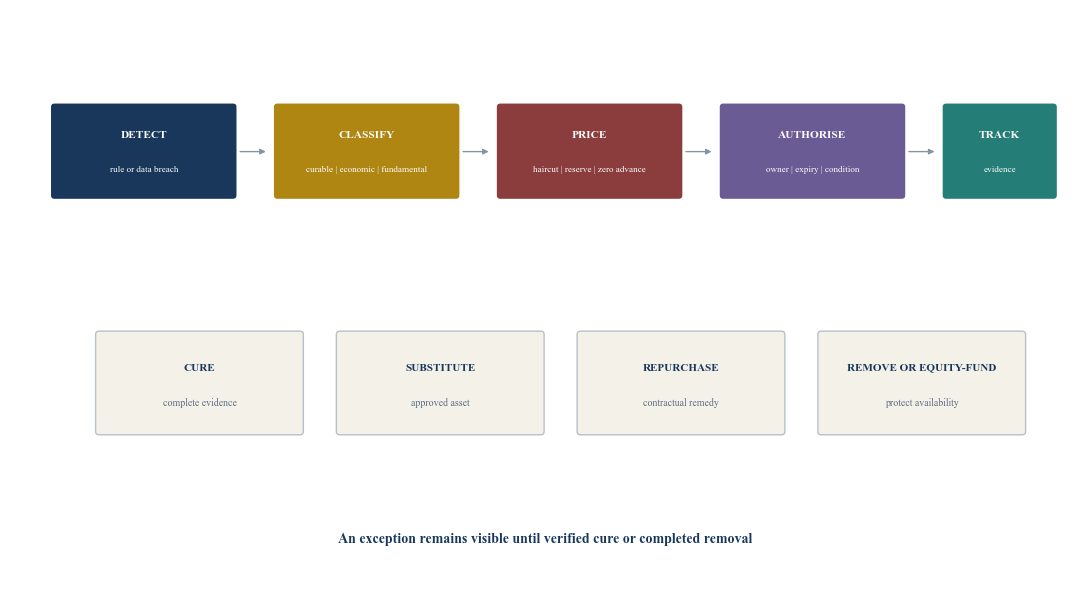
Author framework. Rights and actions depend on the approved mandate and executed documents.
17. Demonstrate a hypothetical warehouse decision
Consider a hypothetical AED 520 million portfolio assembled from mid-market Shari'ah-compliant financings. The assumed mix is 48 percent murabaha receivables, 32 percent ijara-related exposures, 12 percent diminishing musharaka and 8 percent other approved structures. These proportions are management assumptions and do not describe an observed portfolio.
The illustrative eligibility review excludes AED 18 million for incomplete documentation and transfer evidence and AED 12 million for arrears or disputes. An assumed AED 35 million concentration excess is also removed from funded availability. The resulting eligible pool is AED 455 million.
Illustrative asset-level advance rates produce a weighted rate of 72 percent and gross availability of AED 327.6 million. Assumed commingling, data, servicing and currency reserves reduce final availability to AED 309.1 million. With hypothetical senior funding of AED 286 million, headroom is AED 23.1 million.
The committee does not treat headroom as unrestricted acquisition capacity. Each new asset must pass eligibility and remain within concentrations. The model is refreshed after collections, amendments, arrears, substitutions and changes to evidence.
The hypothetical decision approves a limited warehouse subject to completed Shari'ah and legal review, controlled accounts, verified asset tapes, independent borrowing-base review, portfolio limits, a tested servicing-transition package and named take-out milestones. No actual transaction, investor commitment, pricing or legal conclusion is claimed.
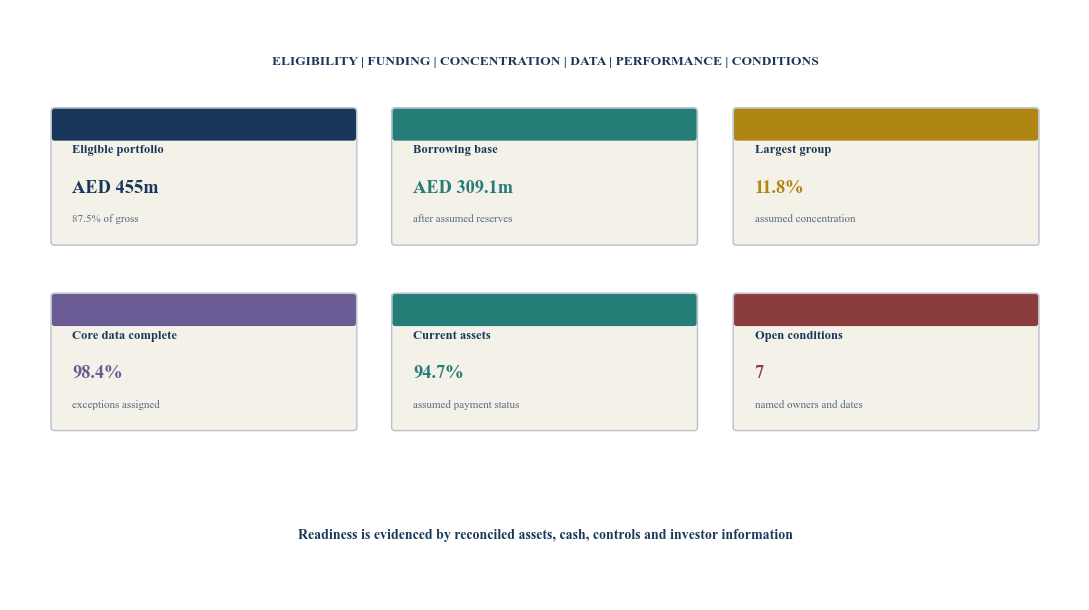
Every displayed value is an illustrative management assumption.
18. Implement the warehouse in 120 days
Days one to twenty establish the mandate, intended investors, eligible structures, Shari'ah governance, legal perimeter, funding objective, authority and risk appetite. The governing body approves the asset universe and the conditions that must close before acquisition.
Days twenty-one to forty build the asset taxonomy, minimum diligence file, underwriting overlay, transfer checklist and core data model. The team tests the standard against a representative set of proposed assets.
Days forty-one to sixty design the warehouse entity, accounts, servicing, document custody, borrowing base, reserves, concentrations, triggers and investor reporting. Shari'ah, legal, credit, operations, finance, tax and data owners reconcile the design.
Days sixty-one to eighty complete funding documentation, transaction opinions, Shari'ah approvals, control-account arrangements, valuation policy, backup-servicing package and operational procedures. The team runs the borrowing base and waterfall in shadow mode.
Days eighty-one to one hundred acquire a limited pilot pool subject to all approvals. Independent review tests eligibility, cash reconciliation, concentrations, reserves and reporting. Material exceptions are cured before ramp-up.
Days one hundred and one to one hundred and twenty complete the investor data room, historical reporting, take-out comparison, diligence responses and committee decision. Expansion occurs only after the operating evidence supports it.
Table 6. One-hundred-and-twenty-day warehouse programme
| Days | Workstream | Controlled deliverable | Gate |
|---|---|---|---|
| 1 to 10 | strategy | intended investors, asset universe and exits | governing body confirms objective |
| 11 to 20 | governance | entities, authority, Shari'ah and specialist ownership | perimeter and approvals agreed |
| 21 to 30 | asset standard | taxonomy, diligence file and underwriting overlay | representative assets tested |
| 31 to 40 | legal transfer | consent, notice, perfection and insolvency checklist | counsel accepts transaction path |
| 41 to 50 | data and servicing | field dictionary, accounts and procedures | cash and data reconcile end to end |
| 51 to 60 | portfolio controls | eligibility, concentrations, borrowing base and reserves | independent calculation reproduced |
| 61 to 70 | funding | term sheet, covenants, waterfall and liquidity plan | downside scenarios within authority |
| 71 to 80 | continuity | custody, backup servicing and transition test | critical data and documents available |
| 81 to 90 | pilot acquisition | limited pool with completed approvals | no unresolved material condition |
| 91 to 100 | shadow reporting | borrowing base, investor report and exceptions | committee accepts operating evidence |
| 101 to 110 | take-out preparation | data room, histories and option comparison | investor evidence set complete |
| 111 to 120 | controlled ramp | approved acquisition and monitoring calendar | senior approval after gate closure |
Timing depends on mandate, assets, jurisdictions, counterparties, approvals and systems.
19. Limitations and conclusion
The cited CBUAE regulations and standards apply within their stated scope. Bank-specific Shari'ah governance, credit-risk, capital and securitisation requirements should not be assumed to apply identically to every fund, family office, special-purpose vehicle, investor or financing business.[1][2][4][5][10][11]
UAE laws on receivables, movable security and bankruptcy require transaction-specific legal interpretation.[6][7][8] A reference to statutory provisions does not establish true sale, perfection, priority, enforceability or insolvency remoteness for a particular structure.
The IFSB capital standard discusses Shari'ah-compliant assets and sukuk securitisation within its defined prudential context.[9] It does not replace review by the relevant Shari'ah authority, regulator, counsel, tax adviser, accountant, trustee, rating agency or investor.
The CBUAE reported Islamic banking assets of approximately AED 1,257.68 billion at 30 September 2025 and described continued sector expansion.[3] That sector-level figure does not measure the available Islamic private-credit warehouse market, investor demand or the value of any transaction.
Every amount, ratio, advance rate, loss assumption, concentration, timeline and outcome in this paper's worked example is a hypothetical management assumption. No client asset, investor appetite, market price, commitment, rating, legal conclusion, Shari'ah conclusion or realised performance is claimed.
An investible Islamic private-credit portfolio is built through evidence and operating discipline. The warehouse defines its destination, separates contract from portfolio instrument, establishes Shari'ah governance, classifies each asset, underwrites twice, tests transfer and insolvency, applies eligibility and concentration limits, controls cash and servicing, calculates transparent availability and prepares investor evidence from inception.
That architecture allows professional capital to evaluate what it owns, how it is paid, which risks remain and what action follows when an asset changes.
References
- [1] Central Bank of the UAE, Standard Re. Shari'ah Governance for Islamic Financial Institutions, STA-LFI-GOV-2020, status in force when accessed 13 August 2026. https://rulebook.centralbank.ae/en/entiresection/2825
- [2] Central Bank of the UAE, Standard Re. Shari'ah Compliance Function at Islamic Financial Institutions, effective 3 April 2025, status in force when accessed 13 August 2026. https://rulebook.centralbank.ae/en/rulebook/article-1-introduction-11
- [3] Central Bank of the UAE, Annual Report 2025, Islamic Finance section, published 2026. https://www.centralbank.ae/media/4qbn11cl/annual-report-2025-en.pdf
- [4] Central Bank of the UAE, Credit Risk Management Regulation, C 3/2024, effective 30 November 2024. https://rulebook.centralbank.ae/en/entiresection/6015
- [5] Central Bank of the UAE, Credit Risk Standards, Article 5 Credit Underwriting, C 3/2024. https://rulebook.centralbank.ae/en/rulebook/article-5-credit-underwriting
- [6] United Arab Emirates, Federal Law No. 4 of 2020 on Securing the Rights in Movables. https://uaelegislation.gov.ae/en/legislations/1446/download
- [7] United Arab Emirates, Federal Decree-Law No. 16 of 2021 on Factoring and Transfer of Receivables. https://uaelegislation.gov.ae/en/legislations/1515/download
- [8] United Arab Emirates, Federal Decree-Law No. 51 of 2023 Promulgating the Financial Restructuring and Bankruptcy Law, current text accessed 13 August 2026. https://uaelegislation.gov.ae/en/legislations/2190
- [9] Islamic Financial Services Board, IFSB-15 Revised Capital Adequacy Standard for Institutions Offering Islamic Financial Services, December 2013, paragraphs on assets in sukuk securitisations. https://www.ifsb.org/wp-content/uploads/2023/10/2013-12-16_eng_IFSB15-Revised-Capital-Adequacy_Dec-2013.pdf
- [10] Central Bank of the UAE, Standards for Capital Adequacy of Banks in the UAE, Securitisation section, status in force when accessed 13 August 2026. https://rulebook.centralbank.ae/sites/default/files/en_net_file_store/CBUAE_EN_1691_VER2.pdf
- [11] Central Bank of the UAE, Securitisation Guidance and Simple, Transparent and Comparable Criteria, including asset risk, transfer and data requirements, status in force when accessed 13 August 2026. https://rulebook.centralbank.ae/en/rulebook/vii-securitisation
- [12] Central Bank of the UAE, Article 11 Shari'ah Compliance for Financial Services, N 1158/2021, status in force when accessed 13 August 2026. https://rulebook.centralbank.ae/en/rulebook/article-11-shari%E2%80%99ah-compliance-financial-services
About the Author
Chennakeshav Adya is an independent researcher and Managing Partner of Matchpoint Partners. His research focuses on investment strategy, capital formation, transaction execution, governance and operating-model design across the Gulf and international markets.
