

1. Define the bid decision before selecting the insurance
The decision is whether a particular insurance structure improves the bidder's total proposition while preserving acceptable recourse and a credible route to closing. The question is wider than whether a policy can be purchased. The board needs to know which risks move to the insurer, which remain with the buyer or seller, how the policy affects price and cash at closing, which diligence steps become conditions to cover, and whether the insurer can bind within the auction timetable.
A competitive bid is judged on several dimensions. Headline price matters, yet sellers also compare escrow, holdback, survival periods, liability caps, conditionality, certainty of funds, regulatory risk, documentation burden and the probability of post-closing claims. W&I insurance can change several of these dimensions simultaneously. It can increase seller cash at closing and reduce seller exposure while giving the buyer a funded recovery route. It can also introduce underwriting conditions, exclusions, a retention, claims uncertainty and insurer-credit exposure.
The board should approve a bid architecture that states five boundaries: the intended policyholder, the covered warranty set, the buyer's maximum uninsured exposure, the minimum seller recourse that must remain, and the latest date at which binding cover is required. The insurance workstream should sit inside the acquisition timetable. A quotation that arrives after the binding bid or depends on unfinished diligence does not provide bid certainty.
The central discipline is to value the transfer of risk rather than the appearance of insurance. A low premium can accompany a narrow policy. A high limit can coexist with exclusions that remove the largest exposures. A seller-friendly liability package can strengthen a bid while leaving the buyer with known tax, leakage, cyber, sanctions, environmental, pension or product risks. The decision paper should show the entire allocation.
2. Understand what the policy is intended to cover
Lloyd's classifies transactional liability W&I cover as insurance for financial losses arising from breaches of warranties, representations or indemnities given in mergers, acquisitions and similar transfers, sales, purchases or investments. Its 2025 risk-code bulletin separates US and non-US W&I from tax insurance and contingent or contested risk products. [1] The classification is useful because it prevents the deal team from treating every transaction exposure as one undifferentiated insured risk.
A buy-side policy usually gives the buyer the insured claim. A sell-side policy can protect the seller against liability to the buyer. The chosen form affects control of claims, disclosure, subrogation, fraud treatment, seller involvement, policy beneficiaries and the relationship with the acquisition agreement. The buyer should confirm which entity is insured, which acquired companies are covered, whether lenders or successors have rights, and how reorganisations affect the policy.
The policy does not replace the sale agreement. The warranties and indemnities arise in the transaction documents. The insurance contract defines the portion of financial loss that the insurer accepts, subject to its own definitions, exclusions, retention, limit, conditions and claim procedure. The policy and acquisition agreement can use similar words while producing different outcomes. Definitions of loss, knowledge, materiality, disclosed matters, damages, consequential loss, tax and third-party claims require line-by-line reconciliation.
The buyer should also verify the insurer and underwriting chain. Lloyd's public coverholder records identify firms authorised to arrange transactional liability products and describe buy-side and sell-side W&I, tax liability and special-situations insurance as distinct products. [2] A live placement requires confirmation of the carrier, capacity, licensing, delegated authority, claims responsibility, governing law, dispute forum and financial security at signing and through the claim period.
Policy structure should follow the acquisition route. A share purchase can expose the buyer to historic company liabilities across the acquired legal entities. An asset purchase may narrow inherited liabilities while creating transfer, consent and perimeter risks. A carve-out can depend on separation accounts, transitional services and shared assets. The warranty package and insurance response should be designed for the legal perimeter actually acquired.
The identity of the insured also affects recovery. A fund, acquisition vehicle, operating buyer and lender can have different interests. The buyer should test whether a change in ownership, merger, assignment, refinancing or internal reorganisation needs consent. The policy should remain usable after the transaction team has disbanded and the acquired business has entered the buyer's group.
3. Treat fair presentation as a transaction workstream
Under the UK Insurance Act 2015, a business insured has a duty to make a fair presentation of the risk before the insurance contract is entered into. The presentation must disclose every material circumstance the insured knows or ought to know, or provide enough information to put a prudent insurer on notice that it needs to make further enquiries. The disclosure must be reasonably clear and accessible. [3]
The statutory structure makes the underwriting submission part of deal governance. Information may come from the data room, disclosure letter, diligence reports, management answers, sale agreement, financial model, tax analysis and insurer questionnaire. These materials should tell one consistent story. A risk identified by tax diligence and omitted from the insurer submission creates both a coverage problem and a control failure.
The Act's explanatory notes state that a fair presentation can comprise more than one document or oral presentation and that information supplied before contract formation forms part of the presentation assessed. [4] The practical implication is that the deal team needs a controlled evidence set. It should know which data-room version, diligence report, Q&A response and disclosure draft were available to the underwriter when cover was bound.
The acquisition committee should require a fair-presentation memorandum. It should identify the people whose knowledge is relevant, the searches performed, material issues disclosed, inconsistencies resolved, questions outstanding and documents delivered. Legal advice is necessary for the governing law and knowledge rules. Operationally, the memorandum creates one audit trail between transaction diligence and insurance placement.
4. Preserve disciplined diligence
W&I underwriting depends on the buyer's investigation. The insurer generally evaluates the quality, scope and conclusions of diligence before agreeing cover. The buyer should assume that an unreviewed area can become excluded, sublimited, subject to a special condition or left entirely uninsured. Insurance therefore rewards targeted diligence. It does not convert absence of work into protection.
The diligence plan should map each material warranty family to a responsible adviser, scope, period, threshold, data set, findings, limitations and management response. Core areas can include title, authority, financial statements, material contracts, tax, employment, pensions, intellectual property, cyber, privacy, regulatory compliance, sanctions, anti-bribery, environment, real estate, litigation, insurance, customers and suppliers. Sector-specific areas need separate work.
The team should distinguish a scope limitation from a clean finding. A report that says no issue was identified after full testing differs from a report that says testing could not be completed. The insurer may treat both cautiously, yet the buyer's response differs. A scope gap may require more work, a price adjustment, specific indemnity, escrow, condition, covenant or alternative insurance.
Materiality should be reconciled across documents. The sale agreement may qualify warranties by materiality. Diligence may use a financial threshold. The insurer may apply a de minimis or retention. Financial statements may aggregate items differently. The buyer should avoid a gap in which an issue is too small for diligence, too large for its risk appetite and excluded from policy recovery.
5. Build one risk-allocation architecture
The transaction should allocate each exposure to one primary response. Unknown warranty risk can move to the W&I policy. A known tax issue may need a specific indemnity, tax policy or price adjustment. Leakage can be governed through the locked-box covenant. A regulatory clearance risk belongs in conditions, efforts covenants and the long-stop date. A cyber remediation programme may require a covenant, budget and escrow.
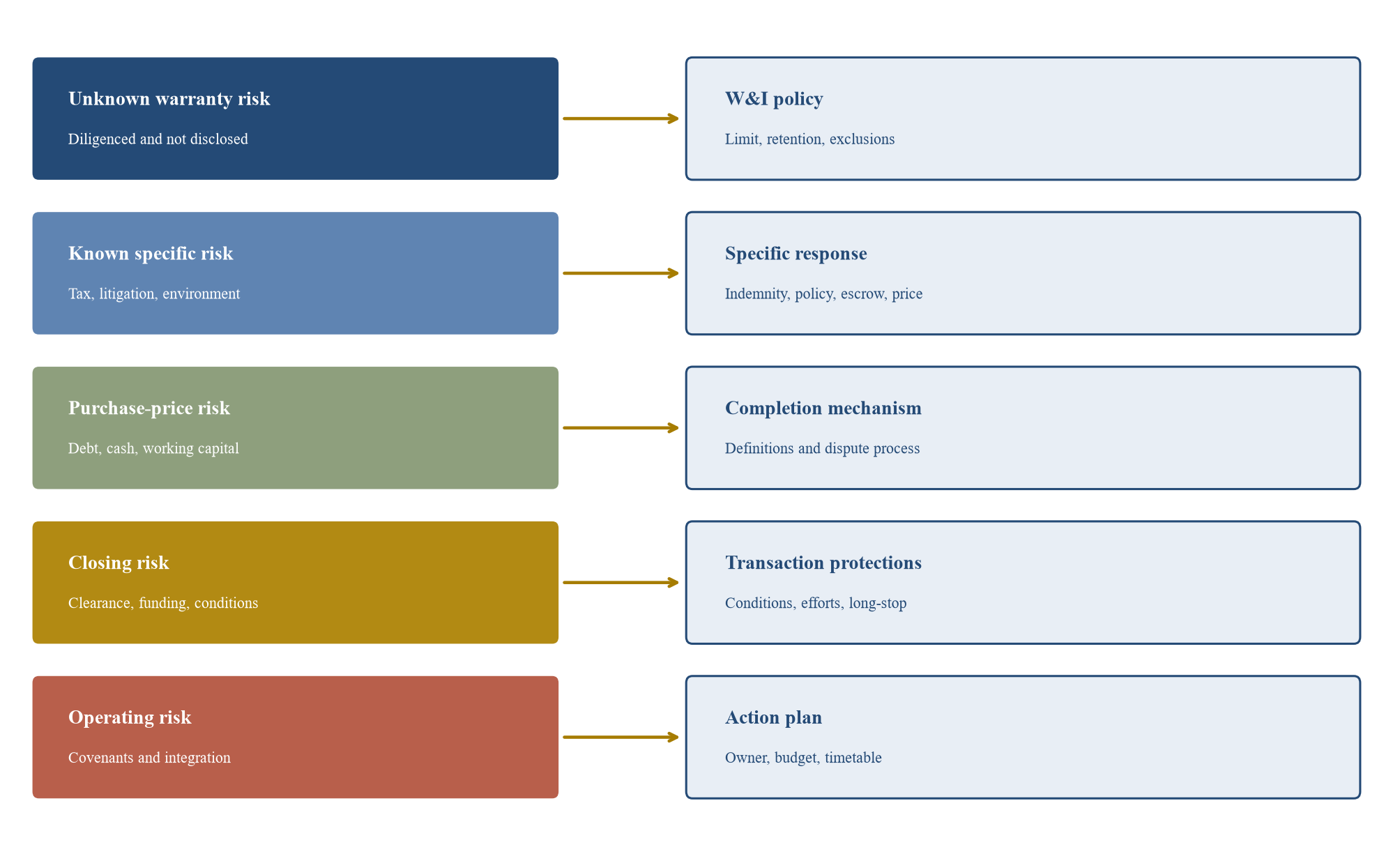
Original framework. Policy response and transaction remedies require current wording, diligence, disclosure and jurisdiction-specific verification.
The architecture prevents double counting. A known issue excluded from the policy cannot also be described as fully transferred. A price reduction and a specific indemnity may both address one exposure, but their combined economics should be explicit. A working-capital adjustment should not be used as a substitute for a warranty claim where the agreement allocates the matter differently.
The allocation register should state the exposure, evidence, legal route, policy treatment, financial capacity, approval owner, claim procedure and residual risk. It should distinguish coverage expected from coverage confirmed in the bound wording. The register becomes the common record for the investment committee, transaction counsel, broker, insurer, lender and integration team.
Risk allocation should also be consistent with the valuation. If the buyer values the target on uninterrupted customer contracts, then a contract warranty exclusion may affect enterprise value rather than merely legal recourse. If the investment case assumes tax attributes, an exclusion concerning their availability should enter the downside model. The insurance register should therefore link each material gap to the valuation driver it can impair.
The financing model needs the same connection. Acquisition lenders may focus on leverage, permitted claims, mandatory prepayment, insurance proceeds and control of litigation. The buyer should confirm whether policy proceeds must repay debt, whether lenders need an assignment or loss-payee status, and whether claim decisions can conflict with finance documents.
6. Align the sale agreement and policy
The policy should be negotiated against the actual acquisition agreement. Changes to warranties, knowledge qualifiers, disclosure, damages, survival, caps, baskets, conduct of claims and governing law can change coverage. A policy based on an earlier draft may contain silent misalignment at signing.
| Transaction term | Acquisition-agreement question | Policy question | Evidence | Residual decision |
|---|---|---|---|---|
| Warranties | Which statements survive and for how long? | Which warranties are insured or deemed modified? | Executed warranty schedule and policy schedule | Accept, negotiate or retain risk |
| Disclosure | What is fairly disclosed against each warranty? | What information is treated as disclosed to the insurer? | Disclosure letter, data room and Q&A archive | Resolve inconsistencies before binding |
| Loss | Which damages and costs are recoverable? | Does policy loss include the same heads and valuation basis? | Definitions and claim examples | Quantify uncovered heads |
| Knowledge | Whose knowledge qualifies the warranty? | Whose knowledge affects inception or claim? | Knowledge schedule and interviews | Complete searches and confirmations |
| Seller cap | What liability remains with sellers? | Is seller recovery required before insurer recovery? | Liability clause and policy recourse terms | Protect direct buyer claim |
| Conduct | Who controls third-party defence and settlement? | What insurer consent and cooperation apply? | Claim-control clauses | Build notification and approval process |
The fields are illustrative. Coverage requires confirmation from the executed policy and transaction documents.
The buyer should reconcile anti-sandbagging or knowledge provisions with the policy. An insurer may exclude matters actually known to identified deal-team members. The acquisition agreement may permit or restrict a claim where the buyer knew of the breach. A mismatch can leave the buyer unable to recover from either counterparty.
Subrogation also matters. A buyer policy may limit the insurer's right to pursue sellers except for fraud or another defined circumstance. The seller will value that protection. The buyer should understand whether seller fraud, management fraud, leakage or deliberate non-disclosure sits outside the limitation and how any recovery affects the policy claim.
7. Quantify the seller proposition
The seller's economic focus is often cash available at closing, residual exposure and the administrative burden of future claims. An insured bid can improve all three. The buyer should state the proposed liability cap, escrow, survival, claim process and fraud carve-out clearly enough for the seller to value the difference.
In the hypothetical transaction, the unenhanced bid offers USD 178.0 million of equity purchase price. It requires USD 12.0 million in escrow and makes USD 166.0 million available to sellers at closing. General warranty liability survives for fifteen months under the scenario. These terms are assumptions, not market benchmarks.
The central insured bid offers USD 180.0 million and reduces the seller escrow to USD 2.4 million. Seller cash available at closing is USD 177.6 million. The buyer pays USD 0.5 million of assumed policy-related costs outside the purchase price. The seller therefore receives USD 11.6 million more at closing than under the unenhanced route while the buyer obtains a USD 24.0 million policy limit subject to a USD 1.8 million retention and all policy terms.
The increase in seller liquidity is economically different from an increase in headline price. A seller may value USD 11.6 million of accelerated cash more than an uncertain deferred amount. The bid comparison should therefore show headline price, escrow, expected release date, remaining cap and claims burden separately.
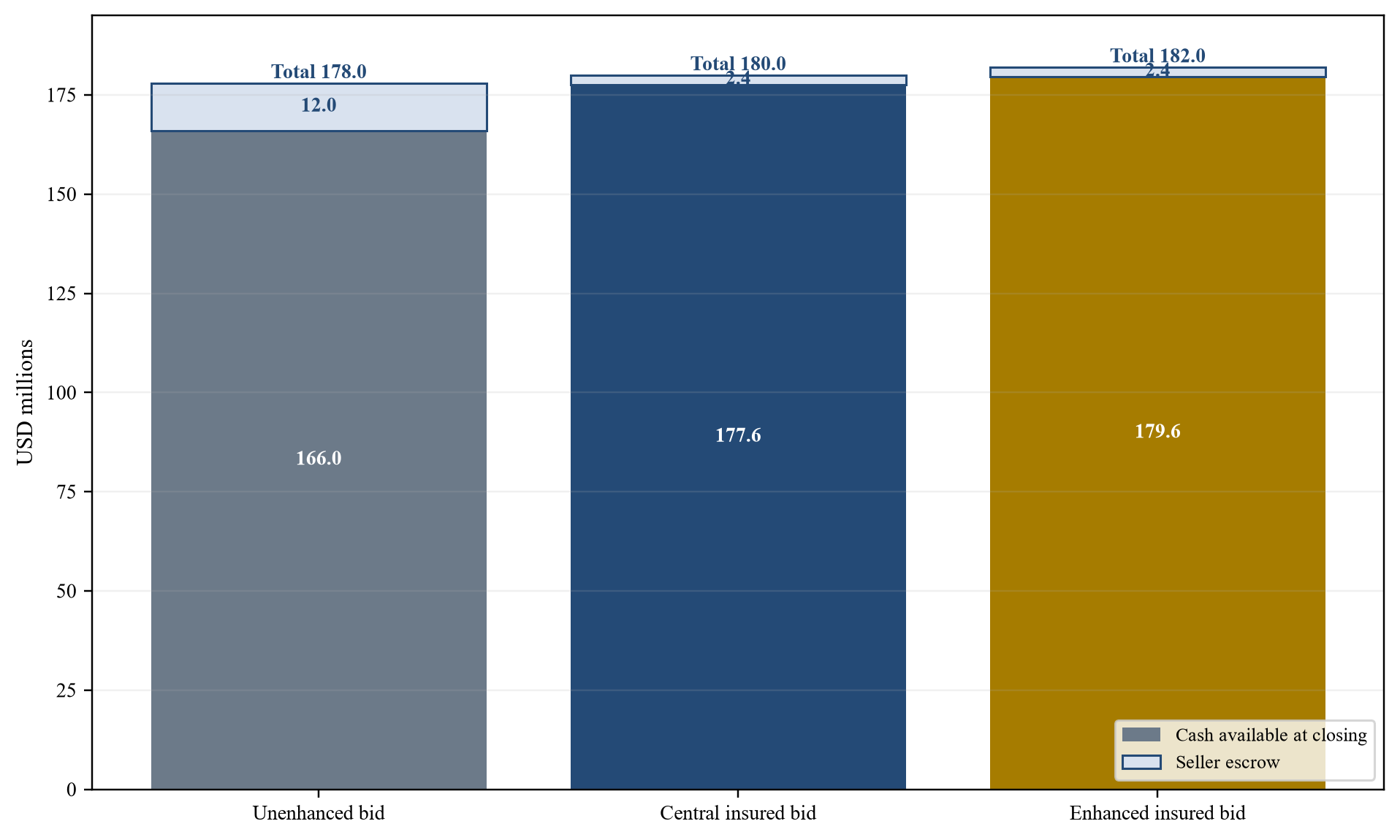
Original scenario analysis using hypothetical amounts. Values do not represent market pricing or a valuation opinion.
8. Quantify the buyer's protection and uninsured tail
The policy limit is not the buyer's expected recovery. The claim must concern an insured warranty, occur within the insured period, satisfy notice and cooperation requirements, avoid exclusions and exceed the applicable retention. The buyer should model covered loss, excluded loss, defence costs, erosion of limits, retention, seller recovery, insurer recovery and residual exposure.
The hypothetical policy has a USD 24.0 million aggregate limit and a USD 1.8 million retention. A covered USD 8.0 million loss produces a modelled policy payment of USD 6.2 million after the retention. A covered USD 30.0 million loss produces a modelled payment capped at USD 24.0 million and leaves USD 6.0 million with the buyer, subject to the exact loss definition and claim terms.
A USD 1.2 million covered loss sits below the retention and produces no modelled insurer payment. A known USD 5.0 million tax issue is excluded in the scenario and also produces no W&I payment. The correct response may be a specific tax indemnity, a tax policy, escrow, price adjustment, covenant or acceptance of risk. The deal team should avoid presenting the USD 24.0 million limit as protection against every USD 24.0 million loss.
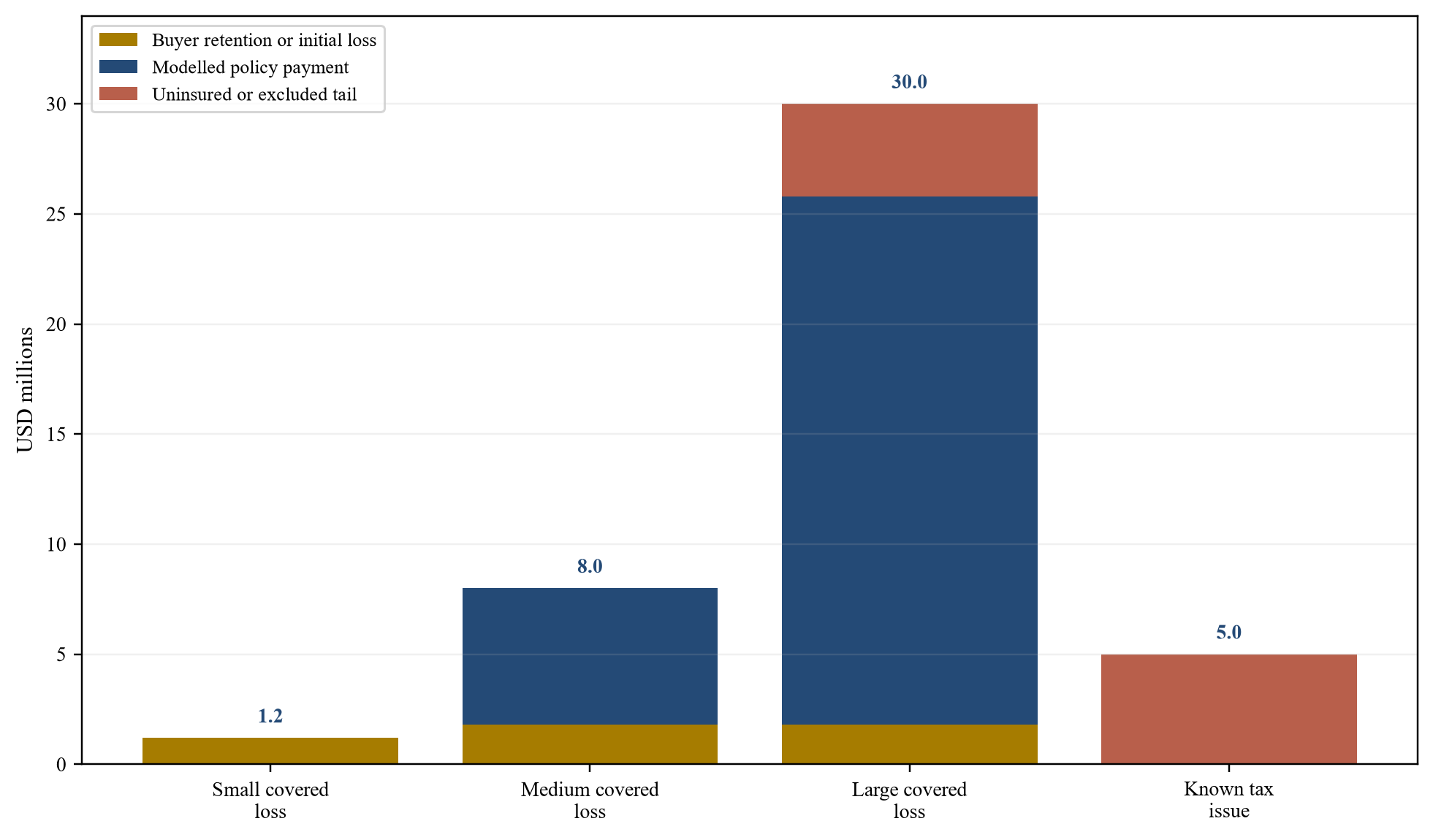
Original deterministic scenarios. Recoveries depend on executed wording, facts, evidence, loss measurement and claim handling.
The buyer should set its limit from exposure rather than a percentage convention. It should examine warranty families, deal size, balance-sheet strength, tax periods, regulated activities, cyber exposure, customer concentration and potential multiplicative losses. Limit adequacy should be tested against the buyer's downside model and available seller recourse.
Loss measurement deserves its own model. A breach can produce a direct payment, remediation cost, lost contract, tax assessment or reduction in the value of the acquired business. The sale agreement and policy may treat these heads differently. The buyer should build examples before signing and ask how the wording responds to diminution in value, multiple-based loss, consequential effects and costs incurred to prevent a larger loss.
Timing can be as important as quantum. The acquired company may need immediate cash to remediate an issue while a claim takes longer to establish and settle. The acquisition model should carry a liquidity line for the gross loss and a separate recovery line. Insurance provides a claim right; it does not automatically fund the operating response on the date the problem arises.
9. Compare bid routes on one scorecard
The bidder should compare price, seller proceeds, recourse, timetable and coverage quality together. A bid can lead on headline price and lose because it requires excessive escrow or uncertain approvals. It can also appear seller-friendly while asking the seller to support an unresolved insurance condition after exclusivity.
| Measure | Unenhanced bid | Central insured bid | Enhanced insured bid |
|---|---|---|---|
| Equity purchase price | USD 178.0 million | USD 180.0 million | USD 182.0 million |
| Seller escrow | USD 12.0 million | USD 2.4 million | USD 2.4 million |
| Seller cash at closing | USD 166.0 million | USD 177.6 million | USD 179.6 million |
| Policy limit | None | USD 24.0 million | USD 36.0 million |
| Retention | Seller basket and cap | USD 1.8 million | USD 1.2 million |
| Assumed policy-related buyer cost | None | USD 0.5 million | USD 0.8 million |
| Diligence and underwriting burden | Buyer diligence | Buyer diligence plus underwriting | Expanded diligence plus underwriting |
| Indicative execution score out of 5 | 3.4 | 4.4 | 4.1 |
All amounts and scores are hypothetical. Scores require transaction-specific evidence and approval.
The central insured bid receives the highest hypothetical execution score because it improves seller cash materially without requiring the expanded underwriting and price of the enhanced route. The score is not a market probability. It combines documented assumptions concerning funding, diligence readiness, insurer timetable, regulatory conditions and document complexity.
The enhanced route offers greater limit and price, yet its additional value may be weak if the largest risks are known and excluded. The decision should test marginal protection. An extra USD 12.0 million of limit adds little where the uncovered exposure is a disclosed tax dispute or a competition remedy.
10. Separate known risks from unknown warranty risk
Known matters require a named response. The policy schedule may exclude issues identified in diligence, disclosure or underwriting. The buyer should record why the matter is known, the estimated range, legal basis, timing, owner and chosen allocation. It should avoid hiding a known issue inside a general warranty.
Tax risks can sometimes be addressed through separate tax insurance where the relevant facts and legal position are suitable. Contingent or contested liabilities can require another product. Lloyd's 2025 risk-code structure expressly separates W&I, tax and contingent-risk classes. [1] That separation should be reflected in the deal model.
| Exposure | Indicative W&I treatment | Primary response | Evidence required | Residual control |
|---|---|---|---|---|
| Disclosed tax audit | Excluded or specifically underwritten | Tax indemnity, tax policy or price | Audit correspondence and tax opinion | Escrow, covenant and claim calendar |
| Cyber incident discovered in diligence | Excluded pending remediation | Remediation covenant and specific allocation | Forensic report, containment and cost plan | Closing condition or reserve |
| Forecast underperformance | Outside warranty loss | Price, earn-out or walk-away analysis | Quality of earnings and forecast bridge | Downside case and integration action |
| Unknown historic compliance breach | Potentially insurable | W&I subject to diligence and wording | Compliance testing and management Q&A | Limit, retention and notification plan |
| Competition remedy | Outside ordinary W&I response | Condition, efforts covenant and long-stop | Filing analysis and remedy model | Alternative perimeter or termination right |
| Leakage | Transaction-document covenant | Locked-box protection and claim route | Cash ledger and related-party review | Specific seller recourse |
Examples are illustrative. Availability and coverage require live underwriting and legal confirmation.
The register should follow the issue through signing and closing. A matter can change status as new evidence appears. The insurer may amend an exclusion after supplemental diligence. The seller may offer a specific indemnity. The buyer may change price or structure. Every change should update the financial model and bid approval.
11. Design the underwriting data room
The underwriting data room should be a controlled subset or indexed view of the transaction evidence. It should include the executed or near-final agreement, warranty schedule, disclosure materials, adviser reports, management Q&A, financial statements, key policies and the final deal-team confirmations. Access logs and version history should be preserved.
The team should maintain a warranty-to-evidence matrix. Each insured warranty should point to the diligence section, relevant disclosure, management answer and policy treatment. Gaps should be visible. A clean matrix does not require every warranty to have equal work. It requires the depth of work to reflect the exposure and stated materiality.
Management meetings need governance. Questions and answers supplied to the insurer can form part of the underwriting record. Responses should be factual, supported and reviewed by the appropriate owner. A hurried verbal answer can create inconsistency with the disclosure letter or diligence report.
The data room should freeze for policy binding with a documented update process. New information between signing and closing requires analysis under the policy and acquisition agreement. The team should know who must disclose it, whether it affects cover and whether a bring-down process applies.
Data quality should be tested before insurer access. The finance folder should reconcile trial balances, management accounts, audited statements and the quality-of-earnings report. Contract schedules should reconcile to revenue and customer concentration. Employment records should reconcile headcount, payroll and benefit liabilities. A mismatch may be innocent, yet it can delay underwriting and weaken confidence in adjacent areas.
Privilege and reliance also require control. Diligence reports can contain legal advice, third-party restrictions and limitations of liability. The buyer, advisers, broker and insurer should agree the permitted disclosure and reliance route. A report delivered to an insurer without the required consent can create contractual and privilege issues without improving coverage.
12. Control exclusions, amendments and synthetic cover
The first policy draft should be reviewed as a risk-allocation document. General exclusions, deal-specific exclusions, warranty amendments, sublimits, retention changes and conditions should be logged. The impact of each item should be stated in cash terms or decision terms where possible.
Synthetic warranties are statements negotiated directly for insurance where the seller does not give the equivalent contractual warranty. They can support transactions with limited seller recourse, yet their availability and scope depend on underwriting, diligence, law and policy terms. The buyer should treat synthetic cover as a separate workstream and avoid assuming parity with seller-given warranties.
The deal team should distinguish a clarification from a reduction in coverage. Adding a knowledge qualifier, narrowing a tax period or excluding a customer contract can change the risk materially. Redline summaries should quantify the effect and name the decision owner.
The policy should also address defence costs, mitigation costs, interest, consequential loss, multiple claims, aggregation, fraud, subrogation, insured-versus-insured issues, assignment, lender rights, currency, tax gross-up, sanctions and dispute resolution. These terms can determine the value of a claim even when the underlying warranty breach is established.
Exclusion negotiations should be evidence-led. If an insurer excludes a whole warranty family because one diligence question remains open, the buyer should determine whether targeted evidence can narrow the exclusion. If the exclusion reflects a structural risk, continued negotiation may add little. The investment committee needs to see which gaps are remediable before signing and which require economic protection elsewhere.
Amendments made near signing should receive the same review as the initial policy. A change in the purchase-price mechanism, target perimeter, warranty giver or disclosure standard can alter the insurer's assessment. The policy team should use a closing checklist that compares the final transaction documents with the versions approved by the insurer.
13. Protect the transaction timetable
Insurance placement has its own critical path: broker submission, insurer selection, non-binding indication, underwriting call, report delivery, exclusion negotiation, policy drafting, inception and premium payment. The acquisition timetable should carry these activities beside diligence, financing, competition filings and document negotiation.
An indicative quote should be labelled by status. It may depend on satisfactory diligence, agreed warranties, no material change, insurer approvals, final documents and premium. The bid should avoid presenting indicative terms as committed protection. Binding authority and executed policy evidence are the relevant gates.
The buyer should prepare a timetable contingency. If one insurer changes terms, can another complete underwriting? If a diligence report is delayed, can the affected warranty family be excluded temporarily and added before signing? If signing moves, does the quotation remain open? If closing is delayed, does cover remain effective?
The latest safe insurance date should precede the irrevocable bid or signing decision by enough time for approval. A policy agreed after the seller has accepted the reduced recourse package can shift risk back to the buyer if exclusions expand.
14. Integrate competition and public-deal constraints
Insurance does not remove regulatory conditions. The CMA's current merger assessment guidance explains how it assesses whether a merger may result in a substantial lessening of competition, including effects on price, quality, choice, innovation and future competition. [9] The US agencies similarly apply a forward-looking framework under the merger laws. [10]
The transaction model should therefore separate warranty risk from clearance risk. A W&I policy may protect historic factual statements, yet it will not ordinarily make a prohibited merger lawful or fund every remedy. The buyer needs a filing plan, efforts covenant, remedy boundary, long-stop date and financing treatment.
For transactions governed by the UK Takeover Code, conditions cannot be treated as ordinary discretionary options. The Panel's Practice Statement on Rule 13.5 explains the material-significance test and relevant factors when an offeror seeks to invoke a condition. [11] A public bid needs specialist advice on whether and how insurance interacts with offer terms, announcements, financing confirmations and disclosure.
The bid committee should keep the insurance message precise. It can state that the buyer has arranged or expects to arrange specified cover when that statement is supported. It should avoid implying that insurance removes regulatory, financing or completion risk.
15. Address insurance regulation and distribution
The placement may involve an insurer, managing general agent, broker, coverholder and other service providers across jurisdictions. The buyer should identify each party's role and authority. Licensing, distribution, sanctions, premium taxes, client money, remuneration disclosure and local policy requirements need jurisdiction-specific analysis.
The EU Insurance Distribution Directive establishes organisational and conduct requirements for insurance distribution, including professional competence, customer information and conflicts. [8] UK FCA rules require insurers and intermediaries to act honestly, fairly and professionally in accordance with the customer's best interests where the relevant provisions apply. [5]
FCA product-governance rules require distributors within scope to understand the products they offer and the identified target market, and to maintain appropriate distribution arrangements. [7] The FCA Handbook also contains exclusions and modified application for specialist risks, bespoke contracts and larger commercial customers. [6] A transaction team should obtain advice on the actual classification rather than applying retail insurance rules mechanically.
The policyholder should know who receives remuneration and who owes which duty. Broker advice, insurer underwriting and legal advice are distinct. The board should approve conflicts and reliance boundaries before binding.
16. Connect insurance to acquisition accounting
Insurance recovery and acquisition accounting should be analysed separately from bid presentation. IFRS 3 requires an acquirer to recognise identifiable assets acquired and liabilities assumed under the acquisition method. It also contains specific guidance on indemnification assets and their relationship to the indemnified item. [13]
A W&I policy is a separate contract with its own recognition, measurement and collectibility considerations. The buyer should not assume that the policy limit offsets an acquired liability in the purchase-price allocation. Accounting advice should address the nature of the right, acquisition-date facts, measurement basis, premium treatment and subsequent claim.
IAS 37 distinguishes provisions, contingent liabilities and contingent assets. It requires a provision where the recognition criteria are met and generally prevents recognition of a contingent asset until the inflow becomes virtually certain. [14] The existence of insurance can affect reimbursement analysis, yet it does not erase the underlying obligation.
The investment paper should therefore show gross risk and potential recovery. It should avoid presenting a net exposure where collectibility, coverage or recognition remains conditional. The financial model can include separate lines for expected loss, policy recovery and timing, with evidence states and sensitivity.
17. Govern claims before they exist
Claims governance should be designed at signing. The buyer should name the policy owner, notification contact, evidence custodian, finance lead, legal lead and decision authority. It should preserve data-room records, diligence reports, disclosure materials, policy versions and correspondence.
The integration team needs training on facts that may trigger notice. A customer complaint, tax enquiry, regulatory request, cyber event, inventory write-off or contract dispute can indicate a warranty breach. Delay in escalating the issue can prejudice evidence or breach policy requirements.
The claim protocol should address notice, mitigation, insurer consent, third-party defence, settlement, privilege, loss calculation, proof of payment, expert determination and recovery allocation. It should also identify interaction with seller claims and any contractual time bar.
The buyer should maintain a gross-to-net claim model. It should show the underlying loss, acquisition-agreement recovery, retention, policy recovery, defence costs, tax, timing and residual exposure. The model should be updated from actual evidence rather than assumed policy percentages.
18. Stress the structure through linked scenarios
The principal scenarios should change facts that affect both the policy and the transaction. A diligence delay can narrow cover and delay signing. A known issue can move from warranty risk to an exclusion. A competition remedy can reduce value without creating a warranty claim. A seller disclosure can eliminate a breach while requiring a price response.
The hypothetical central bid has USD 24.0 million of limit and USD 1.8 million retention. The downside case assumes an USD 8.0 million covered financial-statement breach and a separate USD 5.0 million known tax issue. The policy model produces USD 6.2 million on the covered breach and no W&I recovery on the known tax issue. The buyer must fund USD 6.8 million before considering any specific tax response.
The severe case assumes a USD 30.0 million covered loss. The modelled insurer payment reaches the USD 24.0 million limit and the buyer retains USD 6.0 million. If defence costs erode the limit or the loss definition is narrower, residual exposure increases. The board should test these mechanics before relying on the limit in its valuation.
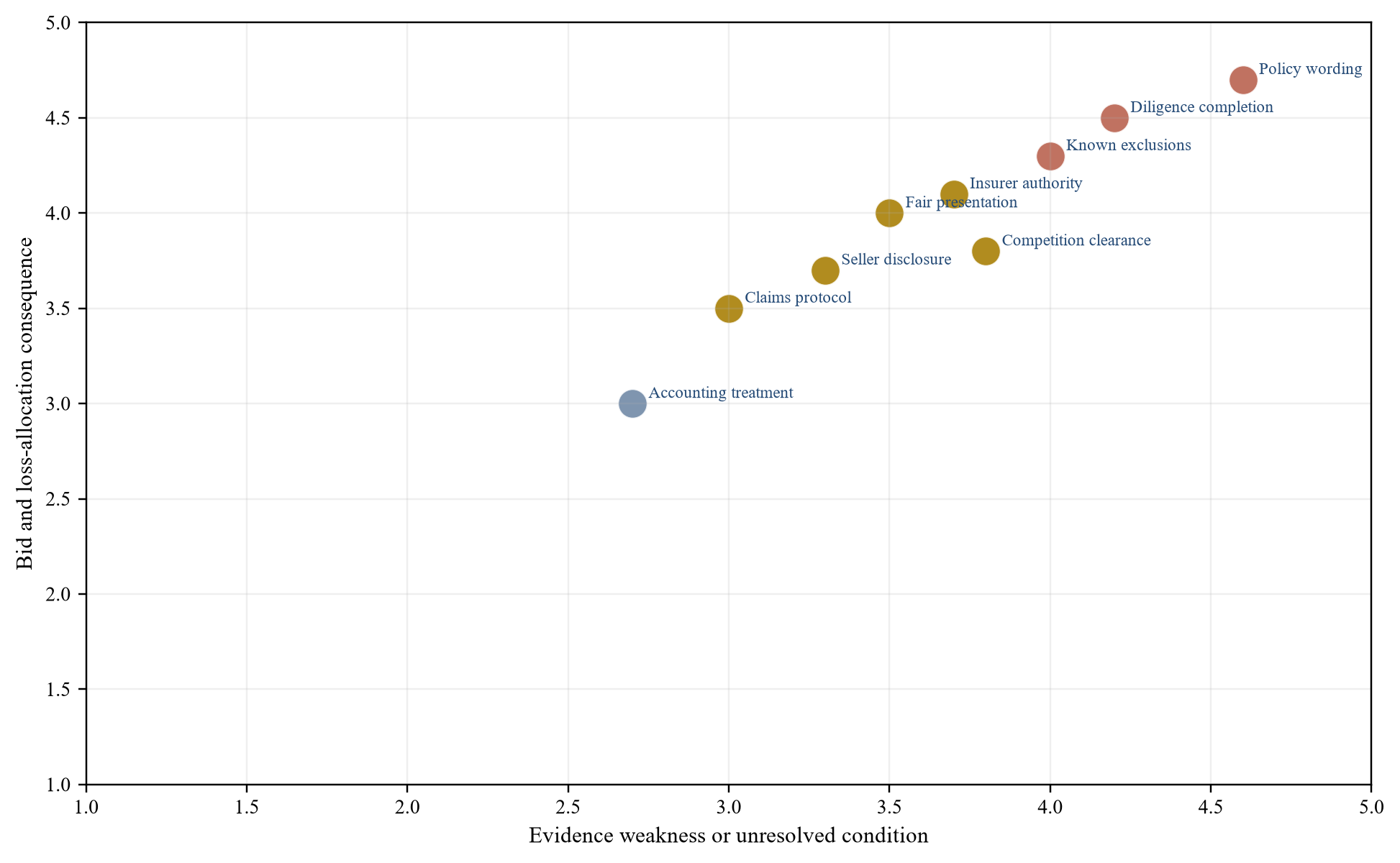
Original framework using hypothetical positions. Ratings require current evidence, accountable owners and transaction-specific judgement.
The risk map should connect to the bid model. A high policy-wording risk may require price protection or seller recourse. A high diligence risk may require more time. A high clearance risk may affect the long-stop date and financing. The chart is useful only when each point has evidence, an owner and a latest safe action date.
19. Establish decision gates and accountability
The investment committee should receive the insurance case at three gates. The indicative gate confirms appetite, possible limit, expected exclusions, underwriting requirements and timetable. The binding-bid gate confirms diligence readiness, seller terms, cost range, carrier selection and fallback. The signing gate confirms the executed policy, premium, insured entities, final exclusions, claims process and alignment with the sale agreement.
Responsibility should be explicit. The deal lead owns the bid. Transaction counsel owns agreement alignment and legal advice. The broker owns placement advice and market process within its mandate. The insurer owns its underwriting decision and policy. Diligence advisers own the scope and conclusions of their reports. Finance owns the acquisition model and payment. Management owns factual responses.
The decision record should state residual exposures. Board approval of an insured bid should never be recorded as approval of a fully insured transaction unless every material risk is in fact transferred, which is unlikely. The record should identify retention, exclusions, limit exhaustion, insurer credit, claim timing and uninsurable matters.
The buyer also needs a fallback. It can retain seller escrow, reduce price, narrow the perimeter, obtain specific cover, require a condition, accept the risk or withdraw. The fallback should be prepared before exclusivity weakens leverage.
20. Implement the insured bid in five phases
| Phase | Indicative timing | Core outputs | Decision gate | Escalation if incomplete |
|---|---|---|---|---|
| Risk architecture | Before first-round bid | Exposure map, seller priorities, preliminary policy role | Does insurance improve the bid? | Use conventional recourse or reprice |
| Market engagement | First to second round | Broker strategy, insurer indications, cost and timetable | Is credible capacity available? | Add carriers or preserve seller recourse |
| Underwriting evidence | Before binding bid | Diligence reports, data-room index, management Q&A | Can the insurer underwrite the required warranties? | Extend work or narrow coverage claim |
| Document alignment | Bid to signing | SPA-policy matrix, exclusions, fair-presentation record | Are risk allocations executable? | Amend price, escrow, wording or structure |
| Binding and claims readiness | Signing and closing | Executed policy, premium, claim protocol, archive | Is cover effective and operational? | Hold signing or activate fallback |
Timing is indicative and should follow the auction, diligence, insurance, financing and regulatory timetable.
Phase one defines the economic use of insurance. Phase two tests capacity and terms without treating indications as commitments. Phase three completes evidence. Phase four reconciles documents and residual risk. Phase five binds cover and prepares the organisation to identify and manage claims.
The roadmap should be integrated with financing and regulatory work. Lenders may require evidence of cover or rights under the policy. Competition conditions may extend the period between signing and closing. Premium payment, insurer consent and policy inception should be aligned with the funds flow.
After closing, the acquisition team should transfer the policy archive and risk register to integration leadership. The handover should identify notice periods, claim contacts, exclusions, retention tracking, seller recourse and open diligence matters. Insurance has little practical value if the operating organisation does not know when to use it.
21. Conclusion
W&I insurance can differentiate a competitive bid when it converts seller exposure into closing liquidity and gives the buyer credible recourse for defined unknown warranty breaches. The value arises from transaction design. Price, escrow, seller cap, policy limit, retention, exclusions, diligence, disclosure, insurer security and claim mechanics must be evaluated together.
The hypothetical case shows the distinction. The central insured bid increases seller cash available at closing from USD 166.0 million to USD 177.6 million. It provides a USD 24.0 million policy limit above a USD 1.8 million retention at an assumed USD 0.5 million buyer cost. The structure remains exposed to known risks, exclusions, limit exhaustion, policy conditions and claim timing.
The reusable method is direct. Map the risks. Separate known from unknown. Align warranties to evidence. Reconcile the sale agreement and policy. Quantify seller liquidity and buyer residual exposure. Protect the underwriting timetable. Confirm binding authority. Prepare claims governance. Keep a fallback until cover and closing are executable.
Sources
- Lloyd's, Market Bulletin dated 16 June 2025, transactional liability W&I, tax and contingent-risk codes, Read the primary source
- Lloyd's Asia, Euclid Transactional coverholder profile, transactional risk insurance, Read the primary source
- United Kingdom, Insurance Act 2015, Part 2 duty of fair presentation, Read the primary source
- United Kingdom, Insurance Act 2015 Explanatory Notes, fair presentation and remedies, Read the primary source
- Financial Conduct Authority, Insurance Conduct of Business Sourcebook, Chapter 2, Read the primary source
- Financial Conduct Authority, Product Intervention and Product Governance Sourcebook, Chapter 1 application, Read the primary source
- Financial Conduct Authority, Product Intervention and Product Governance Sourcebook, Chapter 4 insurance product governance and distribution, Read the primary source
- European Union, Directive (EU) 2016/97 on insurance distribution, Read the primary source
- Competition and Markets Authority, Merger Assessment Guidelines, updated 3 September 2026, Read the primary source
- United States Federal Trade Commission, Mergers and 2023 Merger Guidelines, Read the primary source
- UK Takeover Panel, Practice Statement 5 on Rule 13.5, invoking conditions and pre-conditions, Read the primary source
- United States Securities and Exchange Commission, Financial Disclosures about Acquired and Disposed Businesses, Read the primary source
- IFRS Foundation, IFRS 3 Business Combinations, indemnification assets and acquisition accounting, Read the primary source
- IFRS Foundation, IAS 37 Provisions, Contingent Liabilities and Contingent Assets, Read the primary source
