
Introduction
Waste-energy projects sit inside a materials system. Their feedstock is affected by product design, consumption, separate collection, reuse, recycling, composting, trade, landfill restrictions and enforcement. An investment can therefore lose volume or calorific value even when total waste generation rises. The relevant forecast is the material that remains legally and practically available to the selected treatment route.
The European Union Waste Framework Directive places prevention, preparing for reuse and recycling above other recovery, including energy recovery.[1] The revised Landfill Directive requires Member States to reduce municipal waste sent to landfill to 10 percent or less by 2035, subject to specified extensions, and seeks to keep waste suitable for recycling or recovery out of landfill from 2030.[2] England's Simpler Recycling rules require separate collection of core recyclable streams and weekly household food-waste collection, with anaerobic digestion identified as the preferred treatment for separately collected food waste where suitable.[3]
These rules can create feedstock for some technologies while eroding it for others. Separate food-waste collection can support anaerobic digestion. Higher material recycling can reduce residual-waste volume and remove high-calorific plastics from incineration feedstock. Landfill diversion can support residual treatment during a transition, yet prevention and recycling can compress long-term tonnage.
This paper provides a decision framework for authorities, sponsors, operators, lenders and investors. It tests feedstock before plant capacity, connects policy to material flows, separates contractual availability from tonnage guarantees, and aligns capital with the waste hierarchy.
1. Define the investment decision
The decision should state the jurisdiction, catchment, waste streams, technology, design capacity, operating term, ownership model, procurement route and intended revenues. It should distinguish a new facility from an expansion, retrofit, refinancing, contract renewal or managed retirement.
Approval should cover a defined stage. Development capital can fund material-flow data, composition sampling, collection analysis, site studies, grid and heat connections, permitting, procurement and stakeholder work. Construction capital should follow a tested feedstock case, an executable contract package and evidence that the technology fits the remaining waste.
The committee should identify the service need that survives policy change. A project may provide organic-waste recycling, residual-waste sanitation, landfill-gas control, dispatchable power, heat or several of these services. Each service needs a separate legal and economic basis.
2. Start with the waste hierarchy
The waste hierarchy is an allocation rule for materials. Prevention removes waste before treatment. Reuse preserves product value. Recycling returns material to production. Energy recovery applies to material that remains suitable for that route. Disposal is the final option.[1]
The project case should show why each proposed feedstock belongs in the selected category. A mixed-waste forecast can conceal recyclable paper, plastics, metals, glass and organics that policy may redirect. The model should therefore begin with component-level tonnes and end with treatment-specific availability.
Deviation from the hierarchy may require lifecycle evidence under applicable law. The investment file should contain that evidence rather than assume that combustion, digestion or another process is automatically classified as recovery.
3. Map policy into physical tonnes
Policy affects waste through collection duties, bans, taxes, recycling targets, producer-responsibility fees, product standards and carbon costs. Each rule needs a transmission path in the model. The path should show which material changes, when it changes, who controls the change and which facility bears the consequence.
England's separate-collection rules illustrate the mechanism. Food waste must be collected weekly from households from the applicable implementation date, while separately collected food waste is directed toward suitable recycling or composting routes.[3] This can create a cleaner organic stream for digestion and reduce moisture and biogenic content in residual waste.
The model should distinguish enacted requirements, published implementation guidance, consultations and proposals. Their probability and timing should remain separate. A single policy case can misstate both downside and upside.
4. Build the material-flow system map
The system map should start with waste prevention and product use. It should then follow separately collected recyclables, source-separated organics, residual waste and prohibited or hazardous streams. Each branch needs a permitted treatment route, product output, residue path and data boundary.
Commercial flows should include service or gate fees, power, heat, gas, recovered metals, aggregate or ash products where permitted, renewable or low-carbon attributes, and avoided disposal cost. The model should state quantity, price, eligibility, owner, counterparty and settlement evidence for each flow.
The map should also show diversion. Material can leave the catchment through recycling, export, competing facilities, contract expiry, informal collection or enforcement failure. Feedstock security is a network question rather than a single-contract question.
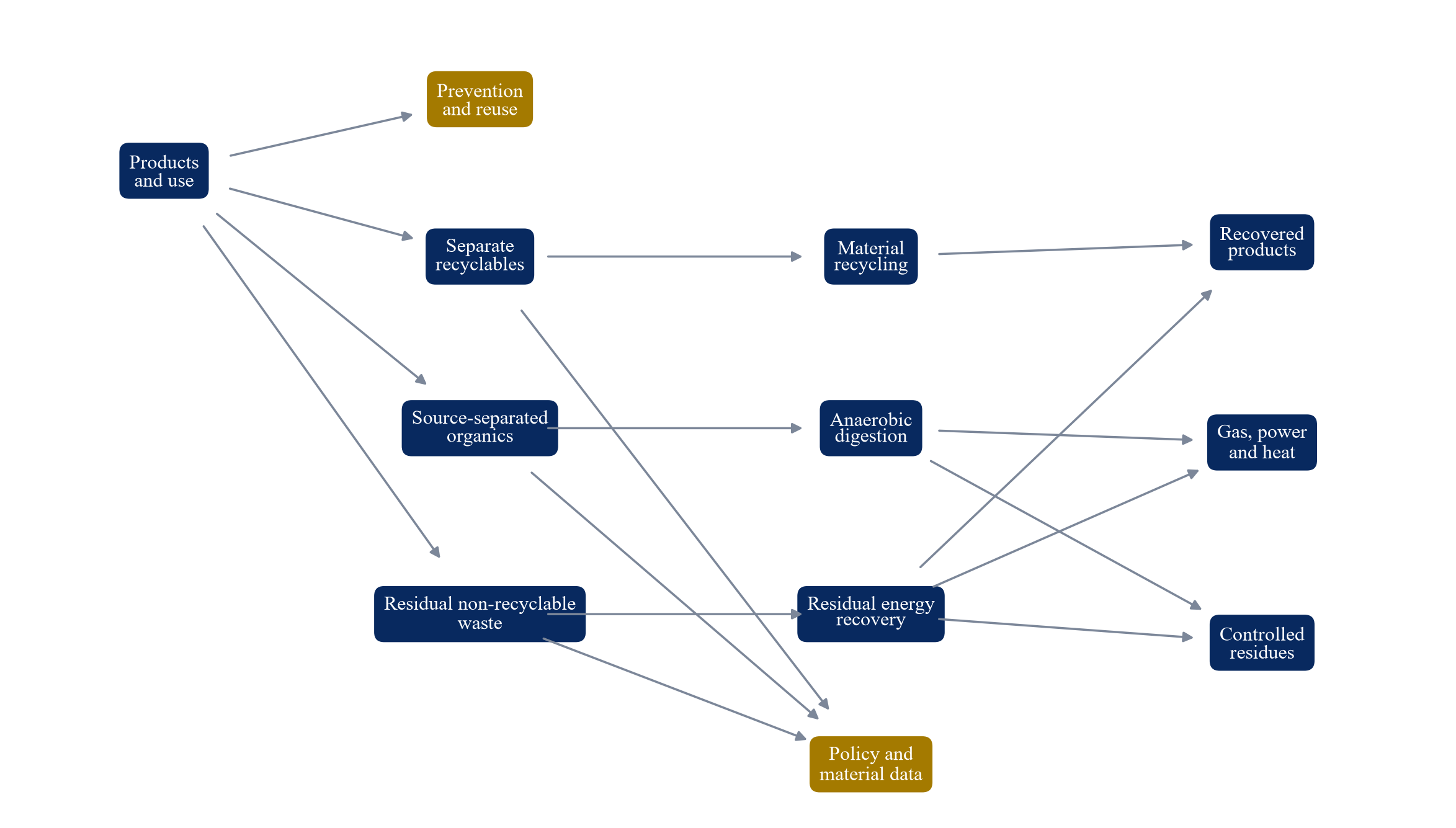
Proposed system map; actual classifications, routes and products depend on law, permits, composition and local infrastructure.
5. Establish the catchment
The catchment should be defined by collection authority, contract, road time, transfer stations, competing plants and cross-border rules. A radius drawn around a site is insufficient because waste follows contracts, cost and permitted routes.
Historical tonnes should be reconciled across weighbridge data, authority reports, contractor invoices, transfer records and national statistics. The reconciliation should separate generated waste, collected waste, accepted feedstock, rejected loads, process loss, recovered output and final residue.
Population and economic growth can raise gross arisings while policy reduces residual waste per person. The base case should model both effects explicitly. A growth assumption applied to residual tonnes alone can overstate durable feedstock.
6. Segment feedstock by legal route
Feedstock categories should reflect legal and technical treatment. Source-separated food waste can support anaerobic digestion when contamination, animal-by-product and permit requirements are met. Dry recyclables should remain in material-recovery routes. Residual waste should exclude materials separately collected for recycling where required.
Hazardous, clinical, persistent-organic-pollutant and other controlled wastes need distinct permits and treatment. Their economics should not be used to support a municipal residual project unless the facility is designed and authorised for them.
The segmentation should be auditable at the load level. Waste descriptions, origin, carrier, contract, composition and acceptance result should connect to invoicing and environmental reporting.
7. Forecast prevention and reuse
Prevention removes tonnage before it becomes feedstock. Product redesign, packaging reduction, repair, reuse and food-waste prevention can affect different components at different speeds. The project model should apply these effects to material categories rather than use a uniform annual decline.
Prevention can also change composition. Reduced food waste lowers moisture in residual waste. Reduced single-use plastic can lower fossil carbon and calorific value. Longer product life can delay bulky waste. These changes affect plant throughput, combustion, emissions and revenue.
The downside case should include faster prevention for materials targeted by regulation or producer action. Debt capacity should follow the resilient case rather than the historical average.
8. Forecast separate collection
Separate collection changes both volume and quality. A successful organics collection scheme can create feedstock for digestion while reducing residual-waste mass. A successful dry-recycling system can remove metals, paper, glass and plastics before energy recovery.
Participation, capture and contamination are different variables. Collection coverage does not prove that households or businesses use the system correctly. The model should track households served, set-out rate, kilograms per household, contamination, missed collections and seasonal variation.
Implementation dates should be linked to contracts and commissioning. A facility that opens before collection reform may experience an initial mix that does not persist.
9. Model recycling capture
Recycling capture should be estimated by material. Metals, glass, paper, card and plastics have different markets, contamination tolerances and collection performance. A single recycling-rate assumption can conceal the removal of high-calorific material from residual feedstock.
The EU framework sets municipal-waste recycling targets of at least 55 percent by 2025, 60 percent by 2030 and 65 percent by 2035.[4] The investment model should use the applicable jurisdictional targets and actual implementation evidence. Targets are policy constraints, while realised capture depends on collection and markets.
Sensitivity should test both higher capture and lower contamination. Better recycling can reduce tonnes while improving residual homogeneity. The net effect on energy output depends on composition.
10. Test landfill diversion
Landfill taxes, bans and targets can move residual waste toward recovery facilities. This can support near-term feedstock, especially where landfill dependence is high. The benefit may be transitional because prevention and recycling continue to move material higher in the hierarchy.
The EU Landfill Directive's 2035 target and 2030 restriction direction provide a policy basis for diversion.[2] England also restricts separately collected recyclable and compostable streams from landfill and requires the waste hierarchy to be applied.[5]
The base case should therefore separate diversion from durable generation. A project built around temporary landfill displacement needs a plan for later tonnage decline.
11. Identify competing capacity
Feedstock can move among recycling facilities, composting sites, digesters, mechanical treatment plants, incinerators, cement kilns, landfills and export routes. The competitive set should include permitted projects and credible capacity under construction, not every announced scheme.
The analysis should compare gate fees, transport, acceptance criteria, contract length, energy sharing, residue liability and credit. A lower nominal gate fee can carry higher rejection, haulage or indexation cost.
Competition can also improve resilience through reciprocal outage arrangements. These arrangements need verified spare capacity and compatible permits.
12. Measure composition and calorific value
Residual energy recovery depends on mass, moisture, ash, biogenic fraction, fossil carbon, net calorific value, chlorine, metals and particle size. These properties change with recycling and organics collection.
Sampling should cover seasons, collection routes and customer types. A single campaign can misstate moisture, garden waste or commercial loads. The method, sample mass, sorting categories and laboratory tests should be documented.
The plant model should translate composition into throughput, energy output, reagent use, corrosion, ash and emissions. Contract quality bands should use measurements that can be repeated and disputed.
13. Select technology after feedstock
Technology should follow the stream. Source-separated wet organics can suit anaerobic digestion. Dry residual non-recyclable waste may suit combustion with energy recovery where the hierarchy and lifecycle case support it. Landfill gas concerns methane generated by legacy deposits. These routes are not interchangeable.
The International Energy Agency assesses biogas and biomethane feedstocks that avoid direct competition with food or animal feed and identifies composition, plant scale, collection radius and infrastructure as key economic variables.[6] UNEP emphasises that thermal energy recovery belongs within an integrated waste-management plan guided by the hierarchy.[7]
The technology screen should reject routes that require recyclable material to maintain utilisation.
14. Define minimum resilient feedstock
Nameplate capacity is not the underwriting volume. Minimum resilient feedstock is the tonnage and quality that remain after prevention, collection reform, recycling, competition, contract expiry and enforcement cases.
The calculation should identify controllable and non-controllable tonnes. Controllable tonnes come from contracts or assets within the sponsor's system, subject to law. Non-controllable tonnes depend on merchant markets, third-party decisions or imports.
The plant should operate safely and economically at the resilient case or contain modular, turndown or shutdown options. Fixed-cost exposure below that point needs reserves or support.
15. Build the feedstock contract architecture
Feedstock contracts should define service territory, eligible waste, excluded waste, delivery points, quantity bands, quality, sampling, rejection, price, indexation, term, change in law, force majeure and termination.
A fixed minimum-tonnage obligation can conflict with waste prevention and recycling duties. The contract can instead combine system availability payments, forecast bands, policy-driven step-downs and transparent cost recovery. The structure should preserve incentives to move material higher in the hierarchy.
The World Bank and IFC model documents for waste-to-electricity, biomethanation and integrated solid-waste projects illustrate how public authorities can standardise concession structures while adapting revenue arrangements.[8]
16. Avoid perverse tonnage incentives
An authority should not have to generate recyclable waste to protect a project company's revenue. Capacity payments can compensate readiness. Gate fees can cover treatment actually delivered. Volume bands can allocate forecast error without undermining policy.
The project should disclose any payment that rises when prevention or recycling underperforms. Governance should test whether the contract rewards service availability, environmental outcomes and efficient operation rather than gross waste generation.
Refinancing should not convert a flexible public-service contract into an inflexible tonnage obligation. Lender protections need to respect the same hierarchy constraints.
17. Contract composition and contamination
Quantity alone cannot define feedstock. Composition affects energy yield, digester biology, emissions, residues and maintenance. Contracts should specify sampling, testing, tolerance bands and remedies.
For organics, contamination by plastic, glass, metal and packaging can increase preprocessing and digestate rejection. For residual energy recovery, excess moisture, inert content, chlorine or metals can reduce output and raise cost. Rejected-load rules should identify responsibility for transport and alternative treatment.
Quality payments can use transparent formulas. Measurement equipment, sampling frequency and independent review should be agreed before disputes arise.
18. Establish gate-fee economics
Gate fees pay for a treatment service and can support fixed cost. The model should separate contracted base fees, merchant fees, transport, taxes, rebates, indexation and pass-through items.
The strongest price is not always the best contract. A high merchant gate fee can reflect short supply, poor credit or difficult material. A lower long-term authority fee can offer volume visibility and payment reliability.
The forecast should test downside in both quantity and fee. Correlation matters because surplus capacity can reduce price at the same time as tonnage falls.
19. Build the energy-revenue stack
Energy revenue can include electricity, heat, steam, biomethane, renewable fuel value, capacity or balancing services where permitted. Each product has a meter, quality standard, connection, buyer and settlement rule.
Power export may be simpler than heat sales but can face grid constraints and merchant price exposure. Heat can improve resource efficiency when a durable customer or network exists. Biomethane needs upgrading, grid or virtual delivery, and product-quality compliance.
The base case should include only contracted or supportable revenue. Potential attributes should remain in separate cases until eligibility and ownership are evidenced.
20. Value recovered materials carefully
Facilities may recover ferrous and non-ferrous metals before or after treatment. Some residues can have construction or other uses when law, testing and markets permit. Revenue should reflect product specification, processing cost, buyer credit and rejection risk.
Recovered-material claims require mass balance. The model should reconcile incoming waste, energy products, recovered materials, emissions, water and residues.
Markets for ash-derived products or digestate can change. Disposal cost should remain in the downside case until durable product status and buyers are established.
21. Separate environmental value
Environmental value can arise from methane avoidance, renewable energy, displaced fossil fuel, carbon removal or other attributes. Each claim needs a baseline, methodology, monitoring boundary, ownership and rule against double counting.
The waste hierarchy can limit the comparison. An energy project should not claim the benefit of displacing landfill when policy already requires prevention, recycling or separate treatment. The counterfactual should be lawful and plausible.
Environmental revenue should be separated from mandatory compliance. Debt reliance should reflect methodology, duration, verification cost, price and counterparty.
22. Model carbon-cost exposure
Fossil carbon in residual waste can create emissions-trading or carbon-tax exposure. The model should estimate fossil and biogenic fractions, monitoring cost, allowance price, free allocation if applicable, pass-through and abatement options.
In August 2026, the UK ETS Authority confirmed that waste-incineration expansion would not begin in 2028 as previously intended and stated that a new timeline and final policy design would follow.[9] The uncertainty belongs in scenarios rather than being treated as zero cost. The European Commission's 2026 proposal would integrate municipal waste incineration into the EU ETS with phased surrender from 2031, subject to the legislative process.[10]
Contracts should allocate monitoring obligations and future carbon cost before the final regime is known.
23. Test heat-network value
Heat can raise total energy recovery and reduce exposure to wholesale power prices. Its value depends on load profile, distance, network ownership, backup, tariff, customer credit and contract duration.
The heat case should separate firm and interruptible demand. Seasonal load may not match plant baseload. Network construction can sit outside the waste facility and create interface risk.
Approval should require an executable route to customers. A future heat network without funded pipes, permits and customers should remain upside.
24. Build the capital programme
Capital should cover site, civil works, reception, preprocessing, treatment, emissions control, energy conversion, grid or heat connection, water, residue handling, data systems, development, financing and contingency.
Circular-economy exposure can justify extra flexibility. Additional sorting, modular digestion, storage, heat take-off, spare preprocessing or space for carbon capture may preserve options. Each option should have a cost and trigger.
The following capital structure is illustrative. It expresses analytical proportions only and does not describe an identified project.
Table 1. Hypothetical waste-energy sources and uses
| Uses | Amount | Sources | Amount |
|---|---|---|---|
| Site, reception and preprocessing | 24 | Sponsor equity | 38 |
| Core treatment and emissions control | 58 | Senior project debt | 62 |
| Energy, heat and grid interfaces | 23 | Equipment or vendor finance | 18 |
| Residue and recovered-material systems | 11 | Public or climate support | 12 |
| Data, development and permitting | 9 | Contracting-authority contribution | 8 |
| Contingency, financing and reserves | 15 | Contingency facility | 2 |
| Total hypothetical uses | 140 | Total hypothetical sources | 140 |
Hypothetical indexed amounts; actual capital structure requires project-specific technical, legal, environmental, market and credit review.
25. Model operating cost
Operating cost should include labour, utilities, maintenance, reagents, consumables, laboratory testing, emissions monitoring, insurance, residue transport, disposal, carbon compliance and central overhead.
Cost changes with composition and utilisation. Lower tonnes can reduce variable cost while increasing unit fixed cost. Poor quality can raise preprocessing, downtime and residue cost. Higher calorific value can constrain mass throughput while increasing energy per tonne.
The model should include major maintenance and lifecycle replacement. Deferral can damage availability and permit compliance.
26. Test tonnage and gate-fee sensitivity
The core financial variables are secured tonnes, composition, gate fee, energy yield and operating availability. Their interactions should be tested together. A project can face lower tonnes and lower gate fees when competing capacity is underused.
The scenario below uses an indexed annual cash-benefit measure. It is a sensitivity illustration, not a valuation, forecast or empirical dataset. It helps identify where fixed-cost coverage becomes weak.
The credit case should identify break-even throughput, minimum liquidity, debt-service pressure and the cost of compliant alternative treatment during outages.
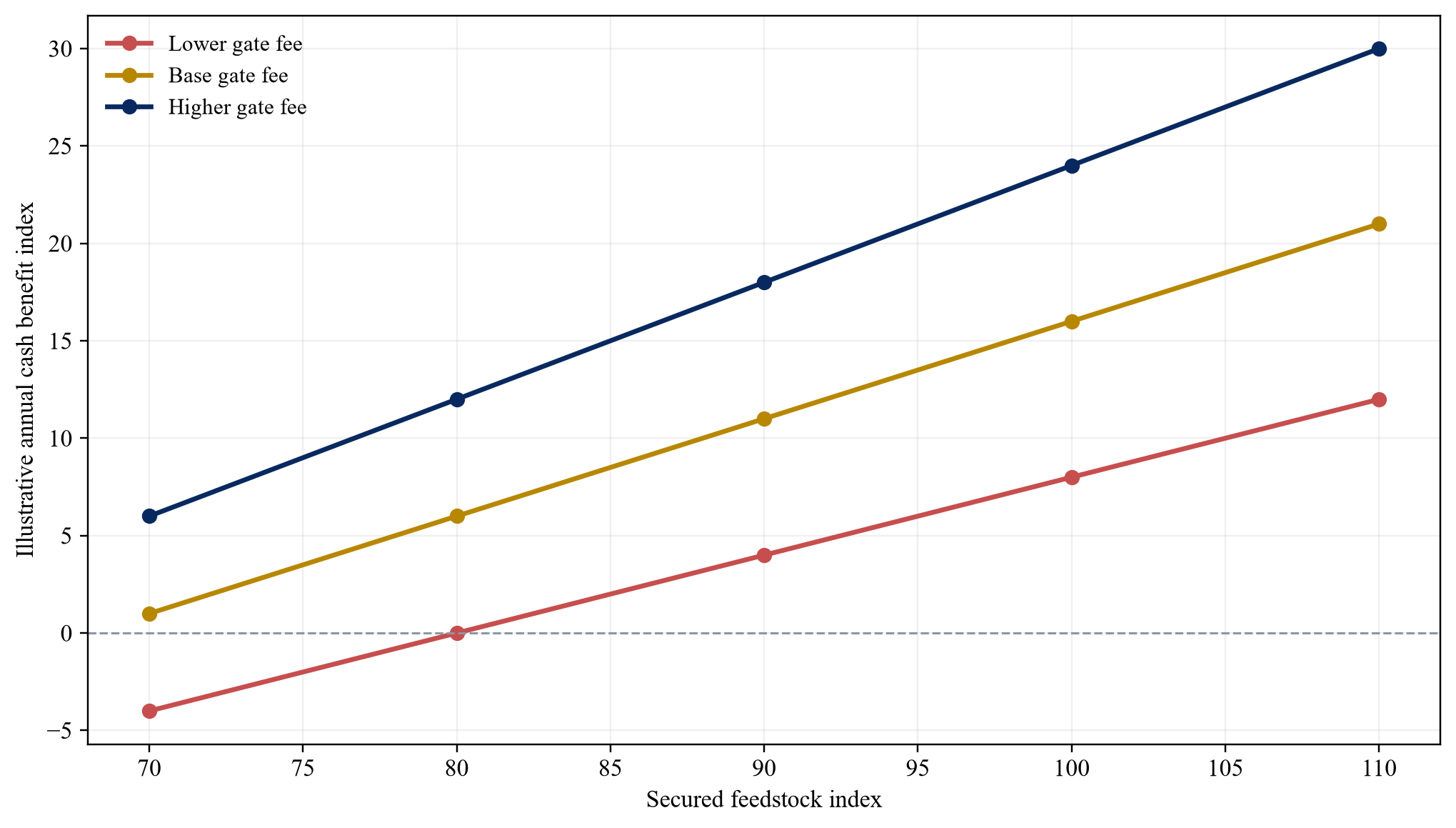
Illustrative scenario analysis only; values are not forecasts or transaction evidence.
27. Compare treatment pathways
Pathways should be compared on the same waste forecast and compliance basis. The comparison should include hierarchy position, feedstock quality, capital, operating cost, energy, recovered products, residues, emissions, connection and contract fit.
Source-separated food waste can support digestion and nutrient recovery when digestate quality is maintained. Residual energy recovery can treat non-recyclable material and provide power or heat. Mechanical sorting can recover material before a residual route. Landfill gas addresses existing deposits rather than new feedstock.
The control case should include lawful transfer to available facilities. A proposed plant must outperform that compliant alternative on risk-adjusted cost and service.
Table 2. Proposed circular-economy pathway scorecard
| Test | Material recycling | Anaerobic digestion | Residual energy recovery | Compliant transfer |
|---|---|---|---|---|
| Suitable feedstock | clean recoverable materials | source-separated wet organics | non-recyclable residual waste | waste accepted by third-party permit |
| Primary output | secondary material | biogas or biomethane and digestate | power, heat, metals and controlled residues | contracted treatment service |
| Main quality risk | contamination and market specification | contamination and biological stability | moisture, calorific value and fossil carbon | rejection and capacity availability |
| Policy direction | generally higher in hierarchy | recycling route for suitable bio-waste | recovery below recycling | depends on destination route |
| Contract focus | specification and buyer demand | quantity, contamination and product quality | quantity band, composition and carbon cost | capacity, price, liability and haulage |
| Flexibility need | market and sorting adaptability | preprocessing and modular capacity | turndown, sorting and energy interfaces | multiple qualified destinations |
| Primary investment gate | durable end market | clean feedstock and product outlet | resilient residual stream and energy route | creditworthy capacity contract |
Proposed framework; conclusions require jurisdiction-specific waste classification, lifecycle, technical, environmental and financial review.
28. Match finance to contract life
Debt tenor should fit the shorter of resilient feedstock availability, service contract, site rights, permits and principal revenue contracts. A long asset life does not create a long contracted life.
Amortisation should reflect tonnage and margin decline. A terminal value based on contract renewal should remain separate from debt sizing unless renewal rights and demand are unusually strong.
Merchant exposure may be suitable for equity, reserves or shorter debt. Public-service obligations can support long contracts when governance, affordability and change mechanisms are clear.
29. Allocate demand risk
Demand risk concerns the authority's or market's need for treatment. It differs from delivery risk, which concerns whether tonnes reach the plant. Contracts should distinguish the two.
An authority can retain system-planning risk while the operator retains facility performance. Policy-driven diversion can sit within an agreed band. Operator-controlled rejection, outage or poor availability should not transfer back to the authority.
The allocation should be affordable through downside cases. A contractual payment from a public counterparty still depends on budget and legal authority.
30. Allocate change-in-law risk
Change in law can affect eligible feedstock, emissions, carbon cost, residues, taxes, monitoring and product status. The contract should define general law, project-specific law, foreseeable policy and relief.
Automatic full pass-through can weaken efficiency incentives. No relief can make financing impossible. A balanced mechanism can use thresholds, sharing, mitigation duties and termination for prolonged material change.
Known consultations and published implementation plans should be priced at financial close. Relief should address genuinely new obligations.
31. Protect refinancing integrity
Refinancing can release equity and lower financing cost. It can also increase fixed debt service against a feedstock stream that policy is reducing.
The refinancing case should refresh material-flow data, collection performance, competing capacity, carbon policy, plant condition and contract life. Historical utilisation alone is insufficient.
Distribution tests should preserve major-maintenance, carbon and residue reserves. Public-sector gain-sharing, where applicable, should be calculated from verified refinancing benefit.
32. Establish completion support
Construction support should cover design, commissioning, ramp-up, acceptance, delay and cost overrun. Completion tests should use representative feedstock rather than unusually favourable commissioning material.
The test period should demonstrate throughput, availability, energy output, emissions, residue quality, reagent consumption, parasitic load and data integrity. Separate tests may be needed for seasonal composition.
Sponsors should fund underperformance until the project meets agreed criteria or the capital structure is repaired.
33. Integrate collection and plant interfaces
Collection design affects plant performance. Bin size, frequency, vehicle type, transfer, storage and contamination controls influence moisture, degradation and delivery profile.
The operating model should coordinate collection disruptions, holidays, weather, road access and planned outages. Buffer storage needs environmental and fire controls.
Interface agreements should define data, dispatch, rejected loads, emergency transfer and restart. A treatment plant cannot correct a collection system that supplies the wrong material.
34. Build the data architecture
The data model should connect customer, route, vehicle, load, weight, composition, acceptance, process batch, energy meter, recovered product, residue, emissions and invoice.
Mass and energy balances should reconcile at defined periods. Unexplained loss can indicate moisture, measurement error, stock movement, theft or process deterioration.
Data ownership and retention should survive contract transition. Authorities and lenders need sufficient access to verify performance without taking operational control.
35. Use analytics with controls
Analytics can forecast deliveries, identify contamination, optimise routing, detect equipment deterioration and predict energy output. Models should have defined inputs, training periods, validation, owners and override rules.
Automated acceptance or pricing decisions can create disputes if the evidence is opaque. The contract should specify which measurements determine payment and how they can be challenged.
Cybersecurity and operational continuity should cover weighbridges, plant controls, meters, laboratory systems and settlement interfaces.
36. Manage emissions and residues
Energy-recovery permits can impose limits on air emissions, water, noise, odour and residues. The EU waste-incineration best-available-techniques reference addresses emissions and energy and material recovery.[11]
The operating plan should connect waste composition, combustion or digestion, control systems, monitoring and residue quality. A change in feedstock can change reagent use, corrosion and emissions.
Residue routes need qualified destinations and contingency capacity. The downside model should include temporary storage and higher disposal cost.
37. Preserve flexibility
Flexibility can include modular digestion, multiple reception lines, enhanced sorting, heat take-off, spare grid capacity, fuel blending within permit, carbon-capture space and conversion or closure rights.
Every option has cost. The investment committee should fund options tied to plausible policy or market paths. Unspecified future flexibility can become unused capital.
The design should make downsizing and retirement executable. A plant that can only run at high utilisation may create pressure to retain recyclable feedstock.
38. Plan carbon-abatement options
Abatement can include better sorting of fossil material, higher energy efficiency, heat use, renewable auxiliary energy, methane control, carbon capture and improved logistics. The technical route depends on process and location.
Carbon capture requires space, energy, flue-gas integration, transport and storage or use. It should be modelled as a separate investment stage until the interfaces and revenue are supportable.
The project should avoid counting captured biogenic carbon as durable removal without an applicable methodology and permanent storage evidence.
39. Test export and cross-border exposure
Waste and refuse-derived fuel can cross borders subject to shipment law, classifications and permits. Export can provide a market outlet or create competition for domestic plants.
The model should include transport, currency, port, documentation, destination capacity and policy risk. A route that depends on another jurisdiction's spare capacity may change quickly.
Import assumptions need equal scrutiny. Debt should not rely on imports without durable rights, legal clearance and competitive delivered cost.
40. Test circular-economy downside
The downside should combine faster prevention, higher recycling capture, separate organics, lower residual calorific value, carbon cost, competing capacity and contract step-downs. Testing one variable at a time can understate the joint effect.
The case should identify a management response at each utilisation band. Responses can include route expansion, contract repricing, sorting changes, heat sales, modular retirement, refinancing restriction or closure.
The best downside is operationally executable and contractually permitted. A spreadsheet response without site, contract or permit capacity is not mitigation.
41. Test implementation failure
Policy may be enacted but poorly implemented. Separate collection can suffer low participation or contamination. Recycling markets can weaken. Enforcement can vary. These conditions can temporarily increase residual feedstock.
The investment case should not treat implementation failure as a durable advantage. It can provide transitional volume while creating political, reputational and contract risk.
Scenario governance should update probabilities from observed collection and market data. Management estimates should remain identified as estimates.
42. Allocate risk to control
Each risk should sit with the party that can control, price or absorb it. Collection authorities can influence service design. Operators control plant availability and acceptance within specification. Technology suppliers control design and performance within agreed inputs. Buyers control product acceptance and payment.
Some risks require sharing. Policy-driven feedstock decline can be addressed through bands, availability payments and periodic rebasing. Carbon cost can be shared with incentives for verified abatement.
The contract should connect relief to evidence and mitigation rather than broad labels.
43. Fund reserves and contingencies
Reserves should cover major maintenance, outage transfer, carbon cost, residue disposal, working capital and decommissioning. Their size should follow modelled exposure and contract recovery timing.
Contingency facilities should have committed terms and draw conditions. An uncommitted sponsor intention is not liquidity.
Distribution should stop when throughput, availability, emissions, liquidity or debt-service tests fail. Cure periods should protect operations and public service.
44. Use a decision scorecard
The scorecard should compare evidence for feedstock, hierarchy compliance, contract, technology, permit, connection, outputs, carbon, financing and operating capability. Each score should link to a document and owner.
Red conditions can include unresolved recyclable content, unsupported minimum tonnage, missing residue route, unallocated carbon cost, uncontracted heat presented as base revenue or insufficient downside liquidity.
The scorecard should be refreshed before financial close, construction notice, completion, refinancing and contract renewal.
45. Build the implementation roadmap
Implementation should begin with policy and material-flow evidence. It should then audit feedstock, select the compliant route, negotiate flexible contracts, complete design and permits, construct, prove performance, and monitor diversion.
Gates should release capital only when the preceding evidence is complete. Procurement can progress in parallel where reversal remains possible.
The roadmap should include a later-life decision. Recontracting, repowering, conversion, downsizing and closure need lead time before feedstock or contracts expire.
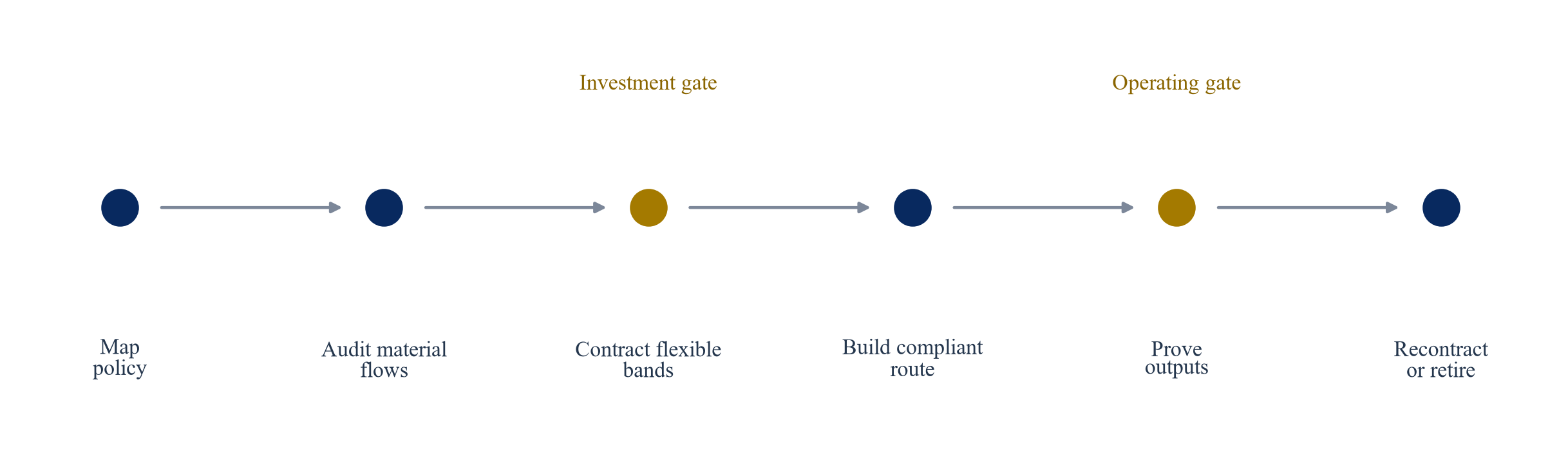
Proposed sequence; timing depends on policy, collection reform, permits, contracts, technology and financing.
46. Define completion tests
Completion tests should cover throughput, composition, availability, energy output, emissions, residues, recovered materials, parasitic load, data and settlement. Tests should use the contract measurement system.
The test should demonstrate stable operation across enough time to expose variability. Short runs with selected feedstock can overstate sustainable performance.
Failure should trigger cure, retest, support, price adjustment or restructuring. Public-service continuity and compliant alternative treatment should remain available.
47. Monitor material and cash performance
Management should report generated waste, separate collection, recycling capture, delivered tonnes, composition, rejection, plant throughput, availability, energy, heat, recovered products, residues, emissions, revenue, operating cost and cash.
Variance should distinguish price, quantity, quality and policy. Higher gate-fee revenue can coexist with worsening feedstock security. Higher energy output can coincide with more fossil plastic in residual waste.
The board should review leading indicators such as collection rollout, competitor commissioning and contract expiry before financial performance changes.
48. Test the project against alternatives
The committee should compare the proposed facility with prevention investment, collection reform, recycling capacity, digestion, third-party transfer, residual energy recovery and delayed construction. The same waste forecast and legal assumptions should apply to every case.
The comparison should include lifecycle cost, flexibility, emissions, residues, deliverability, credit and stranded-capacity risk. A low gate fee can hide public support, long haulage or future carbon exposure.
The selected route should provide the best supportable service for material that remains after higher-priority options.
49. Plan refinancing, conversion or retirement
Refinancing should follow demonstrated feedstock, operating performance and contract life. Conversion can include better sorting, heat, different organics treatment or carbon abatement where permits and economics support it.
Retirement planning should cover service replacement, workforce, site, equipment, residues, environmental obligations and debt. Delay can create an abrupt capacity gap.
Terminal value should remain conservative. A durable site and grid connection can have value, but a treatment technology may lose feedstock before its physical life ends.
50. Apply the investment-committee test
The committee should ask whether the forecast begins with material categories, reflects enacted rules and credible policy cases, and identifies the residual or organic stream that remains available. It should test whether contracts preserve the waste hierarchy and allocate quantity, quality, carbon and change-in-law risk.
Approval should state stage, capacity, feedstock bands, capital, conditions, reserves, support and stop rules. It should identify the compliant alternative when the facility is unavailable or feedstock declines.
The final test is material-to-cash integrity. Generated waste, separate collection, accepted feedstock, process output, energy, recovered products, residues, environmental evidence and settlement should reconcile.
Table 3. Proposed circular waste-energy risk-allocation matrix
| Risk | Natural owner | Contract mechanism | Evidence for capital release |
|---|---|---|---|
| Policy-driven diversion | authority and sponsor within control | quantity bands, availability payment, rebasing and mitigation | material-flow model tied to enacted rules and scenarios |
| Feedstock composition | supplier and operator within control | specification, sampling, rejection and quality adjustment | representative campaigns and agreed test protocol |
| Collection performance | collection authority or contractor | service standards, route data and corrective plan | rollout plan, participation evidence and contingency |
| Plant availability | operator and technology supplier | performance guarantees, security and liquidated damages | factory and site acceptance tests |
| Energy and product sales | project company and buyer | specification, metering, credit support and price formula | executed offtake and connection evidence |
| Carbon and emissions | operator, authority and sponsor as allocated | monitoring, cost-sharing, abatement and change-in-law rules | approved monitoring plan and scenario model |
| Residue and rejected loads | operator and supplier within control | acceptance rules, alternative routes and indemnities | qualified destinations and capacity evidence |
| Construction and integration | sponsor and package contractors | coordinated design, schedule, contingency and completion support | design freeze and funded completion plan |
| Decline and retirement | authority, project company and lenders | step-downs, reserves, conversion and termination rights | funded later-life service and site plan |
Proposed framework; allocation requires project-specific legal, technical, environmental, procurement and credit review.
Conclusion
Circular-economy rules change the feedstock available to energy projects. They can create clean organic streams for anaerobic digestion, divert residual waste from landfill and remove recyclable or fossil-rich material from combustion. The direction and timing differ by jurisdiction and waste category.
A bankable project begins with component-level material flows and a lawful treatment allocation. It contracts quantity bands and quality, preserves prevention and recycling incentives, separates base revenue from policy-dependent upside, and sizes debt to resilient feedstock and contract life.
Sponsors can protect value through flexible capacity, strong data, preprocessing, diversified outputs, carbon scenarios, reserves and executable later-life options. The investment case remains grounded when every tonne, product, environmental claim and cash receipt can be reconciled.
Investment-committee questions
1. Which enacted rules and credible policy cases change each material stream? 2. How are prevention, reuse, recycling and separate collection reflected in tonnes? 3. What feedstock remains legally and practically available to the project? 4. Which historical records reconcile generated, collected, accepted and rejected tonnes? 5. How representative are the composition and calorific-value campaigns? 6. Which competing facilities, exports and landfill routes affect the catchment? 7. Does the technology fit source-separated organics or residual non-recyclable waste? 8. What throughput and quality define minimum resilient operation? 9. Do feedstock contracts preserve waste-prevention and recycling incentives? 10. How are quantity bands, contamination, rejection and policy step-downs measured? 11. Which gate-fee, energy, heat, material and environmental revenues are contracted? 12. What carbon-cost cases apply, and who bears monitoring and allowance cost? 13. Are heat, grid, gas and recovered-product interfaces executable? 14. Which residues require disposal, and where is contingency capacity? 15. How does lower tonnage affect unit fixed cost, debt service and liquidity? 16. Which change-in-law mechanisms are foreseeable and already priced? 17. What completion tests use representative feedstock and stable operation? 18. Which data reconcile material flows, energy outputs, residues and invoices? 19. What conversion, downsizing, recontracting or retirement triggers apply? 20. Why does the selected route outperform the best compliant alternative?
References
- European Union, Directive 2008/98/EC on Waste, consolidated framework and amendments. https://eur-lex.europa.eu/legal-content/EN/TXT/?uri=CELEX:32008L0098
- European Union, Directive 1999/31/EC on the Landfill of Waste, consolidated 4 August 2024. https://eur-lex.europa.eu/legal-content/en/ALL/?uri=CELEX:01999L0031-20240804
- UK Department for Environment, Food and Rural Affairs, Simpler Recycling: Household Recycling in England, updated 13 May 2025. https://www.gov.uk/guidance/simpler-recycling-household-recycling-in-england
- European Union, EU Waste Management Law: Summary of Directive 2008/98/EC. https://eur-lex.europa.eu/legal-content/EN/TXT/?uri=LEGISSUM:ev0010
- UK Environment Agency, Dispose of Waste to Landfill, updated 12 March 2025. https://www.gov.uk/guidance/dispose-of-waste-to-landfill
- International Energy Agency, Assessing the Sustainable Potential and Cost of Feedstocks for Biogas and Biomethane. https://www.iea.org/reports/outlook-for-biogas-and-biomethane/assessing-the-sustainable-potential-and-cost-of-feedstocks-for-biogas-and-biomethane
- United Nations Environment Programme, Waste to Energy: Key Considerations. https://wedocs.unep.org/bitstream/handle/20.500.11822/29521/WTEPoster.pdf
- World Bank Group and International Finance Corporation, Model RFP and Concession Agreement for Waste to Electricity Project. https://ppp.worldbank.org/library/model-rfp-concession-agreement-waste-electricity-project
- UK Emissions Trading Scheme Authority, UK ETS Scope Expansion: Waste, updated 26 August 2026. https://www.gov.uk/government/consultations/uk-emissions-trading-scheme-scope-expansion-waste
- European Commission, Proposal COM(2026) 616 on Revision of the EU Emissions Trading System. https://eur-lex.europa.eu/legal-content/EN/ALL/?uri=COM:2026:616:FIN
- European Commission Joint Research Centre, Best Available Techniques Reference Document for Waste Incineration. https://op.europa.eu/en/publication-detail/-/publication/075477b7-329a-11ea-ba6e-01aa75ed71a1/language-en
- United Nations Environment Programme, Global Waste Management Outlook 2024: Beyond an Age of Waste. https://wedocs.unep.org/items/36e16872-2f02-4447-a3c1-c939bf50ea92
- UK Department for Environment, Food and Rural Affairs, Guidance on Applying the Waste Hierarchy. https://www.gov.uk/government/publications/guidance-on-applying-the-waste-hierarchy
- UK Department for Environment, Food and Rural Affairs, Food and Drink Waste Hierarchy: Deal with Surplus and Waste, updated 1 January 2024. https://www.gov.uk/government/publications/food-and-drink-waste-hierarchy-deal-with-surplus-and-waste
- UK Government, Simpler Recycling in England: Impact Assessment. https://www.legislation.gov.uk/ukia/2024/97/pdfs/ukia_20240097_en.pdf
- European Commission, The Role of Waste-to-Energy in the Circular Economy. https://eur-lex.europa.eu/legal-content/EN/TXT/?uri=oj:JOC_2017_345_R
- World Bank Group, Waste-to-Power Model for Environmental Restoration Public-Private Partnership. https://ppp.worldbank.org/waste-power-model-erp
- International Energy Agency, Outlook for Biogas and Biomethane. https://www.iea.org/reports/outlook-for-biogas-and-biomethane
- International Energy Agency, Renewables 2025: Biogases. https://www.iea.org/reports/renewables-2025/biogases
- Global Methane Initiative, Unlocking Financing for Organic Waste Management Projects. https://globalmethane.org/resources/details.aspx?resourceid=5455
About the Author
Authored by Chennakeshav Adya Independent Researcher
Chennakeshav (CK) is a corporate finance and investment banking executive with 25+ years of global experience in deal origination, structuring and execution across M&A, growth capital and corporate strategy. He has led value-creation mandates for founders, corporates and funds — bridging the boardroom view to hands-on execution and close.
His career spans Morgan Stanley, HSBC, Lloyds Banking Group, EWEC, ADQ portfolio companies and Emirates Growth Fund, across TMT, real estate, fintech, deeptech, cleantech, infrastructure and energy. He has partnered with C-suite leaders, private equity and venture funds, sovereign wealth funds and family offices to finance complex fund raises and scale-up ventures, and has led M&A due diligence, post-merger integration and business-transformation initiatives to create value.
At Matchpoint Partners he is Managing Partner, leading the firm's corporate finance, M&A and capital-raising practice. He holds an MBA from London Business School, an engineering degree from VTU and a Master of Laws (LLM, in progress) from UCL London.
An active start-up mentor, CK mentors at Techstars, DIFC FinTech Hive, Startup Grind, Founder Institute and IN5, serves as Entrepreneur Mentor in Residence (EMiR) at London Business School, and judges the Entrepreneurship World Cup.
Matchpoint profile: https://www.matchpoint-partners.com/team/ck-adya.html LinkedIn: https://www.linkedin.com/in/ckadya/
