

1. Completion working capital is a contract-controlled value bridge
An acquisition price is often discussed as an enterprise value before it is translated into the equity value paid at completion. The translation usually adjusts for cash, debt, debt-like items and the difference between actual working capital and an agreed normal level. Working capital therefore forms a contractual component of the transaction's value bridge.
The commercial purpose is straightforward. A buyer expects the acquired business to have enough ordinary operating current assets and liabilities to continue trading in the manner contemplated by the valuation. A seller should receive the benefit of delivering more than the agreed requirement and should bear the adjustment when the delivered level is lower. The contract must turn that principle into a repeatable calculation.
That calculation becomes difficult because reported current assets and current liabilities are not designed specifically for an acquisition agreement. Cash may include restricted balances. Receivables may include related-party amounts, doubtful debts or unbilled revenue. Inventory may include slow-moving stock. Payables may have been stretched near completion. Accruals can contain operating expenses, transaction costs, bonuses or capital expenditure. Contract assets and contract liabilities may require a treatment aligned with the economics of the transaction. A balance can also sit in both the working-capital discussion and the debt-like schedule unless the parties maintain a single classification map.
The acquisition agreement is the governing instrument for the adjustment. Financial statements, management accounts and accounting standards provide evidence and measurement principles; they do not replace the agreed definition. The Institute of Chartered Accountants in England and Wales and Grant Thornton describe two central completion mechanisms. Completion accounts determine a final equity price from accounts prepared after the transaction. A locked box fixes equity value by reference to an earlier balance sheet and protects the buyer through leakage provisions and contractual protections.[1]
The first control is a common value equation. A simplified form is:
Equity value at completion = enterprise value + cash - debt and debt-like items + actual working capital - working-capital peg - other agreed adjustments.
Every term needs a schedule, sign convention and rule for avoiding overlap. The same label can carry different economic content across transactions. The definition must therefore be negotiated against the target's ledger and operating model.
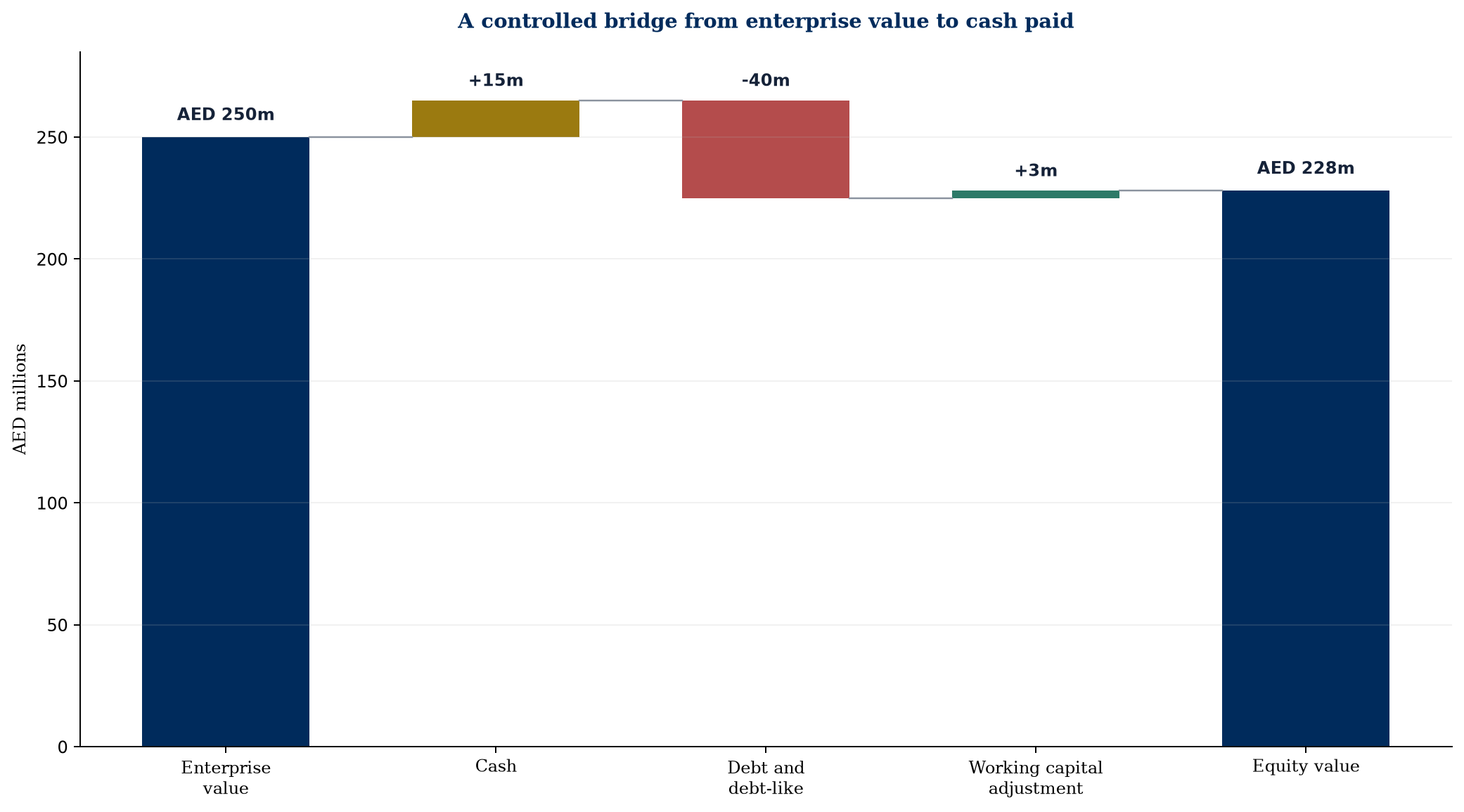
Hypothetical AED values for illustration. The classification and adjustment terms must follow the signed transaction documents.
2. Define the schedule before setting the peg
The working-capital schedule should begin with ledger accounts. The deal team should map each balance-sheet account into one of five categories: included working capital, cash, debt or debt-like, another specific adjustment, or excluded. The map should state whether the balance is gross or net, how provisions are treated, which entities and branches are in scope, the currency conversion rule and whether intercompany amounts survive completion.
A common starting formula is operating current assets less operating current liabilities. Trade receivables, ordinary inventory, prepayments and certain contract assets may be included. Trade payables, operating accruals, deferred income and certain contract liabilities may also be included. Tax balances, financing items, transaction costs, shareholder balances, capital expenditure creditors and employee liabilities can require specific treatment. Their classification depends on the economics, the enterprise-value premise and the transaction's negotiated terms.
The included schedule should reconcile to the trial balance and to each historical balance sheet used to estimate the peg. Unreconciled management schedules weaken the analysis because an apparent working-capital trend may be caused by account reclassifications or inconsistent consolidation. The team should retain an audit trail from the general ledger to the final calculation.
Accounting standards help identify measurement questions. IAS 2 requires inventory to be measured at the lower of cost and net realisable value and describes the costs included in inventory.[2] IFRS 9 addresses the recognition and measurement of financial assets and liabilities, including expected credit losses.[3] IFRS 15 governs revenue from customer contracts and the related contract assets and liabilities.[4] IAS 37 covers provisions with uncertain timing or amount.[5] These standards identify estimates and judgements that the parties should address in the accounting hierarchy. The acquisition agreement supplies the transaction definition.
The hierarchy ordinarily states which rules prevail when the calculation is prepared. ICAEW's completion-mechanisms guidance describes a typical order: specific policies in the sale agreement, consistent application of the policies used in the last accounts, and then the relevant accounting framework.[1] The exact order remains a negotiated term. Specific policies may cover cut-off, provisions, foreign exchange, stock counts, aged debt, rebates, customer deposits, supplier bonuses and unusual accruals.
Table 1. Illustrative classification map for the completion schedule
| Balance | Possible treatment | Control question |
|---|---|---|
| Trade receivables | Working capital, net of agreed loss allowance | Are aged, disputed, related-party and post-completion receipts reconciled? |
| Inventory | Working capital at agreed valuation basis | Are slow-moving, obsolete, consignment and in-transit items identified? |
| Trade payables | Working capital | Are cut-off, unrecorded liabilities and extended payment patterns tested? |
| Customer advances | Working capital or debt-like, as agreed | Will the buyer incur the associated delivery cost after completion? |
| Accrued bonuses and leave | Working capital or debt-like, as agreed | Which service period created the obligation, and when is cash payable? |
| Capital expenditure creditors | Often debt-like or separately adjusted | Is the expenditure included in the valuation case or a seller obligation? |
| Corporate tax and VAT | Usually excluded or specifically adjusted | Which party receives the benefit or bears the pre-completion exposure? |
| Restricted cash | Cash, excluded cash or security-linked item | Can the buyer use the balance freely after completion? |
The table is a discussion framework. Each transaction requires a ledger-level definition and fact-specific legal, tax and accounting advice.
3. Normalise the operating requirement
The peg represents the ordinary working capital required to support the business at completion. A historical average is a useful starting point and rarely the full answer. The selected period, data frequency and adjustments can change the result materially.
A disciplined analysis normally uses at least 24 months of monthly data where available. The analyst should reconcile every month to source ledgers, identify changes in accounting policy or chart of accounts, and split the components into operational drivers. Receivables can be analysed through revenue, billing timing, days sales outstanding and ageing. Inventory can be analysed through purchases, usage, turns, obsolescence and supply lead times. Payables can be analysed through cost of sales, payment terms, overdue balances and supplier concentration. Accruals and deferred income should be linked to the services or costs they represent.
The team should then identify adjustments to history. Examples include a non-recurring project, a delayed government receivable, a one-off stock build, a supply disruption, a temporary payment holiday, owner-managed collection practices, a new revenue model or a material acquisition. Every normalisation should have a quantified basis, source documents and a stated direction of effect. Symmetry matters. A buyer should not remove an adverse historical event while retaining a favourable one that arises from the same cause.
The peg also needs to reflect the operating scale expected at completion. A rapidly growing business may require more receivables and inventory than its trailing average. A declining or contracting operation may require less. A ratio-based cross-check can help, but a single percentage of revenue can conceal different cycles across business units. The preferred approach links each working-capital component to the driver that creates it.
SRS Acquiom reports that practitioners often use a 12-month average when setting a working-capital target.[6] Its 2026 study covers 1,570 private-target acquisitions with aggregate consideration of approximately US$385 billion, completed from 2020 through the third quarter of 2025.[7] The dataset is proprietary and primarily reflects the transactions administered by SRS Acquiom. It is not a representative GCC sample. Its findings provide a reference point for mechanism design; they do not establish GCC market practice.
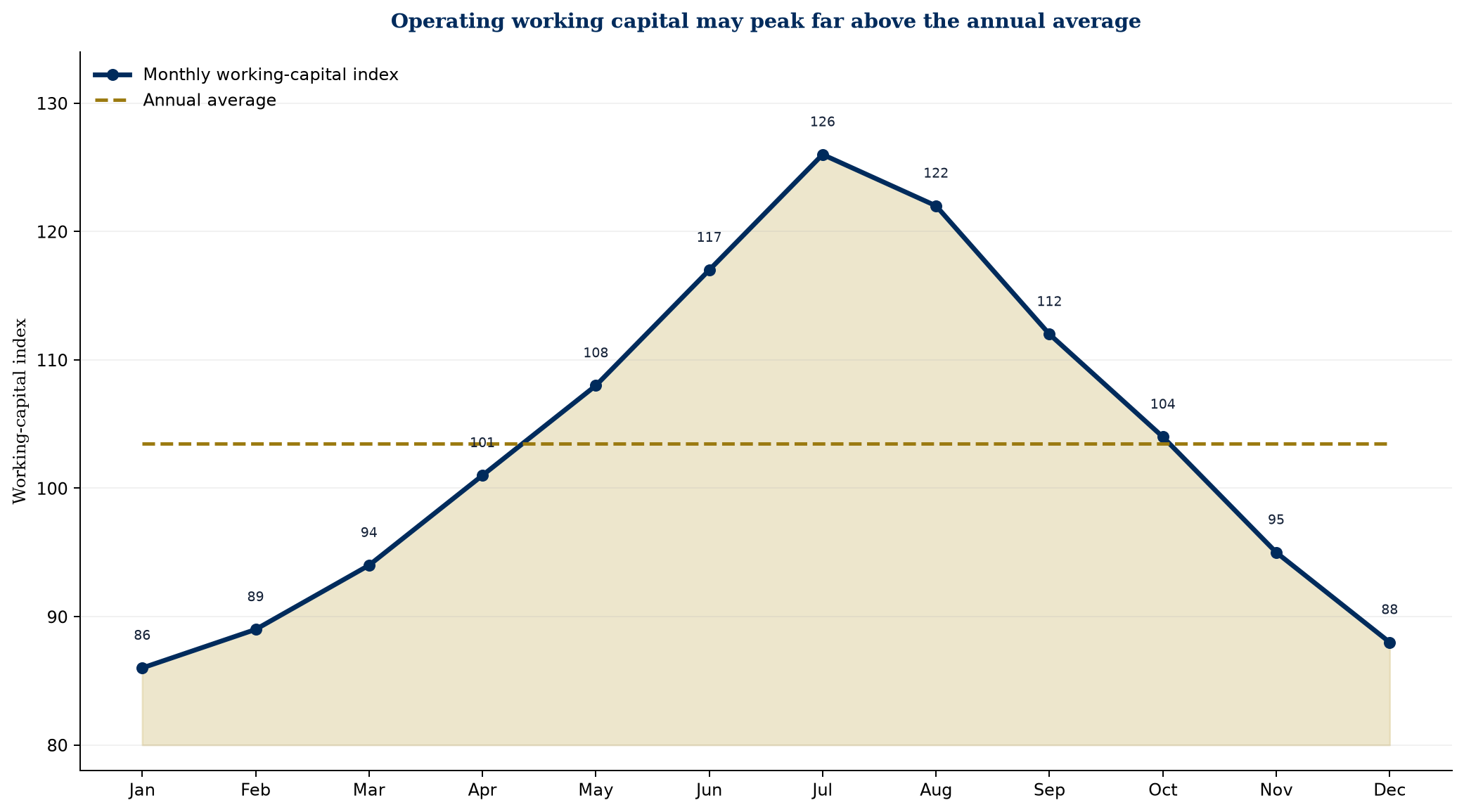
Illustrative monthly index. A completion-date peg should be tested against the target's reconciled monthly history and operating drivers.
4. Seasonality, growth and timing change the answer
Seasonal businesses need a completion-date analysis. ICAEW's guidance notes that a full 12-month period is often required for a seasonal business.[1] Two or more annual cycles provide stronger evidence because they show whether the seasonal pattern is stable. Monthly averages should be supplemented with daily or weekly data around material peaks when month-end balances do not represent intra-month funding requirements.
The transaction timetable can interact with seasonality. A distributor completing immediately before a major sales period may need a higher stock level. A school-services provider may collect annual fees in advance and carry a contract liability. A construction or project business may have milestones, retention receivables and mobilisation advances. A hospitality or retail business may show sharp inventory and supplier-payment patterns around religious holidays or tourism peaks. The peg should reflect the economics at the agreed completion date and the valuation assumptions used by both parties.
Growth introduces a second dimension. If revenue is expanding, historical working capital can be scaled by days or turns, provided those operational ratios remain credible. The analysis should separate growth-driven investment from deteriorating collection or stock management. A rise in receivables may support higher sales, reflect slower payment or combine both. A rise in inventory may protect service levels, reflect supply-chain risk or indicate obsolescence. Management interviews should be corroborated with ageing, subsequent receipts, stock movement and purchase data.
Cut-off can create a large apparent change without changing underlying operations. Shipping terms, acceptance milestones and invoicing rules determine whether revenue, receivables, inventory and payables are recognised before or after completion. The accounting hierarchy should contain explicit cut-off rules and the completion process should test transactions around the measurement date. Where the business operates across several GCC jurisdictions, the schedule should also reconcile branches, local ledgers and intercompany trading.
The peg paper presented to the decision-makers should show at least three views: the reconciled historical average, the completion-date seasonal requirement and the forecast requirement at the completion scale. The negotiated peg can then be explained as a bridge between those views. A single number without that bridge is difficult to defend and difficult to govern.
Table 2. Evidence required for a normalised peg
| Workstream | Core evidence | Decision output |
|---|---|---|
| Reconciliation | Trial balances, ledgers, management accounts, audited accounts | Reliable monthly schedule and account map |
| Receivables | Ageing, invoices, credit notes, subsequent receipts, disputes | Included balance and loss allowance policy |
| Inventory | Stock ledger, counts, ageing, movements, write-downs, consignment records | Valuation basis and normalisation adjustments |
| Payables | Ageing, payment runs, supplier statements, unrecorded-liability testing | Ordinary payment profile and cut-off policy |
| Seasonality | Two or more monthly cycles where available, plus peak-period detail | Completion-date operating requirement |
| Growth | Revenue, purchases, days, turns, capacity and forecast bridge | Scale adjustment separated from deterioration |
| One-off events | Event record, quantified impact, recurrence assessment | Supported and symmetrical normalisations |
The analysis period and granularity should reflect the target's business model and data availability.
5. Separate working capital from cash, debt and debt-like items
The most consequential completion disputes often arise at classification boundaries. If a liability reduces working capital and is also deducted as debt-like, the buyer receives the adjustment twice. If it sits in neither schedule, the seller may receive value for an obligation that the buyer funds after completion. A classification register should therefore cover every relevant account once and record the rationale.
Debt-like analysis focuses on obligations that are economically similar to financing or that relate to value already consumed before completion. Examples considered in transaction negotiations can include unpaid transaction bonuses, deferred consideration, shareholder loans, unpaid dividends, overdue taxes, certain capital expenditure creditors, factoring balances, finance leases and obligations for pre-completion services. The label does not settle the treatment. The parties should identify who receives the economic benefit, when the cash is paid, whether the item is reflected in enterprise value, and whether it is already included in working capital.
Cash also requires a usable definition. Bank balances can be restricted, pledged, trapped, held for customers or subject to local access arrangements. Deposits may have notice periods. Cheques in transit and overdrafts may require bank-level netting rules. The schedule should reconcile bank statements, the ledger and the proposed completion statement. Currency conversion should follow an identified source and time.
The same discipline applies to tax. Pre-completion corporate tax, withholding tax, VAT and customs exposures are generally addressed through a combination of price mechanics, specific indemnities, covenants and tax provisions. Their treatment should be coordinated across the tax deed, completion accounts and debt-like schedule. The economic exposure should appear once in the value bridge and remain subject to the protections agreed by the parties.
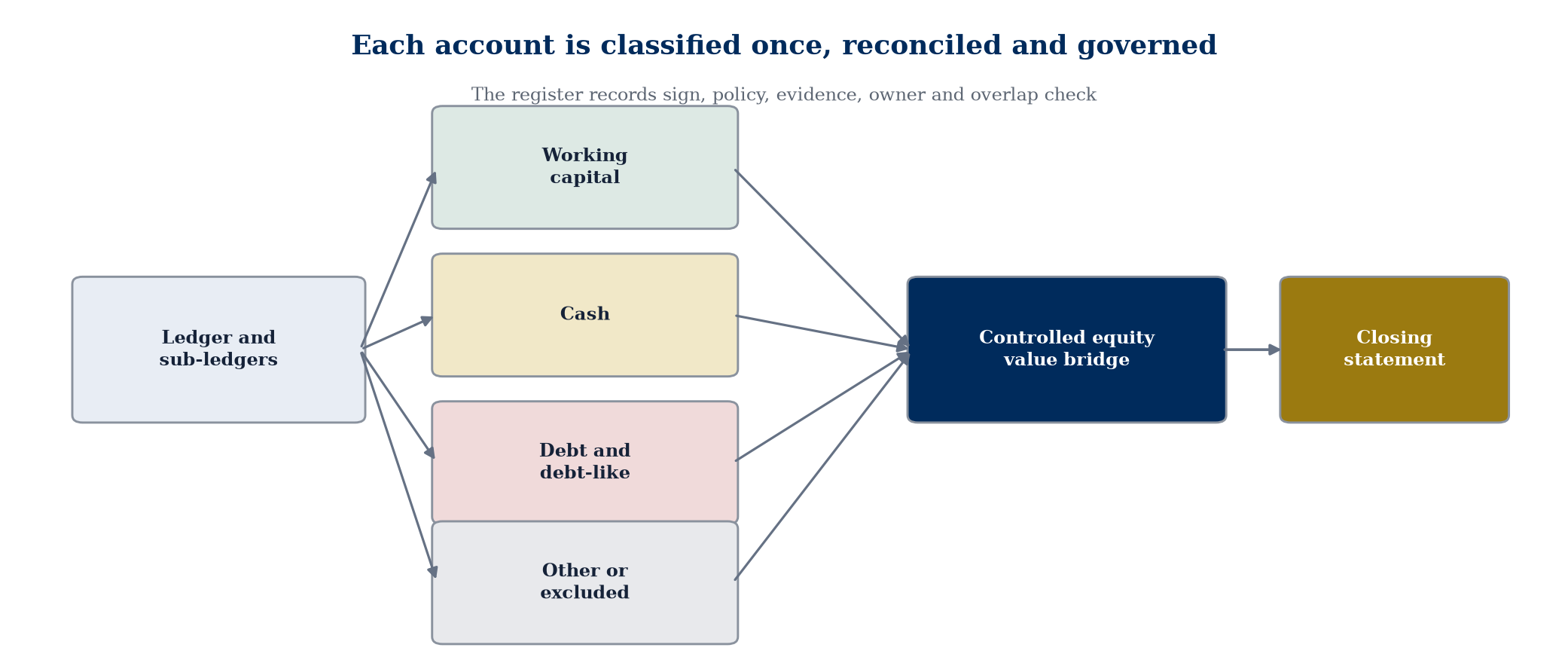
Illustrative control architecture. The final classifications depend on the transaction documents and the underlying facts.
6. Choose the completion mechanism consciously
Completion accounts offer a post-completion true-up. The buyer or seller prepares the statement within an agreed period, the other party reviews it, disputed items proceed through the contractual process and the final price is settled. This mechanism can respond to a volatile balance sheet and a long interval between signing and completion. It also creates preparation cost, uncertainty and the possibility of a dispute after control has transferred.
A locked box uses an agreed historical balance sheet to fix the equity value. Economic benefit and risk pass from the locked-box date, subject to the agreement. The buyer is protected against unauthorised leakage and supported by warranties, covenants, information rights and permitted-leakage schedules. The mechanism offers earlier price certainty when the reference accounts are reliable and the buyer can obtain sufficient diligence. Its protections depend on complete definitions, evidence over the period to completion and effective remedies.
ICAEW's guidance explains these differing mechanics and notes that the choice depends on factors including the parties' bargaining positions, the business and the reliability of the financial information.[1] A hybrid can also be negotiated, such as a locked box with specific adjustments for identified items. The label matters less than the precise allocation of economic risk.
The SRS Acquiom 2026 study found purchase-price adjustments in 92 per cent of the 2022 to third-quarter 2025 deals in its relevant sample. Across finalized adjustments from 2020 through the third quarter of 2025, 51 per cent were buyer-favourable, 38 per cent were seller-favourable and 11 per cent produced no adjustment. Median finalized adjustments were 0.27 per cent of transaction value where buyer-favourable and 0.17 per cent where seller-favourable.[7] These findings are drawn from a non-GCC proprietary dataset. They demonstrate that relatively small percentages can affect significant cash amounts; they do not establish the outcome for a specific GCC transaction.
The same study reports that 32 per cent of proposed final closing statements were delivered after the contractual deadline, with 8 per cent more than 30 days late. The median buyer delivery deadline was 90 days and the median seller review period was 30 days.[7] These statistics support practical controls around data ownership, preparation readiness and escalation. They do not determine the appropriate timetable for a particular agreement.
Table 3. Completion accounts and locked box allocate risk differently
| Dimension | Completion accounts | Locked box |
|---|---|---|
| Price timing | Final equity price determined after completion | Equity price fixed from an earlier reference balance sheet |
| Economic risk | Allocated through the completion date and adjustment rules | Commonly passes from the locked-box date, subject to agreed terms |
| Core buyer protection | Definitions, accounting policies, preparation and dispute rights | Leakage covenant, warranties, permitted leakage and information rights |
| Data need | Reliable closing data and post-close access | Reliable reference accounts and diligence over the locked-box period |
| Main execution burden | Prepare, review and resolve the closing statement | Monitor leakage and compliance from reference date to completion |
| Best-fit conditions | Volatility, uncertain closing balances, longer signing-to-close period | Stable business, strong accounts, clear leakage controls, demand for price certainty |
The comparison is general. Transaction-specific documents determine the actual rights and obligations.
7. Build the closing data pack and accounting hierarchy
The completion process should begin before signing. The finance workstream needs a dry run using a recent month-end, supported by the same ledgers and schedules expected at completion. The dry run tests the definition, account mapping, sign conventions, data availability, estimated preparation effort and likely disagreements. It also exposes where the seller's monthly close process relies on spreadsheets or late adjustments.
The closing data pack should include the trial balance, account-by-account mapping, bank reconciliations, debt statements, receivables and payables ageing, subsequent receipts and payments, stock reports and count evidence, accrual schedules, contract asset and liability analysis, tax balances, intercompany reconciliations, cut-off testing and foreign-exchange calculations. Each schedule should show preparer, reviewer, source system, extraction date and reconciliation status.
The transaction documents should state the measurement time. Midnight, close of business and immediately before legal completion can produce different results. They should also state whether the accounts are prepared on a going-concern basis, how post-balance-sheet information is used and whether events between the measurement time and completion are reflected.
Preparation and review timetables require operational realism. An unachievable deadline creates uncertainty and delays resolution. The parties should specify the form of the statement, access to books and people, the notice of disagreement, the scope of disputed items, the role of an independent expert, allocation of expert costs, payment timing and interest. The expert's mandate should distinguish accounting determination from legal interpretation because the forum and standard may differ.
Management should also decide who controls the cash implications. The price-adjustment team needs authority to reserve the disputed amount, approve settlement within a defined range and escalate material legal or tax interpretations. A decision log should record the amount, evidence, policy, contractual clause, owner and status of each issue.
8. Control leakage and pre-completion value extraction
In a locked-box transaction, leakage provisions protect the value that has economically passed to the buyer. ICAEW describes leakage as value extracted by the seller or connected persons from the locked-box date to completion, while permitted leakage identifies agreed exceptions.[1] Common categories considered in an agreement include dividends, distributions, transaction bonuses, management charges, asset transfers, debt forgiveness, advisory fees and benefits to the seller group.
The agreement should define the recipient group, direct and indirect value transfers, tax gross-up, notification, evidence and remedy. Permitted leakage should be specific, quantified where possible and linked to an approval record. Broad ordinary-course language can create ambiguity when related parties, shared services or owner-managed expenditure are involved.
Operational monitoring should combine finance, legal and transaction controls. The seller can maintain a weekly leakage certificate and a register of payments to connected persons. Bank data, related-party ledgers, payroll changes, board minutes and unusual journal entries should be reviewed. The buyer needs access rights consistent with competition law, confidentiality and the seller's duty to continue operating the business independently before completion.
Completion-accounts transactions also require pre-close conduct controls. A seller could improve reported working capital temporarily by delaying supplier payments, accelerating collections through unusual discounts, reducing inventory below operating need or changing the timing of accruals. The normalised peg, accounting policies and ordinary-course covenants should work together. Subsequent-payment and subsequent-receipt testing can identify whether a closing balance reflects the underlying trading cycle.
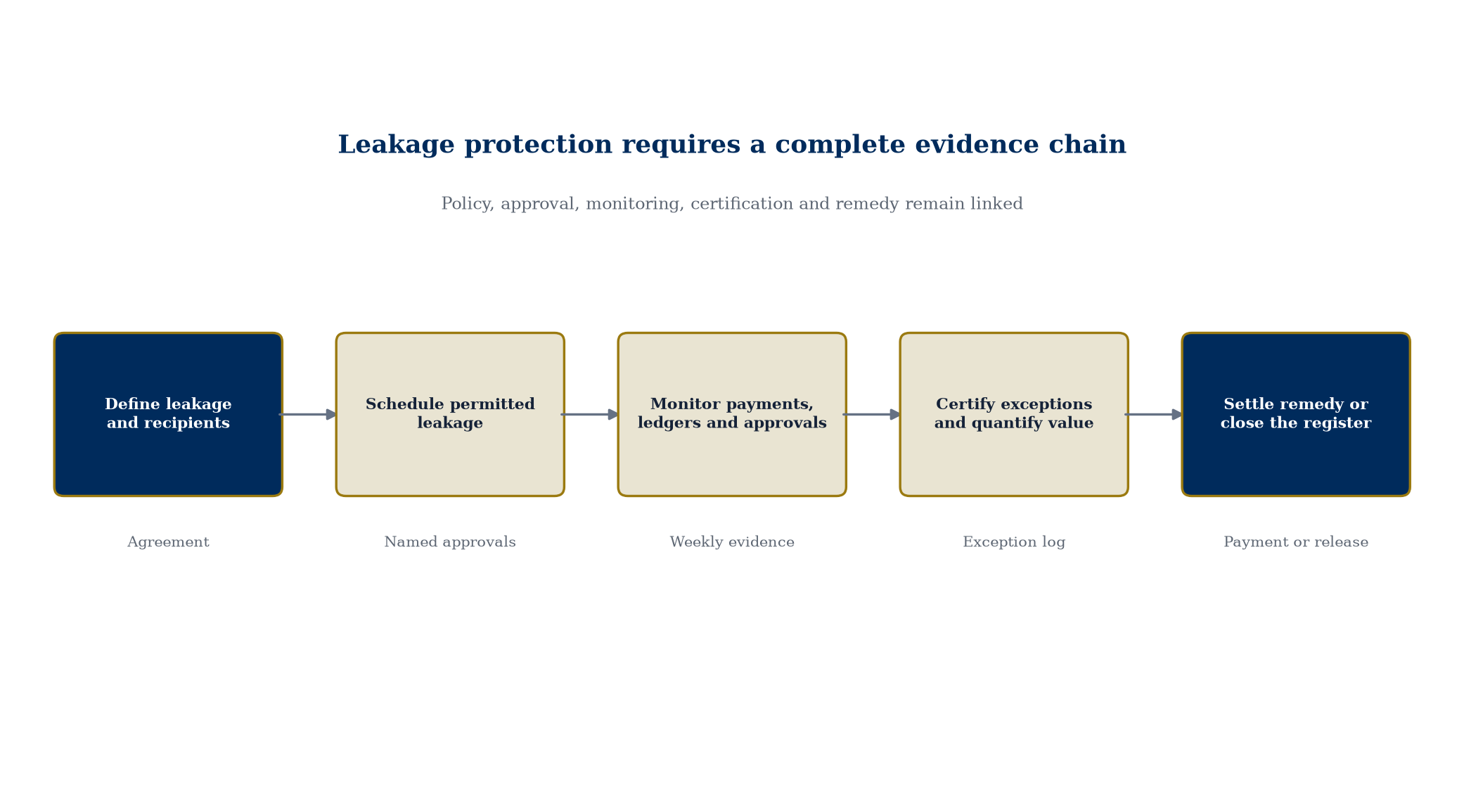
Illustrative governance sequence for a locked-box period. Legal drafting and monitoring should reflect the signed agreement.
9. Run the true-up and dispute process as a controlled project
Once control transfers, the buyer often controls the systems and employees needed to prepare or review completion accounts. The agreement should preserve the seller's access to relevant records while protecting the business. A data room for the closing statement can contain frozen extracts, supporting schedules, questions, responses and version history.
The preparer should begin with the agreed form and account mapping. New accounts opened between signing and completion should be mapped through the documented escalation process. The calculation should reconcile to the closing trial balance and include a bridge from the estimate used at completion, if any, to the proposed final amount.
The reviewer should distinguish factual errors, accounting-policy questions, classification questions and contractual interpretations. Each objection needs an amount, evidence and proposed correction. A general reservation can preserve uncertainty without helping resolution. Early issue meetings can narrow the matters sent to an independent expert.
The transaction team should track gross claims and likely outcomes separately. A large list of objections may contain offsetting items or issues with different evidence strength. The board needs the expected cash range, legal and expert costs, timing, collection risk and operational consequences. Settlement authority should be approved before negotiations begin.
After final determination, the business should record the payment, accounting entry, tax treatment and release of any escrow or retention. The team should also close the control gaps identified by the dispute. A recurring data-quality weakness that affected the adjustment can continue to affect cash forecasting and management reporting after completion.
Table 4. Minimum issue register for a completion adjustment
| Field | Purpose | Example of evidence |
|---|---|---|
| Issue and amount | Defines the financial exposure and sign | Proposed statement and countercalculation |
| Contract reference | Grounds the position in the signed agreement | Definition, accounting policy, covenant or schedule |
| Factual record | Separates evidence from interpretation | Ledger, invoice, bank record, stock count, approval |
| Classification | Identifies working capital, cash, debt-like or other treatment | Agreed account map and precedent schedule |
| Decision owner | Establishes authority and deadline | Delegation matrix and escalation record |
| Expected cash range | Supports liquidity and settlement planning | Probability-weighted management range |
| Resolution status | Controls negotiation, expert referral and payment | Meeting record, determination and settlement proof |
The register should connect transaction, accounting, legal and cash decisions.
10. Protect Day-One liquidity with a 13-week cash view
The working-capital adjustment is a valuation mechanism. The acquired business still needs an operating cash plan. A 13-week receipts-and-payments forecast provides a near-term view of liquidity, timing and headroom. ICAEW recommends a forward 13-week cash flow forecast in periods of pressure and highlights scenario analysis and variance review.[8] IAS 7 provides the financial-reporting framework for cash flows from operating, investing and financing activities.[9]
The Day-One forecast should begin with verified opening bank balances and available facilities. Weekly receipts should be connected to customer-level collection assumptions. Payments should reflect payroll, suppliers, tax, rent, capital expenditure, integration costs, financing and transaction commitments. Restricted balances and undrawn facilities should be shown separately from immediately available cash.
Forecast ownership must be operational. Sales or collections teams own customer receipt assumptions. Procurement and finance own supplier runs. Human resources and payroll owners validate employee payments. Tax advisers and finance validate filing and payment dates. The integration office controls one weekly version, records variances and escalates headroom breaches.
Three cases are usually useful: a management case, a downside case and a severe but plausible case. Scenario variables can include delayed collections, inventory replenishment, supplier-term normalisation, customer churn, one-off professional fees and integration expenditure. The purpose is to identify decisions and trigger points. The scenario is not a prediction.
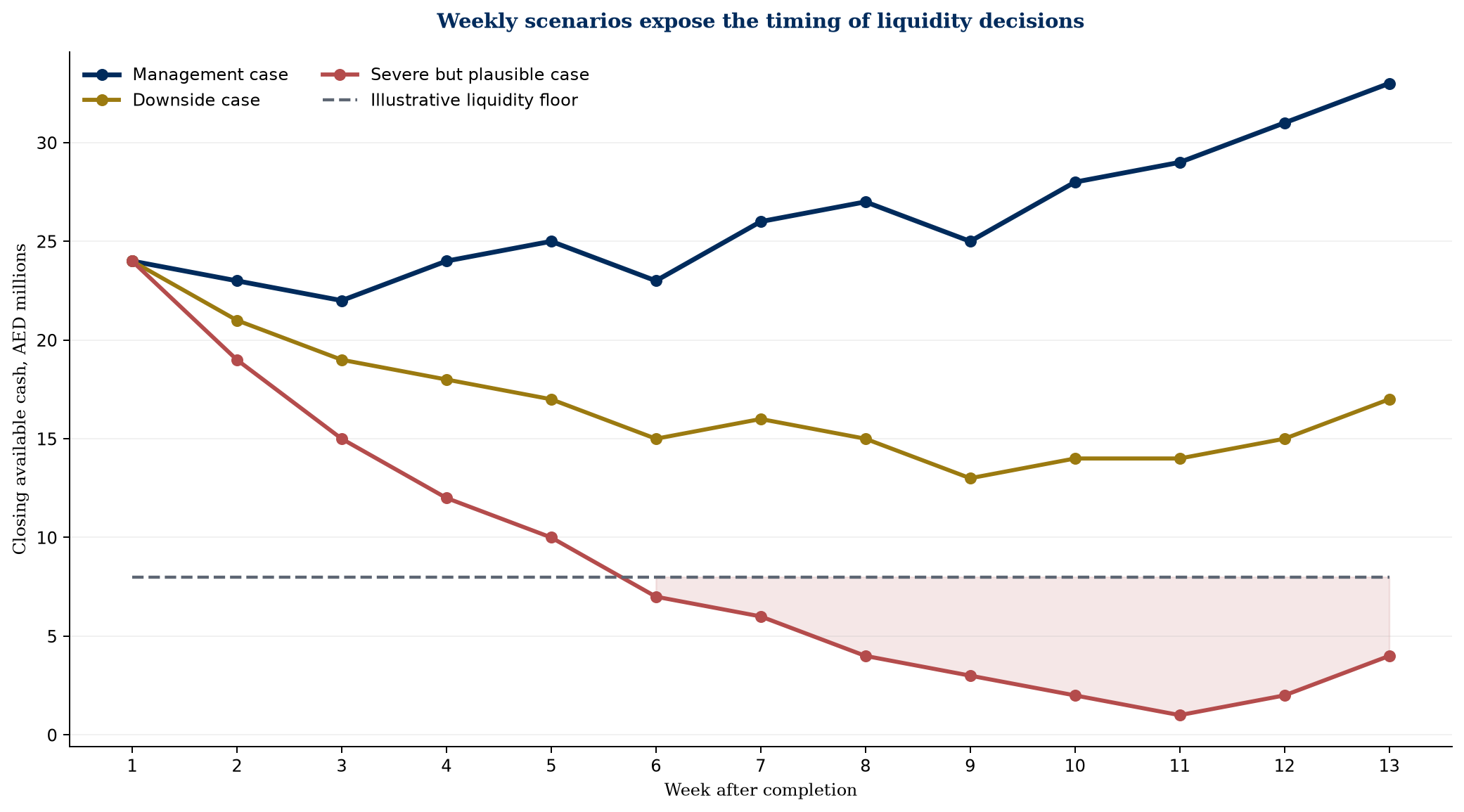
Illustrative AED values. Opening cash, receipts, payments, facilities and minimum headroom require direct verification for the acquired business.
The weekly review should compare forecast and actual receipts and payments, explain the variance and update the remaining horizon. A cash committee can approve collection actions, supplier prioritisation, facility drawings, discretionary spending and integration timing within delegated authority. Material covenant, solvency or funding concerns require immediate specialist advice.
11. GCC legal and tax perimeter
GCC transactions span distinct company, tax, foreign-ownership, competition and sector regimes. The completion mechanism should identify the legal entities, branches, licences, assets and obligations inside the deal perimeter. Counsel and tax advisers in each relevant jurisdiction should confirm the consequences of the chosen structure.
The UAE Commercial Companies legislation contains statutory provisions for mergers, including a merger agreement and approval process.[10] Those provisions concern the legal merger route. A contractual share acquisition uses its own sale agreement and completion mechanics. The transaction team should identify the legal form before applying any merger provision to the timetable or closing conditions.
Asset transfers create a different indirect-tax analysis. The UAE Federal Tax Authority states that a transfer of a whole business or an independent part to a taxable person that intends to continue the business can fall outside the scope of VAT when the relevant conditions are met.[11] A grouped sale of individual assets must independently satisfy those conditions. The clarification concerns a transfer of a business. A sale of shares falls outside its stated scope.
Saudi Arabia's VAT Implementing Regulations contain conditions for the transfer of an economic activity and provide that the recipient assumes specified VAT rights and obligations after the transfer. The regulations also contain notification requirements where the transfer leads to registration or deregistration.[12] Transaction parties should obtain advice on the actual assets, activities, registrations, invoicing and transitional arrangements.
These structural questions connect directly to the price bridge. Transfer taxes, VAT funding, unpaid tax, employee obligations, licence costs and capital expenditure can affect debt-like items, specific indemnities, purchase-price allocation and the post-close cash forecast. Their treatment should be consistent across the agreement, completion statement and integration plan.
12. Hypothetical GCC acquisition scenario
Consider a hypothetical acquisition of a regional distribution business with an agreed enterprise value of AED 250 million. The parties expect completion at the end of September. The business carries imported inventory, sells to corporate and government customers, and experiences a seasonal build in the third quarter. All values in this section are illustrative and do not describe an actual transaction.
The finance team reconstructs 24 monthly working-capital schedules from the trial balance and sub-ledgers. The unadjusted average is AED 18.4 million. Reconciliation identifies three material adjustments. First, aged receivables include AED 1.2 million with limited subsequent collection evidence, and the agreed loss-allowance policy reduces included receivables. Second, a one-off stock build caused by a temporary shipping disruption increased two historical month ends by AED 2.0 million. Third, the September seasonal requirement is higher than the annual average because stock is received before the peak selling period.
The team uses component-level drivers to build the peg. Normal receivable days applied to completion-scale sales produce AED 15.8 million of receivables. Inventory turns and the seasonal purchase plan produce AED 12.6 million of inventory. Ordinary prepayments and other included current assets add AED 2.4 million. Trade payables, operating accruals and deferred income total AED 20.3 million. The resulting illustrative peg is AED 10.5 million.
At completion, actual working capital prepared under the agreed policies is AED 13.5 million. The positive AED 3.0 million difference increases equity value. Cash is AED 15.0 million and debt and debt-like items are AED 40.0 million. The simplified equity value is therefore AED 228.0 million. The calculation follows the bridge shown in Figure 1.
The process identifies an AED 4.0 million capital expenditure creditor. The approved valuation assumed that the seller would fund the associated warehouse equipment. The parties classify the creditor as debt-like and exclude it from trade payables in working capital. That single classification prevents a double adjustment. An overdue VAT amount is handled through the agreed tax provisions and excluded from working capital.
The 13-week forecast begins with AED 24.0 million of available cash. A downside case assumes slower receipts from two major customers, normal supplier payment terms and the planned inventory replenishment. Weekly cash falls to AED 13.0 million before recovering. A severe but plausible scenario falls below an illustrative AED 8.0 million liquidity floor in week six. Management therefore prepares collection actions, a facility draw timetable and spending approvals before completion.
The scenario demonstrates the chain of control: ledger classification informs the peg; the peg informs the completion adjustment; the completion adjustment informs cash paid; and the post-close forecast tests whether the acquired business can operate within approved liquidity. Each stage uses a different control purpose and a linked evidence base.
13. Implementation blueprint
An effective workstream can be organised into four gates.
Gate 1: definition and perimeter. Agree the equity-value equation, legal perimeter, account map, accounting hierarchy, measurement time, sign conventions, currency rules and overlap controls. Identify the documents and advisers responsible for legal, tax and accounting questions.
Gate 2: peg and mechanism. Reconcile historical data, analyse operating drivers, normalise one-off items, test seasonality and growth, choose the completion mechanism and obtain the required decision approvals. Prepare an illustrative calculation in the form expected at completion.
Gate 3: closing readiness. Run a dry close, freeze data responsibilities, prepare the closing data pack, test bank and debt evidence, define the review and dispute timetable, monitor leakage or pre-close conduct, and establish settlement authority.
Gate 4: post-close control. Prepare or review the completion statement, resolve disputes, settle the adjustment, release any retention and operate the 13-week cash process. Transfer open control issues into finance and integration ownership.
Each gate should end with a signed decision record. The record should state the evidence reviewed, unresolved matters, financial range, owner, next deadline and consequence of delay. The gate does not need to remove uncertainty. It needs to make uncertainty visible and controlled.
The operating cadence can remain compact. A weekly working-capital meeting covers data, normalisations and drafting. A weekly transaction-value meeting aligns working capital, cash, debt-like and tax items. A pre-completion cash committee reviews the 13-week forecast. Decision-makers receive a short bridge showing the current expected adjustment, dispute range and liquidity headroom.
14. Scope, assumptions and limitations
This paper is a general research and management framework. It is not legal, tax, audit, accounting, valuation or investment advice. Transaction documents, accounting records, jurisdiction, legal structure, tax registrations, regulatory approvals, financing terms and operating facts determine the appropriate treatment.
The numerical examples and figures are hypothetical. They illustrate calculation and governance methods. They do not estimate a typical GCC purchase-price adjustment, cash requirement or dispute outcome.
The SRS Acquiom statistics cited in this paper are drawn from a proprietary dataset of private-target transactions administered by that organisation. The study is not a representative sample of GCC transactions. The ABA study referenced below also concerns a defined US private-target sample and is not evidence of GCC market prevalence.[13]
Accounting standards cited here identify financial-reporting principles. The acquisition agreement governs the contractual price adjustment, subject to applicable law. Parties should obtain qualified advice and reconcile every conclusion to the signed documents and verified transaction data.
References
- [1] Institute of Chartered Accountants in England and Wales and Grant Thornton, Completion Mechanisms, second edition. https://www.icaew.com/-/media/corporate/files/technical/corporate-finance/guidelines/icaew-completion-mechanisms-v2.ashx?la=en
- [2] IFRS Foundation, IAS 2 Inventories. https://www.ifrs.org/issued-standards/list-of-standards/ias-2-inventories/
- [3] IFRS Foundation, IFRS 9 Financial Instruments. https://www.ifrs.org/issued-standards/list-of-standards/ifrs-9-financial-instruments/
- [4] IFRS Foundation, IFRS 15 Revenue from Contracts with Customers. https://www.ifrs.org/issued-standards/list-of-standards/ifrs-15-revenue-from-contracts-with-customers/
- [5] IFRS Foundation, IAS 37 Provisions, Contingent Liabilities and Contingent Assets. https://www.ifrs.org/issued-standards/list-of-standards/ias-37-provisions-contingent-liabilities-and-contingent-assets/
- [6] SRS Acquiom, Working Capital Purchase Price Adjustment Mechanics: How to Avoid Costly Disputes. https://www.srsacquiom.com/our-insights/working-capital-purchase-price-adjustment-mechanics-how-to-avoid-costly-disputes/
- [7] SRS Acquiom, 2026 Working Capital Purchase Price Adjustment Study. https://learn.srsacquiom.com/rs/664-KLJ-520/images/SRSAcquiom-2026-Working-Capital-PPA-Study.pdf
- [8] Institute of Chartered Accountants in England and Wales, Liquidity management for businesses at times of stress. https://www.icaew.com/technical/corporate-finance/business-restructuring/liquidity-management-for-businesses-at-times-of-stress
- [9] IFRS Foundation, IAS 7 Statement of Cash Flows. https://www.ifrs.org/content/dam/ifrs/publications/pdf-standards/english/2021/issued/part-a/ias-7-statement-of-cash-flows.pdf?bypass=on
- [10] United Arab Emirates Legislation, Federal Decree-Law No. 32 of 2021 on Commercial Companies, including Articles 286 and 287. https://www.uaelegislation.gov.ae/en/legislations/1542
- [11] UAE Federal Tax Authority, VAT Public Clarification VATP015, Transfer of a Business as a Going Concern. https://tax.gov.ae/DataFolder/Files/Pdf/AR/VATP015%20-%20TOGC%20-%2018%2007%202019.pdf
- [12] Saudi Zakat, Tax and Customs Authority, Implementing Regulations of the VAT Law, Article 17. https://zatca.gov.sa/en/RulesRegulations/Taxes/Documents/Implmenting%20Regulations%20of%20the%20VAT%20Law_EN.pdf
- [13] American Bar Association, 2025 Private Target M&A Deal Points Study, study description and sample parameters. https://www.americanbar.org/groups/business_law/resources/business-law-today/2025-december/aba-2025-private-target-mergers-acquisitions-deal-points-study/
About the Author
Chennakeshav Adya is an independent researcher whose work focuses on corporate finance, value creation, private capital and transaction execution. His research translates financial, commercial and operating evidence into decision frameworks for boards, investors and management teams.
Appendix A: Working-capital definition schedule
- Identify every ledger account within the acquired legal and operating perimeter.
- Classify each account once as working capital, cash, debt or debt-like, another adjustment, or excluded.
- State the sign, gross or net basis, accounting policy, evidence source and responsible preparer.
- Define treatment for aged receivables, expected credit losses, inventory provisions, consignment stock and goods in transit.
- Define treatment for rebates, accruals, deferred income, contract assets, contract liabilities and customer advances.
- Reconcile tax, employee, capital expenditure, transaction, related-party and financing balances across all price schedules.
- State the measurement time, foreign-exchange source, consolidation basis and treatment of post-balance-sheet evidence.
- Record the hierarchy between transaction-specific policies, historical consistency and the applicable accounting framework.
- Include a worked example in the contractual form, with sign conventions and the resulting payment direction.
- Establish access, preparation, review, dispute, expert-determination, payment and interest provisions.
Appendix B: Completion and post-close control checklist
- Run a dry close using a recent month-end and reconcile the proposed statement to the trial balance.
- Freeze the account map and assign a documented approval process for any new account.
- Prepare bank, debt, ageing, stock, accrual, tax, intercompany, cut-off and foreign-exchange evidence.
- Monitor leakage or ordinary-course working-capital conduct through completion.
- Confirm the estimate delivered for funds flow and bridge it to the proposed final statement.
- Maintain a dispute register with amount, contract reference, evidence, owner, deadline and expected cash range.
- Establish settlement authority and a process for independent expert referral where required.
- Begin the 13-week cash forecast with verified available balances and facilities.
- Assign receipt and payment assumptions to operational owners and review forecast-to-actual variance weekly.
- Transfer unresolved data, control and liquidity issues into finance and integration ownership.
