

Introduction
Quantum technology companies are built around research systems. A research system includes people, experimental methods, tacit diagnosis, code, equipment configurations, patents, supplier knowledge, university relationships, government eligibility and a sequence of technical decisions. The visible assets may be documented. The capability to use them often depends on interactions that are harder to observe.
This creates a distinctive M&A problem. The buyer may identify a celebrated founder, chief scientist or laboratory director and treat that person as the key risk. The actual dependency can sit elsewhere: a controls engineer who understands unstable calibration, a fabrication lead who can interpret process variation, an algorithm scientist who translates customer problems, or a programme manager who connects evidence to government milestones. Several individually replaceable people may form an irreplaceable cohort when they leave together.
Current policy and company evidence supports careful treatment of the workforce. The United States national plan calls for a continuing understanding of quantum-workforce needs and wider professional pathways [1,2]. The OECD reports an uneven global ecosystem and an inverted workforce pyramid in which engineering and integration roles sit beneath a smaller number of specialist physicists [5,6]. IonQ, D-Wave and other public quantum companies describe intense competition for specialised talent and dependence on advanced scientific and engineering teams [7,8,9,10].
This paper gives boards and transaction teams a method for valuing that capability. It starts with the programme that must survive, maps authority and dependency, tests evidence and mobility, builds retention-weighted scenarios, and converts the result into price, terms and integration gates.
1 Define the capability being acquired
The investment thesis should identify the capability the buyer expects to control after closing. Examples include a trapped-ion control stack, neutral-atom system, cryogenic architecture, photonic interconnect, quantum-memory programme, compiler, error-correction method, sensing platform or application workflow. The thesis should state the technical milestone, customer outcome, time horizon and evidence required.
Capability should be described as an operating sequence. A hardware programme may require device design, fabrication, packaging, control electronics, calibration, experiment design, error analysis, software and systems integration. A software programme may require algorithm research, mathematical implementation, benchmark design, provider integration, customer translation and reproducible delivery. The buyer should identify which links create advantage and which can be sourced externally.
A generic statement that the target has world-class talent is unsuitable for valuation. It does not define the work, authority, evidence or replacement path. The transaction memorandum should name the capability boundary, the decisions that must continue, and the customer or programme milestones that depend on them.
Disconfirming evidence belongs in the thesis. A high publication count may relate to earlier academic work. Patents may be narrow, licensed or difficult to practise. A famous founder may no longer make daily technical decisions. A large engineering team may depend on a small external laboratory. The buyer should specify which findings would reduce value or change structure.
2 Map technical authority rather than organisation charts
Organisation charts show reporting relationships. They rarely show who frames experiments, approves architecture, interprets failed runs or decides when evidence is strong enough to release. Diligence should create an authority map for every value-bearing decision.
The map should record the decision, accountable owner, contributors, evidence reviewed, system of record, escalation route and successor. It should distinguish formal approval from practical influence. Interview answers can be tested against meeting minutes, pull requests, experiment records, patent files, customer correspondence and release decisions.
Authority often changes by phase. A founder may define scientific direction while a systems lead controls implementation. A laboratory lead may decide whether a result is real, while a product lead decides whether it is useful. A programme manager may control what evidence reaches a government customer. The buyer should preserve these distinctions because replacing one role does not replace the others.
The output is a capability graph rather than a list of important names. Nodes represent decisions, systems, people and external relationships. Links show reliance. A concentrated graph increases transition risk. A distributed graph with documented evidence and tested successors supports more durable value.
3 Identify critical people and critical cohorts
Key-person analysis should begin with failure consequences. A person is critical when departure can stop, delay or invalidate a value-bearing activity and the organisation lacks a timely substitute. Seniority, compensation and public profile are incomplete indicators.
Each candidate should be tested across six dimensions: decision authority, tacit knowledge, evidence custody, external relationship, successor depth and replacement time. The team should also assess whether the person controls credentials, laboratory access, supplier exceptions, customer confidence or security eligibility. These practical dependencies can matter more than title.
Cohort risk captures interaction. Quantum programmes join scientists, engineers and operators whose knowledge is complementary. Losing the device architect and controls lead together can be more damaging than the sum of two independent departures. The same applies to a principal investigator, postdoctoral team and laboratory manager who share experimental history.
The model should therefore define correlated groups. Correlation may arise from shared founder loyalty, geography, university affiliation, compensation history, immigration status, technical disagreement or perceived loss of autonomy. Interviews, past turnover and relationship networks can inform the assumption. The output remains an assumption until observed evidence supports it.
4 Separate reputation from current operating contribution
Scientific reputation can attract employees, partners, funding and customers. It can also dominate diligence and obscure the people doing current work. The buyer should separate external signalling value from present operating contribution.
Evidence of current contribution includes recent design reviews, experiment ownership, code commits, patent prosecution, release approval, customer problem solving, laboratory presence and milestone acceptance. Publication records can establish domain expertise and influence. They require recency, subject and role analysis before they support a transaction conclusion.
A prominent scientist may provide valuable recruitment and institutional access while delegating implementation. Another person with fewer publications may hold unique diagnostic knowledge. Both can be valuable through different channels. The valuation model should avoid combining them into one undifferentiated team premium.
Reputation value is also sensitive to conduct and affiliation. Conflicts, publication disputes, export restrictions or loss of an academic appointment can affect the signal. Diligence should confirm which institutional relationships belong to the person, which belong to the target and which require consent.
5 Use publication networks as evidence with defined limits
Publication analysis can reveal scientific domains, collaboration patterns, institutional reach and concentration. It can identify whether the target depends on one senior author, whether younger researchers form an independent cluster, and whether important work crosses universities or national laboratories. The analysis should use verified identities and account for common names and affiliation changes.
Network measures require interpretation. Degree can show the number of direct co-authors. Betweenness can identify a person connecting otherwise separate groups. Recency can show whether a relationship remains active. Topic similarity can indicate whether the network supports the acquired programme. No single score proves commercial importance.
Authorship conventions differ by field. Author order may not reflect contribution consistently. Publications capture disclosed research and can exclude proprietary engineering, negative results, laboratory operations and customer work. A highly central academic collaborator may have no employment obligation to the target.
The buyer should triangulate publications with patents, code, experiments, contracts and interviews. A network becomes transaction evidence when the target can show current work, rights, access and continuity. External collaborators should be classified as retained employee, consultant, licensor, university partner, informal adviser or historical connection.
Network change also matters. A static graph can make a target appear resilient because many historical links remain visible. The diligence team should compare rolling periods and distinguish new collaboration, continuing collaboration and dormant ties. A healthy programme should show evidence that knowledge is being recombined across generations and disciplines rather than routed permanently through one senior scientist.
The buyer can use removal tests. Remove one critical node from the collaboration graph and examine whether the remaining people still connect scientific design to implementation and customer use. Repeat the test for a cohort. The exercise is a structured scenario, not a prediction, and should be reconciled to observed work before it affects price.
6 Map patents, code and laboratory knowledge to people
Patents identify inventors and claimed inventions. They can expose concentration and collaboration across a portfolio. The diligence team should map each material patent family to current products, experiments, inventors, assignment records, licences and know-how required for practice.
Inventorship does not establish ownership or current dependence. Assignment and employment agreements require review. A patent can disclose a principle while implementation depends on calibration, process windows, source code or supplier settings. The buyer should ask whether an independent team can reproduce the claimed capability from the available record.
Code analysis should identify maintainers, review authority, undocumented modules, environment dependencies, external repositories and reproducible builds. Commit volume alone can mislead. Critical value may sit in architecture decisions, test design or release judgment. The buyer should observe a clean build and a controlled defect-resolution exercise.
Laboratory knowledge includes instrument configuration, maintenance, sample preparation, safety, environmental controls, calibration and interpretation. Asset registers and standard operating procedures should be reconciled to practice. Shadowing and paired execution can reveal where a procedure depends on memory.
7 Establish an attrition baseline
Retention-weighted valuation needs a baseline that predates the transaction. The buyer should review voluntary and involuntary departures, regretted attrition, offer acceptance, time to fill, internal movement, promotion, compensation adjustments, visa dependence and exit-interview themes. Small teams require individual explanation because percentages can exaggerate or conceal change.
The baseline should separate critical cohorts from the wider workforce. A stable administration team cannot offset repeated departures from controls or algorithms. The analysis should also distinguish normal academic mobility from organisation-specific problems such as unclear strategy, weak management or repeated milestone changes.
External competition matters. Public quantum filings state that specialist workers are difficult to hire and that larger competitors can offer greater resources [7,9,10]. National strategies emphasise international talent and training pathways [3,4]. Replacement time should reflect geography, security eligibility, laboratory access and immigration.
The transaction can change risk immediately. Public disclosure, uncertainty, integration decisions and altered reporting lines can trigger departures before closing. The buyer should create a signing-to-close retention plan and monitor accepted offers, recruiter activity, leave requests and engagement within legal and ethical limits.
8 Build a retention probability model
The model should estimate retention for roles and cohorts at defined dates: closing, twelve months, twenty-four months and the first critical programme milestone. Probabilities are management assumptions unless supported by signed agreements and observed behaviour.
Inputs can include compensation positioning, unvested equity, role clarity, programme funding, leadership relationship, geographic change, autonomy, immigration, outside demand and personal constraints. The model should avoid false precision. A small number of transparent scenarios is more useful than a decimal generated from weak inputs.
Correlation requires explicit treatment. Independent multiplication can understate the chance of losing a connected team. The buyer can define cohort scenarios such as stable team, founder departure with successor, controls-cohort loss, laboratory disruption and broad integration failure. Each scenario should link to milestone delay, remediation cost, revenue effect and value.
The model must be refreshed. Signing, offer acceptance, role design, regulatory conditions and integration decisions change probabilities. The board should see the movement and the evidence behind it rather than one fixed retention discount.
Replacement assumptions should be separated from retention. A buyer may recruit an excellent scientist who still requires months to gain laboratory familiarity, customer trust and security eligibility. The model should include search time, notice period, relocation, onboarding, duplicated work and the probability that a replacement changes the technical direction. These costs can exceed compensation.
Milestone delay should flow into cash. A six-month delay can extend payroll, laboratory, supplier and programme expense while deferring customer acceptance or funding. The valuation team should state which costs continue, which can be stopped and whether delay affects competitive position. This creates an auditable bridge from people risk to enterprise value.
Decision trees can improve consistency. For each critical departure, the model should identify the immediate control action, available successor, external support, expected recovery time, programme effect and funding need. Where no response exists, the relevant value should remain contingent. The board should resist averaging a severe unmitigated dependency into a portfolio of minor risks.
The model should also distinguish willingness from ability to remain. A person may accept an award while lacking a workable visa, laboratory location, security approval or role. Conversely, a person may decline a special award yet remain because the scientific programme and career path are compelling. Signed terms are strong evidence of obligation; operating conditions remain evidence of practical continuity.
9 Design retention around the work
Retention design begins with the work that must continue. The buyer should define role, authority, resources, reporting line, location, publication policy, research freedom, performance evidence and career path. A financial award cannot compensate indefinitely for an incoherent operating environment.
Awards can combine salary, annual incentive, time-based equity, milestone equity, cash retention and transaction consideration. The mix should reflect the desired behaviour. Time vesting supports presence. Milestone vesting can align evidence but may create disputes if milestones depend on external factors. Team components can encourage collaboration while individual components preserve accountability.
Good-leaver, bad-leaver, disability, death, termination without cause and change-in-control terms require precise drafting. The organisation should avoid incentives that suppress reporting of scientific failure. A researcher should be rewarded for reliable evidence and disciplined decisions, including evidence that invalidates a preferred hypothesis.
Retention capacity should include successors. Concentrating awards on visible founders can weaken the next layer. The buyer should fund paired authority, documentation, recruitment and management development. The measure of success is durable programme capability, not payroll continuity alone.
Communication should be individual and coherent. Critical employees need to understand the transaction rationale, programme funding, governance, reporting lines and what happens to existing equity. Selective disclosure must comply with law and transaction controls. Rumour and inconsistent promises can create correlated attrition even when headline compensation is competitive.
Boards should monitor fairness. Large retention awards for a small visible group can weaken collaboration, especially when less prominent engineers carry operational knowledge. The retention pool should follow the capability map and include people required to support successors. Compensation committees should document the rationale, internal relationships and expected outcome.
10 Distinguish purchase consideration from compensation
Transaction teams should address accounting treatment during term-sheet design. IFRS guidance states that contingent payments forfeited on termination are generally compensation for post-combination services unless the service condition is not substantive [21,22]. United States guidance similarly separates replacement awards attributable to pre-combination service from post-combination compensation [23].
The classification affects reported purchase price, future expense, earnings and communication. Legal form does not determine the accounting result. The team should examine whether recipients are selling shareholders, whether payment is proportionate to ownership, the length of required service, compensation relative to peers and the reason for the arrangement.
Valuation and accounting should remain connected. If value depends on future service, the investment committee should recognise that dependency economically even when legal documents use acquisition language. A cash-at-close price for untransferred capability can overpay regardless of financial-statement classification.
The buyer should prepare a consideration map showing asset consideration, seller contingent consideration, replacement equity, employee retention and ordinary compensation. Tax, securities, employment and accounting advisers should review the same fact pattern before signing.
11 Assess mobility, non-competes and labour-market risk
Retention agreements operate within employment and competition law. Enforceability varies by jurisdiction and fact pattern. The United States Federal Trade Commission states that its broad Noncompete Rule is not in effect, while continuing case-specific enforcement and policy activity [19,20]. State law remains material.
The buyer should rely on a complete protection system: confidentiality, intellectual-property assignment, garden leave where lawful, notice, non-solicitation where enforceable, secure access, knowledge transfer and an attractive role. Aggressive restrictions can damage recruitment, morale and scientific collaboration.
Merger review can also consider labour markets. United States merger guidance explains that mergers between employers can reduce competition for workers and that labour markets can be narrow because matching, switching costs and geography constrain alternatives [17,18]. A quantum combination involving concentrated specialist demand deserves a specific labour-market assessment.
The diligence team should map where critical roles can work, which employers compete for them, and whether the transaction reduces alternatives. Integration plans should preserve fair compensation and working conditions. Retention value built on suppressed mobility is fragile and may carry regulatory risk.
12 Address sovereignty, immigration and security eligibility
Quantum talent can be strategically sensitive. Government funding, export controls, security clearances, national investment review and university obligations can limit where people, data and technology move. The buyer should identify restrictions before offering roles or designing integration.
The United Kingdom final order permitting IonQ's acquisition of Oxford Ionics required maintenance of science, engineering, infrastructure, assets and qualified personnel in the United Kingdom [12]. This demonstrates that talent location and capability continuity can become binding transaction conditions.
Immigration dependence should be mapped at individual and programme level with appropriate privacy controls. A visa renewal or relocation delay can affect a milestone. The plan should include lawful sponsorship, alternate locations, remote-access constraints and successor coverage.
Security eligibility can create longer replacement times than technical recruitment. Government customer access, classified work, export authorisation and secure facilities may depend on specific people and entities. The valuation should separate scientific ability from permission to deploy it.
13 Protect customers, funders and academic relationships
Research teams often carry external trust. Customers may rely on a particular scientist to interpret results. Government programmes may name principal investigators. Universities may license intellectual property, host facilities or supervise students. Suppliers may grant exceptions through established technical relationships.
The buyer should inventory each relationship, contract owner, key person, change-of-control clause, publication right, data right, consent and continuity plan. Informal relationships should be identified without treating them as transferable assets.
Communication requires sequencing. Early outreach may reassure a critical partner but can trigger uncertainty if integration decisions remain unresolved. The buyer should define who contacts each stakeholder, what can be promised and how issues are escalated.
Relationship transfer should be evidenced through accepted governance, renewed contracts, continued programme funding, customer usage and collected cash. A signed introduction is an initial step rather than proof of durability.
14 Test laboratory and programme continuity
Scientific capability can fail even when people remain. A laboratory may depend on leases, permits, cryogenic supply, specialised components, software licences, clean-room access, calibration artefacts and maintenance providers. National-security conditions may require operations to remain in a country [12].
The buyer should run a continuity exercise for a representative experiment. Another qualified team should locate the environment, prepare inputs, execute the procedure, interpret output and reproduce the conclusion. Exceptions should be recorded as people, asset, data or process dependencies.
Programme funding should be traced from award or customer contract to permitted costs and milestones. Grant obligations, publication commitments and ownership rights can survive the transaction. The team should confirm whether funding, equipment and data transfer with the acquired entity.
Integration should protect scientific controls. Premature laboratory relocation, supplier consolidation or security changes can invalidate baselines. The first objective is controlled continuity; optimisation follows verified stability.
The continuity test should include adverse conditions. A successful demonstration under ideal conditions may not establish operational capability. The buyer should select a known failure mode, verify that the team recognises it, and observe diagnosis, escalation and recovery. Safe scientific practice takes priority; the exercise should remain within approved procedures.
Data continuity requires equal attention. Raw results, calibration records, negative experiments, analysis notebooks and environment definitions should be accessible, governed and linked to decisions. Missing negative results can cause a successor to repeat failed work. The transaction should fund disciplined migration and preserve provenance.
15 Perform evidence-led talent diligence
Talent diligence should use multiple evidence sources and proportional privacy. Requested data may include role descriptions, decision logs, succession plans, anonymised compensation bands, turnover records, signed intellectual-property agreements, visa categories, publication and patent records, code ownership, laboratory procedures and programme obligations.
Interviews should follow the capability map. Ask who makes a decision, what evidence they use, who disagrees, who can substitute and what happened during a prior failure. Compare answers across levels. Consistent narratives can still reflect shared assumptions, so documentary and operational tests remain necessary.
The team should observe work. Useful tests include a design review, code build, experiment reproduction, incident diagnosis, patent-family walkthrough and customer result review. The purpose is to understand the system and gaps, not to create artificial examinations.
Every finding should state evidence confidence. Verified contracts and observed tests deserve more weight than management assertion. Sensitive employee information should remain restricted and used only for the transaction purpose.
The diligence report should distinguish a remediable gap from a thesis failure. Missing documentation can be repaired when the people, systems and time are available. A non-transferable licence, unavailable successor or unresolved security condition may require a different perimeter or price. The report should connect every material finding to a board decision, transaction term or funded action.
16 Construct the hypothetical valuation
The hypothetical target has 86 employees, 63 technical staff and 12 people across six critical nodes. It generates USD 22 million of annual revenue, holds USD 48 million of unrestricted cash and uses USD 21 million of cash annually. These values are assumptions.
Four scenarios frame enterprise value. An intellectual-property shell with severe cohort loss is valued at USD 110 million with 25 per cent probability. A functioning team with limited transfer is valued at USD 285 million with 40 per cent probability. An integrated programme that meets transfer and customer gates is valued at USD 520 million with 25 per cent probability. A platform leader with durable network value is valued at USD 900 million with 10 per cent probability.
The probability-weighted enterprise value is USD 323.5 million. This arithmetic is not a market quotation or forecast. It forces the board to separate achieved capability from outcomes requiring people, transfer, programme funding and integration.
The allocation assigns USD 88 million to intellectual property and reproducible technology, USD 42 million to customer and programme relationships, USD 96 million to team continuity, USD 32 million to data and laboratory systems, USD 25 million to contracts and eligibility, and USD 40.5 million to future platform options. Each component has an evidence gate and downside treatment.
17 Structure consideration around continuity evidence
Cash at closing should reflect controlled assets and capability that survives without future service. Seller consideration can address transferred ownership, while employee awards compensate future work. Holdbacks can protect identified liabilities. Contingent consideration can link payment to customer continuity, technical reproducibility and programme outcomes where legally and operationally appropriate.
Milestones should be observable and resistant to manipulation. Examples include a successful independent build, reproduced experiment, successor-certified decision process, customer acceptance, programme novation, retention of a defined cohort and operation through a specified period. Milestones should avoid rewarding unsafe shortcuts or suppressing negative results.
The structure should recognise correlation. Separate individual awards do not protect against a cohort departure caused by the same integration decision. A portion of consideration can depend on team and programme outcomes while preserving fair individual terms.
The buyer should maintain a funding reserve for recruitment, laboratory continuity, knowledge transfer and remediation. These costs are acquisition capital needs, even when accounting classifies them as operating expense.
18 Integrate without destroying research productivity
The first one hundred days should stabilise authority, funding, systems and external commitments. The buyer should preserve critical experiments, customer delivery, laboratory access, security and publication decisions. Changes should follow an evidence-based dependency review.
Integration should establish joint technical governance. Decision rights, escalation, evidence standards and roadmap trade-offs need visible ownership. The acquired team should understand how scientific disagreement is resolved and how commercial priorities enter the process.
Knowledge transfer should occur through paired work. Documents support transfer, while observed decisions and reproduced outcomes prove it. Successors should lead selected reviews, incidents and customer interactions with the previous authority present, then independently.
The value ledger should track retention, successor readiness, reproducibility, milestone delivery, customer continuity, programme funding, recruitment, laboratory stability and realised cash. The board should release integration changes and contingent value only when the evidence gates pass.
Management should distinguish integration from absorption. Shared finance, legal and security controls can be introduced while research decisions retain appropriate specialist governance. The operating model should specify which corporate standards apply immediately, which require technical validation and which remain local because of regulatory, laboratory or programme constraints.
Culture should be assessed through observable mechanisms. Evidence includes how teams review failed experiments, allocate instrument time, resolve authorship, approve releases, communicate uncertainty and balance customer deadlines with scientific integrity. Integration plans should preserve practices that support reliable evidence and correct practices that concentrate authority or conceal problems.
The final transfer gate should require performance through a complete cycle: plan, execute, encounter exceptions, interpret evidence, communicate the result and make the next decision. Presence through a vesting date is an input. Independent organisational performance is the durable outcome.
Conclusion
Quantum talent is an operating network. A buyer acquires durable value when the organisation can continue to generate reliable evidence, make difficult decisions, reproduce work, serve customers and advance the programme after ownership changes.
Named-person retention remains important. The stronger analysis identifies critical cohorts, maps authority, tests publications and patents against current contribution, verifies code and laboratory practice, assesses mobility and sovereignty, and models correlated attrition. It then prices achieved capability separately from service-dependent options.
The practical transaction response is disciplined. Define the capability, observe the system, weight scenarios by evidence, distinguish consideration from compensation, protect lawful mobility, and integrate through tested transfer. This approach makes talent risk visible without reducing research teams to headcount or celebrity.
The board should revisit these conclusions whenever evidence or team conditions change.
Appendix A Capability interview protocol
Ask each interviewee to identify the three decisions that most influence programme value, the evidence used, recent disagreement, known failure modes, current substitute and time required to train a successor. Trace one recent decision into code, experiments, patents, customer delivery and financial consequence.
Repeat the interview across leadership, scientific, engineering, laboratory, product and programme roles. Record differences and test them. Protect personal information and avoid questions unrelated to the transaction.
Appendix B Minimum evidence schedule
The data room should contain organisation and authority maps, role descriptions, anonymised compensation bands, historical turnover, signed intellectual-property agreements, patent assignments, publication identities, code ownership, clean-build records, laboratory procedures, programme agreements, customer dependencies, regulatory restrictions and succession plans.
Each item should have an owner, date, scope and confidence classification. Missing evidence should become a priced risk, condition or remediation action.
Appendix C Retention model controls
The model should preserve input sources, scenario definitions, cohort correlations, replacement assumptions, milestone effects and review dates. Changes require an explanation and accountable approver. Management estimates should remain visibly labelled.
Sensitivity should vary cohort retention, milestone delay, replacement time, programme funding and customer continuity. The board should review outcomes rather than one headline probability.
Appendix D Integration value ledger
The ledger should connect each value component to baseline, target, evidence, owner, cost, timing and realised result. It should distinguish presence, transfer, programme performance and financial outcome.
Examples include retention of controls and algorithms cohorts, successor certification, independent experiment reproduction, customer acceptance, programme novation, laboratory stability and reduced replacement exposure.
Appendix E Decision figures and tables
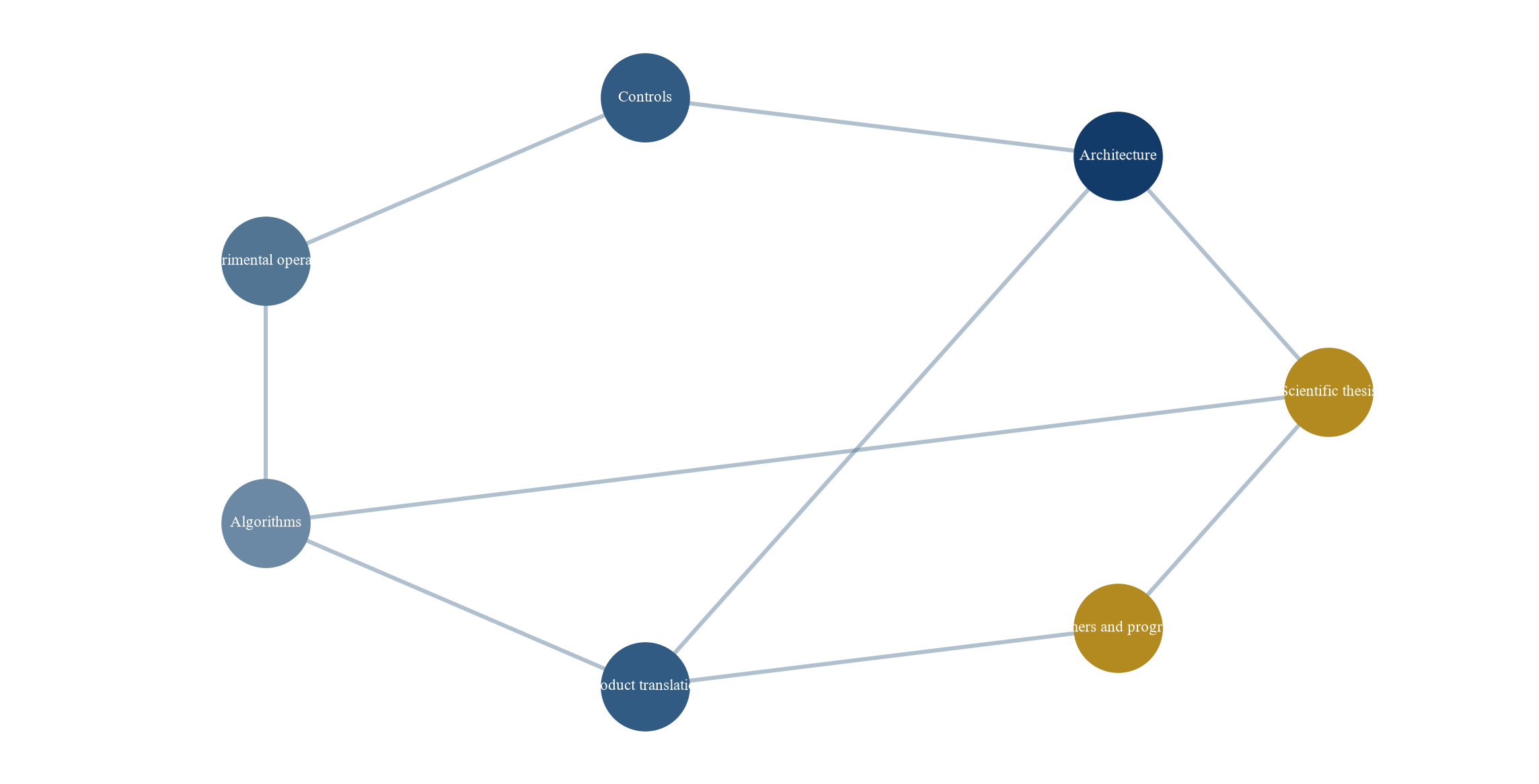
Proposed transaction-diligence architecture; node strength requires evidence of authority, transfer and successor capacity.
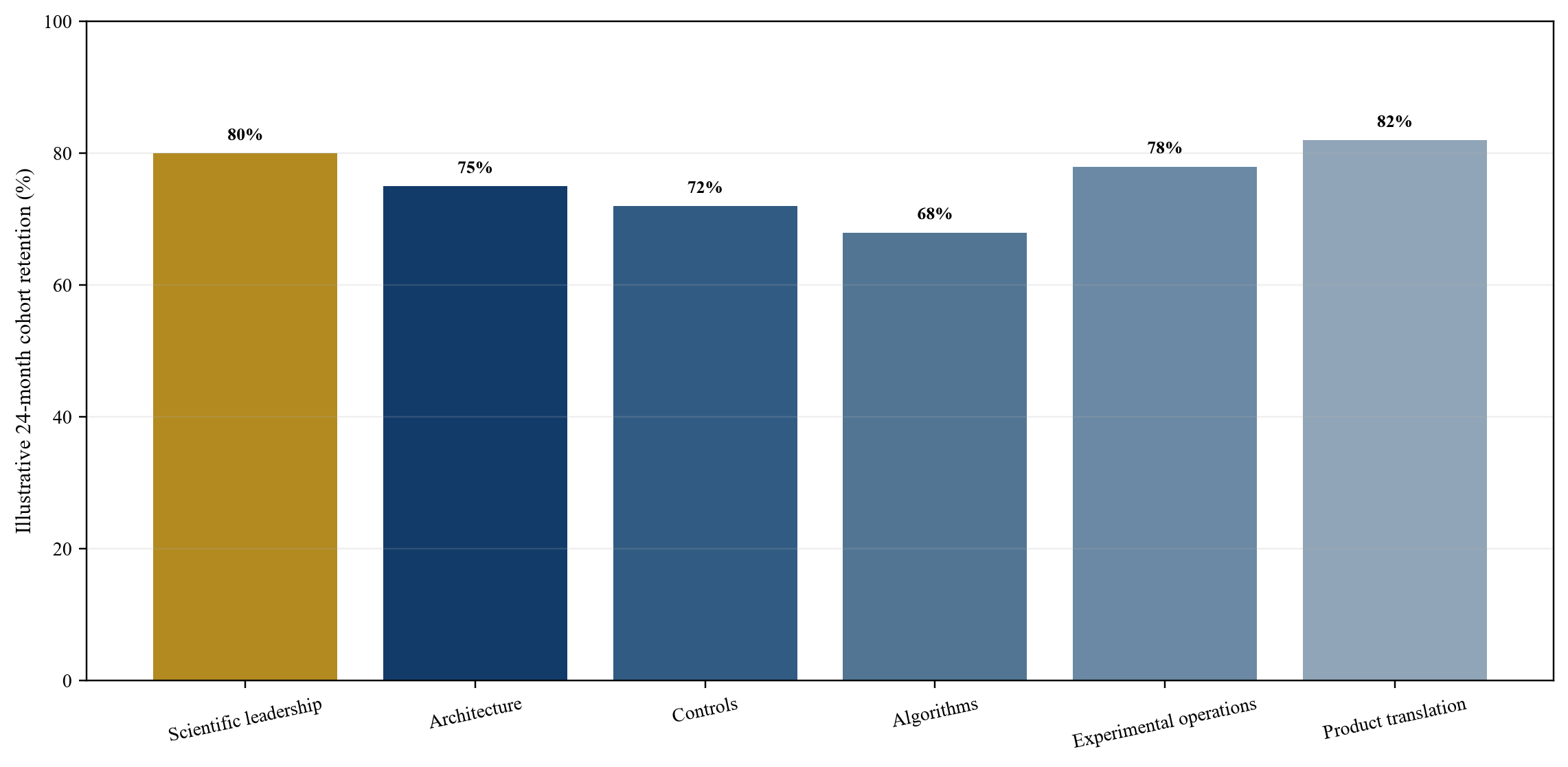
Wholly hypothetical management assumptions; probabilities are not observed employee outcomes.
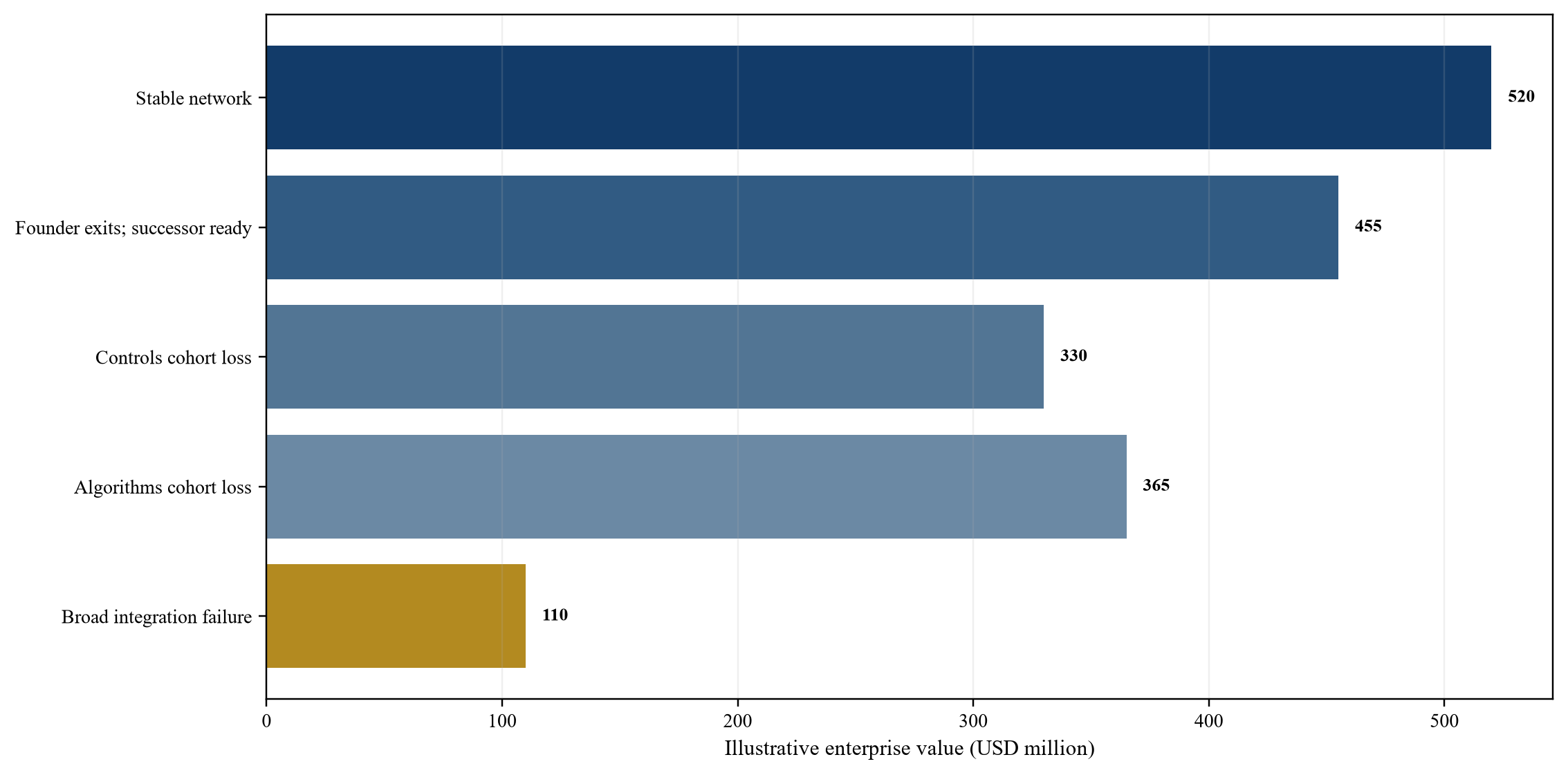
Wholly hypothetical management assumptions; USD million.
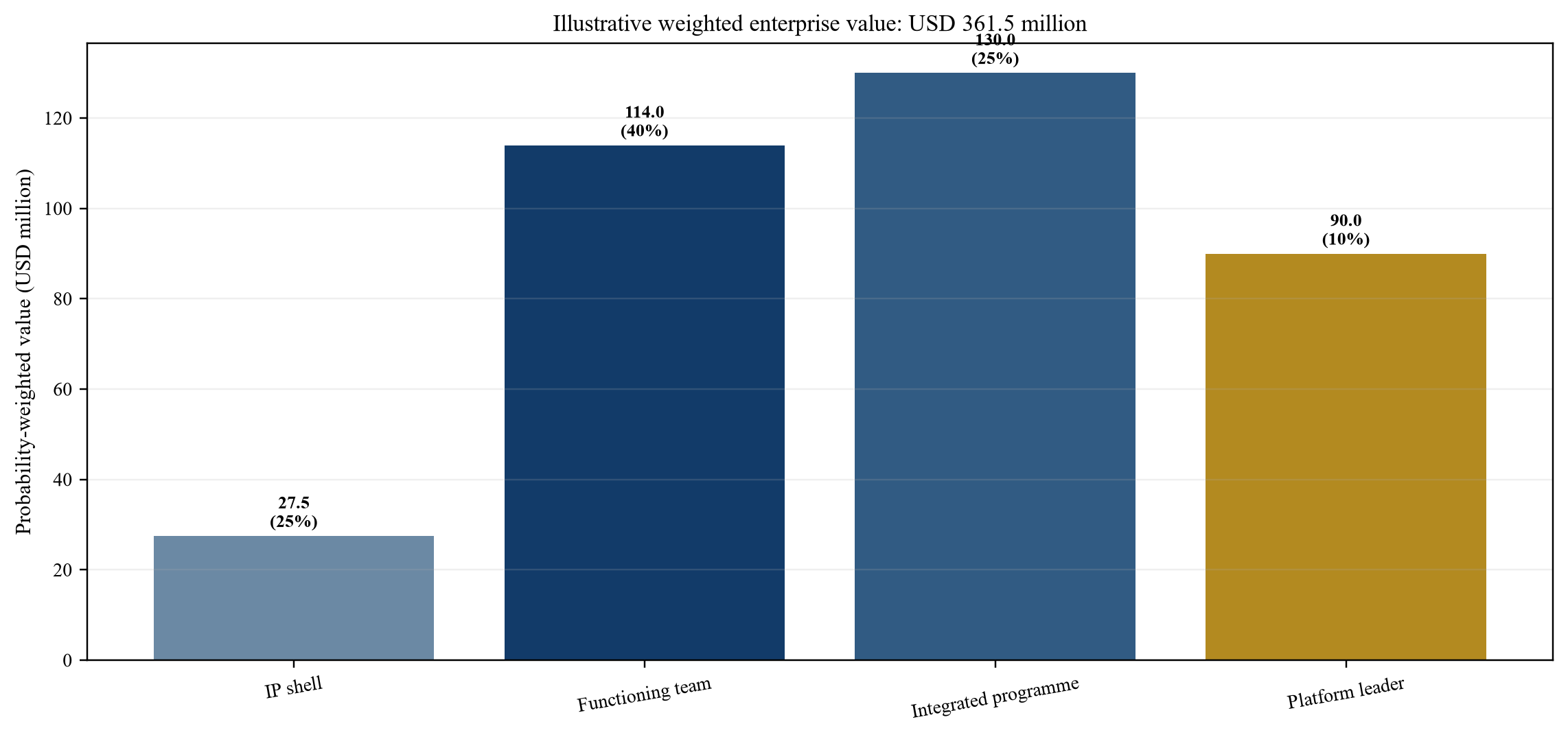
Wholly hypothetical management assumptions; USD million.
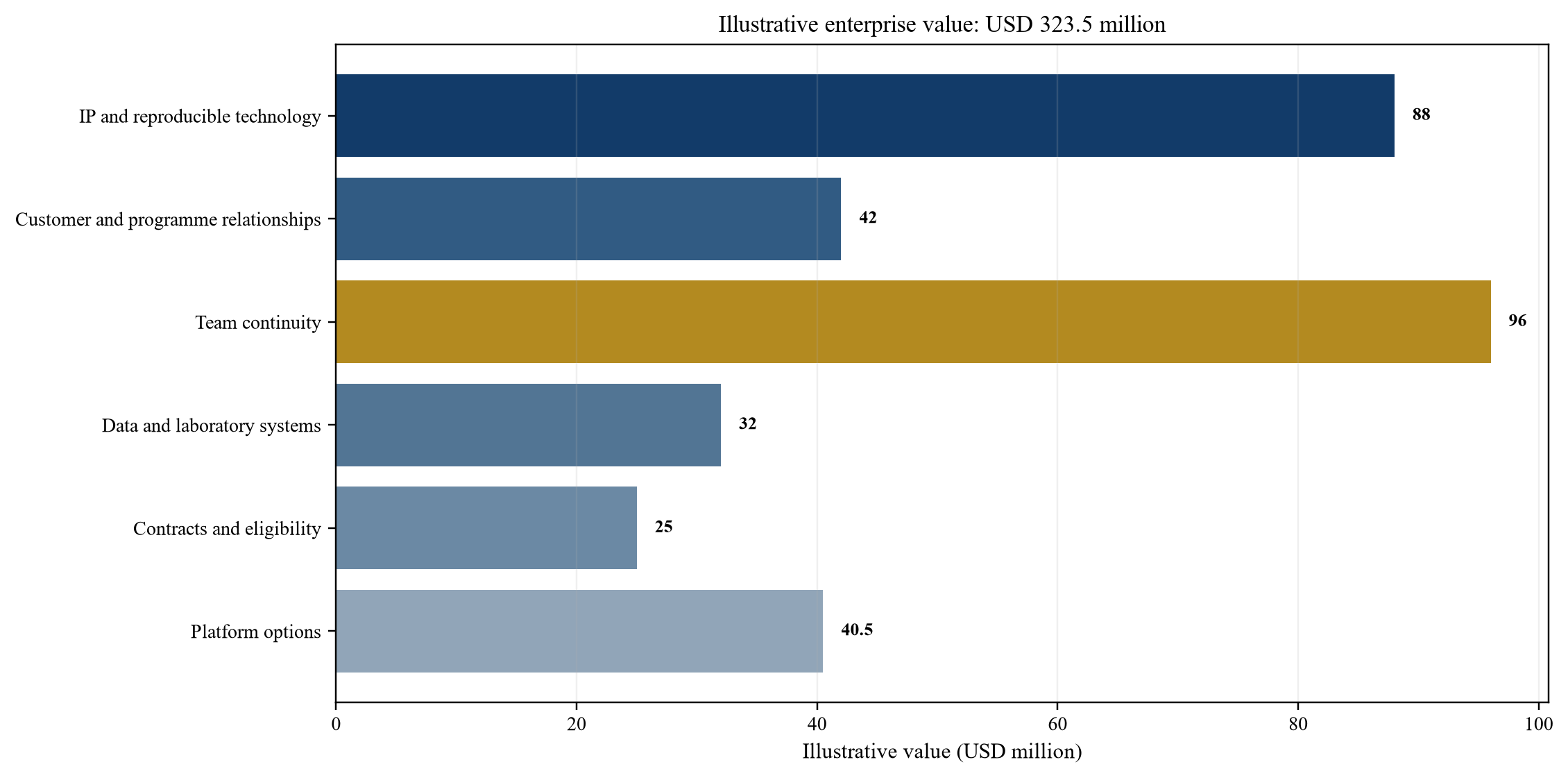
Wholly hypothetical management assumptions; USD million.
| Capability | Primary evidence | Critical dependency | Continuity test |
|---|---|---|---|
| Scientific thesis | Research agenda and design reviews | Principal scientific authority | Successor frames a falsifiable programme |
| Architecture | System decisions and interfaces | Cross-domain architect | Independent architecture review |
| Controls | Calibration, diagnostics and releases | Controls cohort | Reproduce and diagnose representative run |
| Algorithms | Benchmarks, code and customer mapping | Algorithm cohort | Clean build and benchmark replication |
| Operations | Laboratory records and safety | Laboratory lead and suppliers | Controlled end-to-end experiment |
| Product translation | Customer decisions and acceptance | Product science | Customer accepts transferred delivery |
Proposed diligence classification.
| Level | Evidence | Interpretation | Transaction response |
|---|---|---|---|
| 1 | Title or management assertion | Possible dependency | Investigate |
| 2 | Historical publication or patent | Domain contribution | Test current role |
| 3 | Recent decisions, code or experiments | Current operating contribution | Map substitute |
| 4 | Reproduced result with paired successor | Transfer in progress | Retain and monitor |
| 5 | Successor performs independently | Durable continuity | Release transfer gate |
Proposed classification; higher levels require observed operating evidence.
| Signal | Useful question | Limitation | Required corroboration |
|---|---|---|---|
| Co-author degree | Who collaborates widely? | Field and career-stage bias | Current project records |
| Betweenness | Who connects groups? | Historical links may be inactive | Recent decisions and communication |
| Citation influence | Which work shaped the field? | Lag and topic bias | Current product relevance |
| Inventor concentration | Who created claimed inventions? | Inventorship differs from ownership | Assignment, licence and practice evidence |
| Recency | Is the network active? | Proprietary work is absent | Code, experiment and customer evidence |
Proposed analytical controls.
| Metric | Illustrative amount | Evidence required | Valuation use |
|---|---|---|---|
| Employees | 86 | Payroll and contracts | Workforce perimeter |
| Technical staff | 63 | Role and activity map | Capability population |
| Critical-node people | 12 | Authority and dependency evidence | Retention model |
| Annual revenue | USD 22.0 million | Contracts, invoices and cash | Income case |
| Unrestricted cash | USD 48.0 million | Bank and restriction evidence | Equity bridge |
| Annual cash use | USD 21.0 million | Reconciled cash flow | Runway and funding need |
Wholly hypothetical management assumptions.
| Value component | Illustrative amount | Evidence gate | Downside treatment |
|---|---|---|---|
| Intellectual property and reproducible technology | USD 88.0 million | Rights and independent reproduction | Reproduction deduction |
| Customer and programme relationships | USD 42.0 million | Transfer, continuity and cash | Relationship adjustment |
| Team continuity | USD 96.0 million | Cohort retention and successor tests | Retention-weighted release |
| Data and laboratory systems | USD 32.0 million | Rights, configuration and operation | Remediation reserve |
| Contracts and eligibility | USD 25.0 million | Novation and permission | Consent deduction |
| Platform options | USD 40.5 million | Milestone and market evidence | Contingent consideration |
Wholly hypothetical management assumptions; not observed company or transaction data.
| Component | Economic purpose | Evidence | Release basis |
|---|---|---|---|
| Closing consideration | Controlled assets and achieved capability | Ownership and operating evidence | Completion |
| Seller contingent consideration | Uncertain transferred value | Customer, programme or technical outcome | Defined milestone |
| Employee retention | Future service and continuity | Continued service and role performance | Time or milestone vesting |
| Holdback or escrow | Identified risk protection | Claim or remediation evidence | Expiry or resolution |
| Integration reserve | Recruitment, laboratory and transfer funding | Approved plan and spend | Board control |
Proposed structure subject to legal, tax and accounting review.
| Decision area | Green evidence | Amber condition | Red condition |
|---|---|---|---|
| Capability | Reproduced result and clear authority | Transfer plan with tested gaps | Reputation substitutes for evidence |
| People | Critical cohorts accept defined roles | Individual commitments with cohort risk | Unresolved departures or role ambiguity |
| Successors | Independent performance observed | Paired authority underway | No credible substitute |
| Relationships | Customers and programmes accept continuity | Consent path identified | Non-transferable dependency |
| Mobility | Lawful protections and attractive work design | Material jurisdiction differences | Strategy relies on unenforceable restrictions |
| Valuation | Achieved value separated from options | Wide explicit scenarios | Cash price assumes unproved retention |
Proposed decision framework.
Sources
- National Quantum Coordination Office, National Strategic Plan for Quantum Information Science and Technology Workforce Development, 2022. Read the primary source
- National Quantum Initiative, Strategic plan for QIST workforce, 2022. Read the primary source
- National Quantum Initiative, The Role of International Talent in Quantum Information Science, 2021. Read the primary source
- National Quantum Initiative Advisory Committee, Renewing the National Quantum Initiative, 2023. Read the primary source
- OECD, Mapping the global quantum ecosystem, 2025. Read the primary source
- OECD, Building business readiness for quantum computing, 2026. Read the primary source
- IonQ, Annual Report on Form 10-K for 2024, 2025. Read the primary source
- IonQ, Annual Report on Form 10-K for 2025, 2026. Read the primary source
- QuEra Computing, Annual Report on Form 10-K, 2026. Read the primary source
- D-Wave Quantum, Annual Report on Form 10-K for 2025, 2026. Read the primary source
- IonQ, Completion of Oxford Ionics acquisition, 2025. Read the primary source
- United Kingdom Cabinet Office, Acquisition of Oxford Ionics Limited by IonQ Inc; notice of final order, 2025. Read the primary source
- IonQ, Quarterly Report on Form 10-Q for the quarter ended 30 September 2025. Read the primary source
- IonQ, Intention to acquire Lightsynq Technologies, 2025. Read the primary source
- University of Oxford Innovation, Oxford Ionics spinout acquisition, 2025. Read the primary source
- Pasqal, proposed business combination and investor information, 2026. Read the primary source
- United States Department of Justice and Federal Trade Commission, 2023 Merger Guidelines. Read the primary source
- United States Department of Justice, Merger Guidelines; Guideline 10 on workers and other providers. Read the primary source
- United States Federal Trade Commission, Noncompete Rule status, 2026. Read the primary source
- United States Federal Trade Commission, Noncompete enforcement and policy activity, 2026. Read the primary source
- IFRS Interpretations Committee, Payments Contingent on Continued Employment during Handover Periods; IFRS 3 staff paper, 2023. Read the primary source
- IFRS Interpretations Committee, IFRIC Update; continuing employment, January 2013. Read the primary source
- Financial Accounting Standards Board, Statement of Financial Accounting Standards No. 141 revised; replacement awards and post-combination service. Read the primary source
- IFRS Foundation, IFRS 3 Business Combinations. Read the primary source
- IFRS Foundation, IAS 38 Intangible Assets. Read the primary source
- International Valuation Standards Council, International Valuation Standards. Read the primary source
- National Institute of Standards and Technology, Secure Software Development Framework version 1.1, 2022. Read the primary source
- National Institute of Standards and Technology, Zero Trust Architecture, 2020. Read the primary source
- European Patent Office, Patent insight report on quantum metrology and sensing, 2024. Read the primary source
- National Science Foundation, Quantum Information Science programme information. Read the primary source
- United States National Quantum Initiative, Exchange opportunities and international talent. Read the primary source
- United States National Quantum Initiative, National strategy and annual reports. Read the primary source
