
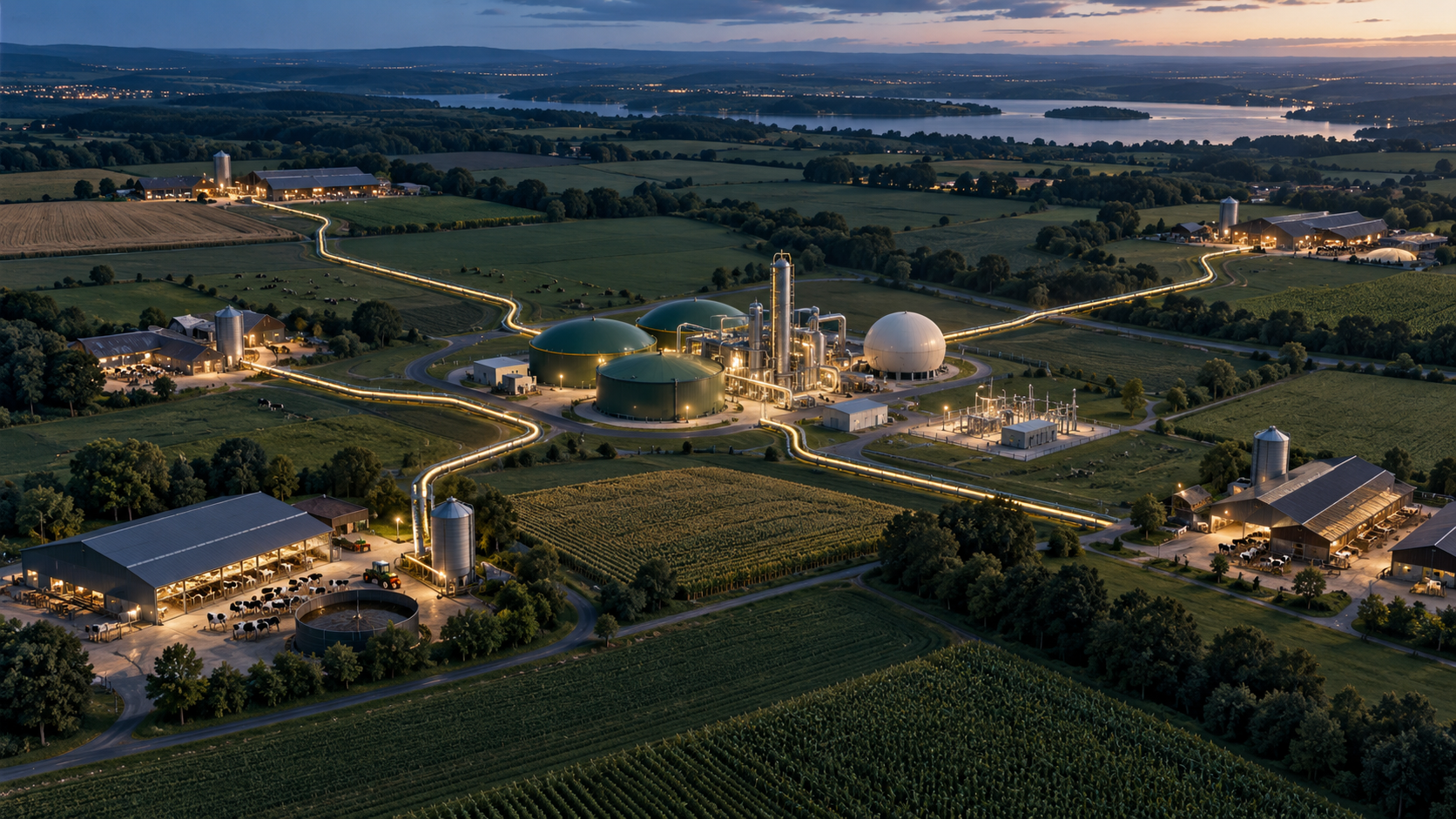
Introduction
Biomethane sits at the intersection of agriculture, waste management, energy security and emissions control. Anaerobic digestion converts organic material into biogas and digestate. Upgrading removes carbon dioxide, water vapour, hydrogen sulphide and other impurities so that the methane-rich product can meet a specified use or gas-grid standard. The resulting business is more than an energy plant. It is a network of farms, feedstock rights, biological processes, logistics, upgrading equipment, environmental controls, product contracts and regulatory evidence.
The International Energy Agency estimates that sustainable biogas potential is geographically dispersed and draws on more than thirty feedstock categories across millions of locations.[1] Its assessment identifies plant size, feedstock composition, collection radius and access to grids and roads as major economic variables.[2] This fragmentation creates an investment problem. A single farm may have a useful resource but insufficient scale, management capacity or balance sheet for institutional finance.
Aggregation can connect several farms to a common commercial and operating platform. The United States Environmental Protection Agency documents both centralised digesters that accept material from multiple farms and hub-and-spoke systems in which farm-level digesters send raw biogas to a central upgrading facility.[3] These examples establish technical and organisational possibilities. They do not establish that every cluster is financeable or that diversification automatically protects returns.
This paper sets out a decision framework for sponsors, infrastructure investors and lenders. It distinguishes physical aggregation, contractual aggregation, corporate aggregation and financial aggregation. It also identifies where standardisation creates scale and where local evidence must remain asset-specific.
1. State the investment decision
The first decision should define the proposed portfolio, initial geography, target feedstocks, conversion route, product market, ownership model and capital envelope. It should identify whether the sponsor is acquiring operating assets, developing greenfield projects, partnering with farms, consolidating developers or combining these routes.
Approval should cover a specific stage. An early stage may fund catchment studies, land rights, farmer contracts, gas-grid applications, permitting and reference design. A later stage may fund construction for a defined cluster after minimum feedstock, offtake and connection conditions are met.
The investment committee should require a stop rule. Examples include failure to contract a minimum proportion of feedstock, an unacceptable grid-injection cost, unresolved digestate disposal, inadequate methane-control design or a revenue case that depends on unsupported environmental attributes.
2. Define the portfolio boundary
The boundary should distinguish assets and obligations owned by the platform from those retained by farms, utilities, hauliers, offtakers and certificate counterparties. It should identify digesters, reception facilities, storage, pipelines, compression, upgrading, grid entry, virtual-pipeline equipment, metering, digestate treatment, laboratories and control systems.
Commercial boundaries matter as much as physical boundaries. A platform may own equipment while depending on farmer-controlled manure management, land access and operating routines. A long lease or feedstock contract can create control, but only if access, quality, exclusivity, remedies and step-in rights are enforceable.
The portfolio boundary should remain consistent across the financial model, insurance, environmental permits and operating responsibility. Ambiguous boundaries create unpriced interface risk.
3. Map the aggregation architecture
Aggregation can occur through four layers. Physical aggregation combines material or gas. Contractual aggregation standardises supply, service and offtake terms. Corporate aggregation holds projects under a common platform. Financial aggregation pools cash flow and capital while retaining asset-level controls.
A hub-and-spoke model can locate digesters close to wet manure and centralise upgrading, injection and commercial operations. A centralised digester can collect several compatible feedstocks when logistics and biosecurity permit. A virtual pipeline can move compressed biomethane where a physical grid connection is unavailable.
The architecture should follow resource density, road access, gas-grid location, farm operations and regulatory requirements. A legal diagram should accompany the physical diagram so that title, payment and liability are visible.
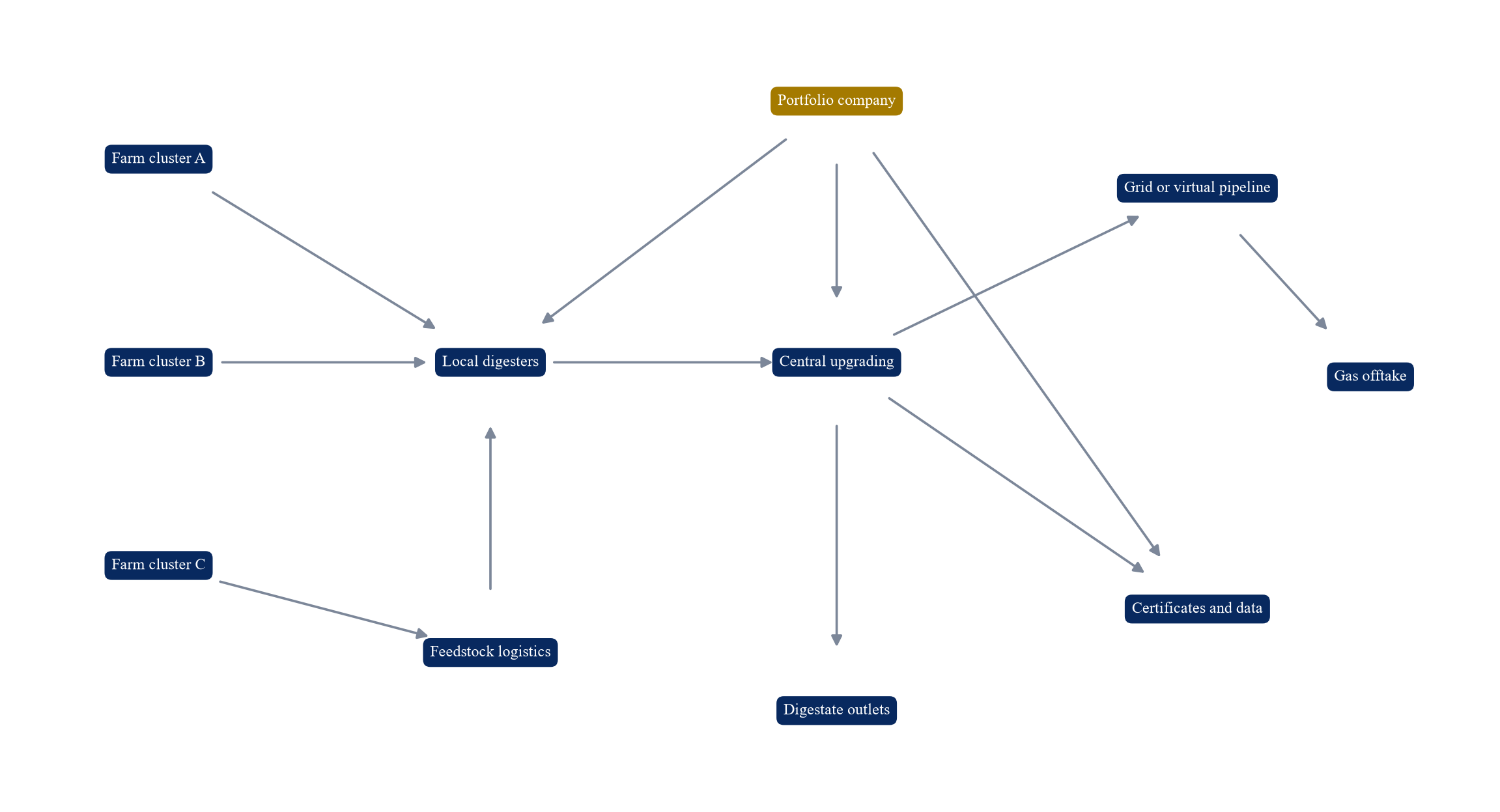
Proposed system map; actual ownership, routing, technology and contracts depend on the farms and jurisdiction.
4. Establish the resource baseline
The resource study should measure feedstock by location, season, moisture, dry matter, volatile solids, contaminants and competing use. Farm records should be reconciled with livestock numbers, housing systems, storage practices, crop yields and processing activity.
The IEA notes that methane yield varies by feedstock and that feedstock quality and spatial density influence economics.[2] A desktop estimate is insufficient for final investment. Sampling should cover seasonal and operational variation. Laboratory results should connect to the proposed digester loading and gas-yield model.
The baseline should identify existing environmental obligations and current disposal cost. A feedstock can carry a gate fee, have zero price or command a positive price. These positions can change once a project creates demand.
5. Build the catchment model
Each project needs a mapped catchment showing farms, road distance, collection routes, vehicle cycle times, seasonal access, storage, transfer points and alternative outlets. Straight-line distance can understate actual logistics.
The IEA indicates that high-moisture animal manure is expensive to transport and may have an economical collection radius around ten kilometres for a centralised digester, while dense crop residues can support longer distances in suitable areas.[2] These are broad observations. The project should calculate its own radius from payload, handling, road condition, labour, fuel, biosecurity and return logistics.
The portfolio model should test concentration. A cluster with several farms under common ownership may still represent one economic counterparty. Weather, disease or agricultural policy can affect many farms simultaneously.
6. Segment feedstock by risk
Feedstock should be grouped by physical, commercial and sustainability characteristics. Manure, crop residue, food-processing waste and municipal biowaste have different gas yields, contamination risks, storage needs and regulatory status.
Base feedstock should support stable biological operation. Higher-yield co-feedstock may improve economics while adding procurement and pre-treatment risk. The EPA notes that co-digestion can increase gas production and improve feasibility for smaller farms.[4]
The financial model should avoid treating all tonnes as interchangeable. It should model energy yield, processing cost, gate fee, transport, rejection and digestate consequence by feedstock class.
7. Secure durable farm participation
Farm participation should be documented through land, feedstock, access, service and operating agreements. The platform needs rights to receive material or gas, inspect practices, meter volume, enforce quality, access equipment and respond to default.
Farmers need a clear economic proposition. Consideration may include a service fee, revenue share, lease payment, avoided handling cost, digestate return or ownership interest. The allocation should match responsibilities and avoid incentives to dilute, divert or contaminate feedstock.
Contracts should address farm sale, succession, herd reduction, disease events, force majeure, land-use change and competing projects. Long duration is valuable only when the agreement remains practical for agricultural operations.
8. Choose physical aggregation deliberately
Three models deserve separate analysis. A central digester collects feedstock from multiple farms. Distributed digesters send raw or partially treated biogas to a central upgrader. Independent plants retain physical operations while the platform aggregates commercial and financial functions.
Central digestion can capture scale in equipment and staffing but increases feedstock transport, reception and biosecurity exposure. Distributed digestion can keep wet material on the farm but requires replicated digesters and a raw-gas gathering network. Commercial aggregation can preserve existing assets but offers less technical standardisation.
The EPA describes multi-farm central digesters and California clusters that consolidate biogas before pipeline injection.[3][5] The choice should follow local evidence rather than a preferred corporate template.
9. Standardise the reference design
A portfolio can reduce development and procurement cost through a reference design covering reception, pre-treatment, digestion, gas handling, upgrading, flare, storage, metering, controls and digestate treatment. Standard equipment can simplify spares, training and performance comparison.
Standardisation has limits. Digester technology must suit feedstock, climate, water balance and loading. Gas treatment must meet the applicable end-use specification. Foundation, drainage, odour, traffic and nutrient-management conditions remain site-specific.
The design authority should control deviations through a documented process. A low-cost local change can create portfolio-wide cybersecurity, safety or maintenance complexity.
10. Validate biological performance
Anaerobic digestion is a biological process. Performance depends on loading rate, retention time, temperature, pH, nutrient balance, mixing, inhibition and operator discipline. A financial model based only on nameplate gas output overlooks biological ramp-up and instability.
Feedstock tests should inform laboratory or pilot work where uncertainty is material. The model should include start-up, acclimatisation, planned maintenance, parasitic energy and realistic availability. Recovery from a biological upset can take longer than mechanical repair.
Portfolio diversification helps when feedstock and operating events are independent. Common design defects, operator procedures or trace contaminants can create correlated underperformance.
11. Select upgrading technology
Upgrading separates methane from carbon dioxide and removes impurities. Technologies include membranes, pressure-swing adsorption, water or chemical scrubbing and cryogenic processes. Selection depends on flow, composition, methane recovery, product specification, energy use, water, chemicals, footprint and maintenance.
The Renewable Energy Directive methodology recognises several upgrading routes and the importance of off-gas treatment in emissions accounting.[6] The project should measure methane recovery and route off-gas safely.
Procurement should specify product gas, methane slip, turndown, availability, consumables, emissions, noise and performance testing. Warranty remedies should reflect lost gas and lost environmental value.
12. Design gas gathering and transfer
Raw biogas contains moisture and corrosive components. Gathering systems require pressure control, condensate management, materials selection, monitoring, isolation and emergency response. A failure can interrupt several farms.
Pipeline routing should secure land rights, crossings, permits and access. Compression requirements depend on distance and central facility design. Trucking compressed or liquefied product creates a different operating and safety system.
The network should allow isolation of one spoke without stopping the portfolio. Metering at each interface is essential for allocation, quality control and farmer payment.
13. Secure grid or delivery access
Grid injection requires an accepted connection point, capacity, gas-quality specification, metering, odorisation where applicable, pressure control and a commissioning process. Reinforcement and operating constraints can dominate economics.
A virtual pipeline can connect remote projects to an injection or customer site. Its cost depends on compression, containers, vehicle utilisation, distance, loading, unloading and backup capacity. It also introduces road, weather and fleet risk.
The portfolio should not assume that one connection solves all clusters. Connection applications, capacity reservations and delivery dates should be tracked asset by asset.
14. Define product quality and custody
Product specifications may limit water, oxygen, hydrogen sulphide, carbon dioxide, siloxanes and other components. The platform should identify the applicable standard and allocate responsibility for testing, rejection, blending and off-specification gas.
Custody transfer requires calibrated meters, sampling, data retention and reconciliation. The same data may support billing, certificates, emissions claims and lender reporting. Governance should prevent inconsistent versions.
An off-specification event needs a safe disposition route. Flaring, reprocessing, storage or temporary shutdown each has cost and environmental consequences.
15. Control methane emissions
Methane leakage can erode environmental performance and revenue. Potential sources include reception, digesters, pressure relief, gas handling, upgrading off-gas, flares, engines and digestate storage. Measurement should cover normal operations and abnormal events.
UK government research identifies digestate storage and other process points as potential leakage sources at anaerobic-digestion plants.[7] The investment case should include enclosed storage where appropriate, leak detection, repair, flare reliability, pressure management and independent performance review.
Environmental attributes should reflect measured or approved methodology. The portfolio should avoid claiming avoided emissions that are inconsistent with actual feedstock practice or methane loss.
16. Plan digestate management
Digestate is a material product stream and an operating constraint. It contains water and nutrients whose value and permitted use depend on composition, treatment, storage, transport, land availability and agricultural rules.
The EPA identifies digestate uses including fertiliser, bedding, irrigation and other products.[8] A use pathway requires local agronomic and regulatory evidence. The financial model should include separation, treatment, storage, sampling, transport and seasonal application.
Nutrient concentration can exceed local land capacity. Aggregating feedstock without planning nutrient outlets can move an environmental burden rather than resolve it.
17. Protect soil, water and communities
Projects require drainage, bunding, spill control, traffic management, odour controls, noise limits and emergency response. Community confidence can affect permitting and operating continuity.
Site selection should consider flood risk, watercourses, groundwater, residences, road capacity and sensitive habitats. Farm familiarity with manure does not remove industrial operating obligations.
The platform should publish a complaints and incident process appropriate to the jurisdiction. Local performance should remain visible within consolidated reporting.
18. Build the revenue stack
Revenue may include biomethane sales, gate fees, renewable or low-carbon attributes, avoided farm cost, digestate value, capacity or service payments and carbon-related income. Each line needs a legal basis, quantity driver, price rule, duration and counterparty.
The European Commission targets increased sustainable biomethane production and has created a mechanism intended to improve matching, regulatory information and financing visibility.[9] Policy support can improve market formation. It does not replace a bankable contract.
The model should separate energy value from policy value. Environmental attributes need ownership, eligibility, measurement, verification, transfer and change-in-law analysis.
19. Structure feedstock payments
Feedstock contracts can include fixed fees, indexed fees, gate fees, revenue shares or combinations. The design should align volume, quality and availability incentives while protecting farm viability.
Payment should use measured accepted material or metered gas, adjusted for defined quality where appropriate. Rejection rights require a process that prevents arbitrary outcomes and unsafe storage at the farm.
Indexation should match the cost driver. A gas-price link can expose farmers and projects to volatility that neither controls. Periodic reopeners should be limited and governed.
20. Contract gas offtake
Offtake may be physical or certificate-based. The contract should specify quantity, delivery point, quality, nomination, balancing, price, credit support, curtailment, force majeure and environmental attributes.
A floor or fixed-price component can support debt capacity. A market-linked component can preserve upside. The hedge should match expected production and avoid over-commitment during biological or feedstock shortfall.
Portfolio aggregation can support a larger contract and diversify individual plant output. The contract should still accommodate ramp-up, maintenance and geographic delivery constraints.
21. Verify environmental attributes
Sustainability and greenhouse-gas evidence may require mass balance, feedstock classification, chain of custody and lifecycle calculation. The Renewable Energy Directive sets sustainability and emissions-saving criteria and recognises independent evidence and voluntary schemes.[6]
The portfolio should maintain traceability from farm and feedstock through production, injection and sale. Aggregation should not erase asset-level evidence. Certificate systems can require allocation rules when gas and attributes move separately.
The base case should include only attributes for which eligibility, volume and monetisation are supportable. Future schemes should remain conditional.
22. Model capital by asset and platform
Capital should be divided between farm or spoke assets, central assets and platform costs. Spoke costs may include reception, digester, gas cleaning, storage and local connections. Central costs may include gathering, upgrading, compression, injection, laboratory and control centre.
Platform costs include origination, development staff, data systems, standard engineering, procurement, financing, legal structure and central operations. These can create scale but also add overhead before the portfolio reaches critical mass.
The estimate should state price date, procurement status, escalation, tax, contingency and accuracy. Development capital should be tracked separately from construction capital.
Table 1. Hypothetical capital allocation for an aggregated biomethane portfolio
| Uses | Amount | Sources | Amount |
|---|---|---|---|
| Farm and spoke digesters | 54 | Sponsor equity | 42 |
| Gas gathering and transfer | 18 | Senior project debt | 76 |
| Central upgrading and injection | 37 | Equipment or asset finance | 18 |
| Digestate and environmental controls | 14 | Public or climate support | 16 |
| Development, platform systems and contingency | 21 | Contingency facility | 8 |
| Financing and reserve accounts | 16 | Farmer or strategic contributions | 0 |
| Total hypothetical uses | 160 | Total hypothetical sources | 160 |
Illustrative values only; no identified farm, project, sponsor, borrower or transaction is represented.
23. Model operating cost
Operating cost should include feedstock handling, transport, labour, electricity, heat, water, chemicals, consumables, laboratory testing, maintenance, insurance, environmental monitoring, digestate management, certification and corporate overhead.
The IEA observes that biogas and biomethane projects can have relatively high operating costs because of pre-treatment, processing and onsite energy use.[2] Portfolio scale can reduce procurement and staffing duplication. Long logistics routes and complex feedstock can offset those gains.
The model should separate fixed and variable cost. It should also show the cost of standby and recovery after a biological or mechanical event.
24. Test operating sensitivities
The central sensitivity is delivered methane, which combines feedstock volume, methane yield, digester availability, methane recovery and product acceptance. Price sensitivity should use the netback after transport, balancing and certificate costs.
Downside cases should combine lower feedstock, lower yield, higher logistics cost, longer ramp-up and weaker gas netback. These variables can move together during agricultural or policy stress.
The model should identify break-even production, minimum liquidity and covenant pressure. Recovery actions should be operationally credible.
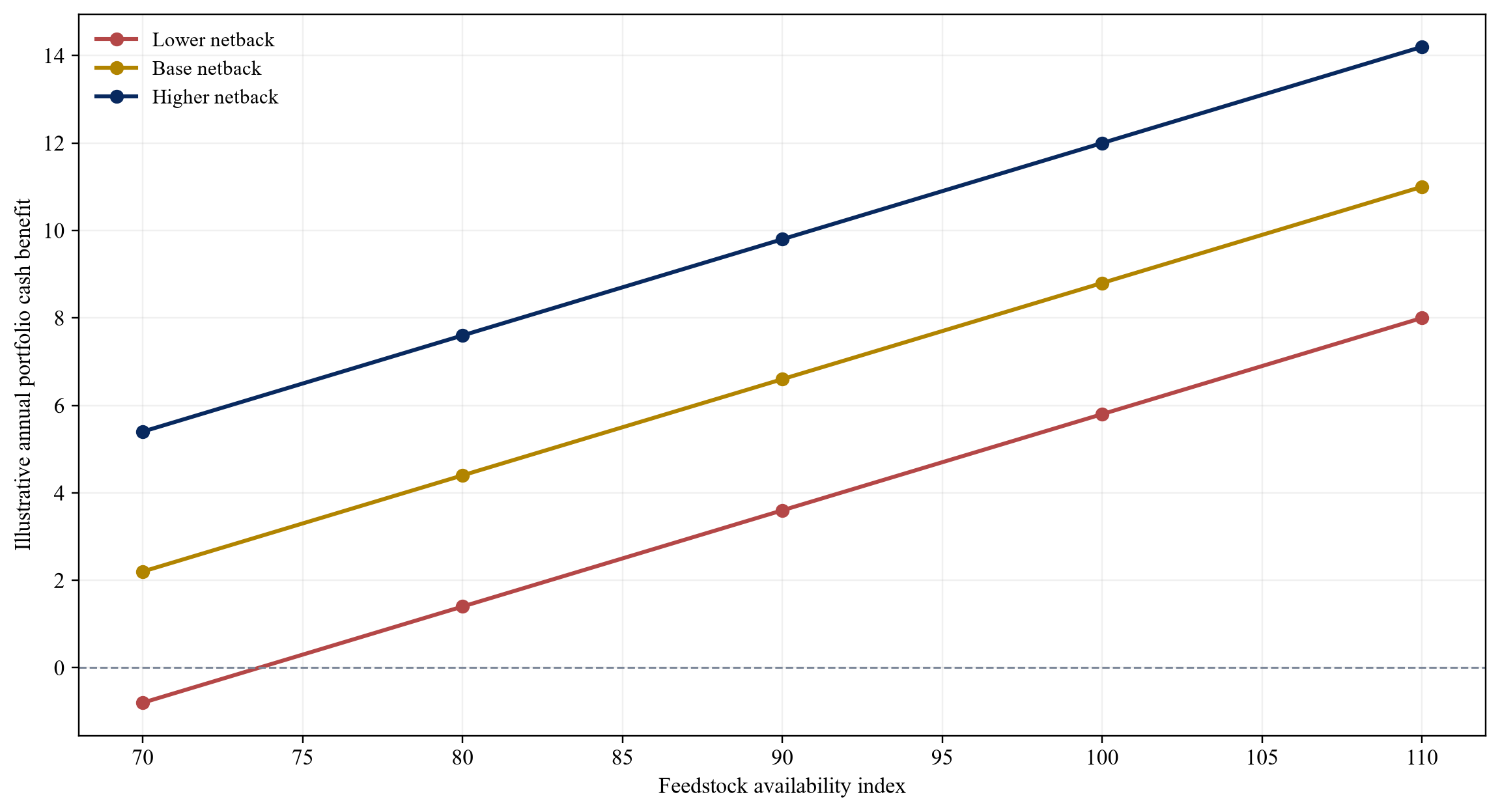
Illustrative scenario analysis only; values are not forecasts or transaction evidence.
25. Value diversification correctly
Diversification can reduce exposure to a single farm, operator or local event. Its value depends on correlation. Drought, disease, agricultural prices, regulation, technology defects or certificate rules can affect multiple assets.
The model should classify risks as idiosyncratic, regional and portfolio-wide. It should calculate production concentration by feedstock, geography, farmer group, technology, upgrader, grid entry and offtaker.
An asset count is not a diversification measure. Ten farms linked to one upgrader and one contract can contain significant common-mode risk.
26. Design the holding structure
A portfolio may use a holding company with project companies for each cluster or site. Project companies can ring-fence permits, land, contracts and liabilities. The holding company can provide development, procurement, data and operational services.
The structure should address cash waterfalls, tax, distributions, intercompany services, cross-default, security and minority rights. Lenders need clarity on which cash flows support which debt.
Cross-collateralisation can improve borrowing capacity while exposing good assets to weak ones. A borrowing-base or eligibility approach may preserve discipline.
27. Match debt to risk
Development risk, construction risk and operating risk may require different capital. Early equity or development facilities can fund origination and permits. Construction facilities can convert after completion tests. Operating debt can rely on contracted and demonstrated cash flow.
Debt sizing should reflect production, price, feedstock, operating and policy uncertainty. Reserve accounts may cover debt service, maintenance, feedstock disruption and environmental obligations.
Portfolio financing can reduce transaction cost and support institutional scale. Lenders should retain asset-level information and exclusion rights for non-compliant projects.
28. Create an eligibility framework
Every asset entering the financed portfolio should meet defined criteria for feedstock, land, permits, technology, contractor, connection, offtake, insurance, data and environmental compliance.
Eligibility should be tested before initial funding and monitored thereafter. Cure periods and removal mechanisms should be defined. Substitution can preserve a revolving portfolio if the replacement asset meets the same standard.
The framework should prevent pressure to add volume at the expense of quality. Growth that weakens controls can reduce portfolio value.
29. Stage capital release
Capital should follow evidence. Early release can fund resource confirmation, contracts and permits. Notice to proceed should require minimum feedstock, secured site, connection path, approved design, construction price, offtake and funded contingency.
Drawdowns should follow verified progress and updated completion cost. Commissioning release should require biological start-up planning, trained operators, gas-quality tests, metering and environmental controls.
Final conversion should depend on sustained production and acceptance rather than mechanical completion alone.
30. Procure for portfolio performance
Procurement can combine framework agreements for standard equipment with project-specific work packages. The sponsor should decide where single-source integration reduces interface risk and where competition protects price.
Performance guarantees should cover throughput, methane recovery, gas quality, energy use, availability and emissions where measurable. Liquidated damages should reflect value and remain creditworthy.
The portfolio needs spares, software support, cybersecurity, obsolescence management and local maintenance. Procurement should consider lifecycle cost.
31. Establish the operating company
Farm-based energy assets require specialist operations. The platform should define central and local roles, staffing, call-out coverage, laboratory support, maintenance planning and emergency response.
The EPA identifies staffing, regulatory requirements and maintenance as economic barriers for farm digesters.[3] A portfolio operating company can pool specialists and standardise procedures. It still needs local knowledge and accountable site leadership.
Operating contracts should use measurable service standards and transparent cost allocation. Incentives should balance production, safety, methane control and equipment life.
32. Build the data architecture
The data platform should capture feedstock receipt, composition, digester conditions, gas production, methane content, upgrading performance, energy use, methane loss, injection, digestate, incidents and commercial settlement.
Meters and sensors need calibration, time synchronisation, ownership and maintenance. Data gaps should trigger investigation and conservative settlement rules.
Portfolio reporting should reconcile physical gas, billed gas and environmental attributes. Asset-level traceability should survive consolidation.
33. Use predictive controls carefully
Analytics can support feedstock scheduling, biological monitoring, preventive maintenance, gas-quality prediction and logistics routing. Models require reliable data and defined operator action.
An alert has value only when responsibility, response time and decision rights are clear. Biological systems can behave differently across feedstocks and seasons. Model performance should be monitored by asset.
Automated optimisation should respect safety, permit and feedstock constraints. Human operators should retain authority over abnormal conditions.
34. Protect operational technology
Digesters, compressors, upgrading units and grid interfaces use connected control systems. Cybersecurity should cover network segmentation, remote access, vendor accounts, backups, patching and incident response.
Portfolio standardisation can improve controls and create a common attack surface. Acquisitions should include technical due diligence on legacy systems and unsupported equipment.
Recovery exercises should test manual operation, safe shutdown and data restoration. Insurance should align with actual controls.
35. Govern farmer relationships
The platform should maintain a structured farmer forum, issue process and performance review. Operational changes on a farm can affect feedstock and project safety. Project changes can affect traffic, odour and farm routines.
Governance should protect confidential farm data while supporting portfolio monitoring. Disputes need escalation and expert determination where technical measurements are involved.
Farmer participation should remain commercially clear. Informal relationships can weaken during succession, ownership change or project underperformance.
36. Manage development pipeline quality
A platform valuation may depend on future projects. Pipeline projects should be classified by evidence: identified, screened, contracted, permitted, ready to build or under construction.
Each stage should have objective entry criteria and probability should not substitute for project work. Development expenditure, attrition and cycle time should be reported.
The platform should compare pipeline growth with operating capability and capital. Too many early projects can consume cash without producing financeable assets.
37. Underwrite acquisitions
Operating assets need technical, environmental, commercial and financial due diligence. Review historical feedstock, production, downtime, methane slip, maintenance, incidents, permits, certificates, contracts and lifecycle capital.
Normalisation should remove unsupported revenue and add missing cost. Deferred maintenance and biological underperformance can remain hidden in short data periods.
The acquisition model should include integration cost and contract change requirements. A low purchase multiple can reflect structural weakness.
38. Plan integration
Integration should preserve safe operation while aligning reporting, procurement, cybersecurity, maintenance and commercial controls. A hundred-day plan should prioritise critical evidence and interfaces.
The platform should avoid immediate technical changes without a verified benefit and change-control process. Operator retention and local stakeholder continuity can protect performance.
Synergies should have owners, costs, timing and baseline. Central overhead reduction should not weaken site coverage.
39. Evaluate regional expansion
Expansion should follow feedstock density, policy durability, gas demand, infrastructure, contractor capability and operating reach. A new country can add legal, tax, currency, certificate and grid complexity.
The IEA finds that a large share of sustainable biogas potential is in emerging and developing economies, with major resource potential in India, Brazil and China.[10] Resource potential does not establish investability. Local contracts, institutions and payment capacity remain decisive.
The platform should use a country-entry scorecard and pilot before scaling. Currency and policy revenue should be tested separately.
40. Test policy dependence
Policy may support capital grants, gas price, fuel credits, certificates, tax benefits or emissions value. The investment case should map legal basis, qualification, duration, budget exposure and change mechanisms.
The IEA expects biomethane growth and identifies policy support as an important driver.[11][12] A lender case should not assume indefinite continuation without contractual or statutory evidence.
Sensitivity should remove, delay or reduce policy value. The portfolio should show whether physical gas remains competitive under that case.
41. Use a portfolio scorecard
The investment committee needs comparable evidence across projects. The scorecard should cover resource, contracts, technology, connection, offtake, environment, operations, finance and community.
Scores should support judgement rather than replace it. A fatal flaw should not be averaged away by strong performance elsewhere. Evidence quality and recency should be visible.
The scorecard can also guide development spending by identifying the next value-creating action.
Table 2. Proposed biomethane-asset eligibility scorecard
| Test | Approval evidence | Downside concern | Gate response |
|---|---|---|---|
| Feedstock | measured catchment and enforceable contracts | seasonal shortfall or competing use | minimum contracted volume and diversity |
| Technology | feedstock-compatible reference design | biological or common-mode failure | pilot evidence, warranties and independent review |
| Connection | accepted grid or delivery solution | delay, curtailment or off-specification rejection | secured capacity and tested backup route |
| Offtake | creditworthy contract and attribute ownership | price volatility or policy dependence | floor, hedge, reserve or reduced leverage |
| Environment | permits, methane controls and digestate plan | leakage, nutrient burden or community opposition | monitoring, containment and funded remedy |
| Operations | staffed plan, spares and data systems | weak local response or skill shortage | central support and site accountability |
| Finance | funded contingency and resilient coverage | correlated ramp-up and liquidity pressure | staged draw, reserves and completion support |
Proposed framework; thresholds require jurisdiction-specific technical, legal, environmental and financial review.
42. Allocate risk to control
Risk should sit with the party able to control, price and withstand it. Farmers control defined feedstock practices. Contractors control design and construction. Operators control process discipline. Utilities control connection obligations. Offtakers control payment and nomination within contract.
Some risks remain shared. Agricultural conditions affect supply. Policy affects attributes. Grid delay can affect sponsor, contractor and farmer. Contracts should define coordination, relief, compensation and termination.
Transfer has limits. Liability caps, exclusions and counterparty credit should be compared with the portfolio exposure.
43. Fund liquidity and reserves
Liquidity should cover development delay, feedstock disruption, biological recovery, major maintenance, certificate settlement and debt service. A portfolio may need both central liquidity and ring-fenced project reserves.
Reserve sizing should follow stress tests and recovery periods. A mechanical spare can shorten downtime. Biological recovery and new feedstock contracting can require longer support.
Distribution tests should preserve capital when performance falls. The platform should avoid relying on continuous asset sales to fund operations.
44. Sequence the first cluster
The first cluster should combine strong feedstock evidence, manageable logistics, an achievable connection, supportive farms and a credible offtake. It should test the platform systems intended for later projects.
The pilot should be large enough to demonstrate institutional operations and small enough to contain risk. Design choices should preserve replicability without forcing future sites into unsuitable equipment.
Lessons should be documented before the next construction wave. Growth should follow proven interfaces.
45. Build the implementation roadmap
Phase one maps catchments, screens counterparties and selects the reference architecture. Phase two contracts feedstock and sites, advances connection, completes permits and develops the base design. Phase three finances and constructs the first cluster. Phase four proves production, quality, emissions and settlement. Phase five adds eligible projects and refinances seasoned cash flow.
Each phase needs evidence, decision authority and a stop rule. The integrated schedule should show agriculture, permitting, connection, procurement, construction, biological commissioning and certification.
The programme should retain alternative projects so that one delayed site does not halt the platform. Alternatives should meet the same eligibility standard.
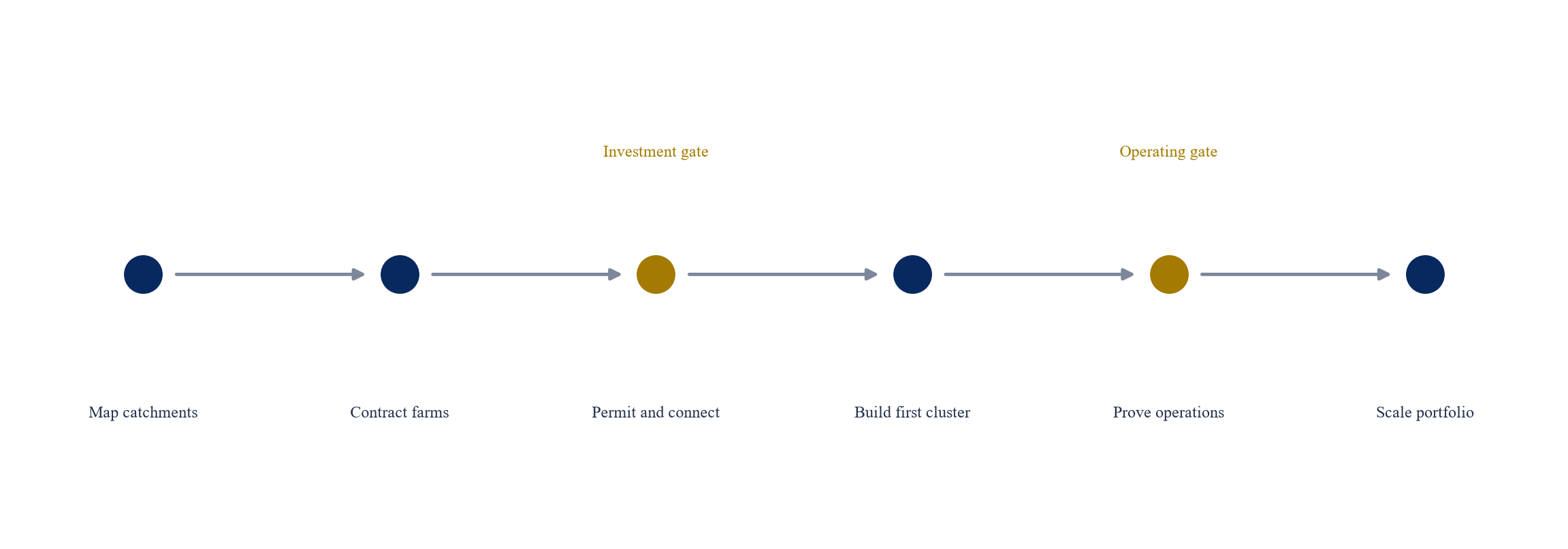
Proposed sequence; timing depends on resource evidence, permits, contracts, connection and financing.
46. Define completion tests
Completion should cover mechanical, biological, gas-quality, environmental, data and commercial performance. A short mechanical run cannot prove stable digestion or environmental-attribute eligibility.
Tests should specify feedstock mix, duration, loading, methane yield, upgrading recovery, gas quality, energy use, methane slip, digestate quality, availability and reporting.
Failure should trigger cure, retest, support or price adjustment. Long-stop dates should reflect biological commissioning.
47. Monitor the operating portfolio
The board should receive comparable asset and consolidated reporting. Measures should include contracted and delivered feedstock, methane yield, product gas, methane recovery, energy use, downtime, incidents, digestate, certificate status, cash and covenant headroom.
Variance should be traced to physical and commercial causes. High gas production with weak cash can indicate price, balancing, eligibility or working-capital issues.
Reporting should preserve local context. A consolidated average can hide a weak asset or environmental event.
48. Test the portfolio against alternatives
The investment committee should compare aggregation with standalone projects, a service-only model, acquisition of operating assets, partnerships with established operators and other uses of capital.
The comparison should include development duration, control, capital intensity, diversification, execution capacity and exit routes. A platform premium requires demonstrated capability and repeatable economics.
The test should also consider whether feedstock has a higher-value or lower-risk use. Biomethane should solve an identified waste and energy problem rather than depend on resource capture alone.
49. Plan exit and refinancing
Potential routes include long-term ownership, infrastructure refinancing, strategic sale, portfolio sale or partial capital recycling. Each requires clean asset records, durable contracts, demonstrated operations and defensible environmental evidence.
Refinancing should follow sustained production and cash conversion. Pipeline value should remain separate from operating value unless development evidence is strong.
Exit preparation should begin with document and data discipline at project inception.
50. Apply the investment-committee test
The committee should ask whether the platform controls sufficient feedstock, converts it reliably, delivers accepted product, contains environmental risk and captures revenue under enforceable contracts. It should see an asset-level and consolidated model.
Approval should state the assets, stage, capital, conditions, stop rules, reserves and sponsor support. Growth targets should be subordinate to eligibility and operating performance.
The decision should identify which risks diversify and which remain common. Portfolio scale has value only when control, data and execution scale with it.
Table 3. Proposed biomethane-portfolio risk-allocation matrix
| Risk | Natural owner | Contract mechanism | Evidence for capital release |
|---|---|---|---|
| Feedstock availability | farm and portfolio originator | minimum supply, exclusivity, quality and remedies | measured catchment and executed contracts |
| Biological performance | technology provider and operator | performance standard, warranty and operating protocol | feedstock tests and reference performance |
| Gas quality and recovery | upgrader supplier and operator | product specification, recovery guarantee and retest | factory and site acceptance tests |
| Connection and delivery | utility, sponsor and logistics provider | connection agreement, capacity and relief | accepted offer and credible delivery plan |
| Methane and environmental performance | sponsor, operator and farms within control | monitoring, repair, indemnity and permit compliance | approved controls and baseline evidence |
| Offtake and attributes | platform and offtaker | price rule, credit support and attribute transfer | signed contract and eligibility opinion |
| Construction and integration | sponsor and package contractors | coordinated design, schedule, contingency and security | design freeze and funded completion plan |
| Portfolio liquidity | sponsor and lenders | reserves, distribution tests and completion support | funded accounts and stress-tested coverage |
Proposed framework; allocation requires project-specific legal, technical, environmental and credit review.
Conclusion
Agricultural biomethane aggregation can turn distributed biological resources into infrastructure-scale cash flow. The investment case depends on more than adding projects. It requires a portfolio architecture that preserves local feedstock and environmental evidence while standardising contracts, technology, operations, data and finance where this creates value.
The strongest platforms should begin with verified catchments and durable farm relationships. They should select physical aggregation around transport and connection economics, control methane and digestate, secure credible offtake, and finance assets through staged gates. Portfolio diversification should be measured through actual correlations and common dependencies.
This approach can reduce duplicated development cost, create specialist operating capability and support larger financing. It also makes failure visible. Assets that cannot meet eligibility, traceability or operating standards should remain outside the financed portfolio until evidence improves.
Investment-committee questions
1. Which feedstock is measured, contracted and available within an economic collection radius? 2. Which farms or counterparties create concentration despite a large asset count? 3. Which aggregation model best fits transport, biosecurity, grid access and gas quality? 4. Which elements can use a reference design, and which remain site-specific? 5. What minimum feedstock and methane yield support the base case? 6. How will methane leakage and digestate be measured and controlled? 7. Which revenue is physical gas value, and which depends on policy or certificates? 8. Who owns the environmental attributes and maintains chain of custody? 9. What happens if a grid connection, offtake or certificate route is delayed? 10. Which risks diversify across assets, and which remain portfolio-wide? 11. What evidence releases development, construction and term capital? 12. How is completion tested across mechanical, biological and environmental performance? 13. How much liquidity is needed for biological recovery and feedstock replacement? 14. Can each project be isolated without stopping the portfolio? 15. Does the operating company have the skills and local coverage required? 16. Which data reconciles physical gas, billing and environmental value? 17. What expansion criteria protect quality as the platform grows? 18. Which refinancing or exit route is supported by demonstrated cash flow? 19. What residual obligations remain with farms, sponsors and communities? 20. Why does aggregation create more value than the best available alternative?
References
- International Energy Agency, Outlook for Biogas and Biomethane, 2025. https://www.iea.org/reports/outlook-for-biogas-and-biomethane
- International Energy Agency, Assessing the Sustainable Potential and Cost of Feedstocks for Biogas and Biomethane, 2025. https://www.iea.org/reports/outlook-for-biogas-and-biomethane/assessing-the-sustainable-potential-and-cost-of-feedstocks-for-biogas-and-biomethane
- United States Environmental Protection Agency, Anaerobic Digestion on Dairy Farms. https://www.epa.gov/agstar/anaerobic-digestion-dairy-farms
- United States Environmental Protection Agency, AgSTAR Project Development Handbook, 2020. https://www.epa.gov/sites/default/files/2014-12/documents/agstar-handbook.pdf
- United States Environmental Protection Agency, Renewable Natural Gas from Agricultural-Based AD/Biogas Systems. https://www.epa.gov/agstar/renewable-natural-gas-agricultural-based-adbiogas-systems
- European Union, Directive (EU) 2018/2001 on the Promotion of the Use of Energy from Renewable Sources. https://eur-lex.europa.eu/legal-content/EN/TXT/?uri=CELEX:32018L2001
- UK Government, Methodology to Assess Methane Leakage from Anaerobic Digestion Plants. https://assets.publishing.service.gov.uk/government/uploads/system/uploads/attachment_data/file/786756/Methodology_to_Assess_Methane_Leakage_from_AD_Plants_final_report_part1.pdf
- United States Environmental Protection Agency, Basic Information about Anaerobic Digestion. https://www.epa.gov/anaerobic-digestion/basic-information-about-anaerobic-digestion
- European Commission, Biomethane Mechanism: Connecting Buyers and Sellers, 2026. https://energy.ec.europa.eu/news/biomethane-mechanism-connecting-buyers-and-sellers-2026-06-18_en
- International Energy Agency, Outlook for Biogas and Biomethane: Key Findings, 2025. https://www.iea.org/reports/outlook-for-biogas-and-biomethane/key-findings
- International Energy Agency, Renewables 2025: Biogases. https://www.iea.org/reports/renewables-2025/biogases
- International Energy Agency, Gas 2025: Executive Summary. https://www.iea.org/reports/gas-2025/executive-summary
- European Commission, Biomethane. https://energy.ec.europa.eu/topics/renewable-energy/bioenergy/biomethane_en
- International Renewable Energy Agency, Best Practices in Bioenergy Policymaking: Agricultural Residues, 2023. https://www.irena.org/-/media/Files/IRENA/Agency/Publication/2023/Nov/IRENA_Agricultural_residue_bioenergy_2023.pdf
- United States Environmental Protection Agency, Building and Operating Biogas Recovery Systems. https://www.epa.gov/agstar/building-operating-biogas-recovery-systems
- United States Environmental Protection Agency, Project Profile: Dane County Digester. https://www.epa.gov/agstar/project-profile-dane-county-digester
- World Bank Group, AgriConnect: Agribusiness, Jobs and Subsistence Farming. https://www.worldbank.org/ext/en/agriconnect
- World Bank Group, AgriConnect FAQ: Smallholder Farming, Agribusiness and Food Security Explained, 2026. https://www.worldbank.org/ext/en/agriconnect/faq
- United States Environmental Protection Agency, Renewable Natural Gas. https://www.epa.gov/lmop/renewable-natural-gas
- International Energy Agency, Biogas and Biomethane Potential by Feedstock, 2025, updated 2026. https://www.iea.org/data-and-statistics/charts/biogas-and-biomethane-potential-by-feedstock-2025
About the Author
Authored by Chennakeshav Adya Independent Researcher
Chennakeshav (CK) is a corporate finance and investment banking executive with 25+ years of global experience in deal origination, structuring and execution across M&A, growth capital and corporate strategy. He has led value-creation mandates for founders, corporates and funds — bridging the boardroom view to hands-on execution and close.
His career spans Morgan Stanley, HSBC, Lloyds Banking Group, EWEC, ADQ portfolio companies and Emirates Growth Fund, across TMT, real estate, fintech, deeptech, cleantech, infrastructure and energy. He has partnered with C-suite leaders, private equity and venture funds, sovereign wealth funds and family offices to finance complex fund raises and scale-up ventures, and has led M&A due diligence, post-merger integration and business-transformation initiatives to create value.
At Matchpoint Partners he is Managing Partner, leading the firm's corporate finance, M&A and capital-raising practice. He holds an MBA from London Business School, an engineering degree from VTU and a Master of Laws (LLM, in progress) from UCL London.
An active start-up mentor, CK mentors at Techstars, DIFC FinTech Hive, Startup Grind, Founder Institute and IN5, serves as Entrepreneur Mentor in Residence (EMiR) at London Business School, and judges the Entrepreneurship World Cup.
Matchpoint profile: https://www.matchpoint-partners.com/team/ck-adya.html
LinkedIn: https://www.linkedin.com/in/ckadya/
