

1. Define the portfolio decision
The investment committee must decide how much exposure to allocate across quantum modalities, stages and time horizons, and how much capital to reserve for follow-ons. The decision should reflect fund life, liquidity, ownership targets, technical risk and the probability that companies need several rounds before commercial proof.
The portfolio thesis should identify the outcomes the fund seeks and the evidence required to continue funding. A broad quantum allocation does not establish diversification. The fund should map shared dependencies and correlated failure modes before approving construction.
2. Define the quantum investment universe
The universe includes quantum computing hardware, control electronics, cryogenics, photonics, algorithms, software, cloud access, networking, sensing, clocks, navigation and post-quantum security. Some companies combine categories. Others supply classical infrastructure essential to quantum systems.
Each category has different customers, capital intensity and time to adoption. The fund should classify revenue and milestones by actual product. A company using quantum terminology for a classical service should be analysed on its delivered economics.
3. Define the quantum clock
The quantum clock represents the time between investment and a verified technical, commercial or liquidity event. Different assets can move on different clocks. Post-quantum migration and enabling components may generate current demand, while fault-tolerant computing can require longer technical and financing sequences.
The clock is a scenario tool rather than a prediction. The fund should update it when direct evidence changes. Portfolio reserves, valuation and fund-life planning should reflect the range of plausible paths.
4. Separate modality from dependency
Modality describes the technical approach, such as superconducting circuits, trapped ions, neutral atoms, photonics, semiconductor spin or topological designs. Dependency describes what must work for economic success. Multiple modalities may depend on error correction, fabrication, cooling, lasers, algorithms, talent and customer adoption.
The fund should map both. Holding several modalities can reduce platform-specific risk while preserving concentration in common dependencies. Portfolio limits should address the dependency level.
5. Use official programme categories
The United States National Quantum Initiative groups work across quantum computing, sensing and metrology, networking and foundational science. NIST also highlights timekeeping, enabling technologies and post-quantum cryptography. The UK strategy uses missions for computing, networks, health sensing, navigation and infrastructure sensing.
These categories provide a useful starting taxonomy. They do not establish commercial timelines or company quality. The fund should translate policy categories into investable products, customers and milestones.
Table 1. Quantum investment modalities, clocks and diligence evidence
| Investment modality | Potential commercial clock | Shared dependencies | Primary diligence evidence | Portfolio role |
|---|---|---|---|---|
| Post-quantum security and migration | Current to medium term | Standards, customer inventories, software integration and procurement | Paid deployments, standards support, migration telemetry and renewal | Nearer-term adoption and cybersecurity exposure |
| Quantum sensing, timing and navigation | Near to medium term | Device performance, ruggedisation, manufacturing and customer validation | Field trials, unit economics, qualification and repeat orders | Application-led exposure with physical-product risk |
| Enabling components and control systems | Near to long term | Customer roadmaps, specialist supply chain and interface standards | Design wins, backlog, gross margin, concentration and reuse | Picks-and-shovels exposure across modalities |
| Quantum networking and communications | Medium to long term | Photonics, memories, repeaters, standards and infrastructure | Testbeds, distance, fidelity, integration and funded customers | Network option with infrastructure dependency |
| Quantum software and workflow | Near to long term | Useful hardware, classical integration, customer problem and proof of advantage | Paid use, benchmark design, workflow adoption and hardware independence | Capital-light option subject to hardware timing |
| Quantum computing hardware | Long and uncertain | Qubit quality, control, error correction, fabrication, facilities and capital | Reproducible performance, scaling path, yield, team and financing plan | High-upside platform exposure with long-duration risk |
Time horizons vary by company, product and evidence; the classifications are a portfolio framework rather than a forecast.
6. Map computing modalities
Computing modalities differ in qubit implementation, control, connectivity, operating environment, fabrication and scaling. No single metric captures system usefulness. Qubit count without quality, connectivity, error, speed and workload context can mislead.
The fund should compare each company against its stated architecture and roadmap. It should inspect reproducible results, independent access and engineering constraints. Modality allocation should follow evidence rather than equal weights.
7. Analyse superconducting systems
Superconducting circuits can use established fabrication methods and fast gates while requiring cryogenic operation and careful control. Scaling can depend on wiring, packaging, calibration, yield and error correction. The fund should examine the complete system rather than a device metric.
Diligence should inspect fabrication ownership, supplier concentration, control-stack cost and reproducible performance. Capital planning should include facilities and successive system generations. Strategic buyers and partnerships require verification.
8. Analyse trapped-ion systems
Trapped-ion approaches can offer high-fidelity operations and flexible connectivity while facing speed, optical control and scaling challenges. Architectures can use modular systems and photonic links. Engineering progress should be assessed at system level.
The fund should examine laser systems, control automation, packaging, uptime and manufacturing. Customer access and workload results should support commercial claims. A technically strong demonstration may still require material capital before repeatable delivery.
9. Analyse neutral-atom systems
Neutral-atom systems use arrays of atoms controlled by optical fields. They can support large configurable arrays and analog or digital operation. Scaling depends on preparation, control, fidelity, loss, calibration and error-management paths.
Diligence should inspect reproducibility, duty cycle, logical-operation roadmap and customer workloads. The fund should distinguish research access from contracted economic use. Optical supply-chain and specialist talent can create shared dependencies.
10. Analyse photonic systems
Photonic approaches use light and optical components for computation, networking or sensing. Potential advantages can include room-temperature operation for parts of the system and links to communications infrastructure. Sources, detectors, loss, switching and manufacturing remain material.
The fund should examine foundry access, packaging, component yield and error-correction strategy. Photonics exposure can create correlation across computing, networking and components. Portfolio mapping should reflect that overlap.
11. Analyse semiconductor-spin systems
Semiconductor-spin approaches seek to use established semiconductor knowledge and small device dimensions. They can face fabrication uniformity, control, readout and cryogenic integration challenges. The industrialisation path matters as much as laboratory performance.
Diligence should inspect process control, foundry partnerships, yield and scaling evidence. The fund should assess whether semiconductor partners have committed resources. Claimed compatibility with existing manufacturing requires direct verification.
12. Analyse topological and emerging approaches
Topological and other emerging approaches seek different protection or control advantages. Their scientific uncertainty and milestone sequence can be substantial. Evidence should distinguish theoretical promise, component observation and system demonstration.
The fund should use staged capital and independent review. Portfolio exposure should reflect the probability and timing of decisive experiments. Strategic option value should not substitute for verified progress.
13. Analyse quantum software
Quantum software spans compilers, error mitigation, algorithm development, resource estimation, workflow integration and application tools. Some revenue can arise before fault-tolerant hardware through education, simulation and hybrid workflows. The enduring product position requires examination.
The fund should test paid customer use, hardware portability and classical alternatives. Services-heavy projects should be allocated accordingly. Software value should not depend on unsupported claims of near-term advantage.
14. Analyse enabling technologies
Enabling technologies include lasers, detectors, control electronics, cryogenics, materials, packaging and test equipment. These companies can sell across modalities and adjacent markets. They can also depend on concentrated quantum customers with uncertain purchasing cycles.
Diligence should separate quantum and non-quantum revenue. It should examine design wins, qualification, backlog, gross margin and manufacturing scale. Cross-market use can improve resilience when verified.
15. Analyse quantum sensing
Quantum sensing uses quantum effects to improve measurement of time, field, acceleration, gravity and other quantities. Applications can include healthcare, navigation, infrastructure, defence and scientific instruments. Commercialisation depends on field performance and integration.
The fund should examine customer trials, ruggedisation, calibration, certification and unit economics. Laboratory sensitivity does not establish operating value. Repeat orders and deployment data provide stronger evidence.
Field evidence should include the operating environment, baseline technology, false results, maintenance and user workflow. A sensor can outperform in sensitivity while losing on size, calibration or total cost. The investment case should identify the customer decision and the measurable advantage required for adoption.
16. Analyse quantum timing and navigation
Advanced clocks and quantum navigation can improve resilience where satellite signals are unavailable or contested. The UK quantum missions include aircraft deployment of quantum navigation systems by 2030. NIST develops precision timekeeping and related standards.
Diligence should identify the specific customer problem, required accuracy, size, cost and qualification. Government trials and procurement stages should be recorded accurately. Long sales cycles and system integration affect reserves.
17. Analyse quantum networking
Quantum networking seeks to distribute quantum states and connect devices. Potential uses include networking processors, secure communication and distributed sensing. The path depends on sources, detectors, memories, repeaters, fibre or free-space links and standards.
The fund should inspect testbed results, distance, fidelity, rate, uptime and customer funding. Infrastructure dependence can make liquidity and capital needs different from software. Partnerships should be supported by contracts and delivered milestones.
18. Analyse post-quantum security
Post-quantum cryptography uses classical algorithms designed to resist future quantum attacks. NIST finalised FIPS 203, 204 and 205 in 2024 and encourages migration. This creates an investment clock separate from quantum-computer readiness.
The fund should examine inventory discovery, crypto-agility, implementation, performance and customer migration. Standards support does not establish product adoption. Revenue, renewals and successful deployment should drive the case.
19. Distinguish quantum cryptography
Quantum cryptography and quantum key distribution use quantum properties in communications. They differ from post-quantum cryptography, which runs on classical systems. Product, infrastructure and threat assumptions should remain clear.
Diligence should identify customer requirements, network topology, hardware, key management and operating cost. Claims of unconditional security require precise assumptions and qualified technical review. The portfolio should avoid double counting security exposure.
20. Establish the diligence population
The population should include every portfolio company, modality, dependency, stage, geography, financing history, ownership position, milestone and reserve commitment. Proposed companies should remain separate from signed investments. The fund should include indirect exposure through suppliers and strategic partners.
The manager should reconcile the population to legal documents, cap tables, bank records and portfolio reporting. This creates the basis for concentration, reserves and liquidity analysis. Unverified management values should remain labelled.
21. Build the dependency graph
The dependency graph should connect companies to critical technologies, suppliers, facilities, standards, talent, customers and financing conditions. It should identify dependencies shared across apparently different modalities. The graph should be updated when architecture or strategy changes.
The manager should test the most material links with company evidence and independent sources. A supplier named in a roadmap may not have committed capacity. Shared dependency exposure should enter portfolio limits and reserve scenarios.
The graph should distinguish an unavoidable scientific dependency from a commercial choice. Two companies can share a laser supplier because it is uniquely qualified or because neither has funded an alternative. The response differs. The first may require concentration acceptance and supplier diligence; the second may justify qualification capital. The fund should record which party owns mitigation.
22. Measure technical correlation
Technical correlation describes the possibility that one discovery, bottleneck or standard affects several holdings. It can arise through error-correction assumptions, photonic components, cryogenics, fabrication, algorithms or common scientific claims. Historical return correlations provide limited guidance for private early-stage assets.
The fund should use structured scenarios and expert review. It should record the holdings affected, direction, severity and potential mitigation. Correlation estimates are management assumptions until supported by observed evidence.
Scenarios should consider positive correlation as well. A common standard, manufacturing breakthrough or validated customer application can improve several holdings together. The fund should avoid counting the same ecosystem improvement in every company valuation and again as a portfolio premium. The decision model should show the shared driver once and allocate its effect consistently.
23. Measure commercial correlation
Commercial correlation can arise from common government budgets, cloud channels, enterprise adoption, procurement cycles and risk appetite. Several companies may depend on the same small group of customers even when their technologies differ.
The manager should map customer and partner concentration across the portfolio. It should inspect pipeline overlap and timing. One cancelled programme can affect multiple holdings, requiring coordinated reserve planning.
Customer maps should look through channel and cloud partners to the ultimate budget where possible. Several contracts can depend on one government programme or corporate innovation fund. Reported diversification by logo may therefore overstate independent demand. Collections, renewal authority and procurement source strengthen the analysis.
24. Measure financing correlation
Frontier-technology companies can seek capital in the same market window. A risk-off environment, public-market correction or strategic-budget change can extend every round. Capital intensity magnifies this correlation.
The fund should model simultaneous financing needs rather than company cases in isolation. It should identify syndicate depth and insiders' capacity. Follow-on reserves should include stressed timing and round-size scenarios.
The model should also recognise competition among holdings for the same specialist investors. A fund may be unable to lead every bridge without creating signalling or conflict concerns. Syndicate development is therefore a portfolio activity. The manager should record potential co-investors, decision timing, allocation constraints and evidence of interest.
25. Measure policy correlation
Public programmes can support research, facilities, procurement and talent. They can also concentrate exposure to budget cycles, export controls and national-security policy. Geographic diversification does not remove policy risk when supply chains cross borders.
The fund should map grants, contracts, restrictions and eligibility. It should distinguish awarded funds from applications and announced programmes. Policy support should not be capitalised without evidence of company access.
Policy analysis should include the obligations attached to support. Domestic manufacturing, security review, publication restrictions, cost sharing or geographic limitations can affect strategy and exit. A grant can reduce dilution while narrowing buyer options. The investment case should measure both effects.
26. Define portfolio buckets
Portfolio buckets should reflect economic roles rather than marketing categories. A fund can use deployment, enabling, network and long-duration platform buckets. Each bucket should have target exposure, evidence gates and reserve policy.
The buckets should remain flexible when a company changes product. Classification should follow principal value driver and capital use. The investment committee should record changes and concentration effects.
Table 2. Quantum portfolio-construction matrix
| Portfolio bucket | Illustrative initial allocation | Illustrative reserve ratio | Principal milestone | Primary portfolio purpose |
|---|---|---|---|---|
| Deployable security, sensing and timing | 20-30% | 0.5-1.0 times initial cost | Paid deployment, qualification or repeat order | Earlier commercial evidence and potential liquidity |
| Enabling components and control | 20-30% | 0.8-1.5 times initial cost | Design win, manufacturing yield and repeatable gross margin | Cross-modality exposure with supply-chain risk |
| Networking and infrastructure | 10-20% | 1.0-2.0 times initial cost | Field test, standard progress and funded customer | Medium-duration infrastructure option |
| Quantum software and workflow | 10-20% | 0.8-1.5 times initial cost | Paid use, renewal and hardware-independent value | Capital-light application and integration exposure |
| Computing hardware platforms | 20-35% | 1.5-3.0 times initial cost | Reproducible system milestone and financed scale path | Long-duration asymmetric platform exposure |
Allocation ranges are illustrative management assumptions for framework demonstration; they are not investment recommendations.
27. Set modality limits
Modality limits prevent one technical approach from dominating cost or fair value. Limits should include direct holdings and suppliers dependent on that modality. They should consider stage and financing exposure.
The committee can approve exceptions when evidence and expected value justify them. The exception should state size, duration and review trigger. Equal company counts do not create equal risk.
Limits should be tested on cost, fair value, planned reserves and downside capital. A young holding can appear small at cost while commanding a large reserve. A successful holding can become a fair-value concentration before liquidity is available. The dashboard should show all four views.
28. Set dependency limits
Dependency limits address exposures such as one foundry, cryogenic platform, laser supplier, public programme or customer. The fund should use look-through data where available. Unknown dependencies should be treated as diligence gaps.
Limits can trigger syndication, reserve changes or new investment in alternative paths. The purpose is informed concentration, not mechanical diversification. A scarce supplier can also hold strategic value.
Dependency limits should include the consequence of failure and time to replace. A low-cost component can still stop a system. The fund should identify inventory, qualification and redesign requirements. Exposure can be reduced through contractual access, technical alternatives or investment in the dependency itself, subject to conflicts and economics.
29. Set stage limits
Stage limits align technical uncertainty with fund life and reserve capacity. Seed investments can provide option value but require more follow-on decisions. Growth investments can have stronger evidence and higher entry values while remaining exposed to technical and market risk.
The fund should measure stage by evidence and financing needs, not round label alone. A Series C hardware company can still face research-stage milestones. Ownership and expected dilution should be modelled.
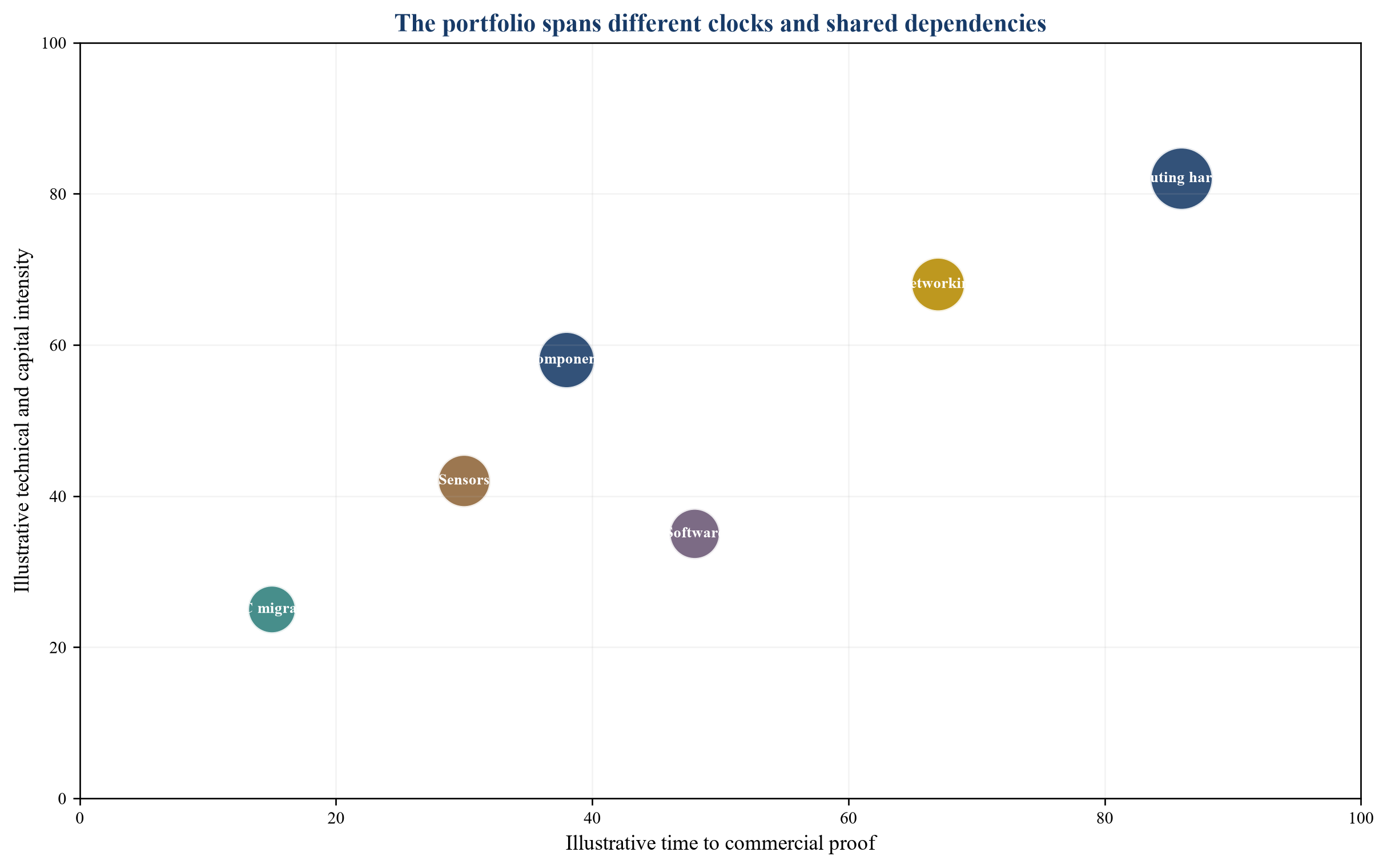
Positions are illustrative; a fund should populate the map with current, verified company evidence.
30. Model ownership
Ownership determines the share of future value and the capital required to maintain it. The fund should model initial, pro rata and enhanced follow-ons under plausible rounds. Option pools, convertible instruments and strategic rights affect dilution.
The model should use executed terms and supported assumptions. Maintaining percentage ownership is not always optimal when evidence weakens. Reserve decisions should maximise expected fund value rather than defend a headline stake.
Ownership analysis should distinguish economic, voting, information and protective rights. Strategic rounds can change governance without proportionate dilution. The fund should model pay-to-play provisions, senior securities and option-pool changes. The value of follow-on participation depends on the full security package.
31. Design milestone reserves
Milestone reserves release capital when technical and commercial evidence improves. Each company should have defined milestones, evidence sources, review dates and decision rights. Milestones should match the company's architecture and customer path.
The fund can reserve a base amount without committing it irrevocably. Failure, delay or changed economics should permit reallocation. Side letters and participation rights should be reflected accurately.
Milestones should have evidence tolerances. A hardware result can meet a headline metric while missing uptime, yield or reproducibility. A commercial milestone can meet bookings while missing acceptance or cash. The committee should define the complete gate before the company reports progress and document any departure.
32. Define technical milestones
Technical milestones can include fidelity, error rate, uptime, scale, yield, performance, power, packaging and reproducibility. A metric should be linked to the product and next risk. The fund should understand how it was measured.
Independent access, customer validation or repeat results can strengthen evidence. A press release alone is insufficient. The committee should record limitations and remaining dependencies.
33. Define commercial milestones
Commercial milestones can include paid pilots, repeat orders, renewals, qualification, contracted backlog and positive contribution. The fund should distinguish grants, collaborations and non-binding announcements from customer revenue.
The milestone should include price, cost, acceptance and collection where relevant. A pilot can validate access while failing to validate unit economics. Follow-on decisions should reflect both.
34. Define financing milestones
Financing milestones include runway, syndicate formation, strategic participation and a funded path to the next technical proof. The company should show use of funds and contingency. Non-dilutive funding should have award and payment evidence.
The fund should avoid financing an undefined sequence of experiments. It should assess whether the next round depends on one result or a broader pattern. Bridge capital requires a decision case, not calendar relief.
35. Allocate reserves across clocks
Nearer-term holdings may need working capital and scale finance. Long-duration platforms may need large rounds over several years. The reserve policy should reflect expected amount, timing and uncertainty.
The manager should maintain company, bucket and fund-level reserve views. It should model simultaneous calls. Unallocated reserves preserve flexibility for outliers and new evidence.
Reserve ratios should change as uncertainty resolves. A successful early result may increase the capital required to scale even while reducing technical risk. A delay may reduce expected value and increase financing need. The decision should consider both rather than releasing capital automatically to the company with the shortest runway.
Table 3. Hypothetical milestone-reserve schedule
| Portfolio clock | Illustrative initial cost | Illustrative planned reserve | Illustrative release gate | Illustrative timing range |
|---|---|---|---|---|
| Deployable | USD 18m | USD 12m | Paid deployment, repeat order and acceptable contribution | 12-30 months |
| Enabling | USD 22m | USD 22m | Qualified design win, yield evidence and scalable production | 18-42 months |
| Network | USD 12m | USD 18m | Field performance, standard path and funded customer | 24-60 months |
| Software | USD 14m | USD 16m | Renewing paid use and defensible workflow position | 12-42 months |
| Computing platform | USD 24m | USD 52m | Reproducible system milestone and financed scale plan | 24-84 months |
All amounts and probabilities are illustrative management assumptions; they are not forecasts or recommendations.
36. Model capital calls
Capital calls should reflect investment execution, fees, expenses and reserves. Long-duration companies can create later calls when early distributions remain limited. The fund should model pacing under base, delay and stress cases.
Limited-partner communication should distinguish committed, called, invested, reserved and available capital. Recycling and subscription facilities should follow fund documents. Liquidity tools cannot cure an under-reserved portfolio.
37. Model the liquidity curve
Liquidity can arise through trade sales, secondary transactions, public markets, dividends or distributions from portfolio cash flow. Quantum assets may have uneven liquidity because strategic buyers, policy and technical proof matter. The fund should use ranges.
The liquidity curve should align with fund term and extension rights. It should identify holdings likely to remain private at termination. Continuation or secondary options require governance and conflict management.
The curve should also incorporate distribution concentration. One early exit can return capital while leaving most value in long-duration holdings. Limited partners may experience very different cash timing from the headline gross multiple. Net cash flows, fees and carried interest should follow fund documents and supported assumptions.
38. Model valuation uncertainty
Private quantum-company valuations can use financing prices, comparable evidence and scenario analysis. Technical progress, financing conditions and rights affect fair value. A recent round can become stale when evidence changes.
The fund should apply its valuation policy consistently and document inputs. Model outputs are management estimates. Independent review and governance help prevent milestone narratives from replacing evidence.
39. Model exit pathways
Strategic acquisition can provide earlier liquidity for components, software and sensing. Hardware platforms may pursue public markets, strategic partnerships or consolidation. Exit pathways depend on customers, intellectual property, export controls and capital markets.
The fund should identify credible buyer categories and transaction barriers. Corporate relationships do not prove acquisition intent. Exit value should remain a scenario until supported by a process or market evidence.
Different buyers may value the same company for product, talent, supply security, intellectual property or national capability. Each rationale has different evidence and transaction constraints. The fund should avoid applying platform valuations to talent acquisitions. Comparable transactions require adjustment for stage, rights, capital invested and strategic context.
40. Model failure and salvage
Failure can occur through technical, financing, team, market or policy events. Salvage value may include patents, equipment, data, contracts, talent or tax assets. Recovery can be limited and slow.
The fund should model write-offs and partial recoveries. Security interests and liquidation preferences should be read from executed documents. Portfolio construction should tolerate several failures without depending on unsupported salvage.
41. Stress-test technical delay
A technical-delay scenario should extend milestones, increase burn and defer commercial proof. It can also trigger down rounds or insider dependence. The stress should affect correlated holdings sharing the same bottleneck.
The fund should model capital required to reach a decision point, not merely another date. Management should identify which costs can be reduced without destroying the programme. Reserve sufficiency should be tested after dilution.
Delay scenarios should distinguish scientific work from industrialisation. Additional experiments may resolve a technical question, while packaging, qualification and manufacturing can consume capital after science succeeds. The reserve model should identify the phase, deliverable, responsible team and independent evidence. Funding an undefined delay can preserve activity without increasing decision value.
42. Stress-test financing contraction
A financing-contraction scenario should reduce external capital availability and values while extending round timelines. Capital-intensive platforms can be affected most. Strong companies may also require insider support.
The manager should prioritise holdings using evidence, expected value and strategic alternatives. Pre-emptive syndication and milestone discipline can reduce pressure. The policy should manage conflicts among portfolio companies seeking the same capital.
The stress case should include weaker terms, smaller rounds and investor protection. A company may survive while existing ownership loses substantial value. The fund should compare bridge, priced round, strategic capital, asset sale and shutdown. Every option should include timing, control and follow-on consequences.
43. Stress-test supply disruption
Specialist components, fabrication, cryogenics and lasers can create long lead times. Export controls or geopolitical events can constrain access. The fund should map alternative suppliers and redesign cost.
Diligence should verify inventory, contracts and qualification. A dual-source plan is not complete until the alternative works. Supply stress can affect several modalities and should enter correlation scenarios.
44. Stress-test customer delay
Government and enterprise customers can defer trials, qualification and procurement. Technical success may therefore fail to produce timely cash. The fund should examine backlog quality and acceptance.
The scenario should include receivables, working capital and bridge needs. Customer concentration across the portfolio can amplify the effect. Earlier application exposure should not be treated as liquid without collection evidence.
45. Stress-test scientific repricing
A decisive result can change expectations for one modality or the entire sector. Positive results can draw capital and talent; negative results can impair valuations. The portfolio should have a response process.
The manager should update dependency maps, reserves and fair values when evidence changes. Public commentary should not substitute for technical review. Decision records should state sources and uncertainty.
46. Analyse team concentration
Quantum companies can depend on founders, principal scientists and specialist engineers. The same experts can sit across academic, government and company roles. The fund should examine commitment, conflicts, intellectual property and succession.
Retention should support knowledge transfer and scalable organisation. A celebrated scientist does not replace engineering, product and commercial leadership. Reserves should include talent-building needs.
47. Analyse intellectual property
The fund should trace patents, know-how, software, designs and data to employees, universities, laboratories, contractors and collaborators. Licences can include fields, milestones, royalties and change-of-control terms. Freedom to operate requires qualified advice.
Diligence should inspect assignments and sponsored-research agreements. Patent count does not establish defensibility. Manufacturing process and control know-how can be material even when not patented.
48. Analyse export controls and security
Quantum technologies can have national-security significance. Export controls, foreign-investment rules, classified work and security obligations can affect ownership, governance, hiring, collaboration and exit. Requirements vary by technology and jurisdiction.
The fund should obtain qualified advice and maintain a current matrix. Transaction structures should not assume unrestricted transfer. Compliance cost and buyer universe should enter valuation.
49. Analyse government funding
Government grants and contracts can fund research, facilities and procurement. The fund should verify award, milestones, cost sharing, intellectual-property terms and payment. Announced programmes are not company cash.
Non-dilutive funding can extend runway while imposing restrictions or reporting. The manager should model timing and eligible cost. Policy concentration remains a portfolio dependency.
50. Analyse strategic partnerships
Partnerships with technology, defence, pharmaceutical, energy and financial companies can provide access and validation. They can also be non-exclusive research arrangements without committed revenue. The fund should classify each relationship.
Executed contracts, work delivered, payments and customer decisions provide direct evidence. Exclusivity and rights can constrain exit. The investment case should avoid treating logos as economic proof.
51. Construct return scenarios
Return scenarios should combine ownership, dilution, follow-ons, timing and exit value. They should reflect correlated outcomes and reserve decisions. One high-upside platform can drive fund value, while nearer-term holdings can contribute smaller distributions.
The model should show gross and net results under consistent assumptions. It should identify the outcomes required to meet target returns. Scenario values remain management estimates.
Table 4. Hypothetical quantum-fund return scenarios
| Scenario | Illustrative invested capital | Illustrative gross distributions | Illustrative gross multiple | Illustrative principal driver |
|---|---|---|---|---|
| Downside | USD 160m | USD 95m | 0.6x | Platform delays, financing contraction and limited salvage |
| Preservation | USD 160m | USD 240m | 1.5x | Components, sensing and security offset hardware losses |
| Base illustration | USD 160m | USD 560m | 3.5x | Several application exits and one scaled platform outcome |
| Upside | USD 160m | USD 1.2bn | 7.5x | Multiple strategic exits and a high-value computing platform |
| Concentrated upside | USD 160m | USD 1.6bn | 10.0x | One platform contributes most value, increasing outcome concentration |
All amounts, multiples and timing assumptions are illustrative management estimates; they are not market observations, forecasts or investment recommendations.
52. Avoid false precision
Quantum timelines and outcomes are uncertain. A detailed model can create unjustified confidence. The fund should use ranges, sensitivities and decision triggers. Assumptions should be visible and dated.
The model is useful when it changes allocation or reserves. It should not imply a scientific forecast. The committee should revisit it after material evidence, financing and policy changes.
53. Govern follow-on decisions
Follow-on decisions should use a current investment memorandum covering evidence, valuation, financing, ownership, alternatives and portfolio effects. Sunk cost and reputation should not drive capital. The committee should compare the holding with other uses of reserves.
Pro rata rights provide an option rather than an obligation. Insider bridges require a defined milestone and runway. Conflicts and information rights should be managed.
54. Govern cross-portfolio learning
The fund can learn across holdings about suppliers, customers, standards and talent. Information sharing must respect confidentiality, competition and governance. Portfolio companies should not be required to disclose protected information to competitors.
Aggregated dependency data can improve risk management. The manager should maintain ethical walls and permissions. Cross-portfolio procurement or technical work requires clear agreements.
55. Plan liquidity actions
The manager should review secondary sales, structured liquidity, strategic processes and continuation options before fund pressure becomes acute. Each action affects value, control and alignment. Limited-partner governance matters.
Liquidity decisions should use supported bids and terms. A secondary discount can be rational when it releases capital or reduces concentration. The decision record should show alternatives and conflicts.
56. Design the dashboard
The dashboard should connect technical, commercial, financing and portfolio evidence. Measures can include milestone status, runway, reserve need, ownership, customer proof, concentration, fair value and liquidity range. Definitions should remain stable.
Each company should have an accountable partner and next decision date. The dashboard should distinguish verified evidence from management estimates. Aggregate value can conceal a stressed dependency.
57. Rebalance the portfolio
Rebalancing occurs through new investments, follow-ons, sales, write-offs and reserve changes. Private assets limit rapid adjustment. The fund should act when evidence changes rather than wait for formal rounds.
Rebalancing should consider dependency and clock exposure together. Adding another company in a favoured modality can increase concentration even when the stage differs. Decisions should preserve fund-level liquidity.
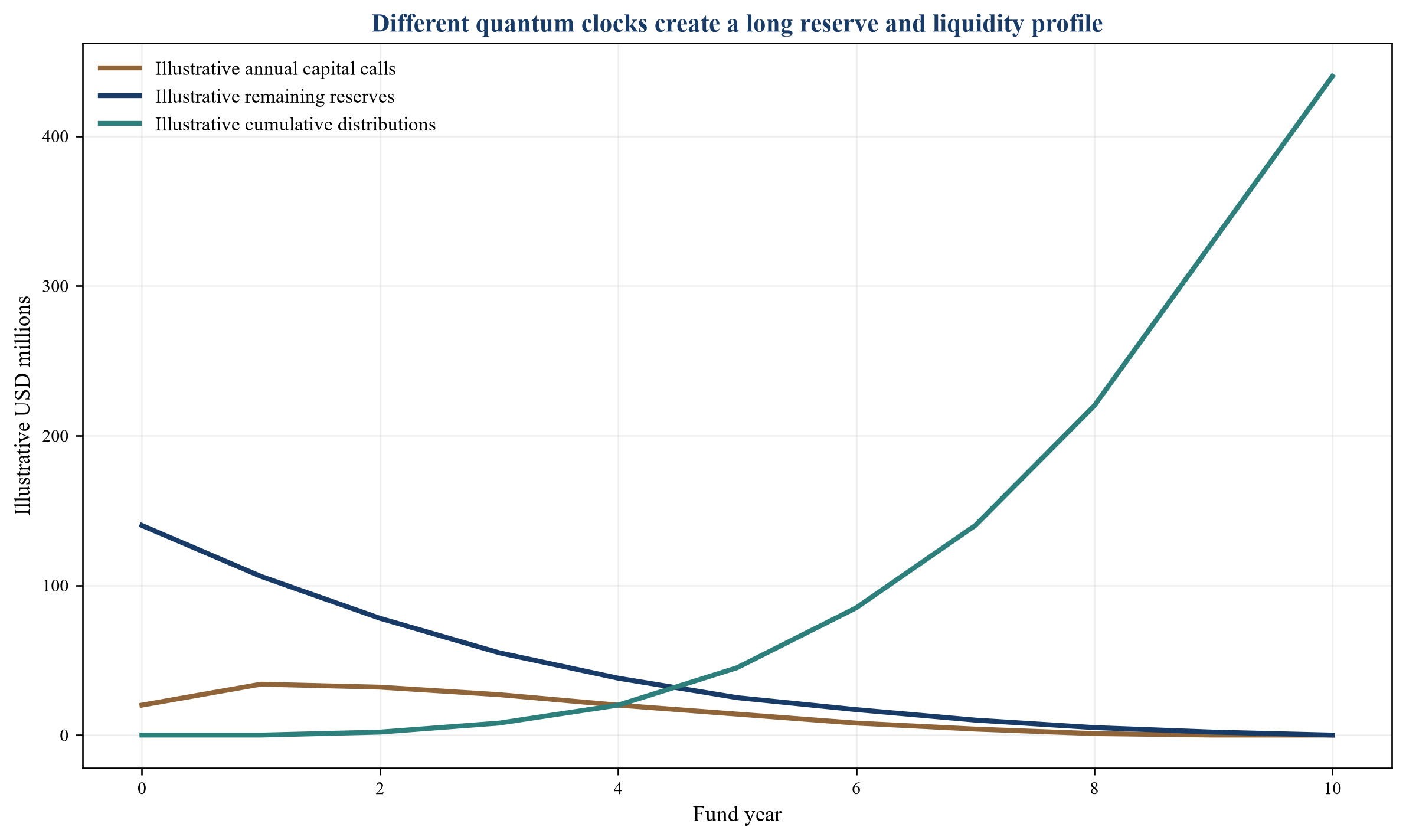
The curves are hypothetical management assumptions; actual timing and values depend on portfolio evidence and transactions.
58. Apply five portfolio gates
The first gate tests technical evidence. The second tests commercial proof. The third tests dependency and concentration. The fourth tests financing and reserves. The fifth tests fund-life and liquidity fit.
An open gate should trigger more evidence, revised terms, syndication, reserve change or a stop decision. The committee should record owner and deadline. A milestone announcement does not close a gate without support.
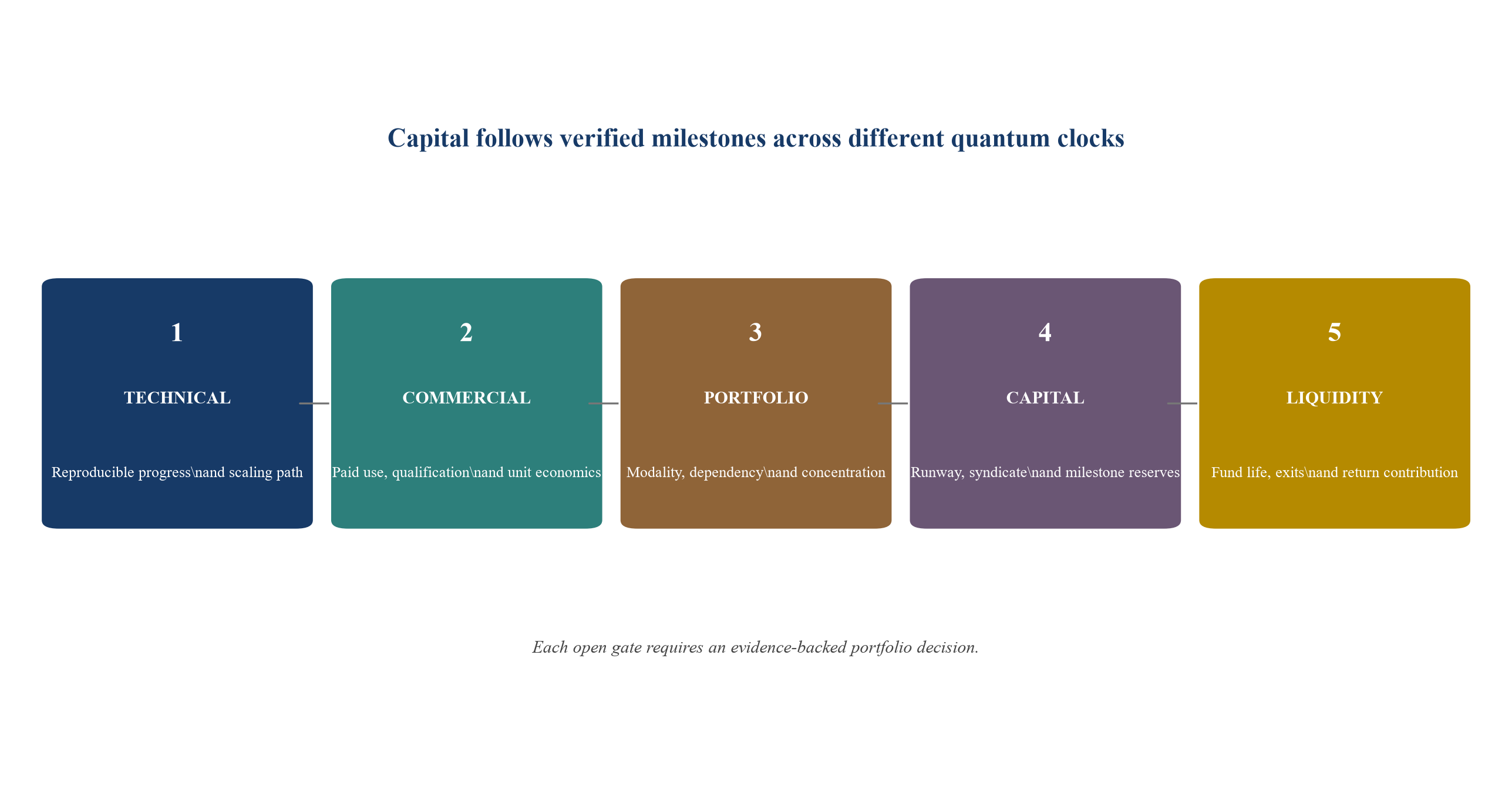
Each gate should be supported by direct evidence and connected to allocation, reserves and liquidity decisions.
59. Maintain the decision record
The manager should record every allocation, reserve, valuation, dependency, assumption, exception and review trigger. The record should identify direct evidence and unresolved items. It should support limited-partner reporting and later performance review.
This prevents technical narratives from becoming facts without support. It also helps explain why capital moved between holdings. The record should survive team changes and fund extensions.
60. Conclusion
Quantum investing spans different technical and commercial clocks. Diversification requires more than multiple companies or modalities because shared dependencies can produce correlated outcomes. Fund construction should connect technical evidence to reserves and liquidity.
The Quantum Clock Portfolio Framework combines modality buckets, dependency mapping, milestone-based follow-ons and scenario analysis. It gives managers a disciplined way to preserve asymmetric exposure while protecting fund-level capital and time.
References
- United States National Quantum Coordination Office. National Quantum Initiative annual reports. https://www.quantum.gov/annual-reports/
- United States National Quantum Coordination Office. National Quantum Initiative Supplement to the President's FY 2025 Budget. https://www.quantum.gov/wp-content/uploads/2024/12/NQI-Annual-Report-FY2025.pdf
- United States Congress. National Quantum Initiative Act. https://www.congress.gov/bill/115th-congress/house-bill/6227
- National Institute of Standards and Technology. Quantum Science. https://www.nist.gov/quantum-science
- National Institute of Standards and Technology. Quantum Information Science. https://www.nist.gov/topics/quantum-information-science
- National Institute of Standards and Technology. Post-Quantum Cryptography project. https://csrc.nist.gov/projects/post-quantum-cryptography
- National Institute of Standards and Technology. FIPS 203, Module-Lattice-Based Key-Encapsulation Mechanism Standard. August 2024. https://doi.org/10.6028/NIST.FIPS.203
- National Institute of Standards and Technology. FIPS 204, Module-Lattice-Based Digital Signature Standard. August 2024. https://doi.org/10.6028/NIST.FIPS.204
- National Institute of Standards and Technology. FIPS 205, Stateless Hash-Based Digital Signature Standard. August 2024. https://doi.org/10.6028/NIST.FIPS.205
- National Institute of Standards and Technology. Transition to Post-Quantum Cryptography Standards, NIST IR 8547 initial public draft. November 2024. https://doi.org/10.6028/NIST.IR.8547.ipd
- UK Department for Science, Innovation and Technology. National Quantum Strategy. March 2023. https://www.gov.uk/government/publications/national-quantum-strategy
- UK Department for Science, Innovation and Technology. National Quantum Strategy Missions. December 2023. https://www.gov.uk/government/publications/national-quantum-strategy/national-quantum-strategy-missions
- UK Research and Innovation. National Quantum Technologies Programme. https://www.ukri.org/what-we-do/browse-our-areas-of-investment-and-support/national-quantum-technologies-programme/
- UK Research and Innovation. Quantum Technologies Challenge. https://www.ukri.org/what-we-do/browse-our-areas-of-investment-and-support/quantum-technologies-challenge/
- European Commission. European Quantum Technologies Flagship. https://digital-strategy.ec.europa.eu/en/policies/quantum-technologies-flagship
- Quantum Flagship. Strategic Research and Industry Agenda. https://qt.eu/about-quantum-flagship/resources/
- European Commission. European Declaration on Quantum Technologies. https://digital-strategy.ec.europa.eu/en/library/european-declaration-quantum-technologies
- European High Performance Computing Joint Undertaking. European quantum computing infrastructure. https://eurohpc-ju.europa.eu/
- United States Department of Energy. Quantum Information Science. https://science.osti.gov/Initiatives/QIS
- United States Department of Energy. A National Quantum Internet Blueprint. July 2020. https://www.energy.gov/sites/prod/files/2020/07/f76/QuantumWkshpRpt20FINAL_Nav_0.pdf
- National Science Foundation. Quantum Information Science and Engineering. https://www.nsf.gov/focus-areas/quantum
- Defense Advanced Research Projects Agency. Quantum Benchmarking programme. https://www.darpa.mil/program/quantum-benchmarking
- Defense Advanced Research Projects Agency. Underexplored Systems for Utility-Scale Quantum Computing. https://www.darpa.mil/program/underexplored-systems-for-utility-scale-quantum-computing
- International Electrotechnical Commission. Quantum technologies standardisation activities. https://www.iec.ch/quantum-technologies
- International Organization for Standardization and International Electrotechnical Commission. ISO/IEC JTC 3 Quantum technologies. https://www.iso.org/committee/9982582.html
- Institute of Electrical and Electronics Engineers. IEEE Quantum Initiative. https://quantum.ieee.org/
- Organisation for Economic Co-operation and Development. Quantum Technologies Policy Primer. https://www.oecd.org/digital/emerging-tech/quantum-technologies/
- Government of Canada. National Quantum Strategy. https://ised-isde.canada.ca/site/national-quantum-strategy/en
- Australian Government Department of Industry, Science and Resources. National Quantum Strategy. https://www.industry.gov.au/publications/national-quantum-strategy
- Government of India. National Quantum Mission. https://dst.gov.in/national-quantum-mission-nqm
- Government of Japan. Quantum Technology Innovation Strategy. https://www8.cao.go.jp/cstp/english/index.html
- United States Government Accountability Office. Quantum Computing and Communications. https://www.gao.gov/products/gao-22-104422
- United States Government Accountability Office. Quantum Sensors. https://www.gao.gov/products/gao-21-104201
- National Academies of Sciences, Engineering, and Medicine. Quantum Computing: Progress and Prospects. 2019. https://doi.org/10.17226/25196
- National Academies of Sciences, Engineering, and Medicine. Manipulating Quantum Systems. 2020. https://doi.org/10.17226/25613
- United States Department of Justice and Federal Trade Commission. Merger Guidelines. December 2023. https://www.justice.gov/atr/2023-merger-guidelines
- International Private Equity and Venture Capital Valuation Guidelines. 2022. https://www.privateequityvaluation.com/
- Institutional Limited Partners Association. Principles 3.0. https://ilpa.org/industry-guidance/principles-best-practices/
- International Organization of Securities Commissions. Principles for the Valuation of Collective Investment Schemes. https://www.iosco.org/library/pubdocs/pdf/IOSCOPD413.pdf
- Financial Accounting Standards Board. Fair Value Measurement, Topic 820. https://asc.fasb.org/topic&trid=2127586
About the Author
Chennakeshav (CK) is a corporate finance and investment banking executive with 25+ years of global experience in deal origination, structuring and execution across M&A, growth capital and corporate strategy. He has led value-creation mandates for founders, corporates and funds — bridging the boardroom view to hands-on execution and close.
His career spans Morgan Stanley, HSBC, Lloyds Banking Group, EWEC, ADQ portfolio companies and Emirates Growth Fund, across TMT, real estate, fintech, deeptech, cleantech, infrastructure and energy. He has partnered with C-suite leaders, private equity and venture funds, sovereign wealth funds and family offices to finance complex fund raises and scale-up ventures, and has led M&A due diligence, post-merger integration and business-transformation initiatives to create value.
At Matchpoint Partners he is Managing Partner, leading the firm's corporate finance, M&A and capital-raising practice. He holds an MBA from London Business School, an engineering degree from VTU and a Master of Laws (LLM, in progress) from UCL London.
An active start-up mentor, CK mentors at Techstars, DIFC FinTech Hive, Startup Grind, Founder Institute and IN5, serves as Entrepreneur Mentor in Residence (EMiR) at London Business School, and judges the Entrepreneurship World Cup.
