
1 A field-level counterfactual for two enterprises
This paper proposes evaluating agrivoltaics through a common field perimeter and separate agricultural and electrical accounts. The opening question is which continuing farm activity, solar design and land allocation each option displaces. A proposal should specify the hectares available throughout the decision horizon, the agricultural calendar, the electrical connection and the costs paid by each participant. Every investment comparison that follows should retain that perimeter or explain a change. This is an analytical convention proposed here; it conveys no planning eligibility or right to use agricultural land for electricity production.
Rutgers' December 2025 information sheet defines land equivalent ratio as the sum of agricultural and electricity output ratios against their respective separate-use comparators. Its agricultural control has comparable agricultural potential without photovoltaic modules. The guide also distinguishes panel-based and agricultural-land-based measures of ground coverage. [1]
For the proposed appraisal, both output ratios should use explicit areas and matching periods. The crop denominator should state the crop, saleable product, moisture or quality basis and control management. The electricity denominator should identify a separate solar configuration, its land footprint and the delivery boundary. An unavailable comparator should remain an unresolved assumption. A reported ratio can otherwise change when the analyst changes the reference crop or increases the reference solar density, while the agrivoltaic installation remains physically identical.
The appraisal should report both ratios alongside their sum. This makes a reduction in one output visible even when the other component produces a favourable combined metric. Financial valuation should then use separately stipulated prices, costs and timing. The physical ratio supplies no price, operating margin, debt capacity or allocation of value between the farmer and the power company. Any worked values in this paper are fictional assumptions. A positive joint valuation would still leave participant cash, permissions and implementation conditions to be examined individually.
2 What original crop experiments can establish
Barron-Gafford and colleagues studied chiltepin pepper, jalapeño and cherry tomato in an Arizona dryland experiment with agrivoltaic and open-sun plots receiving matched irrigation treatments. They measured plant and microclimate responses. Their photovoltaic energy estimate used SAM modelling informed by measured panel temperatures; it was not an annual metered electricity result. [2]
Weselek and colleagues monitored four crops in an organic rotation near Lake Constance during 2017 and 2018. Responses varied by crop and year. Winter wheat and potato performed favourably under the installation in the hot, dry 2018 season, while the study also reported yield reductions. [3]
These studies motivate a proposed identification protocol with a treatment plot, a relevant unshaded control and a documented management schedule. The protocol should record cultivar, planting density, fertiliser, irrigation, pest treatment and harvest method for both plots. An analyst should distinguish the effect attributed to shade from changes introduced through irrigation or crop management. Where several changes occur together, the appraisal should describe the combined intervention and leave the separate contribution of each change unresolved.
Marketable production should be a distinct outcome. A trial can weigh total harvest, record rejected produce and document quality classes without assuming that every additional kilogram receives the same price. The investment record should identify the price evidence applicable to each saleable class. Any assumed quality premium should have its own sensitivity and a buyer-evidence requirement before it enters a committed financing case.
The proposed evidence ladder progresses from measured light and temperature to crop response, saleable harvest, collected farm revenue and repeated operating results. Each stage answers a different question. An experiment in a particular season should inform the local research design and the range of scenarios considered. Extrapolation to another field requires explicit treatment of crop, climate, soil and management differences. The two cited studies do not supply a transferable universal yield uplift or an investment return.
3 Water and microclimate require separate economic bridges
The Arizona experiment reported differences in soil moisture and plant water-use responses under its tested irrigation treatments. Those observations concern a particular site, crop set and experimental design. They provide no water entitlement, transferable reduction in pumping expenditure or demonstrated response for an untested crop. [2]
The proposed water account should begin with physical quantities. Record irrigation delivered to each plot, the measurement location, rainfall, soil moisture and the timing of irrigation. Then identify which decision changes the abstraction, delivery or pumping requirement. A claim of improved crop production per unit of irrigation should be tested independently from a claim of reduced total water consumption. Both questions can be useful, but they need explicit denominators and a consistent field boundary.
Cash treatment should follow the relevant payment mechanism. A hypothetical reduction in purchased water becomes an avoided expense only to the extent that a payable volume charge actually changes. For a privately pumped supply, the appraisal should identify assumed electricity consumption and maintenance expenditure separately. Fixed commitments should remain payable unless a verified agreement or operating change alters them. No water saving should be added to crop revenue when the same benefit has already entered the crop margin through lower irrigation expense.
Microclimate observations should also have named endpoints. Canopy temperature, panel temperature, soil moisture and light availability should remain separate records with their own instruments and observation periods. Proposed crop protections against a particular stress require evidence of the relevant crop outcome. A temperature difference alone should remain a physical observation in the investment file.
For a prospective hot or dry location, the paper recommends testing locally relevant irrigation restrictions and difficult growing seasons as deterministic scenarios. Their assumed severity and duration should be disclosed. These scenarios express a decision-maker's stipulated exposure; they do not predict future weather. The analysis should also identify who bears an agricultural shortfall and whether the affected party has cash available during that season.
4 Design economics from machinery clearance to export power
NREL's 2020 benchmark used bottom-up modelling to compare installation and project-development costs for conventional photovoltaic systems and several dual-use configurations. It included design sensitivities. This is a historical modelling study, with no current construction quotation or project-specific funding terms supplied here. [4]
The US Department of Energy's farmer guidance identifies compatibility between agricultural equipment, panel height and inter-row space as a design consideration. It also discusses unresolved business and regulatory questions. The guidance is advisory material for a US context. [5]
The proposed cost comparison should translate the agricultural operating plan into a drawing before selecting a generating capacity. Specify machinery envelopes, turning areas, access routes, support positions, drainage, cable protection and the harvest calendar. Mark the land used by permanent structures and the land accessible during maintenance. A change in crop or machinery should trigger a new compatibility review. Approval of an earlier drawing should not be treated as acceptance of a subsequent operating configuration.
Each option should have a bill of quantities using the same cost date and currency. Distinguish ordinary solar equipment from costs attributed to the chosen dual-use design, such as additional clearance, different supports or dedicated farm-access measures. Record avoided costs with the same care. Shared items should appear once in the joint account and have a stated allocation in participant accounts. The proposed comparison requires current project evidence before any historical benchmark becomes a procurement allowance.
Electrical output should be valued at a stated delivery point under a specified connection assumption. Module output, inverter output and paid export should have separate lines where the proposed design requires them. The analyst should state how outages, export limits and unpaid generation enter the worked example. Farming beneath modules supplies no evidence of connection approval or an enforceable electricity purchase obligation. The design decision therefore remains conditional on its agricultural, structural and electrical evidence as well as its cash result.
5 French eligibility is a jurisdiction-specific test
Article L314-36 of France's Energy Code requires a qualifying agricultural service, significant agricultural production and durable agricultural income for the relevant farmer. It also requires agriculture to remain the principal activity and the installation to be reversible. The statute contains exclusions for adverse effects on the specified services. [6]
The consolidated implementing provisions inspected here require non-livestock agricultural yield to exceed 90% of the relevant control or reference average, subject to stated prefectural exceptions. They separately address agricultural-sale income and normal agricultural operation. The July 2024 order specifies yield averaging during the first five years and subsequently over five years with the highest and lowest observations excluded. [7] [8]
These provisions should enter a French appraisal through a separate eligibility memorandum. The financial model should preserve the relevant agricultural measurements and dates without representing a modelled result as an administrative decision. A project team should obtain advice on the applicable permission route, control requirements, exceptions and the specific installation. The legal material inspected is identified by version and access limitations in the references; this paper supplies no exhaustive opinion on a proposed French site.
A proposed monitoring budget should identify the measurement work needed to support the applicable tests. It should also identify a responsible agricultural operator and a process for investigating a failed observation. An investment committee could require a funded response plan before accepting an assumed crop outcome. The plan would remain a contractual proposal subject to the competent authority's requirements.
Participant economics should retain their separate tests. An assumed access payment can improve a farmer's total receipts while crop-sale revenue follows a different path. The appraisal should disclose both streams and avoid substituting total project cash for a specifically defined agricultural measure. A favourable electricity valuation also supplies no evidence that the field meets a legal agricultural-production condition. These distinctions are essential to the proposed decision framework and should remain visible when the project is sold, refinanced or transferred to another operator.
6 Programme boundaries and geographic transfer
MNRE's PM-KUSUM page describes Component A as decentralised ground- or stilt-mounted grid-connected generation and identifies DISCOM selection and state-regulator tariff determination. The inspected page states a programme period ending 31 March 2026. No later extension or current application entitlement was verified for this paper. [9]
A 2026 Jordanian study compared tilted and vertical bifacial photovoltaic configurations and measured light conditions for agrivoltaic applications. Its initial measurement year preceded crop introduction. It therefore supplies local electrical and light evidence, with crop performance and water benefits remaining future research questions. [12]
The proposed transfer screen should separate programme applicability from experimental applicability. For an Indian candidate, verify the relevant programme window, state implementation, connection capacity and proposed use before assigning any support or purchase revenue. The existence of a scheme description should remain distinct from an approved project, an award or a receivable. A crop-coexistence assertion needs its own evidence even where a programme permits elevated or stilt-mounted modules.
For a Middle Eastern or North African candidate, identify the actual crop, heat exposure, soil, water source and farming schedule before selecting a trial design. The Jordan study's measured electrical configuration can inform questions about local light distribution. It cannot supply a crop-price premium or a measured irrigation saving. Similarly, the Arizona results concern named crops and treatments, while the German experiment concerns a temperate organic rotation. Geographic resemblance alone is insufficient evidence for copying their cash assumptions.
A practical transfer memorandum should contain three columns: the original observation, the candidate-site difference and the evidence required to resolve that difference. Until the final column is satisfied, the investment case should use clearly stipulated scenarios. This paper proposes comparing their consequences without assigning probabilities that the available evidence cannot support. The resulting sensitivity is a conditional valuation range; it is not an estimated distribution of regional agrivoltaic returns.
7 Financeable cash and the allocation of joint value
In November 2024, the European Investment Bank announced financing for PÜSPÖK agrivoltaic projects in Austria with Erste Bank participation and an Austrian feed-in-premium framework. The announcement establishes a dated financing example. It does not verify subsequent completion or establish standard leverage, pricing or eligibility for another project. [11]
The proposed appraisal should maintain three cash views: the continuing farm comparator, each participant after the transaction and the joint incremental investment. An access payment between the power company and farmer should appear as an expense and receipt in the participant accounts. It should cancel in the joint account when both sides and the same payment dates are included. External taxes, costs and payments should retain their actual account treatment once verified. The worked framework assumes no automatic tax benefit or subsidy.
Power-company debt capacity should use the cash legally available to that borrower under the stipulated financing perimeter. Agricultural gains received by a separate farm should remain outside borrower cash unless a verified arrangement makes them available. A joint surplus can coexist with a participant funding deficit. The decision record should identify who supplies that deficit, when it occurs and whether the commitment survives a disappointing crop or delayed electrical operation.
Proposed revenue analysis should separate a purchase agreement's volume, settlement price, curtailment treatment and payment timing. Each remains unresolved until supported by the relevant documents. Any finance terms in a worked example should be labelled fictional assumptions and kept separate from the EIB announcement. No actual lending offer is inferred from a public example.
Finally, test the farmer's continuing incentive to cultivate the selected crop and the power company's ability to meet its obligations. A proposed contract can define information exchange, access and remedies, but this paper assumes no remedy is enforceable before appropriate legal review. Investment value should be reported alongside participant liquidity and unresolved conditions, with no claim that a single positive metric resolves all three.
8 A staged investment decision with bounded evidence
The EU CAP Network's October 2026 factsheet summarises expert-group recommendations on farm-energy business models, cooperation, advice and demonstration. It identifies agrivoltaic demonstration as a research direction. These are recommendations, with no individual entitlement to a permit, grant or connection established by the factsheet. [10]
The proposed investment sequence begins with a defined continuing-farm case and a feasible candidate drawing. A limited research stage should then specify the crop and energy questions that could change the decision. Its budget, duration and measurement plan should be agreed before full investment. A successful physical observation should advance only the question it answers. A measured light profile can support crop-trial design; it supplies no collected crop revenue by itself.
The next stage should reconcile the technical record with participant cash. Record which outcomes are measured, which costs are quoted, which revenues are contracted and which values remain assumed. For each assumption, show the consequence of a specified adverse change and the person responsible for obtaining better evidence. The committee can then compare proceeding, redesigning, running a further trial or continuing the original farm activity. This is an author-proposed decision process with no claim of optimality.
Before committing construction capital, the decision record should address agricultural eligibility, land use, water access, connection, offtake, operating interfaces and funded contingencies. The actual documents and their unresolved conditions should govern the decision. A financier's or regulator's acceptance remains a separate external determination.
The commercial proposition is therefore conditional and field-specific. Physical co-production, crop revenue, electricity receipts and participant funding should each have an explicit evidential basis. The studies and official materials cited here answer bounded technical or institutional questions. The proposed framework connects those answers to a transparent comparison while retaining the remaining uncertainty. It provides a structured basis for deciding what to measure and finance next, without asserting a universal crop response, land saving, tariff or investment premium.
9 Define the investment perimeter
Agrivoltaics puts two operating businesses on one site. The agricultural activity has its own crop cycle, labour, working capital and route to market. The power activity has construction expenditure, an export arrangement, operating obligations and equipment renewal. An investor should begin by defining the business it proposes to own. A lease-backed solar project, a farming business with a power subsidiary and an acquisition of both enterprises convey different receipts, liabilities and control. The proposed investment assessment in this paper keeps those perimeters explicit.
Prepare three linked accounts. The farm account records crop revenue, agricultural costs and payments received from the power company. The power account records settled electricity receipts and the costs of constructing and operating the installation, including payments to the farmer. The combined account adds the two and cancels internal payments. A fee paid by the power company to the farmer redistributes value within that combined perimeter. Adding the fee to farm income while leaving it out of the power account overstates the combined result. The worked example follows the same allocation in every operating year.
The counterfactual should be feasible and specific. Continued farming on the existing parcel is one comparison. A different parcel carrying conventional solar is another investment opportunity with its own land, grid, permission and capital requirements. A physical land-equivalent ratio can compare separate output systems, while an incremental cash valuation needs the alternative the investor could actually undertake. Record which comparison answers each question. The later model uses continued farming for incremental investment value and an explicitly stipulated separate-solar density for its physical productivity indicator.
Keep benefits outside the investment perimeter visible. A public authority might value food production, avoided land conversion or local employment. A farmer might value stable income or a change in heat exposure. A generator collects payments according to its electricity and access arrangements. A social benefit becomes an investor receipt only through an identified, lawful and measurable payment mechanism. The model assigns no monetary value to public benefits, subsidies or carbon attributes. A separate policy appraisal would need its own evidence, valuation basis and account of who bears the cost.
Ownership and control also require reconciliation. Identify who decides crop selection, planting dates, module position, access restrictions and repairs. A crop-preservation promise needs an operating decision process when the farmer and generator prefer different actions. The proposed investment record should specify the decision owner, observable trigger, response deadline and contractual consequence. Those terms require transaction-specific drafting. An assumed commercial allocation supplies no authority to change a crop, use water, connect to the grid or occupy agricultural land.
10 Translate seasonal production into collected cash
Annual crop tonnage conceals important differences in timing, quality and price. Construct a farm revenue bridge by crop and harvest period. Record marketable output, rejection, grade, realised price and collection terms. A production gain can arrive in a low-price market window, while a smaller harvest may receive a different quality premium. The direction and size require site records or a justified commercial assumption. The fictional model holds a single annual crop and a constant real price so readers can isolate its mechanisms; it makes no claim about an actual harvest schedule.
Costs should follow the operations that change. Additional clearance can alter machinery access, turning space and maintenance procedures. Irrigation, pest management, cleaning and harvesting may interact with the installed structure. Map each proposed operating change to quantities, unit costs and the responsible party. Separate a genuinely avoided cost from a cost that moves from the farm to the power company. A contractor quotation should identify the equipment layout and agricultural duties it covers. An unpriced duty remains a funding question in the investment record.
The energy account needs a separate settlement bridge. Begin with the stated generation definition and identify losses, auxiliary consumption, export restrictions and curtailment before applying the relevant price. Distinguish generated power from electricity accepted and paid for at the delivery point. The later illustration directly stipulates paid annual energy and a degradation assumption; it does not model hourly dispatch, imbalance, merchant capture price or power quality. An actual financing model should add those items when they affect the contractual cash flow.
Working capital belongs in both accounts. Seed, fertiliser, labour and seasonal stock can require cash before crop receipts arrive. Power invoices can have their own settlement delays and disputes. An annual positive margin does not establish sufficient cash on every payment date. Prepare a monthly or crop-cycle cash schedule around the proposed construction and first operating seasons. The illustration excludes those intrayear funding requirements and reports that boundary. Its annual debt coverage ratio cannot certify monthly liquidity or uninterrupted distributions.
Define the evidence used to replace each assumption. Farm accounts support realised prices and costs for specified periods; field experiments support specific treatment effects under the studied conditions; a technical model projects output under its inputs; a signed contract establishes a payment obligation subject to its terms. These are different evidentiary functions. Keep their dates, scope and limitations beside the cash line they inform. A prospective benefit should remain conditional until the relevant observation, quote or entitlement is available.
11 Make crop protection an operating covenant
The combined project needs an explicit method for handling conflict between agricultural and electrical performance. An operating covenant should state the agricultural objective, measurement period, comparator and evidence owner. It should also describe the feasible interventions if performance falls below the agreed standard. Possible responses include adjusting module operation, revising field practices, repairing drainage or modifying access. These are proposed contractual and operational tools; their suitability depends on the site, equipment and applicable permission.
Separate a production covenant from a compensation mechanism. A payment to the farmer can address an agreed financial loss, while the physical agricultural outcome remains below the intended standard. A permit may impose its own production or land-use conditions. The investment record should show the physical measure, farmer receipts and regulatory obligation independently. The numerical example calculates a farmer participation fee against a stipulated income baseline. It makes no representation that paying that fee satisfies a planning condition or establishes agricultural compliance.
Use a change process for agronomic decisions. Crop rotation, altered varieties, soil recovery and irrigation changes can affect both the farm comparator and the power layout. Record who can approve each change, how a new baseline is established and whether contractual or regulatory consent is needed. A fixed initial yield ratio cannot represent every future rotation. The fictional illustration deliberately holds the crop definition constant. A live project should retain the original investment case and show how an approved change alters production, costs and continuing eligibility.
An independent control plot or other accepted reference requires operational care. Specify its management, measurement method and relationship to the project parcel. A poorly matched control can mix the effect of panels with differences in soil, irrigation, crop variety or husbandry. Where a governing rule permits a different reference method, document its exact application and required review. The paper's model uses an assumed crop-output ratio for calculation. It supplies no field control, regulatory benchmark or verified treatment estimate.
Plan for periods when corrective action reduces electricity receipts. The power company may need to fund an agricultural intervention, accept a changed operating mode or suspend work during a crop-sensitive period. Price the direct expense and the dated revenue consequence separately. Examine the payer, consent process and any contractual recovery without presuming reimbursement. The proposed diligence should identify whether the obligations survive a contractor change, farmer replacement or transfer of the asset. This connects the agricultural undertaking to the cash and control actually available to meet it.
12 Set the price and financing conditions together
An acquisition price should reflect the remaining rights and obligations transferred at completion. Identify the agricultural agreement, land tenure, power arrangements, permits, grid rights, equipment and remedial duties in the sale perimeter. Reconstruct their remaining cash flows using the buyer's proposed ownership and financing structure. The worked model concerns a fictional project before construction. It supplies no valuation of an operating asset, seller business or real land parcel.
The investment committee needs separate tests for total value, the farmer's participation and the investor's return. A positive combined incremental net present value can coexist with an unattractive power-company return after the agreed farm payment. A fee affordable in an unlevered project can be incompatible with a particular debt schedule. Report the participation floor, investor-value ceiling and debt-coverage ceiling on the same basis. Their intersection is a conditional negotiating range. An empty intersection identifies terms that require redesign under the stipulated inputs.
Debt sizing should use the defined cash available for debt service and dated expenditures. Large equipment renewal inside the debt term can constrain a loan even where average operating receipts appear strong. A contractual reserve mechanism changes the timing of available cash and requires a separate schedule. It should not be assumed to remove the underlying renewal cost. The later model includes a stipulated renewal expense and calculates its consequence for annual coverage. It assigns no lender commitment or refinancing outcome; the debt-service reserve is an explicit fictional cash account.
For a buyer, bridge operating value to equity consideration once. Reconcile debt, cash, working capital, funded reserves and obligations retained by the seller. Check whether the valuation already includes a closure or remedial cash item before applying a separate price adjustment for the same responsibility. An assumed balance-sheet provision is not evidence that cash has been set aside. The transaction record should identify the gross future cost, the entity responsible and any asset or security actually available to fund it.
Stage the commitment around evidence that can change these decisions. A site option can make further expenditure conditional on permission, a credible crop protocol, an acceptable export arrangement and priced construction obligations. A pilot can test selected agronomic assumptions, subject to the limits of its duration and design. The committee should state which result would justify proceeding, resizing or stopping and the maximum expenditure authorised at each stage. This proposal assigns no probability or expected information value to unknown results. It offers a decision sequence for converting conditional assumptions into an investable set of rights, responsibilities and cash flows.
13 Fix the farm counterfactual and the physical denominator
The following illustration uses an entirely fictional 100-hectare parcel and a twenty-year decision horizon. Its valued alternative is continued farming. A proposed 20 MWac agrivoltaic installation is paid for at time zero and begins operation in year one. Both crop production and electricity receipts stop at the end of year twenty in the calculation. No subsidy, tax benefit, inflation, terminal sale or extension receipt is included. The assumptions describe a calculation that can be replaced with project evidence; they establish no feasible layout, crop response, permission or tariff. All annual cash is treated as arriving or being paid at year end, except the initial investment and reserve funding.
The continuing farm produces a stipulated eight tonnes per hectare each year, sold at USD 400 per tonne. Annual variable crop cost is USD 160,000, fixed crop cost USD 60,000 and external land rent USD 30,000. This produces USD 70,000 of annual farm margin. The agrivoltaic crop-output ratio is assumed to be 0.85. Harvest-related variable cost changes in the same proportion, while fixed cost and external rent remain unchanged. An additional USD 25,000 of annual farm cost is imposed for the dual-use arrangement. These explicit assumptions produce 680 tonnes and USD 21,000 of farm margin before the farmer's separate access receipt. Any crop-specific cost that behaves differently requires its own cash line.
Electricity begins with 20 MWac multiplied by 1,800 MWh per MW and a separate stipulated 0.95 output factor. First-year electricity is therefore 34,200 MWh. Subsequent electricity decreases by 0.5% annually; crop output is held constant. For the physical land-equivalent calculation only, a separate conventional-solar comparator is stipulated to accommodate 40 MWac on the same parcel with the same specific output and degradation. Its first-year reference is 72,000 MWh. The combined physical ratio is consequently 0.85 plus 34,200 divided by 72,000, giving 1.325. Each term has a declared denominator and represents a different product. Crop tonnes and electricity are never added directly.
The physical comparison leaves important decisions open. The conventional-solar reference has no capital budget, contract or cash valuation in this model, so it cannot support a conclusion that agrivoltaics is the best use of the land among every available option. The crop-only counterfactual does support an incremental investment test against continued farming. External land rent is paid in both farm cases and cancels from their difference. Foregone crop margin enters once through the difference between those cases. An additional charge described as the same lost farming opportunity would duplicate that deduction. A credible alternative land transaction would require a separately valued counterfactual with its own timing and rights.
All numerical inputs are fictional and uncalibrated. The calculation uses 100 hectares, a 20 MWac addition, time-zero construction and operating years 1 through 20. Continued farming is the valued alternative; a stipulated 40 MWac conventional-solar system supplies only the physical land-equivalent denominator. Crop quantity and variable cost follow the stated yield ratio. Farmer access payments cancel in joint cash and remain expenses of the power SPV. Cash is real, with an assumed 8% unlevered discount rate. The financing ledger separately models a fixed loan schedule, debt-service reserve, unsmoothed renewal expenditure and uncommitted sponsor support. Tax, inflation, subsidy, crop rotation, hourly dispatch, seasonal working capital, refinancing and terminal sale are excluded. Delayed cases retain farming at baseline until solar operation and keep the original closure date. No scenario represents permission or compliance with a jurisdiction's crop requirements. Tables round appropriate numerical values to three decimals; calculations retain greater precision.
Table 1. Common physical and financial perimeter
| Input | Value | Unit | Boundary |
|---|---|---|---|
| Land | 100.000 | ha | Same parcel |
| AV / comparator | 20 / 40 | MWac | Comparator has no cash valuation |
| Crop baseline | 8.000 | tonnes/ha | Constant annual reference |
| Crop / power factor | .85 / .95 | ratio | Separate assumptions |
| Base capital / premium | 20 / 6 | USDm | Both paid at time zero |
| Debt / tenor | 15 / 12 | USDm / years | Fixed first service year 1 |
Fictional assumptions and calculations. No observed farm, tariff, yield response or financing terms are represented.
Table 2. First-year outputs and crop cash
| Measure | Farm baseline | Agrivoltaic | Unit |
|---|---|---|---|
| Crop output | 800.000 | 680.000 | tonnes |
| Crop revenue | 320,000.000 | 272,000.000 | USD |
| Farm margin | 70,000.000 | 21,000.000 | USD |
| Farmer access fee | 0.000 | 120,000.000 | USD |
| Farmer total cash | 70,000.000 | 141,000.000 | USD |
| Energy comparator / AV | 72,000.000 | 34,200.000 | MWh |
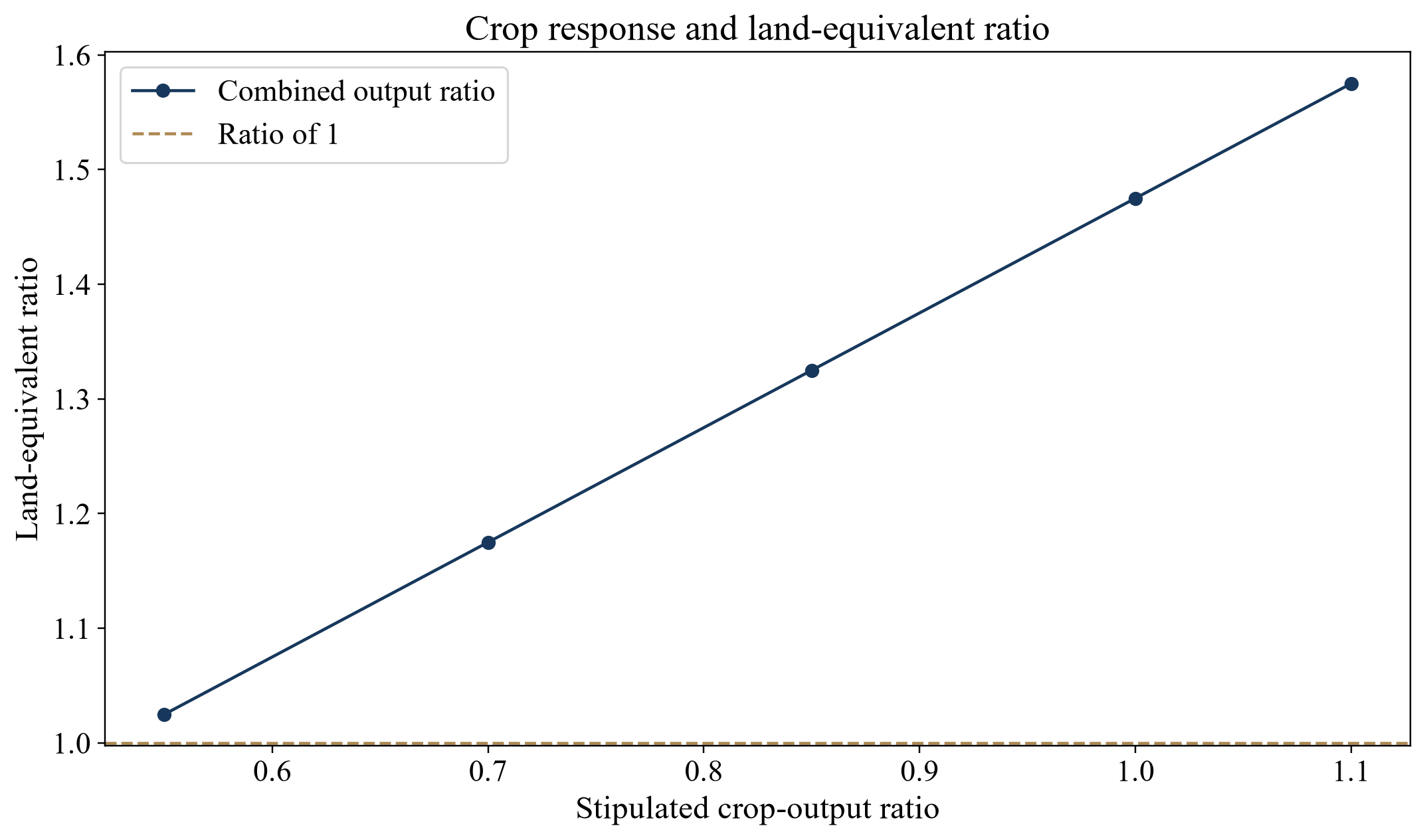
| Land-equivalent ratio | N/A | 1.325 | dimensionless |
Fictional assumptions and calculations. LER adds crop and electricity output ratios against distinct stipulated comparators; it supplies no monetary value.
View figure at full size; scroll horizontally on smaller screens.
Fictional annual output ratios on the same 100 hectares. The 40 MWac conventional-solar reference is a physical denominator only; no alternative solar investment value is calculated.
14 Reconcile joint value with the two cash recipients
The fictional installation requires USD 20 million of base power capital and a USD 6 million dual-use premium at time zero. Annual energy-company operating cost is USD 450,000. A USD 2 million renewal occurs in year ten and USD 1 million of closure expenditure in year twenty. Energy sells for an assumed constant USD 100 per MWh. The energy company also pays the farmer USD 120,000 every year from year one. That access payment is an expense in the energy-company account and a receipt in the farmer account. The joint account removes the internal transfer while retaining crop losses, all external operating costs and dated capital expenditure.
For each year, joint incremental cash equals power receipts less power operating cost, renewal, closure and initial capital, plus agrivoltaic farm margin less continuing-farm margin. Discounted value is the sum of that cash divided by 1.08 raised to the corresponding year. The same 8% discount rate is applied to both recipients solely to make the accounting reconciliation transparent. Different recipient discount rates would produce separate decision values that could not be added into this single-rate identity without further adjustment. The calculation contains no observed required return and no conclusion about an appropriate project valuation rate.
Under these fictional base inputs, joint incremental NPV is USD 0.386 million. The farmer's incremental NPV is USD 0.697 million and the energy company's unlevered NPV is negative USD 0.311 million. The two recipient values sum to the joint result, subject to displayed rounding. The farmer receives USD 141,000 annually, comprising USD 21,000 of crop margin and USD 120,000 of access payment, compared with the USD 70,000 continuing-farm margin. Positive combined value therefore leaves a distribution problem: the chosen payment allocates more value to the farmer than the energy-company account supports at the common valuation rate.
This distinction affects the form of an investment recommendation. A committee using the joint result should identify the parties whose cooperation is required and the transfers that remain negotiable. The energy company's negative result remains visible until a specified change in payment, capital, revenue or external cost changes that account. The USD 0.386 million joint surplus is also a narrow cost allowance. A genuinely additional time-zero external cost consumes that surplus one-for-one when every other cashflow remains fixed. Extra land payments, unmodelled crop disruption and engineering modifications need dated entries before that allowance can be offered in a bid.
Table 3. Separate cash recipients and joint value
| Account | NPV USDm | Included | Excluded |
|---|---|---|---|
| Farmer incremental | 0.697 | Crop margin and access receipt | Power receipts |
| Energy SPV unlevered | -0.311 | Capex and fee expense | Debt and reserve |
| Joint incremental | 0.386 | Both recipients | Internal access transfer |
| Continued farm | 0.687 | Common external rent | Land sale proceeds |
Fictional assumptions and calculations. Joint value equals the two incremental recipient values; financing cash does not enter joint NPV.

View figure at full size; scroll horizontally on smaller screens.
Real USD million at an assumed 8% discount rate. Farmer access payments cancel in combined cash; the energy-company account includes the corresponding expense. Debt and reserves are excluded from these unlevered values.
15 Make renewal and reserve timing visible to the lender
The financing illustration assumes USD 15 million drawn at time zero, 6% annual interest and twelve equal annual debt payments beginning in year one. The calculated payment is USD 1.789 million. Construction uses USD 26 million, and an initial debt-service reserve equal to half one annual payment requires a further USD 0.895 million. Initial sponsor cash is therefore USD 11.895 million. Sources and uses reconcile the loan draw and sponsor contribution with construction and reserve funding. The reserve is a cash stock in the financing ledger; it has no effect on the unlevered joint NPV. No reserve interest, financing fees or construction-period interest is assumed because construction is compressed into time zero.
Cash available for debt service is energy revenue less operating expense, farmer payment, renewal and closure when due. Crop receipts remain with the farmer and cannot support this energy-company debt under the stipulated structure. Year-ten renewal is paid directly and is fully deducted in that year's CFADS. The resulting minimum DSCR is 0.391, below the assumed 1.25 screening target. Annual totals before renewal cannot establish compliance with this dated test. This is a deliberately unsmoothed renewal case: a funded maintenance reserve, different renewal contract or revised debt schedule would require a new model with explicit sources, contributions and permitted withdrawals.
The debt-service reserve can pay part of a cash deficit, but its withdrawal does not increase CFADS or DSCR. When cash after debt service is negative, the model draws the available reserve and reports the remaining need as additional sponsor cash. Later positive residual cash replenishes the reserve before distributions until the debt's last payment; any balance is released after that payment. Distributions are residual cash calculations; covenant distribution tests and cash-trap restrictions are not implemented. The base case requires USD 0.195 million of additional sponsor cash and temporarily exhausts the USD 0.895 million reserve. These are funding requirements and a reserve-target gap. No commitment to provide support, waiver of reserve requirements or lender consent is implied.
Applying the assumed 1.25 target to every scheduled debt year gives a mathematical debt ceiling of USD 4.689 million. This amount is calculated from the lowest dated CFADS and the same interest rate and amortisation factor. It has no status as a financing offer. Lower debt increases initial sponsor funding and leaves engineering, collateral, operating, contractual and credit conditions unresolved. An all-equity case is retained in the dataset to make the separation clear: debt service and DSCR are absent, while the project still has the same operating and renewal cash obligations and the same unlevered joint value.
Table 4. Dated operating and financing bridge
| Year | Joint cash USDm | CFADS USDm | DSCR |
|---|---|---|---|
| 0 | -26.000 | 0.000 | N/A |
| 1 | 2.921 | 2.850 | 1.593 |
| 9 | 2.787 | 2.716 | 1.518 |
| 10 | 0.770 | 0.699 | 0.391 |
| 12 | 2.738 | 2.667 | 1.490 |
| 20 | 1.610 | 1.539 | N/A |
Fictional assumptions and calculations. CFADS includes renewal and closure expenditure when dated; no maintenance-reserve smoothing is assumed.
Table 5. Construction and reserve funding
| Item | USDm | Timing | Account |
|---|---|---|---|
| Capital | 26.000 | 0.000 | Use |
| Debt draw | 15.000 | 0.000 | Source |
| Initial debt reserve | 0.895 | 0.000 | Use |
| Sponsor initial | 11.895 | 0.000 | Source |
| Total later sponsor | 0.195 | Years 1-20 | Conditional cash need |
| Final debt balance | 0.000 | 20.000 | Closing stock |
Fictional assumptions and calculations. Initial reserve is funded once; reserve and debt are excluded from joint NPV. Sponsor amounts are required cash, not commitments.

View figure at full size; scroll horizontally on smaller screens.
Fictional USD 15 million debt, 6% interest and 12 annual payments. The USD 2 million year-10 renewal is deducted from CFADS when paid; reserve withdrawals and sponsor cash do not enter DSCR.
16 Stress crop response and the two output prices
The yield-response cases change the crop ratio while preserving the declared cost behaviour. Ratios of 0.55, 0.70, 0.85, 1.00 and 1.10 are fictional sensitivity points. They represent neither probabilities nor agronomic forecasts. Because the fixed electricity comparator is retained, a high combined physical ratio can coexist with a material farmer loss before access payment. The farmer's willingness to participate depends on crop margin, disruption and contractual cash allocation, each of which needs its own evidence. The ratio chart provides a compact output diagnostic; the separate cash tables show the consequences for the participants.
Electricity-price stresses change energy receipts while preserving output, capital and operating costs. Crop-price stresses change the revenue of both the continuing farm and the agrivoltaic farm. This common-price treatment matters because the base agrivoltaic crop ratio is below one: a higher crop price raises the value of the forgone harvest and can reduce incremental joint value. The model includes a twenty-five-point grid crossing five electricity prices with five crop prices. Each cell is a separate conditional calculation, with no correlation structure, probability weight or claim that one price will offset another in the market.
Holding the other base inputs fixed, the electricity price that reduces joint incremental NPV to zero is USD 98.809 per MWh. The assumed USD 100 price lies close to that boundary. This threshold is an algebraic break-even value under a constant-price convention. An actual contract with escalation, imbalance charges, curtailment, seasonal settlement or delayed receipts needs its dated net cash profile. The annual model cannot establish seasonal farm liquidity or the energy company's working-capital requirement. Those omissions limit the funding conclusions even where annual NPV remains positive.
The sensitivity set also varies the time-zero dual-use premium independently from the base power capital. Under unchanged operation and crop response, the maximum premium consistent with zero joint incremental NPV is USD 6.386 million. The stipulated premium is USD 6 million. This narrow headroom should be expressed in the same cost perimeter: the premium excludes the already included USD 20 million base capital, while external additions to either part of initial capital affect value equally. Claims that a superior land-equivalent ratio justifies any premium have no support in this cash calculation. Crop and electricity performance must still pay for the dated external resource costs.
Table 6. Yield response and joint output
| Crop ratio | LER year 1 | Joint NPV USDm | Farmer gain NPV USDm |
|---|---|---|---|
| 0.850 | 1.325 | 0.386 | 0.697 |
| 0.550 | 1.025 | -0.085 | 0.226 |
| 0.700 | 1.175 | 0.150 | 0.461 |
| 1.000 | 1.475 | 0.622 | 0.933 |
| 1.100 | 1.575 | 0.779 | 1.090 |
Fictional assumptions and calculations. Crop ratio changes crop output and volume-related cost; extra farm cost remains fixed.
Table 7. Electricity price and debt coverage
| USD/MWh | Joint NPV USDm | Minimum DSCR | Debt ceiling USDm |
|---|---|---|---|
| 100.000 | 0.386 | 0.391 | 4.689 |
| 60.000 | -12.584 | -0.340 | 0.000 |
| 80.000 | -6.099 | 0.025 | 0.304 |
| 120.000 | 6.871 | 0.756 | 9.074 |
| 140.000 | 13.357 | 1.122 | 13.460 |
Fictional assumptions and calculations. Debt ceiling is the nonnegative mathematical amount meeting 1.25 in every scheduled debt year, with the unchanged renewal cash.

View figure at full size; scroll horizontally on smaller screens.
Each cell is incremental unlevered NPV in USD million under fictional inputs. Crop-price changes affect both the continuing farm and the agrivoltaic farm; no price correlation or probability is assigned.
17 Test a payment interval before proposing a financed agreement
The farmer participation floor in the fictional base case is USD 49,000 annually. It restores the difference between USD 70,000 of continuing-farm margin and USD 21,000 of agrivoltaic farm margin. This floor only preserves the modelled annual margin. It includes no compensation for risk preference, disruption outside the annual convention, loss of optionality or transaction costs. Those matters require an explicit commercial proposal and supporting evidence. A negotiated farmer payment could reasonably be higher, but its financing and owner-value consequences need to remain visible in the same decision record.
For the energy-company account, the constant annual fee consistent with zero unlevered NPV at 8% is USD 88,328.664. Together with the farmer floor, this produces a conditional economic payment interval of USD 49,000 to USD 88,328.664 before omitted costs and risk allowances. At the assumed USD 15 million debt, however, the DSCR-compatible fee ceiling is negative USD 1.417 million. There is therefore no nonnegative farmer fee that makes the stipulated debt schedule satisfy the target through the renewal year. Adjusting the distribution of positive combined value alone cannot make that particular financing schedule pass.
The explicit reduced-debt case uses USD 4 million with the same rate and maturity. Its DSCR-compatible fee ceiling is USD 222,757.211 annually. The energy-company zero-NPV ceiling remains USD 88,328.664 because debt financing is excluded from that valuation account. Under these assumptions, owner economics is the tighter payment constraint for the smaller loan. The dataset additionally calculates a fictional USD 80,000 fee with USD 4 million debt so that a proposed intersection can be tested as a complete cash schedule. It remains conditional on the input assumptions and increased sponsor equity; no party is presumed to have accepted those terms.
An implementable term sheet should identify the chosen payment, timing, payer and funding source, together with the treatment of crop losses and interrupted access. The model assumes every scheduled fee is paid in full, even in a delayed project. A contingent fee, revenue share, indexed rent or subordinated payment would change both the farmer's receipts and the company's coverage. Such terms should be represented directly before comparing them with this fixed-fee interval. The accounting identity is useful precisely because it makes a transfer visible in each recipient's ledger while retaining one combined external cash result.
Table 8. Farmer payment and available coverage
| Annual fee USD | Joint NPV USDm | Farmer gain NPV USDm | Minimum DSCR |
|---|---|---|---|
| 120,000.000 | 0.386 | 0.697 | 0.391 |
| 0.000 | 0.386 | -0.481 | 0.458 |
| 60,000.000 | 0.386 | 0.108 | 0.424 |
| 180,000.000 | 0.386 | 1.286 | 0.357 |
| 240,000.000 | 0.386 | 1.875 | 0.324 |
Fictional assumptions and calculations. The fee changes allocation and SPV coverage; it cancels from joint cash under identical full payment assumptions.
Table 9. Conditional decision boundaries
| Boundary | Value | Unit | Condition |
|---|---|---|---|
| Joint break-even power price | 98.809 | USD/MWh | Other inputs fixed |
| Farmer baseline payment floor | 49,000.000 | USD/year | Base crop response |
| DSCR-compatible fee ceiling | -1,417,301.943 | USD/year | USD 15m debt and renewal |
| Dual-use premium ceiling | 6.386 | USDm | Time-zero incremental cost |
| Mathematical debt ceiling | 4.689 | USDm | 1.25 each debt year |
| SPV zero-NPV fee ceiling | 88,328.664 | USD/year | 8% unlevered discount |
| Reduced-debt fee ceiling | 222,757.211 | USD/year | USD 4m debt; same renewal |
Fictional assumptions and calculations. A negative fee ceiling means the assumed debt schedule has no feasible nonnegative fee. These are calculation boundaries, not contracts or lender offers.
18 Carry delayed operation through fixed maturity and closure
The delayed-service cases move the first energy-producing year to year two or year three. Initial capital remains paid at time zero, debt payments still begin in year one and final closure remains in year twenty. The farmer's access payment starts in year one despite delayed service. Annual standby cost of USD 100,000 applies before operation, replacing the normal USD 450,000 power operating cost in those years. Farming is assumed to continue at baseline output and cost until the agrivoltaic system starts. This is a favourable and explicit construction-access assumption; disrupted farming during construction would require an additional deduction.
Once operation starts, electricity degradation runs from that first operating year, while the shortened number of service years is retained. Renewal moves to the tenth operating year and is paid once; it is not added to the original renewal date. Debt maturity remains year twelve in every case. The annual ledger therefore exposes early cash deficits and the later renewal burden within the same fixed financing boundary. No refinancing draw, debt-service holiday or terminal extension is inserted to absorb a delay. Sponsor support is reported only as the calculated residual cash required after the available reserve has been used.
The combined adverse case joins a two-year delay with a crop ratio of 0.55, electricity price of USD 70 per MWh and crop price of USD 500 per tonne. This combination is an author-selected stress, with no estimated occurrence probability. Its purpose is to test simultaneous deterioration in the production schedule, crop opportunity cost and energy receipts. The reserve-gap chart separates additional sponsor cash from the largest shortfall against the reserve target. Those quantities describe different obligations and should not be added without inspecting their dates and the contract's restoration requirements.
The resulting decision package contains the complete annual ledgers, recipient reconciliation, price grid and explicit financing mechanics. A proposed investment should carry a versioned choice of crop response, service date, payment structure and capital perimeter into the approvals record. Independent crop measurement and engineering acceptance remain prerequisites for replacing assumptions with evidence. The calculation can support a conditional capital decision and a defined negotiation range; it cannot establish land permission, crop insurance recovery, security enforceability, lender commitment or a forecast return for an actual agrivoltaic asset.
Table 10. Delay and combined adverse cash requirements
| Case | Joint NPV USDm | Later sponsor USDm | Maximum reserve gap USDm |
|---|---|---|---|
| Base | 0.386 | 0.195 | 0.895 |
| Delay years 1 | -2.195 | 1.310 | 0.895 |
| Delay years 2 | -4.589 | 3.319 | 0.895 |
| Combined adverse | -13.246 | 5.307 | 0.895 |
Fictional assumptions and calculations. Debt service and year-20 closure stay fixed. Farmer fee starts year 1; standby cost replaces operating cost before service. Crop farming continues at baseline during delay.

View figure at full size; scroll horizontally on smaller screens.
Initial construction and debt maturity remain fixed. Reserve target gaps are reported separately from cash needed to pay scheduled obligations. Additional sponsor cash is uncommitted; no lender waiver, refinancing or entitlement is assumed.
19 Commission a field-specific agricultural acceptance case
The proposed diligence begins with the farm that must continue operating during and after solar construction. Record the occupied hectares, cultivated hectares, crop rotation, irrigation system, machinery, labour calendar and routes to market. Distinguish the farmer's existing records from a developer's intended changes. The investment boundary should identify who owns the crop, who sells it and which expenditure the solar company proposes to reimburse. Establish the comparison field and decision date before valuing a claimed improvement. A neighbouring farm can provide context, while differences in soil, water, management or planting date require explicit treatment in the trial design.
Commission an agronomist to specify a matched measurement programme for the selected crop and layout. The proposed dataset records planting, canopy-level light, irrigation, interventions, harvested quantity, saleable grade and rejected output using consistent plot boundaries. Retain a record of measurements unavailable during any critical crop stage. The acceptance question concerns the crop and operating system proposed for deployment. An annual light average or aggregate harvest total leaves the timing and distribution of performance unresolved. The technical reviewer should explain which conclusions the observation window supports and what remains dependent on another season or a different weather sequence.
The commercial evaluation should translate the accepted agricultural observations into a margin account. Request sale records or documented buyer requirements for the relevant grade, harvesting period and delivery location. Include labour, seed, fertiliser, irrigation, machinery, handling and unsaleable output. A larger harvest with a different quality mix requires a fresh receipt calculation. Any changed input cost should be supported independently from the yield assumption. For the proposed investment process, a trial report that presents only tonnes per hectare remains incomplete until its consequences for sale receipts and farm expenditure are reconciled.
Agree the response to the trial before committing the commercial installation. The decision record can specify a permitted rollout area, a redesign, another targeted season or termination of the pilot. The stop account should include already committed crop compensation, removal and restoration. Design acceptance should identify the crop, layout, management and measurement conditions that were evaluated. A later change in any of those conditions reopens the relevant review. This procedure purchases a defined body of evidence and gives the committee an explicit decision at the end of the trial, without assuming favourable performance or an automatic route to scale.
Table 11. Proposed agricultural acceptance record
| Evidence | Review question | Decision use |
|---|---|---|
| Field and control boundaries | Comparable management and conditions? | Bound trial conclusions |
| Crop stage and light record | Which periods remain unobserved? | Define further evidence |
| Quantity, grade and rejects | What output is saleable? | Reconcile farm receipts |
| Adaptation and input cost | Who pays for the new practice? | Test farmer margin |
| Pilot stop obligations | What remains committed? | Fund removal and restoration |
Author-proposed method; no observed yield, universal light threshold or agronomic acceptance is asserted.
20 Give crop and electrical operation a shared decision protocol
The proposed operating protocol translates the agricultural calendar into restrictions that the electrical contractor and asset manager can implement. Begin with planting, irrigation, spraying, pruning, harvesting and machinery movements. Map the space and access each activity requires against foundations, cabling, equipment clearance, turning areas and emergency routes. Ask the responsible specialists to identify incompatible activities and the procedures needed to separate them. No generic clearance or safe-work distance is supplied by this framework. The accepted site plan should record actual dimensions and authorised working methods for the chosen equipment and crop.
Where panel movement or operating settings can change the light reaching a crop, specify who proposes and who authorises each change. The proposed record captures the reason, period, expected agricultural effect and estimated electrical consequence. An agronomic request should enter a joint decision process with a named response time; an energy-production target should carry the crop obligations that the project has accepted. The resulting control schedule must be implementable by the operating team. A modelled compromise that cannot be reproduced through approved settings and instructions cannot support the procurement acceptance decision.
Construction planning needs its own seasonal account. Request an occupation schedule by field block, including temporary storage, vehicle routes and dates when access will return to the farmer. Identify standing crops and committed planting expenditure before work starts. The proposed contract should define how delayed access, damaged irrigation, soil disturbance and incomplete restoration are measured and referred for assessment. Budget gross protective and remedial work while responsibility is resolved. A possible contractor payment remains a separately assessed recovery with its own claim process, timing and credit exposure.
At operating handover, rehearse selected maintenance and agricultural tasks with the people expected to perform them. The proposed demonstration checks isolation, access, handling, communications and restoration of normal service under the actual authorised procedures. Record tasks that require specialist equipment or seasonal restrictions. The farm operator should receive the information needed to plan its work, while the solar operator retains its electrical responsibilities. A joint change register should subsequently link an instruction or incident to the affected crop area, energy period, cash consequence and approval. This supports attribution of disputes without assuming that every loss has a single cause or a readily collectable remedy.
Table 12. Proposed farm and power operating protocol
| Interface | Required record | Decision owner |
|---|---|---|
| Planting and harvest access | Block-level calendar | Farm and site leads |
| Panel operating changes | Crop and energy consequence | Joint operating committee |
| Maintenance mobilisation | Authorised work method | Responsible site specialists |
| Construction occupation | Standing crop and restoration scope | Project director |
| Disputed interruption | Event and gross cash record | Commercial and technical leads |
Actual site engineering and safety procedures determine acceptable methods; the matrix establishes no clearance or permission.
21 Allocate receipts and obligations to the parties that carry them
The proposed transaction model starts with separate farm and solar accounts. The farm account retains crop receipts, farming expenditure and any access payment it is entitled to receive. The project-company account retains electricity collections, operating expenditure and its payment to the farmer. A consolidated comparison removes that internal transfer. This treatment allows the committee to test joint value and each participant's position without counting the same payment twice. A favourable combined result can coexist with an unacceptable farmer outcome or insufficient project-company cash, so all three views should remain visible at the commitment decision.
An access-payment proposal needs a defined basis. A fixed annual amount, a share of electricity receipts and compensation linked to an assessed crop loss create different obligations. The proposed term sheet should identify the payment date, indexation, eligible area, deductions, supporting records and treatment of partial occupation. If a minimum payment applies during a solar outage, retain that expense in the SPV stress account. If a variable payment follows actual collection, explain the farmer's exposure to the electricity buyer. These alternatives are analytical contract choices; their enforceability and tax treatment require advice on the actual transaction.
Crop-loss provisions need a counterfactual and a claims procedure that both parties can operate. Define the comparison period, relevant crop, quality adjustments and evidence used to distinguish project interference from other causes. Independent assessment may be proposed for disputed loss, together with interim arrangements for urgent planting or repair cash. Avoid booking an expected reimbursement as collected money before the model establishes its amount and timing. The committee should see the farmer's gross loss, the claimed transfer and the SPV's corresponding liability separately. Contractual caps and exclusions also require explicit downside treatment.
Procurement should preserve the same accounting boundary. Identify whether irrigation changes, replacement machinery, monitoring and restoration are included in an installation price or remain owner commitments. Ask bidders to return exceptions against a common responsibility schedule. Compare the completed operating package after adding retained scope and agreed contingencies. Any revenue-sharing proposal should be tested against the resulting cash account, including delayed commissioning and crop underperformance. The agreement should also specify access to the data needed to verify payments. A payment formula whose inputs cannot be observed or reconciled creates an unresolved execution condition at the proposed investment gate.
Table 13. Proposed participant cash and payment controls
| Cash item | Recipient or payer | Consolidation rule |
|---|---|---|
| Crop sale receipts | Farm operator | Retain once |
| Electricity collections | Solar project company | Retain once |
| Access payment | SPV pays farmer | Remove internal transfer |
| Crop-loss claim | Contract-specific parties | Track liability and recovery |
| Retained installation scope | Named responsible entity | Include complete cost |
Joint economics, farmer participation and SPV cash require separate accounts. Actual documents determine payment rights.
22 Preserve agricultural continuity through changes of operator and control
The proposed legal workstream should examine land occupation and agricultural continuation together. Request the actual title, leases, licences, planning conditions, agricultural-use requirements, water arrangements and electricity connection documents. Record the term, renewal process, assignment conditions and responsible adviser for each. Programme eligibility or a classification mentioned in a public summary should remain separate from the project's own approval. Any farm-support assumption needs a current, project-specific assessment of eligibility and the party bearing a reduction or repayment. This framework establishes no national rule or entitlement to retain support after installing solar equipment.
A continuity plan should address the departure or failure of the farm operator before financial close. Identify who has authority to appoint a replacement, what experience and resources that operator needs, and which consents must be obtained. Record the condition of standing crops, irrigation, equipment and sale commitments at the proposed handover. The transition budget should include the work required to protect the next planting or harvest window. An intervention clause remains a legal provision whose practical operation requires people, access, money and accepted instructions. It supplies no independent evidence that a financier can itself carry out farming.
The proposed lender and owner dialogue should also examine a transfer of the solar project. Identify restrictions on changes of control, security, enforcement and assignment in the land and farm arrangements. Ask advisers to assess whether a proposed remedy could interrupt a required agricultural activity or terminate an essential right. Where consent is outstanding, retain its status and the consequence of refusal in the transaction schedule. The investment case should not silently extend the operating horizon beyond the earliest unsubstantiated right. A longer-term scenario can be shown separately with its required renewal expenditure and conditions.
Exit requires a practical restoration specification. Before construction, agree how relevant soil condition, drainage, access and irrigation will be documented. The proposed removal plan should state which foundations, cables, structures and temporary works must be recovered, which may remain subject to permission, and who accepts the returned site. A security deposit or reserve should be reconciled to the same obligation; funding the reserve does not remove the gross cost. Changes in ownership or farm operator should preserve the records necessary to execute and assess restoration. The buyer's diligence record should identify the obligation, cost basis and conditions for accepting the field's restoration to productive use.
Table 14. Proposed agricultural continuity and transfer gates
| Change | Evidence required | Unresolved consequence |
|---|---|---|
| Farmer replacement | Qualified operator and consents | Transition and season funding |
| Solar ownership transfer | Assignment and control provisions | Closing condition |
| Land or support status | Project-specific adviser assessment | Revenue or tenure stress |
| Operating extension | Renewal rights and condition review | Separate valuation case |
| Removal and restoration | Baseline and acceptance method | Fund remaining obligation |
No automatic agricultural-support continuity, lender step-in right or lawful extension is assumed.
23 Present an auditable lender case and seasonal funding plan
The proposed financing memorandum should first identify the borrowing entity and the cash it can legally receive. Reconcile that entity's operating cash with the wider economic comparison. Crop profit retained by a farmer cannot be inserted into SPV debt-service coverage merely because the activities share land. An access payment is an SPV expense even when it disappears from consolidated value. The model should state the treatment of tax, receivables, maintenance capital, reserve funding and extraordinary claims. A coverage calculation can then be reviewed against its actual definition, payment calendar and assumed collection dates.
Prepare a dated funding schedule for the seasons that matter to the transaction. Seed, labour and irrigation commitments may precede harvest collection under the proposed crop plan, while construction milestones and electricity receipts follow their own dates. Request the relevant records and proposed contract terms before assigning cash dates. Annual profitability alone leaves this timing unresolved. The financing case should identify the lowest available cash point, permitted reserve use and any required new funding. A sponsor contribution or credit facility should be identified as conditional until its commitment and draw conditions are verified.
Stress the common drivers without assigning unsupported probabilities. A selected case might combine delayed grid completion, an impaired crop season, continuing access payments and additional restoration work. Another can hold the farm outcome unchanged while electricity collections are delayed. Define whether unpaid invoices are eventually recovered, partly lost or permanently lost. Keep the original debt schedule fixed unless a distinct refinancing or amendment scenario is explicitly introduced. A reserve draw supplies liquidity and leaves a restoration obligation under its assumed terms; it does not create operating earnings or a new physical benefit.
The lender evidence package proposed here should make every material adjustment traceable. Link power output to the delivery boundary, crop receipts to accepted quantity and grade, access compensation to the contract, and capital to the remaining scope. Present base and stress cash with a reconciliation of opening funds, receipts, expenditure, debt payments and closing balances. State any restrictions omitted from an illustrative distribution calculation. The outcome is an auditable request for financing consideration. It does not establish a lender's willingness to lend, a credit rating, a covenant waiver or the availability of the proposed funding sources.
Table 15. Proposed financing evidence and liquidity reconciliation
| Account | Required test | Boundary |
|---|---|---|
| SPV operating cash | Borrower receipt and cost reconciliation | Exclude farmer-retained income |
| Seasonal working capital | Dated obligations and collections | Annual margin insufficient |
| Debt service | Actual payment schedule | No automatic restructuring |
| Reserve use | Permitted draw and restoration | No operating income |
| Sponsor or facility cash | Commitment and draw conditions | Conditional until verified |
Proposed lender evidence only; no financing availability, credit assessment or actual covenant compliance is asserted.
24 Release capital against a defined dual-use operating outcome
The proposed implementation sequence begins with a bounded feasibility commitment. Establish the field perimeter, feasible alternatives, evidence gaps and trial budget. The next release should purchase the investigations and permissions needed to compare a specific layout and crop plan. Commercial deployment follows only after the investment committee has reviewed the resulting design, agricultural acceptance, rights, complete cost and entity-level cash case. Each release should identify what becomes irreversible and what remains conditional. A gate that is missed needs a recorded decision to redesign, defer, reduce the footprint or stop, together with the resulting committed expenditure.
Construction acceptance should distinguish equipment completion from readiness to farm. The proposed completion record includes electrical tests, agreed field access, irrigation restoration, crop-protection measures, operating instructions and unresolved defects. Assign a responsible party and funding source to every retained item. If part of the farm remains unavailable, record the area and period explicitly in both the compensation and production accounts. A provisional acceptance certificate should preserve its limitations in the investment reporting. Receipts expected after acceptance should retain the commercial conditions that must still be satisfied.
During operation, present a compact reconciliation of approved plan, observed activity and collected cash. Compare planted and harvested area, quantity, grade, irrigation and field access alongside electrical delivery, downtime and settlement. The purpose is to identify a change that warrants an operational response or a revised cash assumption. A single favourable harvest should retain its period and conditions. Repeated exceptions should lead to an explicit review of layout, crop choice, operator capability or contract terms, with the cost and permissions of the proposed change documented before implementation.
The acquisition and refinancing record should preserve this history. A prospective buyer needs the actual operating perimeter, transferable rights, unresolved claims, remaining replacement expenditure and restoration obligations. Report original assumptions alongside subsequent evidence so that improved knowledge can be distinguished from a changed commercial arrangement. A sale or refinancing proposal should use the remaining term supported by the documents and separately identify contingent extensions. The final decision should state the price or capital commitment, outstanding conditions and responsible owners. This keeps the proposed dual-use investment tied to an executable agricultural operation and a traceable project-company cash account.
Table 16. Proposed capital-release and operating decisions
| Stage | Acceptance evidence | Capital response |
|---|---|---|
| Feasibility | Field perimeter and alternatives | Approve bounded investigation |
| Trial | Crop, light and cash reconciliation | Proceed, redesign or stop |
| Construction | Rights, full scope and funding | Commit defined package |
| Handover | Electrical and farming readiness | Retain unresolved items |
| Operating review | Physical and collected-cash variance | Approve corrective action |
These are proposed governance gates. Their inclusion does not report an achieved permission, test result or investment approval.
References
- Both, A. J., and Birnie, D. P., III. Key Dimensions and Calculations for Agrivoltaic Installations. Rutgers Agrivoltaics Program, December 2025, pp. 1-3. https://agrivoltaics.rutgers.edu/wp-content/uploads/2025/12/Key-Dimensions-and-Calculations-for-Agrivoltaic-Installations.pdf. Accessed 10 October 2026.
- Barron-Gafford, G. A., et al. Agrivoltaics provide mutual benefits across the food-energy-water nexus in drylands. Nature Sustainability 2, 848-855, 2019; results and Methods. https://energy.arizona.edu/sites/default/files/2022-09/Barron-Gafford%20et%20al%20Nature%20Sustainability%202019.pdf. Accessed 10 October 2026.
- Weselek, A., et al. Agrivoltaic system impacts on microclimate and yield of different crops within an organic crop rotation in a temperate climate. Agronomy for Sustainable Development 41, 59, 2021; institutional abstract and indexed first page. https://hohpublica.uni-hohenheim.de/items/7bd279ba-3634-486e-b27a-877885c703dd/full. Accessed 10 October 2026; direct full-text access unavailable.
- Horowitz, K., Ramasamy, V., Macknick, J., and Margolis, R. Capital Costs for Dual-Use Photovoltaic Installations: 2020 Benchmark for Ground-Mounted PV Systems with Pollinator-Friendly Vegetation, Grazing, and Crops. NREL/TP-6A20-77811, 2020; official repository abstract. https://research-hub.nlr.gov/en/publications/capital-costs-for-dual-use-photovoltaic-installations-2020-benchm/. Accessed 10 October 2026.
- US Department of Energy. Farmer’s Guide to Going Solar. Undated; agricultural-equipment compatibility FAQ. https://www.energy.gov/cmei/systems/farmers-guide-going-solar. Accessed 10 October 2026.
- France. Code de l’énergie, article L314-36. In force since 12 March 2023, I-IV. https://www.legifrance.gouv.fr/codes/article_lc/LEGIARTI000047298015. Accessed 10 October 2026.
- France. Code de l’énergie, articles R314-108 à R314-123. Versions since 10 April 2024, consolidated display dated 6 October 2026; R314-114, R314-117, R314-118 and R314-120. https://www.legifrance.gouv.fr/codes/id/LEGISCTA000049387777/. Accessed 10 October 2026.
- France. Arrêté du 5 juillet 2024 relatif au développement de l’agrivoltaïsme et aux conditions d’implantation des installations photovoltaïques sur terrains agricoles, naturels ou forestiers. Article 3(1). https://www.legifrance.gouv.fr/loda/id/JORFTEXT000049891545/. Accessed 10 October 2026.
- Ministry of New and Renewable Energy, India. Pradhan Mantri Kisan Urja Suraksha evam Utthaan Mahabhiyaan (PM-KUSUM). Undated; Period and Component A. https://mnre.gov.in/en/pradhan-mantri-kisan-urja-suraksha-evam-utthaan-mahabhiyaan-pm-kusum/. Accessed 10 October 2026; stated period ends 31 March 2026.
- EU CAP Network. Factsheet - Innovative on-farm energy production systems. 8 October 2026; Focus Group findings. https://eu-cap-network.ec.europa.eu/publications/factsheet-innovative-farm-energy-production-systems_en. Accessed 10 October 2026.
- European Investment Bank. Austria: EIB supports PÜSPÖK with €80 million for agrivoltaics. 21 November 2024; financing and feed-in-premium paragraphs. https://www.eib.org/en/press/all/2024-461-austria-eib-supports-puspok-with-eur80-million-for-agrivoltaics. Accessed 10 October 2026.
- Ayadi, O., et al. Comparative Experimental Performance Assessment of Tilted and Vertical Bifacial Photovoltaic Configurations for Agrivoltaic Applications. Sustainability 18(2), 931, 2026; publisher-indexed Methods/Conclusions and version notes. https://www.mdpi.com/2071-1050/18/2/931. Accessed 10 October 2026; direct article access limited.
About the Author
Chennakeshav (CK) is a corporate finance and investment banking executive with 25+ years of global experience in deal origination, structuring and execution across M&A, growth capital and corporate strategy. He has led value-creation mandates for founders, corporates and funds — bridging the boardroom view to hands-on execution and close.
His career spans Morgan Stanley, HSBC, Lloyds Banking Group, EWEC, ADQ portfolio companies and Emirates Growth Fund, across TMT, real estate, fintech, deeptech, cleantech, infrastructure and energy. He has partnered with C-suite leaders, private equity and venture funds, sovereign wealth funds and family offices to finance complex fund raises and scale-up ventures, and has led M&A due diligence, post-merger integration and business-transformation initiatives to create value.
At Matchpoint Partners he is Managing Partner, leading the firm's corporate finance, M&A and capital-raising practice. He holds an MBA from London Business School, an engineering degree from VTU and a Master of Laws (LLM, in progress) from UCL London.
An active start-up mentor, CK mentors at Techstars, DIFC FinTech Hive, Startup Grind, Founder Institute and IN5, serves as Entrepreneur Mentor in Residence (EMiR) at London Business School, and judges the Entrepreneurship World Cup.
https://www.linkedin.com/in/ckadya/ https://www.matchpoint-partners.com/team/ck-adya.html
