

1. Define the investment and commercial decision
The analysis should begin with the decision to be made. A growth-equity round, project financing, acquisition, joint venture, technology licence, strategic partnership and plant expansion each require different evidence. The valuation date, transaction perimeter, funding use, decision horizon, investor rights and expected exit should be explicit before technical claims are translated into financial value.
The central question is whether the recycler can obtain suitable feedstock, transform it safely and consistently into qualified products, and convert those products into durable cash returns. Throughput, recovery and artificial-intelligence claims should therefore connect to contracts, plant performance, product acceptance, price, cost, working capital, capital expenditure and liabilities.
Evidence should be frozen at a defined date. Resolvable gaps belong in diligence and residual uncertainty belongs in scenarios, milestones, holdbacks, warranties, earn-outs, staged investment or governance. This discipline prevents a demonstration result, memorandum of understanding or nameplate figure from entering the valuation as completed commercial proof.
2. Establish the asset, legal and economic perimeter
The asset perimeter should identify collection assets, storage, discharge, dismantling, shredding, separation, thermal treatment, hydrometallurgy, direct recycling, laboratories, utilities, pollution controls, software, data, intellectual property and contracted third-party capacity. Owned, leased, licensed, shared and customer-provided assets should remain distinguishable.
The legal perimeter should map permits, waste classifications, producer-responsibility obligations, transport rules, title, liens, environmental liabilities, technology rights, data rights and product warranties. Feedstock can change legal status during aggregation, pretreatment and processing. Cross-border movements, damaged batteries and black mass can attract different requirements in different jurisdictions.
The economic perimeter should reconcile which revenue, cost, working capital, replacement obligation, closure duty and remediation exposure accompanies each asset and contract. Value residing in a non-transferable licence, related-party contract or uncommitted source should be disclosed. A buyer or investor should know which operating capabilities and liabilities transfer at closing.
3. Build battery and material genealogy
Genealogy should connect manufacturer, plant, batch, chemistry, cell format, pack, application, ownership, use, state, damage, storage and collection route. Production scrap requires its own origin, composition and quality history. Mixed loads should preserve source and sorting records rather than become an unidentified average.
Identity matters because chemistry and construction determine contained materials, hazard, treatment route and potential value. Product labels, digital records, battery passports, serials, diagnostic signals, images, dimensions, spectroscopy and controlled sampling can contribute evidence. No single signal should be assumed complete for every battery design or condition.
The chain should also follow outputs. Black mass, foils, metals, salts, cathode material, residues, wastewater and emissions should trace back through production lots to input populations and process conditions. This two-way lineage supports recovery claims, customer qualification, recycled-content evidence, environmental reporting and investigation of losses or contamination.
4. Map the feedstock funnel
Feedstock should be segmented from theoretical stock to economically available contracted tonnes. Installed batteries, expected retirements and regional waste generation sit at the top of the funnel. Collection eligibility, ownership, reuse, export, storage, competition, transport, safety, chemistry and price reduce the quantity that can reach a specific plant.
Manufacturing scrap, warranty returns, damaged batteries, end-of-life vehicles, stationary storage, consumer devices and intermediate black mass have different timing and economics. The International Energy Agency reports that manufacturing scrap currently plays a major role while future end-of-life flows remain uncertain. Second-hand use and longer asset lives can delay recycling supply.
Forecasts should use cohorts, not a smooth percentage of installed capacity. Each cohort needs expected retirement, collection probability, routing, chemistry, mass, uncertainty and commercial status. Contracted volume should be separated from non-binding expressions, market purchases, related-party supply and management aspirations.
5. Create the battery-recycling evidence ledger
Table 1. Battery-recycling evidence ledger
| Evidence layer | Controlled record | Investment question |
|---|---|---|
| feedstock | source, title, chemistry, condition and delivery | are suitable tonnes available? |
| process | route, batch, settings, downtime and losses | can inputs be transformed consistently? |
| recovery | assays, mass balance, yield and uncertainty | what material is physically recovered? |
| product | specification, qualification, rejection and payability | will customers accept and pay? |
| economics | price, cost, working capital and capex | what cash return remains? |
| obligations | permits, safety, waste, closure and remediation | what downside transfers to investors? |
Each claim should link to a controlled record, an owner, a date and a transaction consequence.
The ledger should distinguish observed measurements, derived metrics, model outputs and management adjustments. Units, dry or wet basis, gross or net weight, sampling method and laboratory status should be explicit. Corrections should preserve the original record and approval history.
Reviewers should be able to move from an equity-value assumption to the contributing feedstock lots, recovery records, customer invoices and costs. They should also be able to move from an incident or rejected product backwards to the responsible input and process state. Unresolved breaks should remain visible and enter the downside case.
6. Forecast available feedstock by cohort
Feedstock forecasts should begin with identifiable populations and contractual routes. Vehicle age, battery age, warranty, accident rates, retirement, second use, producer take-back, ownership and export can influence availability. Stationary storage and fleet batteries can remain integrated with revenue-producing systems beyond the period suggested by a simple calendar-life assumption.
Manufacturing scrap depends on cell-production volume, yield and the supplier's own internal recovery. As manufacturing quality improves, scrap intensity can decline even while production rises. A recycler should avoid assuming high long-term scrap volume and high upstream manufacturing yield simultaneously without a consistent market model.
Forecasts should state geography, chemistry, mass, timing, price, collection channel and confidence. Downside cases should combine delayed retirements, lower collection, greater reuse, competitor bids and adverse logistics where causally related. Contracted floors, take-or-pay terms and ownership rights require legal and counterparty verification.
7. Classify chemistry, format and condition
Lithium iron phosphate, nickel-manganese-cobalt, nickel-cobalt-aluminium, lithium-manganese-oxide and emerging chemistries have different material values and processing needs. Cell format, pack architecture, electrolyte, binders, additives, casing and state also affect dismantling, safety, separation and product quality.
Classification should use a hierarchy of evidence. Controlled manufacturer data or a reliable passport can be supplemented by serial matching, diagnostic data, machine vision, weight, voltage, X-ray, spectroscopy or representative assay. The method should report confidence and invoke quarantine or additional testing when evidence conflicts.
Condition is separate from chemistry. Charged, damaged, recalled, wet, contaminated, modified or thermally exposed batteries require different handling. A valuable chemistry can destroy margin if unsafe or expensive to process. Commercial models should retain condition premiums, discounts, rejection and treatment obligations rather than applying one value per tonne.
8. Build the feedstock-intelligence system
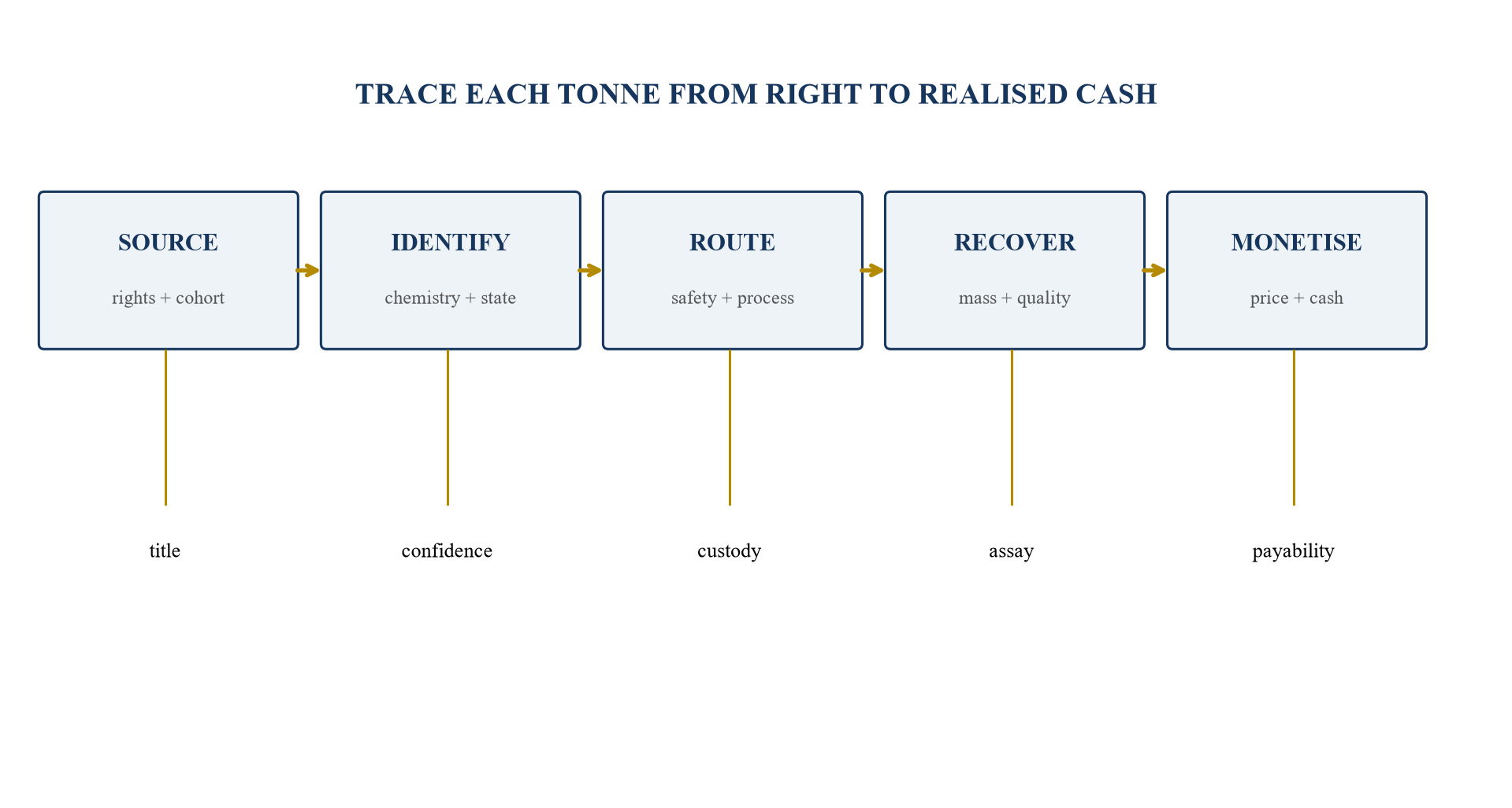
Replace the illustrative chain with controlled source systems, classification tests, rights and decision owners.
Artificial intelligence can combine records, images, diagnostics, sensor data and assays to rank identity and route decisions. The output should include confidence, evidence used, version and reason. Human review remains necessary for hazardous, unfamiliar, damaged or commercially material cases.
Performance should be measured against independently verified identity and downstream outcomes. Average classification accuracy can conceal expensive errors between high-value and low-value chemistry or unsafe false negatives. The financial test is avoided loss, improved yield, safer handling or better capacity use after the costs of data, equipment, review and mistakes.
9. Secure collection, custody and logistics
Collection value depends on who owns the battery, when title transfers, who bears transport and who remains responsible for rejected or damaged material. Producer schemes, dismantlers, fleets, manufacturers, insurers, dealers, storage operators and aggregators can each control different parts of the route.
Contracts should define specifications, minimum and maximum volumes, forecasts, price formula, contamination, packaging, state of charge, documentation, inspection, rejection, liability, insurance and delivery point. A nominal volume commitment can have weak value when the supplier may divert material, substitute chemistry or pass through market price without a margin mechanism.
Logistics design should include compatible packaging, segregation, temperature, fire protection, trained handlers, incident response and lawful transport. The United Nations Manual of Tests and Criteria and applicable dangerous-goods rules should be mapped to the actual batteries and movements. Delays, quarantine and rejected loads belong in cost and working capital.
10. Govern discharge, dismantling and safe preparation
Residual energy can create shock, arc, thermal and fire hazards. Discharge methods should be validated for the chemistry, condition and pack design. Energy recovery, resistive discharge, saltwater practices and physical intervention have different safety and contamination implications; site procedures should follow competent engineering and applicable rules.
Dismantling can recover modules, electronics, copper, aluminium and reusable components before shredding. The optimal depth depends on labour, automation, design variation, safety, recovered value and downstream needs. A process designed for one pack architecture may lose throughput when incoming formats diversify.
Automation and machine vision can support recognition, fastener location, robotic handling and quality checks. Investment cases should include exception rates, tooling changes, line changeovers, manual fallback and maintenance. Safe tonnes per operating hour and downstream quality provide stronger evidence than a demonstration video or peak cycle time.
11. Select the recycling route for the input and product
Pyrometallurgical, hydrometallurgical, direct recycling and hybrid routes should be compared for defined inputs and target products. Temperature, reagents, separation, recovery, impurity tolerance, scale, energy, emissions, wastewater, residues and customer specifications vary. A route can perform well for one chemistry and poorly for another.
Process selection should start from the product the customer will buy. Metal alloys, salts, precursors and regenerated cathode materials require different transformation and qualification. Recovering material into an intermediate that requires expensive third-party refining can produce a lower net value than the contained-metal calculation suggests.
The route model should state maturity, capacity, campaign length, changeover, yield, quality, utility, reagent and disposal assumptions. Laboratory and pilot results should remain separate from continuous commercial performance. Scale-up risks include heat and mass transfer, mixing, filtration, corrosion, solids handling, impurity accumulation and control stability.
12. Reconcile the physical mass balance
Table 2. Battery-recycling mass-balance control
| Stage | Required evidence | Reconciliation test |
|---|---|---|
| receipt | gross, tare, condition and chemistry | approved tonnes equal accepted inventory |
| preparation | components, discharge and rejects | input equals routed outputs and losses |
| pretreatment | metals, plastics, black mass and residue | measured fractions reconcile by batch |
| recovery | solution, precipitate, product and effluent | target elements reconcile through process |
| sale | qualified quantity, assay and shipment | saleable output links to invoice and customer |
| closure | inventory, work in progress and waste | period movement reconciles to opening and closing |
Quantities should use consistent boundaries, periods, moisture basis, sampling and uncertainty.
Mass balance should use calibrated weights, defined moisture and representative sampling. Gross battery weight, active material and contained target element are different denominators. Recycling efficiency, material recovery, process yield and saleable yield should retain their regulatory and economic definitions.
Unmeasured loss should not be hidden in rounding or inventory. Dust, wastewater, filter cake, slag, off-specification material, retained solution and sampling error can matter. The acceptable reconciliation tolerance should reflect equipment and process capability and should trigger investigation before a financial claim is approved.
13. Use AI for sorting and process routing
Sorting can use images, labels, serial data, dimensions, electrical signatures, X-ray and spectroscopy. Models can recommend separation by chemistry, format, condition or treatment route. The operating objective is a safe, consistent and valuable stream rather than maximum model confidence in isolation.
Training data should represent actual incoming diversity, damage, dirt, missing labels, new designs and class imbalance. Validation should separate suppliers, time periods and battery families to reduce leakage. Unknown or low-confidence inputs need a controlled path; forcing every item into a known class can contaminate a valuable batch.
The business case should measure reduced manual inspection, avoided incidents, improved feed rate, reduced contamination and higher product payability. These benefits should be observed after implementation and net of sensors, integration, compute, maintenance, human review, model updates and downtime.
14. Control black-mass quality
Black mass is an intermediate produced after batteries are processed and separated. Its composition depends on feedstock and pretreatment. Moisture, aluminium, copper, iron, fluorine, phosphorus, graphite, binder, plastics and other impurities can change recovery, reagent use, safety and customer payability.
Quality control should define sampling frequency, sample preparation, laboratory method, detection limits, duplicates, standards and dispute procedure. Heterogeneous material creates sampling risk; a precise instrument does not correct an unrepresentative sample. Retained samples and chain of custody support customer and supplier settlements.
Artificial intelligence can combine feedstock history, process settings and assay data to predict composition or detect drift. Predictions should guide sampling and control rather than replace contractual assay without evidence. Commercial models should reflect penalties, treatment charges, moisture deductions, rejection and reprocessing.
15. Compare pyro, hydro and direct-recycling economics
Pyrometallurgy can tolerate mixed inputs and simplify some handling while consuming energy and potentially directing lithium or other components into lower-value streams without additional recovery. Hydrometallurgy can target high material recovery through leaching, separation and precipitation while requiring reagent, water, effluent and impurity control.
Direct recycling seeks to preserve or restore cathode structure, potentially avoiding full elemental breakdown. Its value depends on feedstock purity, chemistry identification, degradation state, process reproducibility and customer qualification. Rapid chemistry evolution can make a recovered material less attractive even when technical performance is restored.
Economic comparison should share common feedstock, product, price, boundary and scale assumptions. Capital intensity, start-up time, utilisation, yield, product value, variable cost, residue and qualification duration should be stressed. A route portfolio can offer flexibility and can also create complexity, duplicated capex and operating fragmentation.
16. Map the controlled process chain
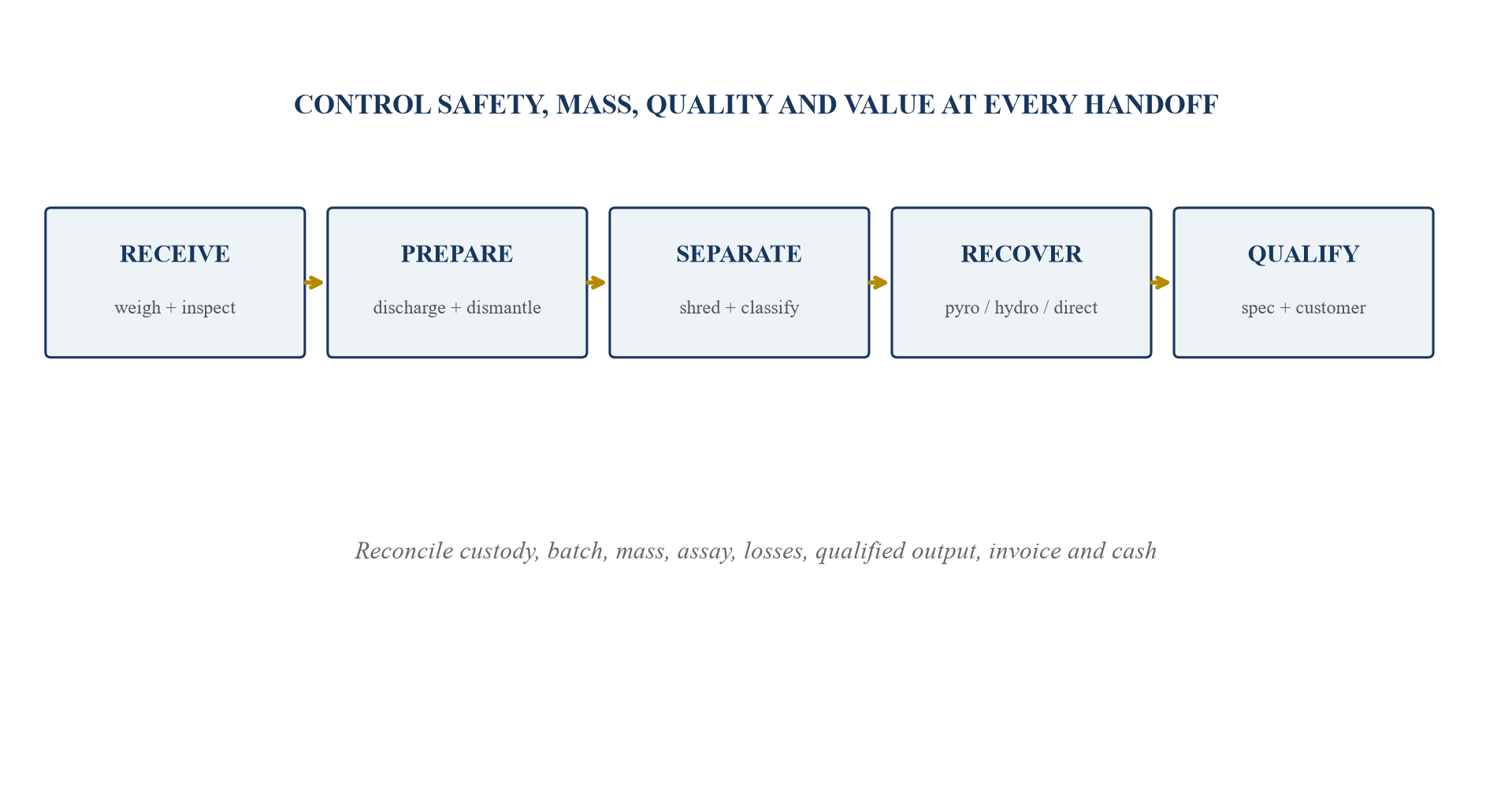
The route should be adapted to chemistry, condition, permits, product strategy and customer qualification.
Each handoff should have acceptance criteria, measurement, owner and exception route. Batch identity should survive blending and rework. Software records should reconcile with physical inventory and laboratory evidence.
Process-control models can recommend settings, detect anomalies or forecast output. Their value depends on reliable actuators, sensor calibration, process stability and operator authority. Changes should be versioned and reversible. Unsafe or out-of-range conditions should invoke engineered protection independent of a predictive model.
17. Define recovery yield precisely
Recovery should state the target element or product, input boundary, output boundary, denominator, period and basis. A percentage of contained lithium recovered is different from total recycling efficiency by weight. A high recovery percentage can coexist with low saleable yield when output is off specification or commercially unattractive.
Yield should be reported by chemistry, input quality, route, batch and product. Blended averages can conceal losses in a growing chemistry or a high-value stream. Recovery measured during stable campaign operation should not be applied to start-up, changeover, maintenance and mixed-feed periods without adjustment.
Uncertainty should cover sampling, assay, weighing, moisture, inventory and unmeasured loss. Financial models should use qualified and paid output after expected deductions. Regulatory reporting should follow the applicable methodology and should remain distinguishable from the internal economic yield used for valuation.
18. Validate assays and laboratory systems
Assay evidence influences supplier payment, process control, recovery claims, product acceptance and revenue. The laboratory system should define methods, calibration, standards, blanks, duplicates, proficiency, retention and approval. Internal and external laboratories should be reconciled where contracts depend on third-party settlement.
Sampling is often the dominant risk. Heterogeneous batteries, black mass and residues require controlled lot definition, increment selection, mixing, splitting and preparation. A model trained on convenient laboratory samples can overstate performance on commercial lots.
Artificial intelligence can detect anomalous spectra, predict slower tests or combine multiple signals. It should be validated against reference methods across relevant concentration and impurity ranges. Use outside the validated domain should trigger confirmation. Contractual settlement should state whether a model output, laboratory result or umpire assay governs.
19. Optimise yield within constraints
Process optimisation should respect product specification, safety, equipment limits, residence time, reagent chemistry, waste and cost. Maximising one recovery metric can increase impurity, reagent use, cycle time or downstream loss. The objective function should reflect net value and constraints rather than isolated percentage recovery.
Historical process data can be biased by operator choice, campaign selection and changing feedstock. Models should separate correlation from actionable control and should be tested through governed trials. Recommended settings need causal plausibility, operating approval and rollback criteria.
Benefits should be measured as incremental qualified output, avoided consumption or additional stable throughput against a controlled baseline. Temporary gains that accelerate corrosion, fouling or maintenance are not durable. Model drift should be monitored when chemistry, supplier, equipment, sensor or reagent changes.
20. Build recovery-yield curves
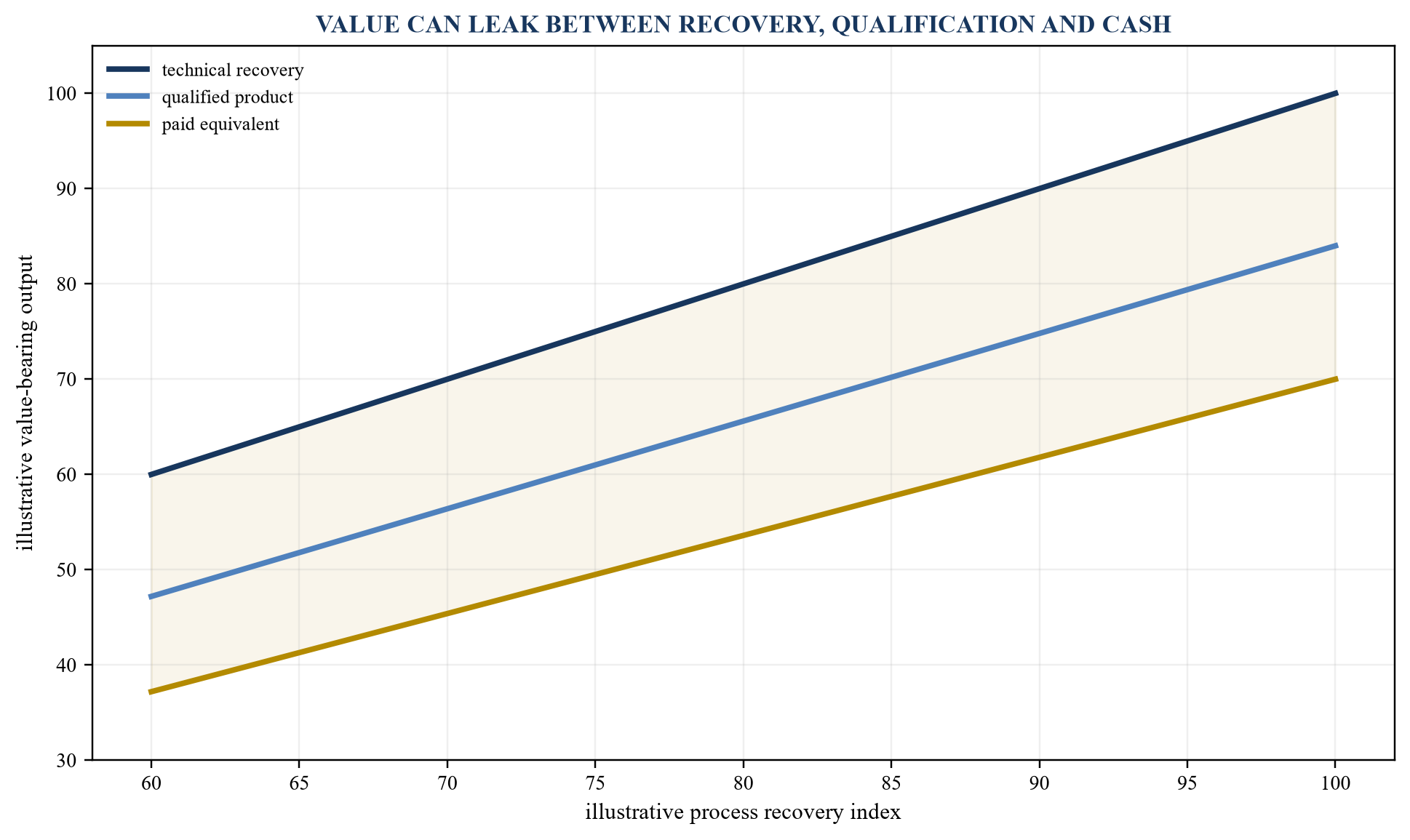
Curves are illustrative; replace them with verified batch evidence, product specifications, prices and costs.
Technical recovery should reconcile to qualified product and paid output. Loss can arise from impurity, moisture, treatment charges, product form, customer rejection, shipment, assay settlement, credit and timing. The commercial bridge should show each deduction separately.
Yield curves should include operating range and confidence. A single best batch should not establish a plant assumption. Ramp, maintenance, changeover and feedstock variability should be included. The downside case should focus on combinations that share a cause, such as low-grade mixed feed increasing reagent, residue and off-specification output together.
21. Identify capacity and bottlenecks
Nameplate capacity should be separated from receipt, preparation, shredding, separation, leaching, purification, crystallisation, drying, packaging, laboratory, storage, wastewater and customer-release capacity. The constrained step can move as feedstock and product change.
Reported throughput should state operating hours, availability, changeover, yield and input mix. A short peak run does not establish annual capacity. Maintenance, cleaning, permitting, waste removal, laboratory turnaround and product holds can consume calendar time.
AI-supported scheduling, predictive maintenance and process control can increase economic capacity when they relieve the actual bottleneck and produce additional qualified output with demand. The valuation should cap benefits at the minimum of available feedstock, constrained processing capacity, qualification and customer demand.
22. Model energy, water, reagents and emissions
Energy, water, acids, alkalis, reductants, solvents and other consumables should be modelled by route, chemistry and product. Recovery improvement can require disproportionate reagent or purification at the margin. Utility availability, quality, price and infrastructure should be verified for the site.
Emissions, wastewater, residue and hazardous streams require measurement, treatment, permits and disposal routes. A material can be physically recovered while other impacts create cost or liability. Life-cycle claims should use defined boundaries and recognised methods; plant-level cash models should include actual tariffs, treatment, monitoring and compliance costs.
Optimisation models can identify operating regions that improve net value or reduce resource intensity. Recommendations should respect permit and safety limits. Savings should be measured against comparable production and adjusted for chemistry, yield, quality, maintenance and output.
23. Govern safety, environmental and closure obligations
Battery recycling combines electrical, fire, chemical, dust, thermal, pressure, transport and waste risks. Hazard analysis should cover normal operation, damaged input, incompatible mixing, equipment failure, loss of utilities, firewater, spill, worker exposure and emergency response.
Permits should match actual materials, capacity, processes, emissions, water and storage. A planned route change or new chemistry may require modification. Compliance evidence should include monitoring, incidents, corrective action, waste destination and financial provisioning where applicable.
Closure and remediation should enter valuation. Inventory, residues, contaminated equipment and site conditions can create obligations after operation stops. Insurance terms, exclusions, deductibles and limits should be reviewed. Technology performance does not remove legal responsibility or the need for engineered safeguards.
24. Qualify recycled products with customers
Customer qualification can require specification, sample history, process audit, traceability, consistency, cell testing and change control. Battery-grade material can take longer to qualify than an intermediate product. The duration, cost, volume and failure path should be reflected in the funding plan.
Specifications should include target composition and relevant impurities, physical form, moisture, packaging and documentation. A product that meets a broad published specification may fail a customer's process. Qualification evidence should identify the exact product, plant, line and production route.
Artificial intelligence can support multivariate quality prediction and early detection, but customer acceptance depends on controlled physical evidence. Letters of intent, sample shipments, approved-vendor status, purchase orders and recurring paid deliveries represent different commercial stages and should not be treated as equivalent.
25. Secure offtake and customer economics
Offtake contracts should define product, specification, volume, forecast, price, benchmark, payability, treatment charge, assay, delivery, title, credit, rejection, warranty and change control. A floor, prepayment or take-or-pay mechanism can affect financeability when enforceable and supported by a credible counterparty.
Customer concentration can be valuable during qualification and dangerous after scale-up. The investor should understand alternative buyers, switching cost, specification transferability and product redirection. A bespoke product with one approved buyer can have lower downside liquidity than a commodity-like intermediate.
Revenue should reconcile shipment, assay, invoice, credit note and cash. Forecast price and volume should remain separate. Non-binding strategic interest should not be valued as contracted demand. Counterparty credit, set-off, claims and working-capital terms can materially change realised value.
26. Model chemistry and commodity exposure
Contained value changes with chemistry and commodity markets. Nickel- and cobalt-bearing batteries can have different gross value from lithium-iron-phosphate batteries, while process, logistics and regulation still create costs. The IEA highlights that chemistry shifts can change recycling economics and may require different business models.
The model should use metal quantities, product form, benchmark, payability, treatment and refining charge, impurity, recovery, timing and currency. Inventory and contract lags can create exposure between feedstock purchase and product sale. Hedging feasibility depends on the product and basis risk.
Scenarios should combine chemistry mix and market price where related. A lower-value chemistry mix can reduce feedstock purchase price and can also increase tolling or producer-paid service demand. The business model should identify who bears negative material value, compliance cost and price volatility.
27. Price feedstock and products consistently
Feedstock can be purchased for a positive price, accepted for a gate fee, processed under tolling or supplied through a revenue-sharing formula. The pricing basis should connect to measured composition, recovery, benchmark, cost and contractual deductions. A fixed price can create margin volatility when chemistry or commodity price changes.
Product price should reflect the exact material and location. Contained-metal value is a starting point, not cash revenue. Conversion to a payable amount requires recovery, quality, benchmark, payability, treatment, transport, assay settlement, credit and timing.
Models should avoid using a high product price and a low feedstock price from different market states. Historical margins should be decomposed into operational performance and market movement. A defendable valuation uses through-cycle or scenario economics and identifies structural advantage separately.
28. Build the circular-value bridge
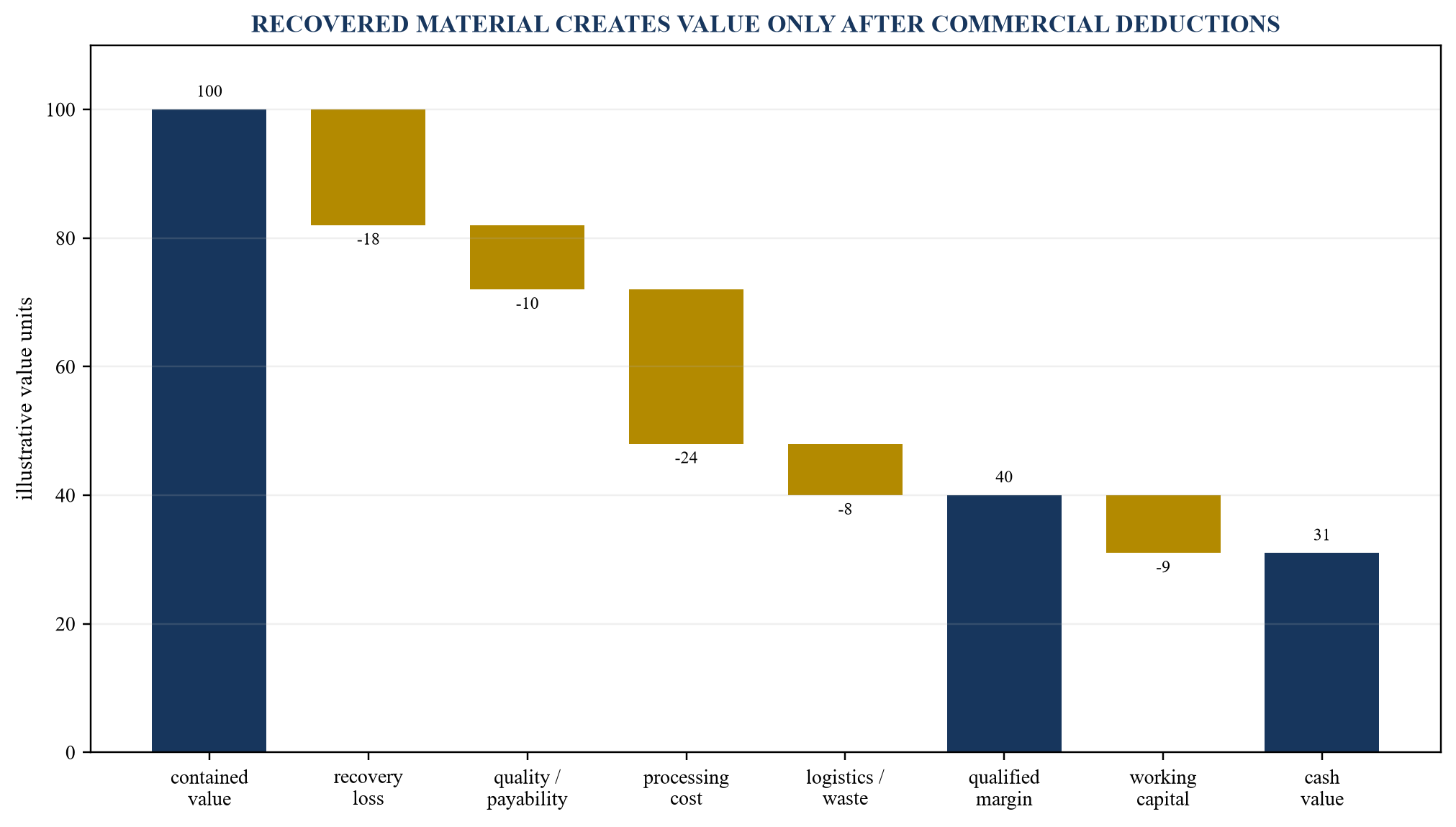
Values are illustrative; replace them with verified contracts, assays, yields, prices, costs, tax and working capital.
The bridge should begin with verified input and end with cash. Recovery loss, qualification, pricing, processing, logistics, waste, working capital, tax and continuing investment should remain explicit. Circular or strategic importance does not itself establish investor return.
The bridge should be built by chemistry, product and contract before aggregation. Cross-subsidy can conceal an uneconomic stream. Producer fees, policy support, grants or credits should be shown separately from product margin and tested for eligibility, duration and change.
29. Control inventory and working capital
Inventory can include received batteries, quarantine, dismantled components, black mass, solution, intermediate products, finished product, retained samples, residues and goods in transit. Each stage carries different value, hazard, title and liquidity. Quantity and value should reconcile to physical records.
Working capital can expand during ramp because feedstock is paid before processing, customer qualification delays sale and assay settlement delays cash. Commodity prices can move while inventory is held. Financing should consider eligibility, control, insurance, valuation, ageing and liquidation route.
Artificial intelligence can improve arrival forecasting, scheduling and inventory visibility. Benefits should appear as lower ageing, fewer shortages, reduced emergency handling or faster cash conversion. The downside model should include quarantine, rejected product, unavailable disposal and counterparty delay.
30. Govern capex, commissioning and scale-up
The capital plan should separate land, buildings, process equipment, laboratories, utilities, environmental controls, storage, fire protection, software, engineering, commissioning, spares, owner cost and contingency. Expansion around a bottleneck should include the dependencies needed to use the new capacity.
Commissioning should progress through mechanical completion, utilities, safe operation, first feed, stable campaigns, mass balance, product qualification and commercial acceptance. Schedule evidence should identify critical path, permits, vendors, long-lead items and accountable owners.
Scale-up assumptions should reflect actual maturity. Pilot yield, batch operation and supplier guarantees should not automatically become continuous annual performance. Funding should cover ramp loss, working capital and corrective investment. Milestone releases can connect capital to verified tonnes, yield, quality and customer approval.
31. Build unit economics by stream
Table 3. Battery-recycling unit-economics framework
| Driver | Required measure | Downside question |
|---|---|---|
| feedstock | delivered tonnes, composition and net price | what volume and quality are controlled? |
| conversion | availability, yield, consumables and labour | what changes during mixed feed and ramp? |
| product | qualified tonnes, payability and customer | what is rejected, discounted or delayed? |
| overhead | site, compliance, laboratory and systems | what cost remains below utilisation? |
| working capital | inventory days, settlement and credit | how much cash funds the cycle? |
| sustaining capex | replacement, maintenance and controls | what investment preserves performance? |
Model each chemistry, feedstock form, route and product before calculating a portfolio average.
Unit economics should use tonnes that correspond to the actual commercial denominator. Revenue per input tonne, cost per processed tonne and margin per qualified output tonne answer different questions. Conversion between them requires measured yield.
Fixed and variable cost should be separated and tested across utilisation. The model should include downtime, rework, residue, laboratory, compliance and customer claims. Corporate allocations should not obscure site cash needs. Reconciliation to financial statements and production records should be repeatable.
32. Value the equity through evidence-gated cash flow
Equity value should begin with cash flows supported by current assets, contracts, permits, capability and remaining capital. Forecast feedstock, utilisation, recovery, qualification, price, cost, working capital, capex, tax and liabilities should each have an evidence status and scenario range.
The forecast should preserve the sequence of industrial proof. Feedstock may arrive before the plant reaches stable operation; qualified product may lag physical output; cash collection may lag qualification and shipment. A model that starts with steady-state margin can omit the funding consumed by commissioning losses, inventory, customer trials and delayed settlements. Monthly modelling during ramp can reveal liquidity needs concealed by annual averages.
Discounted cash flow can be complemented by transaction and trading evidence when business model, maturity, growth, margin, geography and risk are comparable. Capacity multiples can mislead when plants have different feedstock control, process scope, product quality, utilisation and capital still required.
Technology options, future plants and new products should be valued as gated opportunities. Probability, timing, required capital, dilution and correlation should be explicit. Strategic supply-chain value can influence an acquirer and should be supported by credible synergies, scarcity or avoided cost rather than a generic premium.
Terminal value should reflect the durability of feedstock access, process relevance, customer position, environmental compliance and sustaining capital. Chemistry change can reduce the value of a fixed route or create demand for a flexible platform. Asset life, closure cost and future permitting should be consistent with the forecast horizon. Equity value should be presented as a range with clear drivers, not as precision created by a complex model.
33. Stress the equity case
Table 4. Battery-recycling valuation sensitivity matrix
| Risk | Base evidence | Downside treatment |
|---|---|---|
| feedstock delay | contracts and cohort forecast | slower utilisation and higher unit cost |
| chemistry shift | source mix and market outlook | lower contained value or route change |
| recovery shortfall | commercial batch history | lower qualified output and more residue |
| qualification delay | customer plan and samples | later revenue and higher working capital |
| price and payability | contract formula and benchmarks | lower net revenue and inventory value |
| scale-up overrun | engineering and commissioning | more capex, delay and dilution |
Scenario combinations should follow causal relationships and preserve transparent assumptions.
Sensitivity should include combined cases. Feedstock shortage can reduce utilisation and increase purchase price. Mixed or low-value chemistry can reduce product revenue and increase processing complexity. Qualification delay can defer revenue while inventory and debt service continue.
The model should identify break-even feedstock, yield, price, utilisation and working capital. Liquidity runway should be tested before the business reaches stable operation. Downside recovery should consider equipment resale, technology transfer, contract portability, inventory and environmental obligations.
34. Choose the business model deliberately
A recycler can earn from recovered product, tolling, gate fees, producer services, licensing, equipment, software or a combination. Each model allocates feedstock, commodity, performance, capex and customer risk differently. Revenue quality should be evaluated by obligation and cash mechanism.
Vertical integration with manufacturers or refiners can secure feedstock and offtake while increasing concentration and transfer-pricing complexity. An independent model can diversify counterparties and may face stronger competition for material. Joint ventures can combine rights and capabilities and require clear governance, funding and exit terms.
AI products should have a defined buyer and measurable outcome. An internal optimisation capability can improve plant economics; a software product requires repeatable deployment, data rights, service, liability and customer willingness to pay. The valuation should avoid counting the same capability both in plant margin and separate software revenue without evidence.
35. Prepare the investor data room
Table 5. Battery-recycling investor data room
| Workstream | Core evidence | Verification test |
|---|---|---|
| feedstock | contracts, cohorts, chemistry and delivery history | reconcile rights to received tonnes |
| plant | design, permits, capacity, downtime and maintenance | reproduce constrained throughput |
| recovery | batches, assays, mass balance and model validation | trace input to qualified output |
| customers | specifications, qualification, orders and invoices | trace approval to recurring cash |
| finance | unit economics, working capital, capex and tax | reconcile model to statements and records |
| obligations | safety, waste, emissions, insurance and closure | identify liabilities and funded controls |
Evidence should be controlled, current and reconciled across technical, commercial, financial and regulatory workstreams.
Summaries should link to controlled records. Version, date, owner and approval should be visible. Management forecasts should state assumptions and should remain separate from historical evidence. Exceptions and incidents should be disclosed with materiality, remedy and completion evidence.
Independent sampling can test feedstock, inventory, assay, mass balance, yield and product. Site observation should compare reported operation with actual receipts, storage, equipment, laboratory, waste and maintenance. Open issues should identify impact, owner, action, cost and closing condition.
36. Adapt the model to geography and regulation
Feedstock ownership, waste status, transport, export, producer responsibility, permitting, labour, utilities, customer location and policy differ by jurisdiction. A plant's economic catchment should be based on lawful and competitive routes rather than a simple radius.
The European Union Batteries Regulation sets life-cycle obligations and progressive recycling-efficiency, material-recovery and recycled-content requirements. United States federal and state requirements affect universal waste, hazardous waste and transport. Basel Convention controls and national implementation can affect cross-border movement. Each project requires current legal review.
Policy can support collection, infrastructure and demand and can also add reporting, traceability and capital requirements. Forecast support should be tied to enacted and applicable mechanisms. Regulatory advantage should be tested for durability, compliance cost and competitor response.
37. Structure financing and strategic partnerships
Early plants may need equity because feedstock, scale-up, qualification and cash flow are uncertain. Project or asset-based debt becomes more credible when permits, construction, supply, offtake, performance, insurance and downside rights are established. Grants and strategic capital can support defined milestones and may carry conditions.
The capital stack should match the risk that each provider can bear. Equipment finance may cover identifiable assets while sponsor equity funds technology, ramp and contingency. Working-capital facilities require controlled inventory, receivables and borrowing-base definitions. Customer prepayments or supplier credit can reduce cash need and can introduce concentration, set-off, exclusivity or performance obligations that affect equity value.
Financing documents should define permitted process changes, capex, additional debt, related-party transactions, reporting and distributions. Material feedstock, customer or technology concentration should be visible. Reserve and liquidity requirements can cover ramp, maintenance, environmental obligations and working capital.
Strategic partners should contribute verified rights, demand, technology or infrastructure. Exclusivity and control can constrain alternative customers or investors. Joint-development intellectual property, data rights, foreground improvements, licence scope and termination should be settled before valuation assumes broad ownership.
Milestones should measure commercial evidence rather than activity. Examples include permitted mechanical completion, stable campaign hours, reconciled mass balance, independently verified recovery, customer-qualified lots, recurring paid deliveries and agreed working-capital performance. Financing should also define the consequence of delay, underperformance or a change in chemistry. Governance rights, information access and corrective capital should remain usable before liquidity becomes critical.
38. Monitor performance after investment
Reporting should reconcile feedstock receipts, chemistry, inventory, throughput, availability, recovery, product quality, customer acceptance, revenue, cash, incidents, waste and capital. Current results should be compared with prior forecasts and investment milestones.
Model monitoring should cover input drift, classification, prediction error, operator overrides and realised outcome. A stable aggregate metric can conceal failure in a new supplier or chemistry. Material methodology changes should require approval and should preserve historical comparability.
Board reporting should identify causes, actions and cash consequences. Strong recovery with weak qualification, high throughput with low mass reconciliation, or revenue growth with expanding working capital can indicate value leakage. Independent review can increase when thresholds or incidents arise.
39. Execute a one-hundred-day value plan
The first phase should reconcile feedstock rights, permits, plant capacity, inventory, mass balance, customers and liquidity. The second should validate classification, assays, recovery, quality, unit economics and models. The third should approve focused actions on bottlenecks, contracts, working capital, capex and governance.
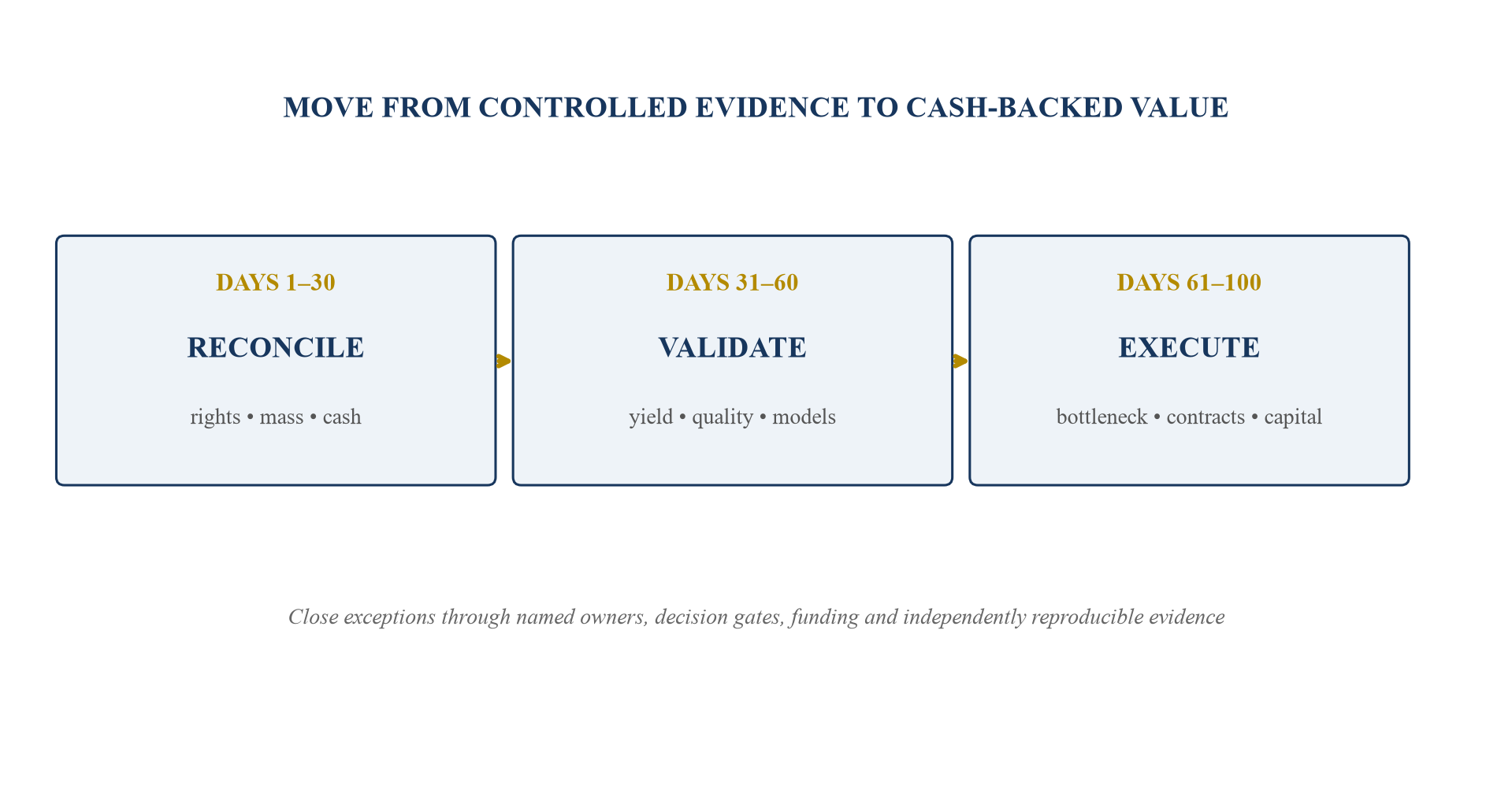
Sequence and gates should be adapted to transaction scope, plant maturity, evidence gaps and liquidity.
Workstreams should have accountable technical, operational, commercial, finance, legal, safety and data owners. Weekly reviews should close material evidence gaps and preserve one definition set. Benefits should be measured against controlled baselines and converted to cash-flow consequences.
The plan should begin with liquidity and safety because delay in either can destroy option value. Immediate controls can include segregating unknown inventory, confirming lawful storage, preserving customer qualification, locking data extracts and freezing inconsistent metric definitions. Quick wins should be accepted only when they do not weaken process control, maintenance or compliance.
Readiness is achieved when feedstock, process, recovery, product, customer and value claims can be reproduced from controlled records. Uncertainty can remain when it is explicit, stressed, funded and governed. The plan should avoid launching multiple technology initiatives before the constrained commercial problem is identified.
The closing review should compare the original investment case with verified evidence and approved actions. It should state what changed, what cash or risk consequence follows, which benefits are realised, which remain forecast, and what capital is still required. A continuing scorecard can then move into board and lender reporting without creating a second set of definitions.
40. Conclusion
Battery-recycling equity value depends on a complete chain from lawful feedstock rights to realised cash. Identity, chemistry, condition, timing and collection determine the inputs. Safe preparation, process route, mass balance, recovery and quality determine the physical outputs. Customer qualification, pricing, working capital, capital and obligations determine the return to investors.
Artificial intelligence can strengthen classification, sorting, process control, assay interpretation, maintenance, scheduling and forecasting. Its outputs should remain traceable to controlled data and physical outcomes. Technical accuracy creates financial value when it changes qualified yield, stable capacity, cost, risk or cash.
Recovery percentage should not be confused with saleable yield or payability. Announced capacity should not be confused with available feedstock or constrained commercial throughput. The defendable case reconciles each claim through mass, quality, contract, invoice and cash.
Investors should apply the framework proportionately. A tolling plant with committed input and output requires different evidence from a technology company scaling direct recycling. Both require clear boundaries, current permits, reproducible evidence, explicit uncertainty and a funded path to stable operation.
Actual results should replace broad assumptions as operations mature. Cohort feedstock, batch recovery, customer settlement and maintenance history can refine the model. Weak evidence should produce lower value, more capital protection or a delayed decision. Strong evidence can support more efficient capital and disciplined growth.
The practical standard is reproducibility. An independent reviewer should be able to select a received lot, verify its identity and commercial rights, follow its controlled transformation, reconcile target materials and losses, inspect qualification and settlement, and trace the resulting cash. That path exposes where technology, contracts, operations and finance agree or diverge. It also creates the management information required to allocate capital toward the process, customer and chemistry combinations that generate resilient value.
References
- International Energy Agency, Global EV Outlook 2026: Electric vehicle batteries, https://www.iea.org/reports/global-ev-outlook-2026/electric-vehicle-batteries
- International Energy Agency, Global Critical Minerals Outlook 2026: Executive summary, https://www.iea.org/reports/global-critical-minerals-outlook-2026/executive-summary
- International Energy Agency, Recycling of Critical Minerals: Executive summary, https://www.iea.org/reports/recycling-of-critical-minerals/executive-summary
- International Energy Agency, Battery Circularity, https://www.iea.org/reports/battery-circularity
- European Union, Regulation (EU) 2023/1542 concerning batteries and waste batteries, https://eur-lex.europa.eu/eli/reg/2023/1542/oj
- European Commission, New rules to boost recycling efficiency from waste batteries, https://environment.ec.europa.eu/news/new-rules-boost-recycling-efficiency-waste-batteries-2025-07-04_en
- European Commission, Batteries: implementation of the Batteries Regulation, https://environment.ec.europa.eu/topics/waste-and-recycling/batteries_en
- European Commission, Commission Delegated Regulation (EU) 2025/606 on recycling efficiency and recovery methodology, https://eur-lex.europa.eu/eli/reg_del/2025/606/oj
- European Commission Joint Research Centre, JRC support to the EU Battery Regulation, https://rmis.jrc.ec.europa.eu/RM4CleanIndustrialDeal
- European Commission Joint Research Centre, Harmonised rules for calculation and verification of recycled content in batteries, https://publications.jrc.ec.europa.eu/repository/handle/JRC146717
- European Commission, Digital Product Passport for batteries, https://single-market-economy.ec.europa.eu/single-market/digital-product-passport/batteries_en
- United States Environmental Protection Agency, Lithium-Ion Battery Recycling Frequently Asked Questions, https://www.epa.gov/hw/lithium-ion-battery-recycling-frequently-asked-questions
- United States Environmental Protection Agency, Used Lithium-Ion Batteries, https://www.epa.gov/recycle/used-lithium-ion-batteries
- United States Environmental Protection Agency, Lithium-Ion Battery Recycling, https://www.epa.gov/hw/lithium-ion-battery-recycling
- United States Department of Energy, ReCell Center focus areas: direct cathode recycling and material separation, https://www.energy.gov/cmei/vehicles/articles/recell-center-focus-areas-direct-cathode-recycling-and-other-materials
- Argonne National Laboratory, EverBatt battery life-cycle model, https://everbatt.amd.anl.gov/
- Argonne National Laboratory, EverBatt battery recycling module, https://publications.anl.gov/anlpubs/2019/07/153050.pdf
- United Kingdom Department for Business and Trade, Vision 2035: Critical Minerals Strategy, https://www.gov.uk/government/publications/uk-critical-minerals-strategy/vision-2035-critical-minerals-strategy
- United Kingdom Department for Business and Trade, UK Battery Strategy, https://www.gov.uk/government/publications/uk-battery-strategy/uk-battery-strategy-html-version
- Basel Convention, Technical guidelines on environmentally sound management of waste batteries other than lead-acid batteries, https://www.basel.int/Implementation/Wastebatteries/DevelopmentofOWBTGs/tabid/9671/Default.aspx
- Basel Convention, Practical guidance on inventories of waste batteries containing lithium, https://www.basel.int/Portals/4/download.aspx?d=UNEP-CHW-NREP-INVENT-GUID-LithiumBatteriesWaste-2022.English.pdf
- United Nations Economic Commission for Europe, Manual of Tests and Criteria, Revision 8 and Amendment 1, https://unece.org/transport/dangerous-goods/rev8-files
- International Organization for Standardization, ISO 59020 Circular economy: Measuring and assessing circularity performance, https://www.iso.org/standard/80650.html
- International Organization for Standardization, ISO 59014 Sustainability and traceability of the recovery of secondary materials, https://www.iso.org/standard/80651.html
- International Organization for Standardization, ISO 22095 Chain of custody: General terminology and models, https://www.iso.org/standard/72532.html
- International Valuation Standards Council, International Valuation Standards, https://ivsc.org/standards/
