

1 The financing decision
An investment committee evaluating forecasting software for a renewable portfolio needs a defined financial decision. The decision may concern approving a subscription, funding integration, increasing a facility, refinancing an operating asset or acquiring a forecasting business. Each decision requires a different cash perimeter. Establish the relevant borrower, assets, contracts, decision horizon and financing constraints before evaluating a technology claim.
The proposed framework asks how a forecast changes an action, how that action changes a payment, and which entity retains the payment difference. It then tests whether the benefit survives the conditions used to size debt. A model can reduce forecast error during ordinary weather and produce little useful improvement when generation is low, prices are adverse or the plant is constrained. Those outcomes belong in the financing appraisal.
Describe the existing process precisely. Identify the incumbent forecast, nomination or dispatch decision, settlement arrangement, service cost and escalation procedure. Specify the proposed change and the budget needed to operate it. This baseline supports a comparison of complete operating alternatives, including a decision to retain the existing service. An accuracy percentage without that baseline provides insufficient information for the proposed investment assessment.
This paper develops an original analytical framework and hypothetical calculations. Its output is a proposed decision record connecting technology evidence to asset cash and financing assumptions. It supplies no empirical claim that AI increases renewable debt capacity and no assurance that a lender accepts the methods or figures presented here. Actual terms require the relevant financing parties, contracts and professional review.
2 Evidence and scope
AEMO's Participant Forecasting FAQ describes the use and assessment of participant dispatch self-forecasts for wind and solar generation. Its published 2023 procedure compares submitted forecasts with the relevant operator forecasts, with initial and ongoing assessment. The procedure is explicitly concerned with five-minute-ahead dispatch forecasts and records the participant's coordination responsibility [1, 2]. That scope differs from a multi-year financing projection.
Renkema, Brinkel and Alskaif study conformal prediction and uncertainty-aware photovoltaic bidding in a 2024 research manuscript [3]. Uniejewski and Ziel's revised 2026 paper examines probabilistic renewable and load inputs in German day-ahead price forecasting [4]. These studies support examining uncertainty and the decision receiving the forecast. Their reported results establish no performance estimate for an asset considered under this paper's framework.
Sharma and colleagues compare a long short-term memory model with simpler probabilistic solar approaches [5]. The SUMMER-GO technical report and the WRF-Solar ensemble report discuss probabilistic solar forecasting and its operational use [6, 7]. Their respective datasets, applications and evaluation designs need to remain attached to their findings. The present paper uses these sources as research context and transfers no headline improvement into its cash calculations.
World Bank infrastructure-finance guidance describes project financing through an asset-specific vehicle and the role of project cash flows and contractual arrangements [8]. NIST's AI Risk Management Framework provides a voluntary governance reference [9]. Neither supplies the illustrative loan terms below. The framework, readiness levels, acceptance factors and commercial roadmap are author proposals requiring validation in any actual application.
3 Define the cash perimeter
Begin with the legal entity whose debt is under consideration. Identify its electricity-sale agreement, balancing or nomination responsibilities, operating costs, taxes, reserves and cash-distribution restrictions. An optimisation benefit earned elsewhere in the corporate group cannot automatically be treated as cash available to this borrower. A proposed transfer requires executable terms and an account of the payment obligations involved.
Map the physical assets to the contracts. For each plant, record what volume is delivered, how price is determined, who forecasts, who submits commitments and who settles deviations. Include any aggregator, offtaker or optimisation provider. Several assets can share a software platform while retaining different cash rights. A portfolio view should preserve those differences before aggregating financial results.
Specify the unit of comparison. Forecast error may be measured in megawatts, energy deviations in megawatt-hours, settlement cost in currency and debt service over a contractual payment period. Maintain the necessary conversions and time alignment. An annual financial model should be traceable to the settlement intervals used to construct it, with exclusions and estimation methods documented.
The proposed financing record also separates unrestricted cash from collateral or reserve balances. A reduction in settlement cost can coincide with a higher working-capital requirement or a new service deposit. Record that timing explicitly. A lender reviewing debt capacity needs the money available for its payment schedule, together with the resources needed to keep the asset and forecasting process operating.
4 Identify the decisions that forecasting changes
A weather forecast can inform a generation forecast, which can inform a nomination, dispatch schedule, maintenance decision or hedge. Describe the specific decision receiving the new information. The operating team should identify the permitted actions, decision deadlines, physical constraints and objective. The proposed test evaluates the full chain associated with that decision, using information available before the deadline.
Separate forecasting from optimisation. A forecast expresses a prediction or distribution. An optimiser selects an action subject to an objective and constraints. An execution system implements the action. Their contribution can be assessed independently by keeping two components fixed while changing the third. This experimental design is an author proposal intended to identify the source of an apparent cash difference.
Different horizons require different comparisons. A five-minute dispatch forecast, a day-ahead nomination and an annual resource assessment can use different data and serve different obligations. A successful short-horizon evaluation supplies evidence for its tested application. Extending it to another horizon requires further validation. A financing submission should state the actual horizon and the operating decisions from which projected cash is derived.
Account for actions unavailable to the project. An idealised benchmark might assume unconstrained trading, unlimited storage or perfect market access. The borrower may have none of those rights. Restrict the simulation to its signed contracts, permitted products and actual operating capabilities. Record any proposed capability as a separate investment requiring cost, approval and an appropriate implementation scenario.
5 Preserve information available at the decision time
The proposed evaluation keeps a historical record of forecast creation, receipt, decision and settlement. Record the weather-model vintage, asset measurements, availability information, software version and publication time. Later revisions should remain separate from the information used for the decision. This record allows a reviewer to examine whether the simulation could have operated under the tested conditions.
Choose training and evaluation periods in time order. Specify how a model is updated and which data each update can access. Hold the decision process fixed during a defined evaluation window or document the change. A comparison should disclose missing inputs, rejected submissions, late forecasts and periods using a fallback. Dropping difficult intervals can materially change the measured result and should be visible.
Use the incumbent forecast as the operational benchmark where records are available. Add a simpler baseline with a stated construction method to assess the marginal value of additional complexity. Evaluate each on the same admissible intervals, decisions and prices. If an incumbent forecast archive is absent, explain that limitation; reconstructing a historical baseline requires its own assumptions and cannot establish an observed head-to-head result.
AEMO's assessment materials demonstrate the importance of submission timing and comparison with operator forecasts within their specific dispatch process [1, 2]. The proposed financing method extends the evidence question to the commercial decision time. The operator's acceptance and a lender's cash-flow acceptance are separate determinations, each requiring the relevant process and decision maker.
6 Measure prediction quality and decision cost separately
Use technical measures suited to the forecast output. A point forecast can be assessed for bias and error magnitude. A probabilistic forecast requires a review of its distribution, calibration and decision-relevant tails. State the metric definition, evaluation window and aggregation method. Provide the underlying observations and predictions to an authorised reviewer where data rights permit.
The proposed financial benchmark replays the permitted decision against each forecast and calculates the resulting payment under the same settlement assumptions. Include the forecast subscription, integration, monitoring, operator effort and fallback costs. Keep market price and asset availability consistent across alternatives. A lower forecast error becomes financially relevant through that explicit decision and payment calculation.
Inspect errors when cash exposure is greatest. The same energy deviation can receive different economic weights across intervals because prices and contractual terms differ. Present error and settlement-cost distributions together, retaining their timestamps. The proposed report separates an ordinary operating summary from specified high-exposure periods and explains why those periods matter to the selected financing case.
Any simulated decision profit should be reported with its execution assumptions. Include transaction costs, delays, rejected actions and relevant constraints. A research result using a particular bidding strategy [3] is evidence about that study's design. The asset owner needs a separate evaluation of its own contracts and operational rights before estimating a retained benefit. No performance claim from the cited literature is used as a percentage uplift here.
Table 1. Proposed evidence from forecast to borrower cash
| Layer | Question | Evidence | Financial treatment |
|---|---|---|---|
| Forecast | What was available before the decision? | Versioned forecast and input times | No automatic cash uplift |
| Decision | Which action could change? | Permitted strategy and replay | Apply actual constraints |
| Settlement | Which payment changes? | Metering, contracts and statements | Reconcile interval cash |
| Allocation | Who retains the benefit? | Executable payment terms | Include borrower share only |
| Cost | What is required to operate? | Service and continuity budgets | Deduct incremental costs |
| Finance | Which downside benefit is accepted? | Reviewed sizing assumptions | Recalculate debt capacity |
Author-developed review matrix. Actual permissions, payments and financing acceptance depend on the relevant records and agreements.
7 Construct a technology-readiness progression
The proposed readiness progression has six levels: a defined use case, a reproducible data history, an offline benchmark, shadow operation, controlled use and finance review. Each level has an evidence requirement and an accountable decision. Advancement requires review of the preceding evidence. The levels are an author-developed approval sequence, with no measured maturity score, certification or prescribed duration.
At the first level, define the commercial decision, borrower and cash rights. At the second, demonstrate that input and forecast vintages can be reconstructed. At the third, compare alternative models through a consistent decision replay. Technical and financial metrics should have compatible evaluation windows. Independent review should be able to rerun the comparison and reconcile its payment calculation.
Shadow operation tests the service under actual data arrival and operating processes while the approved incumbent retains decision authority. Record the proposed actions, exceptions, missing inputs and support work. Controlled use then requires an authorised operating scope, fallback arrangements and the applicable market permissions. A change to the model, decision rights or asset perimeter requires a recorded review.
The final level concerns financing evidence. Reconcile retained cash, document downside performance and obtain the relevant lender's determination of what the debt model can include. A service can pass its technical review while receiving no incremental debt credit. That outcome remains a valid result of the framework and should be reflected accurately in the investment decision.
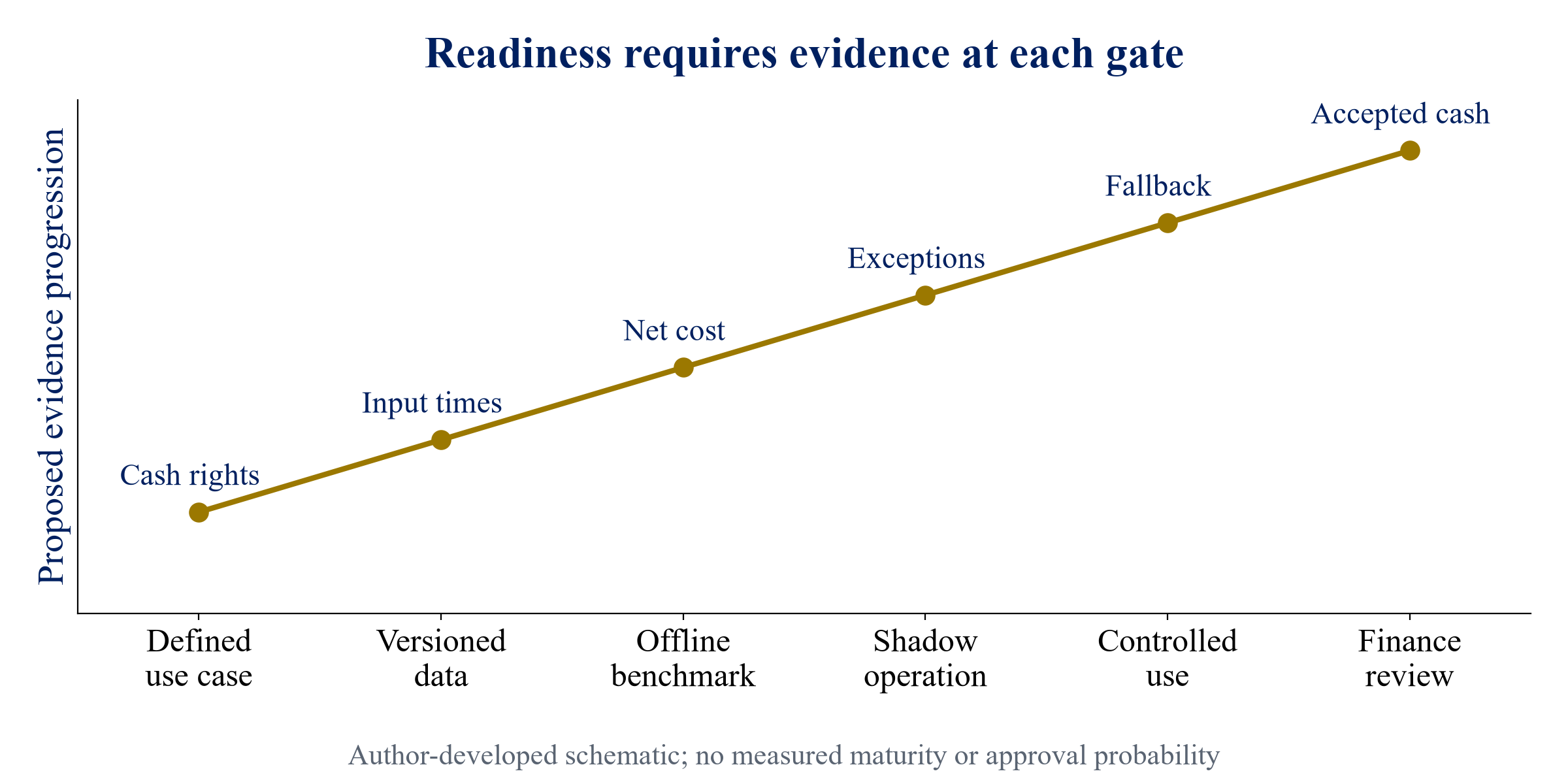
Author-developed evidence levels. The schematic curve represents progression through review gates; it reports no observed technology maturity or probability of financing approval.
8 Establish contractual ownership of the benefit
Review the electricity-sale and balancing arrangements before claiming an asset-level saving. Determine which party bears deviations and which party receives any resulting payment improvement. A fixed-price arrangement, an aggregator service and direct market participation can allocate cash differently. This paper assumes no universal allocation; the proposal follows the actual agreement and its reconciliation mechanism.
A forecasting provider's fee can absorb part of the improvement. Record fixed subscriptions, usage charges, revenue shares and performance fees. State their calculation base and timing. A fee applied to gross settlement improvement produces different cash from a fee applied after operating costs. The proposed model makes those differences explicit and uses the payment actually owed under the evaluated scenario.
Account for dependencies between contracts. An offtaker may control nominations while the asset owner purchases a forecast service. Using the forecast might require an amendment, data permission or operating consent. Until those rights exist, model implementation as a conditional case. Describe the remaining action and its cost, with the affected projected benefit identifiable in the financing submission.
Qualified advisers should review enforceability, termination, assignment, data access and lender-relevant continuity provisions. The analytical question is how the borrowing entity obtains and retains cash throughout the financing period. A contract review can reveal that a proposed service improves group economics while the project receives no share. Debt sizing should preserve that result rather than importing a consolidated benefit.
9 Evaluate generation and price together
The financing scenario should connect generation, prices and forecasting error in time. Independently selecting favourable values for each can produce a cash case with little relationship to the tested operating conditions. The proposed evaluation uses aligned histories where available and documents the assumptions used to construct stresses. The model should retain how low production, price exposure and forecast failures interact.
Portfolio aggregation requires the same discipline. Several plants can share a weather region, grid constraint, offtaker or data provider. An apparent reduction in average error may leave exposure to a common event. Test the joint portfolio payment, including concentrations, without assuming that plant-level errors offset. Any diversification benefit needs an evidenced calculation and an explanation of its dependencies.
Uniejewski and Ziel examine probabilistic renewable and load inputs within German price forecasting [4]. That research provides context for considering uncertain inputs together. It establishes no correlation assumption for this paper's hypothetical portfolio. The proposed cash model needs asset-specific evidence and an explicit process for treating missing data, structural changes and unobserved extreme conditions.
Keep scenario construction distinct from probability claims. A selected severe operating case can be useful for decision review without a stated return period. Calling it a percentile requires a defensible distribution and estimation method. The worked example below uses an author-selected stressed cash case, with no claim that it represents a lender's P90 methodology or a measured loss probability.
10 Include curtailment and asset availability
Generation potential, metered delivery and contractual revenue can differ. A plant can have available renewable resource while a network constraint limits delivery. Equipment availability and maintenance can also affect output. Record these states separately in the proposed evaluation. Otherwise, a forecast may be assessed against an outcome influenced by decisions or physical limitations outside the forecast's intended scope.
Choose a documented treatment for constrained intervals. Technical evaluation might require an estimate of unconstrained possible power, while the financial evaluation follows actual permitted delivery and payment. Retain both datasets and their purpose. An estimated possible-power series is modelled evidence with its own uncertainty. It should not be described as directly observed generation if the relevant production did not occur.
AEMO's published assessment procedure addresses the forecast's dispatch point, local limits and reliability and accuracy requirements within its stated five-minute process [2]. These provisions are market-specific. They do not establish the cash treatment of curtailment in a different asset contract. The proposed financing appraisal obtains that treatment from the actual project agreements and operating records.
The service cost model should also account for changes to asset telemetry and availability feeds. Forecast performance can depend on reliable information about equipment state. Budget the required integration and its maintenance, and identify the responsible operator. A forecasting contract evaluated in isolation can omit expenditure needed to reproduce the conditions under which its proposed result was obtained.
11 Define the cash bridge
The proposed cash bridge begins with the baseline payment under the existing process. Apply the decision change, calculate the settlement difference, allocate the borrower's contractual share, and deduct incremental service and operating costs. Adjust for required cash reserves or working-capital timing separately. Every step should have a calculation, data reference or explicitly stated modelling assumption.
Use cash available for debt service consistently. For this paper's illustration, the stated operating deductions include all assumed non-financing cash charges and any taxes included in the scenario. The example has no separate tax model or jurisdictional tax claim. Actual financing models need their agreed definition, including the treatment of reserves, working capital and distributions.
Present gross and net benefits together. A USD 300,000 reduction in assumed imbalance cost, combined with USD 120,000 of incremental annual service and operating expenditure, produces USD 180,000 of net annual cash improvement. This arithmetic is an author-selected example. It says nothing about the likely saving, price or cost of an actual provider.
Reconcile the bridge to settlement and accounting records during a pilot. Distinguish invoiced payments, collected cash and accruals. A forecast-supported benefit should remain traceable after statements are revised or disputes are settled. The proposed governance process keeps estimated, invoiced and collected amounts separately, providing a consistent basis for subsequent investment and financing review.
12 Set the hypothetical ordinary operating case
Assume annual delivered generation of 100 gigawatt-hours, equivalent to 100,000 megawatt-hours, and an average realised price of USD 80 per megawatt-hour. Gross receipts are USD 8.000 million. Assume USD 1.700 million of non-financing cash deductions and USD 0.800 million of baseline imbalance cost. Cash available for debt service is therefore USD 5.500 million before the proposed forecasting service.
In the improvement case, hold generation, price and the underlying non-financing deductions constant. Assume the permitted decision process reduces imbalance cost to USD 0.500 million. Add USD 0.120 million for the service and incremental operating requirements. Cash available for debt service becomes USD 5.680 million. The net annual improvement is USD 0.180 million, comprising USD 0.300 million of gross saving less the additional expenditure.
This construction deliberately isolates one mechanism. It assumes the borrower retains the full settlement improvement, the new service operates throughout the year and no additional collateral is required. It omits transaction-specific tax calculations, inflation, degradation and construction risk. These are author assumptions, with no measured forecasting accuracy or operating data used to justify the selected saving.
For an actual portfolio, replace those assumptions with an interval-level calculation and the borrower's contractual allocation. Reconcile delivered energy, realised price and operating deductions to the evaluated period. Record implementation costs separately from annual charges. A credible submission should explain how the proposed process produces the payment difference and what evidence supports its persistence beyond the evaluation window.
13 Build the hypothetical stressed case
The stressed case assumes delivered generation of 90 gigawatt-hours and an average realised price of USD 70 per megawatt-hour. Gross receipts are USD 6.300 million. Hold the underlying non-financing deductions at USD 1.700 million and assume baseline imbalance cost of USD 1.000 million. Cash available for debt service is USD 3.600 million. This is a selected scenario, with no assigned likelihood.
Assume the new service reduces stressed imbalance cost to USD 0.820 million while its USD 0.120 million annual expenditure remains payable. Cash available for debt service becomes USD 3.660 million. The net stressed improvement is USD 0.060 million. It is smaller than the ordinary improvement because the author-selected gross saving is lower in the stressed state.
The mechanism matters to debt review. A claim based on ordinary annual cash would present USD 180,000 of improvement. The stated stressed scenario contributes USD 60,000. Which scenario informs debt capacity is a financing decision requiring the actual parties and model. This paper adopts the stressed cash as a simplified sizing assumption to show how that choice affects the arithmetic.
The example assumes no one-off failure cost and no reserve increase. Later sensitivities examine adverse service cash. In an actual review, include the effects of outages, delayed payments, correlated data failures and contractual changes where relevant. A lender may decline all credit for the proposed improvement, and the investment decision should remain intelligible under that outcome.
Table 2. Hypothetical cash bridge for ordinary and stressed operation
| Component | Ordinary baseline | Ordinary with service | Stressed baseline | Stressed with service |
|---|---|---|---|---|
| Gross receipts | 8.000 | 8.000 | 6.300 | 6.300 |
| Other cash deductions | 1.700 | 1.700 | 1.700 | 1.700 |
| Imbalance cost | 0.800 | 0.500 | 1.000 | 0.820 |
| Incremental service cost | 0.000 | 0.120 | 0.000 | 0.120 |
| Cash for debt service | 5.500 | 5.680 | 3.600 | 3.660 |
| Net cash improvement | 0.000 | 0.180 | 0.000 | 0.060 |
USD million annually, author assumptions. Non-financing deductions include all other cash charges and any taxes assumed in the simplified case. No jurisdictional tax rate or actual portfolio result is implied.
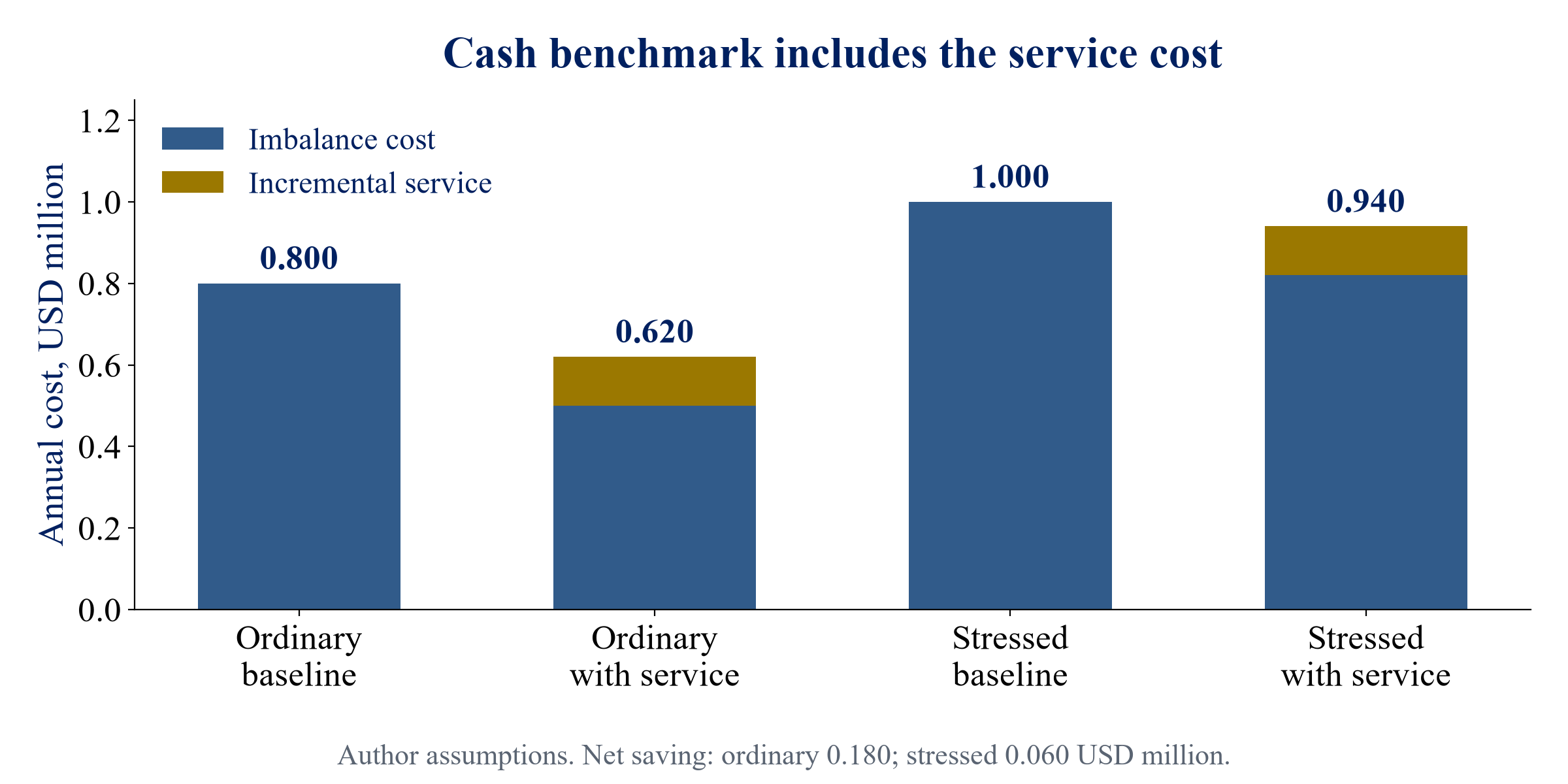
Author assumptions, USD million annually. Imbalance and incremental service costs are shown together for ordinary and stressed operation. No predictive accuracy or realised saving is claimed.
14 Convert accepted downside cash into illustrative debt
Assume a minimum debt-service coverage ratio of 1.35, an annual interest rate of 8 percent, a twelve-year term and level end-of-year debt service. The ratio, rate, term and repayment shape are author assumptions. They are not reported market terms. Ignore upfront financing fees and any balloon payment for this simplified calculation.
With baseline stressed cash of USD 3.600 million, permitted annual debt service under the assumed ratio is USD 2.666667 million. The twelve-year annuity present-value factor at 8 percent is 7.536078. Multiplying the annual debt service by this factor produces illustrative opening debt of USD 20.096208 million. The result is a mathematical capacity under the selected inputs, with no funding offer implied.
If the full stressed improvement is accepted, USD 3.660 million supports annual debt service of USD 2.711111 million. Opening debt becomes USD 20.431145 million, an increase of USD 0.334937 million. The calculation uses unrounded values; displayed figures are rounded. It assumes the improved cash persists in every debt year and that no other sizing constraint binds.
Real financing models can include different repayment schedules, dates, fees, cash sweeps, reserve requirements, loan-life tests and leverage limits. Those features can reduce or change the contribution of the improvement. The proposed method therefore calculates the effect within the actual model and reports which constraint binds. The illustration isolates the cash-to-debt relationship and supplies no general borrowing multiplier.
15 Make lender acceptance visible
The proposed acceptance sensitivity applies a stated fraction to the USD 60,000 stressed improvement. At zero acceptance, modelled debt remains USD 20.096208 million. At 50 percent acceptance, it becomes USD 20.263676 million. At full acceptance, it becomes USD 20.431145 million. The fractions are author-selected sensitivities describing inclusion in the sizing model, with no estimated approval probability.
Explain the reason for the selected treatment. A reviewer might require longer observed performance, a different stress, an executable amendment, continuity protection or independent validation. Record the actual finding rather than selecting a factor to achieve a desired loan amount. The proposed financing submission distinguishes the developer's economic estimate from the benefit accepted by the lending decision maker.
Acceptance may also be time-dependent. A lender could recognise a documented benefit only during the signed service term, or require a replacement cost thereafter. Model that cash profile directly instead of assuming a constant uplift through the loan. A three-year service commitment supplies no evidence of twelve-year pricing or availability unless the documents and operating assumptions support the extension.
The same analysis applies when refinancing a portfolio with several assets. Record accepted cash by borrower and payment period, then apply the actual facility constraints. A shared software arrangement may have costs allocated differently across entities. Any additional borrowing should be supported by the correct consolidated or individual covenant perimeter, with restrictions on cash movement retained in the calculation.
Table 3. Hypothetical financing sensitivities
| Scenario | Cash used for sizing | Illustrative opening debt | Change from baseline |
|---|---|---|---|
| Baseline | 3.600000 | 20.096208 | 0.000000 |
| Improvement excluded | 3.600000 | 20.096208 | 0.000000 |
| Half improvement accepted | 3.630000 | 20.263676 | 0.167468 |
| Full improvement accepted | 3.660000 | 20.431145 | 0.334937 |
| Adverse service case | 3.480000 | 19.426334 | -0.669874 |
USD million, author assumptions and rounded outputs. Debt uses 1.35 coverage, 8 percent interest and twelve level annual payments. Acceptance factors are sensitivities, not probabilities or lender indications.
16 Test an adverse service outcome
Assume the service produces no stressed imbalance saving but its USD 0.120 million annual cost remains payable. Stressed cash falls from USD 3.600 million to USD 3.480 million. Under the same illustrative loan terms, supportable debt falls to USD 19.426334 million, a reduction of USD 0.669874 million. This is a hypothetical service outcome, with no implied failure frequency.
The scenario illustrates an asymmetric cost commitment. A fixed annual charge can persist when the forecast contributes no useful action. Review whether pricing, termination and fallback provisions alter that cash consequence. Any claimed protection should be modelled from the actual agreement and the practical ability to use it, including notice periods and the cost of a replacement process.
Introduce other adverse cases separately. These might include a temporary data outage, a delayed weather feed, an unavailable trader or a software change affecting a high-exposure interval. Each case needs a stated mechanism, duration and cash treatment. Combining them into a single unexplained haircut conceals the evidence needed to evaluate the proposed remedy and operating budget.
The proposed review also tests the incumbent during comparable failures. A new service should be compared with a complete baseline, including its existing limitations and cost. The purpose is to evaluate the additional cash consequences of the proposed decision. No scenario in this paper establishes the actual resilience of either service or the likelihood of an outage at a specific asset.
17 Separate operating value from borrowing proceeds
An increase in borrowing capacity changes financing possibilities and may change the timing of sponsor capital. Borrowed money carries repayment obligations. The proposed appraisal therefore keeps the service's incremental operating cash valuation separate from the debt-capacity calculation. Adding debt proceeds to an operating valuation without modelling the corresponding liability would misstate the defined cash perimeter.
For a separate illustration, assume USD 0.180 million of annual incremental unlevered cash for five years, a 12 percent discount rate and USD 0.150 million of upfront integration expenditure. All taxes and non-financing cash requirements included in this hypothetical stream are assumed already reflected in the USD 0.180 million amount. No tax rate or terminal benefit is assumed.
The five-year present-value factor is approximately 3.604776. Present value of the recurring cash is USD 0.648860 million; deducting the upfront expenditure produces USD 0.498860 million. This is a scenario value for the specified incremental cash stream. It is not a valuation of a portfolio, forecasting company or actual subscription contract.
If additional debt changes financing fees, taxes, distributions or sponsor risk, model those effects within an explicitly defined levered appraisal. Keep each cash flow counted once. A software provider valuing its business needs a separate model of contracted revenue, customer support, data costs, renewal, concentration and capital requirements. Asset-owner benefit alone cannot establish that provider's equity value.
18 Examine storage and hybrid portfolios
A storage asset can create additional decisions around charging, dispatch and reserve capacity. The proposed forecasting review first records those permissions and physical constraints. Include efficiency, degradation, availability and the contractual value of different uses. A forecast's apparent benefit should be assessed through the feasible schedule and the payments the borrower actually receives.
Use a consistent comparison across generation-only and hybrid alternatives. Adding a battery changes capital cost, operating expenditure and the available decisions. Its effect should remain separable from changing a forecast. One proposed evaluation holds the physical assets fixed when comparing models, then assesses an additional storage investment through its own complete cash case.
A simulation using perfect future information can serve as a defined theoretical bound if clearly labelled. It provides no executable forecast or achieved commercial return. The financing submission should present the performance of the actual tested process, including decision deadlines and operational constraints. Any gap to the bound belongs in the research analysis and supplies no automatic debt credit.
For a shared portfolio service, examine how data or optimiser failure propagates across sites. A common control path can affect several assets simultaneously. Record fallback authority at the appropriate plant and portfolio levels. The proposed debt analysis uses the resulting combined cash case, avoiding an unsupported assumption that more assets always diversify the relevant service risk.
19 Govern model changes and continuity
Establish a named owner for the approved model, operating configuration and financial benchmark. Record the release version, validation results and effective date. A forecast service can change its inputs or logic during a loan term. The proposed governance process identifies which changes require reassessment of the technical benchmark, operating permissions or recognised cash improvement.
NIST describes its AI Risk Management Framework as a voluntary resource for managing risks associated with AI systems [9]. The present paper proposes project-specific use of documented responsibilities, measurement and monitoring. It does not assert that following this framework certifies a forecasting system, satisfies a market rule or establishes bankability.
Continuity review should examine the data licences, replacement service, support arrangements and retained records needed to operate after a disruption or termination. Include transition expenditure in the downside model where relevant. A lender reviewing a long-lived asset needs an account of how the commercial process continues if its forecasting supplier becomes unavailable or the licence changes.
Monitor the approved cash definition after implementation. Technical drift, a contract amendment and a price-regime change can each affect financial performance. Report the cause and available evidence, together with the selected response. The proposed review revisits debt-related assumptions through the contractual process; it provides no assurance that a modelled benefit persists for the facility's full life.
20 Design a pilot that informs a commercial decision
The proposed pilot begins with an agreed decision, baseline, evaluation window and acceptance criteria. Identify the assets, eligible intervals and operational constraints. State which technical metrics, cash measures and continuity tests will be reviewed. Agree the treatment of missing data and late submissions before examining results, preserving both inclusion and exclusion records.
Specify what happens after each result. An inadequate benchmark may lead to additional research, a narrower operating scope or a decision to stop. A useful operational result may support a service purchase while incremental debt remains excluded. These outcomes should be recognised in the pilot mandate. A pilot designed only to demonstrate a preferred loan amount supplies a weak basis for independent review.
Separate simulated results from actual operating observations. During shadow operation, the proposed decisions are not necessarily executed, so resulting cash is modelled. During authorised use, reconcile the submitted decisions to settlement statements and collected amounts. State any counterfactual method used to compare actual operation with the incumbent process, including its uncertainty and assumptions.
The investment committee should receive reproducible evidence and a complete cost account. Identify who independently challenges the model and financial calculations, within the permitted access arrangements. An actual paid service, funding mandate or lender decision must be supported by its signed documentation. The proposed pilot and this paper create no evidence of commercial demand or fee conversion.
21 Follow a commercialisation roadmap
The proposed roadmap starts with a narrowly defined customer decision, followed by reproducible evaluation, a governed pilot, an executable contract, finance review and continuing performance assessment. It specifies evidence for each step and leaves timing dependent on the actual project. The sequence supplies no launch forecast, customer conversion estimate or guarantee of a financing outcome.
A forecasting business should price the service required to reproduce its result. Include data, computing, validation, customer integration, support and the cost of operating across markets. Describe the operational responsibilities promised in the contract. A technically useful model can require expenditure that materially changes the provider's margin and the asset owner's retained benefit.
For investors in the provider, examine which activities are repeatable and which depend on bespoke project work. Record the rights to data and models, customer concentration and the terms needed for additional deployments. Avoid valuing an uncontracted pipeline as signed recurring income. Commercial forecasts should retain their assumptions and the evidence needed to move each opportunity into a contracted category.
For project sponsors, define the output of a financing advisory mandate. It could include a validated cash bridge, contractual allocation review, downside model and lender submission. Progress should be measured by the delivered evidence and documented financing response. The service roadmap remains separate from any claim of collected advisory fees or an actual improvement in debt terms.
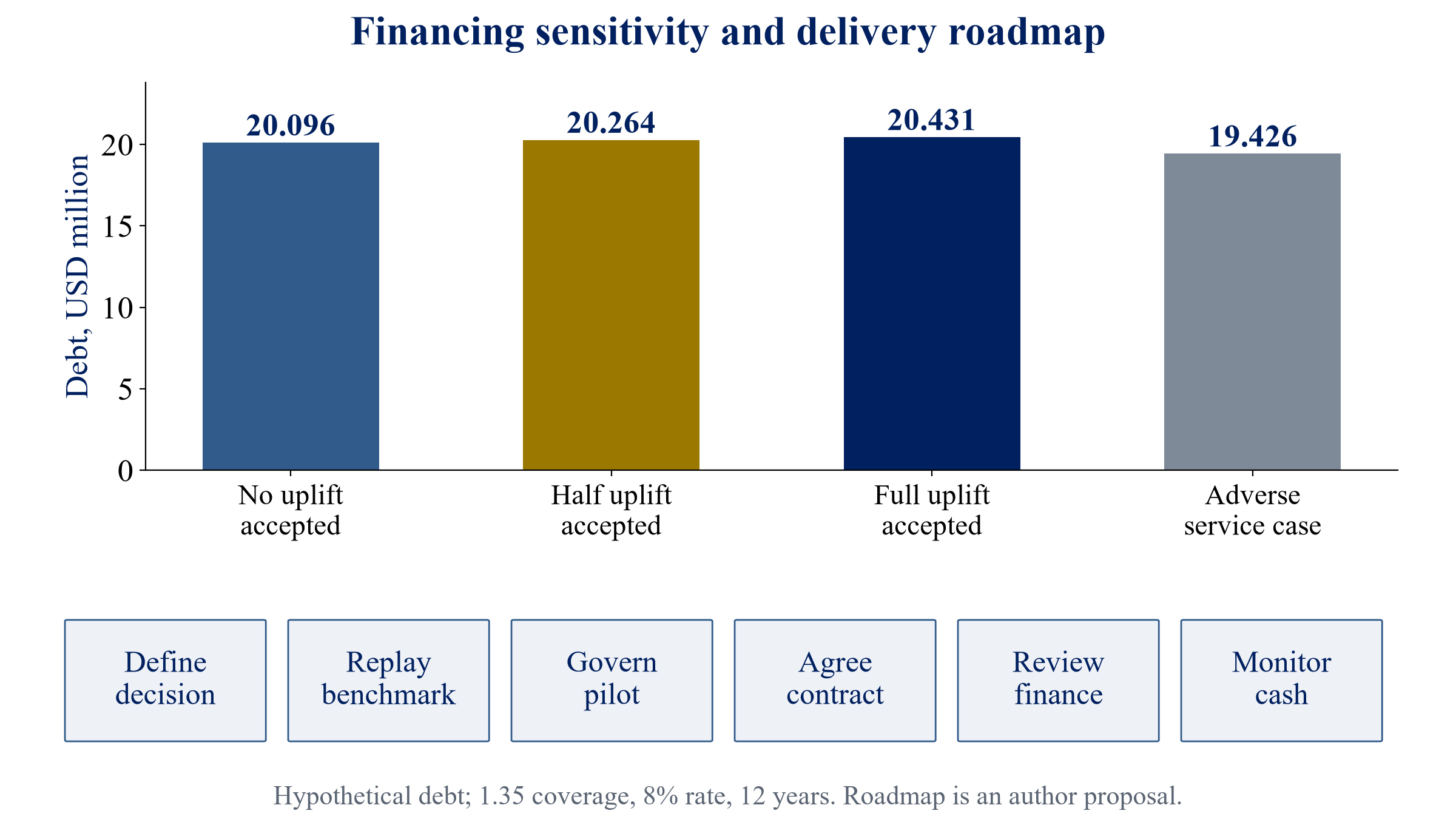
The upper panel shows hypothetical debt capacity under stated cash-acceptance and adverse-service cases. The lower panel presents author-developed delivery stages; no timing, probability of approval or observed commercial result is implied.
22 Adapt the framework across markets
In Australia, the cited AEMO materials address participant dispatch self-forecasting within their stated process [1, 2]. A financing review should obtain the current applicable rules, operating acceptance and project contract treatment. Evidence of acceptance for a particular dispatch application remains distinct from recognition of a multi-year cash benefit in a loan model.
A Great Britain or European project requires its own nomination, balancing, offtake and settlement analysis. A US portfolio requires review of the actual market, balancing authority, products and counterparties. The proposed method asks the same cash-perimeter questions while leaving market-specific conclusions to current official materials, the project documents and relevant specialists. No cross-market settlement equivalence is assumed.
For a GCC or Indian project, establish whether the borrower bears the forecasting-related payment exposure in the first place. Identify the actual tariff, availability, delivery and operating arrangements. If the offtaker retains a benefit, a project-level cash improvement requires an executable route to the borrower. A global technology claim supplies no evidence of that route.
Country diversification should be evaluated alongside concentration in weather inputs, forecasting vendors, software infrastructure and contractual counterparties. Several jurisdictions can still share a critical dependency. The proposed investment record identifies those connections and tests their cash consequences. Any asserted portfolio benefit needs the data and scenario construction applicable to the actual assets under review.
23 Structure financing and acquisition diligence
For a refinancing, reconcile the historical debt-model assumptions with observed operating cash and the proposed service. Identify whether the transaction changes leverage, amortisation, fees or reserve requirements. Present a bridge from the existing facility to the proposed terms. Forecasting-related cash should remain separately identifiable, together with the evidence and acceptance decision associated with it.
For an acquisition, examine whether the buyer inherits the service rights, data access and operating approvals needed to retain the projected benefit. Contract assignment or a change of control may require review. Model integration expenditure and any interruption of service. A purchase-price case should identify cash contingent on an unfinished amendment or operational transition.
For a financing of the software provider, distinguish project cash from provider cash. Recurring customer fees, support costs, implementation revenue and development expenditure need a company-specific analysis. Access to an asset-owner saving does not establish security over that saving. Any proposed receivables financing requires actual eligible receivables and the relevant contractual and lending terms.
The proposed diligence output is a connected evidence schedule: each material financial assumption links to a contract, operating record, independent calculation or explicit scenario. Keep unresolved findings and required decisions visible. Transaction advisers should define the scope of legal, technical, market and financial review, with no suggestion that this framework substitutes for specialised diligence.
24 Limitations and research agenda
The framework has not been validated through a dataset of completed renewable loans using AI forecasting. The cash cases, acceptance factors, loan terms, discount rate and integration cost are hypothetical. The example simplifies repayment, taxes, reserves, working capital and asset life. Its purpose is to expose the mechanism connecting accepted cash to debt, with actual application requiring a substantially more detailed model.
Further research could examine authorised portfolio datasets containing forecast vintages, submitted decisions, settlement statements, service costs and the actual lending treatment. Preserve cases where technical improvement produced no debt increase. A useful study would distinguish better retained cash from changes in leverage policy, interest rates, contracts or the broader financing market.
Another research direction concerns the persistence of value across weather and price regimes. Researchers could compare probabilistic methods, simpler benchmarks and fallback designs under consistent contractual decisions. Report modelled and observed outcomes separately, retain exclusion rules, and avoid attributing financial changes to forecasting when the operating or contract perimeter also changed.
The proposed investment discipline is to approve a forecasting service through an inspectable technical, contractual and cash record. Financing capacity follows the benefit accepted in the actual downside model and the constraints of the facility. Where that chain is incomplete, describe the missing evidence and make the investment decision with the improvement excluded from debt sizing until the relevant review supports its inclusion.
References
- Australian Energy Market Operator (2023). Participant Forecasting FAQ, version 1.3, 7 August. https://aemo.com.au/-/media/files/electricity/nem/planning_and_forecasting/solar-and-wind/participant-forecasting-faq.pdf Accessed 4 October 2026.
- Australian Energy Market Operator (2023). Semi-Scheduled Generation Dispatch Self-Forecast Assessment Procedure, version 4, effective 7 August, sections 1 to 6. https://www.aemo.com.au/-/media/files/electricity/nem/security_and_reliability/dispatch/policy_and_process/semi-scheduled-generation-dispatch-self-forecast---assessment-procedure.pdf Accessed 4 October 2026.
- Renkema, Y., Brinkel, N., and Alskaif, T. (2024). Conformal Prediction for Stochastic Decision-Making of PV Power in Electricity Markets, arXiv:2403.20149. https://arxiv.org/abs/2403.20149 Accessed 4 October 2026.
- Uniejewski, B., and Ziel, F. (2026). The role of probabilistic load and renewable prediction in enhancing day-ahead electricity price forecasts, revised 6 September, arXiv:2501.06180v2; Renewable Energy 269, 125844. https://arxiv.org/abs/2501.06180 Accessed 4 October 2026.
- Sharma, V., Gonzalez Ordiano, J. A., Mikut, R., and Cali, U. (2021). Probabilistic Solar Power Forecasting: Long Short-Term Memory Network vs Simpler Approaches, arXiv:2101.08236. https://arxiv.org/abs/2101.08236 Accessed 4 October 2026.
- Jascourt, S., Doubleday, K., Zhang, J., Feng, C., Florita, A., and Hodge, B.-M. (2023). Solar Uncertainty Management and Mitigation for Exceptional Reliability in Grid Operations (SUMMER-GO): Project Final Report, NREL/TP-6A40-84147. https://research-hub.nlr.gov/en/publications/solar-uncertainty-management-and-mitigation-for-exceptional-relia/ Accessed 4 October 2026.
- Sengupta, M., Jimenez, P., Kim, J.-H., Yang, J., and Xie, Y. (2022). Final Report on Probabilistic Cloud Optimized Day-Ahead Forecasting System Based on WRF-Solar, NREL/TP-5D00-81904. https://research-hub.nlr.gov/en/publications/final-report-on-probabilistic-cloud-optimized-day-ahead-forecasti/ Accessed 4 October 2026.
- World Bank (undated). Infrastructure Finance, Public-Private Partnership Resource Center, section on project financing and project cash flows. https://ppp.worldbank.org/infrastructure-finance Accessed 4 October 2026.
- National Institute of Standards and Technology (2023). Artificial Intelligence Risk Management Framework 1.0, NIST AI 100-1; official framework overview. https://www.nist.gov/itl/ai-risk-management-framework Accessed 4 October 2026.
About the Author
Chennakeshav (CK) is a corporate finance and investment banking executive with 25+ years of global experience in deal origination, structuring and execution across M&A, growth capital and corporate strategy. He has led value-creation mandates for founders, corporates and funds — bridging the boardroom view to hands-on execution and close.
His career spans Morgan Stanley, HSBC, Lloyds Banking Group, EWEC, ADQ portfolio companies and Emirates Growth Fund, across TMT, real estate, fintech, deeptech, cleantech, infrastructure and energy. He has partnered with C-suite leaders, private equity and venture funds, sovereign wealth funds and family offices to finance complex fund raises and scale-up ventures, and has led M&A due diligence, post-merger integration and business-transformation initiatives to create value.
At Matchpoint Partners he is Managing Partner, leading the firm's corporate finance, M&A and capital-raising practice. He holds an MBA from London Business School, an engineering degree from VTU and a Master of Laws (LLM, in progress) from UCL London.
An active start-up mentor, CK mentors at Techstars, DIFC FinTech Hive, Startup Grind, Founder Institute and IN5, serves as Entrepreneur Mentor in Residence (EMiR) at London Business School, and judges the Entrepreneurship World Cup.
