

1 The investment decision
An investor evaluating an energy-bidding platform needs to understand how a model becomes an executable commitment. A forecast may suggest a price or volume, an optimiser may propose a schedule, and a gateway may submit an order under a market participant's credentials. Each stage introduces a decision that requires an identifiable authority and an inspectable record. The proposed framework begins by documenting that chain before assessing commercial scale or valuation.
The practical question is who pays, who acts and who can recover money if an accepted order differs from the authorised intention. A contractual promise of compensation may have a cap, conditions and a payment delay. The entity settling the order needs resources on the settlement timetable. Those features belong in the business model because they influence available growth capital, customer terms and the economics of providing an automated service.
This paper develops a proposed method for that appraisal. It links a trading permission, a failure scenario, a control response, a cash consequence and a contractual recovery. It then places the retained exposure and capital requirement inside a platform valuation. The method can support a vendor-selection exercise, an infrastructure investment or acquisition diligence. Its usefulness in a particular mandate depends on obtaining the actual operational, legal and financial evidence.
The paper provides original frameworks and hypothetical calculations. It supplies no claim of successful live trading, proprietary predictive accuracy, adjudicated liability or realised Matchpoint saving. The numerical assumptions demonstrate how a decision changes when recovery is limited or delayed. Actual implementation requires market specialists, asset operators, qualified legal advisers and relevant financial reporting professionals.
2 Evidence and jurisdictional scope
ACER's July 2024 open letter explains notification requirements for algorithmic trading and direct electronic access under revised EU REMIT. Its annex discusses the classification of several arrangements, including external algorithm provision. The document supports examining what the system actually does and which entity engages in the activity. It does not establish a private damages allocation for a particular software agreement [1].
ACER's first-quarter 2026 report discusses algorithmic trading and the control requirements introduced by Article 5a. Its account includes resilience, trading limits, monitoring and continuity. For an actual European deployment, counsel should check the operative regulation, national implementation and relevant venue requirements. This paper uses the publication as regulatory context and supplies no certification of an individual platform [2].
Ofgem describes Great Britain's wholesale energy integrity regime and its incorporation into UK law following departure from the EU [3]. FERC describes the US anti-manipulation rule within its jurisdiction, while its 2016 staff white paper discusses compliance practices and expressly distinguishes staff views from Commission conclusions [4, 5]. These sources require separate jurisdictional treatment. A cross-border operating design should record the actual market, product and responsible entity for each application.
Technical evidence has a different function. Baltaoglu, Tong and Zhao examine algorithmic virtual bidding in a two-settlement market [6]. Kurz and Stricker propose an architecture for AI-supported European electricity trading in a September 2026 manuscript [7]. These publications inform the decision-system discussion. Their analyses do not validate the performance, liability allocation or investment value of a platform examined under this framework.
3 Separate the four responsibility questions
The proposed assessment uses four questions. First, which entity bears the relevant regulatory obligations? Second, which person or system has authority to submit, change or withdraw a commitment? Third, which party may owe compensation under the applicable contract and law? Fourth, which entity supplies cash while those matters are resolved? The answers require different documents and may involve several parties.
Begin with the market participant, venue agreement and operating mandate. Identify the credentials used, the products admitted and the approved asset perimeter. A software licence should be reviewed alongside those documents. Licensing an optimiser does not describe all rights associated with the account through which its output is executed. A platform investor needs an account of the contractual chain, including intermediaries and delegated access arrangements.
Next, separate factual responsibility from a final legal conclusion. The records may show that a vendor released a changed configuration, a customer approved it, and a gateway applied a different unit conversion. Those facts support investigation. Determining breach, causation, recoverable damage and enforceability requires examination of the agreement and applicable law. The framework preserves the evidence needed for that assessment without assigning universal liability to a job title.
Finally, assign a liquidity owner for each scenario. The settlement debtor, an asset company and a software vendor can have different payment obligations and resources. An indemnity discussion should therefore include the timing and availability of recovery. The proposed financing schedule records immediate payments, restricted collateral, working capital, recovery dates and the party responsible for funding any remaining gap.
4 Define the activity before classifying the technology
Describe the system in functional terms. It may deliver forecasts to a trader, generate an indicative schedule for approval, create orders under preset conditions, or submit and amend orders automatically. Record the degree of human involvement at each point and the authority retained by the operator. This description is the starting evidence for regulatory and contractual review.
AI terminology alone provides little information about the executable risk. A statistical forecast and a deterministic order gateway can appear in the same workflow. A language model may draft an analyst explanation while a constrained optimiser sets volumes. Evaluate each component according to its role, inputs, permissions and potential consequences. The proposed responsibility record should retain the actual component version involved in a decision.
The European AI Act identifies certain AI safety components in critical infrastructure as high-risk, including within electricity supply. The text's intended-purpose and classification provisions require specific review [8]. A team should investigate whether a proposed system falls within that category, along with the applicable timing and requirements. This paper makes no blanket classification of all energy-bidding software and offers no assurance that a commercial trading label resolves the question.
Define the physical boundary as well. A bidding platform may communicate an economic schedule while a separate asset controller determines safe dispatch. Establish which constraints each component enforces and how changes are authorised. NIST's operational-technology security guidance addresses systems whose characteristics include physical-process and reliability considerations [9]. A proposed integration should preserve the responsible operator's authority over the plant and its safety requirements.
5 Build a versioned authority record
The proposed authority record begins with a strategy identifier linked to approved products, assets, volume limits and effective dates. Attach the model version, configuration, data source permissions and responsible approval. Capture the downstream gateway version and market account. An investigator should be able to identify the permitted action and the actual action without reconstructing them from informal messages.
Record the order through its lifecycle. Preserve the proposed decision, approved output, submitted message, acknowledgement, amendment, cancellation request and execution result. Use compatible timestamps and retain the known clock offsets. A cancellation instruction and a confirmed cancellation are distinct events. For a particular venue, specify which acknowledgement establishes the relevant state and how the operator verifies outstanding commitments.
Configuration changes deserve their own record. The approved model can operate with a changed price unit, asset availability or risk limit. Document the person who changed the parameter, the reason, the tests, the approval and the deployment window. The proposed review compares the effective configuration at the time of an event with the authorised baseline. This makes a silent parameter change visible in the evidence chain.
The record should remain accessible under the data, software and customer agreements. Define retention, retrieval and incident access before commercial launch. A customer should establish whether it can obtain relevant logs when a vendor service is unavailable or the relationship has ended. The platform's investment case should budget for those obligations and protect confidential or restricted information through appropriate permissions.
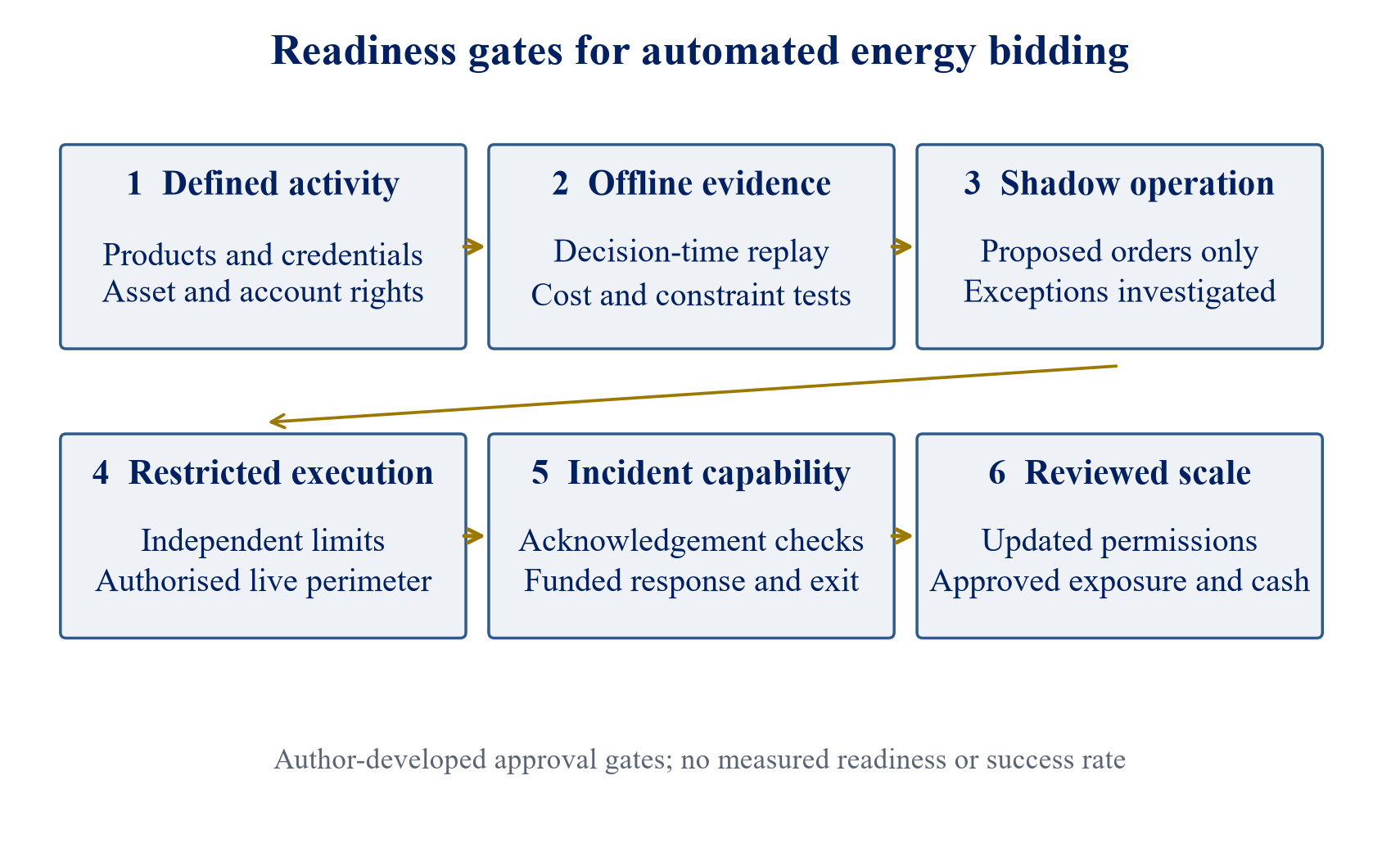
Author-developed progression from advisory analysis to controlled execution. Levels describe approval conditions, with no measured readiness score or regulatory certification.
6 Specify a taxonomy of failure
Separate an inaccurate forecast from an implementation defect. A forecast can be wrong within its stated uncertainty even when every software component follows the approved process. An implementation defect might change megawatts to kilowatts, apply the wrong time zone or send an obsolete order. Those mechanisms require different tests and may receive different contractual treatment. The proposed register records the specific failure and the evidence that would distinguish it.
Other scenarios concern stale data, duplicate messages, missing acknowledgements and incomplete cancellation. A strategy may also be implemented exactly as specified while breaching a product restriction or ignoring an unavailable asset. Include approval failures and limit failures alongside model errors. The transaction team should avoid treating every adverse outcome as a prediction problem because corrective action depends on the actual mechanism.
Consider interactions between markets and assets. A battery schedule might consume the energy intended for a separately contracted obligation, or a portfolio strategy might expose a related position. Assess the combined commitments using the actual agreements and market rules. The proposed portfolio review connects the bidding system to existing contractual obligations before an incremental revenue benefit is included in the investment case.
Each material scenario should end with an action. Specify detection evidence, permitted response, immediate cash consequence and recovery documents. Assign an operator able to carry out the action within the available time. Scenarios with uncertain detectability or disputed response authority should remain visible in the approval record, with a defined deployment restriction or further review.
7 Design permission and limit controls
The proposed control design checks the order against approved products, assets, time windows and volume limits before submission. It should also examine the aggregate position, available collateral and outstanding messages. An order that appears acceptable individually can create an excessive portfolio commitment. The design should state where the authoritative aggregate state is maintained and how uncertainty in that state affects permission to proceed.
Keep the control logic independently inspectable. A model proposing an action should have no authority to silently expand its own limit. Define who can alter limits and the evidence required for the alteration. In a proposed production system, a limit change would pass an approved change procedure, with an audit trail and an effective-time check. Those requirements are design proposals, not claims that a particular installed product already implements them.
Choose a conservative response to missing inputs using the operating context. A stale availability message may require suspension of new orders, a reduced volume allowance or an operator review. The appropriate action depends on existing commitments and the effect of interruption. A generic shutdown policy can create its own exposure if it ignores obligations already accepted by the market.
NIST's AI Risk Management Framework supplies a voluntary vocabulary for governing, mapping, measuring and managing AI risk [10]. The framework's functions can inform the governance record. The specific permission tests here are author proposals for an energy-bidding deployment. Their effectiveness should be established through relevant testing, recorded incidents and continuing operator review.
8 Test the whole execution chain
Start with an offline replay that uses the same decision-time information available to the proposed operator. Preserve the data vintage, publication time, revisions and missing-data treatment. A historical evaluation using later-corrected prices or asset states can answer a different question from one using real-time information. The proposed investment review requires the analyst to disclose that difference.
Include submission mechanics and market timing in the tests. Measure the delay between decision, gateway processing and acknowledgement. Inject duplicate messages, time-zone changes, network interruptions and revised asset constraints in a controlled environment. State the expected response and retain the actual result. An evaluation focused solely on forecasting error leaves these execution characteristics unexamined.
Use shadow operation to compare proposed actions with an approved existing process while maintaining the authorised live execution boundary. Define which records are obtained, how an exception is investigated and the conditions for advancing to restricted production. The progression should depend on completed evidence and approval. A calendar deadline can organise the work, but does not establish operational readiness by itself.
For performance review, report costs and limitations alongside returns. Include the strategy's eligible products, order acceptance assumptions, transaction costs, collateral requirements and interruption treatment. A result obtained under one set of conditions supports evaluation within those conditions. Independent replication should precede reliance on a claimed performance advantage in a customer contract, financing case or acquisition model.
9 Measure the economics of the deployed decision
The proposed benchmark measures cash retained after implementation costs. Begin with compatible operating periods, asset constraints and market participation rights. Compare the automated workflow with a defined alternative using the same information availability. Record expenses for data, compute, gateway access, monitoring, compliance review, market fees and incident response. Specify which expenses belong to the customer and which the platform pays.
Add the working-capital consequences. Margin or collateral may restrict cash even when it is eventually returned. State its timing, funding source and release conditions. A licence business whose customers provide collateral has different economics from a principal trading business that funds positions itself. The proposed cost benchmark keeps these business models separate so that a software margin is not used as a proxy for a trading return.
Include losses under clearly described scenarios. Forecast misses, execution faults and portfolio stress require separate mechanisms. Use an expected-value assumption only when its basis is disclosed. A management-selected event frequency is a sensitivity input, with no empirical confidence implied. Tail scenarios should also show the maximum immediate funding need under their stated assumptions.
The desired evidence is an operating cash reconciliation. It connects the benefit attributed to the deployment, its recurring support cost, retained event losses, committed capital and exit costs. This proposed measure gives investors a basis for discussing scale and pricing. A technically attractive system can still require revised terms or narrower permissions if the demonstrated economics leave insufficient cash for its obligations.
10 Allocate rights across the operating chain
Table 1 summarises a proposed responsibility matrix. Actual appointments and legal duties must be established from the relevant agreements. One organisation can perform several roles; an outsourced role still needs a named counterpart and an accessible operating record. The matrix helps identify an absent approval or an incident action that nobody can execute.
Table 1. Proposed authority and evidence matrix
| Role | Approval or action | Evidence to retain | Funding question |
|---|---|---|---|
| Asset operator | Approve physical constraints | Availability and dispatch records | Who funds asset consequences? |
| Market participant | Approve account activity | Product rights and acknowledgements | Who settles accepted orders? |
| Strategy owner | Approve objective and limits | Versioned strategy approval | Who bears authorised market risk? |
| Software provider | Release agreed functionality | Tests and deployment versions | What recovery is collectible? |
| Independent risk reviewer | Challenge limits and exceptions | Review and escalation record | What liquidity remains available? |
Author-developed design for contract and operating review; actual duties, permissions and liability depend on the relevant documents and law.
The strategy owner should define the permitted economic objective and portfolio boundaries. The software provider should document the agreed functionality and its release evidence. The asset operator should define the relevant physical constraints. A nominated risk function can review whether the combined permissions remain within the approved exposure. These appointments require workable escalation paths and access to the evidence used in the review.
Treat emergency rights explicitly. Identify who can suspend new orders, request cancellation and move to a fallback process. Establish whether the rights are held by the participant, vendor or an authorised service provider. Test their operation and the effect of unacknowledged requests. A matrix entry becomes operationally meaningful when the appointed person has the required credentials, availability and instructions.
Review the matrix when an asset, customer, market or vendor changes. A new legal entity can alter settlement responsibility; a new gateway can change message states and recovery records. Commercial growth should trigger an updated authority record and funding review. The platform's scale plan should budget the staff and systems needed to maintain those arrangements.
11 Negotiate recovery around a defined event
A proposed software agreement should distinguish service availability, functionality, operating instructions and outcome expectations. Define the event that creates a potential claim and the records needed to assess it. Address notification, investigation and dispute procedures. An agreement whose promise depends on undefined model quality can leave the parties with different understandings of performance and remedy.
Review liability caps with the exposed cash flows. A fee-based cap may be small relative to a market commitment, particularly during early deployment. Assess whether the cap applies per incident, customer, year or contract, and whether multiple events share an aggregate amount. Identify exclusions and any different treatment for confidentiality, security or other specified breaches. Their legal effect needs qualified review.
For a proposed loss calculation, state which payments form the claimed damage and how mitigation is evidenced. Consider market settlement, response expenditure and customer compensation separately. Avoid assuming that all indirect or consequential losses receive the same treatment under every jurisdiction or document. The investment team should ask counsel to identify the recoverable categories and the uncertainty associated with them.
Commercial terms should also specify the handling of a disputed invoice, suspension right and continued support during investigation. The parties need access to incident records even when they disagree about payment. The proposed valuation method treats contractual recovery as a separately supported cash-flow item, with assumptions for timing and collection. A signed cap establishes a contract term; collectability requires additional evidence.
12 Examine insurance and counterparty resources
Review the actual insurance wording, named insured, covered activity, limits, excess, exclusions and reporting conditions. Establish whether the proposed incident involves trading loss, professional error, cyber intrusion or physical damage. The availability of a policy labelled technology or professional indemnity does not establish coverage for every automated-bidding loss. No insurance quote or available cover is asserted in this paper.
Map how an insurance payment interacts with contractual recovery. Determine which entity makes the claim, whether another party has relevant rights, and how overlapping recovery is reconciled. Include collection timing and investigation requirements. A policy limit should remain separate from cash available today. The liquidity owner needs resources on the actual payment schedule while any insurance claim is evaluated.
Counterparty financial strength is part of recovery appraisal. Obtain relevant statements, guarantees, security documents and restrictions on access to funds. A group association does not establish an enforceable parent guarantee. A start-up vendor may need a different commercial structure from an established service provider. Options for negotiation can include staged deployment, a supported guarantee or reduced commitments, subject to lawful and commercially acceptable terms.
Consider correlated stress. A single vendor failure may affect several customers while also reducing the vendor's ability to pay claims. The proposed downside review combines the contract's aggregate cap with the counterparty's resources and competing obligations. It should disclose assumptions and avoid adding several nominal recoveries that depend on the same unavailable balance sheet.
13 Reconstruct an incident from the records
The proposed incident procedure first addresses ongoing commitments and authorised operational response. Preserve the relevant records before normal retention or repair activity changes them. Obtain the current market state from a recognised source and identify outstanding orders. Keep the operational record factual, including observations, actions, times and acknowledgement states.
Reconstruct the causal chain in a separate investigation. Compare input data, decision output, authorised limits, gateway message and execution result. Determine which steps can be reproduced and which depend on unavailable information. Identify clock uncertainty and revisions explicitly. A reconstructed explanation should distinguish verified events from unresolved questions about mechanism or contractual responsibility.
Document a contemporaneous alternative action only when its inputs are available. A hindsight strategy using information published after the decision can overstate an avoidable loss. The proposed review preserves the feasible action set and the actual response constraints. Where the alternative cannot be established, the loss analysis should identify that gap and present an appropriately qualified range.
Legal notification, reporting and privilege questions require counsel's direction. An internal operational investigation should not replace the applicable reporting process. After the urgent response, record corrective actions, their owners and acceptance evidence. A commercial restart should follow the relevant approvals and tests, with the event's remaining exposure included in the funding and contract review.
14 Calculate the immediate cash exposure
Consider a hypothetical accepted order that creates a 60 MW unwanted purchase for four hours. Assume the difference between its purchase cost and the available exit value is USD 250 per MWh. The energy amount is 240 MWh and the direct difference is USD 60,000. The example illustrates units and timing; it supplies no observed price, actual venue treatment or enforceability finding.
For the larger hypothetical event used in Table 2, assume direct settlement loss of USD 120,000, response cost of USD 15,000 and a customer payment of USD 20,000. Total gross cost is USD 155,000. Assume the contract permits a claim for the first two items but excludes the customer payment, with a USD 100,000 cap. Eligible costs of USD 135,000 therefore produce a capped claim of USD 100,000.
Assume a 70 percent collection factor and receipt after six months. This factor is an author-selected scenario assumption, not a measured probability or legal opinion. Discounting USD 70,000 at 10 percent annually for half a year gives approximately USD 66,742. The present-value retained cost is approximately USD 88,258. Immediate gross cash need remains USD 155,000 if the entity must pay before receiving any recovery.
Table 2. Hypothetical event cost and recovery
| Component | Amount | Treatment | Cash implication |
|---|---|---|---|
| Settlement loss | 120.000 | Assumed eligible | Pay before recovery |
| Response cost | 15.000 | Assumed eligible | Immediate expenditure |
| Customer payment | 20.000 | Assumed excluded | Retained exposure |
| Capped claim | 100.000 | Cap below eligible 135 | Potential recovery |
| Collected after six months | 70.000 | Assumed 70 percent | Delayed receipt |
| Recovery present value | 66.742 | Assumed 10 percent rate | Discounted benefit |
| Retained present-value cost | 88.258 | Gross 155 less recovery | Economic event cost |
USD thousands, author assumptions. Collection and eligibility are illustrative; cash timing requires the actual settlement and contract records.
15 Stress common failures across customers
Scale changes the consequence of a shared failure. Assume ten customers experience the preceding USD 155,000 gross event at the same time. Combined gross exposure is USD 1.55 million. If the vendor agreement contains one assumed USD 100,000 aggregate cap across those events, the same 70 percent collection assumption yields USD 70,000 nominal recovery across the group. Immediate funding must be assessed before that receipt.
For a separate insurance sensitivity, assume a USD 50,000 excess, USD 500,000 maximum payment and settlement twelve months later. Under the assumed covered-loss mechanism, the payment reaches the limit in this stress. The example does not establish actual cover or an available product. It demonstrates why a future receipt has different liquidity consequences from an immediately drawable facility.
The proposed stress register should include common data-feed failure, shared release defects, gateway interruptions and compromised credentials. Map which customers and products share each dependency. Diversifying asset locations can leave a common software exposure unchanged. Assess the actual architecture and contract aggregation before treating geographical growth as evidence of independent risks.
Keep the stress calculation separate from an expected annual-loss estimate. Ten simultaneous events need a joint scenario and a stated dependence assumption. An investment committee should see the gross peak need, sources of immediately available cash, later recovery and residual uncertainty. The proposed approval decision can reduce scope, establish dedicated liquidity or require further evidence where the current business cannot fund the stated event.
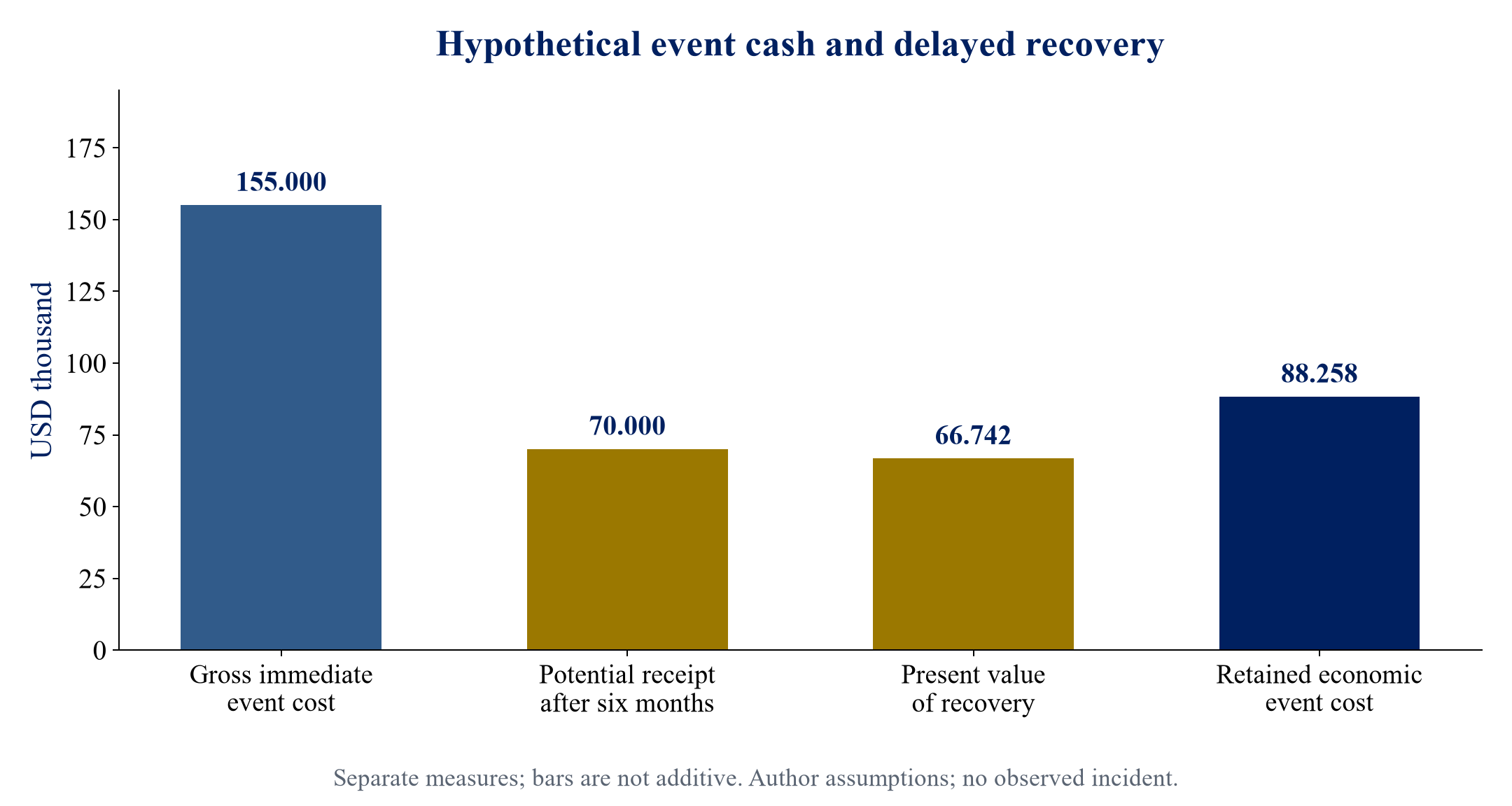
Author assumptions in USD thousands. The gross immediate event is 155; potential collected recovery is 70 after six months. These figures report no observed losses or recovery success.
16 Price the control and support obligations
A proposed platform pricing model should fund the service actually promised. Budget incident support, monitoring, security, independent review, data licences and operational testing. Allocate those costs by customer and product where the drivers are known. Some expenses recur regardless of trade volume; others increase with markets, accounts or the permitted scope of action.
Compare fixed subscriptions, usage charges and performance-linked fees using the same service perimeter. A performance fee requires a defined benchmark, cost treatment, data access and dispute mechanism. Specify whether the measured benefit includes asset constraints, interruptions, fees and collateral cost. The paper supplies no market-standard fee or willingness-to-pay estimate; each proposed commercial structure needs buyer evidence and negotiation.
Consider permission tiers as a proposed packaging approach. Advisory analysis, approved-order preparation and restricted autonomous execution can have different support obligations and exposure. Record their permitted use and customer responsibilities. A customer progressing to a higher tier should complete the relevant evidence and approvals. A tier label alone cannot establish regulatory classification or operational readiness.
Avoid assuming that a profitable small pilot scales at the same margin. A new market can require a gateway integration, local legal review, additional monitoring and customer support. Include those costs in the expansion decision and maintain a record of what the existing platform can reuse. The proposed unit economics should reconcile revenue with the operational work and capital necessary for the promised service.
17 Bring retained losses into platform valuation
Table 3 values a hypothetical five-year platform cash-flow stream. Assume annual subscription revenue of USD 2.4 million and operating contribution of USD 1.2 million before controls and event losses. Annual control and support cost is assumed at USD 320,000. Use the preceding event's retained present-value cost with an author-assumed annual frequency of 0.8 events; this produces approximately USD 70,606 annual retained loss.
The resulting annual operating cash contribution is approximately USD 809,394 before an assumed 20 percent cash-tax adjustment, or USD 647,515 afterward. For this demonstration, cash flows are level and paid at each year-end, with a 15 percent discount rate. The five-year annuity factor is approximately 3.352155. Every assumption requires separate evidence before use in an actual platform investment.
Assume USD 1 million is funded at inception and remains tied until full release at the end of year five. Its discounted release is approximately USD 497,177. Also assume an initial rollout expense of USD 300,000. The simplified value is approximately USD 1.368 million after both initial amounts and the release. There is no terminal operating value, debt, growth or residual software sale in this illustration.
Table 3. Hypothetical five-year platform cash valuation
| Item | Assumed amount | Calculation | Value effect |
|---|---|---|---|
| Annual contribution before controls | 1.200 | Revenue less assumed operating cost | Starting cash |
| Annual controls and support | 0.320 | Recurring expense | Deduct once |
| Annual retained event cost | 0.070606 | 0.8 times 0.088258 | Deduct once |
| Annual cash after assumed tax | 0.647515 | Net contribution times 0.8 | Discount for five years |
| Present value of annual cash | 2.170571 | Cash times 3.352155 | Operating value |
| Initial tied funding | 1.000 | Funded at inception | Subtract at inception |
| Discounted release | 0.497177 | 1 divided by 1.15 to power 5 | Add at year five |
| Initial rollout expenditure | 0.300 | Assumed initial cost | Subtract at inception |
| Simplified value | 1.367748 | Sum of value effects | Scenario output |
USD million, author assumptions, rounded. The financing amount is separately released in year five. No market multiple or actual platform value is claimed.
18 Reconcile valuation sensitivities and accounting
Use sensitivities to identify the assumption driving the investment decision. In the preceding example, an increased annual event frequency affects retained loss. A reduced collection factor affects recovery. Delayed release of tied cash affects its present value. A sensitivity should alter the relevant mechanism and disclose the variables kept constant. The resulting value change is conditional on those assumptions.
Contract improvements can also have a cost. A stronger recovery promise may require a higher vendor fee, security or narrower exclusions negotiated elsewhere. Show the net cash consequence. Compare the revised arrangement using the same discount convention and implementation cost. The proposed model should not recognise improved recovery without considering the price and resources required to obtain it.
Accounting recognition is a separate assessment. The IFRS Foundation's IAS 37 overview addresses provisions, contingent liabilities and contingent assets, including restrictions on recognising uncertain inflows [11]. Qualified accountants should determine the treatment of actual claims and obligations. A hypothetical discounted recovery in an investment sensitivity is no assertion that the corresponding asset can be recognised in financial statements.
Reconcile each event across the model, transaction agreement and accounting review. A loss already reflected in forecast cash should not also be deducted as an identical price adjustment without an explicit reason. Likewise, recovery reflected in the forecast should be excluded from an additional recovery valuation. Maintain one issue identifier internally and a reader-friendly explanation of its cash treatment in the investment memorandum.
19 Assess an acquisition or minority investment
An acquisition review should examine customer permissions, intellectual property, data rights, market dependencies and obligations that survive change of ownership. Obtain the software architecture, incident record, deployment controls and contractual schedules. Identify customer-specific customisations and support promises. The proposed diligence question is whether the cash flows being acquired remain executable under the post-completion operating arrangements.
Analyse revenue concentration alongside dependency concentration. Several customers may rely on one market gateway or an identical strategy release. A customer may also possess a termination right linked to ownership change or service performance. Review the actual clauses and quantify only supported effects. A revenue schedule should distinguish contracted income, renewal assumptions and an unapproved expansion plan.
A minority investor needs to understand its governance rights. Access to risk reporting, material contract changes and funding decisions can matter when the investor cannot direct daily operations. Negotiate appropriate information and approval rights through qualified advisers. The proposed investment record should identify the actions the investor can request and the management decisions outside its control.
Link findings to executable transaction terms. Options for discussion may include conditions before closing, specified remediation, staged capital, price adjustments or defined post-completion obligations. Their availability and enforceability depend on the deal. The financial model should show what the selected term changes, who performs it and whether the investment depends on an unfinished control improvement.
20 Protect continuity and physical operations
Separate market-order continuity from plant-control continuity. The bidding business needs a method for determining outstanding commitments and communicating an authorised schedule. The plant needs to remain within its operating requirements during interruption. Document the interface between these functions and obtain the responsible operator's approval for any change to it.
Design fallback operation around the actual commitments. Establish who obtains market states, who approves replacement actions and which inputs remain trustworthy during an incident. A proposed fallback may use restricted manual operation, an approved alternative service or suspended new activity. It must account for accepted obligations and the ability of staff to operate the process under realistic conditions.
NIST's operational-technology guidance provides technical context for security design involving physical processes [9]. The recommendations in this paper are a proposed transaction and operating review, with no authority to alter a live controller. Any production test should use the required plant, security, market and safety approvals and should preserve evidence of the permitted scope.
Review vendor exit before depending on continuity. Identify the ability to retrieve configurations, logs and agreed data; terminate credentials; and transfer approved operating functions. An escrow or source-access provision needs evidence that its trigger, materials and execution are workable. The platform investor should assess the expense and interruption risk of transition under the actual agreement.
21 Plan a controlled commercialisation sequence
The proposed sequence begins with a defined customer decision and an agreed activity perimeter. Collect the relevant product, market, asset and contract evidence. Decide whether the first engagement covers advisory analysis or executable bids. Establish the economic benchmark and the information required to assess it. Buyer willingness to pay needs direct commercial evidence; this paper provides no demand estimate.
Next, complete reproducible offline testing and a shadow exercise under approved permissions. Retain acceptance criteria, exceptions and the cost record. A restricted pilot should have named operators, a defined funding amount and a tested response process. The pilot's extension should depend on the evidence produced and the approvals required for the larger scope.
Commercial contracting follows the demonstrated service perimeter. Finalise responsibilities, support, data rights and potential recovery with appropriate advisers. Finance should confirm available liquidity under the selected stress scenarios. The investment case can then compare expected contracted cash with the cost and capital required for the promised operation. A market-expansion proposal should repeat the review for its new permissions and dependencies.
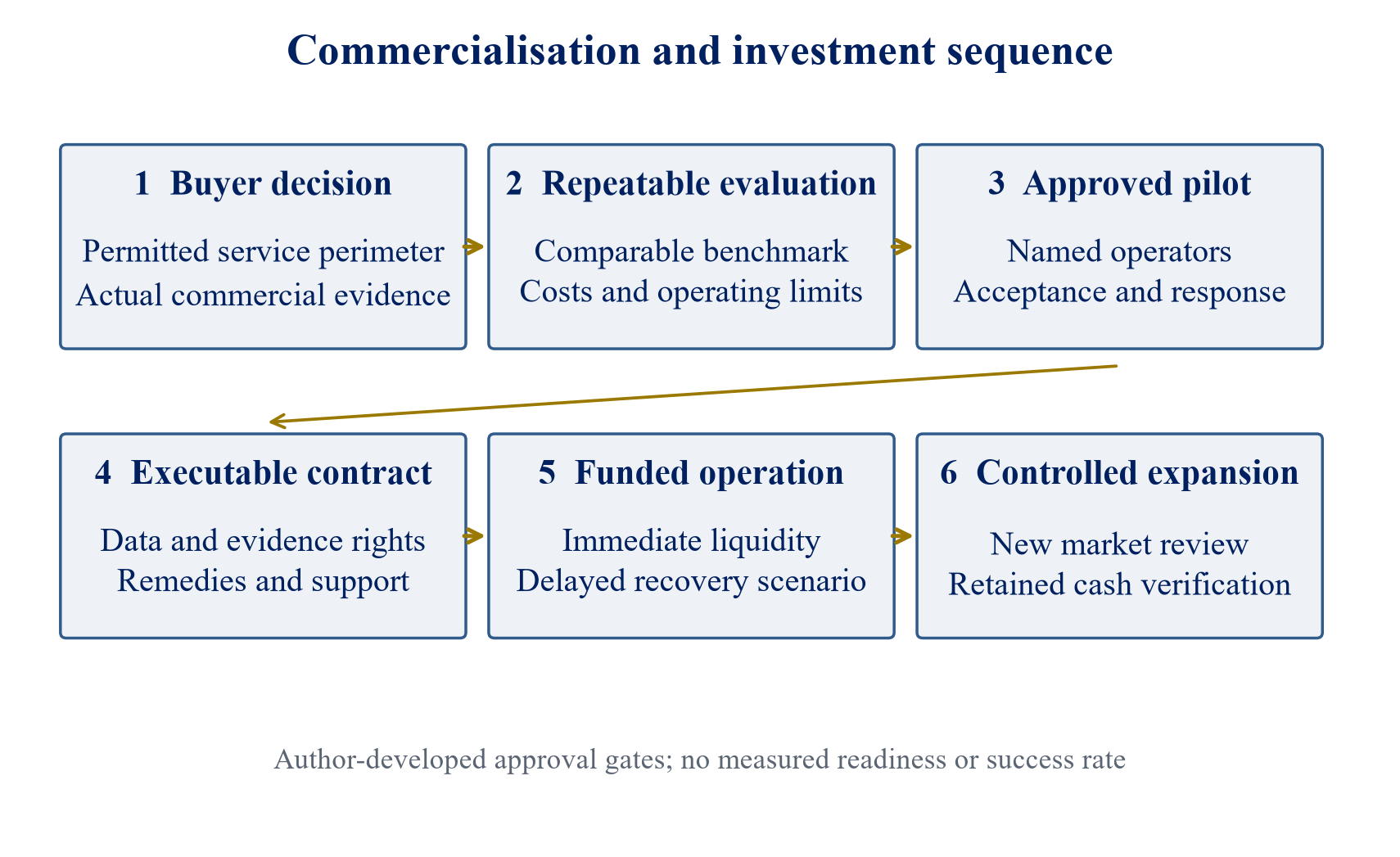
Author-developed gates connecting customer evidence, testing, permissions, contracts, funding and controlled scale. No prescribed launch duration or measured conversion rate is implied.
After launch, monitor accepted commitments, incidents, control exceptions and retained cash. Maintain the versioned authority record as systems and contracts change. Report the actual observations separately from modelled sensitivities. This proposed operating discipline provides a basis for reassessing scope, pricing and capital when evidence changes.
22 Adapt the method across geographies and transaction structures
For a European application, obtain a current review of the specific activity and relevant EU, national and venue requirements. For Great Britain, examine the applicable UK regime and market arrangements separately. For US activity, determine the relevant jurisdiction, product and venue rules. The sources discussed in this paper establish context and do not settle an individual firm's permissions or compliance.
A GCC sponsor using an overseas bidding service should identify the legal entities entering each commitment and providing software or asset services. Examine the actual power-sale, optimisation, operating and funding agreements. An availability-based asset agreement can create different economic sensitivities from merchant trading. No uniform GCC retail or wholesale trading structure is assumed here.
An Indian or other international deployment needs the same activity-level grounding. The relevant operator, products, market access, settlement process and contracts must be established before applying a numerical example. Data rights and cross-border access also require specific review. The proposed responsibility questions can organise that work while the actual conclusions remain tied to the documents and law.
Transaction structure affects capital ownership. A project company, software subsidiary, managed-service provider and principal trading entity can expose different cash pools. Describe any guarantees or security by their actual terms. The proposed appraisal follows the money through those entities, including restrictions on moving it, before assigning a group-level benefit or available funding amount.
23 Establish evidence for board approval
The proposed board decision should include the approved activity perimeter, operating authority, unresolved findings and the financial consequences of the selected limits. Attach the material test results and contract assessments. State which assumptions are hypothetical, management-selected or supported by observed records. Approvers should be able to identify what additional evidence would change the decision.
Present a base cash case and explicit downside cases. Show immediately available resources, restricted capital, expected recovery and timing. Identify any reliance on an unfinished integration or unsigned commercial agreement. The purpose is to connect approval to a funded and permitted operating scope. Forecast income dependent on later approvals should remain identifiable in the business plan.
Use an independent challenge process for material assumptions. A model reviewer can assess evaluation design, an operator can examine asset constraints, and qualified advisers can review contractual and regulatory matters. Record disagreements and the action taken. The proposal requires relevant expertise and documented judgments; no general checklist can certify the complete deployment.
After approval, reporting should follow the same definitions. Reconcile changes in permissions, customers, funding and retained cash. Escalate departures from the approved scope using a documented process. A commercial success claim should rely on verified contracts, operational results and collected cash, with modelled sensitivities shown separately.
24 Limitations and further research
The framework has not been empirically validated in a portfolio of automated energy-bidding businesses. The event frequencies, collection factors, costs, prices and discount rates are hypothetical. Actual losses may have different distributions and dependencies. The proposed valuation illustrates mechanisms and omits growth, terminal operating value, financing structure and many jurisdiction-specific tax effects.
Further research could examine anonymised incident records with authorised access, comparing the submitted-order evidence, remedial actions, settlement payments and eventual recovery. A useful dataset would retain the activity perimeter and contract features associated with each event. It would also record incidents causing no financial loss, reducing selection bias from studying only publicly disputed outcomes.
Another research direction is the relationship between permission scope and economic performance. Controlled comparisons could evaluate the retained cash, funding requirement and support cost of different execution limits under compatible operating conditions. Any claimed benefit would need observed records and an evaluation design that accounts for asset, market and customer differences.
The practical recommendation is to approve a bidding platform through a connected authority, evidence and capital record. Its commercial proposition should state the permitted decision and demonstrate how the business can fund its obligations during a failure. Investment value then follows the cash and rights supported by that record, with the remaining uncertainty kept visible in the decision.
References
- ACER (2024). Open letter on the notifications of algorithmic trading and direct electronic access according to revised Regulation (EU) No 1227/2011, 30 July. https://www.acer.europa.eu/sites/default/files/REMIT/Guidance%20on%20REMIT%20Application/Open%20Letters%20on%20REMIT%20Policy/Open-letter-on-algorithmic-trading.pdf Accessed 4 October 2026.
- ACER (2026). REMIT Quarterly Q1 2026, discussion of algorithmic trading and revised REMIT control obligations. https://www.acer.europa.eu/sites/default/files/REMIT/REMIT%20Reports%20and%20Recommendations/REMIT%20Quarterly/ACER-REMIT-Quarterly-Q1-2026.pdf Accessed 4 October 2026.
- Ofgem (2026). Energy trading, official overview of Great Britain's energy market integrity rules. https://www.ofgem.gov.uk/energy-regulation/markets-and-investment/energy-trading Accessed 4 October 2026.
- Federal Energy Regulatory Commission (2026). Prohibition of Energy Market Manipulation, rule overview. https://ferc.gov/enforcement-legal/enforcement/prohibition-energy-market-manipulation Accessed 4 October 2026.
- Federal Energy Regulatory Commission staff (2016). Staff White Paper on Effective Energy Trading Compliance Practices, November. https://ferc.gov/sites/default/files/2020-07/EffectiveEnergyTradingCompliancePractices-November17-2016.pdf Accessed 4 October 2026.
- Baltaoglu, S., Tong, L., and Zhao, Q. (2018). Algorithmic Bidding for Virtual Trading in Electricity Markets, arXiv:1802.03010v2. https://arxiv.org/abs/1802.03010 Accessed 4 October 2026.
- Kurz, W., and Stricker, W. (2026). Functional Architecture of European Electricity Trading Markets: Requirements for AI Supported Trading Systems under Regulatory Constraints, arXiv:2609.29108v2. https://arxiv.org/abs/2609.29108 Accessed 4 October 2026.
- European Parliament and Council (2024). Regulation (EU) 2024/1689, Articles 3 and 6, Annex III and recital 55, published legal text. https://eur-lex.europa.eu/legal-content/EN/ALL/?uri=OJ%3AL_202401689 Accessed 4 October 2026.
- National Institute of Standards and Technology (2023). Guide to Operational Technology Security, SP 800-82 Revision 3. https://doi.org/10.6028/NIST.SP.800-82r3 Accessed 4 October 2026.
- National Institute of Standards and Technology (2023). Artificial Intelligence Risk Management Framework 1.0, NIST AI 100-1. https://nvlpubs.nist.gov/nistpubs/ai/NIST.AI.100-1.pdf Accessed 4 October 2026.
- IFRS Foundation (2026). IAS 37 Provisions, Contingent Liabilities and Contingent Assets, standard overview. https://www.ifrs.org/issued-standards/list-of-standards/ias-37-provisions-contingent-liabilities-and-contingent-assets/ Accessed 4 October 2026.
About the Author
Chennakeshav (CK) is a corporate finance and investment banking executive with 25+ years of global experience in deal origination, structuring and execution across M&A, growth capital and corporate strategy. He has led value-creation mandates for founders, corporates and funds — bridging the boardroom view to hands-on execution and close.
His career spans Morgan Stanley, HSBC, Lloyds Banking Group, EWEC, ADQ portfolio companies and Emirates Growth Fund, across TMT, real estate, fintech, deeptech, cleantech, infrastructure and energy. He has partnered with C-suite leaders, private equity and venture funds, sovereign wealth funds and family offices to finance complex fund raises and scale-up ventures, and has led M&A due diligence, post-merger integration and business-transformation initiatives to create value.
At Matchpoint Partners he is Managing Partner, leading the firm's corporate finance, M&A and capital-raising practice. He holds an MBA from London Business School, an engineering degree from VTU and a Master of Laws (LLM, in progress) from UCL London.
An active start-up mentor, CK mentors at Techstars, DIFC FinTech Hive, Startup Grind, Founder Institute and IN5, serves as Entrepreneur Mentor in Residence (EMiR) at London Business School, and judges the Entrepreneurship World Cup.
