

1 The acquisition decision
The buyer of a utility needs to know how much cash the acquired assets can generate while delivering the service required by their contracts and operating obligations. A forecast that assumes low leakage, stable availability and a modest renewal budget contains connected judgments about physical condition, measurement quality and management execution. An acquisition model becomes more useful when each judgment can be traced to operating records and a defined intervention.
The question addressed here is how to convert imperfect operating data into a defensible purchase-price and funding decision. The proposed method begins with the transaction perimeter, reconciles the physical and commercial records, tests material exceptions and schedules their cash consequences. AI assists selected review tasks within that process. Its outputs remain proposals for investigation until the relevant operational and financial evidence supports a conclusion.
This distinction is important when a seller presents a technology-enabled improvement plan. An algorithm may rank pipe segments, identify unusual meter readings or classify maintenance notes. The investment case still needs the cost of investigation, the availability of crews, the authority to intervene and the economics of the completed work. The value of a model depends on the decisions and actions it improves within a particular operating system.
The paper offers an original transaction framework and hypothetical calculations. It reports no completed Matchpoint utility acquisition, field trial, proprietary model performance or realised client saving. The framework can guide a diligence mandate, with qualified engineers, accountants and legal advisers determining the findings that require their professional judgment. Its central deliverable is a price and funding bridge whose important inputs remain inspectable after completion.
2 Evidence and current regulatory context
The US Environmental Protection Agency distinguishes physical water losses from apparent losses associated with metering and commercial records. Its water-loss guidance provides a basis for reconciling system input with authorised consumption and the remaining loss components. The EPA also maintains distribution-system resources covering hydraulic modelling, pressure management, water quality and main breaks. These sources establish useful technical categories without determining the investment value of a particular target [1, 2].
Electricity reliability analysis needs equally explicit boundaries. The US Energy Information Administration publishes distribution reliability tables that distinguish event treatments, including results with and without major event days. A comparison should retain the reporting method, customer coverage and event exclusions associated with the data. An acquisition team cannot apply a state-level comparison directly to an individual feeder or assume that differently defined measures are equivalent [4].
Regulatory documents require a current version check. The UK Competition and Markets Authority records final PR24 determinations sent to Ofwat on 10 March 2026, following references concerning five companies. For a relevant UK target, the analyst should identify the applicable company determination and its later amendments before using allowed expenditure or performance assumptions. The case page establishes the procedural history; the actual transaction model requires the operative company documents [5].
The paper uses these sources for context and definitions. Its acquisition workflow, evidence classifications and hypothetical economics are author-developed proposals. They require adaptation to the target's service obligations, jurisdiction and transaction documents. No single leakage target, allowed return, maintenance ratio or discount rate is presented as transferable across utilities or geographies.
3 Establish the transaction perimeter
Begin with an asset and obligation schedule tied to the actual transaction structure. A share acquisition, concession transfer and selected asset purchase can place different contracts, liabilities and data rights inside the perimeter. Identify the operating entities, service territories, physical assets, customer relationships, supplier contracts, employees and systems being acquired. Record the assets or services that remain with the seller and the support needed to operate independently.
For a water target, the schedule should identify treatment capacity, distribution mains, reservoirs, pumping stations, customer meters and the interfaces with wholesale suppliers or municipal infrastructure. For electricity, identify substations, distribution circuits, metering, control systems and the relevant interfaces with transmission or generation. These are proposed diligence categories. Their ownership and operating responsibility must be established from the target's records.
Locate the data associated with each asset. The historian, maintenance system and billing platform may be owned by different entities, maintained by contractors or licensed for a wider group. A buyer needs usable records, the right to access them and a means of relating them to the acquired assets. Historical exports alone may omit configuration, calibration, asset identifiers or the relationships needed to interpret a measurement.
The perimeter schedule should state the evidence supporting each inclusion and the person responsible for resolving an ambiguity. A missing right to software or operating data affects the post-completion plan. A critical pump outside the legal perimeter may require a supply or service agreement. Carry those dependencies into valuation and completion planning so that the price does not assume capabilities the buyer has yet to secure.
4 Reconstruct the physical and commercial balances
A water balance connects system input to billed authorised consumption, unbilled authorised consumption, apparent losses and real losses. Each quantity should share a defined period and boundary. Meter replacement, changes in billing cycles and adjustments to estimated consumption should be visible in the reconciliation. A balance that closes arithmetically can still rely on uncertain measurements; record the basis of each component.
The proposed diligence process first reconstructs reported totals from underlying records. It then tests the material adjustments, estimates and exclusions. Keep the original measurements alongside corrected values, with an explanation of the correction and its effect on the remaining balance. If apparent losses are estimated incorrectly, the residual attributed to physical leakage can also change. That interdependence requires attention before choosing a capital programme [1].
For electricity, reconcile energy entering the relevant network with metered delivery and the target's loss classifications. Separately reconcile interruption records with customer exposure and restoration times. A change in the population of customers can change a headline indicator. An omitted event may affect service assessment even when the annual energy balance appears plausible. Physical and reliability records answer related but distinct questions.
AI can propose exceptions in these reconciliations, such as repeated meter identifiers, implausible timestamps or unexpected changes in recorded consumption. A deterministic reconciliation should remain available so that an analyst can reproduce totals without relying on a model-generated explanation. Every material exception needs a defined investigation and an accountable reviewer before it becomes a financial adjustment.
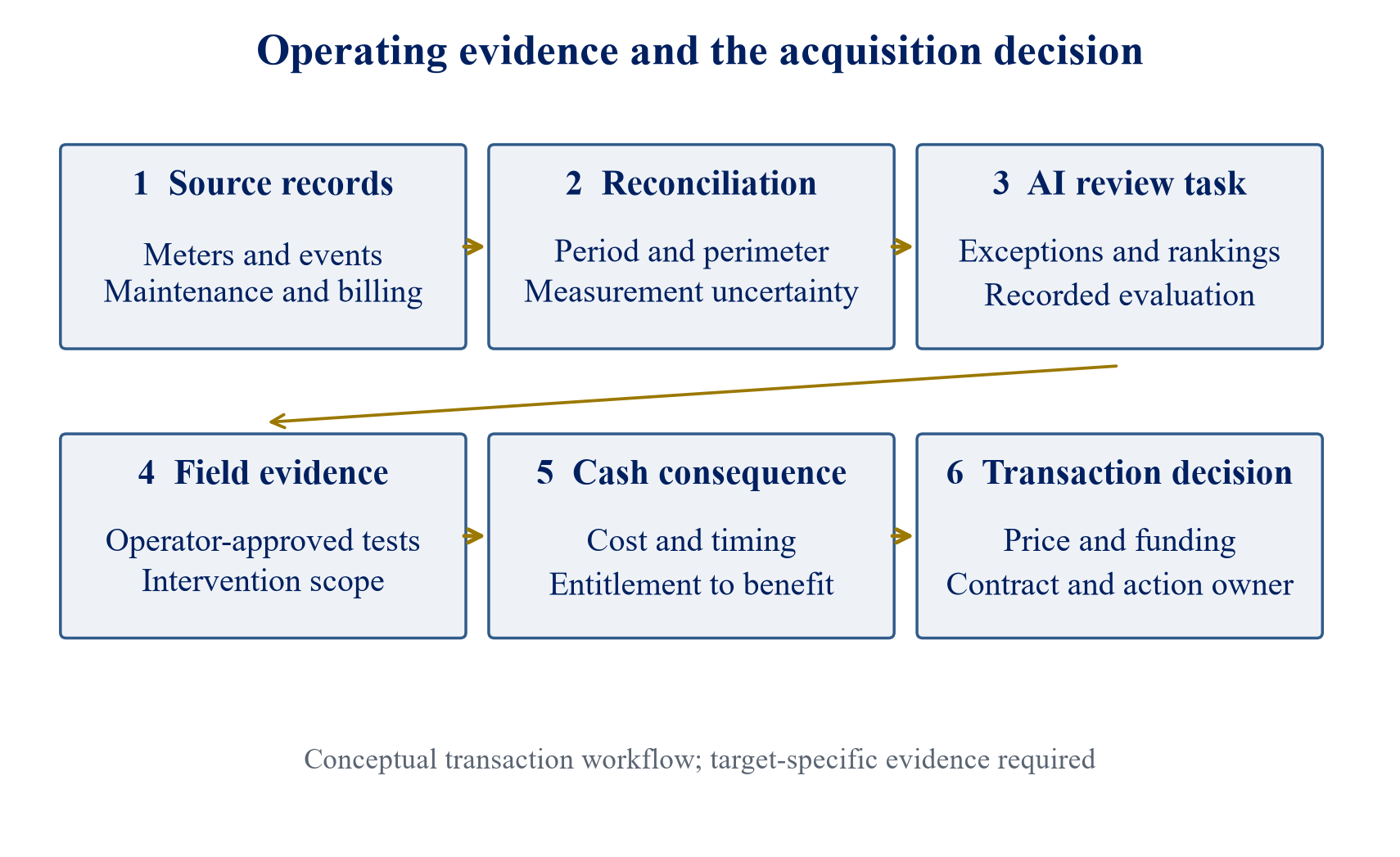
Author-developed diligence architecture. Each transition requires target-specific evidence and professional review; no measured implementation performance is claimed.
5 Measure uncertainty before allocating capital
Treat uncertainty as an input to the investigation plan. A missing calibration certificate, uncertain bulk-meter accuracy and incomplete records of authorised unbilled consumption affect different parts of the balance. Assign a range and a stated basis where a measurement cannot be established precisely. A range should come from relevant calibration evidence or an explicit scenario assumption, with no invented confidence attached to it.
Consider an illustrative system reporting 100 million cubic metres of annual input. If the assumed input measurement uncertainty is plus or minus 2 million cubic metres, a claimed leakage improvement of 1 million cubic metres needs evidence capable of distinguishing improvement from measurement variation. This is a hypothetical example. It shows why the measurement plan belongs in the investment appraisal before a benefit is capitalised.
Uncertainties can be correlated. A common time synchronisation problem can affect several meters together. A single method for estimating consumption can affect multiple districts. Adding individual error margins as if they were independent may misrepresent the range of the aggregate. Ask the measurement specialist to identify common causes and propose a reconciliation or sensitivity method appropriate to the available information.
The research by Mazzolani and colleagues examines the limitations of percentage leakage indicators and the influence of their mathematical formulation [3]. For transaction analysis, the proposed response is to present absolute volumes alongside appropriate normalised measures and their denominators. A changed percentage should trigger a review of the numerator, denominator and service conditions before management assigns a technical explanation or financial value.
6 Build an inspection queue with accountable evidence
An acquisition review can organise exceptions by expected decision relevance. A proposed inspection queue should state the asset, observation, suspected mechanism, potential consequence, available evidence and cost of verification. The aim is to identify which investigations can materially change the purchase decision, funding requirement or completion conditions. A high model score alone does not establish the size or urgency of a defect.
For water, an unusual overnight flow may reflect leakage, legitimate demand, a changed valve configuration or a faulty reading. For electricity, an equipment alarm may reflect a transient condition, a sensor issue or a developing defect. The queue should preserve those alternative explanations. Operators and engineers select the tests that can distinguish them while maintaining the required service.
Rank an exception using both consequence and evidence. A low-frequency event at a critical asset may deserve attention because the cost of failure is substantial. A frequently flagged asset may have a modest consequence or weak measurement. Keep those dimensions separate until the decision team agrees how they affect the investigation. A single combined score can conceal why an asset was prioritised.
Record the result of every investigated item, including findings that do not support the original suspicion. Such records support evaluation of the inspection process and prevent a success register from containing only confirmed defects. The acquisition team should know how much of the network remained untested and whether the inspection sample was deliberately concentrated on likely failures.
7 Select AI tasks that can be evaluated
Define a narrow task before selecting a model. Examples include mapping maintenance notes to an asset identifier, proposing a classification for an outage cause, locating missing dates in work orders and ranking a fixed set of segments for inspection. Each task needs a reference answer or an evaluation procedure. A broad request to find hidden value supplies little guidance on what a useful output would contain.
Use a reviewed sample to establish the performance of the existing process. Compare AI-assisted and existing review on the same task, with consistent records and comparable reviewer effort. Measure the errors that matter to the decision: a missed high-consequence defect, an incorrect asset match, a fabricated explanation or a false alert that consumes scarce inspection capacity. Preserve examples of those errors for operator review.
Temporal evaluation deserves particular care. Information added after a repair can reveal the outcome to a model being tested on an earlier prediction. Training and test records should respect the date at which information would have been available. A model intended for a new region also needs evaluation on that region's asset types, operating conditions and record conventions. Transfer performance remains unknown until tested.
NIST's AI Risk Management Framework is a voluntary resource for managing AI risks. Its current programme also records an April 2026 concept note concerning critical infrastructure [6]. This paper's proposed task definition, evaluation record and approval controls are applications developed for utility transactions. They do not establish compliance with a future profile or prove the safety of a particular system.
8 Interpret an AI test without overstating its result
Consider a hypothetical review of 200 labelled inspection records. Assume that independent field assessment identifies 40 items as defects requiring the specified intervention. An AI-assisted rule flags 50 records, of which 30 correspond to those defects and 20 do not. Ten relevant defects remain unflagged. The other 140 records are correctly unflagged. These counts are assumed for demonstration.
The resulting precision is 30 divided by 50, or 60 percent. Recall is 30 divided by 40, or 75 percent. These are properties of the assumed sample and threshold. The calculation does not establish the accuracy of a commercially available model, the performance of a live network or an expected reduction in failures. Label quality and the definition of an actionable defect remain central to interpretation.
The operational decision concerns the cost of the inspection queue and the consequence of missed defects. Fifty alerts may be manageable in one territory and exceed crew capacity in another. Inspecting every alert also may require permits, shutdowns or specialist testing. Assign those costs to the proposed deployment rather than treating a favourable classification measure as a completed business case.
The sample design can materially affect the result. If records were selected because they already looked suspicious, their defect prevalence may exceed that of the full network. The buyer should retain the selection method, asset coverage and uninspected population. A deployment proposal should state where evaluation is incomplete and identify the additional testing required before relying on its output in operating decisions.
Table 1. Hypothetical evaluation of an inspection queue
| Review outcome | Actual defect | No specified defect | Total |
|---|---|---|---|
| Flagged for inspection | 30 | 20 | 50 |
| Not flagged | 10 | 140 | 150 |
| Total | 40 | 160 | 200 |
Author-assumed sample of 200 records. Defect labels refer to the specified intervention; the table reports no empirical model result.
9 Verify the proposed intervention in the field
A detected pattern needs a field response suited to the asset. The investigation should specify the location, measurement method, safety controls and criteria for accepting the result. Where practical, retain the pre-intervention readings, photographs, test results and work order. Establish whether the action repaired a defect, corrected a record, changed a control setting or merely produced a new estimate.
The measurement of improvement should account for relevant changes in demand, pressure, weather and service conditions. In a proposed water pilot, compare compatible periods or use an engineer-approved adjustment method. A decline in system input during reduced demand cannot automatically be attributed to a repair programme. Likewise, a quieter storm season does not demonstrate that an electricity maintenance intervention caused lower interruption minutes.
Design the verification around the claimed benefit. A revenue-recovery intervention requires billing and collection evidence. A physical-loss intervention requires evidence of the relevant volume change and the cost actually avoided. An asset-life extension requires an engineering basis and a revised renewal schedule. The appropriate evidence differs even when several interventions are described commercially as AI-enabled optimisation.
For acquisition diligence, an incomplete field programme should remain visible in the decision record. The buyer can request further testing, reduce the recognised benefit, fund a post-completion pilot or negotiate a specific contractual treatment. The available options depend on transaction circumstances. They should be chosen deliberately rather than allowing an untested assumption to become the central acquisition case by default.
10 Translate maintenance records into a capital schedule
Maintenance records should explain both the work performed and the remaining requirement. Match work orders with invoices, asset identifiers and evidence of completion. Review repeat repairs, cancelled jobs, deferred interventions and temporary solutions. A work order marked complete may refer to an inspection or partial repair; the acquisition team needs the scope actually delivered before concluding that an asset's condition has improved.
Separate routine operating maintenance, recurring renewals, immediate remediation and optional enhancement in the economic model. The classification should follow the nature and timing of the intervention, with the accounting treatment reviewed separately. A recurring cash requirement can affect the acquisition case even when it is capitalised in the financial statements. An immediate expenditure can affect completion funding even when it does not reduce reported EBITDA.
For each material capital item, specify scope, quantity, unit cost evidence, lead time, installation constraints and the required service interruption. Include enabling costs such as site access, temporary supply, permitting, disposal and commissioning where relevant. A replacement equipment quote is one component of the executable cost. The schedule should identify the evidence still needed to convert a preliminary estimate into a funded programme.
The proposed capital plan should be reviewed by qualified engineers with knowledge of the relevant assets. The transaction team then connects accepted interventions to cash timing and purchase-price treatment. Where the physical scope is uncertain, model a transparent range and fund investigation. This approach preserves the distinction between an engineering finding, a cost estimate and a negotiated financial consequence.
11 Review electricity outages at the asset level
Annual reliability indicators provide a starting point for diligence. Reconstruct a relevant event history with the affected asset, start time, restoration time, customers affected, cause classification and available supporting evidence. Distinguish distribution events from upstream supply interruptions according to the reporting convention. Preserve event exclusions so that the acquisition team can compare like-for-like records.
The EIA publishes SAIDI as minutes per year, SAIFI as interruptions per year and CAIDI as minutes per interruption within its reliability tables [4]. The proposed transaction review adds asset and customer concentration to those reported measures. A network average can obscure a service-critical circuit or a group of customers with materially different interruption exposure. Investigate those concentrations using the target's actual event records.
An AI-assisted classification of outage causes should retain operator review. A maintenance note may mention vegetation, protection operation and weather in the same record. Assigning the event to one cause can simplify the narrative without resolving the mechanism. Ask whether the proposed intervention would have changed the outcome and what evidence supports that assessment. Model savings only after defining the response and its cost.
Translate interruption findings into relevant obligations, repair expenditure and customer consequences. Those effects depend on actual contracts, compensation arrangements and regulation. The paper assumes no universal penalty per interruption or standard value of lost load. The buyer's forecast should use the target's obligations and approved valuation methods, with professional review of material service and liability assumptions.
12 Protect operational systems during diligence
Operational technology interacts with the physical environment. NIST's Guide to Operational Technology Security addresses security together with the performance, reliability and safety requirements of those systems [7]. A transaction review should therefore agree an access method with the operator before collecting data or testing analytical tools. Uncontrolled experimentation on a live control system introduces an additional operating risk into the diligence process.
The proposed default is an authorised, read-only export or separately prepared analysis environment. Record the source system, extraction time, asset mapping and any filtering applied. Limit access to the data needed for the agreed task. Security and privacy specialists should review customer information, sensitive infrastructure details and the use of external processing services before any upload or integration.
A buyer needs to examine the continuity of access after completion. A third-party contractor may control the historian, credentials or maintenance application. The target may rely on a group-wide identity system. Document the transition requirements, licences, configuration backups and support commitments needed for continuing operation. Assign their cost and timing to the separation or integration plan.
Where an analytical proposal extends to automated control, conduct a separate operating and safety assessment. The diligence paper's inspection and review framework provides no authority to change pump pressure, protection settings or dispatch. Such interventions require the responsible operator's approvals and relevant specialist review. Keep analytical access, human decision support and physical control permissions distinct in the transaction record.
13 Determine who receives the improvement benefit
A technical improvement requires a contractual cash-flow analysis. Identify whether the utility earns a volumetric tariff, availability payment, operating fee or other form of remuneration. Review the treatment of saved energy, recovered billing, performance payments and avoided capital expenditure. The operating improvement can be valuable to customers or the service system while producing a different benefit for the acquired entity.
For regulated utilities, investigate how the applicable determination treats expenditure, incentives and efficiency benefits over time. For a concession or operating contract, examine the agreed payment mechanism, baseline and adjustment clauses. A saving that is passed through immediately has a different shareholder cash effect from a saving retained for a defined period. The diligence team should establish that distinction from the operative documents.
Performance-based contracting can be considered as one route to implementing a water-loss programme. The World Bank's contracting resources emphasise the need to specify the underlying causes, costs, benefits and contractual details of non-revenue-water reduction [8]. This paper proposes testing baseline measurement, payment triggers, independent verification, access obligations and residual operating responsibility before including such a contract in an acquisition plan.
Avoid recognising the same benefit in several entities. An operating company, service contractor and asset owner may divide the economic result. A supplier performance fee reduces the cash retained by its customer. A benefit already embedded in the seller's forecast needs a reconciliation to the proposed intervention. Keep a single benefit ledger showing the gross improvement, each contractual allocation and the amount available to the buyer.
14 Define the hypothetical water case
Consider an author-developed acquisition scenario, expressed in USD and using annual volumes in million cubic metres. System input is assumed to be 100. Billed authorised consumption is 75, unbilled authorised consumption is 2, apparent losses are 5 and real losses are 18. The components sum to system input. These assumptions describe no actual utility, concession or market benchmark.
The proposed optional programme recovers 6 million cubic metres of physical loss and 2 million cubic metres of apparent loss per year. Assume that physical recovery avoids a marginal production cost of USD 0.25 per cubic metre. Assume apparent recovery supports billing at USD 0.90 per cubic metre, with 90 percent collected. The two mechanisms are evaluated separately; recovered physical volume is not additionally sold in this case.
Assume annual incremental field and operating cost of USD 0.70 million and annual software and data cost of USD 0.20 million. The optional programme requires USD 8 million initially. Benefits continue for eight years, with no terminal value. A 20 percent assumed cash-tax adjustment applies to the net operating benefit, and the annual discount rate is assumed to be 10 percent. Tax depreciation benefits are excluded for simplicity.
The case also assumes a separate USD 4 million immediate remediation requirement that exists regardless of the optional programme. The recurring baseline cash requirement is assessed in the valuation bridge below. These amounts remain separate so that the optional improvement is not credited with satisfying an obligation already included in baseline expenditure. An actual model would replace every assumption with target-specific evidence and applicable tax treatment.
Table 2. Hypothetical annual water balance and programme assumptions
| Component | Baseline | Proposed change | Cash mechanism |
|---|---|---|---|
| System input | 100 | Reduce by 6 | Avoid marginal production cost |
| Billed authorised use | 75 | Increase by 2 | Recover billing and collections |
| Unbilled authorised use | 2 | No assumed change | No benefit recognised |
| Apparent losses | 5 | Reduce to 3 | USD 0.90 per cubic metre; 90% collected |
| Real losses | 18 | Reduce to 12 | USD 0.25 per cubic metre avoided |
| Optional programme | 8 initial capex | 0.90 annual cost | Eight annual benefit periods |
Author-developed assumptions. Volumes are million cubic metres per year; financial values are USD million unless stated. The physical and billing benefits are distinct.
15 Calculate the optional programme value
The assumed physical-loss recovery produces annual avoided cost of 6 multiplied by 0.25, or USD 1.50 million. The assumed apparent-loss recovery produces annual collected revenue of 2 multiplied by 0.90 multiplied by 0.90, or USD 1.62 million. Total annual gross benefit is therefore USD 3.12 million. Subtracting the USD 0.90 million operating and software cost gives USD 2.22 million before the assumed cash-tax adjustment.
Applying the assumed 20 percent adjustment produces annual cash benefit of USD 1.776 million. Eight end-of-year payments discounted at 10 percent have an annuity factor of approximately 5.3349. The present value of those payments is approximately USD 9.475 million. Deducting the USD 8 million initial programme cost gives a hypothetical net present value of approximately USD 1.475 million.
The calculation recognises no resale value, avoided expansion programme or additional physical-volume sales. It assumes that the utility retains the stated cash benefit and that the recurring costs include the expenditure required to sustain it. A transaction analysis must test each condition. If a material supplier fee, renewal cost or customer allocation is missing, the calculated programme value changes.
The improvement option should be compared with alternative interventions on consistent assumptions. A targeted meter programme, pressure intervention or manual inspection process might produce a different benefit and cost profile. This paper reports no comparative field evidence establishing that an AI-assisted method is superior. The proposed investment decision is to choose a programme after its measured and executable economics support the choice.
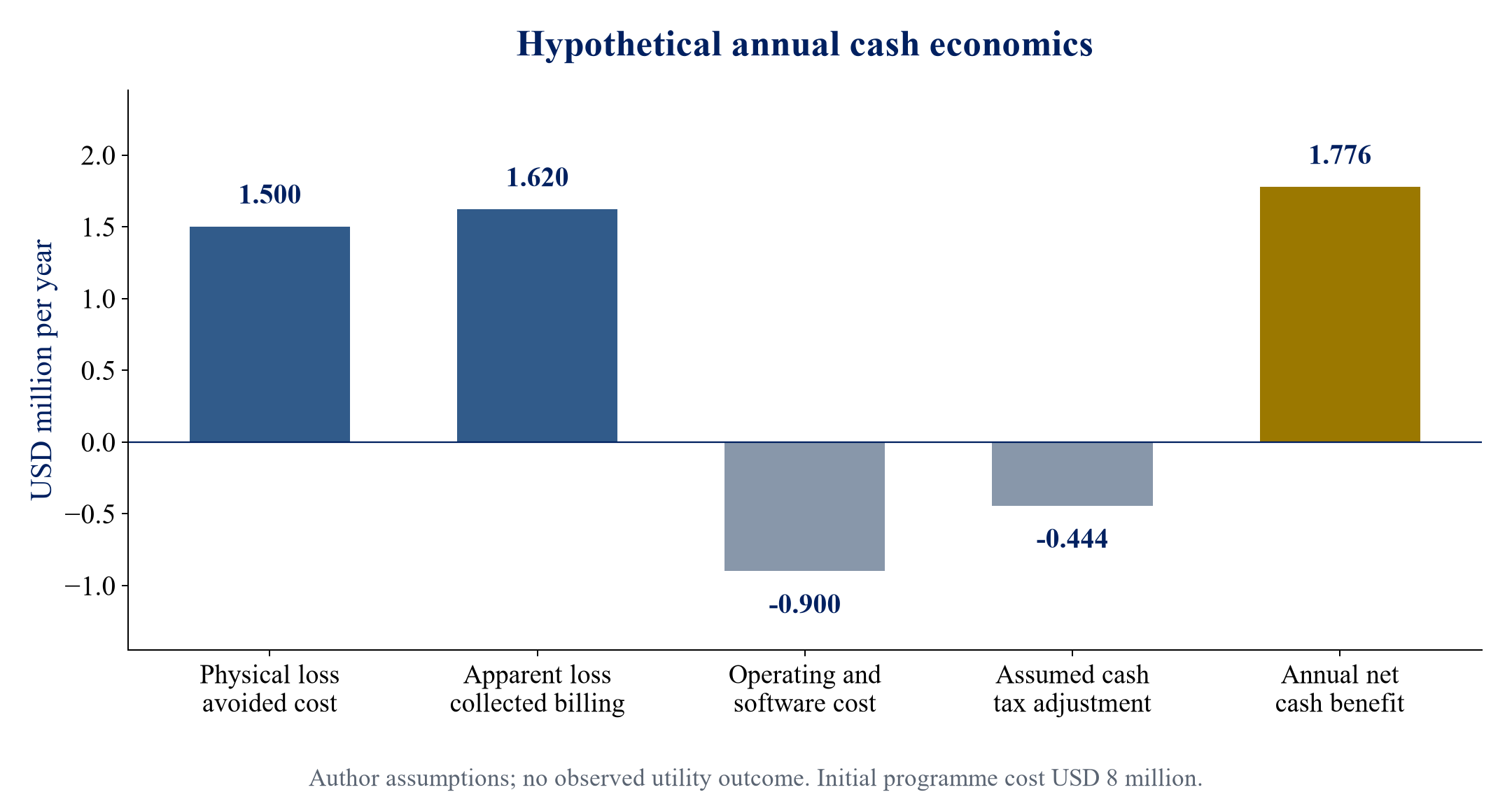
Author calculations using Table 2 assumptions. Annual gross benefit of USD 3.12 million, annual cost of USD 0.90 million and assumed cash-tax adjustment of USD 0.444 million produce USD 1.776 million annual net cash.
16 Test delay and incomplete recovery
A one-year delay changes the value even if the assumed eight annual payments eventually occur. Moving the payment dates from years one through eight to years two through nine divides their present value by 1.10. The hypothetical programme NPV falls from approximately USD 1.475 million to approximately USD 0.613 million, with the USD 8 million cost still paid initially. No additional delay cost is assumed in this sensitivity.
If initial programme cost rises by 25 percent to USD 10 million while benefits remain unchanged, NPV becomes approximately negative USD 0.525 million. That calculation illustrates the sensitivity of the assumed case to scope and execution cost. It does not forecast a particular cost overrun. The buyer should investigate enabling works, equipment availability and access constraints when deciding the expenditure range to fund.
If both gross benefit components reach only half their assumed amount, total gross annual benefit is USD 1.56 million. Keeping annual cost at USD 0.90 million produces USD 0.66 million before the cash-tax adjustment and USD 0.528 million after it. The eight-year present value is approximately USD 2.817 million, giving NPV of approximately negative USD 5.183 million after the initial USD 8 million cost.
These sensitivities suggest a staged investigation for this hypothetical case. Commit to the measurement and pilot scope needed to narrow material uncertainty before funding the full programme. The staged plan needs its own cost, timing and contractual analysis. A pilot cannot be treated as free, and an ability to defer investment does not establish that the entire programme can be abandoned without consequence.
17 Reconcile recurring costs with enterprise value
Assume the illustrative seller reports annual EBITDA of USD 40 million. Diligence identifies USD 2.5 million of additional recurring operating maintenance, USD 0.6 million of recurring cash cost for contracted obligations and USD 0.4 million of continuing data and operating support omitted from that figure. Assume these items are valid EBITDA adjustments in the illustrative model. Normalised EBITDA is consequently USD 36.5 million.
Using an assumed eight-times multiple gives an initial headline enterprise value of USD 320 million and a normalised value of USD 292 million. The eight-times multiple is an author assumption, with no claim to market comparables. It is held constant to isolate the effect of the recurring-cost corrections. A real transaction should assess valuation methods, comparable evidence and the duration of contractual cash flows separately.
Deduct the separate USD 4 million immediate remediation requirement once to obtain USD 288 million before the optional programme. If the buyer elects to recognise the entire hypothetical optional-programme NPV, the corresponding value becomes approximately USD 289.475 million. That figure is an illustrative upper value under the stated assumptions, before other deal costs and uncertainties. It is not a recommended bid or valuation opinion.
The optional programme is valued through its incremental DCF and is excluded from normalised EBITDA in this bridge. Adding both a multiple of its annual benefit and its full incremental NPV would count the same benefit twice. If the acquisition model instead embeds the programme directly into an integrated cash forecast, remove the separate option value and reconcile the result to the same expenditure and payment assumptions.
Table 3. Hypothetical acquisition valuation bridge
| Step | Earnings change | Value effect | Resulting enterprise value |
|---|---|---|---|
| Headline case | 40.0 EBITDA | 8 times assumed multiple | 320.0 |
| Operating maintenance | Minus 2.5 | Minus 20.0 | 300.0 |
| Contracted recurring cost | Minus 0.6 | Minus 4.8 | 295.2 |
| Continuing data support | Minus 0.4 | Minus 3.2 | 292.0 |
| Immediate remediation | No EBITDA change | Minus 4.0 once | 288.0 |
| Optional programme | Excluded from baseline | Plus 1.475 NPV | 289.475 |
Author assumptions; USD million. The eight-times multiple is constant for demonstration. Immediate remediation and optional programme value are counted once; no market valuation is asserted.
18 Treat accounting and transaction adjustments separately
Accounting recognition requires its own assessment. The IFRS Foundation's IAS 37 overview distinguishes provisions and contingent liabilities and explains that future operating losses do not, by themselves, establish a provision. The standard also addresses onerous contracts and restructuring obligations [9]. An acquisition team should ask qualified accountants to assess the target's actual obligations and applicable reporting requirements.
An economic expenditure forecast and a recognised accounting liability can therefore differ. A necessary future renewal programme may affect value and funding even where it is not recorded as a provision. Conversely, a recognised liability may require careful analysis of settlement timing, contractual protection and the price mechanism. The transaction model should show the cash consequence and the proposed negotiated treatment for each material item.
The IFRS 3 overview concerns the accounting for business combinations, including identifiable acquired assets and liabilities [10]. Purchase accounting serves a different purpose from the buyer's negotiation model. The acquisition team should reconcile the schedules so that identifiable obligations and technology rights receive appropriate review, while keeping the commercial valuation assumptions and accounting conclusions separately documented.
Define a single adjustment record for each issue. Include its engineering finding, recurring or one-time cash effect, accounting review, location in the valuation model and treatment in the agreement. This proposed record makes double counting visible. If immediate remediation is deducted from price and also included in debt-like adjustments, the parties need to reconcile whether the agreement intentionally provides both treatments.
19 Allocate uncertainty in the transaction agreement
The agreement should address material findings that the parties have actually investigated. Legal advisers can assess appropriate warranties, indemnities, covenants, completion conditions or contingent consideration in the relevant jurisdiction. The research framework supplies evidence and economic reasoning for that discussion. It does not prescribe enforceable legal terms or assume that every uncertainty can be transferred to the seller.
For a disputed operating baseline, specify the records and measurement method used to determine any adjustment. A proposed performance-linked payment needs a defined period, verification process, access rights, treatment of changes in operating conditions and dispute procedure. The measurement system must distinguish an achieved improvement from a change in reporting convention. Financial incentives should reflect the parties' ability to influence the outcome.
Consider continuity risks during a separation. A transitional service may provide billing, incident response, data hosting or operational support. State the service scope, cost, owner, end date and acceptance conditions for replacement. Include the cost of maintaining service while migration is incomplete. The acquisition model should not assume a rapid transition simply because a new software licence can be purchased.
The buyer also needs a funded response if the seller's protection proves limited. Counterparty credit, liability caps and exclusions can affect recoverability. The decision record should retain the gross exposure, proposed contractual recovery and residual buyer exposure separately. A negotiated clause can change risk allocation; it does not repair an asset or supply the cash needed for immediate operational work.
20 Align acquisition debt with the executable capital plan
Debt sizing should use the cash available after the expenditure needed to sustain contracted service. Build a cash schedule from normalised operations, working capital, taxes, renewal expenditure and the proposed optional programme. Identify restricted cash and amounts unavailable for servicing acquisition debt. The paper assumes no universal leverage ratio, coverage threshold or lender acceptance of technology-related benefits.
Separate funding required at completion from later commitments. Immediate remediation, transaction costs and essential separation work may require cash before the optional programme produces a benefit. Model the period of lowest liquidity and the effect of a delayed intervention. A forecast with positive long-run programme NPV can still have an early funding gap. The sources and uses should match that timing.
Where a lender is asked to recognise an improvement, provide the measurement basis, cost evidence, operating approval and contractual entitlement to cash. Retain a case that excludes the benefit or delays it. Financing documents can then be evaluated against the risk the lender is being asked to accept. An AI demonstration or vendor forecast supplies no independent evidence of debt capacity.
The proposed financing review should include the conditions under which distributions, additional borrowing or further capital commitments are permitted. Assess those conditions using actual facility and service documents. If the utility's assets or cash flows are ring-fenced, obtain advice on the applicable restrictions. Avoid assuming that consolidated cash can automatically be used to service debt elsewhere in the acquisition structure.
21 Plan the first one hundred days
Before completion, identify the minimum operating continuity requirements and the findings that need immediate action. The proposed first phase confirms access to records, incident response, critical supplier support and the funded remediation schedule. Each item needs an accountable operator and an acceptance criterion. The buyer's transaction team should obtain evidence of readiness rather than relying on a general integration presentation.
The next phase reconstructs the operating baseline under the agreed measurement rules. Keep the seller's reporting alongside the reconstructed position so that differences can be investigated. Confirm the inspected asset population, untested areas and the status of deferred work. Establish a controlled benefit ledger with finance and engineering review. Optional programme claims should remain distinguishable from baseline corrections.
An AI-assisted pilot can then operate within an approved analytical boundary. Fix the task, version, evaluation dataset and reviewer responsibilities. Record rejected alerts, missed issues and the actual cost of investigation. Use the results to update the programme scope and economics. Any expansion to new assets or live control needs its own review; the pilot's result does not establish performance across an untested network.
At the end of the period, the governing body should receive a reconciled operating and financial view. Show remediation completed, expenditure committed, remaining condition uncertainty, verified benefits and changes to the funding plan. Preserve the original acquisition assumptions so that the revised position can be understood. A later improvement should not erase the evidence that supported the price paid at completion.
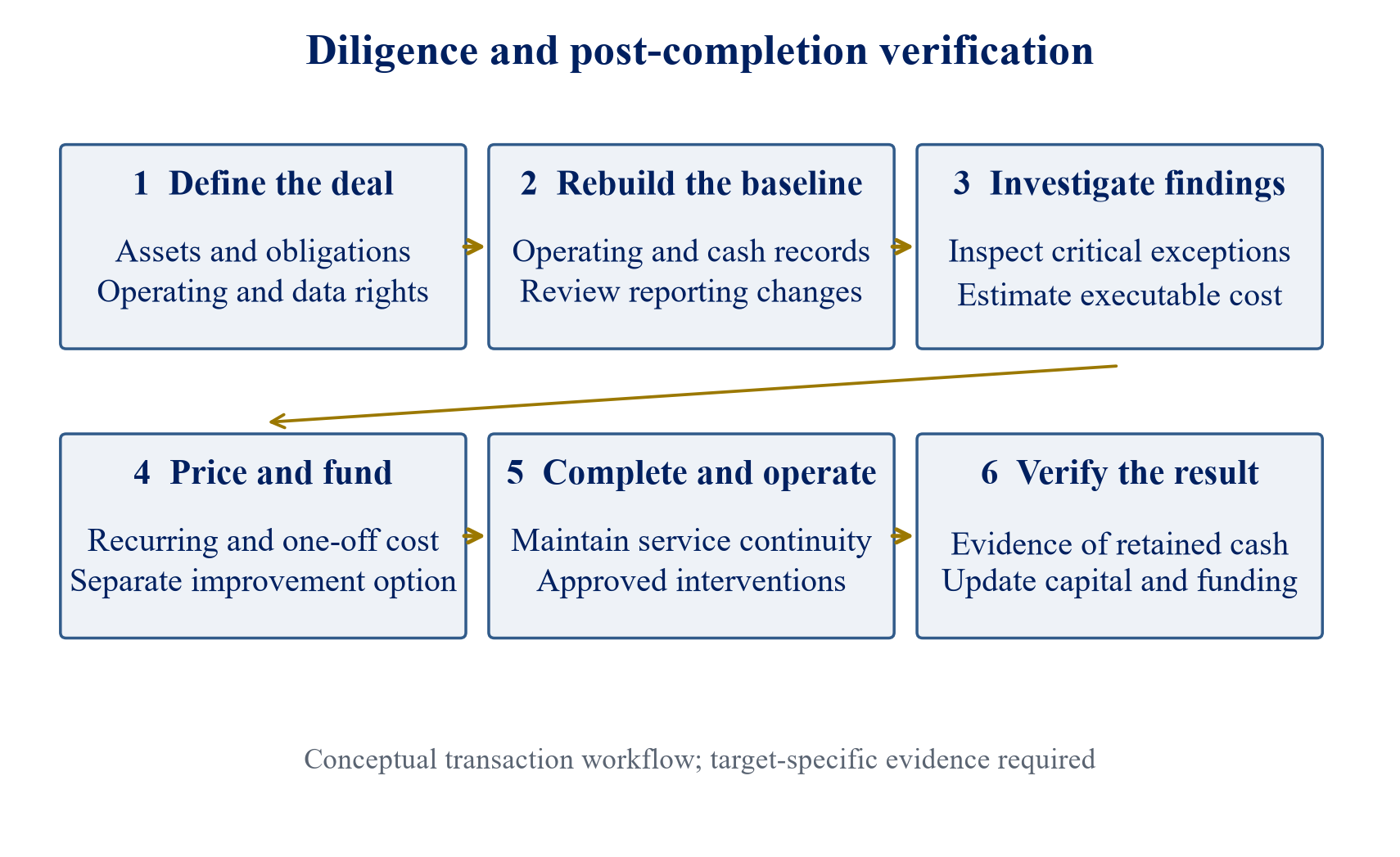
Author-developed workflow. The sequence links perimeter, measurement, investigation, pricing and post-completion verification. Timing and permissions require transaction-specific approval.
22 Adapt the framework to geography and contract
A UK regulated water-company analysis should use the company's operative determination, performance definitions and obligations. A US distribution-utility analysis should use the relevant service territory, regulator and event-reporting convention. In a municipal concession, the concession agreement may define the payment and investment obligations differently. These are proposed adaptation requirements; the paper supplies no universal legal treatment across those settings.
A GCC water or power transaction requires examination of its particular offtake, operating, ownership and financing arrangements. An availability-based payment mechanism produces different revenue sensitivities from a volumetric retail model. An acquisition of a minority interest also gives different decision rights from acquiring operating control. Establish those facts before transferring any numerical assumption from the illustrative water case.
For an Indian engineering or utility-services target, asset ownership, customer contracts and collection rights may differ from those of a network operator. The relevant perimeter might consist of maintenance services, project obligations and working capital. The same evidence-to-cash method can be proposed for that setting, with a new financial model reflecting the contracts actually acquired. No cross-country performance ranking is asserted here.
Technology and data rights need local review in every setting. Customer information, critical-infrastructure records and external data processing can be subject to restrictions. Use qualified advisers to establish what applies to the target and proposed transaction. A model's ability to process records does not establish authority to transfer them, train on them or use them after a change of control.
23 Use investigation economics to allocate diligence effort
An additional test is valuable when its result can change a consequential decision. Define the unresolved issue, available actions, proposed test cost and the way each possible result would affect price, funding or contract terms. This is a proposed decision method. It supports a disciplined allocation of inspection and analytical effort without assigning a fabricated probability to an unknown physical condition.
For example, a targeted examination might establish whether a major pump requires immediate replacement or scheduled maintenance. The economic consequence includes equipment, installation, temporary supply and service constraints. If both findings lead to the same acquisition action and funding requirement, the test may add limited transaction value. If they produce materially different plans, the test can justify more attention subject to its cost and operational feasibility.
Keep the potential cost of a missed issue visible. A narrow sample may resolve one asset but leave the wider condition distribution unknown. A buyer can fund a contingency or broaden the investigation, with the basis stated explicitly. The contingency should be linked to unresolved scope and exposure. A generic percentage inserted into every capital line supplies little explanation of what the funding reserve is intended to cover.
The resulting diligence plan should contain a small set of decision-critical tests and a clear record of the remaining uncertainty. The aim is an executable acquisition decision within the information and access actually available. Where evidence is insufficient for a material assumption, reduce its recognised value, change the structure or request further evidence. Document which option was selected and why.
24 Limitations and research agenda
This paper's numerical tables and figures are hypothetical. They demonstrate reconciliations and investment logic, with no empirical estimate of AI performance, typical leakage recovery, market multiples or realised transaction returns. The proposed framework has not been validated here against a labelled multi-utility dataset. Its effectiveness as a diligence method requires evaluation in actual, authorised engagements.
Useful future research would compare AI-assisted and existing inspection selection under consistent field-verification rules. It should report the asset population, selection method, intervention costs, missed defects and the time between identification and realised cash. Cross-region testing should retain differences in record quality, network conditions and payment mechanisms. Such evidence could support narrower conclusions about the tasks and settings where assistance improves decisions.
Another research priority is the relationship between measurement uncertainty and capital allocation. A study could examine how calibration and record corrections change the ranking of interventions. It would need to distinguish a revised estimate of historical leakage from a physical reduction achieved through work. Similar care is needed when evaluating outage classification and the capital programme selected in response.
The immediate acquisition conclusion is to retain an inspectable connection between evidence, intervention, cash and transaction treatment. An AI output can contribute to that connection when its task and evaluation are clear. The price and funding plan should recognise the benefits and obligations supported by the target's actual evidence, with remaining uncertainty explicitly recorded for the people authorised to accept it.
References
- US Environmental Protection Agency (2010). Control and Mitigation of Drinking Water Losses in Distribution Systems, EPA 816-R-10-019. https://nepis.epa.gov/Exe/ZyPURL.cgi?Dockey=P1009VCZ.TXT Accessed 4 October 2026.
- US Environmental Protection Agency (2026). Drinking Water Distribution System Tools and Resources. https://www.epa.gov/dwreginfo/drinking-water-distribution-system-tools-and-resources Accessed 4 October 2026.
- Mazzolani, G., Ciliberti, F. G., Berardi, L., and Giustolisi, O. (2023). Assessing Water Performance Indicators for Leakage Reduction and Asset Management in Water Supply Systems. Research manuscript, arXiv:2306.17195. https://arxiv.org/abs/2306.17195 Accessed 4 October 2026.
- US Energy Information Administration (2026). Electric Power Annual, Table 11.2, Reliability Metrics Using IEEE of US Distribution System by State, data for 2024 and 2023. https://www.eia.gov/electricity/annual/html/epa_11_02.html Accessed 4 October 2026.
- Competition and Markets Authority (2026). Water PR24 price redeterminations, case record and final determination documents. https://www.gov.uk/cma-cases/water-pr24-price-redeterminations Accessed 4 October 2026.
- National Institute of Standards and Technology (2026). AI Risk Management Framework, programme overview and critical-infrastructure profile development status. https://www.nist.gov/itl/ai-risk-management-framework Accessed 4 October 2026.
- National Institute of Standards and Technology (2023). Guide to Operational Technology Security, SP 800-82 Revision 3. https://csrc.nist.gov/pubs/sp/800/82/r3/final Accessed 4 October 2026.
- World Bank PPP Resource Center (2026). Contracting Tools for Non-Revenue Water Reduction. https://ppp.worldbank.org/water-and-sanitation/contracting-tools-non-revenue-water-reduction Accessed 4 October 2026.
- IFRS Foundation (2026). IAS 37 Provisions, Contingent Liabilities and Contingent Assets, standard overview. https://www.ifrs.org/issued-standards/list-of-standards/ias-37-provisions-contingent-liabilities-and-contingent-assets/ Accessed 4 October 2026.
- IFRS Foundation (2026). IFRS 3 Business Combinations, standard overview. https://www.ifrs.org/issued-standards/list-of-standards/ifrs-3-business-combinations/ Accessed 4 October 2026.
About the Author
Chennakeshav (CK) is a corporate finance and investment banking executive with 25+ years of global experience in deal origination, structuring and execution across M&A, growth capital and corporate strategy. He has led value-creation mandates for founders, corporates and funds — bridging the boardroom view to hands-on execution and close.
His career spans Morgan Stanley, HSBC, Lloyds Banking Group, EWEC, ADQ portfolio companies and Emirates Growth Fund, across TMT, real estate, fintech, deeptech, cleantech, infrastructure and energy. He has partnered with C-suite leaders, private equity and venture funds, sovereign wealth funds and family offices to finance complex fund raises and scale-up ventures, and has led M&A due diligence, post-merger integration and business-transformation initiatives to create value.
At Matchpoint Partners he is Managing Partner, leading the firm's corporate finance, M&A and capital-raising practice. He holds an MBA from London Business School, an engineering degree from VTU and a Master of Laws (LLM, in progress) from UCL London.
An active start-up mentor, CK mentors at Techstars, DIFC FinTech Hive, Startup Grind, Founder Institute and IN5, serves as Entrepreneur Mentor in Residence (EMiR) at London Business School, and judges the Entrepreneurship World Cup.
