

1 The contract decision
Approve an outcome-linked AI water contract only after specifying the physical result that earns a fee and the evidence needed to accept that result. The commercial decision concerns a defined intervention in a defined network over a defined period. The title's reference to a leak found describes the starting event. The proposed payment schedule follows the event through confirmation, repair and measured persistence.
A utility may already have selected its detection technology. This paper addresses the subsequent contracting decision: allocating baseline, implementation and verification responsibilities between the utility and provider. Product selection, sensor procurement rankings and comparative vendor performance require their own evaluation. No named utility, supplier or completed transaction is analysed here.
The proposed approval memorandum should identify the service area, budget authority, intervention owner, independent reviewer and maximum payment exposure. It should also state which conditions would suspend a fee. A missing measurement, an unauthorised change to the baseline or a failure to meet a customer-service floor can each affect acceptance. The parties should decide the corresponding response before receiving a favourable result.
Specify the practical authority that accompanies each responsibility. A software provider may prioritise an investigation while the utility controls road access and repair crews. A promise of measured water savings therefore needs an agreed route from alert to authorised field work. The payment formula should reflect which parts of that route the provider controls, which depend on the utility, and which remain outside both parties' control.
2 Evidence and methodological scope
The World Bank's contracting resources distinguish physical losses, commercial losses and authorised unbilled consumption within non-revenue water. They describe performance-based contracts as incentivised service contracts and identify contract specificity as important to their suitability [1]. A reduction in the non-revenue-water balance can consequently arise through different mechanisms. The proposed contract separates those mechanisms before attributing a physical saving.
The Bank's preparation process covers screening, initial assessment, field assessment, contract design and implementation oversight. It includes meter testing and site-specific loss analysis, and recommends independent verification where payments depend on performance [2]. Its separate guidance page places financial and institutional constraints within contract design [3]. These resources establish preparation questions; they supply no finding that a particular AI system will deliver a saving.
US Department of Energy materials outline isolation, whole-facility and simulation approaches, and identify baseline definition, an agreed verification plan, post-installation reporting and continuing review [4,5]. This paper adapts those concepts to a distribution-network contract. Federal energy-service procedures are not presented as a universally applicable water-network standard.
The World Bank-hosted historical water-management example expressly warns against treating it as an approved model. Its service indicators connect continuity with measurement conditions [6]. NIST's voluntary AI framework calls for documented evaluation methods, deployment-relevant tests and production monitoring [7]. The proposed commercial mechanism combines selected principles with original analytical recommendations. Its effectiveness and legal enforceability have not been empirically tested. Local advisers must assess the actual arrangement.
3 Separate the outcomes being purchased
Define an alert as a machine-generated indication requiring investigation. Define a confirmed leak using agreed field evidence, including location, asset identity and investigation date. Define a repair using the authorised completion record. Define a verified saving as an accepted comparison against the counterfactual after the contract's adjustments and exclusions. These proposed definitions give each stage a separate evidential requirement.
Avoid paying the same economic result twice. A provider could receive an accepted mobilisation fee and a later outcome fee, provided both have distinct scope. The schedule should state whether confirmed-event payments are advances against the outcome fee, independent payments for investigation, or another negotiated arrangement. Without that clarification, the calculation can conceal overlapping compensation.
Separate physical leakage from improved billing, meter correction and collection of arrears. Each can matter commercially, but the money arrives through a different route. The contract can contain more than one outcome schedule when the utility deliberately purchases several improvements. Use different records and financial reconciliations for each schedule. A billing correction alone does not demonstrate that less water escaped from the network.
Specify how partial outcomes are treated. An alert may identify an inaccessible leak that the utility repairs months later. Record the delay and responsible action without assuming that the original detection caused every subsequent saving. The parties can negotiate a discovery credit and a separate persistence payment, supported by evidence. The proposed framework requires the reader to distinguish those contractual choices from a technical finding about causation.
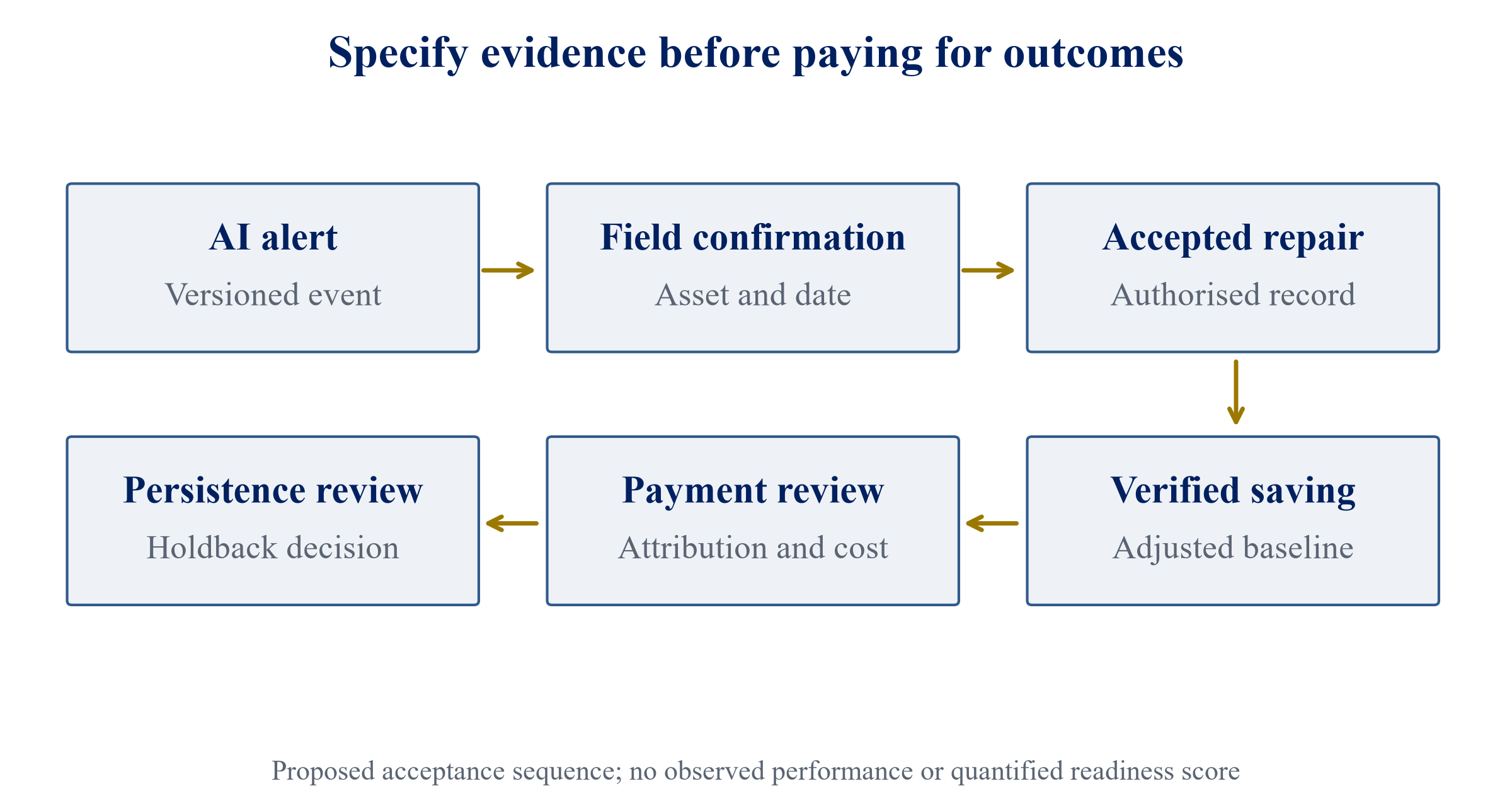
Author-designed contract framework. The stages express proposed acceptance requirements, not observed performance or a validated technology-readiness scale.
4 Draw the measurement boundary
The measurement boundary should identify the network area, its inflow and outflow meters, storage and service connections. Attach a versioned map and an asset register. State how inter-zone transfers, temporary bypasses, emergency supplies and storage changes enter the water balance. An apparent saving can otherwise arise from a changed perimeter rather than a change in physical losses.
For a district-level contract, the parties should agree how to calculate legitimate consumption within the district. The protocol can use customer-meter data where sufficiently reliable and an independently reviewed method for other consumption. It should identify the period covered by each input. Comparing a daily inflow series with a delayed billing total without a timing adjustment can distort the result.
Freeze the initial boundary before intervention. A later change in connections, assets or transfers needs a documented adjustment. Maintain the original map alongside the revised version and identify the days affected. The proposed method treats changes as explicit events with an owner and approval trail. It supplies no default rule that every expansion automatically increases or decreases the provider's entitlement.
The contracting team should test whether the boundary is practical for verification. If the inflow record excludes an important supply path, an additional measurement or a narrower initial scope may be required. A commercial target should follow the evidence available for that perimeter. A large geographical coverage claim has limited payment relevance when the corresponding water balance cannot be reproduced.
5 Establish the baseline record
The baseline should record operating conditions before the contracted intervention. The utility and reviewer should examine meter calibration, time alignment, pressure, connection counts, authorised consumption and known maintenance events. Record missing intervals and any reconstruction method. Acceptance of the baseline should be a named contractual milestone with a retained dataset and calculation version.
A useful baseline period covers the operating variations material to the intervention. The proposed framework leaves its duration to engineering assessment and the actual dataset. A short, stable trial and a seasonally variable network need different evidence. No universal period or minimum number of samples is asserted here. State why the selected observations can support the proposed comparison and identify the conditions they omit.
Review the baseline for pre-existing leaks already scheduled for repair. Include the relevant work orders and budget commitments. Where the utility was already committed to an intervention, the parties must decide how the provider's contribution will be recognised. A discovery system can accelerate a planned action; the incremental benefit requires a separate timing comparison.
Sign an evidence schedule specifying the location of the raw data, access permissions, retention period and calculation dependencies. The schedule should allow the independent reviewer to reproduce the baseline without relying on a supplier's presentation. Table 1 proposes the minimum types of record to discuss. Actual completeness must be assessed for the network and legal setting concerned.
Table 1. Proposed baseline and verification evidence schedule
| Record | Review purpose | Proposed acceptance evidence |
|---|---|---|
| Network perimeter | Identify included flows | Dated map and transfer register |
| Meter condition | Assess measurement changes | Calibration record and exception log |
| Legitimate consumption | Separate customer use | Period-aligned source and method |
| Service conditions | Identify constrained supply | Pressure and continuity records |
| Utility interventions | Avoid overlapping attribution | Approved work orders and dates |
| Calculation version | Reproduce the comparison | Inputs methodology and reviewer sign-off |
Proposed records, not a statutory checklist or an assertion that the records exist for any utility.
6 Define the counterfactual
The counterfactual is the estimated result for the reporting period without the contracted intervention. It can differ from an unadjusted historical average because demand, pressure, weather, network assets or operations may change. The contract should identify which variables can adjust the comparison and which require a separate decision. A convenient historical number should not be selected simply because it produces a larger fee.
An engineering model can offer an interpretable relationship between operating conditions and expected losses. A statistical model can estimate a relationship from suitable historical observations. A matched comparison can use areas with relevant similarity and a documented treatment of differences. These are proposed candidate approaches. Each requires evidence for its assumptions, measurement quality and practical limitations before contractual adoption.
For any model, retain a holdout period that was not used to fit or choose the final specification. Examine its performance across conditions relevant to the payment period. Record residual error and systematic deviations. A good average fit can coexist with poor performance during peak demand or a pressure change. The review should identify those limitations before the result becomes an invoice input.
The contract should also state what happens when the data cannot support a credible counterfactual. Options include a measurement-improvement stage, narrower isolation of a repair, a provisional fee with retained exposure, or suspension of outcome payments. Selecting among those options is a commercial and technical decision. Replacing a weak baseline with an unexplained percentage deduction provides no demonstrated causal identification.
7 Select the verification approach
Use the simplest verification approach that can support the chosen outcome at acceptable uncertainty and cost. A component-level repair may permit a relatively direct comparison. A district containing several interventions may require a broader adjusted balance. The contract should explain the relationship between the intervention and the selected measurement boundary.
The Department of Energy's four-option framework distinguishes approaches using selected measured parameters, all relevant system parameters, overall facility records or calibrated simulation [4]. The transfer to a water-network setting needs engineering judgement. In particular, a whole-network reduction cannot automatically identify the contribution of every individual repair. The proposed contract should retain that attribution limitation alongside the result.
Consider a two-level verification design. The event record can establish that an alert preceded a confirmed leak and repair. A separate network record can examine whether accepted losses declined under the specified conditions. The event record supports delivery acceptance; the broader record supports the volume calculation. Reconciliation between them can reveal missing repair dates, repeat events or changes outside the contracted scope.
Cost the verification method before agreeing the outcome fee. Additional sensors, calibration, independent analysis and field review consume resources. The negotiating team should examine whether the expected contractual benefit justifies those costs under conservative assumptions. No generic accuracy premium is assigned here. If the method costs more than the proposed project's plausible net value, the parties should revisit the scope, payment structure or measurement investment.
8 Protect the service conditions
Attach minimum customer-service conditions to the eligible saving. A reduction obtained by lowering pressure below the agreed service level or restricting supply should not earn a physical-efficiency payment under this proposal. The contract must define how service will be measured, who reviews exceptions, and which periods are excluded or adjusted. Applicable requirements need jurisdiction-specific assessment.
The historical World Bank-hosted management example couples continuity measurement with minimum service conditions across zones [6]. Its specified thresholds are features of that reference document. They are not adopted as engineering limits for this paper or transferred to a different network. The analytical lesson is to connect an outcome indicator with an explicit service condition.
The utility may deliberately change its pressure-management strategy. A permitted intervention could improve efficiency while maintaining approved service. The contract should state whether pressure management is purchased within the provider's scope, performed by the utility, or excluded from the fee calculation. Retain operating records so the verifier can identify the actual change and its timing.
Quality and safety obligations should remain separately governed. A financial incentive requires a route for escalation when an efficiency action conflicts with operating requirements. The proposed reviewer should have access to the relevant exception records, and the contract should define the treatment of affected periods. An outcome fee can be delayed while the disputed evidence is assessed, subject to the negotiated terms and applicable law.
9 Control routine and exceptional adjustments
List routine adjustments in the approved measurement plan. Examples for technical assessment include legitimate demand variation, agreed seasonal factors and changes in normal operating hours. Exceptional adjustments can concern major asset replacement, new connections, revised boundaries or prolonged supply interruption. The categories are proposals for a contract schedule, not claims that a specific factor has a quantified effect.
Each adjustment should identify the evidence, calculation, responsible party and approval route. Retain the result before and after the adjustment. A reviewer should be able to see whether the adjustment increases or decreases the payable outcome and why. Terms that permit either party to revise the baseline retrospectively without review create an avoidable evidential weakness.
State a notification window for material operating changes. The parties should agree how to treat late notice, especially when original observations cannot be recovered. A proportionate response may reserve the affected amount while paying an undisputed balance. The exact deadline and remedy need negotiation; no standard industry timetable or enforceable legal outcome is claimed here.
The adjusted counterfactual must retain a coherent interpretation. If a major utility project transforms the network, the previous relationship may no longer support comparison. A fresh baseline or a revised contract scope can be necessary. Keep that decision visible in the commercial record. Continuing to calculate a precise-looking fee from a discontinued operating relationship does not establish that the claimed saving is valid.
10 Account for measurement uncertainty
Distinguish uncertainty arising from sensors, estimated consumption, the counterfactual model and attribution. The reviewer should identify each source and examine dependence between them. Adding several percentage allowances without a rationale can count the same exposure twice. A formal statistical interval requires a justified method and assumptions appropriate to the dataset.
The numerical illustration later uses a negotiated volume allowance. It is a contractual deduction selected by the author for demonstration. It is not a statistically estimated confidence limit, measurement-error bound or empirical probability. This distinction matters because a payment formula can use a conservative commercial adjustment without supporting a claim about the scientific certainty of the saving.
The parties can agree an acceptance band, a minimum detectable saving or an escalating evidence requirement, provided the engineering and statistical basis is recorded. Where observed changes are small relative to measurement uncertainty, a precise positive payment may be difficult to justify. The contract should specify whether to collect more evidence, aggregate a longer period or withhold the affected outcome fee.
Keep the volume and money effects separate. An uncertain volume multiplied by a precise unit cost remains uncertain. Equally, good physical measurement does not establish the cash value if production costs or tariffs are poorly defined. The proposed decision record should state which assumption controls the commercial conclusion and what further evidence would change it.
11 Evaluate the AI system in operation
Treat the model as one contributor to the intervention chain. Record the model version, input data, alert thresholds and human review rules used for each event. Preserve the original alerts and subsequent changes. An investigation history should remain inspectable even when a supplier releases a new model or dashboard.
NIST's AI framework describes documenting evaluation metrics and test details, assessing performance in deployment-relevant conditions, involving appropriate independent expertise and monitoring production behaviour [7]. The proposed water contract translates those general practices into event and change records. NIST supplies no certification of this framework, leak detector or outcome-payment formula.
Define the relationship between model changes and commercial acceptance. A revised threshold can increase investigation workload or alter the mix of events. The contract should specify when a material change requires revalidation, review or a temporary pause. Revalidation should preserve prior payment evidence and identify the periods evaluated under each version.
Human decisions also need records. If an engineer overrides an alert, retain the reason and eventual field finding where available. If a crew repairs an asset independently of an alert, retain that route. The proposed analysis should examine the combined operating process without attributing every action to software. The result is a documented contribution chain whose gaps can be assessed; it is not proof that the AI caused all accepted savings.
12 Assign attribution before calculating payment
Attribution allocates accepted savings between contributions to delivery. The utility can provide repair crews, access, historical data and operational authority. The provider can supply detection, prioritisation or field work. Other contractors may replace assets in the same area. The contract should describe how those contributions affect the payment basis.
A negotiated attribution percentage can serve as a commercial allocation when supported causal estimation is unavailable. Label it as a negotiated share and explain its scope. It does not establish the provider's scientifically measured contribution. A causal estimate, if used, needs its own design, assumptions and validation. The two concepts should not share an unexplained label such as proven AI benefit.
Maintain a register of overlapping interventions. Identify the asset, intervention date and expected direction of effect. An accepted deduction for utility-led replacement should not also be included in a provider attribution deduction unless the overlap is expressly reconciled. The example separates a capital-work adjustment from the provider's negotiated share for this reason.
The commercial parties should negotiate whether the provider is compensated for accelerated repair, additional discoveries or continuing monitoring. A discovery that would have been found by existing crews may still arrive earlier, but the incremental duration requires evidence. State the baseline response assumption and retain actual timing. The proposed framework leaves this issue explicit rather than assigning a standard payment for every identified leak.
13 Translate accepted water savings into cash
Calculate financial value using the cash mechanism relevant to the utility. A reduction in purchased treated water may avoid a contractual purchase cost. Reduced pumping may avoid a variable electricity expense. Some chemical and operating costs may change with production. Fixed costs remain unless the intervention supports a separately evidenced change in expenditure.
Retail tariff is a different measure from marginal avoidable production cost. A litre saved from physical loss does not automatically produce additional sales, especially where demand, capacity or tariff rules constrain receipts. The proposed model should separately calculate avoided cost and additional collected revenue when both are relevant. Counting the same water volume at full sales value and full avoided production cost requires careful examination of the actual operating case.
Record the cost components, units, timing and source period. If electricity prices change, the payment schedule should state whether to use a fixed reference price, observed marginal cost or an agreed adjustment. A currency conversion should use an identified basis. The fictional example uses a constant USD-per-cubic-metre assumption to make the arithmetic inspectable; it implies no observed water cost in any geography.
Capacity relief, resilience and environmental value may be relevant to a broader investment decision. Keep them in separate cases unless a specific cash mechanism is demonstrated. An avoided-capital scenario requires a dated investment plan and evidence for changed expenditure. A physical water saving alone supplies no project-finance approval, transferable environmental credit or accounting recognition.
14 Construct the hypothetical volume bridge
Consider a fictional district whose adjusted counterfactual physical loss is 10,000 cubic metres per day. Assume reporting-period physical loss of 7,200 cubic metres per day under unchanged acceptable service conditions. These are author-selected values, not measurements from a utility. The initial difference is 2,800 cubic metres per day.
Assume an independent review allocates 600 cubic metres per day to a utility-funded asset replacement outside the vendor's purchased scope. The parties also negotiate a 200-cubic-metre daily allowance for unresolved measurement and baseline exposure. Subtracting those distinct amounts leaves 2,000 cubic metres per day of eligible savings. The assumed deductions illustrate contract mechanics and establish no actual engineering decomposition.
Assume a negotiated vendor attribution share of 75 percent. The payment basis becomes 1,500 cubic metres per day. Keep the utility's accepted physical benefit at 2,000 cubic metres per day; the attribution share allocates compensation and does not make the remaining physical water disappear. This separation allows the utility case and vendor invoice to reconcile while using different volume bases.
Over a hypothetical 90-day verification period, eligible savings are 180,000 cubic metres and the vendor payment basis is 135,000 cubic metres. Extending those daily values over 365 days is an additional persistence assumption. Annual eligible savings become 730,000 cubic metres and the attributed basis becomes 547,500 cubic metres. The contract should avoid treating an annualised projection as an already accepted annual result.
Table 2. Hypothetical verification and payment volume bridge
| Calculation | Daily volume cubic metres | Basis |
|---|---|---|
| Adjusted counterfactual loss | 10,000 | Author assumption |
| Reporting-period loss | 7,200 | Author assumption |
| Initial difference | 2,800 | Counterfactual less reporting loss |
| Utility capital-work deduction | 600 | Assumed separate intervention |
| Contractual allowance | 200 | Negotiated hypothetical deduction |
| Eligible saving | 2,000 | Difference less both deductions |
| Attributed payment basis | 1,500 | Eligible saving multiplied by 75 percent |
Entirely hypothetical. The allowance is not a statistical confidence interval. Annualisation requires a separate persistence assumption.
15 Calculate the hypothetical payment
Assume a marginal avoidable cost of USD 0.55 per cubic metre and a vendor outcome share of 30 percent of the attributed value. The 90-day attributed value is USD 74,250, giving a variable fee of USD 22,275. Assume a 20 percent holdback on that variable fee. The initial release is USD 17,820 and the retained amount is USD 4,455, subject to the later acceptance condition.
For an illustrative annual projection with the same daily performance throughout 365 days, the attributed value is USD 301,125. The uncapped variable fee is USD 90,337.50. Assume a USD 100,000 annual variable-fee cap; it does not bind in this case. The annual holdback is USD 18,067.50 and the initial variable-fee release is USD 72,270. The example supplies no observed contract price or recommended market fee.
The utility's accepted annual avoided-cost value is USD 401,500, calculated from the full eligible volume of 730,000 cubic metres. Assume additional annual fixed monitoring fees of USD 12,000, independent verification costs of USD 18,000 and incremental utility repair expenditure of USD 50,000. Deducting those costs and the full earned variable fee leaves USD 231,162.50 of modelled annual net utility cash.
Treat the holdback as a timing arrangement in this model. The economic calculation deducts the full earned fee and assumes the retained amount is ultimately released. A contract with forfeiture, repayment or a different timing condition needs a revised cash schedule. This avoids presenting delayed payment as a permanent gain to the utility or as immediately collected revenue for the vendor.
16 Test the valuation and downside
Assume three annual periods of the same net utility cash and an upfront implementation expenditure of USD 150,000 at time zero. Use an illustrative annual discount rate of 8 percent with cash received at each year-end. These inputs are hypothetical and omit tax, financing, inflation and terminal value. Discount the three annual cash amounts separately, then subtract the upfront expenditure. The calculated base net present value is USD 445,728.18. The lower-saving case gives USD 44,780.21 and the higher-saving case USD 938,179.20 under the same assumptions.
Evaluate a lower-saving case with 1,000 eligible cubic metres per day and the same attribution, unit cost and costs. Annual gross avoided cost becomes USD 200,750 and the variable fee becomes USD 45,168.75. Net utility cash is USD 75,581.25. The comparison isolates the saving assumption; it does not estimate a probability of that outcome or assume every delivery cost is actually fixed.
Evaluate a higher-saving case with 3,000 eligible cubic metres per day. Gross avoided cost becomes USD 602,250. The uncapped fee would be USD 135,506.25, so the assumed cap reduces the earned variable fee to USD 100,000. Net utility cash becomes USD 422,250. Actual cap design requires examination of incentives, scope and the provider's delivery economics.
The cap changes the slope of the payment curve. Retain this feature in the sensitivity exhibit and explain whether the supplier has continuing obligations after reaching the cap. Model a lower marginal water cost separately, because a physically successful intervention can have modest avoided cash value. The contracting decision should identify whether uncertainty in volume, cost or attribution is most material to the approval.
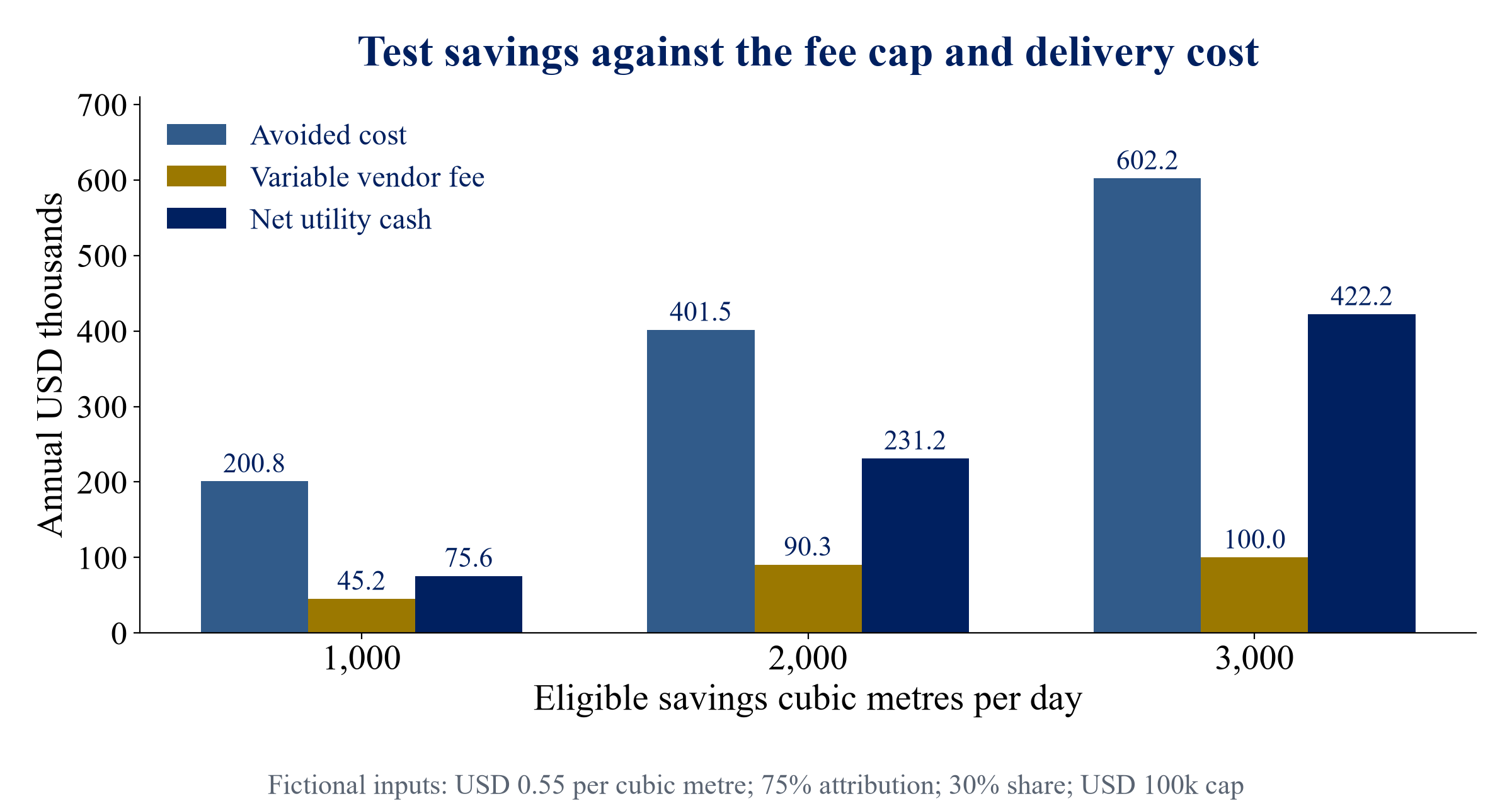
Author calculations using USD 0.55 per cubic metre, 75 percent attribution, 30 percent variable share, a USD 100,000 fee cap and USD 80,000 other annual costs. No forecast or probability distribution.
17 Define persistence and deterioration
The contract should state how long a saving must persist before it earns the final outcome payment. Select a period that reflects the actual repair, network conditions and measurement approach. The illustrative 90-day window is a demonstration input. It does not establish that three months proves a year's performance or that a repaired asset cannot fail again.
Track repeat leakage separately from a new event on another asset. The repair record should link to later observations and identify the responsible maintenance party. A provider supplying detection alone may have limited control over repair quality. The contract can allocate that exposure through explicit responsibilities and acceptance conditions rather than a broad promise of permanent savings.
Define the treatment of deterioration after initial acceptance. Options for negotiation include release of a holdback after persistence review, a capped true-up for the affected period, additional monitoring, or a requirement for remedial action within scope. The exact response depends on the agreed allocation and applicable law. Retain the originally approved calculation when revising a later entitlement.
The financial model should reflect those terms. If persistence falls, adjust the eligible volume and corresponding fees using the agreed method. If verification is delayed, change cash timing. If a measurement record is unavailable, apply the documented suspension or reconstruction rule. A provisional accepted amount should remain identifiable until the reviewer closes the relevant condition.
18 Preserve data access and calculation custody
The utility should negotiate access to the records necessary to reproduce outcome payments throughout the contract and for an agreed period afterwards. Identify raw observations, calibration results, asset maps, alert history, intervention records, model identifiers and calculation outputs. The negotiated rights must be assessed against the actual licences, confidentiality obligations and applicable data rules.
Separate access needed for payment review from any right to reuse data for training or other customers. Permission for one purpose does not establish permission for another. The proposed schedule should describe the intended purpose, storage, authorised recipients and exit arrangements. It should avoid implying an automatic transfer of proprietary software or unrestricted reuse of customer information.
Use an evidence manifest that identifies file versions and calculation dependencies. Keep approved inputs read-only in the verification archive, with later corrections recorded as new versions. An independent reviewer can then identify the dataset used for a payment and compare it with a successor. A manifest supports auditability; it cannot establish accuracy when the underlying observations or permissions are defective.
Plan a practical exit before contracting. A utility may need continuing access to operating records if the provider's service ends. Agree export formats, assistance, costs and transition responsibilities. Test a sample export during mobilisation. The commercial model should include any expected transition expenditure and identify supplier dependency that could disrupt verification or safe operations.
19 Organise independent review and disputes
Appoint a reviewer with the technical competence, access and contractual authority required for the payment calculation. Agree how the reviewer is selected, compensated and replaced. A supplier-funded verification service can still require conflict assessment and a clear independence arrangement. Describe the reviewer's role accurately; a technical determination and a legal adjudication can have different consequences.
Separate factual disputes from methodological and commercial disputes. A missing meter interval may require data recovery. A disagreement over a pressure adjustment may require engineering review. A dispute over the meaning of an attribution clause may require legal interpretation. The escalation procedure should identify the appropriate decision-maker, evidence and interim payment treatment.
Table 3 proposes responses that can be negotiated. A party should continue preserving records and meeting applicable operating obligations while a payment dispute is examined. Any undisputed payment should be treated under the actual contract. The proposed framework gives no legal conclusion about withholding, interest, limitation of liability or an adjudicator's powers.
Include a reasoned determination in the evidence archive. State the disputed assumption, accepted evidence, revised amount and effect on later periods. If the decision changes the methodology prospectively, retain the previous version and clarify its period of application. A reproducible correction can help the parties administer subsequent payments without concealing the original issue.
Table 3. Proposed dispute categories and review responses
| Disputed item | Evidence to inspect | Proposed interim treatment |
|---|---|---|
| Missing observations | Raw meter logs and outage record | Reserve affected amount |
| Boundary change | Maps transfers and dates | Review scoped adjustment |
| Utility repair overlap | Work orders and event history | Reconcile attribution |
| Persistence failure | Subsequent measurements and maintenance | Review holdback condition |
| Unit cash value | Cost records and agreed reference price | Recalculate disputed value |
| Contract interpretation | Signed clause and relevant law | Refer through agreed legal route |
Negotiation framework only. Deadlines remedies and authority require contract-specific legal review.
20 Design a cost and performance benchmark
Benchmark a contract using the result it purchases and the cost necessary to accept that result. A useful comparison can show total incremental expenditure per accepted cubic metre, separated into technology, repair, measurement and administration. State the period and accepted volume alongside the ratio. A price per alert measures a different service and should retain that distinction.
For the annual base illustration, USD 170,337.50 of variable fee, fixed monitoring, verification and repair cost is associated with 730,000 eligible cubic metres. The corresponding cost is approximately USD 0.23334 per eligible cubic metre. This is a calculation from fictional assumptions, not a market benchmark. The ratio becomes less useful if costs and savings cover different periods or one case omits mobilisation.
A procurement team could compare this ratio with its own existing operating approach, provided scope, service and measurement are aligned. State whether the comparator includes sunk infrastructure, additional staff, maintenance and false investigations. A favourable ratio alone does not establish causation or acceptable service. The acceptance evidence should accompany the cost comparison.
The provider should also build a contribution-margin case. Its revenue depends on the negotiated fee and accepted saving, while its cost depends on deployment, support, investigation and verification obligations. Inspect a delayed-payment scenario and cap utilisation. A utility-side saving does not automatically establish supplier viability. The parties need a delivery arrangement that can meet obligations throughout the agreed period.
21 Stage readiness and commercialisation
Use a staged acceptance pathway that reflects growing evidential readiness. Begin with a measurement audit and agreed scope. Proceed to baseline acceptance, shadow operation, controlled intervention, verification and a commercial scale decision. Figure 3 presents this proposed pathway. It is a qualitative sequence, with no empirical readiness score or universal deployment timetable.
Shadow operation can establish how alerts are reviewed and recorded without giving the system uncontrolled operational authority. The parties should examine data gaps and event handling before linking alerts to fees. A controlled intervention then tests the repair-to-measurement process. It should retain operational safety oversight and the specific evidence needed for later acceptance.
Define the scale decision by requirements that can fail. For example, accepted savings must reconcile to the approved baseline, costs must fit the reviewed commercial case, and service conditions must remain satisfied. The board can authorise a larger scope after inspecting those requirements. A completed demonstration should not automatically support deployment in networks with different pressure, asset or data conditions.
Allocate the budget between preparing measurement and purchasing outcomes. If instrumentation is inadequate, a preparatory contract can have explicit deliverables and a separately approved price. Later outcome payments should begin only under the accepted protocol. This proposed separation allows the parties to commission useful preparatory work without describing an incomplete measurement system as a proven performance contract.
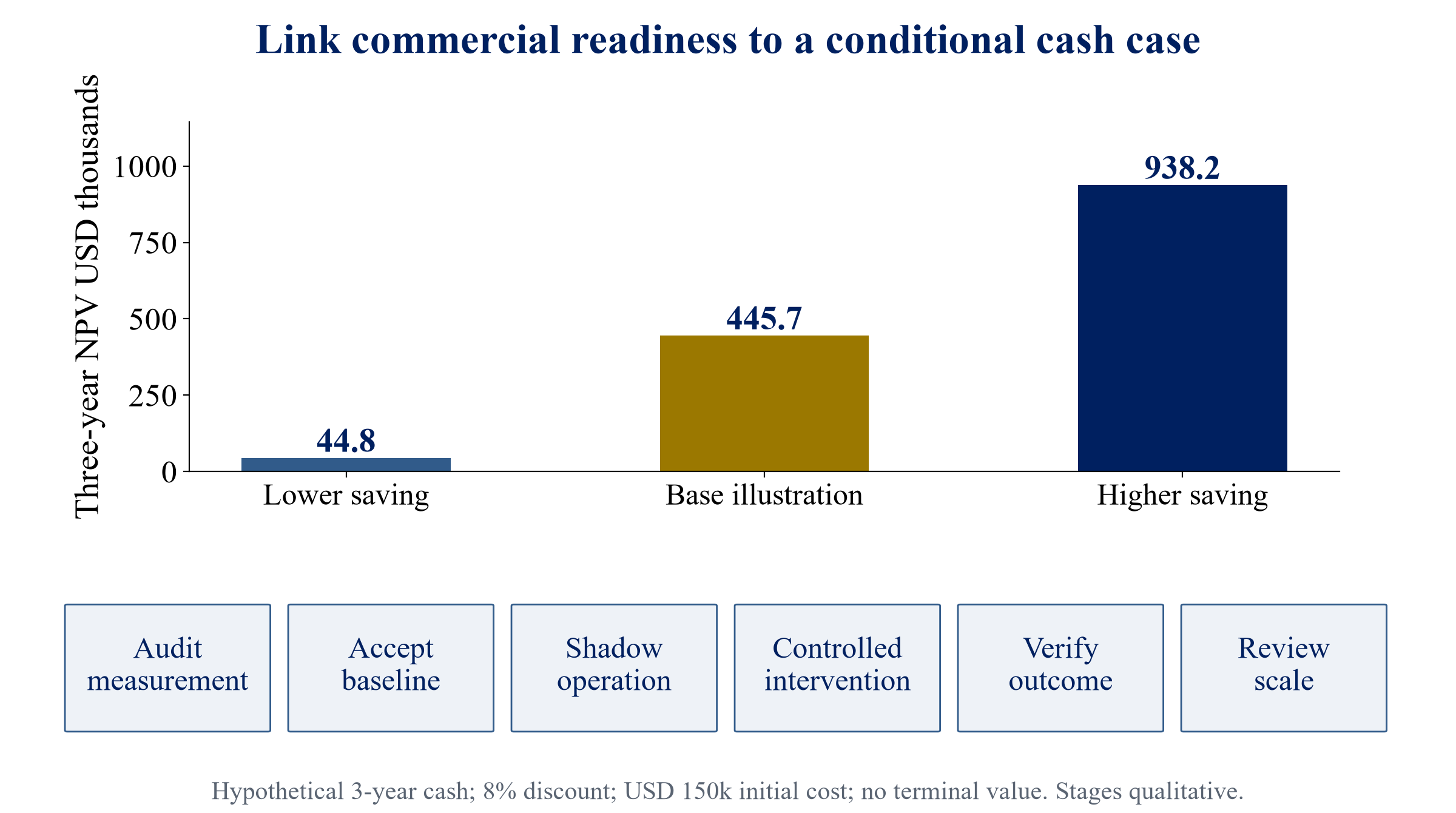
Readiness stages are qualitative author proposals. Valuation uses three year-end net cash amounts discounted at an assumed 8 percent and USD 150,000 initial expenditure, with no terminal value.
22 Apply the framework across geographies
Adapt the framework to the actual water system and contractual setting. The paper does not assert that UK, GCC, Indian or US utilities have uniform costs, service conditions or procurement authority. A reader should identify the relevant legal entity, operational control and customer obligations before adopting the payment schedule. Source examples from another jurisdiction supply questions for assessment.
For a continuously supplied network, the review may focus on stable service conditions and operating variation. For a network with intermittent supply, the counterfactual needs a specific treatment of service hours and pressure. These are analytical cases, not descriptions of every utility in a region. A reduced inflow during curtailed supply should remain visible in the verification record.
Where the utility purchases treated water under a long-term arrangement, inspect whether lower volumes change cash payments. A take-or-pay or minimum-volume obligation can alter the avoided-cost calculation. Where incremental production requires energy-intensive processes, obtain the actual marginal operating assumptions. The paper supplies no generic desalination price, tariff or contractual rule.
Use the same discipline for private developments, industrial estates and data-centre campuses with their own network responsibilities. Map the party receiving the physical saving to the party paying the vendor and holding the relevant cost exposure. A landlord, tenant and operating company may have different incentives. The outcome agreement should allocate payments and evidence access consistently with the inspected operating contracts.
23 State limitations and a validation design
This paper presents an analytical contract proposal. It has no utility dataset, field trial, supplier comparison or measured willingness-to-pay evidence. The numerical exhibits cannot support an empirical estimate of AI effectiveness or a forecast of water savings. The references support selected preparation and governance principles within their stated scopes.
A validation programme should begin with an approved protocol and a retained baseline. Record all investigated events, including unsuccessful investigations and independently initiated repairs. Pre-specify exclusions and the calculation version. Maintain a comparison design suitable for the intervention, with an assessment of interference when network changes affect adjacent areas. Engineering and statistical experts should review the actual design.
Report both accepted and rejected periods. Explain missing data, boundary changes, service exceptions and disagreements. Compare predicted savings with subsequent accepted measurements and actual cash records. A positive physical result with delayed or unavailable cash recognition should retain that distinction. Review the utility and provider perspectives separately, including verification cost and payment timing.
Future research could compare contract structures under the same measurement protocol, investigate the effect of repair responsibility on persistence, or test alternative attribution approaches. Such work needs authorisation, appropriate data rights and sufficient observations. Results should retain geography, network characteristics, intervention scope and uncertainty. A validated result in one setting would still require assessment before generalisation to another.
24 Approve the contract against evidence
The proposed approval sequence is to define the purchased outcome, accept the measurement plan, allocate implementation responsibilities, test the cash mechanism and agree review before paying against results. Each step produces a record that a later reviewer can inspect. The resulting contract should permit an adverse finding to change payment without requiring retrospective invention of a baseline.
The worked example demonstrates the importance of keeping three quantities separate: accepted physical savings, the vendor's attributed payment basis and the utility's net cash. The full eligible volume supports the physical and utility calculation. The negotiated attribution share supports vendor compensation. Costs, caps and holdbacks then determine the commercial result and timing under explicit assumptions.
For a board or investment committee, the decisive question is whether the proposed arrangement can produce an accepted result at a justified total cost while preserving service. Require the technical basis, financial reconciliation and contract conditions together. Where evidence is insufficient, fund a defined measurement improvement or defer the outcome commitment under a reasoned decision.
An AI-assisted leak programme can be examined through this framework without asserting that a particular system delivers a guaranteed result. Its commercial case remains conditional on the actual observations, repairs, operating conditions and agreement. The contribution of the paper is a reproducible route from a defined intervention to an inspectable fee calculation, with clear places to challenge the result.
References
- World Bank PPP Resource Center. Contracting Tools for Non-Revenue Water Reduction. https://ppp.worldbank.org/water-and-sanitation/contracting-tools-non-revenue-water-reduction Accessed 4 October 2026.
- World Bank PPP Resource Center. Performance-Based Contracting Tools for Non-Revenue Water Reduction Project Preparation Process. https://ppp.worldbank.org/water-and-sanitation/performance-based-contracting-tools-non-revenue-water-reduction-project-preparation-process Accessed 4 October 2026.
- World Bank PPP Resource Center. Using Performance-Based Contracts to Reduce Non-Revenue Water. Publication entry dated 1 June 2016. https://ppp.worldbank.org/library/using-performance-based-contracts-reduce-non-revenue-water Accessed 4 October 2026.
- US Department of Energy Federal Energy Management Program. Measurement and Verification Options for Federal Energy- and Water-Saving Projects. https://www.energy.gov/cmei/femp/measurement-and-verification-options-federal-energy-and-water-saving-projects Accessed 4 October 2026.
- US Department of Energy Federal Energy Management Program. Measurement and Verification Activities Required in the Energy Savings Performance Contract Process. https://www.energy.gov/cmei/femp/measurement-and-verification-activities-required-energy-savings-performance-contract Accessed 4 October 2026.
- World Bank-hosted reference document. Performance-Based Management Contract for Water Supply and Wastewater Services. February 2007. Reference-only document with express legal-adaptation caveat; continuity indicators and appendix measurement notes. https://ppp.worldbank.org/sites/default/files/2024-09/water%20management%20contract%202.pdf Accessed 4 October 2026.
- National Institute of Standards and Technology. Artificial Intelligence Risk Management Framework AI RMF 1.0. NIST AI 100-1, January 2023. MEASURE function, evaluation documentation and production monitoring. https://nvlpubs.nist.gov/nistpubs/ai/NIST.AI.100-1.pdf Accessed 4 October 2026.
About the Author
Chennakeshav (CK) is a corporate finance and investment banking executive with 25+ years of global experience in deal origination, structuring and execution across M&A, growth capital and corporate strategy. He has led value-creation mandates for founders, corporates and funds — bridging the boardroom view to hands-on execution and close.
His career spans Morgan Stanley, HSBC, Lloyds Banking Group, EWEC, ADQ portfolio companies and Emirates Growth Fund, across TMT, real estate, fintech, deeptech, cleantech, infrastructure and energy. He has partnered with C-suite leaders, private equity and venture funds, sovereign wealth funds and family offices to finance complex fund raises and scale-up ventures, and has led M&A due diligence, post-merger integration and business-transformation initiatives to create value.
At Matchpoint Partners he is Managing Partner, leading the firm's corporate finance, M&A and capital-raising practice. He holds an MBA from London Business School, an engineering degree from VTU and a Master of Laws (LLM, in progress) from UCL London.
An active start-up mentor, CK mentors at Techstars, DIFC FinTech Hive, Startup Grind, Founder Institute and IN5, serves as Entrepreneur Mentor in Residence (EMiR) at London Business School, and judges the Entrepreneurship World Cup.
