

1. Define the turnaround decision
The board must decide how much liquidity runway is available, which flying remains cash-contributive and which stakeholder actions are required before value erodes. State the minimum cash threshold, decision horizon, route and fleet perimeter, legal entities, currencies and stakeholder constraints. The analysis should distinguish observed operational, contractual and financial evidence from management assumptions and connect each material judgment to safety, passenger delivery, schedule execution, stakeholder rights and cash. Approval should specify daily and weekly triggers for capacity, funding, creditor and contingency decisions. The work should cover a central case and a severe-but-plausible downside, with correlated sensitivities for demand, yield, cancellation, refunds, fuel, currency, aircraft availability, card reserves, supplier terms, creditor relief and implementation timing. Exceptions require a named owner, source, due date and decision consequence. Unsupported savings or financing remain outside the base case until actions are implemented and evidence confirms the cash result. The section output should identify the controlling evidence, decision threshold, accountable owner, forecast week and explicit safety, passenger, capacity or cash consequence. This creates a controlled bridge from diagnosis to action and bank movement.
The turnaround should be managed through one integrated data model. Treasury controls bank cash, settlement timing and funding; commercial teams control bookings, yield and route choices; operations and engineering determine whether the published schedule is executable; and legal and restructuring teams manage stakeholder rights and concessions. Each view should use the same legal entity, route, flight, tail, station, currency and week identifiers. The 13-week forecast then becomes a decision system rather than a treasury spreadsheet. It should show what management can change, when an action reaches cash, which operational or legal dependency controls it, and what happens when the central assumption fails. Variances are analysed by volume, price, timing and classification, with clear separation between genuine benefit and deferred obligation.
2. Use the Cash-Capacity-Network Control Framework
The framework links liquidity, bookings, route contribution, fleet availability, crew, fuel, maintenance, working capital and creditor actions. Every workstream should reconcile to flight, route, aircraft, contract, legal entity, bank account and forecast week. The analysis should distinguish observed operational, contractual and financial evidence from management assumptions and connect each material judgment to safety, passenger delivery, schedule execution, stakeholder rights and cash. Management should prevent commercial schedules and accounting forecasts from running ahead of executable capacity and cash. The work should cover a central case and a severe-but-plausible downside, with correlated sensitivities for demand, yield, cancellation, refunds, fuel, currency, aircraft availability, card reserves, supplier terms, creditor relief and implementation timing. Exceptions require a named owner, source, due date and decision consequence. Unsupported savings or financing remain outside the base case until actions are implemented and evidence confirms the cash result. Evidence should remain traceable to legal entity, account, route, flight, aircraft, contract and forecast week, with control totals to bank records and management reporting. The resulting decision should update cash, capacity and stakeholder plans together.
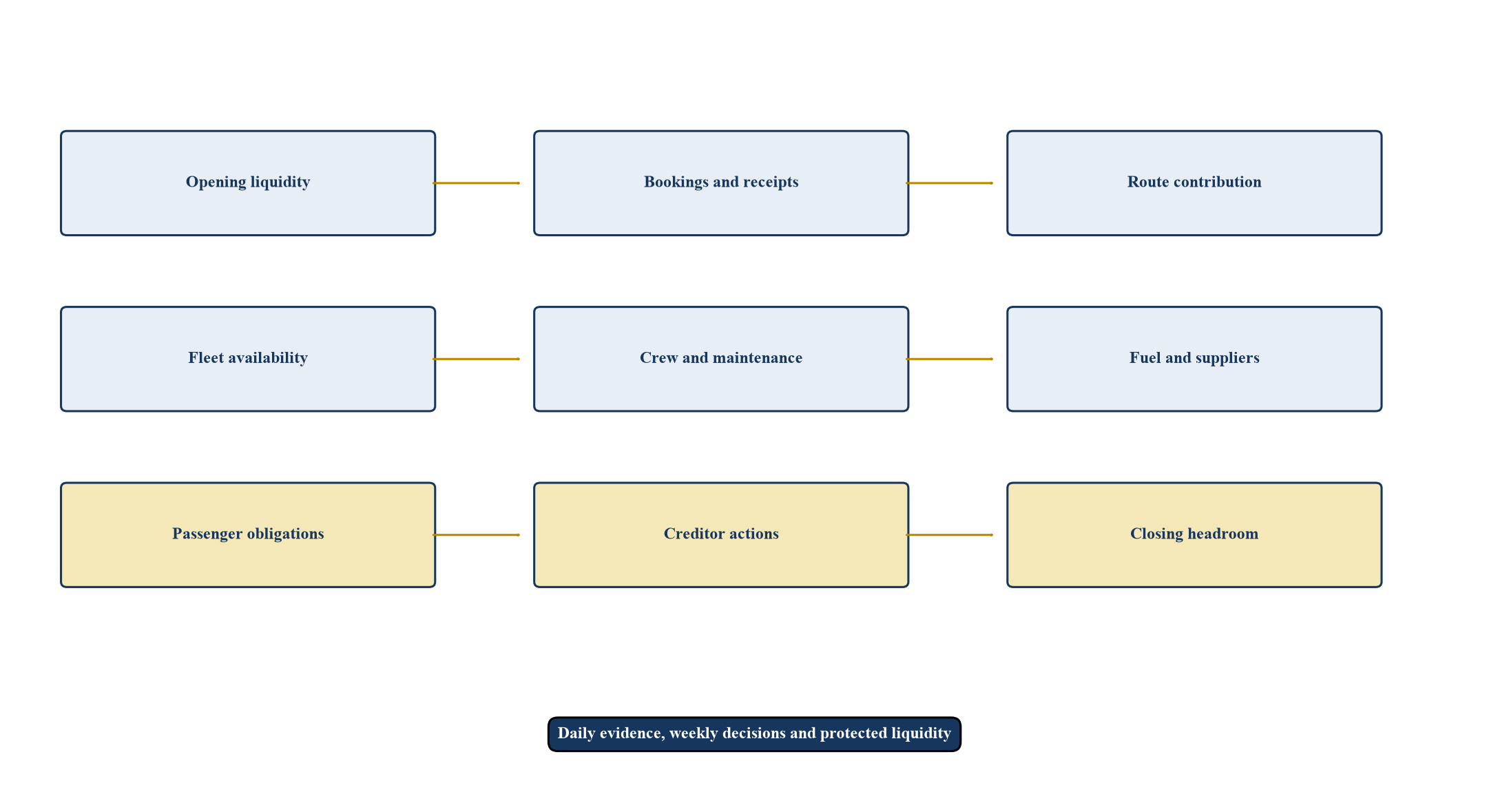
One control system connects receipts, operations and stakeholder decisions.
3. Establish the minimum liquidity threshold
An airline requires cash for safety-critical operations, fuel, airport and navigation charges, payroll, maintenance, insurance, refunds and disruption recovery. Build the threshold from unavoidable daily obligations, settlement timing, restricted cash and plausible operational shocks. The analysis should distinguish observed operational, contractual and financial evidence from management assumptions and connect each material judgment to safety, passenger delivery, schedule execution, stakeholder rights and cash. The board should approve a protected cash floor and escalation levels rather than rely on an undifferentiated cash balance. The work should cover a central case and a severe-but-plausible downside, with correlated sensitivities for demand, yield, cancellation, refunds, fuel, currency, aircraft availability, card reserves, supplier terms, creditor relief and implementation timing. Exceptions require a named owner, source, due date and decision consequence. Unsupported savings or financing remain outside the base case until actions are implemented and evidence confirms the cash result. Management should define the earliest warning indicator, intervention trigger and executable contingency. Reporting should preserve the original case, approved changes and realised cash so the board can distinguish delivery from timing shifts or presentation changes.
4. Build the direct-method 13-week forecast
A direct cash forecast exposes the timing of actual receipts and payments that accrual accounts can obscure. Map opening cash, receipts, disbursements, financing flows and closing cash by bank account, legal entity, currency and week. The analysis should distinguish observed operational, contractual and financial evidence from management assumptions and connect each material judgment to safety, passenger delivery, schedule execution, stakeholder rights and cash. The model should use daily detail for the first two weeks and a controlled weekly horizon thereafter. The work should cover a central case and a severe-but-plausible downside, with correlated sensitivities for demand, yield, cancellation, refunds, fuel, currency, aircraft availability, card reserves, supplier terms, creditor relief and implementation timing. Exceptions require a named owner, source, due date and decision consequence. Unsupported savings or financing remain outside the base case until actions are implemented and evidence confirms the cash result. The section output should identify the controlling evidence, decision threshold, accountable owner, forecast week and explicit safety, passenger, capacity or cash consequence. This creates a controlled bridge from diagnosis to action and bank movement.
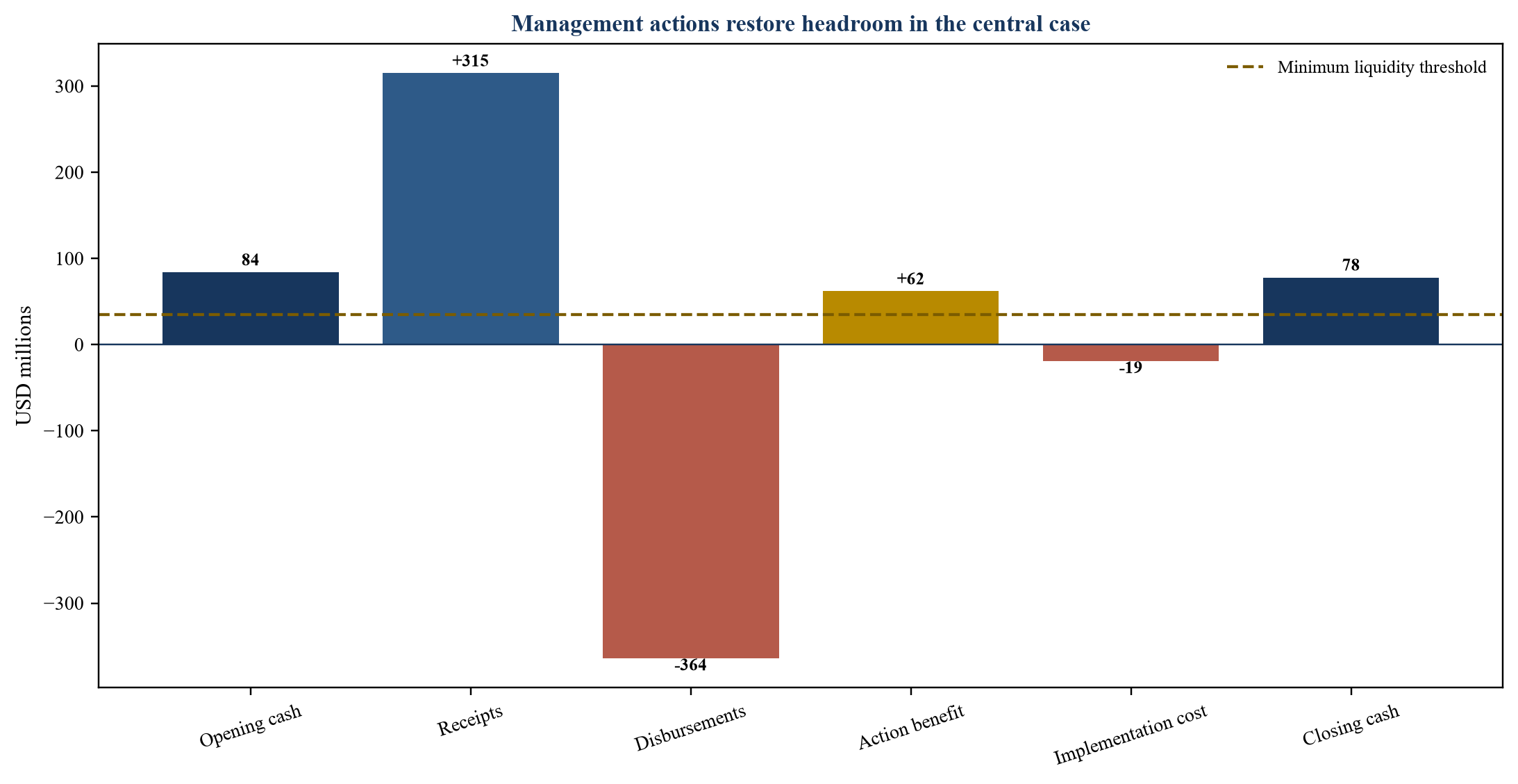
USD millions; every value is an illustrative management assumption.
| Layer | Core evidence | Primary decision | Cash consequence |
|---|---|---|---|
| Liquidity | Bank statements, restrictions, facilities and reserves | Available opening cash | Immediate runway |
| Revenue | Bookings, settlements, refunds and cargo receipts | Receipt timing and confidence | Weekly inflow |
| Network | Flight contribution, feed, slots and capacity | Retain, resize or suspend | Avoidable cash |
| Operations | Fleet, engines, crew, maintenance and disruption | Executable schedule | Delivery and cost |
| Stakeholders | Lessors, airports, fuel, acquirers and lenders | Relief and continuity | Timing and headroom |
| Governance | Actions, approvals, thresholds and variance | Intervention timing | Forecast control |
Evidence should reconcile to legal entity, account, route, aircraft and week.
5. Create a reliable opening-cash position
Bank balances may include trapped, restricted, pledged or operationally inaccessible cash. Reconcile bank statements, card-acquirer reserves, security deposits, local exchange controls, overdrafts and intercompany positions. The analysis should distinguish observed operational, contractual and financial evidence from management assumptions and connect each material judgment to safety, passenger delivery, schedule execution, stakeholder rights and cash. Only demonstrably accessible cash should fund the base case. The work should cover a central case and a severe-but-plausible downside, with correlated sensitivities for demand, yield, cancellation, refunds, fuel, currency, aircraft availability, card reserves, supplier terms, creditor relief and implementation timing. Exceptions require a named owner, source, due date and decision consequence. Unsupported savings or financing remain outside the base case until actions are implemented and evidence confirms the cash result. Evidence should remain traceable to legal entity, account, route, flight, aircraft, contract and forecast week, with control totals to bank records and management reporting. The resulting decision should update cash, capacity and stakeholder plans together.
6. Forecast ticket and ancillary receipts
Booked revenue does not equal near-term cash because sales channels, settlement cycles, taxes, refunds, chargebacks and travel dates differ. Reconcile passenger revenue systems, forward bookings, global distribution, direct sales, agents, cargo and ancillary streams to bank receipts. The analysis should distinguish observed operational, contractual and financial evidence from management assumptions and connect each material judgment to safety, passenger delivery, schedule execution, stakeholder rights and cash. Apply evidence-backed conversion and cancellation assumptions by channel, geography and week. The work should cover a central case and a severe-but-plausible downside, with correlated sensitivities for demand, yield, cancellation, refunds, fuel, currency, aircraft availability, card reserves, supplier terms, creditor relief and implementation timing. Exceptions require a named owner, source, due date and decision consequence. Unsupported savings or financing remain outside the base case until actions are implemented and evidence confirms the cash result. Management should define the earliest warning indicator, intervention trigger and executable contingency. Reporting should preserve the original case, approved changes and realised cash so the board can distinguish delivery from timing shifts or presentation changes.
7. Protect passenger obligations
Schedule changes can trigger refunds, re-accommodation, compensation and reputational damage. Map legal and contractual passenger rights, unused-ticket liabilities, expected refunds, reaccommodation capacity and service communications. The analysis should distinguish observed operational, contractual and financial evidence from management assumptions and connect each material judgment to safety, passenger delivery, schedule execution, stakeholder rights and cash. Capacity actions should include their full passenger cash and operational consequences. The work should cover a central case and a severe-but-plausible downside, with correlated sensitivities for demand, yield, cancellation, refunds, fuel, currency, aircraft availability, card reserves, supplier terms, creditor relief and implementation timing. Exceptions require a named owner, source, due date and decision consequence. Unsupported savings or financing remain outside the base case until actions are implemented and evidence confirms the cash result. The section output should identify the controlling evidence, decision threshold, accountable owner, forecast week and explicit safety, passenger, capacity or cash consequence. This creates a controlled bridge from diagnosis to action and bank movement.
8. Reconcile card-acquirer exposure
Acquirers can extend settlement timing or require reserves when perceived delivery or insolvency risk rises. Review reserve formulas, rolling holds, termination rights, collateral, chargebacks, covenant triggers and weekly settlement files. The analysis should distinguish observed operational, contractual and financial evidence from management assumptions and connect each material judgment to safety, passenger delivery, schedule execution, stakeholder rights and cash. Engage acquirers early with transparent liquidity and delivery evidence and model reserve stress explicitly. The work should cover a central case and a severe-but-plausible downside, with correlated sensitivities for demand, yield, cancellation, refunds, fuel, currency, aircraft availability, card reserves, supplier terms, creditor relief and implementation timing. Exceptions require a named owner, source, due date and decision consequence. Unsupported savings or financing remain outside the base case until actions are implemented and evidence confirms the cash result. Evidence should remain traceable to legal entity, account, route, flight, aircraft, contract and forecast week, with control totals to bank records and management reporting. The resulting decision should update cash, capacity and stakeholder plans together.
9. Build route-level cash contribution
A route can report positive allocated margin while destroying near-term cash after fuel, handling, navigation, crew, disruption and passenger costs. Calculate avoidable and incremental cash contribution by flight, route, departure period and aircraft type. The analysis should distinguish observed operational, contractual and financial evidence from management assumptions and connect each material judgment to safety, passenger delivery, schedule execution, stakeholder rights and cash. Use the decision measure appropriate to the horizon and disclose costs that remain after cancellation. The work should cover a central case and a severe-but-plausible downside, with correlated sensitivities for demand, yield, cancellation, refunds, fuel, currency, aircraft availability, card reserves, supplier terms, creditor relief and implementation timing. Exceptions require a named owner, source, due date and decision consequence. Unsupported savings or financing remain outside the base case until actions are implemented and evidence confirms the cash result. Management should define the earliest warning indicator, intervention trigger and executable contingency. Reporting should preserve the original case, approved changes and realised cash so the board can distinguish delivery from timing shifts or presentation changes.
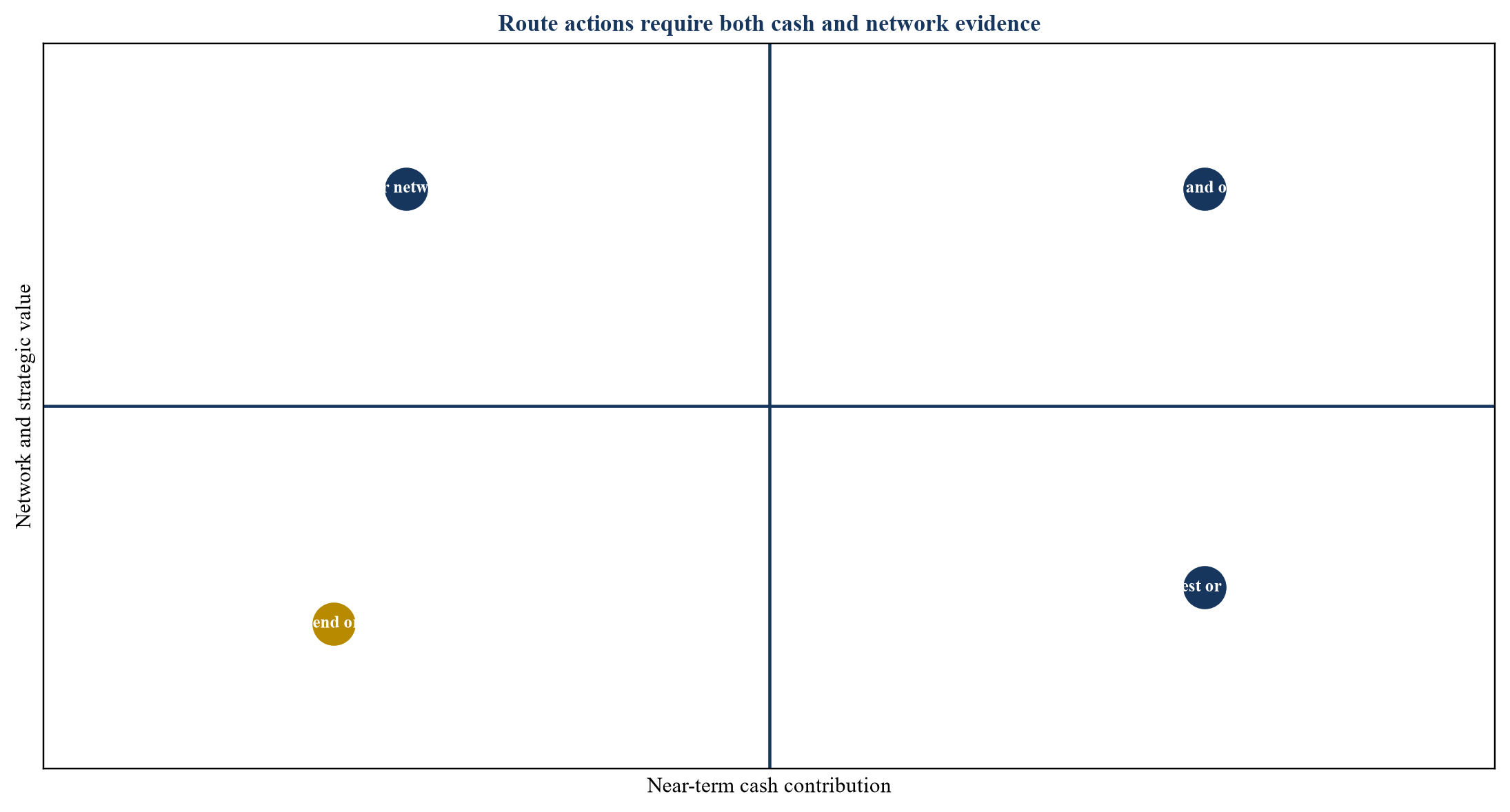
Illustrative route cohorts based on near-term cash contribution and network value.
| Route condition | Evidence | Possible action | Required protection |
|---|---|---|---|
| Positive cash and network value | Stable bookings and executable capacity | Protect and optimise | Yield and reliability |
| Negative cash, high network value | Feed and slot evidence | Resize or time-limit retention | Explicit cash cap |
| Positive cash, low strategic value | Robust standalone demand | Harvest or redeploy | Reversal option |
| Negative cash and network value | Weak bookings and avoidable losses | Suspend or exit | Refunds, slots and contracts |
Decision measures should match the relevant operational horizon.
10. Separate network value from flight economics
Feed, connectivity, slot value, loyalty, cargo and strategic access can make a route more valuable than its standalone flight margin. Measure local and connecting demand, spill, displacement, network contribution and strategic constraints. The analysis should distinguish observed operational, contractual and financial evidence from management assumptions and connect each material judgment to safety, passenger delivery, schedule execution, stakeholder rights and cash. Retain a negative standalone route only when evidenced network value and liquidity capacity justify it. The work should cover a central case and a severe-but-plausible downside, with correlated sensitivities for demand, yield, cancellation, refunds, fuel, currency, aircraft availability, card reserves, supplier terms, creditor relief and implementation timing. Exceptions require a named owner, source, due date and decision consequence. Unsupported savings or financing remain outside the base case until actions are implemented and evidence confirms the cash result. The section output should identify the controlling evidence, decision threshold, accountable owner, forecast week and explicit safety, passenger, capacity or cash consequence. This creates a controlled bridge from diagnosis to action and bank movement.
11. Read forward bookings as a cohort
Aggregate bookings can hide weak departure weeks, promotional dilution, channel concentration or rising cancellations. Track booking curve, fare, yield, load factor, cancellation, refund, no-show and payment timing by departure cohort. The analysis should distinguish observed operational, contractual and financial evidence from management assumptions and connect each material judgment to safety, passenger delivery, schedule execution, stakeholder rights and cash. Reforecast receipts and capacity from current cohorts rather than historical averages alone. The work should cover a central case and a severe-but-plausible downside, with correlated sensitivities for demand, yield, cancellation, refunds, fuel, currency, aircraft availability, card reserves, supplier terms, creditor relief and implementation timing. Exceptions require a named owner, source, due date and decision consequence. Unsupported savings or financing remain outside the base case until actions are implemented and evidence confirms the cash result. Evidence should remain traceable to legal entity, account, route, flight, aircraft, contract and forecast week, with control totals to bank records and management reporting. The resulting decision should update cash, capacity and stakeholder plans together.
12. Convert schedules into executable capacity
Published capacity can exceed the aircraft, engine, crew, maintenance, slot and ground-handling resources available to operate it. Bridge scheduled block hours to serviceable fleet, maintenance events, spare ratio, crew legality and airport constraints. The analysis should distinguish observed operational, contractual and financial evidence from management assumptions and connect each material judgment to safety, passenger delivery, schedule execution, stakeholder rights and cash. Only executable flights should generate receipts and operating cash in the model. The work should cover a central case and a severe-but-plausible downside, with correlated sensitivities for demand, yield, cancellation, refunds, fuel, currency, aircraft availability, card reserves, supplier terms, creditor relief and implementation timing. Exceptions require a named owner, source, due date and decision consequence. Unsupported savings or financing remain outside the base case until actions are implemented and evidence confirms the cash result. Management should define the earliest warning indicator, intervention trigger and executable contingency. Reporting should preserve the original case, approved changes and realised cash so the board can distinguish delivery from timing shifts or presentation changes.
13. Control fleet availability
Aircraft-on-ground events, engine removals, lease returns and deferred maintenance can reduce capacity with little notice. Maintain a tail-level plan covering serviceability, maintenance checks, engine status, parts, lease events and return conditions. The analysis should distinguish observed operational, contractual and financial evidence from management assumptions and connect each material judgment to safety, passenger delivery, schedule execution, stakeholder rights and cash. Use scenario gates for substitution, wet lease, deferral, grounding and fleet exit decisions. The work should cover a central case and a severe-but-plausible downside, with correlated sensitivities for demand, yield, cancellation, refunds, fuel, currency, aircraft availability, card reserves, supplier terms, creditor relief and implementation timing. Exceptions require a named owner, source, due date and decision consequence. Unsupported savings or financing remain outside the base case until actions are implemented and evidence confirms the cash result. The section output should identify the controlling evidence, decision threshold, accountable owner, forecast week and explicit safety, passenger, capacity or cash consequence. This creates a controlled bridge from diagnosis to action and bank movement.
14. Protect safety and regulatory compliance
Liquidity pressure must not weaken continuing airworthiness, operational control, crew legality, maintenance or safety reporting. Ring-fence accountable roles, required maintenance, safety actions, records, insurance and regulator engagement. The analysis should distinguish observed operational, contractual and financial evidence from management assumptions and connect each material judgment to safety, passenger delivery, schedule execution, stakeholder rights and cash. No cash action should rely on flying outside approved, safe and insured conditions. The work should cover a central case and a severe-but-plausible downside, with correlated sensitivities for demand, yield, cancellation, refunds, fuel, currency, aircraft availability, card reserves, supplier terms, creditor relief and implementation timing. Exceptions require a named owner, source, due date and decision consequence. Unsupported savings or financing remain outside the base case until actions are implemented and evidence confirms the cash result. Evidence should remain traceable to legal entity, account, route, flight, aircraft, contract and forecast week, with control totals to bank records and management reporting. The resulting decision should update cash, capacity and stakeholder plans together.
15. Model crew and labour capacity
Schedule reductions and fleet swaps change qualification, duty-time, positioning, accommodation, training and industrial-relations needs. Reconcile rostered crews, licences, type ratings, recency, leave, sickness, training and contractual rules to each schedule option. The analysis should distinguish observed operational, contractual and financial evidence from management assumptions and connect each material judgment to safety, passenger delivery, schedule execution, stakeholder rights and cash. Include transition, redundancy, retention and disruption costs before approving labour savings. The work should cover a central case and a severe-but-plausible downside, with correlated sensitivities for demand, yield, cancellation, refunds, fuel, currency, aircraft availability, card reserves, supplier terms, creditor relief and implementation timing. Exceptions require a named owner, source, due date and decision consequence. Unsupported savings or financing remain outside the base case until actions are implemented and evidence confirms the cash result. Management should define the earliest warning indicator, intervention trigger and executable contingency. Reporting should preserve the original case, approved changes and realised cash so the board can distinguish delivery from timing shifts or presentation changes.
16. Manage fuel price and volume
Fuel is a major cash cost and actual exposure depends on schedule, uplift, efficiency, price, currency, hedges and collateral. Build weekly physical and financial exposure by airport, supplier, aircraft and hedge instrument. The analysis should distinguish observed operational, contractual and financial evidence from management assumptions and connect each material judgment to safety, passenger delivery, schedule execution, stakeholder rights and cash. Test price, crack spread, currency, margin-call, minimum-volume and credit-term scenarios together. The work should cover a central case and a severe-but-plausible downside, with correlated sensitivities for demand, yield, cancellation, refunds, fuel, currency, aircraft availability, card reserves, supplier terms, creditor relief and implementation timing. Exceptions require a named owner, source, due date and decision consequence. Unsupported savings or financing remain outside the base case until actions are implemented and evidence confirms the cash result. The section output should identify the controlling evidence, decision threshold, accountable owner, forecast week and explicit safety, passenger, capacity or cash consequence. This creates a controlled bridge from diagnosis to action and bank movement.
17. Prioritise maintenance cash
Maintenance spending preserves safety, aircraft availability and asset value, while timing varies across checks, engines, components and reserves. Map mandatory events, deferrable tasks, materials, labour, provider deposits, maintenance reserves and redelivery exposure. The analysis should distinguish observed operational, contractual and financial evidence from management assumptions and connect each material judgment to safety, passenger delivery, schedule execution, stakeholder rights and cash. Protect required work and negotiate timing or scope only within approved technical and contractual boundaries. The work should cover a central case and a severe-but-plausible downside, with correlated sensitivities for demand, yield, cancellation, refunds, fuel, currency, aircraft availability, card reserves, supplier terms, creditor relief and implementation timing. Exceptions require a named owner, source, due date and decision consequence. Unsupported savings or financing remain outside the base case until actions are implemented and evidence confirms the cash result. Evidence should remain traceable to legal entity, account, route, flight, aircraft, contract and forecast week, with control totals to bank records and management reporting. The resulting decision should update cash, capacity and stakeholder plans together.
18. Manage airports, navigation and ground handling
Airports and service providers can require deposits, shorten terms or suspend service when arrears rise. Map critical counterparties by station, outstanding balance, security, termination right and substitute availability. The analysis should distinguish observed operational, contractual and financial evidence from management assumptions and connect each material judgment to safety, passenger delivery, schedule execution, stakeholder rights and cash. Use payment priorities and bilateral plans that preserve the executable network. The work should cover a central case and a severe-but-plausible downside, with correlated sensitivities for demand, yield, cancellation, refunds, fuel, currency, aircraft availability, card reserves, supplier terms, creditor relief and implementation timing. Exceptions require a named owner, source, due date and decision consequence. Unsupported savings or financing remain outside the base case until actions are implemented and evidence confirms the cash result. Management should define the earliest warning indicator, intervention trigger and executable contingency. Reporting should preserve the original case, approved changes and realised cash so the board can distinguish delivery from timing shifts or presentation changes.
19. Rebuild working capital
Agents, cargo customers, suppliers, lessors, airports, tax authorities and employees create different collection and payment dynamics. Age receivables and payables by counterparty, dispute, currency, security, criticality and legal entity. The analysis should distinguish observed operational, contractual and financial evidence from management assumptions and connect each material judgment to safety, passenger delivery, schedule execution, stakeholder rights and cash. Convert every proposed action into a dated cash movement with an accountable owner. The work should cover a central case and a severe-but-plausible downside, with correlated sensitivities for demand, yield, cancellation, refunds, fuel, currency, aircraft availability, card reserves, supplier terms, creditor relief and implementation timing. Exceptions require a named owner, source, due date and decision consequence. Unsupported savings or financing remain outside the base case until actions are implemented and evidence confirms the cash result. The section output should identify the controlling evidence, decision threshold, accountable owner, forecast week and explicit safety, passenger, capacity or cash consequence. This creates a controlled bridge from diagnosis to action and bank movement.
20. Sequence creditor and lessor engagement
Uncoordinated requests for relief can accelerate enforcement, deposits or cross-default concerns. Segment stakeholders by legal rights, operational criticality, collateral, replacement options and value at risk. The analysis should distinguish observed operational, contractual and financial evidence from management assumptions and connect each material judgment to safety, passenger delivery, schedule execution, stakeholder rights and cash. Use a board-approved engagement sequence, consistent information and documented concessions. The work should cover a central case and a severe-but-plausible downside, with correlated sensitivities for demand, yield, cancellation, refunds, fuel, currency, aircraft availability, card reserves, supplier terms, creditor relief and implementation timing. Exceptions require a named owner, source, due date and decision consequence. Unsupported savings or financing remain outside the base case until actions are implemented and evidence confirms the cash result. Evidence should remain traceable to legal entity, account, route, flight, aircraft, contract and forecast week, with control totals to bank records and management reporting. The resulting decision should update cash, capacity and stakeholder plans together.
| Stakeholder | Key exposure | Evidence required | Possible action |
|---|---|---|---|
| Card acquirers | Reserves and settlement holds | Delivery, cash and refund plan | Reserve glide path |
| Lessors and financiers | Default, repossession and cross-default | Fleet plan and funding case | Deferral, waiver or exit |
| Fuel and airports | Service suspension | Station cash and continuity plan | Terms, deposits and priorities |
| Employees | Retention and industrial action | Roster and people plan | Consultation and targeted retention |
| Regulators | Safety and operating continuity | Compliance and accountable management | Structured engagement |
Engagement should reflect legal rights, operational criticality and replacement options.
21. Protect slots and traffic rights
Capacity reductions can affect historic slot precedence, route authorities, bilateral rights and future network options. Assess current slot rules, utilisation, justified non-use, transfer or swap rights and local regulatory conditions. The analysis should distinguish observed operational, contractual and financial evidence from management assumptions and connect each material judgment to safety, passenger delivery, schedule execution, stakeholder rights and cash. Compare near-term cash conservation with the evidenced cost of losing or weakening strategic access. The work should cover a central case and a severe-but-plausible downside, with correlated sensitivities for demand, yield, cancellation, refunds, fuel, currency, aircraft availability, card reserves, supplier terms, creditor relief and implementation timing. Exceptions require a named owner, source, due date and decision consequence. Unsupported savings or financing remain outside the base case until actions are implemented and evidence confirms the cash result. Management should define the earliest warning indicator, intervention trigger and executable contingency. Reporting should preserve the original case, approved changes and realised cash so the board can distinguish delivery from timing shifts or presentation changes.
22. Select capacity actions
Frequency reductions, seasonal suspension, aircraft downsizing, wet leasing, code sharing and route exit produce different cash and network effects. Evaluate each action for bookings, refunds, contribution, crew, fleet, maintenance, slots, contracts and implementation timing. The analysis should distinguish observed operational, contractual and financial evidence from management assumptions and connect each material judgment to safety, passenger delivery, schedule execution, stakeholder rights and cash. Approve actions only after dependencies and reversal options are explicit. The work should cover a central case and a severe-but-plausible downside, with correlated sensitivities for demand, yield, cancellation, refunds, fuel, currency, aircraft availability, card reserves, supplier terms, creditor relief and implementation timing. Exceptions require a named owner, source, due date and decision consequence. Unsupported savings or financing remain outside the base case until actions are implemented and evidence confirms the cash result. The section output should identify the controlling evidence, decision threshold, accountable owner, forecast week and explicit safety, passenger, capacity or cash consequence. This creates a controlled bridge from diagnosis to action and bank movement.
23. Model a hypothetical turnaround
The hypothetical airline starts with USD 84 million of unrestricted cash and an assumed USD 35 million operating-liquidity floor. Pre-action receipts are USD 315 million and disbursements are USD 364 million over 13 weeks. The analysis should distinguish observed operational, contractual and financial evidence from management assumptions and connect each material judgment to safety, passenger delivery, schedule execution, stakeholder rights and cash. The central case ends with USD 78 million after USD 62 million of action benefit and USD 19 million of implementation cost; the downside ends with USD 20 million. All values are illustrative management assumptions. The work should cover a central case and a severe-but-plausible downside, with correlated sensitivities for demand, yield, cancellation, refunds, fuel, currency, aircraft availability, card reserves, supplier terms, creditor relief and implementation timing. Exceptions require a named owner, source, due date and decision consequence. Unsupported savings or financing remain outside the base case until actions are implemented and evidence confirms the cash result. Evidence should remain traceable to legal entity, account, route, flight, aircraft, contract and forecast week, with control totals to bank records and management reporting. The resulting decision should update cash, capacity and stakeholder plans together.
| Measure | Central case | Downside case | Decision meaning |
|---|---|---|---|
| Opening unrestricted cash | 84 | 84 | Starting liquidity |
| Thirteen-week receipts | 315 | 285 | Booking and settlement conversion |
| Thirteen-week disbursements | 364 | 379 | Operating and stakeholder cash |
| Action benefit | 62 | 48 | Capacity, price, working capital and relief |
| Implementation cost | 19 | 18 | Restructuring and delivery cost |
| Ending cash | 78 | 20 | Headroom against USD 35m threshold |
USD millions; every value is an illustrative management assumption.
24. Build correlated downside cases
Fuel, demand, disruption, refunds, reserves and creditor behaviour can deteriorate together. Test correlated shocks to bookings, yield, fuel, fleet availability, refunds, settlement holds and relief timing. The analysis should distinguish observed operational, contractual and financial evidence from management assumptions and connect each material judgment to safety, passenger delivery, schedule execution, stakeholder rights and cash. Contingency actions should be executable before projected cash crosses the approved threshold. The work should cover a central case and a severe-but-plausible downside, with correlated sensitivities for demand, yield, cancellation, refunds, fuel, currency, aircraft availability, card reserves, supplier terms, creditor relief and implementation timing. Exceptions require a named owner, source, due date and decision consequence. Unsupported savings or financing remain outside the base case until actions are implemented and evidence confirms the cash result. Management should define the earliest warning indicator, intervention trigger and executable contingency. Reporting should preserve the original case, approved changes and realised cash so the board can distinguish delivery from timing shifts or presentation changes.
25. Establish the turnaround control tower
Fast decisions require one fact base, short reporting cycles and clear rights across treasury, commercial, operations, engineering, people and legal teams. Use daily cash, operational and booking dashboards with an integrated issue and action log. The analysis should distinguish observed operational, contractual and financial evidence from management assumptions and connect each material judgment to safety, passenger delivery, schedule execution, stakeholder rights and cash. Assign each action a baseline, cash date, owner, evidence, dependency and escalation trigger. The work should cover a central case and a severe-but-plausible downside, with correlated sensitivities for demand, yield, cancellation, refunds, fuel, currency, aircraft availability, card reserves, supplier terms, creditor relief and implementation timing. Exceptions require a named owner, source, due date and decision consequence. Unsupported savings or financing remain outside the base case until actions are implemented and evidence confirms the cash result. The section output should identify the controlling evidence, decision threshold, accountable owner, forecast week and explicit safety, passenger, capacity or cash consequence. This creates a controlled bridge from diagnosis to action and bank movement.
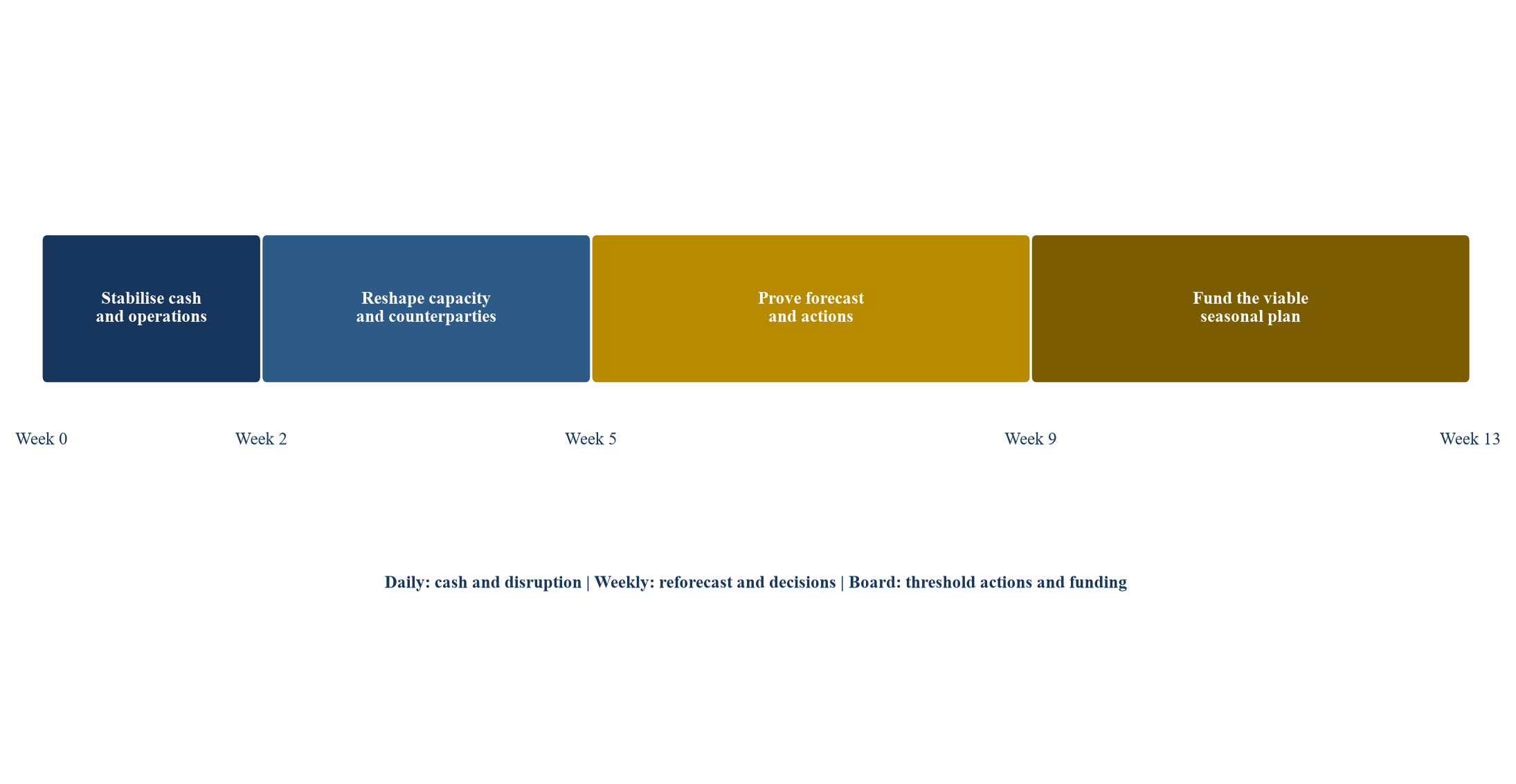
Decision rights tighten near-term and transition into viability planning.
26. Govern payments and cash releases
Decentralised payment activity can defeat the forecast and create inequitable or operationally harmful outcomes. Establish payment authorities, critical-payment categories, documented exceptions, legal review and bank-control procedures. The analysis should distinguish observed operational, contractual and financial evidence from management assumptions and connect each material judgment to safety, passenger delivery, schedule execution, stakeholder rights and cash. Release cash against verified need, approval and model impact while preserving safety and legal obligations. The work should cover a central case and a severe-but-plausible downside, with correlated sensitivities for demand, yield, cancellation, refunds, fuel, currency, aircraft availability, card reserves, supplier terms, creditor relief and implementation timing. Exceptions require a named owner, source, due date and decision consequence. Unsupported savings or financing remain outside the base case until actions are implemented and evidence confirms the cash result. Evidence should remain traceable to legal entity, account, route, flight, aircraft, contract and forecast week, with control totals to bank records and management reporting. The resulting decision should update cash, capacity and stakeholder plans together.
27. Measure turnaround benefits
A programme can claim savings that reflect volume decline, delayed payments or optimistic baselines rather than durable value. Track gross benefit, leakage, implementation cost, timing, cash realisation and continuing run rate. The analysis should distinguish observed operational, contractual and financial evidence from management assumptions and connect each material judgment to safety, passenger delivery, schedule execution, stakeholder rights and cash. Reconcile realised cash to bank movements and preserve the original approved baseline. The work should cover a central case and a severe-but-plausible downside, with correlated sensitivities for demand, yield, cancellation, refunds, fuel, currency, aircraft availability, card reserves, supplier terms, creditor relief and implementation timing. Exceptions require a named owner, source, due date and decision consequence. Unsupported savings or financing remain outside the base case until actions are implemented and evidence confirms the cash result. Management should define the earliest warning indicator, intervention trigger and executable contingency. Reporting should preserve the original case, approved changes and realised cash so the board can distinguish delivery from timing shifts or presentation changes.
28. Communicate with the board and stakeholders
Confidence depends on accurate, timely and consistent information about liquidity, operations, passenger service and the viability plan. Use a weekly board pack with cash bridge, route and fleet decisions, risks, stakeholder actions and requested approvals. The analysis should distinguish observed operational, contractual and financial evidence from management assumptions and connect each material judgment to safety, passenger delivery, schedule execution, stakeholder rights and cash. Separate observed results, management assumptions and decisions under consideration. The work should cover a central case and a severe-but-plausible downside, with correlated sensitivities for demand, yield, cancellation, refunds, fuel, currency, aircraft availability, card reserves, supplier terms, creditor relief and implementation timing. Exceptions require a named owner, source, due date and decision consequence. Unsupported savings or financing remain outside the base case until actions are implemented and evidence confirms the cash result. The section output should identify the controlling evidence, decision threshold, accountable owner, forecast week and explicit safety, passenger, capacity or cash consequence. This creates a controlled bridge from diagnosis to action and bank movement.
29. Transition from crisis to viability
A 13-week forecast controls immediate liquidity but does not replace a credible seasonal network, capital plan and long-term business model. Bridge the short-term plan into monthly forecasts, fleet strategy, restructuring plan and funding requirement. The analysis should distinguish observed operational, contractual and financial evidence from management assumptions and connect each material judgment to safety, passenger delivery, schedule execution, stakeholder rights and cash. Exit crisis governance only after forecast accuracy, liquidity headroom and operating controls remain stable. The work should cover a central case and a severe-but-plausible downside, with correlated sensitivities for demand, yield, cancellation, refunds, fuel, currency, aircraft availability, card reserves, supplier terms, creditor relief and implementation timing. Exceptions require a named owner, source, due date and decision consequence. Unsupported savings or financing remain outside the base case until actions are implemented and evidence confirms the cash result. Evidence should remain traceable to legal entity, account, route, flight, aircraft, contract and forecast week, with control totals to bank records and management reporting. The resulting decision should update cash, capacity and stakeholder plans together.
30. Define the investment and restructuring case
The airline becomes financeable when its network, fleet, cost base, obligations and liquidity needs form a coherent and evidenced plan. Present sources and uses, downside runway, stakeholder support, governance, milestones and value allocation. The analysis should distinguish observed operational, contractual and financial evidence from management assumptions and connect each material judgment to safety, passenger delivery, schedule execution, stakeholder rights and cash. Funding should be conditional on executable actions, sufficient headroom and transparent risk ownership. The work should cover a central case and a severe-but-plausible downside, with correlated sensitivities for demand, yield, cancellation, refunds, fuel, currency, aircraft availability, card reserves, supplier terms, creditor relief and implementation timing. Exceptions require a named owner, source, due date and decision consequence. Unsupported savings or financing remain outside the base case until actions are implemented and evidence confirms the cash result. Management should define the earliest warning indicator, intervention trigger and executable contingency. Reporting should preserve the original case, approved changes and realised cash so the board can distinguish delivery from timing shifts or presentation changes.
Sources
- International Air Transport Association. Global Outlook for Air Transport, June 2026. Read the primary source
- International Air Transport Association. Middle East Disruptions and High Fuel Prices Halve Airline Industry Profitability, 7 June 2026. Read the primary source
- International Air Transport Association. Annual Review 2026. Read the primary source
- International Air Transport Association. How to Work in Airline Network Planning, 17 November 2025. Read the primary source
- International Air Transport Association. Route Forecasting and Development. Read the primary source
- Airports Council International, International Air Transport Association and Worldwide Airport Coordinators Group. Worldwide Airport Slot Guidelines, Edition 4. Read the primary source
- International Air Transport Association. Justified Non-Utilization of Slots. Read the primary source
- International Air Transport Association. Slot Reform White Paper. Read the primary source
- International Air Transport Association. Data Will Help Airlines Save the Next Gallon of Jet Fuel, August 2026. Read the primary source
- International Civil Aviation Organization. Guidance on Economic and Financial Measures. Read the primary source
- International Civil Aviation Organization. Safety Management Standards and Recommended Practices. Read the primary source
- International Civil Aviation Organization. Manual on the Regulation of International Air Transport, Doc 9626. Read the primary source
- IFRS Foundation. IAS 7 Statement of Cash Flows. Read the primary source
- IFRS Foundation. IFRS 16 Leases. Read the primary source
- IFRS Foundation. IFRS 9 Financial Instruments. Read the primary source
- IFRS Foundation. IAS 36 Impairment of Assets. Read the primary source
- European Commission. Draft Guidelines on State Aid to the Air Transport Sector, 2026 consultation. Read the primary source
- European Commission. Air Passenger Rights. Read the primary source
- US Department of Transportation. Airline Refunds and Consumer Protections. Read the primary source
- UNIDROIT. Convention on International Interests in Mobile Equipment and Protocol on Aircraft Equipment. Read the primary source
