

1. Define the refinancing decision
The board must decide how much debt the fleet can carry through the next cycle, how maturities should be distributed and which risks require funded protection. Start with aircraft-level debt, cash flow, technical condition, lease or route economics, ownership, security and expected exit routes. The analysis should distinguish observed contractual or technical evidence from management assumptions and connect each material judgment to cash, timing and executable value. The approval should state central and downside debt capacity, minimum liquidity, amortisation, covenants, hedging and intervention triggers. The work should cover a central case and a severe-but-plausible downside, with correlated sensitivities for utilisation, lease or route cash, maintenance, interest rates, currency, market value and remarketing time. Exceptions require a named owner, source, due date and decision consequence. Unsupported value, cash or refinancing improvements remain outside the base case until actions are implemented and evidence confirms the result. The section output should include reconciled aircraft-level evidence, decision thresholds, a named owner, review cadence and an explicit credit or operating consequence. This creates a controlled bridge from technical and market evidence to financing action.
2. Use the Fleet Debt-to-Residual Framework
The framework connects six evidence blocks: operating cash, technical status, maintenance economics, market value, legal enforceability and capital structure. Each block should reconcile to an aircraft identifier and produce a cash consequence, value adjustment, timing assumption and accountable owner. The analysis should distinguish observed contractual or technical evidence from management assumptions and connect each material judgment to cash, timing and executable value. Credit approval should prevent a strong appraisal from masking weak cash cover or a short maintenance horizon. The work should cover a central case and a severe-but-plausible downside, with correlated sensitivities for utilisation, lease or route cash, maintenance, interest rates, currency, market value and remarketing time. Exceptions require a named owner, source, due date and decision consequence. Unsupported value, cash or refinancing improvements remain outside the base case until actions are implemented and evidence confirms the result. Evidence should be retained at aircraft, contract and facility level, with control totals to the ledger and a documented path for exceptions. The resulting decision should update debt capacity, liquidity, covenants and the refinancing timetable together.
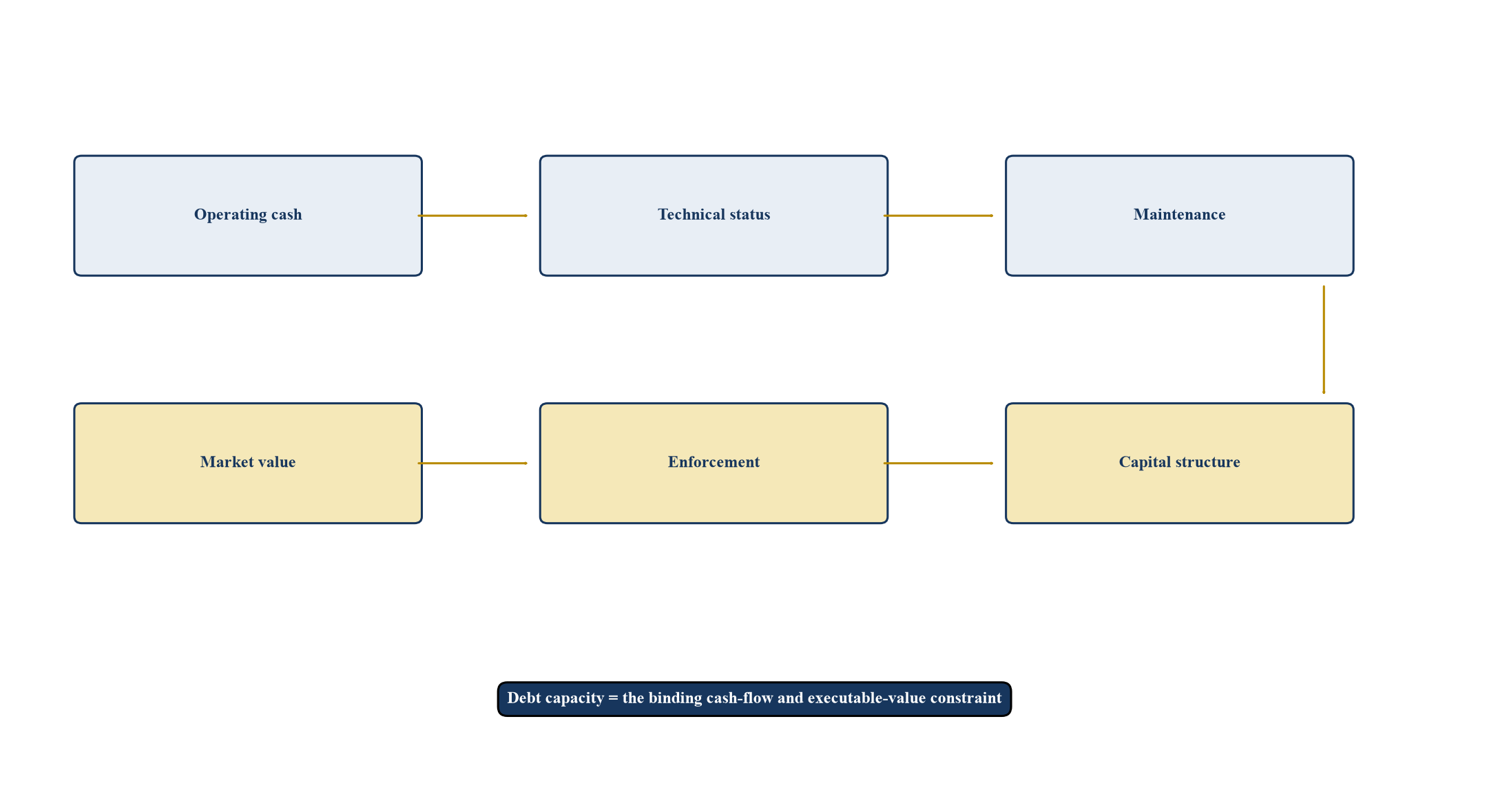
Six evidence blocks connect aircraft operations to capital structure and downside protection.
3. Fix the asset and obligor perimeter
Financing packages may mix owned aircraft, finance leases, operating leases, engines, spare parts, special-purpose vehicles and guarantees. Map title, beneficial ownership, registration, lease, mortgage, security, cross-default, cash accounts and recourse for every asset and obligor. The analysis should distinguish observed contractual or technical evidence from management assumptions and connect each material judgment to cash, timing and executable value. A signed perimeter schedule should align the model, legal documents, insurance, technical records and closing deliverables. The work should cover a central case and a severe-but-plausible downside, with correlated sensitivities for utilisation, lease or route cash, maintenance, interest rates, currency, market value and remarketing time. Exceptions require a named owner, source, due date and decision consequence. Unsupported value, cash or refinancing improvements remain outside the base case until actions are implemented and evidence confirms the result. Management should define the earliest warning indicator, intervention trigger and funded response. Reporting should preserve the original assumption, approved changes and realised outcome so the board can distinguish genuine de-risking from timing or reclassification.
4. Build the minimum aircraft-level dataset
Decision-grade analysis requires serial number, type, vintage, specification, operator, jurisdiction, utilisation, maintenance status, lease terms, debt and valuation history. Reconcile flight hours, cycles, shop visits, life-limited parts, airworthiness directives, rental receipts, reserves, debt service and security to primary records. The analysis should distinguish observed contractual or technical evidence from management assumptions and connect each material judgment to cash, timing and executable value. Preserve source files, valuation dates and exceptions so the model can be refreshed monthly and before each financing milestone. The work should cover a central case and a severe-but-plausible downside, with correlated sensitivities for utilisation, lease or route cash, maintenance, interest rates, currency, market value and remarketing time. Exceptions require a named owner, source, due date and decision consequence. Unsupported value, cash or refinancing improvements remain outside the base case until actions are implemented and evidence confirms the result. The section output should include reconciled aircraft-level evidence, decision thresholds, a named owner, review cadence and an explicit credit or operating consequence. This creates a controlled bridge from technical and market evidence to financing action.
| Layer | Core evidence | Primary decision | Financing consequence |
|---|---|---|---|
| Ownership | Title, registration, mortgage and SPV | Eligibility and security | Enforceable collateral |
| Operations | Hours, cycles, route or lease cash | Cash-flow capacity | Debt service and reserve |
| Technical | Status, records, events and directives | Maintenance funding | Value and availability |
| Market | Appraisals, trades and lease rates | Advance rate | Residual protection |
| Counterparty | Operator credit and payment record | Concentration and controls | Collection and transition risk |
| Capital | Debt, hedges, covenants and maturities | Structure and tenor | Refinance resilience |
Every layer should reconcile to aircraft serial number, obligor and facility.
5. Separate cash-flow credit from asset-value credit
Aircraft finance can rely on airline cash flow, lease rentals, asset proceeds, sponsor support or combinations of these sources. Model each repayment source separately and identify the conditions under which it remains available. The analysis should distinguish observed contractual or technical evidence from management assumptions and connect each material judgment to cash, timing and executable value. Debt sizing should use the weaker binding constraint after liquidity, maintenance and enforcement costs, rather than averaging unlike sources. The work should cover a central case and a severe-but-plausible downside, with correlated sensitivities for utilisation, lease or route cash, maintenance, interest rates, currency, market value and remarketing time. Exceptions require a named owner, source, due date and decision consequence. Unsupported value, cash or refinancing improvements remain outside the base case until actions are implemented and evidence confirms the result. Evidence should be retained at aircraft, contract and facility level, with control totals to the ledger and a documented path for exceptions. The resulting decision should update debt capacity, liquidity, covenants and the refinancing timetable together.
6. Normalise operating cash flow
Reported profitability can conceal fuel hedges, deferred maintenance, temporary capacity constraints, working-capital movements or exceptional route economics. Bridge revenue, utilisation, yield, load factor, fuel, labour, maintenance, airport charges, lease cost and overhead to cash available for debt service. The analysis should distinguish observed contractual or technical evidence from management assumptions and connect each material judgment to cash, timing and executable value. Use monthly cash through a full seasonal cycle and exclude benefits that lack contracted or implemented support. The work should cover a central case and a severe-but-plausible downside, with correlated sensitivities for utilisation, lease or route cash, maintenance, interest rates, currency, market value and remarketing time. Exceptions require a named owner, source, due date and decision consequence. Unsupported value, cash or refinancing improvements remain outside the base case until actions are implemented and evidence confirms the result. Management should define the earliest warning indicator, intervention trigger and funded response. Reporting should preserve the original assumption, approved changes and realised outcome so the board can distinguish genuine de-risking from timing or reclassification.
7. Measure utilisation without rewarding overuse
Higher flight hours and cycles can improve near-term revenue while accelerating engine, landing-gear and airframe maintenance exposure. Link utilisation to revenue, variable cost, maintenance consumption, remaining green time and reserve collections by aircraft. The analysis should distinguish observed contractual or technical evidence from management assumptions and connect each material judgment to cash, timing and executable value. Covenants should monitor both cash generation and technical depletion so performance cannot be manufactured by consuming residual value. The work should cover a central case and a severe-but-plausible downside, with correlated sensitivities for utilisation, lease or route cash, maintenance, interest rates, currency, market value and remarketing time. Exceptions require a named owner, source, due date and decision consequence. Unsupported value, cash or refinancing improvements remain outside the base case until actions are implemented and evidence confirms the result. The section output should include reconciled aircraft-level evidence, decision thresholds, a named owner, review cadence and an explicit credit or operating consequence. This creates a controlled bridge from technical and market evidence to financing action.
8. Reconstruct maintenance status
An aircraft's economic value depends on the condition and remaining life of its engines, airframe checks, landing gear, auxiliary power unit and life-limited parts. Reconcile technical records, forecasts, shop-visit scope, escalation, warranties, power-by-the-hour arrangements and return conditions. The analysis should distinguish observed contractual or technical evidence from management assumptions and connect each material judgment to cash, timing and executable value. The financing base should deduct unfunded maintenance exposure and recognise reimbursements only when contractual eligibility and counterparty capacity are evidenced. The work should cover a central case and a severe-but-plausible downside, with correlated sensitivities for utilisation, lease or route cash, maintenance, interest rates, currency, market value and remarketing time. Exceptions require a named owner, source, due date and decision consequence. Unsupported value, cash or refinancing improvements remain outside the base case until actions are implemented and evidence confirms the result. Evidence should be retained at aircraft, contract and facility level, with control totals to the ledger and a documented path for exceptions. The resulting decision should update debt capacity, liquidity, covenants and the refinancing timetable together.
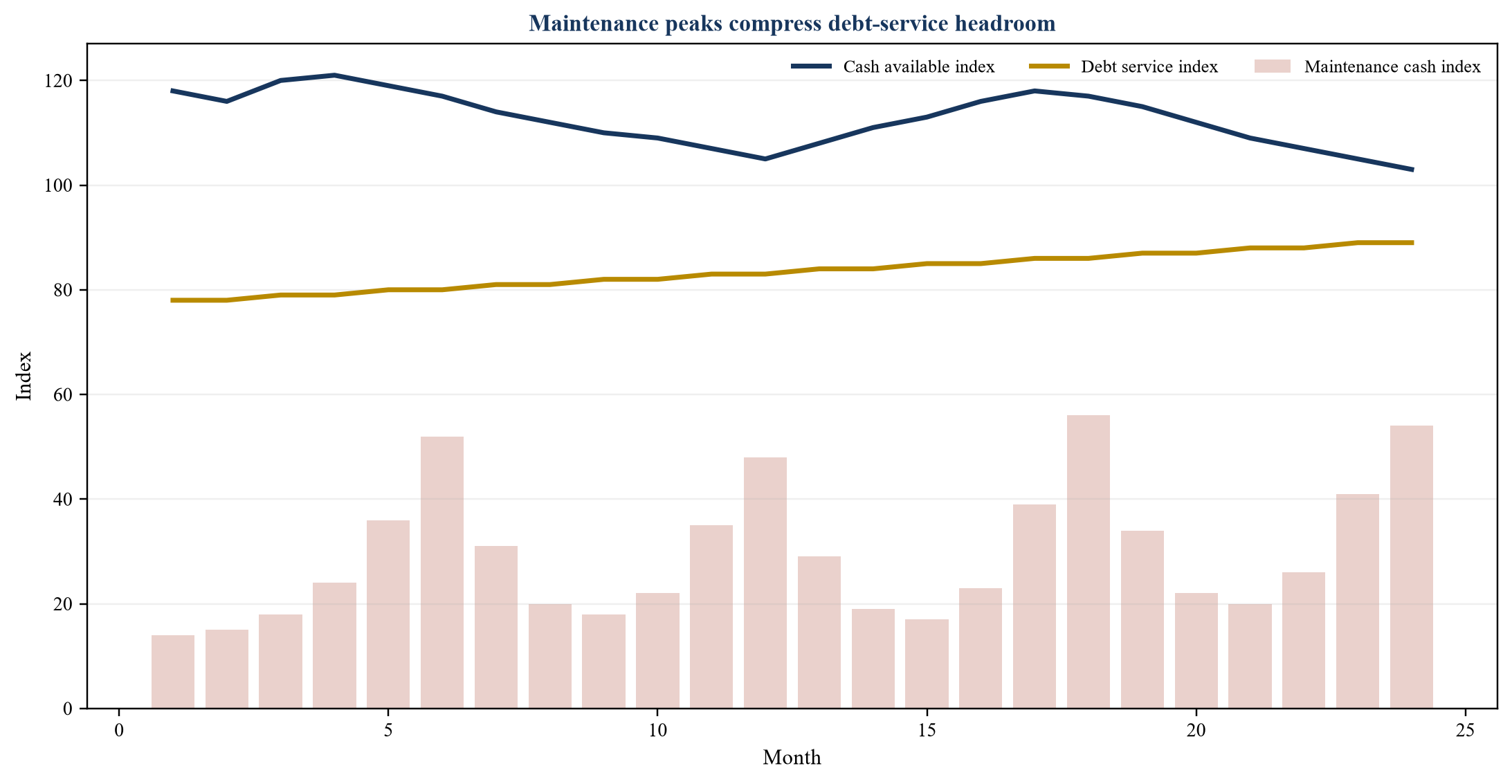
Indexed monthly management scenario; values are illustrative assumptions.
9. Test maintenance reserves and deposits
Maintenance reserves may be restricted, refundable, non-refundable, under-collected or unavailable after a lessee default. Map monthly rates, utilisation measures, eligible events, reimbursement conditions, lessor contributions, balances, arrears and control of cash. The analysis should distinguish observed contractual or technical evidence from management assumptions and connect each material judgment to cash, timing and executable value. Treat each balance according to legal availability and expected recovery; do not assume that a reserve fully funds the next event. The work should cover a central case and a severe-but-plausible downside, with correlated sensitivities for utilisation, lease or route cash, maintenance, interest rates, currency, market value and remarketing time. Exceptions require a named owner, source, due date and decision consequence. Unsupported value, cash or refinancing improvements remain outside the base case until actions are implemented and evidence confirms the result. Management should define the earliest warning indicator, intervention trigger and funded response. Reporting should preserve the original assumption, approved changes and realised outcome so the board can distinguish genuine de-risking from timing or reclassification.
10. Protect records and airworthiness
Incomplete records can delay operation, repossession, sale or lease and can reduce executable value even when the physical aircraft is sound. Audit certificates, logbooks, component trace, modifications, directives, damage history, export documents and digital-record custody. The analysis should distinguish observed contractual or technical evidence from management assumptions and connect each material judgment to cash, timing and executable value. Create closing conditions and recurring reporting for missing or disputed records, with cash reserves and remediation milestones. The work should cover a central case and a severe-but-plausible downside, with correlated sensitivities for utilisation, lease or route cash, maintenance, interest rates, currency, market value and remarketing time. Exceptions require a named owner, source, due date and decision consequence. Unsupported value, cash or refinancing improvements remain outside the base case until actions are implemented and evidence confirms the result. The section output should include reconciled aircraft-level evidence, decision thresholds, a named owner, review cadence and an explicit credit or operating consequence. This creates a controlled bridge from technical and market evidence to financing action.
11. Establish current market value
Appraisals are point-in-time opinions whose usefulness depends on definition, date, specification, maintenance status and market liquidity. Compare base, current market, lease-encumbered and orderly liquidation values; reconcile assumptions to recent transactions and lease-rate evidence. The analysis should distinguish observed contractual or technical evidence from management assumptions and connect each material judgment to cash, timing and executable value. The credit model should use a clearly defined value basis and apply separate adjustments for maintenance, concentration, jurisdiction and execution. The work should cover a central case and a severe-but-plausible downside, with correlated sensitivities for utilisation, lease or route cash, maintenance, interest rates, currency, market value and remarketing time. Exceptions require a named owner, source, due date and decision consequence. Unsupported value, cash or refinancing improvements remain outside the base case until actions are implemented and evidence confirms the result. Evidence should be retained at aircraft, contract and facility level, with control totals to the ledger and a documented path for exceptions. The resulting decision should update debt capacity, liquidity, covenants and the refinancing timetable together.
12. Model residual value by aircraft family
Residual value changes with production status, installed base, engine support, fuel efficiency, regulation, parts demand and operator breadth. Build type-specific curves with central and downside transition paths, including retirement, cargo conversion, part-out and alternative-use evidence. The analysis should distinguish observed contractual or technical evidence from management assumptions and connect each material judgment to cash, timing and executable value. Concentration limits should reflect correlated value movements across common airframes, engines and lessees. The work should cover a central case and a severe-but-plausible downside, with correlated sensitivities for utilisation, lease or route cash, maintenance, interest rates, currency, market value and remarketing time. Exceptions require a named owner, source, due date and decision consequence. Unsupported value, cash or refinancing improvements remain outside the base case until actions are implemented and evidence confirms the result. Management should define the earliest warning indicator, intervention trigger and funded response. Reporting should preserve the original assumption, approved changes and realised outcome so the board can distinguish genuine de-risking from timing or reclassification.
13. Use lease rates as a value cross-check
Lease-rate factors can reveal market pressure before appraisal values move, yet contract rents may include credit, maintenance and scarcity effects. Separate base rent, reserves, security deposits, escalation, incentives and return conditions; compare contracted and current market rents. The analysis should distinguish observed contractual or technical evidence from management assumptions and connect each material judgment to cash, timing and executable value. Capitalise sustainable cash only after accounting for downtime, transition cost, lessor contributions and lessee credit. The work should cover a central case and a severe-but-plausible downside, with correlated sensitivities for utilisation, lease or route cash, maintenance, interest rates, currency, market value and remarketing time. Exceptions require a named owner, source, due date and decision consequence. Unsupported value, cash or refinancing improvements remain outside the base case until actions are implemented and evidence confirms the result. The section output should include reconciled aircraft-level evidence, decision thresholds, a named owner, review cadence and an explicit credit or operating consequence. This creates a controlled bridge from technical and market evidence to financing action.
| Cohort | Evidence focus | Central response | Downside response |
|---|---|---|---|
| Young in-production type | Delivery pricing and operator breadth | Term debt with sculpted amortisation | Conservative balloon and concentration cap |
| Mid-life liquid type | Lease rates, shop visits and transition cost | Cash sweep and maintenance reserve | Earlier amortisation or asset sale |
| Mature passenger type | Parts demand, cargo option and retirement | Short tenor and release price | Liquidation-value advance rate |
| Engine-constrained cohort | Green time, shop slots and spares | Funded maintenance plan | Additional liquidity and lower eligibility |
| Concentrated operator pool | Lessee credit and jurisdiction | Diversification covenant | Cash control and remarketing reserve |
Cohorts should connect operating utility, maintenance horizon and market depth.
14. Price remarketing time
A repossessed or returned aircraft may remain off-lease while records are repaired, maintenance is completed and a new operator is secured. Model notice, enforcement, ferry, storage, maintenance, modification, regulatory approval, marketing and delivery by jurisdiction and aircraft type. The analysis should distinguish observed contractual or technical evidence from management assumptions and connect each material judgment to cash, timing and executable value. Liquidity reserves and debt maturity should cover the full transition window rather than a frictionless sale assumption. The work should cover a central case and a severe-but-plausible downside, with correlated sensitivities for utilisation, lease or route cash, maintenance, interest rates, currency, market value and remarketing time. Exceptions require a named owner, source, due date and decision consequence. Unsupported value, cash or refinancing improvements remain outside the base case until actions are implemented and evidence confirms the result. Evidence should be retained at aircraft, contract and facility level, with control totals to the ledger and a documented path for exceptions. The resulting decision should update debt capacity, liquidity, covenants and the refinancing timetable together.
15. Analyse supply-chain constraints
Engine and component shortages can extend shop visits, raise lease and maintenance costs, and keep older aircraft in service longer. Track original-equipment-manufacturer delivery schedules, repair turnaround, spare availability, escalation clauses and dependence on single suppliers. The analysis should distinguish observed contractual or technical evidence from management assumptions and connect each material judgment to cash, timing and executable value. Scenarios should capture both the near-term support to lease rates and the later residual-value risk when new deliveries normalise. The work should cover a central case and a severe-but-plausible downside, with correlated sensitivities for utilisation, lease or route cash, maintenance, interest rates, currency, market value and remarketing time. Exceptions require a named owner, source, due date and decision consequence. Unsupported value, cash or refinancing improvements remain outside the base case until actions are implemented and evidence confirms the result. Management should define the earliest warning indicator, intervention trigger and funded response. Reporting should preserve the original assumption, approved changes and realised outcome so the board can distinguish genuine de-risking from timing or reclassification.
16. Stress fuel and technology transition
New aircraft and engines can lower fuel, noise and emissions costs, changing demand for earlier technology. Compare operating economics, regulatory exposure, infrastructure compatibility, maintenance maturity and operator switching costs across generations. The analysis should distinguish observed contractual or technical evidence from management assumptions and connect each material judgment to cash, timing and executable value. Residual curves should include accelerated obsolescence and delayed replacement cases without assuming a single transition path. The work should cover a central case and a severe-but-plausible downside, with correlated sensitivities for utilisation, lease or route cash, maintenance, interest rates, currency, market value and remarketing time. Exceptions require a named owner, source, due date and decision consequence. Unsupported value, cash or refinancing improvements remain outside the base case until actions are implemented and evidence confirms the result. The section output should include reconciled aircraft-level evidence, decision thresholds, a named owner, review cadence and an explicit credit or operating consequence. This creates a controlled bridge from technical and market evidence to financing action.
17. Map lessee and operator credit
Asset value cannot eliminate collection, repossession and transition risk when an operator weakens. Review liquidity, leverage, route concentration, government support, payment history, maintenance performance, reserve arrears and jurisdiction. The analysis should distinguish observed contractual or technical evidence from management assumptions and connect each material judgment to cash, timing and executable value. Set lessee concentration, cash-control and early-warning thresholds, and connect deterioration to advance-rate or reserve actions. The work should cover a central case and a severe-but-plausible downside, with correlated sensitivities for utilisation, lease or route cash, maintenance, interest rates, currency, market value and remarketing time. Exceptions require a named owner, source, due date and decision consequence. Unsupported value, cash or refinancing improvements remain outside the base case until actions are implemented and evidence confirms the result. Evidence should be retained at aircraft, contract and facility level, with control totals to the ledger and a documented path for exceptions. The resulting decision should update debt capacity, liquidity, covenants and the refinancing timetable together.
18. Test jurisdiction and enforcement
Mortgage priority, deregistration, insolvency stays, export approvals, sanctions and court capacity influence recovery timing and cost. Obtain jurisdiction-specific legal analysis, verify registrations and Cape Town Convention filings where relevant, and map practical repossession steps. The analysis should distinguish observed contractual or technical evidence from management assumptions and connect each material judgment to cash, timing and executable value. The downside should use executable timing and cost assumptions supported by counsel rather than treaty participation alone. The work should cover a central case and a severe-but-plausible downside, with correlated sensitivities for utilisation, lease or route cash, maintenance, interest rates, currency, market value and remarketing time. Exceptions require a named owner, source, due date and decision consequence. Unsupported value, cash or refinancing improvements remain outside the base case until actions are implemented and evidence confirms the result. Management should define the earliest warning indicator, intervention trigger and funded response. Reporting should preserve the original assumption, approved changes and realised outcome so the board can distinguish genuine de-risking from timing or reclassification.
19. Reconcile insurance and total-loss protection
Hull, liability, war-risk and contingent insurance protect different exposures and may contain deductibles, exclusions or currency mismatches. Confirm insured value, agreed value, loss payee, breach-of-warranty cover, geographic scope, premium status and claims procedures. The analysis should distinguish observed contractual or technical evidence from management assumptions and connect each material judgment to cash, timing and executable value. Debt documents should align insurance proceeds, mandatory prepayment and replacement rights with the refinancing model. The work should cover a central case and a severe-but-plausible downside, with correlated sensitivities for utilisation, lease or route cash, maintenance, interest rates, currency, market value and remarketing time. Exceptions require a named owner, source, due date and decision consequence. Unsupported value, cash or refinancing improvements remain outside the base case until actions are implemented and evidence confirms the result. The section output should include reconciled aircraft-level evidence, decision thresholds, a named owner, review cadence and an explicit credit or operating consequence. This creates a controlled bridge from technical and market evidence to financing action.
20. Match currency and interest-rate risk
Aircraft values and debt are commonly linked to US dollars while operating cash may arise in other currencies and at variable rates. Model revenue currency, fuel, maintenance, rent, debt, hedge tenor, basis risk, collateral and counterparty exposure. The analysis should distinguish observed contractual or technical evidence from management assumptions and connect each material judgment to cash, timing and executable value. Size hedges and liquidity against downside cash flow, and show debt service after hedge expiry or stress. The work should cover a central case and a severe-but-plausible downside, with correlated sensitivities for utilisation, lease or route cash, maintenance, interest rates, currency, market value and remarketing time. Exceptions require a named owner, source, due date and decision consequence. Unsupported value, cash or refinancing improvements remain outside the base case until actions are implemented and evidence confirms the result. Evidence should be retained at aircraft, contract and facility level, with control totals to the ledger and a documented path for exceptions. The resulting decision should update debt capacity, liquidity, covenants and the refinancing timetable together.
21. Design advance rates and borrowing bases
A single fleet-level loan-to-value covenant can hide weaker aircraft, concentrated types or values that are difficult to realise. Calculate eligible value aircraft by aircraft, apply maintenance and concentration haircuts, and exclude assets with title, records, insurance or default exceptions. The analysis should distinguish observed contractual or technical evidence from management assumptions and connect each material judgment to cash, timing and executable value. Use periodic revaluation, cure rights and substitution rules that preserve operations while protecting lender collateral. The work should cover a central case and a severe-but-plausible downside, with correlated sensitivities for utilisation, lease or route cash, maintenance, interest rates, currency, market value and remarketing time. Exceptions require a named owner, source, due date and decision consequence. Unsupported value, cash or refinancing improvements remain outside the base case until actions are implemented and evidence confirms the result. Management should define the earliest warning indicator, intervention trigger and funded response. Reporting should preserve the original assumption, approved changes and realised outcome so the board can distinguish genuine de-risking from timing or reclassification.
| Instrument | Strength | Principal constraint | Suitable use |
|---|---|---|---|
| Secured bank debt | Relationship execution and flexibility | Advance rate and amortisation | Core liquid fleet |
| Private credit | Bespoke structure and speed | Higher pricing and controls | Transitional or complex cohorts |
| Capital markets | Scale and maturity diversification | Disclosure and market window | Large seasoned portfolios |
| Export credit | Long tenor and asset alignment | Eligibility and process | Qualifying new deliveries |
| Sale-and-leaseback | Immediate liquidity and residual transfer | Lease obligations and return conditions | Delivery financing or deleveraging |
| Joint venture | Risk sharing and off-balance-sheet flexibility | Governance and partner economics | Portfolio rotation |
Instrument choice should match aircraft cohort, cash profile and strategic flexibility.
22. Sculpt amortisation to economic depreciation
Straight-line principal can be too fast for young assets or too slow when maintenance and residual risk rise sharply. Align scheduled principal with contracted cash, technical consumption, lease expiry, expected value decline and refinancing windows. The analysis should distinguish observed contractual or technical evidence from management assumptions and connect each material judgment to cash, timing and executable value. Use cash sweeps, release prices and balloon limits to control reliance on a single future capital-market event. The work should cover a central case and a severe-but-plausible downside, with correlated sensitivities for utilisation, lease or route cash, maintenance, interest rates, currency, market value and remarketing time. Exceptions require a named owner, source, due date and decision consequence. Unsupported value, cash or refinancing improvements remain outside the base case until actions are implemented and evidence confirms the result. The section output should include reconciled aircraft-level evidence, decision thresholds, a named owner, review cadence and an explicit credit or operating consequence. This creates a controlled bridge from technical and market evidence to financing action.
23. Control maturity concentration
Fleet debt often clusters around acquisition periods, creating refinancing exposure even when each facility appears serviceable. Map debt maturities, lease expiries, maintenance events, hedge roll-offs and expected aircraft disposals on one monthly timeline. The analysis should distinguish observed contractual or technical evidence from management assumptions and connect each material judgment to cash, timing and executable value. Set annual maturity limits and start refinancing before a downside breach removes negotiating flexibility. The work should cover a central case and a severe-but-plausible downside, with correlated sensitivities for utilisation, lease or route cash, maintenance, interest rates, currency, market value and remarketing time. Exceptions require a named owner, source, due date and decision consequence. Unsupported value, cash or refinancing improvements remain outside the base case until actions are implemented and evidence confirms the result. Evidence should be retained at aircraft, contract and facility level, with control totals to the ledger and a documented path for exceptions. The resulting decision should update debt capacity, liquidity, covenants and the refinancing timetable together.
24. Build covenant headroom
Loan-to-value, debt-service, liquidity, net-worth and utilisation covenants respond differently to market and operating stress. Run correlated scenarios for lease rates, utilisation, value, maintenance, rates, currency and downtime, including cure mechanics and reporting lags. The analysis should distinguish observed contractual or technical evidence from management assumptions and connect each material judgment to cash, timing and executable value. Headroom should be measured after realistic management actions and the cash needed to implement them. The work should cover a central case and a severe-but-plausible downside, with correlated sensitivities for utilisation, lease or route cash, maintenance, interest rates, currency, market value and remarketing time. Exceptions require a named owner, source, due date and decision consequence. Unsupported value, cash or refinancing improvements remain outside the base case until actions are implemented and evidence confirms the result. Management should define the earliest warning indicator, intervention trigger and funded response. Reporting should preserve the original assumption, approved changes and realised outcome so the board can distinguish genuine de-risking from timing or reclassification.
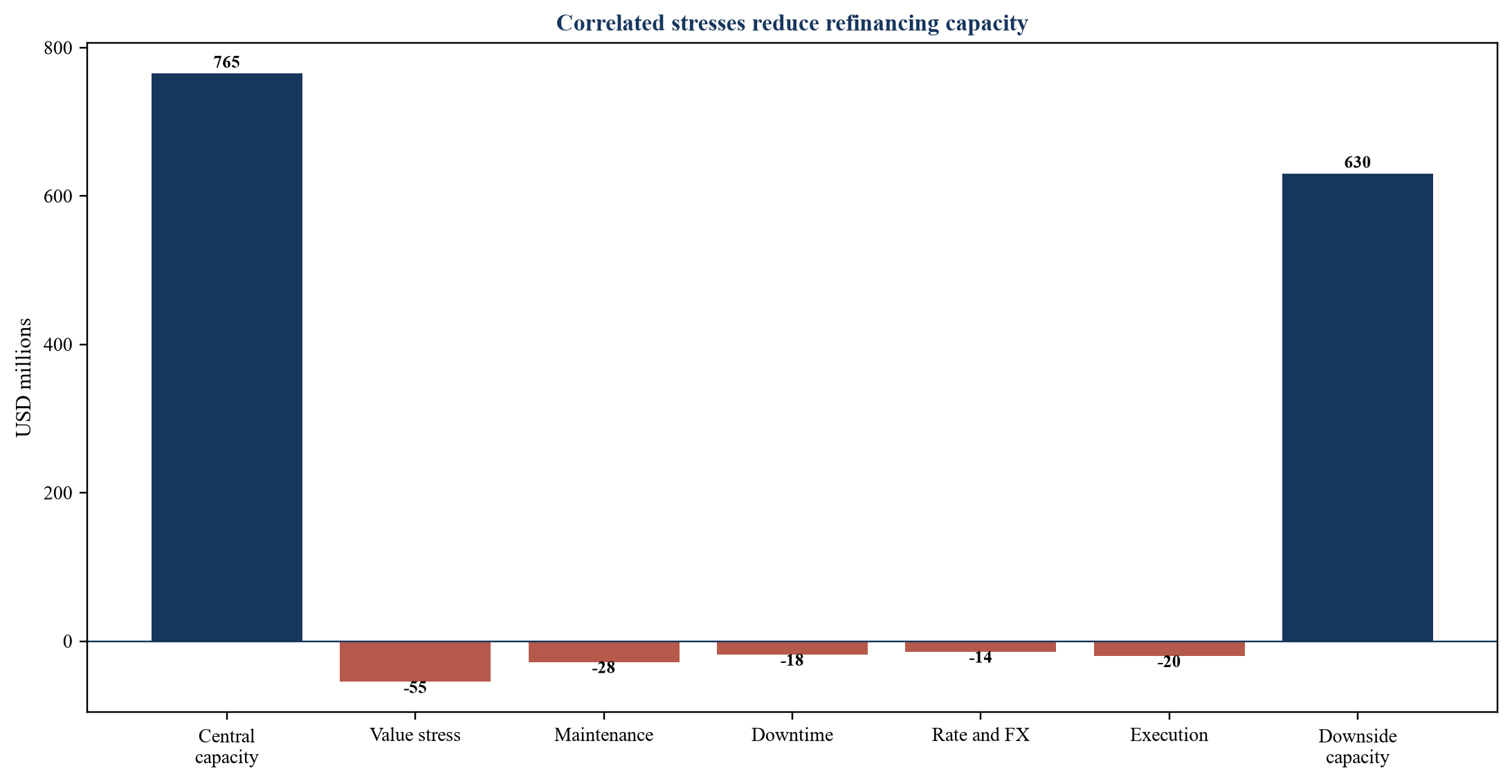
USD millions; every value is an illustrative management assumption.
25. Create a refinancing options matrix
Bank debt, capital markets, private credit, export credit, operating leases, finance leases, sale-and-leasebacks and joint ventures allocate risk differently. Compare all-in cost, advance rate, amortisation, tenor, security, covenants, prepayment, disclosure, execution time and strategic flexibility. The analysis should distinguish observed contractual or technical evidence from management assumptions and connect each material judgment to cash, timing and executable value. Select a portfolio of instruments that diversifies maturity and investor dependence while matching each aircraft cohort. The work should cover a central case and a severe-but-plausible downside, with correlated sensitivities for utilisation, lease or route cash, maintenance, interest rates, currency, market value and remarketing time. Exceptions require a named owner, source, due date and decision consequence. Unsupported value, cash or refinancing improvements remain outside the base case until actions are implemented and evidence confirms the result. The section output should include reconciled aircraft-level evidence, decision thresholds, a named owner, review cadence and an explicit credit or operating consequence. This creates a controlled bridge from technical and market evidence to financing action.
26. Model a hypothetical fleet refinancing
The hypothetical fleet contains thirty narrowbody aircraft with an assumed current market value of USD 1.00 billion and existing debt of USD 780 million. The central case applies maintenance, concentration and execution adjustments and supports USD 765 million of refinancing; the downside supports USD 630 million. The analysis should distinguish observed contractual or technical evidence from management assumptions and connect each material judgment to cash, timing and executable value. The downside therefore creates a USD 150 million gap against existing debt. All figures are illustrative management assumptions. The work should cover a central case and a severe-but-plausible downside, with correlated sensitivities for utilisation, lease or route cash, maintenance, interest rates, currency, market value and remarketing time. Exceptions require a named owner, source, due date and decision consequence. Unsupported value, cash or refinancing improvements remain outside the base case until actions are implemented and evidence confirms the result. Evidence should be retained at aircraft, contract and facility level, with control totals to the ledger and a documented path for exceptions. The resulting decision should update debt capacity, liquidity, covenants and the refinancing timetable together.
| Measure | Central case | Downside case | Decision meaning |
|---|---|---|---|
| Assumed current market value | 1,000 | 820 | Point-in-time portfolio value |
| Existing debt | 780 | 780 | Amount requiring action |
| Maintenance and records adjustment | 45 | 72 | Technical and execution exposure |
| Concentration and jurisdiction adjustment | 30 | 48 | Correlated recovery risk |
| Supported refinancing capacity | 765 | 630 | Debt after all constraints |
| Gap versus existing debt | 15 | 150 | Equity, sale or restructuring need |
USD millions; all values are illustrative management assumptions.
27. Convert the gap into executable actions
A refinancing gap can be addressed through equity, amortisation, asset sales, additional collateral, maintenance funding, tenor changes or operating improvement. Quantify timing, proceeds, cost, approvals and operational consequences for each action; avoid counting mutually exclusive actions twice. The analysis should distinguish observed contractual or technical evidence from management assumptions and connect each material judgment to cash, timing and executable value. The board should approve a sequenced plan with owners and stop-loss triggers before liquidity or covenant pressure narrows the choices. The work should cover a central case and a severe-but-plausible downside, with correlated sensitivities for utilisation, lease or route cash, maintenance, interest rates, currency, market value and remarketing time. Exceptions require a named owner, source, due date and decision consequence. Unsupported value, cash or refinancing improvements remain outside the base case until actions are implemented and evidence confirms the result. Management should define the earliest warning indicator, intervention trigger and funded response. Reporting should preserve the original assumption, approved changes and realised outcome so the board can distinguish genuine de-risking from timing or reclassification.
28. Establish lender-grade reporting
Financiers need timely evidence at aircraft, facility and group level. Report rent and route cash, utilisation, maintenance status, reserve balances, arrears, insurance, values, covenants, liquidity and exceptions with reconciliations. The analysis should distinguish observed contractual or technical evidence from management assumptions and connect each material judgment to cash, timing and executable value. Data lineage and signed ownership should allow the lender and board to trace every material change to source evidence. The work should cover a central case and a severe-but-plausible downside, with correlated sensitivities for utilisation, lease or route cash, maintenance, interest rates, currency, market value and remarketing time. Exceptions require a named owner, source, due date and decision consequence. Unsupported value, cash or refinancing improvements remain outside the base case until actions are implemented and evidence confirms the result. The section output should include reconciled aircraft-level evidence, decision thresholds, a named owner, review cadence and an explicit credit or operating consequence. This creates a controlled bridge from technical and market evidence to financing action.
29. Govern the first twenty-four months
Refinancing remains a continuing asset, liquidity and market-management programme after closing. Track maturities, debt service, technical events, values, lease rates, operator credit, hedges, asset sales and agreed mitigations against the approved case. The analysis should distinguish observed contractual or technical evidence from management assumptions and connect each material judgment to cash, timing and executable value. Escalate deviations early and update debt capacity only after cash, technical and market evidence is reconciled. The work should cover a central case and a severe-but-plausible downside, with correlated sensitivities for utilisation, lease or route cash, maintenance, interest rates, currency, market value and remarketing time. Exceptions require a named owner, source, due date and decision consequence. Unsupported value, cash or refinancing improvements remain outside the base case until actions are implemented and evidence confirms the result. Evidence should be retained at aircraft, contract and facility level, with control totals to the ledger and a documented path for exceptions. The resulting decision should update debt capacity, liquidity, covenants and the refinancing timetable together.
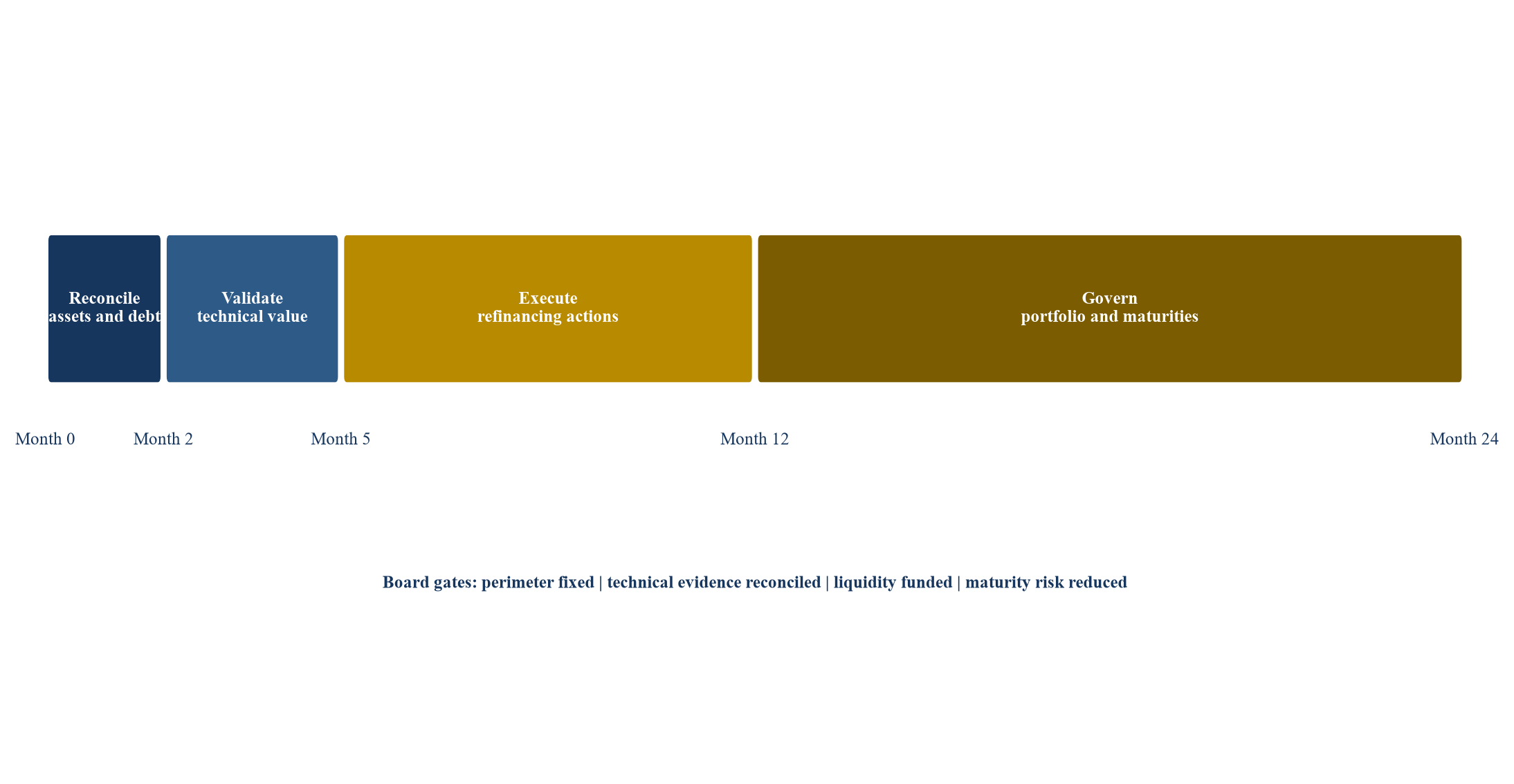
The roadmap links evidence, execution and continuing asset management.
30. Conclude with resilient fleet finance
Resilient aviation debt matches repayment to cash generation while preserving protection against maintenance, market and enforcement risk. The framework gives boards a sequence: fix the perimeter, verify technical condition, normalise cash, define executable value, stress the cycle and diversify refinancing. The analysis should distinguish observed contractual or technical evidence from management assumptions and connect each material judgment to cash, timing and executable value. The result is a capital structure that can absorb operating and asset-value volatility without depending on a single appraisal or refinancing date. The work should cover a central case and a severe-but-plausible downside, with correlated sensitivities for utilisation, lease or route cash, maintenance, interest rates, currency, market value and remarketing time. Exceptions require a named owner, source, due date and decision consequence. Unsupported value, cash or refinancing improvements remain outside the base case until actions are implemented and evidence confirms the result. Management should define the earliest warning indicator, intervention trigger and funded response. Reporting should preserve the original assumption, approved changes and realised outcome so the board can distinguish genuine de-risking from timing or reclassification.
Sources
- International Air Transport Association. Airline Profitability to Strengthen Slightly in 2025 Despite Headwinds. Read the primary source
- International Air Transport Association. Aviation Supply Chain. Read the primary source
- International Civil Aviation Organization. Aircraft Leasing and Financing guidance and resources. Read the primary source
- International Civil Aviation Organization. Convention on International Interests in Mobile Equipment and Aircraft Protocol. Read the primary source
- Aviation Working Group. Global Aviation Industry Cape Town Convention Index. Read the primary source
- IFRS Foundation. IFRS 16 Leases. Read the primary source
- IFRS Foundation. IAS 36 Impairment of Assets. Read the primary source
- IFRS Foundation. IFRS 9 Financial Instruments. Read the primary source
- US Federal Aviation Administration. Aircraft Registration. Read the primary source
- US Federal Aviation Administration. Airworthiness Directives. Read the primary source
- AerCap Holdings N.V. Annual Report for the year ended 31 December 2025. Read the primary source
- Air Lease Corporation. Annual Report for the year ended 31 December 2025. Read the primary source
- Aircastle Limited. Annual Report for the year ended 28 February 2025. Read the primary source
- Aircastle Limited. Quarterly Report for the period ended 31 August 2025. Read the primary source
- Willis Lease Finance Corporation. 2025 Annual Report. Read the primary source
- Ryanair Holdings plc. Annual Report for the year ended 31 March 2025. Read the primary source
- US Securities and Exchange Commission. Regulation S-K. Read the primary source
- US Securities and Exchange Commission. Financial Reporting Manual. Read the primary source
- Bank for International Settlements. Global liquidity and credit statistics. Read the primary source
- International Chamber of Commerce. Uniform Rules for Demand Guarantees, URDG 758. Read the primary source
