

1. Define the bankability decision
The public authority and private bidder must decide whether the concession can deliver safe capacity, acceptable service, affordable charges and risk-adjusted investor returns through a wide range of traffic outcomes. State the airport perimeter, concession term, operating obligations, expansion scope, revenue rights, regulatory regime, existing liabilities and proposed financing. The analysis should distinguish observed technical, contractual, regulatory and financial evidence from management assumptions and connect each material judgment to safety, service, affordability, capacity, financing and public-interest outcomes. The approval should specify the risks each party can control, the risks requiring sharing or relief, and the conditions that must hold at financial close. The work should test central, downside and upside cases with correlated sensitivities for traffic, passenger mix, airline concentration, tariff timing, commercial spend, operating cost, inflation, currency, interest rates, construction, permits and relief events. Exceptions require a named owner, source, due date and decision consequence. Unsupported revenue, savings, compensation or refinancing remains outside the base case until enforceable evidence supports it. The section output should identify the evidence, risk owner, contractual mechanism, model line, approval right and financing consequence. This creates a traceable bridge from feasibility to bid, financial close and operating governance.
The concession should be treated as one integrated economic and contractual system. Traffic determines demand for terminal, runway, stand and access capacity; tariffs and commercial performance convert activity into revenue; operating and lifecycle plans determine service and cost; expansion obligations determine funding needs; and the contract allocates events that management cannot absorb efficiently. A bankability review therefore reconciles the traffic case, technical plan, financial model, risk matrix, concession agreement and financing term sheet. Definitions, indexation, measurement periods and relief mechanics should match across those documents. A change in one layer should flow through the full model and approval record. Scenario analysis should combine related shocks. A traffic shortfall can lower aviation charges, reduce retail conversion, increase airline concentration and delay the case for expansion. Inflation can raise operating and construction costs while regulated tariffs adjust with a lag. Currency depreciation can raise imported equipment and debt service without increasing local-currency revenue. The board and lenders need an integrated downside, pre-agreed interventions and sufficient liquidity before coverage approaches contractual thresholds. Upside traffic also needs testing because early congestion can accelerate capex before retained cash and financing capacity are ready.
2. Use the Airport PPP Bankability Framework
The framework links traffic, capacity, charges, commercial revenue, operating cost, capital expenditure, financing, performance and contractual rights. Each input should reconcile to a passenger segment, aircraft movement, terminal zone, commercial unit, asset, contract, currency and forecast year. The analysis should distinguish observed technical, contractual, regulatory and financial evidence from management assumptions and connect each material judgment to safety, service, affordability, capacity, financing and public-interest outcomes. The model, concession agreement and technical plan should use the same definitions and decision triggers. The work should test central, downside and upside cases with correlated sensitivities for traffic, passenger mix, airline concentration, tariff timing, commercial spend, operating cost, inflation, currency, interest rates, construction, permits and relief events. Exceptions require a named owner, source, due date and decision consequence. Unsupported revenue, savings, compensation or refinancing remains outside the base case until enforceable evidence supports it. Evidence should remain traceable to passenger segment, movement, terminal zone, commercial unit, asset, contract, currency and forecast year. The financial model should reconcile to the technical plan and concession definitions.
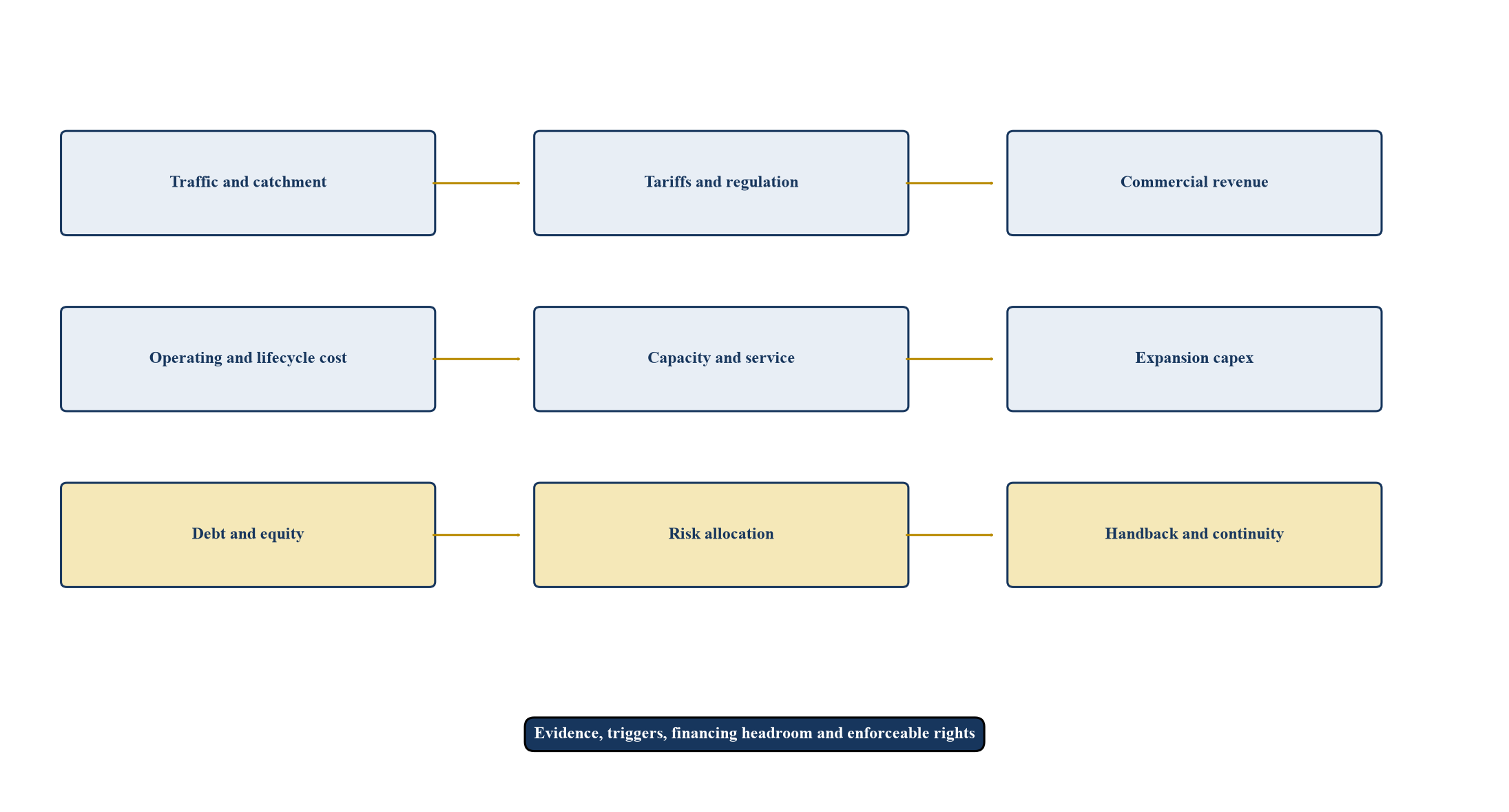
One system connects demand, revenue, capacity, funding and contractual allocation.
3. Segment the traffic forecast
Aggregate passenger growth can conceal route, airline, hub, transfer, seasonality and concentration risks. Separate domestic, international, origin-and-destination, transfer, low-cost, full-service, cargo and general-aviation drivers where relevant. The analysis should distinguish observed technical, contractual, regulatory and financial evidence from management assumptions and connect each material judgment to safety, service, affordability, capacity, financing and public-interest outcomes. Forecasts should show observed history, management assumptions, scenario logic and independent review rather than one deterministic growth curve. The work should test central, downside and upside cases with correlated sensitivities for traffic, passenger mix, airline concentration, tariff timing, commercial spend, operating cost, inflation, currency, interest rates, construction, permits and relief events. Exceptions require a named owner, source, due date and decision consequence. Unsupported revenue, savings, compensation or refinancing remains outside the base case until enforceable evidence supports it. Management should define the earliest warning indicator, measurement period, intervention trigger and executable response. Reporting should preserve the original case, approved changes and observed outcome so renegotiation does not substitute for disciplined preparation.
| Layer | Core evidence | Primary uncertainty | Bankability use |
|---|---|---|---|
| Catchment | Population, income, tourism, trade and surface access | Economic and policy change | Addressable demand |
| Airlines | Routes, fleets, schedules, bases and strategy | Capacity redeployment | Service continuity |
| Passengers | Domestic, international, transfer and purpose | Mix and yield change | Revenue conversion |
| Competition | Airports, rail, road and border alternatives | New capacity | Market share |
| Capacity | Peak-hour assets and service levels | Bottleneck timing | Expansion trigger |
Forecasts should distinguish observed evidence from assumptions.
4. Test catchment and connectivity
Airport demand depends on population, income, tourism, trade, airline networks, surface access, competing airports and policy. Map the effective catchment, airline strategies, route economics, transfer flows, rail and road alternatives, border rules and foreseeable policy changes. The analysis should distinguish observed technical, contractual, regulatory and financial evidence from management assumptions and connect each material judgment to safety, service, affordability, capacity, financing and public-interest outcomes. A credible case should identify which traffic the airport can influence and which traffic remains externally driven. The work should test central, downside and upside cases with correlated sensitivities for traffic, passenger mix, airline concentration, tariff timing, commercial spend, operating cost, inflation, currency, interest rates, construction, permits and relief events. Exceptions require a named owner, source, due date and decision consequence. Unsupported revenue, savings, compensation or refinancing remains outside the base case until enforceable evidence supports it. The section output should identify the evidence, risk owner, contractual mechanism, model line, approval right and financing consequence. This creates a traceable bridge from feasibility to bid, financial close and operating governance.
5. Convert traffic into aeronautical revenue
Passengers and aircraft movements generate different regulated and contractual charges with different collection risks. Model landing, parking, passenger service, security, bridge, cargo, fuel, handling and other aviation-related income using the applicable tariff basis. The analysis should distinguish observed technical, contractual, regulatory and financial evidence from management assumptions and connect each material judgment to safety, service, affordability, capacity, financing and public-interest outcomes. Revenue should reflect exemptions, discounts, airline agreements, collection timing, bad debt and regulatory approval. The work should test central, downside and upside cases with correlated sensitivities for traffic, passenger mix, airline concentration, tariff timing, commercial spend, operating cost, inflation, currency, interest rates, construction, permits and relief events. Exceptions require a named owner, source, due date and decision consequence. Unsupported revenue, savings, compensation or refinancing remains outside the base case until enforceable evidence supports it. Evidence should remain traceable to passenger segment, movement, terminal zone, commercial unit, asset, contract, currency and forecast year. The financial model should reconcile to the technical plan and concession definitions.
6. Model tariff regulation
Airport market power creates legitimate public-interest constraints on charges, while weak indexation can make investment unfinanceable. Document cost-relatedness, consultation, single-till, dual-till or hybrid-till treatment, regulatory asset base, return allowance, inflation and periodic review. The analysis should distinguish observed technical, contractual, regulatory and financial evidence from management assumptions and connect each material judgment to safety, service, affordability, capacity, financing and public-interest outcomes. The concession should define a transparent path for lawful tariff changes and relief when public decisions alter recoverable economics. The work should test central, downside and upside cases with correlated sensitivities for traffic, passenger mix, airline concentration, tariff timing, commercial spend, operating cost, inflation, currency, interest rates, construction, permits and relief events. Exceptions require a named owner, source, due date and decision consequence. Unsupported revenue, savings, compensation or refinancing remains outside the base case until enforceable evidence supports it. Management should define the earliest warning indicator, measurement period, intervention trigger and executable response. Reporting should preserve the original case, approved changes and observed outcome so renegotiation does not substitute for disciplined preparation.
7. Build the non-aeronautical revenue engine
Retail, food and beverage, parking, advertising, lounges, rental cars, property and services depend on passenger mix, dwell time, layout and commercial execution. Model spend, penetration, rent, minimum guarantees, revenue share, occupancy, conversion and contract expiry by category and terminal zone. The analysis should distinguish observed technical, contractual, regulatory and financial evidence from management assumptions and connect each material judgment to safety, service, affordability, capacity, financing and public-interest outcomes. Traffic recovery should not be assumed to restore revenue per passenger without evidence about customer behaviour and commercial design. The work should test central, downside and upside cases with correlated sensitivities for traffic, passenger mix, airline concentration, tariff timing, commercial spend, operating cost, inflation, currency, interest rates, construction, permits and relief events. Exceptions require a named owner, source, due date and decision consequence. Unsupported revenue, savings, compensation or refinancing remains outside the base case until enforceable evidence supports it. The section output should identify the evidence, risk owner, contractual mechanism, model line, approval right and financing consequence. This creates a traceable bridge from feasibility to bid, financial close and operating governance.
8. Value airport land and property
Airport land can support hotels, logistics, offices, maintenance, cargo and airport-city development, subject to title, planning, access and aviation constraints. Confirm ownership, permitted use, leases, utilities, contamination, height restrictions, connectivity, phasing and residual rights. The analysis should distinguish observed technical, contractual, regulatory and financial evidence from management assumptions and connect each material judgment to safety, service, affordability, capacity, financing and public-interest outcomes. Only legally available, serviced and commercially evidenced land should support the finance case. The work should test central, downside and upside cases with correlated sensitivities for traffic, passenger mix, airline concentration, tariff timing, commercial spend, operating cost, inflation, currency, interest rates, construction, permits and relief events. Exceptions require a named owner, source, due date and decision consequence. Unsupported revenue, savings, compensation or refinancing remains outside the base case until enforceable evidence supports it. Evidence should remain traceable to passenger segment, movement, terminal zone, commercial unit, asset, contract, currency and forecast year. The financial model should reconcile to the technical plan and concession definitions.
9. Establish the operating-cost base
Staff, security, utilities, maintenance, insurance, cleaning, technology and service contracts vary with traffic and required service levels. Separate fixed, step-fixed and variable costs and reconcile them to assets, passengers, movements, terminal opening plans and contract terms. The analysis should distinguish observed technical, contractual, regulatory and financial evidence from management assumptions and connect each material judgment to safety, service, affordability, capacity, financing and public-interest outcomes. The model should preserve safety and performance obligations in every downside case. The work should test central, downside and upside cases with correlated sensitivities for traffic, passenger mix, airline concentration, tariff timing, commercial spend, operating cost, inflation, currency, interest rates, construction, permits and relief events. Exceptions require a named owner, source, due date and decision consequence. Unsupported revenue, savings, compensation or refinancing remains outside the base case until enforceable evidence supports it. Management should define the earliest warning indicator, measurement period, intervention trigger and executable response. Reporting should preserve the original case, approved changes and observed outcome so renegotiation does not substitute for disciplined preparation.
10. Diagnose existing-asset condition
Latent defects, deferred maintenance and incomplete records can transfer an unquantified liability into the concession company. Complete technical due diligence covering remaining useful life, code compliance, pavement, terminal systems, baggage, power, water, drainage, digital systems and environmental condition. The analysis should distinguish observed technical, contractual, regulatory and financial evidence from management assumptions and connect each material judgment to safety, service, affordability, capacity, financing and public-interest outcomes. Allocate identified work, latent defects and threshold sharing mechanisms before bid pricing. The work should test central, downside and upside cases with correlated sensitivities for traffic, passenger mix, airline concentration, tariff timing, commercial spend, operating cost, inflation, currency, interest rates, construction, permits and relief events. Exceptions require a named owner, source, due date and decision consequence. Unsupported revenue, savings, compensation or refinancing remains outside the base case until enforceable evidence supports it. The section output should identify the evidence, risk owner, contractual mechanism, model line, approval right and financing consequence. This creates a traceable bridge from feasibility to bid, financial close and operating governance.
11. Define service and capacity metrics
Annual passengers alone do not determine when terminals, baggage, security, stands, runways or access systems become constrained. Use peak-hour demand, level-of-service measures, queue time, stand occupancy, baggage throughput, runway movements, resilience and asset availability. The analysis should distinguish observed technical, contractual, regulatory and financial evidence from management assumptions and connect each material judgment to safety, service, affordability, capacity, financing and public-interest outcomes. Capacity triggers should be measurable, auditable and linked to planning lead time. The work should test central, downside and upside cases with correlated sensitivities for traffic, passenger mix, airline concentration, tariff timing, commercial spend, operating cost, inflation, currency, interest rates, construction, permits and relief events. Exceptions require a named owner, source, due date and decision consequence. Unsupported revenue, savings, compensation or refinancing remains outside the base case until enforceable evidence supports it. Evidence should remain traceable to passenger segment, movement, terminal zone, commercial unit, asset, contract, currency and forecast year. The financial model should reconcile to the technical plan and concession definitions.
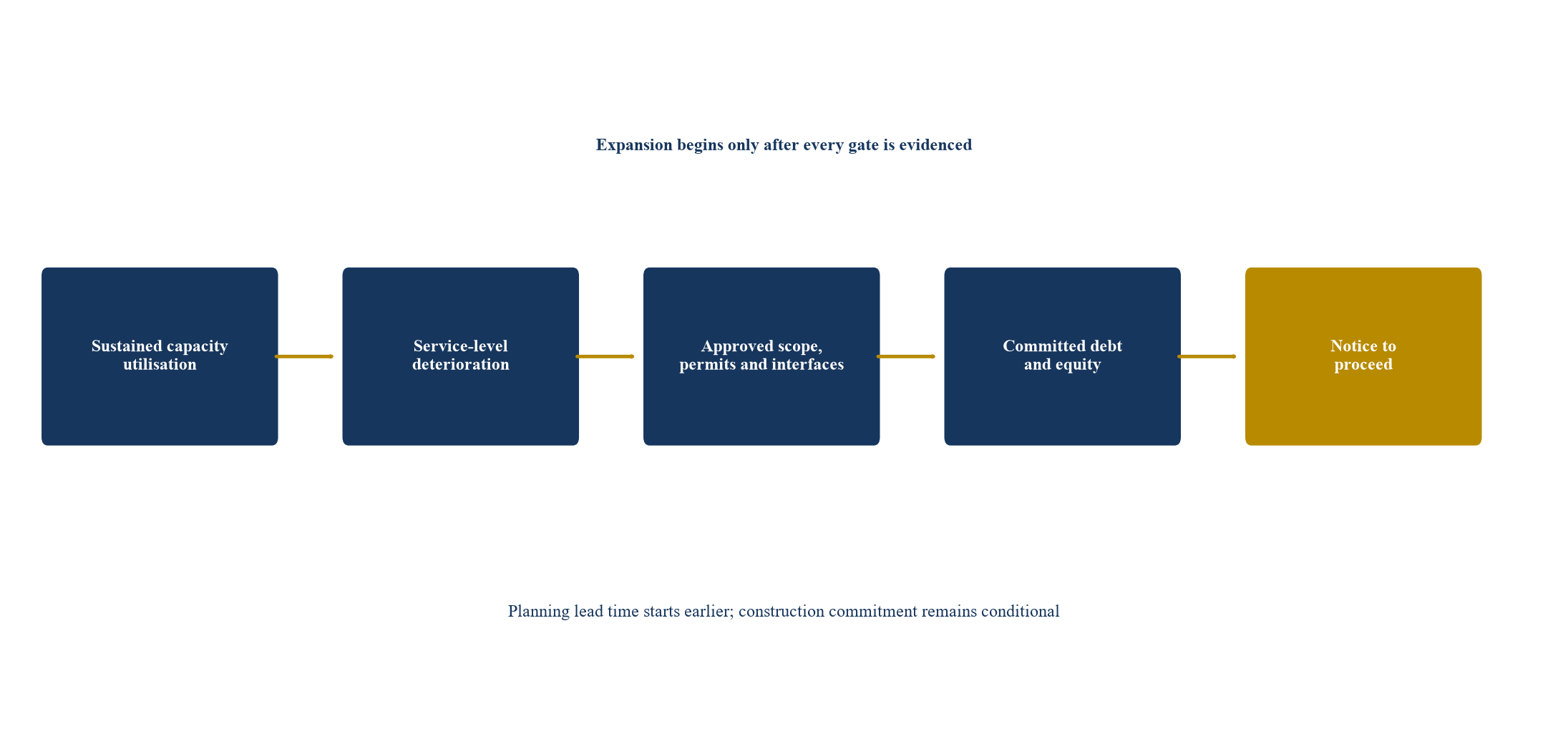
Illustrative decision sequence; thresholds must be defined for the specific airport.
12. Sequence expansion capex
Premature expansion burdens users and investors, while delayed expansion damages service, connectivity and growth. Create modular projects with planning, design, permitting, land, procurement, construction and commissioning lead times. The analysis should distinguish observed technical, contractual, regulatory and financial evidence from management assumptions and connect each material judgment to safety, service, affordability, capacity, financing and public-interest outcomes. Trigger each phase using sustained capacity and service evidence plus an approved business case and committed funding. The work should test central, downside and upside cases with correlated sensitivities for traffic, passenger mix, airline concentration, tariff timing, commercial spend, operating cost, inflation, currency, interest rates, construction, permits and relief events. Exceptions require a named owner, source, due date and decision consequence. Unsupported revenue, savings, compensation or refinancing remains outside the base case until enforceable evidence supports it. Management should define the earliest warning indicator, measurement period, intervention trigger and executable response. Reporting should preserve the original case, approved changes and observed outcome so renegotiation does not substitute for disciplined preparation.
| Gate | Evidence | Decision right | Failure response |
|---|---|---|---|
| Demand | Sustained traffic and peak-hour use | Confirm need | Defer or resize |
| Service | Queues, stands, baggage and resilience | Confirm outcome gap | Operational mitigation |
| Scope | Approved design, land, permits and interfaces | Lock project perimeter | Redesign |
| Funding | Committed debt, equity, reserves and hedging | Authorise funds | Refinance or phase |
| Delivery | Procurement, risk allocation and live-airport plan | Notice to proceed | Repackage |
Each gate should be defined and independently testable.
13. Prevent rigid capex traps
A fixed construction date can become uneconomic after traffic, technology or airline strategy changes. Define objective trigger tests, consultation, independent certification, deferral rights, scope adjustment and dispute resolution. The analysis should distinguish observed technical, contractual, regulatory and financial evidence from management assumptions and connect each material judgment to safety, service, affordability, capacity, financing and public-interest outcomes. The contract should preserve required outcomes while allowing efficient adaptation. The work should test central, downside and upside cases with correlated sensitivities for traffic, passenger mix, airline concentration, tariff timing, commercial spend, operating cost, inflation, currency, interest rates, construction, permits and relief events. Exceptions require a named owner, source, due date and decision consequence. Unsupported revenue, savings, compensation or refinancing remains outside the base case until enforceable evidence supports it. The section output should identify the evidence, risk owner, contractual mechanism, model line, approval right and financing consequence. This creates a traceable bridge from feasibility to bid, financial close and operating governance.
14. Price construction and interface risk
Brownfield airport works must coexist with live operations, security, utilities, airside access and passenger flows. Allocate design completeness, ground condition, utilities, permits, inflation, delay, interface, commissioning and operational-disruption risks. The analysis should distinguish observed technical, contractual, regulatory and financial evidence from management assumptions and connect each material judgment to safety, service, affordability, capacity, financing and public-interest outcomes. Contingency, liquidated damages, relief events and completion support should match the party controlling each risk. The work should test central, downside and upside cases with correlated sensitivities for traffic, passenger mix, airline concentration, tariff timing, commercial spend, operating cost, inflation, currency, interest rates, construction, permits and relief events. Exceptions require a named owner, source, due date and decision consequence. Unsupported revenue, savings, compensation or refinancing remains outside the base case until enforceable evidence supports it. Evidence should remain traceable to passenger segment, movement, terminal zone, commercial unit, asset, contract, currency and forecast year. The financial model should reconcile to the technical plan and concession definitions.
15. Structure the concession vehicle
The special-purpose vehicle should isolate concession cash flows while retaining the operational and technical resources needed to perform. Define ownership, permitted business, related-party contracts, distributions, reserve accounts, security, change of control and sponsor support. The analysis should distinguish observed technical, contractual, regulatory and financial evidence from management assumptions and connect each material judgment to safety, service, affordability, capacity, financing and public-interest outcomes. Governance should protect public obligations and lender rights without obscuring accountability. The work should test central, downside and upside cases with correlated sensitivities for traffic, passenger mix, airline concentration, tariff timing, commercial spend, operating cost, inflation, currency, interest rates, construction, permits and relief events. Exceptions require a named owner, source, due date and decision consequence. Unsupported revenue, savings, compensation or refinancing remains outside the base case until enforceable evidence supports it. Management should define the earliest warning indicator, measurement period, intervention trigger and executable response. Reporting should preserve the original case, approved changes and observed outcome so renegotiation does not substitute for disciplined preparation.
16. Design the capital structure
Debt capacity depends on traffic volatility, tariff flexibility, commercial diversification, capex obligations and concession life. Size senior debt, equity, subordinated instruments, liquidity, debt-service reserve and maintenance reserves against downside cash flow. The analysis should distinguish observed technical, contractual, regulatory and financial evidence from management assumptions and connect each material judgment to safety, service, affordability, capacity, financing and public-interest outcomes. Tenor and amortisation should fit asset life, concession expiry and late-life capital obligations. The work should test central, downside and upside cases with correlated sensitivities for traffic, passenger mix, airline concentration, tariff timing, commercial spend, operating cost, inflation, currency, interest rates, construction, permits and relief events. Exceptions require a named owner, source, due date and decision consequence. Unsupported revenue, savings, compensation or refinancing remains outside the base case until enforceable evidence supports it. The section output should identify the evidence, risk owner, contractual mechanism, model line, approval right and financing consequence. This creates a traceable bridge from feasibility to bid, financial close and operating governance.
17. Test debt-service resilience
A base-case coverage ratio can conceal rapid erosion when traffic, commercial spend, costs, rates and construction overlap deteriorate together. Calculate annual and lock-up coverage, reserve sufficiency, covenant cure and distribution capacity under correlated scenarios. The analysis should distinguish observed technical, contractual, regulatory and financial evidence from management assumptions and connect each material judgment to safety, service, affordability, capacity, financing and public-interest outcomes. Financing should retain headroom above contractual minimums and specify action before covenant breach. The work should test central, downside and upside cases with correlated sensitivities for traffic, passenger mix, airline concentration, tariff timing, commercial spend, operating cost, inflation, currency, interest rates, construction, permits and relief events. Exceptions require a named owner, source, due date and decision consequence. Unsupported revenue, savings, compensation or refinancing remains outside the base case until enforceable evidence supports it. Evidence should remain traceable to passenger segment, movement, terminal zone, commercial unit, asset, contract, currency and forecast year. The financial model should reconcile to the technical plan and concession definitions.
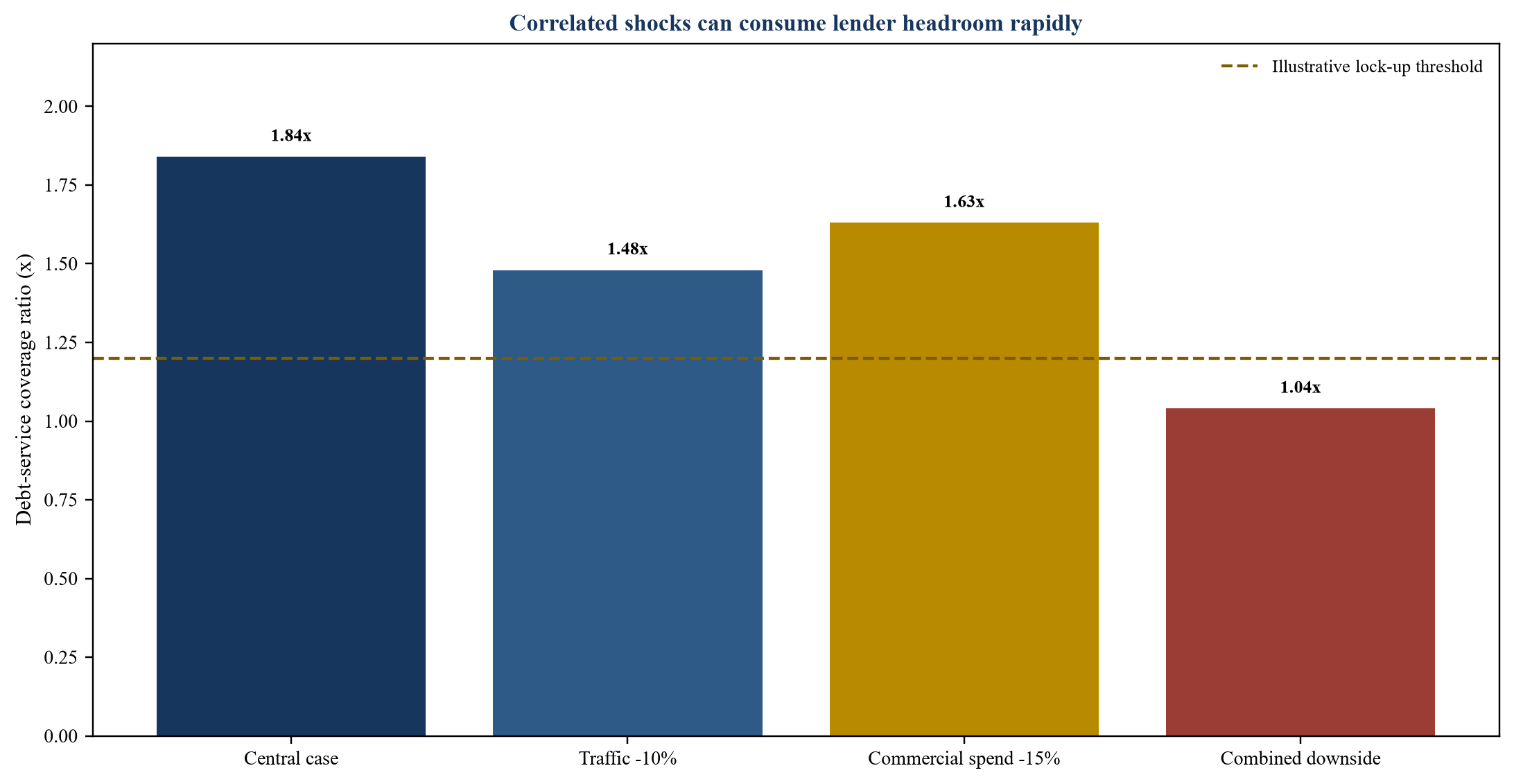
DSCR values are illustrative management assumptions based on the hypothetical case.
18. Allocate demand and revenue risk
Traffic and commercial income often sit with the private party, yet public policy, competing infrastructure or mandated service changes can materially reshape demand. Distinguish general market risk from discriminatory action, competing-facility risk, route restrictions, border closures and public-service requirements. The analysis should distinguish observed technical, contractual, regulatory and financial evidence from management assumptions and connect each material judgment to safety, service, affordability, capacity, financing and public-interest outcomes. Relief should be narrow, measurable and tied to the event rather than a general revenue guarantee. The work should test central, downside and upside cases with correlated sensitivities for traffic, passenger mix, airline concentration, tariff timing, commercial spend, operating cost, inflation, currency, interest rates, construction, permits and relief events. Exceptions require a named owner, source, due date and decision consequence. Unsupported revenue, savings, compensation or refinancing remains outside the base case until enforceable evidence supports it. Management should define the earliest warning indicator, measurement period, intervention trigger and executable response. Reporting should preserve the original case, approved changes and observed outcome so renegotiation does not substitute for disciplined preparation.
19. Consider availability or hybrid structures
A pure user-pay concession may be unsuitable where demand is immature, strategic service is required or public control limits revenue. Compare user-pay, availability-payment and hybrid mechanisms for fiscal cost, performance incentives, demand allocation and financing capacity. The analysis should distinguish observed technical, contractual, regulatory and financial evidence from management assumptions and connect each material judgment to safety, service, affordability, capacity, financing and public-interest outcomes. Payment obligations require budget authority, appropriation mechanics, deductions and transparent contingent-liability reporting. The work should test central, downside and upside cases with correlated sensitivities for traffic, passenger mix, airline concentration, tariff timing, commercial spend, operating cost, inflation, currency, interest rates, construction, permits and relief events. Exceptions require a named owner, source, due date and decision consequence. Unsupported revenue, savings, compensation or refinancing remains outside the base case until enforceable evidence supports it. The section output should identify the evidence, risk owner, contractual mechanism, model line, approval right and financing consequence. This creates a traceable bridge from feasibility to bid, financial close and operating governance.
20. Govern airline concentration
Dependence on one airline or alliance can magnify route, credit and bargaining risk. Measure passenger, movement and revenue concentration, airline financial strength, hub strategy, base commitments and switching options. The analysis should distinguish observed technical, contractual, regulatory and financial evidence from management assumptions and connect each material judgment to safety, service, affordability, capacity, financing and public-interest outcomes. Downside cases should include schedule withdrawal, capacity redeployment and counterparty default. The work should test central, downside and upside cases with correlated sensitivities for traffic, passenger mix, airline concentration, tariff timing, commercial spend, operating cost, inflation, currency, interest rates, construction, permits and relief events. Exceptions require a named owner, source, due date and decision consequence. Unsupported revenue, savings, compensation or refinancing remains outside the base case until enforceable evidence supports it. Evidence should remain traceable to passenger segment, movement, terminal zone, commercial unit, asset, contract, currency and forecast year. The financial model should reconcile to the technical plan and concession definitions.
21. Integrate environmental and social obligations
Airport expansion affects noise, land, communities, biodiversity, emissions, water, waste and labour. Identify applicable permits, standards, consultation, mitigation, resettlement, monitoring and climate-resilience requirements. The analysis should distinguish observed technical, contractual, regulatory and financial evidence from management assumptions and connect each material judgment to safety, service, affordability, capacity, financing and public-interest outcomes. Cost, schedule, responsibility and lender conditions should be embedded in the plan before tender and financing. The work should test central, downside and upside cases with correlated sensitivities for traffic, passenger mix, airline concentration, tariff timing, commercial spend, operating cost, inflation, currency, interest rates, construction, permits and relief events. Exceptions require a named owner, source, due date and decision consequence. Unsupported revenue, savings, compensation or refinancing remains outside the base case until enforceable evidence supports it. Management should define the earliest warning indicator, measurement period, intervention trigger and executable response. Reporting should preserve the original case, approved changes and observed outcome so renegotiation does not substitute for disciplined preparation.
22. Protect safety, security and economic oversight
Private participation does not remove the State's aviation obligations or the operator's safety and security duties. Define certification, accountable management, security, emergency response, occurrence reporting, user consultation and regulator access. The analysis should distinguish observed technical, contractual, regulatory and financial evidence from management assumptions and connect each material judgment to safety, service, affordability, capacity, financing and public-interest outcomes. Commercial and financing actions should remain subordinate to safe, secure and lawful operation. The work should test central, downside and upside cases with correlated sensitivities for traffic, passenger mix, airline concentration, tariff timing, commercial spend, operating cost, inflation, currency, interest rates, construction, permits and relief events. Exceptions require a named owner, source, due date and decision consequence. Unsupported revenue, savings, compensation or refinancing remains outside the base case until enforceable evidence supports it. The section output should identify the evidence, risk owner, contractual mechanism, model line, approval right and financing consequence. This creates a traceable bridge from feasibility to bid, financial close and operating governance.
23. Model the hypothetical airport
The hypothetical concession begins with 18.0 million passengers and USD 385 million of total annual revenue. Assumed operating cost is USD 210 million, producing USD 175 million of EBITDA before tax, financing and capital expenditure. The analysis should distinguish observed technical, contractual, regulatory and financial evidence from management assumptions and connect each material judgment to safety, service, affordability, capacity, financing and public-interest outcomes. The central case produces a 1.84x debt-service coverage ratio; the correlated downside produces 1.04x. Every value is an illustrative management assumption. The work should test central, downside and upside cases with correlated sensitivities for traffic, passenger mix, airline concentration, tariff timing, commercial spend, operating cost, inflation, currency, interest rates, construction, permits and relief events. Exceptions require a named owner, source, due date and decision consequence. Unsupported revenue, savings, compensation or refinancing remains outside the base case until enforceable evidence supports it. Evidence should remain traceable to passenger segment, movement, terminal zone, commercial unit, asset, contract, currency and forecast year. The financial model should reconcile to the technical plan and concession definitions.
| Measure | Central case | Correlated downside | Decision meaning |
|---|---|---|---|
| Passengers (millions) | 18.0 | 14.4 | Traffic conversion |
| Aeronautical revenue per passenger | 12.00 | 12.00 | Regulated and contractual income |
| Non-aeronautical revenue per passenger | 8.00 | 6.50 | Commercial execution and mix |
| Other revenue | 25.0 | 22.0 | Property and services |
| Total revenue | 385.0 | 288.4 | Cash-generating base |
| Operating cost | 210.0 | 190.0 | Fixed and variable cost response |
| EBITDA | 175.0 | 98.4 | Pre-financing operating result |
| Debt service | 95.0 | 95.0 | Contractual financing burden |
| DSCR | 1.84x | 1.04x | Lender headroom |
USD millions except passengers, revenue per passenger and DSCR; every value is an illustrative management assumption.
24. Gate the expansion funding decision
The assumed USD 650 million expansion can impair the existing concession if funded before demand, approvals and interfaces are ready. Require two sustained measurement periods above the capacity threshold, service deterioration, approved design, permits, fixed interface plan and committed debt and equity. The analysis should distinguish observed technical, contractual, regulatory and financial evidence from management assumptions and connect each material judgment to safety, service, affordability, capacity, financing and public-interest outcomes. Release construction only when downside coverage and liquidity remain acceptable after funding the project. The work should test central, downside and upside cases with correlated sensitivities for traffic, passenger mix, airline concentration, tariff timing, commercial spend, operating cost, inflation, currency, interest rates, construction, permits and relief events. Exceptions require a named owner, source, due date and decision consequence. Unsupported revenue, savings, compensation or refinancing remains outside the base case until enforceable evidence supports it. Management should define the earliest warning indicator, measurement period, intervention trigger and executable response. Reporting should preserve the original case, approved changes and observed outcome so renegotiation does not substitute for disciplined preparation.
25. Build the risk-allocation matrix
Risk allocation should follow control, insurability, pricing capacity and the public interest rather than a general preference for transfer. Map land, demand, tariffs, construction, utilities, force majeure, change in law, competing facilities, environment, financing, operations and handback. The analysis should distinguish observed technical, contractual, regulatory and financial evidence from management assumptions and connect each material judgment to safety, service, affordability, capacity, financing and public-interest outcomes. For each risk define owner, mitigation, relief, compensation, evidence and dispute path. The work should test central, downside and upside cases with correlated sensitivities for traffic, passenger mix, airline concentration, tariff timing, commercial spend, operating cost, inflation, currency, interest rates, construction, permits and relief events. Exceptions require a named owner, source, due date and decision consequence. Unsupported revenue, savings, compensation or refinancing remains outside the base case until enforceable evidence supports it. The section output should identify the evidence, risk owner, contractual mechanism, model line, approval right and financing consequence. This creates a traceable bridge from feasibility to bid, financial close and operating governance.
| Risk | Indicative owner | Core mitigation | Contract mechanism |
|---|---|---|---|
| General traffic | Private | Forecasting and flexible operations | Private revenue risk |
| Land and existing title | Public | Diligence and timely access | Condition precedent and relief |
| Construction delivery | Private | Fixed interfaces and capable contractor | Completion support and damages |
| Tariff approval | Shared | Transparent regulatory path | Defined review and relief |
| Discriminatory change | Public | Policy discipline | Compensation event |
| Force majeure | Shared | Insurance and resilience | Time and cost relief |
| Handback condition | Private | Surveys, reserves and rectification | Retention and security |
Final allocation requires project-specific legal, technical and financial analysis.
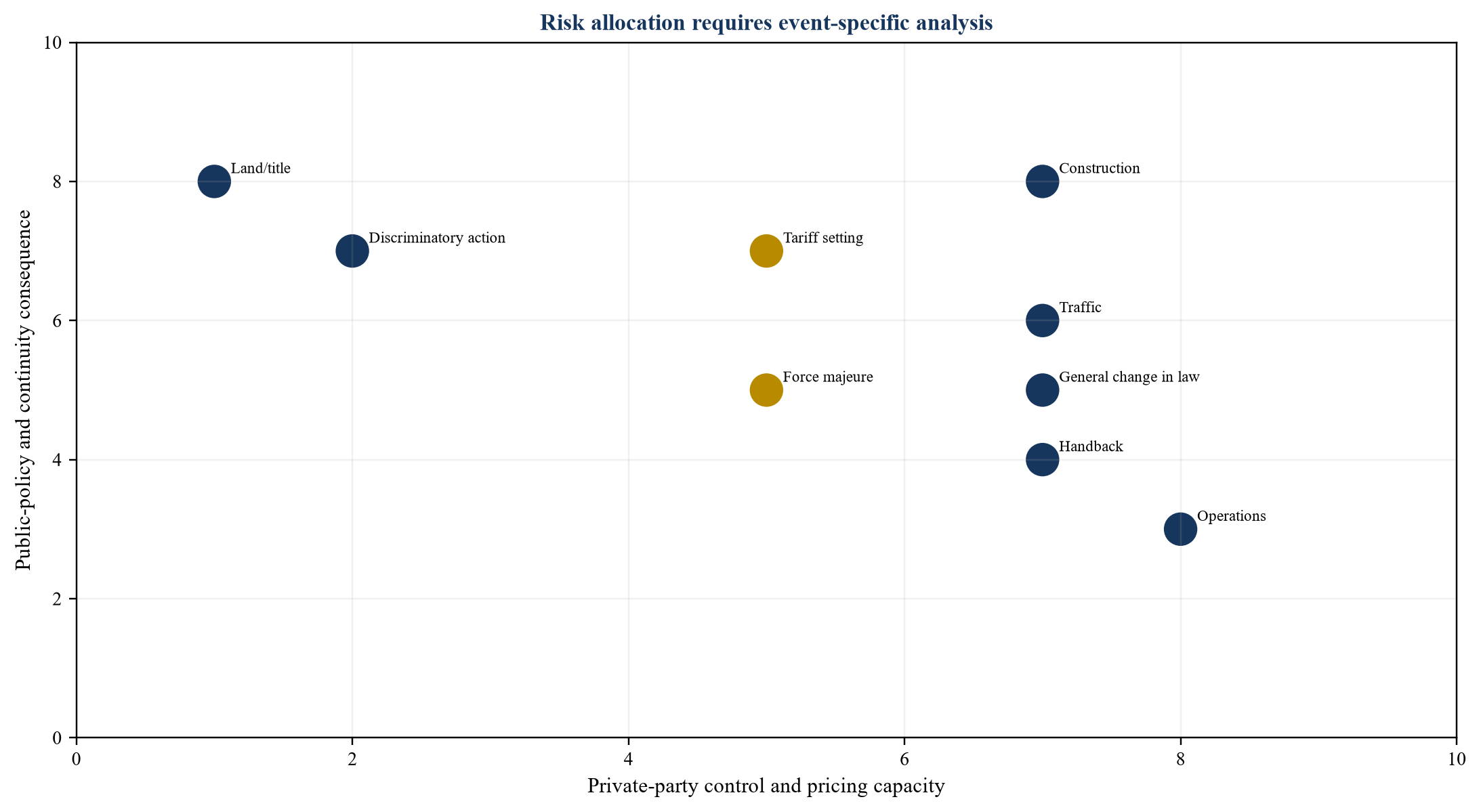
Allocation follows control, pricing capacity and relief design.
26. Establish lender protections
Project lenders require security and cure rights while public authorities require continuity of essential airport services. Define direct agreement, notice, cure, step-in, substitution, account control, insurance proceeds, enforcement and termination-compensation mechanics. The analysis should distinguish observed technical, contractual, regulatory and financial evidence from management assumptions and connect each material judgment to safety, service, affordability, capacity, financing and public-interest outcomes. Protections should allow a viable cure without creating uncontrolled ownership or operational outcomes. The work should test central, downside and upside cases with correlated sensitivities for traffic, passenger mix, airline concentration, tariff timing, commercial spend, operating cost, inflation, currency, interest rates, construction, permits and relief events. Exceptions require a named owner, source, due date and decision consequence. Unsupported revenue, savings, compensation or refinancing remains outside the base case until enforceable evidence supports it. Evidence should remain traceable to passenger segment, movement, terminal zone, commercial unit, asset, contract, currency and forecast year. The financial model should reconcile to the technical plan and concession definitions.
27. Procure for value and deliverability
The highest upfront fee or shortest construction promise can transfer hidden risk into charges, service or later renegotiation. Evaluate technical plan, financing certainty, traffic and revenue assumptions, lifecycle cost, risk acceptance, governance and transition capability. The analysis should distinguish observed technical, contractual, regulatory and financial evidence from management assumptions and connect each material judgment to safety, service, affordability, capacity, financing and public-interest outcomes. Bid evaluation should identify departures and compare whole-life value under common scenarios. The work should test central, downside and upside cases with correlated sensitivities for traffic, passenger mix, airline concentration, tariff timing, commercial spend, operating cost, inflation, currency, interest rates, construction, permits and relief events. Exceptions require a named owner, source, due date and decision consequence. Unsupported revenue, savings, compensation or refinancing remains outside the base case until enforceable evidence supports it. Management should define the earliest warning indicator, measurement period, intervention trigger and executable response. Reporting should preserve the original case, approved changes and observed outcome so renegotiation does not substitute for disciplined preparation.
28. Control the route to financial close
Unresolved permits, land, contracts, conditions precedent or model changes can delay closing and invalidate bid economics. Maintain an integrated close plan covering concession documents, financing, technical scope, insurance, environmental conditions, consents and funds flow. The analysis should distinguish observed technical, contractual, regulatory and financial evidence from management assumptions and connect each material judgment to safety, service, affordability, capacity, financing and public-interest outcomes. Every condition should have an owner, evidence standard, long-stop date and consequence. The work should test central, downside and upside cases with correlated sensitivities for traffic, passenger mix, airline concentration, tariff timing, commercial spend, operating cost, inflation, currency, interest rates, construction, permits and relief events. Exceptions require a named owner, source, due date and decision consequence. Unsupported revenue, savings, compensation or refinancing remains outside the base case until enforceable evidence supports it. The section output should identify the evidence, risk owner, contractual mechanism, model line, approval right and financing consequence. This creates a traceable bridge from feasibility to bid, financial close and operating governance.
29. Govern operations and expansion
The concession needs a durable information and decision system after financial close. Use performance dashboards, audited traffic and revenue data, capex gates, lifecycle plans, regulatory submissions and risk registers. The analysis should distinguish observed technical, contractual, regulatory and financial evidence from management assumptions and connect each material judgment to safety, service, affordability, capacity, financing and public-interest outcomes. The authority, operator and lenders should receive consistent information without duplicating operational control. The work should test central, downside and upside cases with correlated sensitivities for traffic, passenger mix, airline concentration, tariff timing, commercial spend, operating cost, inflation, currency, interest rates, construction, permits and relief events. Exceptions require a named owner, source, due date and decision consequence. Unsupported revenue, savings, compensation or refinancing remains outside the base case until enforceable evidence supports it. Evidence should remain traceable to passenger segment, movement, terminal zone, commercial unit, asset, contract, currency and forecast year. The financial model should reconcile to the technical plan and concession definitions.
30. Plan handback and transition
Late-life underinvestment can emerge when asset expenditure benefits the next operator or public authority after concession expiry. Define asset-condition standards, surveys, reserves, rectification periods, information transfer and continuity arrangements years before handback. The analysis should distinguish observed technical, contractual, regulatory and financial evidence from management assumptions and connect each material judgment to safety, service, affordability, capacity, financing and public-interest outcomes. The financing and distribution regime should preserve sufficient cash and incentives to meet the required condition. The work should test central, downside and upside cases with correlated sensitivities for traffic, passenger mix, airline concentration, tariff timing, commercial spend, operating cost, inflation, currency, interest rates, construction, permits and relief events. Exceptions require a named owner, source, due date and decision consequence. Unsupported revenue, savings, compensation or refinancing remains outside the base case until enforceable evidence supports it. Management should define the earliest warning indicator, measurement period, intervention trigger and executable response. Reporting should preserve the original case, approved changes and observed outcome so renegotiation does not substitute for disciplined preparation.
Sources
- World Bank PPP Resource Center. Airport Module: sector due diligence, traffic, financial performance and capex. Read the primary source
- World Bank PPP Resource Center. Risk Matrix for Airports PPP. Read the primary source
- World Bank PPP Resource Center. Public-Private Partnerships in Airports. Read the primary source
- World Bank PPP Resource Center. Airport Concession Checklist. Read the primary source
- World Bank PPP Resource Center. Direct Contractual Agreements. Read the primary source
- World Bank PPP Resource Center. Infrastructure Finance. Read the primary source
- World Bank PPP Resource Center. Concessions, BOTs and DBO Projects. Read the primary source
- World Bank and Airports Council International. Balanced Concessions for the Airport Industry. Read the primary source
- World Bank. Piloting a New Airport PPP Model for Sustainability and Economic Efficiency in the Philippines. Read the primary source
- International Civil Aviation Organization. Public-Private Partnership. Read the primary source
- International Civil Aviation Organization. ICAO's Policies on Charges for Airports and Air Navigation Services, Doc 9082, 10th edition. Read the primary source
- International Civil Aviation Organization. Airport Economics Manual, Doc 9562, fourth edition. Read the primary source
- International Civil Aviation Organization. Infrastructure Management. Read the primary source
- Airports Council International World. Policymakers must support airport investment as global air travel demand rises, 17 March 2026. Read the primary source
- Airports Council International World. State of the Airport Non-Aeronautical Business: From Traffic Recovery to Value Reinvention, 17 March 2026. Read the primary source
- Airports Council International World. Maximizing Non-Aeronautical Revenues: Key to Airport Financial Sustainability. Read the primary source
- Airports Council International World. Airport Non-Aeronautical Revenues and Activities. Read the primary source
- International Air Transport Association. Airport Charges and Airport Policy. Read the primary source
- IFRS Foundation. IFRIC 12 Service Concession Arrangements. Read the primary source
- IFRS Foundation. IAS 36 Impairment of Assets. Read the primary source
