
1. The decision is who pays for conversion risk
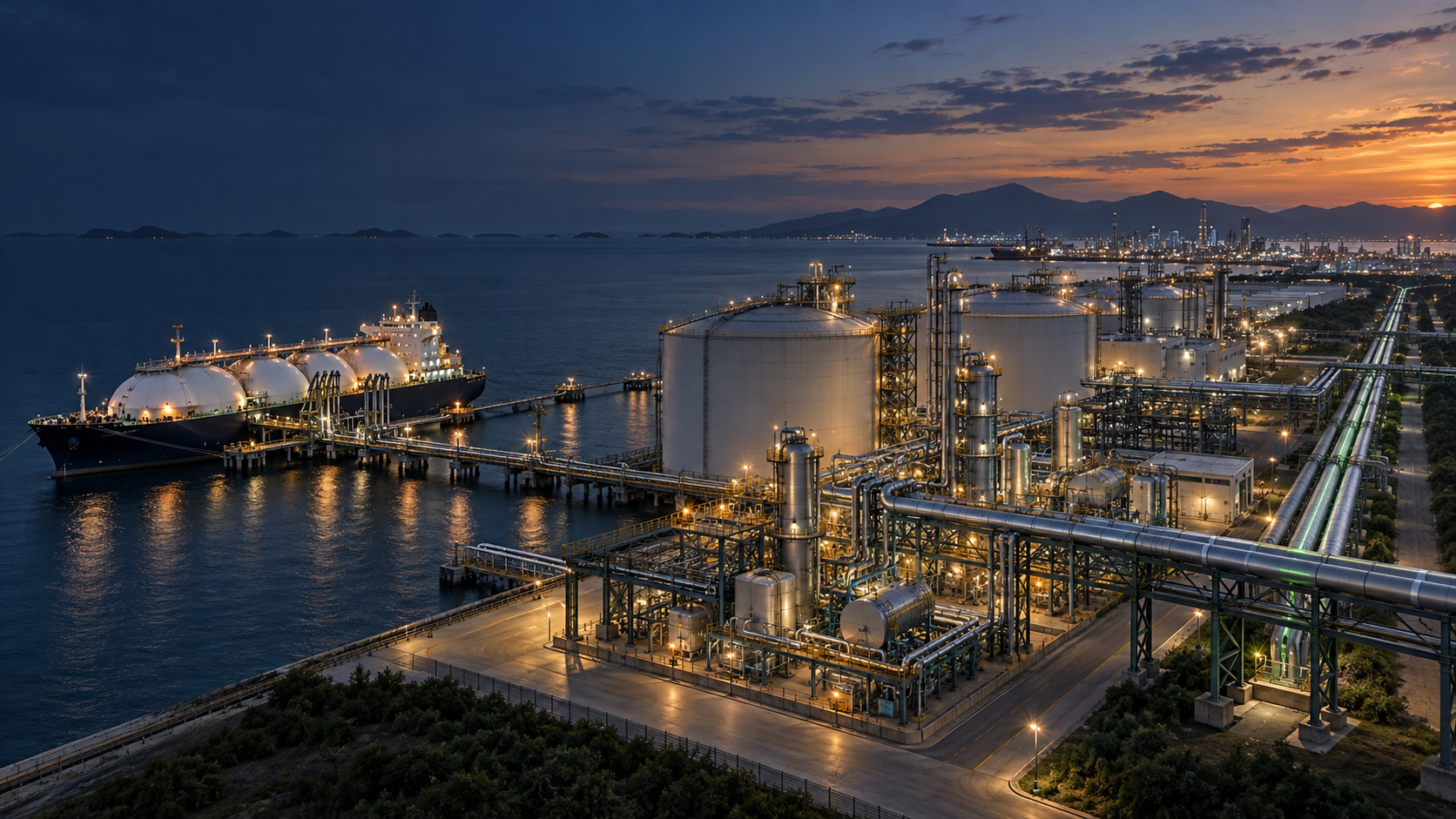
An ammonia import corridor ends at a terminal. A hydrogen supply chain continues through vaporisation, cracking, heat integration, purification, compression, storage and delivery. That additional system can represent a large and operationally demanding asset whose cash flow depends on several companies performing together.
The financing question is therefore broader than the cost of a cracker. It asks who should own the conversion asset, which revenues can support debt, and which party should bear technology, energy, utilisation, completion, certification and demand risks. A terminal operator may control storage and ship interfaces but have limited influence over industrial hydrogen demand. An industrial buyer controls its own consumption but may not want to own unfamiliar process equipment. A technology provider can control design and performance but rarely accepts open-ended commodity or demand exposure.
This paper treats the cracker as a distinct investment decision. It does not assume that a competitive origin price makes destination conversion financeable. It asks whether the conversion system has a contracted throughput, a measurable service, an acceptable technology package, aligned completion, adequate liquidity and remedies that survive downside conditions.
2. Why the cracking bill matters
The International Energy Agency estimates that shipping pathways requiring conversion and reconversion to pure hydrogen impose minimum costs of around USD 2 per kilogram of hydrogen and energy use above 10 kilowatt-hours per kilogram, equivalent to more than 30 per cent of hydrogen's energy content [1]. That estimate covers a broader route than a single terminal cracker, yet it demonstrates the importance of conversion economics.
The IEA also finds that maximum acceptable hydrogen cost is below USD 2 per kilogram for many sector and region combinations without policy support [2]. The relationship is commercially difficult: the logistics and reconversion burden alone can approach or exceed what a buyer can pay for the entire molecule in an incumbent-parity case.
This does not make ammonia cracking uneconomic in every application. It means that selection depends on buyer value, geography, policy, carbon cost, reliability, direct-ammonia alternatives and infrastructure. A refinery, chemical plant, steel project or mobility network can have different purity, pressure, volume and willingness-to-pay requirements. The asset must be underwritten against the actual buyer system.
3. The cracker is a multi-interface asset
The physical process starts with refrigerated or pressurised ammonia storage. Ammonia is vaporised, heated and decomposed into hydrogen and nitrogen. The raw gas then requires removal of residual ammonia and nitrogen, hydrogen purification and compression to the delivery specification. Heat recovery, burners, electrical systems, catalysts, controls, safety systems and emissions management form part of the balance of plant.
The United Kingdom's official import-chain analysis maps ammonia production, transport, storage, shipping, destination storage, cracking, pressure-swing adsorption and compression as connected steps [3]. The Port of Rotterdam's pre-feasibility study similarly frames a large central cracker between imported ammonia and several downstream users [4]. These sources support an interface-based financing analysis.
Each interface creates a condition precedent. The cracker cannot commission without ammonia, terminal access, utilities and a hydrogen sink. The buyer cannot rely on hydrogen until purity, pressure and delivery availability have been demonstrated. A completion test focused only on mechanical completion leaves the commercial chain untested.
4. Technology maturity and scale are different questions
Ammonia decomposition is established in industrial applications, while very large low-emissions-hydrogen import crackers combine scale, integration, dynamic operation and product-purity requirements that still require demonstration. The Clean Hydrogen Joint Undertaking's 2025 programme calls for scalable systems that address heat integration, high-purity hydrogen, materials integrity, flexible operation, safety and at least 5,000 hours of demonstration [5]. The programme expects funded work to progress from technology readiness level 5 to level 7 [6].
Commercial evidence is developing. Public project materials report industrial pilots and feasibility studies, while the required world-scale systems remain dependent on site-specific engineering and guarantees. A lender should distinguish chemical conversion that is theoretically understood from a complete plant that has operated at the proposed scale, pressure, feed specification and duty cycle.
Scale-up risk can appear in catalyst life, hot equipment, thermal cycling, purification recovery, residual ammonia, compressor availability and maintenance duration. The financing response is staged capacity, performance testing, warranty support, reserves and a debt case based on guaranteed rather than aspirational performance.
5. Conversion efficiency must be defined contractually
"Efficiency" can refer to ammonia conversion, hydrogen recovery, thermal efficiency, electrical consumption or total energy retained in delivered hydrogen. These measures are related but not interchangeable. A plant can achieve high ammonia conversion and still have poor net hydrogen yield after purification, fuel use and compression.
US Department of Energy material describes a theoretical thermocatalytic efficiency of approximately 85 per cent relative to the lower heating value of released hydrogen before additional thermal losses [7]. Argonne's public modelling materials use explicit assumptions for cracker conversion, operating pressure, catalyst replacement and pressure-swing adsorption recovery [8]. These are modelling references, not guarantees for a proposed project.
The engineering, procurement and construction contract should therefore define tests for feed quality, tonnes processed, hydrogen recovered, purity, pressure, energy consumption, availability and emissions. The project company needs liquidated damages or other remedies tied to the economic effect of underperformance. A single headline conversion percentage cannot protect debt service.
6. Four ownership models
An integrated importer can own the terminal, storage and cracker. This model centralises interfaces and allows heat, utilities and operations to be optimised. It also concentrates construction and market risk in one balance sheet.
A terminal utility can own a shared cracker and sell reserved capacity to multiple users. This structure can diversify demand and create infrastructure-style cash flow when users commit to take-or-pay or availability payments. It requires clear allocation of feedstock, scheduling, product specification and outage priority.
An industrial buyer can own a dedicated cracker. The buyer controls hydrogen demand, can integrate waste heat and can compare cracking with domestic production or alternative fuels. The asset becomes part of an industrial process rather than a merchant terminal service.
A public or mixed infrastructure platform can own common conversion capacity and grant operating concessions. This may address first-mover coordination and shared-infrastructure needs. It creates procurement, state-aid, tariff and governance questions that must be resolved before lenders rely on public support.
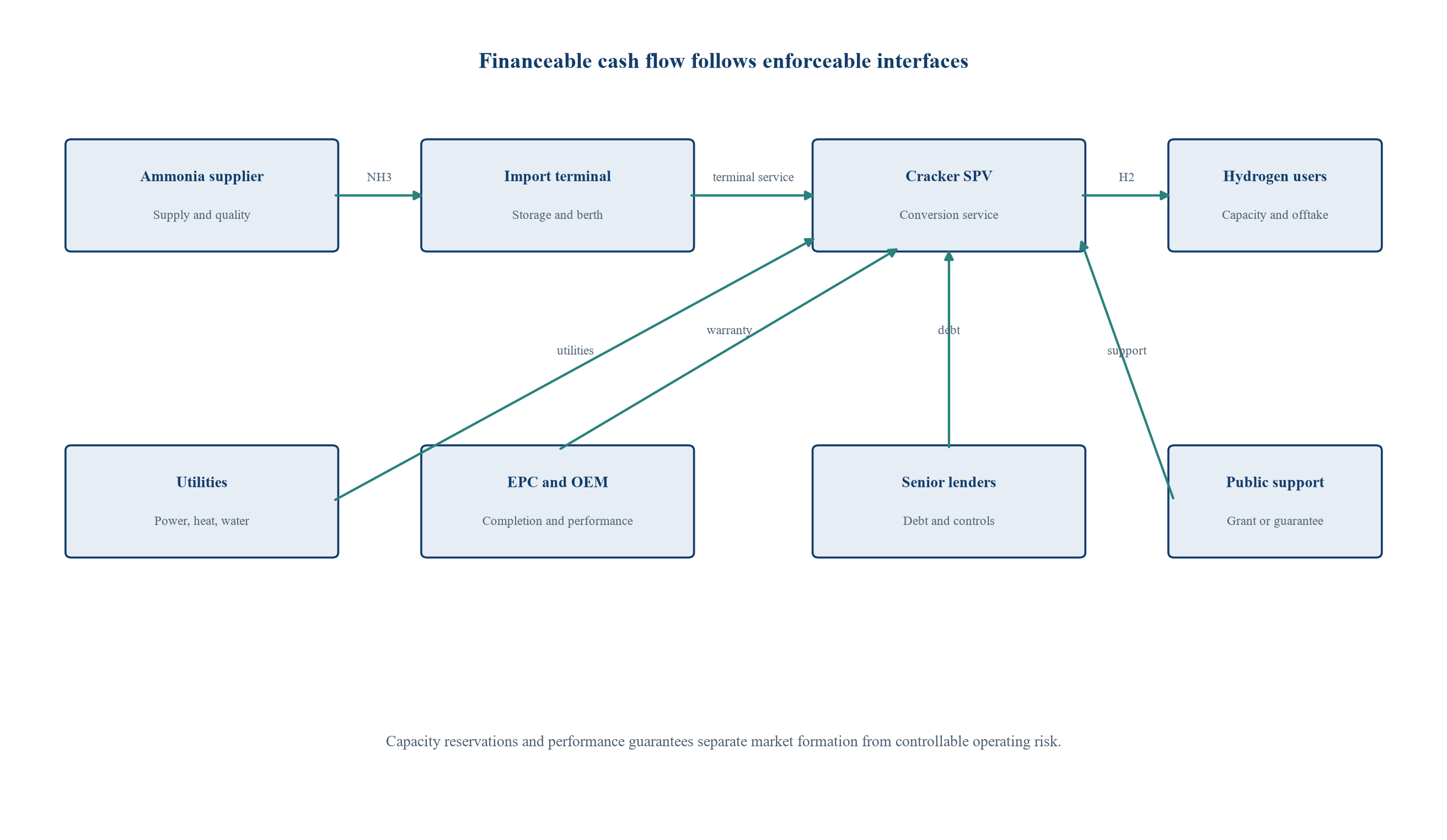
The structure illustrates interfaces and payment directions. Project documents must define the actual ownership, security and risk allocation.
7. Revenue model one: tolling
Under a tolling model, users supply or nominate ammonia and pay the project company to convert it. The fee can be calculated per kilogram of hydrogen delivered, subject to minimum annual volumes and product specification. Commodity price risk largely remains with the user.
Tolling can support debt when minimum payments cover fixed operating cost, maintenance, lifecycle capital and debt service. A purely volumetric fee remains exposed to demand. The contract should therefore combine reserved capacity with a variable conversion charge. Users should pay for contracted availability when the cracker is ready, while the project company should lose revenue or pay damages when it fails to meet availability or performance.
Feedstock quality matters. Off-specification ammonia can damage performance or create product-purity problems. The agreement needs sampling, measurement, rejection and remediation rules. It must also allocate inventory losses, scheduling and terminal congestion. A tolling model works best when users are creditworthy and the service boundary can be measured objectively.
8. Revenue model two: capacity plus variable charge
An availability or capacity model treats the cracker as shared infrastructure. Users reserve a defined percentage of processing capacity and pay a fixed charge for availability. A variable charge covers energy, consumables and throughput-related cost. This structure resembles other terminal and network assets.
The fixed charge should be indexed to known cost drivers and sized to the contracted capacity. It should not depend on the sponsor filling merchant capacity in the base debt case. Variable energy cost can be passed through under a transparent formula, subject to efficiency guarantees that prevent the operator passing through avoidable underperformance.
Multi-user governance is essential. Scheduling rules determine who receives capacity during maintenance, ramp-up and unplanned outages. Expansion rights affect future competition and unit cost. Credit support, cross-default, transfer and lender step-in provisions should be standardised enough to allow portfolio financing.
9. Revenue model three: merchant hydrogen spread
A merchant model buys ammonia, converts it and sells hydrogen. Revenue depends on the spread between hydrogen sale price and ammonia, energy, logistics and conversion cost. The sponsor bears commodity, volume, basis, technology and working-capital risks together.
This model may create upside when hydrogen markets deepen. It is a weak foundation for highly leveraged senior debt during market formation. Ammonia price can rise when hydrogen demand weakens; power cost can increase when utilisation is low; and an efficiency shortfall can reduce saleable output while increasing energy use.
Merchant exposure is more appropriate for sponsor equity, a limited uncontracted tranche or a corporate balance sheet that can absorb volatility. Debt sizing should rely on contracted margins or availability payments. Any merchant contribution should be discounted, capped and stress-tested.
Merchant economics also create a working-capital requirement. The project can pay for ammonia, terminal handling and energy before hydrogen is delivered and collected. Price volatility increases the amount of cash or credit support needed between cargo arrival and customer payment. A model that reports a positive annual margin while omitting inventory and receivable funding can materially overstate distributable cash.
Hedging is unlikely to close every basis risk. Conventional ammonia may have observable benchmarks, while certified low-emissions ammonia, location-specific electricity and hydrogen delivered at a particular pressure can lack matching liquid instruments. Contract formulas can reduce exposure by linking sale prices to input indexes, subject to floors, caps and reopeners. Residual mismatch remains with the party signing the formula.
The investment committee should separate the contracted service case from a merchant option case. The service case determines construction scale, debt and minimum liquidity. The option case measures additional capacity against conservative utilisation, spread and working-capital assumptions. This separation prevents anticipated market growth from financing fixed obligations before the market exists.
Table 1. Revenue-model comparison
| Revenue model | Primary payer | Demand exposure | Commodity exposure | Senior-debt implication |
|---|---|---|---|---|
| Tolling fee with minimum volume | Hydrogen user or capacity holder | Partly transferred through minimum payment | User generally bears ammonia price; energy may be passed through | Financeable when minimum payment, credit and performance remedies are strong |
| Fixed availability plus variable charge | Multiple capacity users | Largely transferred for reserved capacity | Variable inputs passed through subject to efficiency guarantee | Most infrastructure-like structure; requires scheduling and multi-user governance |
| Merchant hydrogen spread | Hydrogen market | Project company bears volume and price | Project company bears ammonia, energy and basis risk | Limited leverage; contracted floor or corporate support usually required |
| Dedicated buyer ownership | Industrial buyer | Internal demand risk | Buyer manages full delivered-cost chain | Financing relies on buyer balance sheet or integrated-project economics |
The table identifies typical allocations. Exact treatment depends on project contracts and law.
10. Minimum throughput converts forecasts into commitments
High fixed cost creates a utilisation problem. Staffing, inspection, catalyst management, safety systems, insurance and much maintenance continue when throughput declines. Debt service also remains fixed. The revenue structure must therefore translate expected demand into enforceable minimum payments.
A minimum-throughput obligation should specify annual and monthly quantities, nomination windows, make-up rights, carry-forward limits and remedies. It should distinguish user failure from operator unavailability, terminal outage and force majeure. Unlimited make-up rights can defer cash and create debt-service stress even when headline contracted volume appears sufficient.
The lender should size debt against the lower of guaranteed plant capacity and credit-supported contracted capacity. Announced demand, non-binding memoranda and forecast market growth should remain outside the base case. Capacity can be expanded after the first tranche operates and demand becomes observable.
11. Demand fluctuation creates an inventory decision
Hydrogen users may have variable hourly or seasonal demand, while a thermal cracking plant performs best within an operating range. Storage can absorb mismatch, but storage adds cost, loss, land, safety and working-capital exposure.
Japanese public project materials describe a feasibility concept combining ammonia cracking with hydrogen storage to absorb demand fluctuations and support stable operation [9]. This illustrates the operating interface. The economic solution can include hydrogen buffer storage, ammonia inventory, flexible turndown, multiple users or supplementary hydrogen production.
The financing model should assign the cost of flexibility to the party that creates the variability. A user requesting interruptible delivery may pay a lower fixed charge and accept curtailment. A user requiring firm hourly delivery should pay for storage, redundancy or backup. The project company should not carry an undefined system-balancing obligation within a simple per-kilogram tariff.
12. Energy input is both cost and performance risk
Ammonia cracking is endothermic. Heat can come from burning hydrogen, ammonia, natural gas, electricity or integrated industrial heat, subject to design and carbon constraints. Purification and compression add electrical demand. Energy price, availability and emissions therefore affect both operating cost and product eligibility.
An energy pass-through protects the project from price volatility but can leave the buyer with an unaffordable delivered cost. A fixed conversion fee transfers price risk to the project and may be difficult to hedge for the full contract tenor. A balanced structure passes through a benchmark quantity and price while holding the operator responsible for guaranteed specific energy consumption.
Heat integration can create value when the cracker is adjacent to an industrial source or sink. It also creates a dependence on another plant's operating schedule. The contract must define availability, backup, metering and outage remedies. Project finance should assume only the heat source supported by an enforceable right.
13. Purity and pressure define the deliverable
Hydrogen for a refinery, steel plant, turbine, fuel cell or pipeline can require different purity, pressure and contaminant limits. Residual ammonia can be particularly important for downstream equipment. The project cannot rely on a generic statement that it produces hydrogen.
The product schedule should specify purity, pressure, temperature, flow range, measurement and sampling. It should define off-specification handling, reprocessing, rejection and damages. The acceptance test should use the same measurement boundary as commercial delivery.
Purification recovery affects quantity. Compression affects energy use and availability. A technology guarantee should cover the integrated system rather than isolated reactor performance. If the terminal, cracker and compressor have different contractors, a wrap, interface agreement or sponsor support may be needed to close gaps.
14. Completion must be integrated across terminal and buyer
A cracker completed before the import terminal can receive ammonia becomes a stranded construction asset. A terminal completed before the buyer can take hydrogen incurs storage and operating cost without full revenue. Separate project schedules therefore need a common completion protocol.
Conditions precedent should include berth and unloading availability, minimum ammonia inventory, utilities, permits, certification systems, pipeline or transport connection and buyer readiness. The long-stop date should be aligned across supply, terminal, EPC, offtake and financing documents.
Delay responsibility should follow control. The EPC contractor can bear construction delay within agreed limits. The terminal operator can bear failure to provide contracted capacity. The buyer can bear failure of its connection or plant. Government or network delay may require a reserve, extension or specific support. Unallocated interface delay ultimately sits with equity.
15. The performance guarantee should protect economics
The EPC and technology package should guarantee capacity, availability, conversion, hydrogen recovery, purity, pressure, specific energy consumption, emissions and catalyst life to the extent each can be tested. Remedies should reflect the financial effect of underperformance.
Capacity damages compensate for fewer units processed. Efficiency damages compensate for additional energy or ammonia consumed. Availability damages address lost service revenue. Purity failure may require reprocessing or create downstream loss. Aggregate liability caps and exclusions determine whether the contractual protection is meaningful.
Liquidated damages rarely cover the full present value of long-term underperformance. The project should retain contingency, conservative debt sizing and rights to repair or replace. Technology-provider credit matters; a guarantee from a thin special-purpose contractor may have limited value. Parent support, bonds, warranties and reserve accounts should match the exposure.
16. Certification travels through the conversion step
European renewable-hydrogen rules apply additionality, temporal and geographic correlation, lifecycle-emissions and certification requirements to renewable hydrogen and imported derivatives [10, 11]. The destination cracker must preserve the evidence linking imported ammonia to delivered hydrogen.
Mass balance, storage segregation, metering, conversion yield and emissions data determine how certification attributes are allocated. Energy used for cracking and compression can affect lifecycle emissions. A plant that meets physical performance can still fail to deliver the expected compliant product if records, energy sourcing or chain of custody are inadequate.
The service agreement should allocate responsibility for feedstock certificates, terminal records, conversion data, verifier access and registry transfer. It should define consequences if regulation changes or certification fails. Debt service should not depend on a green premium without a documented and auditable compliance pathway.
17. Safety, materials and environmental controls are finance issues
Ammonia is toxic and requires established handling controls. Hydrogen creates flammability and materials challenges. High-temperature equipment, corrosion, embrittlement, residual ammonia and nitrogen discharge require site-specific design and operating discipline.
The Clean Hydrogen Joint Undertaking programme explicitly calls for materials-integrity work, safety assessment and standardisation contributions [5]. Lenders should require hazard studies, quantitative risk assessment, emergency response, operator competency, inspection and maintenance plans, and appropriate insurance.
Safety affects layout, land use, shutdown philosophy and capital cost. It can also constrain simultaneous terminal operations or nearby development. Environmental permits may address emissions from heat supply, ammonia slip, water and noise. These requirements belong in the base scope and schedule, rather than a contingency added after design.
18. Sources and uses should isolate interface contingency
A financeable budget separates process equipment, terminal tie-ins, utilities, storage, purification, compression, pipeline connection, owner costs, financing costs and contingency. A single EPC price can conceal exclusions that later become sponsor cost.
The hypothetical case below assumes a total funding requirement of 100 units. It is a capital-structure illustration, not a project estimate. Core process and balance of plant use 48 units; terminal and storage interfaces use 13; utilities and connection use 10; development and owner costs use 8; financing and reserves use 8; and contingency uses 13.
Contingency should be allocated to identified risks. Technology and scale-up contingency differs from site, terminal or buyer-interface contingency. Lenders can release reserve tranches only when the relevant interface passes its milestone. This creates better decision discipline than a single undifferentiated reserve.
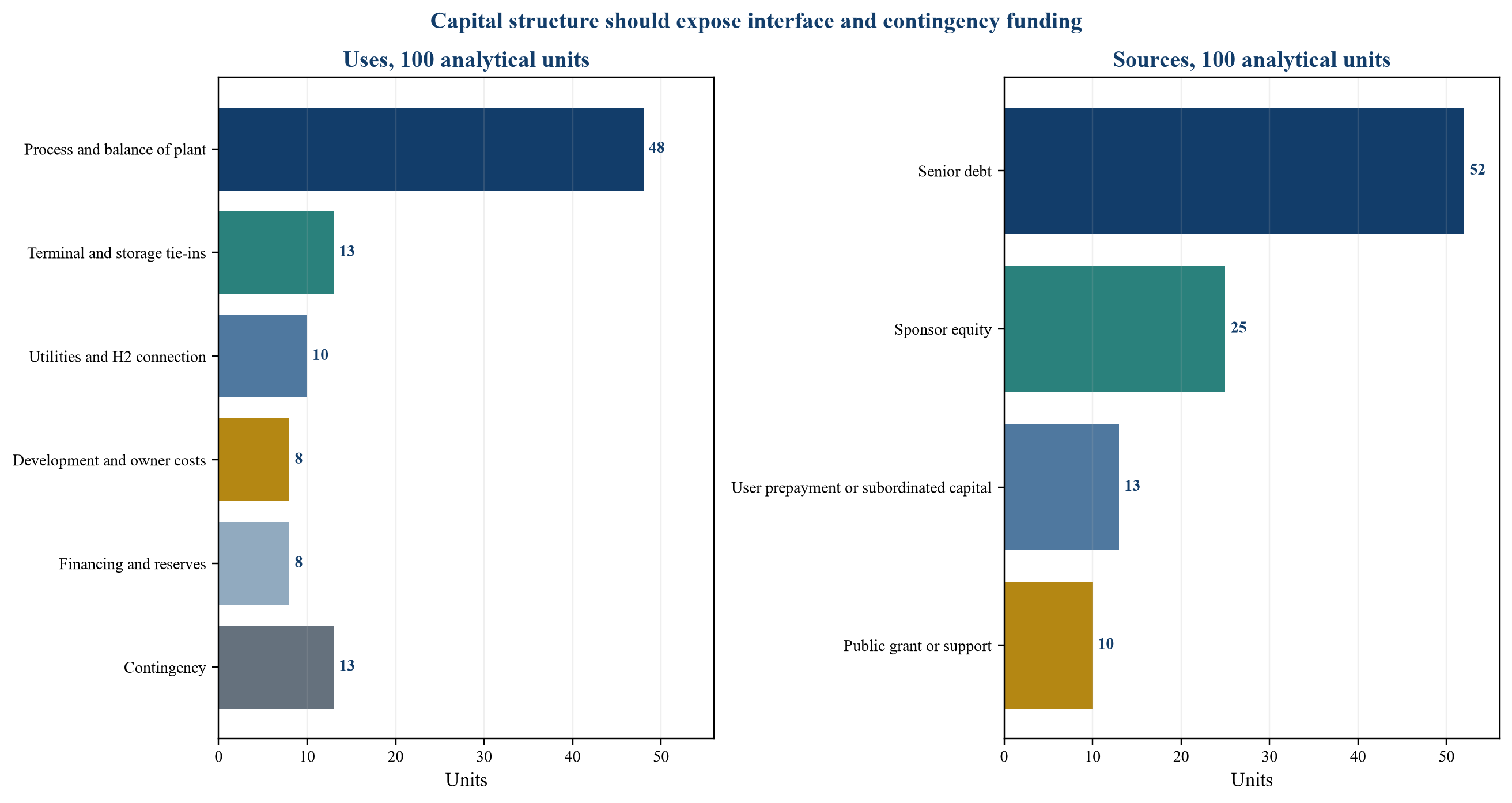
Values are analytical units and do not represent an observed project budget or financing quotation.
Table 2. Hypothetical base, downside and stress cases
| Variable | Base case | Downside case | Stress case |
|---|---|---|---|
| Contracted utilisation | 82% | 68% | 52% |
| Technical availability | 94% | 88% | 78% |
| Net hydrogen recovery versus design | 98% | 94% | 88% |
| Specific energy cost versus budget | 100% | 120% | 145% |
| Completion delay | 0 months | 9 months | 18 months |
| Capital cost versus budget | 100% | 112% | 128% |
| Fixed-charge collection | 100% | 92% | 80% |
| Illustrative DSCR | 1.55x | 1.20x | 0.82x |
Inputs are analytical assumptions; they are not forecasts or observed project data. DSCR is illustrative and before project-specific tax, reserve and sculpting effects.
19. Debt sizing should follow contracted fixed cash flow
Senior debt capacity should be sized to minimum contracted payments after operating cost, maintenance, lifecycle capital, taxes and reserve funding. Variable revenue can support additional debt only when it has robust volume and price protection.
The base case in Table 2 assumes an illustrative debt-service coverage ratio of 1.55 times. Lower utilisation, availability and recovery combined with higher energy cost reduce coverage to 1.20 times in the downside. A compounded stress case falls below one times. The result demonstrates interaction rather than a forecast. Conversion projects can experience multiple adverse movements at once.
Debt sculpting can align repayments with contracted cash flow and ramp-up. It cannot repair an unallocated demand risk. A debt-service reserve addresses temporary disruption, while a major-maintenance reserve funds predictable lifecycle needs. Completion support should remain until integrated tests and sustained operation have been achieved.
20. Utilisation and efficiency are multiplicative
Utilisation determines how often the plant earns throughput revenue. Efficiency determines how much saleable hydrogen emerges from each tonne of ammonia and unit of energy. When both underperform, fixed cost is spread over fewer units and variable cost per delivered kilogram increases.
This interaction is more important than either sensitivity alone. A project operating at 70 per cent utilisation and 94 per cent of design recovery does not merely lose six per cent of economics. It also carries fixed charges and debt over a smaller output base, can face higher start-stop losses and may lose performance-linked revenue.
The model should therefore run combined sensitivities. It should include user nominations, technical availability, turndown, energy price, ammonia quality, purification recovery and fixed-charge collection. The lender should test whether contractual remedies arrive quickly enough to protect the payment period in which the shortfall occurs.
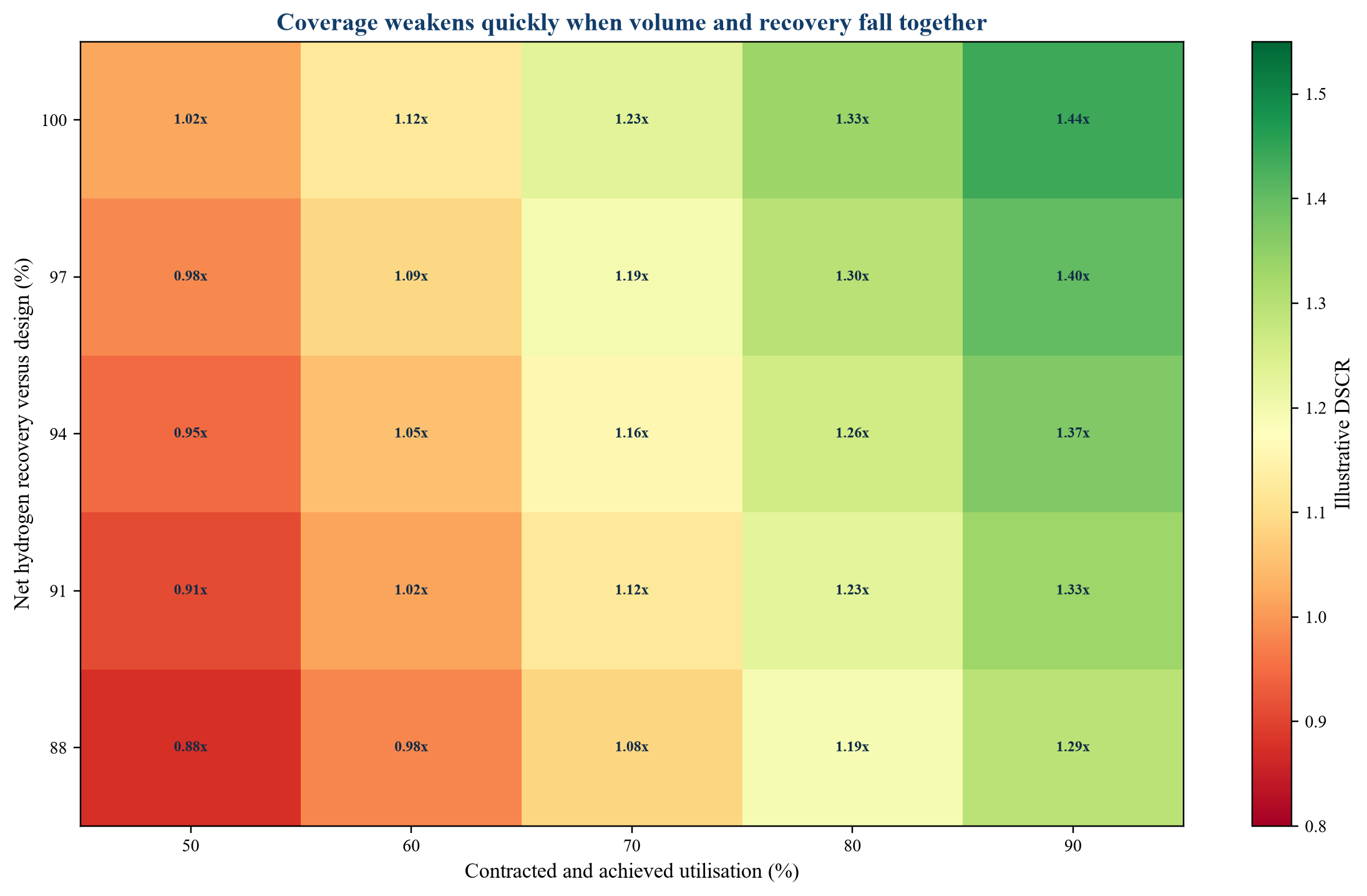
DSCR values are hypothetical analytical outputs. They show interaction and are not project forecasts.
21. A risk-allocation matrix should precede the financing model
The risk register should identify the party that controls each risk, the contract mechanism, the residual exposure and the evidence needed before commitment. Assigning every risk to the project company does not make it allocated; it merely transfers the loss to equity and lenders.
Technology and completion sit primarily with EPC and equipment providers, within negotiated liability and credit limits. Feedstock quality sits with the supplier. Terminal availability sits with the terminal operator. Energy efficiency sits with the operator or technology provider, while benchmark price can sit with users. Demand and capacity sit with users through reservations. Regulation and market formation may require public support or sponsor capital.
Residual risks should be visible in leverage, contingency, reserves and return. If a party cannot control a risk, it can sometimes absorb it because of balance-sheet strength or portfolio diversification. The allocation must remain economically credible through the full tenor.
Table 3. Risk-allocation matrix for an import-terminal cracker
| Risk | Party best placed to control or absorb it | Contract or financing tool | Evidence before commitment |
|---|---|---|---|
| Technology scale-up | Technology provider, EPC contractor and sponsor | Performance guarantee, parent support, staged capacity, contingency | Reference data, test protocol, liability package and independent-engineer review |
| Completion and interface | EPC contractor, terminal operator, buyer and sponsor for residual gaps | Aligned long-stop dates, delay damages, direct agreements, completion support | Integrated schedule and binding interface agreements |
| Ammonia quality and availability | Supplier and importing user | Specification, minimum supply, replacement rights, credit support | Firm supply contract and terminal inventory plan |
| Energy consumption | Operator and technology provider for quantity; user for benchmark price | Specific-consumption guarantee and indexed pass-through | Guaranteed heat and power balance and utility rights |
| Utilisation and demand | Capacity users and sponsor for merchant tranche | Take-or-pay, availability fee, user prepayment, phased expansion | Credit-approved reservations and buyer readiness |
| Hydrogen purity and pressure | Operator, EPC contractor and equipment suppliers | Product specification, test, rejection and damages | Integrated acceptance test and metering plan |
| Certification | Supplier, terminal, operator and user across chain | Data obligations, audit rights, change-in-law clause | Accepted scheme, chain-of-custody map and verifier plan |
| Policy and market formation | Public sector, sponsor and users | Grant, guarantee, contract for difference, subordinated capital | Legally effective support and payment mechanics |
| Major maintenance | Operator and project company | Long-term service agreement and reserve account | Lifecycle plan, catalyst policy and funded reserve |
| Force majeure and route disruption | Shared according to control and insurance availability | Relief limits, alternative route, insurance and liquidity reserve | Route study, cover terms and recovery plan |
The matrix is a decision framework. Project contracts and governing law determine enforceability.
22. Public support should target the unfinanceable layer
Public funding can support demonstration, shared infrastructure, demand formation or price difference. The design should identify the specific failure being addressed. A grant for first-of-a-kind equipment addresses technology and capital risk. A capacity guarantee addresses demand risk. A network investment addresses shared infrastructure.
The Port of Rotterdam reports that companies remain hesitant to invest in import terminals and conversion plants because of demand uncertainty, funding, grid congestion and lagging pipeline infrastructure [12]. Those are separate risks. A broad subsidy that does not resolve demand or connection can leave the project unable to reach financing.
Public support should be measurable, time-limited where appropriate and compatible with private incentives. It should avoid paying for performance the operator already controls. The investment committee should model timing, conditions, clawback and post-support economics. An announcement of potential support is not a committed source.
23. Insurance and reserves are secondary protections
Construction all-risk, delay-in-start-up, property damage, business interruption, marine cargo, liability and environmental cover can protect defined events. Insurers may exclude technology performance, gradual deterioration, catalyst underperformance, market demand or certification loss.
Insurance therefore complements contracts and engineering. It does not replace a performance guarantee or capacity reservation. The project should test deductibles, waiting periods, limits, exclusions, reinstatement and insurer credit. Claims timing matters when debt service is due before proceeds arrive.
Reserve accounts should cover debt service, major maintenance, catalyst replacement and selected operating contingencies. The amount should follow credible repair and replacement periods. Excessive reserves can make the tariff uncompetitive; insufficient reserves transfer predictable lifecycle cost to future liquidity.
24. Phasing can turn uncertainty into observable evidence
A project can begin with one train sized to contracted anchor demand, then add trains after operating data and additional reservations. Modular expansion limits first-loss capital and creates performance evidence. It can also reduce initial scale economy and require shared infrastructure to be oversized.
The decision depends on whether common facilities can be expanded without disrupting operation. Storage, berth, utilities, purification and hydrogen connection may need early capacity. The financing plan should separate enabling infrastructure from process trains and identify who funds spare capacity.
Expansion should require objective triggers: sustained availability, verified efficiency, contracted additional capacity, buyer connection and available utilities. Equity can retain the option value. Senior lenders should have clear consent and security arrangements for new trains.
25. The board should use explicit gates
The first gate confirms the buyer route and delivery specification. The second confirms site, terminal, utilities and safety feasibility. The third confirms technology selection, guarantees and integrated design. The fourth confirms credit-approved capacity reservations and ammonia supply. The fifth confirms certification, permits, public support and financing.
Full notice to proceed should follow a complete interface audit. Every material obligation should have an owner, date, remedy and evidence item. Unresolved assumptions should appear in a quantified contingency or remain outside the base case.
During construction, the board should monitor critical-path interfaces, budget, committed contingency, counterparty credit and buyer readiness. During operation, it should monitor availability, conversion, recovery, energy use, purity, capacity nominations, receivables, certification and reserve funding. A compact dashboard supports earlier intervention than a narrative progress report.
26. A 180-day commercialisation plan
During days 0 to 30, the sponsor defines the product boundary, buyer specification, ownership options and preliminary contract map. It commissions an independent technology and terminal-screening review and identifies candidate anchor users.
During days 31 to 75, it develops the integrated heat and mass balance, operating philosophy, terminal interface, safety basis, certification map and class-four cost range. It requests capacity indications with credit information and minimum-payment parameters.
During days 76 to 120, it selects the ownership and revenue model, negotiates heads of terms for supply, terminal capacity, EPC, technology guarantee, utilities and offtake, and builds the combined sensitivity model. Public support is matched to the remaining financeability gap.
During days 121 to 180, it completes lender market soundings, independent-engineer scope, insurance review, permit plan and decision-gate audit. The board approves further capital only when contracted capacity, performance protection and integrated completion support meet the defined threshold.
27. Common failure modes
The first failure is treating announced hydrogen demand as contracted utilisation. The second is using reactor conversion as a proxy for delivered hydrogen recovery. The third is assuming energy pass-through removes performance risk. The fourth is completing terminal, cracker and buyer facilities on unrelated schedules.
The fifth is using public-support announcements as committed sources. The sixth is ignoring certification through storage and conversion. The seventh is relying on one technology supplier without adequate credit or replacement rights. The eighth is sizing debt to merchant hydrogen prices during market formation.
The ninth is placing all interface risk in a thin project company and describing it as allocation. The tenth is underfunding ramp-up, catalyst, maintenance and working capital. Each failure can be identified before final investment through a contract map, evidence register and combined downside model.
28. Limitations
This paper is a market-structure and financing framework. It does not provide engineering design, a cost estimate, legal advice, a tax opinion or a forecast for a named project. Technology performance and cost depend on scale, process, feedstock, heat source, site, duty cycle and supplier package.
The numerical cases, sources and uses and debt-service ratios are hypothetical analytical assumptions. They illustrate relationships and do not represent observed terms. Public programmes and projects can change after the cited date. A financing decision requires current source verification and project-specific diligence.
Different jurisdictions apply different safety, environmental, certification, subsidy and security rules. The allocation described here must be adapted to local law and the credit strength of each party.
29. Conclusion
Ammonia cracking at an import terminal is a distinct infrastructure and corporate-finance decision. The asset connects a traded feedstock to a developing hydrogen market through technology, energy, terminal, certification and buyer interfaces. Its financeability depends on the quality of those interfaces.
The strongest structure finances contracted capacity, not projected demand. It defines conversion performance across recovery, purity, pressure, energy use and availability. It aligns terminal, cracker and buyer completion. It preserves certification evidence and assigns each risk to the party able to control or absorb it.
A shared utility can support infrastructure-style debt when creditworthy users reserve capacity and the operator accepts measurable performance obligations. Dedicated buyer ownership can work when hydrogen demand and industrial integration are internal. Merchant spread belongs primarily to equity until the market develops deeper liquidity and reliable price formation.
The board's task is to identify the unfinanceable layer and solve it explicitly through contracts, staged capital, public support, reserves or sponsor risk capital. The cracking bill becomes investable when its cash flows, performance and interfaces are visible, enforceable and tested under combined downside conditions.
References
- International Energy Agency. Trade and infrastructure. Global Hydrogen Review 2026. https://www.iea.org/reports/global-hydrogen-review-2026/trade-and-infrastructure
- International Energy Agency. Cost acceptability. Global Hydrogen Review 2026. https://www.iea.org/reports/global-hydrogen-review-2026/cost-acceptability
- UK Department for Business, Energy and Industrial Strategy. Expansion of hydrogen production pathways analysis: import chains. 2022. https://www.gov.uk/government/publications/expansion-of-hydrogen-production-pathways-analysis-import-chains
- Port of Rotterdam Authority and consortium. Executive summary pre-feasibility study: Large-scale industrial ammonia cracking plant. 2023. https://www.portofrotterdam.com/sites/default/files/2023-05/large-scale-industrial-ammonia-cracking-plant.pdf
- European Commission CORDIS. Demonstration of scalable ammonia cracking technology. HORIZON-JU-CLEANH2-2025-02-03. https://cordis.europa.eu/programme/id/HORIZON_HORIZON-JU-CLEANH2-2025-02-03
- Clean Hydrogen Joint Undertaking. Annual Work Programme 2025. https://www.clean-hydrogen.europa.eu/document/download/e5846471-328c-48fd-b91f-837da07556b6_en
- US Department of Energy. Potential roles of ammonia in a hydrogen economy. https://www.energy.gov/eere/fuelcells/downloads/potential-roles-ammonia-hydrogen-economy
- Argonne National Laboratory and US Department of Energy. Hydrogen delivery technologies analysis. 2024. https://www.hydrogen.energy.gov/docs/hydrogenprogramlibraries/pdfs/review24/in025_elgowainy_2024_o.pdf
- Ministry of Economy, Trade and Industry, Japan. Demonstration research to realise stable operation of ammonia cracking equipment. AZEC Projects 419. 2025. https://www.meti.go.jp/press/2025/10/20251017001/20251017001-d.pdf
- European Commission. Renewable hydrogen. https://energy.ec.europa.eu/topics/eus-energy-system/hydrogen/renewable-hydrogen_en
- European Commission. Hydrogen policy framework. https://energy.ec.europa.eu/topics/eus-energy-system/hydrogen_en
- Port of Rotterdam Authority. Market consultation for the development of import terminals for hydrogen and its carriers. https://www.portofrotterdam.com/en/port-future/energy-transition/ongoing-projects/hydrogen-rotterdam/market-consultation-development
- Port of Rotterdam Authority. Import of hydrogen. https://www.portofrotterdam.com/en/port-future/energy-transition/ongoing-projects/hydrogen-rotterdam/import-of-hydrogen
- Port of Rotterdam Authority. The hydrogen system is taking shape. https://www.portofrotterdam.com/en/news-and-press-releases/hydrogen-system-taking-shape
- European Commission CORDIS. Electrified Single Stage Ammonia Cracking to Compressed Hydrogen. Grant agreement 101112144. https://cordis.europa.eu/project/id/101112144/reporting
- Clean Hydrogen Partnership. Hydrogen in ports: conversion of imported hydrogen carriers into hydrogen. 2023. https://www.clean-hydrogen.europa.eu/system/files/2023-09/EN%20PDF%20-%20H2%20in%20Ports%20-%20Report%202%20-%20September%202023.pdf
- European Hydrogen Observatory. Industrial-scale ammonia cracking pilot at the Port of Antwerp-Bruges. 2025. https://observatory.clean-hydrogen.europa.eu/media/news/world-first-air-liquides-innovative-technology-converts-ammonia-hydrogen-industrial
- UK Government. Immingham Green Energy Terminal development consent decision announced. https://www.gov.uk/government/news/immingham-green-energy-terminal-development-consent-decision-announced
- Clean Hydrogen Partnership IPCEI Observatory. Workstream 4: Hydrogen production technologies for mobility applications. https://ipcei.observatory.clean-hydrogen.europa.eu/hy2move/workstream-4-hydrogen-production-technologies-mobility-applications
- ARPA-E. H2 from thermal catalytic ammonia decomposition. https://arpa-e.energy.gov/programs-and-initiatives/search-all-projects/h2-thermal-catalytic-ammonia-decomposition
- US Department of Energy. H2IQ Hour: Ammonia from fertilizer to energy carriers. https://www.energy.gov/cmei/fuels/h2iq-hour-ammonia-fertilizer-energy-carriers-text-version
- European Commission. European Hydrogen Bank. https://energy.ec.europa.eu/topics/eus-energy-system/hydrogen/european-hydrogen-bank_en
- European Commission. Voluntary schemes for renewable fuels. https://energy.ec.europa.eu/topics/renewable-energy/bioenergy/voluntary-schemes_en
- International Energy Agency. Key questions about hydrogen. Global Hydrogen Review 2026. https://www.iea.org/reports/global-hydrogen-review-2026/key-questions-about-hydrogen
- Ministry of Economy, Trade and Industry, Japan. Collaboration with PTT on building a hydrogen and ammonia supply chain for Thailand. 2025. https://www.meti.go.jp/press/2025/10/20251017001/20251017001-i.pdf
- Clean Hydrogen Joint Undertaking. SINGLE project reporting and target summary. 2025. https://www.clean-hydrogen.europa.eu/document/download/d885e399-bf02-45a1-b75b-164e6981c849_en
About the Author
Chennakeshav (CK) is a corporate finance and investment banking executive with 25+ years of global experience in deal origination, structuring and execution across M&A, growth capital and corporate strategy. He has led value-creation mandates for founders, corporates and funds — bridging the boardroom view to hands-on execution and close.
His career spans Morgan Stanley, HSBC, Lloyds Banking Group, EWEC, ADQ portfolio companies and Emirates Growth Fund, across TMT, real estate, fintech, deeptech, cleantech, infrastructure and energy. He has partnered with C-suite leaders, private equity and venture funds, sovereign wealth funds and family offices to finance complex fund raises and scale-up ventures, and has led M&A due diligence, post-merger integration and business-transformation initiatives to create value.
At Matchpoint Partners he is Managing Partner, leading the firm's corporate finance, M&A and capital-raising practice. He holds an MBA from London Business School, an engineering degree from VTU and a Master of Laws (LLM, in progress) from UCL London.
An active start-up mentor, CK mentors at Techstars, DIFC FinTech Hive, Startup Grind, Founder Institute and IN5, serves as Entrepreneur Mentor in Residence (EMiR) at London Business School, and judges the Entrepreneurship World Cup.
LinkedIn: https://www.linkedin.com/in/ckadya/
Profile: https://www.matchpoint-partners.com/team/ck-adya.html
