
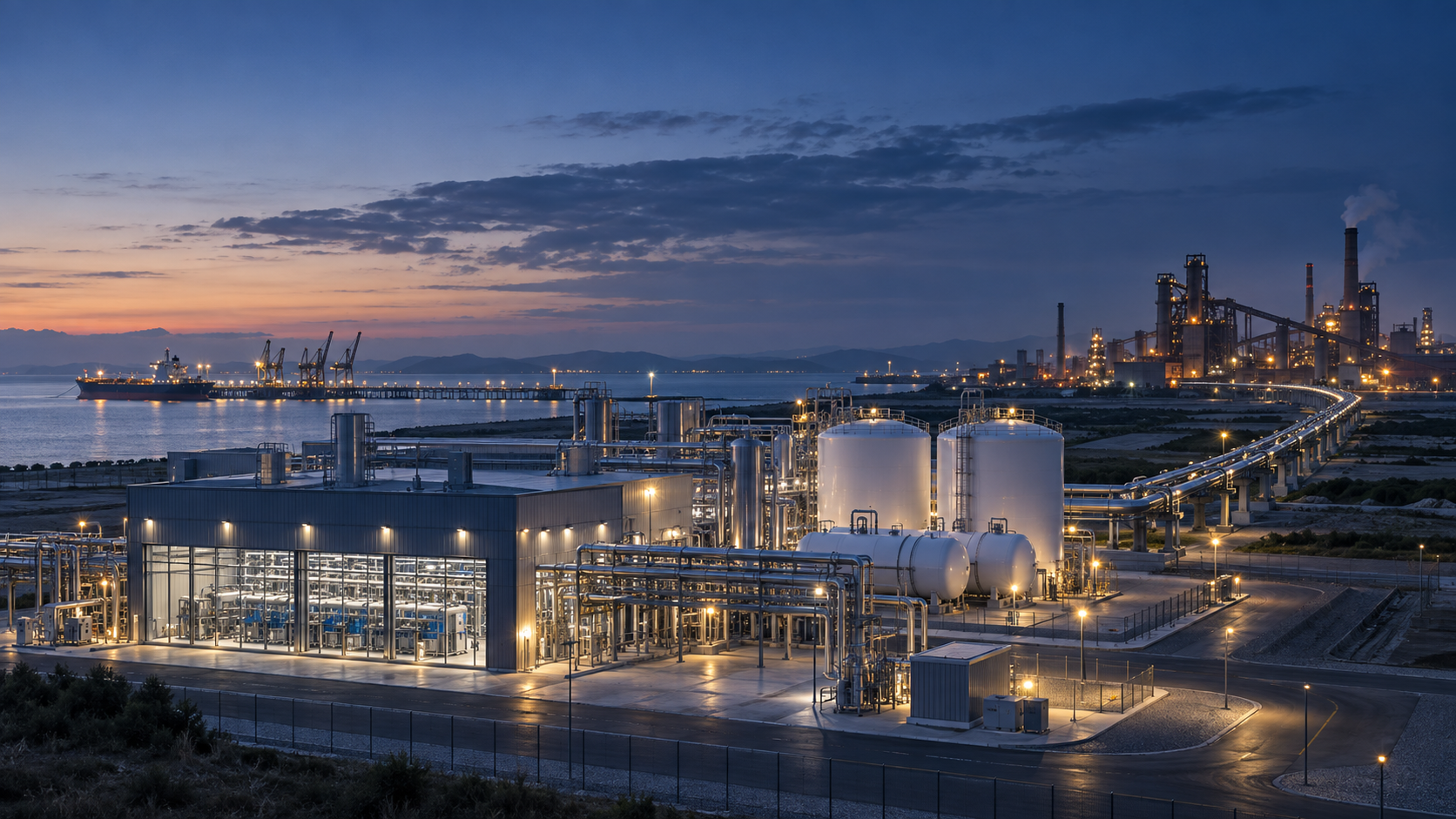
1. The buyer contract is the revenue asset
Hydrogen plant, renewable power, water, compression and storage create production capability. Project debt is repaid by cash received after those assets operate. The commercial centre of the financing is therefore the enforceable payment obligation attached to hydrogen delivered, made available or reserved for a buyer.
The distinction matters because demand announcements describe intention while financing documents require obligation. A memorandum can help organise engineering and policy engagement, but it may permit either party to withdraw, defer volume or reopen price. A lender cannot treat that flexibility as scheduled debt service without another creditworthy source absorbing the gap.
The first investment question is accordingly narrower than whether a market for low-emissions hydrogen will develop. It is whether the specific buyer, contract and support package convert output into cash with enough predictability to sustain the proposed amortisation profile.
2. Current market evidence makes demand the binding constraint
The International Energy Agency's Global Hydrogen Review 2026 reports that new offtake agreements announced in 2025 covered about 1.7 million tonnes, while only around one fifth of those newly signed volumes were backed by firm contractual commitments. The agency identifies demand as the crucial missing element in project development.
The 2025 review reached a related conclusion. Existing uses in refining and chemicals, together with emerging shipping-fuel demand, accounted for nearly all firm private offtake. The IEA's accompanying analysis placed cumulative firm offtake below two million tonnes per year, roughly five per cent of potential 2030 output from announced projects.
These figures measure a market-wide maturity gap. They do not decide whether an individual contract is bankable. They do establish why sponsors, lenders and public authorities should separate announced, preliminary and firm demand in every financing case.
3. Bankability is a chain of linked tests
An offtake can carry debt only when every material link works together. The product must qualify under the relevant certification regime. The delivery point and measurement system must establish performance. The buyer or guarantor must be able and obliged to pay. Minimum volume and price must produce adequate cash flow. Tenor must cover a material part of the loan. Default and termination remedies must protect the outstanding balance. Assignment, step-in and cure provisions must permit lenders to preserve the contract.
A strong clause cannot compensate automatically for a missing link. A long tenor with weak buyer credit creates duration without dependable payment. A creditworthy buyer with annual volume discretion creates payment quality without quantity. A fixed price that does not respond to electricity or feedstock exposure can create visible revenue alongside unstable margin.
The correct unit of analysis is the whole contractual cash-flow chain.
4. Start with the eligible product
Hydrogen is not one homogeneous financing product. The contract should define production pathway, carbon-intensity threshold, certification regime, physical form, purity, pressure, temperature and permitted derivative. It should allocate the risk that a batch fails to qualify for the intended regulation, subsidy or buyer use.
Eligibility affects both revenue and operating flexibility. A buyer may pay a premium only for certified renewable hydrogen, while the plant can physically produce lower-specification output under some power conditions. The financing model should distinguish eligible contracted output, off-specification output, replacement supply and curtailment.
Certification also creates evidence obligations. Metering, chain of custody, power sourcing, temporal correlation and audit records can become conditions to payment. Their systems and cost belong in completion planning rather than a post-commissioning administrative assumption.
5. Define the delivery point before allocating risk
The delivery point determines when title, custody, loss and performance transfer. It can sit at the plant gate, pipeline flange, storage facility, port, derivative-conversion plant or buyer's site. Each position changes transport, compression, storage, contamination, delay and force-majeure exposure.
Plant-gate delivery can isolate the producer from downstream logistics, provided the buyer or an intermediary takes capacity and scheduling risk. Delivered-site obligations place more interfaces within the project company's performance boundary. Export ammonia or methanol adds conversion, terminal and shipping interfaces that can affect both volume and specification.
The contract structure should match the financial model boundary. Revenue cannot be treated as earned at the plant gate if the contract conditions payment on arrival after a producer-controlled transport chain.
6. Buyer credit is measured at the payment source
The named buyer may be an operating subsidiary, trading vehicle, special-purpose company or public entity. Lenders should identify the legal entity owing the payment, the assets and cash available to it, the governing law, ranking of the obligation and any guarantee or letter of credit.
Credit assessment should cover financial capacity, business dependence on hydrogen, commodity exposure, ownership support and the consequences of buyer distress. A new project company created to build a green-steel plant can have strategic importance while lacking a standalone operating record. A parent guarantee, funded reserve, bank instrument or public backstop may be required to convert strategic support into payment quality.
Ratings can inform the analysis, but the contract remains project-specific. Caps, defences, set-off, termination rights and jurisdiction can weaken recovery even where the group is financially strong.
7. Minimum volume must survive buyer discretion
The central quantity question is how much the buyer must take or pay for in each settlement period. A forecast, nomination right or best-efforts obligation does not create the same cash floor as a binding minimum quantity with a defined shortfall payment.
Take-or-pay can support fixed-cost recovery when the buyer pays for a minimum volume regardless of physical acceptance, subject to agreed relief. Capacity reservation can serve a related function where the producer makes capacity available and variable payment follows actual delivery. Make-up rights may allow the buyer to recover prepaid shortfall volumes later, creating a future delivery obligation that must be modelled.
The minimum should be tested after exclusions, tolerances, ramp-up, outages, force majeure and buyer relief. The headline percentage can overstate the effective floor.
8. Price must support margin, not merely revenue
A fixed price creates visible revenue while leaving cost exposure with the producer. An indexed price can reduce input mismatch while transferring volatility or basis risk to the buyer. A cost-plus formula protects margin but may weaken incentives and face buyer resistance. A floor-and-sharing structure can protect downside while preserving participation in market upside.
The relevant financing metric is net cash after electricity, water, feedstock, transport, certification, operations and maintenance. The price formula should therefore be tested against the cost drivers the project cannot control. Index timing, currency, inflation, negative power prices and derivative-conversion yields can materially alter the result.
Lenders should size debt against the contractual price in a downside cost case. A projected future green premium that is outside the contract belongs in upside valuation rather than base debt service.
9. Tenor should align with the debt tail
Long-tenor offtake reduces refinancing and re-contracting exposure. The useful measure is contracted cash flow relative to the loan maturity, including construction delay, ramp-up and any extension options. A fifteen-year agreement with a three-year development period can support less operating debt tenor than the headline suggests.
Debt commonly requires a tail between scheduled final maturity and the end of contracted revenue. The tail provides time for cure, refinancing or recovery before the principal contract expires. Termination options, volume resets and price reopeners can shorten the effective tenor even when the document remains nominally in force.
Where buyers refuse a full debt-length commitment, sponsors can combine anchor offtake, shorter portfolio contracts and public support. Debt sizing should recognise the different reliability of each layer.
10. Ramp-up should be contracted as a financing period
Hydrogen projects and buyer facilities may commission at different speeds. The offtake should define initial operating date, ramp schedule, testing volumes, specification tolerance, delay relief and the consequences of asynchronous completion.
A producer ready before the buyer can face stranded output. A buyer ready before the producer can incur replacement cost and claim damages. Both exposures can become uncapped if interface obligations are vague. Long-stop dates and delay payments should reflect which party controls each dependency.
The financial model should include a ramp case with lower availability, efficiency learning, certification completion and buyer nominations. Capitalised interest and liquidity reserves should cover the contractual case rather than an instantaneous move to nameplate output.
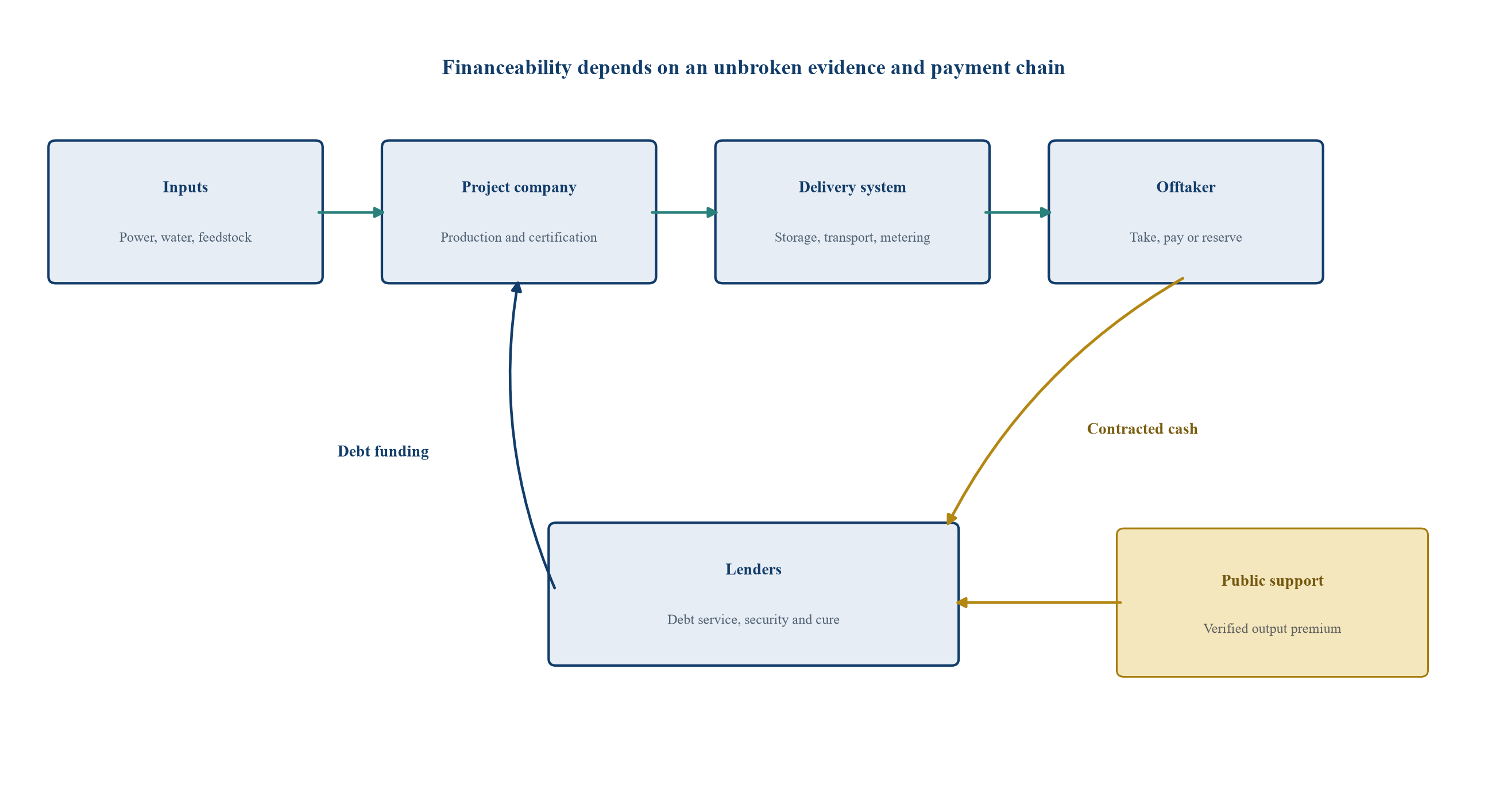
The lender relies on the combined chain of qualified output, delivery evidence, buyer payment and any public support; each interface requires a defined remedy.
Table 1. Hydrogen offtake bankability checklist
| Test | Required evidence | Principal downside | Financing response |
|---|---|---|---|
| Eligible product | Specification, certification route and audit process | Output loses premium or support eligibility | Conservative eligible-volume case and cure protocol |
| Delivery | Defined point, metering and acceptance | Interface dispute delays payment | Independent measurement and deemed-delivery rules |
| Buyer credit | Financials, guarantee and recovery analysis | Payment default | Security, reserves, guarantee or replacement trigger |
| Volume | Binding minimum after relief and make-up rights | Buyer nominations fall | Take-or-pay or capacity-reservation floor |
| Price | Formula, index, currency and reopeners | Margin compresses | Floor, index alignment and downside cost case |
| Tenor | Firm term, options and debt tail | Re-contracting before maturity | Shorter amortisation or refinancing reserve |
| Termination | Payment formula and security | Contract ends with debt outstanding | Debt-linked termination amount and direct agreement |
| Lender rights | Assignment, notice, cure and step-in | Remedy cannot be preserved | Executed consent and standstill |
The checklist identifies the minimum evidence required before contracted revenue enters the base debt case.
11. Availability and deemed delivery protect different risks
Physical delivery revenue normally follows metered hydrogen accepted at the delivery point. Deemed delivery creates payment when the producer is ready and able to perform but the buyer or its downstream system cannot receive. The distinction allocates availability risk and prevents buyer-controlled interruption from removing the cash floor.
Deemed-delivery clauses should define evidence of readiness, avoided variable cost, storage limits and the duration of relief. Paying the full commodity price may overcompensate the producer where electricity and feedstock were not consumed. Paying nothing leaves the producer funding fixed cost and debt despite buyer non-performance. A capacity payment or price net of avoided cost can provide a calibrated result.
The measurement system should capture plant availability, specification and delivery capability. Deemed delivery that depends on subjective certification can become difficult to finance and difficult to enforce.
12. Make-up rights create a future liability
Take-or-pay contracts often permit a buyer that paid for undelivered or untaken volume to claim make-up product in later periods. This can support fairness and commercial flexibility, but it creates an obligation against future capacity and can reduce later revenue.
The model should record the make-up bank, expiry, priority, price adjustment and annual cap. Unlimited carry-forward can concentrate deliveries in later years and impair sales to other customers. Make-up should remain subject to available capacity after current minimum commitments, with clear treatment on expiry and termination.
Cash received under take-or-pay can support current debt service only after recognising the cost and capacity required to fulfil the associated future right. Accounting treatment does not replace that economic analysis.
13. Buyer default needs a liquid remedy
An event of default should cover non-payment, insolvency, repudiation, prolonged failure to take, loss of required licences and breach of credit support. Notice and cure periods should be long enough to correct operational errors and short enough to protect liquidity.
Termination value is central. A formula can include outstanding senior debt, break costs, hedge close-out, demobilisation, replacement cost and a defined equity component. The amount is useful only when the liable counterparty or security package can pay it. A large unsecured claim against a distressed buyer provides limited debt protection.
The producer should also have suspension rights, access to alternative buyers and control over unsold output. Remedies that preserve the project as a going concern can be more valuable than damages pursued after the market window has passed.
14. Producer default should preserve the buyer's operating continuity
The buyer may depend on hydrogen for a refinery, steel plant, chemical process, shipping fuel or compliance obligation. Producer failure can expose the buyer to replacement cost and operational disruption. A balanced contract therefore defines replacement-supply obligations, cover damages, caps and cure.
Lenders require time to step in or install a substitute operator before the buyer terminates. A direct agreement can oblige the buyer to notify security trustees, observe a standstill and accept performance by a qualified substitute. This structure preserves the revenue asset while respecting the buyer's need for reliable supply.
Liability caps should distinguish routine shortfall, wilful misconduct, confidentiality, safety and environmental events. An uncapped cover obligation can make project debt impossible to size.
15. Force majeure should follow control and insurability
Force majeure can excuse performance for events outside reasonable control. Its scope should distinguish production failure, renewable-power shortage, grid curtailment, transport interruption, buyer-facility outage, port closure, change in law and certification-system failure.
Relief should follow the party best able to manage, insure or diversify the risk. A broad clause that excuses the buyer whenever its market deteriorates converts a firm commitment into a discretionary one. A narrow clause that leaves uncontrollable system events with the producer can create unbounded volume risk.
Extended force majeure should trigger a structured response: mitigation, alternative delivery, temporary volume adjustment, insurance proceeds and eventual termination. Debt sizing should assume a realistic relief period and reserve requirement.
16. Change in law can alter both eligibility and economics
Hydrogen value can depend on emissions thresholds, renewable-power rules, additionality, geographic correlation, carbon pricing, mandates and public support. A regulatory change can render output ineligible, increase cost or change buyer willingness to pay.
The contract should define relevant law, baseline, notification, mitigation and economic adjustment. An automatic pass-through protects the producer but can expose the buyer to an uncontrolled price. A shared reopening can preserve the relationship while creating uncertainty for lenders. A bounded formula with termination backstop can be more financeable.
Debt cases should distinguish changes that affect physical production, certification and market premium. Each pathway produces a different remedy and recovery profile.
17. Public support complements the commercial contract
The United Kingdom's Low Carbon Hydrogen Agreement uses a private-law contract with a government-appointed counterparty to provide revenue support. The final first-round terms published in 2025 combine project-specific front-end provisions with standard terms. The structure addresses the gap between low-carbon hydrogen production cost and market revenue through defined support mechanics.
The European Hydrogen Bank's auctions award a fixed premium per kilogram of verified and certified hydrogen produced for up to ten years. The 2025 auction added dedicated support for output supplied to maritime and aviation buyers. Payments follow verified production rather than construction expenditure.
These mechanisms can narrow the cost gap and strengthen cash flow. They do not automatically cover buyer non-payment, transport failure, ineligible output or volume that is not produced. Financing should map each risk to the contract that actually bears it.
18. Demand-side support can bridge a contracting mismatch
The United States Department of Energy has described a recurring mismatch: producers seek medium-to-long-term offtake certainty for a significant share of projected output, while buyers often prefer shorter purchasing commitments. Its demand-side initiative for Regional Clean Hydrogen Hubs was designed to bridge early market demand and support standardised transactions.
Demand-side mechanisms can take several forms, including buyer aggregation, price support, pay-for-difference, market-maker arrangements and credit enhancement. Their financing value depends on eligibility, term, payment trigger, budget, counterparty and interaction with private contracts.
A support programme should target the specific missing obligation. Price support cannot replace buyer credit. Credit support cannot solve an uneconomic production cost. Volume aggregation cannot cure incompatible delivery specifications.
19. Buyer portfolios can reduce concentration
A portfolio of buyers can reduce dependence on one counterparty, one industrial process or one contract expiry. It can also increase scheduling, specification, transport, metering and collection complexity. Diversification has financing value only when the individual commitments remain enforceable and the project can redirect output operationally.
The portfolio should be tested for correlated risk. Several buyers exposed to the same commodity cycle, parent group, pipeline or regulation may fail together. A trader or aggregator can simplify the interface while concentrating payment risk in one intermediary.
Debt sizing can assign different advance rates to anchor volume, secondary contracts and merchant output. The blended result should reflect contractual quality rather than the number of logos on a slide.
20. Aggregators need balance-sheet and operational substance
An aggregator can contract with producers and resell to multiple end users, standardising quality and balancing nominations. This can accelerate market formation where individual buyers cannot commit to project scale. The intermediary also becomes a critical counterparty.
Lenders should assess the aggregator's capital, collateral, risk limits, access to storage and transport, replacement market and ability to withstand basis movements. A thinly capitalised vehicle with matched contracts can still face timing, volume and credit gaps.
Back-to-back documentation should align delivery point, specification, force majeure, liability and termination. A mismatch between upstream and downstream contracts can leave the aggregator with exposure that ultimately reaches the project.
21. Export derivatives add conversion and shipping exposure
Hydrogen can be converted into ammonia, methanol, synthetic fuel or another carrier for transport and end use. The commercial chain may include producer, conversion facility, terminal, shipper, importer, reconversion facility and final buyer.
Each interface affects product yield, energy consumption, certification and delivery. The offtake should identify whether the buyer purchases hydrogen, derivative tonnes, delivered energy or compliant end product. Conversion loss and boil-off should be allocated using a measurable boundary.
An export contract can provide scale and access to stronger buyers. It can also place more completion and operating assets ahead of payment. Project finance should reflect the weakest essential interface and the security available across separate ownership structures.
22. Debt sizing starts with contracted downside cash flow
The base model should calculate revenue from enforceable minimum volume, contractual price and available support, after applying ramp-up, availability, relief and credit assumptions. Operating cost, taxes, reserve funding and maintenance then determine cash available for debt service.
Debt service coverage ratio equals cash available for debt service divided by scheduled principal and interest. The ratio is meaningful only when numerator and denominator use consistent periods and cash definitions. Lenders may also test loan-life and project-life coverage, break-even price, break-even volume and maximum tolerable outage.
The financing case should exclude speculative recontracting premiums and unsupported merchant demand. Those cash flows can support equity upside or a refinancing case after evidence develops.
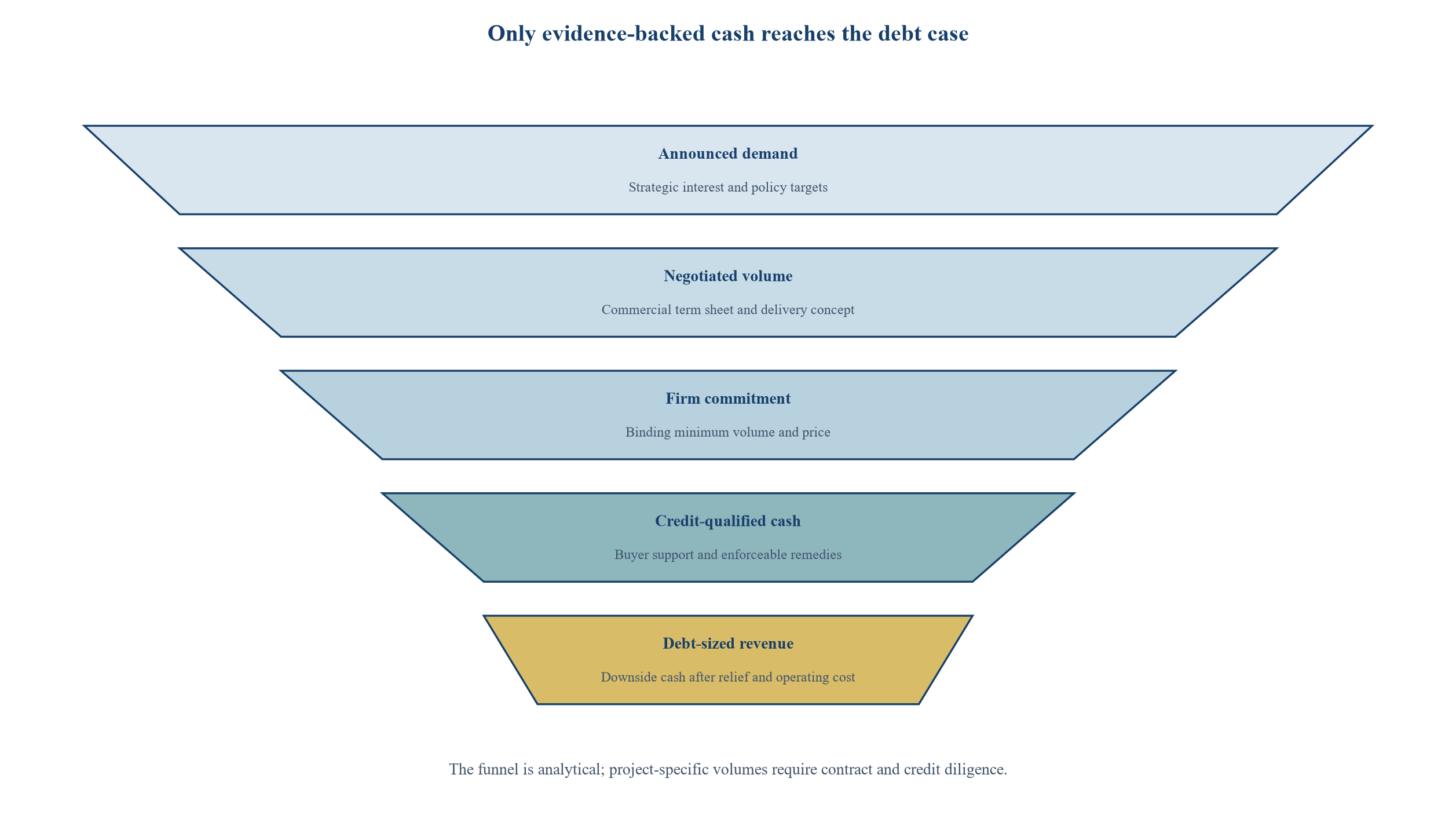
Each stage removes volume that lacks the evidence required for the base financing case.
Table 2. Three hypothetical buyer structures
| Case | Contract design | Principal strength | Principal weakness | Debt response |
|---|---|---|---|---|
| Industrial anchor | Fifteen-year take-or-pay for 70% of output, indexed floor, parent guarantee | Strong volume floor and operational need | Single-buyer concentration and facility-interface risk | Size to guaranteed minimum after outage and relief cases |
| Portfolio aggregator | Ten-year capacity reservation with several downstream users and collateral | Diversification and scheduling flexibility | Intermediary credit and back-to-back mismatch | Advance against collateralised reservation; haircut unmatched volume |
| Export derivative buyer | Twelve-year delivered-ammonia contract with price floor and terminal obligations | Large scale and access to international demand | Conversion, shipping and certification chain | Require interface completion, reserves and debt-linked termination |
The cases are illustrative analytical structures and do not represent observed projects or investment forecasts.
23. Coverage ratios should be read with contract mechanics
A model can show comfortable average coverage while hiding periods of weak contractual protection. Annual ratios may conceal seasonal power cost, maintenance, buyer shutdowns, make-up delivery and support-payment timing. Monthly or quarterly testing can identify liquidity pressure that an annual average smooths away.
The minimum coverage covenant should be paired with distribution lock-up, reserve replenishment and default thresholds. A lock-up retains cash before a payment failure becomes irreversible. The debt-service reserve should reflect the time required to cure a contract dispute or activate replacement sales.
Coverage should also be recalculated after a material contract amendment. A higher forecast volume does not preserve bankability if the amendment weakens price, credit support or termination rights.
24. Price-volume sensitivities expose the true financing boundary
A two-dimensional sensitivity should vary effective minimum volume and net realised price. The result identifies combinations that preserve required debt-service coverage and combinations that require equity support, reserve draw or restructuring.
Effective volume should be calculated after availability, buyer relief, transport loss and make-up deliveries. Net price should include contractual indexation and support but deduct variable cost. This definition keeps the sensitivity connected to cash available for debt service.
The boundary can inform negotiations. If a modest increase in volume commitment materially improves debt capacity, the sponsor can price that commitment for the buyer. If coverage remains weak across plausible volume, the capital structure or production economics require redesign.
25. Sources and uses should include commercial completion
Construction budgets usually include plant, connection, owner's cost, contingency and financing fees. Hydrogen projects also require certification systems, metering, commissioning inventory, contract interfaces, buyer integration and market-development cost. These items are part of commercial completion.
Sources should identify senior debt, subordinated debt, sponsor equity, grants and any milestone-based public funding. Uses should distinguish eligible reimbursable cost from expenditure funded solely by sponsors. Timing matters because output-based support generally arrives after verified production.
Contingency should follow risk rather than a single percentage. Technology, civil works, renewable supply, pipeline, conversion and buyer-facility interfaces can require separate allowances and draw conditions.
26. Completion must prove revenue capability
Technical completion confirms that assets meet specified tests. Financial completion should additionally confirm that the project can deliver qualifying product, invoice the buyer, receive support and operate within the base-case cost envelope.
Conditions can include executed offtake and direct agreements, credit support, transport and storage rights, certification approval, licences, metering validation, reserve funding and buyer readiness. A project that produces hydrogen without access to its payment chain has not completed the financing proposition.
Completion tests should measure net output at the contractual delivery point and under the certification boundary. Reliability runs should cover the operating duration and ramp pattern assumed in the debt model.
27. Direct agreements preserve value during distress
A direct agreement links the buyer with the security trustee or lenders. It usually provides notice of project-company default, a standstill before termination, lender cure rights, step-in and acceptance of a substitute owner or operator meeting defined criteria.
The agreement should also address amendments, assignment, confidentiality, dispute notices and payment during cure. Lenders need enough time to evaluate and implement a remedy, while buyers need protection from prolonged non-performance.
Negotiating direct agreements late can expose conflicts between the offtake and financing documents. The required principles should be agreed with the commercial terms and reflected in the financing timetable.
28. Security over the contract must be legally effective
Project lenders commonly seek security over shares, bank accounts, project assets and material contracts. The value of security over an offtake depends on assignment rules, consent, governing law, insolvency treatment and the ability to continue performance.
Some public contracts or licences restrict assignment. Some buyers accept security assignment but retain broad termination rights. Local law may impose perfection, registration or notice requirements. Legal due diligence should confirm enforceability in each relevant jurisdiction.
Security does not create value where the underlying contract lacks cash flow. It provides a route to preserve and transfer a viable revenue asset during default.
29. Hedging should follow residual exposure
Offtake pricing may leave exposure to power, gas, carbon, foreign exchange, interest rates and inflation. The project should identify residual risk after contractual indexation before selecting hedges. A hedge that uses a different location, grade or timing can create basis risk.
Hedge tenor can be shorter than project debt. Repricing, collateral and break costs should be included in downside analysis. Termination of the offtake can trigger hedge close-out at the same time that revenue disappears.
The financing documents should coordinate hedge ranking, security, voting and close-out with senior debt. The purpose is stable debt service, not an independent trading position.
30. Replacement offtake requires time, access and compatibility
Buyer replacement is often presented as a general mitigation. Its practical value depends on alternative buyers, transport access, product specification, price, certification, contracting lead time and spare demand. Hydrogen is less fungible than many mature commodities where infrastructure is limited.
The model should assume a replacement period, interim storage or curtailment, remarketing cost and revised price. A reserve can cover debt service during the transition. Contract rights should permit sales to alternatives after buyer default and release exclusivity where the buyer fails to perform.
Portfolio development before default can shorten the transition. It should be supported by evidence rather than a list of prospective names.
31. Governance should join commercial and financing decisions
Offtake negotiation should involve commercial, technical, legal, tax, certification and financing teams. A clause that appears commercially acceptable can change debt capacity through an interaction with commissioning, operating cost or remedies.
The board should approve a contract map showing obligations, relief, termination, credit support and lender requirements. Material changes should pass through the same integrated review. A contract summary without the economic model is insufficient for final approval.
Data governance also matters. Metering, certificates, nominations, invoices and support claims should reconcile to one controlled operating record because disputes frequently begin with inconsistent evidence.
32. A staged process reduces wasted development capital
Stage one defines product, buyer use and delivery chain. Stage two qualifies potential buyers and support schemes. Stage three agrees a term sheet covering minimum volume, price, term, credit and termination. Stage four develops technical interfaces and the financial model. Stage five negotiates full documents, direct agreements and financing conditions.
Investment gates should require stronger evidence as expenditure rises. Early engineering can proceed with a credible route to demand. Final investment decision requires executed commitments or clearly defined conditions precedent and funded contingency.
This sequence keeps plant scale linked to financeable demand. It also gives buyers a structured way to purchase flexibility, security and price protection rather than respond to a completed design.
33. The lender diligence request should be contract-led
The diligence package should include executed contract and amendments, buyer financials, guarantees, legal opinions, technical interface schedules, certification analysis, transport rights, support terms, financial model, sensitivity cases and evidence of required approvals.
Independent market review should assess replacement demand and price without converting forecasts into contractual cash. Technical review should reconcile plant capability with delivery obligations. Legal review should trace payment, relief, assignment and termination through every linked agreement.
The diligence conclusion should state which revenue qualifies for the base case, which supports a downside case and which remains merchant upside. This classification creates a transparent bridge from contract to debt quantum.
34. Sponsors should negotiate the financing clauses early
Commercial teams often prioritise price and volume, leaving assignment, cure, termination and credit support for later. Those provisions can determine whether attractive operating economics support debt at all.
A financing term sheet should therefore accompany the commercial term sheet. It can identify acceptable buyer support, minimum tenor, direct-agreement principles, debt-linked termination amount, change-control consent and information rights.
Early alignment also helps the buyer understand the value of its commitment. Stronger terms can reduce the producer's financing cost and therefore the required hydrogen price. That value can be shared through a transparent negotiation.
35. Public authorities should reward verified market formation
Production support can accelerate investment when it closes an evidenced cost gap and pays against certified output. Demand-side tools can help buyers assume longer or firmer obligations. Programme design should preserve incentives for private contracting and avoid paying twice for the same risk.
Qualification can require credible offtake evidence, project maturity, financing plan and delivery schedule. Milestones and completion security can protect scarce public budgets from projects that retain awards without progressing. Published auction results can improve price discovery while respecting commercial confidentiality.
Support duration and contract tenor should be assessed together. A ten-year premium combined with a short buyer commitment can leave material merchant exposure during the support period. The programme should state which market failure it addresses and how private obligations complete the revenue stack.
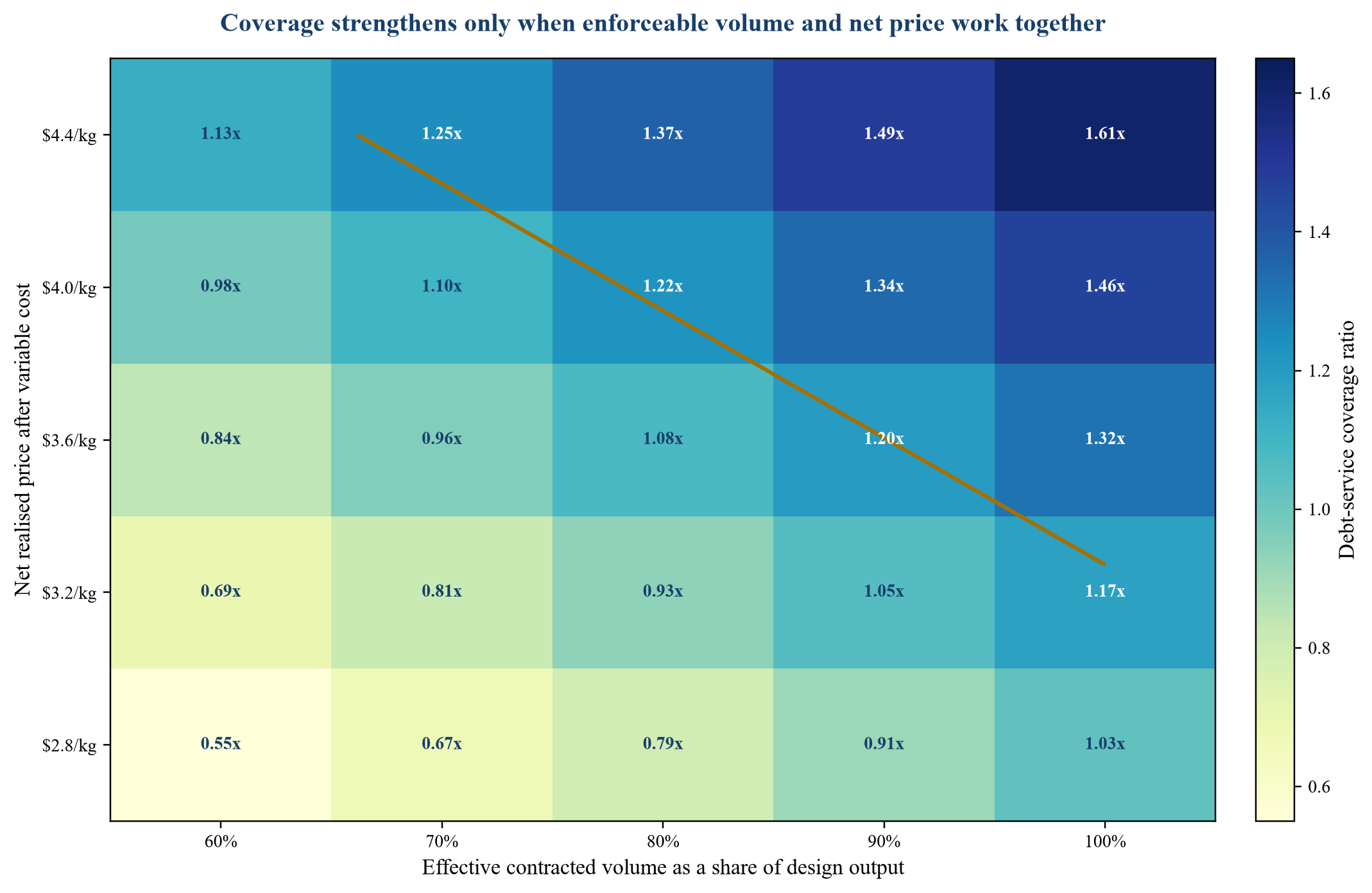
The illustration uses a stylised project and does not represent a forecast. Values show debt-service coverage ratio under the stated price-volume combinations.
Table 3. Risk-allocation matrix for a debt-supporting hydrogen offtake
| Risk | Primary allocation | Contract mechanism | Lender evidence |
|---|---|---|---|
| Product qualification | Producer, subject to defined regulatory change | Specification, certification warranty and change-in-law adjustment | Certification plan and legal review |
| Buyer non-payment | Buyer or guarantor | Credit support, default interest and termination payment | Financial diligence and enforceability opinion |
| Minimum demand | Buyer within agreed relief | Take-or-pay, reservation payment and deemed delivery | Effective minimum-volume calculation |
| Production availability | Producer | Availability warranty, cure and capped damages | Independent engineer report and reserves |
| Transport interruption | Party controlling the relevant interface | Capacity rights, relief and alternative route | Executed transport agreement and contingency |
| Price-cost mismatch | Allocated by formula | Index, floor, collar or reopeners | Basis sensitivity and hedge plan |
| Extended force majeure | Shared through defined endpoint | Mitigation, suspension and termination | Insurance and recovery timetable |
| Contract termination | Defaulting party with secured payment | Debt-linked amount, cure and step-in | Direct agreement and security analysis |
Allocation should reflect control, insurability, mitigation capacity and the cash-flow consequence of each risk.
36. The board decision framework
The board can reduce the decision to seven questions. Is the product eligible and measurable? Is the payment source creditworthy? What minimum volume survives every relief? Does price protect net cash in the downside cost case? How much of the debt term is covered? What cash is available after default or termination? Can lenders preserve or replace the contract?
An affirmative answer should be supported by documents, analysis and independent review. A qualified answer should translate into lower debt, stronger reserves, additional equity or a condition precedent. A negative answer should stop capital commitment until the structure changes.
The framework does not require every risk to disappear. It requires each material risk to have an owner, a remedy, a quantified consequence and a financing response.
37. Conclusion
Hydrogen projects become financeable when committed demand is converted into enforceable net cash flow. The buyer comes first because plant scale, price architecture, debt quantum and completion design all depend on the quality of that commitment.
The strongest structures combine a qualified product, defined delivery, creditworthy payment, binding minimum volume, cost-aware pricing, sufficient tenor, balanced relief, debt-protective termination and lender rights. Public support can close a verified cost gap and accelerate market formation, while the private contract remains responsible for the buyer's performance.
The practical discipline is simple: classify every revenue component by evidence, size debt to the contracted downside and treat replacement demand as a mitigation requiring infrastructure, time and price. That discipline allows boards to distinguish a strategically attractive hydrogen project from a contract that can carry project debt.
38. Limitations
This paper provides a general contracting and financing framework. The three cases and the sensitivity matrix are hypothetical analytical illustrations. They are not forecasts, valuations or descriptions of specific projects.
Actual bankability depends on jurisdiction, technology, certification, buyer credit, governing law, tax, regulation, support terms, transport systems and financing market conditions. Contract language should be reviewed against the complete transaction and applicable law.
Public programmes cited here can change after publication. Project teams should verify current eligibility, auction documents and executed support terms before relying on them.
References
- International Energy Agency, Global Hydrogen Review 2026, Executive Summary, 2026, https://www.iea.org/reports/global-hydrogen-review-2026/executive-summary
- International Energy Agency, Global Hydrogen Review 2025, Executive Summary, 2025, https://www.iea.org/reports/global-hydrogen-review-2025/executive-summary
- International Energy Agency, Five key questions about hydrogen, 2025, https://www.iea.org/reports/global-hydrogen-review-2025/five-key-questions-about-hydrogen
- International Energy Agency, Breakthrough Agenda Report 2025: Hydrogen, 2025, https://www.iea.org/reports/breakthrough-agenda-report-2025/hydrogen
- International Energy Agency, Cumulative firm offtake agreements of low-emissions hydrogen by end product, 2021-2025, 2025, https://www.iea.org/data-and-statistics/charts/cumulative-firm-offtake-agreements-of-low-emissions-hydrogen-by-end-product-2021-2025
- UK Department for Energy Security and Net Zero, Hydrogen Production Business Model, updated 2025, https://www.gov.uk/government/publications/hydrogen-production-business-model
- UK Department for Energy Security and Net Zero, Low Carbon Hydrogen Agreement Front End Agreement, updated 2025, https://www.gov.uk/government/publications/hydrogen-production-business-model/low-carbon-hydrogen-agreement-front-end-agreement-august-2023-accessible-webpage
- UK Department for Energy Security and Net Zero, Low Carbon Hydrogen Agreement Standard Terms and Conditions, 2025, https://www.gov.uk/government/publications/hydrogen-production-business-model
- UK Department for Energy Security and Net Zero, Hydrogen Production Business Model Heads of Terms, 2022, https://www.gov.uk/government/publications/hydrogen-production-business-model
- UK Department for Energy Security and Net Zero, Business Models for Low Carbon Hydrogen Production, 2021, https://www.gov.uk/government/publications/business-models-for-low-carbon-hydrogen-production
- European Commission, Innovation Fund 2025 Hydrogen Auction, updated 2026, https://climate.ec.europa.eu/areas-action/eu-funding-climate-action/innovation-fund/calls-proposals/if25-hydrogen-auction_en
- European Commission, Competitive Bidding under the Innovation Fund, updated 2026, https://climate.ec.europa.eu/areas-action/eu-funding-climate-action/innovation-fund/competitive-bidding_en
- European Commission, Second Renewable Hydrogen Auction Terms and Conditions announcement, 2024, https://climate.ec.europa.eu/news-other-reads/news/second-renewable-hydrogen-auction-european-commission-publishes-terms-and-conditions-2024-09-27_en
- European Commission, IF23 Auction for Renewable Hydrogen Production, 2024, https://climate.ec.europa.eu/eu-action/eu-funding-climate-action/innovation-fund/calls-proposals/if23-auction-renewable-hydrogen-production_en
- European Commission, European Hydrogen Bank, updated 2026, https://energy.ec.europa.eu/topics/eus-energy-system/hydrogen/european-hydrogen-bank_en
- European Climate, Infrastructure and Environment Executive Agency, Innovation Fund Auctions, updated 2026, https://cinea.ec.europa.eu/programmes/innovation-fund/auctions_en
- United States Department of Energy, DOE Selects Consortium to Bridge Early Demand for Clean Hydrogen, 2024, https://www.energy.gov/cmei/oced/articles/doe-selects-consortium-bridge-early-demand-clean-hydrogen-providing-market
- United States Department of Energy, Office of Clean Energy Demonstrations Multi-Year Program Plan, 2023, https://www.energy.gov/sites/default/files/2023-07/OCED%202023%20Multi-Year%20Program%20Plan.pdf
- United States Department of Energy, Regional Clean Hydrogen Hubs, updated 2026, https://www.energy.gov/oced/regional-clean-hydrogen-hubs-0
- United States Department of Energy, U.S. National Clean Hydrogen Strategy and Roadmap, 2023, https://www.hydrogen.energy.gov/library/roadmaps-vision/clean-hydrogen-strategy-roadmap
- International Renewable Energy Agency, Global Hydrogen Trade to Meet the 1.5C Climate Goal, 2022, https://www.irena.org/Publications/2022/Jul/Global-Hydrogen-Trade-Outlook
- International Renewable Energy Agency, Green Hydrogen Cost Reduction, 2020, https://www.irena.org/publications/2020/Dec/Green-hydrogen-cost-reduction
- World Bank, Scaling Hydrogen Financing for Development, Energy Sector Management Assistance Program, https://www.esmap.org/
- European Investment Bank, The EIB partners with Portugal to accelerate investments in the hydrogen sector, 2021, https://www.eib.org/en/press/all/2021-117-the-eib-partners-up-with-the-portuguese-republic-to-accelerate-investments-in-the-hydrogen-sector
- European Union, Directive (EU) 2024/1788 on common rules for the internal markets for renewable gas, natural gas and hydrogen, 2024, https://eur-lex.europa.eu/eli/dir/2024/1788/oj
- European Union, Commission Delegated Regulation (EU) 2023/1184 on renewable liquid and gaseous transport fuels of non-biological origin, 2023, https://eur-lex.europa.eu/eli/reg_del/2023/1184/oj
- European Union, Commission Delegated Regulation (EU) 2023/1185 on greenhouse-gas savings from renewable fuels of non-biological origin, 2023, https://eur-lex.europa.eu/eli/reg_del/2023/1185/oj
- Organisation for Economic Co-operation and Development, Infrastructure Governance, updated 2026, https://www.oecd.org/gov/infrastructure-governance/
About the Author
Chennakeshav (CK) is a corporate finance and investment banking executive with 25+ years of global experience in deal origination, structuring and execution across M&A, growth capital and corporate strategy. He has led value-creation mandates for founders, corporates and funds — bridging the boardroom view to hands-on execution and close.
His career spans Morgan Stanley, HSBC, Lloyds Banking Group, EWEC, ADQ portfolio companies and Emirates Growth Fund, across TMT, real estate, fintech, deeptech, cleantech, infrastructure and energy. He has partnered with C-suite leaders, private equity and venture funds, sovereign wealth funds and family offices to finance complex fund raises and scale-up ventures, and has led M&A due diligence, post-merger integration and business-transformation initiatives to create value.
At Matchpoint Partners he is Managing Partner, leading the firm's corporate finance, M&A and capital-raising practice. He holds an MBA from London Business School, an engineering degree from VTU and a Master of Laws (LLM, in progress) from UCL London.
An active start-up mentor, CK mentors at Techstars, DIFC FinTech Hive, Startup Grind, Founder Institute and IN5, serves as Entrepreneur Mentor in Residence (EMiR) at London Business School, and judges the Entrepreneurship World Cup.
LinkedIn: https://www.linkedin.com/in/ckadya/
Profile: https://www.matchpoint-partners.com/team/ck-adya.html
