

1. Reframe the decision after construction
Construction finance and operating-asset finance solve different problems. During construction, lenders manage drawdowns, cost overruns, contractor performance, completion tests and frequent amendments. After the asset is commissioned, investors can examine actual availability, output, demand, revenue, operating cost and cash conversion. The refinancing case should therefore start with evidence that the risk system has changed.
World Bank guidance distinguishes physical, technical and financial completion. Physical completion means the asset is built; technical completion requires operation at specified quality and volume for a defined period; financial completion adds evidence that agreed financial standards have been achieved [1]. A refinancing should identify which definition applies under every material contract and finance document.
The governing body should state the decision precisely: whether to retain bank debt, amend and extend it, execute a private placement, issue a rated project bond, or combine these routes. The decision paper should compare total economics, risk allocation, flexibility, execution certainty and lifecycle fit.
A lower coupon alone is insufficient. The refinancing can trigger swap break costs, prepayment fees, consent payments, taxes, reserve funding, disclosure obligations and restrictions on future operating decisions. The right objective is a resilient capital structure with a defensible net benefit.
2. Use four approval gates
The Bank-to-Bond Refinancing System uses four gates. Gate One confirms completion. Gate Two tests the operating record. Gate Three establishes capital-markets readiness. Gate Four tests whether the transaction preserves economic and contractual value.
Gate One requires completion certificates, independent engineer reports, acceptance tests, permits, insurance, defect arrangements, contractor obligations and resolution of material claims. Gate Two examines operating history, revenue collection, availability, demand, operating costs, maintenance, working capital and cash flow available for debt service.
Gate Three covers issuer capacity, audited information, rating analysis, legal structure, security, disclosure, listing, clearing, investor reporting, hedging, tax and execution governance. Gate Four compares the proposed structure with credible alternatives and tests downside resilience, public-authority consents, refinancing-gain provisions and future flexibility.
Each gate should have objective evidence, named owners and an escalation rule. A transaction may be attractive in principle yet premature in timing. Deferral can be a value-preserving decision when operating evidence or market access is incomplete.
3. Define completion through contracts
Completion is a contractual condition, not a visual judgement. The project company should map every completion concept across the engineering, procurement and construction contract, concession, offtake agreement, operations contract, insurance programme, permits and financing documents.
The map should cover provisional acceptance, final acceptance, performance tests, reliability runs, liquidated damages, punch-list items, defects liability, warranties, grid connection, environmental approvals and handover of records. It should show which party certifies each item, whether challenges remain and what remedy survives refinancing.
Completion evidence should also identify retained construction risks. A project can be physically complete while facing unresolved claims, delayed ancillary works, unstable performance or a contractor whose security is about to expire. Bond investors need to understand the probability, financial effect and control for each retained exposure.
The refinancing committee should not waive an unresolved completion condition merely to meet a market window. A waiver transfers uncertainty into the operating capital structure and may weaken the rating, increase disclosure risk or create future disputes.
4. Establish an operating-evidence minimum
An operational track record should be long enough to show how the asset performs through relevant conditions. Twelve months may capture seasonality for some assets; a contracted availability project may require a different evidence period from a merchant road, port or renewable-energy asset.
The minimum evidence set should include output or availability, demand, tariff application, billing, collection, downtime, operating expenditure, maintenance performance, working capital, insurance claims and counterparty performance. Variances should be reconciled to the original financing model and updated operating plan.
Rating methodologies examine operating, revenue, counterparty, transaction-structure and framework risks. S&P's project-finance assessment model uses these modules to support issue-credit analysis [2]. Fitch's global criteria similarly evaluate operating cost, demand, revenue, infrastructure renewal, debt structure, liquidity, reserves and covenant protection [3].
Observed performance should be separated from temporary support. Sponsor advances, waived payments, deferred maintenance or one-off compensation can improve reported cash flow while weakening sustainable debt capacity. The evidence file should normalize these effects.
5. Build a refinance data room
The bond data room should allow rating analysts, underwriters, investors, counsel and technical advisers to reconstruct the credit. It should contain executed project contracts, amendments, completion evidence, permits, insurance, financial statements, operating reports, forecasts, tax analysis, security documents, hedging and material correspondence.
Version control is essential. The project company should maintain a contract register with execution date, parties, term, amendment history, consent requirements, termination rights and current owner. Financial data should reconcile across management accounts, audited statements, bank models and the bond model.
The issuer should prepare a question log that records the source, owner, response and supporting document for each diligence item. Material gaps should remain visible until closed. A clean index does not compensate for missing evidence.
Investor disclosure should derive from this evidence base. Any material statement about completion, performance, rights or cash flow should be traceable to a contract, report, account or clearly labelled management assumption.
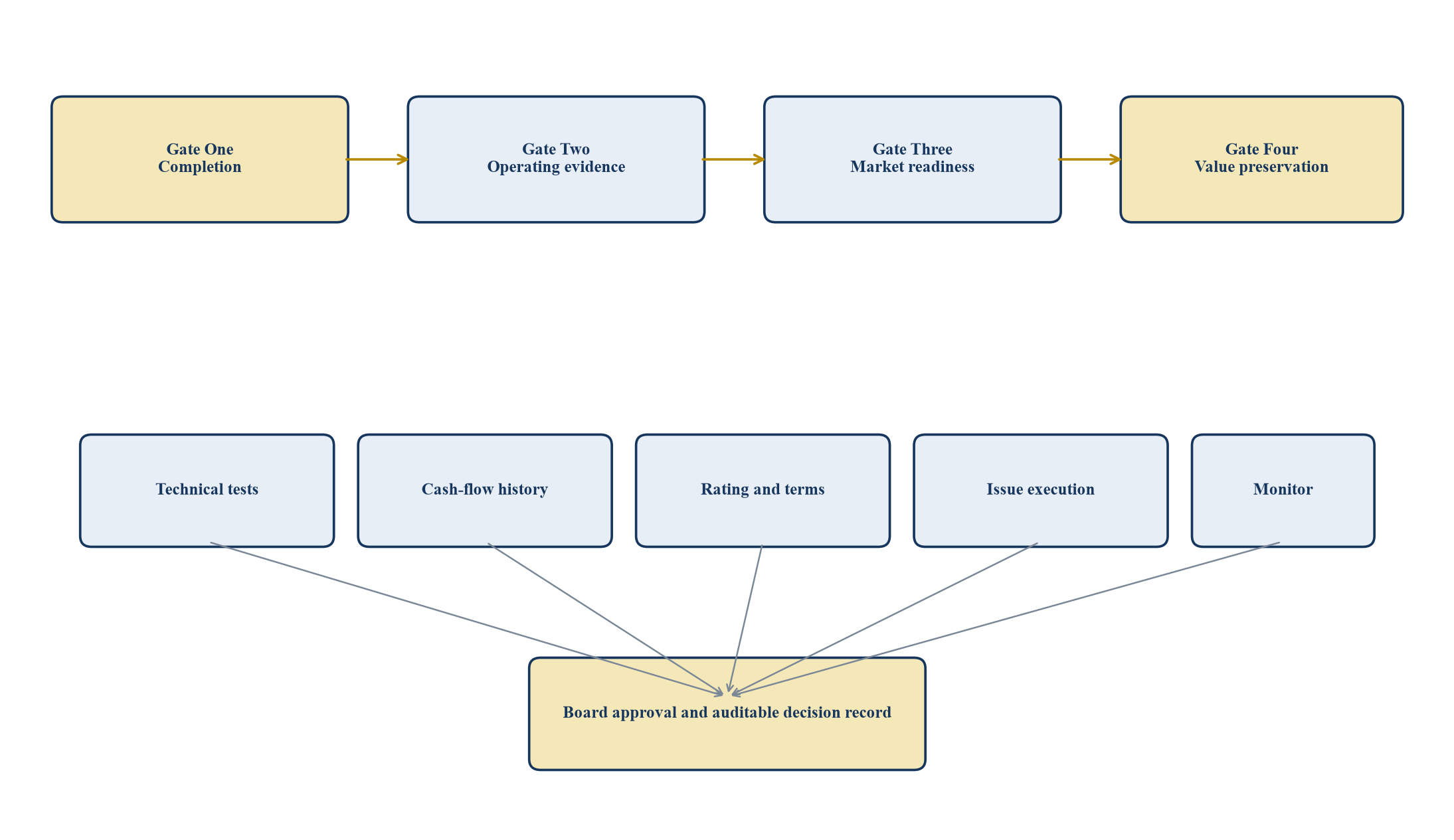
The proposed architecture requires completion and operating evidence before capital-markets execution and value-preservation approval.
6. Reconstruct the construction financing
The existing debt should be reconstructed from initial commitment through the proposed payoff date. The schedule should show drawdowns, interest, fees, capitalised costs, repayments, hedges, reserves, sponsor support and waivers.
This history reveals the economics that a simple outstanding-balance figure misses. The project may have unused commitments, contingent obligations, accrued claims, break costs or lender rights that survive repayment. Security release mechanics can also affect closing certainty.
The review should distinguish mandatory refinancing from elective refinancing. A mini-perm with a margin step-up, cash sweep or bullet maturity creates a different negotiating position from fully amortising bank debt with ample tenor. The committee should identify the cost of doing nothing and the time available to execute alternatives.
World Bank material on power-project financing notes that post-completion de-risking can support refinancing on better terms, while existing lenders may protect their position through prepayment penalties [4]. The actual benefit therefore depends on contract-specific economics.
7. Calculate cash flow available for debt service
Cash flow available for debt service should be built from operating drivers rather than a top-line growth assumption. The model should connect volume, availability, tariff, escalation, collection, operating cost, taxes, maintenance, working capital and reserve movements.
Definitions must match the proposed documents. EBITDA, operating cash flow and cash flow available for debt service are not interchangeable. The model should state permitted adjustments, treatment of insurance proceeds, compensation, major maintenance and restricted cash.
Historical cash flow should reconcile to bank statements and accounts. Forecasts should show the bridge from observed performance to future assumptions. Any improvement should have an identified operational, contractual or regulatory basis.
Debt sizing should use the lower of economic capacity, rating capacity, legal constraints and market capacity. A bond sized solely to repay every existing liability can leave inadequate resilience.
8. Size debt with coverage and lifecycle tests
The model should calculate annual and minimum debt-service coverage, project-life coverage, loan-life coverage, leverage, reserve adequacy and debt tail. The committee should understand which metric drives the proposed rating and which metric protects cash solvency.
Moody's generic project-finance methodology treats liquidity as a fundamental consideration and examines debt-service reserves, maintenance reserves, working-capital facilities and the accessibility and repayment terms of supplemental liquidity [5]. S&P has clarified the treatment of minimum coverage ratios, subordinated tranches and permitted debt [6].
Coverage should be tested under base, rating, lender and sponsor cases. These cases can use different assumptions and purposes. The board should not treat a rating case as a management forecast or a sponsor case as rating evidence.
Debt maturity should leave a tail before the end of the concession, offtake agreement or asset life. The tail provides time to remedy underperformance, refinance or sell before contractual value expires.
9. Decide between amortising and bullet structures
An amortising bond reduces refinancing risk and can match predictable cash flow. A bullet or balloon structure may improve early distributions and suit markets that prefer standard maturities, while leaving a larger terminal obligation.
The choice should follow cash-flow visibility, asset life, investor demand, rating sensitivity and future capital needs. A project with contracted revenue may support scheduled amortisation; a growth asset may need more flexible cash retention.
The model should show annual debt service, refinancing exposure, expected outstanding balance and downside balance at maturity. It should also test whether the project can maintain assets and reserves while meeting the proposed schedule.
Refinancing risk should be treated as an explicit credit exposure. A structure that relies on future capital-market access should identify the conditions, timing and contingency actions for a failed refinancing.
10. Reset covenants for an operating asset
Construction-loan covenants often focus on budget, schedule, draw conditions and contractor performance. Operating bonds require controls around cash flow, distributions, additional debt, asset sales, contracts, maintenance, insurance, hedging and reporting.
The covenant package should define lock-up and default thresholds separately. A distribution lock-up protects liquidity before a payment default occurs. Cure rights should be feasible, time-bounded and consistent with the concession and shareholder arrangements.
Additional-debt tests should cover seniority, purpose, coverage, security and maturity. Restricted payments should include dividends, shareholder-loan payments, related-party transfers and other value leakage.
Covenants should preserve necessary operational flexibility. Overly rigid terms can prevent maintenance, efficiency investments or contract changes that protect value. The decision record should explain each covenant's risk purpose.
| Gate | Required evidence | Decision owner | Stop condition |
|---|---|---|---|
| Completion | Acceptance certificates, tests, permits, defects and claim register | Board and technical committee | Unresolved material completion risk |
| Operations | Performance history, audited cash flow and maintenance evidence | Investment and finance committees | Unstable or unreconciled operating record |
| Market readiness | Rating case, disclosure, legal structure and investor plan | Board and financing committee | No executable structure or disclosure gap |
| Value preservation | Alternatives, all-in economics, downside and consent analysis | Board | Net benefit fails or risk allocation deteriorates |
The evidence thresholds are decision controls and require transaction-specific legal, technical and rating review.
11. Design reserves and liquidity
Reserves should respond to the project's actual interruption risks. A debt-service reserve can cover temporary revenue or operating disruption. Major-maintenance, lifecycle, tax, insurance and working-capital reserves may be required separately.
The design should specify target size, permitted form, funding date, draw conditions, replenishment priority, permitted investments and replacement rules. Cash, letters of credit and surety products have different accessibility, counterparty and repayment characteristics.
Liquidity should be modelled through the payment waterfall. A reserve funded at closing can reduce net proceeds; a reserve built from future cash flow can weaken early protection. A letter of credit can reduce trapped cash while adding renewal and bank-counterparty risk.
The committee should examine correlated draws. An operating failure can reduce revenue, increase cost, trigger maintenance and require reserve replenishment at the same time.
12. Preserve the security package
Project-bond investors rely on ring-fenced cash flows, assets, contracts, accounts and shares. The refinancing should confirm that security can be transferred, recreated or released and retaken without a gap.
The legal review should cover asset ownership, concession rights, assignment restrictions, account control, share pledges, direct agreements, step-in rights, enforcement, insolvency, intercreditor terms and perfection requirements in every relevant jurisdiction.
S&P identifies a bankruptcy-remote limited-purpose entity and a security package over project cash flows and assets as critical attributes of project-finance debt [7]. The bond structure should preserve these fundamentals unless the rating and investor case explicitly supports another approach.
Closing mechanics should sequence payoff, security release, new security perfection, reserve funding and bond settlement. A detailed funds flow and conditions-precedent tracker reduces execution risk.
13. Reconcile concession and public-authority rights
PPP and concession projects often require authority consent to refinancing, security changes, lender replacement, hedging or distributions. The project company should identify every consent, notice, review period and information requirement.
Global Infrastructure Hub guidance notes that refinancing can change pricing, tenor, leverage, reserves, guarantees, security, repayment, lender identity and covenants. The authority should assess financial integrity, value for money and contingent liabilities [8].
The contract may require refinancing gains to be shared. The calculation can depend on a defined base case, discount rate, excluded transactions and the form of benefit. The issuer should model the gain-share before launching the transaction.
Authority approvals should be on the critical path. Delayed consent can cause missed market windows, committed-cost leakage or failed hedging. Governance should identify who owns the relationship and escalation.
14. Treat the rating as a structured workstream
A rating is an independent credit opinion based on methodology, evidence and committee judgement. The issuer should appoint a rating-workstream leader and maintain a response log for information requests, assumptions and sensitivities.
The rating case should test construction residuals, operations, revenue, counterparties, country and currency risk, debt structure, liquidity, recovery and refinancing risk. It should reconcile to the financing model while preserving methodology-specific adjustments.
The committee should examine rating headroom. A structure that achieves a target rating only through a narrow assumption or temporary support can be vulnerable to downgrade. The model should show which variables drive category migration.
Rating feedback can lead to structural change. The issuer should maintain decision authority over leverage, amortisation, reserves and covenants rather than allowing the target rating to become an unexamined objective.
15. Select the issuance route
The principal routes include public bond, private placement, loan refinancing and hybrid structures. A public bond can provide scale and investor breadth; a private placement can offer confidentiality, execution control and negotiated terms; bank debt can preserve amendment flexibility.
ICMA's infrastructure-financing guide compares bank loans, private placements and public bonds, including mechanics, credit review, enhancement, investor base, marketing, pricing and disclosure [9]. The route should be chosen through a weighted decision matrix.
Criteria can include tenor, amount, currency, rating, disclosure, liquidity, execution timetable, amendment process, investor concentration and recurring reporting cost. The weights should reflect the project's strategy and not be adjusted to favour a preferred product.
A dual-track process can preserve competition. It requires careful control of confidential information, adviser roles, fees and decision dates.
16. Build a credible investor proposition
Investors need a clear explanation of the asset, contracts, cash-flow drivers, risks, mitigants, governance and debt structure. The presentation should make the credit legible without oversimplifying uncertainty.
The investor proposition should explain why construction risk has reduced, how operating evidence supports the model, which risks remain and how the structure protects debt service. It should also explain the sponsor's continuing economic interest and operating capability.
Institutional investors often value long-duration assets that match liabilities, while they require reliable information, fair pricing and credible partners. World Bank PPP guidance notes that poorly prepared projects can fail to attract pension capital even where infrastructure bonds offer duration and spread [10].
Marketing should record questions, concerns and indicated demand. Repeated investor concerns can reveal structural weaknesses that require action before pricing.
17. Use credit enhancement selectively
Credit enhancement can improve rating or investor access through subordinated debt, guarantees, contingent facilities, reserve support or anchor investment. It also creates cost, conditions, counterparty exposure and possible control rights.
The EIB describes funded subordinated tranches and unfunded first-demand guarantees as forms of project-finance credit enhancement. Its framework requires ring-fenced project assets and assesses viability, procurement, concession, credit, financial and legal issues [11].
The committee should compare the incremental funding benefit with the full enhancement cost and restrictions. The model should show economics with and without support, together with the rating and market-access effect.
Enhancement should address a specific weakness. Broad support can mask an unresolved operating or structural problem and leave the project exposed when support expires.
18. Align currency and hedging
The refinancing should map revenue, operating cost, capital expenditure, debt service and reserves by currency. Bond denomination should follow economic cash flow and investor access rather than presentation convenience.
Foreign-currency debt can create convertibility, transfer, basis and collateral risk. The World Bank's work on exchange-rate risk describes a Colombian infrastructure refinancing that combined local and foreign-currency tranches to align financing with concession cash flows [12]. This example illustrates matching principles rather than a universal structure.
Existing swaps may carry break gains or costs. Replacement hedges can require collateral, ratings triggers and termination payments. The committee should model these amounts at several market dates.
Hedge governance should specify counterparty limits, permitted instruments, collateral, replacement, reporting and authority. A hedge should reduce identified risk without introducing an unmanaged liquidity obligation.
19. Evaluate sustainable-finance eligibility
Operational infrastructure can qualify for green, social, sustainability or other labelled financing when the use of proceeds, project evaluation, proceeds management and reporting meet the relevant framework.
ICMA's Green Bond Principles support financing and refinancing of eligible projects and emphasise transparency, disclosure, proceeds tracking and reporting. The 2025 edition also references enabling activities and updated guidance [13].
The issuer should establish eligibility from evidence rather than from the asset's broad sector label. It should define financed assets, look-back period, allocation process, exclusions, external review and impact metrics.
A label should not weaken credit analysis. Bondholders remain exposed to project cash flow and structure. Misaligned claims can create legal, reputational and market risk.
20. Compare all-in economics
All-in economics should include coupon or margin, upfront fees, underwriting, rating, legal, listing, trustee, agency, exchange, clearing, audit, technical advice, hedging, reserve funding, taxes, prepayment and recurring reporting.
The comparison should use a common present-value date and consistent assumptions. It should distinguish cash costs, accounting effects and contingent costs. Expected refinancing-gain sharing should also be included.
Tenor has value. A longer-maturity bond may carry a higher initial spread while reducing future refinancing exposure. Flexible bank debt may appear cheaper before amendment and maturity risk are considered.
The committee should test break-even holding periods and rate movements. A transaction that depends on one pricing day should have clear launch and withdrawal thresholds.
21. Model downside before setting leverage
Downside analysis should combine operating and financing stresses. Relevant cases can include delayed availability, lower demand, tariff non-application, higher operating cost, maintenance shock, counterparty delay, interest-rate movement, currency depreciation and reserve draw.
Each scenario should show cash flow, coverage, lock-up, default, reserve, rating and equity-distribution effects. Correlated stresses are essential because infrastructure risks can move together.
Management actions should be feasible and time-specific. Cost reduction, maintenance deferral, sponsor support or refinancing cannot be assumed without evidence, authority and operational consequences.
The board should see the leverage point at which resilience changes materially. The economic optimum may be below the maximum debt supported by a base case.
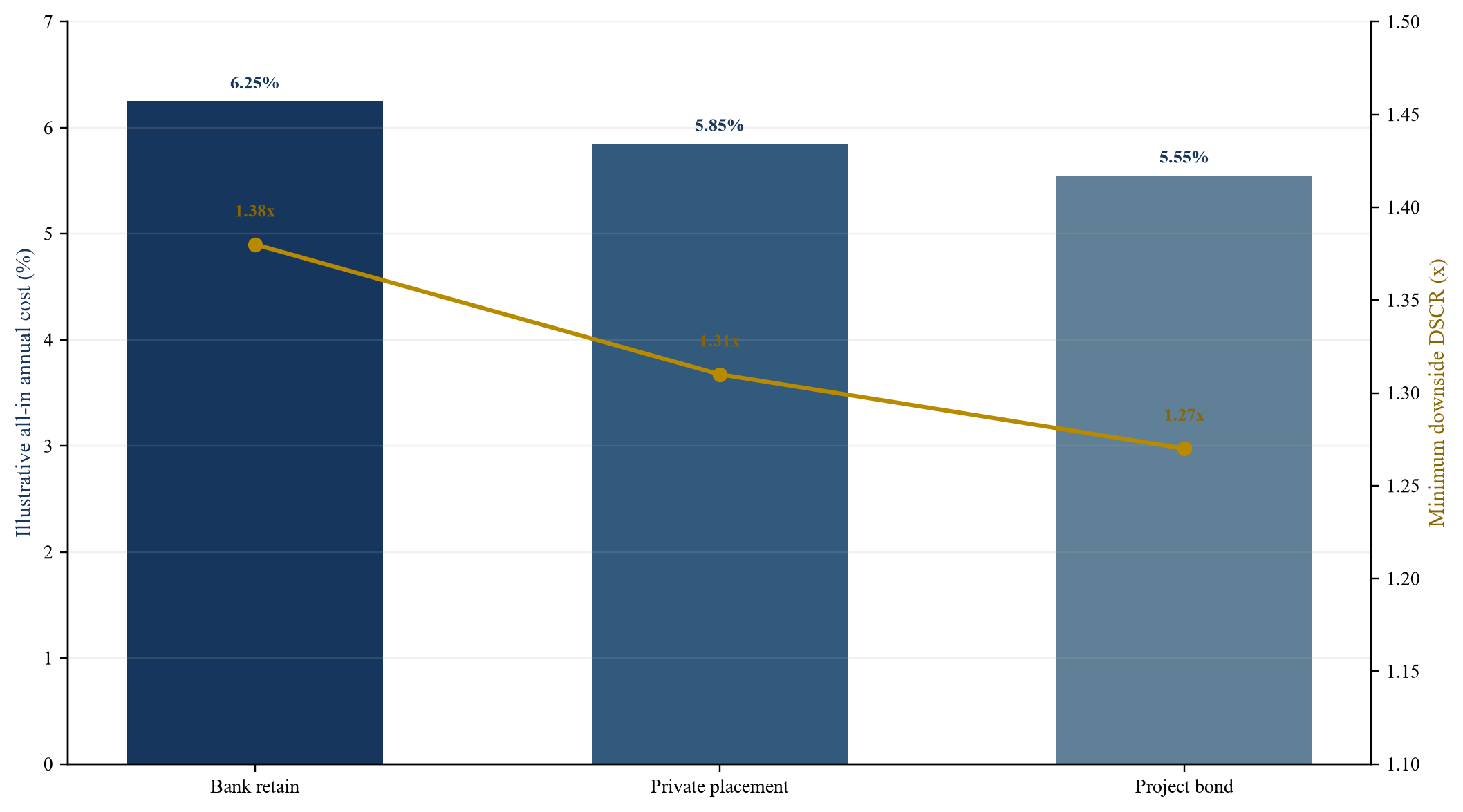
All amounts, yields, coverage ratios and outcomes are illustrative management assumptions and require replacement with approved transaction inputs.
| Criterion | Bank retention | Private placement | Project bond |
|---|---|---|---|
| All-in annual cost | 6.25% | 5.85% | 5.55% |
| Debt tenor | 8 years | 15 years | 20 years |
| Amendment flexibility | Higher | Medium | Lower |
| Disclosure burden | Lower | Medium | Higher |
| Investor diversification | Lower | Medium | Higher |
| Minimum downside DSCR | 1.38x | 1.31x | 1.27x |
All values and assessments are illustrative management assumptions, not market quotations or forecasts.
22. Create a risk heat map linked to controls
The risk heat map should connect each exposure to likelihood, impact, owner, evidence, control, indicator and escalation. It should be updated through execution and after closing.
Principal risks include incomplete construction, unstable performance, demand, tariff, offtaker, operator, maintenance, refinancing, interest rate, currency, documentation, consent, rating, market execution, settlement and disclosure.
Colour alone is insufficient. The heat map should state residual risk after controls and identify correlated exposures. A low-probability settlement failure can still require senior oversight because of its impact.
The financing committee should review indicators weekly during preparation and daily during execution. Post-close risks should migrate into ordinary asset and treasury governance.
| Risk | Inherent rating | Principal control | Indicator | Residual rating |
|---|---|---|---|---|
| Completion claim | High | Independent engineer and settlement plan | Open claim value | Medium |
| Operating variance | High | Twelve-month evidence and downside case | Availability and CFADS variance | Medium |
| Rating shortfall | High | Early rating case and structural options | Rating feedback | Medium |
| Consent delay | Medium | Authority timetable and escalation | Days against critical path | Low-Medium |
| Market widening | High | Dual track and launch thresholds | Spread and order-book quality | Medium |
| Disclosure error | High | Verification and evidence tracing | Open verification points | Low-Medium |
Ratings are hypothetical management judgements and require transaction-specific evidence.
23. Govern documentation and disclosure
The documentation workstream should cover issuer authority, offering document, trust deed or indenture, security, agency, accounts, intercreditor terms, hedging, listing and settlement.
The verification process should trace material statements to evidence and record responsibility. Forward-looking information should be clearly identified and supported by documented assumptions.
Risk factors should be specific. Generic language can obscure the issues that determine debt service. The document should explain retained construction risk, operating record, counterparty dependence, regulatory framework, maintenance, climate exposure and refinancing structure.
Counsel should confirm securities, listing, marketing, tax, sanctions, anti-money-laundering and data requirements in each relevant jurisdiction. The paper does not replace transaction-specific legal advice.
24. Control execution timing and market risk
The project plan should run backward from the required refinancing date. Critical tasks include data-room readiness, model audit, technical diligence, rating, consents, documentation, investor education, roadshow, pricing, settlement and security perfection.
Market execution requires named decision rights. The board should approve a range for size, tenor, pricing, covenants and allocations. A smaller pricing committee can act within those limits and escalate deviations.
The issuer should define launch, pause and withdrawal conditions. These can include rating outcome, spread level, order-book quality, investor concentration, consent status and material operating events.
A failed launch is expensive and visible. Dual-track alternatives, adequate liquidity and early preparation protect negotiating leverage.
25. Design the payment waterfall
The payment waterfall converts contracts and covenants into cash control. It should define the order for revenue accounts, operating cost, tax, senior debt service, reserve replenishment, maintenance, subordinated obligations and distributions.
The waterfall must align with bank accounts, account-control agreements, trustee powers and operating needs. It should also address insurance, compensation, asset-sale proceeds and termination payments.
The committee should model waterfall performance in downside cases. A nominal reserve can fail if higher-ranking uses absorb cash before replenishment.
Reporting should reconcile actual bank movements to the waterfall. Unexplained transfers or recurring manual adjustments are control warnings.
26. Plan closing and first-day operations
Closing is a transition between two control systems. The issuer should prepare a detailed funds flow, payoff letters, security-release and perfection steps, hedge termination or novation, reserve funding, fee payment and settlement instructions.
The first-day plan should confirm account mandates, trustee and agent contacts, reporting calendar, covenant calculations, investor communications, tax processes and document custody. Operational responsibility should be assigned before settlement.
Business continuity should cover failed settlement, delayed security release, payment-system outage and incorrect funds movement. A tabletop exercise can expose dependencies.
The board should receive a closing certificate confirming conditions, exceptions, final economics, ratings, allocations and retained risks.
27. Monitor the bond as a living credit
Post-close governance should track operating performance, cash flow, coverage, reserves, maintenance, counterparties, covenants, ratings, investor reporting and market signals.
Surveillance should compare actual outcomes with the refinancing thesis. The finance committee should understand whether improved economics arise from operations, structure or market movement.
Investor reporting should be timely, consistent and evidence-based. Material events should follow the notice and disclosure requirements in the documents and applicable law.
The project company should maintain a maturity and optional-redemption plan. Early preparation preserves alternatives if the asset, market or strategy changes.
28. Implement through a 180-day roadmap
Days 0-30 define the objective, evidence standard, alternatives and governance. Days 31-60 close completion and operating-data gaps, reconstruct existing debt and appoint advisers. Days 61-100 complete the model, technical review, legal structure, rating case and authority engagement.
Days 101-140 finalise documents, investor materials, external review and execution parameters. Days 141-170 conduct investor education, receive rating feedback, update the downside case and secure final approvals. Days 171-180 launch, price, settle and transfer to surveillance.
Each stage should have exit criteria. The transaction should pause if completion evidence, operating stability, disclosure, consent, rating or economics falls outside approved limits.
The roadmap is a governance device. Market windows can accelerate execution only after the evidence and authority required for the relevant gate are complete.
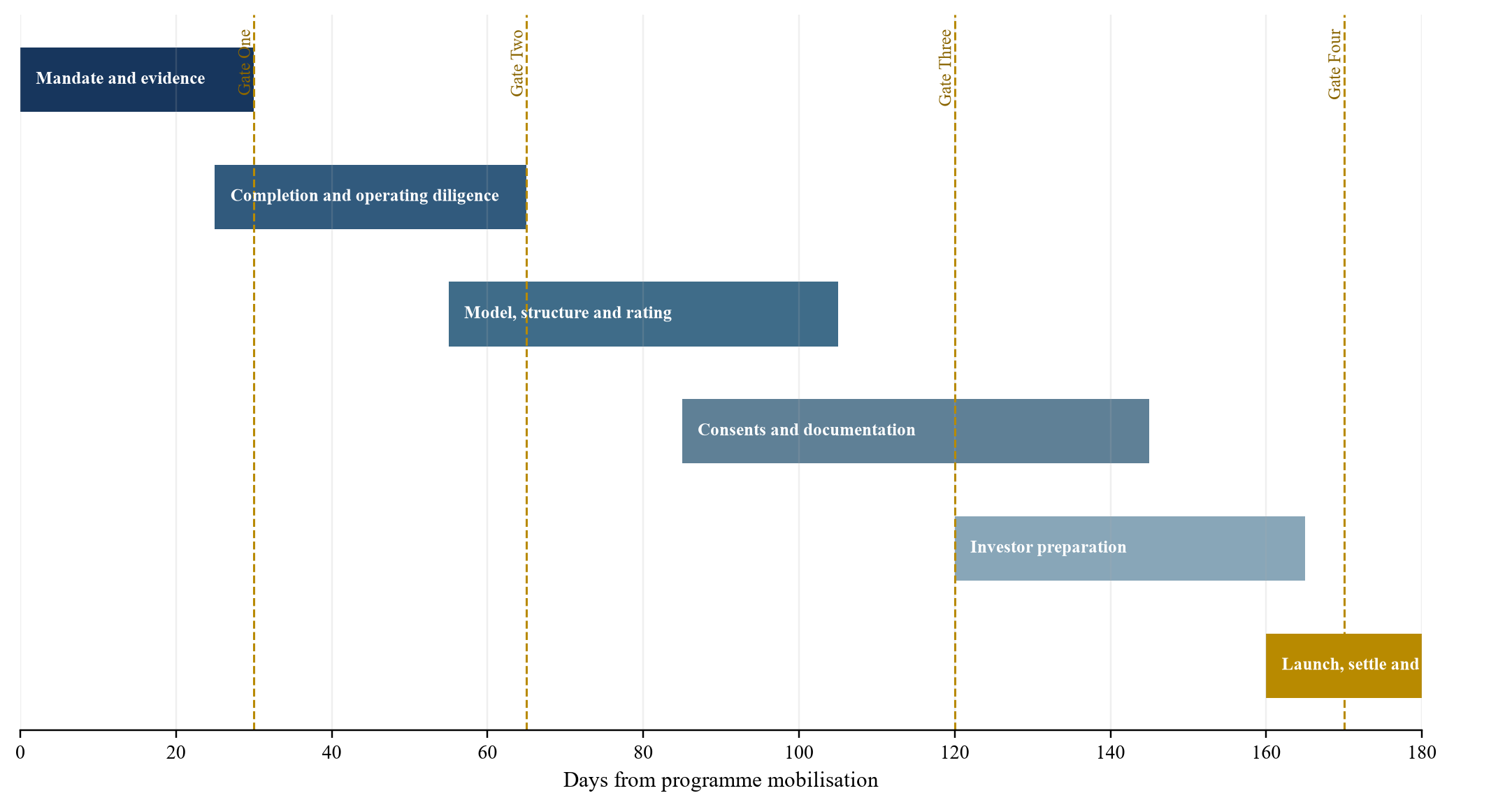
The sequencing is illustrative and should be adapted to the project's contracts, jurisdiction, rating process and market conditions.
| Decision question | Required evidence | Decision owner |
|---|---|---|
| Is construction risk acceptably closed? | Certificates, tests, claims, defects and independent engineer report | Board |
| Is operating performance stable and reconciled? | Historical KPIs, accounts, CFADS and maintenance record | Investment committee |
| Is the structure rating and market ready? | Rating case, covenants, reserves, disclosure and investor feedback | Financing committee |
| Does the transaction preserve value? | Alternatives, all-in economics, downside, consents and gain-share | Board |
| Can the issuer execute and monitor? | Timetable, authorities, controls, reporting and surveillance plan | Board and management |
The checklist supports an auditable decision; transaction-specific advice and approvals remain necessary.
29. Govern model risk and independent review
The refinancing model links operating evidence to debt capacity, pricing and shareholder value. Small errors in indexation, tax, reserve mechanics, sculpting or hedge treatment can change the apparent outcome. Model governance should therefore be independent of the commercial preference for a transaction.
The issuer should maintain a controlled master model with version history, input ownership, change logs and protected calculations. Historical data should reconcile to source systems. Contractual formulas should be mapped to the relevant provisions and reviewed by counsel or the appropriate specialist where interpretation affects cash flow.
An independent model audit should test logic, formula integrity, circularity, scenario controls, financial statements, taxes, debt schedules, reserves, covenants and outputs. The audit scope and materiality thresholds should be agreed before work begins. Open points should remain visible to the financing committee until resolved.
The board paper should report sensitivity rather than a single net-present-value result. It should identify the assumptions that drive route choice, rating headroom and distribution capacity. A model can support judgement only when its limitations and data boundaries are understood.
30. Align tax, accounting and distributable reserves
Refinancing can affect withholding tax, deductibility, transfer pricing, deferred tax, hedge accounting, transaction-cost amortisation and distributable reserves. These effects should be analysed in the issuer, project company, holding companies and investor structure.
The tax workstream should distinguish legal obligation from model assumption. It should address interest limitation, treaty access, beneficial ownership, permanent establishment, value-added tax on fees and taxes on security enforcement or asset transfers. Current advice is required in every relevant jurisdiction.
Accounting analysis should determine classification of the new debt, treatment of extinguishment or modification, embedded derivatives, transaction fees, reserves and covenant disclosures. The result can affect reported earnings and ratios without changing underlying cash flow. The decision paper should show both accounting and cash effects.
Distribution planning should confirm that cash permitted by the financing documents can lawfully be distributed. A refinancing that creates accounting profit or excess cash does not by itself establish distributable reserves or board authority.
31. Procure advisers through defined responsibilities
The transaction can involve financial advisers, arrangers, underwriters, rating agencies, legal counsel, technical advisers, model auditors, tax advisers, external reviewers, trustees, agents and listing venues. The issuer should define each mandate, deliverable, dependency and conflict.
Adviser fees should be compared on a common basis. Retainers, success fees, underwriting discounts, expense caps, discretionary fees and recurring agency costs should be visible. Fee incentives should not determine route selection or launch timing.
The issuer should identify which advisers owe duties to it, which act for investors or lenders and which provide independent opinions. Work-product reliance, confidentiality, liability caps and termination rights should be reviewed before appointment.
A single integrated timetable should assign every deliverable to an accountable owner. The project-management office should track overdue items, decision dependencies and changes to scope. Advisers should inform governance; management and the board retain the transaction decision.
32. Protect future capital expenditure and asset renewal
Long-lived infrastructure requires maintenance, lifecycle replacement, expansion and regulatory investment. The bond structure should leave adequate capacity for these needs rather than maximising initial distributions.
The asset-management plan should classify routine operating cost, major maintenance, lifecycle capital expenditure and expansion. It should identify timing, cost basis, contingency, procurement strategy and funding source. Technical-adviser review can test whether the plan is consistent with asset condition and contractual performance standards.
Reserve and covenant design should support necessary expenditure. A distribution lock-up should not prevent spending required to preserve safety, availability or concession compliance. Additional-debt provisions should distinguish value-preserving capital from speculative expansion.
Fitch's criteria examine infrastructure renewal and obsolescence alongside operations, revenue and debt structure [3]. The refinancing model should therefore cover the full period over which debt relies on asset performance, including replacement cycles that fall after the initial operating record.
33. Build a transaction decision record
The final decision record should allow a later reviewer to understand what the board approved, why it approved it, what evidence it relied upon and which risks remained. It should include the alternatives, evaluation criteria, model versions, adviser reports, ratings, consents, investor feedback and final terms.
The record should distinguish observed information, contractual facts, external opinions and management assumptions. It should document material changes between initial approval, launch and closing. Pricing improvements should not obscure covenant, security or allocation changes introduced during execution.
Exceptions should identify owner, rationale, duration and remediation. A condition waived for timing reasons should become a post-close action with a reporting deadline. Repeated waivers can indicate that the original readiness standard was unrealistic or poorly enforced.
An annual refinancing review should compare the original thesis with realised costs, operating performance, rating movement, covenant headroom, investor engagement and governance burden. Lessons should feed into the next financing decision and the organisation's infrastructure-capital playbook.
34. Prepare for a failed or deferred transaction
A refinancing programme should have a defined response if the bond cannot launch, prices outside the approved range, receives a weaker rating, or fails to settle. The project company should know how long existing liquidity lasts, which bank facilities remain available and which contractual deadlines create pressure.
The contingency plan should include an amend-and-extend proposal, private-placement alternative, bridge facility, sponsor support parameters and cost-control actions. Each alternative should have a lead time, approval path, conditions and maximum acceptable economics. An assumed rescue facility has no value until capacity, terms and authority are evidenced.
Communications require control. Investors, banks, public authorities, contractors, employees and rating agencies may receive different information under different duties. The issuer should prepare accurate, coordinated messages that preserve confidentiality and comply with applicable disclosure requirements.
Deferral should trigger a structured review of the cause. Market volatility, incomplete evidence, consent delay, rating weakness and unacceptable terms require different remedies. The committee should set the evidence and market conditions required to restart, together with an expiry date for stale diligence.
Failure planning strengthens execution discipline. It gives the pricing committee authority to withdraw from a poor transaction without creating an immediate funding crisis. It also protects the project from accepting leverage, covenants or investor concentration that weaken long-term resilience merely to declare the refinancing complete.
35. Convert the evidence pack into an investable credit case
The final credit case should allow an investor who did not finance construction to understand the asset, contracts, operating record, cash controls and downside protections without reconstructing the project from fragmented files. The task is larger than producing a disclosure document. It requires a reconciled chain from physical performance and contractual rights to reported cash flow, debt service and recoveries.
The opening section should define the asset perimeter and the legal entities on which creditors rely. It should identify ownership, concession or licence, land and access rights, material permits, operating contracts, revenue contracts, insurance, hedging, bank accounts, security and intercompany arrangements. A diagram should show where cash originates, which deductions occur before debt service, where reserves sit and which payments can leave the secured group. The legal description and financial model should use the same perimeter.
The operating case should present monthly or quarterly evidence at a level appropriate to the asset. Availability, output, demand, price, operating expenditure, maintenance, lifecycle expenditure, working capital and cash collection should reconcile to audited or independently reviewed records. Exceptions should be explained through cause, duration, financial effect and remediation. Averages can conceal the timing volatility that matters to debt service; the pack should therefore show distributions, seasonality, outages and the relationship between operational events and cash outcomes.
The contract case should translate legal terms into credit consequences. For each material agreement, the issuer should identify term, termination rights, performance standard, payment mechanism, indexation, force majeure, change in law, liability cap, security, step-in rights, cure periods, assignment, consent requirements and dispute status. The analysis should explain how these provisions affect revenue continuity, cost exposure and creditor remedies. S&P and Fitch both place material weight on the contractual and structural features that shape project cash flow and recovery [2][3].
The downside case should combine stresses that can occur together. A demand reduction may coincide with higher operating cost, delayed insurance recovery, weaker currency and a maintenance event. The model should show the timing of reserve use, distribution lock-up, covenant breach, cure rights and minimum liquidity. Management should identify which responses are contractual, which require lender or investor consent and which depend on new capital. Assumed refinancing, asset sale or sponsor support should not be treated as available cash without documented capacity and authority.
The recovery case should explain the creditor pathway after default. Investors need to understand the security package, ranking, enforcement restrictions, direct agreements, step-in process, insolvency regime, public-authority rights, replacement operator arrangements and the conditions under which the asset can continue operating. The value of security depends on practical continuity and transferability as well as legal form. Country, regulatory and concession features may restrict the speed or route of enforcement even when security is comprehensive.
The disclosure process should be controlled by a source register. Every material quantitative statement should point to a model cell, audited record, engineer report, contract or other identified source. Each document should have an owner, date and version. Differences among the model, rating presentation, offering materials and investor responses should be reconciled before launch. A disclosure committee should record material judgements, unresolved qualifications and approved wording.
Investor engagement should test the credit thesis rather than merely market the transaction. Questions should be logged by theme: completion, operations, revenue, counterparty, sovereign, currency, structure, liquidity, covenant, recovery, sustainability and reporting. Repeated questions can identify a missing control or weak explanation. The issuer should decide whether to improve evidence, modify terms, reduce leverage, increase reserves or accept a pricing consequence. The decision should be documented because a lower coupon obtained through weaker protection can reduce long-term financing quality.
The final committee paper should compare the approved refinancing with the executed transaction. It should show sources and uses, maturity, amortisation, coupon or spread, issue costs, hedging, reserves, covenants, rating, allocation, concentration, consent conditions and continuing reporting obligations. It should also show the bank alternative on the same basis. This comparison creates accountability for the full financing outcome and provides a baseline for surveillance, future capital decisions and any later refinancing-gain calculation.
Sources
- International Finance Corporation, Project Finance in Developing Countries, glossary and completion definitions. Read the primary source
- S&P Global Ratings, Project Finance Assessment Template for Assigning Project Finance Issue Ratings. Read the primary source
- Fitch Ratings, Infrastructure and Project Finance Rating Criteria, 14 November 2025. Read the primary source
- World Bank Group, Understanding Power Project Financing, Refinancing Post-Completion. Read the primary source
- Moody's Ratings, Generic Project Finance Rating Methodology, 2 October 2024. Read the primary source
- S&P Global Ratings, RFC Process Summary, Project Finance Rating Methodology. Read the primary source
- S&P Global Ratings, Project Finance: Why Ratings Above the Sovereign Are Possible. Read the primary source
- Global Infrastructure Hub, PPP Contract Management, Refinancing Guidance. Read the primary source
- International Capital Market Association, Infrastructure Financing: Bank Loans, Private Placements and Public Bonds. Read the primary source
- World Bank PPP Resource Center, Considerations for Government Public-Private Partnerships. Read the primary source
- European Investment Bank, Credit Enhancement for Project Finance. Read the primary source
- World Bank, Addressing Exchange Rate Risk in Infrastructure Projects in Emerging Markets and Developing Economies, 2024. Read the primary source
- International Capital Market Association, Green Bond Principles, 2025. Read the primary source
- World Bank Group, Promoting the Use of Capital Markets for Infrastructure Financing. Read the primary source
- Asian Development Bank, Financing Transport Connectivity in the Bay of Bengal Subregion, 2024. Read the primary source
- World Bank, Invest4Climate: Enabling Institutional Investment in Climate-Smart Infrastructure. Read the primary source
- World Bank PPP Resource Center, Infrastructure Asset-Backed Securitization. Read the primary source
- European Investment Bank, An Outline Guide to Project Bonds Credit Enhancement and the Project Bond Initiative. Read the primary source
