
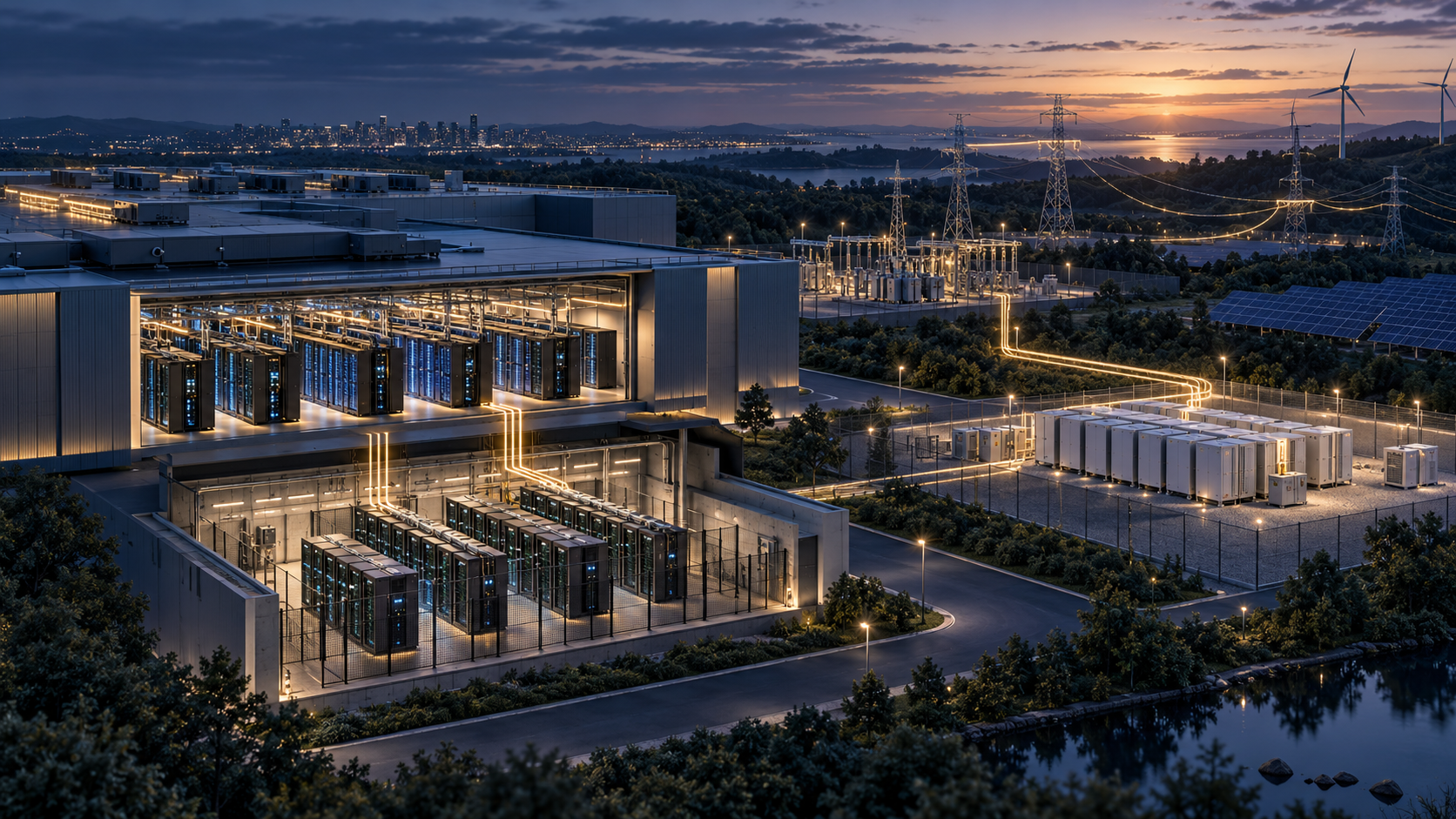
1. Decide whether the installed battery is truly available
The investment question is narrower than the general case for storage beside a data centre. An owner already has batteries, rectifiers, inverters, switchgear and controls whose first purpose is continuity. Management now wants to know whether unused capability can create contracted or merchant cash without weakening the service that justified the equipment.
The answer cannot be read from nameplate megawatts. The available product is the lower of electrical capability, protected-reserve headroom, warranty permission, customer authority, market eligibility and verified performance. Each limit can change by hour, operating state and equipment age.
This paper treats the UPS estate as an existing asset under a possible change of duty. The decision is a retrofit and rights-allocation exercise. It asks whether limited participation, a controls-only conversion, additional battery modules, or a separate grid-interactive system creates the best risk-adjusted value.
2. Establish the protected-service floor
Continuity remains the governing obligation. The protected-service floor should specify critical load, ride-through duration, generator-start and transfer sequence, credible failures, restoration path and minimum energy at the end of battery life. It should also state the operating conditions under which commercial dispatch is suspended.
The International Energy Agency reported that battery-based UPS additions, primarily in data centres, reached 45 GW in 2025. It distinguished these systems from longer-duration storage because UPS generally bridges outages until other backup sources start.[2] Installed scale therefore does not establish duration, dispatch rights or market availability.
The reserve should be expressed in delivered megawatt-hours at the protected bus after conversion losses, auxiliary consumption, temperature effects and degraded capacity. A percentage state-of-charge floor alone can conceal declining usable energy. The reserve policy should increase when generators, feeds, switchgear or cooling equipment are unavailable.
3. Treat conversion as a change of use
Frequent grid-service dispatch can alter cycle count, average state of charge, heat, inspection, replacement timing and control-system exposure. The investment committee should therefore treat participation as a change of use, even when no battery cabinet is added.
The diligence file should contain original design basis, single-line diagrams, load studies, commissioning results, event logs, battery chemistry, age, module configuration, state-of-health evidence, supplier warranty, maintenance contract, insurance conditions and customer service commitments. Missing evidence reduces the eligible tranche.
A conversion should proceed through written technical and commercial consents. Supplier confirmation should address duty cycle and warranty. The independent engineer should confirm protection and failure behaviour. Customers should confirm that the operating protocol does not breach service terms. The insurer should confirm the changed risk. The system operator or programme administrator should confirm eligibility, metering and settlement.
4. Draw the asset and rights perimeter
Value follows control. The owner may own the batteries while an equipment supplier controls firmware, a facilities contractor controls maintenance, a customer controls continuity settings, and an aggregator controls market dispatch. The grid connection agreement can reserve final authority to the utility or system operator.
The rights matrix should identify who may read data, issue a dispatch, override a dispatch, change the reserve, update software, isolate equipment, approve maintenance and receive payment. It should record liability for a failed grid response and liability for a customer outage following commercial dispatch.
Four structures are common in principle. The campus can operate the UPS directly; an aggregator can dispatch an approved envelope; a special-purpose storage company can lease capacity; or a dedicated battery can sit beside the UPS with separate control and metering. The preferred structure depends on enforceable rights and risk allocation rather than nominal ownership.
Table 1. UPS conversion rights and evidence matrix
| Decision right | Minimum evidence | Principal conflict | Approval gate |
|---|---|---|---|
| set protected reserve | load study, event sequence and end-of-life test | commercial dispatch can consume continuity headroom | data-centre operations retains final authority |
| issue grid dispatch | eligible product, secure signal and response test | simultaneous facility event or maintenance | dispatch remains inside pre-approved envelope |
| change firmware or controls | controlled release, test record and rollback plan | new logic can affect protection and transfer | supplier and independent engineer approve |
| cycle existing batteries | chemistry, state of health and warranty model | revenue can accelerate replacement | lifecycle reserve funds incremental wear |
| access operating data | cyber architecture, privacy terms and retention policy | external access can expose critical systems | least-privilege interface and auditable logs |
| receive and allocate cash | settlement statement and revenue waterfall | gross revenue can omit penalties and cost | reconciled net cash before distribution |
Project-specific engineering, contracts, market rules and customer obligations require current verification.
5. Separate UPS conversion from dedicated storage
An existing UPS can offer low incremental capital cost when compatible headroom, controls and rights already exist. Its commercial envelope can remain small because continuity duty dominates. A dedicated battery adds capital, land, interconnection, fire protection and permitting, while creating clearer operating freedom and longer duration.
The comparison should use incremental cash and incremental risk. Sunk UPS capital should not be treated as free capacity when conversion shortens life or requires earlier replacement. Dedicated storage should not receive resilience value unless its electrical position and control sequence actually protect the relevant load.
The decision can be staged. A controls and metering pilot can establish response and settlement. Additional modules can expand headroom. A separate battery can then absorb frequent cycling while the UPS remains protected. Each stage should have a stop condition.
6. Build the incremental valuation case
The investment case should compare mutually exclusive operating choices from the same valuation date. The first case preserves the UPS in continuity-only duty. The second permits a controlled operating band for an approved grid product. The third adds modules or power-conversion capacity. The fourth installs a dedicated battery with separate metering and operating rights. A fifth case can combine a small UPS tranche with dedicated storage where electrical studies support the arrangement.
Each case should begin with incremental capital and incremental lifecycle cost. Controls, meters, communications, protection studies, commissioning, market registration, cyber controls, insurance, legal work and customer-consent processes can be material even when battery cabinets already exist. The model should also recognise earlier module replacement, incremental cooling, auxiliary electricity, maintenance, testing, availability deductions, aggregator fees and settlement disputes.
Gross grid-service receipts are not free cash flow. The revenue waterfall should deduct programme or aggregator charges, non-performance deductions, incremental electricity, degradation cost, operating labour, insurance, tax and lifecycle reserves. Cash should be recognised in the period supported by meter and settlement evidence. Forecast revenue should be classified by contract tenor, counterparty, termination right, price mechanism and exposure to rule change.
The continuity-only case supplies the economic baseline. It includes the cost of maintaining and replacing the UPS for its original duty. The conversion case should include only cash and cost caused by the new use. This prevents a valuation from crediting the project with sunk equipment while omitting the economic consumption of that equipment.
Residual value requires care. Battery modules with limited remaining life, restricted warranties or obsolete controls may have little continuing grid-service value. Power electronics, switchgear, cabling and interconnection rights can retain value when they remain compliant and reusable. The valuer should separate physical components and avoid applying a single terminal multiple to a mixed estate.
For a transaction, the data room should permit a buyer to reproduce the available-capacity calculation and revenue waterfall. Historical nameplate data is insufficient. A buyer needs interval meter data, state-of-health tests, event and override logs, warranty correspondence, maintenance evidence, market settlement, deductions, customer terms and replacement forecasts. Where those records are missing, value should remain in a contingent payment, earn-out or seller-supported warranty rather than unconditional consideration.
An owner can use a special-purpose vehicle when dedicated storage has separable assets, contracts, meters and cash. Existing UPS systems embedded in the data-centre service chain can be harder to isolate. Security over a system that is essential to customer continuity raises step-in, enforcement and operational-consent issues. Financing should reflect the actual separability of the collateral.
Debt capacity should follow controllable downside cash. Contracted availability revenue can support debt when the contract, eligibility, performance and payment mechanism are durable. Activation revenue, tariff savings and merchant spreads may support equity value with appropriate stress. Avoided outage loss is a strategic benefit and should remain outside debt service unless an enforceable cash mechanism converts it into a dependable receipt.
The discount rate should reflect the risks remaining after contract and operating controls. A long-dated fixed availability payment with strong counterparty, tested performance and funded replacement differs from merchant ancillary-service exposure. A blended rate can conceal the distinction. The model should value contractual tranches separately and reconcile them to enterprise value.
The approval paper should report value per verified available megawatt, value per incremental unit of capital, lifecycle net present value, minimum debt-service coverage, payback, downside funding need and the effect on protected-service margin. It should also show the value lost if supplier warranty, customer consent or market eligibility is withdrawn. This sensitivity identifies which consent creates the most economic leverage.
The central decision remains operational. A conversion that raises projected value while reducing continuity evidence can damage the primary asset. Approval should therefore require that every commercial case preserves the protected-service floor at beginning and end of life, during maintenance and after an earlier commercial dispatch.
Valuation governance should also define the evidence date. Battery health, warranty headroom, market rules and customer permissions can change faster than a conventional long-life infrastructure assumption. The committee should require periodic remeasurement and a documented bridge from the prior valuation. Changes should be attributed to realised cash, revised operating evidence, ageing, augmentation, contract movement and market outlook. A clear bridge prevents favourable market pricing from obscuring physical deterioration or a weakening contractual position. It also permits lenders and investors to distinguish operating performance from assumption changes. Where a contract renewal, customer consent or warranty extension remains outstanding, the associated value should be shown separately and should not enter the approved base case until the relevant instrument is executed and its conditions are satisfied.
Transaction documents should translate the operating model into enforceable remedies. A buyer can require a closing state-of-health certificate, verified reserve settings, successful dispatch tests and confirmation that no undisclosed cycling has occurred. A seller can limit responsibility to stated tests and disclosed records. An operator can retain emergency override rights without accepting liability for revenue lost during a genuine facility event. An aggregator can accept settlement and performance obligations inside the approved dispatch envelope. These provisions should align because a commercial promise that exceeds the engineering envelope transfers unpriced risk back to the campus.
Post-closing covenants can require periodic capacity tests, minimum state of health, maintenance, cyber controls, insurance, reserve compliance and funded replacement. Distribution restrictions can apply after a reserve breach or failed test. A replacement account can accumulate cash according to measured throughput and calendar ageing. Step-in rights should preserve qualified operation and customer continuity. Enforcement should avoid forcing a battery dispatch that conflicts with the protected-service floor. The resulting package turns physical headroom into a governed asset without treating continuity as an incidental constraint.
7. Choose the electrical architecture
Storage can connect at the rack, low-voltage DC bus, UPS output, low-voltage AC bus, medium-voltage facility bus or grid connection. Location changes which loads it protects, which losses it experiences and which services it can measure.
Rack storage can respond close to the computing load and reduce central distribution requirements. It increases the number of battery systems, maintenance points and fire locations. Central storage can consolidate controls and energy while depending on common switchgear and distribution paths.
Behind-the-meter storage can reduce facility withdrawal and support customer resilience. Front-of-meter storage may access grid markets more directly and remain electrically separate from the data-centre load. A co-located project can contain both, with distinct meters and operating rights.
The architecture should be evaluated against single points of failure. A battery connected downstream of a failed switchboard cannot protect an upstream loss. A shared inverter or controller can affect several services. Protection coordination and fault contribution require specialist study.
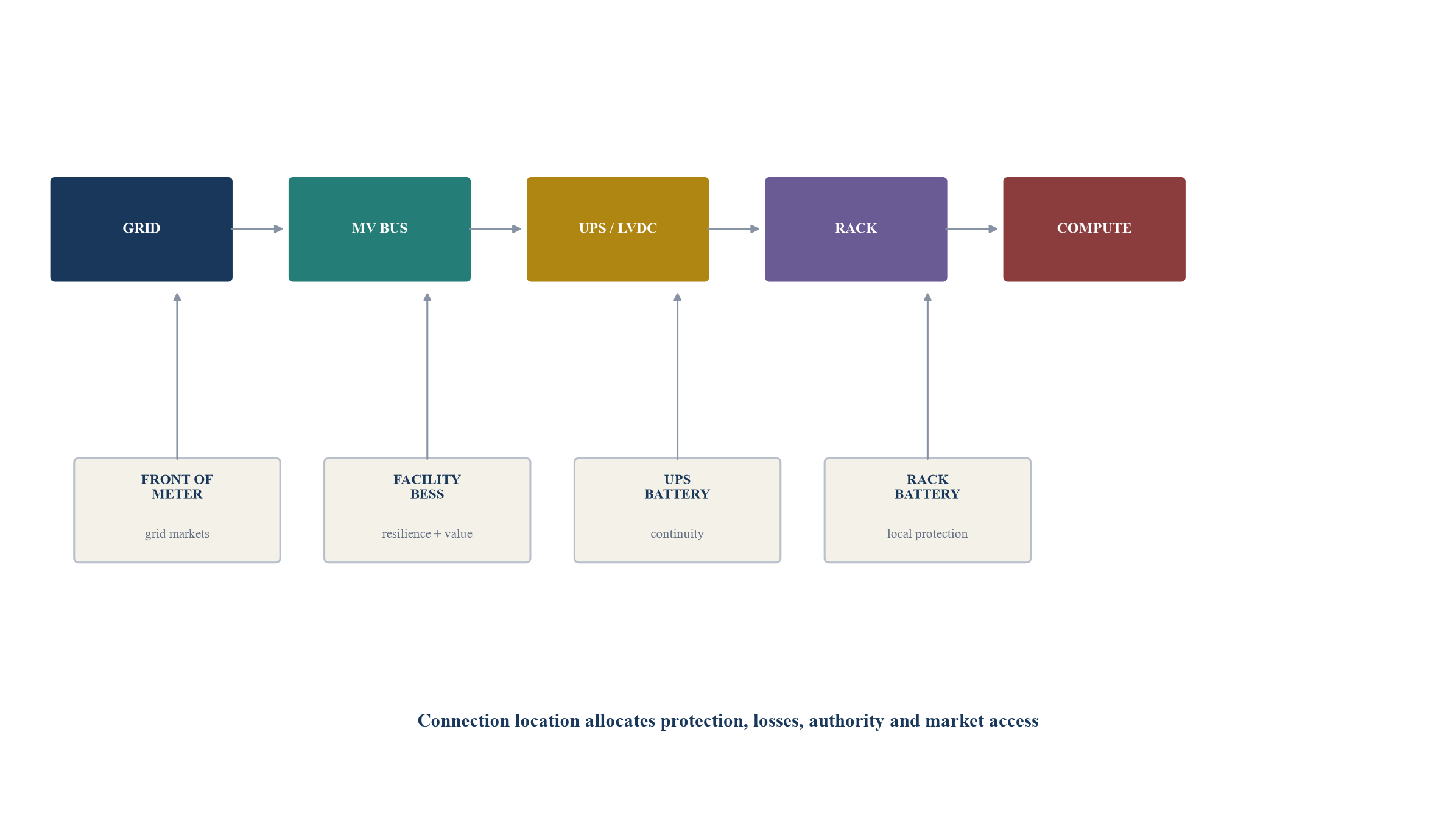
Author framework. The connection point determines protected load, control and settlement boundary.
8. Reserve state of charge explicitly
State of charge is the battery's current energy position. A resilience reserve specifies the minimum energy held for protected service. An operating band limits charging and discharge to preserve life, safety and readiness.
The dispatch controller should allocate energy among protected reserve, committed grid service, expected peak management and discretionary optimisation. These allocations should change with grid condition, generator status, maintenance, customer criticality, weather and battery health.
A simple rule can hold a fixed reserve. A dynamic rule can increase reserve during grid stress or generator maintenance. Dynamic optimisation can improve economics while adding model and governance risk. The committee should approve the rule, override rights and minimum floor.
Recharge deserves the same attention as discharge. The facility needs a maximum recharge rate, permissible windows and plan for consecutive events. Recharging after a system peak can create cost or constraint. Slow recharge can leave the battery unprepared for the next outage.
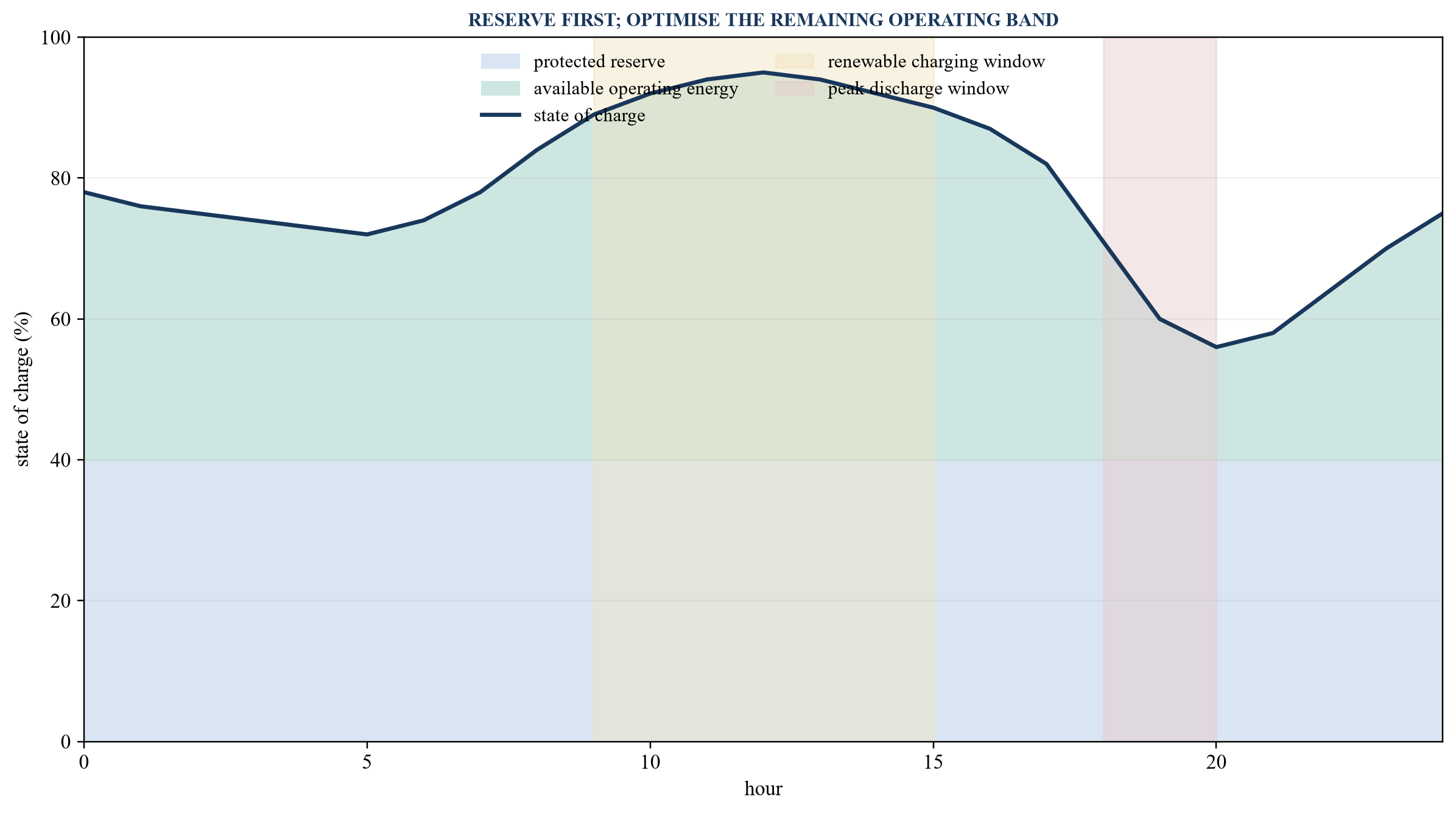
Author framework. Values are illustrative and do not represent an actual battery or dispatch plan.
9. Model Gulf heat and cooling
Battery performance and life depend on temperature. High ambient conditions increase cooling energy and can reduce available power or accelerate degradation when thermal management is inadequate. Data-centre electricity demand can also rise with cooling load during hot periods, making battery need and battery stress correlated.
The design should use site-specific ambient profiles, enclosure heat gain, HVAC redundancy, dust, humidity, salt, ventilation and fire strategy. It should model auxiliary power during charge, discharge, standby and emergency operation.
Singapore's Energy Market Authority used early utility-scale storage projects to gather performance evidence in a hot and humid environment.[11] Gulf projects require their own climatic and site tests. Supplier ratings should be reconciled to the project's maximum design conditions and degradation warranty.
The financial model should reduce net deliverable energy by cooling and conversion losses. It should include cooling capital, maintenance and replacement. Resilience calculations should assume auxiliary systems remain powered during the event.
10. Build the complete sizing file
The sizing file should reconcile nameplate power and energy to beginning-of-life and end-of-life usable service. It should include state-of-charge range, depth of discharge, round-trip efficiency, inverter capability, cell and system degradation, auxiliary load, availability, outages and temperature derating.
Power capability can degrade differently from energy. A system may retain enough energy while failing a high-power response. Inverter and transformer limits can cap delivery. Grid and facility voltage conditions can change performance.
The file should run event sequences rather than isolated events. A grid-service dispatch followed by an outage is more demanding than either alone. A morning event, incomplete recharge and evening peak should be tested. Generator failure should be layered onto a low-state-of-charge case.
Table 2. Battery sizing and diligence file
| Field | Required evidence | Model treatment | Decision test |
|---|---|---|---|
| Nameplate power and energy | supplier data and tested configuration | separate MW and MWh | does the selected configuration match the duty? |
| Usable operating range | warranty and control settings | minimum and maximum state of charge | is protected reserve enforceable? |
| Efficiency | tested charge, discharge and auxiliary data | interval losses by operating mode | does net energy reach the load or meter? |
| Degradation | warranted curves and duty cycle | calendar and cycling loss | is end-of-life service still adequate? |
| Temperature | site weather and thermal design | power, energy and auxiliary derating | does peak heat coincide with system need? |
| Availability | maintenance and component architecture | planned and forced outage cases | is redundancy sufficient for the obligation? |
| Recharge | grid capacity, tariff and operating rule | rate, window and consecutive events | can reserve be restored before the next need? |
| Protection | electrical studies and tests | trip and isolation sequence | does storage remain available through credible faults? |
| Safety | hazard studies and emergency plan | capital, spacing and operating restrictions | are risks managed through the lifecycle? |
| Replacement | module, inverter and control plan | timing, cost and outage | is lifecycle capital funded? |
| Terminal value | residual health and removal obligations | reuse, recycle or disposal case | is residual value supported by evidence? |
Design inputs require current supplier, engineer, operator, insurer and regulatory evidence.
11. Separate resilience value from avoided loss
Resilience value is difficult to price because severe events are infrequent and their consequence can be large. The model should estimate the frequency, duration and cause of service interruptions; the probability storage performs; and the losses avoided.
Avoided loss can include customer credits, lost revenue, damaged equipment, data recovery, operational restoration and reputational consequences. These values require evidence and should not be treated as certain cash. Insurance terms, customer liability caps, redundant grid supply and generators affect the exposure.
The base case should value storage against the complete existing resilience chain. If generators already provide reliable extended backup, battery value may lie in bridge reliability, fuel reduction or power quality. If grid connection is weak, longer energy duration may carry greater value.
Resilience value should be reported as a scenario range separate from contracted revenue. A lender should not size debt to an avoided-loss estimate unless the cash mechanism is clear.
12. Identify contracted and merchant cash
Storage can earn or save cash through capacity, availability, balancing, demand response, energy arbitrage, peak reduction, connection support, tariff management and renewable shifting. Each stream has different counterparty, term, dispatch, measurement and credit quality.
Contracted revenue should be supported by an executed agreement, eligibility, metering, operating history, payment formula and termination rights. Merchant revenue depends on future prices, volatility, competition, regulation and dispatch. Avoided tariff cost depends on the current tariff and facility load.
Australia demonstrates both opportunity and volatility. AEMO reported a new National Electricity Market battery discharge record of 3,556 MW in the first quarter of 2026 and estimated quarterly grid-scale battery revenue of AUD 96.9 million. In the third quarter of 2025, AEMO reported falling battery price spreads alongside capacity growth, which reduced arbitrage earnings despite higher discharge.[8][9]
These observations show why a single historical revenue period is not an underwriting case. Gulf models should separate each stream and stress lower prices, more capacity, dispatch restrictions and market-rule change.
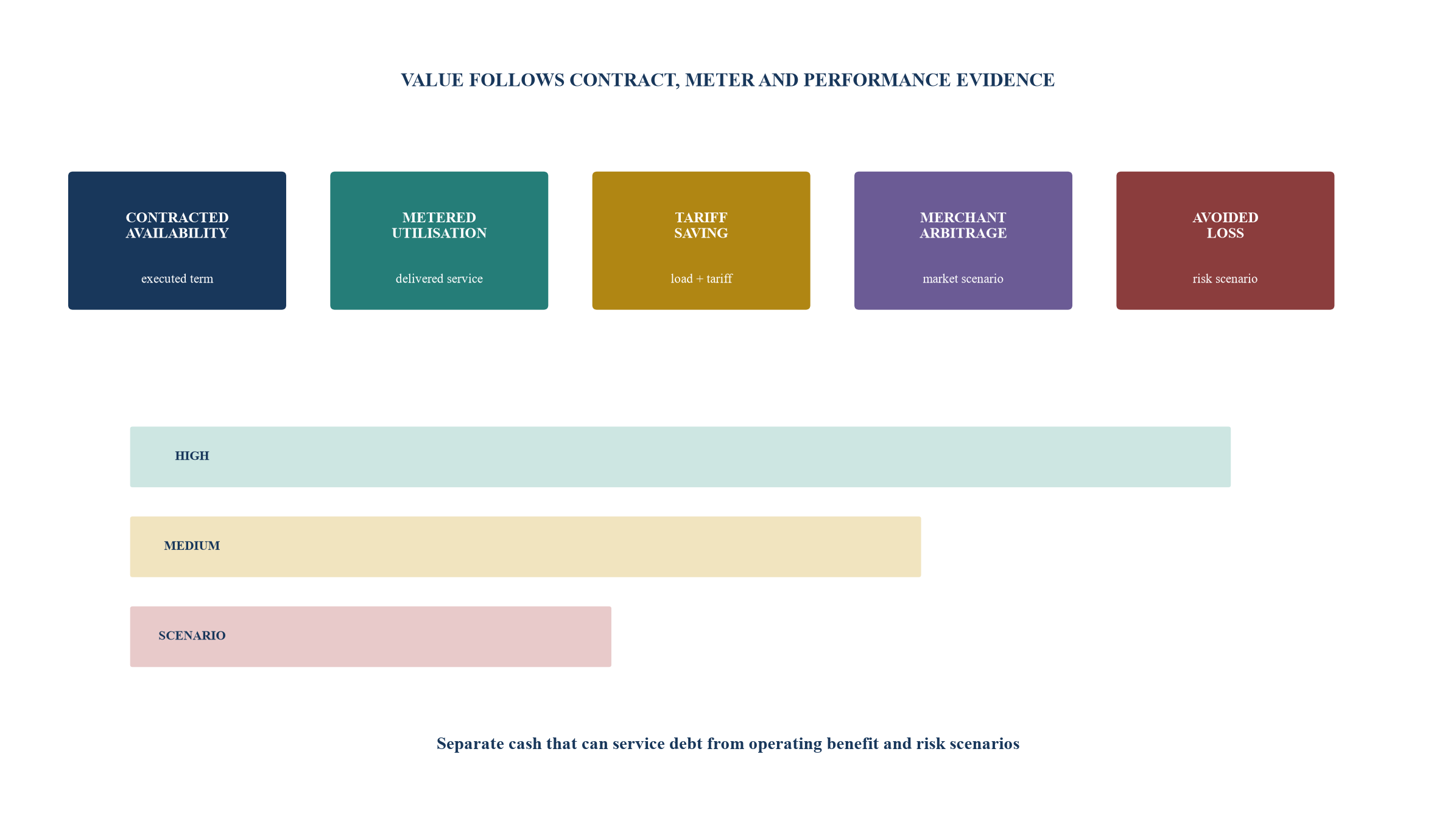
Author framework. Revenue receives value according to contract and operating evidence.
13. Prevent revenue double counting
A battery has finite power, energy and cycling capability. Capacity committed to one service may be unavailable for another. The model should co-optimise services by interval and preserve the protected reserve.
Revenue stacking should use compatible products. A battery cannot receive full capacity value from two buyers who may dispatch simultaneously unless rules permit and physical headroom covers both. Tariff savings and market revenue can also refer to the same discharge.
The operator needs a dispatch hierarchy, nomination process and conflict rule. Settlement data should allocate charge, discharge and losses to each service. Contracts should disclose other obligations and address priority.
The investment case should include an unstacked base case, an approved stacked case and a downside case in which secondary revenue disappears. Capital should remain supportable under the approved downside.
14. Price degradation as a delivered-service cost
Battery capacity declines with calendar time, temperature, state of charge, depth of discharge, cycle count and power. Warranty language may limit annual throughput, average state of charge, temperature and operating modes.
Degradation should be modelled from the proposed dispatch, not a generic annual percentage. The model should calculate equivalent full cycles, energy throughput, calendar loss, augmentation and replacement. It should include downtime and commissioning.
A high-value fast-response service may use little energy while demanding readiness and power. Arbitrage can use more energy and cycles. Resilience reserve can maintain a high state of charge that affects ageing. The optimal stack therefore depends on both revenue and degradation.
15. Underwrite safety as a lifecycle obligation
Battery safety extends from cell selection and factory quality through transport, installation, operation, maintenance, incident response, augmentation and decommissioning. The design should address thermal runaway, fire propagation, explosion, toxic or flammable gases, electrical hazards, water and environmental effects.
Great Britain's Health and Safety Executive states that designers, installers and operators carry lifecycle responsibilities under applicable health and safety law.[12] United Kingdom government guidance maps standards across grid-scale storage deployment.[13] These sources apply in Great Britain, though the control topics are useful diligence prompts elsewhere.
Gulf projects require current local approvals, civil defence engagement, environmental review, insurer input and applicable standards. Site separation from data halls, air intakes, critical switchgear, fuel systems and public boundaries requires specialist consequence analysis.
The financial model should include detection, suppression, ventilation, water, access, monitoring, training, spares, inspections, emergency exercises and decommissioning. Safety capital should not be treated as optional contingency.
16. Govern cyber and control systems
The energy-management system receives price, grid and facility signals and issues commands to batteries, inverters, switchgear and auxiliary systems. It can affect critical power.
Control architecture should segment networks, authenticate users and devices, restrict commands, log activity, manage software change and preserve safe local operation when communication fails. External aggregators should receive only the access needed for the contracted service.
The operator should define manual override, loss-of-communication behaviour, invalid signal rejection and restoration. Cyber incidents should trigger coordinated energy and data-centre response.
Source code, algorithms, cloud dependencies, licences and vendor support belong in diligence. A battery with unavailable controls can lose market and resilience value even when cells remain healthy.
17. Compare international operating evidence
The IEA reported 108 GW of new battery storage capacity worldwide in 2025, with deployment led by China and followed by the United States and Europe.[2] Global scale supports supply-chain learning while project performance remains specific to design and duty.
Australia provides transparent dispatch and revenue evidence through AEMO. California ISO reported that 4,260 MW of battery storage helped meet 2025 summer peak demand.[10] Singapore has used policy and pilots to develop storage in a dense, hot and humid system.[11] Great Britain provides mature safety and planning evidence.[12][13]
Gulf evidence includes Abu Dhabi's 108 MW distributed virtual battery plant opened in 2019, Dubai's planned 1,400 MW six-hour battery system within the seventh phase of the Mohammed bin Rashid Al Maktoum Solar Park, and Abu Dhabi's 2026 solar self-supply policy incorporating battery storage.[14][15][16]
These are different projects and institutional settings. Their value lies in the questions they surface: climate, service duration, control, dispatch, safety, licensing, contracting and system integration.
Table 3. Selected international storage evidence and Gulf decision lessons
| Market | Official evidence | Demonstrated issue | Gulf decision lesson |
|---|---|---|---|
| Global | IEA deployment and flexibility analysis | rapid scale, shorter and longer duration, UPS growth | separate global cost context from project deliverability |
| Australia | AEMO dispatch and revenue reporting | record discharge and changing arbitrage spreads | stress merchant revenue and measure state-of-charge behaviour |
| California | CAISO peak-support evidence | large battery fleet supporting summer peak | test coincident availability during high-load conditions |
| Singapore | EMA policy and hot-humid pilots | dense-system integration and climate evidence | validate thermal design and land-efficient architecture locally |
| Great Britain | HSE and government safety guidance | lifecycle duties, planning and emergency response | fund safety, approvals and decommissioning from inception |
| Abu Dhabi | virtual battery plant and self-supply policy | distributed control, storage policy and licensing | confirm current eligibility, dispatch and settlement rights |
| Dubai | planned six-hour solar-park storage | large-scale renewable shifting and dispatchability | compare facility storage with system-scale procurement alternatives |
Each source applies within its stated market and institutional purpose; project decisions require current local evidence.
18. Select the investment perimeter
The project can own storage within the data-centre company, a separate energy subsidiary, a utility arrangement or a third-party service contract. Ownership affects capital, control, tax, accounting, licences, insurance, grid rights and lender security.
Data-centre ownership maximises control and integration. It concentrates technology and operating risk. Third-party ownership can transfer capital and performance obligations while creating dependency and contract complexity. A utility-owned system can support network needs while offering less customer control.
The investment perimeter should include cells, modules, racks or containers, inverters, transformers, switchgear, cabling, controls, HVAC, fire systems, civil works, grid studies, metering, spares, commissioning and lifecycle capital. Interconnection and data-centre interface costs can be material.
The committee should compare build, lease, storage-as-a-service and utility tariff options on one delivered-service basis.
19. Finance against controllable cash
Lenders need evidence of construction completion, performance, warranties, insurance, operating capability, revenue, operating cost and replacement funding. Technology and market risk should be allocated to parties able to manage it.
Debt sizing should distinguish contracted availability and service revenue from merchant arbitrage, tariff savings and avoided loss. Contract tenor should cover debt service. Termination, change in law and performance deductions require downside modelling.
Security should cover project assets, accounts, material contracts and insurance subject to applicable law. Direct agreements can provide notice and cure. The lender should understand whether the battery can operate separately from the data centre and whether removal is technically and legally practical.
Replacement and augmentation reserves can protect end-of-life service. Cash sweeps can respond to underperformance. Distribution tests should include state of health, reserve compliance and contracted availability.
20. Test a hypothetical Gulf project
Consider a hypothetical 40 MW, 120 MWh facility-scale battery beside a 100 MW data-centre campus. Management assumes a protected reserve of 48 MWh, leaving a controlled operating band for peak management, renewable shifting and a contracted flexibility product.
Management assumes a hypothetical installed cost, operating cost, efficiency, degradation curve, augmentation plan, tariff saving and service revenue. Every input is illustrative. It does not represent a quotation, market price, project or forecast.
The model calculates annual delivered energy, gross cash benefit, operating cost, degradation and augmentation. It reports resilience scenarios separately. Debt sizing uses only the portion of cash supported by an assumed executed contract in the demonstration.
21. Stress the project
The investment case should test higher temperature, lower efficiency, faster degradation, low price spreads, service termination, delayed connection, lower load, battery outage, failed augmentation and safety-related shutdown.
Correlation matters. Extreme heat can raise campus demand, increase battery cooling load and reduce power at the same time. A grid event can arrive after an earlier commercial dispatch. A market downturn can reduce revenue while replacement costs remain.
The base project should remain financeable when merchant cash falls materially. Resilience reserve should survive every approved operating case. A scenario that requires using protected reserve to meet financial covenants indicates an inconsistent structure.
22. Establish the governance dashboard
The board should receive physical, commercial and risk measures. Physical measures include state of charge, state of health, usable energy, power capability, efficiency, temperature, availability, faults and protected reserve.
Commercial measures include contracted availability, dispatch, delivered energy, tariff saving, market revenue, deductions, operating cost and settled cash. Risk measures include reserve breaches, warranty headroom, safety alarms, cyber events, insurance conditions and replacement funding.
Reported cash should reconcile to metered operation. The dashboard should distinguish accrued, invoiced, settled and disputed amounts. Market optimisation results should be compared with the approved downside.
Change control should cover software, dispatch algorithms, service stacking, operating limits, battery modules, suppliers and safety design. Any change that affects protected service should require data-centre operational approval.
23. Implement through gated delivery
The first month establishes governance, load evidence, use cases and the current regulatory route. The second month completes architecture, sizing, safety and market design. The third month runs procurement, financing, contract and interface work. The fourth month completes technical and commercial diligence and reaches a controlled investment decision.
24. Set the investment decision
The committee should approve the protected service, minimum reserve, architecture, nameplate and usable capacity, approved services, dispatch hierarchy, capital budget, lifecycle reserve, contracted revenue and merchant limit.
Conditions should cover regulatory approvals, grid connection, customer and lender consent, final engineering, safety plan, insurance, supplier contract, performance security, control testing and financial close.
The approval should state which value sources support capital. Contracted cash can support debt according to its terms and counterparty. Tariff saving can support equity when the load and tariff evidence is stable. Merchant revenue and avoided loss should remain scenarios unless stronger evidence exists.
The project should decline or resize when the protected reserve is unclear, safety route is unresolved, supplier warranties conflict with dispatch, revenue depends on double counting or lifecycle capital is unfunded.
25. Limitations and conclusion
Battery technology, prices, supply chains, market rules, tariffs, grid needs, safety requirements, insurance, data-centre loads and customer contracts can change. Investment decisions require current evidence from regulators, utilities, system operators, equipment suppliers, independent engineers, fire and safety specialists, insurers, customers, lenders and qualified advisers.
IEA materials provide global and comparative analysis.[1][2][3] DOE and California ISO materials apply within their stated United States purposes.[4][5][6][7][10] AEMO materials describe Australian market outcomes.[8][9] Singapore, Great Britain, Abu Dhabi and Dubai sources apply within their respective institutional settings.[11][12][13][14][15][16]
Every capacity, cost, price, rate, duration, cycle, probability, date, degradation value and financial result in the worked example is a hypothetical management assumption. No data-centre project, battery quotation, tariff, contract, market price or realised performance is claimed.
Storage beside a Gulf data centre can create significant resilience and operating value when the protected service governs design and dispatch. The battery should be sized to net deliverable performance, reserved explicitly, tested under Gulf conditions and supported by a funded lifecycle plan.
The investment case becomes financeable when contracted cash is distinguished from market exposure, merchant upside remains stressed, safety and cyber duties are complete, and every secondary service respects the facility's primary digital obligation.
References
- International Energy Agency, Electricity 2026: Flexibility, 2026. https://www.iea.org/reports/electricity-2026/flexibility
- International Energy Agency, Global Energy Review 2026: Battery Storage, 2026. https://www.iea.org/reports/global-energy-review-2026/technology-battery-storage
- International Energy Agency, Batteries and Secure Energy Transitions: Executive Summary, 2024. https://www.iea.org/reports/batteries-and-secure-energy-transitions/executive-summary
- United States Department of Energy, Uninterruptible Power Supplies, official materials accessed 13 August 2026. https://www.energy.gov/cmei/buildings/uninterruptible-power-supplies
- United States Department of Energy and Pacific Northwest National Laboratory, Electromagnetic Transient Modeling of Large Data Centers for Grid-Level Studies, December 2025. https://www.energy.gov/sites/default/files/2026-01/Data_Center_EMT_Models.pdf
- United States Department of Energy, Battery Energy Storage System Evaluation Method, 30 January 2024. https://www.energy.gov/cmei/femp/articles/battery-energy-storage-system-evaluation-method
- United States Department of Energy, Energy Storage Valuation: A Review of Use Cases and Modeling Tools, June 2022. https://www.energy.gov/sites/default/files/2022-06/MSP_Report_2022June_Final_508_v3.pdf
- Australian Energy Market Operator, Quarterly Energy Dynamics Q1 2026, May 2026. https://www.aemo.com.au/-/media/files/major-publications/qed/2026/qed-q1-2026.pdf
- Australian Energy Market Operator, Quarterly Energy Dynamics Q3 2025, November 2025. https://www.aemo.com.au/-/media/files/major-publications/qed/2025/qed-q3-2025.pdf
- California Independent System Operator, 2025 Year in Review, 2025. https://www.caiso.com/about/news/energy-matters-blog/california-iso-2025-year-in-review
- Energy Market Authority of Singapore, Energy Storage Systems for Singapore, official policy. https://www.ema.gov.sg/content/dam/corporate/regulations/policy-papers/pdf-files/EMA-Regulations-Policies-Policy-on-Energy-Storage-Systems-for-Singapore.pdf
- Great Britain Health and Safety Executive, Grid-Scale Battery Energy Storage Systems, official guidance accessed 13 August 2026. https://www.hse.gov.uk/electricity/battery-energy-storage-systems.htm
- United Kingdom Department for Energy Security and Net Zero, Grid Scale Electrical Energy Storage Systems: Health and Safety, 18 April 2024. https://www.gov.uk/government/publications/grid-scale-electrical-energy-storage-systems-health-and-safety
- Abu Dhabi Department of Energy, Abu Dhabi Launches World's Largest Virtual Battery Plant, 17 January 2019. https://www.doe.gov.ae/en/Media-Centre/News/Abu-Dhabi-Launches-Worlds-Largest-Virtual-Battery-Plant
- Dubai Electricity and Water Authority, Seventh Phase of the Mohammed bin Rashid Al Maktoum Solar Park, January 2026. https://www.dewa.gov.ae/en/about-us/media-publications/latest-news/2026/1/dewa-highlights-7th-phase
- Abu Dhabi Department of Energy, Solar Energy Self-Supply Policy, 5 February 2026. https://www.doe.gov.ae/en/Media-Centre/News/The-Abu-Dhabi-Department-of-Energy-launches-Solar-Energy-Self-Supply-Policy-in-emirate
About the Author
Authored by Chennakeshav Adya Independent Researcher
Chennakeshav (CK) is a corporate finance and investment banking executive with 25+ years of global experience in deal origination, structuring and execution across M&A, growth capital and corporate strategy. He has led value-creation mandates for founders, corporates and funds — bridging the boardroom view to hands-on execution and close.
His career spans Morgan Stanley, HSBC, Lloyds Banking Group, EWEC, ADQ portfolio companies and Emirates Growth Fund, across TMT, real estate, fintech, deeptech, cleantech, infrastructure and energy. He has partnered with C-suite leaders, private equity and venture funds, sovereign wealth funds and family offices to finance complex fund raises and scale-up ventures, and has led M&A due diligence, post-merger integration and business-transformation initiatives to create value.
At Matchpoint Partners he is Managing Partner, leading the firm's corporate finance, M&A and capital-raising practice. He holds an MBA from London Business School, an engineering degree from VTU and a Master of Laws (LLM, in progress) from UCL London.
An active start-up mentor, CK mentors at Techstars, DIFC FinTech Hive, Startup Grind, Founder Institute and IN5, serves as Entrepreneur Mentor in Residence (EMiR) at London Business School, and judges the Entrepreneurship World Cup.
Matchpoint profile: https://www.matchpoint-partners.com/team/ck-adya.html LinkedIn: https://www.linkedin.com/in/ckadya/
