

Introduction
Battery swapping changes the unit of analysis in electric mobility. A conventional vehicle sale bundles the traction battery with the vehicle. A swapping platform can separate them: the customer buys or leases the vehicle, another party owns a pool of batteries, and a network operator exchanges depleted packs for charged packs. This separation can reduce the customer's initial vehicle cost and shorten energy-replenishment time. It also creates questions that ordinary charging models do not answer.
The central question is ownership. The party funding a battery needs control over its use, access to state-of-health data, protection against incompatible vehicle design and a credible route to residual value. The party operating a station needs enough compatible packs to meet demand, while excess inventory depresses utilisation. The fleet needs reliable access and predictable cost without accepting unknown battery condition. The vehicle manufacturer needs safety, warranty and interface discipline.
Evidence shows material scale in selected markets. NIO reported 3,054 power-swap stations and more than 61 million cumulative swaps at 31 December 2024.[1] CATL reported more than 1,000 Choco-Swap stations across 45 Chinese cities at the end of 2025 and described partnerships spanning manufacturers, energy companies, fleets and financial lessors.[2] Gogoro reported 665,000 subscribers at the end of 2025 in its two-wheeler network.[3] These figures demonstrate operating activity in specific ecosystems. They do not establish transferable economics for a new geography, vehicle class or standard.
This paper addresses the investment decision: which ownership, standardisation and utilisation evidence should permit a battery-swapping platform to receive capital, debt or valuation recognition?
1. Define the service before the assets
A swap network sells availability of a compatible charged battery at an acceptable location and time. The physical exchange may take minutes, while the commercial promise spans pack quality, station uptime, reservation, payment, warranty and emergency support. Define the service level before selecting ownership.
Specify vehicle classes, duty cycles, service territory, hours, maximum queue, minimum delivered state of charge, pack-health range and response after a failed swap. A closed depot serving a controlled truck fleet has a different promise from a public passenger-car network. Two-wheelers, taxis, rental fleets and mine-haul trucks create further operating patterns.
Ownership should support the service promise. If the network guarantees a charged pack, it requires rights over inventory, charging priority and maintenance. If the fleet owns every pack, the operator needs contractual authority to inspect, charge and rotate them. Ambiguous control becomes an operational failure when demand peaks.
2. Separate the asset layers
The system contains at least six asset layers: vehicle interface, battery pack, station mechanical equipment, charging equipment, grid connection, and digital platform. Land, buildings, spare parts and maintenance tools add further capital. Each layer has a different life, technology path and security value.
Map legal title, operating control, maintenance obligation, data access and residual-value exposure for each layer. One party may own the station shell while another owns charging modules. A battery financier may hold title to packs while the network operator controls daily cycling. The fleet may own vehicles subject to an interface warranty from the manufacturer.
Avoid a single label such as battery-as-a-service when contracts allocate control differently. The investor needs an asset-by-asset map and a cash-flow map. These reveal whether the party receiving subscription revenue also bears replacement, downtime and technology-migration costs.
3. Identify the relevant ownership models
Four broad structures recur. Integrated ownership places vehicles, packs and stations within one group. Network ownership places packs and stations with a platform while customers own or lease vehicles. Financier ownership places packs or stations in a leasing vehicle. Fleet ownership leaves batteries with the customer and procures swapping as an operating service.
Hybrid structures are common. A manufacturer can guarantee residual value, a financier can fund initial inventory, and an operator can repurchase packs after a defined period. A special-purpose vehicle can hold stations and batteries under long-term fleet contracts. Ownership may also change after commissioning or performance tests.
The choice should reflect control, credit and technology risk. Integrated ownership simplifies interfaces and concentrates capital. Financier ownership can lower the operator's initial cash need while introducing covenants and asset-identification requirements. Fleet ownership can protect the customer's asset while reducing the network's ability to optimise inventory.
Table 1. Battery-swapping ownership model screen
| Model | Principal owner | Commercial strength | Principal exposure | Evidence required |
|---|---|---|---|---|
| Integrated platform | operator or manufacturer group | unified control and customer experience | concentrated capital and technology risk | group funding, uptime and lifecycle economics |
| Network battery pool | platform or battery company | inventory rotation and standard service | demand density and residual value | compatible fleet, pack data and subscriptions |
| Financed battery pool | lessor or special-purpose vehicle | lower operator upfront funding | lease classification, repossession and redeployment | asset identity, security, insurance and offtake |
| Fleet-owned batteries | fleet or vehicle lessor | direct asset control | fragmented inventory and lower pooling efficiency | service agreement and pack interoperability |
| Hybrid with guarantees | divided among manufacturer, operator and financier | tailored risk allocation | interface and contingent-liability complexity | enforceable warranties, buy-backs and step-in rights |
Proposed decision framework; accounting, tax and legal treatment require jurisdiction-specific review.
4. Make the ownership decision operational
Legal title alone does not run the system. Identify who decides charging rate, state-of-charge window, pack rotation, maintenance, quarantine, software update, redeployment and retirement. These decisions affect availability, degradation and residual value.
The owner should receive sufficient data to monitor its asset. The operator should have authority to deliver the service. Where those roles differ, the contract needs a control hierarchy. It should define limits within which the operator can act and events requiring owner consent.
A lender or lessor also needs remedies that work in practice. Repossessing a proprietary battery pool can have little value without compatible vehicles, software keys, diagnostic tools and a service network. Security analysis should therefore cover the full operating ecosystem and the right to transfer data and licences.
5. Distinguish standardisation from compatibility
Standardisation can cover dimensions, mounting, electrical connectors, cooling, communication, safety and data. Compatibility requires a tested vehicle-pack-station combination under defined software and operating conditions. A common dimension does not prove that every chemistry, voltage or cooling system can be exchanged safely.
China's GB/T 29772-2024 sets general requirements for electric-vehicle battery-swap stations and took effect on 1 July 2025.[4] GB/T 40032.2-2025 addresses commercial-vehicle swapping safety and took effect on 1 November 2025.[5] GB/T 32895-2025 covers communication protocols for quick-swap battery packs.[6] These standards show expanding technical governance within a large market.
Investment documentation should identify the exact standards, certification and acceptance tests that apply. It should also record proprietary elements. A platform can comply with general safety rules while retaining a closed pack design that limits redeployment.
6. Price technology lock-in
Lock-in can support reliability during early scaling because one manufacturer controls interfaces and software. It can also expose investors to a single vehicle pipeline, supplier credit and design path. The value of a station depends on continued production of compatible vehicles and packs.
Model the cost of a platform change. This includes station modification, pack replacement, vehicle retrofit, software integration, retraining, certification and downtime. Obtain contract terms for interface support, spare parts and software over the financed life.
Apply a shorter economic life when the technology path is uncertain. Avoid using civil-works life as the depreciation horizon for robotic and electronic equipment. Separate reusable site assets from proprietary modules so residual value is visible.
7. Define the battery pool
The pool includes installed vehicle packs, charged spares, charging packs, cooling packs, maintenance packs and quarantined packs. A headline pack count can conceal the number available for immediate service.
Create an inventory state model by interval. Packs move from vehicle to station, inspection, charging, conditioning, ready inventory and back to vehicle. Faults or health imbalance create additional branches. The model should represent station capacity, charger count and charging time.
Pool design balances service level against capital. Too few spares create queues and missed dispatch. Too many create idle capital and calendar ageing. The optimum depends on arrival volatility, charging duration, energy tariff, pack condition and the cost of failure.
8. Measure demand density
Swapping economics depend on compatible vehicles using a station repeatedly. Count contracted vehicles, probable users and theoretical addressable vehicles separately. Use route and telematics data to estimate actual arrivals by location and hour.
Closed fleets can create dependable anchor demand. Public networks may require broader geographic coverage before customers will adopt compatible vehicles. This creates a coordination challenge: vehicles need stations and stations need vehicles. Contracted fleet volume can bridge the early phase.
Analyse concentration. One anchor customer may support utilisation and create credit or renewal risk. A diversified user base can reduce counterparty dependence while increasing demand uncertainty. Report volume by customer, vehicle model and route.
9. Build an arrival and queue model
Average daily swaps do not determine customer experience. Peaks create queues when several vehicles arrive within the same interval. Model arrivals in fifteen-minute or finer periods and include seasonal and operational variation.
The station cycle includes positioning, authentication, mechanical exchange, inspection, payment and exit. Failed authentication or pack faults extend the cycle. Measure the full bay-occupation time rather than the robotic movement alone.
Set a queue standard linked to fleet economics. A taxi or truck operator values minutes differently from a private passenger-car user. The investment model should connect queue performance to vehicle downtime, customer retention and penalties.
10. Calculate practical station capacity
Theoretical swaps per hour equal available bays divided by cycle time. Practical capacity is lower after planned maintenance, faults, repositioning, staff intervention and demand variation. Grid and charger limits may constrain ready-pack replenishment after a peak.
Apply availability and peak factors based on tested equipment. A dual-bay station can still have common-mode dependencies in robotics, software or power supply. The loss of one component may reduce all throughput.
Report installed, available and delivered capacity. Expansion triggers should use observed peak utilisation and queue performance. Building excess bays far ahead of demand can impair returns, while waiting for chronic queues can damage adoption.
11. Model spare-pack requirements
Spare-pack ratio should be derived from service level, charge time and demand profile. It is not a universal percentage. Fast charging can reduce inventory but increase grid demand and thermal stress. Slower charging can reduce demand charges while increasing the number of packs in process.
Include state-of-charge target and pack-health matching. A platform that promises a high delivered charge may need more ready inventory than one that prices energy precisely and allows variable charge. Pack quarantines require a maintenance reserve.
Stress consecutive peaks, grid curtailment and a batch defect. Determine the minimum inventory that preserves priority fleet routes. The resulting pack requirement should drive capital planning and working-capital facilities.
12. Map the operating and cash-flow system
The operating system links manufacturers, vehicle users, battery owners, station owners, operator, utility, maintenance provider, insurer and recycler. Cash flows include vehicle price, battery rent, energy charge, swap fee, availability payment, maintenance, grid charges, financing and residual proceeds.
Draw rights alongside cash. The battery owner requires data and recovery rights. The customer requires access and quality. The manufacturer controls design approval and warranty. The utility controls connection. The recycler or repurposer needs safe transfer and traceability.
The map should expose gaps. Revenue may sit with an operator while pack replacement sits with an asset company. A fee escalation formula may not match battery cost. A manufacturer warranty may exclude high-throughput commercial use.
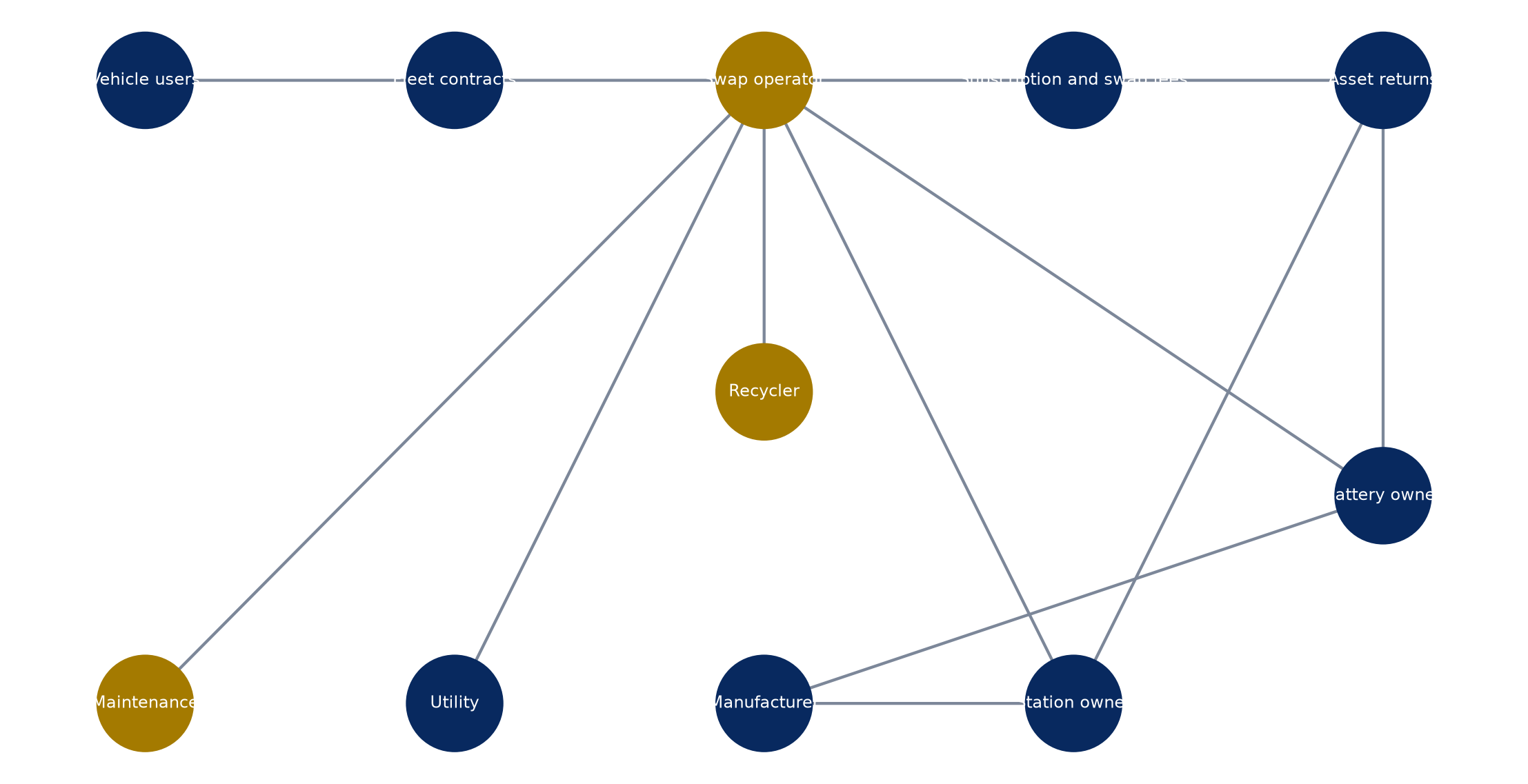
Proposed system map; actual rights, roles and payment flows depend on jurisdiction and contract.
13. Separate energy margin from service revenue
A customer payment can contain energy, access, subscription, convenience and asset-rental components. Separate them. Energy margin depends on tariff, losses and charging schedule. Access revenue depends on subscriber retention. Asset rent compensates capital and residual risk. Swap fees depend on transaction volume.
This separation supports pricing and regulation. Electricity resale may receive different tax or licensing treatment from equipment rental or mobility service. It also reveals cross-subsidy. A low energy price may be funded by a high monthly battery rent.
Build revenue by customer cohort and contract. Report gross billed amount, discounts, taxes, bad debt, energy cost, payment fees and net contribution. Avoid using transaction count as a substitute for margin.
14. Design the customer tariff
Tariffs can combine a fixed monthly fee, energy usage, swap count, distance, battery capacity and service tier. The structure should align payment with cost while remaining understandable. A fleet may prefer a fixed availability charge and variable energy price.
Define fair-use limits, idle fees, reservation, priority, failed-swap treatment and battery damage. Avoid incentives that encourage unnecessary swaps or chronic low state of charge. A pack-size choice should have a transparent price.
Stress customer behaviour after promotional pricing ends. Early discounts can support adoption while obscuring steady-state economics. The base case should use enforceable or evidenced pricing and include churn after tariff changes.
15. Allocate battery degradation
Battery life depends on chemistry, temperature, charge rate, depth of discharge, state-of-charge window, calendar age and operating history. Pooling allows the operator to rotate packs and manage charging, but it also transfers degradation risk away from the driver.
Define permissible operating windows and a state-of-health methodology. Record energy throughput, temperature, fast-charge exposure, faults and repairs. The owner needs independent access to raw data and model assumptions.
Contracts should specify normal degradation, abuse, manufacturing defect and operator fault. They should also define the remedy: repair, replacement, cash compensation or altered rental. A warranty threshold without a measurement protocol creates dispute.
16. Protect pack quality for customers
Customers may receive a different pack at every swap. They need assurance that delivered energy, power, safety and health fall within an approved band. A platform can use grading and rotation to equalise experience.
Publish the service specification rather than individual pack ownership. Define delivered state of charge, minimum usable energy, fault status and recourse. Preserve privacy while making relevant health data available.
Quality controls also protect the network. A defective vehicle interface can damage packs. Authenticate vehicles, inspect connectors and quarantine anomalies. Allocate investigation cost and downtime when the cause is uncertain.
17. Determine residual value
Residual value can arise from continued vehicle use, redeployment to another compatible fleet, refurbishment, stationary reuse or material recovery. Each route requires different evidence. Falling new-battery prices can reduce the value of used packs even when they retain physical capacity.
The IEA reports that used and end-of-life battery markets remain early, with safety, warranty, remaining-life uncertainty and repurposing cost affecting second-life economics.[7] It also notes that reselling or refurbishing vehicles can preserve value longer than dismantling them for parts in current markets.[7]
Use a hierarchy of evidenced exits. Contracted buy-backs or compatible redeployment support stronger value than a generic second-life assumption. Apply transport, testing, refurbishment and compliance costs. Keep commodity recovery as a downside case.
18. Create the residual-value waterfall
Start with expected usable capacity and health at exit. Deduct testing, logistics, repair, certification, software access and channel margin. Apply the price of a substitute new pack at that date, not its original cost.
Then apply compatibility and marketability. A proprietary pack with healthy cells can have limited value outside its ecosystem. A standard module can still face software or warranty restrictions. Legal access to battery-management data matters.
Show gross sale value and net recoverable value separately. Include time to sale and storage cost. Lenders should advance against a stressed net figure and a credible enforcement route.
19. Address battery passports and traceability
Regulation (EU) 2023/1542 establishes requirements relevant to battery information, state of health and expected lifetime, including access intended to support residual-value assessment and preparation for reuse or repurposing.[8] Application depends on battery category, timing and implementing requirements.
A swapping platform should maintain a durable identity for every pack and material module. Record manufacturer, chemistry, capacity, firmware, repair, incident, owner, location, throughput and health. Preserve chain of custody through sale, lease and retirement.
Data quality can reduce diligence cost and support warranty, insurance and finance. It can also create cybersecurity and commercial sensitivity. Define access by role and retain auditable records after operator or software-provider change.
20. Test accounting classification
Battery service contracts can contain leases when a customer controls the use of an identified asset. The IFRS Interpretations Committee has considered substitution rights in a contract involving batteries used with buses and concluded that assessment may occur for each battery; the analysis depends on whether substitution rights are substantive and whether the customer controls use.[9]
Pooling and genuine substitution can affect the assessment. Contract labels do not determine accounting. The economic rights, asset identification, substitution practice and decision-making authority matter.
Obtain accounting advice before signing fleet contracts or financing. Model balance-sheet, EBITDA, cash-flow and covenant effects. Ensure the legal and operating design remains commercially sound even if the preferred accounting outcome does not apply.
21. Align financing with cash flow
Station civil works, robotic equipment, chargers, packs and software have different risk. Fund them in separate tranches where useful. Long-life site assets can support longer debt than proprietary electronics or early-stage inventory.
Pack financing should match contracted rental, warranty and replacement. A revolving facility can fund inventory growth as compatible vehicles enter service. Availability-based fleet contracts can support debt when payment, termination and performance terms are robust.
Avoid using short customer subscriptions to support long non-cancellable debt without liquidity. Include ramp-up reserves, maintenance reserves and replacement accounts. Debt sizing should use stressed utilisation and net cash after energy and lifecycle costs.
22. Use special-purpose vehicles carefully
A special-purpose vehicle can own batteries or stations and lease them to an operator. It can ring-fence cash flows, security and investor rights. It also introduces interface risk between asset owner and service operator.
Define bankruptcy-remote cash control, insurance, maintenance, data access, asset marking, audit and step-in. The SPV needs licences and software rights sufficient to preserve value after operator default. It may need a replacement operator agreement.
Related-party pricing should be transparent. A low operating fee can leave the operator unable to maintain assets, while an aggressive lease payment can shift all demand risk to a thinly capitalised entity. Consolidated economics remain the core investment test.
23. Quantify utilisation
Use several measures: swaps per installed bay-hour, swaps per available bay-hour, pack turns per day, ready-pack utilisation, subscriber swaps, energy throughput and revenue per station. Each answers a different question.
Report denominator availability. A station closed for repair can make utilisation appear high when measured only during operating hours. Pack turns can look efficient while customers queue because inventory is poorly distributed.
Track contribution margin per swap and per station. Higher volume can destroy value when promotional price, peak energy cost, labour, accelerated degradation or service penalties exceed revenue. Utilisation becomes valuable after unit economics.
24. Establish an evidence hierarchy
Theoretical throughput is the weakest evidence. Engineering tests establish mechanical capability. A pilot establishes operation under limited conditions. Contracted fleet schedules establish probable demand. Invoices and settlement establish realised volume and price. Repeated net cash generation establishes commercial performance.
Classify every model input by evidence level. Apply lower recognition to forecasts based on addressable vehicles or non-binding interest. Update the model monthly during ramp-up.
Investors should receive the bridge from registered vehicles to active users, swaps, energy, revenue and cash. This reduces dependence on headline network size.
25. Run a utilisation sensitivity
The key variables are daily swaps, fee per swap, subscription revenue, energy cost, spare-pack ratio, station availability, maintenance and financing. Model them jointly because demand and inventory interact.
The hypothetical exhibit below uses an index rather than currency. A result above 100 represents an illustrative target return threshold. It is designed to show sensitivity and does not forecast any identified project.
Low demand and high spare inventory combine two adverse effects: weak revenue and high capital. High demand can improve economics until queues, accelerated charging or equipment wear require expansion.
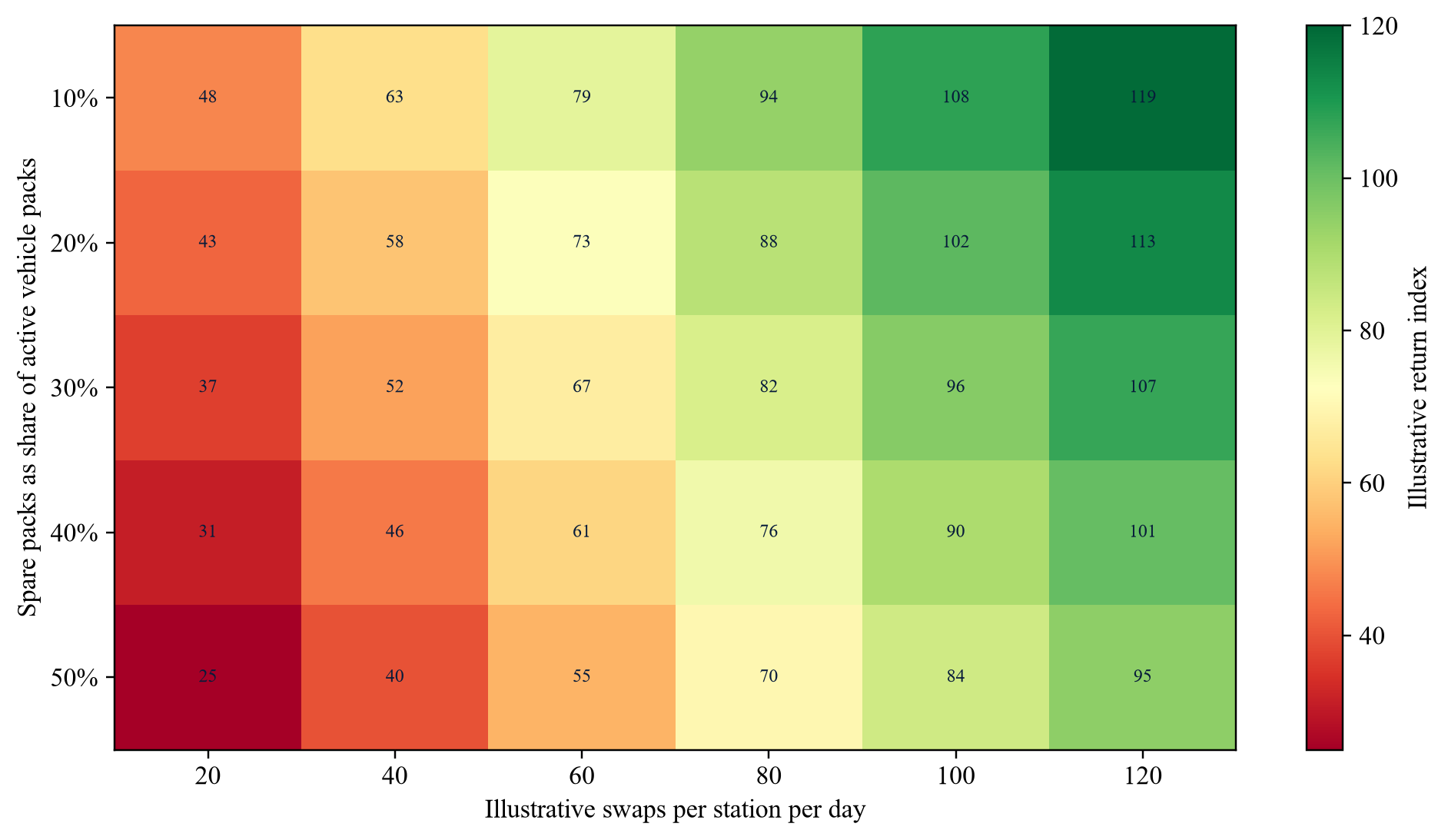
Illustrative sensitivity only; index values are not forecasts, prices or observed market data.
26. Link utilisation to expansion
Expansion should follow leading evidence: contracted compatible vehicles, sustained peak demand, queue breaches and ready-pack shortage. Each new station should have an identified service territory and demand source.
Network coverage can create adoption value before individual sites reach mature utilisation. Treat that as an approved strategic investment with explicit milestones. Avoid hiding coverage stations inside a mature-site average.
Use cohorts by opening date and format. Compare ramp-up, retention, volume and maintenance. Close, relocate or redesign underperforming sites when evidence supports action. Capital discipline strengthens the network effect.
27. Benchmark with disclosed operating evidence
NIO's reported station count and cumulative swaps demonstrate extensive activity within its vehicle ecosystem.[1] CATL's disclosures describe more than 1,000 stations, over twenty compatible models and collaboration across manufacturers, utilities, fleets and financiers at the end of 2025.[2] Gogoro's disclosures provide subscriber and network-service evidence in electric two-wheelers.[3]
These examples differ in vehicle class, geography, ownership, pricing and accounting. Benchmark operating measures with consistent definitions. A cumulative swap count should be paired with station age, active fleet and current run rate.
Use company disclosures as evidence of that company's reported activity. Independent diligence remains necessary for asset condition, profitability, subsidy dependence and transferability to a proposed platform.
28. Assess manufacturer concentration
Count compatible models, annual production, installed fleet and planned launches. Assess whether a model can change without station redesign. Review the manufacturer's financial capacity and strategic commitment.
A broad list of announced models can overstate available demand. Separate launched, delivered, homologated and contracted vehicles. Confirm the exact pack standard and software version.
Use minimum supply, interface support, spare parts, warranty and change-control provisions. Consider termination or compensation if the manufacturer discontinues the compatible platform before the station investment is recovered.
29. Protect against battery-price change
Falling battery prices reduce the cost of new inventory and can impair residual value. Rising mineral or trade costs can increase replacement needs. Chemistry changes can alter safety, range and compatibility.
Model pack additions and replacements at a range of future costs. Avoid assuming original purchase price persists. Price customer tariffs and manufacturer support so the platform can adapt.
A pool can introduce new chemistry only after compatibility, charging, fire-safety and performance validation. Separate physical form factor from electrochemical equivalence. Maintain pack-health bands to protect customers.
30. Integrate grid and energy procurement
Swapping moves vehicle charging into stations, creating controllable load. The operator can schedule charging around demand, tariffs and grid constraints while preserving ready inventory. This is a potential advantage and an operating obligation.
Model peak power, transformer capacity, connection lead time, demand charges and energy losses. Grid curtailment can reduce ready packs. On-site storage or generation may help and adds capital.
CATL has described integrated charge-and-swap facilities that share substation and charging modules; company claims regarding efficiency and utilisation should be independently verified for the proposed configuration.[10] Use measured site data for financing.
31. Treat grid services as incremental
Station batteries may support managed charging, demand response or grid services while waiting. Customer readiness has priority. A grid dispatch that leaves too few charged packs can breach the mobility service.
Define a ready-inventory floor and operating reserve. Only energy above that floor should be offered. Account for efficiency, degradation, market qualification and settlement.
Grid-service income should enter the base case after technical qualification, contractual rights and operating evidence. Keep it separate from swap economics so the core mobility service remains visible.
32. Design safety governance
Swapping introduces repeated mechanical connection, pack movement, high-voltage handling and centralised charging. Safety governance should cover vehicle admission, pack inspection, fire detection, thermal events, isolation, emergency access and incident reporting.
Apply the relevant national and local standards. Test interfaces and communication under normal and fault conditions. Maintain controlled software versions. Quarantine packs after collision, water exposure, thermal anomaly or unexplained health change.
Allocate responsibility across manufacturer, operator, maintenance and owner. Insurance should reflect actual operations. Report incidents and near misses to investors and authorities according to applicable rules.
33. Plan maintenance and spares
Station availability depends on robotics, lifts, connectors, chargers, sensors, communications and software. Establish preventive maintenance and critical spares by failure mode. Record mean time to repair and repeat faults.
Service-level agreements should cover response, parts, remote support, cybersecurity and obsolescence. A proprietary component can create long downtime without local inventory.
Model maintenance as volume-linked and calendar-linked. High swaps increase wear; low utilisation does not remove inspection, software and site costs. Include lifecycle overhaul rather than annual routine cost alone.
34. Allocate cyber and data risk
The platform authenticates vehicles, controls high-voltage equipment, tracks batteries and bills customers. Compromise can interrupt mobility or damage assets. Define identity, encryption, access, patching, monitoring, backup and incident response.
Separate safety-critical control from customer applications. Maintain a safe local mode and manual procedures. Test recovery after communications or cloud failure.
Data contracts should preserve owner and operator access, customer privacy and portability. A financier needs asset-level records without unrestricted personal travel data. Retention should support warranty and residual-value diligence.
35. Address insurance and liability
Coverage may include property, machinery breakdown, battery damage, fire, cyber, public liability, business interruption, cargo and environmental exposure. Confirm whether policies cover packs owned by third parties while at the station or in vehicles.
Define liability after a defective pack is installed, a vehicle damages station equipment, or a platform update causes downtime. Contract indemnities require credit and insurance support.
Use incident data to refine deductibles and reserves. A low premium during pilot does not establish long-term availability. Lenders should be loss payees where appropriate and receive notice of cancellation.
36. Build the unit-economics table
The illustrative scenarios below show how demand and inventory affect economics. Values are indices with a common mature-case revenue base of 100. They do not represent observed costs, prices or returns.
The ramp case carries high pack and station cost relative to revenue. The base case reaches the target threshold through volume and controlled inventory. The stress case combines lower demand, higher maintenance and weaker residual recovery.
Table 2. Hypothetical annual station economics index
| Item | Ramp case | Base case | High-use case | Stress case |
|---|---|---|---|---|
| Subscription and swap revenue | 58 | 100 | 136 | 64 |
| Energy and payment cost | (18) | (27) | (39) | (23) |
| Maintenance and site operations | (24) | (25) | (31) | (31) |
| Battery degradation and replacement allowance | (14) | (18) | (27) | (22) |
| Financing and fixed platform cost | (22) | (20) | (21) | (24) |
| Residual-value contribution | 5 | 8 | 10 | 3 |
| Net cash index | (15) | 18 | 28 | (33) |
Illustrative indices only; no identified operator, tariff, market or financing is represented.
37. Allocate the principal risks
Every risk needs a controller, evidence source, contract treatment and investor protection. Demand belongs partly with fleet customers and the commercial team. Interface risk spans manufacturer and operator. Residual value sits with the asset owner unless guaranteed.
Contract allocation should follow practical control. Passing degradation risk to a thin operator has limited value when a battery company controls chemistry and data. Passing volume risk to a fleet requires a credible minimum-use commitment.
Retained risks belong in price, reserves and return. Contingent guarantees should be valued after credit and enforceability review.
Table 3. Battery-swapping risk-allocation matrix
| Risk | Primary controller | Evidence | Contract control | Investor protection |
|---|---|---|---|---|
| Compatible demand | operator and anchor fleets | vehicle deliveries, routes and swaps | minimum volume and ramp milestones | phased capital and termination rights |
| Pack interface | manufacturer and integrator | certification and acceptance tests | change control, warranty and support | holdback and retrofit protection |
| Station uptime | operator and equipment supplier | availability and fault history | service level, spares and cure | reserve, step-in and replacement rights |
| Battery degradation | operator, owner and manufacturer | state of health and throughput | operating limits and warranty | replacement reserve and audit |
| Residual value | battery owner and guarantor | exit channels and market evidence | buy-back or value guarantee | conservative advance and cash sweep |
| Grid capacity | utility and station owner | connection offer and interval demand | capacity, curtailment and upgrade terms | condition precedent and derating |
| Safety | manufacturer, operator and maintainer | tests, incidents and compliance | procedures, indemnity and insurance | suspension, reporting and reserve |
| Customer credit | operator and fleet | billing and payment history | deposits, direct debit and security | exposure limits and diversification |
Proposed allocation principles; actual rights depend on contracts, law and technical configuration.
38. Test counterparties
Review the manufacturer, operator, fleet, lessor, maintenance provider and guarantor. Assess capital, operating capability, strategic commitment and dependence on subsidies or one contract. Trace which entity signs each obligation.
Guarantees from a parent or bank can strengthen performance. Their scope, expiry, cap and conditions matter. A repurchase commitment has value only if the guarantor can perform when technology changes or demand weakens.
Monitor counterparties throughout the asset life. Credit deterioration can impair warranty, software support or residual value before station operations fail.
39. Address subsidy and policy exposure
Subsidies can support early station construction or vehicle adoption. Record eligibility, payment timing, clawback and operating conditions. Separate subsidy cash from recurring customer economics.
Benchmark projects with and without support. A station can remain strategically useful while requiring policy support, and the investor should see that dependency explicitly.
Policy can also impose standards, safety, recycling and data obligations. Model compliance cost and transition. Avoid assuming that one jurisdiction's subsidy or mandate transfers to another.
40. Design a decision-grade pilot
The pilot should test arrival patterns, complete cycle time, station availability, pack inventory, charging load, health variation, customer acceptance, billing, maintenance and safety. Use representative vehicles and duty cycles.
Define thresholds before operation. Examples include queue time, successful swaps, station uptime, ready-pack stock, cost per swap, energy loss, health dispersion and incident rate. Establish a minimum observation period and seasonal coverage.
The pilot output should be an auditable operating data set and a revised investment model. Technical success alone does not establish demand or net cash.
41. Gate capital deployment
Gate one confirms anchor demand and route suitability. Gate two confirms standards, compatibility and site power. Gate three approves pilot assets. Gate four requires measured performance and signed commercial terms. Gate five funds replication after cohort economics are verified.
Each gate should state maximum capital at risk and missing evidence. Land options and connection applications can preserve future sites before full equipment commitment.
Stop rules protect capital. They may address vehicle delay, interface change, grid-cost increase, failed safety test, weak utilisation or counterparty default. A pause can preserve options while evidence improves.
42. Build the implementation roadmap
During the first ninety days, map vehicle cohorts, routes, standards, sites, grid capacity, ownership alternatives and accounting questions. Secure data and preliminary commercial terms.
During months four to nine, complete engineering, interface tests, grid design, contracts and a controlled pilot. Record every swap, fault, energy flow, queue and pack-health change.
During months ten to twenty-four, finance proven asset cohorts, expand contracted sites and establish operating covenants. Add public-network coverage only with an approved adoption case and milestone budget.
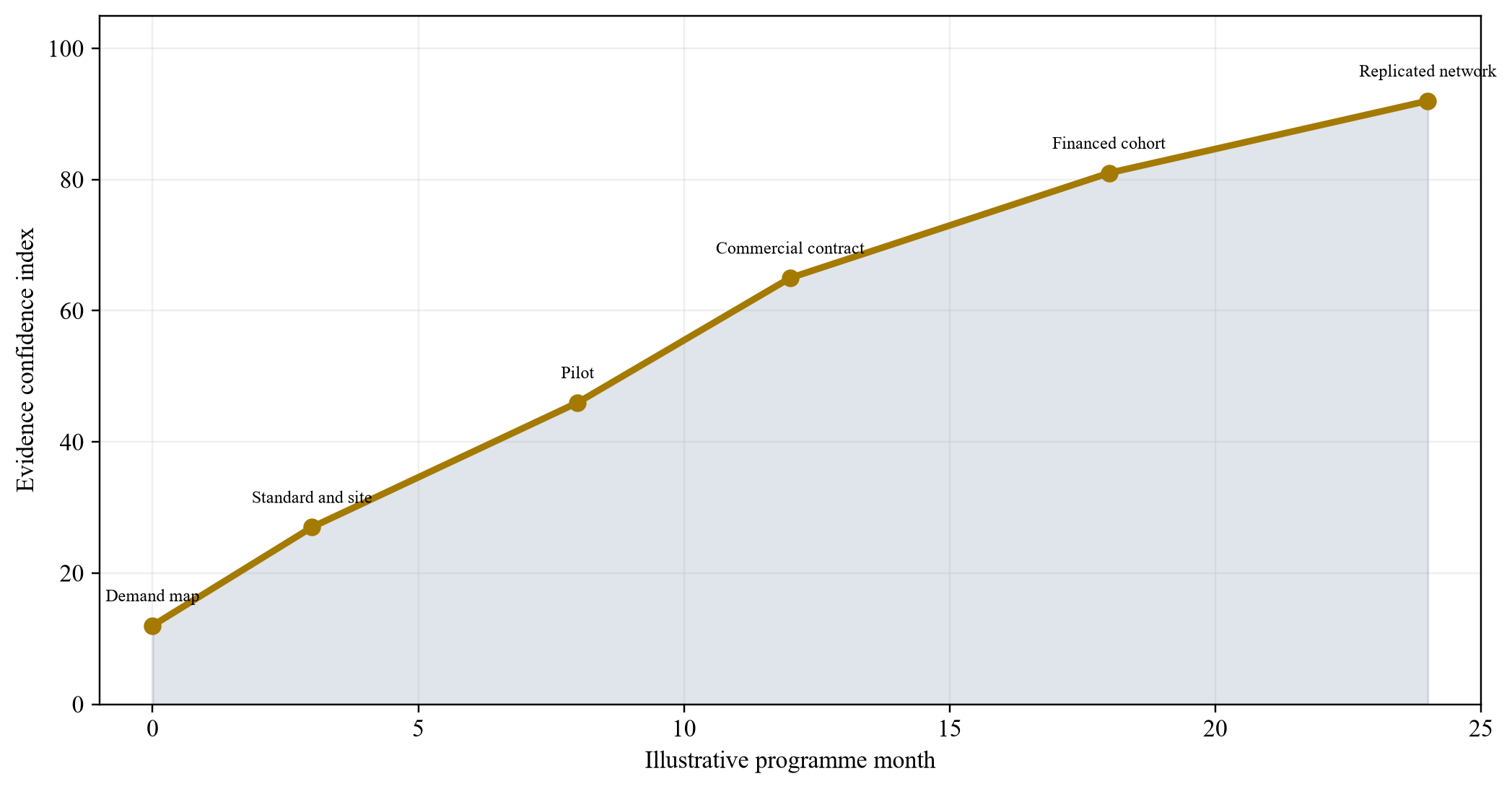
Illustrative gates; timing depends on vehicles, sites, grid, approvals, contracts and operating evidence.
43. Establish operating covenants
Track station availability, successful swap rate, queue, ready inventory, compatible active vehicles, swaps per bay, pack turns, energy cost, health dispersion, incidents, maintenance, revenue, contribution and cash collection.
Set thresholds for remediation, capital pause, tariff review and closure. Report manufacturer or software changes that can affect compatibility. Require owner consent before pack operation outside agreed limits.
Financial covenants should use cash after energy, maintenance and replacement reserves. Avoid covenant definitions that treat customer deposits or unearned subscriptions as recurring income.
44. Apply the investment-committee test
The committee should receive the demand map, ownership structure, standards, compatibility evidence, site and grid design, inventory model, customer contracts, unit economics, residual-value case, accounting analysis, risk allocation and pilot plan.
Approval should answer six questions. Is there a dense compatible vehicle base? Does the ownership model align control and risk? Can the system meet its queue and availability promise? Are pack data, warranty and residual routes enforceable? Does stressed cash support the proposed financing? Can capital stop before losses compound?
Conditions should follow missing evidence. The committee can approve site control, pilot capital and replication separately. Network option value should be identified and budgeted rather than embedded in mature utilisation.
45. Limitations
This framework is general and does not replace engineering, safety, grid, legal, tax, accounting, insurance, battery or financing advice. Standards, regulation, battery technology, prices and market structures can change. Site-specific evidence should govern each decision.
Company disclosures describe reported activity within the relevant businesses. They do not independently establish profitability, transferability or asset condition. Independent diligence should test the proposed platform.
All numerical exhibits are hypothetical. They describe no identified operator, customer, vehicle programme, subsidy, tariff, financing or return. They should not be used as forecasts or valuation inputs without verified project data.
46. Conclusion
Battery swapping can reduce downtime and separate battery finance from vehicle ownership. That separation creates a coordinated asset system whose value depends on compatible demand, station availability, pack inventory, data, warranty and residual routes.
The ownership structure should follow operational control and allocate risks to parties able to manage them. Standardisation supports scale when exact combinations are tested. Utilisation should be measured through delivered service and net cash rather than theoretical throughput.
Investors can stage recognition. An announced ecosystem creates a strategic option. Certified equipment and a pilot establish capability. Contracted fleets establish demand. Verified utilisation, lifecycle cost and cash collection establish a financeable operating case. This discipline allows a network to grow while keeping battery and station risk visible.
Appendix A Investment-committee questions
1. Which vehicle classes, pack formats and stations are within the proposed ecosystem?
2. Which standards apply, and which elements remain proprietary?
3. Which exact vehicle-pack-station combinations have passed acceptance tests?
4. Who owns vehicles, packs, stations, grid equipment, software and data?
5. Who controls charge rate, rotation, maintenance, quarantine and retirement?
6. How many compatible vehicles are delivered, contracted and active?
7. What arrival pattern and peak queue does route data support?
8. What station availability and complete cycle time have been measured?
9. How is spare-pack inventory calculated?
10. What ready-inventory reserve protects priority fleet operations?
11. How are subscription, energy, swap and asset-rental revenues separated?
12. How are degradation, warranty and abusive use measured and allocated?
13. What pack-health band does the customer receive?
14. What residual-value routes are contractually or operationally evidenced?
15. Can assets and data transfer after operator or manufacturer default?
16. Does the customer arrangement contain a lease under applicable accounting rules?
17. What grid capacity, tariff and curtailment apply?
18. What safety standards, insurance and incident controls apply?
19. Does stressed net cash support debt after replacement reserves?
20. Which milestones release the next capital tranche?
References
- NIO Inc., Annual Report 2024, filed 8 April 2025. https://ir.nio.com/system/files-encrypted/nasdaq_kms/assets/2025/04/09/0-38-33/Annual%20Report%202024.pdf
- Contemporary Amperex Technology Co., Limited, Annual Report 2025, 2026. https://www.catl.com/en/uploads/1/file/public/202603/20260311182739_3924pj798y.pdf
- Gogoro Inc., Q4 2025 Earnings Release, 2026. https://investor.gogoro.com/static-files/e2ef3ecb-1a7c-4330-b923-2aaf0879d15a
- Standardization Administration of China, GB/T 29772-2024, General requirements of electric vehicle battery swap station, effective 1 July 2025. https://openstd.samr.gov.cn/bzgk/std/newGbInfo?hcno=1E10B1C888E0774248FDEC2C00C845EB
- Standardization Administration of China, GB/T 40032.2-2025, Safety requirements of battery swap for electric vehicles, Part 2: Commercial vehicle, effective 1 November 2025. https://openstd.samr.gov.cn/bzgk/std/newGbInfo?hcno=2DF9DC31CDD2108CE3E1794825FF05AF
- Standardization Administration of China, GB/T 32895-2025, Communication protocols for swapping battery pack of electric vehicle, effective 1 September 2025. https://std.samr.gov.cn/gb/search/gbDetailed?id=2FF37940EB96D753E06397BE0A0A413F
- International Energy Agency, Electric vehicle batteries, Global EV Outlook 2026, 20 May 2026. https://www.iea.org/reports/global-ev-outlook-2026/electric-vehicle-batteries
- European Parliament and Council, Regulation (EU) 2023/1542 concerning batteries and waste batteries, 12 July 2023. https://eur-lex.europa.eu/legal-content/EN/TXT/PDF/?uri=CELEX%3A32023R1542
- IFRS Interpretations Committee, Definition of a Lease, Substitution Rights, IFRS 16, April 2023. https://www.ifrs.org/content/dam/ifrs/supporting-implementation/agenda-decisions/2023/definition-of-a-lease-substitution-rights-apr-23.pdf
- Contemporary Amperex Technology Co., Limited, CATL Unveils Six Major Innovations: Multi-Chemistry Systems to Redefine New Energy Mobility Experience, 2026. https://www.catl.com/en/news/6811.html
- International Energy Agency, Global EV Outlook 2025, 14 May 2025. https://www.iea.org/reports/global-ev-outlook-2025
- International Energy Agency, Trends in heavy-duty electric vehicles, Global EV Outlook 2025, 2025. https://www.iea.org/reports/global-ev-outlook-2025/trends-in-heavy-duty-electric-vehicles
- Gao, Z. and co-authors, Electrifying Heavy-Duty Trucks: Battery-Swapping Versus Fast Charging, IEEE Transactions on Smart Grid, 2025, DOI 10.1109/TSG.2025.3571819. https://ieeexplore.ieee.org/document/11010187/
- Contemporary Amperex Technology Co., Limited, CATL Launches 10 New Choco-Swap Models with Automakers, 23 April 2025. https://www.catl.com/en/news/6404.html
About the Author
Authored by Chennakeshav Adya Independent Researcher
Chennakeshav (CK) is a corporate finance and investment banking executive with 25+ years of global experience in deal origination, structuring and execution across M&A, growth capital and corporate strategy. He has led value-creation mandates for founders, corporates and funds — bridging the boardroom view to hands-on execution and close.
His career spans Morgan Stanley, HSBC, Lloyds Banking Group, EWEC, ADQ portfolio companies and Emirates Growth Fund, across TMT, real estate, fintech, deeptech, cleantech, infrastructure and energy. He has partnered with C-suite leaders, private equity and venture funds, sovereign wealth funds and family offices to finance complex fund raises and scale-up ventures, and has led M&A due diligence, post-merger integration and business-transformation initiatives to create value.
At Matchpoint Partners he is Managing Partner, leading the firm's corporate finance, M&A and capital-raising practice. He holds an MBA from London Business School, an engineering degree from VTU and a Master of Laws (LLM, in progress) from UCL London.
An active start-up mentor, CK mentors at Techstars, DIFC FinTech Hive, Startup Grind, Founder Institute and IN5, serves as Entrepreneur Mentor in Residence (EMiR) at London Business School, and judges the Entrepreneurship World Cup.
Matchpoint profile: https://www.matchpoint-partners.com/team/ck-adya.html LinkedIn: https://www.linkedin.com/in/ckadya/
