
Introduction
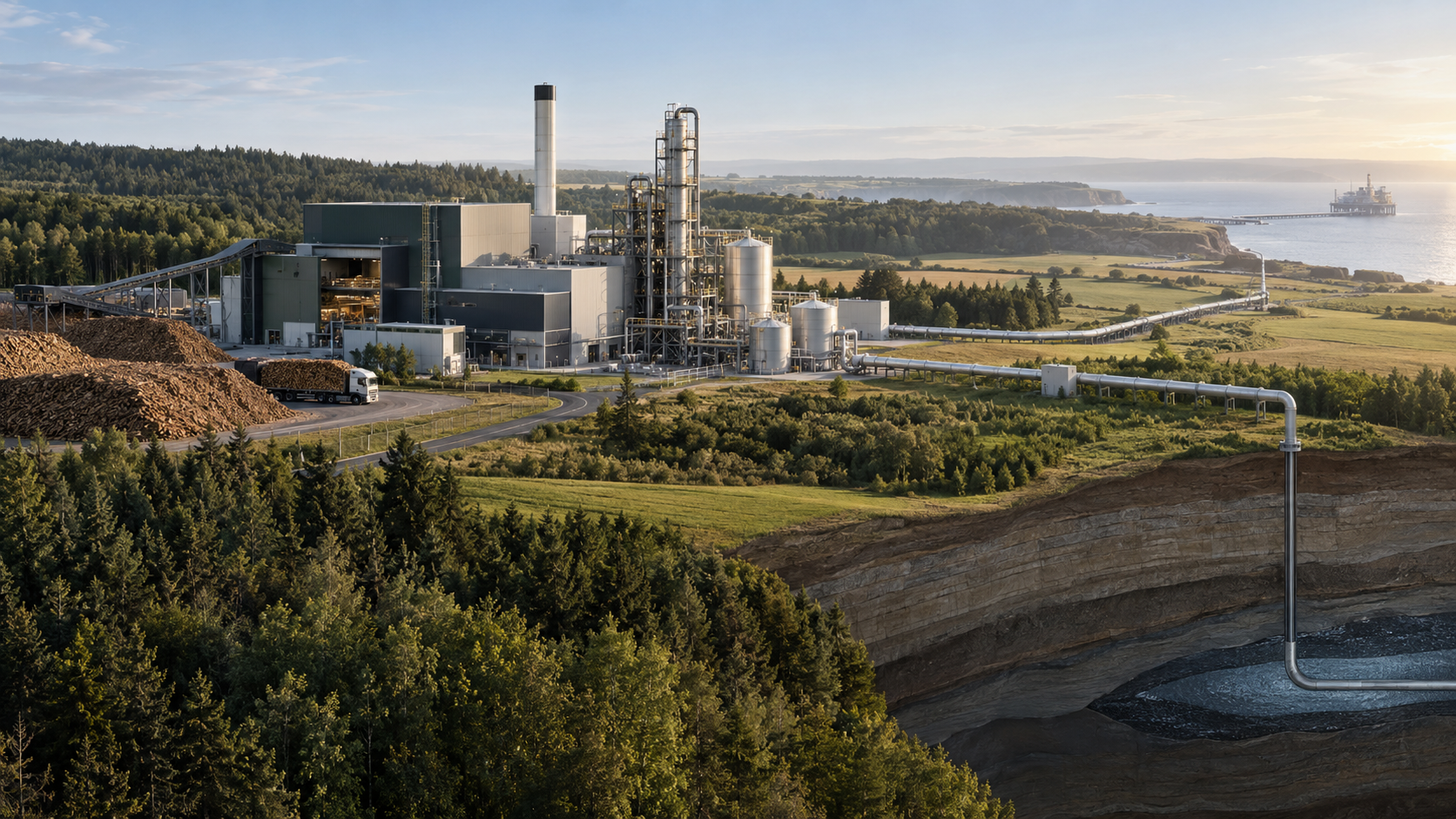
BECCS combines two businesses inside one technical system. A biomass plant converts fuel into electricity or another energy product. A capture unit separates carbon dioxide from the resulting flue gas or process stream. Compression, transport and storage infrastructure move the carbon dioxide into a permitted geological formation. Monitoring and verification establish whether the full chain produced a durable net removal. Each stage has its own performance measure, counterparty and cash cycle.
The United Kingdom's proposed large-scale Power BECCS business model recognises electricity and negative emissions through a dual contract-for-difference structure. The 2023 government response confirmed a carbon contract and an electricity contract, with transport and storage fees calculated and paid separately.[1] The December 2023 update developed the commercial framework and linked the carbon payment to approved carbon-market reference prices.[2] In July 2025, the UK Emissions Trading Scheme Authority stated an aim to integrate UK-based engineered removals by the end of 2029, subject to legislation and further assessment.[6] These measures create a route to revenue certainty while leaving material interface, sustainability and delivery risks with the project.
The investment question is specific: which contracted cash flows remain available when electricity output, capture performance, net removal, transport and storage availability, verification and carbon-market prices move independently? A financeable answer requires one model that connects physical flows, contract terms, evidence and cash.
1. Define the financed system
The financing boundary should identify the biomass supply chain, generation plant, capture island, compression, connection to transport, storage service, metering, carbon accounting, registry arrangements and all shared utilities. The boundary should also show assets owned by the project company and services bought from third parties.
An integrated brownfield retrofit has different completion risk from a new-build plant. A retrofit must coordinate outages, existing permits, legacy maintenance, electrical export and the condition of the host asset. A new build carries site, grid, construction and commissioning risks across every component. The base case should show each interface explicitly.
2. Separate gross capture from net removal
Gross captured carbon dioxide is the mass entering compression. Net removal is lower. It reflects biogenic carbon eligibility, uncaptured emissions, biomass production and transport, auxiliary energy, solvent and chemical use, carbon dioxide transport and storage, leakage, measurement uncertainty and any methodology-specific deductions.
The IPCC notes that BECCS can remove carbon when biogenic carbon is captured and stored, while also identifying biomass supply, land, water, energy and storage constraints.[11][12] The financing model should therefore begin with net verified removal. Gross capture remains an engineering measure and should not be used as a proxy for saleable removal volume.
3. Map the revenue stack
A Power BECCS project can receive electricity revenue, carbon-removal revenue, capacity or system-service payments, heat or co-product revenue and, where permitted, tax or grant support. Some lines may be unavailable in a jurisdiction or mutually exclusive under subsidy, carbon-market or state-aid rules.
Each line should be defined by unit, meter, delivery point, eligible volume, price, index, settlement period, credit support and termination regime. The model should identify whether one operating event reduces several revenues simultaneously. Capture-unit failure can increase electricity output by avoiding capture energy while eliminating removal revenue. The result can look positive in a power-only model and negative in the integrated project.
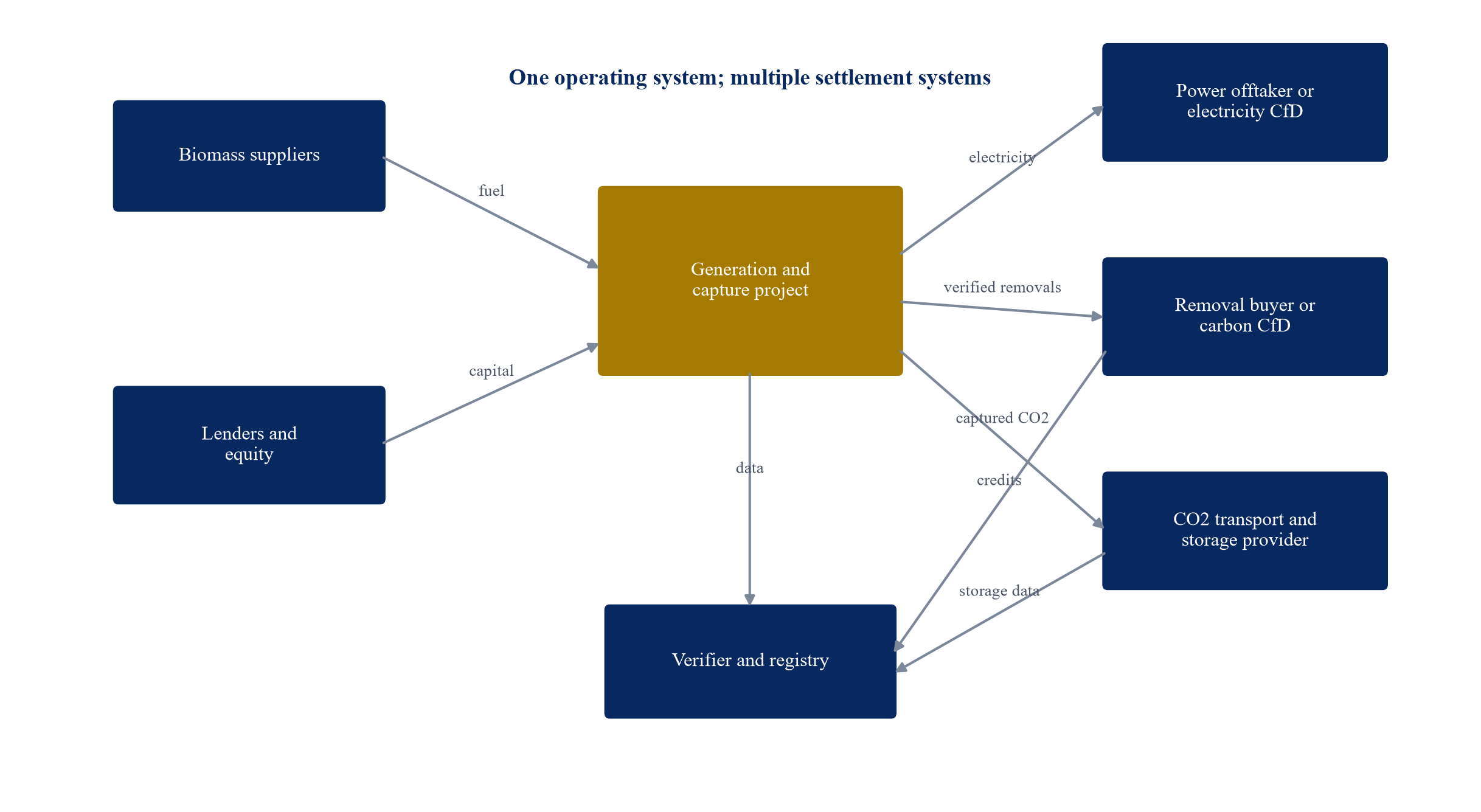
Proposed framework; actual contracts, counterparties, subsidy rules and market access depend on jurisdiction and project design.
4. Read the dual contract correctly
The proposed UK structure values electricity through an electricity contract and negative emissions through a carbon contract.[1][2] That separation does not make the contracts economically independent. Electricity output, capture energy, availability and fuel use arise from the same plant. Transport and storage availability can also determine whether capture can continue.
The financing model should reproduce both settlement formulas. It should then reconcile the formulas to plant meters and the carbon ledger. Definitions of outage, availability, qualifying biomass, commissioning, indexation, change in law and termination should be compared clause by clause.
5. Avoid double counting
The same environmental attribute cannot support inconsistent claims or duplicate payments. Electricity support may value low-carbon generation. A removal payment values atmospheric carbon transferred into durable storage after life-cycle deductions. Carbon credits, UK ETS allowances or voluntary claims may create further value only where the governing rules permit them.
The project should create an attribute register showing the legal owner, unit, period, registry and retirement or transfer status of each claim. Financing documents should prohibit sales that breach subsidy terms or invalidate another revenue line. The base case should include only revenue combinations supported by written eligibility analysis.
6. Underwrite biomass supply
Biomass contracts should specify eligible source categories, sustainability evidence, chain of custody, energy content, moisture, ash, contaminants, delivery profile, price index, transport, substitution, rejection and audit. Volume security alone does not establish carbon integrity.
The UK Biomass Strategy states that BECCS can deliver genuine removals when biomass is sustainable, supply-chain emissions are controlled and the value chain is independently verified.[8] Lenders should treat sustainability failure as a revenue and compliance risk. A disqualified feedstock can produce electricity while failing the carbon contract.
7. Model the carbon balance
The carbon ledger should begin with eligible biogenic carbon entering the process. It should record captured mass, capture efficiency, compression, transport, storage, biomass supply-chain emissions, plant emissions, auxiliary electricity, chemicals, methane and nitrous oxide where applicable, leakage and uncertainty.
The model should preserve each deduction. A single net factor conceals which risk caused deterioration. Periodic reporting should bridge feedstock tonnes, energy content, gross generation, net export, gross capture, stored carbon dioxide and verified net removal.
8. Establish the reference plant case
The financing memorandum should state whether the plant is new, converted or retrofitted; the fuel and catchment; generation capacity; capture technology; expected capture rate; parasitic load; annual availability; connection capacity; transport and storage route; and supported contract term.
Performance assumptions should come from front-end engineering, vendor guarantees, operating history and independent technical review. Public sector policy targets or illustrative industry ranges should not be treated as plant guarantees.
9. Allocate capture-performance risk
Capture performance has at least four dimensions: capture rate, captured mass, energy penalty and product quality. A guarantee stated only as a percentage can be met at low throughput. A mass guarantee can be met with excessive fuel or auxiliary power. Product specifications can be missed even when mass is achieved.
Completion testing should therefore cover sustained generation, capture rate, captured mass, net export, energy consumption, carbon dioxide purity, emissions and availability. Liquidated damages should connect to the economic loss that remains after insurance, contingency and cure.
10. Treat the energy penalty as a shared driver
Capture, solvent regeneration, compression, cooling and pumps consume electricity or steam. This reduces net export and can raise fuel demand. The integrated model should calculate electricity revenue and carbon revenue from the same hourly or monthly operating case.
An optimistic capture case can still weaken cash if the energy penalty exceeds the value of additional removals. The decision metric is incremental net cash after fuel, variable operating cost, transport, storage and settlement effects.
11. Secure transport and storage access
Engineered removals that depend on geological storage require transport capacity, injection availability, storage permits, metering and long-term containment. The project company may depend on a regulated network whose construction and operating dates are outside its control.
The UK policy framework contemplates separate treatment of transport and storage fees.[1][2] Financing should test network delay, constrained injection, planned outages, specification failure and prolonged unavailability. Contracts should state payment, relief, curtailment and termination consequences for each case.
12. Coordinate project schedules
The plant, capture system, grid connection, transport network, storage site, verifier and registry must become available in a workable sequence. Early completion of one asset can create idle capital and operating costs. Late storage access can prevent removal revenue after the plant is mechanically complete.
The integrated schedule should identify critical interfaces and long-stop dates. Drawdown conditions should require evidence that dependent infrastructure remains on a credible path. Sponsor support may be needed where the project company cannot transfer interface delay.
13. Define the verified product
The carbon contract should name the unit, methodology, monitoring period, issuance or verification process, delivery point, ownership and claim. The EU's 2026 permanent-removal methodology includes BioCCS and requires eligible biogenic emissions, life-cycle accounting, long-term storage and monitoring.[18] The UK introduced interim BECCS quantification methodology through BSI Flex 2006 in 2025 for relevant negotiations.[3][5]
The financed unit should match the contract. Captured tonnes, stored tonnes, certified removals, issued credits and delivered units are separate states. The model should connect revenue to the state that triggers payment.
14. Build an auditable data architecture
Meters and records should cover biomass receipts, feedstock classification, energy content, plant output, auxiliary load, capture flow, carbon dioxide composition, compression, custody transfer, injection, storage, emissions and downtime. Each settlement calculation should use controlled data with clear ownership.
The project should maintain one reconciliation between operational data, verifier submissions, registry records and invoices. Manual adjustments need approval, reason codes and an audit trail. Cybersecurity and data retention belong in the financing diligence because missing evidence can delay or prevent payment.
15. Design the electricity contract
The electricity contract should define metered output, eligible generation, reference price, strike price, indexation, negative-price rules, balancing responsibility, outages, change in law and termination. It should also address whether capture-related consumption affects the supported volume or price.
Where merchant power, capacity or ancillary services sit beside support, the project should establish permitted combinations. Revenue stacking assumptions need legal and market confirmation. Senior debt should exclude uncontracted services unless downside cases demonstrate adequate coverage without them.
16. Design the removal contract
The removal contract should define gross and net quantities, eligible biomass, capture and storage boundaries, methodology, reference price, strike price, payment cycle, verification, under-delivery, over-delivery, replacement, invalidation, change in methodology and termination.
The December 2023 UK update describes a carbon contract designed to bridge the difference between a strike price and an approved market reference price.[2] The finance model should reproduce how reference-price movements, market sales and reconciliation affect cash and liabilities.
17. Allocate carbon-price exposure
A two-way difference mechanism can stabilise revenue while requiring repayment when the reference price exceeds the strike price. The project therefore needs settlement liquidity and controls over credit sales. A lag between market receipt and contract reconciliation can create working-capital exposure.
The downside model should test low market prices, high market prices, delayed credit issuance and disputed eligibility. It should also test any floor, cap, gain-share or clawback in the final contract.
18. Define transport and storage charges
Transport and storage charges may include capacity, usage, connection, compression, metering, specification, escalation and decommissioning components. Minimum payments can continue during plant outages. Variable charges can rise with captured volume.
The model should separate fixed and variable components and apply them to the relevant operating state. A plant outage, network outage and storage-specification failure can have different fee consequences. Security packages should recognise step-in, termination and liability limits in the network contracts.
19. Measure completion across the chain
Mechanical completion of the capture unit does not establish revenue completion. The completion test should demonstrate eligible feedstock, stable generation, capture performance, carbon dioxide specification, transport acceptance, storage injection, complete data transfer and verifier-ready evidence.
The test period should be long enough to reveal integration problems and should use representative feedstock. Debt conversion or final drawdown can require both technical completion and a defined first verified-removal milestone.
20. Separate construction and operating reserves
Construction contingency covers design development, equipment, labour, delay and interface risk. Operating reserves cover fuel-price variation, transport and storage fees, verification delay, contract settlements, major maintenance, replacement obligations and debt service.
The reserve structure should reflect cash timing. Carbon-removal revenue may arrive after monitoring and verification while fuel and operating costs are paid earlier. Working capital can therefore increase as production grows.
21. Build a hypothetical sources-and-uses case
Consider a hypothetical retrofit with total uses of GBP 1,200 million. Capture and compression account for GBP 505 million, generation and balance-of-plant modifications GBP 170 million, transport and storage connection GBP 90 million, development and financing GBP 95 million, contingency GBP 165 million, initial reserves GBP 75 million and interest during construction GBP 100 million. These amounts illustrate model architecture and are not a forecast for an identified project.
The funding case uses GBP 600 million of senior debt, GBP 60 million of subordinated capital, GBP 140 million of eligible grant support and GBP 400 million of equity. The grant assumption must be confirmed against actual award terms. Debt sizing remains subject to coverage, completion support and contracted cash.
Table 1. Hypothetical Power BECCS sources and uses
| Uses | GBP million | Sources | GBP million |
|---|---|---|---|
| Capture and compression system | 505 | Senior debt | 600 |
| Generation and balance-of-plant modifications | 170 | Subordinated capital | 60 |
| Transport and storage connection | 90 | Eligible grant support | 140 |
| Development and financing costs | 95 | Sponsor equity | 400 |
| Contingency | 165 | ||
| Initial reserves | 75 | ||
| Interest during construction | 100 | ||
| Total uses | 1,200 | Total sources | 1,200 |
Illustrative model in GBP million; figures do not describe an identified project or available financing terms.
22. Define the operating model
The operating model should calculate feedstock receipts, gross generation, net export, capture rate, captured carbon dioxide, transport and storage volumes, life-cycle deductions, net verified removals and settlement cash in one period structure. It should distinguish planned outages, plant failures, capture failures and network failures.
Fixed costs, variable costs and pass-through costs should be separated. This makes it possible to test whether revenue support protects margins or only prices. A fixed strike price does not protect a project from unhedged fuel, transport, storage or chemical costs unless the contract provides a relevant adjustment.
23. Establish a base-case revenue mix
In the hypothetical steady-state case, net electricity revenue is GBP 210 million, removal revenue GBP 245 million, capacity and system services GBP 18 million, and heat or other permitted co-products GBP 12 million. Operating costs include biomass GBP 145 million, plant and capture operations GBP 74 million, transport and storage GBP 58 million, maintenance GBP 28 million, monitoring and verification GBP 7 million, and other costs GBP 18 million.
The resulting cash flow before debt service is GBP 155 million. This simplified figure excludes tax, movements in working capital, reserve funding and other project-specific adjustments. Those items must be included in an actual financing model.
24. Size debt from resilient cash flow
Senior debt should be sized from cash that survives conservative assumptions. Contracted electricity and removal revenue can support debt when performance, indexation and counterparty risk are acceptable. Capacity, ancillary-service, heat and merchant carbon upside may receive limited or no credit.
Debt service should remain covered after lower availability, lower capture, higher biomass cost, transport and storage escalation, verification delay and lifecycle-emission deductions. The lender case should also test correlated events, since poor fuel quality can reduce generation, increase auxiliary use and weaken net removal together.
25. Test debt-service sensitivity
The hypothetical base case assumes GBP 110 million of annual debt service and a debt-service coverage ratio of 1.41 times. The sensitivity cases below apply direct changes to project cash flow. They are simplified illustrations and do not replace a monthly integrated model.
A 10 percent reduction in net export and a 15 percent reduction in verified removals reduces coverage to 1.07 times in the example. A combined biomass-cost increase and transport outage reduces coverage below 1.0 times. The result shows why debt sizing should use correlated operating cases.
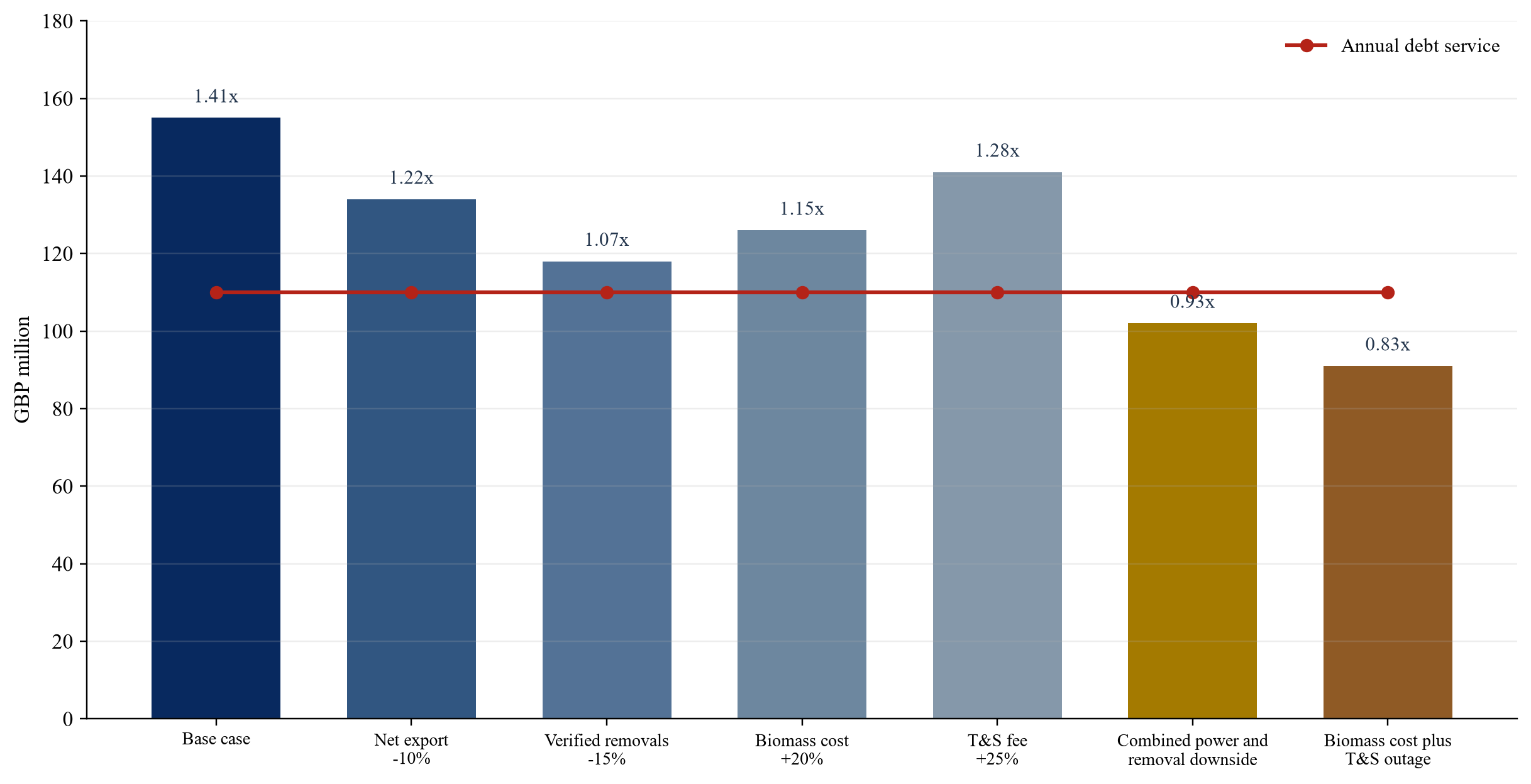
Illustrative GBP million values; scenarios are management modelling examples and do not describe an identified project.
26. Test power-volume risk
Power volume depends on availability, fuel energy content, generation efficiency, capture energy and grid constraints. Electricity support can stabilise price while leaving these drivers with the project. The model should calculate net export after capture and compression loads.
Curtailment needs specific treatment. A project may receive compensation, retain removal capability, reduce capture or shut down. The contract package should identify which revenues remain during each form of curtailment and who bears additional fuel or storage cost.
27. Test removal-volume risk
Removal volume depends on eligible biogenic carbon, throughput, capture performance, transport and storage availability, lifecycle emissions, methodology deductions and verification. Each risk should have a separate input and operational owner.
The model should avoid a constant ratio between electricity and removal. Capture outages can preserve generation. High auxiliary demand can reduce export while maintaining capture. Fuel changes can alter both. Separate calculations are necessary for accurate covenant and settlement forecasting.
28. Test biomass-price and quality risk
Biomass price can be linked to commodity, energy, transport, foreign exchange or inflation indices. Quality changes can raise delivered cost per useful energy unit. A wet tonne can appear cheap while reducing efficiency and increasing handling and emissions.
The project should model delivered cost per unit of usable energy and per net verified removal. Supply contracts can use quality adjustments and rejection rights. A diversified portfolio can reduce concentration and introduce additional sustainability and logistics diligence.
29. Test transport and storage outages
A network outage can stop capture, force a plant outage or allow temporary unabated operation where permitted. Each state has different power, removal, cost and compliance consequences. The financing model should include the actual operating and contractual response.
Relief should be coordinated across the power, carbon and debt documents. A project should avoid a case where the carbon contract excuses delivery while the debt documents still trigger a default solely from the same network event.
30. Test verification and payment delay
Monitoring periods, verifier review, registry processing, dispute resolution and settlement dates can create a long interval between operating cost and cash receipt. The project should model receivables by cohort and identify the evidence required at each stage.
Working-capital facilities can be tied to verified or accepted receivables rather than gross production. Advance rates should reflect dilution, dispute and methodology risk. Reserve release can follow successful delivery and payment history.
31. Model lifecycle-emission deterioration
Longer feedstock transport, higher drying energy, lower plant efficiency or higher methane leakage can reduce net removal. The impact can be nonlinear when a threshold determines eligibility or support.
Management reporting should calculate net removal using current operating data rather than an annual fixed deduction. The finance model should include headroom between expected performance and contractual limits. A plant that operates close to an eligibility threshold has asymmetric downside.
32. Allocate methodology-change risk
Carbon-removal methodologies can change eligible feedstocks, boundaries, emission factors, uncertainty treatment, verification and storage rules. The contract should identify the governing version, transition period, migration duty, cost allocation, recalculation and termination rights.
Senior debt should test a methodology change that reduces saleable removal and increases monitoring cost. Sponsor support, reserves, repricing or contract adjustment can provide protection. A general change-in-law clause may not cover voluntary-standard or methodology revisions.
33. Allocate change-in-law risk
Change in law can affect biomass sustainability, power markets, carbon accounting, environmental permits, transport, storage, taxation and subsidy eligibility. Each contract can define the same legal change differently.
The project should maintain a schedule that maps change events to price adjustment, relief, compensation and termination. The financing documents should recognise the support-contract regime and should avoid duplicating compensation.
34. Manage counterparty credit
The revenue stack can depend on a public or regulated contract counterparty, power market participants, carbon buyers, a transport and storage company, biomass suppliers and major contractors. The project should assess payment capacity, security, termination rights and replacement options for each.
Concentration can remain high even with several contracts. The transport and storage provider can be a single point of failure. The base case should not assume rapid replacement where physical network access is unique.
35. Align insurance with contract risk
Insurance can cover property damage, business interruption, construction, delay in start-up, machinery breakdown, liability and defined pollution events. It may exclude gradual underperformance, methodology change, market-price movements, feedstock sustainability or network unavailability.
The insurance review should compare insured events, waiting periods, indemnity periods and deductibles with contract relief and debt service. Insurance should not be modelled as a general cure for revenue-stack risk.
36. Structure contractor obligations
The engineering and construction package should cover generation modifications, capture, compression, controls and shared utilities. Interface schedules should identify design inputs, battery limits, commissioning sequence and responsibility for system performance.
Separate contractors can provide stronger specialist warranties and leave integration risk with the sponsor. A wrapped contract can simplify remedies and increase price. The choice should reflect market capacity, design maturity and sponsor support.
37. Control operating performance
The operating agreement should align incentives with net cash and net removal. Measures can include availability, generation efficiency, capture rate, captured mass, energy penalty, carbon dioxide specification, emissions, sustainability records and data completeness.
Bonuses based only on power output can encourage capture reduction. Bonuses based only on captured mass can raise energy cost. A balanced scorecard should use the economic and compliance outcomes that determine revenue.
38. Establish covenant architecture
Financial covenants can include debt-service coverage, loan life coverage, reserve funding and distribution tests. Operational covenants can include eligible feedstock, permits, capture availability, storage access, verification status and contract compliance.
Forecast reporting should bridge physical and financial measures. Lenders should receive enough data to understand whether a coverage decline came from power volume, removal volume, price, cost, verification or working capital.
39. Define security and control accounts
The security package can cover project assets, shares, material contracts, bank accounts, insurance, receivables, registry rights and permitted carbon units. Legal analysis should confirm whether registry assets and environmental attributes can be charged and transferred.
The account waterfall should fund operating costs, transport and storage fees, tax, debt service, reserves and distributions in a stated order. Carbon-contract reconciliation and replacement liabilities may require dedicated reserves.
40. Plan for termination
Termination can arise from prolonged delay, performance failure, support-contract breach, network unavailability, methodology failure or default. Termination amounts should be compared with outstanding debt under each contract.
The project should test whether a power-contract termination leaves a viable removal business and whether a carbon-contract termination leaves a viable power business. Technical integration does not guarantee economic separability.
41. Apply a revenue-quality hierarchy
Revenue quality depends on contract term, payment formula, counterparty, volume exposure, operating dependencies, indexation, termination and legal enforceability. A public support contract can provide high price certainty and still leave substantial volume and performance risk.
The investment committee should classify each revenue line by the downside it survives. Contracted base revenue can receive the highest debt credit. Contracted revenue with material performance exposure can receive a haircut. Merchant, voluntary and unproven co-product revenue can remain outside the senior debt case.
Table 2. Proposed revenue-quality and debt-credit framework
| Revenue line | Primary unit | Main dependencies | Proposed senior-debt treatment |
|---|---|---|---|
| Supported electricity | eligible net MWh | plant availability, net export, reference price and support contract | include at lender case volume and contract price after deductions |
| Supported net removals | verified net tCO2 | eligible biomass, capture, transport, storage, MRV and reference price | include contracted volume after lifecycle and timing haircuts |
| Capacity or system services | MW or service unit | market qualification, availability and dispatch | limited credit where contracted and independently deliverable |
| Merchant electricity | net MWh | wholesale price, balancing and basis | use conservative forward or floor case with haircut |
| Voluntary carbon premium | certified unit | buyer demand, methodology, claims and liquidity | exclude or treat as equity upside until contracted |
| Heat and co-products | MWhth or product unit | local offtake, quality, utilisation and logistics | include only under bankable offtake and conservative volume |
| Grants and tax support | eligible expenditure or captured tonne | award, compliance, tax capacity and recapture rules | recognise only after legal and eligibility confirmation |
Proposed framework; credit treatment requires project-specific legal, technical, market, tax and counterparty review.
42. Stage capital release
Development capital can fund site control, engineering, feedstock diligence, permits, grid work, transport and storage access, methodology analysis, commercial term sheets and environmental studies. Construction commitment should require mature design, executed core contracts, credible interface schedules, permits, funded contingency and an agreed completion regime.
Debt conversion can require integrated commissioning and first verified-removal evidence. Refinancing can follow sustained operations, successful settlements and reserve performance. Stage gates reduce the amount of capital exposed before evidence becomes available.
43. Set sponsor-support boundaries
First-of-a-kind integration, network timing and methodology development can exceed the risk that construction lenders accept. Sponsor support can cover cost overruns, delay, completion, reserve funding and defined revenue shortfalls until objective release tests are met.
Support should state amount, duration, credit quality and release. An open-ended obligation can undermine sponsor economics. A weak obligation can leave lenders exposed to risks that the project company cannot control.
44. Prepare a data-backed monthly report
The monthly report should show eligible biomass by source, fuel quality, gross generation, auxiliary use, net export, capture rate, captured mass, carbon dioxide specification, transport and storage availability, lifecycle deductions, verified removals, issued units, invoices, cash receipts and settlement liabilities.
Variance analysis should identify volume, efficiency, price, cost, timing and methodology effects. Each material variance should connect to an operational owner and contractual remedy.
45. Apply the risk-allocation matrix
Risk should sit with the party able to control it, price it or absorb it. Some risks require sharing because no counterparty controls the whole chain. Network delay, change in law and methodology transition can require relief and compensation rather than a simple transfer.
The project should compare the risk matrix against every executed contract. Unallocated gaps remain with the project company and ultimately with equity or lenders. Conflicting allocations can be as damaging as missing ones.
Table 3. Proposed Power BECCS risk-allocation matrix
| Risk | Natural owner | Contract mechanism | Evidence for capital release |
|---|---|---|---|
| Biomass volume, quality and sustainability | supplier within its control; project for portfolio design | specification, chain of custody, audit, rejection, substitution and security | contracted eligible supply and independent sustainability review |
| Generation and capture performance | contractor and operator within control | integrated guarantees, sustained test, liquidated damages and cure | representative performance test across power and capture |
| Energy penalty and auxiliary load | contractor and project as allocated | guaranteed consumption, measurement and performance adjustment | tested net-export and capture-energy reconciliation |
| CO2 transport and storage availability | network provider within regime; project for residual exposure | capacity contract, service standard, outage relief and termination | executed access, aligned schedule and credible network completion |
| Net-removal eligibility and MRV | project; suppliers and operator for their data | methodology covenant, data protocol, verification and reserve | approved monitoring plan and complete evidence chain |
| Electricity and carbon reference prices | support counterparty and project as contract provides | CfD settlement, hedging, floor, cap and reconciliation | model reproducing contractual formulas and settlement timing |
| Verification and registry delay | project and service providers | timetable, service standard, working-capital facility and reserve | verifier plan, registry access and liquidity headroom |
| Methodology change | project, buyer and support counterparty as allocated | version rule, transition, recalculation, repricing and termination | documented migration plan and downside model |
| Construction interface and schedule | sponsor and contractors | interface schedule, contingency, long-stop dates and completion support | coordinated programme and funded overrun plan |
| Counterparty and termination | each counterparty for payment; project for concentration | security, rating trigger, replacement, step-in and termination payment | legal enforceability and debt-tail analysis |
Proposed framework; final allocation requires project-specific legal, technical, sustainability, environmental, tax, accounting and credit review.
46. Establish a decision calendar
The investment committee should approve the project in stages. The first decision confirms the development case and evidence plan. The second confirms contractability and interface maturity. The third commits construction capital. The fourth converts debt after integrated completion. The fifth allows distributions after verified operating history.
Each decision should use defined evidence and stop rules. The calendar should align with procurement, permits, network milestones and support-contract negotiations.
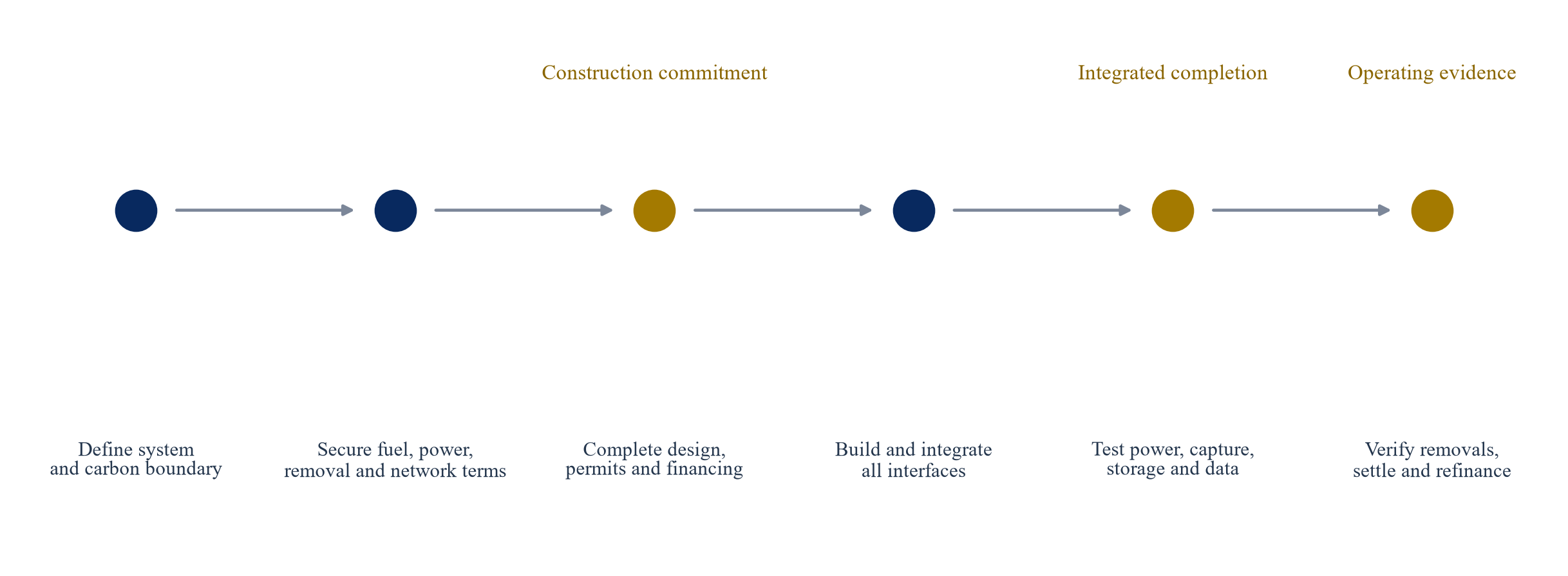
Proposed sequence; timing and gates depend on project, jurisdiction, support contracts, permitting and network delivery.
47. Apply stop rules
Development should pause when eligible biomass cannot be evidenced, transport and storage access lacks a credible schedule, integrated design remains unresolved, the selected methodology does not fit the project, core support terms leave unmanageable volume or termination risk, or the downside case cannot support the proposed capital structure.
Construction drawdown should stop when permits, interface milestones, contingency or sponsor support fall below agreed levels. Operating stop rules should protect safety, permits, carbon integrity and equipment while preserving evidence for affected periods.
48. Compare international support logic
The UK framework uses proposed revenue contracts and developing market integration. The European Union's CRCF provides a voluntary certification framework for permanent BioCCS removals.[17][18] The United States relies materially on the Section 45Q carbon-oxide sequestration credit, alongside grants and other incentives; eligibility, ownership, measurement and secure geological storage requirements require tax and regulatory analysis.[19][20]
These systems should not be treated as interchangeable. A project may borrow design principles from another market while using only locally available support. Cross-border credit sales also require analysis of claims, registry, corresponding treatment and subsidy terms.
49. Maintain environmental and social integrity
BECCS can affect land, water, biodiversity, air quality, traffic and communities through biomass sourcing, plant operation, pipelines and storage. The IPCC identifies material sustainability constraints and context dependence.[11][12][13] The project should integrate environmental and social conditions into supply, construction, operating and reporting systems.
A financeable project should preserve grievance, audit and remediation processes. Carbon-removal revenue does not cure an environmental or community failure.
50. Apply the investment-committee test
Approval should state the asset boundary, biomass portfolio, power and removal contracts, transport and storage route, methodology, capital structure, completion tests, reserves, security, downside case and sponsor support. It should identify which cash flows support senior debt and which remain equity upside.
The decisive test is reconciliation. Biomass origin, energy production, capture, transport, storage, verification, environmental attributes, invoices and cash should form one auditable chain. When the chain breaks, the investment committee should be able to quantify the physical, contractual and financial effect.
Conclusion
Power BECCS creates value from dispatchable low-carbon electricity and permanent carbon removal. The two outputs share fuel, equipment, energy, infrastructure, data and operating decisions. A financeable project therefore needs one integrated operating and settlement model.
The revenue stack can include supported electricity, supported removals, capacity or system services, heat or co-products and permitted market or tax value. Each line should be tested for eligibility, double counting, volume exposure, price, indexation, counterparty, settlement timing and termination. Senior debt should rely on contracted net cash after biomass, capture, transport, storage, verification, replacement and working-capital costs.
Current policy provides useful building blocks. The UK's proposed dual-contract structure addresses electricity and removal value. UK ETS integration can create a longer-term source of demand. EU BioCCS certification defines a public methodology for permanent removals. US 45Q illustrates a tax-credit route. None removes the need to control the full project chain.
Capital should be released through evidence gates. Integrated completion should cover generation, capture, carbon dioxide specification, transport, storage, data and verifier readiness. Operating reports should reconcile physical flows to certified units and cash. This discipline turns a collection of revenue lines into a coherent project-finance case.
Investment-committee questions
1. What assets and contracts sit inside the financed project boundary? 2. Which biomass sources are eligible and independently evidenced? 3. How are supply-chain emissions and land effects calculated? 4. Which meters determine electricity and carbon settlements? 5. How are gross captured tonnes converted into verified net removals? 6. Which electricity revenues are contracted and for how long? 7. Which removal revenues are contracted and at which delivery milestone? 8. Which environmental attributes can be sold or transferred without double counting? 9. How do the electricity and carbon contracts define availability and outage? 10. What capture rate, mass, purity, energy and duration tests govern completion? 11. When will transport and storage capacity become available? 12. What happens during a transport or storage outage? 13. Which methodology and version govern the financed unit? 14. How are methodology changes allocated? 15. What working capital covers verification and settlement delay? 16. Which revenue lines receive credit in senior debt sizing? 17. What correlated downside sets debt capacity? 18. Which costs are fixed, variable, indexed or passed through? 19. What support remains until integrated completion? 20. Which reserves cover carbon settlement, replacement and major maintenance? 21. Can registry units and receivables form enforceable security? 22. How do termination payments compare with outstanding debt? 23. Which environmental and community conditions can stop operations? 24. How does the monthly report reconcile physical and financial performance? 25. Which evidence must be present before each capital-release decision?
References
- [1] UK Department for Energy Security and Net Zero, Power Bioenergy Carbon Capture and Storage Consultation: Government Response, 30 March 2023. https://www.gov.uk/government/consultations/business-model-for-power-bioenergy-with-carbon-capture-and-storage-power-beccs
- [2] UK Department for Energy Security and Net Zero, Greenhouse Gas Removal and Power BECCS Business Models: Update December 2023. https://assets.publishing.service.gov.uk/media/6581851efc07f3000d8d447d/ggr-power-beccs-business-models-december-2023.pdf
- [3] UK Department for Energy Security and Net Zero, Greenhouse Gas Removals Business Model, updated 27 August 2025. https://www.gov.uk/government/publications/greenhouse-gas-removals-ggr-business-model
- [4] UK Department for Energy Security and Net Zero, Greenhouse Gas Removals Standard Terms and Conditions, August 2025. https://www.gov.uk/government/publications/greenhouse-gas-removals-ggr-business-model
- [5] British Standards Institution, BSI Flex 2006 Bioenergy with Carbon Capture and Storage, July 2025, linked by the UK GGR Business Model publication. https://www.gov.uk/government/publications/greenhouse-gas-removals-ggr-business-model
- [6] UK Emissions Trading Scheme Authority, Integrating Greenhouse Gas Removals in the UK Emissions Trading Scheme: Main Response, 21 July 2025. https://www.gov.uk/government/consultations/integrating-greenhouse-gas-removals-in-the-uk-emissions-trading-scheme
- [7] UK Department for Energy Security and Net Zero, Independent Review on Greenhouse Gas Removals: Government Response, 17 July 2026. https://www.gov.uk/government/publications/independent-review-on-greenhouse-gas-removals-government-response/independent-review-on-greenhouse-gas-removals-government-response
- [8] UK Department for Energy Security and Net Zero, Biomass Strategy 2023. https://www.gov.uk/government/publications/biomass-strategy/biomass-strategy-2023-accessible-webpage
- [9] UK Department for Energy Security and Net Zero, UK Carbon Capture, Usage and Storage Collection, updated 2026. https://www.gov.uk/government/collections/uk-carbon-capture-usage-and-storage-ccus
- [10] UK Department for Energy Security and Net Zero, Proposals for Greenhouse Gas Removal and Power BECCS Regulations, 28 April 2025. https://www.gov.uk/government/consultations/proposals-for-greenhouse-gas-removal-and-power-bioenergy-with-carbon-capture-and-storage-regulations
- [11] Intergovernmental Panel on Climate Change, Climate Change 2022: Mitigation of Climate Change, Chapter 6 Energy Systems. https://www.ipcc.ch/report/ar6/wg3/chapter/chapter-6/
- [12] Intergovernmental Panel on Climate Change, Climate Change 2022: Mitigation of Climate Change, Chapter 7 Agriculture, Forestry and Other Land Uses. https://www.ipcc.ch/report/ar6/wg3/chapter/chapter-7/
- [13] Intergovernmental Panel on Climate Change, Climate Change 2022: Mitigation of Climate Change, Summary for Policymakers. https://www.ipcc.ch/report/ar6/wg3/chapter/summary-for-policymakers/
- [14] International Energy Agency, Unlocking the Potential of Bioenergy with Carbon Capture and Utilisation or Storage. https://www.iea.org/articles/unlocking-the-potential-of-bioenergy-with-carbon-capture-and-utilisation-or-storage-beccus
- [15] International Energy Agency, CCUS in the Transition to Net-Zero Emissions. https://www.iea.org/reports/ccus-in-clean-energy-transitions/ccus-in-the-transition-to-net-zero-emissions
- [16] International Energy Agency, Driving Down the Cost of Carbon Removal: Why Innovation Matters, 2025. https://www.iea.org/commentaries/driving-down-the-cost-of-carbon-removal-why-innovation-matters
- [17] European Commission, Carbon Removals and Carbon Farming Regulation. https://climate.ec.europa.eu/areas-action/carbon-removals-and-carbon-farming/carbon-removals-and-carbon-farming-crcf-regulation_en
- [18] European Commission, Commission Delegated Regulation (EU) 2026/285 Establishing Certification Methodologies for Permanent Carbon Removals Activities, 3 February 2026. https://climate.ec.europa.eu/document/download/96845e08-0311-45b4-b6c0-7040e31d9cd0_en
- [19] US Department of Energy, Pathways to Commercial Liftoff: Carbon Management, July 2025. https://www.energy.gov/sites/default/files/2025-07/LIFTOFF_DOE_Carbon-Management.pdf
- [20] US Internal Revenue Service, Instructions for Form 8933 Carbon Oxide Sequestration Credit, December 2025. https://www.irs.gov/instructions/i8933
- [21] UK Emissions Trading Scheme Authority, UK ETS Policy Overview, updated 2026. https://www.gov.uk/government/publications/uk-emissions-trading-scheme-uk-ets-policy-overview/uk-emissions-trading-scheme-uk-ets-a-policy-overview
- [22] International Energy Agency, Cross-Cutting Technologies and Infrastructure: Bioenergy with Carbon Capture and Storage. https://www.iea.org/reports/cross-cutting-technologies-infrastructure
About the Author
Authored by Chennakeshav Adya Independent Researcher
Chennakeshav (CK) is a corporate finance and investment banking executive with 25+ years of global experience in deal origination, structuring and execution across M&A, growth capital and corporate strategy. He has led value-creation mandates for founders, corporates and funds — bridging the boardroom view to hands-on execution and close.
His career spans Morgan Stanley, HSBC, Lloyds Banking Group, EWEC, ADQ portfolio companies and Emirates Growth Fund, across TMT, real estate, fintech, deeptech, cleantech, infrastructure and energy. He has partnered with C-suite leaders, private equity and venture funds, sovereign wealth funds and family offices to finance complex fund raises and scale-up ventures, and has led M&A due diligence, post-merger integration and business-transformation initiatives to create value.
At Matchpoint Partners he is Managing Partner, leading the firm's corporate finance, M&A and capital-raising practice. He holds an MBA from London Business School, an engineering degree from VTU and a Master of Laws (LLM, in progress) from UCL London.
An active start-up mentor, CK mentors at Techstars, DIFC FinTech Hive, Startup Grind, Founder Institute and IN5, serves as Entrepreneur Mentor in Residence (EMiR) at London Business School, and judges the Entrepreneurship World Cup.
Matchpoint profile: https://www.matchpoint-partners.com/team/ck-adya.html LinkedIn: https://www.linkedin.com/in/ckadya/
